Celebrating the Release of “The Colonel’s Spinster: A Tragic Characters in Classic Lit Series Novel” from Author, Audrey Harrison

Today, I welcome another of the authors involved in the Tragic Characters in Classic Lit Series. Where I took up the tale of the Sheriff of Nottingham in I Shot the Sheriff and Lindsay Downs “transformed” Frankenstein in his The Monster Within, the Monster Without, Audrey Harrison has brought happiness to one of my favorite characters: Colonel Fitzwilliam from Jane Austen’s Pride and Prejudice.

The Colonel’s Spinster

He needs a rich wife. A pity he’s falling for the wrong woman.


She’s looking to find out about her past. She wasn’t expecting to find her future.


Colonel Fitzwilliam is a second son, often overshadowed by his titled, older brother and his cousin, Mr Darcy. Returning from Waterloo, he knows it is time to find a wife with a healthy dowry, but he longs for a love match. Unfortunately for Fitzwilliam, love doesn’t put food on the table.


Miss Prudence Bamber has never known her mother’s family. A woman with her own mind and full life, she indulges her father’s wish to visit her long-lost relations. Mr Bamber hopes his daughter will find a husband; she wishes nothing more than to find out more about her mother’s history. It turns out to be a journey she won’t forget in a hurry.


The Colonel’s Spinster is part of the Tragic Characters in Classic Literature Series, giving Pride and Prejudice’s Colonel Fitzwilliam, the story he deserves.

Excerpt:

Prologue

Netherfield, Hertfordshire, 1813

With his ready smile on his face, Colonel Richard Fitzwilliam entered the bedchamber of his cousin. Darcy frowned at him, at which Fitzwilliam’s smile broadened.

“The nerves getting to you?” he asked, as Darcy’s valet fussed around his cousin.

“Why am I so nervous? I want this wedding to take place, but my stomach is behaving like I’m some sort of callow youth on his first adventure,” Darcy said, with a nod dismissing his valet. He looked resplendent in a blue frock coat and cream breeches; his boots had been polished until they shone in the sunlight.

“It is good to be nervous,” Fitzwilliam reassured his relation. “But I’m convinced they are unnecessary doubts.”

Darcy finished fiddling with his neckcloth. He normally spent an age perfecting the gentle folds, but today he was even more inclined than usual for it to look impeccable. “I know you speak the truth. But it does not help that I’d rather not be the centre of attention for the morning.”

“I have some bad news to break to you, Darcy. No one is interested in you. They all want to see your bride in her wedding dress. All the women will be wondering if there will be lace or if she will wear flowers in her hair or a bonnet, or even a feather! You, my friend, are so low down in everyone’s interest, you are virtually not needed to attend,” Fitzwilliam said.

Darcy laughed. Those who did not know him well, would wonder at the uncommon occurrence, but to the few people who were dear to him, it was a regular, natural sound. “Good! Thank you, Fitzwilliam. I needed to be brought to the reality of the day. I too often allow myself to overthink a simple situation.”

“You? My dear cousin, I don’t know what you could possibly mean!”

Darcy shook his head at his cousin but then became serious. “Fitzwilliam, can I ask you a question in which I need your reply to be very honest?”

“Sounds ominous.”

“It is something I should have raised before now. I know I’m a blockhead for needing to ask, but the niggle will not go away. You and Elizabeth — at Rosings, you were…”

Fitzwilliam looked at his cousin with sympathy. He was a man with ten thousand pounds a year, a capable landlord of one of the largest estates in Derbyshire, and yet he could be so unsure of himself. It endeared him further with the cousin who, in many ways, was more like a brother.

“Darcy, I promise you this. I was never in love with Elizabeth, nor she, me. I admit, I think her handsome, funny, and one of the best people I will soon have the pleasure to call cousin, but there are no other feelings towards her. And never have been,” Fitzwilliam said honestly.

“I can see why she would be drawn to you,” Darcy said, still looking uncomfortable.

Moving over to put his hands on his cousin’s shoulders, Fitzwilliam shook him gently. “She turned your first proposal down because she did not truly know you at that time. Plus the fact that the blackguard, Wickham, had been whispering poison into her ear and the general locality of her town.”

It had been a hard time for Darcy, blundering in and causing what had appeared to be a permanent breach with the woman he’d asked to marry him. He had only confessed the whole situation afterwards to his cousin, after he’d actually secured Elizabeth’s affection.

“I could understand if there had been an attraction…”

“No! There was mild flirtation. You know my character and hers. Neither of us can resist being playful, but she is yours Darcy. I am certain she always was. Your good opinion mattered too much to her to be disinterested. Look how she was with the buffoon, Collins — civil but cool. She was never that with you. From the start, there was something between you. Call it a spark if you like. But you were drawn to each other and teased and tormented one another from the beginning. That evening in Rosings in which she played the pianoforte was a prime example. She was far more playful towards you than at any other time with anyone else. We had been speaking. When you arrived, she started to tease you. Trust me on this. You have always been the only man for her.”

Darcy sighed. “Thank you. Again. It’s just the emotions of today. I am doubting everything that is poor in my character and all that I have known. I feel very unsure, and it is causing me some strange thoughts. I will relax. I will.”

“Good. This uncertainty does you no credit, especially towards Elizabeth. You should be convinced of her regard. We can all see it. She is besotted with you and rightly so. It is time, for once, that you relax and enjoy yourself, Darcy. You deserve happiness,” Fitzwilliam pointed out. “And, you know me. I won’t look at any young woman with serious consideration unless she has at least five thousand a year and three properties, one in London, a hunting lodge in Leicester, and a grand mansion in the country, preferably somewhere near Derbyshire.”

“You tell a good Banbury tale, cousin. You would never be so shallow.”

“I’m the second son. I cannot afford to be anything but particular about what a wife brings to the marriage. Otherwise, we will starve.”

Smiling, Darcy picked up his stove top and placed it on his head. “Come. Let’s go and get this over with. The sooner I make Elizabeth Mrs. Darcy, the better.”

“That’s the spirit,” Fitzwilliam laughed, but inside he felt a little jealous of his cousin. Oh, he had spoken the truth when he confessed that he’d never had feelings for Elizabeth. He had enjoyed her company but hadn’t been anywhere near falling in love with her. He was envious of a couple so perfectly suited setting out on their future life together.

They would have hurdles to overcome, mainly because of the family on both sides, but they were a strong couple who would support and love each other. Fitzwilliam was sure and was glad of it. Darcy had lost his father and mother when he was young and yet had to be brother and parent to his younger sister. He had taken on the role without complaint, but it was now time for him to have his own family.

Fitzwilliam longed to have that connection with someone, but his pocket and birth dictated that he was forced to look for a wife who brought a comfortable dowry to the marriage. His income as a colonel barely covered the costs of his uniform and the horseflesh he needed. His allowance from his father made sure his officer’s mess bill was paid each quarter with a little left over, but without the occasional monetary gifts from his Aunt Catherine and Darcy, he would struggle to keep out of dun territory. That was not conducive when hoping to set-up home or start a family.

Yet those were the two things he longed for.

Purchase Link:

US https://www.amazon.com/dp/B08N1K9Y4H

Also available on Amazon UK, Canada, and Australia.

Meet Author Audrey Harrison

I have had the fortune to live a dream. I’ve always wanted to write, but life got in the way as it so often does until a few years ago. Then a hospital visit and redundancy enabled me to do what I loved: sit down to write. Now writing has taken over my life, holidays being based around research, so much so that no matter where we go, my long-suffering husband says, ‘And what connection to the Regency period has this building/town/garden got?’


That dream became a little more surreal when in 2018, I became an Amazon StorytellerUK Finalist with Lord Livesey’s Bluestocking. A Regency Romance in the top five of an all-genre competition! It was a truly wonderful experience, I didn’t expect to win, but I had a ball at the awards ceremony.

I can be found in the North West of England (a Lancashire Lass), married with two grown-up children, a granddaughter, a mad springer spaniel and two granddogs, who come around to get spoiled (they know exactly where the treat cupboard is at Grandma’s and that a mournful gaze will get it open!)


Oh, and I have a husband who is the most unromantic man ever to walk the earth, so much so, that he inspired me to write my own romances to fill the gap! He does supply me with lots of cups of tea though, so he isn’t that bad.

Social Media Links:

Website www.audreyharrison.co.uk – there is a sign-up for my email, which is only sent out when there is something to say! You also receive a free copy of The Unwilling Earl in mobi format for signing up.


Facebook www.facebook.com/AudreyHarrisonAuthor


Amazon Author Page UK https://www.amazon.co.uk/Audrey-Harrison/e/B009SO2EYO

Amazon US https://www.amazon.com/Books-Audrey-Harrison/s?rh=n%3A283155%2Cp_27%3AAudrey+Harrison

The Books in the Tragic Characters in Classic Lit Series:

The Monster Within, the Monster Without by Lindsay Downs – November 7, 2020 (Frankenstein)

I Shot the Sheriff by Regina Jeffers – November 30, 2020 (Robin Hood and the Sheriff of Nottingham)

The Colonel’s Spinster by Audrey Harrison – December 8, 2020 (Pride and Prejudice)

Fated Hearts by Alina K. Field – December 29, 2020 (Macbeth)

The Redemption of Heathcliff by Alanna Lucas – January 1, 2021 (Wuthering Heights)

The Company She Keeps by Nancy Lawrence – January 11, 2021 (Madame Bovary)

Captain Stanwick’s Bride by Regina Jeffers – February 19, 2021 (The Courtship of Miles Standish)

Glorious Obsession by Louisa Cornell – February 26, 2021 (Orpheus and Eurydice)
Posted in Austen Authors, blog hop, book release, books, Georgian England, Georgian Era, Guest Post, historical fiction, Jane Austen, Living in the Regency, military, Pride and Prejudice, publishing, reading habits, Regency era, Regency romance, romance, Vagary, writing | Tagged , , , , , , , , , , , , , , | 4 Comments

Yorkshire Christmas Traditions Playing Out in “Letters from Home” and “Lady Joy and the Earl”

Christmas traditions in Yorkshire date back to the time of the Roman invasion. For example, documentation shows that a celebration dedicated to Saturn, the god of harvest and agriculture, took place somewhere between December 17 and December 25 in York each year. During this time the Romans suspended the court proceedings, gambling was permitted, instead of frowned upon, those committing crimes, other than murder, were often given a lesser sentence, and masters ordered elaborate banquets served to their servants. 

Saturnalia was characterized by role reversals and behavioral license. Slaves were treated to a banquet of the kind usually enjoyed by their masters. Ancient sources differ on the circumstances: some suggest that master and slave dined together, while others indicate that the slaves feasted first, or that the masters actually served the food. The practice might have varied over time.

Saturnalian license also permitted slaves to disrespect their masters without the threat of a punishment. Everyone knew, however, that the leveling of the social hierarchy was temporary and had limits; no social norms were ultimately threatened, because the holiday would end. Gambling and dice-playing, normally prohibited or at least frowned upon, were permitted for all, even slaves. Coins and nuts were the stakes.  The Sigillaria on 19 December was a day of gift-giving. Because gifts of value would mark social status contrary to the spirit of the season, these were often the pottery or wax figurines called sigillaria made specially for the day, candles, or “gag gifts.” Children received toys as gifts.

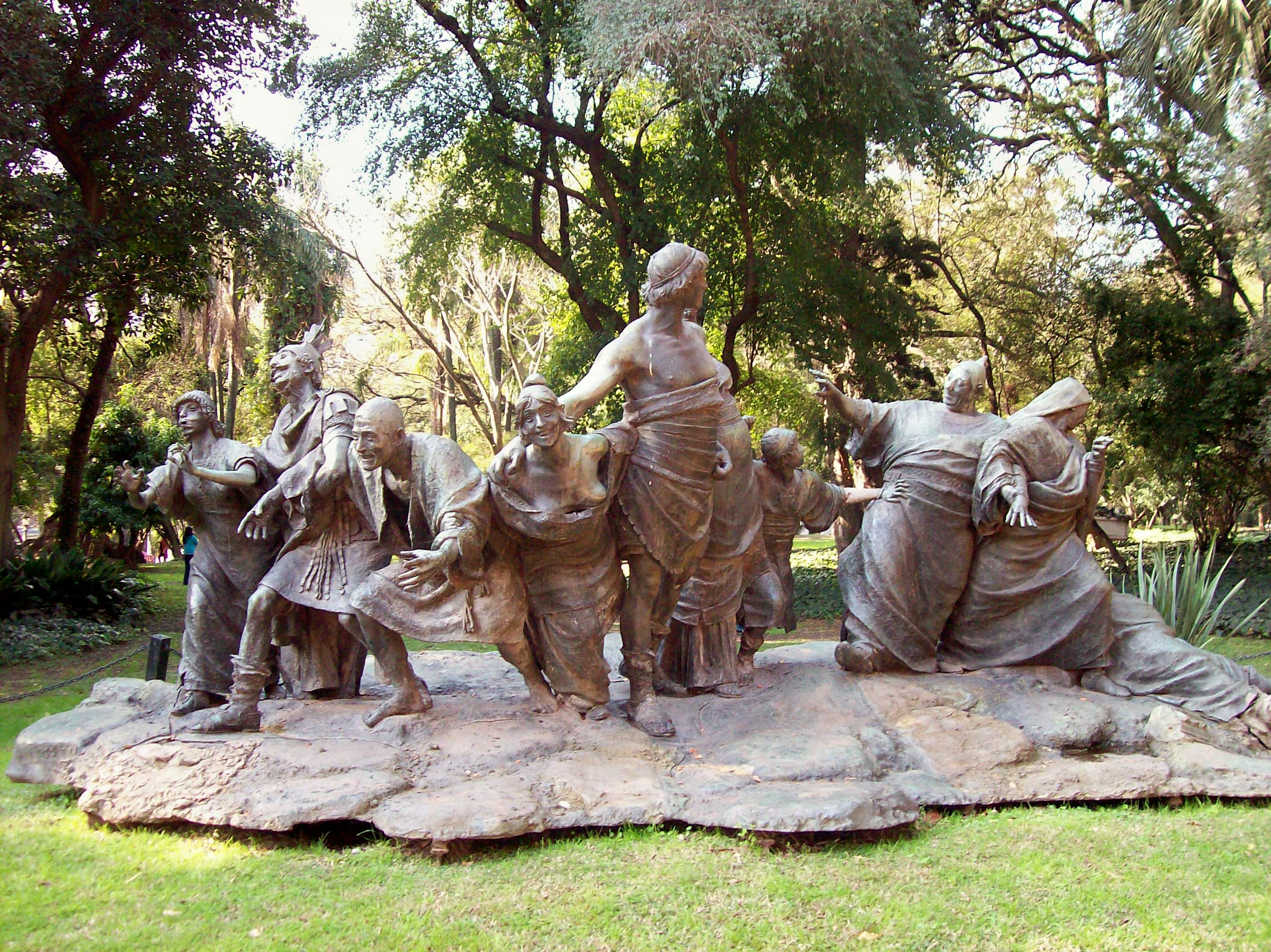
Escultura_Saturnalia_de_Ernesto_Biondi

Saturnalia (1909) by Ernesto Biondi, in the Buenos Aires Botanical Gardens ~ https://en.wikipedia.org/wiki/Saturnalia#/media/File:Escultura_Saturnalia_de_Ernesto_Biondi.jpg

These winter celebrations gradually converted from a pagan ritual to a Christian one as the religion spread throughout the Roman Empire during the 4th Century. The idea that the final day of Saturnalia, the 25th December also marked the day of Jesus’ birth was first recognised by Pope Julius I when Christian ideology began to take hold towards the early middle Ages. The Anglo-Saxon influence marked the winter solstice on December 21. Yuletide came to last for twelve days, thus we eventually have “The 12 Days of Christmas.”

This establishment of a celebration in the third week of December swung heavily back toward religious purposes after the Norman invasion. The word “Christes Maesse” (Festival of Christ) was first used as a description for the festival around 1038. William the Conqueror declared himself King of England on Christmas Day 1066, which in his eyes was a further reason to celebrate.

turkey-crest_3500276a.jpgSince the 1400s a tradition called “The Devil’s knell” has taken place in the town of Dewsbury. On Christmas Eve the parish church bells toll once for every year since the birth of Christ. The peel is timed so the last bell is rung exactly at midnight on Christmas Day. Yorkshire has also made several contributions to the food we eat around Christmas time. The first turkeys were brought over to England from the Americas by Yorkshire explorer William Strickland in 1526. Originally from Marske on the North Yorkshire coast, he built estates at both Wintringham in Ryedale and Boynton Hall near Bridlington with the profits he made from selling these exotic creatures. The Strickland family crest, which adorns both of these residencies, is in the shape of a turkey, something which is widely acknowledged as the first ever depiction of the bird in Europe. Boynton village church lectern, a stand that supports the bible, is carved in the shape of a turkey instead of a traditional eagle in honour of Strickland. The custom of eating turkey on Christmas day would only become popular centuries after Strickland’s death in 1598, during the Victorian Period.

During advent in Haworth, around the time of the Bronte’ sisters, vessel maids would call from door to door carrying a box, called the “Wassail bob,” which contained nativity figures wrapped in a sacred cloth. The maids would unveil the figures at the cost of a penny to the household. It was considered unlucky if the vessel maids did not call round to your house during the run up to Christmas.

Sources: 

I’m From Yorkshire 

Saturnalia 

All of the above, except for the Saturnalia celebration, show up in either “Letters from Home” or “Lady Joy and the Earl,” for they are both set in Yorkshire in December 1815. The estates of Major Lord Simon Lanford in “Letters from Home” and James Highcliffe, Earl of Hough, in “Lady Joy and the Earl,” are only a few miles apart. In fact, Hough mentions one of the minor characters in “Letters…” to Lady Jocelyn Lathrop, his love interest in the novella. 

MDP eBook Cover

“Letters from Home”

She is the woman whose letters to another man kept Simon alive during the war. He is the English officer her late Scottish husband praised as being incomparable. Even without the assistance of the spirit of Christmas attempting to bring them together, she stirs his soul; in her, his heart whispers of being “home.” In him, she discovers a man who truly stirs her soul. Unfortunately for both, the lady fears no longer being invisible to the world and assuming a place at his side.

However, the lady wishes to remain invisible and in her place as her cousin’s companion. Can Major Lord Simon Lanford claim Mrs. Faith Lamont as his wife or will his rise to the earldom and his family’s expectations keep them apart?

“This was both a heart-breaking and heart-warming second chance love story, made all the more satisfying by the Christmas setting.”

Read Reviews:
 Meditative Meanderings

Second Place in Short Historical Category ~ 2019 International Digital Awards 

Kindle https://www.amazon.com/Letters-Home-Regina-Jeffers-ebook/dp/B07SJXDZK7/ref=sr_1_2?crid=2KAFCVZZ6VWUD&keywords=letters+from+home+by+regina+jeffers&qid=1564770214&s=gateway&sprefix=letters+from+home+by+r,aps,135&sr=8-2

 Kindle Unlimited https://www.amazon.com/kindle-dbs/hz/subscribe/ku?passThroughAsin=B07SJXDZK7&_encoding=UTF8&shoppingPortalEnabled=true

MDP eBook Cover

“Lady Joy and the Earl”

They have loved each other since childhood, but life has not been kind to either of them. James Highcliffe’s arranged marriage had been everything but loving, and Lady Joy’s late husband believed a woman’s spirit was meant to be broken. Therefore, convincing Lady Jocelyn Lathrop to abandon her freedom and consider marriage to him after twenty plus years apart may be more than the Earl of Hough can manage. Only the spirit of Christmas can bring these two together when secrets mean to keep them apart.

Kindle   https://www.amazon.com/dp/B07HNMR9LY

Read for Free on Kindle Unlimited https://www.amazon.com/kindle-dbs/hz/subscribe/ku?passThroughAsin=B07HNMR9LY&_encoding=UTF8&shoppingPortalEnabled=true

If you prefer a print copy of the stories, you may find both, along with a bonus story in Beautified by Love. 

“Letters from Home”

She is the woman whose letters to another man kept Simon alive during the war. He is the English officer her late Scottish husband praised as being incomparable. Even without the spirit of Christmas, she stirs his soul; in her, his heart whispers of being “home.” However, the lady wishes to remain invisible and in her place as her cousin’s companion. Can Major Lord Simon Lanford claim Mrs. Faith Lamont as his wife or will his rise to the earldom and his family’s expectations keep them apart?

“Lady Joy and the Earl”

They have loved each other since childhood, but life has not been kind to either of them. James Highcliffe’s arranged marriage had been everything but loving, and Lady Joy’s late husband believed a woman’s spirit was meant to be broken. Therefore, convincing Lady Jocelyn Lathrop to abandon her freedom and consider marriage to him after twenty plus years apart may be more than the Earl of Hough can manage.

Bonus Story: “One Minute Past Christmas” (from George T. Arnold and Regina Jeffers) An Appalachian grandfather and his granddaughter are blessed with a special ability—a gift that enables them briefly to witness a miraculous gathering in the sky each year at exactly one minute past Christmas. The experience fills them with wonder, but they worry their secret “gift” will end with them because, in forty-four years, no other relative has displayed an inclination to carry it on to a new generation.

Amazon https://www.amazon.com/Beautified-Love-Regency-Christmas-Novellas/dp/1724004840?keywords=beautified+by+love&qid=1538138770&sr=8-2&ref=sr_1_2

Posted in book release, books, British history, customs and tradiitons, eBooks, Georgian England, Georgian Era, historical fiction, history, holidays, legends and myths, Living in the Regency, publishing, reading habits, Regency era, Regency romance, research, writing | Tagged , , , , , , , , , , , , , , , , | 4 Comments

Pride and Prejudice and Nuance, a Guest Post from Leila Eye

Photo courtesy of https://www.bl.uk/collection-items/jane-austens-writing-desk

Whenever you start to become a fan of something, that’s when you tend to pay attention to the nuances and all of the details involved. You start placing more importance on what makes something different rather than just what you like about it. Stories about King Arthur aren’t just interesting because they involve swords and wizards; they are interesting because of the way that swords like Excalibur are used and the way that Merlin is presented as a mentor figure rather than just some deus ex machina of a wizard.

As a writer of Pride and Prejudice adaptations, I want to achieve a little of the flavor of Jane Austen, even if I know I will never have her comedic gift or her ability for social commentary. As such, I try to pay attention to more than just the historical aspects of whatever story I am writing. Avoiding contractions and using more formal language isn’t enough for me; I try to go a little further than that.

While trying to analyze the text as a text (rather than as a wonderful work of literature), I have noticed a few things. Here they are in no particular order:

Austen never uses “matter” as a verb. The replacement word used is “signify,” as is seen here:

“[Lydia] was sure they should be married some time or other, and it did not much signify when.”

When it comes to the word “admit,” it is generally used in the sense of letting something or someone in; “own” tends to be used as the replacement word in other instances, such as in this sentence spoken by Elizabeth:

Follies and nonsense, whims and inconsistencies, do divert me, I own, and I laugh at them whenever I can.

Another observation I have made is that Austen never uses “as though” in Pride and Prejudice; she uses “as if” instead.

When describing speech, Austen typically uses a reverse construction where the verb comes before the noun:

“What can be the meaning of that emphatic exclamation?” cried he.

There are a few occasions where she uses other constructions, such as “he replied” or “she added,” but by and large, she uses the reverse construction.

For this post, I decided to quickly look at speech descriptors in the first 20 chapters in Pride and Prejudice.

I found that the most often used speech descriptors are “said” and “cried” and “replied.” A search of the full text for the word “cried” reveals more than 90 instances, “said” has more than 400, and “replied” has more than 100. In contrast, the word “exclaimed,” which modern audiences are more likely to use, only has 8 instances.

Some other speech descriptors I saw in the first 20 chapters were:

  • Returned
  • Continued
  • Added
  • Observed
  • Began
  • Repeated
  • Answered

Less frequently, there were other constructions, such as:

  • The subject elevated him to more than usual solemnity of manner, and with a most important aspect he protested that “he had never in his life witnessed such behaviour in a person of rank—such affability and condescension, as he had himself experienced from Lady Catherine.[“]
  • Lydia gaped as he opened the volume, and before he had, with very monotonous solemnity, read three pages, she interrupted him with:”Do you know, mamma, that my uncle Phillips talks of turning away Richard; and if he does, Colonel Forster will hire him.[“]
  • After a pause of some minutes, she addressed him a second time with:—”It is your turn to say something now, Mr. Darcy.[“]

We don’t see “yelled” or “shouted” at all, the words that modern writers might be more likely to use.

Furthermore, the speech descriptors are typically in the middle of a spoken sentence in Pride and Prejudice:

“My dear Mr. Bennet,” said his lady to him one day, “have you heard that Netherfield Park is let at last?”

Or they come after the end of a spoken sentence:

“I am sick of Mr. Bingley,” cried his wife.

When that is not the case, Austen often sets off the speech with a colon and a new paragraph:

After amusing himself some time with their curiosity, he thus explained:

“About a month ago I received this letter; and about a fortnight ago I answered it, for I thought it a case of some delicacy, and requiring early attention. It is from my cousin, Mr. Collins, who, when I am dead, may turn you all out of this house as soon as he pleases.”

Those are some items of language I’ve noted. But the more I study the text, the more other items catch my attention.

For instance, if you search out Lydia’s name, you will find that she often does not speak directly at all; rather, there will frequently be a description of her speech instead of the direct language. When she does speak, I would say at least half the time there is an exclamation mark somewhere in what she says, like in the below:

She was met in the vestibule by Lydia, who, flying to her, cried in a half whisper, “I am glad you are come, for there is such fun here! What do you think has happened this morning? Mr. Collins has made an offer to Lizzy, and she will not have him.”

Such extremity of emotions helps characterize Lydia as a foolish girl who cares more for fun than propriety, which makes her decision to run off with Wickham make more sense.

In an attempt to further get a feel for the general sense of relationships, I have taken an in-depth look at the phrase “my dear.” That is a phrase that occurs 131 times in Pride and Prejudice, and it often occurs between Mr. and Mrs. Bennet. I feel their relationship deserves a little more attention than we are typically inclined to give. It is easy to say that they have scarcely any relationship at all considering Mr. Bennet’s teasing of his wife, but seeing as they have five daughters together and call each other “my dear” so frequently, I think their relationship is a little deeper than most might think. Certainly, there is a slight distance seen between them when they call each other “Mr. Bennet” and “Mrs. Bennet” as opposed to using their first names, but I believe that to be more of a reflection of their times than anything.

The phrase “my dear” (which is often placed in front of someone’s name) is usually used to indicate affection in Pride and Prejudice. Note that nobody uses that phrase with Mary, who is scarcely appreciated by anyone in the book. The phrase is used affectionately by:

  • Mrs. Bennet to refer to her husband; to her daughters, except for Mary (note that Mr. Bennet calls her “child” when trying to get her to stop playing the pianoforte); to her housekeeper (“My dear Hill” is used when Mrs. Bennet is excited that Lydia is getting married); and to Mr. Gardiner (“my dear brother”)
  • Mr. Bennet to refer to Elizabeth (and none of his other daughters) and his wife
  • Sir William to refer to Elizabeth (“My dear Miss Eliza”) and to refer to Mr. Darcy (“my dear sir”)
  • Jane to refer to Elizabeth, her mother (“my dear mother”), her father (“my dear father”), and the Gardiners (“my dear uncle and aunt”)
  • Elizabeth to refer to Jane and Charlotte as well as Mrs. Gardiner (“my dear aunt”) and her father (“my dear father”)
  • Mary to refer to Lydia (note: Mary has little dialogue)
  • Lydia to refer to Wickham and to Harriet in a letter (note: Lydia does not have a lot of dialogue)
  • Charlotte to refer to Elizabeth
  • Caroline and Charles Bingley to refer to each other (arguably, there could be some condescension in Caroline’s use of “My dear Charles”)
  • Mr. Collins to refer to Elizabeth (“my dear cousin,” for instance), Mrs. Bennet (“my dear madam”), Mr. Bennet (“my dear sir”), and Charlotte
  • Maria Lucas to refer to Elizabeth
  • Mrs. Gardiner to refer to Elizabeth and Jane
  • Mr. Gardiner to refer to Mr. Bennet (“my dear brother”) in a letter

There are also instances that seem less affectionate:

  • When trying to get Charlotte’s assistance, Mrs. Bennet uses “my dear Miss Lucas” (note the distance of her using “Miss Lucas” instead of “Charlotte”).
  • Caroline Bingley uses “my dear friend,” “my dearest friend,” and “my dearest Jane,” but one of the instances is inviting her to dine when her brother is not at home, and the other is in a letter expressing hopes for Bingley to have a union with Georgiana. These seem to be less than sincere, but the fact that Caroline even ventures to invite Jane to come to Netherfield seems to speak volumes about Caroline’s opinion of Jane. She does not think her well off enough to be united with Charles, but she cannot seem to deny that Jane’s character is sound.
  • After marrying Lydia, Wickham says “my dear sister” to Elizabeth more than once. I can only imagine how she must have wished to punch him in the jaw – though of course, Austen would never be so coarse as to write that in there!

I think the use of “my dear” serves as a good illustrator of the relationships among the different characters. For instance, scarcely anyone cares for Mary and Lydia, and Mr. Bennet’s primary concerns are his wife and Elizabeth.

Another minute detail that interests me is the occurrence of “Mr. Darcy” versus “Darcy.” The phrase “Mr. Darcy” occurs approximately 270 times. The name “Darcy” by itself (excluding things such as “Miss Darcy”) occurs approximately 100 times. While “Darcy” is used alone when Bingley refers to him, it is also to be found elsewhere in the text in places that are not speech. I have not determined a particular pattern, except that I have noted that when it is used alone, there is often a reference nearby of “Mr. Darcy” as well. I think this lack of consistency may not have been particularly intended or unintended; I think it probably simply worked out that way. But I do think that the fact that “Mr. Darcy” occurs so many times more is part of why many people prefer to use that as his name when initially talking about him – rather than using “Fitzwilliam Darcy” or simply “Darcy.”

These are just some of the minutiae that have caught my eye. What are some details about the text that you have noticed and found interesting? Is there anything about the characters or the language that you like to ponder? Do you have any opinions about a relationship between certain characters that you think might sometimes be misunderstood?

Posted in Austen Authors, Georgian England, Georgian Era, Guest Post, language choices, Pride and Prejudice, publishing, Regency era, word choices, word origins, writing | Tagged , , , , , , , , | Comments Off on Pride and Prejudice and Nuance, a Guest Post from Leila Eye

The Ins and Outs of a Marriage of Convenience During the Regency Era

I am more than certain many of you have read stories about a “marriage of convenience” in Regency romances, but what does that mean exactly? 

First, such a marriage did not mean “NO” sex forever, not simply no sex for a brief period of time. Remember a marriage without sex is referred to as “mariage blanc.” Mariage blanc “(from the French, literally “white marriage”) is a marriage that is without consummation. The expression may derive from the absence of hymenal blood on the couple’s (white) wedding-night bedsheets; however, the French word blanc also means blank in the sense of empty, e.g. cartouche à blanc = a blank cartridge, one lacking a bullet. Another example is a lavender marriage, one undertaken to disguise the homosexuality of one or both partners. A sexless marriage, on the other hand, may have begun with the standard expectations. he marriages of Thomas Caryle, John Ruskin, Freya Stark, and Max Beerbohm are alleged to have not been consummated through impotence.  The brief marriage of Tchaikovsky might be described as a ‘lavender marriage’.”

A marriage of convenience simply means it is not a love match. It is usually entered into in order to aid or rescue one of the spouses from persecution or harm; or for economic, social or visa advantage. Such plot lines are favorites among Regency romance writers, as love after marriage, or love that is only one-sided at the time of marriage, makes for lots of romantic development and high drama.

Whether or not she chose to sleep with a man or not would have no baring on the contract. Such an arrangement was not likely discussed openly, for no cleric would perform such a ceremony.

From a logical perspective, a woman would usually have very little power in this issue.  If she wanted to avoid a marriage badly enough, she could get herself ruined, but then her family would likely turn her out—a difficult place to place oneself in.  And even if such was known of her, it might not save the woman if the groom did not care whether she was a virgin or not. Such arrangements were more something a man would do—either because he could not or would not participate in the act. As being homosexual was a criminal offence in many cultures, it is unlikely he would ever put anything about not consummating the marriage in writing. It would be an agreement between the two, or he would just not cooperate. If she were to complain, he could beat her, lock her up, banish her, make her life miserable, or even have her killed, all without legal ramifications.  He would just blame her for being barren and send her away. Some family and friends might know the truth, but who was going to say much, especially if the man was powerful?  Some women might be fine with it, but a marriage in the church and a marriage registered with government can have two different purposes.

A marriage contract that spelt out that there would be no sex was unlikely to be enforceable. These types of arrangements would usually be verbal and really involve cases where each person was allowed to go their own way. One must remember, many marriages were arranged ones, a contract between families. Such marriages were “convenient” for the families involved. 

It more modern stories, we might see what we commonly call a sham marriage, but this would not fit for the Regency era, because in the Regency, it took an act of Parliament for a divorce. “A sham marriage or fake marriage is a marriage of convenience entered into without intending to create a real marital relationship. This is usually for the purpose of gaining an advantage from the marriage. Definitions of sham marriage vary by jurisdiction, but are often related to immigration. The essential point in the varying definitions is whether the couple intend to live in a real marital relationship, to establish a life together. A typical definition by the UK Home Office in 2015:

“‘A sham marriage or civil partnership is one where the relationship is not genuine but one party hopes to gain an immigration advantage from it. There is no subsisting relationship, dependency, or intent to live as husband and wife or civil partners.’

“While referred to as a ‘sham’ or ‘fake’ because of its motivation, the union itself is legally valid if it conforms to the formal legal requirements for marriage in the jurisdiction. Arranging or entering into such a marriage to deceive public officials is in itself a violation of the law of some countries, for example the U. S. After a period, couples often divorce  if there is no purpose in remaining married.”

We also have what is known as a Josephite marriage, but the closest we see to this situation in the Regency refers to those who taught at the university or the students themselves. The History of Cambridge or The History of Oxford all report that celibacy was enforced for students. However, I have discovered that if a fellow married, he had one year grace period to finish studies, etc., and leave. I think that was mentioned in the biography of John Scott, the 1st Earl of Eldon. The celibacy rule remained until 1882.

Josephite marriage, also known as spiritual marriagechaste marriage, and continent marriage, is a religiously motivated practice in which a man and a woman live intimately without engaging in sexual activity.  A feature of Catholic spiritual marriage, or Josephite marriage, is that the agreement to abstain from sex should be a free mutual decision, rather than resulting from impotence or the views of one party. In senses beyond spiritual marriage, chastity is a key concept of Church doctrine that demands celibacy of priests, monks, nuns and certain other officials in the Church. The doctrine established a ‘spiritual marriage’ of church officials to their church; in order to better serve God, one had to disavow the demands and temptations of traditional marriage.”

Occasionally, we come across a book where the heroine is a widow who had lived in a platonic marriage with her husband because he was not interested in sex with women. She understands the restrictions before they marry, but she does so because he paid to pull her family out of a financial hole.

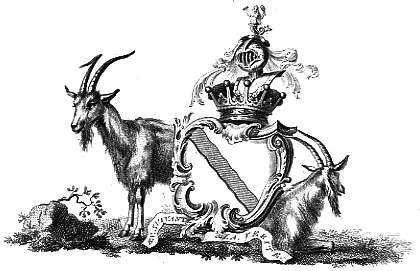
Arms of Wallop, Earls of Portsmouth. The supporters, Two chamois or wild goats sable, are here shown off duty; the crest is: A mermaid holding in the dexter hand a mirror in the other a comb all proper

In real life, we have examples of a marriage of convenience, such as that of John Wallop, 3rd Earl of Portsmouth. “The Earl was known from an early age to have an unsound mind, and his estate was placed under the control of four trustees. While Portsmouth had periods in which he appeared sane, he often engaged in a variety of bizarre and sadistic behavior. He whipped his servants, beat and bled his horses, and slaughtered cattle, shouting, with an axe. The Earl showed a remarkable mania for funerals, which he referred to as ‘black jobs.’ He attended them frequently, insisted on tolling the bells at Hurstbourne for funerals there, and sometimes flogged the ringers with the bell rope afterwards.

“On 19 November 1799, Portsmouth married Hon. Grace Norton, the sister of one of his trustees, William Norton, 2nd Baron Grantley. The marriage was encouraged by Portsmouth’s younger brother, Hon. Newton Fellowes, as Grace was 47 years old at the marriage (Portsmouth was 31) and unlikely to produce an heir to displace Newton. However, Grace also played an important role in moderating Portsmouth’s behavior and keeping his eccentricities out of the public eye. When, in 1808, she found herself no longer able to control the Earl, her relative, Dr. John Combe, was added to the household, to help suppress Portsmouth’s manias.]

“One of the trustees, Portsmouth’s solicitor John Hanson, saw an opportunity at Grace’s death in 1813. Without informing the other trustees or Portsmouth’s brother Newton, he quickly arranged a marriage between Portsmouth and his daughter, Mary Anne. They were married on 7 March 1814; Lord Byron, another one of Hanson’s clients, gave the bride away. When Newton attempted to have Portsmouth declared insane that autumn, Byron’s affidavit as to the circumstances of the marriage was instrumental in getting the charge dismissed.[2] However, the new Countess was by no means equal to the task of controlling Portsmouth; his behavior grew more erratic, while Mary Anne carried on an adulterous affair with William Alder, who fathered three children on her. Eventually, the pair of lovers grew so bold as to have intercourse in the same bed with the Earl (who was almost certainly impotent).

“A new commission de lunatico inquirendo took place in 1823, at the instigation of Portsmouth’s nephew Henry Wallop Fellowes, and it was revealed that the Earl had been badly mistreated by his new wife and her lover, who had spat on him and beaten him. He was adjudged to have been insane since 1809. In 1828, his second marriage was annulled, and Mary Anne’s children were declared bastards. A judgment for the £40,000 cost of the trial was issued against her, and she fled abroad. Portsmouth died in 1853; his brother Newton succeeded him for less than half a year before his own death.”

Some readers assume that the act of consummation is what made a marriage legal—made it a union, as far as the church was concerned. But until the mid 19th Century, this was not a true statement in England, for consummation was not required. Non consummation was not grounds for an annulment, though inability to consummate was. The church held the belief that men and women  were more likely than not to have sex if living in close proximity, so it was assumed that non consummation was something that time could cure. The inability to consummate was different. If a man or woman proved that no amount of time would provide them the ability to consummate the marriage it could be annulled.

In a few cases  when a man had a marriage annulled on such grounds and then went on to marry another and father children, some of the church judges and bishops wanted to  annul the annulment and invalidate the second marriage. Wiser heads prevailed, and  it was decided that God works in mysterious ways.  It helped that the number of such marriages was very small.

The wife’s adultery was just about the only grounds a husband could claim in order to be  rid of his wife. Wives were laughed out of court when they claimed he abused them and brought in mistresses to humiliate them. The wives were told to have Christian forbearance and that there was still a chance for them to have a marriage. The church might grant a legal separation in some of the worse cases. Generally, the wife was supposed to suffer in silence. The two women who were able to obtain a parliamentary divorce in the early years of the 19th century did so because there was no way for them to go back to live with their husbands. In each case the husband took the wife’s sister as his mistress, which made him guilty of incest. It was an odd system that considered sleeping with your wife’s sister a greater crime than beating her.

While the church required that both bride and groom come voluntarily to be married there were many cases of clergymen looking the other way or of girls being too frightened or intimidated to voice a protest.

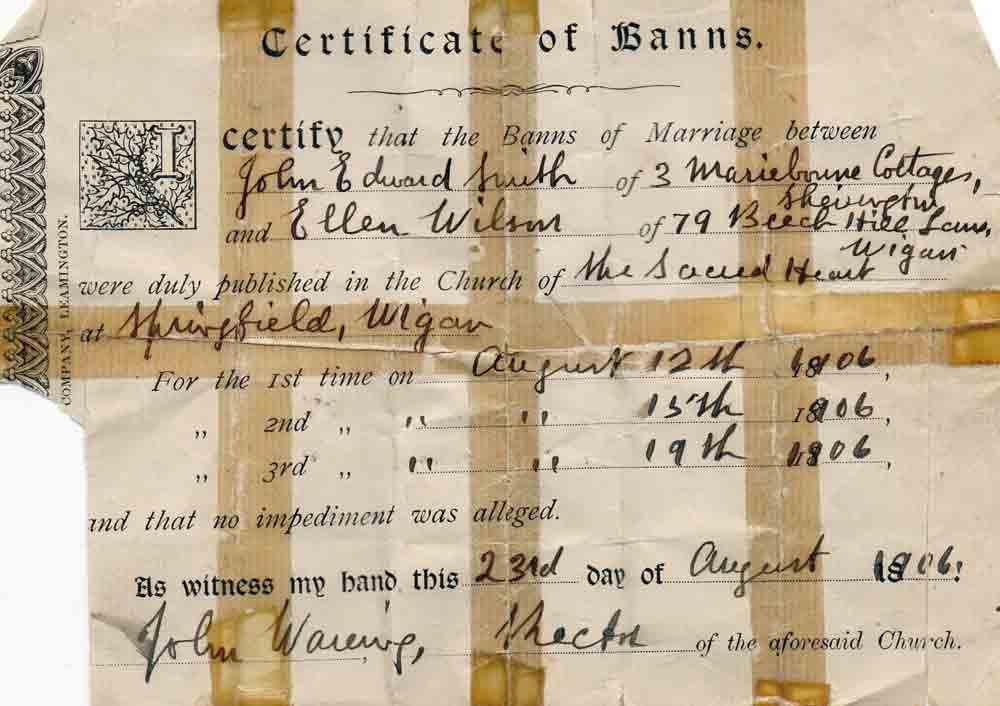
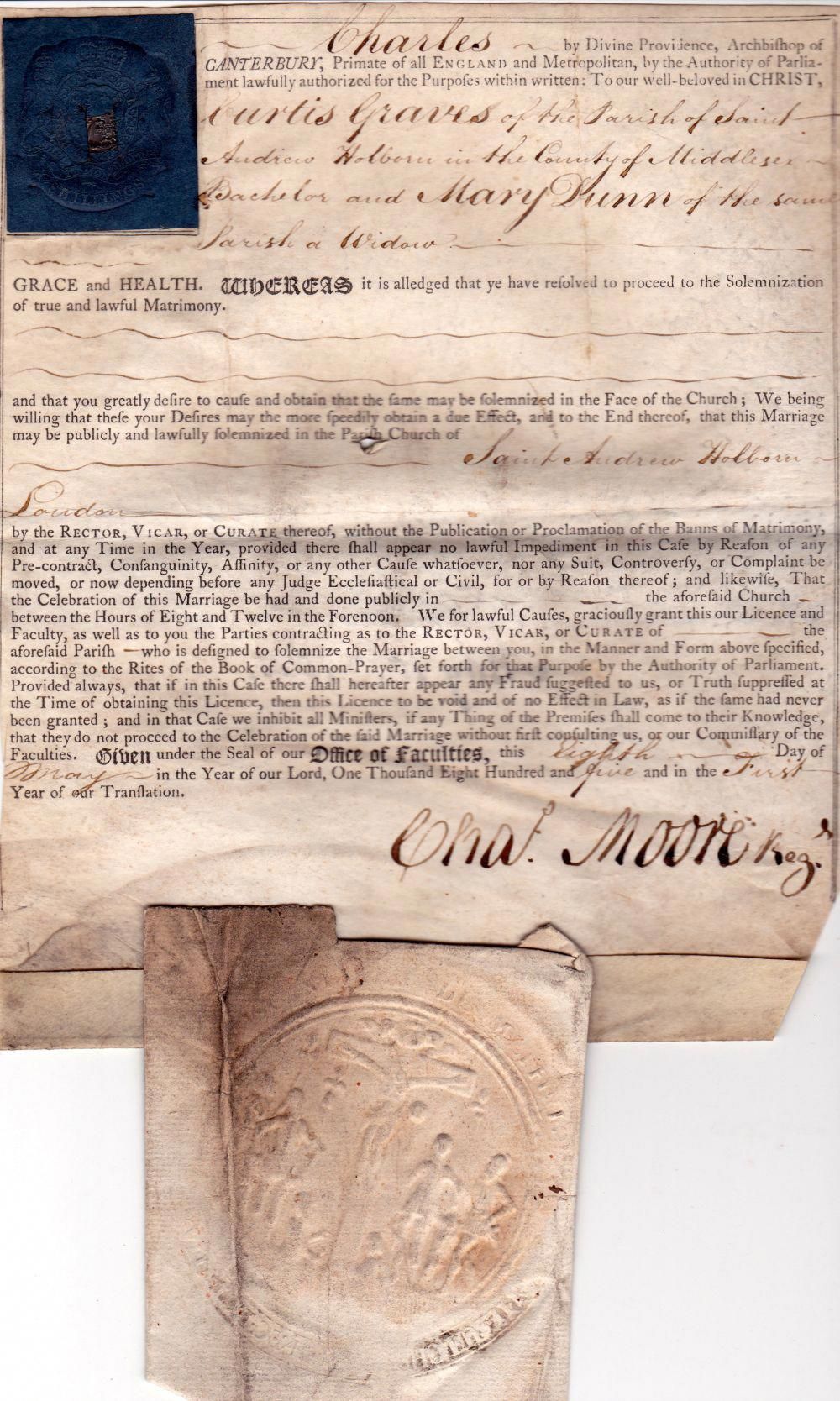
A rare extant copy of a common marriage license from 1806. Licenses were a quicker, more private alternative to reading of banns, but they cost a bit of coin. This one was 10 shillings. BTW, this is not a SPECIAL license, which would have been a lot more expensive and harder to obtain. –Elisa Braden http://www.elisabraden.com

Marriage contracts were not legally enforceable. The Hardwicke Marriage Act of 1753– in force as of 25 March 1754– says that such contracts were no loner enforceable. One thing the church insisted on was that each person standing before the cleric to be married be there of his or her own free will. Of course, they interpreted free will somewhat differently at times. 

However, while there was no legal way to enforce the contract, which a person of age never signed nor agreed to, family and social pressure often did what the law would not. That is why so  often we hear about a person being left money if he/she married so and so. If he did not marry the designated person the money went elsewhere. The man usually was the one guilt tripped into marrying.

The court might say that if he knew about the contract since he was 16 and did nothing to spurn it, he had agreed to it. Usually a breach of that contract would only be a breach of promise, and he could say he never made the promise. Promises made by parents and guardians for a minor could be revoked when the minor became an adult if he knew about it and acted on it. If he just let it go, he might be said to have agreed to it. The courts of the era gave odd decisions sometimes.

Posted in British history, Church of England, Georgian England, Georgian Era, Living in the Regency, marriage, marriage customs, Regency era, Regency romance | Tagged , , , , , , , , , | 8 Comments

Celebrating the Release of “I Shot the Sheriff: A Tragic Characters in Classic Lit Series Novel” with a Who Is Who in the Tale

I Shot the Sheriff: Tragic Characters in Classic Literature Series Novel 

How does one reform the infamous Sheriff of Nottingham? Easy. With Patience.

William de Wendenal, the notorious Sheriff of Nottingham, has come to London, finally having wormed his way back into the good graces of the Royal family. Yet, not all of Society is prepared to forgive his former “supposed” transgressions, especially the Earl of Sherwood. 

However, when de Wendenal is wounded in an attempt to protect Prince George from an assassin, he becomes caught up in a plot involving stolen artwork, kidnapping, murder, and seduction that brings him to Cheshire where he must willingly face a gun pointed directly at his chest and held by the one woman who stirs his soul, Miss Patience Busnick, the daughter of a man de Wendenal once escorted to prison. 

I Shot the Sheriff is based on the classic tales of Robin Hood, but it is given a twist and brought into the early 19th Century’s Regency era. Can even de Wendenal achieve a Happily Ever After? If anyone can have the reader cheering for the Sheriff of Nottingham’s happiness, it is award-winning author Regina Jeffers. 

The Foundation Behind The Tragic Characters in Classic Lit Series: 

With complete artistic license and an abundance of hubris, a dozen Regency romance authors are retelling some of the great stories of literature, setting them in Georgian England and giving these tragic heroes and heroines a happily-ever-after. 

In this series where the reader will encounter some of their “favorite,” or should I say, “least favorite” characters found in classic literature. The parameters of the project were quite simple. (1) The story must be a full-length novel of, at least, 50,000 words. (2) Instead of the original setting for the tale, all the stories in this series take place between the late Georgian period and early Victorian, meaning late 1700s into about 1840. (3) Each novel is based on a different tragic character from a public domain novel, story, or poem. 

The idea is to provide the tragic character a “happily ever after.” It does not matter if he/she was the protagonist or the antagonist in the original tale, in these new renderings he/she will be the hero/heroine. 

In the series, you could meet fallen heroes who have succumbed to vice, greed, etc. He/She could originally have been detested for what values he accepted, but, in these new tales, he redeems himself: His fate changes. He will find the fortitude to change his stars, learn to accept what cannot be changed and move beyond the impossible to discover “Love After All.” 

Characters Found in “I Shot the Sheriff: Love After All” 

Original Character >>> The Character in My Tale…

The Sheriff of Nottingham >>> William de Wendenal 

I grew up reading tales of Robin Hood and his nemesis, the Sheriff of Nottingham. Therefore, the concept of providing the Sheriff a “happily ever after” was a task I was not certain I could manage; however, I do adore a challenge. As readers, we are not certain if the Sheriff’s character in the Robin Hood tales is based on one particular person or whether he is a composite of several men who held the post of the Sheriff of Nottinghamshire, Derbyshire, and the Royal Forests. 

I chose to call my “Sheriff” William de Wendenal, who was a real-life person, a Norman baron living in the 12th Century. De Wendenal was one of the officials charged with overseeing England when Richard I was absent from his homeland, while participating in the Third Crusade. Although we have no record of the land de Wendenal owned, experts assume he was related to a noble family. Some scholars believe he held a joint title with William de Ferrers, 4th Earl of Derby. 

A legal document dating to the Middle Ages names de Wendenal as the High Sheriff of Nottinghamshire, Derbyshire, and parts of Yorkshire, making him a powerful political force during those years. The document indicates de Wendenal assumed his position in 1190, taking over the duties previously performed by Baron Roger de Lizoures, who, in addition to his responsibilities to the Sheriff position, also served as the Constable of Chester and Lord of Pontefract and Clitheroe, and, therefore, likely lived for a time at Ludlow Castle. 

Robin Hood >>> Robert de Lacy, 6th Earl of Sherwood 

The first reference to Robin Hood can be found in the poem “Piers Plowman” in about 1370, but the tales, as we think of them today, date to the latter part of the 15th Century. From the 16th Century forward, the different tales present Robin Hood with a title, making him the Earl of Huntingdon, and my first instinct was to name him as such in my tale. 

However, in actual history, not fiction, throughout the reign of Richard I, David of Scotland, an heir to the Scottish throne until 1198, was the 8th Earl of Huntingdon. The title of Earl of Huntingdon has been created several times in the Peerage of England. In fact, there is a current Earl of Huntingdon: William Edward Robin Hood Hastings-Bass, 17th Earl of Huntingdon. Therefore, not wishing to make references to the Huntingdon earldom, in my tale, I made the “Robin Hood” character Robert de Lacy, 6th Earl of Sherwood. I chose “de Lacy” because the de Lacy family, in real life, were the Lords of Pontefract, Bowland and Clitheroe, which are mentioned above. 

Maid Marian >>> Miss Marian Fitzwater (or Lady Sherwood)

The “Maid Marian” character does not appear in the Robin Hood tales until the 16th Century. She was likely a character associated with the May Day celebrations, probably derived from the French legend of a shepherdess named Marian and her shepherd lover Robin, recorded as Le Jeu de Robin et Marion. The shepherd of the original tale, however, was not an outlaw. The names simply appears to have stuck when the stories were constructed in the oral tradition. 

Robin Hood did have a shepherdess love interest in one of his tales, “Robin Hood’s Birth, Breeding, Valor, and Marriage,” whose name was “Clorinda.” Ironically, in the tale, “Marian” was one of Clorinda’s “aliases.” 

As one of my college degrees has theatre as a minor, I am basing my “Maid Marian” character and even part of the action of the story on the Robert Davenport play, King John and Matilda. The play dates to c. 1628 and was originally performed by Queen Henrietta’s Men at the Cockpit Theatre. In the play, Maid Marian, who after the first 780 lines becomes “Matilda,” is the daughter of Lord Fitzwater, one of the rebellious barons who forced King John to sign the Magna Carta. For reasons I shall explain a little later in this list of characters, the Maid Marian character in my tale, that is, before she became the Countess of Sherwood, is Miss Marian Fitzwater, the daughter of a baronet.

Will Scarlet (or Scarlett) >>> Gamwell Scathlocke 

The character of “Will Scarlet” was part of the Robin Hood tales from the beginning. I chose to use a later ballad, “Robin Hood and the Newly Revived,” which ascribes the name of “Gamwell” to the Will Scarlet character. In this late Robin Hood story, Gamwell has fled his family estate, at age fifteen, after killing his father’s land steward during an argument. 

The Will Scarlet character is also known by several variations of his last name, including Scarlock, Scadlock, Shacklock, etc. I chose “Scathlocke” for my version of the tale. 

I attributed these characteristics to Gamwell Scathlocke: hot-tempered, spirited, and a skilled swordsman—able to use two swords equally well at the same time. 

Alan-a-Dale >>> Sir Allan Clare  

Alan-a-Dale did not appear in the Robin Hood tales until the 17th Century. I chose to use the Pierce Egan the Younger’s story, entitled “Robin Hood and Little John” for this character. In Egan’s story, Alan is presented the name Sir Allan Clare, and he is the brother of Maid Marian. The use of “Sir” before Allan’s name during the Georgian era would have indicated the man was either a baronet or had been presented a knighthood for service to the Crown. I have made Sir Allan a baronet and half brother to Marian. In the Egan tale, Allan’s sweetheart is Lady Christabel, the daughter of the Sheriff of Nottingham, who means to marry the girl off to an elderly knight. As you read, you will see how I twisted that bit into my tale. 

The Downfall of Robert Earl of Huntingdon 

The Death of Robert Earl of Huntingdon 

These two plays were published in the early 1600s and were the first to identify Robin Hood as the Earl of Huntingdon. They are credited to Anthony Munday and were performed by the Admiral’s Men during the Elizabethan era. 

King John and Matilda 

This is a play written by Robert Davenport during the Caroline era, being published around 1655. It depended upon the plays of Anthony Munday for its action. Many of the scenes in I Shot the Sheriff are based on the scenes in this play. 

Here is the early schedule of releases for this series:

The Monster Within, the Monster Without by Lindsay Downs – November 7, 2020 (Frankenstein)

I Shot the Sheriff by Regina Jeffers – November 30, 2020 (Robin Hood and the Sheriff of Nottingham)

The Colonel’s Spinster by Audrey Harrison – December 8, 2020 (Pride and Prejudice)

Fated Hearts by Alina K. Field – December 29, 2020 (Macbeth)

The Redemption of Heathcliff by Alanna Lucas – January 1, 2021 (Wuthering Heights)

The Company She Keeps by Nancy Lawrence – January 11, 2021 (Madame Bovary)

Captain Stanwick’s Bride by Regina Jeffers – February 19, 2021 (The Courtship of Miles Standish)

Glorious Obsession by Louisa Cornell – February 26, 2021 (Orpheus and Eurydice)

Posted in book release, books, British history, Georgian England, Georgian Era, historical fiction, history, Living in the Regency, publishing, reading habits, real life tales, Realm series, Regency romance, research, romance, suspense, writing | Tagged , , , , , , , , , | 1 Comment

Introducing the Tragic Characters in Classic Literature Series + the Release of “I Shot the Sheriff” + a Giveaway

Public Domain ~ Rhead, Louis. “Bold Robin Hood and His Outlaw Band: Their Famous Exploits in Sherwood Forest”. New York: Blue Ribbon Books, 1912, page 129

More than a year ago, a group of us joined together to create a new series of Regency-based stories. The premise behind the project was to take a “tragic figure” from classic literature and present him or her a happy ending. We would be moving the story, no matter the original setting, into the late Georgian to early Victorian era, roughly 1790 to 1840. The chosen characters are found in public domain stories, and the series is entitled “Love After All.” Releases will be staggered and published by each individual author. The idea is to present the “tragic character” a happy ending.

Earlier in November (November 7), Lindsay Downs released The Monster Within,The Monster Without, which is based on Mary Shelley’s Frankenstein.

November 30, 2020, will see my release of I Shot the Sheriff, with a tale of the Sheriff of Nottingham.

December 8, 2020, will bring Audrey Harrison’s The Colonel’s Spinster, featuring Colonel Fitzwilliam from Jane Austen’s Pride and Prejudice.

December 29, 2020, brings Alina K. Field and her tale of Lancelot and Guinevere, entitled, Fated Hearts.

January 1, 2021, will bring us Alanna Lucas’s tale of Catherine and Heathcliffe from Wuthering Heights from Emily Brontë.

January 11, 2021, has the retelling of Madame Bovary, Gustave Flaubert tale from the pen of Nancy Lawrence. It will be entitled The Company She Keeps.

I will be back again on February 19, 2021, with the tale of Miles Standish from Longfellow’s “The Courtship of Miles Standish.” It will be entitled Captain Stanwick’s Bride.

Louisa Cornell will brings us the tale of Orpheus and Eurydice in Glorious Obsession, which will arrive on February 26, 2021.

NOTE: Additional stories will be added as they are arranged.

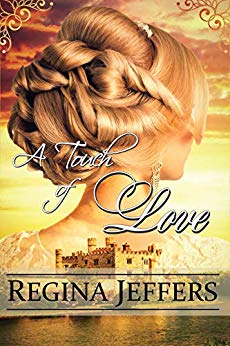
As most of you realize the Sheriff of Nottingham is the main antagonist in the Robin Hood stories—stories upon which I grew up reading on a regular basis. In fact, I still own a copy of 25 collected tales of Robin Hood, which my grandfather had received from his father when he was but 11 years of age. It has a 1912 copyright date, making it over 100 years old. The Sheriff is generally depicted as an unjust tyrant who mistreats the local people of Nottinghamshire, subjecting them to unaffordable taxes. Robin Hood fights against him, stealing from the rich, and the Sheriff, in order to give to the poor; a characteristic for which Robin Hood is best known. I grew up despising the Sheriff and adoring Robin Hood, so taking on this challenge was initially a bit daunting. Then I remembered how as a tongue-in-cheek moment, I added the Sheriff in book 6 of my Realm series, A Touch of Love, to see if anyone caught it. Ironically, if anyone did, he/she did not comment on my moment of brilliance some five years before this project fell into my lap. Little did I realize when I wrote A Touch of Love that it would serve as the basis for this new novel.

In I Shot the Sheriff, the reader will encounter several characters from the Realm series, most particularly, Mr. Aristotle Pennington, Aidan Kimbolt, Lord Lexford, and Mr. Henry Hill. This new story actually starts with a scene from A Touch of Love. As I said previously, I was simply wondering if any of the loyal readers of this Regency series would note I had used William de Wendenal, the suspected name of the Sheriff of Nottingham of the Robin Hood tales, in this new story? Now, I can do the reverse. Will readers of I Shot the Sheriff recognize the characters from my Realm series? 

In the Realm series, Sir Carter Lowery, an agent for the Home Office, is hunting for a group of men involved in an art theft ring. In chapter eleven, we find the following mention of de Wendenal: 

Carter met with the local sheriff regarding the attack. With McLauren’s assistance, he convinced Lord de Wendenal to leave the stranger in Carter’s custody overnight, but the effort proved fruitless. His assailant refused to provide his name or the reasons for the attack. What troubled Carter the most was he still held no idea whether he or Mrs. Warren was the shooter’s target.

Later, in Chapter Twenty-Four, when several of those involved in the theft ring have been caught, we find: 

Pennington agreed and placed the finishing touches to their plans.

“If none of you object, I believe it might be best to have Lord de Wendenal involved in transporting our prisoners.” 

“Why do we require the Sheriff of Nottingham?” Worthing asked. “Is there not someone closer?”

“First, de Wendenal’s auspices also covers Derbyshire. Moreover, my reports say some eight years prior, his lordship had several dealings with Ransing. At the time, I had no reason to think Ransing involved in stolen art, but I did think him connected to a smuggling ring in Kent. De Wendenal’s involvement in the case will provide the man the opportunity to turn over any stolen goods he might have acquired, setting an example for other members of the aristocracy,” Pennington explained. 

“Do you think de Wendenal honest enough to respond as you wish?” Lexford inquired with a lift of his eyebrows in suspicion. 

“I think Lord de Wendenal serves his office to the Crown well, and I do not place merit in the rumors of his dealings with the Earl of Sherwood. As to whether de Wendenal deals in stolen goods, I would say no more so than the average peer considers the brandy he drinks as contraband. Much of the so-called luxuries, we as a social class enjoy, are smuggled into the country. I am well aware of de Wendenal’s reputation, but I am not convinced he is corrupt. Unwise, very much so. Made many poor decisions in his youth, absolutely. But none worse than those owned by the Duke of Thornhill, and we all know Brantley Fowler’s true worth.” 

They all nodded their agreement. “You know best in such matters,” Godown assured. 

“I will have Henderson and Van Dyke accompany the sheriff and the prisoners to London. Give the event a more official look with local magistrates and the Home Office working together. I will send another of our men to take possession of Woodstone’s associates later in the week. From what Lexford and Worthing shared, I suspect the two who assisted with Mrs. Warren’s abduction were nothing more than a pair of unemployed lackeys.”

Finally, in Chapter Twenty-Six, two of the leaders of the theft ring stage an attack on Prince George, heir to the British throne. It is this attack which sets the beginning of I Shot the Sheriff. We read: 

“Remain with me, my boy,” Prinny said through tight lips and a fake smile. 

Through the champagne glass’s shine, Carter noted how Lord Worthing had crossed the musicians’ raised dais to stand some ten feet behind the prince’s attacker, and Swenton approached slowly from the man’s right. Surprisingly, Lord de Wendenal, the Sheriff of Nottingham, edged forward on the left.

In the original Robin Hood tales, we do not upon the sheriff’s character is based. More likely is a composite character, a mix of the stock characters at the time and the real people who served as the High Sheriff of Nottinghamshire, Derbyshire, and the Royal Forests. As most of the Robin Hood tales are set during the absence of King Richard I of England during the Third Crusade, the character of the Sheriff is likely based on the little-known William de Wendenal, which is what I have done in my tale.

The real William de Wendenal was the High Sheriff of Nottingham and Derbyshire from 1190 to 1194. We know little of his life. He assumed his duties in 1190 from baron Roger de Lizoures. However, when King Richard the Lionheart returned to England in March 1194, William de Ferrers, 4th Earl of Derby succeeded William de Wendenal as the High Sheriff. After that, de Wendenal disappears from the historical record. That is, until I brought him back to life (so to speak) in I Shot the Sheriff.

I Shot the Sheriff: Tragic Characters in Classic Literature Series Novel 

William de Wendenal, the infamous Sheriff of Nottingham, has come to London, finally having wormed his way back into the good graces of the Royal family. Yet, not all of Society is prepared to forgive his former “supposed” transgressions, especially the Earl of Sherwood. 

However, when de Wendenal is wounded in an attempt to protect Prince George from an assassin, he becomes caught up in a plot involving stolen artwork, kidnapping, murder, and seduction that brings him to Cheshire where he must willingly face a gun pointed directly at his chest and held by the one woman who stirs his soul, Miss Patience Busnick, the daughter of a man de Wendenal once escorted to prison. 

I Shot the Sheriff is based on the classic tales of Robin Hood, but it is given a twist and brought into the early 19th Century’s Regency era. Can even de Wendenal achieve a Happily Ever After? If anyone can have the reader cheering for the Sheriff of Nottingham’s happiness, it is award-winning author Regina Jeffers. 

NOW FOR THE GIVEAWAY: I HAVE 2 eBOOK COPIES OF “I SHOT THE SHERIFF” AVAILABLE TO THOSE WHO COMMENT BELOW. WINNERS WILL BE ANNOUNCED AND PRIZES DELIVERED WHEN THE BOOK RELEASES ON NOVEMBER 30, 2020.

Posted in book excerpts, book release, British history, eBooks, Georgian England, Georgian Era, historical fiction, Living in the Regency, publishing, real life tales, Realm series, Regency romance, romance, Vagary, writing | Tagged , , , , , , , , , , , , | 3 Comments

The Art of Dressmaking During the Regency Era

I had another author recently ask me if I knew the time frame for a dressmaker to complete a gown. In the scenario explained to me, the gown was already embroidered and an initial fitting had occurred. So it is really be just a matter of making small adjustments after a final fitting. I said 3-5 days. However, the other author’s editor thought that was too short of a time, saying it would take two weeks, at a minimum.

In truth, the number of days would depend on a variety of issues: Is the modiste located in London? Or in a provincial town or village? Is the client one of the leaders of Society or a simple younger sister of a gentleman? A duchess, for example, would command more service than somebody unknown among the haut ton.  How many other clients is the modiste servicing at the time? Is it the beginning of a new Season in London? Or is it off season? When the London Season starts, everyone requires new gowns, so modistes are overrun with business.

Small adjustments after a final fitting can take less than an hour, depending on the amount of work that must be done—all measurements would have been made before starting the gown, so there would be only tiny adjustments.  A reputable, and, likely, a not so reputable, London modiste would have many seamstresses working for her.  In an emergency, they could put together a simple gown for an important client in less than a day from scratch. More than likely, they would work late into the night or through the night, if need be, to please a good client or a client of which they were very fond or they were being paid handsomely to product the gown in a short period of time.

The amount of work a dressmaker has and the number of seamstresses employed would determine how long it takes to make a garment. Of course, the trimming and such also matters.  A court dress could well take five days if the seamstresses worked on nothing else. If one required a garment made expeditiously, one could pay extra, and it could usually be done.

A London dress maker could usually make one faster than a village  seamstress, though even a village seamstress could finish a simple dress in three days, if she had no other work.

One must recall, there were no printed patterns, so the lady and the dressmaker would have to confer on which style dress she wanted and then choose the fabric. If the lady had never been to the store before, she would be measured  and a unfinished muslin or linen mock up dress made and fitted to her. The most skilled part of the procedure was drawing off the pieces and then cutting them properly. The dressmaker had to be able to see the pattern behind the fashion illustrations.

The muslin pieces would be used as pattern pieces when the material was cut. Then the fabric pieces would be pinned together. Next, someone would baste the seams. All this is the time consuming part. The customer was supposed to come for the final fitting wearing the stays she would wear with the dress. Dress makers did not usually make the stays. Usually, the mock up dress served as the lining for the actual finished product.

The dress would be tried on and any final adjustments made. Then seamstresses would sew all the seams and add any trimmings and tidy up the gown.

A slightly out-of-period side note. Around the middle of the 19th century, the average Parisian modiste employed 20 seamstresses. By 1870, when his business was really taking off, Charles Worth employed 1200, turning out thousands of extremely elaborate dresses a year. Even the most elaborate gowns I’ve seen in prints from the Regency era are nothing like as complicated as Worth gowns from the 1870s.

So, as to the answer to my friend’s question, the time for the finished dress could be adjusted to fit the plot and the circumstances. If it means that the adjustments are minor and the dressmaker employs half a dozen seamstresses, the dress could be finished the next day. 

Posted in British history, customs and tradiitons, fashion, Georgian England, Georgian Era, Regency era | Tagged , , , , , | 5 Comments

Pirates of the Barbary Coast, a Guest Post from Jann Rowland

This post originally appeared on the Austen Authors’ blog on July 22, 2020. Enjoy! 

Among the most fearsome historic raiders of the seas were the Barbary Pirates, corsairs who operated from ancient times until the early nineteenth century.While their predations included such acts as seizing shipments of goods and wealth, their main purpose was to secure slaves to fund the slave trade, slaves which were sold as far away as China. Though the pirates operated mainly in the western Mediterranean Sea, their activities extended down the west coast of Africa and as far north as Iceland, as they raided villages and carried away slaves for the markets in northern Africa.

The Berbers themselves, from whom the term “Barbary Coast” derives, are an ethnicity indigenous mostly to North Africa, though some live in parts of West Africa. While they had at times been subject to the Ottoman Empire, the Barbary Coast states, including people based in modern day Algeria, Tunisia, Libya, and Morocco, were largely autonomous in that they chose their own leaders and lived off the booty they took from other powers. The pirates did not seem to care much who they took prisoner as long as it brought them profit—members of every race, creed, or religion were targets for plunder.

It is interesting to note that while most European powers as well as the Ottomans had abandoned the oar-driven vessels of antiquity, the Barbary Pirates continued to employ such vessels, which were often crewed by as many as one hundred fighting men armed with swords and pistols. In many ways, the Barbary ships were the direct descendants of triremes of the ancient world. This led to a distinct advantage for the heavily-armed European navies that sported potent cannons and heavy arms. The Barbary Pirates knew this and their fleets were not built for battle; they were raiders that attacked vulnerable targets and fled at the sight of armed ships of war.

At times, the piracy problem became so great that some states began campaigns to purchase slaves back from the traders. Money was collected at various churches, and at times ships were taxed to add to the fund, which was then used to purchase back slaves. Of course, though this effort was laudable, the numbers of slaves they returned to their homelands through this process was nothing more than a trickle compared with those taken away.

Various expeditions were mounted to attempt to curb the threat, counter-raiding the Barbary Coast states, at times carrying captives away, while at other times destroying facilities in retaliation. A notable such action was the sacking of Bona in 1607 by the Knights of Saint Stephen. Others, such as the Dutch bombardment of Tripoli in 1670 slowed the pirates’ activities for a time. However, it did little to halt the predations of the corsairs and in some ways spurred them on.

The attacks of the pirates reached their peak in the early seventeenth century, though they began to wane late that same century due to the increased naval capacity of those states ravaged by the Barbary Pirates. Some, such as the United States, negotiated treaties with the Barbary States to avoid their ships being targeted, but as a result were forced to pay heavy tributes in exchange. By some estimates, 20% of the United States federal governments’ expenditures in 1800  were in the form of such tributes.

By the nineteenth century, the flow of slaves through raids slowed to a trickle. The United States fought two Barbary wars, the first from 1801 – 1805, the second in 1815, to protect their merchant fleets from the raiders. But it was not until the French conquered Algiers in 1830 that the pirates were defeated and their raiding halted. There are some estimates that during a one hundred year period from the late sixteenth century to the late seventeenth, almost one million slaves were carried into captivity. The total number during their centuries-long existence must have numbered in the millions.

This is just a taste of the history of the Barbary Pirates, for there is much more that could be discussed if we had the time and space to do so. By the nineteenth century and the time of Jane Austen, much of the power of these raiders had been reduced, their effectiveness diluted. That did not stop them entirely, for there are other means of obtaining slaves by the use of men of few morals and an unscrupulous lust for wealth.

Thus, I will leave you with this post. Remember, this is part of a series of posts discussing some of the themes of my upcoming duology, which now has a title! The series name will be called The Bonds of Life, and the first volume The Bonds of Friendship. Thanks to J. W. Garrett for both the suggestion of the title and the original idea! I hope I haven’t painted too dark a picture—there will be a happily ever after. Have no fear of that!

Posted in Austen Authors, Guest Post, history, real life tales, research, writing | Tagged , , , , , , | Comments Off on Pirates of the Barbary Coast, a Guest Post from Jann Rowland

How Did Debrett’s Come By The Information Listed in “The New Peerage”?

I had an author friend send me an email question recently. She wanted to know if a man (her hero) had been married for some time, how well known would the marriage be to others in Society? Could he go about without anyone knowing? (Definitely a interesting plot point)

Today, Debrett’s is a professional coaching (meaning instructional) company, publisher, and authority on etiquette and behaviour. It was founded in 1769 with the publication of the first edition of The New Peerage. The company takes its name from its founder, John Debrett. 

John Debrett (8 January 1753 – 15 November 1822) was the London-born son of Jean Louys de Bret, a French cook of Huguenot extraction and his wife Rachel Panchaud. As a boy of thirteen, John Debrett was apprenticed to a Piccadilly bookseller and publisher, Robert Davis. He remained there until 1780, when he moved across Piccadilly to work for John Almon, bookseller and stationer. John Almon edited and published his first edition of The New Peerage in 1769 and went on to produce at least three further editions. By 1790, he had passed the editorship on to John Debrett who, in 1802, put his name to the two small volumes that made up The Correct Peerage of England, Scotland and Ireland. Despite twice being declared bankrupt, Debrett continued as a bookseller and editor of the Peerage; the last edition edited by him was the 15th edition, which was published in 1823. He was found dead at his lodgings on 15 November 1822, and was buried at St James’s Church, Piccadilly. [Debrett’s]

Now, back to the question at hand: During the early 1800’s, did Debrett’s list marriages?  Would others know of a person’s marriage, even if he does not mention it?

Debrett gathered the published information for his volumes from the deaths, births, and marriage columns in the newspaper and from  announcements sent to it; therefore, if no one reported the marriage, the information would not automatically be included. The 1802 Debrett’s did not, for example, know that Lord Byron had died in 1798. Upon his death, the barony passed to Byron’s cousin George Anson Byron, a career naval officer. The poet we know as Lord Byron, George Gordon Noel, sixth Baron Byron, was born on 22 January 1788 in London. His father died when he was three, with the result that he inherited his title from his great uncle in 1798. (BBC History)

The second part of my friend’s question dealt with how to address the hero, as he also had a military commission. 

The answer is rather simple: The hero could be addressed by whichever designation he prefers:  Captain Lord So-and-so or just Lord So-and-so.

From Debrett’s 1816 we find …  

If an officer has a title, or a courtesy title or style, he is addressed in the opening of a letter and in speech in exactly the same way as any other title-holder. It should be noted, however, that some titled officers prefer to be addressed by their Service rank.

If Admiral Sir Guy Jones expresses his preference to be addressed ‘Dear Admiral Jones’ instead of ‘Dear Sir Guy’, this should, of course, be observed.

On an envelope the service rank appears before the title, except in the case of ‘His Excellency’.

The one aspect of Debrett’s that has to be taken into account (in the historical sense as far as authoring historical novels goes), is that Debrett’s has updated its etiquette in relation to modern day rules of engagement. Take mediaeval and early post mediaeval forms of address – verbal and written – and one can see a differing theme in respect of titles. After all, a prince was referred to as “his grace,” so, too, monarchs who were also referred to as Sire/Majesty, et al.  Slowly changes came about as mediaeval squires (servants) seemingly vanished somewhere along the way and county squires (landowners) who had their own servants are the only reference to squires. What a turn-around in social standing that is?

Prior, during, and post the English Civil Wars and stretching to the Georgian era, names came before title, and in many aristocratic circles remained, thus, until the reign of William IV & the Victorian era, i.e. Charles Standish, Duke of Wherever. Letters were  addressed to the duke by fellow aristocrats as “Charles Balderdash, The Duke of Wherever.” Whilst lesser persons in society (knowing their place) would address a letter to “The Duke of Wherever,” and head the letter with “Dear Duke.” On the other hand, in private letters between aristocrats, one may address the duke as “Dear Balderdash,” and if close or related another may use, “Dear Charles,” or plain “Charles.”

By the Georgian era Squires (county gentlemen) had become magistrates wielding lesser judicial power than county court circuit judges, but nonetheless, these squire magistrates were greatly feared by poachers and livestock rustlers. I do not think I need to enlighten my readers as to why that was so, except local knowledge added greatly to a squire’s intelligence networking. What other interesting aspects of Historical Britain post English Civil Wars strikes a note with you?

Posted in British history, estates, Georgian England, Georgian Era, history, peerage | Tagged , , , , | Comments Off on How Did Debrett’s Come By The Information Listed in “The New Peerage”?

Celebrating the Release of “A Regency Christmas Together” Anthology + a Giveaway

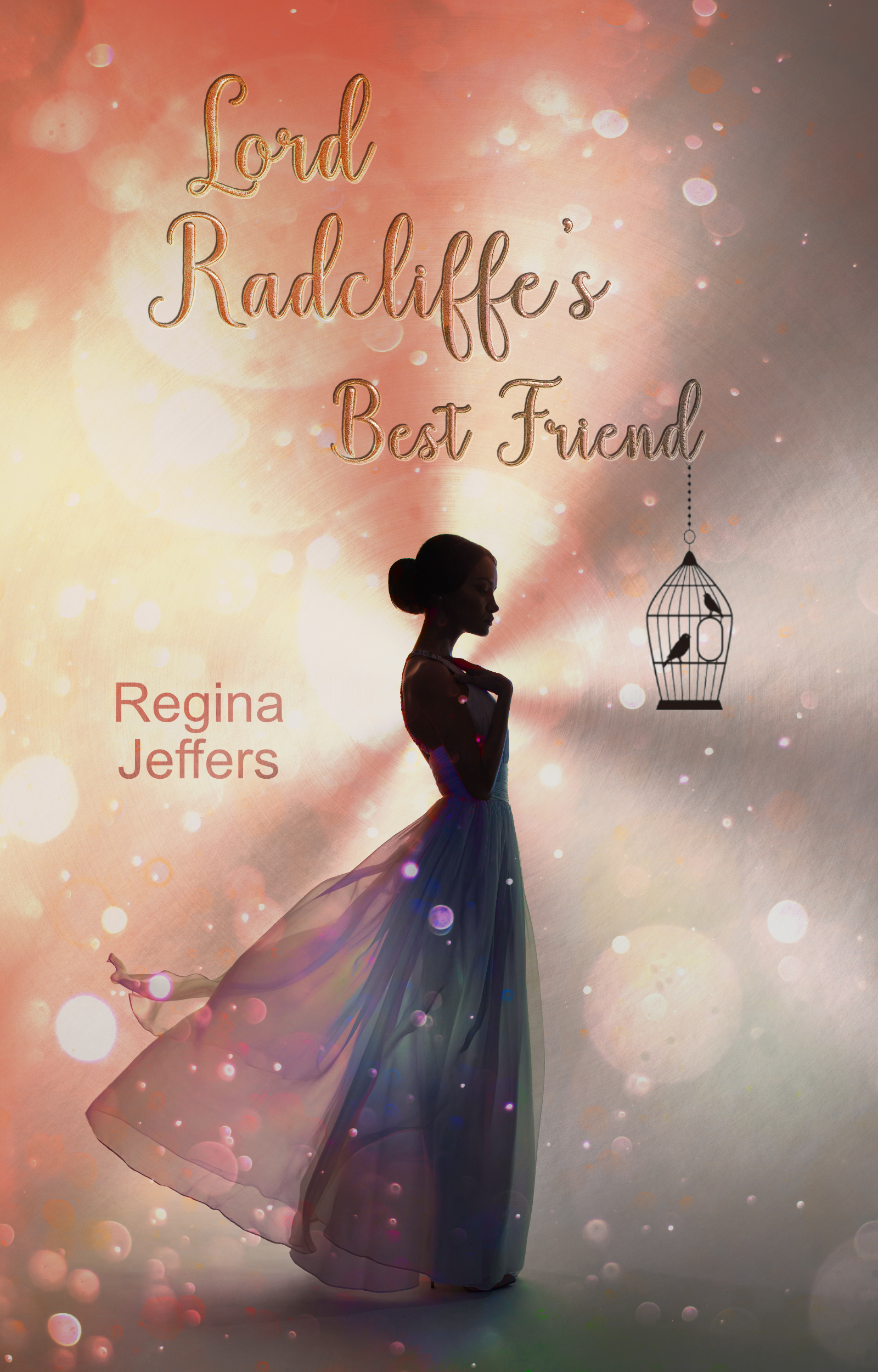
I have again joined forces with several authors for another Christmas-themed anthology. This one is entitled A Regency Christmas Together. The idea behind it is the hero and heroine are “trapped” together at Christmas. The “trapping” could be anything from being snowed in to being in a dangerous situation. My story Lord Radcliffe’s Best Friend is something of the latter nature, for those who regularly follow me know I adore a bit of drama in my tales. 

Hendrake Barrymore, Lord Radcliffe, is a typical male, a bit daff when it comes to the ways of women, especially the ways of one particular woman, Miss Adelaide Shaw, his childhood companion, a girl who plays a part in every pleasant memory Drake holds.

Yet, since he failed to deliver Addy’s first kiss on her fifteenth birthday, his former “friend” has struck him from her life just at a time when Radcliffe has come to the conclusion Adelaide is the one woman who best suits him.

This tale is more than a familiar story of friends to lovers for it presents the old maxim an unusual twist.

Below, you will find a short excerpt from Chapter One. If you are interested in reading more, swing over to Austen Authors for the first part of the chapter and for a second chance to win an eBook copy of A Regency Christmas Together

When news had arrived at the manor that Sultan could not be located, Adelaide knew exactly where the horse had gone. She had quickly changed into her riding habit and set out for the border between her father’s property and that of Lord Radcliffe. Addy suspected Sultan’s natural instinct to mate might be the needle’s prick in the continuing estrangement between the earl and her family. 

She reached a gloved hand down to pat her gelding’s neck. “Might as well face the Devil while the sun is up,” she murmured. She motioned to the grooms, who had accompanied her, to fetch Sultan. “Take him home. I will speak to Radcliffe and discover what restitution will be required. Do not mention any of this to my father. I shall discuss the matter with the baron upon my return. Also, send men out to repair our side of the fence. It appears someone has removed the rails we set atop of the brick wall. For what purpose, I have no idea. Yet, the removal permitted Sultan an easy jump.” 

“Yes, miss,” the men chorused. 

Looking to the opposing ridge, she spotted Radcliffe studying her. Without even a nod of her head in greeting, she nudged her horse forward. Quietly, she questioned, “Why must the man be the handsomest man of my acquaintance?”

Alcon shook his head as if in response. 

“I know,” she said softly. “I should ask the opinion of another female. Perhaps the mare below has taken note of his lordship’s appearance. Mayhap she holds an opinion of her owner that could prove mine in error.” 

She made her approach as Radcliffe had descended his side of the ridge to meet her in the middle. If only they could again find a similar “middle territory” in their relationship, then, she could, perhaps, go on with her life. Yet, Adelaide knew it would take more than this brief meeting to make her whole again. Bringing Alcon to a halt, she schooled her expression before greeting the earl. “Your lordship.” 

“Miss Shaw.” Why was it that the sound of his voice did odd things to her composure? It had been six years since she had displaced him from her world, and so much had changed within both their lives that should have made a difference, but hadn’t. However, anytime her eyes fell upon the man or someone mentioned his name or her father complained about the expense of having a well dug to use for the stock and the crops, she was right back where she always had been: in love with Hendrake Barrymore. 

If she could discover another man she could tolerate for more than an hour, maybe, then, she could marry and move away to her husband’s home. Distance, she had reasoned often, would aid in forgetting the ease which once had existed between her and the young man who had been her best friend when they were children. 

“I apologize for Sultan, my lord,” she said through tight. lips. “I shall speak to my father regarding restitution to Lord—”

“Shelton,” he supplied. 

“To Lord Shelton,” she continued. “I realize Sultan’s actions cost you the sale of the foal, and in these trying times, such business can assist in maintaining the land.” 

“Your father requires the fee, as well,” he said, keeping his steady gaze upon her and making Addy want to fidget. 

“I assure you, my lord, Sultan’s presence here today was not purposeful,” she argued, completely ignoring his gesture of goodwill. 

“I did not think the stallion’s actions purposeful,” he corrected. A frown marked his brow. “But certainly inconvenient.” 

She made to concentrate on the task at hand, rather than the bluest eyes she had ever beheld. “It appears someone has removed the wooden rails my father had placed on the brick wall marking the border between our properties. Sultan can easily clear the brick one without the railing.” 

His lordship eyed the wall suspiciously. “Like you, I would not name what remains of the wooden barrier a detriment to a horse of Sultan’s stature.” 

Addy kept her gaze upon the sad state of the wall. Such was safer where interactions with Radcliffe were concerned. From where she sat, the wall was in worse shape than she had originally thought. “It appears someone required . . . required the wood . . . to warm their cottages.” 

He dismounted, crossed to where she sat and lifted his hands to her to assist her to dismount. Obviously, he meant to make more of this encounter than was necessary. The fact she could not dismount or remount, for that matter, without his assistance, was something she was reluctant to admit, even to herself, for she did not want to consider the exquisite warmth of his hands upon her, for if he was to touch her, she would not be responsible for her actions. Despite his having betrayed her, even after six years, the man still held a power over her. 

“May I assist you down?” he questioned, but he did not step away from her.

Reluctantly, she nodded her agreement. “Step back so I might release my foot from the stirrup.”

“With your permission, I will do it,” he suggested with a slight lift of his brows, as if he meant to challenge her, something he had always done—something she desperately missed of having him in her life. 

Biting her bottom lip in frustration, she nodded her agreement. 

The subtle warmth of his hand on her leg above her half boots did crazy things to her most private place; yet, she swallowed her desire by reminding herself of his betrayal. Instead, she carefully shifted her weight to lift her right leg from around the pommel without exposing more of her person to him or tumbling off the saddle into his arms. A woman without the experience upon a horse she held would have not been able to release her leg and swivel in the seat without a spill. 

Both legs free, she leaned forward to place her hands on his broad shoulders and permitted him to assist her to the ground. The process was quite awkward, not the way one reads of it in the novels she adored, but possible, nonetheless.

At length, he set her before him, catching her hand in his. “We will inspect the wall together.” 

Using his hand for support, she bent to catch the loop on the skirt of her riding habit to avoid tripping upon it and to provide herself a few extra seconds to control the sudden racing tempo of her heart. “Such is not necessary, my lord,” she said tartly as she rose. It was important for her to keep her resentment in place, for she was too susceptible to the man. 

“I insist,” he said, setting her hand upon his arm.

Addy reluctantly fell into step beside him. “I assure you, my lord, my father is capable of seeing to the repair without your input.” 

He stopped suddenly, causing Addy to stumble. His hand again caught her about the waist to prevent her from falling, and Adelaide felt her heart jump with the same pleasant surprise she had known when he had been her best friend in the world and thought to share something with her. 

“Why is it you continue to despise me, Adelaide? I made a foolish mistake. Have you never erred in your judgement?”

The fact her body still touched his in two places—her hand rested upon his arm and his hand rested upon her waist—made it difficult for her to concentrate fully. She purposely stepped back to break their connection in order to clear her thinking. She retorted, “Most assuredly I have erred in my estimation of more than one ‘so-called’ gentleman.” 

“I refuse to apologize for my actions of six years past,” he growled. “I am not the same callow youth I was then.” 

“If I recall correctly, you refused to apologize then, as well. You offered your excuses, but no honest apology,” she countered. 

“This is ridiculous, Addy. We are wasting our lives arguing over something that cannot be changed,” he insisted. 

“As you say, my lord.” She walked away toward the wall. Purposely, studying it, she said, “Evidently, my father must ask Mr. Bowden to design a better barrier.” She fingered the two boards left behind. “This is unacceptable. Someone will take up the task in the morning. You have my word on the matter, my lord.” Without waiting for his opinions, she returned to where Alcon stood munching on the grass. Knowing she could not mount without Radcliffe’s assistance, she caught the animal’s reins to lead it home. “Come, Alcon.” She gave a little tug. “We must return to the manor.” 

Radcliffe stood where she had left him by the wall. From the corner of her eye she noted how he shook his head in what appeared to be disbelief. “You are the most stubborn woman of my acquaintance!”

She kept walking, slowly climbing the hill. It was a good mile to the house, but it would not be her first time walking that distance, nor would it likely be her last, although, she would admit, if only to herself, she wished she had worn more comfortable boots. Yet, she would never voice that particular complaint aloud. 

“You do not mean to allow me to assist you to the saddle?” he called. “Be reasonable, Addy!”

“Miss Shaw!” she declared without looking back to judge his reaction. “I am Miss Shaw.” She hid the pain such a declaration caused her. “My father will be in touch, my lord.” 

“Hendrake!” He stormed toward her, but thankfully did not attempt to prevent her retreat. “I am Hendrake! Drake! Not ‘my lord’ or ‘your lordship,’ not even ‘Radcliffe’! Say my name, Adelaide,” he demanded. 

Tears filled her eyes; yet, she did not slow her pace, nor did she look back to him. Instead, she stiffened her resolve, pulling her posture straighter and lifting her chin. She had a mile to allow herself another good cry. She had had plenty of them in the last six years, and, each time, she prayed it would be the last tears she shed over a man who had allowed his friends to attempt to deliver the kiss he had promised her—who had not thought to protect her from such manhandling—who had not even noticed the redness marking her cheek from where Lord French had slapped her when she had used a fireplace poker to fend off the man’s advances—who had only thought of the kiss she had denied him from a mere maid when Addy had been prepared to present him her whole heart. 

Now, for the GIVEAWAY. I have FIVE eBook copies of A Regency Christmas Together available to those who comment below. The Giveaway ends at midnight EST on Thursday, November 5. The winners will be announced on Sunday, November 8. Prizes will be delivered on November 11, when the anthology releases.

A Regency Christmas Together Anthology is on preorder until November 11, 2020, for only $0.99. It can also be read for FREE on Kindle Unlimited. https://www.amazon.com/Regency-Christmas-Together-Anthology-ANTHOLOGIES-ebook/dp/B08M3BR1Q9/ref=sr_1_3?dchild=1&keywords=a+regency+christmas+together&qid=1603978288&sr=8-3

A delightful anthology of Regency Romance Christmas stories from best selling authors! Fall in love at Christmas, with these wonderful romantic reads! Seven novellas, some sweet, some steamy, to keep you reading all through Winter, each centered around Christmas, and situations where people find themselves unexpectedly trapped together.

Lord Radcliffe’s Best Friend by Regina Jeffers
She’s been his friend since childhood – but he’s only just realised that he wants her to be more. It’s a pity that she’s decided he’s not her friend anymore…

Christmas with THAT Duke by Arietta Richmond
Ten years after betrayal tore them apart, they see each other again, for the first time. Trapped together by a blizzard, will they unravel the truth of the past and reclaim their love?

Mistletoe Magic by Janis Susan May
The daughter of a disgraced peer, now companion to a wealthy merchant’s widow, lady Serena did not expect, when there was a pounding on the door in a snowstorm, that what would fall through that door was her past, come to reclaim her.

Sleigh Bells and Slander by Summer Hanford
The least noticed sister, a gentleman pretending to be someone else, an interfering mother, love found despite it all.

The Merry Widow’s Snowbound Christmas by Sandra Masters
Unexpectedly back together, as the snow piles up outside, the heat rises inside, until long denied love overcomes all resistance.

Julie’s Christmas Joy by Victoria Hinshaw
Time has a habit of passing, and children grow up. When childhood companions meet again, neither is as the other remembered them – they have become far more interesting. When you add the well-meaning plotting of a grandmother and a great-aunt, their Christmas in Bath produces very unexpected results.

Me and Mr Jones by Ebony Oaten
A lady in need of a business partner, a man with a secret, an association that becomes far more than either of them intended.

If you love Regency Historical Romance, you’ll love these!

Posted in anthology, book excerpts, book release, Christmas, Dreamstone Publishing, eBooks, Georgian England, Georgian Era, giveaway, heroines, historical fiction, holidays, Living in the Regency, marriage, marriage customs, peerage, publishing, reading, reading habits, Regency era, Regency romance, writing | Tagged , , , , , , , , , , , , , | 13 Comments