Release Day for “Taming Lord Truist: Book 2 of the Strong Regency Women Duo” + a Bit on the Tower of London

Taming Lord Truist: Book 2 of the Strong Regency Women Duo  

“The very first moment I beheld him, my heart was irrecoverably gone.” – Jane Austen

Miss Eleanor Wilder has admired Lord Augustus Truist since she was a young girl. He had once protected her from an older boy who had meant to strike her. Now, she requires his protection again: This time, it is from her guardian, a cousin who means to marry Eleanor off to a man more that twice Ella’s age in order to keep Eleanor’s fortune in the family. As she will soon be one and twenty, Eleanor must convince Lord Truist to marry her himself, rather than see all her fortune go to a ne’er-do-well. 

Lord Truist must save his family from disgrace and a touch of poverty by marrying an heiress of whom his mother approves, but he finds repugnant. However, when Miss Wilder offers him her fortune with no strings attached—a marriage of convenience—how can he refuse? As his countess, the lady would have the protection she required, and he would have the freedom to enjoy his long-time mistress, Miss Sarah Darling, without complaints. 

How was he to know that the new Lady Truist not only loved him but was quite perfect in ways he did not realize he required?  

Purchase Links:

Kindle https://www.amazon.com/dp/B0CYLPJ72C

Available to Read on Kindle Unlimited 

BookBub https://www.bookbub.com/books/taming-lord-truist-book-2-of-the-strong-regency-women-duo-by-regina-jeffers

 Amazon https://www.amazon.com/dp/B0D93SZ418?ref_=pe_93986420_774957520

When I first purchase the cover image for Taming Lord Truist, I asked the designer London Montgomery Covers for a few changes. I have used more than a dozen covers from this designer and highly recommend his work. For this one, though, I required a tweak. Though I liked the female model, there was a modern skyline at the bottom (think a New York City style skyline). Therefore, I asked that something from the Regency era be used instead. I also asked that the pierced earrings be removed, but earrings are not the topic of today’s post, but rather the Tower of London.

In my story, as a birthday celebration, Lord August Truist takes his new wife to the Tower. Now, that might not sound so romantic, but, you see, Eleanor’s London experience is VERY limited. His brother and sister accompany them, and they all decided to be “London tourists,” not residents.

The Tower of London has stood for more than 900 years. It has served as a royal residence, a prison, a fort, and a tourist attraction. The last state prisoner to be held in the Tower, Rudolf Hess, the deputy leader of the Nazi Party, in May 1941. The last person to be executed in the Tower, Josef Jakobs, Nazi spy, shot by a firing squad on 15 August 1941. The last people to be held in the Tower, the Kray twins. They were members of organized crime syndicate and were arrested in 1968.

However, did you know that for more than 600 years there was a famous menagerie housed within the tower’s walls. It housed ostriches and elephants and lions and polar bears and many more exotic animals. The Constable of the Tower, no other than the Duke of Wellington, dispatched the Royal Menagerie from the Tower to an area of Regent’s Park in December 1831. The Menagerie closed for good in 1835, with many remaining animals sold to other zoos or travelling circuses.

Some amusing facts about the Tower of London and its exotic animals:

King John was the first ruler to bring animals to the Tower of London. He established a menagerie near the western entrance to the tower. That would have been around the year 1200.

Lion keepers were hired around 1210. These lions were said to be Barbary lions, which are now on the extinction list. The Barbary lion was a population of the lion subspecies Panthera leo leo. It was also called North African lion, Atlas lion and Egyptian lion. It lived in the mountains and deserts of the Maghreb of North Africa from Morocco to Egypt. It was eradicated following the spread of firearms and bounties for shooting lions.

Sultan, a Barbary lion in the Bronx Zoo, 1897 ~ Public Domain ~ Wikipedia

The first lion keepers were employed around 1210. Henry III received three “leopards” from Holy Roman Emperor Frederick II in an offer to strengthen diplomatic ties. These leopards were likely Barbary lions, for they were supposedly an homage to Richard III’s coat of arms.

Henry III “started” the Tower of London zoo. At that time, only the privileged guests were permitted to view the king’s collection of animals.

Edward I, in the 1270s, moved the menagerie to the front entrance of the Tower, so all those coming and going (including prisoners) received a large dose of fear at the paws of roaring lions and stamping elephants.

King Haakon IV of Norway sent Henry III a polar bear to join the other exotic animals at the Tower. Henry III was not best pleased to learn how expensive it was for the feed and care of a polar bear. Ordinary citizens were permitted access to view the polar bear as the animal was permitted to “fish” in the River Thames, and he was often viewed by people along the bank.

In 1255, an elephant was brought to London from the Holy Land and the Crusades. People were stunned to touch its rough skin/hide.

Henry III instituted a tax on Londoners so he might have a large “house” built to contain the elephant. Yet, the elephant did live to see the habitat created, for his foolish handlers did not realize an elephant is not a carnivore. Moreover, they gave it a gallon of wine wine to drink each day. After all, something belonging to the king could not be expected to drink plain water.

Hearing of the mismanagement of the first elephant, in 1623, the Spanish king. Philip IV, sent another elephant, but with strict instructions that the animal could only be given wine from September to April of each year.

Under Elizabeth I’s reign, people would be admitted free to the exhibit if they brought a dog or a cat to feed to the lion.

References:

Historic Royal Palaces

List of Prisoners of the Tower of London

The Tower of London Menagerie

Travel Through Time

Posted in aristocracy, book release, British history, eBooks, England, Georgian England, Georgian Era, Great Britain, historical fiction, history, kings and queens, publishing, reading habits, real life tales, Regency era, Regency romance, research, royalty, tradtions, writing | Tagged , , , , , , , , , , , , , , , , , | 4 Comments

Getting Here from There… + the Upcoming Release of “Taming Lord Truist: Book 2 of the Strong Regency Women Duo” + a Giveaway

In both my novella, “Lord Fearghal’s English Bride” (part of the Regency Summer Weddings Anthology) and my upcoming release of “Taming Lord Truist: Book 2 of the Strong Regency Women Duo,” my characters leave England to travel to and through Ireland. However, as I soon learned when conducting research to support my tales, reaching Ireland was one thing. Traveling through it was another.

Purchase links:

Regency Summer Weddings Anthology

Also, available to read on Kindle Unlimited 

To begin, one must recall these stories were both set before the age of steam (first introduced in 1819). This was a time when traveling from London, England, to Dublin, Ireland, was a week’s journey, at a minimum. There were four main ports along the English/Welsh/Scottish borders to the Atlantic Ocean and the Irish Sea where people could make the journey to Ireland. (1) In England, one could board in Bristol and travel to Cork City (which I will give more information on below, for that was not as easy as one might think); (2) One could travel from Liverpool, England, to Dublin, Ireland; (3) One could also travel to Dublin from Holyhead in Wales; or, finally, (4) One could travel from Port Patrick in Scotland to Donaghadee in County Down, Ireland.

The crossing itself could take 16 to 20 hours on an average, for the passage was entirely dependent on the weather. Some ships even turned back because of the unpredictability of the weather. Upon more than one occasion, a ship found itself setting becalmed in the waters for a day or more and waiting for favorable trade winds. Those who traveled from Bristol to Cork City often also encountered French or Spanish privateers.

Originally, I thought it would be easier to send my characters through Cork City, for I knew something of the modern day harbor. I was wrong. Completely wrong. The Port of Cork is situated at the south western end of the island. Cork Harbour is situated in the centre of the southern seaboard facing south to the Atlantic. In the 17th C, the Port of Cork was seen “as a distribution centre for its hinterland by trans-shipment. (Patrick Flanagan, “The Cork Region, c.1600-c.1900,” Perspectives on Cork, Special Publication No. 10 (Dublin Geographical Society of Ireland, 1998, pg. 3)

In 1800, Cork Port was unregulated as regards to shipping and had no port authority to oversee it. Instead, it was controlled by the Cork Corporation, a municipal authority. It was in a poor state of maintenance and was in urgent need to of repair. “In 1813 (when my stories are set), only small vessels drawing 11 feet of water [could] enter Cork city during high water on berthing at Cork had to be aground on a gravel bottom to discharge. The lower harbour was only three feet deep in places and large vessels had to unload cargo onto lighters. All of this added to the time and cost of vessels visiting the port. (Patrick J McCarthy, “An Economic History of the Port of Cork: 1813-1900,” unpublished M. EconSc. thesis (Cork: University College Cork, 1949) 12-13).

In 1813, the Butter Weighhouse Act was passed to improve the harbour and river of Cork. One-third of the fees received by the Weighmaster from the butter trade in the city went to a commission made up of 21 merchants of the city to improve, deepen and widen the port’s accessibility. In 1814, the “Cocket and Entry Tax Act (also known as “The Commercial Buildings Act”) was imposed as another form of revenue. It was a tax on customs documents, rather than the value of the goods. The Cork Harbour Act did not come about until 1820. (Mary Lantry, “The Cocket Tax in Cork: A Tax in the Context of its Time and Place,” unpublished MA thesis, Cork: University College Cork, 2018)

Taming Lord Truist: Book 2 of the Strong Regency Women Duo  

“The very first moment I beheld him, my heart was irrecoverably gone.” – Jane Austen

Miss Eleanor Wilder has admired Lord Augustus Truist since she was a young girl. He had once protected her from an older boy who had meant to strike her. Now, she requires his protection again: This time, it is from her guardian, a cousin who means to marry Eleanor off to a man more that twice Ella’s age in order to keep Eleanor’s fortune in the family. As she will soon be one and twenty, Eleanor must convince Lord Truist to marry her himself, rather than see all her fortune go to a ne’er-do-well. 

Lord Truist must save his family from disgrace and a touch of poverty by marrying an heiress of whom his mother approves, but he finds repugnant. However, when Miss Wilder offers him her fortune with no strings attached—a marriage of convenience—how can he refuse? As his countess, the lady would have the protection she required, and he would have the freedom to enjoy his long-time mistress, Miss Sarah Darling, without complaints. 

How was he to know that the new Lady Truist not only loved him but was quite perfect in ways he did not realize he required?     

Purchase Links:

Kindle https://www.amazon.com/dp/B0CYLPJ72C

Available to Read on Kindle Unlimited 

BookBub https://www.bookbub.com/books/taming-lord-truist-book-2-of-the-strong-regency-women-duo-by-regina-jeffers

 Amazon https://www.amazon.com/dp/B0D93SZ418?ref_=pe_93986420_774957520

If you have not yet read Loving Lord Lindmore: Book 1 of the Strong Regency Women Duo, it is on sale on Amazon for only $0.99 until August 16. Grab it for this weekend and be ready for Taming Lord Truist on Monday.

Loving Lord Lindmore: Book 1 of the Strong Regency Women Duo

LADY CORA TAKES SOCIETY BY STORM . . .

Lady Cora Midland, a highly-spirited country beauty, offers no pretensions, which wins many admirers, despite her lack of knowledge on how to manage the beau monde. However, Matthew Harrington believes she is taking advantage of his elderly grandmother, and he means to put a stop to the girl.

LORD MATTHEW LINDMORE IS IN DENIAL . . . 

Lindmore reluctantly assists his grandmother in bringing Lady Cora out in Society. Yet, what appeared to be a daunting task becomes a transformation the earl does not expect. He finds the woman as delightful, as do others in the haut ton. Yet… 

When Lady Cora is on the the verge of marrying another, Lindmore fears time will expire before he can speak his own proposal. 

Kindle https://www.amazon.com/dp/B0CTFSRB7R?ref_=pe_93986420_775043100

Available to Read on Kindle Unlimited

BookBub https://www.bookbub.com/books/loving-lord-lindmore-book-1-of-strong-regency-women-duo-by-regina-jeffers

Amazon https://www.amazon.com/dp/B0CTLY847C?ref_=pe_93986420_774957520

Audible (Virtual Voice Narration) https://www.amazon.com/dp/B0CW4WLKGZ


GIVEAWAY: I have 5 eBook copies to give away to those who comment on any or all the promotional posts for TAMING LORD TRUIST‘s release. The eBooks will be presented on August 12, the release date. 

References:
Cork Port and Harbour: A Nineteen Century Perspective

Rambles, Sketches, Tours: Travellers & Tourism in Ireland

Posted in book excerpts, book release, British history, eBooks, Georgian England, Georgian Era, giveaway, historical fiction, history, Ireland, Living in the Regency, publishing, reading habits, real life tales, Regency era, Regency romance, research, romance, writing | Tagged , , , , , , , , , , , , , , , , | Comments Off on Getting Here from There… + the Upcoming Release of “Taming Lord Truist: Book 2 of the Strong Regency Women Duo” + a Giveaway

Ireland as Part of the Setting for “Taming Lord Truist: Book 2 of the Strong Regency Women Duo” + a Giveaway

Since the first of the year, I have written two stories in which Regency era Ireland plays a role. The first of those was a novella entitled “Lord Fearghal’s English Bride,” which was part of the Regency Summer Weddings Anthology.

Lord Fearghal’s English Bride

HERS WAS A CONVENIENT ARRANGEMENT 

Lady Claire Waterstone has spent more years out of England than she has enjoying English society. In fact, she feels very odd in making her Come Out with girls four to five years her junior. Claire has never known a “home” of her own. And while several gentlemen are eager to claim her hand, she knows their ardor has more to do with the size of her dowry than true affection. Then she encounters Lord Ainmire Fearghal, an impoverished Irish earl, whose tales of how he sees his land creates in her a desire to share it with him. Claire, therefore, abandons decorum and proposes to Lord Fearghal. However, his roguish charm soon has her wishing for more than a marriage of convenience. 

HE BARGAINED FOR HER FORTUNE, NOT HER HEART

Fearghal has only one purpose in marrying Lady Claire: Save his estate. Melhman Manor reeks from inherited debt, and Fearghal requires a wealthy wife immediately. Originally, he thought to leave Claire in London, but his wife soon puts an end to those thoughts, but when she suggests Ainmire’s cousin could be working against Ainmire’s efforts to save his land, Fearghal and Lady Claire strike a different type of bargain – one based in trust and loyalty and the beginnings of love

Purchase Links to the Anthology:

Regency Summer Weddings Anthology

Also, available to read on Kindle Unlimited 

****************************

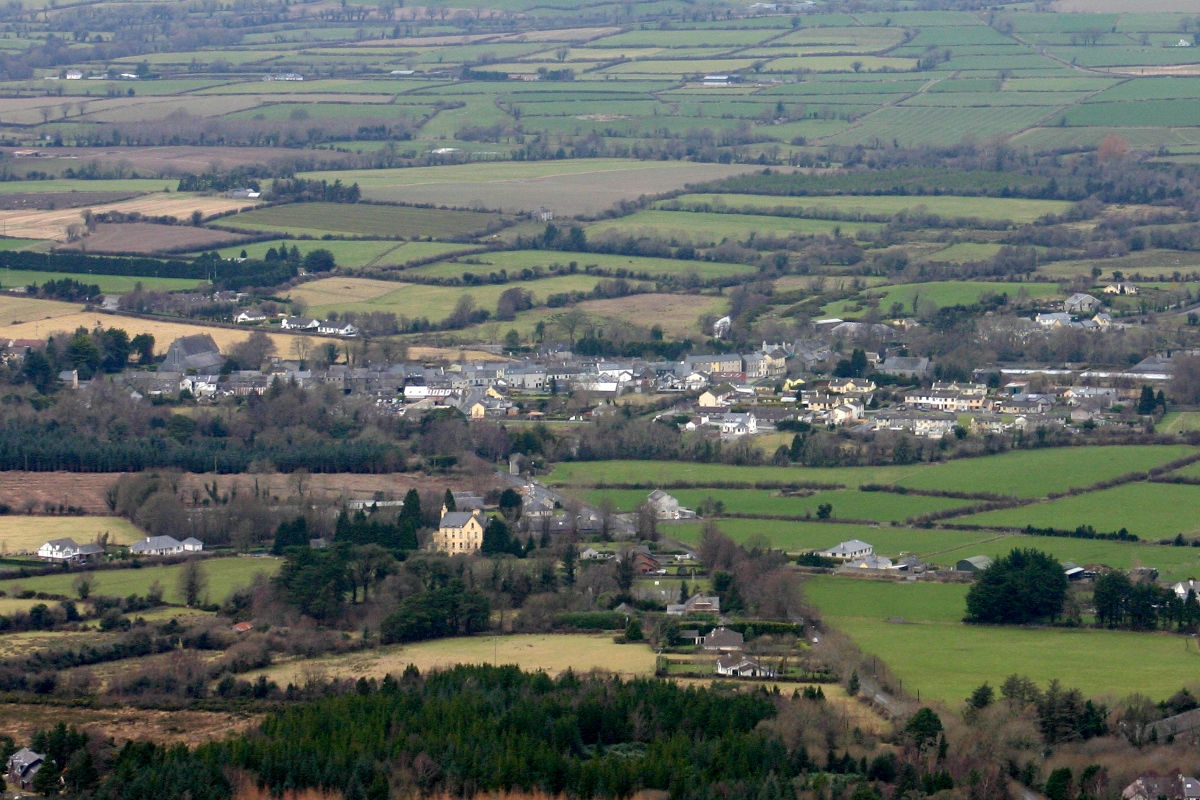
In Taming Lord Truist, the heroine’s parents, though having lived in England for many years, also had an estate in Ireland, where Lady Eleanor Truist retreats without telling her husband where she is going. I shan’t explain the necessity of her action, for that is a major plot point, but Eleanor chooses to return to an area close to Clogheen and Tubrid.

Clogheen lies in the Galtee-Vee Valley with the Galtee Mountains to the north and the Knockmealdowns in close proximity to the south. The River Tar runs through the village. The first substantial records of the village date from the Cromwellian period, but the village did not come to note until the 18th and 19th centuries. It then became a local centre of trade and commerce. The village takes its modern form from the 19th century with a wide area that was formerly the Market Square (and still named so) and a number of townhouses in the Georgian style. Cloghee sets about 50 miles from Cork City.

Clogheen, County Tipperary, Ireland. As seen from the nearby Knockmealdown Mountains. ~ CC BY 3.0 https://en.wikipedia.org/wiki/Clogheen,_County_Tipperary#/media/File:Clogheen_tipperary.jpg ~

Tubrid or Tubbrid was formerly a civil and ecclesiastical parish situated between the towns of Cahir and Clogheen in County Tipperary, Ireland. A cluster of architectural remains at the old settlement still known as Tubrid includes an ancient cemetery and two ruined churches of regional historical significance.

According to Power, the parish derives its name from the well (Tobraid Chiaráin) at which St. Declan (“Declan” is the surname for two of the characters in the book) baptised a local infant named Ciaran, who in time became a noted holy figure. It was said of Ciarán (Ciaran Mac Eochaidh) that he founded a monastery in the locality and that:

He worked many miracles and holy signs and this is the name of his monastery Tiprut [Tubrid] and this is where it is:–in the western part of the Decies in Ui Faithe between Slieve Grot (Galtee) and Sieve Cua and it is within the bishopric of Declan.

This holy well near the site, was in previous times a place of pilgrimage. St. Ciaran is remembered in the name of the church at Ballylooby. There was also, until recent times, an annual mass celebrated at this location. To the front of the site is the former local schoolhouse which was completed soon after the construction of St. John’s and is in danger of falling into a dilapidated condition. [That schoolhouse has its fictional beginning in this story.]

Taming Lord Truist: Book 2 of the Strong Regency Women Duo  

“The very first moment I beheld him, my heart was irrecoverably gone.” – Jane Austen

Miss Eleanor Wilder has admired Lord Augustus Truist since she was a young girl. He had once protected her from an older boy who had meant to strike her. Now, she requires his protection again: This time, it is from her guardian, a cousin who means to marry Eleanor off to a man more that twice Ella’s age in order to keep Eleanor’s fortune in the family. As she will soon be one and twenty, Eleanor must convince Lord Truist to marry her himself, rather than see all her fortune go to a ne’er-do-well. 

Lord Truist must save his family from disgrace and a touch of poverty by marrying an heiress of whom his mother approves, but he finds repugnant. However, when Miss Wilder offers him her fortune with no strings attached—a marriage of convenience—how can he refuse? As his countess, the lady would have the protection she required, and he would have the freedom to enjoy his long-time mistress, Miss Sarah Darling, without complaints. 

How was he to know that the new Lady Truist not only loved him but was quite perfect in ways he did not realize he required?      

Purchase Links:

Kindle https://www.amazon.com/dp/B0CYLPJ72C

Available to Read on Kindle Unlimited 

BookBub https://www.bookbub.com/books/taming-lord-truist-book-2-of-the-strong-regency-women-duo-by-regina-jeffers

 Amazon https://www.amazon.com/dp/B0D93SZ418?ref_=pe_93986420_774957520

Short Excerpt:

There was a soft tap on the door of her hotel room in Cork. Yet, Eleanor did not open it immediately. Instead, she said, “Yes?”

“It’s Sean Declan, Mrs. Banks. Me uncle in London sent word to meet you here.” 

Eleanor released the lock and opened the door to the man. “Thank you for coming.” 

“My condolences regardin’ the passin’ of yer father. Many of us be surprised to learn of yer loss. Aidan Wilder be a good man.” 

Eleanor nodded her gratitude. “I pray you may see me safely to my father’s former house near Tubrid.” 

“This time of year will be wetter than we might like. By horse be best. Easier than the Old Cork Road going towards the west.” 

“I had considered such would be true,” she admitted. 

“It be easier than coming in at Waterford where it be more mountainous, and, perhaps even an early snow.” 

“I pray you may return for supplies for those upon my father’s estate. I would have you choose items now, but my fortune will only go so far, and I wish to address the more critical needs first.” 

Remarkably, Mr. Declan smiled. “You’ll do well, Mrs. Banks. I be confident those on Wilder land will be glad for your coming. Dare I ask of Mr. Banks?”

“You may not,” she said with a lift of her chin in challenge. 

“Yer business, ma’am,” Mr. Declan said with a nod of acceptance. “Might’n we depart on Monday morning? Expectin’ fair weather for the next few days, but I must arrange for the horses and perhaps a mule to tote your trunks.” 

They discussed the specifics of their journey. Then Mr. Declan left her for the evening. Closing the door behind the man, she said with tears forming in her eyes, “I did not think it would be done so quickly, August. However, how shall I be done with how much I love you?”

If you have not yet read Loving Lord Lindmore: Book 1 of the Strong Regency Women Duo grab yourself a copy while you may. It is only $0.99 until August 12, 2024.

LADY CORA TAKES SOCIETY BY STORM . . .

Lady Cora Midland, a highly-spirited country beauty, offers no pretensions, which wins many admirers, despite her lack of knowledge on how to manage the beau monde. However, Matthew Harrington believes she is taking advantage of his elderly grandmother, and he means to put a stop to the girl.

LORD MATTHEW LINDMORE IS IN DENIAL . . . 

Lindmore reluctantly assists his grandmother in bringing Lady Cora out in Society. Yet, what appeared to be a daunting task becomes a transformation the earl does not expect. He finds the woman as delightful, as do others in the haut ton. Yet… 

When Lady Cora is on the the verge of marrying another, Lindmore fears time will expire before he can speak his own proposal. 

Kindle https://www.amazon.com/dp/B0CTFSRB7R?ref_=pe_93986420_775043100

Available to Read on Kindle Unlimited

BookBub https://www.bookbub.com/books/loving-lord-lindmore-book-1-of-strong-regency-women-duo-by-regina-jeffers

Amazon https://www.amazon.com/dp/B0CTLY847C?ref_=pe_93986420_774957520

Audible (Virtual Voice Narration) https://www.amazon.com/dp/B0CW4WLKGZ


GIVEAWAY: I have 5 eBook copies to give away to those who comment on any or all the promotional posts for TAMING LORD TRUIST‘s release. The eBooks will be presented on August 12, the release date. 

Posted in book excerpts, book release, British history, excerpt, Georgian England, Georgian Era, giveaway, historical fiction, history, Ireland, publishing, reading, reading habits, Regency era, Regency romance, research, romance, writing | Tagged , , , , , , , , , , , , , , , | Comments Off on Ireland as Part of the Setting for “Taming Lord Truist: Book 2 of the Strong Regency Women Duo” + a Giveaway

The London Borough of Hornsey + the Release of “Taming Lord Truist: Book 2 of the Strong Regency Women Duo” + a Giveaway

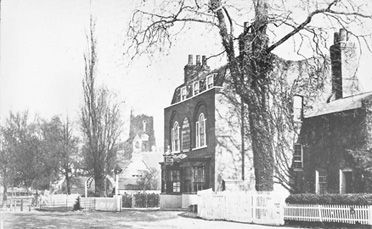
Hornsey High Street in 1873, with the old Three Compasses pub building in the centre ~ Public Domain – Wikipedia

In my tale, Taming Lord Truist, Lord Augustus Banks, 9th Earl Truist, keeps his mistress in the borough of Hornsey. He first took on Miss Sarah Darling when he was straight out of university. He has always fancied himself somewhat in love with the woman, though he knows he cannot marry her, for she is but a very poor former governess.

Hornsey is between 7 and 8 miles north of London proper. The name Hornsey has its origin in the Saxon period and is derived from the name of a Saxon chieftain called Haering. Haering’s Hege meant Haering’s enclosure. The earliest-written form of the name was recorded as Harenhg’ in about 1195. Its development thereafter gave rise to the modern-day names of Harringay (the district of London), the London Borough of Haringey and Hornsey. Hornsey Village developed along what is now Hornsey High Street, and in the seventeenth century it was bisected by the New River that crossed the village in three places: first at the end of Nightingale Lane, secondly from behind the Three Compasses and lastly, as it does now, at the bottom of Tottenham Lane. Hornsey is relatively old, being originally a village that grew up along Hornsey High Street, at the eastern end of which is the churchyard and tower of the former St Mary’s parish church, which was first mentioned in 1291. At the western end is Priory Park. This was the administrative centre of the historically broad parish.

Book Blurb:

Taming Lord Truist: Book 2 of the Strong Regency Women Duo  

“The very first moment I beheld him, my heart was irrecoverably gone.” – Jane Austen

Miss Eleanor Wilder has admired Lord Augustus Truist since she was a young girl. He had once protected her from an older boy who had meant to strike her. Now, she requires his protection again: This time, it is from her guardian, a cousin who means to marry Eleanor off to a man more that twice Ella’s age in order to keep Eleanor’s fortune in the family. As she will soon be one and twenty, Eleanor must convince Lord Truist to marry her himself, rather than see all her fortune go to a ne’er-do-well. 

Lord Truist must save his family from disgrace and a touch of poverty by marrying an heiress of whom his mother approves, but he finds repugnant. However, when Miss Wilder offers him her fortune with no strings attached—a marriage of convenience—how can he refuse? As his countess, the lady would have the protection she required, and he would have the freedom to enjoy his long-time mistress, Miss Sarah Darling, without complaints. 

How was he to know that the new Lady Truist not only loved him but was quite perfect in ways he did not realize he required?   

Purchase Links:

 Kindle https://www.amazon.com/dp/B0CYLPJ72C

Available to Read on Kindle Unlimited

 BookBub https://www.bookbub.com/books/taming-lord-truist-book-2-of-the-strong-regency-women-duo-by-regina-jeffers 

Amazon https://www.amazon.com/dp/B0D93SZ418?ref_=pe_93986420_774957520

Excerpt:

They were through the main course when Mr. Speaks stepped up beside August’s setting and extended a silver salver. “From Hornsey, sir,” the man whispered. 

August snatched the message from the tray and looked to Eleanor, who was conversing with Lady Marlow, though his wife’s eyes briefly met his. Worry crossed her expression, but was quickly captured and placed from sight. 

“Serve the next course, Mr. Speaks,” he ordered and slid the note into his inside pocket. He held no doubt that somehow Eleanor knew the source of the note. It had been more than a month since he had called on Sarah. She had never sent him any type of communication, especially not to his home, which meant something had happened which required his attention. 

He noted the slight shake of Lord Lindmore’s head, but what was August to do? What if Sarah was ill? Had she been attacked? “Please carry on. I must address this. I humbly beg your pardon. I shan’t be long.” 

His wife continued to chatter on to Lady Marlowe, but he could tell by the tone of her voice that she knew true concern. 

August paused briefly to claim her hand where it rested on the table and to squeeze the back of it. He wished to apologize, for he held no doubt whichever choice he made—however he chose to act this evening—he would break Eleanor’s heart. He despised what he was about to do to her, for she was the most caring and gracious soul he had ever encountered. With a strength he admired in her, Eleanor nodded her permission for him to continue on. 

He left the supper room and crossed into the library, where he reclaimed the note from his pocket. With his hands shaking, he broke the wax seal, expecting to read the worst. Instead, it said, “There’s a fire. S.”

“A fire?” he asked himself. “Where? Her house? Is she in danger?”

He was still looking at the sheet of rough paper when Lindmore slipped into the room. “What the hell has gotten into you? You left your wife to face your mother’s cronies alone!”

“There is a fire in Hornsey,” he said, not considering either the tone or volume of his voice. 

“Shush,” Lindmore cautioned, catching August’s arm to drag him deeper into the room. “Please tell me you are not thinking of riding to Hornsey. You cannot leave your wife while you chase after your mistress. Such is unacceptable, Truist.” 

“What if the house is on fire?” he asked in a panic. 

Lindmore shushed him again. “First, if the house was on fire, why would Miss Darling take the time to write you a note to that effect? Moreover, if the house was on fire when the lady wrote the note, the building would be burned to the ground by now. Hornsey is nearly eight miles from here. That would be more than an hour by horseback for the note to arrive at Truehold House, and it will be another hour for you to reach her. Do you not think it a bit too convenient that during the evening you make a public appearance with Lady Eleanor that your mistress sends you a cryptic note? Have you heard from the woman even once in all these weeks of your marriage? Have you even called upon Miss Darling in all that time?”

“No. But Sarah is not of the same nature as other mistresses,” he argued.

Now on sale until August 16, 2024, Book 1 of the Strong Regency Women Duo. If you have not yet read Loving Lord Lindmore, claim your copy while it is only $0.99.

Loving Lord Lindmore: Book 1 of the Strong Regency Women Duo

LADY CORA TAKES SOCIETY BY STORM . . .

Lady Cora Midland, a highly-spirited country beauty, offers no pretensions, which wins many admirers, despite her lack of knowledge on how to manage the beau monde. However, Matthew Harrington believes she is taking advantage of his elderly grandmother, and he means to put a stop to the girl.

LORD MATTHEW LINDMORE IS IN DENIAL . . . 

Lindmore reluctantly assists his grandmother in bringing Lady Cora out in Society. Yet, what appeared to be a daunting task becomes a transformation the earl does not expect. He finds the woman as delightful, as do others in the haut ton. Yet… 

When Lady Cora is on the the verge of marrying another, Lindmore fears time will expire before he can speak his own proposal. 

Kindle https://www.amazon.com/dp/B0CTFSRB7R?ref_=pe_93986420_775043100

Available to Read on Kindle Unlimited

BookBub https://www.bookbub.com/books/loving-lord-lindmore-book-1-of-strong-regency-women-duo-by-regina-jeffers

Amazon https://www.amazon.com/dp/B0CTLY847C?ref_=pe_93986420_774957520

Audible (Virtual Voice Narration) https://www.amazon.com/dp/B0CW4WLKGZ

GIVEAWAY: I have 5 eBook copies to give away to those who comment on any or all the promotional posts for TAMING LORD TRUIST‘s release. The eBooks will be presented on August 12, the release date. 

Posted in book excerpts, book release, excerpt, Georgian England, Georgian Era, giveaway, historical fiction, history, Ireland, publishing, reading habits, Regency era, Regency romance, research, romance, writing | Tagged , , , , , , , , , , , , | 6 Comments

Gardens in the Regency + the Release of “Taming Lord Truist: Book 2 of the Strong Regency Women Duo” + a Giveaway

Our garden is putting in order by a man who bears a remarkably good character, has a very fine complexion, and asks something less than the first. The shrubs which border the gravel walk, he says, are only sweetbriar and roses, and the latter of an indifferent sort; we mean to get a few of a better kind, therefore, and at my own particular desire he procures us some syringas. I could not do without a syringa, for the sake of Cowper’s line. We talk also of a laburnum. The border under the terrace wall is clearing away to receive currants and gooseberry bushes, and a spot is found very proper for raspberries. ~ Letter to her sister Cassandra from Jane Austen, 8 February 1807.

As some of you know, I consider working in my garden as my therapy. Scenes in books I am writing are developed while tending my flower beds. Conversation between characters occur, and I tug out the most annoying weeds. I live in a relatively new house, the second person to move into this new subdivision. Behind us on this street, our lots dip down to an open field which must be maintained by the city and our HOA. Where others have let that part of their land just sit and be unproductive, I have developed a pollinator garden over the last two years. It includes American beauty berry shrubs and sweet spire at the bottom. Coming up the hill to the main yard, one finds pugester butterfly bushes, mixed with gauria (beeblossom), coneflowers, cat’s pajamas, columbine, ornamental onion, sage, etc. The hillside, when in bloom is all shades or red and purple. Both sides of my house also contain flower beds, as does a curved out area in the front with rhododendron, hydrangeas, verbena, weigela, bluebeards, phlox, lavender, and more pugsters. Again, shades of purple are the way I go. I have neighbors stopping all the time to ask about particular plants. Therefore it is only natural in my tale, Taming Lord Truist, that Lady Eleanor Truist has assumed the “redevelopment” of the Truist gardens in both London and the family estate. It is her first “task,” as the earl’s new mistress and she wishes him to be proud of her. She has decided to “color block,” the plantings with reds leading to pinks leading to a pale salmon and on to white. Such is a more modern approach, but images of gardens of the Regency era say such would be possible.

“The very first moment I beheld him, my heart was irrecoverably gone.” – Jane Austen

Miss Eleanor Wilder has admired Lord Augustus Truist since she was a young girl. He had once protected her from an older boy who had meant to strike her. Now, she requires his protection again: This time, it is from her guardian, a cousin who means to marry Eleanor off to a man more that twice Ella’s age in order to keep Eleanor’s fortune in the family. As she will soon be one and twenty, Eleanor must convince Lord Truist to marry her himself, rather than see all her fortune go to a ne’er-do-well. 

Lord Truist must save his family from disgrace and a touch of poverty by marrying an heiress of whom his mother approves, but he finds repugnant. However, when Miss Wilder offers him her fortune with no strings attached—a marriage of convenience—how can he refuse? As his countess, the lady would have the protection she required, and he would have the freedom to enjoy his long-time mistress, Miss Sarah Darling, without complaints. 

How was he to know that the new Lady Truist not only loved him but was quite perfect in ways he did not realize he required?   

Purchase Links:  

Kindle https://www.amazon.com/dp/B0CYLPJ72C

Available to Read on Kindle Unlimited 

BookBub https://www.bookbub.com/books/taming-lord-truist-book-2-of-the-strong-regency-women-duo-by-regina-jeffers

 Amazon https://www.amazon.com/dp/B0D93SZ418?ref_=pe_93986420_774957520

Excerpt:

Eleanor gladly retrieved the drawings from the small portfolio case she had held in the coach. She spread the papers upon the table. “I was thinking if we moved the spring daffodils to here,” she tapped the drawing, “and over here, as well as the geraniums, we could have color along the walkways year-round.” 

Lady Lindmore studied the diagram. “If I were you, I would place the white lilies before the red and white roses. I like the blocks of color, but not all the patterns require the same touch. Variety. Move some of the white lilies behind the red geraniums. Some blocks should be a single color. Some a continuing color leading to a different block. I particularly enjoy the great burnet for their dark crimson flowers that bloom in June and July. They do require a partly shaded area, so closer to one of the two trees.” 

“I could add some pinks and dark plum plants,” Eleanor suggested. “Perhaps some grape hyacinth. They are customarily a March to early April blooming flower. Or even some betonies. Their pink color would work well between the white and the reds, and they bloom from June to September.”

“Do not forget red poppies,” Lady Cora suggested. “I love poppies.” 

“I just wish we could see it all right away,” Eleanor said. “His lordship says I may do something similar at his home in Lincolnshire, but I must first consider what differences in the temperature and soil are found there from what I knew in Hertfordshire.” 

The dowager countess said, “I prefer flowers that return year after year, but I am also fond of bushes that serve all the seasons. I have a few chokeberry bushes I acquired from a friend whose grandparents brought roots here from America. They have only been in England for perhaps a hundred years, but I had never considered them previously. They are tough and hardy and fit well to a shrub border or they may be permitted to grow ten to twelve feet tall in a woodland context. My friends also shared the American version plants with me. The berries on the aronia plant are sweeter and are red. The chokeberries are bitter. What I like best is the shrub has white to pinkish flowers that appear in clusters in April. In the autumn, the foliage turns a bright scarlet color and then the fruit berries arrive and last through the winter.”

Eleanor added, “My mother grew what she called an ‘honesty’ lunaria. It is rather tall, and, if I recall correctly, it is a biennial, but it would have lovely lilac-colored flowers in the summer, followed by shiny silver translucent discs in the autumn. They looked as if one might see completely through them, but you could not in actuality.” She sighed heavily, but with satisfaction. “I am so grateful for all you two have done for me and for these lovely suggestions. I just pray my husband’s mother does not object.” 

“You should permit the Dowager Lady Truist her say on some issues, but you are now Truist’s wife. It is your house. Your reign as the countess,” Lady Agnes Lindmore instructed.

If you have not already read Book 1 of the duo, grab you copy while you wait on the Taming Lord Truist release. Loving Lord Lindmore: Book 1 of the Strong Regency Women Duo will be reduce to $0.99 on Kindle until August 16, 2024. Read it first and see how Truist’s friendship with the Lindmores develops.

LADY CORA TAKES SOCIETY BY STORM . . .

Lady Cora Midland, a highly-spirited country beauty, offers no pretensions, which wins many admirers, despite her lack of knowledge on how to manage the beau monde. However, Matthew Harrington believes she is taking advantage of his elderly grandmother, and he means to put a stop to the girl.

LORD MATTHEW LINDMORE IS IN DENIAL . . . 

Lindmore reluctantly assists his grandmother in bringing Lady Cora out in Society. Yet, what appeared to be a daunting task becomes a transformation the earl does not expect. He finds the woman as delightful, as do others in the haut ton. Yet… 

When Lady Cora is on the the verge of marrying another, Lindmore fears time will expire before he can speak his own proposal. 

Kindle https://www.amazon.com/dp/B0CTFSRB7R?ref_=pe_93986420_775043100

Available to Read on Kindle Unlimited

BookBub https://www.bookbub.com/books/loving-lord-lindmore-book-1-of-strong-regency-women-duo-by-regina-jeffers

Amazon https://www.amazon.com/dp/B0CTLY847C?ref_=pe_93986420_774957520

Audible (Virtual Voice Narration) https://www.amazon.com/dp/B0CW4WLKGZ


GIVEAWAY: I have 5 eBook copies to give away to those who comment on any or all the promotional posts for TAMING LORD TRUIST‘s release. The eBooks will be presented on August 12, the release date. 

Posted in book excerpts, book release, British history, eBooks, estates, Georgian England, Georgian Era, giveaway, historical fiction, Ireland, Jane Austen, Living in the Regency, publishing, Regency era, Regency romance, writing | Tagged , , , , , , , , , , , , | 4 Comments

Wedding Announcements in the Regency + the Release of “Taming Lord Truist: Book 2 of the Strong Regency Women Duo” + a Giveaway

“A great many changes have happened in the neighbourhood, since you went away. Miss Lucas is married and settled. And one of my own daughters. I suppose you have heard of it; indeed, you must have seen it in the papers. It was in The Times and The Courier, I know; though it was not put in as it ought to be. It was only said, ’Lately, George Wickham, Esq. to Miss Lydia Bennet,’ without there being a syllable said of her father, or the place where she lived, or anything. It was my brother Gardiner’s drawing up too, and I wonder how he came to make such an awkward business of it. Did you see it?” – from Chapter 53 of Jane Austen’s Pride and Prejudice

Often times when reading a Regency era book, one will find where there is an upcoming wedding announcement in the newspaper. Unfortunately, such was not the usual way it happened. I have digital copies of several newspapers from the time period, and only once did I see a mention of an upcoming marriage, and it was handled as part of the “gossip” column, along with who was seen at a particular event, etc. I do understand that The Herald carried more gossip about balls and fashionable gatherings, but I have never seen an actual copy of The Herald to know whether that is true.

Newspapers of the time period might mention a betrothal, but not the wedding itself. That duty was left to the vital statistics column, along with matters such as births and deaths, as well the weddings.

Taming Lord Truist: Book 2 of the Strong Regency Women Duo  

“The very first moment I beheld him, my heart was irrecoverably gone.” – Jane Austen

Miss Eleanor Wilder has admired Lord Augustus Truist since she was a young girl. He had once protected her from an older boy who had meant to strike her. Now, she requires his protection again: This time, it is from her guardian, a cousin who means to marry Eleanor off to a man more that twice Ella’s age in order to keep Eleanor’s fortune in the family. As she will soon be one and twenty, Eleanor must convince Lord Truist to marry her himself, rather than see all her fortune go to a ne’er-do-well. 

Lord Truist must save his family from disgrace and a touch of poverty by marrying an heiress of whom his mother approves, but he finds repugnant. However, when Miss Wilder offers him her fortune with no strings attached—a marriage of convenience—how can he refuse? As his countess, the lady would have the protection she required, and he would have the freedom to enjoy his long-time mistress, Miss Sarah Darling, without complaints. 

How was he to know that the new Lady Truist not only loved him but was quite perfect in ways he did not realize he required?    

PreOrder Purchase Links:

Kindle https://www.amazon.com/dp/B0CYLPJ72C

Available to Read on Kindle Unlimited 

BookBub https://www.bookbub.com/books/taming-lord-truist-book-2-of-the-strong-regency-women-duo-by-regina-jeffers

 Amazon https://www.amazon.com/dp/B0D93SZ418?ref_=pe_93986420_774957520

Excerpt from Chapter Five:

“What did you wear for the wedding?” Julia asked as Mr. Speaks wheeled in a tea cart.

“Nothing fashionable,” Eleanor said. “At least, not by today’s standards. My grandmother still had my mother’s dress from when she married my father. It was my grandmother’s request that I wear it. I am confident August despised all the lace, but I could not deny Grandmother Reynolds’s request. Surprisingly, the dress fit quite well.” 

“I think it sounds romantic,” Julia said. “Might we have champagne with supper, Mama?” his sister asked. 

“Should we not be asking Augustus’s wife?” his mother responded. 

“I would be grateful, ma’am, if you would continue in your role as mistress of the house. Though I tended my father’s home after my mother’s passing, as we were in mourning, we did not entertain. I still have much to learn of the task, and August has praised your service to both him and his father. I have no desire to replace you. In fact, as my own mother is no longer on this earth, I had hoped, though you may not think of me as a daughter, that you might consider me . . .” 

“What?” his mother asked. 

“In honesty, I have not a name for it,” Eleanor admitted. “Not a student, and, most assuredly, not a protégé. I suppose ‘friend’ will have to suffice.” 

August watched his mother’s expressions. Eleanor had quite successfully befuddled Lady Lorraine Truist, backing her into a corner with a cup of “sweetness.” He thought he would never see such a day, but it had come. His wife wielded her “gentle” nature as if it were a heavy sword. 

The rest of the evening had gone better than August could have hoped, as they likely had chronicled their coming together a half dozen times. He had spoken to the quality of the estate belonging to Eleanor’s father. “Perhaps, you might travel with me when I inspect the home farms at Wassar Hall,” he told Octavius. “We might consider some of the successes from Wassar to instill at Franklin Place and vice versa. Herts and Cambridge generally share the same type of weather. The Wilders’ land agent, a Mr. Centwell, spoke of a special sheep breeding plan they had developed on the estate.” 

“I would be delighted,” his brother said. “Thank you, Eleanor, for opening new doors to us. It is difficult for August and me always to know what is best for Franklin Place, when we are accustomed to Lincolnshire climate and land. Our father only used Franklin Place as a summer estate, but, some day, it will be my home and the place where my family will reside.” 

“I did nothing but pronounce my vows to your brother,” Eleanor protested. “Yet, I can honestly say my father would be excited to hear your hopes to learn from his beloved estate and for you to share what you have learned elsewhere to keep Wassar Hall prosperous. Thank you, August, for doing more than selling my father’s life’s work.” 

“What shall the Hugos say of this marriage?” his mother asked the question August knew most pressing on her mind. 

“First, I never offered Miss Hugo anything beyond the two times I danced with her. I never asked if I might call on her. Never rode out with the chit in the park. I have not even spoken to Lord Hugo in the House of Lords in the short time between the ball his wife hosted and today. I held no obligation to Miss Hugo. In fact, I believe the chit preferred Mr. Cardea to me. She assuredly did not wish to leave his side to dance with me the first time. She would have preferred to be Lady Truist rather than Mrs. Cardea, or I should say, her mother would have preferred a title for her daughter.”

His wife added meekly, “As for me, I am assuming, by today, the Hugos will have discovered I am no longer in the house.” Eleanor played with her fingers and her head was down in a submissive gesture, of which August did not approve. 

“Would they not have known yesterday?” his mother asked in incredulity. 

August reached for Eleanor’s hand and rested it gently in his lap. He meant to defend her. “You saw the gown in which the Hugos clothed Eleanor at the ball. Surely you noted, at the break for supper, Lady Hugo banished Eleanor from the ballroom, while using part of my wife’s inheritance to pay for, not only the food, but also the orchestra and the gown for Miss Hugo and the flowers.” He purposely brought the back of his wife’s hand to his lips to present her knuckles a gentle kiss. 

“On the day of our marriage, Eleanor snuck out a small trunk with a couple of simple dresses and her feminine wear along with her mother’s jewels, which she has kept hidden from the Hugos for nearly two years. As Lady Hugo had ordered her to her room on Sunday evening to wait for Mr. Westlake’s arrival, we have no idea when they will realize she is no longer under their roof, but I am confident it will be sometime tomorrow when I demand a return of her personal belongings, those she did not bring to the marriage.” 

“Such is not necessary,” Eleanor pleaded. “Our marriage will be shocking enough.” 

“It is necessary, my dear. No one abuses my family. We cannot begin a lifetime together by permitting those of the nature of Lord and Lady Hugo to benefit from your good fortune. Nor should we permit them the upper hand in spreading rumors that I was caught seducing you or some such nonsense to save face, for Lady Hugo has spread the word that she expects me to propose to her daughter some time this week.” 

Ignoring what he said, his mother said, “We should send around a notice of your marriage to the Times. With your permission, Augustus, I would send it over this evening. I am confident it could be in tomorrow’s edition under the section chronicling such events. In that manner, we may be ahead of the onslaught of insults we are likely to hear from the Hugos.” 

“Lindmore and I mean to silence his lordship’s objections in the House of Lords. If Hugo does not take his family in hand, it will be a cold day in the Devil’s realm before he passes another bill in the Lords or finds even one member of his club with whom to play a hand of cards. Lady Hugo may find her husband spending more time with his . . .” August broke off rather than to embarrass his mother, sister, or Eleanor, though he suspected his wife knew something of the matter, nevertheless.” 

“It is not necessary for you to take such measures. I promised not to be a trial on your time,” Eleanor begged. 

“You are not a trial on my time,” he said emphatically. “Our agreement is not all for my benefit. I wish my wife to have what she deserves, and that is a voice in her future. In our future.” 

You might also enjoy Loving Lord Lindmore: Book 1 of the Strong Regency Women Duo, which is on sale for $0.99 on Kindle until August 12.

LADY CORA TAKES SOCIETY BY STORM . . .

Lady Cora Midland, a highly-spirited country beauty, offers no pretensions, which wins many admirers, despite her lack of knowledge on how to manage the beau monde. However, Matthew Harrington believes she is taking advantage of his elderly grandmother, and he means to put a stop to the girl.

LORD MATTHEW LINDMORE IS IN DENIAL . . . 

Lindmore reluctantly assists his grandmother in bringing Lady Cora out in Society. Yet, what appeared to be a daunting task becomes a transformation the earl does not expect. He finds the woman as delightful, as do others in the haut ton. Yet… 

When Lady Cora is on the the verge of marrying another, Lindmore fears time will expire before he can speak his own proposal. 

Kindle https://www.amazon.com/dp/B0CTFSRB7R?ref_=pe_93986420_775043100

Available to Read on Kindle Unlimited

BookBub https://www.bookbub.com/books/loving-lord-lindmore-book-1-of-strong-regency-women-duo-by-regina-jeffers

Amazon https://www.amazon.com/dp/B0CTLY847C?ref_=pe_93986420_774957520

Audible (Virtual Voice Narration) https://www.amazon.com/dp/B0CW4WLKGZ

GIVEAWAY: I have 5 eBook copies to give away to those who comment on any or all the promotional posts for TAMING LORD TRUIST‘s release. The eBooks will be presented on August 12, the release date.

Posted in British history, eBooks, Georgian England, Georgian Era, giveaway, historical fiction, history, Living in the Regency, marriage customs, Pride and Prejudice, publishing, Regency era, Regency romance, research, romance, tradtions, writing | Tagged , , , , , , , , , , , , | 6 Comments

PreOrder for “Taming Lord Truist: Book 2 of the Strong Regency Women Duo” is Live!!! + a Giveaway

Taming Lord Truist: Book 2 of the Strong Regency Women Duo  

“The very first moment I beheld him, my heart was irrecoverably gone.” – Jane Austen

Miss Eleanor Wilder has admired Lord Augustus Truist since she was a young girl. He had once protected her from an older boy who had meant to strike her. Now, she requires his protection again: This time, it is from her guardian, a cousin who means to marry Eleanor off to a man more that twice Ella’s age in order to keep Eleanor’s fortune in the family. As she will soon be one and twenty, Eleanor must convince Lord Truist to marry her himself, rather than see all her fortune go to a ne’er-do-well. 

Lord Truist must save his family from disgrace and the very honest touch of poverty by marrying an heiress of whom his mother approves, but he finds repugnant. However, when Miss Wilder offers him her fortune with no strings attached—a marriage of convenience—how can he refuse? As his countess, the lady would have the protection she required, and he would have the freedom to enjoy his long-time mistress, Miss Sarah Darling, without complaints. 

How was he to know that the new Lady Truist, not only loved him, but was quite perfect in ways he did not realize he required?    

Purchase Links:

Kindle https://www.amazon.com/dp/B0CYLPJ72C

Available to Read on Kindle Unlimited 

BookBub https://www.bookbub.com/books/taming-lord-truist-book-2-of-the-strong-regency-women-duo-by-regina-jeffers

 Amazon https://www.amazon.com/dp/B0D93SZ418?ref_=pe_93986420_774957520

Short Excerpt from Eleanor’s proposal to August. . . Enjoy!

Eleanor had specifically chosen the fourth set to pair with Lord Truist for she knew it was to include a minuet and a l’allemande series of Baroque dances. Slower. More opportunities to hold a conversation. 

“Miss Wilder, I believe this is our dance.” Lord Truist extended his gloved hand to her, and she placed her fingertips in his hand, and he brought her palm to rest on his arm. He closed his hand over hers and gave her the slightest of tugs to bring her to his side. She noticed that he looked at her in an odd manner, but she was relatively confident he had felt the same warmth as she did through their gloved hands. 

He was so devastatingly handsome, Eleanor thought she could spend a lifetime just watching him age, and, if her plan went off as she hoped, such would be her fate. Though he did not sport a smile at this moment, she knew he was more often than not seen with a crooked, almost taunting, smile on his lips. Those lips were said to spill a boatload of nonsense or a heavy shovel full of truth, depending on the situation. Earlier, the Honorable Mr. Octavius Banks claimed his elder brother was the best man he knew. 

His lordship’s hair was a tad darker than hers, with his being a nice mix of dark brown with golden and auburn strands mixed in. His eyes were brown, where hers were blue. They assumed their position on the floor, and the music began. They circled back to back, and for an elongated moment, she simply enjoyed the warmth of his body surrounding her.

The moment disappeared when he said, “Lindmore says there is some foolishness about Lady Hugo marrying you off to her brother Arthur Westlake.” 

They made the required turns and came close again. “She wants to keep my father’s money within her side of the family.” 

“I thought the Hugos were well placed,” he said. 

“Not so much after they present you Miss Hugo’s dowry.” 

They separated then to bow to another couple and weave through a line of dancers. Whey they came together again, he stated, “I do not comprehend how your potential marriage to a distant cousin concerns me.” 

The dance pulled them apart once more; therefore, she had a few extra seconds to repeat in her head what she had been rehearsing for several days. “I had considered if you held no true affection . . .” 

Separation. A bow. A turn with another gentleman and then face-to-face with the most handsome man of her acquaintance. “no true affection for Daphne, you might . . .” The first part of the dance was to end soon with them at opposite corners of the formation and watching others within the rectangle complete the same steps he and she had already executed. 

She watched the myriad of emotions which crossed his features. He studied her, attempting to anticipate what she meant to say, though he surely knew. From all she had learned of him, he was considered quite intelligent, as well as more than a bit cynical. 

At last, the music had them weaving their way back to each other. He did not wait for her to speak first. He demanded, “I might what?”

She kept her eyes diverted from his, but she said the words she had rehearsed. “Might marry me instead.” 

He appeared puzzled by her declaration, but there was no instant rejection. In fact, as they wove their way through the early steps of a l’allemande, he studied her carefully, as if he were memorizing how she looked, which was drab and a bit like she had just left a clod of country soil on the Lord Hugo’s entrance steps. 

Finally, they were close enough to speak, though they were again back to back. “My father was from the Irish gentry, but we came to England when I was very young. He owned an estate in Hertfordshire and two smaller ones, which are not entailed. He left them to me, along with fifty thousand pounds.” 

His lordship stumbled briefly, but quickly recovered as the music came to an end. “You are serious?”

“I cannot live in this house much longer,” she said as they slowly walked to the side of the room. “Mr. Westlake is to arrive at this house in a matter of a sennight. She looked to where Lady Hugo stood frowning in her direction. Eleanor touched his arm so he might pause. “I know you have a mistress who you hold dearly. I do not care. All I want is a family that does not find me appalling. I shall be a good mistress for your house, and you shall have my fortune.” 

If you have not previously read, Book 1 of the Strong Regency Women Duo, Loving Lord Lindmore, now is the time to have a look, for I dropped the price to $0.99 on Amazon until Taming Lord Truist arrives on August 12. (Get it!!! His name is “Augustus” so the book comes out in August.) You may also read both on Kindle Unlimited.

LADY CORA TAKES SOCIETY BY STORM . . .

Lady Cora Midland, a highly-spirited country beauty, offers no pretensions, which wins many admirers, despite her lack of knowledge on how to manage the beau monde. However, Matthew Harrington believes she is taking advantage of his elderly grandmother, and he means to put a stop to the girl.

LORD MATTHEW LINDMORE IS IN DENIAL . . . 

Lindmore reluctantly assists his grandmother in bringing Lady Cora out in Society. Yet, what appeared to be a daunting task becomes a transformation the earl does not expect. He finds the woman as delightful, as do others in the haut ton. Yet… 

When Lady Cora is on the the verge of marrying another, Lindmore fears time will expire before he can speak his own proposal. 

Kindle https://www.amazon.com/dp/B0CTFSRB7R?ref_=pe_93986420_775043100

Available to Read on Kindle Unlimited

BookBub https://www.bookbub.com/books/loving-lord-lindmore-book-1-of-strong-regency-women-duo-by-regina-jeffers

Amazon https://www.amazon.com/dp/B0CTLY847C?ref_=pe_93986420_774957520

Audible (Virtual Voice Narration) https://www.amazon.com/dp/B0CW4WLKGZ

GIVEAWAY: I have 5 eBook copies to give away to those who comment on any or all the promotional posts for TAMING LORD TRUIST‘s release. The eBooks will be presented on August 12, the release date.

Posted in book excerpts, book release, excerpt, Georgian England, Georgian Era, giveaway, historical fiction, reading, Regency era, Regency romance, romance, writing | Tagged , , , , , , , , | 6 Comments

Georgian Era Lexicon – Nearing the End: We’re at “W”

In the singular form the lexicon of a particular subject is all the terms associated with it. The lexicon of a person or group is all the words they commonly use. As a plural noun, a lexicon is an alphabetical list of the words in a language or the words associated with a particular subject. To distinguish lexicon from a dictionary, it is an alphabetical list of the words in a language or the words associated with a particular subject.

These examples are a mix of what one might hear upon the lips of the aristocracy, as well as examples of Cant used upon London’s streets and those terms used by farmers and like in the country.


wafer – made of flour and gum; one dampened the wafer and then placed it on a letter to seal it

waggonette – a four-wheel lightweight carriage; used for pleasure trips such as picnics, etc.; common mode of transportation for the rural middle-class; could seat 6; very popular after the mid 1800s

Walcot Church – the site of the marriage of George Austen (1731-1805) to Miss Cassandra Leigh (1739-1827) on April 26, 1764; located in Bath

wainscoting – a “fancy” oak imported from Russia, Holland, or Germany; the term “wainscoting” was applied to panels originally made of such oak

waistcoat – a vest for a gentleman

waistband – the part of a skirt or pants (around the waist) in which money was kept

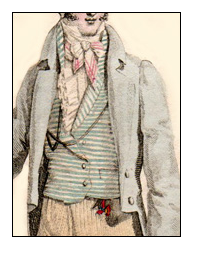
waistcoat – (also spelled “weskit,” for such the pronunciation in the Regency era) a sleeveless under-coat, either single or double breasted. Americans might call it a “vest.” short, and cut square across the waist; single-breasted versions were most often worn with evening wear; single- or double-breasted styles were worn with day wear; during the early 19th century, the waistcoat almost always had lapels; sometimes were layered, often pairing a white waistcoat underneath a patterned waistcoat.

a “Costume Parisien” print from the French magazine Journal des Dames et des Mode, December 20, 1811. ~ https://candicehern.com/regency-world/glossary/

walking out – long romantic walks were discouraged; there was a “no time alone in private” rule for courtship

wallflower – a young lady repeatedly without a partner at a ball/assembly; gentlemen were expected to ask young ladies who were seated without a partner to dance

watch fob – A short chain or ribbon with an attached medallion or ornament that connected to a man’s pocket watch and hung from a small pocket in his waistcoat. Men often wore several fobs, along with seals and other ornaments, clustered together on a single chain or ribbon. (via Candace Hern)

print shows a detail of “Concert Dresses” from Le Beau Monde, September 1807 ~ https://candicehern.com/regency-world/glossary/

watering pot – one who cries easily or too much

waltz – introduced to England from Germany in 1812; was considered scandalous as it required the partners to be in close proximity to one another; was finally approved by England’s great dancing arbiter, Thomas Wilson, in 1816; even then, the waltz was only approved for married couples

ward – a child under the care of a guardian and not his parents; wards in Chancery were so assigned by the courts; a Chancery ward could not marry or enter into a contract without the court’s permission

wardrobe – large wooden cupboard used for hanging clothes

warrant officer – an officer in the Royal Navy; usually a boatswain, carpenter, or surgeon; his position was attained by warrant rather than by commission

washhand stand – a small table in the bedroom that held water, soap, towels, etc., for the occupant’s ablutions; changed several times daily by a household maid

Watch – men who policed the streets at night; called out the time and weather at set intervals

watch guard – a chain or ribbon attached to a watch/timepiece to keep it attached to the gentleman’s clothing

water butt – a barrel placed under the eaves to catch rain water for washing, etc.

water cart – used to keep the dust down on dirty streets; water was released through small holes in a barrel as the cart rolled along the streets

watering place – seaside resorts such as Bath and Mudeford where one went to drink or bathe in the “healing” waters

Waterloo – The Battle of Waterloo was fought on Sunday, 18 June 1815, near Waterloo in present-day Belgium, then part of the United Kingdom of the Netherlands. An Imperial French army under the command of Emperor Napoleon was defeated by the armies of the Seventh Coalition, comprising an Anglo-Allied army under the command of the Duke of Wellington combined with a Prussian army under the command of Gebhard von Blucher. It was the culminating battle of the Waterloo Campaign and Napoleon’s last. The defeat at Waterloo ended his rule as Emperor of the French, marking the end of his Hundred Days return from exile.

watermen – rowed people out to boats on the River Thames or across the river for a fee

watermen – stood at hackney stands and gave water to the horses

wax jack – a coiled spindle that held a taper of sealing wax meant to seal documents/letters

wedding clothes – a woman’s parents purchased her an entire wardrobe (from ball gowns to riding habits) for the wedding; the bride traditionally wore a formal white bridal gown (the girl had the option of wearing her best dress, which could be any color except black or red); the dress was, generally, a white muslin columnar or tube-shaped dress, which was decorated with fine needlework; serving as underwear, a white chemise was worn beneath the gown; men wore his best clothes; the groom usually spent his money on a new coach

wedding protocol – weddings occurred during the canonical hours (between 8 A.M. and noon), unless the couple had a special license, which allowed them to marry later in the day, if they chose; usually, only friends and family were invited to the ceremony (unless the couple were extremely showy or held a place of importance in Society); the ceremony was followed by a wedding breakfast; at the breakfast the couple would often distribute little gifts to their guests

weeds – mourning clothes

weepers – symbols of morning easily spied by the public, such as a black band on a man’s hat or a long black veil on a lady’s

Wellington, Duke of –  Field Marshal Arthur Wellesley, 1st Duke of Wellington,  (1 May 1769[1] – 14 September 1852), was a British soldier and statesman, and one of  the leading military and political leaders of the 19th Century; defeated Napoleon at the Battle of Waterloo; later became Prime Minister; was responsible for passing the Catholic Emancipation Act in 1829

wet nurse – hired to breast feed a child not her own

West End – the western part of London, reaching from Charing Cross to the western boundary of Hyde Park; included Buckingham Palace, Mayfair, and St. James’s Park

Westminster – a separate city west of London (before London expansion); home of the monarch and Westminster Abbey, the royal palaces of Whitehall and St. James, the Palace of Westminster, the royal courts and Parliament

whalebone – used to reinforce the corsets worn by ladies of the day

wheelers – horses harnessed closest to the carriage (“leaders” were the farthest away)

Whig Party – the Whig Party was revived by Charles James Fox (1749-1806); the Whigs supported the reformists, religious dissent, and the need for electoral and parliamentary change; keep in mind that during the Regency, only rich landowners could vote

whippers-in – assistants of the huntsman during a fox hunt; kept the hounds together (“whips” became the term for party members who kept tabs on others in their Parliamentary party to make them available for crucial votes)

whipper-snapper – a small fellow

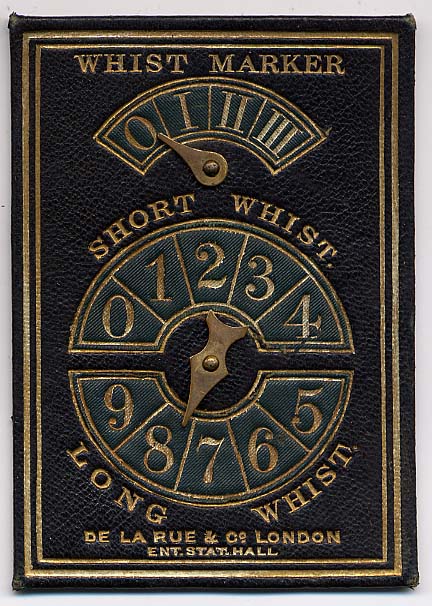
whist – a card game similar to bridge for 2 to 4 players

A leather Whist marker produced by the English cardmaker Charles Goodall by the end of the 19th century ` Public Domain ~ via Wikipedia

White’s – along with Brooks’ was one of the premiere gentlemen’s clubs during this period; White’s was for some time a citadel of the Tory party, as Brooks’ was for the Whigs, yet many members of the club either belonged to the other party (and the other club) or had no political affiliation; the oldest gentleman’s club during the time period; White’s Chocolate House was opened in 1693 and is said to be the origin of the name and the affiliation; opened as a gentleman’s club on St James’s street, but the original burned down in 1753; moved to larger quarters across the street, where it remains; members were voted into White’s and other exclusive gentlemen’s clubs in London by a secret election using white balls/marbles and black balls/marbles, such is where we get the term “blackballed” when admittance is not permitted

White’s Club St James’s Street A private members club over 250 years old. Its members include some of the most distinguished members in society as well as members of the Royal family. Renowned for its heavy gambling sessions, entry continues to be widely sought after by today’s gentry. It has been at this site (37-38) since 1778 ~ CC BY-SA 2.0 ~ via Wikipedia

white gowns – Most gowns of the period were made from muslin, a fine cotton fabric. White was the favorite color of muslin gowns because it appeared very classical (like the marble statues of Ancient Greece and Rome, which were very much in vogue at the time), and a white gown indicated the wearer was rich enough to employ maids to keep the gown white.

Whitehall – home of the Admiralty, the Treasury, the prime minster’s residence at 10 Downing Street, the Horse Guards, the army headquarters, etc.

Whitsun – the seventh Sunday after Easter; also known as Pentecost

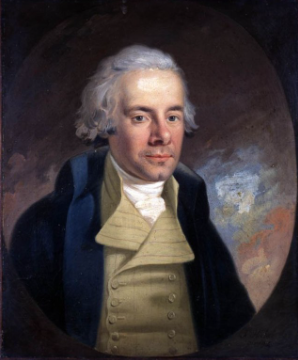
William Wilberforce – an Evangelical reformer (1759-1833) who strongly opposed the slave trade

William Wilberforce – Public Domain- Wikipedia

wilderness – an area in a park or garden where one found many trees, as opposed to the groomed lawns

window tax – one of the taxes active during the Georgian era; every window in a person’s house was taxed

Windsor – a town on the Thames west of London; housed a palace of the royal family

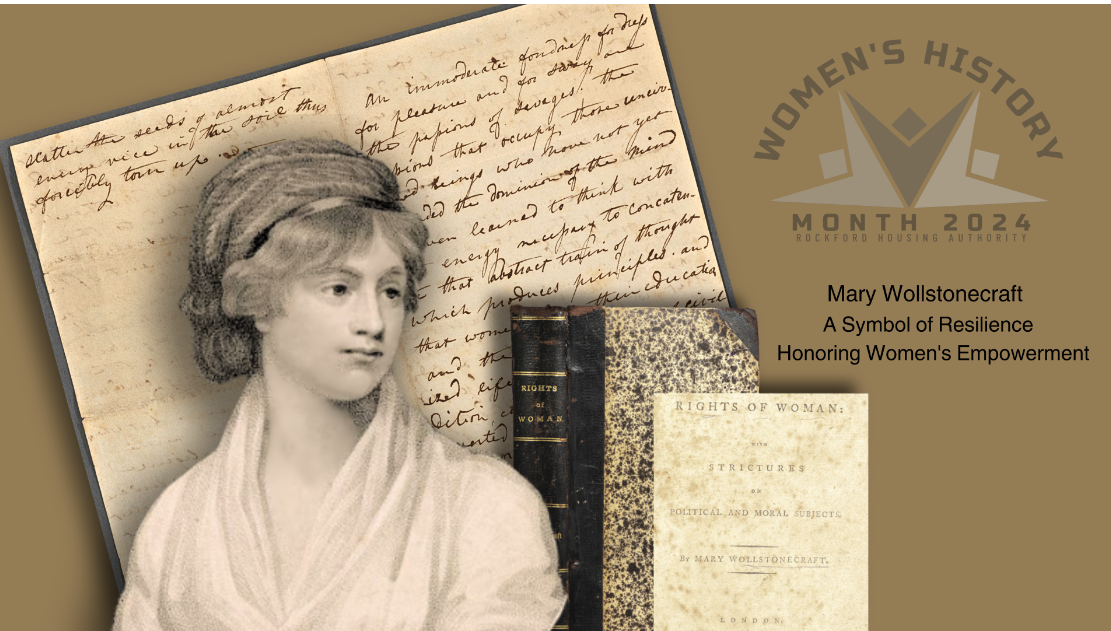
Mary Wollstonecraft – the most famous champion of women’s rights of the period; she authored A Vindication of the Rights of Women (1792); Wollstonecraft accused Fordyce’s Sermons of creating “artificial grace” in females

https://rockfordha.org/mary-wollstonecraft-a-symbol-of-resilience-honoring-womens-empowerment/

woolsack – the Lord Chancellor sat on a sack filled with wool while presiding over the House of Lords; therefore, “elevated to the woolsack,” meant to assume the position as Lord Chancellor

The Wonder – A Woman Keeps a Secret– a comedic play by Susanna Centlivre, which dealt with ladies and gentlemen in love and with the jealousy love can entail

workbox – sewing, embroidery, etc.; women’s “work”

workhouse – the place where those unable to care for themselves went for food and shelter in exchange for work

worsted – a fancy wool yarn; named for the place in Norfolk where the wool was made

wrangler – the name given to those taking top honors in math at Cambridge

Other Sources: 

Candice Hern

Donna Hatch

18th Century Vocabulary 

Georgette-Heyer: Regency Cant and Expressions 

Jane Austen Organization

Kathleen Baldwin

Messy Nessy Chic

Regency Reader

Sara Ramsey

Sharon Lathan

Posted in British history, etymology, history, Jane Austen, language choices, legends and myths, real life tales, Regency era, research, terminology, word choices, word origins, word play | Tagged , , , , , , , , , , , | 2 Comments

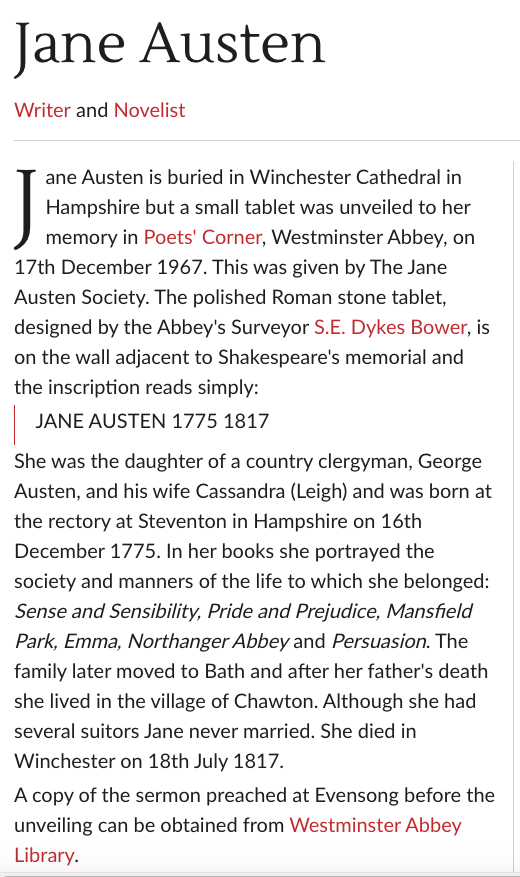
24 July 1817, Marks the Burial of Jane Austen at Winchester Cathedral

via http://www.telegraph.co.uk/women/womens-life/10199138/Jane-Austen-unveiled-as-face-of-new-10-note.html


July 18, 2024 marked the 207th anniversary of the death of Jane Austen. Tribute from Austen’s most loyal fans continue to flow through any number of activities, readings, evensongs, and events, leading us to July 24, the date of her funeral. In the UK, for the 200th anniversary of her death, public benches were dedicated to Austen, and the “Rain Jane” program had Austen’s words appear in public places throughout Hampshire whenever there was precipitation. Yet, this year, which is not so monumental in terms to be marked, it will those of the Austen brigade, those who still read her daily or study her with an intensity many in the public eye cannot fathom or write their own versions of her stories who will stop and take note of the passing of a lady from Hampshire, England.

Even in this “off” year, Winchester Cathedral, where she is interred, will likely see a steady influx of visitors. For the 200th Anniversary of her burial, the UK unveiled a £10 note (image above), graced with her face. As she is also on the £2 coin, Austen is the first person, other than a monarch, to appear on more than one form of British currency at the same time. Cathedral bell, on that day, tolled 41 times to mark each of her years on this earth.

In mid April 1817 Jane Austen was so ill she took to her bed in Chawton. By the 27th April she had written her will. After a visit from her brother James and his wife Mary she agreed to go to Winchester to be close to her surgeon who would take care of her there. (Jane Austen’s World)

Austen came to Winchester due to its proximity to Chawton, where Jane was initially brought when her illness reached a point she could no longer deny. She stayed at #8 College Street, along with her family. She reportedly passed away in her sister Cassandra’s arm. Jane Austen was but 41 years of age. There are rumors that she might have died of arsenic poisoning, but something sinister, but it was common for physicians to administer arsenic during the late Georgian era.

“In early June of 1817 James Austen wrote to his son at Oxford, ‘I grieve to write what will grieve to read; but I must tell you that we can no longer flatter ourselves with the least hope of having your dear valuable Aunt Jane restored to us.’”

We who love Austen, likely know the answer, but in case some of you have not thought twice about the lady, permit to answer this question: Why, when this comparatively obscure spinster died in 1817, was she buried in a cathedral which houses the bones of Saxon kings and saints?

It seems highly unusual for an ordinary citizen to be buried in a place normally reserved for secular and religious leaders. According to Jo Bartholomew, curator and librarian at the cathedral, the mortuary chests hold such dignitaries as: Cynigils and Cenwalh, two Christian kings from the seventh century; Kings Egbert and Ethelwulf (grandfather and father of King Alfred); King Cnut (Canute) and his Queen Emma; two bishops, Alwyn and Stigand; and king William Rufus. Most had been originally buried in Old Minster, the predecessor to Winchester Cathedral, which was just to the north and partially beneath it.

Was it common for an ordinary citizen to be buried there in 1817, or was this an extraordinary honor? In those days, not so extraordinary after all. Indeed, Jane was the third and last person buried there that year. Cost, rather than rank, may have been the limiting factor for a cathedral interment. Jane’s funeral expenses came to £92, a significant amount for someone of her means. Clearly, she or her family was determined to make a statement—after all, none of her brothers, including Frank, who died the highest-ranking naval officer in England, received such a burial.

In Memory of
JANE AUSTEN
Youngest daughter of the late
Rev GEORGE AUSTEN,
formerly Rector of Steventon in this County
she departed this Life on the 18th of July 1817,
aged 41, after a long illness supported with
the patience and the hopes of a Christian.
The benevolence of her heart,
the sweetness of her temper, and
the extraordinary endowments of her mind
obtained the regard of all who knew her and
the warmest love of her intimate connections.
Their grief is in proportion to their affection
they know their loss to be irreparable.
but in their deepest affliction they are consoled
by a firm though humble hope that her charity,
devotion, faith and purity have rendered
her soul acceptable in the sight of her
REDEEMER.

Elizabeth Proudman, vice chairman of the Jane Austen Society and an expert on Jane Austen, said in a letter that the location was likely Austen’s choice: “I believe that she is buried there, because she wanted to be. It was up to the Dean in those days to decide who could and who could not be buried in the Cathedral. Usually it was enough to be respectable and ‘gentry.’ This, of course, she was as her late father and two of her brothers were in the church.”

Jane’s father, George, had been the rector at Steventon, fourteen miles away, until he retired in 1801. He was succeeded by James, his oldest son, who still held that position in 1817. Henry, who had taken up the cloth after his bank collapsed in the recession of 1816, also had a clerical position nearby. It probably did not hurt that Jane’s brother Edward was the wealthy inheritor of the Knight estate, with extensive holdings in Steventon and Chawton, which was sixteen miles away. From his recent ordination, Henry knew the Bishop, according to Claire Tomalin; and the Dean, Thomas Rennell, was a friend of the important Chute family who were relatives of the Austens.

Having lived at Chawton for nine years, where she wrote or significantly revised her oeuvre, Jane was taken to Winchester for unsuccessful medical treatment. “She had been ill in Winchester for about two months, and I think her burial must have been discussed,” Proudman says. “I like to think that her family would have talked about it with her, and that they followed her wishes. … It may be that she had no particular attachment to the village [of Chawton]. We know that she admired Winchester Cathedral, and she knew several of the clergy. When she died she had some money from her writing, and her funeral expenses were paid from her estate. It was a tiny funeral, only 3 brothers and a nephew attended, and it had to be over before the daily business of the Cathedral began at 10.00 am.”

plaque on #8 College Street, Winchester, where Austen spent her final days

In fact, most funerals were relatively small in those days, and women did not attend. Cassandra, with their friend Martha Lloyd (James’s sister-in-law), “watched the little mournful procession the length of the street & when it turned from my sight I had lost her forever.” In a letter to their niece Fanny in the days after Jane’s death, Cassandra added: “I have lost a treasure, such a Sister, such a friend as can never be surpassed,—She was the sun of my life, the gilder of every pleasure, the soother of every sorrow, I had not a thought concealed from her, & it is as if I have lost a part of myself. … Never was [a] human being more sincerely mourned … than was this dear creature.”

Jane Austen
known to many by her
writings, endeared to
her family by the
varied charms of her
Character and ennobled
by Christian Faith
and Piety, was born
at Steventon in the
county of Hands Dec.
xvi mdcclxxv, and buried
In this Cathedral
July xxiv mdcccxvii
“She openeth her
mouth with wisdom
and in her tongue is
the law of kindness”
Prov xxxi. v. xxvi

Edward, Francis, and Henry were the brothers who attended. Charles was too far away to come. James was ill (He died two years later.), but his son, James Edward, rode from Steventon to Winchester for the service. Thomas Watkins, the Precentor (a member of a church who facilitates worship), read the service. Jane was interred in a brick-lined vault on the north side of the nave.

Burial site of for Jane Austen’s mother and sister near Chawton

Tomalin believes it was Henry who “surely sought permission for their sister to be buried in the cathedral; splendid as it is, she might have preferred the open churchyard at Steventon or Chawton.” One suspects it was Henry who pushed for the cathedral, and Jane would have been happy to be at rest anywhere. Yet, modest as she was in many ways, she understood the worth of her writing. She may have made the decision with a view to posterity. In any event, Cassandra was pleased with the decision. “It is a satisfaction to me,” she said, that Jane’s remains were “to lie in a building she admired so much—her precious soul I presume to hope reposes in a far superior mansion.”

Henry arranged for a plaque to be installed in the cathedral to commemorate Jane’s benevolence, sweetness, and intellect—but curiously enough, not her writing. As the popularity of her novels grew over time, officials were baffled by the pilgrims coming to visit the crypt of a woman the church knew not as a brilliant novelist but only as the daughter of a rural clergyman.

Spencer Means tells us, “Her memorial stone makes no mention of her writing, but that fact was rectified by the addition of a brass plaque nearby in 1872 and a stained glass window in her honor in 1900. Although the stone is the original location of Austen’s tomb, it is said by Cathedral guides that the coffin was moved “a yard or two to the right” when central heating was installed in the 1930s.The question of why she is buried here among saints, kings, and bishops has been the subject of speculation, as you can see here: www.jasa.net.au/l&t/grave.htm. The Cathedral Web site’s answer to “Why here?” is that she “greatly admired” the building (!). It also acknowledges that only four persons attended the “modest funeral.”

Meanwhile, the Winchester Cathedral website provides us with this information:

Posted in British currency, British history, buildings and structures, Georgian England, Georgian Era, Great Britain, history, Jane Austen, literature, Living in the Regency, Living in the UK, publishing, reading, reading habits, real life tales, Regency era, Regency personalities, writing | Tagged , , , , , , , , , | Comments Off on 24 July 1817, Marks the Burial of Jane Austen at Winchester Cathedral

“King of the Road” or the Cost of Traveling in the Regency Era

In nearly every historical book set in the Regency, we find characters traveling by coach from one destination to the next. The question is: How expensive was it to do so? 

The Hyde Park Gate in London, erected by the Kensington Turnpike Trust. This was the first toll point encountered along the Bath Road, upon leaving London. ~ Public Domain ~ https://en.wikipedia.org/wiki/
Turnpike_trusts#/media/
File:Hyde_park_turnpike_toll_
gate.jpg

First, the major roads during the Regency were TOLL ROADS. Readers should keep in mind that the person hiring or owning the carriage paid the toll. Many aristocrats trusted a footman with the task of actually paying the toll keeper, but it was the responsibility of the person letting or owning the carriage to see that the fee was paid. Turnpikes had been established with toll gates and tolls set by local parishes, who were responsible for maintenance of their stretch of road. Rates were variable, as were the distances between toll gates–could be anything from 10 miles apart to 30 miles apart. [I live in North Carolina. Our tolls are often determined my the number of cars using those lanes.]

Jane Austen’s World provides us this description of A View of London: Tottenham Court Road, 1812. “Inquiring readers, I had read about the closeness of rural areas near London during Jane Austen’s day. This image of Tottenham Court Road from the 1812 edition of Ackermann’s Repository shows the countryside beyond the toll gate. One imagines that Jane Austen was accustomed to such vistas when she visited her brother Henry in London. One moment she would be traveling through the countryside, the next moment she would be entering a teeming metropolis (Click here to see map):

“In the first years of the eighteenth century, pastures and open meadows began by Bloomsbury Square and Queens Square; the buildings of Lincoln’s Inn, Leicester Square and Covent Garden were surrounded by fields, while acres of pasture and meadow still survived in the northern and eastern suburbs outside the walls. Wigmore Row and Henrietta Street led directly into fields, while Brick Lane stopped abruptly in meadows.“World’s End” beside Stepney Green was a thoroughly rural spot, while Hyde Park was essentially part of the open countryside pressing upon the western areas of the city. Camden Town was well-known for its “rural lanes, hedgeside roads and lovely fields”where Londoners sought “quietude and fresh air.” – Extract from “LONDON The Biography”, by Peter Ackroyd. Published by Vintage, 2001.

Or, perhaps, you might find an earlier piece of mine entitled, The Beginning of the Turnpike Roads in Georgian England, helpful.  

Next, we must consider how much time was involved in the journey. I often research the distance from point A to B in current miles, and then I make appropriate adjustments for time of year of the story, proximity to the London Road or other major roads, etc., before I add the travel to the story. More than once, I have had to make major adjustments to my “time” profile of the story before I could finish writing it. Time for the journey depends on several things: weather (time of year), how much money do the characters have available (more money means more ability to hire horses, and the character can hire a team instead of a pair), and quality of the horses and carriage.

The stage and mail coaches generally took 2 days or about 20 to 30 hours of travel, depending on the coach and specific route taken. There were a couple of route options on the Great North Road. For a post chaise, the cost was about 1s 6d a mile for a pair of horses, and double that for four. So it was not really an economical method of travel. Tickets on the stage or the mail coach were cheaper, but travel was slower. (It is claimed that the highwayman Dick Turpin rode from London to York in less than 15 hours on his mare Black Bess. No idea if such was actually true, but a horseman can get over bad ground far easier and faster than wheels.) A trick I learned from another writer was to use Google Maps and set up one’s search for “traveling by bicycle” to estimate traveling by carriage during the Regency era. 

Snow and mud slows everything down. An author does not even need to write in a broken axle, just bad weather. Even rain that takes out bridges or flooded rivers that must be forded will put a stop to travel.

In estimating the speed of the travel, one must consider a number of factors. As mentioned above, the journey would be much slower in mud because horses can pull a tendon or a shoe in mucky ground. One must figure the average speed of a walk = 4 mph, trot – 4-12 mph, and that was the safest gait at which to travel. It is symmetric, meaning the horse is less likely to slip. We see movie images of stage coaches with horses cantering and galloping, but the post chaises–the fastest conveyances in Regency England–only averaged 11 mph, and that was in summer, when the roads were best. A galloping horse can do 35 mph, but not for long, especially not when hauling a load. 

An excellent source to consult is Following the Great North Road Then and Now: A Guide for the Modern Traveller, by Louise Allen. “From the Romans to the present day the Great North Road has carried travellers between London and Edinburgh. Roman emperors, Samuel Pepys, Dick Turpin and Jane Austen are only a few of famous and infamous travellers who passed along this iconic route. Despite bypasses, dual carriageways and concrete, the old road remains to be explored, and this guide is for any curious traveller who wants to break the monotony of a long drive by discovering the picturesque towns and curious byways on this route through British history. With it you can travel in the wheel tracks of coach passengers in the early 19th century, before the railway and the motorcar changed travel for ever.” The book describes the old road as it would have been in the coaching days, shows where the modern road diverges from it, lists a number of the inns along the way, and some description of the scenery as it would have been and various landmarks along the way.

A private light weight vehicle could go about 7 to 8 miles an hour for short distances on decent roads. “16 mile an hour tits” meant carriage horses could do 16 miles an hour. This would be a good, fit, well fed team. The trick was it was impossible to sustain this pace for miles and miles and miles. If one was going for speed, he would change horses every 10 miles, which is about once an hour.

In Jane Austen’s Pride and Prejudice, Mr. Darcy tells Elizabeth Bennet that fifty miles of good road was “little more than half a day’s journey.”  And the roads were so good to Brighton that they were often used for setting speed records.

Much of the above information can be found at https://shannondonnelly.com/2009/06/14/horse-sense/

Poster advertising the letting of tolls, 1826.
Unknown – National Library of Wales ~ Public Domain ~ https://en.wikipedia.org/wiki/Turnpike_trusts#/media/
File:To_Be_Let_The_Tolls_Cribbin,_
Llanfihangel_and_
Pencader_Gates_1826.jpg

As to costs at an inn, those also varied, depending on the type of inn (is it a high class one or not) and services required. The American Joseph Ballard wrote in 1815: “Besides the fare in the coach you have to pay the coachman one shilling per stage of about thirty miles, and the same to the guard whose business it is to take care of the luggage, &c. &c. You must pay also, at the inns, the chambermaid sixpence a night, the “boots” (the person who cleans them) two pence a day, and the head waiter one shilling a day. The porter who takes your portmanteau up stairs moves his hat with ‘pray remember the porter, Sir.’  In fact, it is necessary in travelling through England to have your pocket well lined with pounds, shillings and sixpences, otherwise you never can satisfy the innumerable demands made upon a traveller by landlord, waiters, chambermaids, and coachmen, &c. &c.  My bill at Manchester for one supper, a dinner, a breakfast, and two nights lodging was five dollars. (About a pound).”

So…cost for inns were pretty expensive. A night on the road not so bad….several days due to whatever problems could quickly mount up.

Other Resources: 

https://wordwenches.typepad.com/word_wenches/2015/03/travelling-the-roads-of-regency-england-with-louise-allen.html

Thoughts on Travel in ‘Sense and Sensibility’

The Hyde Park Gate in London, erected by the Kensington Turnpike Trust. This was the first toll point encountered along the Bath Road, upon leaving London. ~ Public Domain ~ https://en.wikipedia.org/wiki/
Turnpike_trusts#/media/
File:Hyde_park_turnpike_toll_
gate.jpg

 janeaustenslondon.com/tag/regency-travel

Posted in British history, commerce, Georgian England, Georgian Era, history, Jane Austen, Living in the Regency, real life tales, Regency era, travel | Tagged , , , , , , | 2 Comments