The landed aristocrats were VERY slow to give up the expenses of an extensive household staff. We saw that “plot” being used in the final season of Downton Abbey. It is said that the sixth Duke of Portland employed some 300 servants. Even Queen Victoria kept a separate staff of Indian cooks to prepare her daily curry midday meal.
The fourth Earl of Ashburnham recorded these expenses for his household (via the East Sussex Record Office): £769 for wages and house labourers; £300 for beer for the servants’ meals; £138 on liveries and hats.
From Royal Chef by Gabriel Tschumi (1954, William Kimber Publishing) speaks of an additional 24 French chefs being employed for Queen Victoria’s diamond jubilee. Forty to fifty servants was the norm for the larger landed estates. Believe it or not, the number of indoor male servants defined a man’s status in the world. This delineation was especially important in the Victorian era. At the beginning of Victoria’s reign, a house steward would earn £70 – 80 (while a good housekeeper might earn only £30 – 40).
Attingham Park attinghamparkmansion. wordpress.com
A tax on male servants was legislated in 1777 to help pay for the cost of fighting the Americans in the Revolutionary War. This practice continued during the long years of the Napoleonic conflict. If there eleven or more male servants in a household, the tax was a little over £7 for each. This tax was gradually reduced to 15 shillings by the end of 1869, but it was not abolished until 1937. Needless to say, this tax was a considerable burden on those who saw the need for male servants in their household.
The same Earl of Ashburnham mentioned above once paid £21 15s 9d male servant tax for a half year (1843). In addition, he was assessed a tax of £11 on his carriages, £1 4s for his armorial bearings, plus a 10% surcharge.
The Footman archive.laoisedcentre.ie
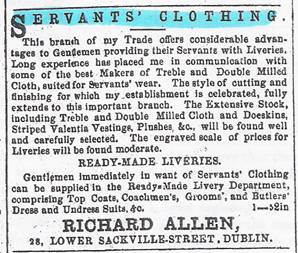
A duty on hair powder (1786 -1869) increased the cost of powdered footmen. The employer also provided the footmen with an allowance of £1 – 2 for the powder. It was common for the footmen to use household flour to save on the costs. Tailored livery for male servants also added to the expense of keeping the servants. Doudneys of Old Bond Street and Burlington Arcade charged 3 guineas for a footman’s livery. Two new suits of clothing were common for each male servant.
Some male servants were done away with by the beginning of Victoria’s reign. For example, the running footman, the male cook, and the sewer. Higher wages, taxes, and additional expenses aided the employers to be rid of these extravagances. According to Frank Huggett’s Life Below Stairs (page 23) from the 1901 Census report we learn, “Although the figures are not strictly comparable, because of changes in methods of classification, the official census of England and Wales shows that the total number was reduced from 74,323 in 1851 to 58,527 in 1891. Only the wealthiest could afford to employ the full range of house steward, footmen, usher, page and ‘tiger,’ plus coachmen, grooms and gardeners. Others, whose income at the beginning of the reign amounted to no more than £1000 or £1200 a year were advised to be content with a single male servant or, they had only £600 or £700, with a footboy.
Employment as a footboy to a clergyman, a lady, or a farmer, whose fortunes did not match their social aspirations, was one of the methods by which a lad could enter service in the first half of the nineteenth century, though it was more common, and usually more satisfactory, to obtain some less ostentatious position on a large estate instead.
‘Footboy’ was often a euphemism for ‘general dogsbody’ or ‘man-of-all-work’, as Henry White [Henry White, The Record of My Life, Cheltenham, 1889, page 59] found in 1837 when, at the age of fifteen, he started to work for Dr Sisson, the rector of Duntisborne, Gloucestershire. In addition to his more formal duties in livery, he was expected to clean the boots and the knives, to do some gardening, to act as ‘groom and coachman’ for the rector’s only conveyance – a humble donkey cart – and, in his spare time, to make himself generally useful! His livery, which had been tailored for him in the neighbouring town of Cirencester, would not have disgraced the footman of a lord. It consisted of a conventional full dress suit of ‘low shining shoes, white stockings, black plush breeches, with bright buckle and buttons at the knees, a brilliant brimstone-coloured waistcoat, covered by a bright sky-blue coat, pigeon-tailed, of course, with stand-up collar, embroidered with two rows of gold braid, and finishing with a set of yellow buttons.’ When he tried it on, he was then summoned to the drawing room where his ‘young mistress was pleased to make some the smallness of my legs, but this, as the Doctor sagely remarked, was an evil which would grow less every day.'”
Despite the sometimes less than desirable conditions under which many of those below stairs endured in service, there were other compensations. Servants learned their deference. They were “invisible,” while remaining upon display throughout most of their work days. As such, they learned to anticipate the likely imposition of an unwelcome task or an unpleasant task. Amazingly, they would often disappear into the bowels of the house or they would become engaged in a more pressing duty.
Beyond their wages, many upper servants found means to line their pockets without their masters’ knowing. House stewards would secretly give tradesmen a “cash discount” for the privilege of continued business with the household. The butler, cook, and housekeeper customarily found similar compensations in the purchases made for the household over which they saw. A butler, for example, could claim his share of the wine purchased for the master’s use. A cook might claim the meat drippings to be sold. In Cooking with Jane Austen by Kirstin Owen (page 90), we find, “Emma’s father was a bit daft about one thing though, and that is the frying of anything in the Regency period ‘without the smallest of grease.’ Steaks of all kinds were fried in large quantities of butter – partly to keep them from sticking to the pan, partly for the sake of the flavor, and partly for the sake of the cook, whose perquisites included the right to sell the dripping fat. The more butter she used, the more was ‘left over’ in the pan, and the richer she got.” The groom of the chamber could claim the ends of the candles to resell. Moreover, the taking of “vails” (or tips from guests) became a common practice.
A guest at a country house could expect to leave a variety of tips for his host’s servants. The housemaid (several silver coins), the groom of the chamber (several silver coins), the butler (sovereign), the footman (sovereign), the gamekeeper (a couple of guineas), etc. In English Notebooks, Nathaniel Hawthorne (page 439, Paul Kegan, 1894) complained of parting with several shillings to compensate the housekeeper of Lord Byron’s home of Newstead Abbey in 1857. In some houses in the early 1800s, servants actually lined up expecting their due upon the guest’s departure.
The guests who were less forthcoming “paid” in other ways. A dog cart might be sent to retrieve a guest from a public conveyance. Their requests were ignored or were delayed. A less desirable room might be set aside for the person or at a “shoot,” he would be ill-placed.
In the singular form the lexicon of a particular subject is all the terms associated with it. The lexicon of a person or group is all the words they commonly use. As a plural noun, a lexicon is an alphabetical list of the words in a language or the words associated with a particular subject. To distinguish lexicon from a dictionary, it is an alphabetical list of the words in a language or the words associated with a particular subject.
These examples are a mix of what one might hear upon the lips of the aristocracy, as well as examples of Cant used upon London’s streets and those terms used by farmers and like in the country.
xebec – a small three-masted Mediterranean vessel with both square and lateen sails, originally used by Algerian pirates and later used for commerce
yager –a 19th Century rifle; a muzzle-loading hunting rifle
yam – a posting house along a road
yapp – a type of bookbinding in which the leather edges overlap the pages
yarborough – a hand of 13 cards in which no card is higher than a nine; supposed to be named after the second Earl of Yarborough (1809–62), who is said to have bet a thousand to one against the occurrence of such a hand
yard of tin – was a horn, somewhere around a yard or so long, used by the guard of a mail coach or stage coach to warn of approach and departure
yardland – an archaic medieval unit of land, between 15 and 40 acres, depending upon the locality; a virgate; a peasant who holds the land
Yarmouth capon – a red herring (but not in the sense of a false clue in a mystery); Yarmouth was famous for curing herrings; a bloater because they swell; A salted, and lightly smoked herring or mackerel [also called a Norfolk herring]
Yarmouth coach – a kind of low two-wheeled cart drawn by one horse, not much unlike an Irish car
Yarmouth pye – a pye (pie) made of herrings highly spiced, which the city of Norwich is by charter bound to present annually to the king
yawl – a two-masted sailing vessel, rigged fore-and-aft, with a large mainmast and a small mizzenmast stepped aft of the rudder post; a ship’s small boat, usually rowed by four or six oars
“to look yellow” – is to be jealous
yellow – the color of the Whigs during elections; the Tories used blue
yellow belly – a native of the Fens of Lincolnshire; an allusion to the eels caught there
yellow boys – slang or cant for “guineas”
yellow fever – a tropical disease spread by mosquitoes; those who traveled to the West Indies were exposed to the disease
yeoman – an independent farmer with land of his own, usually 300-1000 acres
yeomanry – the mounted, wealthier faction of the militia
yest – a contraction of “yesterday”
yoked – slang for “married”
TheArchbishop of York – is a high-ranking cleric in the Church of England, second only to the Archbishop of Canterbury. He is the diocesan bishop of the Diocese of York and the metropolitan of the Province of York, which covers the northern portion of England (north of the Trent) as well as the Isle of Man. The archbishop is a member ex officio of the House of Lords, and is styled Primateof England. (The Archbishop of Canterbury is “Primate of All England.”)
Yorkshire Pudding – Yorkshire Pudding, also known as batter pudding, is a dish named after Yorkshire, England, though there is no evidence it originated from there. It is made from batter and usually served with roast meat and gravy.
Your Grace – the form of address for a duke or duchess when addressed by the nobility or the gentry; also the form of address for an archbishop by everyone
Your Highness – used in direct conversation with the nephews, nieces, and cousins of the sovereign
Your Majesty – used in direct conversation with the king or queen
Your Royal Highness – used in direct conversation with the monarch’s spouse, children, and siblings
Your Worship – the form of address for a magistrate
yowl – to cry aloud or howl
zany – a stupid person
zemindar – in colonial India, an indigenous revenue collector or landholder
zibeline – a sable; a thick cloth made of wool or other animal hair, having a long nap and a dull sheen
znees – frost or frozen; zneesy weather is frosty weather
zouch, or slouch – a slovenly ungenteel man, one who has a stoop in his gait
zounds – an exclamation, an abbreviation of “God’s wounds”
Maids-of-all-Work were the “general,” rather than the exception in Victorian England. Women employed in these positions were expected to be a combination of housemaid, nurse, parlourmaid, and even cook if something happened to incapacitate the cook. They were expected to perform all the duties and chores, except that of laundress. [Occasionally, a charwoman or a ‘step girl’ assisted with the required work, but not with any consistency.]
In some households, a single servant served in the role of maid-of-all work. Generally, this servant was a girl from the age of twelve to fifteen. The conditions of the work were poor, with the girl often working from 5 A.M. to midnight for a wage of £6 to £9 per year. In James Fennimore Cooper’s Gleanings in Europe: England (Bentley, 1837, Vol.II, page 123), the author says: “These poor creatures have an air of dogged sullen misery that I have never seen equalled in any other class of human being, not even excepting the beggars in the streets.” He described one such slavey who entered a room with “a sort of drilled trot, as if she had been taught a particular movement to denote assiduity and diligence, and she never presumed to raise her eyes to mind, but stood the whole time looking meekly down. [Find a copy of the book HERE.] These young girls were often recruited from the workhouse. In the 1870s, the government permitted approved families to ‘adopt’ girls from the workhouses as foster children who would be trained for service in the households. This was a form of subsidized domestic labour.
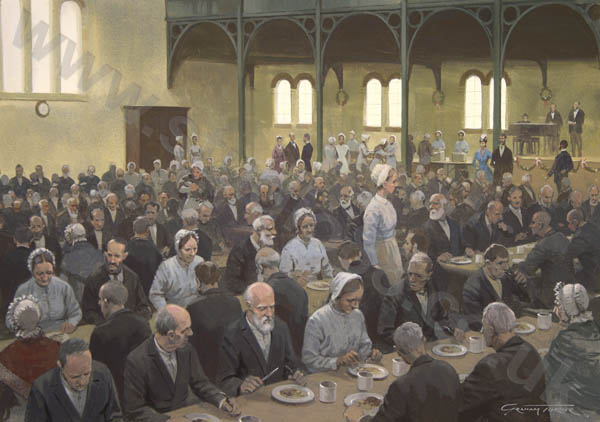
Households benefited by employing those from workhouses as domestic servants Frank Huggett in Life Below Stairs [Book Club Associates, London, 1977, pages 110-111] describes an 1871-72 investigation into the practice of taking girls from the workhouses. “[The investigation] showed that only 16 per cent of the girls were given good marks by their mistresses; 30 per cent were considered ‘fair’; 38 per cent were rated ‘unsatisfactory’; and 16 per cent were described as ‘bad.’ Although the workhouses claimed that the children were already trained for service, many mistresses found that, in addition to their other manifold faults, they were often totally lacking in domestic abilities. One ‘unsatisfactory’ girl was described by her mistress as ‘a pilferer, untruthful, idle; incorrigibly dirty in habits. Can scrub a floor, but has no other accomplishments.’ A comment on another child read: ‘Girl said she had never lit a fire or cleaned a grate, but as she never spoke the truth about anything, probably she lied there.’ A number were unsound in both body and mind: one ‘half-witted’ orphan was round-backed and unhealthy, with one eye permanently dimmed by disease. No less than 8 per cent of the girls had weak or seriously defective eyesight. Another girl, who was described as ‘strong in body, but deficient in mind,’ was told to sweep the bedroom. When her mistress returned, expecting to find the room neat and tidy, she found to her amazement and annoyance that the girl had trodden all the tea leaves firmly into the carpet.
image from the St Pancras workhouse at the turn of the century
“Lacking the security of a family, friends and home, these girls often reacted violently to any real imposition or imagined slight. One not unintelligent fifteen-year-old girl,whose father wad dead and whose mother was still living in a workhouse, would ‘sing like a bird’ at her work when she was in a good mood. But ‘when she took a fit of sulks, nothing could be done with her. She would fold her arms and stand behind the kitchen door, and absolutely refuse to do anything.’ Others howled and screamed their rage until a crowd gathered threateningly outside the house to the alarm of the mistress. Mistresses, who tested the girls’ honesty by leaving a coin under the carpet (a common stratagem in Victorian homes), often had their worst expectations confirmed. Some of the girls were violent. One threatened to stab the nurse; another broke a plate over the head of a fellow servant. About 8 per cent absconded and another 2.5 per cent were known, or believed, to have ‘fallen,’ joining the many other former servants who had sunk into the vast underworld of vice and crime in the capital. One girl, who left service to marry a £2-a week house painter, soon discovered that he was nothing but a pimp; another girl, who was dismissed for theft and violence, was later seen by the daughter of the house, walking along the street ‘with long curls down her back, and not looking respectable.’ It was amazing what some mistresses, obviously not uneducated, would put up with just in the hope of getting cheap domestic labour.”
There are tales of footmen who experienced criticism and mild taunts when they went about their master’s business. Even so, the footman became a sort of symbol of the division in society. Reports abound of street urchins throwing mud on their uniforms and white stocking. Some even reported those who attempted to prick the footman’s legs to see if he were wearing “falsies” to make his legs appear to have more muscular curves. Footmen also knew some disparagement from upper servants in the house.
However, many managed to develop a certain resplendence while out and about on their master’s business. In full dress livery, they wore white gloves and a hat, often set at a jaunty slant. Later in the century, they wore a top hat with a colorful cockade. In some houses, they also had an indoor livery that could include a dress coat with brass buttons stamped with the lord’s crest (rather than a tailed coat), pumps (instead of buckled shoes), and a white tie. The daily powdering of the hair was not a pleasure. The process involved a stiff lather produced with plenty of soap and water. The hair was combed so that their grooved (evenly spaced) lines in it to which the powder or flour was applied. At night, the footman had to wash his hair and add oil to fee it from the clogging detritus.
Footmen were chosen for their height (and for their handsome countenance, especially in the service of a lady’s household). The preference was six feet or taller. For each inch over six feet, the man was generally paid extra. In most households, footmen were matched in height. In that manner, none stood out from the rest. They were trained to perform as one, and they prided themselves on their presentation at a door when escorting their mistress about Town.
Typically, three footmen were required for the better households. The first footman served as the mistress’s footman. He prepared her early morning and breakfast trays, walked her dogs, cleaned her shoes, brushed the mud from her riding habit and hems of her dresses, and cleaned/scrubbed the silver coins to disinfect them after tradesmen handled them. The first footman served the meals at the master’s house. He accompanied his lady when she dined at another’s home without her husband. He stood behind her chair to increase the appearance of rank and status. He was often charged with the duty of paying toll gates, hired carriages, and postage, expense reimbursed to him by the house steward. He was ironically called “James,” no matter his Christian name.
Alfred Nugent, Footman – played by Matt Milne
The second footman assisted in preparing the table for the midday meal, and along with the first footman served the meals. He would occasionally be assigned the duty of acting as valet to the eldest son of the lord. He regularly cleaned all the mirrors in the house. (Think of all the mirrors Sir Walter had at Kellynch Hall in Jane Austen’s “Persuasion.”) Meanwhile, the third footman was responsible for carrying in the coal, wood, etc. His duties varied greatly.
Footmen traveled with the family carriage, no matter the weather or the time of day. He also cleaned the plate, a task he often shared with the under butler. This was a tiresome duty. Cleaning the gold or silver plate involved first sponging off the grease before the moistened plate powder was rubbed in (by hand). The longer the powder was rubbed, the greater the shine. Afterward, the powder was brushed from the surface, with special care given to the crevices of crests and ornamental work. Think of polishing the area between the prongs of a fork. Yes, that was part of the process.
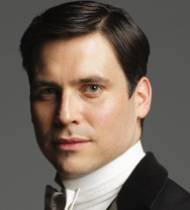
Rob James-Collier as Thomas Barrow
Footmen served a lengthy apprenticeship. Some used this training to apply for positions as valets or butler. (Were you thinking of Thomas Barrow in Downton Abbey?)
Resources:
James Fennimore Cooper, England, Bentley, 1837, Vol. 1, page 188.
Frank E. Huggett, Life Below Stairs: Domestic Servants in England from Victorian Times, Book Club Associates, 1977.
Thomas Webster. An Encyclopedia of Domestic Economy, Longmans, 1844, pages 330-331.
Previously, I introduce you to my novel, His Irish Eve. The events of that particular novel lead up to the hero and heroine being caught in the melee of the Peterloo Massacre. The year is 1819, and Adam Lawrence, Viscount Stafford, recognizes the need to leave the old ways of the aristocracy behind; however, his father, the Earl of Greenwall, is not so receptive to the changes sweeping across England after the Napoleonic Wars and on the edge of the Industrial Revolution. So, what exactly happened at St. Peter’s Field in Manchester?
A depiction of the Peterloo Massacre by Richard Carlile – Public Domain
On August 16, 1819, the Peterloo Massacre occurred at St. Peter’s Field in Manchester. A crowd of 60,000-80,000 gathered to protest the lack of parliamentary representation for the heavily populated industrialized areas.
With the end of the Napoleonic Wars in 1815, the Corn Laws exacerbated the famine of the Year without Summer (1816) and the growing unemployment problems. By the beginning of 1819 the pressure generated by poor economic conditions, coupled with the lack of suffrage in northern England, enhanced the appeal of political radicalism. In response, the Manchester Patriotic Union, a group agitating for parliamentary reform, organized a demonstration to be addressed by the well-known radical orator Henry Hunt.
Fearing the worst, local magistrates called on the military to dispense with the crowd. They also demanded the arrest of Hunt and the other featured speakers. The Cavalry charged the crowd with sabers drawn. In the melee, 15 people were killed and some 500+ were injured. The massacre was given the name Peterloo, an ironic comparison to the devastation found at the Battle of Waterloo. The Peterloo Massacre became a defining moment of the age. Unfortunately, the massacre’s immediate effect was the passage of the Six Acts, which labelled any meeting for radical reform as “an overt act” of treasonable conspiracy.
It also led directly to the foundation of The Manchester Guardian, but had little other effect on the pace of reform. In a survey conducted by The Guardian in 2006, Peterloo came second to the Putney Debates as the event from British history that most deserved a proper monument or a memorial. A plaque close to the site, a replacement for an earlier one that was criticized as being inadequate, as it did not reflect the scale of the massacre, commemorates Peterloo.
In 2018 for the 200th Anniversary, Peterloo was released. It written and directed by Mike Leigh, based on the the events of that day. The film received its UK premiere on 17 October 2018, as part of the BFI London Film Festival, at HOME in Manchester.The screening marked the first time that the festival had held a premiere outside London. Leigh said he was delighted that Peterloo would be premiered “where it happened”.
When the Earl of Greenwall demands his only son, Viscount Stafford, retrieve the viscount’s by-blow, everything in ADAM LAWRENCE’s life changes. Six years prior, Lawrence released his former mistress Cathleen Donnell from his protection, only to learn in hindsight Cathleen was with child. Stafford arrives in Cheshire to discover not only a son, but also two daughters, along with a strong-minded woman, who fascinates him from the moment of their first encounter.
AOIFE KENNICE, the children’s cousin and caregiver, is a woman impervious to Stafford’s masculine charms, as one of England’s most infamous rakes. In truth, Aoife is not as immune as she pretends, but she cannot imagine herself as the object of more than a flirtation on the part of the viscount. On balance, they are world’s apart: Aoife is daughter of a minor Irish baron and the opposite of her beautiful cousin Cathleen, who possessed all the skills to lure in a handsome viscount. To make matters worst, Aoife maintains the family’s a sheep farm to support Stafford’s family. A “lady,” Aoife is not.
A battle begins: A fight Adam must win–a fight for the heart of a woman worth knowing, his Irish “Eve.”
______________________________________
Excerptfrom part of Adam’s and Aoife’s struggles to reach safety during the melee known as the Peterloo Massacre. Adam planned to meet Aoife at the park and to propose transforms into a confrontation with soldiers and political reformation.
… Sheltering the children before her, Aoife held her ground against those who would push her from the way. Jonesboro cupped her with his body, absorbing the elbows and jabs rather than permitting her to suffer. She was most grateful for the kindness of his lordship’s valet.
Aoife wished she had never agreed to meet Lord Stafford at this program. All along, she sensed disaster lay dormant, just waiting to rear its ugly head. Early on, Aoife assumed her misgivings had to do with her parting from Lord Stafford; now, she held different ideas.
Apprehension ruled Aoife’s every thought as she surveyed the best way to maneuver the children from danger’s presence. She hoped that when the speeches started, the people would cease their jostling of others in order to listen, but that did not prove true. A quick look around solidified her resolve; fearing for the children’s safety, Aoife decided staying at the event would prove detrimental for all concerned.
Even if Lord Stafford made no appearance, Aoife would not wait to hear Hunt and Richard Carlile. Her intuition warned that something was not right; she could feel it in her gut.
* * *
Expecting any second to see them, Adam looked up and down the street, but even with all the children in the crowd, none of them were his.
“Where are they?” he mumbled and worriedly examined his watch again. Twenty past the hour – five minutes longer than Adam intended to wait. Turning on his heels, he started towards the gate before hearing a familiar voice call out. Adam turned to see his footman hurrying towards him.
“Ferguson!” He rushed to meet the man. “Where are Jonesboro and my family?”
The footman made a quick bow.
“By the stage, sir. Miss Kennice said the crowd was too large to bring the children through it.”
“By the stage?”
Adam’s eyes declared his panic.
“The authorities are sending soldiers to keep the peace.”
He was moving to the staging area with the others, pressing his way towards his family. Towards Aoife.
“Hurry, Ferguson, they are in danger.”
The crowd swallowed them as Adam led the way, an anxious dread filling his lungs as he squeezed between families and workers.
* * *
In concern, the crowd edged forward when the main speakers took to the stage. In addition to Henry Hunt, who was billed as the main speaker, Joseph Johnson, John Knight, and Richard Carlile moved to a position of authority upon the raised platform. In a counter maneuver, the constables, who formed two continuous lines between the hustings and some place along the street where people entered the park, pushed back in unison against the milling crowd.
To Aoife’s horror, those around her refused to move. The throng pressed Aoife, Jonesboro, and the children uncomfortably against the staging area.
Tempers flared and faded. Words of contempt and hatred exploded, and raised fists accented the anger. As a murmur of discontent rose from those around her, Aoife pulled the children closer. She bent to whisper to Daniel.
“If I tell you to move, I want you to take the girls and hide under the speaker’s stand.”
“Yes, ma’am.”
The boy’s eyes grew in size.
“The crowd is too large, but we must wait for Lord Stafford.”
She held no desire to frighten the boy, but Aofe thought it necessary for him to be aware of what occurred him.
“Stay close, children,” she warned, standing again to survey the onlookers, protecting Lord Stafford’s children – her children, really –b y closeting them close to her legs, her arms draped over the girls’ shoulders.
* * *
Adam cut a direct course to where Aoife reportedly stood, but the special constables shoved all comers away, including him. He thought of arguing, reminding these locals he was part of the aristocracy, but he had no time for reason, only for action.
“This way,” he called to Ferguson as they circled around the edge of the crowd, in order to penetrate the line.
When the speakers took the stage, the open space separating onlookers shrank dramatically. Adam squeezed between a man and his wife, offering words of apology as he went. His mind rested purely on the danger, which surrounded them.
He overheard one of the constables grumble, “Nadin is crazy if he thinks I am going to arrest Hunt before all these people. It would be suicide.”
The words spurred Adam to double his efforts, but no matter what he did, he could not escape the growing crowd surrounding him. People pressed him, choking every point of entry or exit –extinguishing his hopes of reaching Aoife before trouble began.
“Your lordship!”
Ferguson caught his shoulder, staying Adam’s progress.
“Look.”
Adam turned his head sharply in the direction Ferguson pointed.
“Oh, my God!”
The words exploded. From the direction cleared by the constables, yeomen entered the area from Portland Street, sabers drawn against those who locked arms, closing the pathway created by the constables. As the yeomen breached the line of onlookers, Adam surged through the opening with Ferguson close on his heels.
* * *
Aoife noted the soldiers when they entered the field. Only moments before, yeomen pushed through the crowd. The one closest to her, when he passed, reeked of alcohol and sweat and fear.
Unfortunately, the spectators reacted before Aoife could do anything to protect the children. The peaceful crowd of a few minutes prior took offense at the authority’s intrusion and set up a wall of people to protect the speakers. Standing shoulder to shoulder, the lookers-on dared the irrational yeomanry to make a move in the direction of the crowd’a “exulted” guests. The column, which created earlier by the constables, collapsed around the intruders, and pure chaos broke loose.
In terror, Aoife watched as the yeomanry pulled their sabers and hacked away at those closest to them.
“Disperse them!” someone behind her ordered.
“Aoife!” Elaine’s sweet voice held real urgency.
“I have you, Poppet.”
She caught the child around the waist and pushed her under the raised dais. Meanwhile, Jonesboro shoved Daniel and Aileen in the same direction.
“Work your way towards the center, and do not come out until I tell you to,” Aoife urged.
“Ma’am?” Daniel questioned.
“It shall be well, Daniel.”
Aoife squeezed the child’s hand and then shoved his head low so he could follow his sisters into the maze of wooden supports bracing the raised platforms. She saw him catch Aileen’s hand to lead his sisters away from the melee.
Frightened, Aoife turned frantically to look where Jonesboro now tussled with a local law officer. Officers struck onlookers indiscriminately.
“Leave him alone,” Aoife charged forward, hands on her hips, taking an authoritative stance.
Without thinking, the officer swung his arm around as he tried wrestled Jonesboro to the ground. His upper arm caught Aoife on the butt of her chin, knocking her backward, sending her sprawling in a very unladylike “thump” to the hardened earth.
Shaking her head to clear it, Aoife rolled onto her side to right herself, pulling her knees up under her to fight her way to her feet again. Looking about her, she spotted the officer, who held Jonesboro in a strangle hold and who dragged his lordship’s valet away from where Aoife waited. A distinctive strangled sound filled her with fear. Acting instinctively, Aoife covered the short distance to launch herself at the officer, jumping on the man’s back and pummeling him with her fists.
“Release him!” she screamed.
* * *
To Adam’s perturbation, a mounted officer charged into the fracas surrounding him.
“No!” Adam yelled, freezing those around him in a terrible tableau. However, the officer continued his assault. The man struck the woman who blocked his way: the baby she held flying from her arms. The child’s blanket unfurled, giving the impression of the infamous tales of flying carpets, and then the tiny body, suspended momentarily, crashed violently to the ground. A thud, which Adam felt in his bones as he bent to scoop the babe’s form from the ground. His heart pounded in his ears, as the broken frame hung loosely in his grasp. The child’s thin arms sagged without life at its side.
The woman rushed forward to snatch the child from Adam’s hold. Wailing disconsolately, she sank to her knees, tears streaming down her face as she clutched the baby to her breast. Adam reached for her, desperately wishing to offer his comfort, but his footman’s voice stayed his actions.
“Come!” Ferguson urged as he grabbed Adam’s arm.
Looking about a bit unhinged, Adam realized his goal remained unearned. Staggering to his feet, he spun toward the stage. Horror-stricken, he could see Aoife across the field, a hundred yards away.
With the popularity of Upstairs, Downstairs and Downton Abbey, the populace has become more aware of the British servant class. So what do we know of those who lived “below stairs”? First, rank and precedence ruled those of the servant class as much as it did their masters. What was known as the “pugs procession” was commonplace among servants. Instead of the chatty scenes between upper and lower servants on Downtown Abbey, most household were ruled by “silence.” All the servants would take their dinner together in the servants’ hall, but then the upper servants (the house steward, the butler, and the housekeeper) would move to a private sitting room for their dessert.
Being neither seen nor heard would be the order of the day. It was not unusual for maids to turn and face the wall if she encountered her master or mistress in the passageways. The upper housemaids were responsible for the appearance of the rooms. They addressed the draperies, the floral arrangements, the chair covers, etc. The under housemaids did the physical duties of laying a fire, polishing, cleaning the grates, etc. In Letters from England, Elizabeth Davis Bancroft, the wife of the U.S. Minister to England (1846-49), wrote, “The division of labour, or rather ceremonies, between the butler and the footman I have now mastered, I believe in some degree, but that between the upper and under housemaid is still a profound mystery to me, though the upper has explained to me for the twentieth time that she did only ‘the top of the work.”
Richard Henry Dana, son of the author of Two Years Before the Mast, spoke of a similar demarcation of duties in his Hospitable England in the Seventies. Dana had been invited to spend some time with Earl Spencer at Althorp. He and Lord Charles Bruce wished to play some lawn tennis, but they could find no one to whitewash the court’s markings in the grass. It seems that the job belonged to the “man-of-all-work,” but the servant was no where to be found. Dana said, “Neither the gardener, nor the footmen, nor the valets, nor the bootblacks nor, of course, the maids would help. Our hostess knew this so well that she did not even ask them.”
Servants did receive certain “compensations” for their service. They had a roof over their heads and four full meals per day – breakfast, dinner, tea, and supper. If they were enterprising enough, they could also have the remains of the masters’ meals. They received either a pint of home brewed beer (half pint for women) with each meal or a beer money allowance, usually 8d per day. The upper servants often were provided with wine for their meals. Wages were paid quarterly. Except for clothing, servants had few expenses, and a wise servant could save enough for a nest egg, to start a small business, or assist his struggling family. Loyal servants received pensions of £20 to £25. Smart upper servants could “earn” extra funds from tradesmen seeking the master’s business. The cook, traditionally, claimed the roast’s drippings as her own. The butler and footmen laid claimed to the candle butts. A smart butler might siphon off some of the master’s wine stock, either a decanter at a time or a whole bottle.
In “Life Below Stairs” by Frank Huggett, there is a list of wages (1888) from the records of the Duke of Richmond and Gordon paid out to the duke’s servants for a year’s service:
the house steward £100
the groom of the chamber £70
the valet, the housekeeper, and the cook £60 each
the butler £45
the footmen £26 to £34
the ladies’ maids £26 to £28
the stillroom maid £22
the kitchen maids £14 to £24
the housemaids and laundry maids £12 to £26
the scullery maid £12
Servants also EXPECTED to receive a tip from the master’s guests. A guest would be leave a half-sovereign for the housemaid in honor of the condition she maintained his quarters, a sovereign for the groom of the chambers for lighting the candles each evening, likewise a sovereign for the butler for his personal advice and favors and a footman who acted as valet to a gentleman traveling without his personal servant. A guest might also tip the gamekeeper, etc. etc., etc. The list could easily grow to a tidy sum. Even visitors making tours of great estates were expected to tip the housekeepers guiding their tours.
And Heaven help the guest who did not meet his obligations. Upon his next visit, he might be housed in a drafty chamber or find his cut of meat the least desirable ones.
Taming Lord Truist: Book 2 of the Strong Regency Women Duo
“The very first moment I beheld him, my heart was irrecoverably gone.” – Jane Austen
Miss Eleanor Wilder has admired Lord Augustus Truist since she was a young girl. He had once protected her from an older boy who had meant to strike her. Now, she requires his protection again: This time, it is from her guardian, a cousin who means to marry Eleanor off to a man more that twice Ella’s age in order to keep Eleanor’s fortune in the family. As she will soon be one and twenty, Eleanor must convince Lord Truist to marry her himself, rather than see all her fortune go to a ne’er-do-well.
Lord Truist must save his family from disgrace and a touch of poverty by marrying an heiress of whom his mother approves, but he finds repugnant. However, when Miss Wilder offers him her fortune with no strings attached—a marriage of convenience—how can he refuse? As his countess, the lady would have the protection she required, and he would have the freedom to enjoy his long-time mistress, Miss Sarah Darling, without complaints.
How was he to know that the new Lady Truist not only loved him but was quite perfect in ways he did not realize he required?
When I first purchase the cover image for Taming Lord Truist, I asked the designer London Montgomery Covers for a few changes. I have used more than a dozen covers from this designer and highly recommend his work. For this one, though, I required a tweak. Though I liked the female model, there was a modern skyline at the bottom (think a New York City style skyline). Therefore, I asked that something from the Regency era be used instead. I also asked that the pierced earrings be removed, but earrings are not the topic of today’s post, but rather the Tower of London.
In my story, as a birthday celebration, Lord August Truist takes his new wife to the Tower. Now, that might not sound so romantic, but, you see, Eleanor’s London experience is VERY limited. His brother and sister accompany them, and they all decided to be “London tourists,” not residents.
The Tower of London has stood for more than 900 years. It has served as a royal residence, a prison, a fort, and a tourist attraction. The last state prisoner to be held in the Tower, Rudolf Hess, the deputy leader of the Nazi Party, in May 1941. The last person to be executed in the Tower, Josef Jakobs, Nazi spy, shot by a firing squad on 15 August 1941. The last people to be held in the Tower, the Kray twins. They were members of organized crime syndicate and were arrested in 1968.
However, did you know that for more than 600 years there was a famous menagerie housed within the tower’s walls. It housed ostriches and elephants and lions and polar bears and many more exotic animals. The Constable of the Tower, no other than the Duke of Wellington, dispatched the Royal Menagerie from the Tower to an area of Regent’s Park in December 1831. The Menagerie closed for good in 1835, with many remaining animals sold to other zoos or travelling circuses.
Some amusing facts about the Tower of London and its exotic animals:
King John was the first ruler to bring animals to the Tower of London. He established a menagerie near the western entrance to the tower. That would have been around the year 1200.
Lion keepers were hired around 1210. These lions were said to be Barbary lions, which are now on the extinction list. The Barbary lion was a population of the lion subspecies Panthera leo leo. It was also called North African lion, Atlas lion and Egyptian lion. It lived in the mountains and deserts of the Maghreb of North Africa from Morocco to Egypt. It was eradicated following the spread of firearms and bounties for shooting lions.
Sultan, a Barbary lion in the Bronx Zoo, 1897 ~ Public Domain ~ Wikipedia
The first lion keepers were employed around 1210. Henry III received three “leopards” from Holy Roman Emperor Frederick II in an offer to strengthen diplomatic ties. These leopards were likely Barbary lions, for they were supposedly an homage to Richard III’s coat of arms.
Henry III “started” the Tower of London zoo. At that time, only the privileged guests were permitted to view the king’s collection of animals.
Edward I, in the 1270s, moved the menagerie to the front entrance of the Tower, so all those coming and going (including prisoners) received a large dose of fear at the paws of roaring lions and stamping elephants.
King Haakon IV of Norway sent Henry III a polar bear to join the other exotic animals at the Tower. Henry III was not best pleased to learn how expensive it was for the feed and care of a polar bear. Ordinary citizens were permitted access to view the polar bear as the animal was permitted to “fish” in the River Thames, and he was often viewed by people along the bank.
In 1255, an elephant was brought to London from the Holy Land and the Crusades. People were stunned to touch its rough skin/hide.
Henry III instituted a tax on Londoners so he might have a large “house” built to contain the elephant. Yet, the elephant did live to see the habitat created, for his foolish handlers did not realize an elephant is not a carnivore. Moreover, they gave it a gallon of wine wine to drink each day. After all, something belonging to the king could not be expected to drink plain water.
Hearing of the mismanagement of the first elephant, in 1623, the Spanish king. Philip IV, sent another elephant, but with strict instructions that the animal could only be given wine from September to April of each year.
Under Elizabeth I’s reign, people would be admitted free to the exhibit if they brought a dog or a cat to feed to the lion.
In both my novella, “Lord Fearghal’s English Bride” (part of the Regency Summer Weddings Anthology) and my upcoming release of “Taming Lord Truist: Book 2 of the Strong Regency Women Duo,” my characters leave England to travel to and through Ireland. However, as I soon learned when conducting research to support my tales, reaching Ireland was one thing. Traveling through it was another.
To begin, one must recall these stories were both set before the age of steam (first introduced in 1819). This was a time when traveling from London, England, to Dublin, Ireland, was a week’s journey, at a minimum. There were four main ports along the English/Welsh/Scottish borders to the Atlantic Ocean and the Irish Sea where people could make the journey to Ireland. (1) In England, one could board in Bristol and travel to Cork City (which I will give more information on below, for that was not as easy as one might think); (2) One could travel from Liverpool, England, to Dublin, Ireland; (3) One could also travel to Dublin from Holyhead in Wales; or, finally, (4) One could travel from Port Patrick in Scotland to Donaghadee in County Down, Ireland.
The crossing itself could take 16 to 20 hours on an average, for the passage was entirely dependent on the weather. Some ships even turned back because of the unpredictability of the weather. Upon more than one occasion, a ship found itself setting becalmed in the waters for a day or more and waiting for favorable trade winds. Those who traveled from Bristol to Cork City often also encountered French or Spanish privateers.
Originally, I thought it would be easier to send my characters through Cork City, for I knew something of the modern day harbor. I was wrong. Completely wrong. The Port of Cork is situated at the south western end of the island. Cork Harbour is situated in the centre of the southern seaboard facing south to the Atlantic. In the 17th C, the Port of Cork was seen “as a distribution centre for its hinterland by trans-shipment. (Patrick Flanagan, “The Cork Region, c.1600-c.1900,” Perspectives on Cork, Special Publication No. 10 (Dublin Geographical Society of Ireland, 1998, pg. 3)
In 1800, Cork Port was unregulated as regards to shipping and had no port authority to oversee it. Instead, it was controlled by the Cork Corporation, a municipal authority. It was in a poor state of maintenance and was in urgent need to of repair. “In 1813 (when my stories are set), only small vessels drawing 11 feet of water [could] enter Cork city during high water on berthing at Cork had to be aground on a gravel bottom to discharge. The lower harbour was only three feet deep in places and large vessels had to unload cargo onto lighters. All of this added to the time and cost of vessels visiting the port. (Patrick J McCarthy, “An Economic History of the Port of Cork: 1813-1900,” unpublished M. EconSc. thesis (Cork: University College Cork, 1949) 12-13).
In 1813, the Butter Weighhouse Act was passed to improve the harbour and river of Cork. One-third of the fees received by the Weighmaster from the butter trade in the city went to a commission made up of 21 merchants of the city to improve, deepen and widen the port’s accessibility. In 1814, the “Cocket and Entry Tax Act (also known as “The Commercial Buildings Act”) was imposed as another form of revenue. It was a tax on customs documents, rather than the value of the goods. The Cork Harbour Act did not come about until 1820. (Mary Lantry, “The Cocket Tax in Cork: A Tax in the Context of its Time and Place,” unpublished MA thesis, Cork: University College Cork, 2018)
Taming Lord Truist: Book 2 of the Strong Regency Women Duo
“The very first moment I beheld him, my heart was irrecoverably gone.” – Jane Austen
Miss Eleanor Wilder has admired Lord Augustus Truist since she was a young girl. He had once protected her from an older boy who had meant to strike her. Now, she requires his protection again: This time, it is from her guardian, a cousin who means to marry Eleanor off to a man more that twice Ella’s age in order to keep Eleanor’s fortune in the family. As she will soon be one and twenty, Eleanor must convince Lord Truist to marry her himself, rather than see all her fortune go to a ne’er-do-well.
Lord Truist must save his family from disgrace and a touch of poverty by marrying an heiress of whom his mother approves, but he finds repugnant. However, when Miss Wilder offers him her fortune with no strings attached—a marriage of convenience—how can he refuse? As his countess, the lady would have the protection she required, and he would have the freedom to enjoy his long-time mistress, Miss Sarah Darling, without complaints.
How was he to know that the new Lady Truist not only loved him but was quite perfect in ways he did not realize he required?
If you have not yet read Loving Lord Lindmore: Book 1 of the Strong Regency Women Duo, it is on sale on Amazon for only $0.99 until August 16. Grab it for this weekend and be ready for Taming Lord Truist on Monday.
Loving Lord Lindmore: Book 1 of the Strong Regency Women Duo
LADY CORA TAKES SOCIETY BY STORM . . .
Lady Cora Midland, a highly-spirited country beauty, offers no pretensions, which wins many admirers, despite her lack of knowledge on how to manage the beau monde. However, Matthew Harrington believes she is taking advantage of his elderly grandmother, and he means to put a stop to the girl.
LORD MATTHEW LINDMORE IS IN DENIAL . . .
Lindmore reluctantly assists his grandmother in bringing Lady Cora out in Society. Yet, what appeared to be a daunting task becomes a transformation the earl does not expect. He finds the woman as delightful, as do others in the haut ton. Yet…
When Lady Cora is on the the verge of marrying another, Lindmore fears time will expire before he can speak his own proposal.
GIVEAWAY: I have 5 eBook copies to give away to those who comment on any or all the promotional posts for TAMING LORD TRUIST‘s release. The eBooks will be presented on August 12, the release date.
Since the first of the year, I have written two stories in which Regency era Ireland plays a role. The first of those was a novella entitled “Lord Fearghal’s English Bride,” which was part of the Regency Summer Weddings Anthology.
Lord Fearghal’s English Bride
HERS WAS A CONVENIENT ARRANGEMENT
Lady Claire Waterstone has spent more years out of England than she has enjoying English society. In fact, she feels very odd in making her Come Out with girls four to five years her junior. Claire has never known a “home” of her own. And while several gentlemen are eager to claim her hand, she knows their ardor has more to do with the size of her dowry than true affection. Then she encounters Lord Ainmire Fearghal, an impoverished Irish earl, whose tales of how he sees his land creates in her a desire to share it with him. Claire, therefore, abandons decorum and proposes to Lord Fearghal. However, his roguish charm soon has her wishing for more than a marriage of convenience.
HE BARGAINED FOR HER FORTUNE, NOT HER HEART
Fearghal has only one purpose in marrying Lady Claire: Save his estate. Melhman Manor reeks from inherited debt, and Fearghal requires a wealthy wife immediately. Originally, he thought to leave Claire in London, but his wife soon puts an end to those thoughts, but when she suggests Ainmire’s cousin could be working against Ainmire’s efforts to save his land, Fearghal and Lady Claire strike a different type of bargain – one based in trust and loyalty and the beginnings of love
In Taming Lord Truist, the heroine’s parents, though having lived in England for many years, also had an estate in Ireland, where Lady Eleanor Truist retreats without telling her husband where she is going. I shan’t explain the necessity of her action, for that is a major plot point, but Eleanor chooses to return to an area close to Clogheen and Tubrid.
Clogheen lies in the Galtee-Vee Valley with the Galtee Mountains to the north and the Knockmealdowns in close proximity to the south. The River Tar runs through the village. The first substantial records of the village date from the Cromwellian period, but the village did not come to note until the 18th and 19th centuries. It then became a local centre of trade and commerce. The village takes its modern form from the 19th century with a wide area that was formerly the Market Square (and still named so) and a number of townhouses in the Georgian style. Cloghee sets about 50 miles from Cork City.
Tubrid or Tubbrid was formerly a civil and ecclesiastical parish situated between the towns of Cahir and Clogheen in County Tipperary, Ireland. A cluster of architectural remains at the old settlement still known as Tubrid includes an ancient cemetery and two ruined churches of regional historical significance.
According to Power, the parish derives its name from the well (Tobraid Chiaráin) at which St. Declan (“Declan” is the surname for two of the characters in the book) baptised a local infant named Ciaran, who in time became a noted holy figure. It was said of Ciarán (Ciaran Mac Eochaidh) that he founded a monastery in the locality and that:
He worked many miracles and holy signs and this is the name of his monastery Tiprut [Tubrid] and this is where it is:–in the western part of the Decies in Ui Faithe between Slieve Grot (Galtee) and Sieve Cua and it is within the bishopric of Declan.
This holy well near the site, was in previous times a place of pilgrimage. St. Ciaran is remembered in the name of the church at Ballylooby. There was also, until recent times, an annual mass celebrated at this location. To the front of the site is the former local schoolhouse which was completed soon after the construction of St. John’s and is in danger of falling into a dilapidated condition. [That schoolhouse has its fictional beginning in this story.]
Taming Lord Truist: Book 2 of the Strong Regency Women Duo
“The very first moment I beheld him, my heart was irrecoverably gone.” – Jane Austen
Miss Eleanor Wilder has admired Lord Augustus Truist since she was a young girl. He had once protected her from an older boy who had meant to strike her. Now, she requires his protection again: This time, it is from her guardian, a cousin who means to marry Eleanor off to a man more that twice Ella’s age in order to keep Eleanor’s fortune in the family. As she will soon be one and twenty, Eleanor must convince Lord Truist to marry her himself, rather than see all her fortune go to a ne’er-do-well.
Lord Truist must save his family from disgrace and a touch of poverty by marrying an heiress of whom his mother approves, but he finds repugnant. However, when Miss Wilder offers him her fortune with no strings attached—a marriage of convenience—how can he refuse? As his countess, the lady would have the protection she required, and he would have the freedom to enjoy his long-time mistress, Miss Sarah Darling, without complaints.
How was he to know that the new Lady Truist not only loved him but was quite perfect in ways he did not realize he required?
There was a soft tap on the door of her hotel room in Cork. Yet, Eleanor did not open it immediately. Instead, she said, “Yes?”
“It’s Sean Declan, Mrs. Banks. Me uncle in London sent word to meet you here.”
Eleanor released the lock and opened the door to the man. “Thank you for coming.”
“My condolences regardin’ the passin’ of yer father. Many of us be surprised to learn of yer loss. Aidan Wilder be a good man.”
Eleanor nodded her gratitude. “I pray you may see me safely to my father’s former house near Tubrid.”
“This time of year will be wetter than we might like. By horse be best. Easier than the Old Cork Road going towards the west.”
“I had considered such would be true,” she admitted.
“It be easier than coming in at Waterford where it be more mountainous, and, perhaps even an early snow.”
“I pray you may return for supplies for those upon my father’s estate. I would have you choose items now, but my fortune will only go so far, and I wish to address the more critical needs first.”
Remarkably, Mr. Declan smiled. “You’ll do well, Mrs. Banks. I be confident those on Wilder land will be glad for your coming. Dare I ask of Mr. Banks?”
“You may not,” she said with a lift of her chin in challenge.
“Yer business, ma’am,” Mr. Declan said with a nod of acceptance. “Might’n we depart on Monday morning? Expectin’ fair weather for the next few days, but I must arrange for the horses and perhaps a mule to tote your trunks.”
They discussed the specifics of their journey. Then Mr. Declan left her for the evening. Closing the door behind the man, she said with tears forming in her eyes, “I did not think it would be done so quickly, August. However, how shall I be done with how much I love you?”
If you have not yet read Loving Lord Lindmore: Book 1 of the Strong Regency Women Duo grab yourself a copy while you may. It is only $0.99 until August 12, 2024.
LADY CORA TAKES SOCIETY BY STORM . . .
Lady Cora Midland, a highly-spirited country beauty, offers no pretensions, which wins many admirers, despite her lack of knowledge on how to manage the beau monde. However, Matthew Harrington believes she is taking advantage of his elderly grandmother, and he means to put a stop to the girl.
LORD MATTHEW LINDMORE IS IN DENIAL . . .
Lindmore reluctantly assists his grandmother in bringing Lady Cora out in Society. Yet, what appeared to be a daunting task becomes a transformation the earl does not expect. He finds the woman as delightful, as do others in the haut ton. Yet…
When Lady Cora is on the the verge of marrying another, Lindmore fears time will expire before he can speak his own proposal.
GIVEAWAY: I have 5 eBook copies to give away to those who comment on any or all the promotional posts for TAMING LORD TRUIST‘s release. The eBooks will be presented on August 12, the release date.




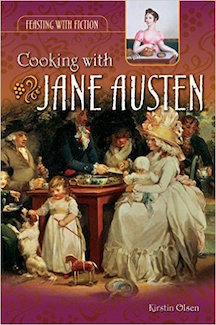 Beyond their wages, many upper servants found means to line their pockets without their masters’ knowing. House stewards would secretly give tradesmen a “cash discount” for the privilege of continued business with the household. The butler, cook, and housekeeper customarily found similar compensations in the purchases made for the household over which they saw. A butler, for example, could claim his share of the wine purchased for the master’s use. A cook might claim the meat drippings to be sold. In Cooking with Jane Austen by Kirstin Owen (page 90), we find, “Emma’s father was a bit daft about one thing though, and that is the frying of anything in the Regency period ‘without the smallest of grease.’ Steaks of all kinds were fried in large quantities of butter – partly to keep them from sticking to the pan, partly for the sake of the flavor, and partly for the sake of the cook, whose perquisites included the right to sell the dripping fat. The more butter she used, the more was ‘left over’ in the pan, and the richer she got.” The groom of the chamber could claim the ends of the candles to resell. Moreover, the taking of “vails” (or tips from guests) became a common practice.



 In some households, a single servant served in the role of maid-of-all work. Generally, this servant was a girl from the age of twelve to fifteen. The conditions of the work were poor, with the girl often working from 5 A.M. to midnight for a wage of £6 to £9 per year. In James Fennimore Cooper’s Gleanings in Europe: England (Bentley, 1837, Vol.II, page 123), the author says: “These poor creatures have an air of dogged sullen misery that I have never seen equalled in any other class of human being, not even excepting the beggars in the streets.” He described one such slavey who entered a room with “a sort of drilled trot, as if she had been taught a particular movement to denote assiduity and diligence, and she never presumed to raise her eyes to mind, but stood the whole time looking meekly down. [Find a copy of the book
  Households benefited by employing those from workhouses as domestic servants Frank Huggett in Life Below Stairs [Book Club Associates, London, 1977, pages 110-111] describes an 1871-72 investigation into the practice of taking girls from the workhouses. “[The investigation] showed that only 16 per cent of the girls were given good marks by their mistresses; 30 per cent were considered ‘fair’; 38 per cent were rated ‘unsatisfactory’; and 16 per cent were described as ‘bad.’ Although the workhouses claimed that the children were already trained for service, many mistresses found that, in addition to their other manifold faults, they were often totally lacking in domestic abilities. One ‘unsatisfactory’ girl was described by her mistress as ‘a pilferer, untruthful, idle; incorrigibly dirty in habits. Can scrub a floor, but has no other accomplishments.’ A comment on another child read: ‘Girl said she had never lit a fire or cleaned a grate, but as she never spoke the truth about anything, probably she lied there.’ A number were unsound in both body and mind: one ‘half-witted’ orphan was round-backed and unhealthy, with one eye permanently dimmed by disease. No less than 8 per cent of the girls had weak or seriously defective eyesight. Another girl, who was described as ‘strong in body, but deficient in mind,’ was told to sweep the bedroom. When her mistress returned, expecting to find the room neat and tidy, she found to her amazement and annoyance that the girl had trodden all the tea leaves firmly into the carpet.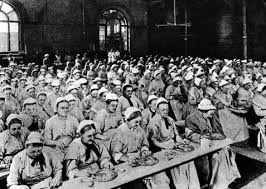
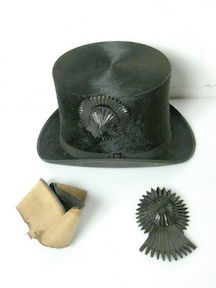
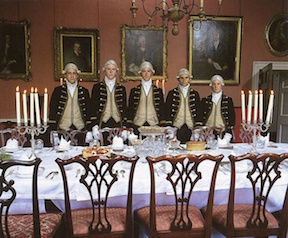 Typically, three footmen were required for the better households. The first footman served as the mistress’s footman. He prepared her early morning and breakfast trays, walked her dogs, cleaned her shoes, brushed the mud from her riding habit and hems of her dresses, and cleaned/scrubbed the silver coins to disinfect them after tradesmen handled them. The first footman served the meals at the master’s house. He accompanied his lady when she dined at another’s home without her husband. He stood behind her chair to increase the appearance of rank and status. He was often charged with the duty of paying toll gates, hired carriages, and postage, expense reimbursed to him by the house steward. He was ironically called “James,” no matter his Christian name.


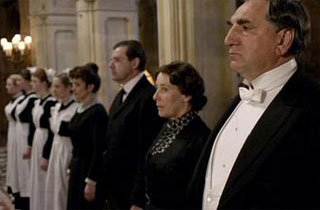
 Being neither seen nor heard would be the order of the day. It was not unusual for maids to turn and face the wall if she encountered her master or mistress in the passageways. The upper housemaids were responsible for the appearance of the rooms. They addressed the draperies, the floral arrangements, the chair covers, etc. The under housemaids did the physical duties of laying a fire, polishing, cleaning the grates, etc. In Letters from England, Elizabeth Davis Bancroft, the wife of the U.S. Minister to England (1846-49), wrote, “The division of labour, or rather ceremonies, between the butler and the footman I have now mastered, I believe in some degree, but that between the upper and under housemaid is still a profound mystery to me, though the upper has explained to me for the twentieth time that she did only ‘the top of the work.”
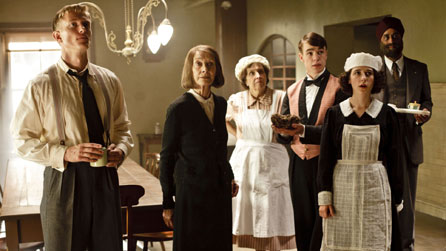 Servants also EXPECTED to receive a tip from the master’s guests. A guest would be leave a half-sovereign for the housemaid in honor of the condition she maintained his quarters, a sovereign for the groom of the chambers for lighting the candles each evening, likewise a sovereign for the butler for his personal advice and favors and a footman who acted as valet to a gentleman traveling without his personal servant. A guest might also tip the gamekeeper, etc. etc., etc. The list could easily grow to a tidy sum. Even visitors making tours of great estates were expected to tip the housekeepers guiding their tours.







 Every Woman Dreams...


