
This article comes from NPR. It addresses the changing role of traditional publishing. This article matches up well with the one from yesterday on the increase in eBook reading among Americans.
E-Books Destroying Traditional Publishing? The Story’s Not That Simple
by ZOE CHACE
What counts as a book these days, in a world of Kindles, Nooks and iPads — and eager talk about new platforms and distribution methods?
Traditional publishers are traveling a long and confusing road into the digital future. To begin with, here’s the conventional wisdom about publishing: E-books are destroying the business model.
People expect them to be cheaper than physical books, and that drives down prices. But the story’s not that simple. For one thing, digital publishers have the same problem that record labels do: piracy. And there’s just not the same stigma attached to pirating an e-book as there is to holding up a Barnes & Noble.
It turns out, though, that some publishers are doing pretty well despite the piracy problem. “We’ve had an incredible year,” says Sourcebooks President Dominique Raccah. “Last year was the best year in the company’s history. This year we beat that, which I didn’t think was even possible.” Raccah adds that her company is doing well because of digital publishing, not in spite of it. “It’s been an amazing ride,” she says.
It turns out there are some huge advantages — at least for publishers. A big one: The price of an e-book isn’t fixed the way it is with physical books. Ten years ago, a publisher would have sent out its books to the bookstore with the price stamped on the cover. After that, it was done — the publisher couldn’t put it on sale to sell more books.
To continue reading, please visit http://www.npr.org/2012/12/27/168068655/e-books-destroying-traditional-publishing-the-storys-not-that-simple One can even listen to the story rather than read it.


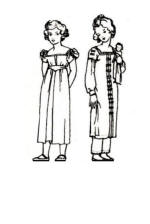
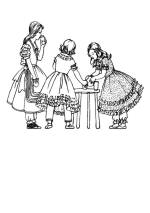
 A governess’s job was to teach the children of middle and upper class households in 19th Century England. By 1850, there were 21,000 governesses registered in England. In Charlotte Bronte’s Jane Eyre, our heroine places the following advertisement, which eventually lands her the position at Thornhill Hall: A young lady accustomed to tuition is desirous of meeting with a situation in a private home where the children are under fourteen. She is qualified to teach the usual branches of a good English education, together with French, Drawing, and Music.” The governess would remain in the household until the children departed for school or, in the case of young ladies, made her Come Out.
 Being neither family nor servant, the governess spent a lonely lifestyle. Unfortunately, a large number of governesses had no family of their own to visit when given a rare holiday or from whom to receive a letter to ease the hours of isolation. Of course, in romance novels, the governess often attracts the attentions of the younger sons, or in Jane Eyre’s case, the master’s eye. For every “Jane Eyre,” there were likely many governesses who succumbed to the attentions of the households’ most seductive gentlemen. Affairs were more commonplace than we would like to think.
 Expectations placed on young people of the aristocracy and the gentry were quite high. A young man was “expected” to make a match that would bring wealth or position to his family name. First, a gentleman was often several years older than his potential mate. For example, Fitzwilliam Darcy is eight and twenty years of age, while Elizabeth Bennet is twenty. In fact, Elizabeth and Jane Bennet are very close to being “on the shelf.” Girls made their Society debut at age sixteen. Gentlemen at age one and twenty. Several logical reasons affected these unspoken rules of courtship. For example, childbirth was a difficult time for women. Dangers were aplenty. It was believed that a young wife could withstand the need to produce the necessary “heir and a spare.” For the gentleman, twenty-one was the age at which a man could enter a contract without his father’s permission. One must recall that an engagement required a written contract during the Regency Period. Men without financial prospects often waited to marry in order to establish their careers and earn enough money to support a wife and children. Therefore, it was not uncommon for a man to marry at age 30 and for his wife to be between 16 and 20 years of age.
 Actually, the first time most couples were alone was during the actual proposal. Engagement rings were not necessarily given as a symbol of the lady’s acceptance. A woman’s power of refusal was her only control in the situation. Henry Tilney says as such in “Northanger Abbey.” Rarely did a woman refuse the proposal (except in the case of Elizabeth Bennet with both Mr. Collins and Mr. Darcy). If one recalls, Mr. Collins points out that Elizabeth is not likely to receive another proposal if she refuses him. Occasionally, a woman would break the engagement, but it was frowned upon for a gentleman to break the engagement. Society’s disapproval of his breaking the engagement is why Edward Ferrars keeps his word to Lucy Steele in “Sense and Sensibility.”


 Every Woman Dreams...