Paying for Postage in the Regency: Distance Times the Number of Enclosures, as Well as Something of “Sombre Statements”

This is a follow up question regarding the one from last Friday, 7 March 2025, regarding posting a letter during the Regency Era. This one is about “Post Offices.”

Question: If someone was to send a letter from Cornwall in our time period, would a) there have been any regular postal service from there or would they have to send it by personal messenger and b) was there special funeral stationary to write on or is that a Victorian convention and c) would you put a return address on the outside of the letter?

Postal delivery started improving about 1760 or so. After 1784, country areas had three deliveries and two collections, with deliveries sent out from London by horse messenger to the receiving houses. So even in the wilds of Cornwall there would be great postal service. No return address is ever put on the letter. And the address/directions to where it is going might be as simple as the person’s name, and either the house name or the village (or city). No numbers even. The person who received the letter paid for it in general (but one could pre-pay and the letter would be stamped as such.

Postage was based on the number of miles the letter traveled from point A to point B and the number of sheets of paper used. The paper that one folded and sealed was one item. Even one tiny slip of paper inside counted as a second item, doubling the cost. Recipients paid, rather than the sender of the letter. Naturally, the person receiving the letter could refuse it and send it back to the sender.

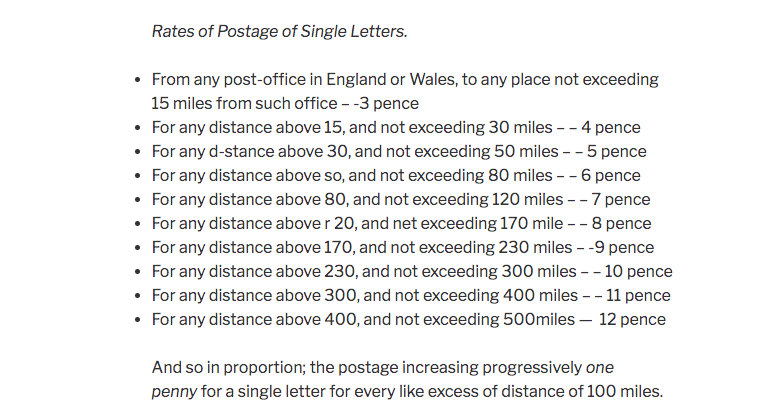
These were the going rates for a single page: fourpence for the first fifteen miles, eightpence for eighty miles, etc., etc., up to seventeen pence for a letter covering seven hundred miles. Additional pages increased the price accordingly. Afterward, costs were standardized and based on weight instead of distance times number of enclosures. 

https://susannaives.com/wordpress/2012/03/lost-in-the-regency-mail/

A “two penny post,” which was developed for mail delivery within London proper, was separate from the General Post Office, which dealt with the national mail. There were designated shops for dropping off the mail. As with the writing of the letter, abbreviations were used as part of the address/directions to speed the delivery: “W” for the West End; “N” for north of the Old City, etc.

As to the part about the funeral: The black border started up quite a bit earlier so it was around in Regency times. The width of the black showed how deep in mourning you were. The letters were always folded sheets (no envelopes around). Black bordered paper could be used for mourning letters with black seals. People were often sent black gloves when invited to a funeral.

How To Write Like a Duke or Duchess: A Guide To Regency Era Stationery For Bridgerton and Period Drama Fans tells us, “Sombre Statements: Elaborately designed black-bordered stationery was used for mourning announcements and condolences. The thickness of the border and the quality of the paper indicated the closeness of the relationship between the sender and the deceased. Intricate flourishes or emblems were replaced with simple designs. In stark contrast to the vibrant colours and playful illustrations used in happier times. This shift in stationery served as a visual reminder of loss.”

Shapell.org also tells us something of mourning paper, though their examples are set in America rather than England. “Black Bordered & Victorian Mourning Stationery: In the Shapell Manuscript Collection, there are a number of black-bordered manuscripts that are available to the public to view online. It’s easy to overlook this aspect of letter writing and stationery, but to the writer and recipient of such papers, this border signifies an important sociological phenomenon. These marked papers, known as mourning stationery, are immediately identifiable by a black border surrounding the page, and are often accompanied by a black-bordered envelope. The recipient would instantly understand that the sender is in mourning. Though this practice has its origins in the seventeenth century, it became popular in the Victorian era and remained in vogue for much of the nineteenth and first part of the twentieth century. Generally, the mourner would begin with a thick black border around his or her stationery, which would narrow over time.”

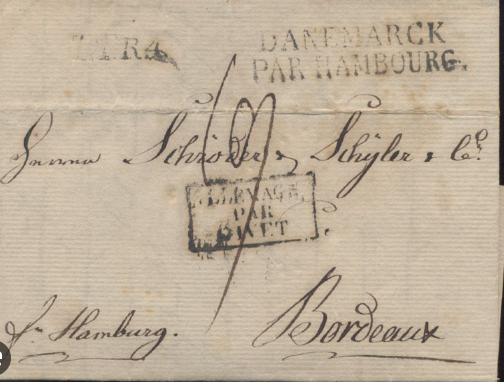
To see what they looked like Google Stampless Postal Covers – https://www.google.com/search?q=stampless+postal+covers&source=lnms&tbm=isch&sa=X&ved=0ahUKEwi0hoL2977NAhVW-2MKHQ8VB4UQ_AUICCgB&biw=911&bih=439 And you can include the year in your search if you like.

The mail service was pretty good from all parts of the kingdom, though they might have to travel to a post office in some places. Usually the post offices were where the mail and stage coaches stopped or else they could be near by. A shopkeeper could also run the post office. Quite often it was a part of the inn where the stage coaches or mail coaches stopped. Post chaises were hired from the post office and these were available in most larger towns.

A mail route ran down the spine of Cornwall. Smaller towns all had local arrangements to carry mail to the nearest official stop. I have not seen return addresses on the outside, but I cannot rule those out.  Letters generally show the recipient’s address plus a signature across one corner if the letter has been franked plus a stamped notation showing the mail stop that first received the letter since the cost to the recipient is based on the distance traveled.

Mail smuggling was also rife; it was said that four out of every five letters sent from Manchester never saw the inside of a post office.

The call for postal reform was tied to the rise in literacy: When only rich people could read & write, paying to receive letters was not a problem, but as literacy spread to the middling classes, affordable postage became an issue.

Note: Susana Ives, who I quoted about have lots more information on the postal system during the Regency for who are hoping to write a scene dealing with mail delivery. Lost in the Regency Mail

Posted in British history, commerce, customs and tradiitons, England, Georgian England, Georgian Era, Great Britain, historical fiction, history, Jane Austen, laws of the land, Living in the Regency, Regency era, research | Tagged , , , , , , | Comments Off on Paying for Postage in the Regency: Distance Times the Number of Enclosures, as Well as Something of “Sombre Statements”

How Did Those Living in the Regency Era Go About Paying Their Bills?

Question from a Follower: How would a widowed duchess go about paying her bills?

Most of the rich kept a good supply of cash on hand in a safe. They paid the servants and others in cash on a regular basis.

If there was a bailiff or estate steward who collected the rent and paid the bills for repairs and such, he would also put some in the bank and hand some over to the owner.

However, very few widowed duchesses would be handling their own expenses. Usually her son would do so. If she did not have a son, the husband usually provided a trustee. She could have her own man of affairs.

What was not paid in cash could be paid by the equivalent of a check.

They did have checks, but those were awkward for most people to use and most shopkeepers of the day preferred cash. Most preferred hard coin and not paper money as well.

So if you want the duchess paying her own bills, she would have the cash in a safe, and send a trusted  servant (or two) or the man of affairs to the shop with the money.

Follow-up Question: Just a final question. To get the cash from the bank to her safe, how would that be done? If she was living independently without a male relative, would she have gone to the bank herself or is there someone in her employ that would handle that for her?

The Bank of England gained a monopoly over the issue of banknotes with the Bank Charter Act of 1844. ~ Public Domain

As mentioned above, she could have a man of affairs, a solicitor, her son, or a trusted servant take care of the payments. She could send the person to the bank with the equivalent of a check. 

Though many businesses were run without an actual handling of money, most people had cash.

She would receive her  jointure or other  payments periodically–quite often on quarter days, and they would probably be in cash. Even if much of the payment was deposited in a personal account at the bank, the rest would be in cash. Her budget would tell her how much to have in cash and it would be some unexpected item that might require a withdrawal.

It was a cash society for most people. The shoemaker or the butcher was leery enough of paper money and cheques were something most of them distrusted. They wanted coin they could bite and test for authenticity.

The bank was not yet set up for many personal checking accounts. Banks were mainly commercial, savings or clearing banks and not ones where individuals had checking accounts.

Men might use checks or bank drafts for horses and carriages or for some tailor or coal bills, but servants, milliners, and ordinary shopkeepers were paid in cash.

Some even had the shopkeepers come to their house to be paid. A Duchess wasn’t going to walk around paying bills and wouldn’t send out a servant with a great deal of money on his person.

The money was more often in the safe than in the bank.

You must also remember something of the Bank Restriction Act of 1797. [This act and its follow up renewals plays out in book two of the new series I am writing for Dragonblade Publishers. The book will be out on September 17, 2025 and will be entitled Lyon’s Obsession. Book 1, Lyon in the Way releases June 18, 2025.]

Investopedia tells us: “In 1694, the Bank of England, a private corporation, was created out of the British government’s need for cheap loans to finance its expenses. [Bank of England. “Our History,” https://www.bankofengland.co.uk/about/histor.”%5D Three years later, the Bank was given monopoly rights that covered banking and note-issuing activities. However, once the war with France began in the 1790s, the British government’s military expenses rose very quickly. Thus, the government issued paper notes that the Bank of England was expected to convert into gold on demand. [Bank of England. “Bank of England. “Bank of England – 1734-1984. https://www.bankofengland.com.uk/-/media/boe/files/archive/publications/the-bank-1734-1894.pdf, pages 3-4.]

“However, by 1797, the Bank’s gold reserves had been reduced to dangerously low levels as a result of heavy demands for gold redemptions from both domestic and foreign note holders. To save the Bank from bankruptcy, the British government passed the Bank Restriction Act of 1797. [The New York Times. “War Finance in England: The Bank Restriction Act of 1797—Suspension of Specie Payments for Twenty-four Years—How to Prevent Depreciation of the Currency, https://www.nytimes.com/1862/01/27/archives/war-finance-in-england-the bank-restriction-act-of-1797suspension.html.”]

“By the end of the war in 1814, the amount of currency in circulation was far larger than the amount of gold backing it, leading to a sharp depreciation in the value of British currency, the pound sterling. [Federal Reserve Bank St. Louis. “British Financial Experience, 1790-1830, https://fraser.stlouisfed.org/files/docs/meltzer/silbri19.pdf,” Page 5] Convertibility to gold was restored in 1821 to stabilize the currency. By then, the amount of gold backing the currency had grown substantially and amounted to much more than the value of the pounds in circulation.”

If you choose to keep the character as handling her own bills and expenses, I would say, if she wants to be independent, then she is going to have to decide how she will attend to things.  And that will be character revealing. Maybe she asks her solicitor or her brother, what the procedure will be. They might even argue with her.

Another Follow-Up Question: Would it be normal to ask for a receipt?  Our checks are our receipts.  But what did they do?  What if someone says they were not paid?

They did give receipts for payments.

History of banking will help you out. Cheques (or bank drafts) existed:

http://www.britishmuseum.org/research/publications/online_research_catalogues/paper_money/paper_money_of_england__wales/english_banking_history.aspx

There were printed cheques from the 1720’s on. So she could write a cheque, or a bank draft, or she could visit the merchant with banknotes in hand (from the bank), or she could have her man of business settle accounts, or she could send servants out with these drafts or cheques upon her account.

Part of it depends on how the estate was left (Did her husband leave everything in the hands of trustees or in her hands?).

Depending on her status, too, she might have the merchants visit her.

Posted in Act of Parliament, aristocracy, British currency, finance, Georgian England, Georgian Era, Great Britain, history, laws of the land, Living in the Regency, Regency era, research | Tagged , , , , , , | 3 Comments

Can Courtesy Titles Be Bestowed?

Since my last post on Courtesy Titles, I have received several inquires about how courtesy titles were bestowed upon others. First, permit me to clarify, once again, there is a difference between an actual title of the peerage and a courtesy title. The confusion comes in the form that the sovereign, or in the case of the Regency (the Prince Regent), possesses the right to bestow an actual title upon an individual, meaning privileges of the peerage, but NOT a courtesy title. The sovereign may also bestow an “honorific.” 

There are honorific titles presented to individuals. A title of honor or honorary title is a title bestowed upon individuals or organizations as an award in recognition of their merits.

knight is a person granted an honorary title of knighthood by a monarch or other political leader for service to the monarch or country, especially in a military capacity. In the United Kingdom, honorific knighthood may be conferred in different ways: The first is by membership of one of the pure Orders of Chivalry such as the Order of the Garter, the Order of the Thistle and the dormant Order of Saint Patrick, of which all members are knighted. In addition, many British Orders of Merit, namely the Order of the Bath, the Order of St Michael and St George, the Royal Victorian Order and the Order of the British Empire are part of the British honours system, and the award of their highest ranks (Knight/Dame Commander and Knight/Dame Gran Cross), comes together with an honorific knighthood, making them a cross between orders of chivalry and orders of merit. The second is being granted honorific knighthood by the British sovereign without membership of an order, the recipient being called Knight Bachelor. In Jane Austen’s Pride and Prejudice, Sir William Lucas has been made a knight because of his dedication to duty as mayor of Meryton.

Dame is an honorific title and the feminine form of address for the honour of knighthood in the British honours system. The masculine form of address is “Sir.” The word damehood is rarely used, but the official website of the British monarch uses it as the correct form. A woman appointed to the grades of Dame Commander or Dame Grand Cross of the Most Honourable Order of the Bath, the Most Distinguished Order of Saint Michael and Saint George, the Royal Victorian Order, or the Most Excellent Order of the British Empire becomes a dame. Since there is no female equivalent to a Knight Bachelor, women are always appointed to an order of chivalry. 

Since 1611, the British Crown has awarded a hereditary title in the form of the Baronetcy. Like knights, baronets are accorded the title Sir. Baronets are not peers of the Realm, and have never been entitled to sit in the House of Lords, therefore like knights they remain commoners in the view of the British legal system. However, unlike knights, the title is hereditary and the recipient does not receive an accolade. The position is therefore more comparable with hereditary knighthoods in continental European orders of nobility, such a ritters, than with knighthoods under the British orders of chivalry. However, unlike the continental orders, the British baronetcy system was a modern invention, designed specifically to raise money for the Crown with the purchase of the title.

Now to the issue of “real” titles. 

Anyone could recommend a man for knighthood, a baronetcy, or one of the lower peerages, but only the sovereign could act upon the deed. A man could be made a knight, baronet, baron, viscount, or earl depending on the rank he already held and the service he had preformed. It was very rare for anyone to be made a peer of higher rank than earl. Even Wellington was only made a viscount at first.

James I was the only king openly to sell baronetcies. Most other peerage titles were advancements in the peerage for those already peers or a new creations, such as it was for Wellington. We must remember that Wellesley was born in Ireland at the Honourable Arthur Wesley, for he was the third of five surviving sons (fourth otherwise) to Anne and Garret Wesley, 1st Earl of Mornington. He had no right to his father’s peerage and so a new one was created for him. Most new creations  in the peerage were made barons. The most issued honor was a common knighthood. Next was a baronetcy. 

Oftentimes the new position was created to cause a political shift, say from Tory to Whig. Even so, the reason stated behind the creation had to be a good one: Saving the King’s life, preventing another Guy Fawkes-type conspiracy, preventing political upheaval, valor during war, etc., or something that is unique to his talents, abilities, or wealth.

0423e1078f065f20abfbd1d9153750d0.jpg

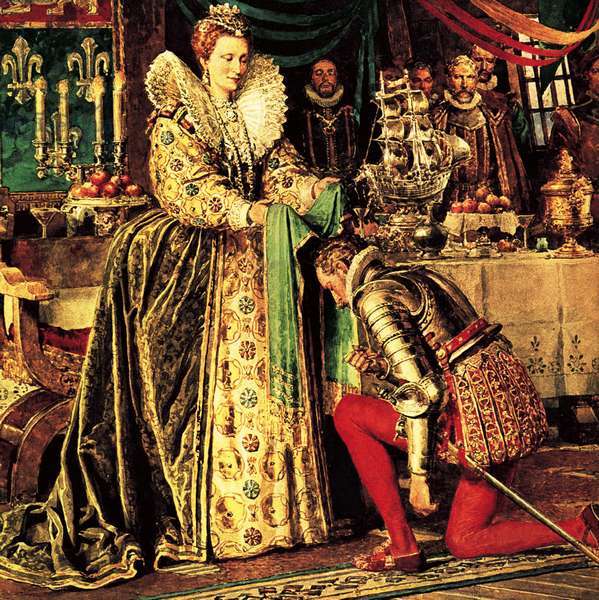
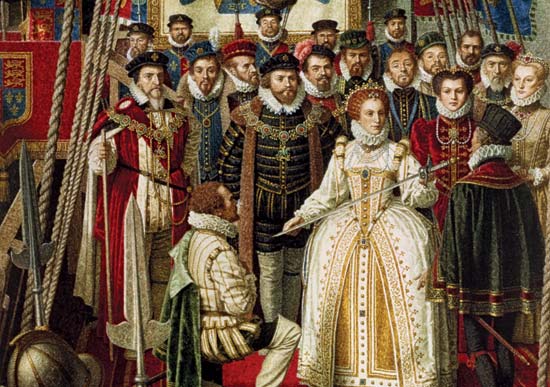
In the early days of England history, the king/queen would take a sword and tap the man on the shoulder and then fasten a belt around his waist. Up to the seventeenth century an earl was invested by the Sovereign with a sword which was girded around his waist – hence ‘a belted earl’, a phrase beloved by Victorian novelists and others.

166778-004-4F607212.jpg.

Camelot International tells us, “Though a barony is the oldest peerage title proper, the word ‘earl’ has much older origins, being derived from the Anglo-Saxon magnate known as an ealdorman who was more of a local ruler than a legislator. The term itself comes ultimately from the word Karl’ – a powerful Viking noble, so that the title of earl has very ancient roots.

earl2.gif“Although the oldest extant English earldom is that of Arundel (1433), it has long been merged with the Dukedom of Norfolk and the Earl of Shrewsbury is regarded as the premier Earl, his creation dating from 1442.

“The origin of the earldom of Mar, the premier earldom of Scotland is, according to an 18th century lawyer, ‘lost in its antiquity’. Certainly there were Mormaers (earls) of Mar in the early 12th century and the present holder is the 31st. This earldom, like a number of other Scottish ones, passes through female lines and is at present held by a woman.

“It was long the custom for retiring Prime Ministers to be offered a peerage – usually an earldom. Churchill refused a peerage and Sir Harold Wilson accepted a life barony. For a time it looked as if hereditary peerages had been phased out but Mrs. Thatcher revived the custom and the late Harold Macmillan accepted the earldom of Stockton.”

By 1820,  the man had to be asked what title he preferred. Wellington’s brother is said to have chosen Wellington for his brother’s peerage when the man was first  made a viscount. Then the College of Arms checks to see if anyone else has that title, if it had been attainted, or if it is in abeyance. Next, a patent is drawn up bestowing the peerage on the man. If the patent has an error in it, it cannot be corrected. Therefore, great care is taken in a patent’s creation. There is a ceremony at which time the king bestows the title on the man and presents him the patent. The man must pay the College of Arms a fee for the “gift.” Then  he applies to the House of Lords for admittance as a peer. This “permission” is known as a writ of summons.  He sends in a statement that he has a patent and gives the information about it which has already been published in the London GazetteHe asks two peers of his rank—one the most senior he can find and the other the  youngest before him (meaning the youngest in date of peerage presentation, not of person) to accompany him. He receives a writ of summons and when the House is in session, he dresses in his parliamentary robe, with his two sponsors also in their robes. These two sponsors must be the same rank as the new peer, and they cannot be a duke.

During the ceremony, he approaches the woolsack and presents his credentials. His patent is read aloud. Then he and his two sponsors step out to remove their robes and return quietly to take their seats in ordinary clothes.

For a more detailed summary of the ceremony, I would recommend “Introduction of a New Peer to the House of Lords on Nancy Regency Researcher

Posted in British history, Georgian England, history, Jane Austen, legacy, Living in the UK, Napoleonic Wars, real life tales, research, titles of aristocracy | Tagged , , , | 5 Comments

What Do You Know About Posting a Letter During the Regency Era?

This subject of this post came from a faithful reader of the blog. Below are some of the items I shared with her.

People went to the local post office to mail a letter.

Usually the recipient paid.

People sent mail from and received it from a post office.

This was usually near a place where the post horses were changed or a busy inn where stage coaches stopped.

Stamps were the kind made with a stamper.

The letter had to be in hand ready to mail. 

Governesses and others looking for work usually requested prepaid and the respondents were not necessarily in London.

All stamps were hand stamps or postage cost was hand written on the letter. The One Penny Black–the first stamp–comes in place around 1840.

One could NOT get a sheet with of stamps that were marked PREPAID. However, one could–if he knew his local MP (member of Parliament) or was friends with a lord–have them FRANK a sheet. All Members of Parliament were allowed to frank their letters–sign them to send them free in the post.

To see what all this looks like:

Google “prepaid stampless covers

And “franked stampless covers

Postmarks were in use in various forms for centuries. Google the four penny post (and you will see its postmark) certainly predates the Regency Era.  But it will show you that by 1805, the initial of the name of the place the letter was mailed from had been part of the postmark for some time. 

It was also common for those post offices through which that letter passed (on its way to the recipient) to postmark the letter as well. The postmarks had the initials of the place of posting, and the date. 

“The uniform fourpenny post was a short-lived uniform pre-paid letter rate in United Kingdom of Great Britain and Ireland that lasted for 36 days from 5 December 1839 until 9 January 1840. The Uniform Fourpenny Post was the first component of the comprehensive reform to the Royal Mail postal service that took place in the 19th century.

“From 5 December 1839 until 9 January 1840, a uniform charge of 4d was levied for pre-paid letters up to half an ounce in weight instead of postage being calculated by distance and number of sheets of paper. One ounce letters were charged 8d and each additional ounce, up to 16 ounces, cost 8d. Unpaid was charged double the pre-paid rates. For mail whose rates were already less than 4d, the existing lower rates applied to those letters.

“The quantity of letters carried increased significantly. For the week ending 29 November 1839, the London post office carried 1,585,973 letters. For the week ending 22 December, the quantity was 2,008,687 and by the week ending 23 February 1840 they carried 3,199,637.”

Sources

  • Reynolds, Mairead (1983). A History of The Irish Post Office. Dublin, IE: MacDonnell Whyte. 91 pp.
  • Grimwood-Taylor, James (1990). The British Postal Reforms of 1839 to 1840. Derby, ENG, UK: Cavendish Philatelic Auctions. 67 pp.
  • Crouch, Guy Robert. The Uniform Fourpenny Post Office Stamps.
  • Kane, William (1990). The Uniform 4d Post of Ireland. UK: Irish Philatelic Circle. 28 pp.

Postal marks were hand stamps (and sometimes writing), and most post offices (particularly those in London) stamped the covers.

A good selection for you to view …

There would be a mark indicating postage due on receipt (most folks paid to receive letters, not to send them).

For more information, check out these writers who have also posted on the process of sending and receiving letters during the Regency Era.

Jane Austen Centre – Regency Letter Writing

Jane Austen Foundation – Issue 111: An Exploration of Regency Letter Writing

Regency Fiction Writers (formerly known as The Beau Monde) Letter Writing – Postal Information in the Regency Era

Regina Jeffers – We Get Stacks and Stacks of Letters-The Expense of Mail During the Regency Period

Shannon Donnelly – The Regency Post: A Pity We’ve Lost Letters

Posted in British history, Georgian England, Georgian Era, history, Jane Austen, Regency era, research | Tagged , , , , , | Comments Off on What Do You Know About Posting a Letter During the Regency Era?

Beyond Writing Letters, What Type of Paper Was Used in Regency Households?

Question from a Reader: I have found a great deal of information on the web about writing utensils, but the information about paper during the Regency era primarily centers on letter-writing and general discussions of the high cost and methods used to avoid waste.

Given all that, what was used for general household list-making? Specifically, I have a heroine who is compiling a to-do list of areas that need to be addressed in a neglected estate to bring it up to snuff, but I envision she would use in that circumstance whatever method would have been usual for internal household business such as menu planning, party guest lists, shopping lists, etc. Would paper and pencil have been used for this? If not, what else? If anyone has a resource to recommend, I would be grateful!

Answer: Okay, I have really not researched paper that well, but I do have a bit of information in my Regency Tidbits file that I will share and attempt to give credit where it is due. In the file, I generally note who provided me the information.

First, I am quoting Andrea Penrose from a post over on Goodreads. Andrea used some of this information in her Murder on Black Swan Lane (which is a great historical mystery, by the way).

“So let’s take a quick look at some of the historical highlights of paper making in Great Britain during the Georgian and Regency eras. Until the late 19th century, when wood pulp became the primary source for mass market printing, paper was made of plant fiber, with linen and cotton fibers being the most common. Ragmen collected scraps of cloth, which were sold to paper mills. These were washed to rid them of dirt and foreign matter, then soaked in large vats where they were, as the old saying goes, pounded to a pulp!

“Until the 18th century, stampers—large metal-clad lengths of wood—were worked by hand to reduce the rags to a slurry of fibers (Imagine the muscles of a paper stamper!) The hollander (named as such because it was invented in Holland) took tech to a new level. It was a drum with a wooden roller in its center that was bristling with knifelike blades. The hollander was rotated in a vat of soaking rags, and reduced them to pulp much faster than the old method. (Steam power further improved productivity.) But as is usual with progress, not everything was for the better. Hollanders cut the rag fibers to very short length, while stamping produced long fibers, which made for a stronger paper.

“From there, the pulp was then put in a paper mold—wooden frames with a screen set inside it. The pulp embedded in the screen and the water drained away (Leveling the pulp quickly and efficiently was an art!) After a first stage of drying, the sheet was placed on a felt pad—the papermaker would interleaf maybe two dozen sheets of paper and felt together before placed the stack in a press to squeeze out the remaining water.

“The earliest type of screen was a grid fine horizontal wires held together by regularly spaced vertical wires or threads of horsehair, which produced “laid” paper. The surface tended to be a little irregular and was hard to print on. In 1757, James Whatman the Elder invented a screen that looks very much like our modern window screens. It produced a finer texture paper, which was called “wove” paper. (Today, Whatman paper is still one of the top brands of high quality paper, and is a favorite of watercolor artists.)

“As a final step, the sheets were hung to dry completely before being packaged for sale. As mentioned, paper was not inexpensive—while we routinely buy reams of paper for our printers, Jane Austen and her contemporaries would more often buy far less. The most common package was a quire, which consisted of 24 sheets.

“One of the interesting things I discovered was that in 1800, the paper making industry was using nearly 24 million pounds of rags annually to produce 10,000 tons of paper in England and Wales, and imported cloth scraps were needed to keep up with demand. The shortage of rags prompted experiments with other materials, such as sawdust, rye straw and cabbage stumps, but it wasn’t until the middle of the 19th century that wood pulp became a viable alternative to rag paper.”

Nancy Mayer Researcher tells us: ‘There was a rough sort of paper one used for making lists and ordinary notes. It was to be used with pencils, charcoal, or crayons because ink would go right through. There was rough wrapping paper—brown paper for parcels type, and all the expensive paper for letter writing and invitations.

The paper the mistress of the house would use for menu planing would be different from that used by the cook or housekeeper when they noted what supplies were needed or what was going out in the laundry. There were many different qualities of paper around and a well-stocked house would have them all.

Bronwyn Clarke tells us: The mistress of the house might well use an old notebook or ledger book that had been used by someone else but only part-filled.

I studied a small notebook (pocketbook?) in Yorkshire that had originally been used by clothier John Gibson to record cloth received from weavers and payments made; he subsequently fell ill and died, and someone else used it to record amounts paid to his wife and daughters for their upkeep; however, there were also a few other assorted lists and notes in the book.

Barbara Johnson used an old ledger book and pasted in her fabric samples and fashion plates over the previous owner’s financial records – you can find images of this in the Victoria and Albert Museum website.

From Nancy Mayer: A copy of Johnson’s project was sold some years ago. The fabric samples are only photographs now, but it is still interesting. The book is oversized– more the size of legal paper.

Bronwyn Clarke tells us: It’s out of print now, but the V&A Museum does have photographs of each page in their online catalogue, which is a great resource.

Posted in British history, Georgian England, Georgian Era, history, Regency era, research, writing | Tagged , , , | Comments Off on Beyond Writing Letters, What Type of Paper Was Used in Regency Households?

Falling into Easy Writing Traps: Do You Know These Rules?

7178225_fd10bbb6b2_o.jpg.736x0_q85 (image via 4 Common Academic Writing Mistakes and How to Fix Them from http://www.noodle.com)

Falling Into Easy Writing Traps…

1.  The word “hold” is confusing to some. Essentially a person can hold a baby, a spoon, a smart phone, etc., but how does one “hold” a meeting, a party, or a conversation?

Example: The committee held its meeting last week. (should be) The committee met last week.

Example: The elected representatives will hold a meeting Monday to vote for officers. (should be) The elected representatives will vote for officers Monday.

2.  The words “feel,” “think,” and “believe” are not interchangeable. “Feel” refers to your sense of touch and to refer to your health. “Think” is to express an opinion. “Believe” refers to a conviction or a principal.

Example: The senator thinks (not “feels”) the new bill will pass.

Example: The preacher believes (not “thinks” or “feels”) in God’s salvation.

Example:  He feels sympathetic for those who grieve for lost loved ones.

Tim Challies, an author, blogger, and book reviewer, tells us, “There is a hierarchy when it comes to the ways we express ourselves and our convictions. There are some things we believe, some things we think, and some things we feel. The terms are hierarchical rather than synonymous and over time we ought to see a progression from feeling to thinking to believing. We should want to elevate more of what we feel into what we think and more of what we think into what we believe. I will grant that there can be fine distinctions here, but there is still value in distinguishing them, at least for our purposes.

“The things I believe are the things for which I have the highest confidence. They are the things I am convinced of, the things I hold to be absolutely true, even though you may disagree. I believe Jesus Christ rose from the dead. I believe democracy is superior to fascism or communism. I believe marriage is meant to be a lifelong commitment between one man and one woman.

“The things I think are the things for which I have a little bit less confidence. These are the areas in which I am in a process of growth in understanding and conviction. These are the areas in which absolute right or wrong may not be quite as clear. I believe God tells us to assemble with other Christians to worship him each week, and I think it is best to do this on Sunday (especially here in North America).

“The things I feel are the things I am unsure of, the things I am encountering and responding to on an impulsive or emotional level. I feel that it would be a bad idea for the government of Canada to shut down the office of religious freedom. I feel that because I have only the barest knowledge of the office and its functions and I would need to learn more in order to develop thoughts and then beliefs about it. I feel that it would be a good idea for the Blue Jays to offer a contract extension to Jose Bautista, but I have not read or researched enough to have well-formed thoughts.

“In this way I believe, I think, and I feel have different meanings. And I believe (not “I feel”) that these meanings are consistent with how they have typically been used.”

3.  “Bad” is customarily an adjective, while “badly” is an adverb. Because “badly” is an adverb, it describes the manner in which an action is performed. Therefore if you say, “I feel badly about…,” you are saying that your sense of touch does not perform well. “Feel” is not an action verb, and so one is use “bad” to describe the pronouns “we” and “I.”

Example: I feel bad about missing the appointment.

Example: The runner performed badly in the 400 m race. (“Performed” is an action verb. “Badly” tells how the runner performed.

4.  “Everyday” written as a single word is an adjective that indicates days in general, without emphasizing a specific day. “Every day,” written as two words, has a different meaning. “Every” is an adjective describing the noun “day.” [Hint: Substitute the word “each” for “every.”]

Example: Sam’s Hardware has everyday low prices. [You cannot substitute “each” in this sentence and have it make sense. “…has each day low prices.”  Therefore, one word is needed.]

Example: Sam’s Hardware has the lowest prices every day. [ You can substitute “each” in this example. It would sound fine to say “the lowest prices each day.” Therefore, two separate words is required.}

5. Plurals are easy to confuse.

Add “es” to form plurals from words ending in ch, sh, x, s, ss, and zz. [batches, blushes, boxes, buses, addresses, buzzes]

Change the singular “sis” ending to “ses” for the plural. [analysis – analyses]

If “y” is preceded by a vowel, just add an “s.” [alley – alleys, Monday – Mondays]

If Proper Nouns end in “y,” just add an “s.” [Barry – I know two Barrys.]

If “y” is preceded by a consonant, drop the “y” and add “ies.” [apology – apologies]

Most words ending in “o” add an “s” to form the plural. [cellos, pianos, studios zeros]

Some words ending in “o” add “es” to form a plural. [echoes, heroes, mosquitoes, potatoes, tomatoes, vetoes]

Some words have both endings. [cargos/cargoes, placebos/placeboes, lassos/lassoes, mementos/mementoes, tornados/tornadoes]

images16.  Forming the possessive of proper nouns ending in “s.”

Example: [singular possessive … Charles = Charles’ (or) Charles’s; Lucas = Lucas’ (or) Lucas’s; Hayes = Hayes’ (or) Hayes’s]

Example: [plural possessive … Hayes (singular)      Hayeses (plural)    Hayeses’ (plural possessive)

William (singular)     Williamses (plural, more than one William)   the Williamses’ house

7.  “Healthful” refers to something that promotes good health (i.e., food, exercise, etc.). “Healthy” refers to being in good physical and mental health.

Example: He believes that running is healthful (promoting health).

Example: Fruits and vegetables are healthful (not healthy) for you.

Example: After running the 5K race, he is feeling healthy.

8.  There is a multitude of phrases that require editing because they are too wordy.

Examples:

matinee performance = matinee

joined together = joined

Jewish rabbi = rabbi

made good his/her escape = escaped

on account of = because

off of = off

in the near future = soon

etc.

9. Some words are easily confused.

“Blond” is the adjective used for all references. As a noun, “blond” refers to males, while “blonde” refers to females.

“Credibility” means believability, while “credulity” means to be gullible or unsuspecting.

“Each other” is used when two people, places or things are involved. “One another” is used for three or more.

Use “farther” to refer to distance.” Use “further” to refer to degree or extent.

“Brief” is used to refer to time, while “short” is used to distinguish something that is neither long or tall.

“Compared to” is to liken one person, place, or thing to another. Compared to is used for similarities. “Compared with” is to provide a more concrete and factual comparison of similarities and differences.

“Famous” means well known for favorable reasons. “Infamous” and “notorious” means to be well known for unfavorable reasons.

“Burglary” is when the culprit breaks into a building to steal. The victim is not present or is not confronted. “Robbery” is the unlawful use of force or threat of force to take something belonging to another.

10. Of late, I’ve been doing some editing of my own, as well as scoring the manuscripts of others for writing contests. I am a West Virginia Hillbilly by birth, but even so, I am still sensitive to split infinitives. That does not mean I do not use them occasionally; yet, I do attempt to correct them in my work.

What is an infinitive? It is the verb root, written as “to” + “the verb,” as in “to read,” “to call,” and “to love.”

What is a split infinitive? It is a construction consisting of an infinitive with an adverb or other word inserted between “to” and the “verb,” e.g., she seems to really like it. (“to diligently read,” “to consciously call,” and “to devotedly love”).

I recently read a manuscript for a contest where FEW infinitives used in the work were not a split infinitive. Many experts are mixed on the “rule” not to split infinitives; however, I am still of the persuasion to avoid them. (Remember that I spent 40 years teaching English.) In the dialogue of a work of fiction, I can overlook the split construction, for people often use them orally. However, I’d like to see more diligence in eliminating some of the damage found in the narration. 

Posted in books, editing, Industry News/Publishing, language choices, manuscript evaluation, publishing, vocabulary, word play, writing | 8 Comments

Do You Know These Words and Phrases?

Inexpressibles ~ Etymology Compare to unmentionables ‎(“underwear”). Geri Walton at her Unique Histories from the 18th and 19th Centuries tells us “That part of the dress which it is now unlawful to name, seems of old to have had the singular virtue of discomfiting witches and demons. Every one may have heard how the bare vision of St. Francis’ inexpressibles put the devil to flight.” This was one nineteenth century description of men’s trousers, known as inexpressibles, and they likely acquired the name because they were extremely erotic and fit so tightly they showed every nook and cranny of a man’s sexual organs, posterior, and muscular legs. In fact, they would have accentuated a man’s sexual organs even more if extra room had not been allowed in one thigh, which created a pocket where a man could position them.

“Even with the pocket, inexpressibles left nothing to the imagination. Wearers created the image of a naked Greek God, as inexpressibles were usually pale in color. At least one person noted inexpressibles were a natural evolution:

“‘[They emanated from] small clothes to tights, from tights to inexpressibles, from inexpressibles to unspeakables, and from unspeakables to unmentionables, from unmentionables to shorts, from shorts to etceteras, from etceteras to continuations, and so on through antifeminines, remainders, masculines, and nether integuments down to the Quaker periphrase lower garments!'”

____________________________________

broadcast-television-collection-of-old-television-sets-of-the-50s-cpnawe.jpgThe Free  Dictionary tells us that Mingle-Mangle is a motley assortment of things (other closely related words include farrago, gallimaufry, hodgepodge, hotchpotch, melange, mishmash, oddments, odds and ends, omnium-gatherum, ragbag assortment, miscellanea, miscellany, mixed bag, motley, potpourri, salmagundi, smorgasbord, etc.).

______________________________________

A Mare’s Nest is a much vaunted discovery, which later turns out to be illusory or worthless.

The Phrase Finder tells us, “There are two unrelated meanings of ‘mare’s nest’ in circulation, and there’s little to connect them. The first, and ‘proper’ meaning, has it that finding a mare’s nest is imagining that one has found something remarkable when in fact one has found nothing of the sort. The second meaning, which is more widespread today, is that a mare’s nest is a confused mess – more on that later. The earlier ‘misconception’ meaning has been in use since at least the 16th century, when Robert Peterson published a version of the Italian John Della Casa’s Galateo. This was ‘done into English’, that is, translated, by Peterson in 1576:

Nor Stare in a mans face, as if he had spied a mares nest.

“Animals are often alluded to in phrases of this sort, for example, lion’s share, dog’s breakfast, bird’s-eye view etc. Of course, this one is different, in that mares don’t make nests – the allusion was meant to be comically ironic. That humour is reflected in several of the early citations of ‘mare’s nest’ (or horse’s nest, as some early references have it), which refer directly to laughter, for example, John Fletcher’s Jacobean tragedy Bonduca, circa. 1613

Why dost thou laugh? What Mares nest hast thou found?

The joke was pushed further by Dr. [Jonathan] Swift, in the play Miscellanies, 1751:

What! Have you found a mare’s nest, and laugh at the eggs?

“Back to the second, ‘muddle’ meaning, which didn’t begin to be used until the mid-19th century. It appears to have come into being as the result of a simple misunderstanding. To someone who was unfamiliar with the original meaning, and that meaning is hardly intuitive, ‘a mare’s nest’ would seem very much like the earlier 19th century phrase ‘a rat’s nest’. In reality, rats make rather neat nests, but the phrase was certainly meant to mean a disordered tangle (see also haywire) and the currently widespread meaning of ‘mare’s nest’ was copied from that.

“The transition from the earlier meaning to the later one was gradual and appears to have been well underway by the 1920s, when Agatha Christie wrote The Mysterious Affair at Styles. Christie managed there to use both meanings in the same story:

a misunderstanding… “In my opinion the whole thing is a mare’s nest of Bauerstein’s! … Bauerstein’s got a bee in his bonnet. Poisons are his hobby, so of course he sees them everywhere.”

and, a muddle… “A pretty mare’s nest arresting him would have been.”

_________________________________

Fly into a Pelter was more difficult to define. Wordnik provides these definitions and sources:

from the GNU version of the Collaborative International Dictionary of English

  • n. One who pelts.
  • n. A pinchpenny; a mean, sordid person; a miser; a skinflint.

from The Century Dictionary and Cyclopedia

  • n. One who or that which pelts.
  • n. A shower of missiles; a storm, as of falling rain, hailstones, etc.
  • n. A passion; a fit of anger.
  • n. A dealer in skins or hides; a skinner.
  • n. A mean, sordid person; a pinchpenny.
  • n. A fool.
  • n. In poker, a hand which has no card higher than a nine and no chance for a flush or straight: sometimes called Chicago pelter. Also, kilter.

from WordNet 3.0 Copyright 2006 by Princeton University. All rights reserved.

  • n. a heavy rain
  • n. a thrower of missiles

Some examples provided were 

  • Mary Jane and I have been wet through once already to-day; we set off in the donkey-carriage for Farringdon, as I wanted to see the improvements Mr. Woolls is making, but we were obliged to turn back before we got there, but not soon enough to avoid a pelter all the way home. (Jane Austen, Her Life and Letters: A Family Record)

  • Colonel Boone had but to hear him out and bare his shoulders for such other blows which Judge Wright sought to pelter him, and we will hear with what blow he was driven from his post as Indian Agent. (The Second William Penn: A True Account of Incidents That Happened Along the Old Santa Fe Trail)

  • A tremendous storm brewing to windward, cut short our intended drive; and, putting the nags to their best pace, we barely succeeded in obtaining shelter ere it burst upon us; and such a pelter as it came down, who ever saw? (Lands of the Slave and the Free Cuba, the United States, and Canada)

_______________________________________

Merriam Webster tells us Diablerie is black magic or sorcery; a representation in words or pictures of black magic or of dealings with the devil or demon lore; or mischievous conduct or manner

The Unofficial White Wolf Fandom Page gives a definition in vampiric terms.
“The aggressor, dubbed the diablerist, automatically loses some of its humanity and is branded by black streaks in their aura that may persist for several years. Still, the practice holds a great deal of allure, for it is said to bestow the greatest pleasure imaginable to the diablerist, greater than the Kiss, and can also grant him or her greater power. Diablerie involves the consumption of another Indred’s vitae to the point of Final Death, but as the “heart’s blood” is consumed, the aggressor might devour it’s victims very soul. Most vampires consider it a heinous act, akin to cannibalism.

“Diablerizing the soul of a Cainite of significant age is one of the few ways of lowering one’s Generation, for if the victim possessed more potent blood then the diablerist’s, the diablerist’s Generation drops by one, possibly more if the victim was of notably lower Generation. However, there is the risk of some portion of the victim’s soul living on within the diablerist. Rumors abound of diablerists taking on the mannerisms of their victims, and even stranger tales speak of the victims consuming their assailants from within and taking over their bodies. Some Antediluvians and Methuselahs are believed to have survived their death  in this manner.”

Fury: The Reference Desk adds this to the vampiric discussion: “There is one thing that elder Kindred dread even more than fire or the light of the sun. This is the sin known as diablerie, or the Amaranth. Among Camarilla society, diablerie is the ultimate crime; those who practice it are subject to the harshest punishments imaginable. It is as loathed and feared as cannibalism is among mortal society. The vampires of the Sabbat, as well as the warriors of Clan Assamite, are said to indulge in diablerie freely, which is yet another reason why the elders hate them so.

“Quite simply, diablerie is the act of feeding on a vampire in the way that a vampire feeds on a mortal. In so doing, not only does the murderer consume the victim’s blood (and vampire blood is far, far sweeter than even the tastiest mortal’s), but the victim’s power as well. By stealing the life of a vampire closer to Caine, the vampire can permanently enrich his own vitae. In this manner can even the youngest vampire gain the power of the elders, should he have the strength and daring to wrest it from them.”

___________________________________

Purlieus, according to the Free Dictionary is environs or neighborhoods; a place where one may range at large; confines or bounds; a person’s haunt or resort; an outlying district or region, as of a town or city; or a piece of land on the edge of a forest, originally land that, after having been included in a royal forest, was restored to private ownership, though still subject, in some respects, to the operation of the forest laws.

Wikipedia tells us “Purlieu is a term used of the outlying parts of a place or district. It was a term of the old Forest Las, and meant, as defined by John Manwood,  Treatise of the Lawes of the Forest (1598, 4th ed. 1717),

a certain territory of ground adjoining unto the forest [which] was once forest-land and afterwards disafforested by the perambulations made for the severing of the new forests from the old
516956_8b7eb28b

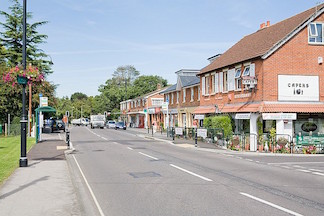
Shops in Beaulieu Road, Dibden Purlieu

“The owner of freelands in the purlieu to the yearly value of forty shillings was known as a purlieu-man or purley-man. The benefits of disafforestation accrued only to the owner of the lands. There seems no doubt that purlieu or purley represents the Anglo- French pourallé lieu (old French pouraler, puraler, to go through Latin perambulare), a legal term meaning properly a perambulation to determne the boundaries of a manor, parish, or similar region. The word survives in place names. Examples include Dibden Purlieu in Hampshire,  on the border of the New Forest and Bedford Purlieus, once part of Rockingham Forest. ” 

___________________________________

Merriam Webster defines Farouche as wild or marked by shyness and lack of social graces. “In French, “farouche” can mean wild or shy, just as it does in English. It is an alteration of the Old French word forasche, which derives via Late Latin forasticus (“living outside”) from Latin foras, meaning “outdoors.” In its earliest English uses, in the middle of the 18th century, “farouche” was used to describe someone who was awkward in social situations, perhaps as one who has lived apart from groups of people. The word can also mean “disorderly,” as in “farouche ruffians out to cause trouble.”

____________________________________

If you’re known as being Pawky, you’ve got a sly, mischievous sense of humor. The pawky one in your group of friends is probably good at making everyone laugh while barely cracking a smile. You’re most likely to encounter the word pawky in Scotland, but it’s a good way to describe someone who’s got a sardonic wit, wherever you happen to be. You might surprise people with your pawky wit if you’re usually quiet and retiring. Pawky is Scots, and it’s also used in Northern England, from the Northern English pawk, or ‘trick.'” (Vocabulary.com)

_______________________________________
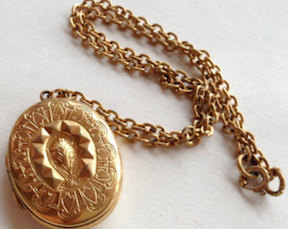
il_340x270.711669650_83yj.jpg Wikipedia tells us that Pinchbeck is a form of brass, an alloy of copper and zinc, mixed in proportions so that it closely resembles  gold  in appearance. It was invented in the 18th century by  Christopher Pinchbeck, a London clockmaker. Since gold was only sold in 18-carat quality at that time, the development of pinchbeck allowed ordinary people to buy gold ‘effect’ jewellery on a budget. The inventor allegedly made pinchbeck jewellery clearly labelled as such. Pinchbeck jewellery was used in places like stagecoaches   where there was a risk of theft. Later dishonest jewellers passed pinchbeck off as gold; over the years it came to mean a cheap and tawdry imitation of gold.  Pinchbeck is typically composed of copper and zinc in ratios of 89% copper to 11% zinc; or 93% copper to 7% zinc.

Also check out Pinchbeck at World Wide Words for a more complete telling of its origins. 

__________________________________________

From World Wide Words, we learn that Rodomontade is a mass noun meaning boastful talk or behavior. The term is a reference to Rodomonte, a character in Italian Renaissance epic poems Orlando innamorato and its sequel Orlando furioso.  

  • A 17th-century example of the term exists in Don Tomazo by Thomas Dangerfield, with a slight alteration of spelling. As the titular protagonist heads towards Cairo with a number of stolen treasures, he is informed by an acquaintance that:
. . . he could, in that heathenish city, command a thousand pound – which was at that time no rodomontado, in regard the jewels were worth above four times the value. 
  • A 19th-century example of the use of the term can be found in The Adventures of Captain Bonneville by Washington Irving. Irving used it to describe the behavior of “free trappers”, fur trappers who worked freelance and adopted the manner, habits, and dress of the Native Americans. When free trappers visited Bonneville’s camp, he welcomed them and ordered grog for everyone:
They [the free trappers] pronounced the captain the finest fellow in the world, and his men all bon garçons, jovial lads, and swore they would pass the day with them. They did so, and a day it was, of boast, and swagger, and rodomontade.
  • Another 19th-century example can be found in Thomas Carlyle’s 1829 essay Signs of the Times:
We have more Mathematics than ever; but less Mathesis. Archimedes and Plato could not have read the Mécanique Céleste; but neither would the whole French Institute see aught in that saying, “God geometrises!” but a sentimental rodomontade.

“English borrowed the word rodomont in the sixteenth century as a way to describe an extravagant boaster or braggart. Our form appeared in the following century. At first it meant a single brag or boastful act, so that one could speak in the plural of rodomontades. In that form, the first known user was John Donne, in 1612: “Challengers cartells, full of Rodomontades.” Later it became both an adjective and a verb and a mass noun that refers to the whole business of making your point by laying it on rather too thick.

“In that sense, it turns up in many works of literature, including The Tenant of Wildfell Hall by Anne Brontë: ‘She knows what she’s about; but he, poor fool, deludes himself with the notion that she’ll make him a good wife, and because she has amused him with some rodomontade about despising rank and wealth in matters of love and marriage, he flatters himself that she’s devotedly attached to him.'”

_______________________________________
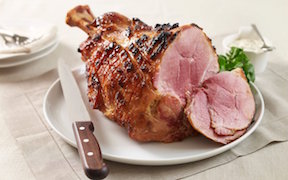
ham-getty-images-ftr.jpg Gammon has several meanings. First, Dictionary.com gives us the game of backgammon; a victory in which the winner throws off all his other pieces before the opponent throws off any; verb (used with object) to win a gammon over. Next we have a smoked or cured ham or the lower end of a side of bacon. Origin 1480-90; Old French gambon ham ( French jambon), derivative of gambe; see jamb Finally, deceitful nonsense; boshto talk gammon;to make pretense; or (verb)to humbug.

Gammon is the hind leg of pork after it has been cured by dry-salting or brining.  It may be sold on-the-bone or without bone, or as steaks or rashers. It differs from ham in that ham is cured after being cut from the carcass but not cooked, and the curing process for ham may be different. Gammon hock (or knuckle) is the foot end of the joint, and contains more connective tissue and sinew. Joints of cooked gammon are often served at Christmas or Boxing Day. 

“Gammon is often purchased to be further cured into ham – this is carried out by immersing the joint in water, then adding sugar, salt, spices, and other ingredients, and bringing it to the boil. The words gammon, ham and bacon are sometimes used interchangeably. Particularly in the U.S., the word ‘ham’ may refer to raw, uncured hind leg of pork. The word ‘gammon’ is related to the French word jambon, meaning ham, which in turn is derived from Late Latin gamba, meaning leg.” [W K H Bode; M J Leto. The Larder Chef. Routledge; 25 June 2012. p. 178.]

_______________________________________
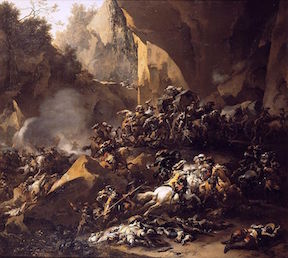
800px-Travellers_attacked_by_brigands.jpg “Brigand refers to the life and practice of brigands: highway robbery and plunder. A brigand is a person who usually lives in a gang and lives by pillage and robbery. The brigand is supposed to derive his name from the Old French brigand, which is a form of the Italian brigante, an irregular or  partisan soldier. There can be no doubt as to the origin of the word bandit, which has the same meaning. In Italy, which is considered the home of the most accomplished European brigands, a bandito was a man declared outlaw by proclamation, or bando, called in Scotland “a decree of horning” because it was delivered by a blast of a horn at the town cross. The brigand, therefore, is the outlaw who conducts warfare after the manner of an irregular or partisan soldier by skirmishes and surprises, who makes the war support itself by plunder, by extortion, by capturing prisoners and holding them to  ransom, who enforces his demands by violence, and kills the prisoners who cannot pay.

Posted in vocabulary, word origins, word play | Tagged , , , | 3 Comments

This and That About Parliamentary Elections in the Regency Era

Looking at the House of Lords Journals in the first decade of the 1800s, the members often sat all week, including Saturdays. From some of their Minutes, I gather they began in the morning. One entry included the note that the House rose earlier than usual at 1 PM, suggesting the sitting day could be quite long normally. The hours they met and sat has been one of the more difficult pieces of information to come by. Though the Regency and the War of 1812 would have called for more discussions, it seems that the general sessions were shorter- only from February to July for several years.

Hours: Until 1888 The Commons met at 3:45 on Monday, Tuesday, Thursday, Friday. No cut-off time 40 were needed for a quorum in the Commons and 3 in House of Lords. There is a suggestion in some writings that the House of Lords met four or more days a week between the hours of 10:00 and 4. Other authorities say like House of Commons, the late hours were remarked on, and they often stayed late in the evening.

Regina Scott has a fabulous blog post listing when Parliament was in session:

http://www.reginascott.com/parliament.htm

Meeting Dates for Parliament During the Regency ~ During the Regency, Parliament met at least once a year to vote on the military budget and various bills. Gleaning dates from a variety of sources, Parliament was in session during the following times: 

  • 1 November 1810 to 24 July 1811
  • 7 January 1812 to 30 July 1812
  • General election: 5 October to 10 November 1812
  • 24 November 1812 to 22 July 1813
  • 4 November 1813 to 30 July 1814
  • 8 November 1814 to 12 July 1815
  • 1 Feb 1816 to 2 July 1816
  • 28 January 1817 to 12 July 1817
  • 27 January 1818 to 10 June 1818
  • General election: 15 June to 25 July 1818
  • 14 January 1819 to 13 July 1819, before the 16 August 1819 Peterloo Massacre
  • 23 November 1819 to 28 February 1820 (special session because of the massacre but ending early because of the death of George III)
  • General election: 6 March to 14 April 1820
  • 21 April to 23 November 1820 (including a special session beginning the third week of August for the trial of Queen Caroline).

Who was allowed to vote? Parishes or Boroughs? Only male landowners could vote, and if I remember correctly, their property had to be worth a certain sum.

A. Those who could vote: Qualifications for voters varied. Most counties allowed all who had a freehold worth 40 shillings a year to vote. Those who could vote for the members from the county were called 40 shilling freeholders. They had to occupy property that was charged a land tax of 40s a year.

Other qualifications were required to vote in borough elections.

Scot and lot: all householders who paid poor rate was required. The term scot comes from the Old English word sceat, an ordinary coin in Anglo-Saxon times, equivalent to the later penny. In Anglo-Saxon times, a payment was levied locally to cover the cost of establishing drainage and embankments for low-lying land and for ensuring they remain secure. This payment was typically a sceat, so the levy itself gradually became to be called sceat. In burghs, sceat was levied to cover maintenance of the town walls and defences.

In Norman times, under the influence of the word escot, in Old French, the vowel changed, and the term became scot. In 19th century, low-lying farmland in Kent and Sussex was still being called scot-land. Scot, though, gradually became a general term for local levies; a person who was not liable for the levy, but received its benefits, got off scot-free. 

Lot means portion/share, hence lottery and allotment. The phrase scot and lot thus meant the local levies someone paid and the share they received of local provisions; more generally, it meant rights and obligations in respect of local government.

Parliament had evolved from the king’s baronial court. Before the mid 19th century, burghs varied in their choice of franchise. In some burghs, the franchise was set at scot and lot; that is, people were only permitted to vote if they were liable for the local levies.

B. Householder: all who were not receiving alms or poor relief – the usual definition of a householder was a person able to boil a pot on his/her own hearth.

C. Burgage was voting rights attached to certain property in the borough – in England and Scotland tenure of land in a town was held in return for service or annual rent.

D. Corporation: Where a corporation runs the borough only members could vote.

E. Freeman: All freeman had the right to vote – a freeman was one who was not a slave or a vassal.

F. Freeholder: All freeholders could vote. A freeholder had a freehold, which was land held in fee, fee-tail, or for life. 

Peers could not vote.

http://www.regencyresearcher.com/pages/pp1.html

1802 United Kingdom general election

The electoral districts were boroughs which could be a whole village or align with a parish.

I do not recall ever seeing a breakdown of electoral districts  in London and Westminster.Voters in 

London.          Middlesex          4           10,000

Westminster.   Middlesex.         2           12,000

http://www.regencyresearcher.com/pages/counties.html

How, exactly, would one go about standing for Parliament? If one goes looking, he/she will find all sorts of information about rotten boroughs, how some seats were totally under the control of certain influential families, and who could and could not vote, but it is difficult to find much of the truth about the process itself. I have the impression that stumping and making speeches was a later development (although I would be happy to be wrong!), and I am assuming that entertaining influential people to dinner would be necessary, but how would one go about reaching the few people who could vote, I cannot say with any authority.

There is the rumor that Duchess of Devonshire went out campaigning for Whig candidates, offering a kiss for a vote? So there must have been some campaigning.

Georgiana Spencer, Duchess of Devonshire

Most agree that stumping and speeches and paying the voters ( bribing them with ale and beer) was flourishing well in the Regency.

Process: One declared for a seat. One did not have to be resident in the district.

Usually one had a party behind him for the contested seats.

The rotten boroughs and seats held by peers (they owned the village) were seldom contested.

Sir Ralph Milbanke nearly put himself into the debtors’ prison because of campaign debts. Much money was spent on the contested elections.

There really were not that many seats that were contested.

One had to be 21 years of age (though William Pitt the Younger and one or two others were younger than 21) and a member of the Church of England.

I am pretty sure that the Lord Chancellor ‘s office was in charge of the writs to the House of Lords, but am not confident if his or the Home Secretary’s office organized elections and proclaimed the winner of them and issued writs of summons to the next session of parliament for the House of Commons.

While some seats were strongly contested and could cost a man a fortune to win, most were obtained by influence and patronage.

Eighty-seven peers controlled the seats of 218 members.

Ninety commoners controlled the seats of 137 members.

The Government had influence in sixteen seats. The treasury had 11, Admiralty had 4, and Ordnance had one.

These totaled 371, or more than half the 474 English MPs.

Five counties ( including their boroughs) returned 142 MPs, or around a fourth of the total membership of the House of Commons. The number of voters in the five counties came to 48,443 out of a population of 1,221,671.

Posted in Act of Parliament, British history, England, estates, Georgian England, Georgian Era, history, laws of the land, Living in the Regency, Living in the UK, Regency era, research, Whigs | Comments Off on This and That About Parliamentary Elections in the Regency Era

The Cost of Military Uniforms in the Regency Era

I had a reader recently ask me what I knew of officers uniforms, specifically the cost of those for the British Army.

Note: Most of what I have included are notes from a class I sat in on regarding the British Officer from multiply years ago.

It is my understanding that tailors would sew a monogram or letter in the lining to identify their work. So Stultz had a ‘St’ sown in it. As there was no set regulations on what materials were to be used, officers’ uniforms could be plain with little cording or gaudy with lots of gold cording and lace. Of course, any officer who showed up with a new uniform heavy with gold would be looked down upon. There are memiors noting such things.

As unbelievable as it may seem, a gentleman’s pocketbook and tailor often had more to do with the look of the uniform than the Army regulations. Weston made uniforms as well as tailors in Cheapside. Each infantry and cavalry regiment had a different uniform, though the general cut of each was proscribed by the British Army. Most, but not all, infantry coats and about half of the cavalry coats displayed the British scarlet. The facings were all different colors as a way of identifying the regiment. Facings were the collar, cuffs and lapels, which could be red, white, buff, brown, yellow, green, black, purple, orange, or light blue, and for all guards and royal regiments, dark blue. Usually, for officers, the inner lining of the coat was the facing color because the coat could be buttoned with the facings turned out and showing, or buttoned as a double-breasted coat.

Each regiment also had a unique badge, sort of a crest or emblem, which would be stamped on all buttons, and often pinned as decorations on the white tails, or turnbacks of the coat as well as the on the shield of the shako or hat.

Mr. Buckmaster, a tailor on Old Bond Street, could make a full officer’s uniform, coat, waistcoat, and two pair of breeches for between £20-30, and Mr. Hoby, the Bootmaker, could make a pair of Wellingtons, long Regent boots, or Hessians for about the same amount. George Hoby had shops on both St. James Street and 163 Piccadilly.  A Mr. Prater, a linen draper, could supply the shirts for six shillings apiece and stockings for four a pair.  We know this because a Colonel Burgoyne sent money from Spain in 1811 to a brother officer in London asking him to settle his accounts with the merchants above. He even paid the saddler, Mr. Cuff of Curzon Street, £16 for a saddle. 

Side Note Regarding Colonel Burgoyne:

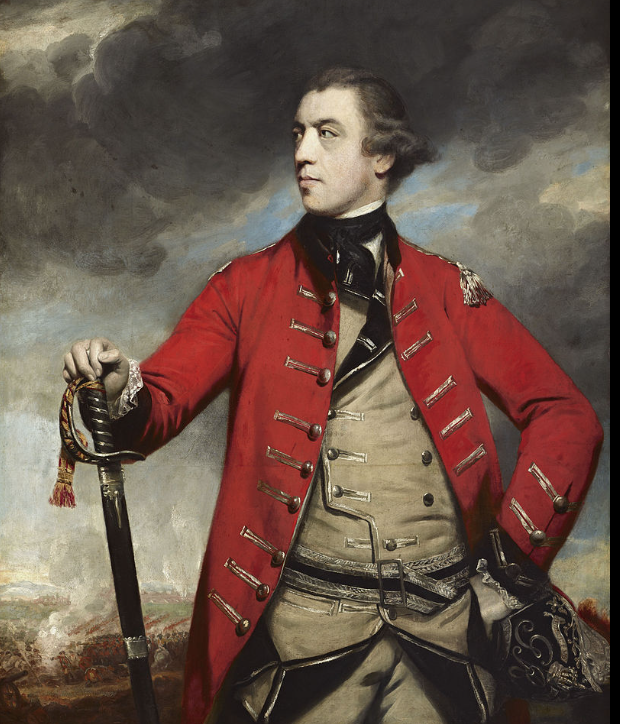
General John Burgoyne (24 February 1722 – 4 August 1792) was a British military officer, playwright and politician who sat in the British House of Commons from 1761 to 1792. As a member of the British Army he first saw action during the Seven Years’ War when he participated in several battles, most notably during the Spanish invasion of Portugal in 1762.

Burgoyne is best known for his role in the American Revolutionary War. He designed an invasion scheme and was appointed to command a force moving south from Canada to split away New England and end the rebellion. Burgoyne advanced from Canada but his slow movement allowed the Americans to concentrate their forces. Instead of coming to his aid according to the overall plan, the British Army in New York City moved south to capture Philadelphia. Burgoyne fought two small battles near Saratoga but was surrounded by American forces and, with no relief in sight, surrendered his entire army of 6,200 men on 17 October 1777. His surrender, according to the historian Edmund Morgan, “was a great turning point of the war, because it won for Americans the foreign assistance which was the last element needed for victory”.France had been supplying the North American colonists since the spring of 1776. [Morgan, Edmund S. (1956). The Birth of the Republic 1763–1789, pp. 82-83]

General John Burgoyne – Joshua Reynolds c. 1766 ~ Public Domain

In all, a uniform with boots could cost upwards of £100. Any number of times, the newly commissioned young man, if without funds, would borrow the money from the Regimental agent against his future pay, 3% interest going to the regiments stock-purse or into the Agents pocket [legally, depending on whose money was being loaned.]

However, a cavalry officer could pay twice or three times that much for a uniform, because of the extensive cording, belting, and sabretache [saber pocket]. An example of the elaborate decorations on one is in the file, as well as examples of how it was worn, with a cover to protect it, by the officers of the 10th Hussar.

The officer’s hat, along with its oilcloth cover, was one of the more expensive items, whether the Wellington bicorne, felt and leather shako, metal dragoon helmet, or fur-covered Busby worn by the Hussars. There was also the forage cap which was worn in most all situations outside of parade and battle.  These items, with the variety or requirements, materials and metals, required specialists. One of the most well-known Military Cap and Hat Maker was Hawkes on 24 Piccadilly. Cavalry officer Lt. Dyneley asked his brother to order another forage cap from Hawkes, saying If Hawkes does not recollect [what it looked like], send me one neat but not gaudy. Later the same officer ordered a sabretache and belts from Hawks for £15.

General officers could go to the famous tailor and the politician Mr. Place. From Spain, General Pakenham begged his brother Lord Longford, at one point, to have Mr. Place ship him enough cloth for a regimental coat[the cut], blue cloth for the facings, cuffs, and collar, and three dozen staff buttons. [All general staff members had dark blue facings and specific staff buttons instead of buttons for a regiment.] Cost: £30, including shipping. 

A book about Savile Row mentions a Stultz and a Scholte but no Schultz, Hoby made boots. 

Meyer and Mortimer made uniforms for Wellington.

Gieves (now called Gieves & Hawkes) made uniforms for some naval officers.

Thomas and William Adeney also made uniforms 

T. Davies made uniforms for the military.

People could easily identify uniforms by cut, and some tailors did  put a small mark to show their work  in the clothes.

If anyone’s name was sewn into the garments, it would have been the owner’s. Worth was the first designer to sew his label in clothing and that was not until the after 1850.  

I don’t know if this helps but, in Every Man Will Do his Duty: An Anthology of Firsthand Accounts from the Age of Nelson by Dean King. there is a firsthand account by William Dillon in which he needs a uniform fast. He did not have a uniform due to being a prisoner in France. He manages to secure a sudden commission and must leave the next day. On page 194, he states that his stepmother “had ordered a tailor to be in waiting who understood he was to make me a coat and waistcoat in a few hours.” He then goes on to say what else he went around London and bought before shipping out. The tailor did not finish the coat as promised, but he did ensure it was delivered to him by 4 o’clock the next morning in Rochester. The uniform did arrive by parcel at 4a.m..

The phenomenal success of Patrick O’Brian’s seafaring novels has spawned a great hunger for more reading material on the Royal Navy and the Napoleonic Wars. Dean King has combed through mountains of primary-source material and has selected the most riveting, informative, and entertaining accounts from the great age of sail. His explorations have, in the words of Douglas Day, C. W. Barrett Professor of English at the University of Virginia, “yielded a collection of narratives that are just as exciting as the marvelous Aubrey–Maturin novels of Patrick O’Brian.”

Told by actual participants, the eyewitness stories range from slices of life at sea to events of great historical significance, including epic battles such as those of Cape St. Vincent and Trafalgar, and the death of Nelson. Every Man Will Do His Duty is sure to delight legions of seafaring adventure fans.
Posted in British history, British Navy, England, Georgian England, Georgian Era, Great Britain, history, Living in the Regency, military, Napoleonic Wars, real life tales, Regency era, research, terminology | Tagged , | Comments Off on The Cost of Military Uniforms in the Regency Era

Pounds, Shillings, Pence, and Guineas: Understanding British Currency Used in the 19th Century

Okay, I admit it. When it comes to understanding the British system of currency in the books I read, even I am sometimes confused. So, I set out to learn more of the currency. 

The common currency was created in 1707 by Article 16 of the Articles of Union.

Here is a guide to British currency:

Pound: This was the basic unit of currency. One could find possess a “pound” in the form of a paper note or in the form of a sovereign (a gold coin). Sometimes it was also called a “quid,” but this was more of a slang term. Another slang term found in the period was a “monkey,” which was equal to £500. Meanwhile, a “pony” was £25. The pound sign (£) represents Libra, a pound weight in Latin. “The symbol derives from a capital “L”, representing libra, the basic unit of weight in the Roman Empire, which in turn is derived from the Latin name of the same spelling for scales or a balance. The pound became an English unit of weight and was so named because it originally had the value of one tower pound (~350 grams) of fine (pure) silver.” (Pound Sign)

In 1066, after the Norman Conquest, the pound was divided into twenty shillings or 240 pennies. It was as such until the decimalization on 15 February 1971. Prior to that time, money was divided into pounds (£ or 1), shillings (s. or/-) and pennies (d.). 

lima_shilling_giiShilling: The most popular coin of the period was a shilling. It was used to purchase food, coal, soap, cloth, etc. There are 20 shillings to a pound and twelve pennies to a shilling. The symbol s. or /- came from the Latin solidus. The slang term for a shilling was “bob.”

“The word shilling comes from scilling, an accounting term that dates back to Anglo-Saxon  times, and from there back to Old Norse, where it means ‘division.’ One abbreviation for shilling is s (for solidus). Often it was informally represented by a slash, standing for a  long s or ʃ thus 1/6 would be 1 shilling and sixpence, often pronounced “one and six” (and equivalent to 18d; the shilling itself was valued at 12d). A price with no pence was written with a slash and a dash: 11/–. Quite often a triangle or (serif) apostrophe would be used to give a neater appearance, such as 1’6 or 11’–. During the Great Recoinage of 1816, the mint was instructed to coin one troy pound (weighing 5760 grains) of standard (o.925 fine) silver into 66 shillings, or its equivalent in other denominations. This effectively set the weight of the shilling, and its subsequent decimal replacement 5 new pence coin, at 87.2727 grains or 5.655 grams from 1816 to 1990, when a new smaller 5p coin was introduced.” (Shilling)

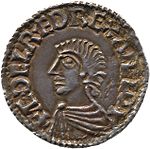
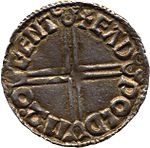
150px-Aethelred_obv2150px-Aethelred_rev2Penny: This was the smallest unit of currency. The plural of “penny” is “pence.” There were 12 pence for each shilling and 240 pence for each pound. “The earliest halfpenny and farthing (¼d.) thus found date to the reigns of Edward I and Henry III, respectively. The need for small change was also sometimes met by simply cutting a full penny into halves or quarters. In 1527, Henry VIII abolished the Tower pound of 5400 grains, replacing it with the Troy pound of 5760 grains and establishing a new pennyweight of 1.56 grams. The last silver pence for general circulation were minted during the reign of Charles II around 1660. 

Cartwheel_Penny“Throughout the 18th century, the British government did not mint pennies for general circulation, and the bullion value of the existing silver pennies caused them to be withdrawn from circulation. Merchants and mining companies began to issue their own copper tokens to fill the need for small change. Finally, amid the Napoleonic Wars, the government authorized Matthew Boulton to mint copper pennies and twopences. Typically, 1 lb. of copper produced 24 pennies. In 1860, the copper penny was replaced with a bronze one (95% copper, 4% tin, 1% zinc). Each pound of bronze was coined into 48 pennies.” (Penny)
If I have not lost you completely at this point, we must also address coins that a reader might encounter in an historical document or novel. There were also special coins that were used that spoke of “multiples” and “fractions” of shillings and pence. For example…

Guinea = one pound, one shilling (Slang word for a guinea was “yellowboy.”) You will read in historical novels where a gentleman paid for his business transactions in guineas. 

farthing_queenanneOther coins in multiples and fractions are…

Florin = 2 shillings
Crown = 5 shillings
Half-crown = 2.5 shillings
Tuppence = 2 pence
Thrupence = 3 pence
Groat = 4 pence
Tanner6 pence
Ha’penny = 1/2 of a penny
Farthing1/4 of a penny
Mite 1/8 of a penny

For a more detailed explanation visit The Proceedings of Old Bailey, which also addresses questions on wages and the cost of living at time, or British Life and Culture.


Posted in Act of Parliament, British currency, British history, Uncategorized | Tagged , , , , , , , , , , , , , | 20 Comments