Demoiselle en detresse, a Popular Story Telling Trope + the Anticipated Release of “Lyon in the Way” from Dragonblade Publishers

What does it mean to be a “damsel in distress”? In today’s culture, such a phrase will likely set off triggers of some kind or another. Please remember that I am 77 years old, and we never thought of “triggers” as a possibility. I am not criticizing those who have known trauma (for I have, in my past, been savagely attacked), but I am just setting the table for the phrase “damsel in distress” as a common trope in storytelling.

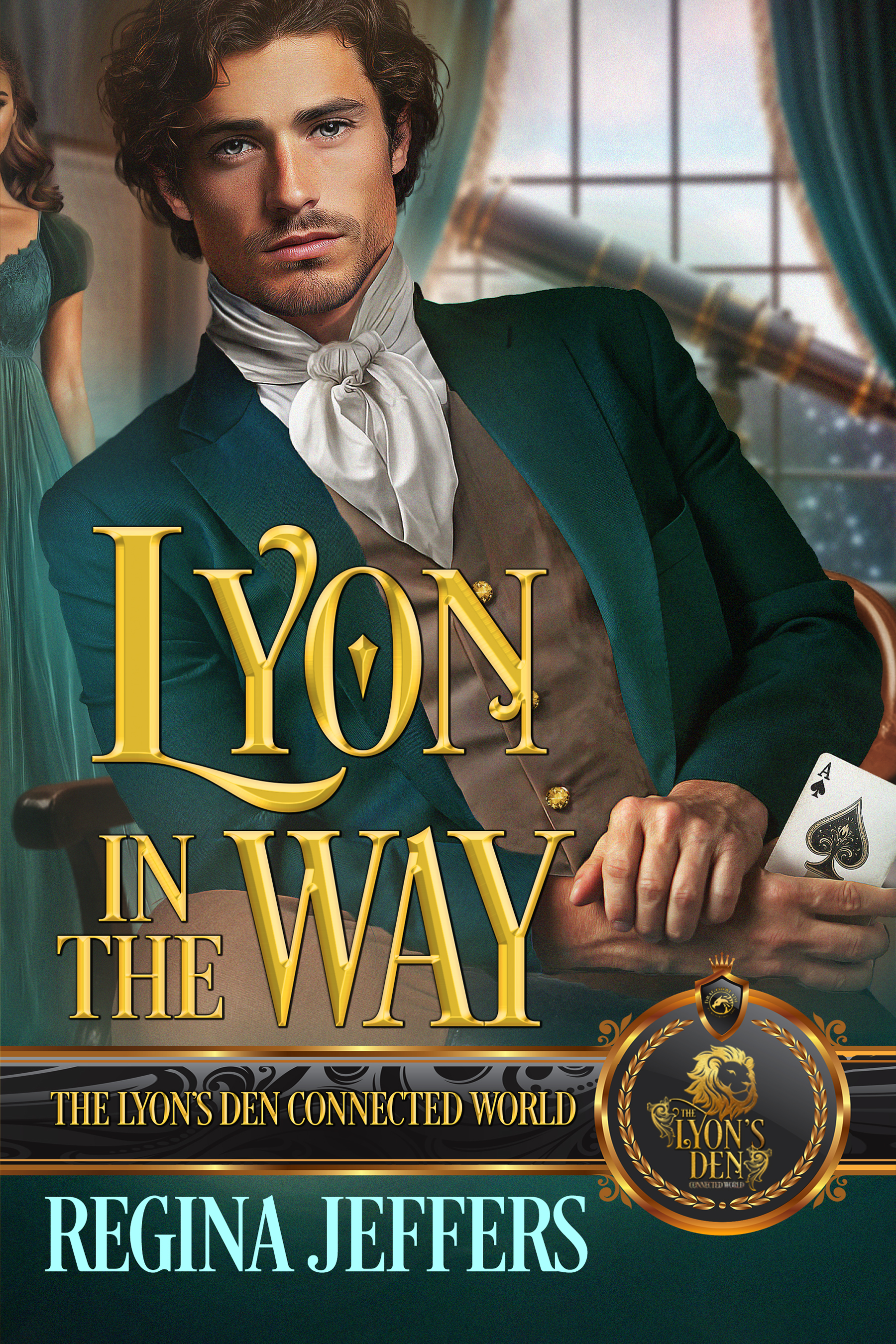
It is a trope used by writers in which a helpless woman is in need of being saved by a hero. I admit to being guilty of using this trope in my upcoming novel, Lyon in the Way, which will be released by Dragonblade Publishers on 18 June 2025.

We have grown up with this trope, and while it assuredly does nothing for the feminine movement, it is an easily recognizable means used by writers to move a romance story forward.
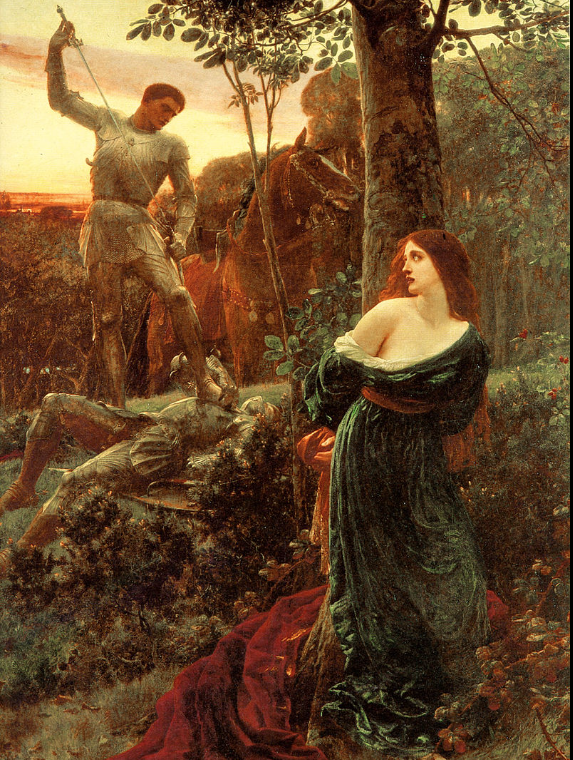
Frank Bernard Dicksee‘s 1885 painting Chivalry ~ Public Domain

I will pause for a moment in my storytelling and quote from a site that speaks to how this trope has hurt women.

“A damsel in distress is typically a helpless woman who is in need to be saved by a hero, usually a man who is flawless. The woman, whether a princess or a peasant, doesn’t take any action towards saving herself, but waits patiently for the hero figure to take plenty of steps to save her. While this may be a simple description of the damsel in distress trope, we’re sure you have come across plenty of variations. From Cinderella and Rapunzel to the plots of innumerable movies and shows in languages from around the world, we’ve seen this trope surface again and again all around us. 

“But the thing to note is that for a trope that emerges frequently, most of us have failed to outgrow it or recognise the harm it does, especially to women. In fact, the trope does immense disservice to women and women empowerment. Here’s everything you need to know.” [How the Damsel in Distress Trope Hinders Women Empowerment]

A literary trope is an artistic effect realized with figurative language — word, phrase, image — such as a rhetorical figure. In editorial practice, a trope is “a substitution of a word or phrase by a less literal word or phrase”. Semantic change has expanded the definition of the literary term trope to also describe a writer’s usage of commonly recurring or overused literary techniques and rhetorical devices (characters and situations), motifs, and clichés in a work of creative literature.

The damsel in distress is a narrative device in which one or more men must rescue a woman who has been kidnapped or placed in other peril. The “damsel” is often portrayed as beautiful, popular and of high social status; they are usually depicted as princesses in works with fantasy or fairy tale settings. Kinship, love, lust or a combination of those motivate the male protagonist to initiate the narrative. [Sarkeesian, Anita (March 7, 2013). “Damsel in Distress (Part 1) Tropes vs Women”Feminist Frequency.]

Critics have linked the helplessness of these women to societal views that women as a group need to be taken care of by men and treated nicely. [Sarkeesian] Throughout the history of the trope, the role of the woman as the victim in need of a male savior has remained constant, but her attackers have changed to suit the tastes and collective fears of the period: “monsters, mad scientists, Nazis, hippies, bikers, aliens…” [Lowbrow, Yeoman (December 28, 2014). “When Natives Attack! White Damsels and Jungle Savages in Pulp Fiction“]

European fairy tales frequently feature damsels in distress. Evil witches trapped Rapunzel in a tower, cursed Snow White to die in Snow White, and put the princess into a magical sleep in Sleeping Beauty. In all of these, a valorous prince comes to the maiden’s aid, saves her, and marries her (though Rapunzel is not directly saved by the prince, but instead saves him from blindness after her exile). [“Unga Fakta – Grekisk mytologi”http://www.ungafakta.se (in Swedish).]

The damsel in distress was an archetypal character of medieval romances, where typically she was rescued from imprisonment in a tower of a castle by a knight-errant. Geoffrey Chaucer’s The Clerk’s Tale of the repeated trials and bizarre torments of patient Griselda was drawn from Petrarch. The Emprise de l’Escu vert à la Dame Blanche (founded 1399) was a chivalric order with the express purpose of protecting oppressed ladies. [“Chivalry or The Chivalric Code”webpages.uidaho.edu.]

Paolo Uccello’s depiction of Saint George and the dragon, c. 1470, a classic image of a damsel in distress

The theme also entered the official hagiography of the Catholic Church—most famously in the story of Saint George who saved a princess from being devoured by a dragon. A late addition to the official account of this Saint’s life, not attested in the several first centuries when he was venerated, it is nowadays the main act for which Saint George is remembered. [“BBC – History – Historic Figures: St George (?–303)”http://www.bbc.co.uk.]

These tales are not just in the Western cultures. When I taught World Literature in high school, one of the units I used was Fairy Tales from around the world. I brought in children’s book versions of probably 50 different tales. This I would ask the students to identify the different tropes. Needless to say, in many of the fairy tales, there was “saving the damsel in distress.”

For example, look at
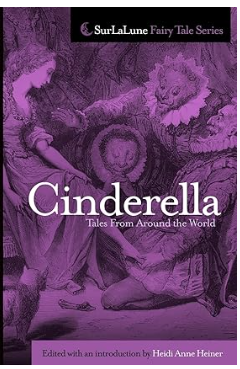
Yeh-hsien. Cenerentola. Cendrillon. Ashenputtle. Chernuska. Cinderella. These are just a few of the names of one of the best known and most beloved fairy tale characters in the world. The tale is known in countless variations throughout Europe and Asia as well as Africa and the Americas. The tales share the familiar story of a persecuted heroine who finally triumphs over oppressed circumstances through her virtue and the assistance of a magical helper. Whatever name she is given, the character has inspired countless generations and remains a vibrant part of modern popular culture. A discussion of the Cinderella Cycle is provided in the introduction, explaining how seemingly unrelated tales are considered part of the Cinderella family. A brief history of Cinderella scholarship is also included, detailing why the tale was once considered the key to understanding how stories were disseminated around the world. Building upon Marian Roalfe Cox’s seminal work with Cinderella over 120 years ago, this collection offers more than 150 full length Cinderella tales and over 200 summaries of other variants from around the world. Some of the tales are new translations, a few appearing for the first time in English. Many of the stories are clearly related to each other, but with some the relationship is less obvious. Whether you are a student of folklore or an armchair enthusiast, this anthology offers a diverse array of tales with a unifying theme that both entertains and educates, all gathered for the first time in one impressive collection.

Book Excerpt: Enjoy this Excerpt from Chapter One of Lyon in the Way, where Lord Richard Orson stumbles across a badly beaten Lady Emma Donoghue, a woman he has desired for more than a year for her bravado, her comely face, and (well, you will learn when you read the book).

Satisfied the stranger had abandoned his plans, Richard was again in search of Hunt’s carriage, but he had somehow made a wrong turn in his pursuit of the unknown man in black. “Foolish,” he chastised himself. “I am no better than the other drunks peppering these streets.” 

He made two more ill turns in quick succession and had to backtrack. “It would be nice to have a street light here and there,” he grumbled as he found himself in what he thought was the old market area. “I understand now why the Duke of Bedford wishes Parliament to regulate this area.” He paused to look around him to claim his bearings. Thinking himself assured of where to find Hunt’s carriage, Richard took a side street and a short alley, ignoring a man throwing up his oats and a woman chastising him in her best “fishwife” imitation for ducking under her line of clean laundry and knocking part of the rope down. 

Richard had cleared the pair and stepped upon the wooden walkway when a woman staggered from the shadows and, quite literally, into his arms. At first, he thought another of the area’s many pickpockets thought to make him her mark, but somehow Richard recognized her. The woman was not inebriated, nor did she appear to be on some sort of black powder, she was injured. 

Though she attempted to pull away from his embrace, he held her in place. There was blood seeping from a cut at her temple, as well as several defensive style wounds along her arm. 

She swayed in place as he propped her against the side of a nearby building so he might determine how badly she was injured, while also searching the area for a sign of her attacker. 

“Don’t!” she groaned as he braced her with one hand and turned as best he could to scan the area. “Don’t touch me, I must find the three . . .” 

“I shan’t!” he declared, though he kept his hand on her shoulder. “Who was in your party?” he asked, though the idea of her being with any man who would do this to her was unsettling. “Find three what?”

Her dark chocolate hair hung loose on one side and what once must have been a string of pearls laced in her curls had fallen over her forehead, which sported what would likely be a large bruise. The skirt of her gown was ripped on one side and covered with “alley” filth, a mix of garbage and human waste and mud, as if she had been knocked to her knees, and she was missing her evening slippers. 

He asked again. “With whom were you traveling? Are there others for whom I should be seeking? Three more, perhaps?” Richard was already wondering if the man he had been following earlier had committed this crime. He could not imagine even the daring Lady Emma Donoghue, though she pushed all boundaries of conformity, would venture to Covent Garden alone. She swayed in place and he tightened his hold on her shoulder. “How did this happen?”

She looked at him oddly, as if she suddenly realized he was there before her. “I . . . I . . . I do not know.” 

“We will discover the truth,” he said. “Permit me to assist you to this building’s entrance steps. I would like to have a look around. To know assurances that someone else has not been harmed. Can you place your trust in me to do what I say? Afterwards, I will see you home.” 

“Home?” she asked and frowned. “Do not wish to return home.”

“Do not worry. I will not desert you.” He guided her to the steps leading to the main door of the building, but he had quickly become aware of how his touch frightened her. She half sat and half collapsed onto the stained bricks of the entranceway. He permitted her to slump against the cold stone, claimed his Queen Anne pistol, and walked back the way she had come, but there was no one along the street and no signs of a struggle, not even one of her missing shoes. He was guessing whatever had happened to her, it had not happened nearby. Perhaps someone had dumped her in Covent Garden after assaulting her elsewhere. 

Richard briefly wondered if she had been raped. He prayed not, for a woman of her “huzzah” should not be played foul.

Hurrying back to where he had left her, he roused her gently. If she had a head injury, he did not want her sleeping until a physician or a surgeon examined her. “Come now, my lady,” he said as he gently coaxed her to her feet. “Again, I ask, can you tell me who you were with earlier this evening?” 

She looked around her. “I do not . . . recall,” she said with a frown. 

“My lady . . .” he began, but she reached a bloody hand to him to prevent his question. 

“How do you . . . know me . . . to be a lady?” she asked, and it was the first time she appeared truly frightened, rather than simply confused. 

“You are Lady Emma Donoghue. Earlier today, you and some of your acquaintances prevented a number of gentlemen from entering White’s.” He would not tell her he had been asking the occasional question about her for coming up on two years. Like it or not, the woman fascinated him. 

“And this was . . . my punishment?” she asked. 

“I cannot say with any confidence,” he admitted. “As I was one of the men at White’s, I saw you there. You have been among those ‘protesting,’ shall we term your actions, at several venues for months. Yet, of course, you are well aware of those efforts.” 

“Who are you?” she asked as she staggered away from him, fear obviously returning. 

He reached a hand to her when she swayed in place. “I am Lord Richard Orson. I am a peer of the realm and often assist those in the government.”

Book Blurb:

One man wants her dead. Another may love her forever.

For over a year, Lord Richard Orson has been quietly captivated by the unconventional Lady Emma Donoghue. Headstrong, brilliant, and unapologetically involved in causes that rattle Society’s comfort, Emma is nothing like the debutantes he’s expected to court.

But when he finds her bruised, confused, and alone in Covent Garden after midnight, Richard is thrust into a far more dangerous game.

Someone wants Emma silenced. And now, Richard has only moments to uncover the truth, protect her from harm, and keep her out of scandal’s reach. But staying focused is harder than he imagined—especially when every glance, every accidental touch, reminds him how perfectly she fits in his arms.

Tropes you’ll love:
✔ Protective hero / damsel in distress (with a twist)
✔ Bluestocking heroine
✔ Rescue & recovery romance
✔ Unlikely match / opposites attract
✔ Slow burn with rising suspense
✔ One bed (forced proximity)
✔ Hero falls first

As danger closes in and secrets are revealed, Richard must decide whether he’s willing to risk his life—and his heart—for a woman who’s always been worth the fight.

A suspenseful, slow-burn Regency romance where danger ignites desire, and love must outpace the clock.

Purchase Link:

Read in Kindle Unlimited!

Enjoy book one in a new series within The Lyon’s Den Connected world by Regina Jeffers.

Book 1 – Lyon in the Way
Book 2 – Lyon’s Obsession
Book 3 – Lyon in Disguise
Book 4 – Lost in the Lyon’s Garden
Book 5 – Lyon on the Inside
Posted in book excerpts, book release, books, British history, Chaucer, Dragonblade Publishers, Georgian England, Georgian Era, hero, heroines, historical fiction, mystery, reading habits, Regency era, Regency romance, research, romance, suspense | Tagged , , , , , , , , , , , , , , , , | Comments Off on Demoiselle en detresse, a Popular Story Telling Trope + the Anticipated Release of “Lyon in the Way” from Dragonblade Publishers

The First Time I Wrote a Regency Romantic Suspense/Mystery: A Touch of Scandal, Book 1 of the REALM Series

In June, the first of my new five mystery/romance/suspense books for Dragonblade Publishers hits the shelf. A new book will follow every three months. The titles are Lyon in the Way, Lyon’s Obsession, Lyon in Disguise, Lost in the Lyon’s Garden, and Lyon on the Inside. Yes, they are each part of the Lyon’s Den series trademarked by Dragonblade, but they are an original series that uses the Lyon’s Den as one of the backdrops for the action.

Lyon in the Way from Dragonblade Publishers, releasing 18 June 2025 – now on PreOrder on Amazon

For the books, I chose to use a format I used in my highly successful Realm series. Each book begins with a prologue told by the hero of the book. With each new edition of the series, the reader learns more and more facts about what happens in that moment in time and how it changes the lives of these seven men. In the Realm series, that prologue begins in an isolated camp on what would now be the Pakistan and India border. A young woman is being abused because she spoke out against the leader of the men, and Brantley Fowler, the hero of book 2, saves her. However, his actions on that day changes not only his life but that of each of the men in the group. Likewise, the epilogue of each book provides a “picture” of the extremes the warlord uses to discover which of the seven Realm members stole a large jewel. With each book the reader is provided more and more clues until the wild and crazy conclusion.

This format—prologue and epilogue—is being repeated in my Lyon’s Den mystery series. Hopefully, you’ll not figure the whodunit out until the end.

Until I wrote The Scandal of Lady Eleanor, all I had written were Jane Austen adaptations and retellings, including Darcy’s PassionsDarcy’s Temptation,Vampire Darcy’s DesireThe Phantom of Pemberley and Captain Wentworth’s Persuasion. I was very appreciative of Ulysses Press taking a chance on my first true Regency romance. What did not work out was before they could continue the series, Ulysses made the business decision to finish the fiction books under contract (including several of mine) and then switch to non-fiction only products. In truth, Ulysses was very much a non-fiction publisher when I joined them, so the decision was not surprising. However, that particular decision left my Realm series in limbo. It was impossible to sell the series to another traditional publisher for who would want to finish a series started by another publisher? Therefore, I ended up self publishing the series. Nevertheless, it still was quite successful, winning multiple writing awards.

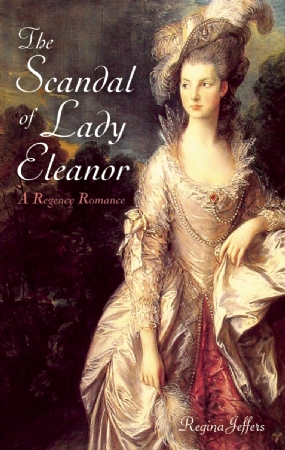
Ulysses Press cover for The Scandal of Lady Eleanor

I must admit that it was liberating to write a story from beginning to end, without a preconceived framework already in place. When an author tackles an Austen storyline, he/she must stay somewhat true to the original characters or “suffer the ire” of Janeites. In my Austen books, I work in her original wording and use what I know of the lady and the times. With the Realm series, the characters and the conflict were part of me. 

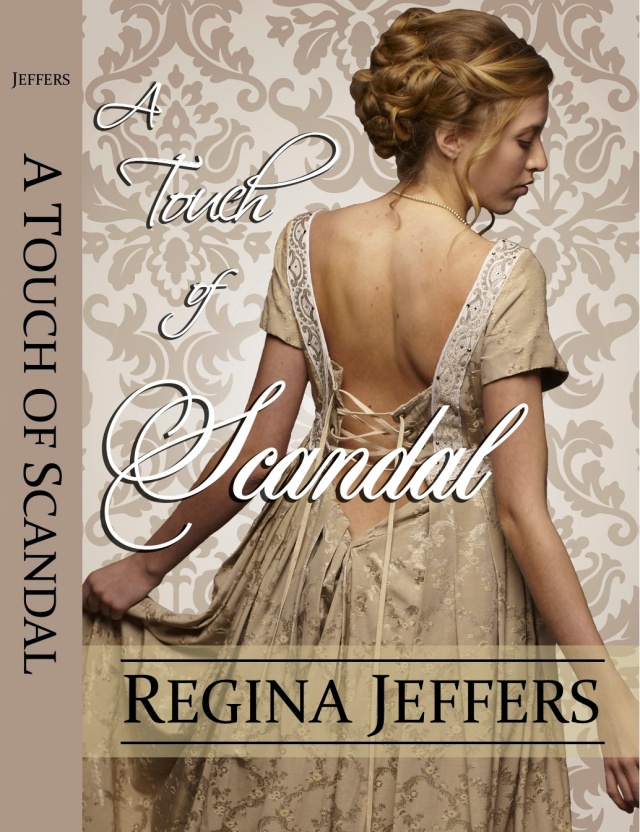
The Scandal of Lady Eleanor (aka A Touch of Scandal): Book 1 of the Realm Series

2011 Write Touch Readers’ Award, 2nd Place, Historical Romance 

Warning: This series is a bit “spicier” than my customary clean JAFF romances.

A Touch of Scandal (formerly called The Scandal of Lady Eleanor) is the first book in the “Realm” series. 

The Realm is a covert group working for the British government during the Regency Period. They rescue British citizens, bring about diplomatic portals, etc. Its members are titled aristocrats and minor sons—therefore, the name “the Realm.” The members in this series number seven: James Kerrington, Lord Worthing (and future Earl of Linworth), who is the hero of A Touch of Scandal; Brantley Fowler, the Duke of Thornhill, from Book 2, A Touch of Velvet; Gabriel Crowden, Marquis of Godown, from A Touch of Grace; Aidan Kimbolt, Viscount Lexford, from A Touch of Mercy; Marcus Wellston, serving as the regent for his elder disabled brother, the Earl of Berwick, from A Touch of Cashémere; Lord John Swenton, a baron, from A Touch of Honor, and Carter Lowery, the youngest son of Lord Blakehell, from A Touch of Love. The series conclusion, A Touch of Emerald, features Kerrington’s son, Daniel. These men of the Realm have served together for several years in India and Persia, and they possess a stout camaraderie. Each holds reason for fleeing his home and title, and each must reclaim his place in Society, while still occasionally executing a mission in the name of the government. Unfortunately, not only must these men fight their own demons, they must foil the plans of Shaheed Mir, a Baloch warlord, who believes one of them has stolen a fist-sized emerald; and Mir means to have it back and at any cost to lives.

In A Touch of Scandal, James Kerrington, the future Earl of Linworth and a key member of the Realm, never expected to find love again after the loss of his beloved wife, Elizabeth. But upon his return home, Kerrington’s world shifts on its axis when Lady Eleanor Fowler, literally, stumbles into his arms. Unfortunately, not all is as it seems with Lady Eleanor, as she hides a deep secret. She had hoped the death of her father, William Fowler, the Duke of Thornhill, would offer her family a chance at redemption from their dark past, but when Sir Louis Levering produces proof of Eleanor’s father’s debauchery, she is thrown into a web of immorality and blackmail. It is up to Kerrington and his associates in the Realm to free Eleanor from Levering’s hold.

original cover for A Touch of Scandal

In writing this series, I chose to use “modern issues” throughout. Just because life appears “simpler” does not mean Regency England did not reek of scandal. Women lacked options. Even women of a wealthier class were the property of first their fathers and then their husbands. As such, Lady Eleanor Fowler is no exception. When her mother dies, her father’s debauched lifestyle invades her privacy, and she is sucked into a situation because she “loves” a parent who does not really understand the meaning of the word. Eleanor’s brother Brantley escaped the Duke of Thornhill’s hold on his household, but Eleanor is left behind to cope in the only way she knows how: Survive.

__________________________________

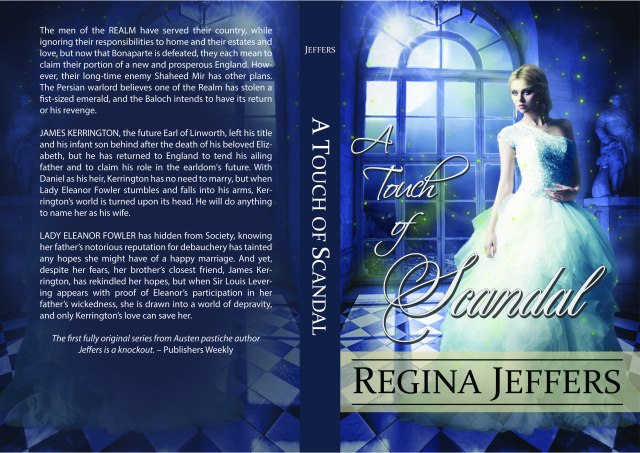
Current cover for A Touch of Scandal

A Touch of Scandal: Book 1 of the Realm Series

The men of the REALM have served their country, while ignoring their responsibilities to home and love, but now Bonaparte is defeated, they each mean to claim their portion of a new and prosperous England. However, their long-time enemy Shaheed Mir has other plans. The Persian warlord believes one of the Realm has stolen a fist-sized emerald, and the Baloch intends to have its return or his revenge.

JAMES KERRINGTON, the future Earl of Linworth left his title and his infant son behind after the death of his beloved Elizabeth, but he has returned to England to tend his ailing father and to establish his roots. With Daniel as his heir, Kerrington has no need to marry, but when Eleanor Fowler stumbles and falls into his arms, Kerrington’s world is turned upon its head. He will do anything to claim her.

LADY ELEANOR FOWLER has hidden from Society, knowing her father’s notorious reputation for debauchery has tainted any hopes she might have of a happy marriage. And yet, despite her fears, her brother’s closest friend, James Kerrington, has rekindled her hopes, but when Sir Louis Levering appears with proof of Eleanor’s participation in her father’s wickedness, she is drawn into a world of depravity, and only Kerrington’s love can save her.

The first fully original series from Austen pastiche author Jeffers is a knockout. – Publishers Weekly

Jeffers’s characters stay in the reader’s heart and mind long after the last page has been turned. – Favored Elegance

Purchase Links:

Kindle   https://www.amazon.com/Touch-Scandal-Book-Realm-ebook/dp/B00JBOA9PW/ref=asap_bc?ie=UTF8

Amazon   https://www.amazon.com/Touch-Scandal-Book-Realm/dp/1496180941/ref=tmm_pap_swatch_0?_encoding=UTF8&qid=&sr=

Kindle Unlimited  https://www.amazon.com/kindle-dbs/hz/subscribe/ku?passThroughAsin=B00JBOA9PW&_encoding=UTF8&shoppingPortalEnabled=true

BookBub https://www.bookbub.com/books/a-touch-of-scandal-book-1-of-the-realm-series-by-regina-jeffers

Audible (Virtual Voice Narration) https://www.amazon.com/dp/B0CSQT18P2

Prologue (Excerpt):

“What do you plan to do?” James Kerrington asked as he leaned across Brantley Fowler, while pretending to reach for the bowl of fruit. Kerrington studied Fowler’s countenance as the man stared at where the Baloch warriors held the girl. Kerrington really did not need to ask. He and Fowler were the two of the original members of a group the British government “lovingly” referred to as the Realm. The unit ranged between the ages of nineteen and twenty-five. As he was the eldest, the others called Kerrington “Captain,” although no such military ranks existed between them.

The group often called Fowler “The Vicar” because the future Duke of Thornhill always wanted to “save” every soul they encountered, especially woman and children. Surprisingly, the baby-faced Fowler was also able to convince those their group captured to confess as readily as any clergyman. “Authoritative persuasion,” was the word they had coined for exacting information from those mean to defy the English government. Fowler had joined the group after a short stint with some shady seamen following the young man’s alienation from Thornhill and the dukedom, as well as a tumultuous time with Wellesley and the Spanish front. Fowler had never said exactly what had caused the rift between him and his infamous father.

Kerrington’s family knew something of Fowler’s. His mother, Lady Camelia Kerrington had made her Come Out with Fowler’s aunt, Agatha Braton, the Duchess of Norfield, and so Kerrington was familiar with some of the family history. Fowler’s father, the Duke of Thornhill, held a reputation for a lusty sexual appetite. Having viewed his friend’s multiple attempts to save more than one woman who suffered at the hands of a brute, Kerrington suspected there was truth buried in the gossip.

Fowler gritted his teeth, offering a grim smile to the Baloch warriors sitting about the low table, while Kerrington immediately assessed the situation. Fowler hissed, “Each man who enters that tent gives the girl a rupee because Mir says that is all she is worth — one rupee — one shilling and fourpence in England.” His friend’s breathing became shallow, obviously biting back anger. “She is not yet sixteen.”

“You cannot save the world, Fowler,” Gabriel Crowden, another of Realm numbers, cautioned.

Fowler insisted, “I can save her.”

Kerrington shot a glance about the tent to assure himself the others were aware of the change in their situation. He often regretted the fact he had shown more care with these men than he had ever shown to his son. Daniel resided with James’s parents at Linworth Hall. When he had walked away from his home after Elizabeth’s death, he had also deserted the child, who had cost his wife her life.

“Oh, Lord, here we go again,” Crowden grumbled as he slid the bench and slipped into the shadows. “Permit me time to assume a position.”

Kerrington stiffened in anticipation as he watched Fowler stand slowly and stretch. His friend pretended to exercise his legs. “I believe I will take a walk,” Fowler announced, but before James’s friend could execute more than five steps in the direction of the girl’s tent, a burly-looking soldier, under Mir’s command, blocked Fowler’s path. Without saying a word, the man had told Fowler to reconsider his choices, but James knew the Baloch would be sorry he had crossed the young duke.

Raising his hands in an act of submission, Fowler smiled largely and turned to Kerrington with a warning of what was to come. Fowler shrugged as if to agree with the warrior, but in a split second, he had struck the guard with an uppercut, sending the man reeling with a broken nose.

A heartbeat later, Kerrington and Fowler stood back-to-back, taking on all comers, delivering lethal thrusts after deadly jabs. “I have it,” Kerrington called as he parlayed a broken chair for a weapon. “Retrieve the girl. Take her to the Bombay safe house.” He shoved Fowler in the direction of the girl’s tent.

His friend did not look back; Fowler knew he count on Kerrington and the others in their group to break through Mir’s line of defense. Together, they would provide Fowler time to make a complete escape.

Preparing for the next assault, he wondered about his own sanity. How many times over the previous two years had Fowler staged “a fight to the death” in order to save some female? Somehow, Kerrington had accepted the future duke’s “need” to rescue the disadvantaged. It seemed only fair, if he was to die, he should do so in an effort to save some woman — an act of penitence, so to speak. He had had no skills to save the woman he love — Elizabeth Morris — the woman he had married and had promised to love and to honor and to protect “as long as ye both shall live.” Unfortunately, Elizabeth Morris Kerrington had live but two years, two months, and ten days before she had passed in childbirth — his child — their child. Mayhap by saving this woman, he might atone for for what he could not do for Elizabeth, and what he had done to Daniel — just walking away from the boy, unable to look upon his own child without seeing Elizabeth and experiencing the pain of her loss.

Turning his head, Kerrington noted how Fowler ran for the horses while pulling the scantily-clad girl behind him. Kerrington spun to the right, twirling a sword he had pulled from his walking stick, using the stick and rapier in tandem with swinging figure eights to ward off three Baloch soldiers. “Now!” he called above the battle’s clamor, and the Realm members synchronized their final strikes, leaving their opponents sprawled on the tent’s floor. They had dashed toward their tethered horses, swinging up into the saddles. They would distract pursuers, riding off in three separate directions — all in opposition to Fowler’s exit — to meet again in two days at their common house.

Racing toward the nearest hill, Kerrington pulled up the reins to take a quick look, making certain they had all made it out safely. He felt responsible, although each of his mean were quite capable and very menacing in his own right. “Let us depart, Captain,” Aidan Kimbolt called from somewhere behind him. Kerrington had seen all he had needed to see — they all were moving away from Shaheed Mir’s tents. Turning the horse in a complete circle, he nodded to Kimbolt, the group’s best horseman, to disguise Fowler’s hoof prints in the sand, before galloping away in the direction of the dying sunset.

Posted in book excerpts, books, British history, eBooks, excerpt, Georgian England, Georgian Era, historical fiction, mystery, peerage, publishing, reading habits, Realm series, Regency era, Regency romance, war, writing | Tagged , , , , , , , , , , , | Comments Off on The First Time I Wrote a Regency Romantic Suspense/Mystery: A Touch of Scandal, Book 1 of the REALM Series

Could an Earldom Pass Through the Female Line?

Question from a Reader: Could an earldom pass through the female line? Let us say an earl dies and he has no living sons remaining and there are no grandsons, could the earldom pass to his eldest daughter?

Answer: Could be “yes,” but more likely “no,” so if this is the plot point on which you wish to know author suicide, I would not recommend it as a plot bunny. That being said, let me make several explanations.

First and foremost, It depends on the original documents that set up the title in the first place. If the documents say, as most do, ‘to heirs male of the body’, then the title CANNOT descend through daughters. Some of the older titles say ‘heirs of the body’. In this case, one of the daughters will inherit in her own right and will become the countess of XXXXX, but will not be able to exercise all the privileges of the title (for example, she will not be able to sit in the House of Lords). Everything depends on the founding documents.

If it is heirs male of the body, the title would become dormant until they can search all collateral family lines, no matter how distant.

Here’s a brief summary with an example from the lovely Jude Knight’s website ~ https://judeknightauthor.com/…/who-inherits-the-title…/

Generally speaking, only the Scottish had founding documents that permit a female to inherit. Now that I have said such, people will provide me a hundred examples from the time period where a female inherited.

It is often easier to start with the question of how to make X the peer. There were a few cases of earldoms in the English peerage where the title went to a daughter. There is even an appendix on it in the Complete Peerage. Usually, such peerages went to the oldest daughter if there were no sons. while baronies could go into abeyance, some argue that earldoms did not.

The complete peerage of England, Scotland, Ireland, Great Britain, and the United Kingdom : extant, extinct, or dormant

A peerage by writ was a very old peerage. There were only earls and barons at that time. These peerages were based on a writ of summons to the Parliament of the day. As most peers acquired other titles and higher ranks along the way, these sometimes were forgotten. However, there have been several cases where a superior title was dormant, extinct, or went to a male where the barony (and rarely an earldom) could be inherited by a daughter or daughters. Because they were by writ, there was no patent for these and so the inheritance was not tied strictly to the oldest son.

Basically, legitimate sons inherited in birth order. If the founding documents do not specifically allow daughters to inherit, then the title goes into abeyance until the Monarch allows a child of one of the daughters to take the title. It might not be the eldest, in this case.

The title does not go into abeyance if the daughter can inherit (the wording appears to be heirs general). It goes to the eldest daughter. This happens mostly in Scotland. The eldest daughter’s eldest son inherits from her even if he is younger than any son the other daughters have.

Abeyance is where there is no known heir or where there is a dispute about which heir is the right one. For example, the 1st earl had an eldest son who inherited and twin sons as younger sons. Birth order for these two has been lost over time, and they both have one male descendant in the 6th generation. Which is the heir? No one can be confident. Therefore, the title goes into abeyance while the King, and those he assigns the task, figure it out.

Question #2 – What if the holder of the title successfully petitioned the Crown to recreate the title for the eldest son of one of the daughters?

Answer: Though I assume this could be accomplished, I am not assured of what sort of rules and caveats one must overcome to make this happen. I would also assume that this option would have had to have been set up prior to the death of the last title holder.

It seems to me, and I do not wish to be your “Debbie Downer” in this matter, that this option would have been known before the last title holder’s death. This is not something that research might discover, after the death, making an unknown as the new title holder.

Title holders knew who was next in line. Simple as that. Only if there were numerous deaths (which I have written in one of my books) would one see a significantly younger son inherit or even the son of one of the daughters. However, when I did this, I kept it in the male line, with two heirs dying before they could inherit and one of those having only daughters at the time of his death. One killed in a duel on the Continent before he married. And the fourth with a son who became the new earl after that father’s death. A bit overkill (pardon the pun), but still male heirs of the body.

Posted in Uncategorized | Comments Off on Could an Earldom Pass Through the Female Line?

Competency Hearings During the Regency

I had a reader send me a question about a particular book, which I will not name nor provide the author’s name, for I do not call out others on a public forum, unless it is in a positive manner. In it, a duke suffered a stroke, and the incident affects him physically, but not mentally. The reader wanted to know what I knew of these type of hearings during the Regency and early 1800s, for in the story the duke is sent to an asylum. I will tell you the reader had nothing but good things to say of the story, speaking of how it touched her emotions deeply, but this one hiccup bothered her.

First, I must say, this is not an area in which I have completed much research. However, based on what I know of the time period, I would not think a duke would be placed in either a public or private asylum if he still had his faculties about him, though, as authors, we often extend reality to fit our stories. Gosh, I have written so many “coincidences” to move a story along, I should be ashamed of myself. Yet, I am not. So, again, I do not mean this as criticism, for, although I have used “coincidences” galore, I understand how the reader with a working knowledge of the history of the time might have difficulty on this point. A duke simply was not treated like other members of the aristocracy or of the gentry. That being said, as it was easy to commit an ordinary person to an asylum for there was lots of corruption at that time, a duke, in my opinion, was not “ordinary.” Dukes were lord lieutenants, members of the Privy Council, hereditary gentlemen, and holders of ceremonial or regular offices. Dukes were not so easily tossed aside.

It seems to me, if he were competent enough to write out his responses, an asylum would not be the appropriate place for him. Yet, as I said above, there were lots of bribes and corruption in the system at that time, so a traitorous family might have had him placed aside, though he would still be the duke.

http://www.historyisnowmagazine.com/blog/2014/5/28/a-scene-of-chaos-in-a-19th-century-asylum-image-of-the-week#.Y_jvbuzML5Y= History Is Now Magazine ~ The image above is a scene entitled In the Madhouse, painting eight of William Hogarth’s A Rake’s Progress. In the scene we can see the inside of Bethlem Hospital (‘Bedlam’), the foremost criminal lunatic hospital of its day. The painting was produced in the 1730s. The hospital’s roots can be traced as far back as the thirteenth century, while in the Georgian era, it housed many people who were classed as insane by the authorities. The image itself shows us a picture of chaos inside the hospital, with dark figures lurking who are undertaking all sorts of weird and wonderful activities.

In most cases, I believe he would have been kept at home, probably with attendants, as well as his personal servant. The question would remain: Could he read and comprehend papers and could he still communicate?

I do have a bunch of notes from a class I took from the ever fabulous Louis Cornell as part of one of the Romance Writers of America’s Academe classes. I am sharing them in no particular order:

**The important thing to remember is the laws concerning certificates of lunacy and commissions of lunacy changed a great deal after 1823. Before that, whilst the procedures appeared fair and above board on paper, there was a great deal of room for bribery, abuse of the system, and outright graft and greed.

**From the late eighteenth century until the mid-nineteenth century there WERE cases where unscrupulous family members or even solicitors used the system to get their hands on the estates and monies of wealthy cits, peers, and yes, even men ranking as high as a duke.

**One did not have to be a family member to petition the Lord Chancellor to call a Lunacy Commission. However, one did have to inform the subject’s next of kin.

Once the Lord Chancellor read the petition and decided to convene a commission, that commission would consist of one to three (sometimes more) legal representatives. They would conduct the commission. A jury of up to 23 men would be convened to hear the evidence of the case. These men would be gentlemen, professionals, and peers of the subject. With this many people involved and so much power in play (MP’s often sat on these commissions) the chance for bribes and old grievances to be used against a subject were rife.

**Lunacy and competence were two different things. A person might be declared incompetent and still be allowed the freedom to live his life. His incompetence would result in a guardian or a board of trustees to oversee the person’s finances, etc. Questioning in a competency hearing might include asking the person to do math in his head, or to explain contracts of business, or to recite what his estate’s crop yields were last year. So a man who had suffered a stroke might be seen as incapable of doing these tasks. Remember the medical world and especially the mental health world was at a crossroads in the Regency – some thought of mental illness as a spiritual failing and the other of mental illness as an actual physical of psychological issue. Get the right men on the jury and a stroke victim could be seen as incompetent as a person born with brain issues and learning disorders.

**A certificate of lunacy issued by a physician could suffice to have a person locked up in an asylum. But there were ways to secure a release. However, it took a commission of lunacy to lock a person up and deprive them of his civil rights. This would have been harder to override.

**Yes, locking a duke up in an asylum would be hard, but not impossible, especially if the duke were locked up in a private asylum with a good reputation and those involved in petitioning for the lunacy commission were able to prove the duke was dangerous to himself or others.

Posted in British history, Georgian Era, laws of the land, Living in the UK | Tagged , , , , , , | Comments Off on Competency Hearings During the Regency

Use of Mews in Regency London

Question from a Reader/Writer – Were mews actually kept behind London’s great houses or were there a, for lack of another word, a group barn for the people along a street?

Okay, I admit I am not an expert in this area. My editor often corrects my ignorance in these matters. I rode some when I was young, but not enough to know all the ins and outs of riding, saddles, barns, etc. Below is a hodgepodge of tidbits I picked up from writing Regency.

RIBApix – The UK’s Largest Architecture Image Library – Architectural Images & Drawings via Pinterest ~ https://www.ribapix.com/design-for-a-stable-and-mews-house-for-s-pocock-possibly-in-regency-mews-brighton-plans-and-elevations_riba37553

Many large houses in Mayfair had their own mews along the back of the property, opening onto an alley behind. You can see these spaces on the The A to Z of Regency London 1819 maps. It was important to keep the carriages separate from the horses because manure let off gases that harmed carriages, so one configuration would be 4-6 stalls perpendicular to the alley, which were separated by a wall from a carriage house on the other side of the space. The upper floor would contain rooms for grooms and a coachman plus storage for hay. It took time to fetch a carriage for use because it would have to be hitched up, then exit the alley and drive around to the front door. If one did not have his own stabling facilities, he could rent/let space at public mews, which were located all over the place. So a family might use a mews on the next street, which did not add much time to fetching a carriage in an emergency. Most uses of a carriage were pre-arranged so it would be at the front door when wanted. Or one could use hired horses/carriages to move to London and then rent horses and carriages as needed once arriving in the City. 

DESCRIPTION

The London Topographical Society A to Z series consists of seven books, which provide fully-indexed maps of London at roughly 100 year intervals. Each reproduces a key map of the period. The indexes allow users to identify the position of streets and buildings, in some cases right down to small courts and alleys.

They appeal to anyone interested in the development of London and are invaluable for those researching family history.

This publication reproduces at two-thirds actual size the 4th and last edition of Richard Horwood’s map of London.

As a guide to the topography of early-nineteenth-century London it is unequalled. The 40 sheets of the map are accompanied by an introductory essay describing its making, assessing its qualities, and casting new light on the life of the map-maker, as well as indexes to streets and buildings showing the juxtaposition of residential and industrial premises.

***************************************

There is a good article on the cost of maintaining a horse in London–always follow the money. It covers stabling (which includes feed, water, and getting rid of the manure).

https://janeaustensworld.wordpress.com/2009/06/18/cost-of-maintaining-a-horse-in-regency-london/

There is also information worth noting on the Royal Mews —

http://www.royal.gov.uk/TheRoyalHousehold/RoyalAnimals/Workinganimals/TheRoyalMews/History.aspx

Also some good information on stabling arrangements here:

http://regencywriter-hking.blogspot.com/2014/08/stabling-in-nineteenth-century_22.html

One could stable horses at local inns; however, that would be both expensive and would not guarantee a well maintained horse. So … either one is rich enough to have one’s own mews for his horses, or he opts for hiring horses (for riding and driving) as he needs them from London stables, or he walks. This was one reason why driving one’s own horse in Hyde Park was a sign of wealth.

“Hackneys, or public carriages for hire made their first significant appearance in the early 17th century. By 1694, these vehicles had increased to such a number that a body of Hackney Coach Commissioners was established in London. The commissioners dealt out licences, which was a bit of a joke, for a mere four inspectors were responsible for over 1,000 vehicles.

“Most of these licensed hackney coaches were purchased second hand. All that an enterprising person needed to establish his own hackney coach business was enough money for a used carriage and three horses, two that worked in rotation, and one that could be used as a replacement in case of injury or illness. The death of a horse could lead to a cab owner’s financial ruin. Another important ingredient was housing for the horses.”

“By, 1823, the lighter horse cabs began to replace cumbersome hackney coaches in great quantity, and by the mid 1830’s, the hansom cab set the new standard for modern horse cabs. Aloysius Hansom, an architect, designed the first carriage. When Hansom went bankrupt through poor investments, John Chapman took over, designing an even lighter, more efficient cab, one whose framework did not strike the horses on their backs or sides whenever a carriage ran over an obstacle in the road.

“It is also why hansome cabs took off in the Victorian era as the city’s middle class boomed–the population created the need for more carriage for hire for those who could afford to pay but who could not afford to keep their own horses and carriages. “The hansom cab is a kind of horse-drawn carriage designed and patented in 1834 by Joseph Hansom, an architect from York. The vehicle was developed and tested by Hansom in Hinckley, Leicestershire, England. Originally called the Hansom safety cab, it was designed to combine speed with safety, with a low centre of gravity for safe cornering. Hansom’s original design was modified by John Chapman and several others to improve its practicability, but retained Hansom’s name.”

Hansom cab and driver in the 2004 movie Sherlock Holmes and the Case of the Silk Stocking, set in 1903 London ~ Wikipedia
Posted in British history, buildings and structures, customs and tradiitons, Georgian England, Georgian Era, Great Britain, history, Living in the Regency, Regency era, research, travel | Tagged , , , , , , | Comments Off on Use of Mews in Regency London

Were There Any Requirements for Those of Age to Elope to France?

Question from a Reader/Author: Is there any other reasons besides age when a couple was considering elopement during the Regency Era? I mean, if they were both twenty-one or older, were there other restrictions? Would they still require a parent’s permission? Was Scotland the only choice? Could they go to France or some other European country?

As a general rule, the English accepted all marriages as valid that were valid in the country where they were celebrated. However, there were few marriages of English persons in France, for example, during the war, except those of soldiers who had a chaplain officiating. A marriage that took place in such conditions after the war was declared invalid because it was not done in accordance with local law.

There were the Channel Islands where some people went to be married, but usually these were people who lived in the southwest corner of the country and were accustomed to the sea. I have recently written such a scenario in The Marchioness’s Madness, which is waiting to be published. Of course, the couple in that tale are older, looking for a second chance romance.

The Channel Islands are an archipelago in the English Channel, off the French coast of Normandy. They are divided into two Crown Dependencies: the Bailiwick of Jersey, which is the largest of the islands; and the Bailiwick of Guernsey, consisting of Guernsey, Alderney, Sark, Herm and some smaller islands. Historically, they are the remnants of the Duchy of Normandy. Although they are not part of the United Kingdom, the UK is responsible for the defence and international relations of the islands as it is for the other Crown Dependency, the Isle of Man, and the British Overseas Territories. [The term “Channel Islands” was not used until about 1830, so do not use it in a Regency era book.]

As for the Channel Islands, they were properties of the English crown but had their own legislature and laws. They were not part of France, though their proximity to the French coast made travel there dangerous during the war. According to my notes, they allowed marriage to anyone 21 or older without any residency requirements.  My notes do not mention what the rules were for younger people as I was not researching that situation when I made them…

A couple things to remember…

On 20 September 1789, the age of legal majority was reduced to 21 for both men and women, confirmed in 1804, and parental permission was no longer required.

When the Code Napoleon came into effect in the early 1800s, it automatically repealed all previous laws, including the 1789 law I cite below. [See my piece on Eloping During the Regency and What the Code Napoleon Said About It.]

Note that under the Code Napoleon, there were different majority ages for different aspects of the law.

Given that Britain was at war during a good part of the Regency, one would either need to set his story AFTER the war had ended, or NOT have one’s couple elope to France. Having them elope to France during the war simply because it is supposedly easier than going north, and I would instantly toss the book. The author would need to have very strong reasons for them to go to France, other than it being easier than going to Scotland to have any hope of my continuing to read. Even having them elope to France after the war would be a big step to ask of most readers.

Moreover, there are other factors one needs to consider before pursuing this course.

In the early 19th century (and throughout the period we call the Regency) family consent was required for most marriages IN FRANCE. Women who had not attained their 21st/22nd (depending on which source one reads) birthday, and men who had not attained their 26th birthday, needed permission from a parent or guardian, though only the father’s permission was required if the parents were in disagreement.

If the parents refused consent for women aged between 22 and 25, or for men aged between 26 and 30, the couple had to make three written requests, at one-month intervals, seeking permission. If all three requests were denied, then one month after the third denial, a marriage license would be issued. For women over the age of 26 and men over the age of 30, only a single written request and denial was required. These requirements were, I guess, the state’s way of giving the couple an enforced cooling off period.

Both parties had to present birth certificates (or notarised acts in the case of lost or destroyed birth certificates), AND the parents’ death certificates if other relatives were acting as guardians, AND notarised acts of consent if the parents are unable to come to the town hall to give consent in person.

Foreigners in France were subject to the same laws, but with additional restrictions, depending on marriage law within their country of origin.

The French marriage would be legitimate in France, but France did not have reciprocity agreements with its European neighbors, meaning that the foreigner couple could not return to their own country and expect that the marriage would be considered valid. I do not know if there were reciprocity agreements in place with England, but I very much doubt it given the Code Napoleon was introduced before the Regency era proper began. 

In any event, to avoid issues of foreigners being stuck on French welfare rolls, the French government ordered its officials to ensure that foreigners adhere to all regulations of their country of origin before any marriage service was performed in France.

“Women had more or less control of their own lives depending on the specific area covered by the Code. For example, a female could not be forced to marry against her will, or marry at all before age 21 – but then not without the permission of her parents or grandparents.” [I ran into this bit when writing my way out of a forced marriage scenario in a book yet to be published.]

Therefore, if one is writing an elopement, it is a bad idea to have them elope to France because the couple would not have parental permission. All the rules of the local law had to be followed for the English courts to declare the marriage valid.

Georgette Heyer used that device in her book Cotillion, and I cannot remember if she brought a time frame into that particular book or not. Of course, that’s fiction!

Heyer also allowed a man to scratch out the name of the bride on a special license and substitute another, which is absolutely not valid.  I enjoy her books, but I never trust Heyer for legal details.

A marriage in France must also take into account that France was (and still is) mainly a Catholic country–not Church of England religion. Also, the Revolution threw out the church, but then Napoleon made up with the Pope, who was all for Napoleon being crowned Emperor, so it was back to being Catholic. All this means it was unlikely for an English couple to think about running away to marry in France. (Scotland is mainly Protestant.) Plus, how do you go about finding a church in which to marry? Most parishes wanted the couple to be a resident in the area for a set time before they would marry you [Remember that George Wickham had to live in St Clements for 15 days to be considered a resident of the area.], and most priests would want to make certain the couple were good Catholics, and they cannot do that if they do not know you.

In Austen’s Pride and Prejudice, “When Lydia remarks that “We were married, you know, at St. Clement’s, because Wickham’s lodgings were in that parish.” – she gives a clue that perhaps contemporary readers would not have found confusing, but we are left with not being completely sure which St. Clements she is referring to: St Clement Danes in the Strand, or St. Clement Eastcheap. Neither is mentioned in her extant letters.

“Pat Rogers notes in her 2006 Cambridge edition of Pride and Prejudice that the fairly large parish of St. Clement Danes had a population of 12,000 in 1801 and “contained areas of cheap lodgings and some raffish districts, notably a part of Drury Lane” (531-32). Most who have written on this would agree (see Kaplan and Fullerton cites below), largely because the other St. Clement (Eastcheap), on St. Clement’s Lane between Lombard Street and Great Eastcheap, would have been too close to the Gardiner’s who lived on Gracechurch Street [see maps for location of both churches]. Wickham would not have placed himself in such a smaller parish, with a population of 350 in 1801 (Rogers, 531), and so close to those who might find him out. Another reason that Rogers selects this as the best option is that in order to marry in this parish, one of the parties had to have residence there for fifteen days (Rogers, 532). Laurie Kaplan adds that “the length of time required for residency functions perfectly for the elopement plot of the novel, for tension increases the longer Lydia and Wickham remain unmarried” (Kaplan, 7).” 

What was an option for a time was the Isle of Man and the Isle of Wight – http://www.regencyhistory.net/2015/11/why-did-regency-lovers-elope-to-gretna.html

Unless the lovers had relatives in France, it is highly unlikely that they travelled there to marry. War conditions would really make it impossible for any Englishman to be in France from 1793 until 1814…you have only the brief peace in 1803.

Religion is also a bar with elopements to Spain, Tuscany, or any other country that is primarily Catholic, unless one of the couple is also Catholic with relatives in that country, and then the residency issue is no longer an issue. Now, one might try a run away and live in sin, particularly if the woman is a wife on the run from a husband or vice versa.

Of course, too, Mary Godwin and Percy Bysshe Shelley eloped to France in 1814, but they were in no way respectable, and he was still married to Harriet at the time, so I doubt that is what you’re looking for.

Sources used to help write the piece:

BookLadyDeb. “The Places of Pride and Prejudice: Where, Oh Where, Did Wickham and Lydia Marry? Or the Dilemma of the Two St Clements.” Jane Austen in Vermont Blog. 3 March 2013.

Laurie Kaplan. “London as Text: Teaching Jane Austen’s “London” Novels In Situ.” Persuasions On-Line 32.1 (2011).

Pat Rogers, ed. Pride and Prejudice: The Cambridge Edition of the Works of Jane Austen. Cambridge UP, 2006. Google link: http://books.google.com/books?id=yxIHAemJKM4C&lpg=PA531&ots=DK3PxqM79J&dq=st.%20clements%20pride%20and%20prejudice&pg=PA531#v=onepage&q=st.%20clements&f=false

Posted in Uncategorized | Comments Off on Were There Any Requirements for Those of Age to Elope to France?

Proud Member of Clan MacThomas, Whose Blood Flows Through My Veins

When I traveled to Disney World with my son and his family several years back, I was quite disappointed for I only saw my favorite Disney princess once. That is Merida from “Brave.” One of things I like about Merida is she chooses her own path to travel, and she does not require a prince to save her. Yada, Yada! The film was released in 2012, but no one then was complaining about the prince not saving Snow White. Yet, that is another story for current times, not the purpose of this post.

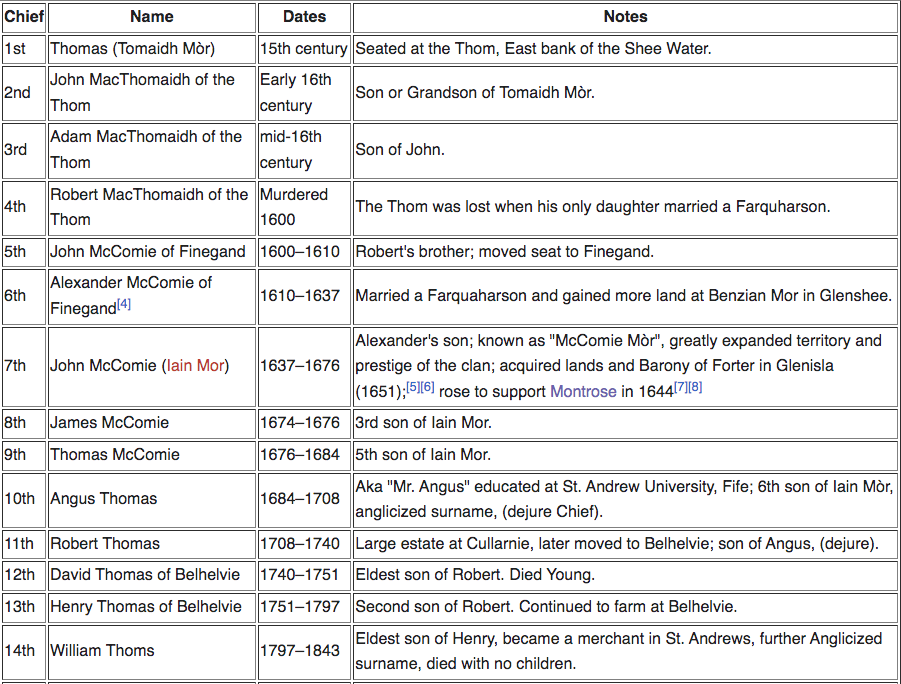
When the clans arrive to bring their suitors from which Merida is to choose, I automatically scream “Macintosh” along with the voice over from Craig Ferguson. My granddaughters always looked at me curiously, but only recently have I explained that my 9th Great-Grandfather on my father’s side is the 7th Chieftain of the clan, John Mccomie (Iain Mòr), who has passed into the folklore of Perthshire. [https://www.maclaine.org/legends] You see, the reason I screamed “Mackintosh,” was the fact that the progenitor of the Clan MacThomas was Thomas, who was a Scottish Gaelic speaking Highlander. He was known as Tomaidh Mòr and it is from him that the clan takes its name. He was a grandson of William Mackintosh, 7th chief of Clan Mackintosh and 8th chief of the Chattan Confederation. [Way, George and Squire, Romily. Collins Scottish Clan & Family Encyclopedia. (Foreword by The Rt Hon. The Earl of Elgin KT, Convenor, The Standing Council of Scottish Chiefs). Published in 1994. Pages 258–259.]

According to the tale of the Mccomies, my 9th great-grandfather objected to the taxes the Earl of Atholl had placed on them. One must remember that the Mormaer or Earl of Atholl was the title of the holder of a medieval comital lordship straddling the highland province of Atholl (Ath Fodhla), now in northern Perthshire. Atholl is a special Mormaerdom, because a King of Atholl is reported from the Pictish period. ANYWAY, the Earl of Atholl thought to be done away with my great-grandfather by employing a champion swordsman from Italy. One problem existed; Mccomie slew the swordsman instead. Or, at least, that is how I heard it.

Clan MacThomas supported Charles I during the 17th Century Scottish Civil War. My ancestor, Ian Mor MacThomas joined James Graham, 1st Marquess of Montrose, in 1644 at Dundee. When the royalists captured Aberdeen, Iain Mor himself captured Sir William Forbes who was sheriff of Aberdeen and commander of the Covenanter cavalry. However the chief of Clan MacThomas withdrew his support from Montrose after he was defeated at the Battle of Philiphaugh and instead devoted his time to extending his lands which included purchasing the Barony of Forter from the Earl of Airlie.

“After the Restoration of 1660 Macthomas was fined heavily by Parliament and the Earl of Airlie set about trying to recover some of his lands. Airlie’s legal action was successful but the chief of Clan MacThomas refused to recognize this and continued to pasture his cattle on the disputed land. In response Airlie used his legal right to lease the land to men of the Clan Farquharson which led to a feud. On 28 January 1673 Farquharson of Broughdearg was killed along with two sons of Iain Mor MacThomas. The lawsuits that followed crippled the MacThomas chief and when he died in 1676 his remaining sons were forced to sell the lands.”

The MacThomas chief is mentioned again in 1678 and 1681 in Government proclamations but the clan had begun to drift apart. Some moved south to the Tay valley where they became known as Thomson and others to Angus in Fife where they are known as Thomas, Thom or Thoms. The tenth chief took the name Thomas and then later Thoms. He settled in northern Fife and successfully farmed.

After all the battles, and following Iain Mor’s death, his remaining sons were forced to sell their lands. The clan drifted apart some going to the Tay Valley and some to Angus and Fife where they took the names Thomas, Thom or Thoms. Others moved to Aberdeenshire where the name became corrupted to McCombie of Tillyfour.

“In 1954 the Clan MacThomas Society was formed. The Clan is unusual as most of its members do not have the name MacThomas. But have a name of one of its septs. These are Comb, Combie, McColm, McComas, McComb, McCombie, McComie, McComish, Macomie, Macomish, Macthomas, Tam, Thom, Thomas, Thoms and Thomson.

“The current chief is Andrew MacThomas of Fingand. During his lifetime the clans ancient gathering ground ‘The Cockstane’ was purchased as well as the new bridge at The River Shee was named after the family. Historic links with with the Glenshee family have been re-established. The current chief has one son, Thomas born in the late 1980s.” [MacThomas Clan History]

Posted in castles, customs and tradiitons, family, Great Britain, heraldry, hero, history, legends, Scotland | Tagged , , , , , , | 3 Comments

Children’s Meals in the Regency Era

A reader recently asked of what I knew of children’s meals during the Georgian era. In truth, I have collected a hodgepodge of facts. I will attempt to organize the in some manner, but I fear not to know true success, so bear with me.

Seems to me the important thing to remember is that English children of the comfortable classes were traditionally fed their main meal (i.e. dinner–usually the meal with meat) in the middle of the day. That’s when everyone had dinner back in medieval times–Henry VIII supposedly had his dinner at 11:30 A.M.

Children’s meals remained settled there as the adult meal shifted farther and farther into the afternoon and evening. Children (at least the ones in one of our typical Regency upper classes) did not eat with adults; they were fed by nannies or nursemaids in the nursery. Their meals remained stable, probably because it was just easier that way. A nursery tea, therefore, was the children’s meal just before a bath and bed or just bed in the earlier periods when a daily bath was not considered next to godliness. Whether they called it “tea” or not in Regency times I do not know. Perhaps originally it was “supper.” I have never seen any reference to the children’s meal being a “snack” at any time.

I do not know when it began, but I do know that the English use of the word ‘tea’ for a meal as well as a simple noun for a beverage.

English Language Thoughts tell us: “In Britain in the 18 and 19th centuries, dinner was often served around 8 pm, so the meal tea was developed in order to provide some sustenance during the long hours between lunch and dinner. In upper-class households where leisure time was plentiful, this became known as afternoon tea, and was usually served around 4pm, consisting of tea, of course, and some light dishes such as sandwiches.

“For working-class families though, tea usually had to wait until shortly after 5pm, when the workday was finished. This meal, which tended to feature heavier cooked dishes such as pies, became known as high tea, apparently as families would have it while sitting on high-backed chairs, and not the soft armchairs of the upper classes.

Teatime then, refers to the general late-afternoon, early-evening period when either of these variations were served. But as I said earlier, there are three meals which claim the name tea, and the third one is the one that really provokes strong feelings in some people.

“As we moved into the 20th century, the number of highly physically-demanding jobs declined, as did working hours, and many working-class families no longer felt the need to have both tea and dinner after work. Both meals were therefore often replaced by a single evening meal at about 6 or 7 pm. Some called this dinner, but some preferred tea. To this day, what you call your evening meal is considered a sure sign of your social class in the UK. Referring to it as tea identifies you as working-class, whereas dinner is more of a practice of the middle classes. If you’re a member of the upper classes though, the word dinner might be refer to a formal affair, and therefore the word supper is used to refer to a more humble, homemade evening meal.

“But of course supper is also sometimes used, by those who use the term dinner, to refer to a light nighttime meal. You can see then, why this gets confusing, and why people get so defensive about which one they use! Makes you want to sit down with a nice cup of tea, or cha, or char, or cuppa…”

While the grownups had tea – as we drink it today, with sugar and milk – the child/children were given cambric tea, consisting of a scant spoon of sugar, a teaspoon or so of tea (poured from the pot, just like an adult’s) and then filled to the brim with warm milk. Remember though, cambric tea was not a Georgian era term. “Also known as nursery tea, or milk tea, it was coined cambric tea because, like the fabric, it was light and thin. It is suggested it was first used mid-century, in 1859, but there is no definite confirmation of its origins. Claimed to be coined in the US, it can also be found referenced in fiction and non-fiction sources from both Canada and the UK.

No More Cambric Tea tells us, “Cambric tea was also featured in American author Laura Ingalls Wilder’s Little House series, and like Montgomery, described it as a childhood drink, especially in winter months, when warm water and a dash of tea gave the younger children in the Ingalls family a bit of energy.

At noon Ma sliced bread and filled bowls with the hot bean broth and they all ate where they were, close to the stove. They all drank cups of strong, hot tea. Ma even gave Grace a cup of cambric tea. Cambric tea was hot water and milk, with only a taste of tea in it, but little girls felt grown-up when their mothers let them drink cambric tea”. (The Long Winter, by Laura Ingalls Wilder).

In my family, the “old folks” often spoke of how my great grandparents several times removed (who came from Scotland in the mid to 1800s) would have tea when they came home from school starving (as children usually do). They called it ‘cambric tea.’ She had tea every day of her life in the mid-afternoon, whether the family was dirt-poor or reasonably comfortable (our family was never rich!) and she believed that children should learn both proper habits and manners. You can find recipes for “nursery tea” online with lots of milk, sugar, and vanilla–basically a way to add a little more nutrition to a child’s tea

There’s a good overview of the history of “tea” as a social function here – http://www.foodtimeline.org/teatime.html

Tea as a social even (as in tea time) really start off more in the 1830’s and became the more formal affair in Victorian and Edwardian times. During that later era “tea” became the working class meal as well.

In Regency era, children often took their meals in the nursery and not with the family–so they might have nursery tea with their dinner. But tea in Georgian and Regency time tea was still more of a beverage to be served as a possible refreshment to callers–or a beverage for late in the evening along with possibly some cakes or a light snack type meal before bed, but not so much a social event as in afternoon tea.

Also, if one is looking to learn what the children in a household might have, it would not be too out of the ordinary for cook to have a treat for them–hot pastries or biscuits (the English version of cookies) or cakes. A child might well eat in the kitchen in a household that is not too formal.

And, by the way “snack” is in period – http://www.etymonline.com/index.php?term=snack

verb – The meaning “have a mere bite or morsel, eat a light meal” is first attested 1807.

noun – Main modern meaning “a bite or morsel to eat hastily” is attested from 1757.

From what I have discerned regarding raising small children in England, nursery tea was the final meal for children during the day. They had a proper meal, dinner, at what we call “lunch” time. Nursery tea was half tea/half milk, bread and milk, and usually some cake for afterwards. I remember my grandfather talking about how his grandmother would present them with an “egg tea,” meaning the children would have a boiled egg as well.

This was of course long after the Regency and even the Victorians! But I would expect it was one of the meals that changed little. Probably since tea was so expensive it would be only a taste of tea or perhaps none at all–or some herbal tea. But I would believe that the base would most likely be bread and butter for the comfortable middle class and much the same for the wealthy–except perhaps in the north of England, Ireland, and Scotland, where oats were more commonly available than wheat, and then it would be a dish of porridge.

https://ladybakerstea.com/blogs/blog/no-more-cambric-tea#:~:text=Also%20known%20as%20nursery%20tea,definite%20confirmation%20of%20its%20origins.

“Nursery tea” would then most likely refer to a very simple meal–and I agree that it would probably be Victorian or possibly late Regency period, because it was only then that the grownups–the ladies!–started drinking tea in the afternoon. At that period, as I understand it, people routinely went from breakfast to dinner w/o eating in the meantime, except for snacks that eventually became known as elevenses and tea (as a time to eat, not a beverage). It was the advancing hour of dinner, from 5-6, which it was generally in the 18th century, to later in the day that gradually re-established the mid-day meal that had been called dinner before it moved later and later. In the days when dinner as the main meal was mid-day, there was supper in the evening.  Nursery tea, therefore, could be considered an adaptation of supper for children!

I looked into this when I saw the term “nursery tea” in a Regency book. Nursery tea was hot water with milk and sugar. It could be because tea was expensive or it could be because they noticed bad effects (like being really hyper or uncontrollable or not being able to sleep) on children of a certain age. I do not remember if it said when this practice started, but the book I saw it in was right after Waterloo. 

Personally, I think “nursery tea” sounds Victorian–something established after tea became an afternoon ritual  and could well signify a childish version of high tea. High tea was not a more formalized, elaborate version of the established Victorian practice of afternoon tea, but a supper moved forward  in time to late afternoon or early evening. I read once that it started out as a sort of mocking name for the meal a working family had in the evening.

In the Regency period, tea was still a bit too expensive to be wasted on children. Their meals were often merely bread and milk.

Posted in American History, British history, food, Georgian England, Georgian Era, history, Living in the UK, Regency era, research | Tagged , , , , , , , , | Comments Off on Children’s Meals in the Regency Era

Easter Through the Georgian/Regency Era and the Earlier Victorian Era

One must recall, especially this year when Easter feels like it is so late, that Easter, unlike Christmas which falls on the same date each year, as a “moveable feast,” the date of Easter is determined in each year through a calculation known as computus paschalis (Latin for ‘computation’) – often simply Computus – or as paschalion particularly in the Orthodox church. [Bede (1999) The Reckoning of Time. Translated by Faith Wallis. Liverpool University Press. p.xviii]  Easter is celebrated on the first Sunday after the Paschal full moon (a mathematical approximation of the first astronomical full moon, on or after 21 March – itself a fixed approximation of the March equinox). Determining this date in advance requires a correlation between the lunar months and the solar year, while also accounting for the month, date, and weekday of the Julian or Gregorian calendar. [Bede (1999) pp. xviii – xx] The complexity of the algorithm arises because of the desire to associate the date of Easter with the date of the Jewish feast of Passover which, Christians believe, is when Jesus was crucified. [John 19:14 “Now it was the day of Preparation for the Passover; and it was about noon. He said to the Jews, “Here is your King!”

Easter’s date is based on the lunar calendar. not a calendar as with Christmas. Easter comes on the first Sunday after the first full moon following the spring equinox.

The spring equinox arrived on March 20 this year, which marks the astronomical start of spring. It’s the time when there are roughly the same number of hours of day and night on all parts of Earth, according to NASA. That means Easter Sunday can fall anywhere between March 22 and April 25.

This year, Coordinated Universal Time (UTC), often referred to as the military time zones plays a big role in when we celebrate Easter, for Easter is set as the first Sunday after the first full moon of the vernal equinox (start of spring). In 2025, though we in the U.S. had our first full moon after the vernal equinox on Saturday, April 12, we are on Daylight Savings Time, meaning we jumped ahead one hour. If not, Sunday, April 13, would have been Easter because it would have been the Sunday after the full moon. That is where UTC time comes in. The full moon is actually a FULL 22 minutes after midnight in the U.S., meaning April 13. Therefore, we must wait until April 20 for Easter. Are you thoroughly confused? Though I know the reason, I had difficulty explaining all this.

Just to mess with your minds a bit more, in case you have never considered this part of the night sky, in the Southern Hemisphere, the Moon is observed from a perspective inverted, or rotated 180°, to that of the Northern, so that the opposite sides appear to wax or wane. Closer to the Equator, the lunar terminator will appear horizontal during the morning and evening. This is a plot point in one of my upcoming novels. LOL!

All that being said, I thought that as it is nearly Easter 2025, some of you who read and write Regency might wish a reminder as to when Easter occurred during the Regency era (and a bit beyond). [Please note that I wrote this piece in late 2024 as I was recovering from three cancer surgeries. Yes, I generally do my blog posts several months in advance! Anyway, I chose to include pieces from other authors on Easter rather than to do all the research myself, as I am not yet at my best. I did find the moveable dates for Easter, however. I have presented each author link. As a former English teacher, I strongly despise plagiarism and believe in giving credit where it is due.]

It was originally feasible for the entire Christian Church to receive the date of Easter each year through an annual announcement by the pope. By the early third century, however, communications in the Roman Empire had deteriorated to the point that the church put great value in a system that would allow the clergy to determine the date for themselves, independently yet consistently. [Bede (1999) p. xx]  Additionally, the church wished to eliminate dependencies on the Hebrew calendar, by deriving the date for Easter directly from the March equinox.

EASTER:

13 April 1800    3 April 1825  

5 April 1801   26 March 1826  

18 April 1802    15 April 1827  

10 April 1803    6 April 1828  

1 April 1804   19 April 1829 

14 April 1805   11 April 1830 

6 April 1806    3 April 1831 

29 March 1807   22 April 1832 

7 April 1808    7 April 1833   

2 April 1809   30 March 1834  

22 April 1810   19 April 1835  

14 April 1811    3 April 1836  

29 March 1812   26 March 1837  

18 April 1813   15 April 1838  

10 April 1814   31 March 1839  

26 March 1815   19 April 1840  

14 April 1816   11 April 1841  

6 April 1817   27 March 1842  

22 March 1818   16 April 1843  

11 April 1819    7 April 1844  

2 April 1820   23 March 1845  

22 April 1821   12 April 1846  

7 April 1822    4 April 1847  

30 March 1823    23 April 1848  

18 April 1824 

In the  early years of the 19th century, the date of Easter was quite important. Law courts, parliament, school terms  — as well as the church calendar all based dates on that of Easter. Generally, the season in Town did not start until after Easter.

Donna Hatch tells us something of Holy Week: “True believers viewed Easter and Holy Week, the week between Palm Sunday and Easter Sunday, as even more important than Christmas due to its reminder of the Resurrection. Multiple church services occurred during the week complete with choirs singing. On Easter Sunday, worship included choirs singing, incense burning, chanting, kneeling, making the sign of the cross, and lighting candles during personal prayers. Some churches today, especially larger cathedrals, still practice these traditional forms of worship. A common practice includes draping the statues in black and stripping the altar on Good Friday symbolic of mourning the Savior’s death. On Easter morning, they removed black from church altars and dressed them to celebrate His Resurrection.

“According to Gaelen Foley, new gowns and Easter bonnets were a must for all gently-bred Regency ladies to wear to church and social events, a custom that many still observe today. An important part of the day included Easter dinner, usually including ham or lamb, and, of course, hot cross buns.”

Jane Austen UK tells us, “… Though dying and decorating eggs to mark the coming of Spring has been a tradition since before the advent of Christianity, the first chocolate eggs started to appear on the continent somewhere around the end of Austen’s lifetime, and would have been chocolate  the whole way through, rather than hollow- now that sounds like a challenge for your fillings! The first commercially produced Easter egg in the UK was created by J.S. Fry and Sons in 1873, followed by Cadbury in 1875.

“Easter celebrations would have begun, as they do now, on Shrove Tuesday, or Pancake day… they made a whole day of it, with the ladies of the parish racing around their parish clutching a frying pan, trying to be the one to win the Pancake Day race. Ash Wednesday would follow the next morning, and forty days and nights of observance with it. 

“Easter (was) a strictly observed day in the Church of England’s calendar. The whole parish would get together to observe the occasion. …

“Then it would be time for (the midday meal). Like today, our Regency forebears would have enjoyed a Hot Cross Buns, with vendors lining the streets in the days running up to the big event. Lamb or ham would also have been served for the main meal.”

Meanwhile, 10 Victorian Easter Traditions You Should Try, tells us, “Just as they do today, children loved their Victorian Easter. They would dye hens’ eggs using cranberries, beets, oranges, and lemon peel. Just like the Christmas tree, Easter egg hunts and the egg roll was introduced by Germans to England during the 1800s. Children would participate in both egg rolling and egg hunts and the winner would receive a special prize. Some Victorian egg hunts included cardboard eggs lined with fabric and containing candy.”

Date of Easter

From Yahoo Life: What’s the earliest date Easter is held? You’ll wait until 2285 for the next one

The earliest date Easter is held is March 22.

The last time Easter was on March 22 was in 1818. The next time will be in 2285, according to earthsky.

What’s the latest date Easter is held? That will come in 2038

The latest date Easter is held is April 25.

The last time Easter was on April 25 was in 1943. The next time Easter will be on April 25 will be in 2038, followed by the one in 2190.

Posted in Uncategorized | Comments Off on Easter Through the Georgian/Regency Era and the Earlier Victorian Era

The Quem Quaeritis Trope, the Roots of Liturgical Drama

413ZV9RH8FL.jpg The first Easter or Quem Quaeritis trope had its beginnings in the Benedictine Abbey of St. Gall, Switzerland. (The script of this first trope and an accompanying translation can be found below.) The Easter trope became the model for similar tropes associated with Christmas and the Ascension. 

Melodies connected with the Mass were sung with vowel sounds alone, and these were the beginnings of the liturgical dramas, which grew into the English Miracle and Morality plays. Originally the Quem Quaeritis trope was an Introit trope at the beginning of the Easter mass. Later, it became part of the Sepulchrum, an Easter drama, which began on Good Friday and the “creeping of the cross,” known as Adoratio Crucis. The Good Friday Communion known as Depositio Crucis and then on to the Elevatio Crucis on Easter morning. This ceremony varied greatly depending upon the country in which it was performed. 

duccio_di_buoninsegna_detail1

Triduum, a Liturgical Drama in Three Acts

In England there was Quem Quaeritis held at Winchester Cathedral. The manuscript used then was copied in about 980 A.D. At the Winchester ceremony they placed the Quem Quaeritis in the middle of the performance instead of at the beginning of the Easter Mass. It was part of the third Nocturn at Matins on Easter morning. E. K. Chamber in The Medieval Stage (Vol. II, p. 15) says that in the Quem Quaeritis that the “Dialogued chant and mimetic action have come together and the first liturgical drama is, in all its essentials, complete.” 

Angelica de Christi Resurrectione

Quem quaeritis in sepulchro, Christicolae?

Sanctarum mulierum responsio:

Ihesum Nazarenum crucifixum, O caelicola!

Angelicae vocis consolatio:

non est hic, surrexit sicut praedixerat,

ite, nuntiate quia surrexit, dicentes:

Sanctarum mulierum ad omnem clerum modulatio:

alleluia! resurrexit Dominus hodie,

leo fortis, Christus filius Dei!

Deo gratias dicite, eia!

Dicat angelus:

venite et videte locum ubi positus erat Dominus,

alleluia! alleluia!

Iterum dicat angelus:

cito euntes dicite discipulis quia surrexit Dominus,

alleluia! alleluia!

Mulieres una voce canant iubilantes:

surrexit Dominus de sepulchro,

qui pro nobis pependit in ligno, alleluia!

_________________________________________

The Angel After Christ’s Resurrection

Whom seek ye in the sepulchre, O Christians?

Response of the Holy Women:

Jesus of Nazareth who was crucified, O heavenly one.

The Angel in a voice of consolation:

He is not here, he is risen as he fore-told.

Go, announce that he is risen, saying:

Chant of the Holdy Women:

Alleluia! The Lord is risen today,

The strong lion, Christ the son of God,

Unto God give thanks, eia!

Let the Angel say:

Come, and see the place where the Lord was laid.

Alleluia! Alleluia!

Let the Angel say again:

Go quickly, tell to the disciples that the Lord is risen.

Alleluia! Alleluia!

The women with one voice sing joyously:

The Lord is risen from the sepulchre,

Who for us was hanged on the cross, Alleluia!

(Translated by Edd Winfield Parks)

Posted in acting, Church of England, customs and tradiitons, drama, medieval | Tagged , , , , | Comments Off on The Quem Quaeritis Trope, the Roots of Liturgical Drama