Special New Year’s Edition Featuring “Twelfth Night at Longbourn” with Maria Grace

I have to confess, one of my favorite parts of writing historical fiction is having an excuse to read up on the manners and customs of the period. I was doubly excited to when I realized that my latest book would take place over Christmas and Twelfth Night and I had to research those holiday traditions. I had such fun incorporating period traditions into the story. My biggest disappointment was that I could not include more of them!

I’m so glad Regina invited me to come by and share a few of them with you today.

Twelfth Night Revelry

Epiphany or Twelfth Night was the exciting climax of the Christmastide season, a time for putting away social norms. It was a feast day to mark the coming of the Magi, and as such was the traditional day to exchange gifts.

Revels, masks and balls were the order of the day and night. Typically each guest would portray a character for the evening. The hostess might create them herself or turn to a stationary shop or game good to provide her with a set of characters.
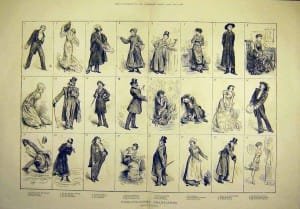
Twelfth night characters

Twelfth Night Characters

Guests might select a character to play by drawing a slip of paper from a hat or bag. Hostesses might provide dress up items for their guests to don after characters had been chosen. Other hostesses would send characters around to her guests so that they could come already dressed as their character. If a guest broke out of character during the night they would have to ay a forfeit later.

Besides the King and Queen, a variety of characters, often pulled from popular literature and plays were available. Common characters were Sir Gregory Goose, Sir Tumbelly Clumsy, Miss Fanny Fanciful and Mrs. Candour. Rachel Revel offers an extensive set of numbered characters in her book as well as instructions to introduce the characters by arranging them in order of their number and when all the guests have characters, they each read the lines for their character in turn. For example:

1. King: Fate decrees me your King: grave and gay, wise and fools, Must consent, for this night, to submit to my rules.
2. Queen: I’m your Queen: good my liege, your confessor, may shrive you; But for me, I’m resolved, if I can’t lead I’ll drive you.
3. Lord Spendthrift: Blood, for money, Lord Spendthrift is ready to barter,
If some rich maid will purchase a Knight of the garter.
4. Molly Mumper: Molly Mumper wants a husband: Baron, or Duke, she cares
not which; If you’ll marry a beggar’s heiress, she’ll promise to make you rich.
5. Lucy Leertoell: “lis so humdrum to live single, Lucy Leerwell would prefer, On some facetious youth, her hand and fortune to confer.
6. Joe Giber: Take Joe Giber, the king’s jester, he’s the fellow for your
Twelfth001yoke, Tho’ marriage, it must be confess’d, by most wits is counted no joke.
7- Miss All-agog: Miss All-agog’s a candid girl, who hates monastic vows,
And she will never take the veil if she can get a spouse.
8. Sam Sadboy.: Sam Sadboy’s neither monk nor friar; he sees into your views:
Marry him, you may cast off your veil, and the rest of your deeds when you choose.
9. Miss Romance.: Miss Romance to accept for her partner proposes
One who’ll print in his press ev’ry work she composes…

Servants were often included in the revelries. This could become particularly interesting when one became the king or queen for the evening.

Twelfth Night Cake
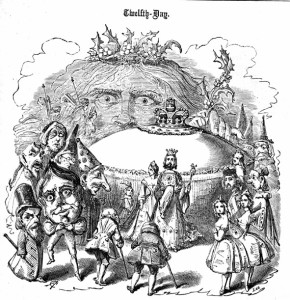
A twelfth cake with crown from Robert Chambers, The Book of Days, (London: 1869)

A twelfth cake with crown from Robert Chambers, The Book of Days, (London: 1869)

A special Twelfth Cake, would be the centerpiece of the party. The cakes were light and covered with were elaborate creations with sugar frosting, gilded paper trimmings, and sometimes delicate plaster of Paris or sugar paste figures. In towns, confectioners would display these cakes in their shop windows, illuminated by small lamps so the displays could be admired during winter evenings.
Recipes for Twelfth Cake do not appear in print until 1803, although either of this recipe might have been used prior to that to make it.

To Make a Rich Cake
Take four pounds of flour dried and sifted, seven pounds of currants washed and rubbed, six pounds of the best fresh butter, two pounds of Jordan almonds blanched, and beaten with orange flower water and sack till fine; then take four pounds of eggs, put half the whites away, three pounds of double-refined sugar beaten and sifted, a quarter of an ounce of mace, the same of cloves and cinnamon, three large nutmegs, all beaten fine, a little ginger, half a pint of sack, half a pint of right French brandy, sweet-meats to your liking, they must be orange, lemon, and citron; work your butter to a cream with your hands before any of your ingredients are in; then put in your sugar, and mix all well together; let your eggs be well beat and strained through a sieve, work in your almonds first, then put in your eggs, beat them together till they look white and thick; then put in your sack, brandy and spices, shake your flour in be degrees, and when your oven is ready, put in your currants and sweet-meats as you put it in your hoop: it will take four hours baking in a quick oven: you must keep it beating with your hand all the while you are mixing of it, and when your currants are well washed and cleaned, let them be kept before the fire, so that they may go warm into your cake. This quantity will bake best in two hoops.
~Hannah Glasse

To make icing for a Bride Cake.
Almond Iceing for the Bride Cake. Take the whites of six eggs, a pound and half of double refined sugar; beat a pound of jordan almonds, blanch them, and pound fine in a Iittle rose water; mix all together, and whisk it well for an hour or two; then lay over your cake, and put it in an oven.
~Every woman her own housekeeper John Perkins 1790

Parlor Games

Parlor games were the order of the evening for a Twelfth Night Party and often involved overstepping the strict bound of propriety. Losers often paid a forfeit, which could be an elaborate penalty or dare, but more often were a thinly disguised machination for getting a kiss. Often, forfeits were accumulated all evening, until he hostess would ‘cry the forfeits’ and they would all be redeemed. Some favorites included:

Blind Man’s Bluff and variations there ofBlind man's bluff
Many variations of this game existed, including Hot Cockles, Are you there Moriarty, and Buffy Gruffy. All the variations include one player being blindfolded and trying to guess the identity of another player who had tapped them or who they have caught. A great deal of cheating was generally involved, which only added to the sport.

The Courtiers
The king or queen occupied a chair in the center of the room. The courtiers would then copy the monarch’s movements with losing their decorum. Any number of simple or vulgar actions might be attempted to cause laughter among the courtiers, thus resulting in a forfeit.

Bullet pudding
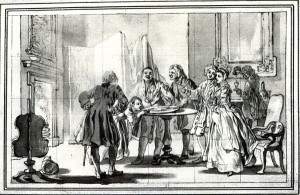
Playing bullet pudding

Playing bullet pudding

Flour was piled into a high mound and a bullet placed on the top. Players cut slices out of the flour pile with a knife without dislodging the bullet. If the bullet fell, the player had to retrieve the bullet from the flour with their teeth.

My characters had a great deal of fun with this one.

Charades
The game could be played two different ways. In one, each player in turn would recite their riddle, and the rest had to guess at their word.
In the second, the party would divide into two or more groups, would create short one minute acts to describe the syllables, the last describing the whole word for the rest of the party to guess.

Once the festivities were over, the evergreen decorations were to be taken down and burned by midnight on this day or face bad luck for the rest of the year. Some believed that for every branch that remained a goblin would appear.

If you’d like to read about a very special Twelfth Night party, try out my newest release:

GGP 4d copy

Available at Amazon and Nook

Twelfth Night—a night for wondrous things to happen.

At least for other people.

In the months after her sisters’ weddings, nothing has gone well for Kitty Bennet. Since Lydia’s infamous elopement, her friends have abandoned her, and Longbourn is more prison than home. Not even Elizabeth’s new status as Mrs. Darcy of Pemberley can repair the damage to Kitty’s reputation. More than anything else, she wishes to leave the plain ordinary Kitty behind and become Catherine Bennet, a proper young lady.

Her only ray of hope is an invitation to Pemberley for the holidays. Perhaps there she might escape the effects of her sister’s shame.

Getting to Pemberley is not as simple as it sounds. First she must navigate the perils of London society, the moods of Georgiana Darcy, and the chance encounter with the man who once broke her heart. Perhaps though, as Catherine, she might prove herself worthy of that gentleman’s regard.

But, in an instant all her hopes are dashed, and her dreams of becoming Catherine evaporate. Will Kitty Bennet’s inner strength be enough to bring her heart’s desire?

On an ordinary night perhaps not, but on Twelfth Night, it just might be enough.

Maria Grace can be found on line at:

email: author.MariaGrace@gmail.com.

Facebook: facebook.com/AuthorMariaGrace

On Amazon.com: amazon.com/author/mariagrace

Visit her website Random Bits of Fascination (RandomBitsofFascination.com)

Posted in book excerpts, excerpt, food and drink, George IV, Georgian Era, Great Britain, holidays, Uncategorized | Tagged , | 3 Comments

The Ninth Day of Christmas (Jane Austen Style)

(Sung to the tune of “The Twelve Days of Christmas”)

images-5On the ninth day of Christmas, Jane Austen gave to me,
Nine Named Musgrove
Eight Minor Pieces
Seven Austen Siblings
Six Classic Novels
F-i-v-e Bennet Sisters
Four Abbey Tilneys
Three Sailing Captains
Two Dashing Colonels
And a love for Mr. Dar..cy.

Mr. Musgrove+Mrs. Musgrove

Mary Elliot+Charles Musgrove         Dick Musgrove          Henrietta Musgrove

   Walter         Charles                          Louisa Musgrove        Henry Musgrove

(2 unnamed Musgrove children)

Posted in holidays, Jane Austen | Tagged , | Comments Off on The Ninth Day of Christmas (Jane Austen Style)

Life Below Stairs ~ Part One ~ Compensation and Obligations

da13With the popularity of Upstairs, Downstairs and Downtown Abbey, the populace has become more aware of the British servant class. So what do we know of those who lived “below stairs”? First, rank and precedence ruled those of the servant class as much as it did their masters. What was known as the “pugs procession” was commonplace among servants. Instead of the chatty scenes between upper and lower servants on Downtown Abbey, most household were ruled by “silence.” All the servants would take their dinner together in the servants’ hall, but then the upper servants (the house steward, the butler, and the housekeeper) would move to a private sitting room for their dessert.

Being neither seen nor heard would be the order of the day. It was not unusual for maids to turn and face the wall if she encountered her master or mistress in the passageways. The upper housemaids were responsible for the appearance of the rooms. They addressed the draperies, the floral arrangements, the chair covers, etc. The under housemaids did the physical duties of laying a fire, polishing, cleaning the grates, etc. In Letters from England, Elizabeth Davis Bancroft, the wife of the U.S. Minister to England (1846-49), wrote, “The division of labour, or rather ceremonies, between the butler and the footman I have now mastered, I believe in some degree, but that between the upper and under housemaid is still a profound mystery to me, though the upper has explained to me for the twentieth time that she did only ‘the top of the work.”

from “Jane Austen’s World”

Richard Henry Dana, son of the author of Two Years Before the Mast, spoke of a similar demarcation of duties in his Hospitable England in the Seventies. Dana had been invited to spend some time with Earl Spencer at Althorp. He and Lord Charles Bruce wished to play some lawn tennis, but they could find no one to whitewash the court’s markings in the grass. It seems that the job belonged to the “man-of-all-work,” but the servant was no where to be found. Dana said, “Neither the gardener, nor the footmen, nor the valets, nor the bootblacks nor, of course, the maids would help. Our hostess knew this so well that she did not even ask them.”

Servants did receive certain “compensations” for their service. They had a roof over their heads and four full meals per day – breakfast, dinner, tea, and supper. If they were enterprising enough, they could also have the remains of the masters’ meals. They received either a pint of home brewed beer (half pint for women) with each meal or a beer money allowance, usually 8d per day. The upper servants often were provided with wine for their meals. Wages were paid quarterly. Except for clothing, servants had few expenses, and a wise servant could save enough for a nest egg, to start a small business, or assist his struggling family. Loyal servants received pensions of £20 to £25. Smart upper servants could “earn” extra funds from tradesmen seeking the master’s business. The cook, traditionally, claimed the roast’s drippings as her own. The butler and footmen laid claimed to the candle butts. A smart butler might siphon off some of the master’s wine stock, either a decanter at a time or a whole bottle.

In “Life Below Stairs” by Frank Huggett, there is a list of wages (1888) from the records of the Duke of Richmond and Gordon paid out to the duke’s servants for a year’s service:

the house steward £100

the groom of the chamber £70

the valet, the housekeeper, and the cook  £60 each

the butler £45

the footmen £26 to £34

the ladies’ maids £26 to £28

the stillroom maid £22

the kitchen maids £14 to £24

the housemaids and laundry maids £12 to £26

the scullery maid £12

Servants also EXPECTED to receive a tip from the master’s guests. A guest would be leave a half-sovereign for the housemaid in honor of the condition she maintained his quarters, a sovereign for the groom of the chambers for lighting the candles each evening, likewise a sovereign for the butler for his personal advice and favors and a footman who acted as valet to a gentleman traveling without his personal servant. A guest might also tip the gamekeeper, etc. etc., etc. The list could easily grow to a tidy sum. Even visitors making tours of great estates were expected to tip the housekeepers guiding their tours.

And Heaven help the guest who did not meet his obligations. Upon his next visit, he might be housed in a drafty chamber or find his cut of meat the least desirable ones.

from “Upstairs, Downstairs”

Return tomorrow for Part II on “Life Below Stairs.”

BTW, those of us in the States are anxiously awaiting the return of “Downtown Abbey” – Season 4 on January 5. NO SPOILERS PLEASE!!!!

Posted in British history, Great Britain, real life tales | Tagged , , , , | 2 Comments

Happy New Year!!!

1507652_10202799915384221_2129721026_n

Posted in Uncategorized | 1 Comment

The Eighth Day of Christmas (Jane Austen Style)

(Sung to the tune of “The Twelve Days of Christmas”)

On the eighth day of Christmas, Jane Austen gave to me,
Eight Minor Pieces
Seven Austen Siblings
Six Classic Novels
F-i-v-e Bennet Singers
Four Abbey Tilneys
Three Sailing Captains
Two Dashing Colonels
And a love of Mr. Dar…cy.

Love and Freindship [satiric-humorous]
The Three Sisters 
[more serious]
Frederic and Elfrida [satiric-humorous}
Jack and Alice
 [unrestrained Juvenilia]
Henry and Eliza [early humorous]
Lesley Castle
 (excerpts) [satiric-humorous]
Lady Susan [Jane Austen’s wickedest tale]
The Watsons
 [uncompleted novel]

If you are interested in a summary of each of these works or if you are interested in reading them by eText, visit The Republic of Pemberley.

Posted in Uncategorized | Tagged , | Comments Off on The Eighth Day of Christmas (Jane Austen Style)

Regency Happenings: The Year Without Summer ~ 1816


tambora_11The Year Without a Summer (also known as the Poverty YearYear There Was No Summer, and Eighteen Hundred and Froze to Death) was 1816, in which severe summer climate abnormalities resulted in major food shortages. Much of the cause of this anomaly is blamed on the volcanic eruption of Mount Tambora (located on the island of Sumbawa, Indonesia) in April 1815.

Rated a 7 on the Volcanic Explosivity Index, the Tambora eruption had ash falls as far away as Borneo, Sulawesi, Java, and the Maluku islands. Most who died from the eruption came from starvation and disease. 71,000+ people died. Some 12,000 killed from the explosion.

In Europe, people were still recovering from the devastation of the Napoleonic Wars. Food shortages were already prevalent. In the UK and France, food riots were common. Switzerland declared a national emergency because of famine. Abnormal rainfall swelled European rivers. 100,000 Irishmen perished from a combination of a famine and a major typhus epidemic.

In New England, the corn crop failed. Because of supply and demand, the cost of wheat and grains skyrocketed. In Hungary, the population experienced brown snow. Italy had red snow. Volcanic ash is believed to be the cause. The rice crop in China failed due to the summer’s low temperatures. Summer snowfalls occurred in several of China’s provinces. In tropical Taiwan, snow was also reported.

J. M. W. Turner celebrated the spectacular sunsets during this period, likely caused by high levels of ash. People have noted the yellow tinge that is predominant in his paintings, such as Chichester Canal circa 1828.

The crop failures of the “Year without a Summer” may have helped shape the settling of the “American Heartland,” as many thousands of people (particularly farm families who were wiped out by the event) departed New England for what is now western and central New York and the upper Midwest in search of a more profitable land.


Chichester Canal, circa 1828 by J.M.W. Turner

Among those who left Vermont were the family of Joseph Smith. This move precipitated a series of events which culminated in the publication of the Book of Mormon and the founding of the Church of Jesus-Christ of Latter-day Saints.

Mary Shelley

In July 1816 “incessant rainfall” during that “wet, ungenial summer” forced Mary Shelley, John William Polidori, Lord Byron and their friends to stay indoors for much of their Swiss holiday.

John William Polidori

They decided to have a contest to see who could write the scariest story, leading Shelley to write Frankenstein, the Modern Prometheus and Polidori to write The Vampyre In addition, their host, Lord Byron was inspired to write a poem, “Darkness,” at the same time.


The events of April 1815 play a part in my novel The Disappearance of Georgiana Darcy (released March 2012), which begins in July 1815, after Wellington vanquishes Napoleon at Waterloo. The Year Without Summer is often mentioned in the books in my Realm series, which take place between the years of 1815 and 1819.

 
Posted in British history, buildings and structures, Great Britain, Living in the Regency, real life tales, Regency era | Tagged , , , , , , | 1 Comment

On the 7th Day of Christmas (Jane Austen Style)

I have included this tale in the past, but it’s back for a repeat…

images-6
On the seventh day of Christmas, Jane Austen gave to me,
Seven Austen Siblings

Six Classic Novels
F-i-v-e Bennet Sisters
Four Abbey Tilneys
Three Sailing Captains
Two Dashing Colonels
And a love for Mr. Dar…cy

Posted in holidays, Jane Austen, Uncategorized | Tagged | Comments Off on On the 7th Day of Christmas (Jane Austen Style)

The Border Wars Between England and Scotland

400px-watharden The political struggle that has dominated much of England/Scotland’s history was often a result of the border wars. In Elizabethan times the Anglo-Scottish border counties, especially Northumberland, were the home of lawless clans who spent their lives raiding and marauding. The Border Reivers were not necessarily men of lower class. In fact, many were members of the Realm. They were excellent fighters and knew how to survive in a desolate land.

From BBC Home, we find that “Reiv” means to steal. The Reiver period is roughly categorised as 1450 – 1610. The movement came to its height in the late 1500′s and ended around 1610. The Reiver history is a mixture of fact and folklore. The English crown destroyed almost all of the documentation relating to Reiver life and so the Reiver’s story has passed down through oral history and folk traditions, rather than formal documentation. As a result, it is hard to untangle the mythological from the material when describing the Reiver movement.”

Following the Cheviot Hills, a bleak line of ridges and valleys that forms the border between England and Scotland, was the land upon which much blood was shed. Hadrian’s Wall, built by the Romans from Solway Firth to Berwick, never successfully kept either nation apart. The Chevoits sport peat bogs, broad rivers, hidden valley, salt marshes, and wooded areas. Raiding was an important way of life for those who lived on the borders. Neither treaties nor truces could prevent the continual struggle to survive in this desolate area. The purveyor of the strongest sword ruled the land.

220px-black_middens_bastle_-_geograph-org-uk_-_1224658 The Borders were not the romantic lands often portrayed in many current novels. It was a cruel, brutal land. The times were peppered with feuds between families. Clan loyalties were stronger than allegiance to either crown. Intermarriages brought about new alliances, but what really tied the area together was the geography, the belief in independence, and the society in which this people lived. English fought Scots, but they also fought Englishmen. The same held true for the Scotsmen. This created a dual nationality among men who lived along the Cheviot Hills. Not spoken of openly, it would not be unusual for the English to share “the spoils” with their Scottish brothers, or vice versa.

Autumn brought an increase in activity for the reivers. These families were often nomads, of sorts. The houses were of the type that they could be moved at a moment’s notice. We must remember that these people were violent, aggressive, and often ruthless, but they had a “sense of honor.” They consider reiving a way of life, but murder was looked down upon (even during a raid) unless there was no other option. A reiver’s object was to make a quick strike, plunder his enemy’s land, and return with his loot in tact – all this without loss of life, if possible.

400px-hermitage_castle_062 Using a series of beacons as warning signals, the retreat was the most risky part of a reiver’s foray. If he managed to avoid the local watches, the warden’s troopers, the paid militia, the broad rivers and mossy bogs, he might fall victim to the Hot Trod, the legal pursuit of the reivers, who were loaded down from their loot and by driving stolen cattle and sheep to their own keeps. During the Hot Trod, all male neighbors, between the ages of 16 and 60 of the victim, were required by law to join in the pursuit of the attackers. The posse also had the legal right to recruit others along the way. If a person refused to aid in the pursuit, he could be considered a traitor and put to death.

David Simpson of The Roots of the Region website says, ”George M Trevelyan the great British historian, (a Northumbrian) superbly summed up the nature of the Border Reivers and their ballads when he wrote;

400px-reivers_raid_on_gilnockie_tower‘They were cruel,coarse savages, slaying each other like the beasts of the forest; and yet they were also poets who could express in the grand style the inexorable fate of the individual man and woman, the infinite pity for all cruel things which they none the less inflicted upon one another. It was not one ballad- maker alone but the whole cut throat population who felt this magnanimous sorrow, and the consoling charms of the highest poetry.’ Many of the Border Ballads still survive today, due to the avid collecting of the famous Border poet, Sir Walter Scott (1771-1832), himself the descendant of a famous border clan.”

Border Clans included the Armstrongs, Bells, Cecils, Croziers, Dodds, Douglases, Elliotts, Fenwicks, Forsters, Grahams, Homes, Howards, Irvines, Johnstones, Kerrs, Maxwells, Nixons, Robsons, Scotts, Storeys, and Taits.

A superb source that summarizes and explains many of the key issues of the Border Wars is The Border Reivers.

JeffersDofGDThe remnants of the reiver huts that were used as part of the “escape routes” became part of my Austenesque novel, The Disappearance of Georgiana Darcy, which was released in March 2012. In researching these border wars for this novel, I became quite enthralled with the story lines.

ATOCcropI also used the “border wars” as part of the backdrop for the rescue of Cashémere Aldridge by the Earl of Berwick in book 3 of my highly popular Realm series, A Touch of Cashémere. Berwick’s estate was once part of Scotland, but now sits on the English side of the border.

Posted in British history, buildings and structures, castles, Great Britain, legends and myths, political stance, real life tales, religion, royalty, Scotland | Tagged , , , , , | 2 Comments

On the 6th Day of Christmas (Jane Austen Style)

I have posted this rhyme previously, but it’s back for a repeat…
images-6
(Sung to the tune of “The Twelve Days of Christmas”)

On the sixth day of Christams, Jane Austen gave to me

Six Classic Novels
F-i-v-e Bennet Sisters
Four Abbey Tilneys
Three Sailing Captains
Two Dashing Colonels
And a love for Mr. Dar…cy.

Posted in holidays, Jane Austen | Tagged | Comments Off on On the 6th Day of Christmas (Jane Austen Style)

On the 5th Day of Christmas (Jane Austen Style)

I have posted this rhyme previously, but it’s back by popular demand.
images-6

(Sung to the tune of “The Twelve Days of Christmas”)

On the fifth day of Christmas, Jane Austen gave to me,
F-i-v-e … Bennet Sisters
Four Abbey Tilneys
Three Sailing Captains
Two Dashing Colonels
And a love for Mr. Dar…cy.

Posted in holidays, Jane Austen | Tagged , | Comments Off on On the 5th Day of Christmas (Jane Austen Style)