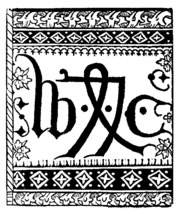
William Caxton, Publisher and Translator

William Caxton - Wikipedia, the free encyclopedia en.wikipedia.org

William Caxton – Wikipedia, the free encyclopedia
en.wikipedia.org

Born in Hadlow, Kent around 1420, William Caxton traveled to London somewhere between the age of 14 and 16 to serve as an apprentice to a London merchant, When Caxton’s master passed, Caxton inherited a sum large enough to begin his own business. From London, Caxton traveled to Bruges, where he finished his apprenticeship and was later employed by Margaret, Duchess of Burgundy (sister to King Edward IV), likely as her financial advisor.  She encouraged Caxton’s translation of the French tale, “The Recuyell of the Histories of Troye,” into English. From 1462 to 1470, Caxton served as governor of the English Nation of Merchant Adventures, where he negotiated contracts for his fellow merchants and acted as a diplomat for the King. 

“In the epilogue of Book III of the completed translation, entitled The Recuyell of the Historyes of Troye, he [Caxton] tells how his “pen became worn, his hand weary, his eye dimmed” with copying the book; so he “practised and learnt” at great personal cost how to print it.” (Enclyclopedia Britannica)

In Cologne in the early 1470s, Caxton learned something of the printing business, a skill he brought back to Bruges and later to England. He joined forces with Flemish calligrapher Colard Mansion to set up a printing press. Caxton’s translation of “The Recuyell of the Histories of Troye” was the first book printed in the English language (1475). Caxton’s translation from the French of The Game and Playe of the Chesse (in which chess is treated as an allegory of life) was published in 1476. 

“In 1476, when he was in his 50s, Caxton was back in London [in Westminster], and he started printing and selling books. This included very influential books, such as Chaucer’s Canterbury Tales, [Gower’s Confession Amantis]Le Morte d’Arthur, Sayengis of the Philosophres (Sayings of the Philosophers) and The Book of the Knight in the Tower, published 1484. This included some of the first verses in the Bible to be printed in English.

Al these thynges consydered, there can no man resonably gaynsaye but there was a kyng of thys lande named Arthur. For in al places, Crysten and hethen, he is reputed and taken for one of the nine worthy, and the fyrst of the thre Crysten men.
– William Caxton, Preface to Sir Thomas Malory Le Morte Darthur (1485)[Biography Online]

books.google.com

books.google.com

Caxton printed more than 100 books in his lifetime. “Although a pioneer of printing in England, Caxton showed no great typographical originality and produced no books of remarkable beauty. Kings, nobles, and rich merchants were Caxton’s patrons and sometimes commissioned special books. His varied output—including books of chivalric romance, conduct, morality, history, and philosophy and an encyclopaedia, The Myrrour of the Worlde (1481), the first illustrated English book—shows that he catered also to a general public. The large number of service books and devotional works published by Caxton were the staple reading of most literate persons. He also printed nearly all the English literature available to him in his time.” (BBC-History)


Posted in Age of Chaucer, British history, Great Britain, real life tales | Tagged , , , , | 1 Comment

Winner of a 3-AudioBooks Giveaway from Romantic Suspense Author, Jacki Delecki

Congratulations go out to lasvegasnan, who won an audiobook set of A Code of Love, A Code of the Heart and A Christmas Code from Jacki Delecki. Congratulations! Check your email from me to claim your prize.

PicMonkey Collage

Posted in Regency era, romance | Tagged , | Comments Off on Winner of a 3-AudioBooks Giveaway from Romantic Suspense Author, Jacki Delecki

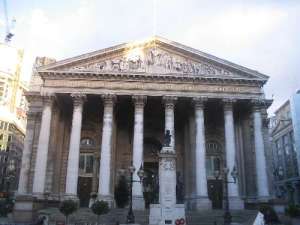
London’s Architecture and Commerce Combine in The Royal Exchange

InfoBritain http://www.infobritain.co. uk/Royal_Exchange_ London.htm

InfoBritain http://www.infobritain.co.
uk/Royal_Exchange_
London.htm

The Royal Exchange, a trapezoid-shaped structure, was opened by Queen Elizabeth I in 1571. Cornhill and Threadneedle Streets flank the exchange. The original building was destroyed by the Great Fire in 1666. It was rebuilt in 1669 and again destroyed by fire in 1838. The first building was a gift from Sir Thomas Gresham. It was rebuilt by Edward Jerman, a contemporary of Sir Christopher Wren. Jerman’s design rose from the ashes of the Great Fire and were built upon Elizabethan foundations. Statues of the kings of England from Edward I to Charles II graced the interior courtyard. Eventually, those of William and Mary, Anne, George I, George II, George III, and George IV followed.

Info Britain tells us a bit of the background for the original Royal Exchange, “London has always been a trading centre, lying as it does on a river estuary opposite the mouth of the Rhine, which places it ideally for trade with Europe. London also occupies what was once the lowest fordable point of the Thames, which made it a natural place for internal trade. When the Romans arrived after their invasion in 43AD, they found a regular market being held roughly on the site of what is now Southwark Market. This was an obvious place to build a town. By the sixteenth century Richard Gresham, supplier of tapestries to Henry VIII’s palace at Hampton Court decided that London should have a purpose built centre for trade, using the Bourse in Antwerp as a model. Richard was unable to make his vision a reality, but his son Thomas followed his father into the world of trade. Thomas made his home in Antwerp, and gained royal favour by arranging loans for English monarchs. In 1559, one year after the succession of Elizabeth I, Thomas was knighted for his services. Then in 1565, remembering his father’s vision, Thomas offered to build the City of London its own bourse at his own expense if the City would provide suitable land. Work started in 1566 on an arcaded building housing small shops, surrounding a central courtyard used for trading. Thomas Gresham used the rental income from these shops to fund a programme of free public lectures given at what would become known as Gresham College, based at his house in Bishopsgate.”

British History Online provides us a detailed description of the costs for and the look of Gresham’s project. (Old and New London: Volume 1. Originally published by Cassell, Petter & Galpin, London, 1878, pages 494-513.) “Lombard Street had long become too small for the business of London. Men of business were exposed there to all weathers, and had to crowd into small shops, or jostle under the pent-houses. As early as 1534 or 1535 the citizens had deliberated in common council on the necessity of a new place of resort, and Leadenhall Street had been proposed. In the year 1565 certain houses in Cornhill, in the ward of Broad Street, and three alleys—Swan Alley, Cornhill; New Alley, Cornhill, near St. Bartholomew’s Lane; and St. Christopher’s Alley, comprising in all fourscore householders—were purchased for £3,737 6s. 6d., and the materials sold for £478. The amount was subscribed for in small sums by about 750 citizens, the Ironmongers’ Company giving £75. The first brick was laid by Sir Thomas, June 7, 1566. A Flemish architect superintended the sawing of the timber, at Gresham’s estate at Ringshall, near Ipswich, and on Battisford Tye (common) traces of the old sawpits can still be seen. The slates were bought at Dort, the wainscoting and glass at Amsterdam, and other materials in Flanders. The building, pushed on too fast for final solidity, was slated in by November, 1567, and shortly after finished. The Bourse, when erected, was thought to resemble that of Antwerp, but there is also reason to believe that Gresham’s architect closely followed the Bourse of Venice.

“The new Bourse, Flemish in character, was a long four-storeyed building, with a high double balcony. A bell-tower, crowned by a huge grasshopper, stood on one side of the chief entrance. The bell in this tower summoned merchants to the spot at twelve o’clock at noon and six o’clock in the evening. A lofty Corinthian column, crested with a grasshopper, apparently stood outside the north entrance, overlooking the quadrangle. The brick building was afterwards stuccoed over, to imitate stone. Each corner of the building, and the peak of every dormer window, was crowned by a grasshopper. Within Gresham’s Bourse were piazzas for wet weather, and the covered walks were adorned with statues of English kings. A statue of Gresham stood near the north end of the western piazza. At the Great Fire of 1666 this statue alone remained there uninjured, as Pepys and Evelyn particularly record. The piazzas were supported by marble pillars, and above were 100 small shops. The vaults dug below, for merchandise, proved dark and damp, and were comparatively valueless. Hentzner, a German traveller who visited England in the year 1598, particularly mentions the stateliness of the building, the assemblage of different nations, and the quantities of merchandise.

“Many of the shops in the Bourse remained unlet till Queen Elizabeth’s visit, in 1570, which gave them a lustre that tended to make the new building fashionable. Gresham, anxious to have the Bourse worthy of such a visitor, went round twice in one day to all the shopkeepers in “the upper pawn,” and offered them all the shops they would furnish and light up with wax rent free for a whole year. The result of this liberality was that in two years Gresham was able to raise the rent from 40s. a year to four marks, and a short time after to £4 10s. The milliners’ shops at the Bourse, in Gresham’s time, sold mousetraps, birdcages, shoeing-horns, lanthorns, and Jews’ trumps. There were also sellers of armour, apothecaries, booksellers, goldsmiths, and glass-sellers; but the shops soon grew richer and more fashionable, so that in 1631 the editor of Stow says, ‘Unto which place, on January 23, 1570, Queen Elizabeth came from Somerset House throught Fleet Street past the north side of the Bourse to Sir Thomas Gresham’s house in Bishopsgate Street, and there dined. After the banquet she entered the Bourse on the south side, viewed every part; especially she caused the building, by herald’s trumpet, to be proclaimed ‘the Royal Exchange,’ so to be called from henceforth, and not otherwise.'”

The west side of the building saw extensive repairs at the hands of William Robinson, the surveyor of the Gresham Trustees, in 1767.
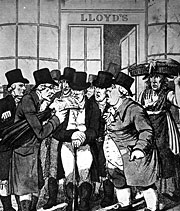
Lloyd's Coffee House - Wikipedia, the free encyclopedia en.wikipedia.org

Lloyd’s Coffee House – Wikipedia, the free encyclopedia
en.wikipedia.org

The Royal Exchange quickly became London’s door to international business. In the 17th Century, London’s importance as a trade centre led to an increasing demand for ship and cargo insurance. Edward Lloyd’s coffee house became recognized as the place for obtaining marine insurance, and this became the Lloyd’s of London that we know today. “Lloyd’s Coffee House” moved to the first floor of the Royal Exchange in 1774. The RE was forced to move to South Sea House after the 1838 fire. 

George Smith, architect to the Mercers’ Company, replied Jerman’s wooden tower with a stone one between 1820-1826.

Royal Exchange courtyard, City of London www.inetours.com

Royal Exchange courtyard, City of London
http://www.inetours.com

“The third Royal Exchange building, which still stands today, was designed by William Tite and adheres to the original layout–consisting of a four-sided structure surrounding a central courtyard where merchants and tradesmen could do business. The internal works, designed by Edward I’Anson in 1837, made use of concrete—an early example of this modern construction method. It features pediment sculptures by Richard Westmacott (the younger), and ornamental cast ironwork by Henry Grissell’s Regent’s Canal Ironworks. It was opened by Queen Victoria on 28 October 1844 though trading did not commence until 1 January 1845.In June 1844, just before the reopening of the Royal Exchange, a statue of Arthur Wellesley, 1st Duke of Wellington, was unveiled outside the building. The bronze used to cast it was sourced from enemy cannons captured during Wellington’s continental campaigns.” (The Royal Exchange)

A tower to replace the one designed with the Gresham grasshopper symbol was rebuilt in 1842 under the direction of Sir William Tite in the centre of the facade towards Throgmorton Avenue. 

Posted in Age of Chaucer, British history, Great Britain, real life tales, Victorian era | Tagged , , , , , , , , , , , | Comments Off on London’s Architecture and Commerce Combine in The Royal Exchange

Are You Ready for the Onslaught of Holiday Movies?

Since the onset of film, a little over a century prior, Christmas has been employed as plot device for some of our most endearing films, as well as those not so engaging. Today, we have channels, such as the Hallmark Channel, on television, which run countless made-for-TV films “celebrating” Christmas.

Ironically, none of the traditional Christmas classics tell the story of Jesus’s birth. Instead, they speak to the values taught by the Christian faith. As with the morality plays of the Medieval and early Tudor times, these “interludes” are a type of allegory in which the protagonist is met by personifications of various moral attributes, who try to prompt him to choose a Godly life (most noble of human qualities) over one of evil or of dispensation.

Christmas Interlude #5 – A Christmas Carol – Movie Posters and ... twentyfourframes. wordpress.com A Chrstimas Carol 1938

Christmas Interlude #5 – A Christmas Carol – Movie Posters and …
twentyfourframes.
wordpress.com
A Chrstimas Carol 1938

One of the most popular of holiday films are those based on Charles Dickens’s A Christmas Carol. There have been more than 20 film versions of the Victorian classic, and this does not take into consideration play productions, television, etc. Dickens’ story was first brought to film in 1938 with Reginald Owen playing Scrooge; however, most critics believe the 1957 version told a truer tale. Dickens’ tale has even seen the 1970 musical with Albert Finney and Kermit the Frog in The Muppet’s Christmas Carol. The value of family and of giving is the nucleus of most retellings. 

A Christmas Carol (1951) - IMDb www.imdb.com

A Christmas Carol (1951) – IMDb
http://www.imdb.com


Miracle on 34th Street - Wikipedia, the free encyclopedia en.wikipedia.org

Miracle on 34th Street – Wikipedia, the free encyclopedia
en.wikipedia.org

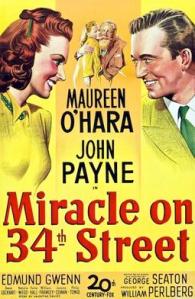
Miracle on 34th Street remains one of my favorites. The 1947 version of the film starred Edmund Gwen, Maureen O’Hara, Natalie Wood, and Gene Lockhart. (Note! Lockhart was also notably in the 1938 version of A Christmas Carol.) The film’s story line teaches us there is no place for negativity in the midst of joy and “miracles.” Ironically, the movie was not released during the winter months, but rather during July. Six months later, crowds still filled theatres, and Hollywood had learned the lesson of “Christmas” as a money-making draw.

MV5BMjA0Mzg0OTU0OF5BMl5BanBnXkFtZTYwNTM4MjY5._V1_SY317_CR5,0,214,317_AL_Another of my favorites is White Christmas. What can I say? I am a sucker for a movie musical. Needless to say, the film was designed to highlight Bing Crosby’s release of the Irving Berlin classic “White Christmas.” The song made its debut in the 1942 film Holiday Inn. White Christmas (1954) brought a group of WWII veterans together to honor the man had led them through the trials of battle and is a spectacular lesson on respect and responsibility. The only thing I “dislike” about the film is I spend the next month singing “Sisters.”  Just to mess with your mind, here are the lyrics so you might song along with me. 

Sisters, sisters
There were never such devoted sisters
Never had to have a chaperon, no sir
I’m here to keep my eye on her
Caring, sharing
Every little thing that we are wearing
When a certain gentleman arrives from Rome
She wore the dress and I stayed home
All kinds of weather
We stick together
The same in the rain or sun
Two different faces
But in tight places
We think and we act as one… uh-huh
Those who’ve seen us
Know that not a thing could come between us
Many men have tried to split us up but no one can
Lord help the mister
Who comes between me and my sister
And lord help the sister who comes between me and my man
Sister
Sister
Sister don’t come between me and my man (Lyrics)

Christmas in Connecticut - Wikipedia, the free encyclopedia en.wikipedia.org

Christmas in Connecticut – Wikipedia, the free encyclopedia
en.wikipedia.org


An old Hollywood screwball comedy, Christmas in Connecticut, speaks to us of the ways to nourish love with honesty. The film starred Barbara Stanwyck and Dennis Morgan and displays the typical “Happily Ever After” so sought by those who love the romance genre.

Likely the most popular of the Christmas films is Donna Reed’s and Jimmy Stewart’s It’s a Wonderful Life (1946). In reality, the film was not received well by film critics, saying the film was “too perfect” – sugary sweet to the point of being “sickening.” However, the advent of television brought new life to the film. The lesson of how one life can have a domino effect on the rest of the world rang true for those children of the Cold War era. Flickfilospher offers this criticism of the film: “An ordinary man sees the life of adventure and travel he hoped for constantly thwarted but eventually learns to love the pleasant life he does have. Cherish what you have, is the movie’s message. Count your blessings. Who could argue with those aphorisms? And that, maybe, is my problem with It’s a Wonderful Life: it’s too easy. Its two main characters — George Bailey (James Stewart: The Greatest Show on Earth) and Mr. Potter (Lionel Barrymore: You Can’t Take It with You) — are stereotypes, respectively, of the poor, eternally put-upon ordinary guy and the mean-spirited, rich old bastard. The conflicts the film sets up couldn’t be more black-and-white — and I’m not talking about the film stock.”

This is a list from Wikipedia of Holdiay-based films. I do not totally agree with some of the choices, but here they are just the same…

Christmas Classics
These are Christmas films released in the 1930s, 1940s and 1950s.

Babes in Toyland – 1961 – Disney adaptation of the Herbert operetta.
Beyond Tomorrow (Beyond Christmas) – 1940 -The first half of this fantasy film takes place on Christmas Eve as three old men befriend two strangers, a young man and woman, who return their wallets.
The Bishop’s Wife – 1947 – An angel helps a bishop rearrange his priorities during the Christmas season.
A Christmas Carol – 1938 – MGM’s adaptation of Charles Dickens’ classic story.
A Christmas Carol – 1951 – American title of British film Scrooge (see below).
Christmas Holiday – 1944 -A stranded soldier listens as a cabaret singer recounts a doomed marriage to a killer.
Christmas in Connecticut – 1945 – A columnist must entertain her boss and a returning war hero for the holidays. Remade for television in 1992.
Holiday Affair – 1949 – Romance blooms between a young widow and a sales clerk at Christmastime.
Holiday Inn – 1942 – Musicians prepare for a white Christmas at a cozy lodge.
I’ll Be Seeing You – 1944 – A war veteran finds romance with furloughed prisoner during the holidays.
It’s a Wonderful Life – 1946 – After attempting to commit suicide on Christmas Eve, a man is rescued by a guardian angel and shown what his hometown would be like had he never lived.
Scrooge – 1935 – Early film adaptation of Charles Dickens’ A Christmas Carol starring Sir Seymour Hicks.
Scrooge – 1951 – Dickens’ ghostly meditation on Christmas. This version of the story, with Alastair Sim as Ebenezer Scrooge, is universally regarded as the very best.
Miracle on 34th Street – 1947 – Macy’s Santa, with help from the U.S. Postal Service, restores a little girl’s faith. Remade for television in 1955, 1959, 1973.
The Shop Around the Corner – 1940 – Unbeknownst to each other, coworkers become romantic pen pals at Christmastime.
White Christmas – 1954 – As in Holiday Inn, musicians bring Irving Berlin’s lyrics to Vermont lodge. (The story is not a remake, however.)

Contemporary Christmas Classics
These are Christmas films released in the 1970s, 1980s, and 1990s.

A Christmas Story – 1983 – All Ralphie wants for Christmas is a Red Ryder BB gun.
All I Want for Christmas – 1991 – Two kids plot to reunite their estranged parents at Christmas.
Home Alone – 1990 – Kevin McCallister, an eight-year-old boy, is mistakenly left behind when his family flies to Paris for their Christmas vacation.
Home Alone 2: Lost in New York – 1992 – Kevin McCallister, now ten-years-old, mistakenly travels to New York City without his family on Christmas.
Jingle All the Way – 1996 – A Dad competes with others to find sold out hot toy for his son.
Mickey’s Christmas Carol – 1983 – Disney’s animated adaptation of Charles Dickens’ classic story.
Miracle on 34th Street – 1994 – Theatrical remake.
The Muppet Christmas Carol – 1992 – Jim Henson’s creations tackle Charles Dickens’ festive favorite.
National Lampoon’s Christmas Vacation – 1989 – The Griswold family plans turn to disaster, this time at Christmas. Followed by a made-for-TV sequel.
One Magic Christmas – 1985 – At Christmas time an angel shows a young mother the true meaning of the holiday.
The Nightmare Before Christmas – 1993 – Jack, a Halloween skeleton, discovers Christmas and attempts to hijack it.
The Santa Clause – 1994 – An ordinary man who accidentally causes Santa Claus to fall to his death from his roof on Christmas Eve must replace the “Jolly Old Elf”
Scrooge – 1970 – A musical adaptation of Dickens’ tale, starring Albert Finney in the title role.
Scrooged – 1988 – Modern, dark-humored interpretation of Dickens’ story, with Christmas spirits visiting a cynical, selfish TV exec, played by Bill Murray.

Modern Christmas Classics
These are Christmas films released in the 2000s and 2010s.

Angels Sing – 2013 – A man who as a child loved Christmas, but after a tragic accident, his holiday spirit was crushed. He needs to find his holiday spirit again, and meets a man named Nick, who gives him a gift that helps him find the joy of Christmas again.
Arthur Christmas – 2011 – Santa’s youngest son must deliver a bicycle to an overlooked girl before Christmas morning dawns. 3-D/CGI animated film.
A Christmas Carol – 2009 – Walt Disney Pictures/ImageMovers Digital performance capture film starring Jim Carrey.
Christmas with the Kranks – 2004 – When a suburban couple decide to forgo Christmas festivities, preferring to take a cruise to the Caribbean instead, their neighbours refuse to allow such Scrooge-like behaviour.
Deck the Halls – 2006 – Rival neighbors duke it out when one of them decides to light his house up so it can be seen from outer space
Elf – 2003 – A human who thinks he is an elf searches for his family in New York.
The Polar Express – 2004 – A magical train takes a boy and other children up to the north pole to meet Santa Claus.
The Santa Clause 2: The Mrs Clause – 2002 -Sequel to The Santa Clause; Santa must find a Mrs. Claus.
The Santa Clause 3: The Escape Clause – 2006 -Santa battles Jack Frost to keep his title.
Unaccompanied Minors – 2006 – Bored kids make up their own holidays while stuck in an airport after Christmas.

So, what are some of your favorite holiday-based films? Comment below.

Posted in Uncategorized | Tagged , , , , | 10 Comments

John Gower, Medieval English Poet and Contemporary of William Langland and Geoffrey Chaucer

John Gower was a medieval English poet whose work spoke of moral allegory and courtly love. He was known to be a friend of Geoffrey Chaucer and their styles were compatible. Gower was said to influence many other poets of the time. His writings in French and Latin and English are voluminous. The Confession Amantis is, for example, a lengthy series of stories told in English verse. One of the most notable of these is the Tale of Florent. The verse form is octosyllabic (eight syllables) couplet. Interest in Gower’s work died out in the 16th Century, but the mid 20th Century saw a resurgence in him. My son attended Western Carolina University, and at WCU there is International John Gower Society, devoted to his works. 

It is assumed that Gower hailed from Yorkshire and his family was wealthy. His language is of Kentish origin, however. Assumptions are also made as to his life in London as many of Gower’s works hod allusion to London life and life at court. “At one point, he professed acquaintance with Richard II, and in 1399 he was granted two pipes (casks) of wine a year for life by Henry IV as a reward for complimentary references in one of his poems. In 1397, living as a layman in the priory of St. Mary Overie, Southwark, London, Gower married Agnes Groundolf, who survived him. In 1400 Gower described himself as “senex et cecus” (“old and blind”), and on Oct. 24, 1408, his will was proved; he left bequests to the Southwark priory, where he is buried.

“Gower’s three major works are in French, English, and Latin, and he also wrote a series of French balades intended for the English court. The Speculum meditantis, or Mirour de l’omme, in French, is composed of 12-line stanzas and opens impressively with a description of the devil’s marriage to the seven daughters of sin; continuing with the marriage of reason and the seven virtues, it ends with a searing examination of the sins of English society just before the Peasants’ Revolt of 1381: the denunciatory tone is relieved at the very end by a long hymn to the Virgin.

“Gower’s major Latin poem, the Vox clamantis, owes much to Ovid; it is essentially a homily, being in part a criticism of the three estates of society, in part a mirror for a prince, in elegiac form. The poet’s political doctrines are traditional, but he uses the Latin language with fluency and elegance.

Vol 1-Confessio“Gower’s English poems include In Praise of Peace, in which he pleads urgently with the king to avoid the horrors of war, but his greatest English work is the Confessio amantis, essentially a collection of exemplary tales of love, whereby Venus’ priest, Genius, instructs the poet, Amans, in the art of both courtly and Christian love. The stories are chiefly adapted from classical and medieval sources and are told with a tenderness and the restrained narrative art that constitute Gower’s main appeal today.” (Enclyclopedia Brittanica)
In The Tale of Florent, Florent is a young knight who kills Branchus in a fight. Branchus’ grandmother wants revenge. However, she offers Florent his life if he can find out what women most desire. Florent sets out to travel, in order to observe what women most wants. On his way, he meets an old hag. She offers to tell him the answer to the question if he will marry her. Florent offers her land or money, but she turns down these bargains. But Florent, being young and charming, is not anxious to die yet, so he promises to marry the hag. She then tells him that women want power over man’s love most of all. Florent returns to the court, gives this answer, and his life is spared. Then with some feelings of disgust he takes the old hag to his castle to fulfill his promise. When they are married and in bed, the story resolution is shown. The old hag turns into a most beautiful woman of eighteen. She is the daughter of the King of Sicily and had been transformed into a hag by her wicked step-mother. Florent broke the spell with his faithfulness. (History of English Literature: Part I – Early Saxon Through Milton, Hymarx Outline Series, Boston, Massachusetts)

In The Tale of Ceyx and Alceone, Ceyx, King of Trocinio, loved his wife Alceone and his brother Dedalion. Unfortunately, Dedalion was transformed into a goshawk. Ceyx resolves to go on a holy pilgrimage in the hope of curing his brother. He sails away and is heard of no more. The frantic Alceone begs Juno for aid. Juno hearkens and sends Iris to the dark realm of Sleep. Sleep sends out Morpheus to appear to Alceone in the likeness of her drowned husband. He appears to her at night. The next morning, she goes to the shore when she dreamt she saw his body, and there she finds her drowned husband. She leaps into the water after him, and they are both transformed into birds, called “halcyons,” after Alceone. (History of English Literature: Part I – Early Saxon Through Milton, Hymarx Outline Series, Boston, Massachusetts)

Critics of Gower say his language was simpler than most of the authors of his time, but they praise his narrative style and his innate ability to develop the exposition in exact proportions. Most say he lacks Chaucer’s sense of humor, dramatic power, and understanding of characterization. It is noted that Gower does not digress when telling his story: He is always on point. He does moralize often, but he is not “preachy” in his approach to the story. His stories move easily from plot point to plot point. Although Gower’s verse is regular and his meter smooth, his greatest fault is his simplicity sometimes led to prosaic and commonplace expression.

Wikipedia list these works for Gower: 
Mirour de l’Omme, or Speculum Hominis, or Speculum Meditantis (French, c.1376–1379)
Vox Clamantis (Latin, c.1377–1381)
Confessio Amantis (English, c.1386–1393)
Traité (French, 1397)
Cinkante Balades (French, 1399–1400)
Cronica Tripertita (Latin, c.1400)
In praise of peace (English, c.1400)
See also…
Pericles, Prince of Tyre, a play co-written by Shakespeare, based on Gower’s work and featuring Gower as the Chorus
Henry IV Part II includes Gower as a messenger
In Henry V, Gower is the ideal English soldier

Posted in Age of Chaucer, Anglo-Normans, British history, Great Britain, real life tales, Uncategorized | Tagged , , , , , , , , | 2 Comments

Georgian Architecture: Mincing Lane, The Commercial Salerooms, and The Corn Exchange

London Commercial Sales Rooms Prints, Posters & Framed Wall Art www.magnoliabox.com The London Commercial Sale Rooms and Mincing Lane, City of London

London Commercial Sales Rooms Prints, Posters & Framed Wall Art
http://www.magnoliabox.com
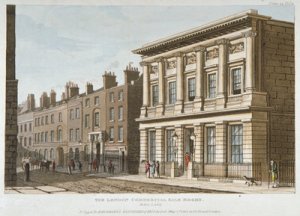
The London Commercial Sale Rooms and Mincing Lane, City of London

Mincing Lane is one of the smaller streets in the City of London. It links Fenchurch Street to Great Tower Street. For many years, Mincing Lane was “the world’s leading centre for tea and spice trading after the British East India Company successfully took over all trading ports from the Dutch East India Company in 1799. It was the centre of the British opium business (comprising 90% of all transactions), as well as other drugs in the 18th century. Businesses in the British slave trade…were also based in Mincing Lane. In 1834, when the East India Company ceased to be a commercial enterprise, and tea became a ‘free trade’ commodity, tea auctions were held in the London Commercial Salerooms on Mincing Lane. Teas merchants established offices in and around the street, earning it the name ‘Street of Tea.'” (Mincing Lane)

The Commercial Salerooms is on the east side of Mincing Lane. The Commercial Salerooms are two stories. The lower rise display six attached Ionic columns supporting a continued entablature. Between the columns are large square-headed windows, above which are relievo’s in pannels by James George Bubb. The centre sports Britannia. On either side are emblems representing colonial produce, commerce, navigation, and science. (Thomas Allen, The Histroy and Antiquities of London, Westminister, Southwark, and Parts Adjacent , Volume 3, page 749)

Garraway's Coffee House | London Details baldwinhamey.wordpress. com Plaque where Garraway's used to be. Source: Wikipedia

Garraway’s Coffee House | London Details
baldwinhamey.wordpress.
com
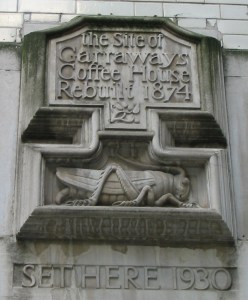
Plaque where Garraway’s used to be. Source: Wikipedia

The Great Fire of 1666 burnt down The Royal Exchange. Afterwards a myriad of coffee houses took over the area. For the following 100 years, time and neglect saw the demise of these establishments. Garroway’s, which was the last of these to fall. It succumbed in 1860. Auctions of many commodities occurred in the buildings until they were transferred to the London Commercial Salerooms, which opened in 1811. These were destroyed by the bombing in 1941. 

The London Commercial Salerooms were the model for traditional commodity trading. These establishments saw the progress that would change the world of commodity exchange: the development of steamships and railways; international postal services; the opening of the Suez Canal, and the invention of the telegraph. (Richard Duncan, Agricultural Futures and Options: A Guide to Using North American and European Markets, page 86 )

On Mark Lane the corn-factor sold the corn of the country farmer to the miller, the meal man, and to the corn-chandler of London. The Corn Exchange is located on the east side of Mark Lane. Originally, “the farmers of Kent and Essex used to send their grain up the river, and attend a sort of market at Bear Quay; but…when grain was cheap, the farmers often returned home without selling their grain. Those from Essex used the Bull inn, Whitechapel; and the landlord, who was of an enterprising spirit, proposed that the samples, with the prices, be left with him, in order that he might try to dispose of the grain in their absence. This man, whose name was Johnson, and who was originally the ‘boots’ of the inn, soon got so much business in this way, that he opened an office at Bear Quay as a corn factor, and amassed a fortune.” (The History and Antiquities of London, Westminister, Southwark, and Adjacent Parts)

The business get so quickly that the Corn Exchange was open on Mark-lane. The building is of the Doric order. There is a large, spacious room set aside for the display of grain samples. Across from this structure, one can find the smaller, The New Exchange for Corn and Seed. 

LONDON:New Corn Exchange,Mark Lane,antique print,1828: Amazon.co ... www.amazon.co.uk LONDON:New Corn Exchange,Mark Lane,antique print,1828

LONDON:New Corn Exchange,Mark Lane,antique print,1828: Amazon.co …
http://www.amazon.co.uk
LONDON:New Corn Exchange,Mark Lane,antique print,1828

“The principal facade ranges with the houses on the east side of Mark-lane; it is made into a centre between two wings. The former consists of a portico or corridor composed of six fluted Doric columns from Grecian examples, raised on a continued plinth, and sustaining an entablature. The plinth is broken with three flights of steps, and two low windows, entrances to the vaults beneath the floor; in the entablature the triglyphs are omitted, and their place supplied by chaplets of wheat-ears instead of myrtle…. The cornice is charged with lion’s heads at intervals, and the whole is surmounted by a blocking course; above the centre is a large pedestal crowned with a cornice, abode which are the royal arms in stone, accompanied by ploughs and agricultural emblems. On the dado is inscribed 

Corn Exchange. Erected 1828, Pursuant to Act of Parliament,

7th Geo. IV. Cap. 55.” 

(The History and Antiquities of London, Westminister, Southwark, and Adjacent Parts)

Posted in Uncategorized | Tagged , , , | 2 Comments

‘Tis the Season…for romantic suspense! from Jacki Delecki + a 3-Book Giveaway

Tis the Season…for romantic suspense!

Picture 001The lovely Jacki Delecki is back with a look at writing romantic suspense, as well as a fabulous giveaway. 
As a romantic suspense author, I am always in search of new ideas and concepts that I can weave into my stories and plots. What might sound like homework to some is more like a challenging scavenger hunt to me. The idea is to collect a variety of random ideas and then figure out how to assemble them into a compelling tale of intrigue.

For A Christmas Code, Book 2 of the Regency romantic suspense series, the Code Breakers, I combined elements from the winter holiday season to craft a story that features an attempted poisoning set against the elegant backdrop of the Regency Ton. In this story, the hero Ash is poisoned by a dose of ground up holly berries meant for the Prince Regent.

A popular accent used in Christmas decorations, holly is an evergreen shrub that can grow to be a tree, and there are more than 400 different varieties of the plant. The fruit and leaves contain a mix of caffeine-like alkaloid theobromine, caffeine and glycosides (theobromine is also found in chocolate and cocoa).

People and pets avoid the prickly leaves, but children may be attracted to the bright red berries. As few as 20 can be lethal if consumed, and eating just three berries can cause nausea, vomiting and diarrhea. More severe symptoms include drowsiness, slowed breathing and heart rate, coma, and death.

In the book, Ash catches a lucky break, because, while holly berries are toxic, people rarely die from ingesting this type of poison. Nowadays modern medicine can treat individuals who consume holly berries, but that wasn’t always the case.

I recently released the audiobook version of A Christmas Code, which is narrated by the talented Pearl Hewitt, who also narrated two other books in this series: A Code of Love and A Code of the Heart. You can listen to an audio sample HERE

THE CODE BREAKERS SERIES

Men and women from the class of privilege and rank risk their lives to defend England against the treacherous designs of Napoleon. They confront disaster, scandal, and passion as they pursue their code of honor and love.

51V4E45VDcL-1._SX331_BO1,204,203,200_Book One: A Code of Love 
Threatened by French spies, assassins, and calculating suitors, can Lady Henrietta Harcourt trust the infamous rake, Lord Cordelier Rathbourne, with her carefully guarded family secrets?
Cord’s passionate attraction for the indomitable Henrietta hasn’t diminished in his four years abroad, but neither has Henrietta’s memory of his libertine past.
As England’s new Director of Intelligence, Cord faces more peril protecting the Harcourt family of brilliant code breakers than he did as an undercover spy in Napoleonic France. Henrietta’s brother, on a clandestine assignment in Paris, has vanished.
In pursuit of the missing brother, Henrietta and Cord become entangled in a web of international intrigue, danger, and white hot passion.

51q8fCHcz0L._SX331_BO1,204,203,200_Book 2: A Christmas Code: Lady Gwyneth Beaumont has long awaited the opportunity to show Viscount James Ashworth that she is no longer the impetuous child who dogged his footsteps. Now a much sought-after debutante, she is determined to prove to the hard-headed rake that she is a grown woman and a worthy participant in both the spy game and the game of love.
Ash, recently returned from three years undercover in France in His Majesty’s service, wants nothing more than to complete his final mission and retire to his bucolic country estate. However, what seemed a simple assignment to protect the Prince Regent at a Christmas party turns into a maze of intrigue, desire, and treachery.
Adding to the perilous secret operation is one problem Ash never anticipated: The appearance of the reckless, enticing Gwyneth, who has blossomed into a gorgeous woman and self-appointed spy. When a snooping Gwyneth uncovers a shocking secret, she puts herself in mortal danger.
Can Ash protect Gwyneth and the Prince from French assailants and, at the same time, win the passionate lady’s heart?
Can Ash and Gwyneth both triumph as winners in the game of spies and love?

511WgiFm9tL._SX306_BO1,204,203,200_Book 3: Code of the Heart: Miss Amelia Bonnington has been in love with her childhood hero since she was eleven years old… or so she thought until a not-so proper impassioned and unyielding kiss from the not-so honorable and equally disreputable Lord Derrick Brinsley, gave her reason to question the feelings of the heart. Lord Brinsley, shunned from society for running off with his brother’s fiancée, hasn’t cared about or questioned his lack of acceptance until meeting the beguiling Amelia Bonnington. One passionate moment with the fiery Miss Bonnington has him more than willing to play by society’s rules to possess the breathtaking, red-haired woman. Amelia unwittingly becomes embroiled in espionage when she stumbles upon a smuggling ring in the modiste shop of her good friend. To prove her French friend’s innocence, she dangerously jumps into the fray, jeopardizing more than her life. On undercover assignment to prevent the French from stealing the Royal Navy’s deadly weapon, Derrick must fight to protect British secrets from falling into the hands of foreign agents, and the chance at love with the only woman capable of redeeming him.

Comment on this blog for a chance to win an audiobook set of A Code of Love, A Code of the Heart and A Christmas Code. The giveaway ends at midnight, Tuesday, November 8, 2015, EST. 

PicMonkey Collage
Fans of holiday romance are in for an added treat from Jacki Delecki. A holiday edition of Marriage Under Fire, Book 4 of the Grayce Walters contemporary romantic suspense, is available. This edition features more than 9,000 words of exclusive content, including Maddy and Hunter’s romantic Christmas wedding with Grayce, Davis, Hollie, James and the entire Grayce Walters crew. The holiday edition of Marriage Under Fire is available at Amazon, Barnes & Noble, iBooks, Kobo and Google Play for a limited time. Readers who have already purchased the book can enjoy the new scenes for free by accessing the updated ebook.

Picture 001Jacki Delecki is a bestselling romantic suspense writer. Delecki’s Grayce Walters Series, which chronicles the adventures of a Seattle animal acupuncturist, was an editor’s selection by USA Today. Delecki’s Romantic Regency The Code Breaker Series hit number one on Amazon. Both acclaimed series are available for purchase at http://www.JackiDelecki.com. To learn more about Jacki and her books and to be the first to hear about giveaways join her newsletter found on her website. Follow her on Facebook Jacki Delecki or Twitter @jackidelecki.

Posted in British history, Great Britain, Living in the Regency, Regency era, romance, suspense, Uncategorized | Tagged , , , , | 12 Comments

November 30 ~ St. Andrew’s Day

St Andrew's Day - Pre-Intermediate English Reading www.esolcourses.com

St Andrew’s Day – Pre-Intermediate English Reading
http://www.esolcourses.com

Who was Saint Andrew ? Despite what many may think, St. Andrew, who is the patron saint of Scotland, did not live and work in that country. In fact, his legendary connections to Scotland appeared centuries after his death.

Andrew, one of the twelve disciples of Jesus, was a fisherman by trade. After Jesus’s crucifixion, Andrew carried on Jesus’s work. He brought the gospel to parts of Asia Minor, specifically to Syria. Roman soldiers ended Andrew’s life. According to the traditions of the time, the soldiers crucified Andrew on a diagonal cross. Later, his “relics” were taken to Constantinople. Reportedly, those relics were moved to Italy in the later part of the fourth century. During that time, Saint Regulus managed to bring some of Saint Andrew’s bones to Fife, in Scotland. We are unsure of these facts because the bones no longer exist. They were reportedly lost during the Reformation, but a plaque in the ruins of St Andrews Cathedral marks where the bones once were kept. (Catholic Online)

Outside of Scotland, Saint Andrew’s Day is of little significance. However, it is a special day for Scots worldwide.

Why is Saint Andrew the patron saint of Scotland? In the ninth century AD, control of the area around Lothian led to a conflict between the Picts and the Scots and the Northumbrians. Near Athelstaneford in East Lothian, Angus McFergus, the leader of the Picts, had a dream in which St. Andrew promised him a victory. In the midst of the battle the following day, Angus supposedly saw an X-shaped cross in the sky above him. The sight gave the Picts the inspiration they needed to win the confrontation. The white cross against a blue background became part of the saltire, the Scottish national flag.

From The Official Gateway to Scotland, we learn: “Having Saint Andrew as Scotland’s Patron gave the country several advantages: because he was the brother of Saint Peter, founder of the Church, the Scots were able to appeal to the Pope in 1320 (The Declaration of Arbroath) for protection against the attempts of English kings to conquer the Scots. Traditionally, Scots also claimed that they were descended from the Scythians who lived on the shores of the Black Sea in what is now Romania and Bulgaria and were converted by Saint Andrew.

“In the fascinating legend of The Voyage of St Rule from Greece to Scotland we can see the complicated spread of devotion to Saint Andrew – from Constantinople in modern Turkey, to St Andrews in Fife. St Rule (Regulus in Latin) and the six nuns and monks who took the long sea-journey with him, stands for the missionaries and monasteries who worked long and hard to bring the Good News to Britain. They lived in communities organised by a monastic Rule – hence the name St Rule or Regulus.

“As Scotland slowly became a nation it needed a national symbol to rally round and motivate the country. Saint Andrew was an inspired choice and the early Picts and Scots modelled themselves on Saint Andrew and on one of his strong supporters, the Roman Emperor Constantine the Great, whose statue you can see today in York, where the he visited his father, a Roman General then trying to force the Picts to go back north.”

30th of November
St. Andrew’s Day is the feast day of Saint Andrew. It is celebrated on the 30th of November. Saint Andrew is the patron saint of Scotland, Greece, Romania, Russia, Poland, Ukraine, the Ecumenical Patriarchate of Constantinople and Saint Andrew, Barbados. (Wikipedia)

Posted in Act of Parliament, British history, Great Britain, real life tales, Scotland, St. Andrew | Tagged , , , , , | 2 Comments

‘Tis the Season, Celebrating What is Known as “Christmastide”

ye-old-yule-logChristmastide (also Christmas or the Christmas season) is one of the seasons of the liturgical year of most Christian churches. It tends to be defined (with slight variations) as the period from Christmas Eve to the Epiphany. This period is also commonly known as the Twelve Days of Christmas, as referred to in the Christmas carol of the same name, or Yuletide, as in “Deck the Halls.” [Christmastide]
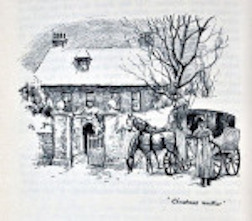
Many Protestant churches add an Epiphany season after the Christmas season, extending the celebration of Christmas for forty days until the feast of the Presentation of Christ in the Temple (Candlemas) on 2 February (or a nearby Sunday). In the Missal and Breviary of the Roman rite, since 1970, the Christmas season runs a shorter period, from Christmas Eve to the Baptism of the Lord, which depending on the place and the year can occur between 7 January and 13 January. In the Little Office of the Blessed Virgin Mary, the season runs from Vespers on 24 December till Compline on 2 February.

scene-from-emmaDuring the season, various festivities are traditionally enjoyed and buildings decorated. In some countries the superstition has arisen that it is bad luck to leave the decorations up after Twelfth Night.

Advent, anglicized from the Latin word adventus meaning “coming”, is a season observed in many Western Christian churches, a time of expectant waiting and preparation for the celebration of the Nativity of Jesus at Christmas. It is the beginning of the Western liturgical year and commences on Advent Sunday, called Levavi. The Eastern churches’ equivalent of Advent is called the Nativity Fast, but it differs both in length and observances and does not begin the church year, which starts instead on September 1.

The progression of the season may be marked with an Advent calendar, a practice introduced by German Lutherans. At least in the Roman Catholic, Anglican, Lutheran, Moravian, Presbyterian, and Methodist calendars, Advent starts on the fourth Sunday before December 25, the Sunday from November 27 to December 3 inclusive.

Latin adventus is the translation of the Greek word parousia, commonly used in reference to the Second Coming of Christ. For Christians, the season of Advent anticipates the coming of Christ from two different perspectives. The season offers the opportunity to share in the ancient longing for the coming of the Messiah, and to be alert for his Second Coming.

Posted in real life tales | Tagged , , , , | Comments Off on ‘Tis the Season, Celebrating What is Known as “Christmastide”

Did You Know These Facts Regarding Thanksgiving?

First, I wish all my lovely friends and family a most joyous Thanksgiving Day. Thank you for reading my blog. 

 Elvis Deputy Sherriff of Shelby County | Linda Hood Sigmon Truth lindahoodsigmontruth.com


Elvis Deputy Sherriff of Shelby County | Linda Hood Sigmon Truth
lindahoodsigmontruth.com

From History.com, we learn the following facts regarding Thanksgiving Day: 

It took more than 200 years after the first Thanksgiving before it became an official holiday.

The first Thanksgiving was a three day feast, which included hunting, athletic games, and eating. The Pilgrims dined on venison, NOT turkey. There was also NO pumpkin pie or potatoes or cranberry sauce.

In 1789, George Washington announced the first NATIONAL Thanksgiving holiday, but Thanksgiving did not become an annual tradition until the 19th Century. The Americans celebrated on Thursday, November 26, 1789.

As the first Thanksgiving (1622) was to celebrate the Pilgrims’ first successful harvest, the celebration was not repeated.

American writer, Sarah Josepha Hale, was inspired by A Diary of Pilgrim Life. In 1827, Hale began a 30 year campaign to make to make Thanksgiving a national tradition. At her own expense, Hale published recipes for pumpkin pie, stuffing, turkey, etc. (By the way, Hale is the author of the nursery rhyme “Mary Had a Little Lamb.”)

In 1863, Abraham Lincoln declared Thanksgiving will would be celebrated on the last Thursday of November.

thanksgiving-gallery.jpg www.kidzworld.com

thanksgiving-gallery.jpg
http://www.kidzworld.com

In 1939, FDR moved the holiday to the 3rd Thursday in November to give retailers an extra week to make money during the holiday buying season. It was the Depression, after all.

Ironically, in 1941, FDR signed a bill to keep Thanksgiving on the 4th Thursday of November.

In 1989, George H. W. Bush gave the first official turkey pardon.

 These facts and lots more about Thanksgiving can be found at History.com.

Posted in America, American History, Thanksgiving | Tagged , , , | Comments Off on Did You Know These Facts Regarding Thanksgiving?