Sir Thomas Malory, Knight-Prisoner, Author of “Le Morte Darthur,” and Criminal?

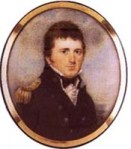
We know that Sir Thomas Malory compiled the tales of King Arthur to give us Le Morte Darthur. But was the real Thomas Malory? 

Encyclopedia of World Biography | 2004, COPYRIGHT 2004 The Gale Group Inc., tells us some important facts regarding the author known as Thomas Malory.  “The English author Sir Thomas Malory (active 15th century) wrote Le Morte Darthur, one of the most popular prose romances of the medieval period. The work was the first full-length book in English about the adventures of King Arthur and the Knights of the Round Table.

“Although Le Morte Darthur (also known as Le Morte d’Arthur) is universally accepted as a masterpiece of imaginative literature, so much mystery surrounds the identity of the author (that is, which one of several Sir Thomas Malorys of the 15th century actually wrote it) that any one definitive biography seems imprudent. The only direct information extant concerning the author is that a Sir Thomas Malory completed the book while he was a “knight-prisoner” in the ninth year of Edward IV’s reign, from March 4, 1469, to March 3, 1470. All the rest is conjecture.

“In the 16th century John Bale associated Malory with Welsh origins mainly because of a place called Mailoria in Wales and because of the subject matter of the book. There are no records, however, of a Thomas Malory in Wales in the 15th century. Although several other Thomas Malorys were suggested, the next serious candidate was identified by George L. Kittredge at the end of the 19th century as Sir Thomas Malory, Knight, of New-bold Revel, Warwickshire. This Thomas Malory, who, as the record shows, led an active and colorful life, has been accepted as the author of Le Morte Darthur by most scholars.

Thomas Malory's 'Le Morte Darthur' British Library Add. MS 59678, f.35 Copyright © The British Library Board A high-quality version of this image can be purchased from British Library Images Online. www.bl.uk/onlinegallery/ onlineex/englist/malory/

Thomas Malory’s ‘Le Morte Darthur’
British Library Add. MS 59678, f.35
Copyright © The British Library Board
A high-quality version of this image can be purchased from British Library Images Online. http://www.bl.uk/onlinegallery/
onlineex/englist/malory/

“Although Malory’s exact date of birth is unknown (probably around the year 1410), he succeeded to his father’s estates in 1434. He served at the siege of Calais in the retinue of Richard Beauchamp, Earl of Warwick, in 1436, and he was elected as knight of the shire for Warwickshire in 1445. Most of the other records show that he was frequently in conflict with the law, spending much of his last 20 years in and out of prison. In 1443 he and another man were charged with assault and robbery. Over the years he was accused of many offenses, including rape, armed assault, conspiracy to commit murder, horse stealing, and extortion. On at least two occasions he dramatically escaped from prison, and he was excluded from two general pardons in 1468. He was committed to Newgate Prison in 1460, but he was apparently freed to fight with the forces of the Earl of Warwick in Northumberland in 1462. Although he had pleaded not guilty to all charges, he probably was in prison at the time of his death on March 14, 1471.

“However, a recent study by William Matthews presents a rather convincing argument for yet another candidate, about whose life unfortunately very little is known, one Thomas Malory of Studley and Hutton, Yorkshire. Emphasizing a linguistic approach, Matthews analyzes the backgrounds and careers of four possible candidates, stating that the criteria by which they must be judged are certain facts concerning Le Morte Darthur. These facts are that the work was written by one Sir Thomas Malory and completed by 1470; that it exemplifies the religious and secular aspects of medieval chivalry; that its major source is a French book of several prose romances; that it draws heavily from Yorkshire and other northern romances; that its language is mainly standard English with frequent scattering of northern dialect words and forms; that the author was familiar with places, institutions, and legends of northern England; that he was a knight-prisoner while he wrote the book; and that he seems to have had Lancastrian sympathies. Matthews responds to the possible weaknesses in the case of the Yorkshire Malory (he is not actually described as a knight, and there is no record of his having been a prisoner) by pointing out that, although this Malory’s family was an eminent one, in the 15th century titles were used rather loosely and often not used even when appropriate, and that it was not the custom in the 15th century to keep records of prisoners of war, as Malory may have been as a result of an ill-fated expedition to France in 1469. Matthews concludes that since the author of Le Morte Darthur ‘was so remarkably familiar with northern dialect, northern literature, and northern affairs…. he must have been a northerner himself…. probably a Yorkshireman [and that] Thomas Malory of Studley and Hutton is the only Yorkshireman of appropriate name and age who has been found in documents at the appropriate time.’

Title page (N.C. Wyeth) for The Boy's King Arthur: Sir Thomas Malory's History of King Arthur and His Knights of the Round Table, Edited for Boys by Sidney Lanier (1922). - Public Domain - https://en.wikipedia.org/ wiki/Le_Morte_d%27Arthur#/media/File:Boys_King_ Arthur_-_N._C._Wyeth_-title_page.jpg

Title page (N.C. Wyeth) for The Boy’s King Arthur: Sir Thomas Malory’s History of King Arthur and His Knights of the Round Table, Edited for Boys by Sidney Lanier (1922). – Public Domain – https://en.wikipedia.org/
wiki/Le_Morte_d%27Arthur#/media/File:Boys_King_
Arthur_-_N._C._Wyeth_-title_page.jpg

“In any case, Malory related in vigorous prose the familiar stories of the Arthurian legend. The work was first published in 1485 by William Caxton. In this edition it is divided into books and chapters, thus making it appear to have continuity, while the version in the Winchester manuscript is divided into a series of individually entitled tales, indicating to some scholars a lack of artistic unity. The sources for Malory’s work are mainly 13th-century French prose romances, with the exception of book V, which is a prose adaptation of the alliterative Morte Arthur, a 14th-century English poem.”

Meanwhile, The Columbia Electronic Encyclopedia, 6th ed. Copyright © 2012, Columbia University Press, gives us this answer to the true identity of Sir Thomas Malory: “Malory, Sir Thomas, d. 1471, English author of Morte d’Arthur. It is almost certain that he was Sir Thomas Malory of Newbold Revell, Warwickshire. Knighted in 1442, he served in the parliament of 1445. He was evidently a violent, lawless individual who committed a series of crimes, including poaching, extortion, robbery, rape, and attempted murder. Most of his life from 1451 on was spent in prison, and he probably did most of his writing there. Malory’s original book was called The Book of King Arthur and His Noble Knights of the Round Table and was made up of eight romances that were more or less separate. William Caxton printed it in 1485 and gave it the misleading title of Morte d’Arthur. This work is generally regarded as the most significant accomplishment in English literature in the two centuries between the works of Chaucer and those of such masters as Spenser and Shakespeare. The last medieval English work of the Arthurian legend, Malory’s tales are supposedly based on an assortment of French prose romances. The Morte d’Arthur is noted for its excellent dramatic narrative and the beauty of its rhythmic and simple language. It remains the standard source for later versions of the legend.”

Plot of the Story: The story contains the famous legends surrounding King Arthur, his knights of the Round Table, and his lovely queen Guinevere. It is a compilation of stories based upon French and English sources. For the first time, the cycle of stories, which had been developing gradually, are woven into a consecutive and loosely unified whole centered in Arthur and the Round Table. The Morte D’Arthur serves as the standard source for later treatments of the Arthurian subjects. In 21 books, the story covers the founding of Arthur’s kingdom, the institutions of chivalry practiced by the knights sitting at the Round Table, the quest for the Holy Grail, Arthur’s death, and the fall of his kingdom. 

The sample page of the document above gives us, “This page opens the third book. It starts, “In the begynnyng of Arthure, after he was chosen kynge by adventure and by grace…” People’s names and some place names are shown in red lettering, known as ‘rubrication’. Malory goes on to describe the wedding of Arthur to Queen Guinevere. Arthur tells Merlin, “I love Guenever the king’s daughter, Leodegrance of the land of Cameliard, the which holdeth in his house the Round Table that ye told he had of my father Uther.” (British Library Online)

Posted in Age of Chaucer, British history, Great Britain, real life tales | Tagged , , , , , | 3 Comments

Only Two Days Left to Take Advantage of a Sale on 20 of Your Favorite Titles from Regina Jeffers

Js997182225273020514_c21_i1_w250ust in time for the New Year, these titles are available in eBook format, each for $2.50 or less. Load up those eReaders while you may. The sale ends 4 January 2016. BOOKS ARE AVAILABLE FROM KINDLE, NOOK, AND KOBO. 


Jane Austen Titles…

dpcover2CFWP Crop2Darcy’s Passions: Pride and Prejudice Retold Through His Eyes 

Captain Frederick Wentworth’s Persuasion: Austen’s Classic Retold Through His Eyes 


Unknown

Elizabeth Bennet’s Deception: A Pride and Prejudice VagaryUnknown-2

Mr. Darcy’s Fault: A Pride and Prejudice Vagary


EBEA Cover-2 copyElizabeth Bennet’s Excellent Adventure: A Pride and Jeffers-H&H2Prejudice Vagary

Honor and Hope: A Contemporary Pride and Prejudice


Regency Historicals and Contemporaries…

ATOS eBook Cover Concept

A Touch of Scandal: Book 1 of the Realm SeriesATOV eBook Cover

A Touch of Velvet: Book 2 of the Realm Series


ATOGraceCrop2

ATOCcrop2A Touch of Cashémere: Book 3 of the Realm Series

A Touch of Grace: Book 4 of the Realm Series


ATOLATOMCrop3

A Touch of Mercy: Book 5 of the Realm Series

A Touch of Love: Book 6 of the Realm Series


ATOHCrop2

ATOE eBook Cover - Green Text

A Touch of Honor: Book 7 of the Realm Series

A Touch of Emerald: The Conclusion of the Realm Series


HAHS

Unknown-1His American Heartsong: A Companion to the Realm Series

His Irish Eve


scCover

FWCCoverjpgcropThe First Wives’ Club

Second Chances: The Courtship Wars


OMPC Cover Concept 2

Holiday Novella: 

One Minute Past Christmas 


Do Not Forget: My latest Austen cozy mystery is still available for $4.99 in eBook format. All 5 ***** Reviews: The Prosecution of Mr. Darcy’s Cousin: A Pride and Prejudice Mystery.PoMDC Cover-2-2

images

Posted in British history, Great Britain, Jane Austen, Living in the Regency, Regency era | Tagged , , , , , , , , , , , , , , , , , , , , , | 3 Comments

References to Austen’s Life and Writing in the Film “Becoming Jane”

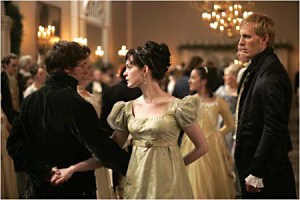
bj6Becoming Jane is an imaginative, romantic tale that captures Jane Austen’s spirit, while playing with the truth. Many of us who delve in Austen-inspired literature write our own “what if” stories, but one must be able to suspend reality and accept the witty, enchanting romance as all good storytelling to truly enjoy this film. (I did. So, I’m not offering that point as a criticism – only as a warning for those unfamiliar with the movie.) This film takes some well known facts from Austen’s life and spins them into an ingenious tale of lost love.

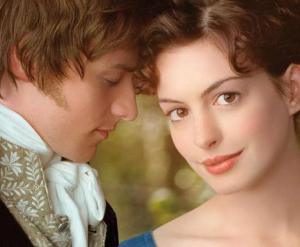
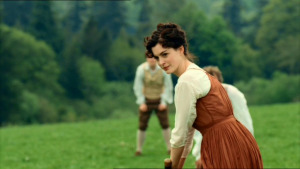
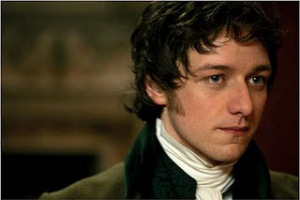
The film opens in the year 1795 and explores the feisty beginnings of an emerging 20-year-old writer, who wishes to live beyond what is expected of her – to actually marry for love. Anne Hathaway portrays Jane Austen, and James McAvoy plays the non-aristocratic Tom Lefroy, whose intellect and arrogance first raises young Jane’s ire and then captivates her heart.


Grosvenor House Art and Antiques Fair undated handout photo of a rare miniature portrait of Tom Lefroy, the Irishman who the young Jane Austen loved and lost and who may have been the inspiration for her handsome fictional character Mr Darcy in Pride and Prejeudice, and will go on sale at The Grosvenor House Art & Antiques Fair in London from 12-18 June 2008. PRESS ASSOCIATION Photo. Issue date: Monday June 9 2008. See PA story SALE Austen. Photo credit should read: Grosvenor House Art and Antiques Fair/PA Wire

Grosvenor House Art and Antiques Fair undated handout photo of a rare miniature portrait of Tom Lefroy, the Irishman who the young Jane Austen loved and lost and who may have been the inspiration for her handsome fictional character Mr Darcy in Pride and Prejeudice, and will go on sale at The Grosvenor House Art & Antiques Fair in London from 12-18 June 2008. PRESS ASSOCIATION Photo. Issue date: Monday June 9 2008. See PA story SALE Austen. Photo credit should read: Grosvenor House Art and Antiques Fair/PA Wire

Juliann Jarrold, the film’s director says that “A couple of recent biographies have sort of honed in on this romance with Tom Lefroy, because it’s the older bios that tend to say she [Austen] didn’t have this romance; that somehow, out of her imagination, she was able to portray these amazing characters. Straight after [the alleged romance], she started writing First Impressions – and then Sense and Sensibility, and Northanger Abbey.” (BTW, do you not love the facial similarities between the real Tom Lefroy and James McAvoy in this pictures?)

bj3The film is known for taking the truth and making it a reality. For example, there is some evidence that Ann Radcliffe influenced Jane Austen; however, the film creates a meeting between the two. During this encounter, Radcliffe asks Austen of what she will write.
Radcliffe: Of what do you wish to write?
Jane: The heart.
Radcliffe: Do you know it?
Jane: Not all of it.
Radcliffe: In time you will. If not…well, that situation is what imagination is for.
The film also provides us with plenty of “Jane” talk.

For example, we hear part of the story/poem that Jane created as a tribute to her sister Cassandra’s engagement. “The boundaries of propriety were vigorously assaulted, as was only right, but not quite breached, as was also right. Nevertheless, she was not pleased.”

When others question Jane’s ambitions to become a novelist, she responds,
“Novels are poor insipid things, read by mere women, even, God forbid, written by women.”

But beyond the plot’s twists and turns, Becoming Jane playfully references Austen’s themes, characters, and story lines. So my question is how many such references can you name? Here are some (but not all) that I noted.

bj1From Pride and Prejudice, we find…
Jane’s character resembles a cross between the flirtatious Lydia Bennet, who loves to dance, and Elizabeth Bennet, whose verbal swordplay with Mr. Darcy is enticing. Mr. Warren is the klutzy clergyman whose proposal reminds us all of Mr. Collins. (He also is a bit like Mr. Elton in Emma.)
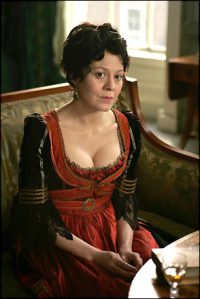
Lady Gresham (Maggie Smith) is so Lady Catherine De Bourgh. She does not want Wisley to consider Jane as a mate, and I love the scene where she mentions “a little wilderness.”
Lefroy’s character reminds of us the “worthless” activities of George Wickham early on in the film. Like Wickham, Lefroy studies law, but with not much success. Later he is very much Darcy in his judgment of “country” life.

From Sense and Sensibility, we find …
Like Marianne Dashwood, Jane’s decisions are not based on “sense,” but on her “sensibility” (emotional response).
Jane’s situation, if she does not marry Wisley, will be very much like the Dashwood sisters after losing their home.

bj4From Northanger Abbey, we find …
Jane plays cricket, very much as did Catherine Morland.
Jane defends her desire to write novels.
The scene in Uncle Benjamin’s house between Jane and Lefroy reminds one of the staircase scene between Henry Tilney and Catherine Morland.
References to Ann Radcliffe’s (as well as other Gothic novels) are made in the novel. In the film, Jane visits Radcliffe. bj2

From Mansfield Park, we find …
Lady Gresham’s line to Jane about her duty to marry well reminds us of those spoken by Lady Bertram to Fanny Price.
Lady Bertram spends her days with her pug dog, as does Countess Eliza, Jane’s cousin.
From Persuasion, we find …
Although she loves him, Jane breaks an engagement with Lefroy so that he has a chance for a better future. This is similar to what happens between Anne Elliot and Captain Wentworth.

tom2blefroyIn the novel, Anne meets Wentworth at a concert, where she must translate the opera for her cousin. She recognizes their love still exists, but she can say nothing. “How was the truth to reach him?” In the film, Jane meets Lefory many years after their separation at a concert. He has married and has a daughter named “Jane.”

Posted in British history, Great Britain, Jane Austen, Living in the Regency, real life tales, Regency era | Tagged , , , , , , , , , | 4 Comments

A Jane Austen Time Line

george-austen411-correction1764-The Reverend George Austen marries Cassandra Leigh. They take up residence at Deane Parsonage in Hampshire.

1765 (to 1819) – Brother James was born. Like his sister, James had literary aspirations, but he never knew even the success than Jane could claim. “Often thought by the family to be the “literary one” (see his poem on Sense and Sensibjames_austen1wility), one of Austen’s brothers James followed in his father’s footsteps attending Oxford university at the age of 14 in 1779. After his ordination in 1787, he and his brother Henry edited a university magazine called The Loiterer, which ran for sixty issues. (Some issues of The Loiterer are available on-line.) After his marriage, he became his father’s curate at Deane, and after his retirement, James took on the duties of the Steventon as well.” (www.janeausten.co.uk/jane-austens-brothers)

1766 (to 1838) – George Austen was born. “Not much is known about young George Austen. Though he lived a relatively long life, characteristic of the Leigh side of the family, he spent the whole of it living with a farming family a few miles from Steventon. Some scholars believe he was mentally retarded, others that he was merely deaf, speculation rising from Jane Austen’s comment that she was fluent in “finger speaking”. Regardless of the cause, George was destined to play little part in the Austen’s brothers and family daily lives.” (www.janeausten.co.uk/jane-austens-brothers/)

edwardknight1767 (to 1852) -Edward Austen was born. Later, he was adopted by Thomas Knight. Because the Knight family had no children, Edward inherited all their property. “Edward was the only Austen brother not to have a profession. Early in the 1780’s he was adopted by Mr. Austen’s Patron, the rich but childless Thomas and Catherine Knight. Instead of going off to University, He was sent on the “grand tour” of continental Europe in 1786-1788, and eventually inherited their estate of Godmersham, Kent, and took the last name of “Knight.” As part of his inheritance, Edward also acquired Steventon and an estate in Chawton. It was a cottage attached to the latter that he made available to his widowed mother and sisters, and here that millions of fans tour each year when they visit “Jane Austen’s Home.” (http://www.janeausten.co.uk/jane-austens-brothers/)

steventon-rectory-engraving1767 – The Austens move to Steventon Rectory. “The village of Steventon lies nestled in a quiet spot between two main routes from Basingstoke: the Andover road at Deane to the north, where stage coaches to and from London halted twice a day, and the Winchester road to the south near Dummer, which was known as Popham Lane. Like Elizabeth Bennett in Pride and Prejudice, Jane was a keen walker and often walked to Popham Lane, where the family collected their letters at what is now known as the Wheatsheaf Inn.

“The late 17th century house, repaired in the 1760s for the Austens’ occupation, had seven bedrooms. Its flat facade was broken up by evenly placed windows, and a trellised porch almost more suited to a cottage formed a centrepiece.

“Outside there were fields where Mr Austen farmed and his wife grew potatoes (at that time quite an innovation), formal gardens with a turf walk, sundial, strawberry beds, and a grassy bank down which the young Jane, possibly enjoyed rolling as a child, like Catherine Morland in Northanger Abbey. There was also a carriage sweep, and a barn used for private theatricals except in winter, when the dining room had to suffice. Later, a double hedgerow with mixed shrubs and wild flowers was added, for use as a private footpath to the church. At the side of the Rectory were chestnut, fir and elm trees. The elms met with a violent end on 8 November 1800, when one of the “great winds” that recurred throughout the 18th century blew down all but one under Jane’s very eyes.” (Steventon – Jane Austen’s Home)

1771 (to 1850) – Jane’s brother Henry was born. It was with Henry’s influence that Jane found her publisher. “Henry was Jane Austen’s favorite brother and the sibling most like her in looks and temperament. He was witty and enthusiastic in whatever he did; the eternal optimhenryaustenist, though success did not always find him. He entered Oxford in 1788 in time to co edit the Loiterer with his brother James. He and James also shared a passion for the same woman, their widowed cousin, Eliza de Feuillide. She eventually chose Henry, 10 years her junior, and they were married in 1797.” (http://www.janeausten.co.uk/jane-austens-brothers/)

cassandrasil1773 (to 1845) – Cassandra Austen is born. “In about 1794, Cassandra became engaged to a former student of her father’s, Thomas Fowle. This engagement carried on for some time as Tom was waiting for a family living in Shropshire to become available. Eventually, he decided to join the military as an army chaplain and was sent to the Caribbean. Unfortunately he contracted Yellow Fever and died there in 1797. It was some time before the Austens heard the news and while Cassandra benefited from an annuity left in his will (she inherited Tom’s savings of £1000 which yielded about £50 per year.) she never recovered from this blow and, like Jane, never married.” (http://www.janeausten.co.uk/cassandra-austen-jane-austens-beloved-older-sister/)

donotcopy1774 (to 1865) – The first of Jane’s sea-faring brothers, Francis, was born. “Francis Austen had, perhaps, the most glorious career of the Austen brothers, serving in the Navy from the age of 12 and eventually achieving Knighthood as Sir Francis Austen and rising to the position of Admiral of the Fleet. Considered by Admiral Nelson to be “an excellent young man”, he narrowly missed involvement in the battle of Trafalgar due to his temporary detachment as captain of a captured French Ship, the Canopus. It is doubtless this connection which gave Jane Austen such an admiration for the men of the Royal Navy. A look at his career proclaims him not only the inspiration for the young Lieutenant William Price in Mansfield Park, but even more so for the unforgettable Captain Wentworth of Persuasion. Even the high points of their promotions stem from the same Battle, The Action off Santo Domingo.” (http://www.janeausten.co.uk/jane-austens-brothers/)

1775 (to 1817)On December 16, Jane Austen is born.

1779 (to 1852) – Charles Austen was born. Charles spent seven years in the British navy’s efforts in the West Indies. “Charles was Jane’s darling little brother, clearly a favorite with both sisters as a boy. Though his career was nowhere near as distinguished as that of his brother, he also joined the Naval Academy as Midshipman at the age of 12 and rose to become a Rear-Admiral. Much to the regret of his family, he was stationed in the West Indies where he remained for seven years straight, returning at the end of that time with a wife and child. It was Charles’ gift of Topaz Crosses to his sisters which inspired a similar scene in Mansfield Park. Charles Austen’s ship, Endymion captured many prizes during the war with France, leaving him a comfortable settlement. He died, at age 75, still on Active Duty, during a naval river-war in Burma.” (http://www.janeausten.co.uk/jane-austens-brothers/

1782 – The first theatrical presentation is performed by the Austen family in their home. Jane is 6 years old at the time.

1783 – Cassandra and Jane Austen are sent to Oxford, England to be educated by a private tutor named Ann Cawley. Both girls contract typhoid fever during an outbreak and return home to Steventon. Jane comes close to dying.

1784 – The Austen family performs Sheridan’s The Rivals.

1785 – Jane Austen enrolls in boarding school at Abbey School in Reading.

1786 – The family’s money runs out and Austen returns to Steventon from boarding school. The rest of her education is completed at home from her father’s voluminous library. Austen lives with her parents and sister for the rest of her life.

1787 – Jane’s formal education ends, and she begins to write short stories and poems that later are collectively referred to as the Juvenilia and consists of three bound notebooks of works. She preserves scraps of her early writing in Volume the First.

1790 – Jane pens Love and Friendship and dedicates the work to cousin Eliza. It is believed that at about this time, she makes the conscious decision to write for profit and become a professional writer.

1793 – The last pieces are added to Volume the Third.  Austen begins Lady Susan, a novella told in the form of a series of letters (epistolary). She works on it for two years. She begins to write and later abandons a short play entitled Charles Grandison or the Happy Man, a six act comedy. Jane also pens the poem “Ode to Pity.” She is 17 years of age. Jane’s nieces Anna and Fanny Austen are born. 

1795 – Jane writes Elinor and Marianne.

1795 December – Austen meets Tom LeFroy, an Irish law student who is the nephew of her neighbor. Austen and LeFroy spend time together during his month-long visit to Steventon. He leaves in January 1796 and soon becomes engaged to someone else, ending whatever relationship they had. Austen writes affectionately of LeFroy to her sister, prompting later speculation that he is the real-life inspiration for her male characters.

1796 – The first of the letters, which were preserved, are dated from this year. For example, in a January letter, Jane writes of flirting with Tom Lefroy, and in an October one, she tells of beginning First Impressions. This work remains her most famous piece (better known as Pride and Prejudice).

1797 – Jane finishes First Impressions. It is offered to the publisher, Cadell, who declines Rev. Austen’s presentation of the manuscript.
Jane decides to revise Elinor and Marianne (Sense and Sensibility).

1798 – Jane completes her revisions of Elinor and Marianne. This revision removed the epistolary point of view and stages the story in the more traditional 3rd person perspective. Jane begins writing Susan, which is later called Catherine and finally Northanger Abbey. Her nephew (and future biographer), James Edward Austen is born.

1799 – Jane finishes Susan. She and her mother visit Bath and stay for some time in Queen Square.  

1800 – Jane’s parents decide to retire in Bath. Jane completes her short story “Sir Charles Grandison or the Happy Man,” as well as Susan

1801 – In January, Jane spends time with her long time friends, Catherine and Alethea Bigg in Hampshire at Manydown Park. In May, Jane’s parents take a lease on 4 Sydney Place in Bath.

1802 – In September, Charles, Jane and Cassandrea visit Godmersham. In late November, Jane again visits with the Bigg sisters at Manydown Park.

1802, December 2 – Harris Bigg-Wither proposes. Just before her 27th birthday, Jane Austen receives her only marriage proposal. A recent Oxford grad named Harris Bigg-Wither proposes to Austen while she is visiting his sisters. Realizing that the marriage would be good for her family’s circumstances, Austen accepts. The next morning, however, she changes her mind and withdraws her acceptance. Bigg-Wither marries two years later; Austen never does.

1803  Susan is sold to publisher Crosby for £10. But the book is never published, and Austen’s family later buys back the rights to the work. The family spends time at Godmersham.

1804 – Jane’s family moves to Green Park Buildings, Bath. They spend the summer months in Lyme Regis. On December 16 (Jane’s 29th birthday), friend and mentor, Madam Lefroy, is killed in a freak horse riding accident.

1805 – Rev. George Austen dies suddenly from an illness on January 21. Jane begins The Watsons, which she soon abandons. Her family moves to 25 Gay Street in the spring and then to Trim Street in the autumn. Her father’s death leaves his wife and sisters financially dependent on his sons. The Austen women first rent a house in Bath, then move in with Jane’s brother Frank and his new wife in Southampton.

1806 – Jane and Cassandra visit Manydown Park in February. In August, they join Mrs. Austen’s cousin in Warwickshire. 

1807 – The Austen women (mother, Jane, and Cassandra) take a house with brother Frank and his wife in Castle Square, Southampton.

1808 – Another visit to the Bigg family comes in January. Brother Edward offers the Chawton cottage to his mother and sisters in October.

1809 – On Wednesday, April 5, Jane writes an angry letter (under the pseudonym Mrs. Ashley Dennis = M.A.D.) to publisher Benjamin Crosby and offers up a revised version of the manuscript for Susan to force Crosby’s hand in publishing the work or returning it to her possession. Crosby claims that no timeline was ever set for the book’s publication and as such Ms. Austen can continue waiting or purchase back the rights to the novel. Without the means to do so, Jane cannot reclaim the rights. In July, the women (Mrs. Austen, Cassandra, and Jane) move into the Chawton cottage.

1810 Sense and Sensibility is accepted for publishing by Thomas Egerton.

1811 – Jane begins writing Mansfield Park. In March, Jane visits Henry and wife Eliza in London. In November, Egerton publishes Sense and Sensibility, whose author is identified on the cover only as “a Lady.” Austen’s name is not attached to any of the novels she publishes during her lifetime.

1812 – Much of the year is spent revising First Impressions. The copyright for First Impressions is sold to Thomas Egerton for publication for the sum of 110 pounds.

1813 – In January, Jane releases Pride and Prejudice. Thanks to numerous resources employed by Thomas Egerton, the novel is an instant success. In late April, Jane leaves for London to attend to an ailing Eliza, who dies three days later, leaving Austen’s brother Henry a widower. By July, Mansfield Park is finished. In October, the first edition of Sense and Sensibility is sold out, and a second printing is ordered.

1814 – Austen begins Emma in the early part of the year. In May, Mansfield Park is published. Although ignored by professional reviewers, the novel is nonetheless a success. The first edition sells out in just six months. Mansfield Park becomes Jane’s most profitable venture to date.

1815 – Jane begins Persuasion. She and Henry negotiate with famed publisher John Murray for the publication of Emma. In November, James Stanier Clarke, the librarian of the Prince Regent (later King George IV), a big fan of Austen’s work, invites her to the prince’s London home and suggests that she dedicate her soon-to-be-published book to him. Austen is not a fan of the prince, but is unable to refuse a request from the future monarch. Emma is published the next month with a dedication to the prince. It is the last novel published in her lifetime.

1816 – In January, Henry Austen purchases the copyright to Susan from Benjamin Crosby. The title is changed to Catherine. Sales of the second edition of Mansfield Park do not meet expectations, negating the earnings from Emma. Sir Walter Scott gives Emma favorable notice in Quarterly Reviews. In March, Henry’s bank venture fails, forcing the Austen family into financial uncertainty and delaying the publications of The Elliots and Catherine. In addition, investments in a venture by brothers Edward, James, and Frank are lost. Austen begins to feel the first signs of a long, progressive illness that saps her energy. She continues to work on two novels, The Elliots (Persuasion) and Catherine (Northanger Abbey), but is delayed by her illness and by financial troubles caused by the failure of her brother Henry’s bank. In May, Cassandra escorts Jane to Cheltenham to seek medical care. In August, Jane finishes Persuasion, rewriting the concluding two chapters for a more satisfying ending. She takes ill shortly afterwards.

May 1817 – A bed-ridden Jane and Cassandra Austen move to Winchester in order to be closer to Austen’s doctor.

1817 – In January, she begins The Brothers (Sanditon), but abandons it in March (with 12 completed chapters) due to her health issues. In April, she pens a short will. In July, Jane Austen dies. She is buried in Winchester Cathedral. Persuasion and Northanger Abbey are published posthumously with a Biographical Notice written by Henry in which he publicly identifies her for the first time as the author of her previous novels. Sales start strong but fall off just as quickly.

1820 – John Murray destroys the remaining unsold copies of Northanger Abbey and Persuasion. 

1832 – Richard Bentley purchases all the remaining copyrights to Jane Austen’s works. In December, after a 12 year hiatus of no Austen works in publication, Bentley publishes all of the works in a collection of illustrated five-volume series known as the Standard Novels.

1833 – Bentley publishes the collected works of Jane Austen for the first time. Jane Austen’s novels would never go out of print again.

1869 – Austen’s nephew James Edward Austen-Leigh publishes a biography of his aunt entitled A Memoir of Jane Austen. The memoir sparks renewed interest in the writer.

1883 – The first popular editions of Austen’s novels are published, sparking Austen fandom that continues to this day. Critic (and father of Virginia Woolf) Leslie Stephens calls her rabid following “Austenolatry.”

Some of the facts included in this list come from Shmoop, while others not cited come from JaneAusten.org.

Posted in British history, Great Britain, Jane Austen, Living in the Regency, real life tales, Regency era | Tagged , , , , , , , , , , , , , , , , | 10 Comments

A Touch of Christmas Trivia

MV5BMjA0Mzg0OTU0OF5BMl5BanBnXkFtZTYwNTM4MjY5._V1_SX640_SY720_
**Bing Crosby and Danny Kaye starred in 1954’s White Christmas. But did you know that the movie was the first one to be made in Vista Vision?

**The Philippines celebrated Christmas as long ago as 1280-1320 A.D. That was 200 years before Ferdinand Magellan discovered the country.

**A choirmaster at Cologne Cathedral was the first to shape candy canes with a “shepherd’s crook.” At that time, canes were plain white sugar candy. It was the 20th century before anyone added the stripes.

Scrooge**Charles Dickens’s originally planned for Scrooge to say “Bah Christmas.”

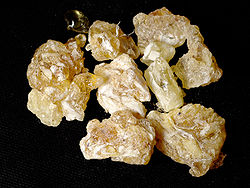
**Frankincense was burned by the Romans on their altars and at cremations. It was a valuable resin and was very costly. It is a sweet smelling gum resin from Boswellia trees. Frankincense was presented to the Christ Child by the black king, Balthasar.

**Oklahoma was the last U.S. state to declare Christmas a legal holiday. That happened in 1947.

**Dutch children receive gifts left in shoes rather than to hang Christmas stockings. The gifts are received any time between mid-November and December 5, which is St. Nicholas’s birthday.

**The modern version of a stable is wooden. However, if one studies the Biblical time period, he would realize that it was likely that Jesus Christ was born in a cave rather than a wooden stable. Caves were used to keep animals out of the intense heat of that area of the world. In fact, a large church is now built around the cave. People can go down inside the cave to see the reported scene.

** “Silent Night” was written in 1818 by an Austrian priest Joseph Mohr. The church organ was in disrepair, and Mohr did not want the ceremony to have no music. So, he composed three stanzas which could be sung by the choir to guitar music.

**”The Twelve Days of Christmas” was written to help Catholic children, in England, to remember different articles of faith during the persecution by Protestant Monarchs. The “true love” is God.
“Partridge in a pear tree” = Christ
2 Turtle Doves = Old and New Testament
3 French Hens = Faith, Hope, and Charity (Theological Virtues)
4 Calling Birds = the Four Gospels
5 Golden Rings = The “Pentateuch”
6 Geese A-Laying = the days of the Creation
7 Swans A-Swimming = the seven sacraments
9 Maids A-Milking = the eight beatitudes
10 Lords A-Leaping = the Ten Commandments
11 Pipers Piping = eleven apostles who remained faithful
12 Drummers Drumming = the twelve point of doctrine in the Apostle’s Creed

Other fab links for Christmas-themed trivia:

http://www.xmasfun.com/Trivia.aspx

http://icebreakerideas.com/christmas-trivia/

http://www.christmastrivia.net

http://facts.randomhistory.com/christmas-facts.html

http://www.corsinet.com/braincandy/xmastrivia.html (Lots of interesting facts here.)

http://thefw.com/christmas-facts/ (Contains some special items specific to Christmas)

Posted in Uncategorized | 4 Comments

The Treasure of “Frankincense” Buried in History

250px-Frankincense_2005-12-31 Frankincense, also called olibanum  is an aromatic resin obtained from trees of the genus Boswellia, particularly Boswellia sacra, B. carteri, B. thurifera, B. frereana and B. bhaw-dajiana (Burseraceae). The English word is derived from Old French “franc encens” (i.e. high quality incense) and is used in incense and perfumes.

(Image above from Wikipedia) There are four main species of Boswellia that produce true frankincense and resin from each of the four is available in various grades. The grades depend on the time of harvesting. The resin is hand-sorted for quality.

Description [Wikipedia]
Frankincense is tapped from the scraggly but hardy trees by slashing the bark, which is called striping, and allowing the exuded resin to bleed out and harden. These hardened resins are called tears. The aroma from these tears are more valuable for their presumed healing abilities and are also said to have superior qualities for religious ritual.

There are several species and varieties of frankincense trees, each producing a slightly different type of resin. Differences in soil and climate create even more diversity of the resin, even within the same species. Boswellia Sacra trees are considered unusual for their ability to grow in environments so unforgiving that they sometimes grow out of solid rock.

The initial means of attachment to the rock is unknown but is accomplished by a bulbous disk-like swelling of the trunk. This growth prevents it from being ripped from the rock during violent storms that frequent this region. This feature is slight or absent in trees grown in rocky soil or gravel. The trees start producing resin when they are about eight to 10 years old. Tapping is done two to three times a year with the final taps producing the best tears due to their higher aromatic terpene, sesquiterpene and diterpene content.

Generally speaking, the more opaque resins are the best quality. Fine resin is produced in Somalia and along the northern coast of Somalia, from which the Roman Catholic Church draws its supplies.

Recent studies have indicated that frankincense tree populations are declining, partly due to over-exploitation. Heavily tapped trees produce seeds that germinate at only 16% while seeds of trees that had not been tapped germinate at more than 80%. In addition, burning, grazing, and attacks by the longhorn beetle have reduced the tree population. Conversion (clearing) of frankincense woodlands to agriculture is also a major threat.

History

“Familiar by name, yet otherwise perfectly obscure – this much fabled Arabian tree has been as famous as it has been elusive since long before the birth of Christ, when the three wise men from the East brought it as a gift to that humble stable in Bethlehem. We do not know how far the use of Frankincense goes back in time, but we do know that it already scented the Egyptian Temples to honour Ra and Horus and it is said that Queen Sheba brought a great number of Frankincense trees as a special gift for King Solomon. Unfortunately those trees were destined to die as Frankincense trees only grow in a very limited geographic range and very arid conditions. Nevertheless, it’s the thought that counts and bringing all these trees was indeed a very strong sign of honour and respect. In the ancient world incense trees fuelled the economy of the Arab world as oil does today. Trading cities positioned at important points of the spice or incense routes prospered considerably thanks to the thoroughfare business. At one time Frankincense was more valuable than gold – needless to say, a situation much relished by the traders who only benefited from the obscurity and remoteness of the trees. Legend had it that the trees only grew in the most inhospitable mountainous places, guarded by dragon-like creatures that would readily strike out at any intruder. Obviously such stories were invented to scare off any attempts of enterprising and adventurous young men who otherwise perhaps might have ventured in search of the trees to do a little harvesting themselves. But, scare tactics aside, the long journey across the desert was no amble down the garden path – it was fraught with peril and as potentially dangerous as it was lucrative.”Frankincense has been traded on the Arabian Peninsula and in North Africa for more than 5000 years. A mural depicting sacks of frankincense traded from the Land of Punt adorns the walls of the temple of ancient Egyptian Queen Hatshepsut, who died circa 1458 BC. The charred remains of frankincense, called kohl, was crushed and used to make the distinctive eyeliner seen on ancient Egyptians.” [Sacred Earth]

Leaves and flowers of a Boswellia sacra tree, a common source of frankincense http://www.history.com/news/a-wise-mans-cure-frankincense-and-myrrh

Leaves and flowers of a Boswellia sacra tree, a common source of frankincense http://www.history.com/news/a-wise-mans-cure-frankincense-and-myrrh

“What made frankincense so precious that the wise men of New Testament fame bestowed it upon the infant Jesus? Scientists at Cardiff University in Wales have an answer that may have eluded the three kings of the Bible: It may help relieve and alleviate the painful symptoms of arthritis, which affects millions of people around the world.

Frankincense and the other plant-derived treasure given to the newborn Jesus in the New Testament narrative—myrrh—have a long history dating back thousands of years. Though perhaps best known for their use in incense and ancient rituals, these substances—both of which boast proven antiseptic and inflammatory properties—were once considered effective remedies for everything from toothaches to leprosy. ‘We have textual—and also archaeological—evidence that both frankincense and myrrh were used as medicinal substances in antiquity,’ confirmed Alain Touwaide, a historian of medicine at the Institute for the Preservation of Medical Traditions and the Smithsonian Institution. Today, researchers like the Cardiff team are drawing on this centuries-old knowledge to develop modern treatments for a variety of disorders. Find out more about these healing gifts of the magi.” [History]

“Frankincense was one of the consecrated incenses (HaKetoret) described in the Hebrew Bible and Talmud used in Ketoret ceremonies. The frankincense of the Jews, as well as of the Greeks and Romans, is also called Olibanum (from the Arabic al-lubbān). Old Testament references report it in trade from Sheba (Isaiah 60:6 ; Jeremiah 6:20). Frankincense is mentioned in the Song of Solomon (Song of Solomon 4:14).

“It was offered on a specialized incense altar in the time when the Tabernacle was located in the First and Second Jerusalem Temples. The ketoret was an important component of the Temple service in Jerusalem. It is mentioned in the Hebrew Bible book of Exodus 30:34, where it is named levonah (lebonah in the Biblical Hebrew), meaning “white” in Hebrew. It was one of the ingredients in the perfume of the sanctuary (Exodus 30:34), and was used as an accompaniment of the meal-offering (Leviticus 2:1, 2:16, 6:15, 24:7). When burnt it emitted a fragrant odour, and the incense was a symbol of the Divine name (Malachi 1:11 ; Song of Solomon 1:3) and an emblem of prayer (Psalm 141:2 ; Luke 1:10 ; Revelation 5:8, 8:3). It was often associated with myrrh (Song of Solomon 3:6, 4:6) and with it was made an offering to the infant Jesus (Matthew 2:11). A specially “pure” kind, lebhonah zakkah, was presented with the shewbread (Leviticus 24:7).

“While burning incense was accepted as a practice in the later Roman Catholic church, the early church during Roman times forbade the use of incense in services resulting in a rapid decline in the incense trade.”

“Frankincense was reintroduced to Europe by Frankish Crusaders, although its name refers to its quality, not to the Franks themselves. Although it is better known as “frankincense” to westerners, the resin is also known as olibanum, in Arabic al-lubān (roughly translated: “that which results from milking”), a reference to the milky sap tapped from the Boswellia tree. Some have also postulated that the name comes from the Arabic term for “Oil of Lebanon” since Lebanon was the place where the resin was sold and traded with Europeans.

“The lost city of Ubar, sometimes identified with Irem in what is now the town of Shisr in Oman, is believed to have been a center of the frankincense trade along the recently rediscovered “Incense Road.” Ubar was rediscovered in the early 1990s and is now under archaeological excavation.

“The Greek historian Herodotus was familiar with Frankincense and knew it was harvested from trees in southern Arabia. He reported that the gum was dangerous to harvest because of venomous snakes that lived in the trees. He goes on to describe the method used by the Arabs to get around this problem, that being the burning of the gum of the styrax tree whose smoke would drive the snakes away. The resin is also mentioned by Theophrastus and by Pliny the Elder in his Naturalis Historia.

“Southern Arabia was a major exporter of frankincense in ancient times, with some of it being traded as far as China. The Chinese writer and customs inspector Zhao Rugua wrote on the origin of Frankincense being traded to China:

“‘Ruxiang or xunluxiang comes from the three Dashi countries of Murbat (Maloba), Shihr (Shihe), and Dhofar (Nufa), from the depths of the remotest mountains. The tree which yields this drug may generally be compared to the pine tree. Its trunk is notched with a hatchet, upon which the resin flows out, and, when hardened, turns into incense, which is gathered and made into lumps. It is transported on elephants to the Dashi (on the coast), who then load it upon their ships to exchange it for other commodities in Sanfoqi. This is the reason why it is commonly collected at and known as a product of Sanfoqi.'” [Wikipedia]


Posted in food and drink, holidays | Tagged , , , , , , | 3 Comments

Winner of a 2016 Jane Austen Illustrated Calendar

party-clip-art-balloons-different-coloursCongratulations to Kier Salmon the winner of a 2016 Jane Austen Illustrated Calendar, designed by the lovely Janet Taylor.

Posted in Jane Austen, Regency era, Uncategorized | Tagged , | Comments Off on Winner of a 2016 Jane Austen Illustrated Calendar

Welcome Regency Romance Author, Sherry Ewing with an Excerpt from Mistletoe, Marriage, & Mayhem + a Giveaway

51Qp6aSXJjL._SX331_BO1,204,203,200_Thank you, Regina, for the opportunity to introduce your readers to the Bluestocking Belles’ first box set, Mistletoe, Marriage, & Mayhem. I’ll be giving away an ePub or mobi copy of our novellas to one random commenter. The giveaway will end on Tuesday, December 22, 2015, at midnight EST.

My contribution to the Belles’ box set is entitled, Under the Mistletoe.

When Margaret Templeton is requested to act as hostess at Captain Sander Morledge’s Christmas party and possibly agree to marry him, she did not think she would see the man who once held her heart. Frederick Maddock, Viscount Beacham, never forgot the young woman he fell in love with, and his feelings are evident when he sees her at a holiday gathering. In a swirl of Christmas miracles and joyous celebration, will the two finally put down their differences and once again fall in love?

Did you know?

Mistletoe is relevant to several cultures and its use goes back to Norse Mythology and the Middle Ages. By the 18th century, Mistletoe began to be used in Christmas celebrations and tradition dictated that a man was allowed to kiss any woman standing beneath it. Bad luck would befall any woman who refused the kiss. Another variation of this tradition stated that with each kiss a berry was picked from the mistletoe and once all the berries were removed, the kissing must stop. Did you know that mistletoe is actually a parasite?

Here are my hero and heroine from Under the Mistletoe:

12336285_10208446333139353_862954111_n12336397_10208446333099352_1210530971_n copy


Excerpt:
With Digby gone, Margaret took a seat by the fire, and Frederick sat opposite her. An awkward silence fell between them, broken only by the crackling and popping of the wood within the hearth. Conversation had never been stilted between them, but Margaret was clearly nervous because she kept peeking over her shoulder as if she were being watched. Frederick was unsure what he should say to calm her nerves.

“You have no need to fear me, Margaret,” Frederick whispered softly now that they were alone.

“I do not fear you, Freddy.”

He was pleased to hear his name as it passed her lips.

“Then what is troubling you so?”

The eyes raised to his were filled with worry.

“Why are you here?”

He watched her fidget with the fabric of her gown.

“You know why. I was invited,” Frederick answered.

A sound escaped her, but it was hardly ladylike.

“You could easily have made your excuses and refused.”

“I wanted to make sure you were safe,” he replied.

“How could I not be safe? Captain Morledge is practically my betrothed.”

Frederick ran his hand across his eyes.

“I do not trust him. There are rumors—”

The laugh she gave was meant to be merry, but sounded forced.

“Frederick, please tell me you have not taken to believing in town gossip. I would have thought you, above all people, were above such nonsense.”

He frowned. “Nonsense or not, I needed to see for myself that you are not in danger, even if I must watch over you myself.”

“It is hardly necessary.”

Margaret’s attention once more flew to the entryway.

He reached over to take her hand.
 
She wrenched back with a silent and pleading look, and the briefest shake of her head. Leaning slightly forward, she confided, “Please do not, for it will not be wise. The servants watch my every move, and even now, it is reckless of me to be here alone with you.”

“You see! There is cause for concern. Why will you not let me help you?”

“Please, Freddy. This is my one chance to find some happiness. Do not ruin it for me.”

“We have discussed this before, Margaret. You know my offer still stands. I would wed you on the morrow if you would have me.”

“Shush, you fool. You know I cannot.”

“Yet you would enter into a marriage with a man you do not love.”

A heavy sigh left her lips. “I can learn to love him.”

“Now who is the fool?” he grumbled irritably.
Mistletoe, Marriage, and Mayhem: A Bluestocking Belles Collection


In this collection of novellas, the Bluestocking Belles bring you seven runaway Regency brides resisting and romancing their holiday heroes under the mistletoe. Whether scampering away or dashing toward their destinies, avoiding a rogue or chasing after a scoundrel, these ladies and their gentlemen leave miles of mayhem behind them on the slippery road to a happy-ever-after.

***All proceeds benefit the Malala Fund***

Buy Links
:

Amazon      Amazon UK      Amazon Australia     Amazon Germany

Amazon France      
Amazon Japan      
Amazon Spain    Amazon Italy 
  

Amazon Netherlands      Amazon Canada      Amazon Brussels   

Amazon Mexico      Amazon India      Barnes and Noble     iBooks    Kobo


12351313_10208446334259381_591234140_oMeet the Author:
Sherry Ewing picked up her first historical romance when she was a teenager and has been hooked ever since. A bestselling author, she writes historical & time travel romances to awaken the soul one heart at a time. Always wanting to write a novel but busy raising her children, she finally took the plunge in 2008 and wrote her first Regency. Sherry is currently working on her next novel and when not writing, she can be found in the San Francisco area at her day job as an Information Technology Specialist. You can learn more about Sherry and her published work at http://www.SherryEwing.com

The Bluestocking Belles Online:
– Website and home of the Teatime Tattler: 

Facebook, Twitter, and Pinterest: BellesInBlue
– The Bluestocking Bookshop online storytelling game
Support the Bluestocking Belles’ fundraising campaign for the Malala Fund:
www.classy.org/BluestockingBelles

Posted in excerpt, giveaway, Living in the Regency, Regency era | Tagged , , , , , , , , , , | 4 Comments

Exquisite Excerpts from My Holiday Austen Sequel, “Christmas at Pemberley” + a Giveaway

DofGD-150x203JeffersC@PemberleyMy Christmas at Pemberley: A Pride and Prejudice Holiday Sequel has won several awards as an inspirational romance. It is an Austen-inspired piece set some two years into the Darcys’ marriage, and it gives us the tale of Georgiana Darcy finally being recognized by her “true love.” The sequel is a cozy mystery, entitled The Disappearance of Georgiana Darcy, which is followed by another mystery entitled The Prosecution of the Mr. Darcy’s Cousin. PoMDC Cover-2-2Although some may not think the idea of the two mysteries are appropriate for continuing the story of “love” found in Christmas at Pemberley, I would, obviously, disagree. The mysteries places our favorite characters is stressful situations, where only love can lead them to a resolution.
To refresh everyone’s memory, in Christmas at Pemberley, Elizabeth has been plagued by several miscarriages, and she is haunted with the idea that the “shades of Pemberley” were “thus polluted” by her inability to present Darcy an heir. She is struggling with whether she is worthy of her husband’s devotion. Encouraged by her physician to bring some joy into his wife’s life, Darcy invites the Bennets and the Bingleys to spend Christmastide at Pemberley. To that effect, to allow time for his guests’ arrival, Darcy takes Elizabeth with him on a business journey to Northumberland. Upon their return to Pemberley, the Darcys are, unfortunately, unable to outmaneuver a daunting snowstorm, and Darcy and Elizabeth are stranded at a small inn, along with a young couple, whose name ironically is Joseph and whose first child is likely to be born during the night.

Meanwhile, Georgiana attempts to manage the chaos surrounding her brother’s six invited guests (Mr. and Mrs. Bennet, Kitty, Mary, Jane, and Bingley) and the eleven unscheduled arrivals, including Mary Bennet’s betrothed Mr. Grange (who Mrs. Bennet invited without asking the Darcys), Lady Catherine (who has not been at Pemberley since that infamous argument with Elizabeth and whose sudden presence will only confirm Elizabeth’s feeling of inadequacy), Anne De Bourgh (who can no longer be her mother’s pawn), Mrs. Jenkinson (who staunchly guards against Anne’s heart being broken), Mr. and Mrs. Collins (who Lady Catherine invited without anyone’s knowledge), Caroline Bingley (who decided to spend the holidays with the Bingleys rather than the Hursts), Mr. Winkler (the local minister who, during the storm, escorts the Collinses to Pemberley, but who is really there to woo Kitty Bennet), Colonel Fitzwilliam (who has returned from the American front), his aide-de-camp, Lieutenant Southland (whose cousin once held the living at Rosings Park and who is “fascinated” with the De Bourgh family), and an American, Beaufort Manneville (who the colonel has been ordered to escort to London, but of whom the colonel is suspicious).

This first excerpt brings the last of the “uninvited guests” to Pemberley. Expecting Darcy and Elizabeth, Georgiana is both disappointed and elated that her cousin, Colonel Edward Fitzwilliam, returns from his duty on the American front.

Georgiana and Kitty raced along the passage and down the main staircase. “We’ll tell Elizabeth that your parents allowed you to return to Pemberley because you were lonely now that Miss Bennet is engaged.”

“Elizabeth will never believe I miss Mary’s company,” Kitty objected.

Georgiana tutted her disagreement. “We just need our sister to believe us long enough for her to reach the drawing room to greet your family.”

They waited impatiently for the Darcys’ arrival, each girl fidgeting with her dress. Then Mr. Nathan opened the door, and instead of Mr. and Mrs. Darcy, three winter-cloaked gentlemen strode through the opening. Both girls stood in awe of the men—all fine specimens of maleness.

“Oh, my,” Kitty swallowed her words. She clawed at Georgiana’s arm.

But Georgiana stood frozen in disbelief. The man in front held her mesmerized. A year—more than a year passed since she last saw him, but he remained as before. Solid. Raven haired. Smoky blue eyes. Eyes that appeared to look through her. See me. Georgiana willed herself not to say the words. Not quite as tall as Darcy, the man’s broad shoulders filled Georgiana’s gaze.

“Edward!” she called and launched herself into his waiting arms. In his embrace, Georgiana inhaled him deeply. He smelled of cold and leather and sweat and the spicy cologne he always wore. “Thank God, you’ve returned to us.”

Her cousin picked her up, clutching Georgiana to his chest, and swung her around in a circle.

“My, goodness!” he laughed easily. “What happened to my little Georgie?”

“You’ve been away for a year, Edward,” she protested.

“So, I have.” He laughed again as he set her on her feet. “Where’s that rascally brother of yours?” He glanced toward the main stairs.

“Fitzwilliam and Mrs. Darcy are on their return from Northumberland,” she explained.

Edward frowned. “Well, Fitz will be delayed. We barely made it from Liverpool on horseback. Darcy won’t chance it in a carriage.” The colonel gestured to the men waiting behind him. “Do you have rooms available, Cousin? I don’t wish to attempt riding to Matlock.”

“Most certainly.” Georgiana nodded to Mr. Nathan, and the man ducked into a servant’s passageway to do her bidding.

Edward spotted Kitty waiting patiently.

“And is this who I believe it to be?” he asked teasingly.

“You remember Mrs. Darcy’s sister Catherine from the wedding, do you not, Edward?”

The colonel bowed to Kitty. “Absolutely. I am pleased to find you at Pemberley, Miss Catherine.”

Kitty curtsied to the group.

“I’m certain Mr. Darcy and Elizabeth shall be thrilled for your return, Colonel.” Edward placed Georgiana’s hand on his arm. “Allow we to introduce my traveling companions, my dear. Miss Darcy. Miss Catherine. May I present Lieutenant Roman Southland? The lieutenant is my assistant.”

The officer bowed formally. “Miss Darcy, the colonel speaks often of his cousin, but his words did not do you justice.” He kissed Georgiana’s outstretched hand. “Thank you for accepting our intrusion upon your hospitality.”

“Pemberley would never turn away the colonel’s associates,” Georgiana responded. “Edward is family.”

She wanted to ask what her cousin said of her and how often the colonel spoke of her, but instead, Georgiana smiled welcomingly at the man.

“And this gentleman,” the colonel indicated the man not wearing a uniform. “This is Mr. Beauford Manneville. Mr. Manneville is from South Carolina in the Americas, but he has come to our ‘enemy’ shores to do business with our government and to renew his acquaintance with his distant cousin Lord Shelton.”

“Welcome to England, Mr. Manneville.” Georgiana curtsied and again extended her hand. “I am sorry that your first experience on British shores brings you icy roads.”

The colonel laughed softly. “You do not understand, Georgie. In South Carolina, snow rarely falls. Cold weather does not tarry either. Is that not correct, Manneville?”

The man openly shivered.

“I’ve never been so cold, Colonel, and you may leave your misplaced levity elsewhere, Sir.”

Colonel Fitzwilliam bowed stiffly. “As you wish, Manneville.”

He turned to Georgiana with a touch of lightheartedness.

“And from what did we pull you ladies?”

Georgiana suddenly remembered the others waiting in the drawing room for her return.

“Oh, Edward,” she gushed. “I am doubly happy to see you, especially in Darcy’s absence. We’ve a houseful of guests, including Lady Catherine and Anne.”

“Darcy invited our aunt for Christmastide?” he asked incredulously.

“No. Her Ladyship invited herself, as well as Mr. and Mrs. Collins. Lady Catherine visited the Earl, but His Lordship and the Countess traveled east to welcome the arrival of Viscount Lindale’s first child.”

Edward beamed with the news.

“Did you hear, Southland? I’m to be an uncle. My brother Rowland’s wife is in her confinement.”

The lieutenant removed his gloves and laid them nearby.

“Then it is fortuitous that we did not seek Matlock. It appears your family is scattered between here and Lincolnshire, Sir.”

“They are. That they are.” He smiled genuinely at Georgiana. “Come, Gentlemen. I will introduce you to Lady Catherine De Bourgh, my family’s paragon of virtue,” he said teasingly.

Georgiana fell into step beside him as they climbed the stairs. “In addition to Her Ladyship and Anne, the Bingleys and the Bennets are in residence,” she said softly.

“My, you do have a houseful. I thought you exaggerated, Cousin. How many await me in the drawing room?” he directed Georgiana toward the open door. Kitty and the lieutenant followed, and Mr. Manneville brought up the rear. “Counting you three, we number nineteen,” she responded. “Darcy invited the Bennets and Mr. and Mrs. Bingley as a surprise for Mrs. Darcy, but others sought shelter at Pemberley.” Georgiana leaned against him. “Handling so many distinct personalities has been challenging.”

His finger stroked her arm.

“I am certain you have performed well, Georgie. I would expect nothing less from my dearest girl.”

They reached the open door. Taking a deep breath, Georgiana glided into the room. “Look who’s joined us,” she announced.

~~~~~~~~~~~~~~~~~~~~~~
An hour later, Georgiana and Kitty climbed the main stairs together.

“When did you plan to tell me of Mr. Winkler?” Georgiana teased.

“As I did not know myself until this evening, how could I tell anyone?” Kitty’s eyebrow kicked up.

Georgiana giggled. “What do you think of the possibilities?”

Kitty clicked her tongue against the roof of her mouth.

“Delicious. At least, in some ways. Mr. Winkler is a fine-looking man. But then again, so are Mr. Manneville, Lieutenant Southland, and your cousin.”

Georgiana jerked to a stop, her mind rebelling at her friend’s words.

“Kitty, you are welcome to choose among our guests. Look to Mr. Winkler, to Mr. Manneville, or to the lieutenant. Look to any of them except the colonel.”

Kitty wrapped her hand around Georgiana’s elbow and smiled sweetly.

“Exactly as I supposed. So, that is how the land lies?”

“That’s exactly how it is.”

***************************

This second excerpt appears a bit later in the book. Colonel Fitzwilliam is attempting to discover Lady Catherine’s true reasons for coming to Pemberley.

Edward tapped softly on Lady Catherine’s door and a maid admitted him immediately. Her Ladyship lounged on a chaise. She held toast in one hand and a teacup in the other. He bowed and then motioned the maid’s departure.

“Thank you for agreeing to see me, Your Ladyship.”

“Why would I not, Edward? You’re a most beloved nephew. You’ve brought honor to the Fitzwilliam name.”

She gestured him to a chair.

Edward took the seat, but he remained alert. Years of dealing with his aunt had taught him to never underestimate the woman. Dressed in a dark purple velvet gown, his aunt was a paragon of determination, and many shrank from her renowned inflexibility. She was dark of eye and hair, much darker than her brother, Edward’s father, and the complete opposite of the fair-haired Lady Anne, Darcy’s mother. She could convey her arrogance with a lift of her square chin or a glare along her straight, high-bridged nose.

“My choice of military service came as the lesser of two evils, but I’m content with my time. I believe God has placed me in this role to save men from death’s grip. I’m thankful for that position.”

“As you well should be.” Lady Catherine pushed her way to a seated position. “Of what did you wish to speak, Colonel?”

Edward frowned deeply. “I’d like to know your true reason for coming to Pemberley uninvited.”

“You came to Pemberley uninvited,” she accused.

His eyes forcefully demanded that his aunt not fence verbally. “True. However, I’ve never expressed indignation regarding Darcy’s marriage. Neither did I send him language so very abusive, especially of Mrs. Darcy, when he announced his engagement. You’ve not spoken to Darcy or his wife for over two years, and then suddenly you appear on my cousin’s doorstep. I ask myself why, but I cannot decipher your way, Aunt.”

“Possibly, I had no other recourse,” she said slyly.

Edward forced himself to hold her gaze. Years had taught him that Lady Catherine used her dominating stare to quell her dissenters. “I might believe you sought Pemberley’s safety if you hadn’t sent word to Mr. Collins before you left Matlock.”

“Georgiana told you that, did she?” Lady Catherine accused.

Edward struggled for an obliging response.

“I’m Georgiana’s guardian. It would be natural for her to seek my advice. And I would warn Your Ladyship not to think that I’ll fall for your diversionary tactics. Georgiana isn’t the issue. Now, let’s revisit your motive for returning to Pemberley.”

Lady Catherine’s mouth tightened in a furious line.

“In reality, I have no response.” She waited for his retort, but Edward’s silence demanded a longer explanation. “Matlock left for Lincolnshire. I’d already promised Collins a means to Kent.” She ticked off her reasons on her fingers. “The road conditions deteriorated before I could make other arrangements. I saw my niece in your family home some days prior, and I realized I missed my sister’s offspring.”

Edward’s eyebrow rose in disbelief. “Do you mean to say, Aunt, that you wished for a reconciliation with Darcy?”

“Marriage is forever. I cannot change what’s been done. Although I vehemently disagree with Darcy’s choice, I’ve come to realize that my objections are also keeping me from Georgiana. In order for my niece to have a successful Season, Georgiana needs the weight of her connections. Darcy’s position gives Georgiana impetus, but Matlock and Lindale’s names lend credence to her consequence.”

His aunt’s words didn’t sit well with Edward, but he couldn’t identify what it was about the image of his cousin’s Society Come Out that bothered him most. It was certainly not Georgiana’s appearance; his cousin’s beauty would awe even the most hardened heart. Possibly, that was it: He couldn’t picture Georgiana in another man’s embrace.

“The De Bourgh connection shall strengthen my niece’s suit.”

“So, for Georgiana’s sake, you’ll swallow your distress regarding Darcy’s marriage?” he said incredulously.

“Darcy has thrice sent correspondence offering an appeasement. Admittedly, I’ve ignored his olive branch, but Christmastide seemed a time for forgiveness.”

Edward certainly didn’t believe her reasons, but he knew from experience that his aunt believed what she said. Therefore, Lady Catherine’s frankness penetrated his reserve.

“You are an intelligent woman, Your Ladyship, so I’ll forego the customary warning. You’re aware of Darcy’s nature. My cousin will never tolerate your condemnation of his wife or his guests.”

Surprised, he watched as Lady Catherine swallowed her temptation to criticize.

“I am appalled by the people with whom Darcy surrounds himself, but I can tolerate his acquaintances without considering them my intimates.”

“I pray you can, Aunt.” Her sincerity rang of possibilities. “It’s comforting to think that you’ve considered Georgiana’s future, but you should also make room for Mrs. Darcy’s role in your life. You must maintain no delusions of Elizabeth ever being replaced in Darcy’s estimation. The man loves his wife, very much in the manner that the late Mr. Darcy loved Lady Anne. You must accept it, or Darcy will limit your access to Georgiana.” He hoped she didn’t practice some sort of chicanery.

Their conversation at an end, Edward prepared to leave her; however, Lady Catherine reached out to stay him.

“Tell me what has transpired with Mrs. Darcy.”

“I do not understand, Aunt.”

Lady Catherine sighed deeply in exasperation. “As you said, Colonel, I’m far from lacking my wits. I have overheard bits and pieces of information. Why has Mrs. Darcy not given her husband an heir?”

Edward’s suspicions returned.

“If you mean to insinuate that Mrs. Darcy hasn’t presented my cousin with his first child because of her low connections, I’ll warn you of the danger of doing so. Darcy will bring his ire to your doorstep, Ma’am.”

“That wouldn’t stop me, Edward,” she declared. “I have faced a man’s dudgeon before. Give me the facts, and I shall decide my actions.”

Edward growled. “I will not be a part of your venomous ways, Your Ladyship. A moment ago, you spoke of harmony. You cannot have it both ways, Aunt.”

“You make the assumption that I mean Mrs. Darcy harm. I never said I would openly criticize the chit. I simply said that Darcy’s ire wouldn’t deter me. Would you prefer that I ask Mrs. Darcy’s witless mother?”

Edward felt his cheeks flush.

“Mrs. Darcy has yet to carry to term,” he said through gritted teeth. “But the lady’s with child. Darcy hopes the pleasure of seeing her family for Christmastide will give Mrs. Darcy comfort. He’s surrounded his wife with those who love her.”

“Except for uninvited guests,” she observed.

“That’s more than half of those in attendance,” Edward responded. “Darcy isn’t likely to be happy with the alteration in his plans.”

“I suppose that means me.”

Dismay tightened Edward’s jaw. “Your presence will truly be a Christmastide surprise, Your Ladyship.”

NOW FOR THE GIVEAWAY. I HAVE A COPY OF THE 2016 PEACOCK EDITION CALENDAR, AN AUSTEN-INSPIRED DELIGHT, FROM THE LOVELY JANET TAYLOR. LEAVE A COMMENT BELOW TO BE ENTERED INTO THE GIVEAWAY, WHICH WILL END ON FRIDAY, DECEMBER 18, 2015, AT MIDNIGHT EST. 

2016 calendar front wobleed 101015 website-u1588112 pers piba website pic-u16321

Posted in British history, Great Britain, Jane Austen, Living in the Regency, Regency era | Tagged , , , , , , | 7 Comments

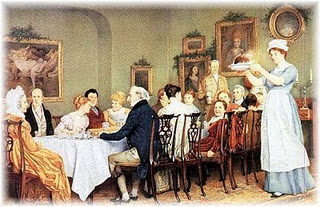
Celebrating a Regency Christmas

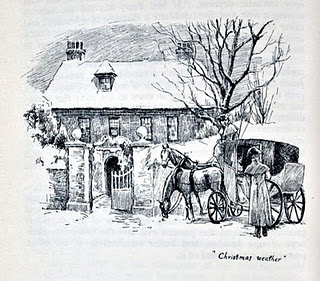
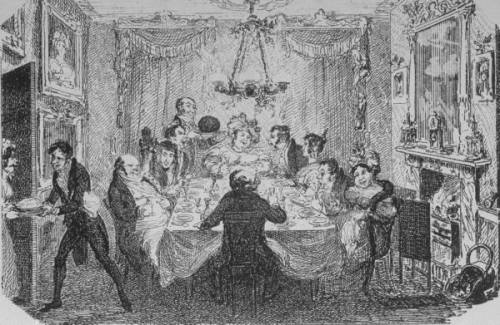
When most people consider a Regency Christmas, they are really envisioning a Victorian one. During the Regency Period (1811-1820), Christmastide began on Christmas Day and ended with a Twelfth Night celebration. There are few references to Christmas traditions in Regency literature other than the occasional wish for a “Happy Christmas” among story characters and real-life accounts. Even Jane Austen made few references to the day as anything other than an acknowledgement of Jesus’ birth.

Religious observances remained the foundation of English Christmases of the time. One must remember that in the 16th Century, to prevent subversion, the government banned Christmas celebrations. According to the Jane Austen Centre Magazine, “We have accounts from early 19th Century journals of Christmas days where the writer mentions the holiday but makes absolutely no fuss about it. Likewise, there are records of newspapers, published on December 25th that do not even contain the word Christmas.”

In Chapter 14 of Austen’s Persuasion, we see how the schoolboys’ return home for the holidays is the most important event, not the celebration of Christmas itself. “Immediately surrounding Mrs. Musgrave were the little Harvilles, whom she was sedulously guarding from the tyranny of the two children from the Cottage, expressly arrived to amuse them. On one side was a table occupied by some chattering girls, cutting up silk and gold paper; and on the other were trestles and trays, bending under the weight of brawn and cold pies, where riotous boys were holding high revel; the whole completed by a roaring Christmas fire, which seemed determined to be heard in spite of the noise of the others.”

The Christmas pudding is traditionally made on Stir Up Day, the last Sunday before Advent. All family members of a household take a turn in the stirring with a special wooden spoon, which represents the Christ Child’s crib and the stable. Stirring in a clockwise direction with his eyes closed, each person makes a secret wish during his turn at the spoon – very much as one might do before blowing out the candles on a birthday cake.

In country houses, the occupants hung decorations on Christmas Eve. These remained in place until the Epiphany on January 6, when they were removed. One might hang holly, ivy, rosemary, evergreen, hawthorn and hellebore (Christmas rose). As for the mistletoe/kissing ball, it became quite elaborate during the Victorian Period. However, many believe the tradition remained below stairs in the servants’ quarters during the Regency Period. Yet, the kissing ball and the removal of the berries for each kiss “stolen” from a lovely heroine is often found in Regency based romances.

A Yule Log to burn throughout the festive days would have been common, as well as a Christmas candle. The kindling from the previous year’s Yule Log would be used to light the current year’s find. Groups – mummers whose origins date back to the Middle Ages – sang and performed short plays, usually on Boxing Day (December 26). The actors often mixed bits of history with the heroes of the British Napoleonic Wars in their tales. Of course, Saint George remained a staple of the plays.

Parlor games entertained houseguests, but there was no caroling (except possibly in Wales), no decorated trees, no stockings hung by the chimney with care, and no Christmas cards. Gifts were few and often took the form of charitable acts by the aristocracy. A landowner’s cottagers might bestow a gift symbolizing their devotion to his generosity or representing the bounty of the estate’s harvest on the main house. A Regency Christmas was a time to reflect upon one’s religious beliefs and to enjoy the companionship of friends and family. It was not the commercialized holiday we of this century would expect.

In creating Christmas at Pemberley, the challenge was to tell a tale of “Christmas” for a modern audience, but to stay true to the Regency Period’s practices. In the novel, Christmas arrives on a Sunday. It is December 25, 1814, the time period between Napoleon’s arrival on Elba and his escape in March 1815. I shifted the story’s emphasis from the expected symbols of Christmas (gifts, carols, trees, etc.) to the birth of two children and how each child’s entrance into this world changes the family into which he is introduced. I used the holiday’s practices as the framework through which the story is told.

Christmas at Pemberley
A Pride and Prejudice Holiday Sequel

By Regina Jeffers
A festive holiday novel in which personal rivalries are resolved, generosity rediscovered and family bonds renewed
It’s Christmastime at Pemberley and the Darcys and Bennets have gathered to celebrate. With such a mix of eclectic characters under one roof, bitter feuds, old jealousies, and intimate secrets come to the surface. Stubborn Lady Catherine seeks forgiveness, shallow Caroline Bingley finds love, and immature Kitty pursues a vicar. Forced into playing hostess, Georgiana tries desperately to manage the chaos while wishing Darcy and Elizabeth would return from their trip.
Enroute home, Darcy and Elizabeth are waylaid by a blizzard that forces them to take shelter in a nearby inn. Elizabeth is tormented that they will spend Christmas away from their families, but when a young couple arrives at the inn in need of a place for the night, Elizabeth’s concern turns to the pregnant girl. As Elizabeth and Darcy comfort and soothe her through a long and painful labor, they’re reminded of the love, family spirit, and generosity that lie at the heart of Christmas.

Posted in British history, Great Britain, Jane Austen, Living in the Regency, real life tales, Regency era, Uncategorized | Tagged , , , , | 6 Comments