Are You Familiar With These Words and Phrases?

maxresdefault.jpgSpillikin ~ The Oxford Living Dictionaries gives us: [treated as singular] A game played with a heap of small rods of wood, bone, or plastic, in which players try to remove one at a time without disturbing the others, while Wikitionary tells us that Spillikin is “One of the straws used in the game of Jackstraws (which ironically is also called spillikins. The word came into the language in the mid 18th Century. I always called the game “pick up sticks.” Wikipedia gives us this explanation: “Pick-up sticks or pick-a-stick is a game of physical and mental skill. A bundle of ‘sticks’, between 8 and 20 centimeters long, are held in a loose bunch and released on a table top, falling in random disarray. Each player, in turn, must remove a stick from the pile without disturbing the remaining ones. One root of the name “pick-up sticks” may be the line of a children’s nursery rhyme, “…five, six, pick-up sticks!” The game has spawned several variations such as Jackstraws (or Jack Straws), Spellicans, and Spillikins.

______________________________________

“We are not amused.” ~ Surely you have heard this line attributed to Queen Victoria. However, Phrase Finder tell us… 

This supposed quotation was attributed to Queen Victoria by courtier Caroline Holland in Notebooks of a Spinster Lady, 1919. Holland attests that Victoria made the remark at Windsor Castle:

‘There is a tale of the unfortunate equerry who ventured during dinner at Windsor to tell a story with a spice of scandal or impropriety in it. “We are not amused,” said the Queen when he had finished.’

Holland doesn’t claim to have been present at the dinner and is good enough to describe the account as a “tale’, that is, her account has the same standing as “a man in the pub told me”.

Despite the fact that in almost all of the photographs and paintings of her, Victoria provides a particularly po-faced demeanour, she had the reputation of being in private a very fun loving and amusing companion, especially in her youth and before the crown began to weigh heavily on her. In public it was another matter, as Victoria preferred to maintain what she saw as the dignity of her position by remaining sternly impassive. She did, of course, become considerably less fun-loving after the death of her husband and her persona in later life is well-documented as being dour and straight-laced. 

As to whether she ever uttered the expression ‘we are not amused’, there’s little convincing evidence that she did so with the intention of conveying the serious intent that we now ascribe to the phrase, although in the 1976 biography Victoria Was Amused, Alan Hardy makes the claim (again without offering explicit evidence) that Victoria did sometimes utter the expression ironically.

The evidence to support the idea that Queen Victoria originated this expression ‘we are not amused’ lies somewhere between thin and nonexistent.

_______________________________________

Warts and all ~ From Phrase Finder we have this explanation: The whole thing; not concealing the less attractive parts.

Oliver Cromwell- warts and allThis phrase is said to derive from Oliver Cromwell’s instructions to the painter Sir Peter Lely, when commissioning a portrait.

At the time of the alleged instruction, Cromwell was Lord Protector of England. Lely had been portrait artist to Charles I and, following the restoration of the monarchy in 1660, he was appointed as Charles II’s Principal Painter in Ordinary.

Charles IILely’s painting style was, as was usual at the time, intended to flatter the sitter. Royalty in particular expected portraits to show them in the best possible light, if not to be outright fanciful. Lely’s painting of Charles II shows what was expected of a painting of a head of state in the 17th century. It emphasizes the shapely royal calves – a prized fashion feature at that time.

Cromwell did have a preference for being portrayed as a gentleman of military bearing, but was well-known as being opposed to all forms of personal vanity. This ‘puritan Roundhead’ versus ‘dashing Cavalier’ shorthand is often used to denote the differences in style of the two opposing camps in the English Commonwealth and subsequent Restoration. It is entirely plausible that he would have issued a ‘warts and all’ instruction when being painted and it is unlikely that Lely would have modified his style and produced the ‘warts and all’ portrait of Cromwell unless someone told him to.

We have Cromwell’s death mask as a reference. From that it is clear that Lely’s portrait is an accurate record of Cromwell’s actual appearance.

Despite the plausibility of the account, there doesn’t appear to be any convincing evidence that Cromwell ever used the phrase ‘warts and all’. The first record of a version of that phrase being attributed to him comes from Horace Walpole’sAnecdotes of Painting in England, with some account of the principal artists, 1764. Walpole’s authority for the

Oliver Cromwell - death mask - warts and all attribution came from a reported conversation between John Sheffield, Duke of Buckingham, the first occupant of Buckingham House, now Buckingham Palace, and the house’s architect, Captain William Winde. Winde claimed that:

Oliver certainly sat to him, and while sitting, said to him – “Mr Lely, I desire you would use all your skill to paint my picture truly like me, and not flatter me at all; but remark all these roughnesses, pimples, warts and everything as you see me, otherwise I will never pay a farthing for it.”

That was published in 1764 – over a hundred years after Lely painted Cromwell. Walpole included no evidence to support the attribution, nor any explanation of why no one else had mentioned the phrase in the preceding hundred years – this despite Cromwell’s life being the subject of minutely detailed historical research and over 160 full-length biographies. We can only assume he was indulging in a piece of literary speculation rather than historical documentation. The first known citation in print of the actual phrase ‘warts and all’ is from a ‘Chinese whisper’ retelling of Walpole’s story – an address given by an Alpheus Cary, in Massachusetts, in 1824:

When Cromwell sat for his portrait he said, “Paint me as I am, warts and all!”

It may well be the case that Oliver Cromwell preferred portraits of him to be accurate, but it is most unlikely that he ever uttered the words ‘warts and all’.

________________________________________

MARCELLA-WHITE-FINE-SHIRTING-FABRIC-600x450.jpg Marcella ~ While some of us know “Marcella” as a British crime noir detective series, for this post, I am speaking of an English cotton fabric made with a quilted or honeycomb face and used especially for clothing, trimming, or bedspreads. Dictionary.com says, “a cotton or linen fabric constructed in pique weave, used in the manufacture of vests, mats, etc.” It is probably an alteration of marseilles. It entered the language around 1805-1815. 

________________________________________

In many Regency books, a wealthy man will present his mistress her congé, but what does that mean? Merriam-Webster tells us the word congé means “a formal permission to depart; a dismissal.” The origin is likely an alteration of earlier congee, congie,from Middle English conge, from Anglo-French cungé, from Latin commeatus going back and forth, leave, from commeare to go back and forth, from com- + meare to go — First Known Use: 14th century.

________________________________________

Tomfoolery ~ World Wide Words gives us this origin for “tomfoolery.” The word often turns up in print in the way you have written it, or as Tom foolery or tom-foolery or Tom-foolery. Such forms show that their writers still link the word with some fool called Tom, even though they may not know who he was.

Tom Skelton
A portrait of Tom Skelton.

It is sometimes claimed that the original Tom Fool was Thomas Skelton. He was a jester, a fool, for the Pennington family at Muncaster Castle in Cumbria. This was probably about 1600 — he is said to be the model for the jester in Shakespeare’s King Lear of 1606. In legend, he was an unpleasant person. One story tells how he liked to sit under a tree by the road; whenever travellers he didn’t like asked the way to the ford over the River Esk, he would instead direct them to their deaths in the marshes. Another tale links him with the murder of a carpenter who was the lover of Sir William Pennington’s daughter.

So much for stories. In truth, Tom Fool is centuries older. He starts appearing in the historical record early in the 1300s in the Latinate form Thomas fatuus. The first part served even then as a generic term for any ordinary person, as it still does in phrases like Tom, Dick or Harry. The second word means stupid or foolish in Latin and has bequeathed us fatuousand infatuate, among other words. By 1356 Thomas fatuus had become Tom Fool.

Around the seventeenth century, the character of Tom Fool shifted somewhat from the epitome of a stupid or half-witted person to that of a fool or buffoon. He became a character who accompanied morris-dancers or formed part of the cast of various British mummers’ plays performed at Christmas, Easter or All Souls’ Day.

A tom-fool was more emphatically foolish than an unadorned fool. Tomfoolery was similarly worse than foolery, the state of acting foolishly, which had been in English since the sixteenth century. Perhaps oddly, it took until about 1800 for tomfoolery to appear. It had been preceded by the verb to tom-fool, to play the fool.

________________________________________

By hook or by crook ~ For this one, I again turned to World Wide Words. 

“This curious phrase has bothered many people down the years, the result being a succession of well-meant stories, often fervently argued, that don’t stand up for a moment on careful examination.

“As good a place to start as any is the lighthouse at the tip of the Hook peninsula in south-eastern Ireland, said to be the world’s oldest working lighthouse. It is at the east side of the entrance to Waterford harbour, on the other side of which is a village and parish called Crook. One tale claims that Oliver Cromwell proposed to invade Ireland during the English Civil War by way of Waterford and that he asserted he would land there “by Hook or by Crook”. In another version the invasion of Ireland was the one of 1172 by Richard de Clare, 2nd Earl of Pembroke, also known as Strongbow.

“Two other stories associate the phrase with gentlemen called Hook and Crook. Both appeared in early issues of the scholarly research publication Notes and Queries. One linked it with the difficulties of establishing the exact locations of plots of land after the great fire of London in 1666. The anonymous writer explained:

“The surveyors appointed to determine the rights of the various claimants were Mr. Hook and Mr. Crook, who by the justice of their decisions gave general satisfaction to the interested parties, and by their speedy determination of the different claims, permitted the rebuilding of the city to proceed without the least delay. Hence arose the saying above quoted, usually applied to the extrication of persons or things from a difficulty. The above anecdote was told the other evening by an old citizen upwards of eighty, by no means of an imaginative temperament.

Notes and Queries, 15 Feb. 1851.

“The other supposed derivation was equally poorly substantiated:

“I have met with it somewhere, but have lost my note, that Hooke and Crooke were two judges, who in their day decided most unconscientiously whenever the interests of the crown were affected, and it used to be said that the king could get anything by Hooke or by Crooke.

Notes and Queries, 26 Jan. 1850.

“Most of these stories can be readily dismissed by looking at the linguistic evidence, which tells us that the expression is on record from the end of the fourteenth century, by which time it was already a set phrase with the current meaning.

“During this period, local people sometimes had rights by charter or custom known as fire-bote to gather firewood from local woodlands. It was acceptable to take dead wood from the ground or to pull down dead branches. The latter action was carried out either with a hook or a crook, the latter implement being a tool like a shepherd’s crook or perhaps just a crooked branch.

“Little contemporary evidence exists for this practice. Written claims for it dating from the seventeenth century are said to exist for the New Forest in southern England, one of which argued for an immemorial right to go into the king’s wood to take the dead branches off the trees “with a cart, a horse, a hook and a crook, and a sail cloth” (it’s not stated why the sail cloth was needed). Another version was once claimed to be in the records of Bodmin in Cornwall, whereby locals were permitted by a local prior “to bear and carry away on their backs, and in no other way, the lop, crop, hook, crook, and bagwood in the prior’s wood of Dunmeer.” Richard Polwhele’s Civil and Military History of Cornwall of 1806 argued in support of this claim that images of the hook and the crook were carved on the medieval Prior’s Cross in nearby Washaway, though modern writings describe them as fleurs-de-lys.

“The examples suggest that this origin for the expression is the correct one, though some doubt must remain.

Medieval peasant trimming vines
This medieval illustration shows a billhook, but the worker is pruning a tree, not cutting firewood.

“The hook of the idiom may have been just a bit of wood or metal but might equally have been a tool with a sharpened edge, allied to the billhook or reap hook of more modern agricultural practice. We now connect crook principally with shepherds and bishops, but in medieval times it was any hooked device or implement. This meant that hook and crook were synonyms as well as rhymes, which made it almost inevitable that they were put together to make a reduplicated rhyming phrase.”

_________________________________________

250px-the_life_of_william_cobbett_-_written_by_himself-_no_2_william_cobbett_by_james_gillray

Cartoon of a “hobbledehoy” William Cobbett enlisting in the army. From the Political Register of 1809. Artist James Gillray. Wikipedia

Did you know that a hobbledehoy is an awkward, gawky youth? According to Merriam Webster, hobbledehoy was first used in 1540. World Wide Words tells us, “You will not find a better description of the type than in Anthony Trollope’s The Small House at Allington: ‘Such young men are often awkward, ungainly, and not yet formed in their gait; they straggle with their limbs, and are shy; words do not come to them with ease, when words are required, among any but their accustomed associates. Social meetings are periods of penance to them, and any appearance in public will unnerve them. They go much about alone, and blush when women speak to them. In truth, they are not as yet men, whatever the number may be of their years; and, as they are no longer boys, the world has found for them the ungraceful name of hobbledehoy.’

“But where the world found it is far from clear. The word seems to have been around at least since the sixteenth century, but was long distinguished by seeming never to be written the same way twice. It may well be related to Hoberdidance or Hobbididance, which was the name of a malevolent sprite associated with the Morris dance (and whose name is from Hob, an old name for the Devil; nothing to do with hobbits). It may also be linked to hobidy-booby, an old English dialect word for a scarecrow. The modern spelling seems to be the result of popular etymology, which has changed a puzzling word into something that looks as though it might make more sense.”

_______________________________________

Billet-doux is a love letter. It is literally a “sweet letter” from the French. (French billet doux, from billet (“note”) + doux  ‎(sweet). Its first known use is 1673. 

He mutters something about fate and free-will, and walks off with the billet-doux. – The Miscellaneous Writings and Speeches of Lord Macaulay, Vol. 2 (of 4) by Thomas Babington Macaulay

________________________________________

One of the literary devices my AP students were expected to recognize within the literature was metonymy. “It is a figure of speech that replaces the name of a thing with the name of something else with which it is closely associated. We can come across examples of metonymy both from literature and in everyday life. Metonymy is often confused with another figure of speech called synecdoche. They resemble each other but are not the same. Synecdoche refers to a thing by the name of one of its parts. For example, calling a car ‘a wheel’ is a synecdoche. A part of a car i.e. “a wheel” stands for the whole car. In a metonymy, on the other hand, the word we use to describe another thing is closely linked to that particular thing, but is not a part of it. For example, ‘Crown’ which means power or authority is a metonymy.”

Literary Devices provides this example: 

The given lines are from Shakespeare’s  “Julius Caesar” Act I.

“Friends, Romans, countrymen, lend me your ears.”

Mark Anthony uses “ears” to say that he wants the people present there to listen to him attentively. It is a metonymy because the word “ears” replaces the concept of attention.

________________________________________

Pourboire ~ Dictionary.com gives us “a gratuity; tip (especially in appreciation).”Origin of pourboire: literally, for drinking [pour + boire (“for drinking,” cf. Ger. Trinkgeld)]. One can find the word in this examples: 

  • Then to Jefferson she added: “Give him a franc for pourboire —that makes five francs altogether.” – The Lion and The Mouse by Charles Klein. 

  • Tartarin went up to give him a pourboire, as he had seen all the other tourists do. – Tartarin on the Alps by Alphonse Daudet

  • “Nay, thou shalt have pourboire,” and he gave him a small coin. – The Cloister and the Hearth by Charles Reade

_________________________________________

Carry Coals to Newcastle ~ Phrase Finder gives us this explanation. 

Newcastle Upon Tyne in England was the UK’s first coal exporting port and has been well-known as a coal mining centre since the Middle Ages, although much diminished in that regard in recent years. ‘Carrying coal to Newcastle’ was an archetypally pointless activity – there being plenty there already. Other countries have similar phrases; in German it’s ‘taking owls to Athens’ (the inhabitants of Athens already being thought to have sufficient wisdom). ‘Selling snow to Eskimos’ or ‘selling sand to Arabs’, which in many people’s understanding also have the same meaning, are a little different. Those expressions refer to things that are difficult to achieve, that is, requiring of superb sales skills, rather than being things that are pointless..

Carry coals to NewcastleDespite the name of the city, Newcastle’s castle keep is almost a thousand years old – having replaced an earlier castle in 1178. The association of the city with coal and the phrase itself are also old. In 1606, Thomas Heywood in ‘If you know not me, you know no bodie: or, the troubles of Queene Elizabeth‘ wrote:

“As common as coales from Newcastle.”

The explicit link with pointlessness came soon afterwards, in Thomas Fuller’s The history of the worthies of England, 1661:

“To carry Coals to Newcastle, that is to do what was done before; or to busy one’s self in a needless imployment.”

Posted in etymology, language choices, Pop Culture, tall tales, vocabulary, word origins | Tagged , , , , | 1 Comment

‘Holly and Hopeful Hearts’ and Charity at Christmas Time from the Bluestocking Belles + a Giveaway

AmyRose Bennett.jpg Today, I welcome Amy Rose Bennett back to the blog, representing several of my favorite Regency authors, a group known as the Bluestocking Belles. They have a lovely boxed holiday set they are sharing with us. I preordered mine, and it has been delivered. Reading frantically… Check out a bit of each story. You will love this!! 
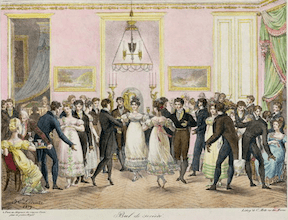
Thank so much, Regina, for having the Bluestocking Belles on your blog again so we might share our latest release, a Regency holiday box set, Holly and Hopeful Hearts. We’re very proud of our latest joint story-telling endeavor as it features eight interconnected novellas that are centered around a Yuletide house party and New Year’s Eve charity subscription ball at Hollystone Hall, the country estate of the Duchess of Haverford.

Note: The Belles will be giving away an ePub or mobi copy of our anthology to one random commenter. The giveaway will end on November 20th, 2016 at midnight EST.

My contribution to the Belles’ box set is Dashing Through the Snow. I had such fun writing a story about a headstrong bluestocking with a strong philanthropic streak and a very proud nobleman who, despite opposing interests, find themselves falling in love.

Miss Kate Woodville, teacher and bluestocking, enjoys her independence, thank you very much. But when a very determined viscount insists she accompany him on a mad dash through the snow to Gretna Green to stop his younger sister, Violet, eloping with Kate’s own brother, she has little choice but to go. She’ll risk the ruin of her own pristine reputation if it means she can save Freddie from Lord Stanton’s wrath.

As they race along the road north and then back to Hollystone Hall in Buckinghamshire for a New Year’s Eve charity ball, hearts and wills are certain to collide. But will anyone—Freddie and Violet, or Kate and Lord Stanton—find the path to everlasting love?

All of our Regency heroines in this anthology take part in charitable endeavors to raise funds for furthering the education of the less fortunate and in particular, girls and women. Indeed, the major overarching theme linking all the stories is about charity and giving during the Christmas season. Fictional charities reflecting those that existed during the Regency era, plus one very real charity, are featured:

  • The Duchess of Haverford, a character created by Jude Knight who features in all the novellas and Jude’s own two stories, A Suitable Husband and The Bluestocking and the Barbarian, is the hostess of the Yuletide house party and New Year’s Eve charity subscription ball. As befitting her elevated station, she is very much a philanthropist and is a patroness of many charitable causes both in the rural community surrounding her country estate of Hollystone Hall and beyond. During the course of the house party she arranges a gift giving visit to the local orphanage and on Boxing Day, she distributes charity to the tenants of her estate and the local poor.

A Regency Ball, 1819.png a-basket-of-good-things

  • The Benevolent Society for the Women of Whitechapel is a charity close to the heart of my heroine from Dashing Through the Snow. Even though Kate Woodville is a music teacher at an exclusive young ladies’ finishing school, in her free time she conducts lessons for the children residing at White Church House, The Benevolent Society’s charity lodging house for destitute mothers in the Whitechapel area. The fictitious charity is also supported by the nearby St Mary Matfelon Church (sadly, this church no longer stands as it was badly damaged during World War II and later demolished). Kate intends to attend the Hollystone house party to seek more funding for her chosen charity.

st-mary-matfelon-church-whitechapel

  • Lord Nicholas Lacey from Sherry Ewing’s A Kiss for Charity offers to donate rather a large sum to the Duchess of Haverford’s charitable fund for the New Year’s Eve charity ball.
  • A school and orphanage for the poor at Southwark, London appears in Jessica CalesArtemis.
  • The heroine of Nicole Zoltack’s Christmas Kisses, Lady Anna Wycliffe enjoys writing and reading stories to the orphans who reside within the fictional Home for Motherless Children. She also raises money to provide them with clothes.
  • The heroine of Caroline Warfield’s An Open Heart, Esther Baumann, wishes to advocate for funds for a Jewish school for girls.
  • The very real Foundling Hospital features in Susana Ellis’s Valuing Vanessa. It was a children’s home established in 1739 in London for the ‘education and maintenance of exposed and deserted young children’. Despite its name, the institution was indeed a children’s home rather than a hospital; the word ‘hospital’ was used to indicate the notion of ‘hospitality’ to those less fortunate.

Foundling_Hospital.jpg

The Bluestocking Belles hope readers enjoy all our stories within the anthology. As a group we support the Malala Fund and 25% of the proceeds from the sales of Holly and Hopeful Hearts will be donated to this most worthy cause that supports the education of girls and women around the world.

Holly and Hopeful Hearts.jpgAbout HOLLY AND HOPEFUL HEARTS releasing on November 8, 2016.

When the Duchess of Haverford sends out invitations to a Yuletide house party and a New Year’s Eve ball at her country estate, Hollystone Hall, those who respond know that Her Grace intends to raise money for her favorite cause and promote whatever marriages she can. Eight assorted heroes and heroines set out with their pocketbooks firmly clutched and hearts in protective custody. Or are they?

Genre: Regency romance, historical romance, holiday romance

Heat rating: G-PG13

Buy links for HOLLY AND HOPEFUL HEARTS:

Amazon US       Amazon UK     Amazon Australia     Amazon Canada

Smashwords     Kobo     Barnes & Noble     iBooks

ABOUT THE BELLES:

The Bluestocking Belles, the “BellesInBlue”, are seven very different writers united by a love of history and a history of writing about love. From sweet to steamy, from light-hearted fun to dark tortured tales full of angst, from London ballrooms to country cottages to the sultan’s seraglio, one or more of us will have a tale to suit your tastes and mood. Come visit us at http://bluestockingbelles.net and kick up your bluestockinged heels!

BLUESTOCKING BELLES ON THE WEB: Look for us online…

Website and home of the Teatime Tattler: http://bluestockingbelles.net

Facebook: www.Facebook.com/BellesInBlue

Twitter: www.Twitter.com/BellesInBlue

Pinterest: www.Pinterest.com/BellesInBlue

Amazon Author page: www.amazon.com/author/BellesInBlue

Posted in book excerpts, book release, Guest Blog, Guest Post, holidays, Living in the Regency, publishing | Tagged , , , , , | 5 Comments

A Play from Emma Wood: “Mr Bennet’s Bride,” a Pride and Prejudice Prequel

First, before we begin, I should say that Emma is literally on the other side of the world. Where she lives it is already Thursday, November 10, so if she does not respond too quickly to comments below, it is not because she does not want to do so. That being said, permit me to introduce you to Emma Wood and “Mr Bennet’s Bride.” Personally, I loved this play, and I hope you will too. 

Emma Wood profile shot.jpg From Marriage to Courtship: Looking Back

Pride and Prejudice is a novel that offers so much to the reader that to quantify it in a single sentence is simplistic in the extreme. But without doubt, it is deeply concerned with courtship and marriage. An array of engaging characters and plots present different models of this well-trodden pathway. Over time I became gripped with one couple in particular. To explain why it may help to look briefly at a few others.

Naturally, the relationship that develops between Elizabeth Bennet and Mr Darcy comes to mind as the most prominent example of a courtship. Beginning without intention on either side, then developing slowly with many twists and turns, and happily resulting in a marriage of equals in mind and heart; their story is the core of the novel. Jane and Mr Bingley, though shown to be a true match, navigate many hurdles before finally overcoming them to general satisfaction. Lydia and Wickham appear somewhat settled by the end of their tumultuous path to matrimony, but as the reader knows too well, theirs is only a superficial ‘happy ending’. Another view is offered through the marriage of Charlotte Lucas and Mr Collins. Made hastily and without love on either side, it is seen through Lizzie’s eyes to be a penury she could never submit to.

The author rewards the elder Bennet girls who hold out for love. Lydia’s recklessness results in a marriage far less satisfactory, although she is blessedly ignorant of present complexity and probable future unhappiness. In spite of Lizzie’s misgivings, sensible Charlotte is pleased to have achieved material security, and willing to bear the inevitable frustrations of being married to the ludicrous Mr Collins.

The novel shows vividly that marriage has varying outcomes depending on many factors: luck, timing, fortune or the lack of it, decision-making, behaviour, and what we might call these days ‘love-onomics’. Charlotte fairly accurately assesses her own worth in the marriage market and does indeed settle for the best prospect she is likely to be offered. She is a realist and accepts the limited terms that society sets for women and seems reasonably content with the outcome. Lizzie, idealistic and romantic, does the opposite and holds out for love at all costs, stating ‘I am determined that only the deepest love will induce me into matrimony.’ 

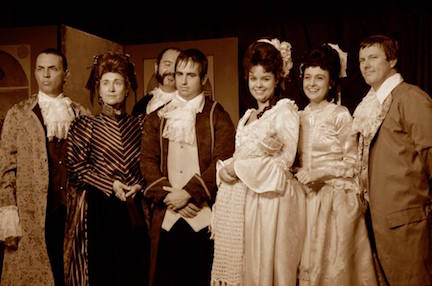
12309567_441231272753165_8523834716480412224_o.jpg Each of these couples is depicted in their early adulthood, and mostly the journey to marriage is more closely examined than the destination. Each plot is brilliantly drawn, offering significant reflections on the theme of marriage. But there is another couple who matters greatly in broadening the understanding of Lizzie and others on marriage. Mr and Mrs Bennet kindle my greatest curiosity. Unlike the others, it is a marriage that has already endured decades, and any brief honeymoon period has long since been forgotten. Indeed, the opening chapter of the novel portrays the mismatched pair engaged in their customary game of cat and mouse, in which Mr Bennet continually takes delight. His provocation causes Mrs Bennet to cry on the second page of the novel:
‘You take delight in vexing me. You have no compassion on my poor nerves.’

To which he perfectly responds:

‘You mistake me, my dear. I have a high respect for your nerves. They are my old friends. I have heard you mention them with consideration these twenty years at least.’

This verbal jousting, in which he is always triumphs by virtue of his superior mind and steadier temperament, provides much amusement to both Mr Bennet and the reader throughout the novel – and in later screen productions provides wonderful comic opportunities for the actors.

Mr and Mrs Bennet are written with such theatrical flourish that their characters almost demand to be given life on stage or screen – and have been with delightful results in countless productions. Much of their story is conveyed through direct dialogue, a technique Austen utilises frequently in her novel, to great effect. Particular qualities of Mr and Mrs Bennet – her thoughtless, small minded and frequently melodramatic commentary, coupled with his dry, playful but provocative responses, make them a very lively sparring partners. The reader understands their relationship and all its dynamic failings with an immediacy that lends itself to dramatization.

But where did it all begin? What courtship was the prelude to this pairing?

While the story I began to envisage could have been written by a novelist, I am not one. I have a theatrical background: an actor, a director, a drama teacher, and recently a playwright of my first full length play, a modern drama called Water Child. The play won an award, produced some strong reviews, and I was inspired to continue. So when I sat down at the computer with Mr and Mrs Bennet burning in my brain, it didn’t occur to me to write a novel. I began a play.

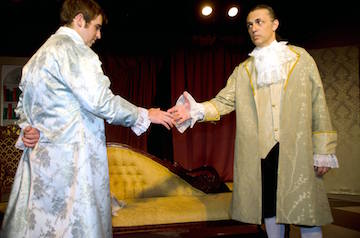
I have conceived a prequel to Pride and Prejudice in the form of a full length play, entitled Mr Bennet’s Bride, set twenty-three years before the novel begins. The audience already knows how the courtship must end: so the mystery is how and why it began. The novel’s brief glimpse into their past allows so much room for speculation, that it was both a challenge and a delight to consider how this odd coupling began. In imagining their courtship, I have tried to emulate Austen’s ability to evoke both laughter and empathy. And much as the reader might enjoy the wit and ‘quick parts’ of Mr Bennet, and sympathise with his marriage to a woman of ‘mean understanding, little information, and uncertain temper’, the match begs closer imaginative examination.

What of the world they inhabited as younger people? What of the previous generation? Did their parents encourage or discourage the match? Did the future daughters of this couple inherit their widely differing personalities from a colourful range of forbears? And how did Mr Collins of the novel come to inherit – what was his place in the family, and why had the fathers not spoken for decades?

1930629_441235096086116_2259993717650662656_n.jpg
These questions and more were my canvas and provided so much to consider that it was hard to organise my thoughts. But I had a vision of the final moment of the play before I put pen to paper: a young Mr Bennet, having enthusiastically initiated a courtship with a woman entirely unsuited to him in temperament and ability, suddenly realises the outcome that will surely follow. The penny drops, and as the light dims, the dawning trepidation on his face is the last thing the audience sees. With this image as the destination point, young Mr Bennet became the protagonist. The other reason was that in sketching the details of their early lives, Mr Bennet inevitably became a more complex person. ‘…
so odd a mixture of quick parts, sarcastic humour, reserve, and caprice, that the experience of three and twenty years had been insufficient to make his wife understand his character.’ His behaviour toward his wife, and his daughters, with whom he is incredibly uneven in his treatment, had to be shown to be shaped by influences in his earlier life.

While the future Mrs Bennet (in my play, a young Miss Gardiner) is a delightfully energetic and vivacious stage presence, her character was inevitably simpler to conceive, in order to maintain credibility with the character in the novel. As Austen states in Chapter One:‘Her mind was less difficult to develop.’ This playwright echoes that sentiment!

I felt an enormous responsibility to create characters that would ring true to Austen fans, who already knew and loved them so well: it was in many ways daunting. But when the play was written, refined, rehearsed and performed, it was the greatest joy to hear the audience laugh and cry, and to hear them afterward discussing the younger characters I had developed as being just what they would have hoped for. The Newcastle Theatre Company (Australia) immensely enjoyed the box office records too! The connection to Ms Austen was, of course, gold.

12671791_434257590117200_5637213056095622095_o.jpg

The play offers a cast of 6F/4M, with both the Bennet and the Gardiner family seen in their respective houses as the unsuitable match is kindled and deepened. Mr and Mrs Bennet, the younger, you will recognise – but other characters I have taken the liberty of creating afresh. 

The play is meant for the stage, but to the Austen enthusiast will offer an engaging read. It has been enjoyed thoroughly as a read aloud at book clubs – something to consider for a fun night in? Or if you enjoy it and have theatre connections – perhaps suggest it to your local company as a thoroughly enjoyable and highly marketable play – being quite unique in that it is a both ‘new’ and ‘period/classic’.

I welcome your comments and questions, but as I live in Australia we may be in very different time zones, so please bear with me if my response is not immediate.

To Purchase:

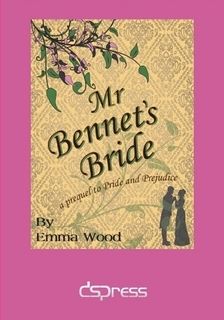
product_thumbnail.jpghttp://www.lulu.com/shop/emma-wood/mr-bennets-bride/paperback/product-22046504.html

Mr Bennet’s Bride by Emma Wood is set in the 1780s, 25 years before the novel Pride and Prejudice opens. The play concerns the ill-suited couple Mr and Mrs Bennet, portrayed with such humour in that famous novel, and examines how they met and decided to marry. When it debuted in 2014, at the Newcastle Theatre Company, its ticket sales were the third highest in the group’s sixty year history.

To see photos and reviews:

https://www.facebook.com/mrbennetsbride/

Performance Rights available at:

http://shop.stagescripts.com/categories/plays/full-length/comedic-drama/mr-bennets-bride.html (UK only)

http://www.davidspicer.com.au/shows/mr-bennets-bride (Australia/USA/worldwide)

To contact playwright directly:   wood.emma.e@gmail.com

Posted in Austen actors, British history, drama, family, Georgian England, historical fiction, Jane Austen, JASNA, marriage, playwrights, Pride and Prejudice, Vagary | Tagged , , , , , , , | 1 Comment

Queen Victoria Chooses a Husband for Her Second Daughter, Princess Alice

Princess_Alice_reclining.jpg With the marriage of Victoria, Princess Royal, to the future Frederick III of Prussia, Queen Victoria turned her “matchmaking” skills upon her second daughter, Princess Alice Maud Mary. Although she promoted the idea of love matches for all her children, Victoria made certain the choice of spouses were limited to certain individuals and families.
Although she was known to possess a quick temper and a shrewish tongue at times, Alice was considered Victoria’s most sympathetic child. Alice held a reputation of caring for the burdens of others. Her education was devised by Albert’s close friend and adviser, Baron Stockmar, and included practical activities such as needlework and woodwork, as well as French and German. When her father, Prince Albert, was diagnosed with typhoid fever in December 1861, Alice nursed him until his death on 14 December that year. Following his death, Queen Victoria entered a period of intense mourning, and Alice spent the next six months acting as her mother’s unofficial secretary.

In choosing a husband for Princess Alice, Queen Victoria was most insistent that the prospective bridegroom be a Protestant, more specifically a Protestant from the European continent. She did not approve of her children choosing one of her own subjects, no matter how high the person’s rank. In fact, Victoria did not approve of many of the British Hanoverian relations. Moreover, marrying another British subject eliminated the possibility of extending foreign relations and Victoria’s influence on foreign powers.

The “match pool” for Princess Alice included Willem, Prince of Orange, Prussian Prince Albert, Pedro of Portugal (who was eliminated because he was a Catholic), and 

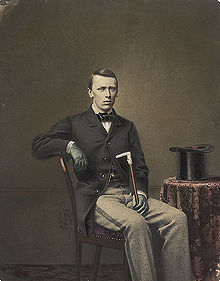
220px-Kroonprins_Willem.jpg Willem, heir apparent to the Dutch throne as the eldest son of King William III, would have been Victoria’s first choice for Alice, but word was received early on at Windsor that the Dutch prince was besotted with an Austrian archduchess, who was, Heaven Forbid!, a Catholic. Nevertheless, Willem traveled to London in January 1860 to be inspected by Victoria and Albert. Little did he know, they had already rejected the idea of an alliance with the man. Thankfully, Alice also did not find him interesting.  The prince fell in love with the 19-year-old Countess Mathilde von Limburg-Stirum in 1873. The relationship between the prince and his parents became very problematic, as his parents refused William’s wish to accept Mathilde as his bride in 1874. By the standards of the Dutch royal family, a marriage between a member of the royal family and a member of the nobility was considered unequal  and therefore unacceptable. Also a rumor circulated that Mathilda was an illegitimate daughter of King William III and so William could be marrying his half-sister. The 33-year-old William wanted to marry, if necessary, without the consent of his parents. However, Mathilda was not yet twenty and so permission was needed from her parents too. Since they denied permission, the prince’s attempt to marry Mathilda failed. Disillusioned, Prince William then went into exile in Paris, where he threw himself into a life of sex, drinking and gambling. Ironically, he died, debauched, within months of Alice’s death in 1878.

A cousin to Princess Victoria’s husband, Frederick III, was also a candidate. However, when Victoria and Albert consulted their son-in-law regarding Prince Albert of Prussia being a worthy suitor for Alice, Fritz candidly vetoed his cousin, saying that Alice “deserves the very best.” 

In June 1860, Louis of Hesse-Darmstadt, accompanied by his brother Henry, arrived at Windsor. Hesse-Darmstadt, whose ancestors included Charlemagne,  had prior to this event been known to have strengthened its blood lines through inter-marriages. It was a landgravate (a country ruled by sovereign counts), which had been raised to the status of Grand Duchy in the 16th Century and had come to be known as “Hesse and the Rhine.” Louis was born at the Prinz-Karl-Palais, the first son and child of Prince Charles of Hesse and by the Rhine and Princess Elisabeth of Prussia. As his father’s elder brother Louis III (1806-1877), the reigning Grand Duke of Hesse and by Rhine, had been married to his first wife since 1833 without legitimate children and from 1868 was married morganatically, Prince Louis was the likely heir eventual to the grand ducal throne from childhood.

Both Queen Victoria and Princess Alice approved of Louis, but he was rumored to have his heart set upon Princess Marie of Baden. However, the longer he remained at the British royal court, the more smitten he became with Alice. Thankfully, Alice spoke German rather well for Louis’s English was undeveloped. Alice quickly declared herself “in love.” Perhaps if she had been permitted more time with Prince Louis, Alice would have discovered that he certainly was not her equal or her superior in either intelligence or emotional stability. Alice had no idea of “true society.” Victoria and Albert kept their family matters private. Louis was said to have thought of Alice as “bauble” to be displayed upon his arm. He was not of the nature to understand his wife’s complicated nature. 

220px-LudwigIVHeRhein.jpgLouis made a second call at Windsor in November 1860. The pair became officially engaged on 30 November 1860. Even so, Victoria declared the marriage must wait a year before the wedding. Louis remained in England until three days after Christmas. He presented Alice a cast of her hands as a Christmas gift. Ironically, Victoria wrote to her Uncle Leopold her expectation of Louis remaining in England with her family after his marriage. 

The Hesse-Darmstadt duchy was a poor country. Although the British government presented Alice a dowry of £30000, but Alice’s prospects were slim. In reality, Louis’s homeland could not afford a new palace for the pair, and Victoria’s insistence upon one was thought ill-fit by Louis’s countrymen. Louis holidayed with Alice’s family at Balmoral in the spring of 1861. Although she still grieved her mother’s death, the queen welcomed Louis’s return. 

In December of 1861, Prince Albert succumbed to typhoid fever. It was the 18-year-old Alice who attended him. Therefore, the wedding was again postponed. Alice and Louis did not marry until July 1862. They married at Osborne House on the Isle of Wight. On the day of the wedding, the Queen issued a royal warrant granting her new son-in-law the style of Royal Highness in the United Kingdom. The Queen also subsequently made Prince Louis a knight of the Order of the Garter.  Becoming parents in less than a year following their marriage, the young royal couple found themselves strapped financially to maintain the lifestyle expected of their rank. Princess Alice’s interest in social services, scientific development, hands-on child-rearing, charity and intellectual stimulation were not shared by Louis who, although dutiful and benevolent, was bluff in manner and conventional in his pursuits. The death of the younger of their two sons, Frittie, who was afflicted with hemophilia and suffered a fatal fall from a palace window before his third birthday in 1873, combined with the wearying war relief duties Alice had undertaken in 1870, evoked a crisis of spiritual faith for the princess in which her husband does not appear to have shared.2004alice

Resources: 

Diaries and Letters: Princess Alice of Hesse and by Rhine ~ by Raegan Baker, Alexander Palace Time Machine

Eilers, Marlene. Queen Victoria’s Descendants. Rosvall Royal Books, Falkoping, Sweden, 1997. pp. 49-50. 141, 175.

“Princess Alice.” 

Wikipedia 

Posted in British history, Church of England, history, kings and queens, legacy, marriage, marriage customs, Victorian era | Tagged , , , , | 2 Comments

Colorful (But Lesser Known) Contemporaries of William Shakespeare, Part II

Previously, in our survey of the History of English Literature, we looked at Barnaby Barnes, John Fletcher, and Nicholas Breton. You may find that post HERE. Today we will explore the accomplishments of Sir Henry Wotton, Anthony Munday, and Raphael Holinshed. 

imgres Sir Henry Wotton, was on born 30 March 1568 at Bocton Hall, Boughton Malherbe, Kent, and died December 1639, Eton, Buckinghamshire) English poet, diplomat, and art connoisseur who was a friend of the poets John Donne and John Milton. He was educated at Winchester and New and Queens Colleges, Oxford. Whilst studying at Oxford he met John Donne, the first and greatest of the metaphysical poets, who later became a close friend. In 1595, Wotton became secretary to the Earl of Essex, collecting foreign intelligence.

Of his few surviving poems, “You Meaner Beauties of the Night,” written to Elizabeth of Bohemia, is the most famous. Izaak Walton’s  biography of Wotton was prefixed to the Reliquiae Wottonianae (1651), the volume in which most of Wotton’s writings first appeared.

Wotton was knighted in 1604, served as ambassador to Venice intermittently from 1604 to 1623. Whilst on a visit to Augsburg in 1604 he wrote a definition of an Ambassador which is now one of his most famous phrases; “An Ambassador is an honest man, sent to lie abroad for the good of his country.”

As the English Ambassador (1604–12, 1616–19, and 1621–4) to Venice he was in a good position to purchase works of art and become familiar with distinguished architecture. In 1624 he published The Elements of Architecture (1624), a work indebted to Alberti and Vitruvius and a landmark volume that helped introduce Italian architectural theories into England. In it, he famously identified the ‘three conditions’ for ‘well building’ as ‘Commodity, Firmness, and Delight’ (a remark itself derived from Vitruvius). Wotton also described the Roman Corinthian Order as ‘a columne lasciviously decked like a courtesan’. It was the first book devoted to architecture written in English, and may have had some influence on architects such as Jones and Pratt. His admiration for Palladio put his work in good order with Burlington and his circle.

 Wotton also served as a member of Parliament in 1614 and 1625. In 1624 he became provost of Eton and in 1627 took holy orders.

“Elizabeth of Bohemia”

You meaner beauties of the night,
     That poorly satisfy our eyes
   More by your number than your light;
     You common people of the skies,
     What are you when the sun shall rise?

    You curious chanters of the wood,
     That warble forth Dame Nature’s lays,
   Thinking your voices understood
     By your weak accents; what’s your praise
    When Philomel her voice shall raise?

   You violets that first appear,
    By your pure purple mantles known,
  Like the proud virgins of the year,
    As if the spring were all your own;
    What are you when the rose is blown?

   So, when my mistress shall be seen
    In form and beauty of her mind,
  By virtue first, then choice, a queen,
    Tell me, if she were not design’d
    Th’ eclipse and glory of her kind?

0662.jpg Anthony Munday, also spelled Mundy was born around 1560 in London. He was buried in London on 9 August 1633. He was an English poet, dramatist, pamphleteer, and translator. In a literary abstract, James H. Forse says, “Anthony Munday (1560-1633) was one of Tudor/Stuart England’s most prolific writers. Over the course of a literary career that lasted for more than fifty years, Munday penned over eighty works, many published more than once. Scholars have over the years constructed a framework that describes Munday variously as author, playwright, “our best plotter,” pamphleteer, uninspired literary hack, translator, historian, and spy. Beyond these labels, Munday has received little attention from the academic community.” (EARNING A LIVING AS AN AUTHOR IN EARLY MODERN ENGLAND: THE CASE OF ANTHONY MUNDAY, G. D. George, Ph.D. Candidate Dissertation, May 2006, Bowling Green University) 

The son of a draper, Munday began his career as an apprentice to a printer. In 1578 he was abroad, evidently as a secret agent sent to discover the plans of English Catholic refugees in France and Italy, and under a false name he obtained admission to the English College at Rome for several months. On his return he became an actor and a prolific writer. He published popular ballads, some original lyrics, much moralizing in verse, translations of many volumes of French and Spanish romances, and prose pamphlets, but only two of his many plays were printed.

In 1581–82 Munday was prominent in the capture and trials of the Jesuit emissaries (many of whom he had known at Rome) who followed the martyr Edmund Campion to England.  Critics have found his English Romayne Lyfe (1582) of permanent interest as a detailed and entertaining, though hostile, description of life and study in the English College at Rome. By 1586 he had been appointed one of the “messengers of her majesty’s chamber,” a post he seems to have held for the rest of Elizabeth I’s reign.

munday.jpgMunday wrote at least 17 plays, of which only a handful survive. He may be the author of Fedele and Fortunio (c. 1584), an adaptation of an Italian original; it was performed at court and printed in 1585. His best-known plays are two pseudo-histories on the life of the legendary outlaw hero Robin Hood, The Downfall of Robert, Earl of Huntingdon and The Death of Robert, Earl of Huntingdon (both 1598). He was probably the main author of Sir Thomas More (c. 1590–93), a play that William Shakespeare  assisted in revising. Munday ceased to write plays after 1602, but during 1605–23 he wrote at least five of the pageants with which the lord mayor of London celebrated his entry into office. A friend of the chronicler John Stow, he was responsible for enlarged editions of Stow’s Survey of London in 1618 and 1633.

31GHH2HV4IL._SX331_BO1,204,203,200_.jpgIn Anthony Munday and the Catholics 1560-1633 by Donna Hamilton, Ms. Hamilton “offers a major revisionist reading of the works of Anthony Munday, one of the most prolific authors of his time, who wrote and translated in many genres, including polemical religious and political tracts, poetry, chivalric romances, history of Britain, history of London, drama, and city entertainments. Long dismissed as a hack who wrote only for money, Munday is here restored to his rightful position as an historical figure at the centre of many important political and cultural events in sixteenth and seventeenth century England. In Anthony Munday and the Catholics, 1560-1633, Hamilton reinterprets Munday as a writer who began his career writing on behalf of the Catholic cause and subsequently negotiated for several decades the difficult terrain of an ever-changing Catholic -Protestant cultural, religious, and political landscape. She argues that throughout his life and writing career Munday retained his Catholic sensibility and occasionally wrote dangerously on behalf of Catholics. Thus he serves as an excellent case study through which present-day scholars can come to a fuller understanding of how a person living in this turbulent time in English history – eschewing open resistance, exile or martyrdom – managed a long and prolific writing career at the centre of court, theatre, and city activities but in ways that reveal his commitment to Catholic political and religious ideology. Individual chapters in this book cover Munday’s early writing, 1577-80; his writing about the trial and execution of Jesuit Edmund Campion; his writing for the stage, 1590-1602; his politically inflected translations of chivalric romance; and his writings for and about the city of London, 1604-33. Hamilton revisits and revalues the narratives told by earlier scholars about hack writers, the anti-theatrical tracts, the role of the Earl of Oxford as patron, the political-religious interests of Munday’s plays, the implications of Munday’s reports on the execution of Campion, the relationship of the chivalric romances to changing religious and political events, and the role of city government in the religious political controversies of the sixteenth and seventeenth centuries. This study resonates not only for literary scholars, but also for researchers interested in the political and religious history of sixteenth- and seventeenth-century England.”

+++++++++++++++++++++++++++++++++++++++++++++++++++++++

imgres-1.jpg Raphael Holinshed, (died c. 1580) English chronicler, remembered chiefly because his Chronicles enjoyed great popularity and became a quarry for many Elizabethan dramatists, especially Shakespeare, who found, in the second edition, material for  Macbeth, King Lear, Cymbeline, and many of his historical plays. Holinshed is thought to have studied at Cambridge, but little else is known of his life.

Holinshed probably belonged to a Cheshire family. From roughly 1560 he lived in London, where he was employed as a translator by Reginald Wolfe, who was preparing a universal history. After Wolfe’s death in 1573 the scope of the work was abridged, and it appeared, with many illustrations, as the Chronicles of England, Scotlande, and Irelande, 2 vol. (dated 1577).

The Chronicles was compiled largely uncritically from many sources of varying degrees of trustworthiness. The texts of the first and second (1587) editions were expurgated by order of the Privy Council, and the excisions from the second edition were published separately in 1723. An edition of the complete, unexpurgated text of 1587, edited by Henry Ellis and titled Holinshed’s Chronicles of England, Scotland and Ireland, was published in six volumes (1807–08, reissued 1976). Several selections have also appeared, including Holinshed’s Chronicle as Used in Shakespeare’s Plays, edited by Allardyce and Josephine Nicoll (1927); Shakespeare’s Holinshed, compiled and edited by Richard Hosley (1968); and The Peaceable and Prosperous Regiment of Blessed Queene Elisabeth (2005).

“Holinshed’s Chronicles of England, Scotland, and Ireland was at once the crowning achievement of Tudor historiography and the most important single source for contemporary playwrights and poets, above all Shakespeare, Spenser, Daniel, and Drayton. Popularly known as Holinshed’s Chronicles, the work was first printed in 1577. The second, revised and expanded, edition followed in 1587. In both its incarnations, the Chronicles was a collaborative venture. Among the authors and revisers were moderate Protestants (Raphael Holinshed, John Hooker), militant Protestants (William Harrison, Abraham Fleming), crypto-Catholics (John Stow), and Catholics (Richard Stanihurst, Edmund Campion). The upshot was a remarkably multi-vocal view of British history not only because of the contrasting choices of style and source material but also because the contributors responded very differently to the politics and religion of their own age.

“The importance of Holinshed’s Chronicles for the understanding of Elizabethan literature, history, and politics cannot be overestimated. Yet despite the recent growth of interest in the chronicle tradition, the politics of historiography, and the uses of the past by imaginative writers which has led, for instance, to a proliferation of studies of Foxe’s ‘Book of Martyrs’ and an impressive online edition, Holinshed’s Chronicles has not properly benefited from this scholarly re-awakening. The vast scope of the book, and the lack of a complete scholarly edition, has meant that it has eluded systematic analysis. With one or two exceptions such work on Holinshed as we’ve got centres on the sections dramatized by Shakespeare.” (The Holinshed Project, ©2008-13. Design by Richard Rowley.) 

Holinshed’s writing was narrative genius. He expertly reproduces the atmosphere and superstitions of the times. 

In volume 2 of his Chronicles we encounter the source of Shakespeare’s Macbeth. Holinshed wrote the piece on Macbeth as “history.” Shakespeare turned the history into dramatic fiction. The drama does not follow the historical account in every detail. For example, Lady Macbeth does not appear in Holinshed’s Chronicles, nor does Macbeth take Banquo into his confidences as he does in the “history.” As a historian, Holinshed accepts some “tales” as the truth. He does not attempt to trace down each fact he records. However, the Chronicles are “good” history and “great” literature. 

Resources: 

Anthony Munday from Encyclopedia Britannica Introduction to the Munday Plays by Stephemas H. Ohlgren (Editor) from University of Rochester’s Middle English Text Series from: Robin Hood and Other Outlaw Tales  1997

The Life of Sir Henry Wotton, by Izaak Walton from Project Canterbury 

“Raphael Holinshed” from Encyclopedia Britannica 

“Sir Henry Wotton” from All Poetry

Sir Henry Wotton” from Encyclopedia Britannica 

Selected Works of Anthony Munday from Luminarium 

Wotton, Sir Henry.A Dictionary of Architecture and Landscape Architecture. .Encyclopedia.com. 12 Oct. 2016 http://www.encyclopedia.com.


Posted in British history, Great Britain, historical fiction, literature, Living in the UK, playwrights, poetry, reading, religion, romantic verse, Tudors | Tagged , , , , , , , | 3 Comments

Drambuie: Scotland’s First Commercially Produced Liqueur

To fully appreciate how Scotland claimed drambuie as its own, one must possess a general

220px-james_ii_1633-1701

James II and VII, was the last Catholic monarch in the British Isles. Portrait by Nicolas de Largillière, c 1686. Wikipedia

knowledge of what is known in Scottish/English history as the Rebellion of ’45. James II of England and Ireland (James VII of Scotland) converted to Catholicism when he succeeded his brother to the throne in 1685. The Protestant factions of government feared losing favor of the court to Catholicism because James was more inclined to accept a certain “freedom” of religion. James’s second wife, Mary of Modena, a Catholic, presented him an heir to the throne in the form of James Edward Stuart. The Protestants invited the Dutch William of Orange to invade England and set up a Protestant alliance with the Netherlands. William was married to Mary, James’s daughter by first wife Ann Hyde. 

William invaded in 1688, and James fled the country to reside in France. In what is known as the Glorious Revolution of 1689, Parliament declared that James abdicated his throne by fleeing the country, and his daughter Mary became queen. She ruled with her husband, who became William III of England and Ireland (William II of Scotland). This led to a constitutional monarchy and a “Bill of Rights.” 

Meanwhile, many, especially those in Scotland where the Stuarts had served as kings for centuries, still regarded James as their king. They came to be known as Jacobites. Scotland’s Catholics rose in ire after Scotland’s Parliament replaced the Episcopalian church with the Presbyterian one and with the 1692 Massacre at Glencoe. 

Such feelings of anger grew steadily. With the death of Mary and later of William, Mary’s sister Anne came to the throne. However, Anne could not provide an heir and so Parliament named her cousin, George, Elector of Hanover, (George II) as her successor. George was chosen because he was a Protestant. The Jacobites thought Anne’s half-brother, James Edward Stuart, should be her successor. The Jacobites threw their support the way of the Stuart line. 

cave.jpgEventually, James Edward Stuart married Maria Clementina Sobeiska, godchild of Pope Clement XI. She presented her husband a son, Charles Edward Stuart, who came to be known as “Bonnie Prince Charlie.” Acting as his father’s Regent, Charles led a small force to restore his father’s claim to the English throne. He landed on the West Coast of Scotland on the island of Eriskay. In August 1745, Prince Charles Edward raised his father’s standard at Glenfinnan, beginning of the Rebellion of ’45. The most powerful clans in the Highlands supported the idea of James Stuart as king. They Jacobites fought brilliantly until they knew defeat at the hands of the Duke of Cumberland at Culloden. 

Prince Charlie fled for his life. The British government place a price upon his head of £30000. However, no clansman would betray him. Prince Charlie hid with loyal clansmen, but was always on the move. At length, Flora MacDonald disguised the Prince as her maid and smuggled him onto the Isle of Skye. One of the Mackinnons (Captain John Mackinnon) of Strathaird rowed him to a safe hiding place until a French ship arrived off the West Coast and managed to transport Prince Charlie back to France in September 1746. 

1fe0f1e1f18269930bc13ffdea2536f7.jpgIn gratitude, Prince Charlie presented the Mackinnon family his secret formula for his personally crafted liqueur, an dram budbeach, which means “a drink that satisfies” in Gaelic. Today we know the liqueur as “drambuie.” This recipe would have included a concentrated tincture of essential oils intended to be used to flavor spirits, likely brandy. The Mackinnons guarded the secret of the drink for more than 150 years. They made only very small quantities of the liqueur, and it was served reverently at the annual Gathering of the Clans. 

In 1906, Malcolm Mackinnon emigrated from the Isle of Skye to Edinburgh, where he took employment in an established distilling house, W. Macbeth & Sons. By the age of 23 he was a junior partner. He was considered a connoisseur of Scotch whiskies. By 25, his senior partners had passed, and Malcolm found himself the sole owner of the distilling house. It was his idea to produce the family’s secret liqueur, and eventually, he persuaded the elder clansmen. The recipe was given into his trust, with a demand for secrecy. 

Malcolm set to work to convert the many varied ingredients into a commercial formula. He worked alone in a cellar under Union Street. He had no utensils other than those commonly found in a kitchen. It took weeks to fill a dozen bottles of the elixir for Malcolm insisted upon creating the mixture as he had observed his family members do during his childhood. 

drambuie-cocktailsMalcolm sold twelve cases of the mixture that first year. But the next saw an influx of orders from fellow Scotsmen, who wished to taste Scotland’s first commercially produced liqueur. In 1916, the cellarman of the House of Lords presented ®Drambuie its seal of special approbation. The legend has it that the family secret is still locked away. And supposedly, a member of the Mackinnon family are the only ones permitted to mix the formula. Four small vials of the mixture can create 1200 gallons of Drambuie.


There are less flamboyant versions of how the liqueur came about including a French officer presenting the recipe to John Mackinnon rather than Prince Charlie. Others say it was a personal physician who discovered a box of tinctures when the prince fled Culloden. Some tales of have the Mackinnons presenting the formula to John Ross, the owner of the Broadfront Hotel on the Isle of Skye, and Ross’s son James used the elixir to flavor whisky. James Ross registered the trademark in 1893. The story goes that James’s son, John, became friends with Malcolm Mackinnon, and that Malcolm was from a different faction of the Mackinnons than was Captain John Mackinnon. [For more details of the “real” story of how Malcolm became the owner of ®Drambuie, see the link below on the “History of Drambuie.” I am more of a fanciful nature. LOL!]


Resources:

History – The Drambuie Liqueur 

Posted in Act of Parliament, British history, commerce, Georgian Era, kings and queens, legends and myths, real life tales, Scotland | Tagged , , , , , , , , , , | 2 Comments

Happy November Birthdays to Some of Our Favorite Austen-Inspired Actors

Happy Birthday Wishes, Quotes, Messages, Greetings, Cards, SMS, Images www.happybirthdaywishes-quotes.com

Happy Birthday Wishes, Quotes, Messages, Greetings, Cards, SMS, Images
http://www.happybirthdaywishes-quotes.com


Happy November Birthdays to these actors who held roles in Austen-related films. 

MTIwNjA4NjM0MDQxOTU5OTQ4


November 1 – Toni Colletti, who portrayedash-closeup Harriet Smith in 1996’s Emma

November 1Aishwarya Rai, who portrayed Lalita Bakshi in Bride and Prejudice


MV5BMTYwNTkxOTQzMV5BMl5BanBnXkFtZTcwODQ3ODIyOA@@._V1_UX214_CR0,0,214,317_AL_

NMV5BMTM1NTg0NjMzMl5BMl5BanBnXkFtZTcwNTk4MTMzMQ@@._V1_SX640_SY720_ovember 4 – Justine Waddell, who portrayed Julia Bertram in 1999’s Mansfield Park

November 7Lindsay Duncan, who portrayed Lady Catherine de Bourgh in Lost in Austen, as well as Mrs. Price/Lady Bertram in 1999’s Mansfield Park


The-Fallout-3-Videogame-Launch-Party-16-10-2008-matthew-rhys-18813765-304-450November 8 – Matthew Rhys, who portrayed Mr. DaMV5BMTQ3MzIyOTAxOF5BMl5BanBnXkFtZTYwNDU0MjUz._V1_UY317_CR30,0,214,317_AL_rcy in Death Comes to Pemberley

November 10 – Brittany Murphy, who portrayed Tai in Clueless (10 November 1977 to 20 December 2009)


imagesNovember 10 – Hugh Bonneville, who portrayed Reverend Brook Bridges in Miss Austen Regr959bf038-2155-473d-83dd-d0079f078c6dets, as well as Mr. Bennet in Lost in Austen and Mr. Rushworth in 1999’s Mansfield Park

November 12 Anne Hathaway, who portrayed Jane Austen in Becoming Jane


hqdefaultNovember 15 – Jonny Lee Miller, who portrayed Mr. Knightley in 2009’s Emma, as well as Edmund Bertram in 1999’s Mansfield Park (and a very young Charles Price in 1983’s Mansfield Park)7638e96adf7569d48b2da8c5d06dc400_400x400

November 18 – Georgia King, who portrayed Miss Amelia Heartwright in Austenland


chloesevigny-news November 18 – Chloë Sevigny, who portrayed Alicia Johnson in Love and Friendship 


MV5BMTU0NDM5OTE0N15BMl5BanBnXkFtZTcwMzMzNjM0Nw@@._V1_UY317_CR21,0,214,317_AL_images-2


November 21Jena Malone, who portrayed Lydia Bennet in 2005’s Pride and Prejudice

November 23Ricky Whittle, who portrayed Captain George East in Austenland


mv5bmtqxnjaynty0m15bml5banbnxkftztywnzmzntmz-_v1_ux214_cr00214317_al_November 25Shirley Henderson, who played Jude in Bridget Jones’s Diary, Bridget Jones: The Age of Reason, and Bridget Jones’s Baby


david-rintoul

La Cage aux Folles Press night - LondonNovember 27 – Samantha Bond, who portrayed Mrs. Weston in the 1996 TV version of Emma

November 29 – David Rintoul, who portrayed Mr. Darcy in 1980’s Pride and Prejudice

Posted in acting, Austen actors, film adaptations, real life tales | Tagged , , , , , , , , , , , , , , , , , , | 9 Comments

Are You Familiar with These Words and Phrases?

Bell the Cat ~ To hang a bell around a cat’s neck to provide a warning. Figuratively, the expression refers to any task that is difficult or impossible to achieve. This explanation comes from Phrase Finder. This expression ultimately derives from the fable, often attributed to Aesop, The Mice in Council. This story tells the tale of a group of mice who were terrorized by the house cat. One of them suggests that a bell be placed around the cat’s neck to warn of his arrival. Volunteers for the job are asked for but no mouse steps forward. The moral of the story (and with fables, there’s always a moral) is ‘don’t only consider the outcome when making plans; the plan itself must be achievable or it is useless’.

Bell the catThe attribution to Aesop is almost certainly incorrect. The tale doesn’t appear in any collection of Aesop’s Fables until the Middle Ages and is doubtless the work of a mediaeval mind.

The best known instance of the fable’s moral being put to work concerns the Scottish nobleman, Archibald Douglas, 5th Earl of Angus. In 1482, at a meeting of nobles who wanted to depose and hang James III’s favourites, Lord Gray is said to have remarked “Tis well said, but wha daur bell the cat?”, that is, ‘Who will take the necessary but highly risky action of openly defying the king?’. The story goes that Angus accepted and successfully accomplished the challenge. This story, like the Aesop attribution, is almost certainly a fanciful invention by later writers. While it is the case that the Earl of Angus was involved in an undoubtedly treasonable plot against James III, the ‘bell the cat’ story and Angus’s subsequent nickname didn’t arise until many years after his death. No earlier chronicler, not even Robert Lindsay of Pitscottie who was the official chronicler of the event, mentions the story. Nevertheless, the tag has stuck as an undeserved nickname for the fifth earl.

__________________________

March up the Cannon’s Mouth ~ Words and Phrases from the Past gives this explanation: The phrases means “to walk into danger unflinchingly.” The site provides this example: From: Jefferson and Liberty: Or, Celebration of the Fourth of March : A Patriotic Tragedy, By J. Horatio Nichols, 1801, A Romance of the Republic, Chapter V., P. 51/52

2800744.png

________________________________________________

To Court Disaster ~ WordWizard gives us an explanation of this phrase. “In the 16th century the verb COURT meant to ‘play or act the courtier’ (an attendant at a sovereign’s court) and also to ‘pay amorous attention to’ as Bob mentions above. The verb ultimately derives from the noun ‘court, an enclosed yard, which eventually became associated with the place where a sovereign (or other high dignitary) resides and holds state, attended by their retinue, and where the courtiers did their ‘courting.’ At the beginning of the 17th century the verb took on the more generalized meaning of ‘to seek to win or attract/entice/invite/allure (any one) to do something’ and thus went beyond the original courtly ‘courting’ and romantic ‘wooing.’ And in the 19th century some of those ‘somethings’ apparently came to include negative stuff such as death and DISASTER. An expression having a similar ring to it asCOURTING DISASTER – but not quite a synonym – is PLAYING WITH FIRE, which appears (?) to have emerged in about the same time frame.

COURTING DISASTER, surprisingly though, did not show up in any word and phrase origin books that I checked. The American Heritage Dictionary defines the relevant sense of COURT as “To behave so as to invite or incur: <‘Courts disaster by taking drugs’>.” And The Oxford English Dictionary claims that this sense of COURT meaning “To act as though trying to provoke (something harmful, unpleasant, etc.); to invite unwisely” didn’t come into use until 1930, and their one quote for the phrase TO COURT DISASTER is from 1986. I guess I don’t quite understand where they are coming from since I was easily able to find many examples of COURTING being used in the sense of courting a negative (e.g. ‘death,’ ‘ruin,’ see 1851, 1861, and 1875 quotes below) and I had no trouble finding examples of the use of COURT(ING) DISASTER dating back to 1863. Seems to me that they are clearly in error here and they have been duly e-mailed.

And I would also add that the specific relevant meaning of COURT that OED provided above (with its 1930 dating) is technically correct, but the usage of this word in COURTING DISASTER easily falls under the umbrella of their 1602 definition, which includes, “To invite, allure, entice into, to, from, out of, etc.” And that clearly covers the sense that the 19th-century examples below were referring to – no need to wait for special dispensation in 1930!

________________________________

Go Through Fire and Water ~ This phrase means “Pressed to the extreme.” According to Phrasiology, its origin comes to us from the Bible. Numbers 31:23  Every thing that may abide the fire, ye shall make it go through the fire, and it shall be clean: nevertheless it shall be purified with the water of separation: and all that abideth not the fire ye shall make go through the water.

Other common phrases that comes from the Bible include: Give Up the Ghost ~ meaning
“To give up entirely.” It comes from Gen 25:17: And these are the year of the life of Ishmael, an hundred and thirty and seven years: and he gave up the ghost and died; and was gathered unto his people.

I’ll Pin Him to the Wall ~ meaning “Acting out of anger. ” It comes from 1 Sam 18:10-11: Saul had a spear in his hand and he hurled it, saying to himself, “I’ll pin David to the wall.” But David eluded him twice.

Nursing a Grudge ~ meaning “Having a long-term resentment.” It comes from Mk 6:18-19 For John had been saying to Herod, “It is not lawful for you to have your brother’s wife.” So Herodias nursed a grudge against John and wanted to kill him. But she was not able to…

__________________________________

World Wide Words gives as “Fewmet.” 

“The fewmets have hit the windmill,” cried a character in Harvard Lampoon’s parody Bored of the Rings. Readers not familiar with archaic English hunting terms will have missed the joke.

Fewmets — also called fewmishings — are the excrement or droppings of an animal hunted for game, especially the hart, an adult male deer. For medieval hunters they were evidence that an animal was nearby; their condition gave a clue as to how near the quarry actually was. Huntsmen would bring fewmets to their masters to demonstrate that game was there to be chased and that the hunt wasn’t likely to be a waste of time.

Fewmets being shown to Queen Elizabeth I
A huntsman showing fewmets to Queen Elizabeth I. From The Noble Arte of Venerie or Hunting, by George Gascoigne, 1575.

To make a proper assessment, the huntsman needed to know a lot about the ways of the animal: You muste vnderstand that there is difference betweene the fewmet of the morning and that of the euenyng, bicause the fewmishings which an Harte maketh when he goeth to relief at night, are better disgested and moyster, than those which he maketh in the morning, bycause the Harte hath taken his rest all the day, and hath had time and ease to make perfect disgestion and fewmet, whereas contrarily it is seene in the fewmishyng whiche is made in the morning, bycause of the exercise without rest whiche he made in the night to go seeke his feede. ~ The Noble Arte of Venerie or Hunting, by George Gascoigne, 1575.

The word came into English during the fourteenth century and is from an Anglo-Norman French variant of Old French fumées, droppings.

With the decline in great landed estates and the hunting they offered, the word went into a decline, to become fashionable again in recent decades with the rise in fantasy fiction and role-playing games. The inspiration for most of the modern examples must surely be this:

    “I know what fewmets are,” said the boy with interest. “They are the droppings of the beast pursued. The harbourer keeps them in his horn, to show to his master, and can tell by them whether it is a warrantable beast or otherwise, and what state it is in.”
    “Intelligent child,” remarked the King. “Very. Now I carry fewmets about with me practically all the time.”
    “Insanitary habit,” he added, beginning to look dejected, “and quite pointless. Only one Questing Beast, you know, so there can’t be any question whether she is warrantable or not.” ~ The Once and Future King, by T H White, 1939.

In the exotic spirit of King Pellinore’s questing beast, these days the animal producing the fewmets is more frequently a dragon:

He’s going to where my dragons were! Come on, Meg, maybe he’s found fewmets!” She hurried after boy and dog. “How would you know a dragon dropping? Fewmets probably look like bigger and better cow pies.” ~ A Wind in the Door, by Madeline L’Engle, 1973.

It has become a useful substitute in such literature for a couple of coarser words: “‘Oh, fewmets,’ Schmendrick cursed” (James A Owen, The Dragons of Winter); “Speaking between friends and meaning no offense, you’re full of fewmets.” (Poul Anderson, Satan’s World); “Caryo intends to be caught, so she can kick the fewmets out of him” (Mercedes Lackey, Exile’s Valour).

The word has also been spelled fumet, which might lead to an unfortunate confusion with the concentrated fish stock used for seasoning that goes by that name, a relative of the Roman garum. The source of this sense of fumet is a related French word, originally applied to the smell of game after it had hung for a while.

_______________________________________

Katy Bar the Door can also be found on World Wide Words. Various sources down the years have suggested at least three. However, the more one investigates, the further away a simple answer seems to get.

The idiomatic expression Katy bar the door! (also as Katy bar the gate! and with Katie instead of Katy) is an American exclamation of the later nineteenth century, at one time most common in the South. The speaker is warning that trouble lies ahead. It’s still common:

[W]hen we abandon the belief in absolutes — such as telling the truth, being honest, and doing what is right — then Katy bar the door because there is no compass to guide us and our actions. ~ Galveston County Daily News (Galveston, Texas), 9 Nov. 2013.

William and Mary Morris’s book The Dictionary of Word and Phrase Origins suggests that it derives from a traditional ballad, most probably the medieval Scots one usually entitled Get Up and Bar the Door, still widely known and sung. But no version I’ve found mentions Katy anywhere. The ballad tells the tale of an argument between man and wife about who should bar the door. They agree that the first who speaks will do so. Neither speaks, and neither bars the door. At night, robbers enter through the open door. Though the ballad is really a wry commentary on marital obstinacy and its consequences, the lesson is that not barring the door has led them to trouble. It’s conceivable that “bar the door!” was adapted from it to suggest unpleasantness lies ahead.

In 1941, the renowned American language researcher Peter Tamony issued an appeal for information about the expression. In response, the even more renowned Damon Runyon wrote a little tongue-in-cheek squib, syndicated in newspapers on 9 March that year, which told how a fine Irish lass called Katherine Sullivan Jale came over to America before the Revolution. She and her husband worked a trick on Native Americans by which she would entice them into her log cabin so her husband could scalp them and sell the hair. As soon as one was inside, her husband would holler, “Katie, bar the door” and get to work. This product of a mischievous imagination may be why some people have suggested the idiom was originally Irish. Please don’t perpetuate it, or the waters will be still further muddled.

An illustration of Cathering Barless.
Catherine Barlass, by J R Skelton, from H E Marshall’s Scotland’s Story of 1906.

Many World Wide Words subscribers pointed to a quite different story that involved one Catherine Douglas. Under attack while staying at the Dominican chapter house in Perth on 20 February 1437, King James I was holed up in a room whose door had the usual metal staples for a wooden bar, but whose bar had been taken away. The legend is that Catherine Douglas, one of the queen’s ladies-in-waiting, tried heroically to save the king by barring the door with her naked arm. Her attempt failed and the King was murdered, but she was thereafter known as Catherine Barlass. Dante Gabriel Rossetti wrote a poem about her in 1881, entitled The King’s Tragedy, which has been suggested as the direct source of the saying, but the nearest Rossetti comes to the usual form of the expression in the poem is “Catherine, keep the door!”

In any case, we now know that it can’t be the source because US researcher Bonnie Taylor-Blake has found examples that predate publication of Rossetti’s poem. This one, from two years before, shows that the idiom was already fully formed in the same sense as today:

To sum it all up, my advice to anyone thinking of going there would be “don’t,” unless they have a pocketfull of the “rhino” which they can afford to lose. I saw it was “Katy bar the door” with me unless I skipped, and I lost no time in skipping. ~ The Democrat (Lima, Ohio), 30 Oct. 1879.

A rather earlier one hints at a possible source: The Custom House Packet, with the Custom House colored band, U.S. Marshal Packard, in command, with the old flag triumphantly kissing the breeze of old Red, the band playing “Katie, Bar The Door,” and with waving rags touched the wharf and proceeded to land her precious cargo. ~The Louisiana Democrat (Alexandria, Louisiana), 2 Oct. 1872.

So the implication once again is that a popular melody may be involved. We have no way of knowing if the tune’s title was the source or if its authors were referring to something older that’s now lost to us. The context was an African-American event, the Radical Custom House Colored Jubilee, on the banks of the Red River at Alexandria, which may suggest a link with black popular music. But nobody has yet been able to establish what the band was playing and its title doesn’t appear in the various comprehensive online archives of American popular music. Jonathon Green suggests in his Green’s Dictionary of Slang that it was a popular American fiddle tune, though he gives no further information, nor any indication of how or why its title should be connected to the idiom.

Posted in word origins, word play | Tagged , , , , | Comments Off on Are You Familiar with These Words and Phrases?

Celebrating the Launch of “The Renegade Wife” with Caroline Warfield + a Giveaway

unnamed-1

Entrance to Rideau Canal, Bytown, ca. 1838

Today, I welcome one of my author friends, Caroline Warfield. I love Caroline’s “Dangerous” series, and now she is back with a new series that brings the children from the “Dangerous” series to new lands. 

One of the things I love about writing is…wait for it…travel! That’s my favorite form of research.

In the process of writing The Renegade Wife, I discovered the Rideau Canal. While the canal itself plays a relatively minor role in the book, which is set in the Rideau watershed, I became fascinated with it.

Soon after the War of 1812, the duke of Wellington proposed that Britain build a canal that linked Kingston on Lake Ontario with the mouth of the Rideau River on the Ottawa River, thus bypassing the Saint Lawrence where it was vulnerable to attack by those pesky Americans.

The project was assigned to Lieutenant Colonel John By of the Royal Engineers, who began work in 1826 using local contractors with the design and engineering work done by the Royal Engineers. Most of the actual labor was done by hand using pickaxes and shovels, much of it by French and Irish workers. These men cut through virgin forest and untamed rivers, using existing waterways where feasible and canalizing them where rapids or other features made that impossible. They created lakes, dams, and locks where needed. John By insisted that the

unnamed

The author sitting on a lock gate

locks and the canals be wide enough to accommodate steamships, a farsighted idea that greatly increased the value of the canal, but also sharply increased its cost.

Among the notable features are the eight monumental locks at Ottawa, Bytown itself (now called Ottawa) built for the workers, a stone bridge spanning two cliffs at Bytown, and the Stone Arch Dam, a massive sixty-foot dam at Jones Falls which was the largest dam in North America and the third largest in the world when built. They also built blockhouses at strategic points to protect the canal in case of invasion from the south.

An estimated 1000 people died building the canal, approximately 500 of them from malaria, which was particularly virulent at Jones Falls. That number doesn’t include deaths from disease among the women and children who followed the workers.

The canal never served its original military purpose after its completion in 1832. Instead, it served as the gateway to the settlement of Ontario and commercial development. Poor Lieutenant Colonel By was called back to London to account for the cost overruns and died in disgrace. The Rideau, now a UNESCO World Heritage Site, is still in use, mainly for recreational purposes, and a statue of John By watches over it at Ottawa.unnamed-2.jpg

I confess that I did most of my research about the Rideau via the Internet while I was writing the book. I couldn’t resist a trip to see it for myself, however. We walked across the lock gates at Ottawa and watched boats going up and down the eight giant steps of the locks. We also crossed the dam at Jones Falls, which is impressive today. I can only imagine how it must have awed visitors in the 1820.

_____________________________________

therenegadewifeRand Wheatly, reclusive would-be timber baron, shelters a woman on the run. Now she’s gone again. Can he save her and himself as well?

Betrayed by his cousin and the woman he loved, Rand Wheatly fled England, his dreams of a loving family shattered. He clings to his solitude in an isolated cabin in Upper Canada. Returning from a business trip to find a widow and two children squatting in his house, he flies into a rage. He wants her gone, but her children are sick and injured, and his heart is not as hard as he likes to pretend.

Meggy Blair harbors a secret, and she’ll do whatever it takes to keep her children safe. She’d hopes to hide with her Ojibwa grandmother, if she can find the woman and her people. She doesn’t expect to find shelter with a quiet, solitary man, a man who lowers his defensive walls enough to let Meggy and her children in.

Their idyllic interlude is shattered when Meggy’s brutal husband appears to claim his children. She isn’t a widow, but a wife, a woman who betrayed the man she was supposed to love, just as Rand’s sweetheart betrayed him. He soon discovers why Meggy is on the run, but time is running out. To save them all, Rand must return and face his demons.

Teaser: 

She pushed away from the door. “If you’re finished, I’ll clear up your dishes.

“Damn it woman, I fend for myself here.” He looked her up and down. He noticed her deep blue eyes, midnight black hair, and dusky skin. “What are you? Gypsy? Is that where you learned how to diddle a man out of his belongings?”

She drew her back up straight and squared her shoulders. The gesture pulled her dress tight across obviously ample breasts.

There’s a practiced enticement. She’s in for a surprise if she thinks that trick will work on me.

Chin high, she met his eyes without flinching. “My grandmother is Ojibwa, my father was French, and my husband was a Scot. You can despise whichever one of those your English heart chooses, or all of them, but I am not a thief.”

She grabbed her skirt and took a step toward the door. “Do fend for yourself. We’ll leave as soon as we can.”

“I’ll decide when you’re a thief,” he snarled, bringing her to a halt. “It’s my house.”

For purchase on Amazon.      https://www.amazon.com/Renegade-Wife-Children-Empire-Book-ebook/dp/B01LY7IRT6/

*********

Series Blurb

Children of Empire

Raised with all the privilege of the English aristocracy, forged on the edges of the British Empire, men and woman of the early Victorian age seek their own destiny and make their mark on history. The heroes and heroines of Caroline’s Dangerous Series overcame challenges even after their happy ending. Their children seek their own happiness in distant lands in Children of Empire.

Caroline’s Other Books

Bookshelf       http://www.carolinewarfield.com/bookshelf/

Dangerous Works    http://amzn.to/1DJj0Hi

Dangerous Secrets   http://tinyurl.com/ph56vnb

Dangerous Weakness  http://amzn.to/2aZj3rr

Dangerous Works, a novella prequel to both Children of Empire and the Dangerous Series (and in which Rand first appears) is available for free at:

Barnes&Noble   Kobo   Amazon  Smashwords

********

Meet Caroline Warfield: WarfieldProfile.jpg

Award winning author Caroline Warfield has been many things: traveler, librarian, poet, raiser of children, bird watcher, Internet and Web services manager, conference speaker, indexer, tech writer, genealogist—even a nun. She reckons she is on at least her third act, happily working in an office surrounded by windows while she lets her characters lead her to adventures in England and the far-flung corners of the British Empire. She nudges them to explore the riskiest territory of all, the human heart.

Learn More of Caroline HERE: 

Visit Caroline’s Website and Blog                http://www.carolinewarfield.com/

Meet Caroline on Facebook                         https://www.facebook.com/carolinewarfield7

Follow Caroline on Twitter                            @CaroWarfield

Email Caroline directly                                  warfieldcaro@gmail.com

Subscribe to Caroline’s newsletter            http://www.carolinewarfield.com/newsletter/

Renegade Wife Pinterest Board  http://bit.ly/2aHWOr6

Amazon Author               http://www.amazon.com/Caroline-Warfield/e/B00N9PZZZS/

Good Reads                      http://bit.ly/1C5blTm

Bluestocking Belles      http://bluestockingbelles.net/about/caroline-warfield/

NOW FOR THE GIVEAWAY!!!! To celebrate the launch, Caroline will present a copy of one of her Dangerous Series books to one randomly selected person who comments below. The person can choose from the books found here:

http://www.carolinewarfield.com/bookshelf/

Posted in blog hop, book excerpts, book release, books, British history, buildings and structures, excerpt, giveaway, historical fiction, holidays, publishing, real life tales, romance | Tagged , , , , , , , , , | 9 Comments

Colorful (But Lesser Known) Contemporaries of William Shakespeare, Part I

There are a slew of contemporaries of Shakespeare of which many of you never encountered in your English classrooms, whether high school of university. These are some of the more colorful ones. 

bohem2.JPGBarnaby (Barnabe) Barnes was the third son of Dr Richard Barnes, bishop of Durham. He was baptized in York at St Michael le Belfry Church in March 1571 (although he was reportedly born in 1569). He entered Brasenose College, Oxford in 1586, but did not earn a degree for his father passed in 1587. Dr Barnes left a portion of his estate to each of his six children, and Barnes lived on the income of this bequest. 

In 1591, he traveled with the Earl of Essex to France. On his return he published Parthenophil and Parthenophe, Sonnettes, Madrigals, Elegies and Odes (ent. on Stationers’ Register 1593), dedicated to his “dearest friend,” the poet and nobleman William Percy, who contributed a sonnet to the eulogies prefixed to a later  work, Offices. Parthenophil was possibly printed for private circulation, and the copy in the Duke of Devonshire’s library is believed to be unique.”Parthenophil and Parthenophe” are the names given to the two protagonists in the sonnets, the first name meaning “virgin-lover” and the second “virgin.” Some experts believe the two represent Essex and Queen Elizabeth. At the end of the sonnet cycle,the lover Parthenophil dreams that he uses black magic to compel his unattainable mistress to appear to him naked, whereupon he rapes her. Barnes was known to write sonnets, madrigales, etc. 

Barnes became involved in the pamphlet feud between Gabriel Harvey and Thomas Nashe. Barnes took the part of Harvey, who wanted to impose the Latin rules of quantity on English verse: Barnes even experimented in classical metres himself. This partisanship is sufficient to account for the abuse of Nashe, who accused him, apparently on no proof at all, of stealing a nobleman’s chain at Windsor, and of other things. Prior to this literary assault Barnes had written a sonnet for Harvey’s anti-Nashe pamphlet Pierces Supererogation (1593), in which he labelled Nashe a confidence trickster, a liar, a viper, a laughing stock and mere “worthless matter” who should be flattered that Harvey even deigned to insult him. It is however on record that Barnes was prosecuted in Star Chamber (an English court of law which sat at the royal Palace of Westminster, from the late 15th C to the mid-17th C)  in 1598 for attempting to murder one John Browne, first by offering him a poisoned lemon and then by sweetening his wine with sugar laced with mercury sublimate. Browne fortunately survived the attack and Barnes fled prison before the case concluded. He was not pursued. It seems likely he attempted Browne’s assassination at the behest of Lord Eure, warden of the Middle March and of Berwick upon Tweed, and political string pulling protected him.

592-004-87908D56.jpgJohn Fletcher was a Jacobean playwright, who collaborated with Francis Beaumont and others during the the early 1600s. (baptized 20 December 1579, Rye, Sussex – died 29 August 1625, London, during the plague epidemic).  His father, Richard Fletcher, was minister of the parish in which John was born and became afterward queen’s chaplain, dean of Peterborough, and bishop successively of Bristol, Worcester, and London, gaining a measure of fame as an accuser in the trial of Mary, Queen of Scots, and as the chaplain sternly officiating at her execution. When not quite 12, John was apparently admitted pensioner of Corpus Christi College, Cambridge, and two years later became a Bible clerk. From the time of his father’s death (1596) until 1607 nothing is known of him. The family was heavily in debt and Fletcher and his eight siblings suffered. His name is first linked with Beaumont’s in Ben Jonson’s Volpone (1607), to which both men contributed encomiums.

John Fletcher was known for his tragicomedies, and his plays were performed at royal court. Between 1615 and 1642, approximately 40 of the plays the Kings Company performed were attributed to John Fletcher and Francis Beaumont. Their collaborations include the plays Philaster (staged 1609), A King and No King (staged 1611), and The Scornful Lady (staged 1615). Fletcher also collaborated with Shakespeare on The Two Noble Kinsmen (staged around 1613) and Henry VIII (staged 1613). Fletcher’s own work includes The Faithful Shepherdess (staged 1608), which he identified as a “pastoral tragicomedy,” and The Wild Goose Chase (staged around 1612).

Authorship is difficult to identify in the collaborations; Fletcher also wrote plays with Philip Massinger. The two may have worked with two other authors to pen the tragedyThe Bloody Brother (produced around 1621), also referred to as Rollo Duke of Normandy, which includes the poem “Take o take those lips away,” a variation of a poem from Shakespeare’s Measure for Measure; the poem may have been added to a late version of the play.

George_Gascoigne.pngNicholas Breton (born 1553?—died 1625?) was a prolific English writer of religious and pastoral poems, satires, dialogues, and essays. His father, William Breton, a London merchant who had made a considerable fortune, died in 1559, and the widow (née Elizabeth Bacon) married the poet George Gascoigne before her sons had attained their majority. Nicholas Breton was probably born at the “capitall mansion house” in Red Cross Street, in the parish of St Giles without Cripplegate, mentioned in his father’s will. 

There is no official record of his residence at the university, but the diary of the Rev. Richard Madox tells us that he was at Antwerp in 1583 and was “once of Oriel College.” He married Ann Sutton in 1593 and had a family. He is supposed to have died shortly after the publication of his last work, Fantastickes (1626).

Breton’s life was spent mainly in London. He dedicated his works to many patrons, including James I; his chief early patron was Mary Herbert, Countess of Pembroke. In 1598 Breton was accounted one of the best lyrical poets, but he outlived his reputation. His satires are rather mild and general; more successful are the descriptions of simple country pleasures, whether in the pastoral poetry of  The Passionate Shepheard (1604) or in the prose descriptions of the months and the hours in his Fantasticks (1604?), which in some respects anticipates the fashion for character books. Modeled on the Characters of the Greek philosopher Theophrastus, which became available in Latin translation in 1592, these books contained brief sketches, describing a dominant virtue or vice in such characters as the thieving servant, the cringing courtier, the generous patron, or the pious fraud. Breton himself wrote two character books, The Good and the Badde (1616) and Characters Upon Essaies (1615), the latter containing essays as well.

Breton was a prolific author of considerable versatility and gift, popular with his contemporaries, and forgotten by the next generation. His work consists of religious and pastoral poems, satires, and a number of miscellaneous prose tracts. His religious poems are sometimes wearisome by their excess of fluency and sweetness, but they are evidently the expression of a devout and earnest mind. His lyrics are pure and fresh, and his romances, though full of conceits, are pleasant reading, remarkably free from grossness. His praise of the Virgin and his references to Mary Magdalene  have suggested that he was a Roman Catholic, but his prose writings abundantly prove that he was an ardent Anglican. 

Sources: 

“Barnabe Barnes,” Wikipedia

Cox, John D. “Barnes, Barnabe (bap. 1571, d. 1609),” Oxford Dictionary of National Biography, Oxford University Press, 2004.

“Nicholas Breton,” Encyclopedia Britannica

“Nicholas Breton,” The Online Books Library

“Nicholas Breton,” Poet’s Corner

“John Fletcher,” Encyclopedia Britannica

“John Fletcher,” Luminarium.

“John Fletcher,” Poetry Foundation

Posted in ballads, British history, drama, Elizabethan drama, Great Britain, playwrights, real life tales, religion, romantic verse | Tagged , , , , , , , | 1 Comment