Desiring Elizabeth Bennet – A Movie Discussion of 2005’s Pride and Prejudice

In a previous post, I discussed how Andrew Davies “created” the image of a very masculine and virile Darcy by adding scenes to the 1995 Pride and Prejudice adaptation. Some of you reading this post likely participated in “Darcy Loving Parties” at the time of this mini-series’ release.

tumblr_n7ak9pPTe21qfisvuo4_250.gifToday, I would like to examine the visual shift of “desire” to Elizabeth Bennet in the 2005 film. Casting the beautiful Keira Knightley in the lead role changed the focus. Choosing Ms. Knightley, who had established herself in Bend It Like Beckham, King Arthur, Love Actually, and The Pirates of the Caribbean, was designed to appeal to a younger and wider audience. Add Joe Wright’s emphasis on social realism to Knightley’s casting, and we have a film that grossed over $125 million worldwide.

Knightley’s casting could have backfired. Remember that Austen describes the character as, “She (Elizabeth) is tolerable, but not handsome enough to tempt me.” and “But no sooner had he made it clear to himself and his friends that she had hardly a good feature in her face ….” and “Though he had detected with a critical eye more than one failure of perfect symmetry in her form ….” Obviously, the casting of the equally lovely Rosamund Pike as Jane helped to “sell” the idea that Elizabeth’s fair face was less than her elder sister’s.

article-2544327-02CD763A0000044D-541_634x413.jpgIn the 2005 film, Elizabeth (Knightley) is found in EVERY scene, from the opening shot of her walking home while reading her book to the final kiss in the American version. The camera follows Elizabeth through the house. We see her world through Elizabeth’s eyes. When she walks away from Darcy at the Meryton assembly, everyone else pales, but our focus remains constant on Elizabeth. She is framed by the retreating camera lens.

When Elizabeth and Jane share secrets under the blankets, the audience is invited to join them. When she sensually traces Darcy’s belongings with her fingertips, we feel Elizabeth’s longing for a man she has allowed to slip through her fingers.

Through the camera, the viewer is always at Elizabeth’s side. We read over her shoulder in the opening scene. We enjoy the interplay between Elizabeth and Mr. Bennet regarding Mr. Collins’s pomposity. We hide behind a Netherfield column with her when her family’s actions bring humiliation. We observe Darcy’s approach through the morning mist as Elizabeth would, and we peek through the open door as she watches Darcy spin his sister around in circles.

2239782af7c7c9a67e48bf40eff1f8ea.jpgEven when we have the occasional film seconds when Knightley is not in the framing, the scene pans to Elizabeth’s presence. It’s as if the camera leads us back to her. The maid carries items through the Bennet household and ends up in Elizabeth and Jane’s shared room. The intimate scene of Mr. and Mrs. Bennet’s bedroom guides us to another meeting between Jane and Elizabeth. Darcy’s appreciation of Georgiana’s pianoforte skills lead the viewer to Elizabeth’s accepting his invitation to Pemberley.

Knightley’s star power is “lessened” by her appearance in dingy, drab dresses and having her surrounded by a “working” home: animals, a barnyard swing, the kitchen, clothes lines, disarray. These techniques “muffle” Knightley’s beauty and allow the viewer to accept her as Austen’s most famous character. In contrast to the 1995 film, Matthew Macfadyen’s Darcy is often shot from a distance and always fully clothed (minus the American ending again). Even his open-shirt appearance in the pre-dawn hours is viewed from Elizabeth’s point of view. He’s coming to her. She waits for him. Therefore, she remains the center of attention.

Wright’s “extra” scenes direct the desire to Elizabeth. Davies’s film showed Darcy in his bath and diving into a pond to increase Colin Firth’s role. Wright uses the near kiss from Darcy’s first proposal, the caress as Darcy assists Elizabeth to the carriage, and the seductive circling of Darcy and Elizabeth at the Netherfield Ball as part of the film’s sexual subtext. These and several other scenes amplify the desire for Elizabeth.

large One part of the film that has received much criticism is the way this adaptation minimizes the relationship between Elizabeth and Wickham and between Elizabeth and Colonel Fitzwilliam. Wright chose to omit Austen’s diversions because Elizabeth is the one to be desired, and Elizabeth desires Darcy. In this version, we do not consider her flirtation with either man as serious possibilities. In the 2005 film, Wickham spends more time with Lydia than he does with Elizabeth.

Okay, it is your turn. Where else in the film is Elizabeth the point of desire? How has her character been created? I have other ideas, but I am waiting for our Miss Austen’s loyal fans to add their own opinions.

Resources: 

Holden, Stephen. “Marrying off Those Bennet Sisters Again, but This Time Elizabeth is a Looker.” Review of Pride and Prejudice. The New York Times. 11 Nov. 2005. {http://movies2.nytimes.com/2005/11/11/movies/11prid.html?ex=1176782400&en=97912be821dd7738&ei=5070}

Posted in Uncategorized | 4 Comments

The Statute of Anne, the First Copyright Law

Current copyright law in the United States says, “Copyright in a work created on or after January 1, 1978, subsists from its creation and endures for a term consisting of the life of the author and 70 years after the author’s death. After a period of 95 years from the year of first publication of a work, or a period of 120 years from the year of its creation, whichever expires first, any person who obtains from the Copyright Office a certified report that the records provided by subsection (d) disclose nothing to indicate that the author of the work is living, or died less than 70 years before, is entitled to the benefit of a presumption that the author has been dead for at least 70 years. Reliance in good faith upon this presumption shall be a complete defense to any action for infringement under this title.” (U. S. Copyright) “The Constitution gives Congress the power to enact laws establishing a system of copyright in the United States. Congress enacted the first federal copyright law in May 1790, and the first work was registered within two weeks. Originally, claims were recorded by clerks of U.S. district courts. Not until 1870 were copyright functions centralized in the Library of Congress under the direction of then Librarian of Congress Ainsworth Rand Spofford. The Copyright Office became a separate department of the Library of Congress in 1897, and Thorvald Solberg was appointed the first Register of Copyrights.” (U. S. Copyright Office)

the_stationers_company_mark

The Mark of the Stationers’ Company, who held a monopoly on the right to copy from 1556 until 1695. via Wikipedia

From where did this practice of ensuring intellectual property begin? The British Parliament enacted what is called “the Statute of Anne” in 1709. The actual title of the act is the Copyright Act 1709 8 Anne c.21. Its long title is An Act for the Encouragement of Learning, by vesting the Copies of Printed Books in the Authors or purchasers of such Copies, during the Times therein mentioned. The act was named after Queen Anne, and it was the first copyright statute in the Great Britain. It was the world’s first full-fledged copyright statute. It was enacted in the regnal year 1709 to 1710 and entered into force on April 10, 1710.  

The statute granted publishers of books legal protection for 14 years for books printed after the statute came into place. It also granted 21 years of protection for any book already in print. At the expiration of the first 14 year copyright term the copyright re-vested in its author, if he or she were still alive, for a further term of 14 years.

“The statute determined that the ‘copy’ was the ‘sole liberty of printing and reprinting’ a book and this liberty could be infringed by any person who printed, reprinted or imported the book without consent. Those infringing copyright had to pay a fine of one penny for every sheet of the book, one moiety of which went to the author, the other to the Crown. In today’s terms this was a considerable fine. In addition the book in question was to be destroyed. Leaving in place the existing system of registration, the statute specified that action against infringement could only be brought if the title had been entered in the register at the Stationers’ Company before publication. The formal requirements of registration enabled users to locate the owners of copyrighted works. The requirement for copies of published books to be deposited in university libraries ensured that there was public access to copyrighted works.

“Authors’ rights

“The statute was the first to recognise the legal right of authorship, but it did not provide a coherent understanding of authorship or authors’ rights. While the statute established the author as legal owner, and so providing the basis for the development of authors’ copyright, it also provided a 21 year copyright term to books already in print. At the end of the 21 years granted by the statute the concept of literary property was still a booksellers’ rather than an author’ concern, as most authors continued to sell their works outright to booksellers. Given that the statute primarily intended to encourage public learning and to regulate the book trade, any benefits for authors in the statute were incidental. Throughout the 18th century, at the encouragement of the booksellers, rather than the authors, an understanding emerged that copyright originated in author’s rights to the product of his labour. Thus it was argued that the primary purpose of copyright was to protect authors’ rights, not the policy goal of encouraging public learning” (History of Information)

This is the first copyright act in the world, the British Statute of Anne, from 1710. This facsimile is taken from British Library, 8 Anne c. 19. Several monographs on copyright date this text to 1709. However, 1710 is the correct date, see John Feather, The Book Trade in Politics: The Making of the Copyright Act of 1710, “Publishing History”, 19(8), 1980, p. 39 (note 3). (Copyright History)

Statute_of_Anne_1.jpg

Anno Octavo
Annæ


Posted in Act of Parliament, books, British history, customs and tradiitons | Tagged , , , , | Comments Off on The Statute of Anne, the First Copyright Law

Meet Adam Lawrence, my Go-To Character in Nine of My Novels

This post appeared recently on Helen Hollick’s blog, but I thought to share it with you because I dearly loved the premise. Enjoy! 

We all know the protagonist is the hero (or anti-hero!) of a novel. He or she usually has a companion main character, often the ‘love interest’ or mayhap the stalwart side-kick, but what about that next rank down: the supporting role guy or gal? You know, the one who doesn’t get Best Actor, but Best Supporting Actor at the Oscars. I thought it time that some of these supporting cast characters had a chance to step from the shadows of novels and have a turn in the limelight. 

So, a rousing round of applause please for….Adam Lawrence, Viscount Stafford

Helen: Hello, I believe you appear in several of Regina Jeffers’s novels. Would you please introduce yourself?

Stafford: I am Adam Lawrence, the only child and heir to the Earl of Greenwall, with whom I am often at odds. I employ of father’s courtesy title of Viscount Stafford. I have appeared in eight of Mrs. Jeffers’s novel: two of her Austen-inspired titles and six of her Regency-based “Realm” series.

Helen: What role do you play in the novel/s?

Stafford: I first appeared in Jeffers’s cozy mystery, The Phantom of Pemberley. In it, I begged shelter at Pemberley House during a raging snow storm. Mr. Fitzwilliam Darcy, Austen’s most famous hero, would have preferred to turn me away for I was traveling with my mistress, and Darcy wished not to expose his wife and sister to such a woman. However, as I am an intimate acquaintance of his cousin, Darcy relented. Later, he was glad of my attendance in what turned out to be an impromptu house party because I aided in his attempts in locating a killer at the grand manor.

In other of Ms. Jeffers’s books, my role varies. I had a “walk through” role in A Touch of Velvet, greeting the Duke of Thornhill and Miss Velvet Aldridge at the infamous Vauxhall Gardens. In A Touch of Grace, I was the foil to Gabriel Crowden, the Marquis of Godown, for he and I often vied for the same women. I again came to the aid of the heroes of A Touch of Mercy, A Touch of Love, and A Touch of Honor by providing transportation, advice, and a bit of “pretense.”  I attended the house party in His American Heartsong and persuaded Lawrence Lowery to seek out an American hoyden, Miss Arabella Tilney, as his lady love, as well as protecting the reputation of both Lowery and the lady. In Ms. Jeffers’s latest Austen-inspired novel, Mr. Darcy’s Bargain, I assist Darcy in capturing Mr. Wickham and foiling the authorities. 

Helen: No spoilers. But are you a ‘goody’ or a ‘baddie’? (Or mayhap you are both!)

Stafford: I suppose many among the ton would characterize me as a “rake.” I hold the reputation of being a man about Town, but I privately pray that does not define me. I enjoy the turn of a card for my winnings supplement my allowance from my father, the Earl. I admit that I have not been the easiest of sons for Greenwall, for I am often defiant and disrespectful. I learned long ago that I could not live up to him reputation, and so I chose no longer to try. Nor have I been a “true friend,” for the majority of my “friends” are mere acquaintances, not trusted companions. However, in each of Mrs. Jeffers’s novels, the dear lady has been kind enough not to paint me with a “black stroke.” She saw beyond my shallow facade and presented me with a few redeeming qualities.

Helen: So you support the lead character? Who is he or she and tell us a little bit about him or her?

Stafford: I said prior that Fitzwilliam Darcy was not happy to accept me into his home. In truth, I was not much pleased with the idea either, for his cousin had filled my head with tales of Darcy’s “perfectionism.” However, my attitude changed when I observed Darcy’s tender care of his sister, his wife, his servants, and his house guests. I began to envy the relationship he and Mrs. Darcy share.

I admit to enjoying plaguing Lord Godown. In my opinion, the man is too thin-skinned. I have been known to seek out a particular woman just because Godown showed interest in her. However, I have witnessed the man’s devotion to his wife. To my regret, their marriage brought an end to our “competition.”

As to the other men of the Realm, I am a bit desirous of their “brotherhood.” I have no doubt that their duties to the Home Office often placed them in danger, but as I have never known the type of loyalty they display, I feel ashamed of my failures.

Helen: Do you like being the ‘supporting role’ or do you wish you could have a lead part in a book of your own?

41SlfufFlDL._SX322_BO1,204,203,200_.jpg Stafford: My dear Ms. Jeffers has been kind enough to bring me from the shadows and into a starring role. I am greatly in her debt and that of her loyal readers who kept asking for me to have my own tale. His Irish Eve takes place some six years after I released my mistress to a return to her family after that debacle at Pemberley House. Little did I know at the time that Cathleen Donnel was with child. It was only after Cathleen’s cousin contacted my father for financial assistance that I learned of my “bastard.” When I arrived to claim the child, I found not only a son, but also two daughters. As I am certain you readily suspect, they are triplets.

This encounter brought me into the life of not only the children, but also their cousin, Miss Aoife Kennice, who assumed the children’s care when Cathleen passed. Miss Kennice is type of woman to demand that a man be a better person. She rejected my flirtations while enticing me to learn more of my responsibilities as the future Earl of Greenwall, a task I had avoided for years. Needless to say, we were meant to be together for she is “Aoife,” the Anglicized name for “Eve.” I am much impressed when Ms. Jeffers adds these little details to a story, for I am quite happy to be “Adam and Eve.”

Helen: What is one of your least favourite scenes?

Stafford: My least favorite scene in all the books comes in His Irish Eve. I planned to propose to Miss Kennice when she turned over the children to me. We were to meet in Manchester. Unfortunately, the day of our meeting was also the day of the Peterloo Massacre at St. Peter’s Field. I have never been more frightened in my life, not for myself, for I could have turned and walked away from the melee, but I could not leave Aoife and the children, who were caught between the cavalry and those who came to the park to demand the reform of parliamentary representation. I had to fight my way across the field to reach my family.

Helen: And your most favourite?

Stafford: There was a moment in A Touch of Mercy where I executed something “heroic,” but not dangerous. Aidan Kimbolt, Viscount Lexford, searched for Miss Mercy Nelson, who had been kidnapped. I had encountered the woman upon the road, although I did not recognize her situation at the time, and informed him of where to search. Meanwhile, his friend Lord Swenton was to purchase a special license in Lexford’s name so Lexford could marry the girl quickly when he found her. Needless to say, the Archbishop did not approve of Swenton’s maneuvering. With the combined efforts of Lexford’s Realm companions, I pretended to be Lexford in order to convince the Archbishop that the special license was necessary. Despite it being but a twist of the facts, it was quite satisfying to know I served the Lexford well.

Helen: Thank you – that was really interesting – I look forward to meeting you again in Ms. Jeffers’s novels!

Helen: Now something for the intrepid author to answer. You can invite six fictional characters (not your own!) to Christmas Dinner – who will they be?

Jeffers: Gosh, this threw we at first. I am accustomed to answering the one about what “real” people I would ask to supper.

First, I would choose Mr. Rochester from Charlotte Bronte’s Jane Eyre. Rochester fascinates me because he plays his games with Jane and Miss Blanche Ingram well. He is the perfect Byronic hero: dark, brooding, intense, troubled, arrogant, emotional. His great passion and forcefulness make him an appealing character. As a military brat and a military wife, such men do not intimidate me.

A character I return to often is Lieutenant Rebecca Phillips in Zack Emerson’s (really Ellen Emerson White) Echo Company series (Welcome to Vietnam, Hill 568, ’Tis the Season, Stand Down, and The Road Home). Rebecca is a nurse in Vietnam who encounters Echo Company when her medvac helicopter is shot down. Although the story was written for young adults, it is filled with enough grit to satisfy even those who wish for a description of the horrors of war. Having once thought to be a nurse, this would likely have been my calling for Vietnam was my era and the military was my life. I adore Rebecca’s vulnerability and her wit and her larger-than-life optimism in the midst of war’s worst scenarios.

One Thousand White Women: The Journals of May Dodd brings us the fictitious adventures of an “J. Will Dodd’s” ostensibly real ancestor in an imagined “Brides for Indians” program of the United States government. The premise of the story is that the Northern Cheyenne Indians are shrinking in numbers and seek a way to assimilate into white society. They decide to marry white women and have half-blood children, enabling the two cultures to blend naturally. The Cheyenne Chief Little Wolf approaches President Ulysses Grant with the proposal to trade 1000 white women for 1000 horses, an offer publicly refused by the government. May Dodd chooses to join the program as a means to be released from a mental asylum, where she has lived since being incarcerated by her family for having two children out of wedlock. I would be very interested in her backstory, one of which the reader learns only bits and pieces.

Sharyn McCrumb’s The Songcatcher, shares the story of pioneer settler Malcolm McCourry beginning in 1751, when nine-year old Malcolm was kidnapped from his home on the Scottish island of Islay to serve aboard a sailing ship. As an adolescent Malcolm turned up in Morristown, New Jersey, where he apprenticed with an attorney, later becoming a lawyer himself. He fought with the Morris Militia in the American Revolution. In the 1790s, Malcolm McCoy left his wife and children in New Jersey, and in the company of his daughter and her husband, he made his way down the Wilderness Road to western North Carolina, where he homesteaded, married, and raised a second family. As I live in North Carolina, this book and character struck a real chord with me. I often used it in my classes on Regional literature when I was a teacher. I love how McCrumb intertwines the traditional ballad sung by Malcolm with the country music star modern-day relative, who searches for the old song to give it new life. I have a ton of questions I wish to ask Malcolm on what he witnessed.

Another female I would choose would be Regina Hubbard Giddens in Lillian Hellman’s The Little Foxes. The role of Regina Giddens was one I adored performing over the years in community theatre. Tallulah Bankhead originated the role on Broadway, and Bette Davis played the part in film. The play’s focus is Southern Regina Giddens, who struggles for wealth and freedom within the confines of an early 20th-century society where fathers considered only sons as legal heirs. She is conniving and will do anything to be independently wealthy, including taunting her fatally ill husband Horace with her contempt. She withholds the medicine he requires to live. I ask you: Who does not love a woman who takes no prisoners? Especially in a time when women held few options.

Those of you who know me can guess the last person on my guest list. I fell in love with Jane Austen’s Fitzwilliam Darcy from Pride and Prejudice when I was but 12. That emotion has not changed. Darcy exhibits all the good and bad qualities of the ideal English aristocrat — snobbish and arrogant, he is also completely honest and sure of himself. As Darcy’s nemesis, George Wickham, notes in his sly assessment, “His [Darcy] pride never deserts him; but with the rich, he is liberal-minded, just, sincere, rational, honorable, and perhaps  agreeable — allowing for fortune and figure.” Darcy falls in love with a girl who is smart, witty, a bit judgmental, sympathetic, and naive to the ways of the world. At age 12 (and now at age 69), those traits still describe me.

——————————————-

Regina2x2.5.jpgRegina Jeffers, an award-winning author of historical cozy mysteries, Austenesque sequels and retellings, as well as Regency era romances, has worn many hats over her lifetime: daughter, student, military brat, wife, mother, grandmother, teacher, tax preparer, journalist, choreographer, Broadway dancer, theatre director, history buff, grant writer, media literacy consultant, and author. Living outside of Charlotte, NC, Jeffers writes novels that take the ordinary and adds a bit of mayhem, while mastering tension in her own life with a bit of gardening and the exuberance of her “grand joys.”

You may find Regina at …

Every Woman Dreams    Website     Austen Authors

Facebook     Twitter     Amazon Author Page

Also on Pinterest, LinkedIn, and Google+.

41K5KR61S8L._AC_US160_-1.jpg  51s8f5+1gtL._AC_US160_.jpg  51Fa-15aWfL._AC_US160_.jpg  51YKc0AyULL._AC_US160_.jpg  51wz7WK6k-L._AC_US160_.jpg

51iTwdJj5XL._AC_US160_.jpg  51y7cF2BsVL._AC_US160_.jpg  51oAFC8i1iL._AC_US160_.jpg

Posted in blog hop, book excerpts, book release, books, heroines, historical fiction, Jane Austen, Living in the Regency, Peterloo Massacre, Pride and Prejudice, publishing, reading, reading habits, Realm series, Regency era, Regency romance | Tagged , , , , , , , , , , , , , , , , | Comments Off on Meet Adam Lawrence, my Go-To Character in Nine of My Novels

Mother’s Day Sale! Austen-Inspired Titles Up First!

3091029-3d-illustration-of-christmas-balls-with-sale-sign-isolated-over-white-backgroun

Starting today, some 26 of my titles will go on sale for my Twelve (+5) Days of Christmas Sale! Today, I highlight TWELVE of my Austen-inspired titles which will be featured in the eBook sale. The sale runs from December 21 to January 5. [I will feature the Regency and Contemporary Titles tomorrow.] Fill up your eReaders!!!!  Here are some of the choices: 

51wgw1ln-ul Darcy’s Passions: Pride and Prejudice Retold Through His Eyes [Austenesque; classics; retelling; Regency era; historical fiction]

FITZWILLIAM DARCY loves three things: his sister Georgiana, his ancestral estate, and Elizabeth Bennet. The first two come easily to him. He is a man who recognizes his place in the world, but the third, Elizabeth Bennet, is a woman Society would censure if he chose her for his wife. Can he risk everything he has ever known to love an impossible woman, a woman who has declared him to be “the last man in the world (she) could ever be prevailed upon to marry”?

Revisit Jane Austen’s beloved novel, Pride and Prejudice, retold from Mr. Darcy’s point of view. Discover his soul-searching transformation from hopeless into the world’s most romantic hero. Experience what is missing from Elizabeth Bennet’s tale. Learn something of the truth of Fitzwilliam Darcy’s pride. Return to your favorite scenes from Austen’s classic: Darcy’s rejection of Miss Elizabeth at the Meryton assembly; the Netherfield Ball; the first proposal; his discovering Elizabeth at Pemberley; and Darcy’s desperate plan to save Lydia Bennet from his worst enemy, George Wickham, all retold through his eyes. Satisfy your craving for Austen’s timeless love story, while defining the turmoil and vulnerability in a man who possesses everything except the one thing that can make him happy.

Kindle       Kobo       Nook    

*******************************************************************

517vBABpW6L._SY346_.jpg Captain Frederick Wentworth’s Persuasion: Austen’s Classic Retold Through His Eyes [historical fiction; Regency romance; retelling’ Austenesque; classics]

(Disclaimer: This is not a new title; it is a reworking of “Captain Wentworth’s Persuasion” from Ulysses Press.)

The love affair behind Jane Austen’s classic, Persuasion, rests at the heart of this retelling from Captain Frederick Wentworth’s point of view.

He loved her from the moment their eyes met some eight years prior, but Frederick Wentworth is determined to prove to Anne Elliot that she made a mistake by refusing him. Persuaded by her family and friends of his lack of a future, Anne had sent him away, but now he is back with a fortune earned in the war, and it is Anne, whose circumstances have brought her low. Frederick means to name another to replace her, but whenever he looks upon Anne’s perfect countenance, his resolve wavers, and he finds himself lost once again to his desire for her. Return to the Regency and Austen’s most compelling and mature love story. Jeffers turns the tale upon its head while maintaining Jane Austen’s tale of love and devotion.

Nook      Kobo      Kindle 

*******************************************************************

51amJGdxvML._SY346_.jpg Vampire Darcy’s Desire: A Pride and Prejudice Paranormal Adventure [Regency romance; paranormal; Scottish; Austenesque; classics}

[Disclaimer: This work was originally released by Ulysses Press. It has been reworked and self published by the author.]

Vampire Darcy’s Desire presents Jane Austen’s Pride and Prejudice as a heart-pounding vampire romance filled with passion and danger.

Tormented by a 200-year-old curse and his fate as a half human/half vampire dhampir, Fitzwilliam Darcy vows to live a solitary life rather than inflict the horrors of his life upon an innocent wife and his first born son. However, when he encounters the captivating Elizabeth Bennet, his will is sorely tested.

As a man, Darcy yearns for Elizabeth, but as a vampire, he is also driven to possess her. Uncontrollably drawn to each other, they are forced to confront a different kind of “pride” and his enemy’s “prejudice,” while wrestling with the seductive power of forbidden love. Evil forces, led by George Wickham, the purveyor of the curse, attack from all sides, and Darcy learns his only hope to survive is to align himself with Elizabeth, who is uncannily astute in how to defeat Wickham, a demon determined to destroy each generation of Darcys.

Vampire Darcy’s Desire retells Austen’s greatest love story in a hauntingly compelling tale. Can love be the only thing that can change him?

“An engaging and romantic paranormal surprise” ~ JustJane1813

“Jeffers ups the ante even more by basing the core of the plot line on the traditional Scottish ballad.” ~ The Royal Reviews

Kindle       Kobo      Nook  

*******************************************************************

51UhMSGTs0L._SX322_BO1,204,203,200_.jpg Mr. Darcy’s Fault: A Pride and Prejudice Vagary (Fiction/Historical Fiction; Romance; Austenesque; Variation; Regency)

What if an accident prevents Elizabeth Bennet from reading Mr. Darcy’s letter of apology? What if said letter goes missing and ends up in the hands of George Wickham? What if Mr. Wickham plans to use the evidence of both Georgiana Darcy’s ruination and Darcy’s disdain for the Bennets to his benefit? How will Darcy counter Wickham’s plans and claim happiness with the woman he loves?

When he notices his long-time enemy in the vicinity of Hunsford Cottage, FITZWILLIAM DARCY means to put an end to an assignation between ELIZABETH BENNET and Mr. Wickham, but Darcy is not prepared for the scene which greets him in Rosings Woods. Elizabeth lies injured and crumpled beneath the trees, and in order to save her, by Society’s standards, Darcy must compromise Elizabeth. Needless to say, Darcy does not mind being forced into claiming Elizabeth to wife, but what of the lady’s affections? Can Darcy tolerate Elizabeth’s regard being engaged elsewhere?

Kindle         Nook        Kobo   

*******************************************************************

51hCXC3Q41L._SX326_BO1,204,203,200_.jpg The Pemberley Ball: A Pride and Prejudice Vagary Novella [Austeneque; Regency romance; historical fiction; vagary; multiple endings]

Elizabeth Bennet’s acceptance of his hand in marriage presents FITZWILLIAM DARCY a hope of the world being different. Elizabeth offers warmth and naturalness and a bit of defiance; but there is vulnerability also. With characteristic daring, she boldly withstood Caroline Bingley’s barbs, while displaying undying devotion to her sister Jane. More unpredictably, she verbally fenced with the paragon of crudeness, his aunt, Lady Catherine, and walked away relatively unscathed. One often finds his betrothed self-mockingly entertaining her sisters and friends, and despite Darcy’s best efforts, the woman makes him laugh. She brings lightness to his spirit after so many years of grief.

Unfortunately for ELIZABETH BENNET, what begins gloriously turns to concern for their future. She recognizes her burgeoning fears as unreasonable; yet, she cannot displace them. She refuses to speculate on what Mr. Darcy will say when he learns she is not the brilliant choice he proclaims her to be. Moreover, she does not think she can submit to the gentleman’s staid lifestyle. Not even for love can Elizabeth accept capitulation.

Will Elizabeth set her qualms aside to claim ‘home’ in the form of the man she truly affects or will her courage fail her? Enjoy a bit of mayhem that we commonly call “Happily Ever After,” along with three alternate turning points to this tale of love and loss and love again from Austen-inspired author, Regina Jeffers.

Kindle      Nook      Kobo       

*******************************************************************

51ZFir7XyIL._SX331_BO1,204,203,200_.jpg Elizabeth Bennet’s Excellent Adventure: A Pride and Prejudice Vagary [Pride and Prejudice, Fiction, Jane Austen, Regency romance, Historical romance, classics, variation]

The Last Man in the World She Wishes to Marry is the One Man Who Owns Her Heart!

ELIZABETH BENNET adamantly refused Fitzwilliam Darcy’s proposal, but when Maria Lucas discovers the letter Darcy offers Elizabeth in explanation of his actions, Elizabeth must swallow her objections in order to save her reputation. She follows Darcy to London and pleads for the gentleman to renew his proposal. Yet, even as she does so, Elizabeth knows not what she fears most: being Mr. Darcy’s wife or the revenge he might consider for her earlier rebuke.

FITZWILLIAM DARCY would prefer that Elizabeth Bennet held him in affection, but he reasons that even if she does not, having Elizabeth at his side is far better than claiming another to wife. However, when a case of mistaken identity causes Darcy not to show at his wedding ceremony, he finds himself in a desperate search for his wayward bride-to-be.

Elizabeth, realizing Society will label her as “undesirable” after being abandoned at the altar, sets out on an adventure to mark her future days as the spinster aunt to her sisters’ children. However, Darcy means to locate her and to convince Elizabeth that his affections are true, and a second chance will prove him the “song that sets her heart strumming.”

Kobo        Kindle      Nook      

*******************************************************************

5150exgt9jl-_sx322_bo1204203200_ Elizabeth  Bennet’s Deception: A Pride and Prejudice Vagary (Fiction/Historical Fiction; Romance; Austenesque; Regency Romance; Vagary; Classics)

What if Fitzwilliam Darcy refused to approach Elizabeth Bennet when he observes her upon the grounds of Pemberley? What if Elizabeth permits Mr. Darcy to think her the one ruined by Mr. Wickham? What if love is not enough to bring two souls together?

FITZWILLIAM DARCY’S pride makes the natural lead to ELIZABETH BENNET’S ruination when the lady appears, without notice, upon Pemberley’s threshold to plead for Darcy’s assistance in locating his long-time enemy, George Wickham. Initially, Darcy cannot look beyond the pain of lost hopes, but when Charles Bingley demands that Darcy act with honor, Darcy assumes the task. Even so, the idea of delivering Miss Elizabeth into the hands of Mr. Wickham leaves Darcy raw with anguish. Yet, Darcy loves Elizabeth Bennet too much to see her brought low. He sets his heartbreak aside to save the woman he affects, but it is not long before Darcy realizes Elizabeth practices a deception, one Darcy permits so he might remain at her side long enough to convince the lady that only in each other can either find happiness.

Kindle      Nook       Kobo   

*******************************************************************

51lEzfOB1xL._SX326_BO1,204,203,200_.jpg Mr. Darcy’s Present: A Pride and Prejudice Vagary [Fiction; Romance; Regency; Austenesque; vagary; Christmas; holiday]

The Greatest Present He Would Ever Receive is the Gift of Her Love…

What if Mr. Darcy purchased a gift for Elizabeth Bennet to acknowledge the festive days even though he knows he will never present it to her? What if the gift is posted to the lady by his servants and without his knowledge? What if the enclosed card was meant for another and is more suggestive than a gentleman should share with an unmarried lady? Join Darcy and Elizabeth, for a holiday romp, loaded with delightful twists and turns no one expects, but one in which our favorite couple take a very different path in thwarting George Wickham and Lydia Bennet’s elopement. Can a simple book of poetry be Darcy’s means to win Elizabeth’s love? When we care more for another than ourselves, the seeds of love have an opportunity to blossom. 

Words of Praise for Mr. Darcy’s Present…     Jeffers takes a familiar story and reinvigorates it with humor, warmth, and wisdom. – Roses and Lilacs Reviews

Nook       Kobo      Kindle 

*******************************************************************

51S9Dyhz5ML._SX326_BO1,204,203,200_.jpg Mr. Darcy’s Bargain: A Pride and Prejudice Vagary [vagary; Austenesque; Regency romance; scams; Ponzi; historical fiction]

Darcy and Elizabeth are about to learn how “necessity” never makes a fair bargain.

When ELIZABETH BENNET appears on his doorstep some ten months after her refusal of his hand in marriage, FITZWILLIAM DARCY uses the opportunity to “bargain” for her acceptance of a renewal of his proposal in exchange for his assistance in bringing Mr. George Wickham to justice. In Darcy’s absence from Hertfordshire, Wickham has executed a scam to defraud the citizens of Meryton, including her father, of their hard-earned funds. All have invested in Wickham’s Ten Percent Annuity scheme. Her family and friends are in dire circumstances, and more importantly, Mr. Bennet’s heart has taken an ill turn. Elizabeth will risk everything to bring her father to health again and to save her friends from destitution; yet, is she willing to risk her heart? She places her trust in Darcy’s ability to thwart Wickham’s manipulations, but she is not aware that Darcy wishes more than her acquiescence. He desires her love. Neither considers what will happen if he does not succeed in bringing Mr. Wickham before a magistrate. Will his failure bring an end to their “bargain”? Or will true love prevail?

Kindle        Kobo      Nook  

*******************************************************************

51dJIb7G0dL._SX331_BO1,204,203,200_.jpg The Road to Understanding: A Pride and Prejudice Vagary  [Pride and Prejudice; Inspirational Romance; vagary; historical fiction; Great Valley Road; Colonial romance]

DARIUS FITZWILLIAM’s life is planned down to who he will marry and where he will live, but life has a way of saying, “You don’t get to choose.” When his marriage to his long-time betrothed Caroline Bradford falls through, Darius is forced to take a step back and to look upon a woman who enflames his blood with desire, but also engenders disbelief. Eliza Harris is everything that Darius never realized he wanted.

ELIZA HARRIS is accustomed to doing as she pleases. Yet, despite being infuriated by his authoritative manner, when she meets the staunchly disciplined Captain Fitzwilliam, she wishes for more. She instinctively knows he is “home,” but Eliza possesses no skills in achieving her aspirations.

Plagued with misunderstandings, manipulations, and peril upon the Great Valley Road between eastern Virginia and western Tennessee in the years following the Revolutionary War, Darius and Eliza claim a strong allegiance before love finds its way into their hearts.

This is a faith-based tale based on Jane Austen’s Pride and Prejudice.

Kindle      Kobo         Nook     

*******************************************************************

41DEbC8a+vL._SX331_BO1,204,203,200_.jpg Honor and Hope: A Contemporary Pride and Prejudice [romance; contemporary romance; classics; Austenesque; football; winery]

Liz Bennet’s flirtatious nature acerbates Will Darcy’s controlling tendencies, sending him into despair when she fiercely demands her independence from him. How could she repeatedly turn him down? Darcy has it all: good looks, intelligence, a pro football career, and wealth. Attracted by a passionate desire, which neither time nor distance can quench, they are destined to love each other, while constantly misunderstanding one another until Fate deals them a blow from which their relationship may never recover. Set against the backdrop of professional sports and the North Carolina wine country, Honor and Hope offers a modern romance loosely based on Jane Austen’s Pride and Prejudice.

Kindle        Kobo        Nook   

*******************************************************************

Note! I do not yet have the rights back for this title, but the eBook version is reasonably priced by Pegasus Books. 

51zxCx1ka8L._SX331_BO1,204,203,200_.jpg The Prosecution of Mr. Darcy’s Cousin: A Pride and Prejudice Mystery (Mystery/Suspense/Thriller; Fiction/Historical Fiction)

2016 Finalist for the Frank Yerby Award for Fiction

2016 Finalist for the Daphne du Maurier Award for Excellence in Mystery/Suspense

Fitzwilliam Darcy is enjoying his marital bliss. His wife, the former Elizabeth Bennet, presented him two sons and a world of contentment. All is well until Darcy receives a note of urgency from his sister Georgiana. In truth, Darcy never fully approved of Georgiana’s joining with their cousin. Major General Edward Fitzwilliam for Darcy assumed the major general held Georgiana at arm’s length, dooming Darcy’s sister to a life of unhappiness.

Forced to seek his cousin in the slews of London’s underbelly, at length, Darcy discovers the major general and returns Fitzwilliam to his family. Even so, the Darcy’s troubles are far from over. During the major general’s absence from home, witnesses note Fitzwilliam’s presence in the area of two horrific murders. When Edward Fitzwilliam is arrested for the crimes, Darcy must discover the real culprit before his cousin is hanged for the crimes and the Fitzwilliam name is marked by shame.

Kindle        Nook        Kobo    

Amazon (Print Copy) 

Regency and Contemporary Titles Will Be Featured on Tomorrow’s Post 

Posted in book release, books, eBooks, Jane Austen, modern adaptations, mystery, Pegasus Books, publishing, romance, Ulysses Press, Vagary, vampires, writing | Tagged , , , , , , , , , , , | 5 Comments

An Old-Fashioned Holiday Season? Perhaps Not!! Be Careful For What You Wish

images-entries-entry_image_file_-_entry_id-2645_-_20110427142149548.w_420.h_280.m_crop.a_center.v_top

An Old-Fashioned Holiday Season…Or, Perhaps Not!! Be Careful For What You Wish.

images-1Have we lost the meaning of the holidays? As many are conserving their energies for Black Friday shopping tomorrow, others are wondering how we lost the true meaning of the Christmas season. Christians bemoaned the lost of the story of Jesus in the manger to the idea of Santa Claus, shopping, and parties.

In reality, Christmas has only been celebrated by Christians in the past two hundred plus years. Until the 1800s, Christmas was very much a pagan celebration. For centuries, Christmas was greeted with bawdy songs, high spirits and rabble-rousing. Laws were ignored and citizens were terrorized. Mummers roamed the streets of England, stopping periodically to perform short plays or sing songs (not carols with religious overtones). People would attend church in costume to gamble and to hear “sermons” of a secular nature. After services, the poor would roam the streets, demanding food and drink from the more affluent families. If the wealthy refused, the “mob” would break into the homes and steal what they wanted. All this mayhem was reminiscent of the drunken, self-indulgent celebrations of the Greeks and Romans, who celebrated the winter solstice. These irreverent displays turned Christians from the day, naming Christmas as “sinful.”images-2

It took over 300 years for the Church to decide upon a day to recognize the birth of Christ. Church leaders wished to create a holy day to oppose the ancient wild festivals. Early cultures celebrated the “rebirth” of the sun within days of the shortest day of the year. Egyptians and Babylonians celebrated midwinter festivals, as did early Germans. On December 25, those in Phrygia marked the birth of the sun god Attis and those in Persia did the same for the sun god Mithras. The Romans celebrated Saturnalia, a festival dedicated to Saturn, the god of peace and plenty. This festival lasted from 17 December to 24 December, a party of wild abandon. To protect themselves from prosecution, newly-minted Christians also decorated their homes for Saturnalia.

Telesphorus, the second bishop of Rome, was the first to declare a day to memorialize the Nativity. This was in 125 A.D. Those first Christmas services was held in September, during the Jewish Feast of Trumpets (not known as Rosh Hashanah). In truth, for many years more than a dozen different days were designated for the celebration. Finally, the Epiphany (now January 6 on the calendar, but January 17 on the old British calendar) was chosen as the proposed date of the birth of Jesus. This lack of consistency demonstrates the lack of emphasis on Christmas.

When the Roman Empire “converted” to Christianity (approximately during the 4th Century), more importance was placed on Christian celebrations, but even then, Christmas was not a major holiday because Saturnalia still thrived. In 274, the Roman emperor Aurelian declared December 25 Natalis Solis Invicti, the festival of the birth of the invincible sun.

In 320, Pope Julius I specified 25 December as the official date of Jesus’s birth. In 325, Constantine the Great declared the celebration of an immovable feast for Christmas on 25 December. Constantine also named Sunday as a holy day in each seven-day week. However, Saturnalia had not seen its last days. Christians with an attitude of “if you can’t beat them, join them” marked the day with wild carousing. “Party today. Repent later.” became the status quo. The lack of religion in the celebrations became part of the overthrow of the English monarchy in 1649.

oliver-cromwell-1 Oliver Cromwell led a rebellion to overthrow King Charles I. Cromwell was a political conservative of the Puritan sect. He was the figurehead for the Protestant movement of the era and served as Britain’s “Lord Protector.” He set his sights on restoring order in society and establishing a democracy. Many changes came to England under Cromwell’s fifteen year reign, but to common people, the banning of Christmas activities was a hard blow. Those who participated in the lewd and bawdy celebrations (drinking and merrymaking) were arrested, fined, and jailed.

Cromwell and other religious leaders believed Christmas should be a reverent marking of Christ’s birth – a day of reflection rather than celebration. Unless Christmas fell on a Sunday, people were to go about their daily work and deeds. No gifts. No drinking. No carols. It was a somber, uneventful day.

With Cromwell’s passing, his son Richard came into the office once held by his father. Richard attempted to keep his father’s tenets in place, but with the promise of a return to the most “joyful” Christmas celebrations, Charles II was welcomed to the throne, and the Puritans were out of power. A period song says…

Now thanks to God for Charles’ return,
Whose absence made old Christmas mourn,
For then we scarcely did it know,
Whether it Christmas were or no.

images The return of the drunken melees meant many churches closed their doors and ignored Christmas’s significance. In London, people feared going into the streets for fear of being attacked or robbed. For nearly two centuries, Christmas was anything but holy in English-speaking countries. During this time, the Puritans attempted to outlaw Christmas completely in America. The holiday was banned throughout New England from the time of the landing at Plymouth Rock in 1620. Churches did not meet and business stayed open. Celebrating Christmas in any manner was punishable by an arrest and a fine. As a point of reference, Congress met on December 25 every year from 1789 to 1856.

Unfortunately for the Puritans, other immigrants to America did not easily fall into line with the banishment of Christmas. “The Lords of Disorder” took to the streets on 25 December to “party” throughout the night. In New York City, a special police force was formed in 1828 to meet and subdue unlawful activities.

Ironically, while those in England and America celebrated wildly, those in Germany had chosen to acknowledge the day with food and fellowship. Christmas became the second most holy day of the year. When Queen Victoria chose her cousin, Germany’s Prince Albert, as her husband, German traditions “invaded” Windsor Castle. English citizens mimicked the traditions practiced by the royal family. Even so, it took several elements to make Christmas the day we know today.

NBC-cover-350px.jpg Children became prominent to the picture of Christmas after Clement Moore’s (a minister and educator) A Visit from St. Nicholas was printed in the New York Sentinel. In 1843, Charles Dickens’s A Christmas Carol stressed the true meaning of Christmas. “At the heart of Dickens’s story were charity, hope, love, and family. This book was written at a time when the Industrial Age had created a culture in which money and hard labor seemed to rule every facet of society. Holidays had been all but eliminated. Men worked twelve hours a day, six days a week. Children were often put to work in factories at the age of eight or nine. No one had time to stop for even a moment to examine the wonder of life, much less to reflect on the birth of a Savior. With Scrooge representing the common thinking of almost all industrialists of the time in both England and the United States. A Christmas Carol made people take a second look at their values.” (Ace Collins, page 18, Stories Behind the Great Traditions of Christmas)

By the early 1870s, Christmas had taken on the elements we now associate with the holiday. There are religious aspects, and there are more worldly images. No more do the Lords of Disorder rule the night.

Posted in British history, food and drink, Great Britain, holidays, real life tales | Tagged , , , , | 2 Comments

The Tradition of Gift Giving

Follow The Light: How Did The Wise Men Know What The Star Meant ... www.follow-the-light.org

Follow The Light: How Did The Wise Men Know What The Star Meant …
http://www.follow-the-light.org

“Then they opened their treasures and presented him the gifts of gold and of incense and of myrrh.”

In Biblical times, the gift of gold indicated the receiver stood in high standing, but giving gold to a child would have been unheard of during those times – that is unless the child was of royal blood.

“Familiar by name, yet otherwise perfectly obscure – this much fabled Arabian tree has been as famous as it has been elusive since long before the birth of Christ, when the three wise men from the East brought it as a gift to that humble stable in Bethlehem. We do not know how far the use of Frankincense goes back in time, but we do know that it already scented the Egyptian Temples to honour Ra and Horus and it is said that Queen Sheba brought a great number of Frankincense trees as a special gift for King Solomon. Unfortunately those trees were destined to die as Frankincense trees only grow in a very limited geographic range and very arid conditions. Nevertheless, it’s the thought that counts and bringing all these trees was indeed a very strong sign of honour and respect. In the ancient world incense trees fuelled the economy of the Arab world as oil does today. Trading cities positioned at important points of the spice or incense routes prospered considerably thanks to the thoroughfare business. At one time Frankincense was more valuable than gold – needless to say, a situation much relished by the traders who only benefited from the obscurity and remoteness of the trees. Legend had it that the trees only grew in the most inhospitable mountainous places, guarded by dragon-like creatures that would readily strike out at any intruder. Obviously such stories were invented to scare off any attempts of enterprising and adventurous young men who otherwise perhaps might have ventured in search of the trees to do a little harvesting themselves. But, scare tactics aside, the long journey across the desert was no amble down the garden path – it was fraught with peril and as potentially dangerous as it was lucrative.” [Sacred Death]

“It was offered on a specialized incense altar in the time when the Tabernacle was located in the First and Second Jerusalem Temples. The ketoret was an important component of the Temple service in Jerusalem. It is mentioned in the Hebrew Bible book of Exodus 30:34, where it is named levonah (lebonah in the Biblical Hebrew), meaning “white” in Hebrew. It was one of the ingredients in the perfume of the sanctuary (Exodus 30:34), and was used as an accompaniment of the meal-offering (Leviticus 2:1, 2:16, 6:15, 24:7). When burnt it emitted a fragrant odour, and the incense was a symbol of the Divine name (Malachi 1:11 ; Song of Solomon 1:3) and an emblem of prayer (Psalm 141:2 ; Luke 1:10 ; Revelation 5:8, 8:3). It was often associated with myrrh (Song of Solomon 3:6, 4:6) and with it was made an offering to the infant Jesus (Matthew 2:11). A specially “pure” kind, lebhonah zakkah, was presented with the shewbread (Leviticus 24:7).” [Wikipedia]

Myrrh was used by the ancient Egyptians, along with natron, for the embalming of mummies.

According to the Encyclopedia of Islamic Herbal Medicine, “The Messenger of Allah stated, ‘Fumigate your houses with al-shih, murr, and sa’tar.’” The author claims that this use of the word “murr” refers specifically to Commiphora myrrha.

“Myrrh and frankincense have had spiritual significance since ancient times and they also were adopted as medicines for physical ailments. When referring to this pair of herbs, Westerners might immediately think of their historic importance in religion. The herbs are best known through the story of the Three Wise Men (Magi) delivering gold, frankincense, and myrrh for the baby Jesus; myrrh was also used to anoint Jesus’ body after the crucifixion. These herbs, valued like gold, were mentioned repeatedly in the Old Testament, in instructions to Moses about making incense and anointing oil, and in the Song of Solomon, where, among other references, are these:

“Who is this coming up from the wilderness
Like palm-trees of smoke,
Perfumed with myrrh and frankincense,
From every powder of the merchant?”

“Till the day doth break forth,
And the shadows have fled away,
I will get me unto the mountain of myrrh,
And unto the hill of frankincense.” [Institute for Traditional Medicine]

According to the book of Matthew 2:11, gold, frankincense and myrrh were among the gifts to Jesus by the Biblical Magi “from the East.”Because of its mention in New Testament, myrrh is an incense offered during Christian liturgical celebrations. Liquid myrrh is sometimes added to egg tempera in the making of ikons.

Myrrh is mixed with frankincense and sometimes more scents and is used in almost every service of the Eastern Orthodox, Oriental Orthodox, traditional Roman Catholic and Anglican/Episcopal Churches.

Most people today think of these three gifts as being the original “Christmas presents.” However, we must recall that during the Roman ritual, known as Saturnalia, gifts were exchanged. The pagan rituals said generosity would be rewarded with good fortune in the coming year. During the early stages of Christianity, most Christian converts still celebrated their old Roman holidays. When Christmas became an official date on the calendar (approximately the 4th Century A.D.), it was natural to carry over the tradition of giving presents, especially as “Christmas” and “Saturnalia” were celebrated at about the same time of the year. However, that being said, gift giving and the Christmas spirit did not come so easily to each other.

Gift Giving on New Year’s Day was a common practice during the Roman rule. This tradition began in the Dark Ages and continued in Britain through Queen Victoria’s reign. To this gifting tradition, we might add the legend of St. Nicholas, the bishop of Myra (beginning in the 4th Century). This St. Nicholas legend says the the priest bestowed gifts upon the poor throughout Asia Minor. The images of “Santa Claus” and of “Christmas stockings” can be traced to St. Nicholas’s life’s work. The anniversary of St. Nicholas’s death (December 6) was often marked during the Middle Ages with the bestowing of gifts on children.

 Who is good king Wenceslas? | Examiner.com www.examiner.com


Who is good king Wenceslas? | Examiner.com
http://www.examiner.com

 Unfortunately, not all who knew of St. Nicholas kept his teaching sacred. Some European rulers demanded gifts of their subjects rather than to spread their wealth around. In the 10th Century, King Wenceslas (a Bohemian duke) began the practice of gift giving in the nature of St. Nicholas. He distributed firewood, food, and clothing to his subjects.

On December 25, 1067, William the Conqueror donated a large sum of money to the pope. This act planted the seed for change in Eastern Europe and later England and America. In Germany, many chose to give gifts to friends and neighbors anonymously. The Dutch did something similar, but they made it into a “treasure hunt” with written clues to where the gifts were located. The Danes were the first to wrap presents. They would put a small box into a larger one and then another one, etc., etc.

England at this time was under Puritan rule, and gift giving and all things Christmas were banned. The Puritans thought God did not want Jesus’s birthday to be a time of giving to others. Christmas was a day of solemn reflection. That being said, the upper class still gave gifts at New Year’s (a leftover tradition from Roman times). Some families also presented gifts to children on January 6 (old calendar January 17), which is “Twelfth Night” – a symbol of the day when the wise men gave gifts to the baby Jesus, twelve days after the Christ child’s birth.

615100pn0-L._SY402_BO1,204,203,200_Clement Moore’s poem “The Night Before Christmas” was an 1820s sensation, and the idea of Christmas gifts became more accepted. Charles Dickens’s A Christmas Carol emphasized the idea of gift giving, especially giving to the needy. Merchants took the idea to the next level. After the American Civil War, America was the center of “gift giving.” In the 1880s, Christmas gifts became commonplace in England, and by the early 1900s, Christmas had replaced the New Year’s tradition for gifts.

Catalogs, large department stores, dependable mail service, etc., all contributed to the gift giving frenzy known as Christmas. In the U.S., the average person spends $750-1000 on Christmas gifts.

Posted in Anglo-Normans, Anglo-Saxons | Tagged , , , , , , , | 6 Comments

The British Royal Navy and Jane Austen

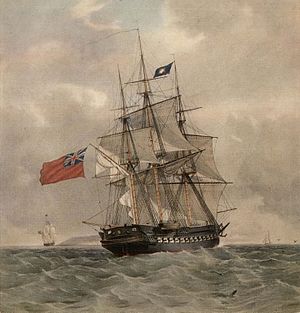
naval_battle_3In referring to the cult-like following of those who extolled all things involving Admiral Horatio Nelson, Jane Austen once wrote, “I am sick of Nelson.” Yet, the author always appreciated the lives of men in the Royal Navy. Two of her brothers served thusly. The British Navy at the time of the Napoleonic War was divided into “ships of the line,” those carrying between 60 and 100 guns, and “cruisers,” which were frigates, sloops, and brigs with fewer guns. In 1810, British naval strength was estimated to be 150+ ships of the line and near 400 cruisers. Documents on the naval history sites say that the Navy employed 800+captains, 600+ commanders, and nearly 3300 lieutenants.

During the Napoleonic Wars, the size of the British fleet was greater than all the other sea-faring nations put together.

The British Isles remained safe behind the “Wooden Walls” of the Royal Navy, and Britain was able to continue its world trade and empire building. They controlled English Channel and trading routes with size of their fleet, but Britain also actively sent its vessels out to attack enemy warships. With its strength in numbers and its developing naval industry, Britain could risk losing a ship or two to protect the British people.

In 1797, 1801, and 1807, the British navy sailed to destroy the neutral or French-allied vessels of Holland and Denmark. At Camperdown in 1797, Admiral Duncan pitted his 16 ships against 16 Dutch warships under Admiral de Winter and destroyed the enemy fleet – capturing seven Dutchmen and allowing the rest to flee.

In April 1801, the Admirality sent an expedition against Denmark to break up a northern European agreement, the Armed Neutrality of the North, that threatened British trade and shipbuilding materiel – wood, rope, grain and tar – in the Baltic Sea.

The naval Battle of Copenhagen was a British victory that saw 12 of 18 Danish vessels captured and ended the threat to its trade. In 1807, Britain again moved against Denmark when it became known there was a French move to grab the Danish fleet. Admiral Gambier took 20 ships of the line and an infantry force of some 20,000 men – including Arthur Wellesley (yes, that is the Duke of Wellington) – to prevent the vessels falling into French hands. A two-week siege began and a Danish military move to break the blockade was ended by Wellesley’s infantry. The bombardment of the capital by the Royal Navy forced neutral Denmark to hand over its 18 ships to London.

Sir Charles Austen

Sir Charles Austen

Jane Austen’s brothers entered the navy at the age of 12 and first went to sea at age 15. Naval life was a hard one, and many believed it necessary “to toughen up the boys.” Unlike in the army, naval commissions could not be bought. It was necessary to succeed in a naval career to have the patronage of an influential personage. If one recalls Admiral Crawford in Mansfield Park, this makes more sense. A man earned his future in prize money. Do we not recall Captains Wentworth, Benwick, and Harville in Persuasion? The captain would receive one-fourth of the value of the captured ship. His officers would receive graduated proportions, and ordinary seamen divided the final quarter among themselves. In Persuasion, Wentworth has earned 20,000 pounds in his eight years of service. Men learned to look forward to another war so they might continue their winning ways.”

Excerpt from Jane Austen’s Persuasion (upon letting Sir Walter’s estate, Mr. Shepherd, who is Sir Walter’s man of business, ventures a suggestion:

images-1“If a rich Admiral were to come in our way. . . “

“He would be a very lucky man, Shepherd,” replied Sir Walter. “That’s all I have to remark.”

“I presume to observe, Sir Walter, that, in the way of business, gentlemen of the navy are very well to deal with. . .I am free to confess that they have very liberal notions and are as likely to make desirable tenants as any set of people one should meet with.”

Sir Walter only nodded. But soon afterwards, rising and pacing the room, he observed sarcastically, “There are few among the gentlemen of the navy, I imagine, who would not be surprised to find themselves in a house of this description.”

Here Sir Walter’s daughter Anne spoke, “The navy, I think, who have done so much for us, have at least an equal claim with any other set of men, for all the comforts and all the privileges which any home can give. Sailors work hard enough for their comforts, we must all allow.”

“Very true, very true. What Miss Anne says, is very true,’ was Mr. Shepherd’s rejoinder, and “Oh! certainly,” was his daughter’s; but Sir Walter’s remark was, soon afterwards. “The profession has its utility, but I should be sorry to see any friend of mine belonging to it.”

“Indeed!” was the reply, and with a look of surprise.

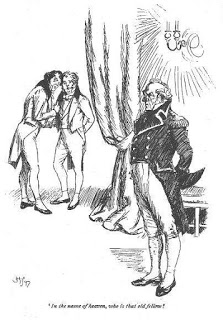
Admiral and Mrs Croft 1995.jpeg “Yes; it is in two points offensive to me; I have two strong grounds of objection to it. First, as being the means of bringing persons of obscure birth into undue distinction, and raising men to honours which their fathers and grandfathers never dreamt of; and secondly, as it cuts up a man’s youth and vigour most horribly; a sailor grows old sooner than any other man; I have observed it all my life. A man is in greater danger in the navy of being insulted by the rise of one whose father, his father might have distained to speak to, and of becoming prematurely an object of disgust himself, than in any other line. One day last spring, in town, I was in company with two men, striking instances of what I am talking of, Lord St. Ives, whose father we all know to have been a country curate, without bread to eat; I was to give place to Lord St. Ives, and a certain Admiral Baldwin, the most deplorable looking personage you can imagine, his face the colour of mahogany, rough and rugged to the last degree, all lines and wrinkles, nine grey hairs of a side, and nothing but a dab of powder at top.– ‘Inthe name of heaven, who is that old fellow?’ said I, to a friend of mine who was standing near (Sir Basil Morley). ‘Old fellow!’ cried Sir Basil, ‘it is Admiral Baldwin. What do you take his age to be?’ ‘Sixty,’ said I, ‘or perhaps sixty-two.’ ‘Forty,’ replied Sir Basil, ‘forty, and no more.’ Picture to yourselves my amazement; I shall not easily forget Admiral Baldwin. I never saw quite so wretched an example of what a sea-faring life can do; but to a degree, I know it is the same with them all: they are all knocked about, and exposed to every climate, and every weather, till they are not fit to be seen. It is a pity they are not knocked on the head at once, before they reach Admiral Baldwin’s age.”

It seemed as if Mr. Shepherd, in this anxiety to bespeak Sir Walter’s goodwill towards a naval officer as tenant had been gifted with foresight; for the very first application was from an Admiral Croft. . .

“And who is Admiral Croft?” was Sir Walter’s cold suspicious enquiry.

Mr. Shepherd answered for his being of a gentleman’s family, and mentioned a place; and Anne, after the little pause that followed, added, “He is rear admiral of the white. He was in the Trafalgar action, and has been in the East Indies since; he has been stationed there, I believe, several years.”

“Then I take it for granted,” observed Sir Walter, “that his face is about as orange as the cuffs and capes of my livery.”

Resource: 

Jane Austen’s Sailor Brothers: Francis and Charles in Life and Art

Gilman, Daniel; Thurston, H. T.; Colby, F. M., eds. (1905). New International Encyclopedia (1st ed.). New York: Dodd, Mead.

Posted in British history, Great Britain, Jane Austen, Living in the Regency, Regency era | Tagged , , | 8 Comments

Thomas More’s Life and Literature and Being a Reformation Martyr

images.jpg I am continued my journey through my undergraduate degree by looking at English literature through the ages. Today we have Sir Thomas More.

Thomas More was born on Milk Street, London on February 7, 1478, son of Sir John More, a prominent judge. He was educated at St Anthony’s School in London.He attended St. Anthony’s School in London, one of the best schools of his day. As a youth he served as a page in the household of John Morton, Archbishop of Canterbury and chancellor of England. More went on to study at Oxford under Thomas Linacre [humanist scholar and physician] and William Grocyn [an English scholar and a friend of Erasmus]. During this time, Thomas wrote comedies and studied Greek and Latin literature. One of his first works was an English translation of a Latin biography of the Italian humanist Pico della Mirandola. It was printed by Wynkyn de Worde in 1510.

Around 1494, More returned to London to study law, was admitted to Lincoln’s Inn in 1496, and became a barrister in 1501. Yet More did not automatically follow in his father’s footsteps. He was torn between a monastic calling and a life of civil service. More managed to keep up with his literary and spiritual interests while practicing law, and he read devotedly from both Holy Scripture and the classics. Also around this time, More became close friends with Desiderius Erasmus during the latter’s first visit to England. It was the beginning of a lifelong friendship and professional relationship, for they corresponded often regarding their ideas, and the pair worked on Latin translations of Lucian’s works during Erasmus’ second visit. These were printed in Paris in 1506. On Erasmus’ third visit, in 1509, he stayed in More’s home and wrote Encomium Moriae [or] Praise of Folly, dedicating it to More.

While at Lincoln’s Inn, he determined to become a monk and moved into a monastery outside of London and subjected himself to the discipline of the Carthusians, living at a nearby monastery and taking part of the monastic life. The prayer, fasting, and penance habits stayed with him for the rest of his life, as would the practice of wearing a hair shirt. More’s desire for monasticism was finally overcome by his sense of duty to serve his country in the field of politics. He entered Parliament in 1504, and married for the first time in 1504 or 1505, to Jane Colt. They had four children: Margaret, Elizabeth, Cicely, and John.

More is thought to have written History of King Richard III (in Latin and in English) between 1513 and 1518. The work is considered the first masterpiece of English historiography (the study of history, or the study of a particular historical subject), and, despite remaining unfinished, influenced subsequent historians, including William Shakespeare.

In 1504 More was elected to Parliament to represent Great Yarmouth, and in 1510 began representing London. One of More’s first acts in Parliament had been to urge a decrease in a proposed appropriation for King Henry VII. In revenge, the King had imprisoned More’s father and not released him until a fine was paid and More himself had withdrawn from public life. After the death of the King Henry VII in 1509, More became active once more. In 1510, he was appointed one of the two under-sheriffs of London. In this capacity, he gained a reputation for being impartial, and a patron to the poor. In 1511, More’s first wife died in childbirth. More soon married again, to Alice Middleton. They did not have children.

During the next decade, More attracted the attention of King Henry VIII. In 1514, he became Master of Requests (The Court of Requests was a minor equity court in England and Wales.). In 1515 he accompanied a delegation to Flanders to help clear disputes about the wool trade. His most famous work, Utopia, opens with a reference to this very delegation. More was also instrumental in quelling a 1517 London uprising against foreigners, portrayed in the play Sir Thomas More, possibly by Shakespeare. More accompanied the King and court to the Field of the Cloth of Gold.  In 1518 he became a member of the Privy Council. After undertaking a diplomatic mission to the Holy Roman Emperor, Charles V, accompanying Thomas Wolsey, Cardinal Archbishop of York, to Calasis and Bruges, More was knighted and made under-treasurer of the Exchequer in 1521.

More helped Henry VIII in writing his Defence of the Seven Sacraments, a repudiation of Luther, and wrote an answer to Luther’s reply under a pseudonym. More had garnered Henry’s favor, and was made Speaker of the House of Commons in 1523 and Chancellor of the Duchy of Lancaster in 1525. As Speaker, More helped establish the parliamentary privilege of free speech. However, he refused to endorse King Henry VIII’s plan to divorce Katherine of Aragón (1527). Nevertheless, after the fall of Thomas Wolsey in 1529, More became Lord Chancellor, the first layman yet to hold the post.

 While his work in the law courts was exemplary, his fall came quickly. More’s fate would begin to turn when, in the summer of 1527, King Henry tried to use the Bible to prove to More that Henry’s marriage to Catherine of Aragon, who had failed to produce a male heir, was void. More tried to share the king’s viewpoint, but it was in vain, and More could not sign off on Henry’s plan for divorce. He resigned in 1532, citing ill health, but the reason was probably his disapproval of Henry’s stance toward the church. He refused to attend the coronation of Anne Boleyn in June 1533, a matter which did not escape the King’s notice, and his vengeance was imminent. This amounted to More essentially refusing to accept the king as head of the Church of England, which More believed would disparage the power of the pope. In 1534 he was one of the people accused of complicity with Elizabeth Barton, the nun of Kent who opposed Henry’s break with Rome, but was not attainted due to protection from the Lords who refused to pass the bill until More’s name was off the list of names.

In April, 1534, More refused to swear to the Act of Succession and the Oath of Supremacy, and was committed to the Tower of London on April 17.  More was found guilty of treason and was beheaded alongside Bishop Fisher on July 6, 1535. More’s final words on the scaffold were: “The King’s good servant, but God’s First.” More was beatified in 1886 and canonized by the Catholic Church as a saint by Pope Pius XI in 1935.

In 1516, More published Utopia, a work of fiction primarily depicting a pagan and communist island on which social and political customs are entirely governed by reason. The description of the island of Utopia comes from a mysterious traveler to support his position that communism is the only cure for the egoism found in both private and public life—a direct jab at Christian Europe, which was seen by More as divided by self-interest and greed.

Utopia covered such far-reaching topics as theories of punishment, state-controlled education, multi-religion societies, divorce, euthanasia and women’s rights, and the resulting display of learning and skill established More as a foremost humanist. Utopia also became the forerunner of a new literary genre: the utopian romance.

Summary of Book 1 of Utopia: The author/narrator meets Raphaell Htholdaye. He brings him to the house of a friend in Antwerp where they discourse on the economic and social abuses prevalent in contemporary England. They lament the prevalence of crime, declaring that it cannot be checked by the methods of punishment then practiced. They are opposed to capital punishment for thieving, branding it as unjust in consideration of the fact that thieving has its source in poverty. Especially likely to become thieves were those parasitical retainers who lost their means of subsistence when their lords went bankrupt. Accustomed to live in pampered luxury, they are not able to work for a living when work proves necessary. Another cause of poverty was the law enforcing the enclosure of sheep lands and general morality was at a very low state anyhow. 

The remedy for these conditions was to be found in Perisia. Here evil-doers would be segregated in places provided by money collected from alms or taxes. These evil-doers would be free except from a certain amount of daily labor. They would have to wear a special form of dress. Anyone who would inspire these people to rebel would be punished by death. 

In these conversations on the state of England, it is further suggested that kings should be allowed a limited amount of money, since it was more important that the people be wealthy than that the king be wealthy. If, furthermore, wealth is to be distributed with greater equality, it would be necessary to abolish property. Under the present system, the poor are getting poorer and the rich richer. 

Analysis of Thomas More’s Tale: Utopia is a special treatise. If falls into the class of literature, which today is generally known as Utopian. Thomas More, a man with social conscience, looked upon the England of his day as a land governed with much inefficiency. He saw no reason for the sufferings, which the common people had to endure in the struggle for existence. Even more, he believed he had the remedy for these sufferings. He conceived a land in a far-away spot that was governed much as he believed contemporary England could be. This system of government he has painted in Utopia. From this work shines forth the author’s humanitarianism and hatred of war. Thomas More wanted people to be happy, hence the people of his imaginary land are happy. Further, he presents those constituents of government and life which would make people happy. Most important to the happiness of people was work. Second, as recreation from labor, innocent recreations were provided. Nor does he write as an impractical idealist. He was perfectly well aware that human nature is such that it often comes into conflict with beautiful ideals. Hence, a certain amount of force is also used in this ideal land to compel cooperation from the inhabitants. As an artist, More gives us his ideal picture with enough concrete detail to make his imaginary land live as working reality. As a whole he writes dispassionately, but with deep love for humanity. From the passage on punishment especially it can be seen how far ahead of his times More was in his social thinking. 

Resources: 

Biography 

Gabrieli, Vittorio. Melchiori, Giorgio, editors Introduction. Munday, Anthony. And others. Sir Thomas More. Manchester University Press.

History of English Literature (Part I – Early Saxon Through Milton). Hymarx Outline Series. Student Outlines Company Publishers, Boston, MA, pp. 95-96.

Luminarium 

Magnusson (ed.) Chambers Biographical Dictionary (1990) p. 1039.

Wikipedia 

Posted in British history, Great Britain, history, kings and queens, religion, research, Tudor, Tudors | Tagged , , , , , , | 3 Comments

Benedictine, the Exquisite French Liqueur

Year Founded: 1863
Distillery Location: Fécamp, France

BÉNÉDICTINE ESSENTIAL FACTS

  • In 1510, the Benedictine monk Don Bernardo Vincelli created the recipe for this French liqueur, which calls for 27 plants and spices. The three main ingredients are Angelica, Hyssop and Lemon Balm.
  • There are only three people on earth who know the complete recipe for making the spirit.
  • Benedictine is aged for up to 17 months before bottling.
  • The brand was first imported to the United States in 1888.
Posted in business, Edward III, Guest Blog | Tagged , , , , | 4 Comments

“And the Best Supporting Role” Blog Hop Continues!

Please follow a fab blog hop that celebrates the favorite supporting characters of some authors you love already and some of have yet to meet. Personally, I am on Friday, December 9, but I encourage you to visit the authors’ posts listed below to learn more of the best of the best. Each post will appear on Helen Hollick’s “Of History and Kings” Blog. 

15390951_1352922801385443_9050855439897278516_n.jpg

We all know the protagonist is the hero (or anti-hero!) of a novel. He or she usually has a companion main character, often the ‘love interest’ or maybe the stalwart side-kick, but what about that next rank down: the supporting role guy or gal? You know, the one who doesn’t get Best Actor, but Best Supporting Actor at the Oscars. I thought it time that some of these supporting cast characters had a chance to step from the shadows of novels and have a turn in the limelight.

PLUS! something for the intrepid author to answer. Each author can invite six fictional characters (not their own!) to Christmas Dinner – who will they invite? 

Here are our participating authors – but who will be their Supporting Role Characters? Join us each day!

Here is the schedule: 

December 6 ~  Inge H Borg and the Supporting Character Post is found HERE
December 7 ~ Matthew Harffy and the Supporting Character Post is found HERE
December 8 ~ Alison Morton and the Supporting Character Post is found HERE
December 9 ~ Regina Jeffers and the Supporting Character Post is found HERE
December 10 ~ Anna Belfrage and the Supporting Character Post is found HERE
December 11 ~ Christoph Fischer and the Supporting Character Post is found HERE
December 12 ~ Pauline Barclay and the Supporting Character Post is found HERE
December 13 ~ Antoine Vanner and the Supporting Character Post is found HERE
December 14 ~ Annie Whitehead and the Supporting Character Post is found HERE
December 15 ~ Derek Birks and the Supporting Character Post is found HERE
December 16 ~ Carolyn Hughes and the Supporting Character Post is found HERE
December 17 ~ Helen Hollick and the Supporting Character Post is found HERE


I will be featuring one of my favorite characters, Adam Lawrence, Viscount Stafford, who has made an appearance in nearly a dozen of my books: The Phantom of Pemberley, His American Heartsong, A Touch of Velvet, A Touch of Grace, A Touch of Mercy, A Touch of Love, A Touch of Honor, and Mr. Darcy’s Bargain. Adam received his own book in His Irish Eve. He is something of a scoundrel, but I am certain you will learn to love him as much as I do. 

41slfuffldl-_sx322_bo1204203200_

Posted in blog hop, book release, books, British Navy, mystery, Napoleonic Wars, paranormal, Peterloo Massacre, reading, real life tales, Realm series, Regency era, Regency romance, romance, Tudors, Victorian era, War of 1812 | Tagged , , , , , , , , , , , , , | 2 Comments