

Walter Scott was the first great writer to recognize the potential of historical romance as a “dramatic narration of national history, a modern commercial equivalent of the old national epic. Scott’s Waverley novels started out as the romance of Scotland, but of a Scotland that was now part of the United Kingdom, so that the hero was generally a young adventurer from south of the border. But Scott soon broke with this pattern, and with Ivanhoe (1819), the tenth in the series, her turned the adventure tale into a ‘foundation epic of England.’” [Parrinder, Patrick, Nation and Novel, Oxford University Press, 2006, pg. 151]
In Ivanhoe, Scott addresses what he purports to be the beginnings of the “English identity” with the portrayal of the barriers between the Norman lords and their Saxon serfs. Scott creates “history” with his scenes demonstrating the divide between these two groups: politically, culturally, and linguistically. These depictions influenced later historiography. For a discussion of whether this “creation of history” was a good or a bad thing, read The Isles: A History, by Norman Davies (Macmilliam Press, 2000, pp. 335-337).
 Scott’s story brings to life the hardships under which the Saxons lived. Ivanhoe is set four generations after the Norman conquest of England. Having been captured on his return to England after the Crusades, King Richard is an Austrian prison. His brother, Prince John, has claimed the throne. Prince John encourages the Norman nobles to claim supremacy over the Saxons, capriciously robbing the Saxons of their lands and turning Saxon landowners into serfs. The Saxon nobility, especially Cedric of Rotherwood, decry the Norman’s highhandedness. Cedric is so loyal to the Saxon cause that he has disinherited his son Ivanhoe for following King Richard to war.
The epigraph for Chapter 7 comes from John Dryden’s poem “Palamon and Arcite.” This poem is based on Geoffrey Chaucer’s “Knight’s Tale,” one of the Canterbury Tales. In these particular lines, we get a description of knights coming together for a tournament.
Knights, with a long retinue of their squires,
In gaudy liveries march and quaint attires;
One laced the helm, another held the lance,
A third the shining buckler did advance.
The courser paw’d the ground with restless feet,
And snorting foam’d and champ’d the golden bit.
The smiths and armourers on palfreys ride,
Files in their hands, and hammers at their side;
And nails for loosen’d spears, and thongs for shields provide.
The yeomen guard the streets in seemly bands;
And clowns come crowding on, with cudgels in their hands.
Palamon and Arcite
 Chapter 7 gives the reader a detailed description of the conditions in which the nation suffered. Scott’s uses the suffering of the Saxons as a means to define the ‘state of the nation.’
The condition of the English nation was at this time sufficiently miserable. King Richard was absent a prisoner, and in the power of the perfidious and cruel Duke of Austria. Even the very place of his captivity was uncertain, and his fate but very imperfectly known to the generality of his subjects, who were, in the meantime, a prey to every species of subaltern oppression.
Prince John, in league with Philip of France, Coeur-de-Lion’s mortal enemy, was using every species of influence with the Duke of Austria, to prolong the captivity of his brother Richard, to whom he stood indebted for so many favours. In the meantime, he was strengthening his own faction in the kingdom, of which he proposed to dispute the succession, in case of the King’s death, with the legitimate heir, Arthur Duke of Brittany, son of Geoffrey Plantagenet, the elder brother of John. This usurpation, it is well known, he afterwards effected. His own character being light, profligate, and perfidious, John easily attached to his person and faction, not only all who had reason to dread the resentment of Richard for criminal proceedings during his absence, but also the numerous class of “lawless resolutes,” whom the crusades had turned back on their country, accomplished in the vices of the East, impoverished in substance, and hardened in character, and who placed their hopes of harvest in civil commotion. To these causes of public distress and apprehension, must be added, the multitude of outlaws, who, driven to despair by the oppression of the feudal nobility, and the severe exercise of the forest laws, banded together in large gangs, and, keeping possession of the forests and the wastes, set at defiance the justice and magistracy of the country. The nobles themselves, each fortified within his own castle, and playing the petty sovereign over his own dominions, were the leaders of bands scarce less lawless and oppressive than those of the avowed depredators.
To maintain these retainers, and to support the extravagance and magnificence which their pride induced them to affect, the nobility borrowed sums of money from the Jews at the most usurious interest, which gnawed into their estates like consuming cankers, scarce to be cured unless when circumstances gave them an opportunity of getting free, by exercising upon their creditors some act of unprincipled violence.
Under the various burdens imposed by this unhappy state of affairs, the people of England suffered deeply for the present, and had yet more dreadful cause to fear for the future. To augment their misery, a contagious disorder of a dangerous nature spread through the land; and, rendered more virulent by the uncleanness, the indifferent food, and the wretched lodging of the lower classes, swept off many whose fate the survivors were tempted to envy, as exempting them from the evils which were to come.
Parrinder says, “In Ivanhoe the King whose banner of Le Noir Faineant, literally, the ‘do-nothing’ black knight – [represents] a medieval anticipation of the nineteenth century doctrine of laissez-faire (155).” Scott’s story creates a crisis of instability and anarchy as the setting. Much of the derision between the Normans and the Saxons occupies the opening chapters of the novel. The “contagious disorder” in the quote above is the suffering of ordinary people.
Scott follows this description of desolation with a “romantic” scene of a tournament held to entertain Prince John. One of the champions of the displaced Saxons turns out to be Ivanhoe, who fights under the name of the ‘Disinherited Knight.’ Ivanhoe defeats his Norman foes. “The ethic of chivalry is manifestly inadequate to deal with the social injustices Scott has outlined, but, after, all, he is writing an adventure romance and not a historical tract for his times.” (Parrinder, 155)
This “epic” romance is what Scott called the “Big Bow-Wow strain.” In Part II, we will look at the “romance” found in Scott’s Ivanhoe.
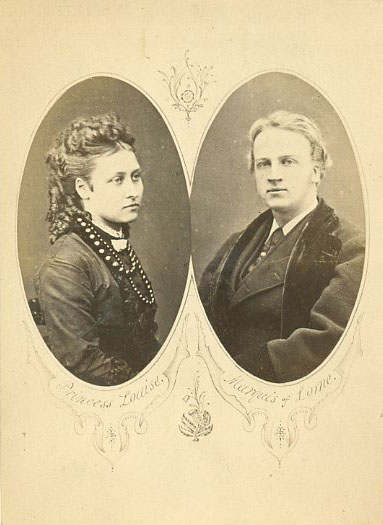
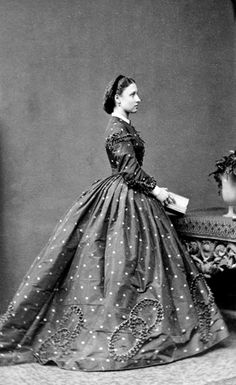 In March 1871, Princess Louise Carolina Alberta, fourth daughter and sixth child of Queen Victoria married John Douglas Sutherland Campbell, Marquis of Lorne and heir to the dukedom of Argyll , which created quite a stir. In 1870, Lorne was marked by Queen Victoria as a possible groom for Louise, but at first, the princess was undecided upon Lorne.
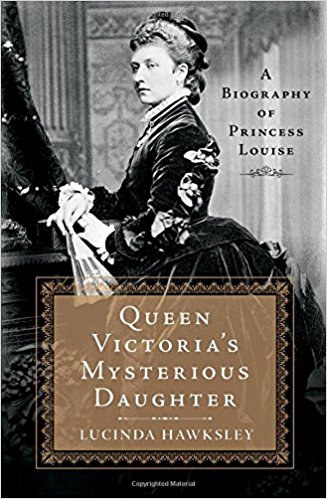 “The end of her putative engagement to Lorne does not seem to have caused Louise much heartache. Soon afterwards, she was at a breakfast party hosted by the Gladstone [the queen’s longtime bête noire, Prime Minister William Gladstone] family and Lady Lucy Cavendish noted in her diary, ‘Sat by Princess Louise, who looked very pretty and was charming and well-mannered, as usual.’ Rumours now suggested Lord Cowper as the princess’s intended fiancé. At the start of October, however, all mention of Lord Cowper was at an end, and the newspapers were about to get the story they’d been longing for.” (Hawksley, Lucinda. Queen Victoria’s Mysterious Daughter: A Biography of Princess Louise. ©2013, St Martin’s Press, 119) The princess and Lorne’s chance meeting at the Gladstones’ breakfast party at Carlton House Terrace led them to a better understanding. At the time of their engagement, Lorne’s income was a paltry £4,000, but he was eventually to be 9th Duke of Argyll. Although “romantic love” was purported, it was more likely that the pair thought they could like in harmony.
 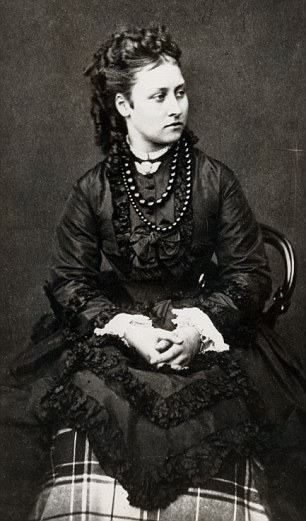 Objections to the marriage were expected from the European states, which did not condone marriages between royalty and commoners; however, the Prince of Wales’s objection was not. As the eldest son and Victoria’s assumed heir, Albert Edward (Bertie) not only objected to his sister marrying a commoner, but he also objected to Lorne for the Campbell family were prominent Liberals. Moreover, Lorne sat in the House of Commons as a supporter of Gladstone. According to Jerrold M. Packard in Victoria’s Daughters (©1998, St. Martin’s, 146), “It is likely, however, that Bertie’s most fundamental objection to his sister’s marriage purely concerned Lorne’s rank, a complaint founded on what were at the time rational grounds. In fact, all sorts of problems would inevitably have to be sorted out: Lorne’s precedence, the unedifying specter of Louise and her spouse being distantly separated at official functions, the Argylls’ deep involvement with banking and commerce (which might generate conflicts of interest, not to mention smacking of actually working for a living), even whether Louise herself might have to give up her own royal status.”
  The royal family did not expect objections from the public sector. By the time of Louise’s marriage, Victoria’s popularity had dipped considerably for she was sore to make public appearances after Prince Albert’s death. However, in order to force Parliament’s agreement to both Louise’s dowry of £30,000 (+ £6,000 a year for life) and £15,000 for life for Prince Arthur (who had come of age at the same time as the wedding), Victoria agreed to open Parliament (a duty she had forgone since Albert’s death). Louise stood on the steps during this duty.
 Bold Outlaw breaks down the “fyttes” as follows: “The Gest is divided into eight sections, known as Fyttes. Here’s a breakdown of the main action….
 “And there’s much debate over which Edward the king is meant to be. In the early 19th century, Joseph Hunter found the king’s journey in the Gest is similar to that of Edward II’s. There was even a Robyn Hood serving as a porter in this king’s court. However, other details point to the reign of Edward III. Professor Stephen Knight stated in his 1994 study of Robin Hood that the king may have been Edward IV, who was likely the king at the time of composition.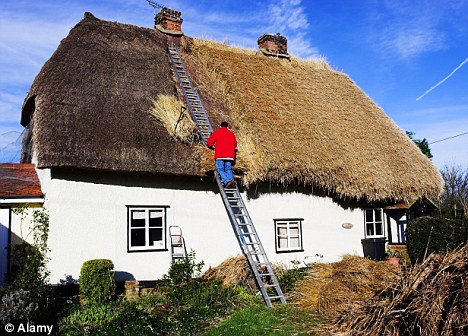
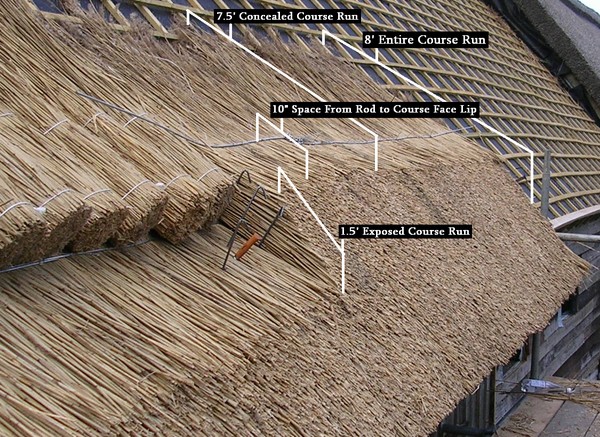

 “Another particular of a thatcher’s tool box is the shearing hook which looks like a left-handed scythe, except it’s right-handed and is used to shear the ears off the reeds. When Holloway has finally, and painstakingly, worked his way up to the ridge of the roof he has to pin the thatch down tightly with some spars. He creates a double layer of thatching at the ridge and covers this with thatching wire (like chicken wire but with a smaller mesh) to protect it from lumbering crows.
 nd when he thinks he has lost Anne forever, he stalks off in a fit of jealousy. For all this I blame him, but then comes that letter …


 (To read the entire letter, visit Woodland Heritage, which reproduced the letter. Reproduced with the kind permission of “The Mariner’s Mirror” – Journal of the Society for Nautical Research. Go

 ” That event is well documented, and is certainly in the style of the Marquis, who was a notorious hooligan. To his friends he was Henry de la Poer Beresford; to the public he was known as ‘the Mad Marquis’. In the Oxford Dictionary of National Biography he is described as ‘reprobate and landowner’. His misdeeds include fighting, stealing, being ‘invited to leave’ Oxford University, breaking windows, upsetting (literally) apple-carts, fighting duels and, last but not least, painting the heels of a parson’s horse with aniseed and hunting him with bloodhounds. He was notorious enough to have been suspected by some of being ‘Spring Heeled Jack’, the strange, semi-mythical figure of English folklore. The phrase isn’t recorded in print until fifty years after the nefarious Earl’s night out.

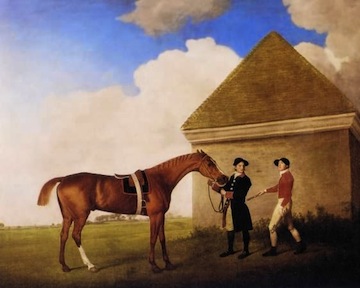 Yet I write Regencies, and in Regency times, gentlemen were as obsessed with their horses as today’s men are with their cars or motorbikes. In fact, in two of my books, including the latest release, the hero breeds horses for sale.
  If you wanted to sell, or to buy, a horse, you might go to a local horse fair. Or, if you lived in London, you’d drop down to Tattersall’s on Hyde Park Corner. It had been founded in 1766 by a former groom of the Duke of Kingston, and held auctions every Monday and on Thursdays during the Season. Tatersall’s charged a small commission on each sale, but also charged both buyers and sellers for stabling.
 My hero in

 Meet the Author Jude Knight
 When Viscount Avery comes to see an invalid chair maker, he does not expect to find Min Bradshaw, the woman who rejected him 3 years earlier. Or did she? He wonders if there is more to the story. For 3 years, Min Bradshaw has remembered the handsome guardsman who courted her for her fortune. She didn’t expect to see him in her workshop, and she certainly doesn’t intend to let him fool her again.
 Lieutenant Rick Redepenning has been saving his admiral’s intrepid daughter from danger since their formative years, but today, he faces the gravest of threats–the damage she might do to his heart. How can he convince her to see him as a suitor, not just a childhood friend?
  Rede, the Earl of Chirbury wants the beautiful widow, Anne Forsythe, from the moment he first sees her. Not that he has time for dalliance, or that the virtuous widow would be available if he did.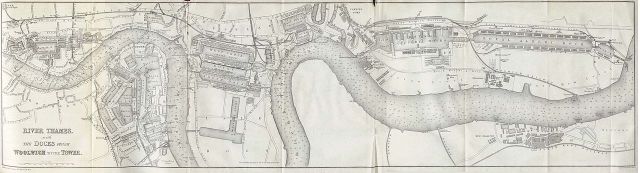
 The London Docks, located at Wapping, were the second dock system to be built in London. A large range of items were traded at the London Docks, including: tobacco, marble, bark, rubber, whalebones, iodine, mercury, wool, wax, paper, hemp, coir yarn, rattans, jute, skins, coconuts, sausage skins, rice, fruit, olive oil, fish oil, nuts, sugar, coffee, cocoa, spices, chutney, brandy, wine, rum, and sherry.
 In my newest cozy mystery, The Prosecution of Mr. Darcy’s Cousin, the character of Thomas Cowan makes a repeat performance. Readers met Cowan as a friend of and former sergeant serving under Colonel Fitzwilliam during the Spanish campaign of the Napoleonic Wars in The Mysterious Death of Mr. Darcy.
 Unfortunately, by the 1820s their reputation stood in disarray. Many individuals within the organization associated with common thief takers and were known to look the other way when a crime was not of notice. The government disbanded them in 1839. [J.M. Beattie, The First English Detectives: The Bow Street Runners and the Policing of London, 1750-1840 (Oxford: Oxford University Press, 2012)
 The Prosecution of Mr. Darcy’s Cousin: A Pride and Prejudice Mystery


 Every Woman Dreams...