Okay, to the best of my knowledge the term “debutant” was later than the Regency Era.
The word “debutante” is of later vintage than the Regency. She would be referred to as “coming out”, per Jane Austen’s Mansfield Park, where the discussion is whether Fanny Price is “out” or not.
The reference often quoted to determine this issue comes from a letter written in 1817, which calls young ladies “debutants” was written by a young man. From the tone of the parts I read, he was not being kind by using that word. Another reference can be found in a newspaper in Scotland sometime between 1830-1840.
The usual use of the word “debut” and “debutant” was in regard to actors and actresses. If a man said girls were “debutantes'” I fear he might have been comparing them to actresses who often went overboard when making an acting debut.
Debutante balls were later. During the Regency one might or might not have a ball for a young lady. The Queen did not hold drawing rooms regularly from 1811 to her death. It was not necessary to make one’s curtsey to the Queen or to hold a ball for a girl to enter society.
Girls wore white or pastels because they were the fashionable colors. It was not, as many assume, a sign of her virginity. The girls wore fashionable evening gowns. They wore their hair as was fashionable. They did not do group introductions.
Prior to about 1817 debutant refers to an actress debuting on stage – http://www.etymonline.com/index.php?term=debutante
What you might want to look into is court presentation:
https://susanaellisauthor.wordpress.com/2013/08/22/presentation-at-court-in-the-regency-period/
http://historicalhussies.blogspot.com/2009/06/being-presented-to-queen.html
You have no idea how much research I did on court presentations for my REALM series, for there is a scene in both A Touch of Scandal and A Touch of Velvet on the necessary dresses, hair style, how to walk into the room and exit the room backwards, etc.
Daughters of peers made their curtsey to the queen when their parents thought them old enough. Lady Sarah Spencer mentioned her presentation in a letter to her grandmother. Then when the young lady married a peer or a man who might attend court, she was presented again. A lady did not need to be presented to be out in Society. During much of the Regency period, drawing rooms and presentations were less common than before the time George III became ill.
One had to be presented to attend court functions, but not to be considered out or to marry.
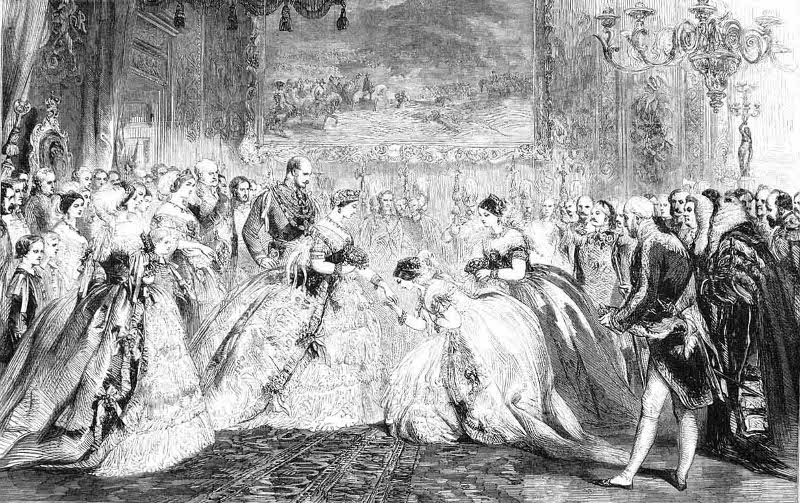
A family might or might not also host a ball for the daughter. It could be held at the family’s townhouse or elsewhere, depending on the size of the house and those invited. All of this depends on what the family could afford (how rich are they and how much do they want to impress others?). The ball also might be arranged by the girl’s godmother (such events were generally arranged by women), especially if the family did not have deep pockets.
This is a piece from Jane Austen’s World on the cost of living in Regency England, if you are interested in that information.
https://janeaustensworld.wordpress.com/tag/cost-of-living-in-regency-england/
In many eras, the court was the arbiter of fashion and, thus, vital to the ton. This was not true during the Regency. So presentation only really mattered for those who expected to participate in court functions. Society had other arbiters of fashion.


 Every Woman Dreams...