Loving Mr. Bennet, a Guest Post from Jann Rowland

This post originally appeared on Austen Authors on June 26, 2019. Enjoy! 

I’ve always liked Mr. Bennet as a character in Pride and Prejudice. He’s sarcastic and funny, he provides several priceless moments, and is Elizabeth’s true supporter, sometimes in direct confrontation with his wife. I am well aware that in looking after her daughters’ needs (i.e. wishing to see them married) Mrs. Bennet feels like she is killing two birds with one stone, but I’ve always thought her motives were primarily selfish—in securing her daughters’ futures, she’s really securing her own. Mr. Bennet, however, is more focused on what is best for Elizabeth.

One thing that’s always surprised me, however, is that Mr. Bennet is as beloved a character as he is. I’ve had several conversations with other people who also claim to enjoy him as a character, and only few who disagree. To be honest, I’ve always wondered why that ratio did not swing the other way. Let’s face it, Mr. Bennet is actually a bit of an ass. Let’s dig a little into his character.

In many ways, Mr. Bennet is a reprehensible character. Among his faults are:

  • Sarcasm, if used correctly, is altogether acceptable, and by that, I mean it’s not directed toward someone in a mean way. Mr. Bennet is a master of sarcasm, and all too often, it’s directed at his youngest daughters and, more often, his wife. The fact that his wife is not really able to understand a lot of his witticisms is not a mitigating factor—though Mrs. Bennet is a twit, I’m sure she frequently understands that he’s making fun of her, even if she doesn’t understand what he’s saying. In modern terms, this could be called a form of emotional abuse.
  • Mr. Bennet’s neglect of his family beyond dispute. Other than Elizabeth, and occasionally Jane, he doesn’t have time for any of his daughters, except to make fun of them. This neglect, of course, culminates in Lydia’s elopement and the near ruin of his family. They are saved from this calamity, not because of Mr. Bennet, but almost in spite of him. And while he does vow to do better, his attempts consist of telling Kitty she won’t be out for ten years, and a few words about soldiers in a raised voice.
  • Mr. Bennet takes no thought for the family’s eventual support until he is forced to do so. His excuse is that he expected to father a son to provide for his daughters and widow. This, again, is Mr. Bennet taking the easy way out, as he would simply pass the burden to a son. It’s also short-sighted, as without dowries, the girls face a difficult time attracting a husband, and if unable to do so, would leave them dependent upon their brother, who would likely come to see them as a burden.
  • Furthermore, the family’s situation is truly desperate. We are told Mr. Bennet has to watch his wife or she will exceed his income, and yet, if he passed away early, he would leave his wife and daughters homeless, to attempt to subsist on an income of £200, when they would be accustomed to ten times that amount. There was a reason why Mrs. Bennet feared genteel poverty, though her way of showing it is reprehensible.
  • The younger girls are allowed to run wild. As the master of the house, Mr. Bennet possesses the power to compel obedience and teach good behavior, but he allows his wife to teach the girls when she’s clearly not equipped to do so. This makes it doubly difficult for the girls to attract good suitors—not only would a man not wish to marry a woman who will embarrass him, many would not wish to marry a woman whose sisters might do so, to say nothing of eventually having to support them.

By these accounts, Mr. Bennet’s faults are heavy, indeed. But do not despair, for Mr. Bennet also possesses may sterling qualities, though they are not all shown in proper ways. Consider the following:

  • Mr. Bennet is a good provider. You can look at this as both a negative and a positive, but he rarely forbids his girls anything, and they always have everything they require. The girls are always dressed well, have been given a good home and a good life which, though of the lower gentry, would have been the envy of the majority of those who lived at that time.
  • Within the Bennet family, Mr. Bennet plays the role of Elizabeth’s protector. Mrs. Bennet and Elizabeth have never seen eye to eye. She is habitually critical of her second eldest daughter and would have forced her into a disastrous marriage with Mr. Collins if she had her way. And no one can forget the memorable line from Mr. Bennet on the occasion: “An unhappy alternative is before you, Elizabeth. From this day you must be a stranger to one of your parents. Your mother will never see you again if you do not marry Mr. Collins, and I will never see you again if you do.” Knowing his daughter as he does, he knows what will make her happy and what will not. He truly is her protector.
  • Mr. Bennet is an intelligent man, and the one daughter of his who could share in his intellect, he made certain she learned as much as she wished. I’ve always thought Mr. Bennet would have been better suited to be a university professor or a researcher, though I suppose we’re never really told where his literary tastes tend. Regardless, it’s clear he’s not really cut out to be a landowner, as he can’t bother himself with the estate’s maintenance. But he certainly is a smart man.
  • Though his methods of dealing with his wife are not always laudable, Mr. Bennet does not descend to some of the behaviors which were common in his day. He does not have a mistress (though we’re not told directly, I am confident we can infer this), so he doesn’t go looking elsewhere to satisfy needs Mrs. Bennet cannot meet. He also does not physically mistreat his wife. Let’s face it—being married to a woman like Mrs. Bennet would drive most around the twist! There is a counter argument there, but the fact that he does none of these things, though society would not have condemned him if he did, is a point in his favor.

Regardless of these facts, it seems the majority of the fandom appreciates Mr. Bennet’s good points, while recognizing those which are not so laudable. He’s a flawed character, but somehow we love him all the more for it. Then again, who wants to read books about perfect people? It’s a character’s weakness that makes them interesting! The reason I often tend toward writing variations where Mr. Bennet is a little changed or rises to the occasion, is because I do like him as a character and would like to see him realize a little more of the potential that lurks under his sardonic exterior. Thanks for reading!

Posted in Austen Authors, family, Georgian England, Georgian Era, Guest Post, Jane Austen, Living in the Regency, marriage, Pride and Prejudice, reading, reading habits, Regency era, Regency romance, writing | Tagged , , , , , , , | Comments Off on Loving Mr. Bennet, a Guest Post from Jann Rowland

Colours of the Regency

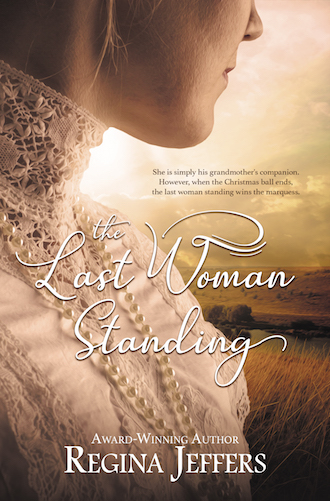
LastWomanStanding3x5   In my novella, “Last Woman Standing,” which is to be a part of a Christmas anthology, the heroine’s father is a horticulturalist. He has an unusual monkey flower species called the “Calico” in the book. In case you are interested, here is what the website Calscape says of the flower: “Mimulus pictus is a species of monkey flower known by the common name calico monkey flower. It is endemic to central California, where it is known only from the southernmost Sierra Nevada and adjacent Tehachapi Mountains in Tulare and Kern Counties. It grows in forest and woodland habitat, in open, bare, rocky, and often disturbed areas. This is an annual herb growing in a small patch at ground level or erect to a maximum height of about 38 centimeters. The stem is hairy and rectangular in cross-section. The oppositely arranged leaves are somewhat oval in shape and up to 4.5 centimeters long. The tubular base of the flower is encapsulated in a dark reddish calyx of sepals with uneven lobes. The five-lobed flower has a maroon throat and the circular face is white with stark maroon veining.” The last line of this description is the one that drove me a bit batty while describing the flower in the book, for “maroon” was not a termed commonly used during the Regency. It was just becoming popular at the end of the 18th Century. 

s-l640

From Dictionary. com
ma·roon1
/məˈro͞on/
adjective
adjective: maroon
  1. 1.
    of a brownish-crimson color.
    “ornate maroon and gold wallpaper”
noun
noun: maroon; plural noun: maroons
  1. 1.
    a brownish-crimson color.
    “the hat is available in either white or maroon”
  2. 2.
    BRITISH
    a firework that makes a loud bang, used mainly as a signal or warning.
Origin
late 17th century (in the sense ‘chestnut’): from French marron ‘chestnut’, via Italian from medieval Greek maraon . The sense relating to color dates from the late 18th century.

It seems like the Regency was the era for colorful names and names for colors. However, many only lasted a season or two. Some colors were dictated by events of the day (battles won, allied countries, etc.). But one of the reasons the Regency era is so fascinating is due to the many descriptive colors, etc.

I am not sure certain whether there were specific color names confined just to the Regency. However, if you would like a list of colors used across the Regency and the longer Georgian eras, accompanied by swatches, you might want to have a look at Sarah Waldock’s post at her blog, Renaissance and Regency Ruminations. If you read my story, you will notice I use both the terms “chestnut” and “Egyptian brown” to describe the veining in the flower pictured above. 

This color list was primarily prepared by Sarah, who also dyes fabrics using old techniques and formulas, augmented by information provided to her by Charles Bazalgette, who recently published a biography of his ancestor, Louis Bazalgette, entitled Prinny’s Taylor. It is important to keep in mind that most of the colors on this list came primarily from colors used for garments and accessories, rather than interior decor. Which is not to say that such colors were not used for such purposes, just that the sources of these color names are based upon garment colors.

51jyow5S1BL.jpg In case you want to know more of the book Prinny’s Taylor: The Life and Times of Louis Bazalgette (1750-1830)The Prince of Wales, later George IV, is probably the most written-about of all British monarchs, and his excesses, his debts and the huge sums that he expended on his wardrobe are legendary. It is therefore strange that the man who was the Prince’s tailor for over thirty-two years, and his principal tailor for over half of that time, should have been named, and then only in passing, in just two other books. 
The reason why Louis Bazalgette has been a shadowy figure until now is that the relationship between the two men was discreet and almost clandestine. This biography presents a detailed picture of an extraordinary man, of humble origins, whose influence on gentlemen’s tailoring, and upon the Prince himself, must have been far-reaching. 
This fascinating story presents a new angle on Georgian and Regency life, as seen through the eyes of a little French tailor who by his own efforts became a very wealthy propertied merchant. There is also a great deal of information on gentlemen’s tailoring of the period, a subject sparsely covered in other publications, and we are regaled in detail with the clothes that were made for Prinny, when and where he wore them and how much they cost. Many of the anecdotes about George are included, but given new meaning because of the fresh information that the author has discovered.
Some of Louis Bazalgette’s descendants also enter the story. His eldest son Joseph William Bazalgette, R.N, served with distinction during the Napoleonic wars, and his grandson of the same name was the noted civil engineer who made such a difference to London. The author is Louis’ great-great-great-great-grandson.
Lovers of the period will be delighted by many previously unpublished items which have been uncovered during over twenty years of painstaking research.

The earliest reference I have found of Navy Blue comes in 1814. (from the Oxford English Dictionary). Forest Green dates to 1810. Navy Blue might have been already in use at the time because the reference refers to a vat of dye. Forest Green was used by a Scot in reference to a color called Lincoln green. Some of the names of colors used in house paint  were very odd. Farrow and Ball used to have a sample card for historic colors like dead salmon and mouseback. We can also discover color names in the descriptions of fashion prints in the magazines. Some color terms date from after the Regency, such as Mauve. Colors and fashion details were also named after events. A fashion color was stone. I wondered it there was a difference between stone and Bath stone, field stone, or flagstone. Fruits and flowers were names often used. Navy blue was the color of the British naval uniform. Navy bean attested from 1856, so called because they were grown to be used by the Navy. (From etymonline.com) But it does not say when they began using the term as a color rather than a noun. I have seen “cerulean blue,” “Pomona green,” and “primrose yellow,” to name a few.

There were common Regency/Georgian terms for various hues within each color. Someone on the Beau Monde loop (sorry, I cannot discover who provided this list) tells us about “greens.” 

Greens, for instance, were:

Bottle green

Bronze Green

Corbeau coloured

Emerald green

Olive (green)

Parrot green

Pomona green

Rifle green

Saxon green

Spring (green)

This table reads as: the title of the color, the year the term was first used, the modern color description/name as per the British Color Council,

Aurora, 1809. Chilli.

Aurora, 1829.  Shell-Pink.

Eminence, 1829.  Crushed Strawberry.

Japanese Rose, 1826.  Crushed Strawberry.

Marsh Mallow, 1829. Crocus or Old Rose.

Morone, 1811. Peony Red.

Naccarat, 1800. Tangerine.

Terre D’Egypt, 1824. Brick Red.

In the Regency period, there certainly are more colors for white/cream/shades thereof than for red/pink/orange.

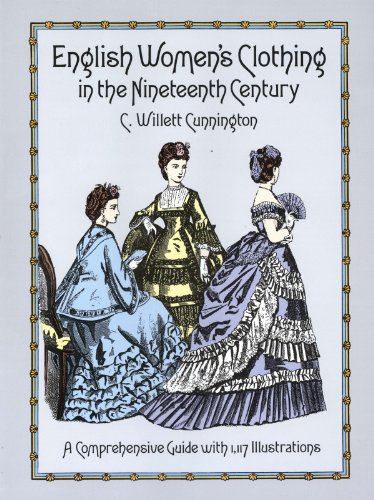
51mvL3GneQL.jpg  You might consider an investment in C. Willett Cunningham’s, English Women’s Clothing in the Ninetheeth Century: A Comprehensive Guide with 1,117 Illustrations. At 576 pages, it is well worth the nearly $20 cost, for it has information on hair styles, hats, prices on yardage, undergarments, etc. 

Book Blurb:

The nineteenth century was a period of continuous change for women’s clothing in England. The growing prosperity of the merchant class meant an ever-larger number of women for whom “dress” was a principal function in life, while the increasing availability of lower-priced ready-made garments enabled women of moderate means to purchase the fashions of the day. In addition, the development of the railways spurred the spread of new goods, while the removal of the tax on papers in 1854 produced an abundance of fashion magazines at cheap prices, bringing news of the latest styles to the multitudes.
The magnificent array of ladies’ fashions that characterized the century are on display in this remarkably complete decade-by-decade overview. Drawing almost exclusively on contemporary sources — fashion magazines, newspapers, rare period photographs, memoirs, Victorian novels, periodicals, and other publications, as well as firsthand observation of actual garments — the author describes and explains the couture that evolved in response to changing social conditions, technological innovations, and cultural developments.
Over 1,100 line and tone drawings and photographs depict hundreds of outfits ranging from lovely morning dresses and starkly attractive riding outfits to elegant carriage costumes, opulent evening dresses, and exquisite bridal gowns. Full-page plates also depict period millinery, footwear, underclothing, and other apparel, while three useful glossaries provide descriptions of materials, definitions of technical terms, and more.
Museum curators, vintage clothes collectors, and fashion historians will find this carefully researched and well-written book an indispensable tool for dating, identifying, and authenticating vintage clothing. Not only are styles described and illustrated in detail for each year; all the small details of construction by which specimens can be dated are given wherever possible. Moreover, designers, illustrators, and fashion enthusiasts will be delighted by the superbly detailed illustrations, which painstakingly document the fashionable finery of the Victorian era.

Posted in book release, British history, Georgian England, Georgian Era, Living in the Regency, Regency era, research, writing | Tagged , , , | 3 Comments

What is the Difference Between a Peerage That is “Dormant,” “Extinct” or in “Abeyance”?

1200px-Wreath_lockup_gold_rgb.jpgI was recently looking for names and titles to use for characters in a list of extinct  and abeyant peerages in an online copy of  Debrett’s from the mid 1800s. Some of the titles in abeyance had been in that state since the 13th Century. It got me thinking as to whether the readers of Regency romances know the difference between dormant, extinct, or in abeyance as a plot point. Does it matter to the average reader whether the history is accurate or not? 

While most peerages were created by patent and become extinct when there are no longer any male heirs, some peerages were created when a man was called to the House of Lord by a writ of summons issued in  his peerage title. If the clerk made a mistake and wrote the wrong title then a new peerage was created. These peerages by writ could descend to both sons and daughters. However, while if a man had several sons the peerage went to the oldest, the practice was that sisters shared equally. If a holder of a barony had four daughters and no sons, they would all share equally in property, but none of them would actually hold the title. This would remain in abeyance until such time as one descendant survived and was willing and able to do a detailed  family tree accounting for all the sisters and their children for how many years or decades since the death of the last peer. If there were four daughters there would be fewer descendants than if there had been fifteen daughters. By the fifth generation the families probably forgot there was  ever a matter of a peerage title.

4a8592acf0eb682ac1272c6931b4ddcb.png

It was an arduous task to show all of the children of the last peer, when born, when died, when married to whom, with proofs from parish registers about marriages and baptisms, as well as records of deaths. The successful claimant need not be the only surviving descendent of the sisters, but the descendant of the oldest sister had a bit of precedence over the descendants of the younger sisters.

When peerages are in abeyance, the birth of a son to one of the sisters does not automatically make him the successor to all of the sisters. 

Secondary peerages are dormant titles if there are no heirs to bear them or if the heir is not given a peerage title.

A title is also dormant when it is known or suspected that male heirs exist somewhere, but that they have not come forward to claim the title.

It is my understanding, for example, that the Avonmore peerage is dormant because one of the sons of the 3rd viscount went off to Australia, where he was known to have married and  had a child. However, no one ever came forward to claim the peerage, so it is dormant. If  it was known that there were no longer any male heirs left alive , the peerage will be considered extinct.

Frederick Berkeley, 5th Earl of Berkley was also the baron of Berkeley, He had married Mary Cole and had ten children, but 5 were declared illegitimate in 1811, after Frederick’s death in 1810. There was a question regarding the exact date of Frederick and Mary’s marriage. Although they both claimed it occurred on 30 March 1785, the incontrovertible proof offered at the time was the marriage occurred at Lambeth Church, Surrey, on 16 May 1796. Thus, the earldom was presented to their fifth child (the others being illegitimate), a son, age 16 years at the time: Thomas Morton Fitzhardinge Berkely. Because the young man was alive, but too frightened of, or loyal to, his oldest brother and his mother, he ever claimed the peerage and never took his seat in the House of Lords. It is said, per his father’s will, Thomas would have lost his small inheritance had he disputed his eldest brother’s claim to the titles. 

Burke's_Peerage,_Sixth_Edition_(1839),_Title_Page

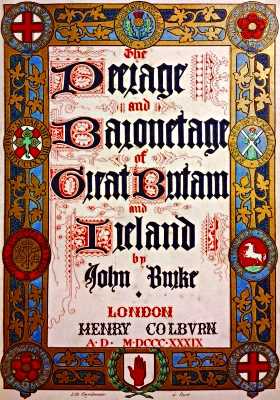
A Genealogical and Heraldic Dictionary of the Peerage and Baronetage of the British Empire, Sixth Edition 1839 (known better simply as Burke’s Peerage) ~ Public Domain via Wikipedia

   Therefore, the earldom of Berkeley remained dormant until Thomas died in August 1882, unmarried and without issue. Then the Berkeley earldom went to a descendent of a younger legitimate  brother. At that time a female descendent of an older legitimate brother petitioned to have the barony awarded to her. After proving her descent and that the barony was a barony by writ, she succeeded. She was Louisa Mary Milman, 15th Baroness Berkeley (by birth: Berkeley) (1840-1899). Louisa was followed by Eva Mary Foley, 16th Baroness Berkeley (by birth: Milman) (1875-1964) (The peerage became abeyant in 1964.) Eva was followed by Mary Lalle Foley-Berkeley, 17th Baroness Berkeley (1905-1992) (The abeyance was terminated in 1967.) Then, Anthony Fitzhardinge Gueterbock, 18th Baron Berkeley (b. 1939), her nephew became the baron. The heir apparent is his son the Hon. Thomas FitzHardinge Gueterbock (b. 1969).

Extinct indicates the peerage has no more heirs at all or no more male heirs if a peerage by patent.

Dormant means a peerage has been swallowed up in a superior title or an unclaimed peerage when a likely successor is known to be alive.

Abeyance means daughters shared equally in the right of succession so the prize goes to the descendent who either out lives the others or can prove she or he has a better claim than the cousins.

For more information on how a peerage is swallowed up in a superior title, visit:

http://www.regencyresearcher.com

The Prince Regent could not call a title out of abeyance, but he could grant a title in a second creation that had become extinct. Titles in abeyance have known contenders and usually start with a title available to daughters. When daughters inherit, they all do equally, so the title is in abeyance until one claimant is given the right to it. The numbering starts over. I used this in my book Captain Frederick Wentworth’s Persuasion.

Abeyance is when there is more than one claimant to a title. This usually happens when a peerage by writ is inherited by daughters. It remains in abeyance until it is called out by one of the claimants. One title was claimed after 400 years. Afterwards, Parliament decided to limit the statute for such claims to 100 years.

When there are no title holders to be found and no people presumed to be around, the title becomes extinct and reverts to the Crown.

The title is dormant, if  a person is thought to be alive, but just has not claimed it. The baby would be the duke, and the title would be alive during the child’s life time unless proof can be found of his death.

The law, however, is not without its remedy for this anomalous situations. It vests in the Crown a power by its prerogative of selecting one of the co-heirs, or the heir of one of the co-heirs, to take the peerage, and so soon as the Crown has declared its will in this respect, the peerage descends to the person thus selected. The usual mode in which the Crown has made its selection has been by causing a Writ of Summons to be issued to the person selected, or, if such person be a woman, by causing Letters Patent be made determining the abeyance in her favour. Where the person selected is already a peer, the abeyance has also been determined in his favor by Letters Patent. The heir in whose favour an abeyance is thus terminated takes the peerage and holds it to him and the heirs of his body. This is not a new peerage, but, rather, the old peerage with the old precedence. (The Peerage Law Handbook, p. 100-101).

According to one of the peerage law books, the ONLY power a monarch retained over a title once it was granted was the power to choose from amongst co-heirs and terminate an abeyance in the favor of one of them. It almost never happened, but it is technically possible that as Regent, Prince George, the Prince of Wales, could, in fact, have done this if the hero in an author’s next Regency romance is somewhere in the line of co-heirs.

Posted in British history, family, Georgian England, Georgian Era, historical fiction, Inheritance, kings and queens, Living in the Regency, peerage, real life tales, Regency romance, research, writing | Tagged , , , , , , | Comments Off on What is the Difference Between a Peerage That is “Dormant,” “Extinct” or in “Abeyance”?

Banks and Banking During the Regency Period

The model for modern day banking system came at the hands of 17th Century goldsmiths. The goldsmiths quickly realized that the gold being used by their depositors was only a fraction of what they had in store. They began to loan people money from one of their depositors’ gold supply. They held promissory notes for full payment, plus interest. In time paper certificates (paper money, so to speak) were issued instead of the gold coins. 

One of the most successful goldsmith’s of the time was Richard Hoare, who owned the Golden Bottle in Cheapside. Toward the end of the 1600s, he moved his business to Fleet Street. “C. Hoare & Co. is the sole survivor of the private deposit banks which were established in the 17th and 18th centuries.  The bank has been owned and directed by members of the Hoare family since it was founded by Richard Hoare in 1672. In the days before street numbering, businesses were identified by signs.  Richard Hoare traded at the ‘Sign of the Golden Bottle’ in Cheapside.” 

Mr. Hoare,
     Pray pay to the bearer hereof Mr. Witt Morgan fifty-four
 pounds ten shillings and ten pence and take his receipt for the
 same. Your loving friend,
                                              Will Hale


For Mr Richard Hoare
  at the Golden Bottle in Cheapside.

The Hoare family eventually became part of the landed gentry. Henry Hoare II improved the Stourhead estate with Grecian-styled gardens. “Henry [Hoare] ‘the Magnificent’ was one of a small group of early eighteenth-century ‘gentleman gardeners’ using their acres to create a particularly personal landscape which expressed their hopes and beliefs about the world and their journey through it. His vision, recreating a classical landscape, depended on water. The centre piece of the garden at Stourhead is the lake, which dictates the path you take and the views you enjoy. The damming of the river and the creation of the lake was an ambitious undertaking. Henry ‘the Magnificent’ and his architect Henry Flitcroft planned it before work began on the garden buildings such as the Temple of Flora, Pantheon and Grotto. 


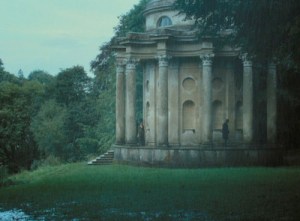
Buried deep in the beautiful greenery of Stourhead Garden is the Temple of Apollo, where Mr Darcy makes a swoonworthy confession to Elizabeth Bennet in the Pride and Prejudice film from 2005.

Like any good idea, eventually, the value on the banknotes in circulation was larger than the value of gold begin stored by the goldsmiths. Therefore, a different direction was required. The Bank of England and the Bank of Scotland changed banking with the formation of banking corporations.

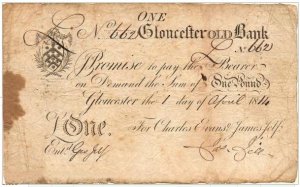
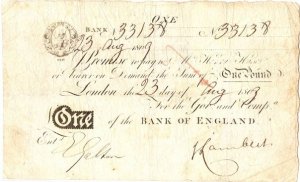
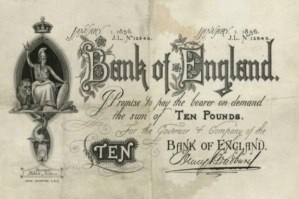
The Bank of England was founded in 1694. It began as a privately owned bank when William Patterson and some of his friends agreed to assist King William III in financing a war with France. Patterson and his associates set up a joint-stock bank with limited liability and a Royal Charter, thanks to the King. This bank issued its own bank notes as legal tender. Each note held a “promise” to pay the holder of the note the sum written upon the note. The payment would be in gold or coins. They were handwritten on bank paper and signed by one of the Bank’s cashiers. They contained the precise sum deposited by the person, meaning they could be “thirty-two pounds, six shillings, and 4 pence.” Later, standard denominations, between £20 and £1000, were used, but that was not until around 1750. These “standard denominations” still required the name of the person holding the note and the Bank cashier’s signature to be legal. The bank also served as the banker for the Government and its operations. It now occupies three acres on Threadneedle Street. 

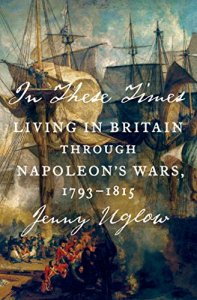
I have a book called  In These Times: Living in Britain. Through Napoleon’s Wars by Jenny Uglow. Farrar, Straus and Giroux (January 27, 2015). In it, the author mention’s Hoare’s bank. There are several references to banking and banks: city banking and country banking, as well as the Bank of England. “Several private banks dotted down Fleet street and the Strand to Charing Cross, a busy corridor between the city and Westminster and the West end, all dealing with wealthy landed customers in need of mortgages and loans, or, if they were flush, a safe house for their deposits. …. Each bank had its distinctive clientele: Praed & Co in Fleet Street had the West Country and Cornish business; Drummond’s catered for army agents, Gosling’s and Child’s for East India company tycoons; Coutts dealt with the aristocracy and never with industry; Wright’s in Covent Garden looked after the Catholic gentry and Herries Bank in St. James Street, further west, issued cheques for smart travellers setting out on the grand tour.The rule at Hoare’s was that one partner was in attendance at all times…. Ten clerks. One must be in at all times even on Sundays and Christmas day. They could live there.” Baring’s was a merchant banker. The Quakers had several banks, including Lloyd’s in Birmingham, Backhouse in Darlington, and Gurney’s in Norwich.

Goldsmiths, John Freame and Thomas Gould began Barclay’s in Lombard Street in London in 1690. When James Barclay, a Quaker, married Freame’s daughter, Sarah, he became a partner in the bank, along with Freame’s son, James. This was in 1736. Thus, the name Barclay’s stuck. Barclay’s was one of the first to print their banknotes instead of writing them out by hand. Like those mentioned above, the banknotes still need to be signed by a Barclay’s cashier. “In an age when few people could read, signs were used to identify buildings; when buildings changed hands, the sign would remain. The Barclays business moved to the sign of the Black Spread Eagle in 1728, which later became numbered as 54 Lombard Street. As a result, Barclays became identified with the Spread Eagle, which was adopted as its official coat of arms in 1937.”


Founded in 1717 by goldsmith Andrew Drummond, Drummonds Bank remained in the Drummond family until the early 1900s when The Royal Bank of Scotland purchased it. Andrew Drummond practiced his trade as a goldsmith at the sign of the Golden Eagle on the east side of Charing Cross, when many of the Scottish gentry resided. However, his banking interests soon outshone his work as a goldsmith. “The firm grew quickly and in 1760 moved to a commissioned building on the bank’s present site on the west side of Charing Cross. Andrew Drummond died in 1769 and a series of subsequent partnership agreements divided the business among three branches of the Drummond family. In addition two of the partners were involved in substantial Treasury contracts for the payment of British troops in Canada and America before and during the American War of Independence The firm also kept accounts for King George III and other members of the royal family. By 1815 Messrs Drummond had over 3,500 accounts. In 1824 customer deposits exceeded £2 million.”

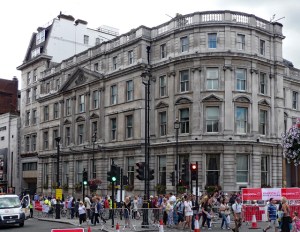
Drummonds now specializes in wealth and asset management. It is located at 49-50 Trafalgar Sqare, London, where it began its services. Reconstruction began on the building in 1877 and was completed in 1881. Some of Drummonds many clients over the years included His Majesty King George III, Alexander Pope, Benjamin Disraeli, Beau Brummel, Capability Brown and Thomas Gainsborough. “Both Coutts & Co. and Drummonds have received royal patronage. King George III moved his account from Coutts to Drummonds during his reign as he was displeased with Coutts for bank-rolling the Prince of Wales from his personal account. Messrs Drummond & Co. honoured the wishes of the King but unsurprisingly when the Prince of Wales became King George IV in 1820 he moved the royal account back to Coutts. More recent known members of the royal family include the late Queen Elizabeth The Queen Mother.”  

John Taylor


Taylors & Lloyds Bank was founded in 1765. “The original Taylor was John. He was a Unitarian – a non-conformist like his business partner Sampson Lloyd. John started life in Birmingham as a cabinet-maker, ‘a mere artisan’, but went on to make his fortune manufacturing buttons and other trinkets. He became particularly well-known for his exquisite enamelled snuff boxes. Something no self-respecting 18th century gentleman would be seen without. At its height, Taylor’s business employed more than 500 people, and made a very healthy profit. Taylor was 54 when he went into partnership with Sampson Lloyd. His sound business reputation and his great wealth were recognised, with his name being placed first in the bank’s title.”

Sampson Lloyd II (1699-1779), co-founder of Taylors & Lloyds.

Meanwhile, Sampson Lloyd, a Quaker, was an iron producer and dealer. He became rich because of the Seven Years War, but, afterwards, he looked for another business outlet. With his son Sampson Lloyd II, Sampson formed a partnership with John Lloyd in what became Taylors & Lloyds Bank, originally located in Birmingham. The bank’s original purpose was to provide credit to small manufacturers in and around Birmingham. They showed a profit of £10,000 over the first six years. “The first branch office opened in Oldbury, some six miles (10 km) west of Birmingham, in 1864. The symbol adopted by Taylors and Lloyds was the beehive, representing industry and hard work. The black horse regardant device dates from 1677, when Humphrey Stokes adopted it as sign for his shop. Stokes was a goldsmith and “keeper of the running cashes” (an early term for banker) and the business became part of Barnett, Hoares & Co. When Lloyds took over that bank in 1884, it continued to trade ‘at the sign of the black horse.'” [Timeline. Lloyds Banking Group]

Child & Co.was one of the oldest British bank, coming into existence in the 1580s. It originated in the goldsmith shop of the Wheeler family. Like, Drummond above, the goldsmithing business soon took a back seat to the banking business. William Wheeler’s widow eventually married another goldsmith, Robert Blanchard. Their shops merged under the sign of the “Marygold” on Fleet Street. Francis Child joined in Blanchard’s partnership. Child, eventually, inherited the whole business located at 1 Fleet Street, when he married Blanchard’s stepdaughter. This occurred in 1681. Incidentally Francis Child later became Lord Mayor of London. [History of Child & Co]

“Francis Child’s grandson, Robert, had no male issue and the Child fortune was eventually settled on his granddaughter, Sarah Sophia Fane, who married the fifth Earl of Jersey. Lady Jersey had an income of £40,000, and had some London fame as one of the patronesses of Almack’s assembly rooms. Sarah was to act as senior partner of the bank for sixty-one years.

“Child & Co remained a relatively small bank through the nineteenth century surviving because of its location in the west end and due to the interest of the aristocracy, politicians and officeholders of Westminster. In 1924, Child’s and Co. was sold to Glyn, Mills &Co, bankers of London, which was in turn acquired by The Royal Bank of Scotland in 1939. Child & Co has since continued to trade under its own name as an office of the Royal Bank and recently re-established its private banking traditions under the old Marygold trade sign.” [Georgian Index]

Coutts & Co “was founded at the sign of the Three Crowns in London’s Strand in 1692 by John Campbell, a Scottish goldsmith. A fellow Scot and able banker, George Middleton, was taken into partnership in 1708 and assumed sole control upon Campbell’s death in 1712. Middleton later married Campbell’s daughter, Mary, and quickly attracted a large aristocratic clientele. Middleton was forced to stop payment temporarily during the 1720 financial crisis, but subsequently recovered and took into partnership his brother-in-law, George Campbell, in 1727 and his nephew, David Bruce, in 1744. By this time the business was located at 59 Strand and was focused exclusively on banking, having abandoned the original goldsmithing business which had involved the fashioning and sale of gold and silver wares. Middleton died in 1747 and Bruce in 1751, leaving George Campbell as sole proprietor.

“In 1755 the business became known as Campbell & Coutts, following the entry into the partnership of James Coutts, the son of an Edinburgh banker, upon his marriage to George Campbell’s niece. In 1761, a year after Campbell’s death, James took his younger brother, Thomas Coutts, into partnership as James & Thomas Coutts. This partnership continued until 1775 when James retired and the business adopted the title of Thomas Coutts & Co. Thomas soon took in several partners, the best known of whom were Edmund Antrobus, Edward Marjoribanks and Coutts Trotter, but their names were never included in the title of the bank.

“Coutts was an astute banker and well-connected in society. He developed the business, taking over the private banking house of Davison, Noel, Templer, Middleton & Wedgewood in 1816 and attracting many new clients. When Thomas Coutts died in 1822, the bank was renamed Coutts & Co. It was by then unquestionably one of the leading private banks in London and acted as banker to British and foreign royalty as well as to many important personalities from such spheres as politics, theatre, literature and business.” [Coutts & Co, RBS Heritage Hub]

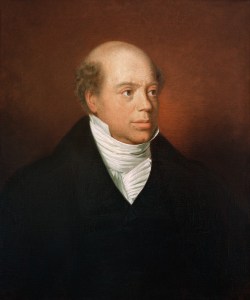
Nathan Mayer Rothschild ~ public domain

N. M. Rothschild’s efforts in the banking industry in England came much later than the others. Nathan Rothschild came to London early in the 19th Century to open the bank that became N.M. Rothschild & Sons. Nathan Mayer acquired the premises at New Court on St Swithin’s Lane in 1809 which remain the headquarters of N M Rothschild & Sons today. [Georgian Index]

Mayer Amschel Rothschild became a powerful European banker in the late 18th Century and early 19th Century. They had powerful customers in the Landgraviate of Hesse-Kassel in the Holy Roman Empire. Mayer sent his sons to the various capitals of Europe to establish banks. Nathan Mayer Rothschild was sent to England. 

“Nathan first settled in Manchester, where he established a business in finance and textile trading. He later moved to London, founding N M Rothschild & Sons in 1811 at New Court, which is still the location of Rothschild & Co’s headquarters today. Through this company, Nathan Mayer Rothschild made a fortune with his involvement in the government bonds market. According to historian Niall Ferguson, ‘For most of the nineteenth century, N M Rothschild was part of the biggest bank in the world which dominated the international bond market.’

“During the early part of the 19th century, the Rothschild London bank took a leading part in managing and financing the subsidies that the British government transferred to its allies during the Napoleonic Wars. Through the creation of a network of agents, couriers and shippers, the bank was able to provide funds to the armies of the Duke of Wellington in Portugal and Spain. In 1818 the Rothschild bank arranged a £5 million loan to the Prussian government and the issuing of bonds for government loans. The providing of other innovative and complex financing for government projects formed a mainstay of the bank’s business for the better part of the century. N M Rothschild & Sons’ financial strength in the City of London became such that by 1825, the bank was able to supply enough coin to the Bank of England to enable it to avert a liquidity crisis.

“Like most firms with global operations in the 19th century, Rothschild had links to slavery, even though the firm was instrumental in abolishing it by providing a £15m gilt issue necessary to pass the Slavery Abolition Act of 1833. The money provided by Rothschild was used to pay slave owners compensation for their slaves and the gilt issue was only fully redeemed in 2015.” [Rothschild & Co]

This is not to say all people used banks during this time. In any city or small town during the Regency, there are also always pawn shops, where people could get cash for goods. Also most folks would keep a strong box with some cash funds on hand–any country estate would need this in order to pay wages to servants and to workers. Town houses would also require cash on hand to pay wages.

Do not be confused by the term “banknote.” It is simply used in numismatic and banking circles. Banknotes were promissory notes drawn on a bank’s funds. In the U. S., banknotes are what we call “dollars.” U.S. banknotes are drawn on the Federal Reserve Bank, and no other bank in the country is authorized to issue them. This is similar to other countries. But such was not true in the early days of banking in England and Europe. Strictly speaking, they were promissory notes (or cheques/checks) issued by specific banks to a specified value.  They are called Bank Cheques today, which are a different beast to cheques written by a bank’s customers.

The Bank Notes of old are the equivalent of today’s Bank Cheques/Checks – a check issued by a specific bank against its own holdings (they withdraw the funds from their customer’s account and hold it in their own reserves), and the bank holds that money until the the Bank Cheque/check is presented for payment.

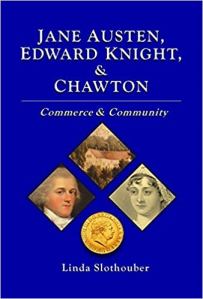
In Jane Austen, Edward Knight & Chawton: Commerce and Community by Linda Slothouber she says that Edward Austen Knight’s primary London bank was Goslings Bank. He also used a bank founded by his brother Henry called Austen, Maunde & Austen, which went bankrupt and made him suffer a substantial loss.


Goslings bank had records of money deposited in country banks. One such was Hammond & Co, in Canterbury. That bank consistently sent large deposits to the Gosling bank. I imagine these deposits would travel with guards,

Agents also regularly made deposits in the Gosling bank. They were close enough to town to do so.

Sparrow & Co., an Essex bank also made deposits into the Gosling account. Money for current expenses and for current wages were kept on hand so not all money was sent to the bank. They were not quite in the habit of writing checks. Coin was preferred to paper and most servants and such were paid in coin. Though this book is about the finances of Edward Austen Knight, it is the only one so far that I have found that actually discusses the bank deposits. Others discuss the debts, the expenses, loans made by the landowner to others or taken out from a bank.

Other Sources:

Banking in Eighteenth Century England

British Banking History

Regency England and Money 

Posted in Uncategorized | Tagged , , , , , , , , , , , | 2 Comments

Mansfield Park, or the Dark Side of Jane Austen’s Characters, a Guest Post from Eliza Shearer

Every single Janeite I know, regardless of the degree of their crush for Mr Darcy, agrees that Pride and Prejudice is an enjoyable novel. Mention Mansfield Park, however, and dissent soon appears. Fanny is too quiet, too passive, too boring, say her detractors. I used to be one of them, but over the years, the novel has grown on me.


An acquired taste

Mansfield Park is Jane Austen’s equivalent of Marmite. For those of you who are not familiar with this most British of concoctions, Marmite is a dark, salty spread with the power to drastically divide opinion, best exemplified by its famous slogan, “love it or hate it”. Any mention of Marmite reminds me of my friend Amanda, who moved to the UK in her twenties. I was with her when she tried Marmite for the first time, spread over toast. She found it revolting. But back to Mansfield Park.

Mansfield Park is a bit like a visit to the hall of mirrors in an old-fashioned fun fair. Jane Austen distorted and stretched some of the archetypes we find in her novels to the point that they are barely recognisable. Looking at it from this perspective, Mansfield Park is like the dark side of her other works, almost a cautionary “what ift” in some cases. I am sure that the parallels are many, but below are my favourites.


Maria Bertram is Emma Woodhouse on the loose

Both Mansfield Park’s Maria Bertram and Emma’s protagonist are pretty, clever and rich. They think they know better than anyone else around them, but still, fail to see what’s right in front of their eyes when it comes to their own love life. However, where Emma’s worst instincts are reigned in on time, Maria’s are encouraged. Maria’s fate is like Emma’s ghost of Christmas’ Yet to Come, a show of what might have happened to Miss Woodhouse had she not learned from her mistakes and rectified her behaviour.

Mrs Norris is a poorer, older version of Fanny Dashwood

Fanny Dashwood’s name always appears in Janeite’s lists of their favourite baddies. She is the scheming and selfish wife of Mr Dashwood, Elinor and Marianne’s brother in Sense and Sensibility. Artfully, she convinces her weak husband to limit the financial assistance to his late father’s widow and her three daughters to little more than “presents of fish and game” during the hunting season. Fanny is a wealthy woman, but she is far from generous, even with her nearest. Quite the opposite: she is every bit as mean and tight as Mrs Norris, and equally disagreeable.


Mr Rushworth is a financially independent Mr Collins

At first sight, these two gentlemen only have in common the fact that they are not particularly bright, nor gifted in the art of conversation. But dig deeper, and you will see some interesting patterns emerge. Mansfield Park‘s Mr Rushworth and Pride and Prejudice‘s Mr Collins only pay attention to what interests them. They are utterly oblivious to the subtle female signals around them, even those that are obvious to everyone else. They also share the same deep respect towards an older woman, Mrs Rushworth in one case, Lady Catherine de Bourgh in the other. The only difference, and what fires up Mr Collin’s unsufferable obsequiousness, is their fortune.

Lady Bertram is the female equivalent of Mr Woodhouse

Lazy, indolent and selfish, Mansfield Park‘s Lady Bertram and Emma‘s Mr Woodhouse see everything under the filter of self-interest and agree that change is the worst possible evil. They also care little about what lies beyond their little obsessions. That’s pug for Lady Bertram, and his and everyone else’s state of health in the case of Mr Woodhouse. Mr Woodhouse’s sex and disposition mean that he gets to be a lot more outspoken than Lady Bertram, but dig deeper, and you will see two kindred souls resting on equally comfortable sofas.

Henry Crawford is a rich Wickham

Pride and Prejudice’s George Wickham and Mansfield Park’s Henry Crawford could not look more different. Where Wickham is handsome, Crawford is slight and not particularly good-looking. Ignore their physical appearance, however, and the similarities between them are striking. Both men are irresistibly attractive to some women, enjoy flirting with anyone who is game and have a tendency to land ladies in trouble. The big difference is that Henry has money and can enjoy creating havoc and then moving on. Wickham, on the other hand, has the unfortunate combination of a modest income and a gambling problem, meaning that he has a price – and so he ends up married to Lydia.

Mary Crawford is a (seriously) insolent Elizabeth Bennet

Mansfield Park’s Mary Crawford and Pride and Prejudice’s Elizabeth Bennet are witty, pretty and fascinating young women with a sense of fun and some serious sparkle. They don’t mince their words, are not afraid to stand her ground and are experts in the art of teasing. Perhaps that’s why they are magnets for socially awkward and introverted men. However, Mary takes sassiness to a whole new level with her flippant comments and double entendres. Lady Catherine de Bourgh should count herself lucky: she may think Elizabeth Bennet an insolent girl, but she would have a heart attack if she ever met Mary Crawford.

Edmund Bertram is Henry Tilney without a sense of humour

As well as their profession, Mansfield Park’s Edmund Bertram and Northanger Abbey’s Henry Tinley share a similar moral compass, a kind heart and an eagerness to educate their respective protegées. But that is pretty much it. Edmund’s approach to life is solemn, serious, moralistic even, whereas Henry prefers irreverence, irony and laughter. Just think of Mr Tilney’s delightful conversation with Catherine – his opinions on muslin are a personal favourite of mine – then compare them to Edmund’s talk about sermons, house approaches and old horses. No wonder Edmund never makes it to the top of the favourite Austen leading men lists.

Fanny Price is an uninvolved Anne Elliot

Readers of Miss Darcy’s Beaux are well aware of my soft spot for Jane Austen’s introvert characters, of which Mansfield Park’s Fanny and Persuasion’s Anne are excellent examples. Both heroines are strong in their beliefs, but they have a quiet, unassuming manner, that many Janeites consider to border on sheer passivity (and, in the case of the former, was fatally ignored in one of the most catastrophic casting mistakes in an Austen adaptation). However, compared to Fanny Price, Anne is like Wonder Woman. She is the person everybody turns to when things go awry, and she delivers, coming to the rescue of injured children and keeping her cool when everyone is hysterical at Lyme. Perhaps it is no wonder that so many people love Anne, but accuse Fanny of single-handedly dragging Mansfield Park into the heart of the Mansfield Park rocks/sucks debate.

In any case, remember my friend Amanda and her dislike of Marmite? After a few years in the UK, she finally challenged her own assumptions and tried it with an open mind. I can’t say she has become a fan of Marmite, but she appreciates its sharp, strong taste and will even have it on toast every once in a while.


What are your thoughts regarding Mansfield Park? Can you think of any other similarities or distortions amongst Austen characters?

Posted in Austen Authors, Georgian England, Georgian Era, Guest Post, historical fiction, Jane Austen, Living in the Regency, reading, Regency era | Tagged , , , , , , , | 2 Comments

Celebrating the Winners of Recent Giveaway

and-the-winners-are.jpg

All these prizes have been delivered:

from The Tea Room – July 10, 2019

Becky Cherrington, Mary Anne Landers, and Molly Laird chose Regency Summer Escape.

Margaret Murray-Evans and Mary Ann Anderson chose Angel Comes to the Devil’s Keep.

Patricia Sanford Addison chose Lady Joy and the Earl. 


from Swoonworthy Summer Reading – July 13, 2019 

Denis Austen and Karen M. Llanes chose Regency Summer Escape. 

Morse Dawn chose Lady Chandler’s Sister.

Anna Katherine Koehler chose Letters from Home. 


from the Austen Authors’ Blog – July 15, 2019

Caryl Kane, Jerilynn Rodriquez, Teresa Williams, Charlene Capodice, Susanne Barrett, Talia Sommers, Eva Edmonds, Mary Campbell, Teresa Broderick, Kayla Rose, and Virginia Kohl all received Regency Summer Escape. 


from Soiree with Sandra Masters – July 18, 2019 

Mary Ann Landers, Peggy Parker Martin, Roxane Twisdale, and Bobbie Gore chose Regency Summer Escape. 

Crystal Blake chose Lady Chandler’s Sister. 

Charlene Whitehouse chose In Want of a Wife. 


from my blog posts on July 19, 2019 and July 23, 2019

Luthien84, Glenda M, DarcyBennett, Cyndi Bennett, and Patricia Finnegan all received Regency Summer Escape. 


Posted in giveaway, Uncategorized | Tagged , , , , , , , , | 3 Comments

Prince Augustus Frederick, Duke of Sussex: Two Illegal Marriages


Artist: G.E. Madeley (fl.1826–1841, date of death unknown). Photograph by User:Dr_pda – Sir Nicholas Harris Nicolas (1799 – 1848) History’ of the Orders of Knighthood of the British Empire,of the order of the Guelphs of Hanover; and of the medals, clasps, and crosses, conferred for naval and military service, Volume iii, published in London, 1842. Photo taken by User:Dr_pda
Prince Augustus Frederick, Duke of Sussex wearing the robes of a Knight Companion of the Order of the Thistle ~ wikipedia 

The sixth son and ninth child of King George III and Queen Charlotte, Prince Augustus Frederick, Duke of Sussex, was known to have convulsive asthma’; therefore, he did not join his brothers Ernest, Duke of Cumberland, and Adolphus, Duke of Cambridge, in military service. He was tutored at home before being sent to the University of Göttingen in Germany, along with Ernest and Adolphus. He briefly considered becoming a cleric in the Church of England. In 1805, during the Napoleoinic War, he served at home in Britain as Lieutenant-Colonel Commandant of the “Loyal North Britons” Volunteers regiment. [The Complete Peerage, Volume XII, Part 1. St Catherine Press. 1953. p. 535.Edited by Geoffrey H. White.]

Augustus travelled extensively. He was something of a scholar, with a love for music and books. It is said he owned over 5000 bibles, all part of 50,000 books’ collection that he claimed. In Rome, Augustus met Lady Augusta Murray, the second daughter of John Murray,  4th Earl of Dunmore, and Lady Charlotte. Lady Augusta was five years older than the prince, was considered without countenance, being very plain of face, and was known to be as bossy, as was her mother. Augustus and Augusta married, without his father’s permission, on 4 April 1793. The King’s minister of Hanover affairs Ernst zu Münster was sent to Italy to escort him back to London. [T. F, Henderson, ‘Augustus Frederick, Prince, duke of Sussex (1773–1843)’, Oxford Dictionary of National Biography, Oxford University Press, 2004.] Supposedly, the couple married a second time at St George’s, Hanover Square, on 5 December 1793. However, they did not disclose their complete identities to the cleric conducting the ceremony. Both marriages took place without King George III’s consent or knowledge.

Unfortunately, the Royal Marriages Act of 1772 said: “…no descendant of King George II, male or female, other than the issue of princesses who had married or might thereafter marry “into foreign families”, could marry without the consent of the reigning monarch, ‘signified under the great seal and declared in council.’ That consent was to be set out in the licence and in the register of the marriage, and entered in the books of the Privy Council. Any marriage contracted without the consent of the monarch was to be null and void. However, any member of the royal family over the age of 25 [Augustus was only 20 at the time.] who had been refused the sovereign’s consent could marry one year after giving notice to the Privy Council of their intention so to marry, unless both houses of Parliament expressly declared their disapproval. There is, however, no instance in which the sovereign’s formal consent in Council was refused.” [Royal Marriages Act 1772]

Artwork by August Grahl, Portrait of Lady Augusta Murray, Wife of H.R.H. Augustus Frederick ~ https://www.mutualart.com/Artwork/Portrait-of-Lady-Augusta-Murray–Wife-of/C1084E914277119F

In August 1794, the Court of Arches annulled the prince’s first marriage on the grounds that it contravened the Royal Marriages Act 1772, not having been approved by the King. However, Prince Augustus Frederick continued to live with Lady Augusta until 1801, when he received a parliamentary grant of £12,000 and the couple separated. Lady Augusta retained custody of their children and received maintenance of £4,000 a year. Their two children were named Sir Augustus Frederick d’Este (1794-1848), born in Essex, and who later became Deputy Ranger of St James’s and Hyde Parks and who unsuccessfully claimed the dukedom of Sussex on his father’s death, and Augusta Emma d’Este (1801-1855), born at Lower Grovsvenor Street, London, and who married. Thomas Wilde, 1st Baron Truro, (age 63 at the time and Augusta Emma was age 44) who served as Lord High Chancellor from 1850-1852.

Augustus d’Este is the earliest recorded person for whom a definite diagnosis of multiple sclerosis can be made. The course of his MS, which was not diagnosed during his lifetime, is known from the diaries he kept. D’Este left a detailed diary describing his 22 years living with the disease. Meanwhile, like her father, Augusta Emma also suffered from asthma. Upon her death, The Thanet Advertiser remembered her as: “a lady of strict business habits, and rather reserved in manner, of exceedingly good general information, living, while at Ramsgate, in a very quiet and unostentatious way”. Neither of Prince Augustus’s children had children of their own. 

Both parents were descended from the royal House of Este, therefore, the use of “d’Este”. In 1806, their mother, Lady Augusta, was given royal licence to use the surname “de Ameland” instead of Murray. With this she was styled as “Countess.” Prince Augustus was alienated from his parents and the Court for years because of his illegal marriage. Eventually, Augustus and Augusta became estranged. She died in 1830 at Ramsgate. 

Cecilia_Underwood_duchess_of_Inverness

Cecilia Underwood, duchess of Inverness and second wife of Augustus Frederick, duke of Sussex ~ https://en.wikipedia.org/wiki/ Cecilia_Underwood,_1st_Duchess_of_ Inverness#/media/File:Cecilia_ Underwood_duchess_of_Inverness.JPG

Prince Augustus again acted in contravention of the Royal Marriages Act 1772, not receiving his brother’s, William IV’s, permission, when he married Lady Cecilia Letitia Underwood in May 1831. Twelve years Augustus’s junior, Lady Cecilia was a widow, having lost her husband Sir George Buggin. She was the daughter of the Irish lord, Sir Arthur Saunders Gore, 2nd Earl of Arran. The pair sired no children. 

“As the marriage was not considered lawful, Lady Cecilia could not take the style and title Her Royal Highness The Duchess of Sussex. Instead she assumed the name “Underwood”, her mother’s maiden name, by Royal Licence and was known as Lady Cecilia Underwood. The couple resided at the Duke’s apartments in Kensington Palace. However, Lady Cecilia was not accepted as a full member of the British Royal Family. Royal protocol restricted Lady Cecilia from being present at any functions attended by other members of the Royal Family, as she was unable to take a seat beside her husband due to her lower rank. To compensate for this, in 1840 Queen Victoria created her Duchess of Inverness, in her own right, with remainder to the heirs male of her body lawfully begotten. This recognised her husband’s subsidiary title of Earl of Inverness.”

With a morganatic marriage and a illegal marriage plaguing her, Lady Cecilia could not come to Court; therefore, she spent her time in Society, where she was welcomed by many a hostess. Meanwhile, Prince Augustus became a great supporter of the arts, science and literature. He was a favorite of Queen Victoria, when she came to the throne, and even did the honor of giving her away at her wedding to Prince Albert. 

Prince Augustus died of erysipelas on 21 April 1843. [Erysipelas is an infection typically with a skin rash, usually on any of the legs and toes, face, arms, and fingers. It is an infection of the upper dermis and superficial lymphatics, usually caused by beta-hemolytic group A Streptococcus bacteria on scratches or otherwise infected areas. Affected individuals typically develop symptoms including high fevers, shaking, chills, fatigue, headaches, vomiting, and general illness within 48 hours of the initial infection.] Because Cecilia’s body could not be accepted into the royal vault, Prince Augustus is buried at Kensal Green Cemetery, north of Paddington. 

NOTE! “Lady Cecilia is portrayed briefly in the 2016 ITV series Victoria, Episode 6 “The Queen’s Husband” by Dais Goodwin, creator of the series and its main writer. The portion of this episode relative to Lady Cecilia is thus described: “Victoria curries favour with her uncle the Duke of Sussex, who is unable to present his wife at court because their morganatic marriage was in violation of the Royal Marriages Act 1772. Although his wife was the daughter of an earl, she was not a member of the royal family. Victoria uses her discretion to make her the Duchess of Inverness and welcomes her to court.” In this episode, Lady Cecilia’s last name is given as ‘Buggin’, her former married name, and is not cared for much by Victoria for its sound. But no mention is made later of Lady Cecilia’s taking her mother’s surname Underwood. Lady Cecilia’s husband, the Duke of Sussex, is portrayed by David Bamber.”


Posted in British history, Church of England, Georgian England, Georgian Era, Great Britain, kings and queens, Living in the Regency, marriage, Napoleonic Wars, real life tales, Regency era, Victorian era, William IV | Tagged , , , , , , , , , , , , | 8 Comments

Celebrating the Release of “Courting Lord Whitmire” + an Excerpt & Giveaway

thejointblog.co

thejointblog.co


I have a new release which is part of the Regency Summer Escape anthology. In it illness we now call PTSD (Post Traumatic Stress Disorder) plays a major role. The main character has spent 15 years in war, first as part of the Napoleonic Wars and then on the Canadian front. Naturally, we must assume he has memories of the battles. Yet, PTSD did not exist as we know it. So, what do we know of PTSD in history?

GotQuestions.org provides us with a summary of PTSD. “Post traumatic Stress Disorder develops in some people following a traumatic event. The event or “stressor” could be exposure to death or threatened death, actual or threatened serious injury, or actual or threatened sexual violence. The sufferer may be directly exposed, indirectly exposed through a family member or close friend experiencing the event, or extremely or repeatedly indirectly exposed through his or her work (such as first responders, police officers, military personnel, or social workers). Common trauma experiences are combat, car accidents, natural disasters, abuse, rape, and mass violence. After such an event most people will show signs of stress such as feeling on edge, anxiety, fear, anger, feelings of depression, a sense of detachment, desire to avoid trauma-related reminders, flashbacks, difficulty sleeping, headaches, changes in appetite, irritability, self-blame, “survivor’s guilt,” or a sense of numbness. For most people, these reactions lessen and eventually subside with time.”

In the Bible, Job likely suffers from PTSD. Job loses his wealth, family, health, etc. Job says of his suffering: “For my sighing cometh before I eat, and my roarings are poured out like the waters./ I was not in safety, neither had I rest, neither was I quiet; yet trouble came.” (Job 3:25-26) In Job 7: 14-15, we find, “Then thou scariest me with dreams, and terrifies me through vision:/ So that my soul chooseth strangling, and death rather than my life.”

From The History of Post Traumatic Stress Disorder, we learn more of the history of the illness. In “Mahabharata, an epic tale in Indian mythology originally written by Sage Ved Vyas in Sanskrit, Mahabharata illustrates the Great War of Mahabharat between the Pandavas and the Kauravas that happened in 3139 B. C. […] The great epic Mahabharata describes vivid combat stress reactions exhibited by the ancient worriers.” (Sir Lanka Guardian

Examples in literature abound of the evidence of PTSD. The Illiad describes multiple battles scenes and combat suffering. Could Ajax in Homer’s tale suffer from the disorder? And what of Achilles? Was not Achilles devastated by the death of his comrade Patroklos? And what of the Trojan women who waited for their husbands’ return.

In the piece entitled “From ‘Irritable Heart’ to ‘Shellshock’: How Post-Traumatic Stress Became a Disease,” we have, “The Greek historian Herotodus writes a lot about PTSD, according to a presentation by Mylea Charvat to the Veterans Administration. One soldier, fighting in the battle of Marathon in 490 BC, reportedly went blind after the man standing next to him was killed, even though the blinded soldier “was wounded in no part of his body.” Also, Herotodus records that the Spartan leader Leonidas — yes, the guy from 300 — dismissed his men from combat because he realized they were mentally exhausted from too much fighting.” 

In Shakespeare, we find a description of PTSD in Henry IV, Part 2.
Tell me, sweet lord, what is’t that takes from thee
 Thy stomach, pleasure, and thy golden sleep?
Why dost thou bend thine eyes upon the earth,
And start so often when thou sit’st alone?
Why hast thou lost the fresh blood in thy cheeks,
And given my treasures and my rights of thee
To thick-eyed musing and cursed melancholy?

In Act 5, Scene 3 of Macbeth, we are provided:

“Macbeth: How does your patient, doctor?


Doctor: Not so sick, my lord, as she is troubled with thick-coming fancies that keep her from rest.


Macbeth: Cure her of that! Canst thou not minister to a mind diseased, pluck from the memory a rooted sorrow, raze out the written troubles of the brain, and with some sweet oblivious antidote cleanse the stuffed bosom of that perilous stuff which weighs upon her heart.


Doctor: Therein the patient must minister to himself.”

hilobrow.com

hilobrow.com

Charles Dickens speak of how a train accident affected him. He says he was ”curiously weak… as if I were recovering from a long illness,” after a traumatizing railway accident in which the front of the train plunged off a bridge under repair and 10 people died, with another 49 injured. Dickens wrote in letters to people: “I begin to feel it more in my head. I sleep well and eat well; but I write half a dozen notes, and turn faint and sick… I am getting right, though still low in pulse and very nervous.” Dickens admitted to continue to feel anxiety when train travel was necessary, even after the accident described above. (From ‘Irritable Heart’ to ‘Shellshock’)

CourtingLordWhitmire 5x7 copyAlthough in my story there is no real “word” or “diagnosis” to describe the effects of war, the early literature tells us that some sort of upheaval most assuredly did exist. So wether we call it melancholia, nostalgia, ester root, heimweh, malady du pays, soldier’s heart, neurasthenia, hysteria, compensation sickness, railway spine, shell shock, combat exhaustion, stress response syndrome, situational disorders, or PTSD, physical shock, accompanied by horrifying circumstances have haunted men since the beginning of time.

She is all May. He is December. But loves knows not time. 

Colonel Lord Andrew Whitmire has returned to England after spending fifteen years in service to his country. In truth, he would prefer to be anywhere but home. His late wife cuckold him, before he departed England. His daughter, who was reared by his father, enjoys calling him “Father” in the most annoying ways. However, his future is the viscountcy, and Andrew knows his duty to both title and child. He imagines himself the last of his line until he encounters Miss Verity Coopersmith, the cousin of his dearest friend. Miss Coopersmith sets Whitmire’s world spinning out of control. She is twenty years his junior, but all he can think is she is absolute perfection. 

You may purchase copies of Regency Summer Escape for $0.99 on Amazon or read it free on Kindle Unlimited. 

Enjoy this excerpt from “Courting Lord Whitmire,” where our hero, Colonel Lord Andrew Whitmire, acts instinctively to save the life of the one woman who fascinates him, Miss Verity Coopersmith. 

Andrew turned to look out over the groomed lawns and inhaled slowly, while praying for calm. How could anyone, most certainly a woman he had known but a matter of weeks, understand how many people he had failed in his life, especially her relation, Robert Coopersmith. “You cannot know of the kinship I held with your cousin,” he said, attempting to keep the irritation from his tone. He turned his head to permit her to see his sincerity, but he found himself lost in her steady gaze. “Although I hold nothing but honest respect for your uncle and your brother, it should have been my long-time friend, Robert Coopersmith, who sits in this house as the 16th Lord Coopersmith. If he had returned to Worcestershire after the Peninsular battles, he could have been long settled with a family and an heir. Instead, he stayed with me—because of my foolish pride—my fear of others knowing how my wife cuckolded me—Robert died in the last battle of the war, ironically, saving my life.”

“You are in error, my lord,” she said softly, never looking anywhere but into his eyes. “Over the years, Cousin Robert regularly wrote to my parents and to my aunt and uncle and even, occasionally, to me. In each letter, he praised you as the best of men, showering you with compliments for your ability to instill leadership in your men.” She stepped closer still, close enough that Andrew could bend his neck and kiss her if he so chose. “Whether you realized it or not, Robert depended upon you in so many ways.” Her words were infused with a bit of sadness.

“You are in error; it was I who depended upon him,” Andrew contested.

“Robert was afraid to return to the estate and to the assumption of his inheritance,” she continued as if he had said nothing. “He wished the role of baron to pass to my father, but the law would not permit a deviation in the entailment nor in the title.”

“You cannot know this,” he argued.

“Oh, but I do,” she countered. “When I was about ten, I overheard Uncle Theodore and my father discussing that very fact. It was some two years before my father’s death. Evidently, Uncle Theodore had encouraged my father to marry a second time in hopes of an heir who could run Cooper Hall. My Cousin Robert was the most likable of fellows, but he possessed no skills to run an estate. Do you not recall how miserable he was in school?”

“He was just a rambunctious fellow. All would have been fine if he had taken his studies more seriously,” Andrew declared.

“The family kept the secret that Robert could not read—that the letters danced around in front of him each time he attempted to do so. No matter how many punishments he endured, nothing solved his dilemma. He only passed his courses because he would converse with you and his fellow classmates, discussing what you had read in your studies. Such was enough for him to survive university.”

Andrew looked at her expression, searching for any signs of deceit. “His calculating?” he asked, remembering how Robert despised his classes in mathematics.

“The same as with the reading. He could sometimes do the figures in his head, but not if they were too complicated. Can you imagine Robert balancing estate books, ordering supplies, responding to correspondence?”

“He could have hired someone to handle the accounts,” he reasoned.

“And never be certain the person was not robbing him blind or that others would learn of his inability to govern the barony,” she contended. “He could follow orders, but not give them with any assurance of accuracy. How would he contend with the bills in Parliament? How could he form an opinion on what was right to do for his cottagers? For Worcester? For England? For the Commonwealth? If he had been a commoner, he could have simply not run for the Commons, but, as a baron, he could not bear to be thought of as a simpleton. If you think upon your years together, you will recall that during school and in the military, my cousin never asked for your assistance. He did not want anyone to know of what he thought to be his faults, and you were the most perceptive of his acquaintances.”

“Apparently not perceptive enough,” Andrew grumbled.

“Robert stayed in the service because he idolized you as his friend, but, more importantly, because he wished never to be found wanting.”

Before Andrew could respond to such a wild assertion, the unthinkable happened. From somewhere off to his right, an explosion occurred, and, instinctively, he dived for the hard floor of the balcony, taking Miss Coopersmith down with him. Covering her with his body, he clasped his hands on the back of his head to protect it and waited for the debris to rain down upon them. However, nothing happened. The ground did not tremble beneath him, nor did another round of explosions follow closely after the first.

He held his breath, fearing even to breathe. At length, a soft hand caressed his cheek. “My lord? Whitmire? My lord, do you hear me?”

Slowly, he opened his eyes to discover the concerned expression upon the face of the woman who had executed havoc upon his dreams. “Forgive me, Miss Coopersmith,” he murmured in embarrassment.

Again, the lady’s fingers stroked his cheek. “Forgive you, my lord? Should I forgive you for placing yourself between me and what you perceived as danger?”

Andrew attempted to make sense of what had occurred, but his heart still raced in anticipation. “There was an explosion,” he said lamely.

“I know.” She continued to speak in quiet tones. “You were very brave.”

“Perhaps today,” he spoke in sorrowful tones. “But I was not always brave. I was not the brave one at Waterloo,” he confessed. Odd that he would tell another—someone who was essentially a complete stranger what he had never spoken to anyone. Was not confession a weakness? And he had never considered himself weak. He had always thought to suffer his own punishment in silence, but he said, “I sidestepped a French officer charging at me, pulling him from his horse and dispatching him to his God. Then, I turned to view my end. I froze in place.” Despite his best effort, tears formed in his eyes. “Robert was close by, as he always was when we were in battle, literally, fighting all comers, back-to-back, and he knocked me from the way. A cannonball. Hit him, not me.” Again, he had no idea what had driven him to speak so intimately to her—of all people—of that fateful day. Without knowing the reason of it, he had accepted the fact she would not judge him. Looking into her eyes, he could do nothing less than to confess the secret of his soul.

“Oh, my darling,” she whispered, before tugging him into a loose embrace. She rested on the base of the balcony with him now bent over her. “You were not to blame. You simply did not recognize the vagaries of Robert’s personality. It is said within the family that Robert was excessively merry, followed by periods of equally excessive unhappiness.”

Andrew lifted his head a few inches, so he might look more fully upon her. “Are you saying Robert meant to die that day?” An image of Robert on that fateful day flashed before Andrew’s eyes. His friend had taken more than the usual number of chances during the battle. Andrew had always thought his friend was as sick of the fighting as was he, but Miss Coopersmith was suggesting something he had never considered. Part of him wished to permit himself absolution, while part of him rebuked the idea.

“No one will ever know, but even Uncle Spenser has considered the possibilities aloud. We all knew Robert did not wish to return to England. As the battle turned toward a British victory, perhaps he made his decision. My brother would be next in line: The title would not suffer. Then again, it might simply have been Fate, or his faithfulness to you, but my cousin’s death was not your fault.”

“I wish I could be so certain,” he murmured. He might have returned home after Waterloo if he had not set himself a penitence to pay for what happened on the battlefield. How could he claim both his title and happiness if he was the reason Robert Coopersmith was dead? He may have been able to salvage a relationship with Matilda and nurse his father during the former viscount’s last days, but he could not allow himself to assume a normal life when the world, as he knew it, was no longer normal.

“If it is forgiveness you seek, you will find it among those gathered at Cooper Hall,” she assured.

Unfortunately, before he could claim the lady’s hand in forgiveness and lift her from the floor, the sound of voices approaching from the distance had Andrew scrambling to his feet. Spotting Spenser Coopersmith leading a group of visitors toward the house restored his sensibilities. When Coopersmith waved, Andrew warned the lady, “Do not move until your uncle and his guests pass. It would not do for you to be seen in a disheveled state.”

“Am I disheveled?” she asked in that now familiar tone that said he was acting his age, which he most assuredly was.

He studied her and, for a moment, wished to see her thusly arranged beneath him. Nevertheless, he said, “You know my opinion of your comely face. Now, be still until they pass below us.”

He returned his attention to the party crossing the side lawn. From her place stretched out on the balcony floor, she said, “Uncle Spenser enjoys setting off one of the small cannons he secured from the days of Charles II.”

Andrew did not turn to look at her for fear of drawing the attention of those approaching the house; yet, he smiled. “I managed to draw that conclusion,” he said from the corner of his mouth. “Your uncle still carries the rammer.”

Miss Coopersmith giggled, a sound he found delightfully uplifting. “At least, my uncle only uses the small cannon for his lectures. He owns one of the large ones that some say required sixteen horses to move into place, but it remains at the smaller estate outside of Manchester. Can you imagine your reaction if he possessed cannonballs for such a weapon?”

Andrew waited until the last of the visitors were from view before he answered. He extended his hand to assist Miss Coopersmith to her feet. “I would have responded the same, except a man of my ‘advanced years’ might not have survived the shock of large guns being fired once again in Worcestershire.”

The lady brushed off her dress and moved a few curls into place. At length, she looked upon him to pronounce in a voice of reason. “I would never wish you to know troubles, my lord, but I would be proud to accept your protection any time you care to extend it.”

Regency Summer Escape 5x7.jpeg

NOW FOR THE GIVEAWAY!!! I have 2 ebooks of Regency Summer Escape available to those who comment below. The giveaway will end at midnight EDST on Friday, July 26. Winners will be contacted on July 28. 

Posted in book excerpts, book release, British history, eBooks, estates, excerpt, family, Georgian England, historical fiction, history, Living in the Regency, marriage, Napoleonic Wars, reading, real life tales, Regency era, Regency romance, research, romance, writing | Tagged , , , , , , , , , , | 17 Comments

Celebrating the Release of “Courting Lord Whitmire” with an Excerpt + a Giveaway of the Regency Summer Escape Anthology

Regency Summer Escape is currently on preorder for $0.99 or free on Kindle Unlimited on Amazon; it will release on July 23. This wonderful anthology contains stories from my friends Victoria Hinshaw and Arietta Richmond, as well as my “Courting Lord Whitmire.” I have been teasing you with the cover and snippets for awhile now, and, finally, I can provide you more details for my particular story. 

Three wonderful Regency Summer stories! Will the Lord win his Lady by summer’s end?
***** FREE ON KINDLE UNLIMITED *****

This anthology contains:

Her Summer Duke by Arietta Richmond

Courting Lord Whitmire by Regina Jeffers 

Sarah’s Summer Surprise by Victoria Hinshaw

If you love great stories, and the Regency era, you’ll love these!

Presenting “Courting Lord Whitmire”… 

At the bend of a path, an unexpected meeting.

She is all May. He is December. 

But loves knows not time. 

Colonel Lord Andrew Whitmire has returned home to England after spending fifteen years in service to his country. In truth, he would prefer to be anywhere but England. His late wife cuckold him, before he departed England. His daughter, who was reared by his father, enjoys calling him “Father” in the most annoying ways. However, his future is the viscountcy, and Andrew knows his duty to both title and child. He imagines himself the last of his line until he encounters Miss Verity Coopersmith, the cousin of his dearest friend, Robert Coopersmith. Miss Coopersmith turns Whitmire’s world on its axis. She is more than twenty years his junior, but all he can think is she is absolute perfection. 

As you may guess from the book blurb, Andrew Whitmire denies his attraction for Miss Verity Coopersmith, but it vibrates just under the surface whenever they are together. He attempts to be strong; however, Miss Coopersmith has other ideas. Despite his objections, she is determined to win Lord Whitmire’s heart. She accepts the challenge and “courts” Lord Whitmire.


Enjoy this excerpt from Andrew and Verity’s first meeting in Chapter One. 

She wished she had taken her aunt’s warning to heart, but Verity had been determined to mail her letter to her brother at the posting inn, assuring him, once again, she was satisfied with her life and that their aunt and uncle had promised they would bring her out into Society with the Short Season in the autumn. Robinson was concerned she would not be permitted a Season until he took the reins as the new baron. Repeatedly, she had told herself, it was not that either her Uncle Spenser or Aunt Margaret were neglectful of either her or Robinson: It was simply they always had another new discovery or another relic that took precedence over days spent in doing nothing more than attending balls, soirees, afternoon teas, and the like. She hoped she was correct in that assumption, but, of late, a niggling doubt had crept in and would not be displaced. Unfortunately, she had nothing upon which to hang her concerns, and so she had assumed it was simply her loneliness and her desire to see Robinson once again that kept her in a state of melancholy.

Although Robinson was three years her junior, since their parents’ untimely deaths, eight years prior, her brother had considered himself her protector, whereas, their father’s will specifically stated that when she was one and twenty or when she married, Verity was to be Robinson’s guardian, until he reached his majority. Naturally, her parents had thought she would have had a husband and perhaps a child by now, not still be living with her relations. They had expected her to be in a position to aid Robinson; regrettably, no one had considered the possibility of their early demise and the unthinkable outcome.

The fact Uncle Spenser and Aunt Margaret had interrupted their lives and his career to take in a twelve-year-old niece and a nine-year-old nephew when no one else stepped forward proved their worth in Verity’s opinion. The fact she had not been given a Season was of little consequence in the realm of what all had occurred. Moreover, she had been given much more: experiences no fresh maid out of the schoolroom would ever be able to claim. And if not a “parent’s love,” her aunt and uncle had provided her their support and their encouragement. She and Robinson had been fortunate in many ways. Yet, of late, she wondered how benevolent her relations actually were. Certainly, they had placed their lives on hold for some six months, but, after those few months of grieving the family they all had lost, her aunt and uncle had packed up her and Robinson and taken them on an “adventure,” meaning Uncle Spenser had resumed his life as an archaeologist and historian. Until recently, she and Robinson had trailed their family across exotic lands.

“Just a bit eccentric.” She grinned as she pulled her cloak tighter around her. “Eccentric and kind and well-meaning, but more somewhat forgetful,” Verity declared aloud to convince herself of the truth of the words and then looked around, making certain no one had heard her talking to herself. “Everyone will soon think I am quite as odd as is my uncle if they hear me having a conversation with myself.”

It was then a large drop of rain landed upon the top of her hand, where she held her bonnet upon her head. “Wonderful,” she grumbled, picking up her pace. She would likely be soaked to the bone before she reached Cooper Hall.

With every step Verity took, the rain increased in intensity to the point she could barely see a foot or two in front of her. It slanted down in torrents. How she wished she had taken the time to learn some of the alternate paths that led across the stiles and farmlands and woods, instead of taking the traditional road into the village every time she ventured that way. She had been at Cooper Hall for a mere eight months, and she knew little of the surrounding area, for she spent most of her days serving as both housekeeper and companion to her Aunt Margaret, rather than the other way around.

Pausing to claim her bearings, Verity turned in a circle. In the rain and beneath the dark clouds that had stolen away much of the daylight, everything appeared different. Had she reached the fork in the road that led to her family’s residence? “Surely not,” she murmured in indecision. Swallowing her confusion, she plowed ahead, certain she would soon stumble across the entrance road to Cooper Hall.

Shoving back the drooping bonnet for the fifth time, in a fit of anger at herself for being caught out in this onslaught, Verity ripped the dratted thing from her head, which allowed her hair to fall around her shoulders in a matted mess. Water ran into her eyes, but she stumbled forward again. She hoped she would come across Vicar Simonsen’s cottage soon. The vicar would offer her shelter until the storm ended.

Spotting what she thought must be the steeple of the village church, she paused to use her handkerchief to clean away the steady flow of rain from her hair sliding over her forehead and into her eyes. “Must be the church,” she said aloud, as she turned to the left to follow a path she thought she remembered being wider and smoother.

Decision made, Verity again stepped smartly along the road, attempting to sidestep the quickly-forming puddles full of muddy water. Her half-boots were soggy, water seeping in every time her stride was too short to miss the accumulating water overflowing the ditches, leaving her gown some six inches deep in brown smudges.

The farther she walked the less familiar her surroundings became. She debated on turning back, but she was not certain she could find the main road again, for she had made several turns along the way. Her relations were not sociable people, not the type to make calls and have people over for company, and they rarely went into the village. They all resided in Uncle Spenser’s childhood home, and Aunt Margaret’s people had been from an estate some five miles on the other side of the village. They knew the roads when they moved into Cooper Hall, and they had never thought to teach either Verity or Robinson their way around the neighborhood, and, moreover, Verity had never thought to ask them because she knew their doing so would take them away from Uncle Spenser’s work. Renowned as an archaeologist and a military history expert, his work was very important to the history of England and the world.

Feeling her gown and cloak weighing her down, Verity shortened her stride. It was rare for her to know fear, but she wished the rain would stop, so she could claim something familiar. Thunder rumbled through her as easily as it did the sky. And each bolt of lightning made her literally jump in alarm. Not knowing for certain where she was had caused a knot of urgency to settle in her chest—making it harder to breathe. Her steps clicked and stomped along the road, echoing back to her. For a moment, she wondered if a wild animal might have caught her scent and was, at that very minute, stalking her. She looked repeatedly over her shoulder to note its approach. Were there wild animals in Worcestershire? Highwaymen? Smugglers?

As the fear began to fill her chest, she turned to study the path behind her. Was the movement marking the bend in the trail the wind stirring up the trees or had someone stepped back from view? Staring intently at the spot, she prayed she had not stumbled upon the land of some irate farmer or into a den of poachers. Without realizing what she did, Verity slowly backed away from the spot, where, again, she noted movement.

Unfortunately, in her retreat, she had not taken into account how soggy the ground had become until she took a giant step backward, only to feel her right leg sink into a watery bog. “Demme!” she growled. “Now what?” Mud and slime settled around her leg, which held her upright, but she teetered, nearly falling face-first into the muck. Quickly releasing her cloak, she wadded it into a ball, attempting to toss it toward what she hoped was solid ground; however, the movement set her wobbling again, balancing in an awkward stance where her right leg was stuck in the bog, while her left one was raised in the air, placing her in what would have been a high kick if she were standing upon a stage in some Parisian burlesque, her toes resting upon the soggy ground surrounding the pit in which she was trapped.

The trees overhead provided some protection from the rain, but the new leaves hid whatever light remained of the day. “I still have one leg on solid ground,” she reasoned. “Or as close to solid ground as this rain provides. But I possess no means to pull myself out. Not a fingerhold anywhere.” A sigh of frustration escaped as she examined her position. “Claws,” she said with a second sigh, this one in disbelief. She was afraid to move too quickly, fearing, if she slipped, her other leg might slide into the waiting bog. It was reposed slightly above the muck at the moment, but she did not expect to be able to hold it in place for long. If her left leg also slid below the surface, she could be pulled under completely.  Already, that leg cramped from being held in such an awkward position.

“What do we have here?”

A very masculine voice came from behind her, but Verity made no attempt to turn. She feared the slightest movement would spell her doom.

“How does it appear to you, sir?”

“It appears you thought the bog was a warm mineral spring.” The man’s voice held levity, but Verity found nothing amusing about the situation in which she found herself. She heard the man dismount and begin to walk slowly in her direction. “It is not often people dare to trespass upon my land, and, especially, not any as comely as you.” Although he attempted to sound intimidating, Verity suspected he simply thought her situation a diverting tale to share with his chums over ale at the inn. There was no hardness in his tone.

He continued to stroll casually around the outside rim of the bog. At length, he stopped before her. “Perhaps you are one of those fairies who creates the steps which are impossible to climb—so impossible you took a fall and were caught in your own trap.”

Verity scowled. “I would appreciate it, sir, if you would cease with your attempts to make light of my situation and, instead, provide me a hand out of this muck.”

He grinned again, and Verity realized how breathtakingly handsome he was. Certainly, he was not a young man, likely old enough to be her father; yet, there was nothing lacking in his appearance. His eyebrows were everything masculine. He possessed a nose that was a bit crooked—as if he had known more than one round of fisticuffs—but, nevertheless, it was very aristocratic. And his mouth sat in a straight line, but remained unable to disguise his humor. She wished she could view the color of his eyes and the exact shade of his hair. She thought he would make an excellent study for her paints. Would she be capable of capturing the life and depth she viewed in his countenance?

He studied her for a moment, without comment. Finally, he asked, “How did you come to be caught in the bog?”

“It was a mistake,” she began.

“You do not appear to be a half-wit,” he declared, “so I assumed your situation was not purposeful.”

She glanced off to the path. “I permitted my imagination free rein. For a few minutes, I thought someone followed me.” She made her gaze meet his. “In fact, how do I know it was not you who trailed me?” she accused.

“I assure you, a man of my age has better things to do than to frighten young ladies in the midst of a rain storm.” As if on cue, a crack of thunder and a bolt of lightning accented his words. He tossed his hat behind him, and, without notice, he stepped into the bog and edged forward. “At least my batman will kill me but once for the abuse my clothes and boots have known today.” Although he did not ask her permission first, he placed his hand around her waist. “It would be of use if you would wrap your arms around my neck,” he instructed. “I plan to lift you into my arms.”

“But, sir—” she began to protest.

“Dear lady,” he corrected, “there is no tree or rock close enough to the edge for you to use as leverage to release yourself. If I am to remove you from this scum, you must assist me. I intend to lift you and to cradle you in my arms, and we will walk out together.”

After an elongated second, she presented him a nod of acceptance. Carefully, he bent his knees and slid an arm underneath and around her legs and lifted her to him. With a grunt, he pivoted to return to solid ground. It was then that her right leg finally pulled free with a popping sound, and she released a gasp of pain before she could swallow it. Her rescuer did not stop his progress until they stood along the tree line, with her still cradled in his arms. “What occurred?” he asked, as he set her on a downed tree.

Verity was still shaky, but she managed a response. “My boot stayed in the bog. My ankle—” She gestured toward the foot that throbbed as thoroughly as if it were a rotten tooth.

“May I?” He indicated her ankle. All the teasing was gone from his tone.

Tears crept into her eyes, but, again, she nodded her agreement. The gentleman knelt before her and discreetly lifted her skirt before bracing her right heel in the palm of his hand. With the fingers of his other hand, he rotated her foot and studied the movement before poking the soft tissue with his finger. “The ankle is not broken, but I fear it will turn black and blue before it knows no pain.” Standing again, he said, “Permit me to see you home. I will put you up before me on Tyr.”

Just as she thought to remark on the horse’s name being the same as that of the son of the Norse god, Odin, and a god of war, the man bent to lift her to him again. He was certainly a man accustomed to having his way—a man, a gentleman, no doubt, who gave orders and expected them to be obeyed. He strode toward the waiting horse and lifted her, with ease, to the saddle. Verity was, most assuredly, on the lean side, but she was tall and “solid,” as her father had often called her. Even so, her rescuer lifted her as if she weighed no more than a sack of meal. “Be careful, my dear,” he cautioned. “The saddle is wet and, therefore, slippery.” Then he retrieved her discarded cloak and hat and handed the items to her. With that, he stepped into the stirrup and swung himself onto the saddle behind her.

Before he took up the reins, he lifted her onto his lap. “Slide your left hand around my waist and catch hold. If you like, you may rest your head against my shoulder.” He had unbuttoned his coat and wrapped it around her. “Such will provide you more balance, and ladies unaccustomed to riding often require assistance with balance.”

Despite the man’s kind deed, Verity’s temper arrived. She was unaccustomed to men making condescending remarks about her, specifically, or about the female populace, as a whole. Neither her father nor her uncle spoke as such, but she had heard many men do so in the various countries she had visited with her relations. Just because she had heard the tone before did not mean she would tolerate anyone using it in her presence. “I assure you, sir, I am no weeping violet. You will notice I did not cry when I found myself in the bog nor when your rough handling caused me injury, as well as the loss of my boot.”

He leaned back as if to have a closer look at her—to study her as if she were a rare specimen. Verity could feel her cheeks redden under his prolonged gaze; yet, she willed herself not to look away. In spite of her previous ire, she found herself suddenly quite lightheaded. Those eyes she had wished to view when she first encountered him were now only a few inches removed and focused purely on her. Silver. Molten. And darkening in what appeared to be concern.

“Perhaps your previous fear of an attacker has finally known fruition,” he declared in self-assurance. “You are trembling.”

Although she knew the gentleman she faced had more to do with her sudden loss of control than she would care to admit, she declared, “I am soaked to the bone! My ankle is injured! And one of my boots—a favorite pair, I might add—is lost to the muck of a bog located upon your land!”

“So your woes all arrived at my hand?” he asked incredulously.

“All except for the rain,” she retorted.

He leaned closer. They were at eye level, and Verity found the experience quite disconcerting. “At least you did not place that fault also at my feet,” he said boldly. “Mayhap you would prefer I replace you where I found you. I would be less than a gentleman if I ignored the wishes of a lady. That is what you are, is it not? A lady?” He paused as if he knew how he inflamed her pride. His words had been purposeful, but Verity had no means to control her growing temper nor the feeling the man had just undressed her with his eyes. She blushed thoroughly.

“You rogue!” she accused. “I am most certainly a lady. My brother is a baron or will be a baron when he reaches his majority!”

A look of puzzlement crossed his countenance. “The only baron in this area was Theodore Coopersmith of Cooper Hall.”

“Exactly,” she confirmed in triumph.

His features hardened. “Both Theodore and his son Robert are dead. The latter died at Waterloo. I understand Theodore suffered a bout with his heart and passed nearly two years removed.”

The rain had lessened to a steady drizzle, but Verity barely noticed the difference. “Although you obviously consider yourself the chronicler of the aristocracy in this little section of Worcestershire, you forget Theodore was not an only child. My uncle had two brothers: Murdoch and Spenser. My brother and I are products of the marriage of Mr. Murdoch Coopersmith and Miss Clare Hadley.”

“But Murdoch passed some ten years before Theodore,” he argued in tones that spoke of disbelief and of an emotion she could not identify.

“Very true, sir,” she said through trembling lips that betrayed her state of mind. Speaking of her parents’ deaths always had that effect on her. They were sorely missed. “But it was eight years, not ten, and such is why I am blessed that Uncle Spenser and Aunt Margaret showed compassion and accepted the responsibilities for my brother Robinson and me. We returned to Cooper Hall when Uncle Spenser determined that before Robinson could claim his title, my brother would require an English education.”

“Then you are Miss Coopersmith?” he asked in bewilderment.

“Did I not just say so, sir?” She raised her chin on a dare. “And you are?”

He pulled himself up straight in the saddle. “I fear I am your neighbor.”

“Colonel Lord Whitmire?” she said with a small gasp. “But I thought you were still in Canada.” She knew much of the exploits of Lord Whitmire. He was a decorated hero on two Continents. She wished to melt away—to disappear with a snap of her fingers for appearing before a man she had admired from afar for many years.

“Hardly. If Spenser Coopersmith is anything like the man I recall from my youth, it is no wonder you are behind in the latest gossip of the neighborhood. I returned to Whit Manor a fortnight ago.”

GIVEAWAY!!! I have 3 eBooks copies of a Regency Summer Escape to share with those who comment below. The giveaway will end at midnight EDST on Monday, July 22. 

Posted in American History, book excerpts, book release, British history, eBooks, excerpt, Georgian England, Georgian Era, giveaway, Living in the Regency, marriage, Napoleonic Wars, Regency era, Regency romance, titles of aristocracy, Uncategorized | Tagged , , , , , , , , , | 8 Comments

When the Sun Never Set on the British Empire, a Guest Post from Elaine Owen

This post originally appeared on the Austen Authors’ blog on 24 May 2019. Enjoy! 

Today I’d like to share the first of two entries regarding a business entity that played a significant role in Jane Austen’s life. This public company held sway over large parts of the British Empire. It held a charter from the crown, acted as an agent of the British government, and even had its own army and navy. It may even have helped finance the publication of some of Jane’s novels. Yet it is never mentioned in any of her published stories. Can you imagine what it was?

The East India Company (or EIC) was the creation of Queen Elizabeth I of England, who gave it a royal charter in the year 1600 for exclusive trade in the east. The company organizers were eager to explore lands on the other side of the world and to open routes for trading spices and tea. They promptly recruited stockholders, pooled funds, bought ships, and began sending ships to India. By the mid seventeenth century the company had established trading outposts and gained a sizable presence on the Indian sub-continent.

At the time, this region of the world was controlled by the Mughul dynasty, which ruled over a number of provinces from India all the way to modern day Afghanistan. But in the mid eighteenth century the Mughuls were facing outbreaks of rebellion against their rule.  One by one the provinces began to resist their overlords. This left a wide open door for the British, who were quick to offer military and political support to the rebels in order to strengthen their own position. To protect their interests the EIC hired more and more “security officers,” both Indian and British citizens, who gradually became a military force in their own right. Before too long the EIC had effectively taken over control of large parts of India.

In 1765 the EIC deposed the Mughul dynasty itself and took complete control of the entire former empire. From that point on it behaved more like a nation-state than a trading company. England gave the company the right to collect taxes in the areas it controlled, and it negotiated with foreign governments and signed treaties. Nominally, it was still a stockholder corporation operating under a charter, but in practice it ruled India and other territories on behalf of the British government. In fact, by 1805 its “security force” had grown to include 260,000 men, twice the size of the entire British army! It was truly a force to be reckoned with.

Sadly, there was little accountability to go along with all that power. The company imposed crippling land taxes as well as trade tariffs in the areas it controlled, and almost all of the money collected went straight to England. Little of it was used for the benefit of the native people. Trade agreements were always designed for the benefit of the British at the expense of the native population, and England forced India to import only from England. When Indians objected, torture and other atrocities became common. Mismanagement of the land along with natural disasters eventually caused one of the worst famines in modern times.

To be sure, the East India Company did do some good things in the areas it controlled. New methods of transportation and communication were introduced, and legal and administrative systems came into being. The levels of sanitation and medical care went up in some areas, and for awhile the population grew at a healthy rate. Taken as a whole, however, most historians agree that the East India Company did more harm than good.

One of many revolts against British rule in India

How did all of this affect Jane Austen and her writing? What did she think of the practices of the EIC? And how did the EIC’s reign finally come to an end?  I’ll talk about that in next month’s post, but for now I thought you might be interested in the following facts about the EIC:

  • The EIC leadership was incredibly compact and efficient. The entire operation was managed from a relatively small office in London that never had more than 300 permanent employees.
  • Remember the Boston Tea Party, one of the events that set off the American Revolution? The tea thrown overboard into the Boston Harbor came from the EIC.
  • Slavery was a thing. The EIC imported slaves from Africa to work in India, a practice that continued until 1847.
  • The EIC illegally smuggled opium out of India and sold it in China, which eventually caused war between the British and the Chinese. The outcome of these wars led to the founding of Hong Kong as a British territory.
  • General Charles Cornwallis, the British general who surrendered to George Washington, was appointed Governor General of India in 1786. He used his position to make significant reforms to the East India Company. He died in India in 1805.
Posted in Austen Authors, British history, British Navy, Georgian England, Georgian Era, Guest Post, history, Jane Austen, Living in the Regency, military, real life tales, Regency era, Uncategorized | Tagged , , , , , , , , | Comments Off on When the Sun Never Set on the British Empire, a Guest Post from Elaine Owen