A Rose By Any Other Name (or) The Naming of Characters in Novels (Mine and Austen’s)

Recently, one of my friends noted I had used a familiar name or two from where I once lived in Ohio. She thought it quite clever of me, but I explained this was a common practice with authors. In fact, most of my “author” friends have told me of their naming characters and places after people they know.

I, for example, named Chadwick Harrison from Darcy’s Temptation after Chad Pennington, the former NFL quarterback. Pennington showed a great kindness to my son while my mother lay dying. Clayton Ashford from the same book comes from Clay Aiken and my former principal at one of the schools I taught. Kim Withey, a regular follower on this site, found her name used for the villain in The Phantom of Pemberley. My son’s godmother was once married to a man named Epperly. In The First Wives’ Club, Nathaniel Epperly is Lord Eggleston. While I was writing The Mysterious Death of Mr. Darcy, I was watching Tamara Drewe on a cable channel. A character I introduced in the chapter therefore became Nicholas Drewe. I met a young man at an Enterprise Rental Car outlet in Monroe, North Carolina. His name was Brantley Fowler. I told him I intended to “steal” his name for one of my characters. Bran is matched with Velvet Aldridge in A Touch of Velvet. Velvet is named for a former student – a young lady who was beautiful on the outside, as well as being a compassionate and loving individual.

ATOGraceCrop1-150x189 In The Scandal of Lady Eleanor, James Kerrington is Lord Worthing. My son attended school in Worthington, Ohio. Gabriel Crowden, the hero of my Regency romance, A Touch of Grace, is the Marquis of Godown. In the Worthington area, Godown Road is a regular cut through between major thoroughfares. (We often called it “God own”-ed.) I have been known to open the newspaper or to switch to a news channel in search of an interesting name for my characters.

From my local news stations, I have had minor characters named Wickersham, McGinthy, and Troutman. 

hiethumbnail Occasionally, I choose a name that is indicative of the name’s meaning. “Aoife,” the heroine of His Irish Eve, is so named because “Aoife” is the Anglicized version of “Eve.” She is the “Eve” to “Adam” Lawrence, one of the main characters in The Phantom of Pemberley. This novel is a continuation of Adam’s life after Phantom.

CaPThumbnail.jpg Likewise, in my Christmas tale, Christmas at Pemberley, “Mary Joseph” is a major influence on Elizabeth Darcy’s life. She is the “Mary” from the Biblical tale. From The Disappearance of Georgiana Darcy, one finds such names as “Dolina,” which comes from the Scottish Gaelic Dolag, which means “world ruler,” an apt name for the villain of the tale. Even the last name “MacBethan” was chosen to meet several requirements of the story line. First, “MacBethan” is a derivative of “MacBean.” As I wished the MacBethans to be related to the infamous Sawney Bean, that was important. Secondly, “MacBean” is a patronymic name that comes from the Gaelic and means “life.” As “life” is in short supply in the MacBethan household, it seemed more than appropriate.DofGD-150x203

So, based on my assumption from above, what is the possibility that our beloved Jane Austen used famous names or those she parlayed from the local newspapers in her stories? Could Mrs. Reynolds in Pride and Prejudice have come about because Jane read a piece about the famous artist Joshua Reynolds?

220px-George_Morland_by_Henry_Robert_Morland.jpg There was, for example, a real life George Morland, a man known for his paintings of rustic scenes. Was he the source for Catherine Morland’s name? Could William Hodges have lent his name to Emma Woodhouse’s housekeeper? Hodges is best known for his paintings of exotic locales, especially those he visited while accompanying James Cook on the captain’s second voyage to the Pacific Ocean.

220px-Charles_Hayter_by_John_Hayter_1811_v3.jpg Charles Hayter was a painter who specialized in portraits of navy men. Is there any wonder Hayter gives his name to a character in Austen’s book of seafaring men, that of Persuasion? (By the way, the real-life Hayter taught Princess Charlotte about perspective and was later given the title of Professor in Perspective and Drawing.)

Also in Persuasion, one finds Sir Walter openly declaring that Frederick Wentworth was “[q]uite unconnected; nothing to do with the Strafford family.” One must recall in her early History of England, Austen defended Thomas Wentworth, the first Earl of Strafford and the architect of Charles I’s design for absolute government. In fact, scholars have traced the Strafford connection to Austen’s novels. It shows that in the 13th Century Robert Wentworth married an heiress named Emma Wodehous. Coincidence? Also, when Austen and her family stayed at Stoneleigh Abbey, after her father’s death, she used what she learned from the journey in her novels. Stoneleigh and its ancestral history does resurface in her novels. Some of her characters are named after Leigh family connections, such as Willoughby, Woodhouse, Wentworth and Osborne. In Mansfield Park the description of the fictitious Sotherton Court has many resonances of Stoneleigh Abbey, including details of the chapel, grounds and nearby village with almshouses, and Northanger Abbey is set in an old abbey which has become a country home, like Stoneleigh which was founded in 1154 by Cistercian monks.

One of the things that I often found ironic in Austen’s novels is the number of “Whig” names she used: D’Arcy, Fitzwilliam, Dashwood, Wentworth, Woodhouse, Watson, Brandon, Churchill, Russell, Steele, and Bertram. Could our dear Jane have spent time with her nose buried in the Peerage of England? For a Tory daughter, she certain gave the Whigs prominence!

For a more in-depth study of these names, please visit, Janine Barchas’ “Artistic Names in Austen’s Fiction: Cameo Appearances by Prominent Painters,” Persuasion. 2009. Volume 31.
http://www.jasna.org/persuasions/printed/pers31.html

(or)

Reinbold, Amanda Katherine, “Jane Austen and the Significance of Names.” (2009). University of Tennessee Honors Thesis Projects. http://trace.tennessee.edu/utk_chanhonoproj/1313

Posted in Ulysses Press, White Soup Press, writing | Tagged , , , , , , , , , , , , | 2 Comments

Grave Matters, or Death and Dying in 19th Century England

In The Mysterious Death of Mr. Darcy (originally released in 2013), multiple deaths occur. What were some of the “customs” associated with death and dying in the 19th Century?

In the country, “ringing of the passing bell” signaled to all those in the local parish that a member of the community was near death. Six tolls of the bell indicated the person was a woman; nine foretold of a man.

Women prepared the body for the funeral, but did not attend. Women were considered too weak to withstand the ceremony without succumbing to the “vapors.” Wearing black in remembrance of the departed was an important symbol of one’s grief, unless the deceased was a child or a young, unmarried girl. Then the mourners wore white. Occasionally, special mourners known as “mutes” were hired to stand about and look solemn. Other special mourners carried staves draped in black cloth.

Men wore black armbands as a sign of mourning. Women, however, were expected to dress completely in black. Their dresses were generally made from bombazine. No jewelry, except jet pearls, made from coal, was worn.  A widow was expected to mourn her husband for two years, wearing all black for one year and “half mourning” after that. One mourned his parents or children for a year. Six months was the period for a sibling or a grandparent. Three months for an aunt or uncle and six weeks for a first cousin. Queen Victoria wore mourning for Albert from his death in 1861 to her passing in 1901.

The carriage bearing the coffin was drawn by black horses with black feathers in their  harnesses. People wore mourning for one full year. Social invitations were declined and the mourners maintained an “unsociable” appearance.

When the body arrived at the gravesite, a death knell was rung by the sexton, who likely dug the grave for the deceased. By law, if the person died by suicide, he was buried at a crossroads with a stake in his heart to prevent his ghost from walking about. The crossroads diluted the evil of the suicide by sending the mayhem in four directions. This “custom” continued until it was outlawed in 1823.  The personal property of someone who committed suicide was forfeited to the Crown. That tradition ended in 1870. Until 1832, a suicide corpse had to be buried between 9 P.M. and midnight. It was only after the 1830s that a suicide corpse could be buried in the cemetery of a Church of England parish, but no service could be conducted over the body.

Unfortunately, resurrectionists made a tidy fortune through body snatching. Medical schools could only use a body donated to them through the courts for dissection and anatomy lessons. Those who committed major crimes might be appointed for dissection by the courts. It is estimated that the courts averaged between 50-60 “donations” each year, but that the schools required, at least, 500 cadavers. Therefore, an “industry” arose where body were prematurely resurrected by body snatchers. The resurrectionists earned an average of two guineas per cadaver.

Families hired watchers and set traps to try to stop this custom. The “snatchers” sometimes sent a “pretend mourner” to the gravesite to spot the traps and to report back to them. The body snatchers would dig close to the site’s head, tear open the top part of the coffin, and drag the body out. Normally, the grave clothes were left behind because it was a punishment of seven years’ transportation to be caught with a clothed body. A naked one was a different story. Laws for “naked corpses” imposed only minor fines.

The Mysterious Death of Mr. Darcy: A Pride and Prejudice Mystery 

A THRILLING STORY OF MURDER AND BETRAYAL FILLED WITH THE SCANDAL, WIT AND INTRIGUE CHARACTERISTIC OF AUSTEN’S CLASSIC NOVELS

Fitzwilliam Darcy is devastated. The joy of his recent wedding has been cut short by the news of the sudden death of his father’s beloved cousin, Samuel Darcy. Elizabeth and Darcy travel to Dorset, a popular Regency resort area, to pay their respects to the well-traveled and eccentric Samuel. But this is no summer holiday. Danger bubbles beneath Dorset’s peaceful surface as strange and foreboding events begin to occur. Several of Samuel’s ancient treasures go missing, and then his body itself disappears. As Darcy and Elizabeth investigate this mystery and unravel its tangled ties to the haunting legends of Dark Dorset, the legendary couple’s love is put to the test when sinister forces strike close to home. Some secrets should remain secrets, but Darcy will do all he can to find answers—even if it means meeting his own end in the damp depths of a newly dug grave.

With malicious villains, dramatic revelations and heroic gestures, The Mysterious Death of Mr. Darcy will keep Austen fans turning the pages right up until its dramatic conclusion.

Posted in book excerpts, book release, British history, Church of England, excerpt, Georgian England, Georgian Era, historical fiction, history, Jane Austen, Living in the Regency, mystery, Pride and Prejudice, publishing, reading habits, real life tales, Regency era, Regency romance, writing | Tagged , , , , , , , , , , , , , , | 2 Comments

Body Snatchers, Part II – the Release of “The Mysterious Death of Mr. Darcy”

On Friday, we looked at Resurrectionists. Today, we will make a slight distinction with Body Snatchers. 

Like what resurrectionists did, body snatching is the secret removal of a corpse from its burial site. As was explained in Friday’s piece the body snatchers sold the corpses to medical schools fro anatomy lessons. Some also refer to this practice as grave robbing, but with grave robbing, the culprits are customarily seeking the personal effects of the deceased. A grave robber finds no value in the body itself where body snatchers and resurrectionists do.

Before Britain’s Anatomy Act of 1832, the only legal supply of corpses fro anatomical purposes were those condemned to death and dissection by the courts. Those who committed the more heinous crimes were generally those who were candidates for dissection. One must recall medicine in the early 19th Century was making great strides, and private anatomical schools did not require a license up until the Anatomy Act of 1832. In the 18th Century, hundreds were executed, providing a ready supply, but by the 19th Century, the number was reduced to only 50 – 70 per year. Yet, medical school breakthroughs and growth in number required 10 times that many cadavers annually. 

Body snatching was a crime that many authorities overlooked. It was considered a misdemeanour, not a felony. One would be fined for the act and imprisoned for a short period of time, but the fear of transportation or execution was removed. The trade was lucrative and very appealing to those returning from the Napoleonic War and accustomed to viewing death. With no ready means to make a living, men were easily lured into the trade. 

In fact, body snatching was so commonplace that relatives and friends of the deceased often watched over the body before and after burial to prevent it being taken. Some went so far as to use a framework of iron bars called mortsafes to protect the grave. A few opted for iron coffins. Later in the century, mort houses were used to store bodies until decomposition, making the bodies useless for medical school dissection.

Udny Mort House – Aberdeen ~ built 1832 ~ https://commons.wikimedia.org/wiki/File:Udny_Mort_House_01.JPG

“One method the body snatchers used was to dig at the head end of a recent burial, digging with a wooden spade (quieter than metal). When they reached the coffin (in London the graves were quite shallow), they broke open the coffin, put a rope around the corpse and dragged it out. They were often careful not to steal anything such as jewellery or clothes as this would cause them to be liable to a felony charge. Again, the body had value only if it could be sold to the medical school. 

The Lancet reported another method. A manhole-sized square of turf was removed 15 to 20 feet (5 to 6 m) away from the head of the grave, and a tunnel dug to intercept the coffin, which would be about 4 feet (1.2 m) down. The end of the coffin would be pulled off, and the corpse pulled up through the tunnel. The turf was then replaced, and any relatives watching the graves would not notice the small, remote disturbance. The article suggests that the number of empty coffins that have been discovered ‘proves beyond a doubt that at this time body snatching was frequent’.” [Bodysnatching]

The Mysterious Death of Mr. Darcy: A Pride and Prejudice Mystery 

A THRILLING STORY OF MURDER AND BETRAYAL FILLED WITH THE SCANDAL, WIT AND INTRIGUE CHARACTERISTIC OF AUSTEN’S CLASSIC NOVELS

Fitzwilliam Darcy is devastated. The joy of his recent wedding has been cut short by the news of the sudden death of his father’s beloved cousin, Samuel Darcy. Elizabeth and Darcy travel to Dorset, a popular Regency resort area, to pay their respects to the well-traveled and eccentric Samuel. But this is no summer holiday. Danger bubbles beneath Dorset’s peaceful surface as strange and foreboding events begin to occur. Several of Samuel’s ancient treasures go missing, and then his body itself disappears. As Darcy and Elizabeth investigate this mystery and unravel its tangled ties to the haunting legends of Dark Dorset, the legendary couple’s love is put to the test when sinister forces strike close to home. Some secrets should remain secrets, but Darcy will do all he can to find answers—even if it means meeting his own end in the damp depths of a newly dug grave.

With malicious villains, dramatic revelations and heroic gestures, The Mysterious Death of Mr. Darcy will keep Austen fans turning the pages right up until its dramatic conclusion.


Posted in book release, British history, Georgian England, Georgian Era, historical fiction, history, Jane Austen, Living in the Regency, Living in the UK, medicine, mystery, Pride and Prejudice, real life tales, Regency era, Regency romance, research, suspense, writing | Tagged , , , , , , , , , , , , , , , | Comments Off on Body Snatchers, Part II – the Release of “The Mysterious Death of Mr. Darcy”

Resurrectionists in the UK – Supplying Bodies for the Teaching Hospitals, Part I – the Release of “The Mysterious Death of Mr. Darcy”

In THE MYSTERIOUS DEATH OF MR. DARCY, my research brought me to the value of the human body to teaching hospitals. Below, you will find part one of an interesting look at the “business” and the history of recovering bodies for medical research.

Resurrectionists (1847), by Hablot Knight Browne. This illustration accompanies an account of John Holmes and Peter Williams who, for unearthing cadavers in 1777, were publicly whipped from Holborn to St Giles. ~ https://en.wikipedia.org/wiki/Resurrectionists_in_the_United_Kingdom#/media/File:Resurrectionists_by_phiz.png

Employed as anatomists during the 18th and 19th Centuries, resurrectionists disinterred the bodies of recently deceased individuals. Then they delivered said bodies to their clients, generally the medical schools, for those schools were allotted fifty or less bodies to study, when they customarily required 5 times as many. 

In 1752, Parliament created what was called the Murder Act. “The new law allowed judges to substitute gibbeting with dissection—a fate generally viewed with horror—and significantly increased the number of bodies anatomists could legally access. But it proved insufficient to meet the needs of the hospitals and teaching centres that opened during the 18th century. Corpses and their component parts became a commodity, but although the practice of disinterment was hated by the general public, bodies were not legally anyone’s property. The role of the resurrectionists therefore occupied a legal grey area.

Nevertheless, resurrectionists caught plying their trade ran the risk of physical attack. Measures taken to stop them included the use of increased security at graveyards. Night watches patrolled grave sites, the rich placed their dead in secure coffins, and physical barriers such as mortsafes and heavy stone slabs made extraction more difficult. Body snatchers were not the only people to come under attack; in the public’s view, the 1752 Act made anatomists agents of the law, enforcers of the death penalty. Riots at execution sites, wherefrom anatomists collected legal corpses, were commonplace.

“Matters came to a head following the Burke and Hare murders of 1828. Parliament responded with the 1828 Select Committee on anatomy, whose report emphasised the importance of anatomical science and recommended that the bodies of paupers be given over to anatomy. Following the discovery in 1831 of Burking in London, a bill submitted by Henry Warburton, author of the Select Committee’s report, was debated in Parliament. Although it did not make body snatching illegal, the resulting Act of Parliament effectively put an end to the work of the resurrectionists by allowing anatomists access to the workhouse dead.” [Resurrectionists in the United Kingdom]

Henry VIII and the Barber Surgeons (1543), by Hans Holbein the Younger. Anatomical research on human cadavers was legalised in England in 1540. ~ https://en.wikipedia.org/wiki/Resurrectionists_in_the_United_Kingdom#/media/File:Henry_VIII_and_the_Barber_Surgeons,_by_Hans_Holbein_the_Younger,_Richard_Greenbury,_and_others.jpg

1506 – King James IV of Scotland presented the Barber-Surgeons of Edinburgh the rigt to dissect “bodies of certain executed criminals.”

1491 – 1547 – During Henry VIII’s reign presented the Company of Barber-Surgeons four executed felons per year.

1564 – Elizabeth I granted the College of Physicians the right to anatomise four felons annually.

1630 – 1685 – During the reign of Charles II the number was raised to  six felons each year. Elizabeth I granted the College of Physicians the right to anatomise four felons annually in 1564.

1694 – Edinburgh permitted anatomists to dissect corpses of those found dead in the streets, as well as the bodies of those dying a violent death and whose body no one claimed.

Suicide victims were given over, as were infants who had died while being born and also the unclaimed bodies of abandoned children. But even though they were supported by the common law, anatomists occasionally found it difficult to collect what was granted to them; fueled by resentment of how readily the death penalty was used, and imbued with superstitious beliefs, crowds sometimes sought to keep the bodies of executed felons away from the authorities. Riots at execution sites were commonplace. Worried about possible disorder, in 1749 the Sheriff of London ignored the surgeons and gave the dead to their relatives.

While the Murder Act gave anatomists statutory access to many more cadavers than were previously available, it proved insufficient. Attempting to bolster the supply, some surgeons offered money to pay the prison expenses and funeral clothing costs of condemned prisoners, while bribes were paid to officials present at the gallows, sometimes leading to an unfortunate situation in which corpses not legally given over for dissection were taken anyway.

THE MYSTERIOUS DEATH OF MR. DARCY: A PRIDE AND PREJUDICE MYSTERY

A THRILLING STORY OF MURDER AND BETRAYAL FILLED WITH THE SCANDAL, WIT AND INTRIGUE CHARACTERISTIC OF AUSTEN’S CLASSIC NOVELS

Fitzwilliam Darcy is devastated. The joy of his recent wedding has been cut short by the news of the sudden death of his father’s beloved cousin, Samuel Darcy. Elizabeth and Darcy travel to Dorset, a popular Regency resort area, to pay their respects to the well-traveled and eccentric Samuel. But this is no summer holiday. Danger bubbles beneath Dorset’s peaceful surface as strange and foreboding events begin to occur. Several of Samuel’s ancient treasures go missing, and then his body itself disappears. As Darcy and Elizabeth investigate this mystery and unravel its tangled ties to the haunting legends of Dark Dorset, the legendary couple’s love is put to the test when sinister forces strike close to home. Some secrets should remain secrets, but Darcy will do all he can to find answers—even if it means meeting his own end in the damp depths of a newly dug grave.

With malicious villains, dramatic revelations and heroic gestures, The Mysterious Death of Mr. Darcy will keep Austen fans turning the pages right up until its dramatic conclusion.


Posted in British history, Georgian Era, legends and myths, Living in the Regency, real life tales, Regency era, Scotland, Victorian era | Tagged , , , , | Comments Off on Resurrectionists in the UK – Supplying Bodies for the Teaching Hospitals, Part I – the Release of “The Mysterious Death of Mr. Darcy”

Mudeford, an English Spa Favored by King George III + an Excerpt from “The Mysterious Death of Mr. Darcy”

With the onset of the French Revolution and the Napoleonic Wars, the idea of a European Grand Tour for English aristocratic class lost its appeal. Instead, English men and women turned their sights on popular British destinations, such as Brighton, Margate, Lyme, and Weymouth. In England, inland spas, such as Bath, were the models of health spas. Among the early fashionable Georgian-Regency resorts (from approximately 1789 – 1815) was one favored by King George III, but Mudeford never achieved the popularity of the other tourist destinations.

Some believe the negative idea of “mud” used for health and medicinal purpose for the lack of development to the Christchurch district’s name. Mudeford was then part of southwest Hampshire. Also to the area’s detriment, Highcliffe was not adopted as a village name until 1892. Before that time, the local hamlets were known as Chuton, Newtown, and Slop Pond. The district’s other name was Sandhills.

In the summer of 1789, George III arrived in Weymouth to partake of the healing waters, a good sign for a concerned English population, which saw its King as a man going slowly mad. Each day, during his visit, as the King partook of his royal plunge into the salt waters, a band played “God Save the King.” Dips in the “curative waters” at Weymouth helped popularize the idea of “spa” towns.

At the time, Mudeford had caught the attention of other members of the aristocracy when a former British Museum curator and retired director of the Bank of England purchased large tracts of land in the area and began to invite members of the aristocracy to visit the area. Gustavus Brander (1720-1787) built a house on the grounds of Christchurch Priory and a summerhouse on Hengistbury Head. Later, the Brander family sold High Cliff estate to Pitt’s retiring Prime Minister, John Stuart, Lord Bute.

Bute retired to High Cliff in 1770. A botanist (co-founder of Kew Gardens), Bute hired the most famous landscape designer of the time, Capability Brown, to redesign the parkland on the High Cliff estate. The original house, built in a mediaevalist style to a Robert Adam design, set upon the cliff top “to command the finest outlook in England.” In fact, the house was so close to the cliff that it was necessary to dismantle it brick by brick when the cliff side crumbled away. Most of the estate was sold off following Bute’s death.

Bute Homage was the only house remaining on the estate. Lord Stuart de Rothesay, the 4thEarl of Bute, bought back the much of the estate in 1807 and began to build a grander manor than the former High Cliff. Not completed until 1835, the restored Highcliffe Castle sported stained glass windows from Rouen and other French art treasures “rescued” from the aftermath of the French Revolution.

In 1790, George Rose (1744-1818) became a MP for Christchurch. First, Rose, who owned Cuffnells Park in the New Forest near Lyndhurst, had been a Member of Parliament for Lymington (1788). He was a strong supporter of William Pitt the Younger. His youngest son, William Stewart Rose, became the second MP to serve Christchurch. George Rose resided at Cuffnells, where he wrote books on finance and policy and from where he attempted to run his cabinet post of Treasurer of the Navy. He also entertained both Pitt and King George in his home. George III stayed at Cuffnells in 1789, 1801, and 1803.

In 1785, Rose built a seaside house just east of Mudeford Quay, which he named Sandhills. The two Roses used Sandhills as their summer residences when not serving in Parliament.  Rose’s eldest son, Sir George Henry Rose, lived at Sandhills House while George Rose occupied Cuffnells, and William Stewart Rose lived in a row of seaside cottages (completed in 1796 on the Sandhills estate and just east of the main house). The house and the row of whitewashed seafront cottages would be named “Gundimore.”

The house sported one room designed to resemble a Persian tent and another room in Arabian Nights style because many of the Romantic poets of the time used exotic Eastern references in their poems. WS Rose was an amateur poet and translator. Robert Southey was among the many poets who visited the area and stayed in the cottages. So, while George Rose invited Pitt, Nelson, and the King to Gundimore, WS Rose held an interest in art and literature. Sir Walter Scott worked on “Marmion” while visiting at Gundimore, as well as on Waverley, Scott’s first historical novel. Samuel Taylor Coleridge (Southey’s brother-in-law) visited in 1816. Coleridge planned a poem about the house, but his various ailments prevented him from working on it. Instead, WS Rose wrote a poem commemorating the visits of these writers, appropriately entitled “Gundimore.”

From “Our Forgotten English Resort,” we learn, “When Southey later became Poet Laureate, his mandatory memorial poem for his late patron George III was ridiculed by Byron and others, who felt Southey might just as well depict the King entering Heaven in a bathing machine. While George III’s favourite seaside resort had been Weymouth, he did visit Sandhills en route at George Rose’s bidding. Rose had him stop over at Cuffnells on his first journey to Weymouth, on 29 June 1789, and some sources say he also stopped at Sandhills. He also visited Sandhills on 3 July 1801, but better known is his 1803 official visit. In 1803 Rose arranged an official Royal ‘inspection’ style visit to Mudeford, complete with military parade, on another stopover by the royal yacht en route to Weymouth. The Christchurch Artillery fired a 3-volley salute echoed by another on Wight opposite, while detachments of the Scots Greys and the local Volunteers stood lined up on the beach. So that the King should not get his feet wet as he re-embarked on the royal barge, the pier-less resort’s three new bathing machines were laid end to end in the shallows. Sir Arthur Mee adds in his The King’s England guidebook series, ‘After that Mudeford brightened and increased the number of its bathing machines’ (apparently from three to seven). ‘…A picturesque little story which will, no doubt, ever be told of Mudeford,’ commented theBournemouth Times & Directory.

“Despite these claims, that was the end of George’s public patronage. The Prince Regent seems not to have visited either: generally, he tended to steer clear of anywhere his disapproving father might be found. The Prince had privately married the Catholic widow of the owner of Lulworth Castle, but in 1795 he had to put aside his secret Catholic wife and remarry to help pay off his debts. This arranged marriage was disastrously unhappy for both parties. His new Princess Of Wales, Caroline Of Brunswick, did stay at Sandhills in 1796 before she moved back to the Continent. The King’s brother, HRH Duke of Cumberland, also stayed with Rose on New Year’s Eve 1803 to inspect, and thank for their service, the Christchurch Volunteers who had lined up for his brother, although in the event rain cancelled the official parade. However after he became King, the former Regent did visit Gundimore and Mudeford, in the 1820s.

“An early Cooke’s guidebook of circa 1835 refers to this visit: ‘the admired spot, the favourite summer residence of numerous families of distinction … Muddiford, a beautiful village on the sea-shore, possessing every convenience for a watering-place, having good bathing machines, and a fine sandy beach. His late Majesty, George IV, honoured this spot with a visit, and his admiration of its scenery. The air here is salubrious…. These qualities were appreciated and emphatically remarked on by his Majesty George III, who with the royal family honoured Mr Rose with a visit at Sandhills.’”

Additional Sources: 

Highcliffe Castle     Highcliffe and Mudeford

Mudeford         Mudeford Quay

________________________________________________________

The Mysterious Death of Mr. Darcy

by Regina Jeffers

A thrilling story of murder and betrayal filled with the scandal, wit and intrigue characteristic of Austen’s classic novels

Fitzwilliam Darcy is devastated. The joy of his recent wedding has been cut short by the news of the sudden death of his father’s beloved cousin, Samuel Darcy. Elizabeth and Darcy travel to Dorset, a popular Regency resort area, to pay their respects to the well-traveled and eccentric Samuel. But this is no summer holiday. Danger bubbles beneath Dorset’s peaceful surface as strange and foreboding events begin to occur. Several of Samuel’s ancient treasures go missing, and then his body itself disappears. As Darcy and Elizabeth investigate this mystery and unravel its tangled ties to the haunting legends of Dark Dorset, the legendary couple’s love is put to the test when sinister forces strike close to home. Some secrets should remain secrets, but Darcy will do all he can to find answers—even if it means meeting his own end in the damp depths of a newly dug grave.

With malicious villains, dramatic revelations and heroic gestures, The Mysterious Death of Mr. Darcy will keep Austen fans turning the pages right up until its dramatic conclusion.

_________________________________________________________

Excerpt from Chapter 7 of The Mysterious Death of Mr. Darcy

Elizabeth shivered involuntarily. As Darcy had directed, she had met with the Woodvine cook regarding the weekly menu. They had finished their task when dread had physically rocked Elizabeth’s spine. Despite the feeling of dizziness drowning her senses in its sweep, she desperately pushed the swirling sensation away.

“Is something amiss, Mrs. Darcy?” the cook asked with what sounded of true concern.

Elizabeth shook her head in denial. “Just one of those intuitive moments we women experience daily. Likely, Mr. Darcy has turned his ankle or one of my sisters have has spotted a snake along the road to Meryton.” She laughed at her foolish nature.

The gray-haired woman with the sparkling, equally gray, eyes pushed her spectacles further up her nose. “It be the way of women,” she said sympathetically. “Me boy, Arnie, be one of Mr. Darcy’s grooms. We both have served the old master for many years. Whenever Arnie gets himself kicked by one of them ‘ornery beasts, I knows before he ever shows himself on me doorstep and looking for some of my herbs to ease the pain.”

Elizabeth again wondered if something had happened to Darcy. Her husband had spoken of the possibility that the gypsy band had posed an unknown threat. At home, at Pemberley, she had often sensed Darcy’s presence before he appeared on the threshold of her sitting room, but this was different. The lingering dread which currently wrapped itself about her shoulders had nothing to do with the pleasant anticipation she often experienced when her husband surprised her in the middle of the day. This was a warning of danger. Bravely, she said, “I am certain it is nothing. Mr. Darcy’s cousin, a seasoned military commander, as well as Mr. Cowan, accompanied my husband. I am being foolish.”

Mrs. Holbrook’s eyebrow rose in sharp denial, but the lady wisely said, “If that be all, Mrs. Darcy, I’s best return to me duties.”

Elizabeth gathered her notes. “Remember, Mrs. Holbrook, no sauces on the meats. The colonel prefers his dishes plain. Serve the dressings in a separate dish.”

“Yes, Ma’am. I understand.”

Elizabeth stood slowly to follow the woman to the door. “I expected Mrs. Ridgeway to join us,” she said as nonchalantly as she could muster. In reality, the housekeeper’s absence had irritated Elizabeth. It was another affront to Darcy’s authority, and she planned to express her anger over the woman’s slight.

Mrs. Holbrook paused in her speech, as well as her step. The woman looked about quickly—as if she suspected someone could be eavesdropping on their conversation. “Mrs. Ridgeway sent word, Ma’am, that she be experiencing a megrim.”

“I see,” Elizabeth said knowingly. “I suppose a headache might keep Mrs. Ridgeway from her duties.”

Mrs. Holbrook smiled wryly. “I suspect that be true, Mrs. Darcy.” The woman disappeared into Woodvine’s apparently empty halls.

Elizabeth stood silently by the still open door and listened carefully to what were obviously exchanged whispers. Someone, or several people, concealed themselves in Woodvine’s late afternoon shadows. The thought of others watching her every move, on one hand, shook her resolve, but on the other, it irritated her. She would permit no one to intimidate her. After all, had she not withstood the imperious Lady Catherine De Bourgh? “We shall see how they perceive their positions when I have my say,” she said privately to fortify her resolve.

Then she was on the move, climbing to the house’s third level again. As she turned the corner, Elizabeth declared boldly aloud, “I know you have hidden yourself from my view, but I am aware of your presence. If you have any sense of self-preservation, you will disperse immediately and attend to your duties.” As she climbed, Elizabeth did not turn her head to observe which of Woodvine’s staff broke from his hidden security, but she was well aware of the sound of scrambling feet and the quick opening and closing of doors. “They have chosen to make me their enemy,” she declared. “But they do not know that I am well seasoned in the comings and goings of servants.”

She thought immediately of how Darcy had early on complimented her on her quick assimilation into the role of Pemberley’s mistress. Little had her husband known that at Longbourn, Elizabeth and Jane had equally shared in the running of their parents’ estate. Their mother had taught all her daughters of the responsibilities of an estate’s mistress. As she and Jane had matured, Mrs. Bennet had relinquished more and more of her duties to her eldest children.

Elizabeth had arrived on Pemberley’s threshold well versed in preparing menus, balancing expenses, and settling service disputes. Her transition into the role of Pemberley’s mistress had come easily.

She paused at the top of the stairs and set her shoulders in a stubborn slant. “You mean to frighten me, but I will not be alarmed. There is a stubbornness about me that never can bear to be frightened at the will of others. My courage always rises with every attempt to intimidate me,” she declared to the empty passageway.

With renewed determination, Elizabeth entered Mrs. Ridgeway’s quarters unannounced. “I believe I requested to speak to you this morning,” she said tersely.

It did not surprise Elizabeth to find the woman dressed and working on an embroidery pattern. The housekeeper sprang to her feet. “Mrs. Darcy, I…I had…I had a severe headache,” she stammered. She tucked her sewing hoop behind her, but Elizabeth had observed the meticulous work of the pattern.

Taking a satisfyingly slow breath, Elizabeth’s mouth set in a tight line. “Evidently, you have recovered remarkably.” She gestured to the tea set upon a low table. “That being said, I will see you in my chambers in a quarter hour.” Elizabeth turned on her heels to leave.

However, Mrs. Ridgeway’s offer slowed Elizabeth’s retreat. “Why do we not share tea here?”

Elizabeth turned haltingly to the woman. “I think not. You will attend me. It is not acceptable for the mistress to attend those she employs. You did understand my husband has assumed control of this household?”

“Yes, Ma’am.” Mrs. Ridgeway dropped her eyes.

The act infuriated Elizabeth. “Do not offer me a false face.” She turned again for the door. “A quarter hour, Mrs. Ridgeway.” To emphasize her indignation, Elizabeth launched the door against the wall. The sound echoed throughout the dark passageway.

Returning to her quarters, Elizabeth fought hard to rein in her temper. “It would not do to permit Mrs. Ridgeway to know how much I dread this interview,” she declared as she punched one of the pillows decorating the bed. “Concentrate, Elizabeth,” she chastised her image in the cheval mirror. “You must see this through for Fitzwilliam’s sake.” The thought of her husband brought an immediate smile to Elizabeth’s lips. “Everything he has done he had has done for me,” she thought.

When Lydia had inadvertently disclosed Mr. Darcy’s part in bringing about her sister’s match to Mr. Wickham, Elizabeth could not fathom how his regard for her had allowed him to act without pride. The vague and unsettled suspicions which uncertainty had produced of what Mr. Darcy might have been doing to forward her sister’s match, which Elizabeth had feared to encourage as an exertion of goodness too great to be probably, and at the same time dreaded to be just, from the pain of obligation, were proved beyond their greatest extent to be true: Darcy had followed Lydia and Mr. Wickham purposely to Town; he had taken on himself all the trouble and mortification attendant on such a research; in supplication had been necessary to a woman whom he abominated and despised, and where he was reduced to meet—frequently meet, reason with, persuade, and finally bribe—the man whom he always most wished to avoid, and whose very name it was punishment to Darcy to pronounce. He had done it for her. For a woman who had already refused him.

Even as she considered her husband’s benevolence in the matter, Elizabeth blushed with embarrassment. Every kind of pride must have revolted from the connection. She was ashamed to think how much. Though, at the time, she could not place herself as his principal inducement, she had perhaps believed in Darcy’s remaining partiality for her might have assisted his endeavors in a cause where her peace of mind must be materially concerned. “If Fitzwilliam could place his qualms aside, then I will follow his lead.” Darcy’s ability to overcome a sentiment so natural as abhorrence would serve as her model.

When Mrs. Ridgeway arrived, Elizabeth bade the woman’s entrance in a perfectly calm voice. She motioned the woman to a chair across from where she sat at the small desk before setting the ledger, which she had used as a “stage prop” to make herself appear not to be awaiting the housekeeper’s appearance, aside. In reality, to compose her erratic heart and to soften her anger, Elizabeth had retrieved several of the notes, which Darcy had left for her over their few months of marriage. Beginning with the morning following their first night as man and wife, her husband had periodically presented her an eloquent reminder of their time together: a reminder of their one month anniversary and again to mark their first half year of marital bliss; one for the night they would spent apart when Darcy had been called away on business; and the one where he consoled her during the loss of the child she had not known she carried. Her magnificent husband had grieved silently for their lost child while she openly nursed her broken heart. Today, Elizabeth had read the two “anniversary” letters. They were full of love’s awe, and they had bolstered her spirits immensely.

Elizabeth did not permit Mrs. Ridgeway to speak. Instead, she had assumed the offensive. “I had expected better of you, Ma’am. When we first met, I presumed you to be a woman possessed of kindness, but also a woman well aware of her place in the world. I thought you possessed of an independent nature and capable of overcoming adversity.”

Mrs. Ridgeway asked earnestly, “And you no longer hold the same opinion, Mrs. Darcy?”

Elizabeth’s forthright nature never faltered. “You have proven yourself, Ma’am, to be a coward.”

“Do not think ill of me, Mrs. Darcy,” the woman challenged.

“How may I not?” Elizabeth asked aristocratically. She considered the possibility that Darcy’s air had found a new home in her. “Mr. Darcy gave specific orders for you to present yourself in the role of Woodvine’s housekeeper; yet, last evening, you made no appearance after our arrival, nor did you sit with me and Mrs. Holbrook this morning.”

“And did you find something lacking in your quarters? In Mrs. Holbrook’s attention to your needs?” Mrs. Ridgeway asked confidently.

Elizabeth’s chin rose with the challenge. This was her first real test as Darcy’s wife. Her transition at Pemberley had gone smoothly: partly because of her mother’s training, but partly because of Mrs. Reynolds’ guidance. Pemberley’s long-time housekeeper had brought Elizabeth along and had instilled the confidence of a fine lady in a country miss. “Do you dare claim to be the source of efficiency I have observed from certain members of the late Mr. Darcy’s staff?” Elizabeth would not mention those she suspected had found hiding places to shirk their duties.

Mrs. Ridgeway’s countenance betrayed a momentary lapse of confidence, but the woman quickly schooled her features. “And why should I not? Mr. Darcy blamed me for the deficiencies he discovered among those Mr. Samuel had hired. Why should I not glory in the household’s successes?”

If the older woman thought Elizabeth’s age would provide the housekeeper an advantage, Mrs. Ridgeway would discover otherwise. Elizabeth’s shoulders shifted, and she presented the Woodvine housekeeper with a look of scorn she had once seen displayed upon the countenance of Lady Catherine De Bourgh when the grand lady had instructed Mr. Collins on the state of the cleric’s gardens. “I am pleased to hear it, Mrs. Ridgeway.” The housekeeper’s forehead crinkled with disappointment, and Elizabeth knew satisfaction. She would definitely share her “disapproving” glower with Darcy when they were alone. She would ask her husband’s opinion of its effectiveness as compared to the one of his imperious aunt. “Then you will have no difficulty in overseeing a thorough cleaning of each of Woodvine’s rooms. I shall not have the Earl and Countess of Rardin finding Woodvine lacking. Lady Cynthia holds her uncle in loving regard. I will not tolerate having Her Ladyship’s memories of the late Mr. Darcy tarnished by finding Samuel Darcy’s home in anything but pristine condition.”

Elizabeth noted how the housekeeper recoiled, but the lady held her tongue. Elizabeth continued, “Every shelf will be dusted. Every rug beaten. Every piece of silver polished.” Elizabeth snarled her nose in disgust. “Cousin Samuel’s propensity for clutter will create additional responsibilities, but with your discipline, the staff shall rise to the challenge. You must inform me immediately if any of our current employees choose to seek other positions. As I have noted several among the staff who appear less than enthusiastic about fulfilling their duties, I assume we shall need to replace them. If you do not feel comfortable in making those decisions, I assure you I hold no such qualms. At home in Hertfordshire, I often dispensed with the servants.” That was a stretch of the truth, but Elizabeth would never permit the woman an advantage.

She stood to end the conversation. “I am pleased that we have had the opportunity to address Mr. Darcy’s perceived grievances. It shall make our stay more agreeable. Now, as I know you have many duties to which to attend, I shall excuse you.” Mrs. Ridgeway looked on dismay, but she managed a proper curtsy. Elizabeth led the way to the door. “Is this not more pleasant?” she asked sweetly. “To have a complete understanding between us?”

Mrs. Ridgeway spoke through tight lips, “As you say, Mrs. Darcy.”

* * *

Darcy had resumed his seat in the chariot. His cousin had pocketed the shell fragment, and they had reluctantly returned to their ride. Silence reigned as Mr. Stalling set the horses in motion.

Edward’s cross expression spoke of his cousin’s frustration. “Could the gypsy leader be sending you a message, Darcy? That if he cannot have the horse then neither can you.”

Darcy rubbed a weary hand across his face to clear his thinking. “Obviously, we should examine the American connection?” They did not speak for several minutes, each man lost in his thoughts. Finally, Darcy cautioned, “I would prefer Mrs. Darcy possessed no knowledge of today’s events. I would not worry my wife with news of this attack.” Another elongated silence followed. “I am thankful no one was hurt in this folly,” Darcy said sadly.

Cowan warned, “You must not permit your guard to become lax, Mr. Darcy.”

Darcy frowned noticeably. “I do not understand. Surely, you do not think this was more than a dispute about a horse’s ownership.”

The former Runner’s eyes scanned the passing countryside. “I believe, Mr. Darcy, that your insistence on discovering the disposition of your cousin’s estate has brought a warning. We might think the shooter made an unfortunate shot, but the bullet was placed in the animal’s neck. It was a admonition that a skilled marksman could easily achieve a smaller target. Say a man’s head.”

“You are saying someone wants me dead!” Darcy said incredulously. He felt the air rush from his lungs.

“I am saying, Sir, that someone knows desperation, and he holds no reservations about exercising mayhem in order to relieve himself of your interference.”

Posted in Austen Authors, book excerpts, book release, books, British history, buildings and structures, Dorset, Georgian England, Georgian Era, Great Britain, historical fiction, history, kings and queens, Living in the Regency, Living in the UK, medicine, mystery, Pride and Prejudice, real life tales, Regency era, romance, royalty, spooky tales, suspense | Tagged , , , , , , , , , , , | 1 Comment

A Witch Bottle and the Writing of “The Mysterious Death of Mr. Darcy” + Excerpt

Incorporating Research into a Story Line

Today, I thought I would spend some time on how I incorporated my research into Dorset’s superstitions and legends into the text of one of my Austen-inspired cozy mysteries. Enjoy the short history lesson below and then an excerpt from Chapter 8 of The Mysterious Death of Mr. Darcy.

8d55faeb09a900bad9b3295853840368.jpg

While writing The Mysterious Death of Mr. Darcy, I explored many of the superstitions and beliefs of the 18th and 19th Centuries in England. In doing so, I collected information on tales of fairies, the Cerne Giant, and witchcraft. One of the plot devices I have incorporated into The Mysterious Death of Mr. Darcy is that of a “Witch Bottle.” What is a Witch Bottle, you may ask? How could it be a weapon in a mystery book? The purpose of a witch bottle is to trap the evil spirits operating in a household. A traditional witch bottle was made of blue or green glass and was about 3-4 inches high.


BBellarmine jugs, are named after Robert Bellarmine, an ardent Catholic Inquisitor, who earned his reputation in the prosecution of Protestants and the burning of Giordano Bruno at the stake. Bruno was an Italian Dominican friar, philosopher, mathematician, and astronomer. For claiming that the Sun was one of many stars and there was likely other inhabitable worlds containing intelligent beings, Bruno was burned alive for the crime of heresy in 1600. Bellarmine jugs, some 9 inches in height, were made of brown or gray stoneware. They were embossed with faces of bearded men to scare off the evil spirits.

Bellarmine jug,(Bartmann Krug) Frechen,Germany 1520-1545 https://www.pinterest.com/pin/226517056237287824/?lp=true

The victim’s urine, hair, nail clippings, or red thread (sprite traps) were included in the bottle. Sometimes iron nails or pins were included. The bottle was traditionally buried beneath the house’s hearth or at the farthest corner of the property. Some say that the witch bottle wards off the spirit, keeping the witch from entering the house. Others believe the bottle captures evil and impales the dark spirit on the pins and nails before being drowned by the liquid (urine, holy water, wine, sea water, etc.).

The Dorset Echo carried a story of an unusual bottle buried under a wall near Langton Matravers. Dated October 27, 2005, the article says, “Experts believe that the rare find is a ‘witch bottle’ used to fend off evil spirits, which were thought to cause horned cattle distemper. The bottle’s contents was dark brown syrup and is one of only four bottles discovered in the UK with liquid still inside. Since then, a series of tests has revealed the liquid contained 30 different components including a salt solution–known as holy water at the time–covered with a layer of decayed animal fat.”

So now you, the reader, can identify what a witch’s bottle might contain, please enjoy the excerpt below from my Austen-inspired release: The Mysterious Death of Mr. Darcy.

You might also be interested in this article from Catherine Cavendish: Witch Bottles – No Home Should Be Without One. (Note: In Ms. Cavendish’s tale, the witches are a powerful and evil force with which to be reckoned.)

The characters with which you may not be familiar are Thomas Cowan (a former Bow Street Runner and close associate of Colonel Fitzwilliam); Mr. Franklyn (an archaeologist from the British Antiquarian Society); Mrs. Ridgeway (the Woodvine Hall housekeeper) and Captain Lewis Tregonwell (the real-life founder of Bournemouth). Please remember that in my Austen books, as Miss Austen did not provide a Christian name for Colonel Fitzwilliam, he is “Edward,” my father’s middle name. (I am aware others use the name “Richard” in their fan fiction stories.) Please share any reactions below.

**************************************************************************

The Mysterious Death of Mr. Darcy: A Pride and Prejudice Mystery

A THRILLING STORY OF MURDER AND BETRAYAL FILLED WITH THE SCANDAL, WIT AND INTRIGUE CHARACTERISTIC OF AUSTEN’S CLASSIC NOVELS

Fitzwilliam Darcy is devastated. The joy of his recent wedding has been cut short by the news of the sudden death of his father’s beloved cousin, Samuel Darcy. Elizabeth and Darcy travel to Dorset, a popular Regency resort area, to pay their respects to the well-traveled and eccentric Samuel. But this is no summer holiday. Danger bubbles beneath Dorset’s peaceful surface as strange and foreboding events begin to occur. Several of Samuel’s ancient treasures go missing, and then his body itself disappears. As Darcy and Elizabeth investigate this mystery and unravel its tangled ties to the haunting legends of Dark Dorset, the legendary couple’s love is put to the test when sinister forces strike close to home. Some secrets should remain secrets, but Darcy will do all he can to find answers—even if it means meeting his own end in the damp depths of a newly dug grave.

With malicious villains, dramatic revelations and heroic gestures, The Mysterious Death of Mr. Darcy will keep Austen fans turning the pages right up until its dramatic conclusion.

Chapter 8

Darcy arrived at Woodvine Hall to a flurry of activity. Servants scurried forth and back in a frenzied state. Whatever Elizabeth had said to the Woodvine housekeeper had proved effective: Mrs. Ridgeway oversaw the moving of furniture in the front drawing room. Two footmen rolled a heavy carpet, likely one brought to Dorset from the East. Its intricate patterns spoke of looms accustomed to prideful artisans. As they passed the room’s open door, Darcy noted his cousin’s wry smile. Edward leaned closer to say, “Mrs. Darcy has performed a miracle.”

“My wife never ceases to amaze me,” Darcy said honestly. He wanted to see her. Needed to see her. To observe how she fared. To speak of his admiration. It was the way with him. Darcy despised being separated from her more than a few minutes. At Pemberley, he had set up a desk for her in his study. He had found he accomplished more work whenever Elizabeth was in the room. If she were elsewhere in the house, Darcy was often on the move: In search of his Elizabeth.

Yet, before he could seek her out, Mr. Franklyn appeared on Woodvine’s steps. “Thank Goodness, you have returned. I must speak to you, Mr. Darcy. It is a matter of great urgency.”

Silently, Darcy groaned. He turned to his cousin. “If you would please inform Mrs. Darcy of our return, I would appreciate it. And instruct my wife she is welcome to join me in Samuel’s study.”

Edward’s mouth widened into a sly grin. A familiar tease followed. “Your wife likely holds no taste for this loathsome business. Perhaps I will convince Mrs. Darcy to join me for a walk in the gardens.”

Darcy could not stifle the chuckle. He and Edward had competed in every facet of their lives: strength, education, marksmanship, and women. Darcy excelled in the first three. Edward in the last. “I am certain Mrs. Darcy would prefer experiencing the gardens on my arm,” he said confidently.

“The lady preferred my company over yours at Rosings Park,” Edward taunted good-naturedly. “Miss Elizabeth liked me first.”

Darcy bowed to his cousin. If it had not been for Edward’s good counsel, Darcy would never have approached Elizabeth a second time. “’Tis true, Cousin. First impressions are often mistaken ones. The lady may have preferred your acquaintance first, but she loves me last.”

Edward returned a flamboyant bow. “I concede to your mastery, Darcy.” With a hearty laugh, Edward attacked the staira two at a time.

Darcy motioned to the archaeologist to follow him. Entering his cousin’s study, he said, “What may I do for you, Franklyn?”

The man rushed to close the door behind him. He nervously cleared his throat before saying, “I have taken the liberty of sending for others to assist me in this task.”

Darcy nodded his agreement. “I have previously given my permission to do so. You have a phenomenal task before you, and I fear neither the colonel nor I hold any expertise in the field.”

Franklyn appeared relieved. “I have some concerns on how the many artifacts have been handled, and I am, obviously, anxious to witness the items in the secret room you have described previously.”

Darcy sighed heavily. “I had thought we might accidentally discover the vault some time after supper.”

Franklyn’s anticipation was what Darcy had expected. “I will be glad of it, but on second thought, I hold misgivings about the Woodvine staff knowing of the room’s existence. Just today I have seen evidence that someone has rifled through your cousin’s treasures, likely looking for items to pawn. Once the staff knows of the room, it must be guarded at all hours of the day and night.”

Darcy agreed. “Allow me to speak to the colonel and Mr. Cowan on how best to handle this. Perhaps Cowan knows of men in the area we can trust. Or I could seek the aid of Captain Tregonwell.”

“I would find those actions most satisfying, Mr. Darcy. Such treasures must be secured as part of mankind’s history.”

Having excused Franklyn to his own devices, Darcy made his way quickly through Woodvine’s passages. He had hoped Elizabeth would join him in Samuel’s study, but she had yet to make an appearance. After the drama of earlier, he had a distracted need to hold his wife in his embrace. Cowan’s warning clung to Darcy’s shoulders. He could not shake the foreboding the man’s words had left behind. All he had wanted since he, Cowan, and his cousin had set their sights on Woodvine was to catch Elizabeth up in his arms and bury his face in his wife’s scent. He had only felt alive in her presence, and with death closing in on everything Darcy held dear, he desperately desired to look upon her fine eyes.

He had just turned into the passageway to their quarters when the blood-leaching scream filled the ground floor and ricocheted off the high ceilings. Darcy froze in mid stride. Immediately, he was on the move. Skipping steps and vaulting over the landing. “Elizabeth!” he bellowed. “Elizabeth! Where are you?” He did not think it his wife’s voice he had heard, but he could not shed the dread building in him.

Darcy heard a heavy tread behind him and realized it was his cousin. Both men skidded to a stop in the front foyer as Cowan burst through a side entrance. “What is amiss?” the Runner asked in an anxious exhale.

“Not certain.” Darcy’s eyes scanned the hall. “Where are the servants?”

He motioned his cousin to search a side hallway, but before either man could take a step Elizabeth called, “In here, Fitzwilliam!”

Darcy followed her voice to come upon a most unusual setting. “What has occurred?” he asked as he knelt beside his wife. Elizabeth cradled Mrs. Ridgeway’s head in her lap. Meanwhile, one of the younger maids wrapped the housekeeper’s bloody hand with a strip of cloth he suspected had come from Elizabeth’s petticoat.

“Mrs. Ridgeway has suffered some sort of injury,” Elizabeth explained. “I have sent for Doctor Glover.”

Edward slowly circled the room’s periphery. From his eye’s corner, Darcy noted his cousin palmed a small pistol. “Why such drama?” the colonel asked suspiciously.

“I am uncertain.” Elizabeth directed the maid cleaning the housekeeper’s wound.

An older woman eyeing the proceedings from her place in the corner said, “The lady be burned when she tuched the witch’s bottle.”

Darcy stood slowly. He surveyed the room. From where his wife nursed the housekeeper, soft sobs and whispers continued. “Explain,” he demanded as his eyes rested on the woman’s wrinkled countenance. The woman showed no signs of alarm. In fact, she appeared almost gleeful in her attitude.

“Thar be a witch’s bottle under the lose hearth stone. None of us be tuching it, but Mrs. Ridgewy said we be fools. Yet, when she grasped it, it burned her skin. Brought the blood.”

“A witch’s bottle,” Edward said with some amusement. “Why would there be a witch’s bottle in this house?”

“Protect those within,” the woman insisted. “We not be overlooked by a witch from without. No familiar.”

Cowan retrieved pieces of the offending item from the floor where Mrs. Ridgeway had dropped it. “Not many use such conjures these days.” He closely inspected the bottle’s contents. “Appears to be some bent iron nails. Some thorns. Pins.” He touched the spilled liquid with his fingertip before sniffing his finger. “Blood. Maybe some holy water. Very likely a person’s urine.”

“You jest,” Darcy said incredulously.

“No. Seen them many times in Cornwall.” The Runner stood slowly.

Darcy was not certain whether the reference to Cornwall was part of the story they had concocted for the villagers or whether Cowan truly knew something of England’s historic shire. “I still do not understand what could have burned Mrs. Ridgeway’s hand.”

Cowan explained, “Generally, several pins are set within the stoneware. When the lady dropped the Bellarmine Jar, your housekeeper was cut by the jar and the items within. Then the liquid poured over the wounds.”

The old woman scowled. “Perhaps it be as you say or perhaps not. Thar be many among those who live about that believe those which the bottle burns know the worst of the arts.”

With all it implied, the woman’s prediction annoyed Darcy. “We will have no such talk in this house. Do you understand?”

The maid obediently dropped her eyes, but he did not think it was from a subservient deference to his position in the household. “Yes, Mr. Darcy.”

Elizabeth assisted Mrs. Ridgeway to a seated position. She examined the woman’s hand again. Darcy noted her frown of disapproval. “There are several lacerations.” She sighed heavily. “We have done all we may until Doctor Glover arrives. Els would you see Mrs. Ridgeway to her quarters?”

“Yes, Mrs. Darcy.”

The housekeeper struggled to her feet. With what appeared to resemble fear, she glanced toward the hearth. “When Dunstan returns, I want him to check each of the fireplaces. I want no more accidents.”

After the maid had assisted Mrs. Ridgeway from the room, Darcy caught his wife’s hand and brought her to his side. To the remaining Woodvine staff he ordered, “I want this situation resolved before the bottle’s contents stain the floor.”

Darcy led Elizabeth from the room, but in the main foyer, he turned to speak privately with Cowan and the colonel. “Edward, if you would join Elizabeth and me in her sitting room, I would appreciate it.”

“Of course, Darcy.”

To the Runner, he said, “Cowan, please locate Mr. Franklyn and then join us also. It is odd the gentleman did not respond to the chaos.”

Posted in book excerpts, British history, excerpt, gothic and paranormal, Great Britain, Jane Austen, legends and myths, Regency era, writing | Tagged , , , , , , | Comments Off on A Witch Bottle and the Writing of “The Mysterious Death of Mr. Darcy” + Excerpt

The Lesser Key of Solomon, a Grimoire, a Minor Plot Point in “The Mysterious Death of Mr. Darcy”

The Lesser Key of Solomon, a Grimoire


Although it has nothing to do with Halloween and the images of witches, demons and spirits, The Lesser Key of Solomon (or) Lemegeton does present a mystery of sorts. In researching my cozy, The Mysterious Death of Mr. Darcy: A Pride and Prejudice Mystery (releasing August 10), I sought out several sources that speak of The Lesser Key of Solomon. Although there is not much print space assigned to it, the Lemegeton plays a central role in this novel. Therefore, I thought it prudent to bring to light some of the beliefs and inaccuracies associated with this text. What is this manuscript and what is its significance?

The circle and triangle, used in the evocation of the seventy-two spirits of the Goetia. The magician would stand within the circle and the spirit was believed to appear within the triangle.

The circle and triangle, used in the evocation of the seventy-two spirits of the Goetia. The magician would stand within the circle and the spirit was believed to appear within the triangle.


An anonymous 17th Century textbook of magic, The Lesser Key of Solomon or Clavicula Salomonis Regis, is widely known as the Lemegton. The Lesser Key of Solomon took much of its text from several 16th century manuscripts, including Johann Wierus’s Pseudomonarchia Daemounum (a hierarchy of demons) and late-century grimoires. Some of the first section dates to the 14th Century. It earns its name because there were claims that the book was originally written by King Solomon, but those claims have easily been proven false. Even so, it remains a popular source for those who practice demonology. 

Some of the proofs against Solomon being the author include the titles given to many of the demons. These titles of the nobility were not in use in King Solomon’s time, nor were the prayers to Jesus, for Solomon was born some 900 years before Jesus, as well as the use of the Christian Trinity included in the text.

Reginald Scott’s extensive research on magical texts mentions Ars Paulina, Ars Almadel, and Ars Notoria (three of the Lesser’s 5 books) and a text closely related to the Goetia. Several experts believe the text of the Lesser could have been collected by 1584.

Buer, the 10th spirit, who teaches “Moral and Natural Philosophy” (from a 1995 Mathers edition. Illustration by Louis Breton from Dictionnaire Infernal).

Buer, the 10th spirit, who teaches “Moral and Natural Philosophy” (from a 1995 Mathers edition. Illustration by Louis Breton from Dictionnaire Infernal).

The Lesser provides detailed description of spirits and conjurations of how to evoke their powers. The several original copies extant vary in detail and spellings. Modern editions are widely available in print and on the Internet.

The books of the Lesser Key of Solomon include:

Ars Goetia – list of 72 demons similar to that of Johann Wierus’s; no demonic seals are assigned to Wierus’s demons, nor are the rituals for conjuring the demons as elaborate as those found in the Lesser; deals with the evocation of different types of spirits

Theurgia Goetia – a system of angel magic; closely parallels Trithemius’ Steganographia (At esotericarchives.com there are some great comparison between the Trithemius’ manuscript and the Lesser.); deals with spirits of the cardinal points; explains the names, characteristics and seals of the 31 aerial spirits that King Solomon evoked

Ars Paulina – the spirits in this part of the Lesser coincide with those found in Trithemius’s Steganographia Book 2; supposedly the Apostle Paul discovered “The Pauline art”; experts have known of the Ars Paulina since the Middle Ages; it contains detailed descriptions on how to deal with the angels of me

Ars Almadel – explains how the almadel, or a wax tablet with protective symbols drawn upon it; has instructions concerning the colors, materials, and rituals necessary for the construction of the almadel

Ars Notoria – a collection of prayers, mixed with kabbalistic phrases and magical words from several languages

Note! As one can easily observe, researching the smallest details of a fictional novel are often time consuming and frustrating. Authors attempt to be accurate in the most minute details, but often they encounter conflicting information, as I have in researching The Lesser Key of Solomon. In my story, the archaeologist  character finds an original copy of this manuscript, and several devious elements wish to take it from him.

Posted in British history, Great Britain, Jane Austen, Living in the Regency, mystery, real life tales, Regency era, Uncategorized | Tagged , , , , , , | 2 Comments

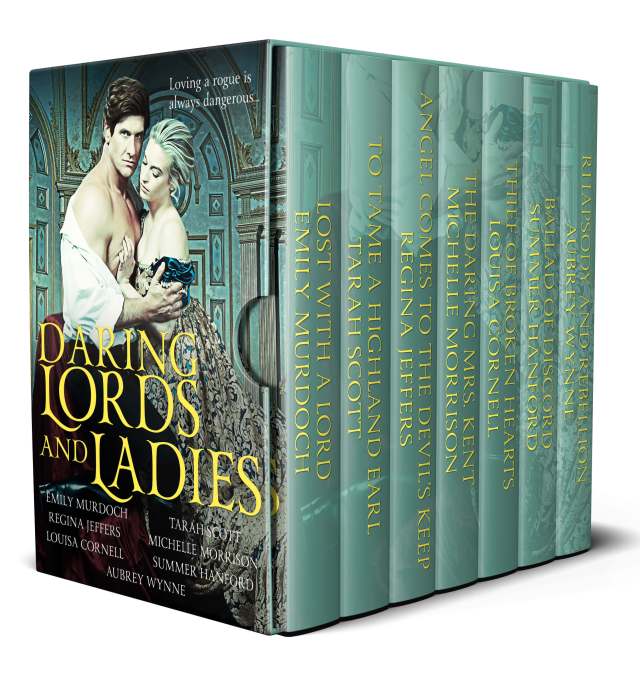
Latest Release “Daring Lords and Ladies” Available Now for $0.99 + a Giveaway

My latest venture is a new anthology entitled Daring Lords and Ladies, which features SEVEN full-length novels for only $0.99. That is 1428 pages of reading. The anthology features…

LOST WITH A LORD by Emily Murdoch
A man in search of a courtesan, and a woman in search of a ship – will they find what they are looking for?

Lord George Northmere is tired of his lonely existence, and makes the radical decision to go against the ton and society’s rules, and seek out comfort in the arms of a courtesan. But in all his thirty years, he has never met anyone quite like the fiery Italian Miss Florence Capria.

She is no courtesan, but she inflames Lord George’s curiosity – and his spirits – nonetheless.

TO TAME A HIGHLAND EARL by Tarah Scott
A man torn between two worlds. Both need him… neither wants him.

Groomed for a life amongst the English aristocracy, Lord Erroll Rushton is unexpectedly thrust back into his father’s Scottish world when the Englishwoman he compromises refuses to marry him.

No gentleman breaks into a lady’s bedchamber…but then, no lady sleeps with a pistol under her pillow.

ANGEL COMES TO THE DEVIL’S KEEP by Regina Jeffers
Huntington McLaughlin, the Marquess of Malvern, wakes in a farmhouse, after a head injury, being tended by an ethereal “angel,” who claims to be his wife. However, reality is often deceptive, and Angelica Lovelace is far from innocent in Hunt’s difficulties. Yet, there is something about the woman that calls to him as no other ever has. When she attends his mother’s annual summer house party, their lives are intertwined in a series of mistaken identities, assaults, kidnappings, overlapping relations, and murders, which will either bring them together forever or tear them irretrievably apart.

THE DARING MRS. KENT by Michelle Morrison
She was not always daring…Josephine Kent risked everything to escape an abusive husband: a perilous sea voyage, a new life in the Caribbean, and the constant worry that Mr. Kent would find her. She settles into a safe new life in her brother’s house, content to avoid society and serve as her brother’s housekeeper…until her identity is discovered by one of her husband’s henchmen.

THIEF OF BROKEN HEARTS by Louisa Cornell
Seventeen years ago, after losing his mother and brothers in a horrific tragedy, Endymion de Waryn left his memories, his past, and the childhood friend he’d been forced to marry behind in Cornwall, vowing never to return. Now, as the Duke of Pendeen, he lives a very ordered life, just as he prefers. Having scheduled the months of August and September to conceive an heir, he summons his wife to London to do just that. When her answer is an emphatic No! he is left no choice but to break his vow and go to Cornwall to fetch her. However, a duchess who meets her husband at the door with one of Manton’s finest firearms needs more than a ducal command to be fetched.

BALLAD OF DISCORD by Summer Hanford and Tarah Scott
If the man you love won’t trust you with the truth, how can you ever again trust him?

The pieces of Elizbeth McKinley’s world scatter when her father, in an act of pure madness, joins forces with a mysterious Frenchman in an attempt to claim the Scottish crown. Now, pawns in a game far vaster than they can imagine, Elizbeth and her sister must flee or be shipped off to France to wed strangers. To make matters worse, the one man who should most wish to help her, the man Elizbeth loves, refuses to believe she’s in danger. His betrayal will cut deeper than any sword.

RHAPSODY AND REBELLION by Aubrey Wynne
A Scottish legacy… A political rebellion… Two hearts destined to meet…

Raised in his father’s image, the Earl of Stanfeld is practical and disciplined. There are no gray lines interrupting the Gideon’s black and white world. Until his mother has a dream and begs to return to her Highland home.

Alisabeth was betrothed from the cradle. At seventeen, she marries her best friend and finds happiness if not passion. In less than a year, a political rebellion makes her a widow. The handsome English earl arrives a month later and rouses her desire and a terrible guilt.

Kindle 

Kindle Unlimited 

NOW FOR THE GIVEAWAY. I HAVE 5 eBOOK COPIE S OF “DARING LORDS AND LADIES” AVAILABLE FOR THOSE WHO COMMENT BELOW. THE GIVEAWAY ENDS AT MIDNIGHT TUESDAY, AUGUST 4, 2020. 

Posted in book release, British history, eBooks, Georgian England, Georgian Era, giveaway, Regency era, Regency romance, romance, Scarsdale Publishing | Tagged , , , , , , , , , , , , , , , , , , , | 2 Comments

Something in the Air: Two Regency Romances

I have combined two of my 2019 long novellas in one volume. Something in the Air features “Courting Lord Whitmire: A May-December Romance” from the Regency Summer Escape anthology with “Last Woman Standing” from the A Regency Christmas Proposal anthology. Both stories can be purchased individually or you may find them combined in this volume. Something in the Air can also be purchased in print format for those of you who still prefer to hold a book in your hands. 

The stories are available on Kindle, Amazon (print version) or they may be read for FREE on Kindle Unlimited. 

Kindle   https://www.amazon.com/Something-Air-Two-Regency-Romances-ebook/dp/B08B1T59BF/ref=sr_1_1?dchild=1&keywords=something+in+the+air+by+regina+jeffers&qid=1591965043&sr=8-1

Amazon  https://www.amazon.com/dp/B08B33M1NX/ref=tmm_pap_swatch_0?_encoding=UTF8&qid=1591965043&sr=8-1

Kindle Unlimited  https://www.amazon.com/kindle-dbs/hz/subscribe/ku?passThroughAsin=B08B1T59BF&_encoding=UTF8&shoppingPortalEnabled=true

Courting Lord Whitmire: A Regency May-December Romance

At the bend of the path, an unexpected meeting.

She is all May.

He is December. But loves knows not time.

Colonel Lord Andrew Whitmire has returned to England after spending fifteen years in service to his country. In truth, he would prefer to be anywhere but home. Before he departed England, his late wife, from an arranged marriage, had cuckolded him in a scandal that had set Society’s tongues wagging. His daughter, Matilda, who was reared by his father, enjoys calling him “Father” in the most annoying ways. Unfortunately, his future is the viscountcy, and Andrew knows his duty to both the title and his child. He imagines himself the last of his line until he encounters Miss Verity Coopersmith, the niece of his dearest friend, the man who had saved Andrew’s life at Waterloo. Miss Coopersmith sets Whitmire’s world spinning out of control. She is truly everything he did not know he required in his life. However, she is twenty-two years his junior, young enough to be his daughter, but all he can think is she is absolute perfection.

Last Woman Standing: A Clean Regency Romance

She is simply his grandmother’s companion.

However, when the Christmas ball ends, the last woman standing wins the marquess.

JACKSON SHAW, the Marquess of Rivens, never considered the “gypsy blessing” presented to his family during the time of Henry VIII truly a blessing. He viewed it more as a curse. According to the “blessing,” in his thirtieth year, at the Christmas ball hosted by his family, he was to choose a wife among the women attending. The catch was he possessed no choice in the matter. His wife was to be the one who proved herself to be his perfect match, according to the gypsy’s provisions: a woman who would bring prosperity to his land by her love of nature and her generous heart. In his opinion, none of the women vying for his hand appeared to care for anything but themselves.

EVELYN HAWTHORNE comes to River’s End to serve as the companion to the Marchioness of Rivens, his lordship’s grandmother. However, Lady Rivens has more than companionship in mind when she employs the girl, whose late father was a renown horticulturalist. The marchioness means to gather Gerald Hawthorne’s rare specimens to prevent those with less scrupulous ideas from purchasing Hawthorne’s conservatory, and, thereby, stealing away what little choice her grandson has in naming a wife, for all the potential brides must present the Rivenses with a rare flower to demonstrate the lady’s love of nature. Little does the marchioness know Hawthorne’s daughter might not only know something of nature, but be the person to fulfill the gypsy’s blessing.

Posted in book release, British history, Dreamstone Publishing, Georgian England, Georgian Era, historical fiction, Living in the Regency, marriage, publishing, reading habits, Regency era, Regency romance, writing | Tagged , , , , , , , , , | 2 Comments

Carriages, Coaches, Landaus, Gigs, Phaetons, and More – How to Write Regency Accident Scenes

This is a repeat from a 2019 post by request of two of my author friends. Enjoy!

There are many fine posts on the internet regarding the various types of coaches available to those of the Regency, but such is not the purpose of my piece today. This one has more to do with writing scenes in which these vehicles break down and the aftermath.

One of the many plot devices available to us as writers is a coach breaking down. When this happens, what are some of the realities of such an accident. I know I have had my fair share of disabled vehicles in my stories. In truth, in some of my earlier ones, I was not as accurate as I am now, nor as accurate as I hope to be in the future. Historical facts are a steep learning curve, and, as I have little to no personal experience with these types of transportation, I am constantly learning. Therefore, I am including a variety of facts I hope will help others struggling with these scenes.

One thing each writer must keep in mind, the speed at which the characters are traveling and the stamina of both the horses and the occupants of the vehicle are equally as important as is the size of the carriage. Pay attention to that fact as I include some facts on each type.

__________________________

Miss de Bourgh drove by in her phaeton, which he never failed coming to inform them of, though it happened almost every day. (Chapter 29, Jane Austen’s Pride and Prejudice).

Miss De Bourgh’s phaeton and ponies is an extravagant display of her family’s wealth. To be able to afford a specialized carriage for only one person’s use demonstrates the family’s affluence. In comparison, the Bennets, who are less wealthy than Lady Catherine, have one set of horses for the whole family. Therefore, when the horses are needed to work on the farm, the carriage cannot be used and the family must walk to their destination.
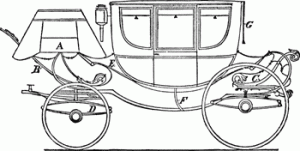
Likely Miss de Bourgh’s phaeton was of the low-slung variety, especially as it is being pulled by ponies. It would have a lower center of gravity and be very safe and secure, and the ponies easy for a woman to control and unlikely to run away with the vehicle.In Georgette Heyer novels, we often read of the more dashing heroines driving a high-perch phaeton, which also has four wheels, but the box is suspended high over the front axle. It is a fast and fun vehicle to drive, but like a modern SUV, has a higher center of gravity, making it more likely to overturn, especially when pulled by the high-couraged cattle that would make such a sporty vehicle worth owning. (Austen Blog)

A phaeton did not have a place for a “tiger” to ride on the back of the carriage.

_______________________________

One morning, about a week after Bingley’s engagement with Jane had been formed, as he and the females of the family were sitting together in the dining room, their attention was suddenly drawn to the window, by the sound of a carriage; and they perceived a chaise and four driving up the lawn. It was too early in the morning for visitors, and besides, the equipage did not answer to that of any of their neighbours. The horses were post; and neither the carriage, nor the livery of the servant who preceded it, were familiar to them. (Chapter 56, Jane Austen’s Pride and Prejudice)

http://historicalhussies.
blogspot.com/2010/
06/regency-travel-by-coach.html

A traveling carriage would customarily be drawn by a team of four horses. This would be true for managing a country road, but not in the city. While in London or any city of prominence, the coach would typically employ only two horses.

If the coach is drawn by a team of four, the outriders or any gentlemen riding beside the coach would be positioned by the pair closest to the carriage’s wheels. These horse, known as wheelers, were generally larger and stronger than the lead horses. If the lead horses were spooked, the rider could possibly keep the wheelers calm and prevent a ride-away carriage accident.

The Bennets keep a carriage; we aren’t told what kind, but we can probably assume it is a closed vehicle that can seat six to eight people—quite proper for a large family like the Bennets. Mr. Bennet does not keep horses solely to pull the carriage; he borrows working animals from the home farm for carriage duty. That detail not only shows that the Bennets are not extremely rich, but allows for the plot twist of Jane Bennet riding horseback to Netherfield, getting caught in the rain, and catching a cold that allows Jane and her sister Elizabeth to get to know Messrs. Bingley and Darcy a little better—and vice-versa. (AustenBlog)

Often we read where a coach is turned on its side. I have written more than one such scene in my career. Again, the writer must remember that newer coaches were lighter than those carried over from the previous century, and a broken axle would not necessarily cause the coach to end up on its side. It would likely be tilted. If you turn it on its side, you require more than the broken axle to send it over. The writer could add a nearby ditch (been there, done that) or have the coach traveling at a greater rate of speed than normal (runaway leaders on a carriage team, right?). Remember that when a closed carriage ends up on its side, the people must climb out the door. They will be slammed against each other (no seat belts) and likely piled upon one another. It is also NOT likely that a couple of men could right it. In addition to the weight of the people inside, a traveling coach would be loaded down with trunks, etc. Naturally, we all have read stories of petite women right a car when her child is trapped under it, but that would be the exception, not the rule. Now, if a friendly farmer comes along with a team of mules, the men + the mules = the possibility of an upright carriage.

I, also, would not suggest that people fall out the door of a carriage being knocked over. Rocks. Paving stones. Stone walls. All spell a hard landing. Moreover, if the carriage is turning onto its side, they could be easily crushed by the weight of it.

This link has several photos of coaches with a broken axle (It has been purposely broken to fit the space, but it still works by clicking on the first line).

https://www.google.com/search?q=carriage+broken+axle&source=

lnms&tbm=isch&sa=X&ved=0ahUKEwiU3pXz0tLMAhVKw2MKHUtWAmIQ_

AUIBygB&biw=1047&bih=505#imgrc=Tz7AaON629K2_M%3A

Regency writers must remember, there was no brake that could be set from the seat. For heavier stagecoaches and coaches, one of the coachmen had to get down from the box and set the “drag” to slow the carriage when it was going down a steep hill. Harold Esdale Malet, Nimrod in Annals of the Road: Or, Notes on Mail and Stage Coaching in Great Britain, provides us with an anecdote regarding the drag not being properly set: “‘Some few years past I was travelling to Brighton, I think by the ” Alert,” at the time driven by a coachman named Pattenden. On pulling up at the extreme point of Reigate Hill, and being anxious to get the drag on, he did not do it securely. On starting rather brisk, whether it came in contact with a stone, or from what cause I know not, but it flew from the wheel it was placed on to the opposite one, and fixed as properly and securely as if placed by hand, in which manner we proceeded down the hill, in my opinion, a providential and singular circumstance, which perhaps, prevented a serious accident.”

Meanwhile, Mueller’s Lane Farm in NW Illinois tells us a bit about the history of brakes, which, although not Regency era specific, will provide you an overview of the issue: “When large and heavy loads were being transported to towns, ranches, homes and mining camps, etc., the steep, winding grades were scary to even the most hardened of teamsters. Costly and deadly would not be overstating the situation. In these circumstances, the standard brakes were woefully inadequate to keep from pushing the team out of control and wrecking the whole shooting match. There were three basic methods to ease the loaded wagon safely down to the bottom.

The first was to use the “pole brake”. This is done by placing a long pole about 4’ to 6’ long into the two steel bands on the roller bar at the rear of the wagon. The roller bar is the heavy steel arm that is suspended slightly ahead of the rear axle. The bar is bent at a right angle that rises up between the wheel and the box on the right side of the wagon. The ‘arm’ has two steel bands attached. The stout pole is placed into the bands and extends up into the air. A rope is then securely tied to the upper end and is run down to the front of the wagon where the teamster can pull it with his hand or push with his foot by way of a loop in the rope. This pulls the pole forward thus adding greater leverage to the brake shoes against the rear wheels and applying the braking pressure.

“Another way to create drag to control the load was by using ‘skid shoes.’ These are small steel sleds of a sort, that the teamster would place, one in front of each rear wheel. The wagon was then rolled into the skid shoe and by way of a chain or heavy leather straps and the shoes secured to the bottom of the wheels. A chain at the nose of the shoe was fastened forward to the body of the wagon. As the wagon was drawn forward, the rear wheel s were kept from turning and the wagon drug down the hill.

“The last method was very similar to the skid shoe method in that a long pole was run between the spokes of the real wheels. As the wagon was moved forward, the rear wheels were blocked from moving. This way of skidding the loaded wagon was quick to implement but hard on the wheel spokes and the wagon itself. It was called ‘rough locking the wheels’.”

Another major error when creating a carriage wreck is that the harness cannot be simply switched to another type of coach, for the harness is specific to the carriage. As most coaches were custom made, the harness would be created for that particular coach, not easily interchangeable. The “wrecked” carriage would have to be a common type of carriage, and the harness could only be used on the same type, i.e., phaeton to another phaeton, curricle to another curricle, etc. Moreover, if the carriage is overturned, those who survived would most likely need to cut the harness to free the horses. Doing so would leave but a bridle and bits of the reins, not something to be used on another carriage. In addition to the harness, the coach’s axle, middle post, etc., must match to make repairs.

Those who drove for the Royal Mail would cut one of the horses free and ride with the mail pouch to the next station, leaving the passengers and the coach behind to wait for assistance.

___________________________________

“He meant, I believe,” replied Jane, “to go to Epsom, the place where they last changed horses, see the postilions, and try if any thing could be made out from them. His principal object must be to discover the number of the hackney coach which took them from Clapham.” (Chapter 46, Jane Austen’s Pride and Prejudice)

“Everyone says he is eat up with pride, and I dare say he had heard somehow that Mrs. Long does not keep a carriage, and had come to the ball in a hack chaise.” (Chapter 5, Jane Austen’s Pride and Prejudice).

A hackney-coach is the equivalent of a modern-day taxi: a horse and carriage for hire to take a person a short distance to his or her destination; thus Mr. Bennet could guess that the eloping couple had completed their journey in London. The coach itself would likely have been an old vehicle, castoff by its original owner, and could be any type of vehicle that has a box for a driver, who was known as a jarvey. Hackney coaches within London were licensed and assigned registration numbers, which would allow Mr. Bennet to trace the driver and, in the case described above, hopefully learn where he had set down, or delivered, Lydia and Wickham. (AustenBlog)

By, 1823, the lighter horse cabs began to replace cumbersome hackney coaches in great quantity, and by the mid 1830’s, the hansom cab set the new standard for modern horse cabs. Aloysius Hansom, an architect, designed the first carriage. When Hansom went bankrupt through poor investments, John Chapman took over, designing an even lighter, more efficient cab, one whose framework did not strike the horses on their backs or sides whenever a carriage ran over an obstacle in the road.
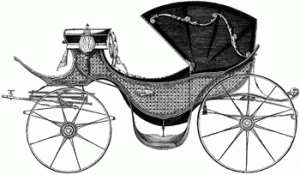
___________________________

“And if you will stay another month complete, it will be in my power to take one of you as far as London, for I am going there early in June, for a week; and as Dawson does not object to the Barouche box, there will be very good room for one of you — and indeed, if the weather should happen to be cool, I should not object to taking you both, as you are neither of you large.” (Chapter 37, Jane Austen’s Pride and Prejudice)

“and that will be our time for exploring. While they are with us, we shall explore a great deal, I dare say. They will have their barouche-landau, of course, which holds four perfectly; and therefore, without saying any thing of our carriage, we should be able to explore the different beauties extremely well. They would hardly come in their chaise, I think, at that season of the year. Indeed, when the time draws on, I shall decidedly recommend their bringing the barouche-landau; it will be so very much preferable. When people come into a beautiful country of this sort, you know, Miss Woodhouse, one naturally wishes them to see as much as possible; and Mr. Suckling is extremely fond of exploring. We explored to King’s-Weston twice last summer, in that way, most delightfully, just after their first having the barouche-landau. You have many parties of that kind here, I suppose, Miss Woodhouse, every summer?” (Chapter 32, Jane Austen’s Emma)

A barouche is an open vehicle that seats four people and has a top that folds back like a convertible automobile. Lady Catherine offers to take Elizabeth Bennet and Maria Lucas to London in her barouche when she goes there. A barouche-landau has two seats facing each other, and a top that opens in the middle and folds back. (In P&P95, we think Elizabeth and the Gardiners arrive at Pemberley in a barouche-landau, which attentive readers of Emma will know is just the thing to use for summer sightseeing in the countryside! (AustenBlog)

A landau, drawn by a pair or four-in-hand, is one of several kinds of social carriages with facing seats over a dropped footwell, which was perfected by the mid-19th century in the form of a swept base that flowed in a single curve. The soft folding top is divided into two sections, front and rear, latched at the center. These usually lie perfectly flat, but the back section can be let down or thrown back while the front section can be removed or left stationary. When fully opened, the top can completely cover the passengers, with some loss of the graceful line.

The landau’s center section might contain a fixed full-height glazed door, or more usually a low half-door. There would usually be a separate raised open coachman’s upholstered bench-seat, but a landau could be postilion-driven, and there was usually a separate groom’s seat, sprung above and behind the rear axle, saving the groom from having to stand on a running board.

Shannon Donnelly’s Fresh Ink, in an article called “Horse Sense” tells us, “Chandros Leigh, a distant cousin of Jane Austen, obtained an estimate for a fashionable laundau in 1829. The price of the basic carriage was 250 pounds, which included: ‘plate glass and mahogany shutters to the lights, and plated or brass bead to the leather, lined with best second cloth, cloth squabs, and worsted lace….’ The ‘extras’ ordered including footman’s cushions, morocco sleeping cushions, steps, silk spring curtains, his crest on the door, embossed door handles and full plated lamps. These brought the cost to 417 pounds, 11 shillings and 6 pence, but he was given 60 pounds in exchange for his old carriage.”

Ms. Donnelly, who is quite knowledgeable on horses, also warns Regency writers that a wreck with an open carriage would cause more injuries. An open carriage turned upon its side would mean the passengers were ejected because of the carriage’s high center of gravity. As the horses would remained spooked by the carriage, the animals will, more than likely, not accept being hitched again to the carriage, even if it can be turned upright.

The act of overturning any vehicle, but especially the larger ones meant for traveling, would break the harness. 

___________________________

“Curricle-hung, you see; seat, trunk, sword-case, splashing-board, lamps, silver moulding, all you see complete; the iron-work as good as new, or better. He asked fifty guineas; I closed with him directly, threw down the money, and the carriage was mine.” (Chapter 7, Jane Austen’s Northanger Abbey)

Younger gentlemen’s personal vehicles were usually either a gig or a curricle. These fast, sporty carriages were similar in being open vehicles with two wheels, seating two comfortably, and driven by one of the passengers; the main difference being that a gig was equipped to be pulled by one horse and a curricle by two, thereby doubling the horsepower—a Trans Am to the gig’s Firebird, if you will. Mr. Collins, predictably, owns a gig, in which he takes Sir William driving while he is visiting Hunsford. Mr. Darcy, also predictably, owns a curricle, which he uses to drive Georgiana to visit Elizabeth at the inn in Lambton. (Austen Blog)

A gentleman could also have a tiger ride on the back of a curricle, but not a gig. If one of these carriages overturns, a person could possibly jump free of the vehicle, and the writer could have them only experience bumps, bruises and scrapes. Fatal injures are not guaranteed. Hopefully, when the person jumps he calculates his chances of not slamming his head into a stone wall or catching his coattail and being dragged along by the frightened team. (Just saying a stone wall would be my luck!)

Like all modes of transportation mentioned previously, curricles and gigs were custom made for the owner. Some curricles had a step on the back, while others had a seat for the tiger. If no tiger was employed, a box of scrap metal was secured to the back to assist with balance and to keep the harness from weighing too heavily on the horse/horses.

Check out some of these disasters found on “Curricle Crashes and Dennet Disasters—The Dangers of the Regency Road” on Jane Austen’s London, in which Miss Austen describes her own misadventures.

Additional References Not Cited in the Post:

Adams, William B. English Pleasure Carriages: Their Origin, History, Varieties, Materials, Construction, Defects, Improvements, And Capabilities (1837). London: Kessinger, LLC, 2008. Print.

Georgian Index

“Nineteenth Century Carriages: Descriptions of Different Types of Horse-Drawn Transportation | Suite101.com.” Historical Resources | Suite101.com. Web. 28 Oct. 2009.

http://historicalresources.suite101.com/article.cfm/nineteenth_century_carriages.

“Queensland Museum – Cobb & Co.” Cobb Co Museum. Web. 28 Oct. 2009. http://www.cobbandco.qm.qld.gov.au/exhibitions/carriage/carriage.asp?Carriage=28.

“Transportation in the 19th Century.” Literary Liaisons, Ltd. Web. 28 Oct. 2009. http://www.literary-liaisons.com/article033.html.

Walking-Through Shire Blogspot

Posted in British history, commerce, customs and tradiitons, England, Georgian England, Georgian Era, Great Britain, Jane Austen, Living in the Regency, Pride and Prejudice, real life tales, Regency era, travel | Tagged , , , , , , , , , , , , | 2 Comments