Felt But Unseen in Pride and Prejudice, a Guest Post from Lelia Eye

This post originally appeared on the Austen Authors’ blog on 30 June 2022. I hope you find it as interesting as I did. Enjoy!

I thought I would touch upon five characters that each have a presence which is felt despite the fact that they are deceased. In novels, we often get caught up in the living characters who speak and act, but in Pride and Prejudice, Jane Austen created such depth in her novel that there are numerous characters who have a presence despite their absence! Some of them are more in a wondering sense (like, “If X character is like this, then what were X’s parents like?”), and some are expressed with more details.

The Old Mr. Bingley

I am beginning with the Old Mr. Bingley. Since we are shown Mr. Bingley, his sisters, and his brother-in-law, the question of what his parents were like is brought to mind. We don’t really see any sort of real hint about the Old Mrs. Bingley, but we are given a glimpse of the Old Mr. Bingley even beyond the fact that his family was respectable and that their wealth was acquired in trade. The most descriptive information from the book is below:

They were of a respectable family in the north of England; a circumstance more deeply impressed on their memories than that their brother’s fortune and their own had been acquired by trade.

Mr. Bingley inherited property to the amount of nearly a hundred thousand pounds from his father, who had intended to purchase an estate, but did not live to do it. Mr. Bingley intended it likewise, and sometimes made choice of his county; but as he was now provided with a good house and the liberty of a manor, it was doubtful to many of those who best knew the easiness of his temper, whether he might not spend the remainder of his days at Netherfield, and leave the next generation to purchase.

His sisters were anxious for his having an estate of his own; but, though he was now only established as a tenant, Miss Bingley was by no means unwilling to preside at his table—nor was Mrs. Hurst, who had married a man of more fashion than fortune, less disposed to consider his house as her home when it suited her. Mr. Bingley had not been of age two years, when he was tempted by an accidental recommendation to look at Netherfield House. He did look at it, and into it for half-an-hour—was pleased with the situation and the principal rooms, satisfied with what the owner said in its praise, and took it immediately.

As you can see in the bolded portion, the first line tells us that the Old Mr. Bingley had money to buy an estate but died before he did it. The following line makes it sound as though perhaps the Old Mr. Bingley was like his son. As long as the family is comfortable and well off, why go to the trouble of buying an estate? Let someone else handle the work! Because of this portion, I think that the Old Mr. Bingley was much like his son. And perhaps the daughters took after their mother, but that can only be speculation!

Sir Lewis de Bourgh

I rather thought Sir Lewis de Bourgh would be mentioned quite a bit, but we really don’t see much about him:

  • [Quote from Mr. Collins:] My mind, however, is now made up on the subject, for having received ordination at Easter, I have been so fortunate as to be distinguished by the patronage of the Right Honourable Lady Catherine de Bourgh, widow of Sir Lewis de Bourgh, whose bounty and beneficence has preferred me to the valuable rectory of this parish, where it shall be my earnest endeavour to demean myself with grateful respect towards her ladyship, and be ever ready to perform those rites and ceremonies which are instituted by the Church of England.
  • Every park has its beauty and its prospects; and Elizabeth saw much to be pleased with, though she could not be in such raptures as Mr. Collins expected the scene to inspire, and was but slightly affected by his enumeration of the windows in front of the house, and his relation of what the glazing altogether had originally cost Sir Lewis de Bourgh.
  • “Your father’s estate is entailed on Mr. Collins, I think. For your sake,” turning to Charlotte, “I am glad of it; but otherwise I see no occasion for entailing estates from the female line. It was not thought necessary in Sir Lewis de Bourgh’s family. Do you play and sing, Miss Bennet?”

We basically see that Sir Lewis spent a lot to look good. (Presumably, it was his idea anyway.) Based on the officious nature of Lady Catherine, I rather think he was cowed by his wife and just did whatever she wished of him. Could you imagine a man who tried to dampen Lady Catherine’s enthusiasm? I cannot! I think the way Lady Catherine speaks of him seems to indicate that they were not at odds with one another, which in turn implies that she was in charge.

Lady Anne Darcy

We have a few different references to Lady Anne Darcy:

  • “You know of course that Lady Catherine de Bourgh and Lady Anne Darcy were sisters; consequently that she is aunt to the present Mr. Darcy.”
  • ” . . . When my niece Georgiana went to Ramsgate last summer, I made a point of her having two men-servants go with her. Miss Darcy, the daughter of Mr. Darcy, of Pemberley, and Lady Anne, could not have appeared with propriety in a different manner. . . . “
  • “The engagement between them is of a peculiar kind. From their infancy, they have been intended for each other. It was the favourite wish of his mother, as well as of her’s. While in their cradles, we planned the union: and now, at the moment when the wishes of both sisters would be accomplished in their marriage, to be prevented by a young woman of inferior birth, of no importance in the world, and wholly unallied to the family! Do you pay no regard to the wishes of his friends? To his tacit engagement with Miss de Bourgh? Are you lost to every feeling of propriety and delicacy? Have you not heard me say that from his earliest hours he was destined for his cousin?””Yes, and I had heard it before. But what is that to me? If there is no other objection to my marrying your nephew, I shall certainly not be kept from it by knowing that his mother and aunt wished him to marry Miss de Bourgh. You both did as much as you could in planning the marriage. Its completion depended on others. If Mr. Darcy is neither by honour nor inclination confined to his cousin, why is not he to make another choice? And if I am that choice, why may not I accept him?”
  • “I will not be interrupted. Hear me in silence. My daughter and my nephew are formed for each other. They are descended, on the maternal side, from the same noble line; and, on the father’s, from respectable, honourable, and ancient—though untitled—families. Their fortune on both sides is splendid. They are destined for each other by the voice of every member of their respective houses; and what is to divide them? The upstart pretensions of a young woman without family, connections, or fortune. Is this to be endured! But it must not, shall not be. If you were sensible of your own good, you would not wish to quit the sphere in which you have been brought up.”

Lady Catherine’s fondness for Lady Anne and the plans she made with Lady Anne seem to indicate that Lady Anne was probably much like her sister. Yet with what we have heard about the Old Mr. Darcy (and the fact that Fitzwilliam Darcy doesn’t appear to have received a dying wish about marrying Anne de Bourgh or anything like that), it also seems likely that Lady Anne was much less extreme in her concerns for proper matches. Regardless, if she did indeed hope to match Fitzwilliam Darcy with Anne de Bourgh, that means she either had leanings toward haughtiness or she had a fondness for her sister and simply wished to be made closer to her.

The Old Mr. Darcy and the Old Mr. Wickham
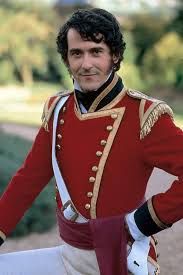
I attempted to break up the sections on the Old Mr. Darcy and the Old Mr. Wickham at first, but they would have been frequently repeated. Much of what we know about one is related to the other. A good chunk of what we hear is from a conversation between Elizabeth and Wickham that I have abbreviated below:

” . . . His father, Miss Bennet, the late Mr. Darcy, was one of the best men that ever breathed, and the truest friend I ever had; and I can never be in company with this Mr. Darcy without being grieved to the soul by a thousand tender recollections. His behaviour to myself has been scandalous; but I verily believe I could forgive him anything and everything, rather than his disappointing the hopes and disgracing the memory of his father.”

. . .

” . . . The church ought to have been my profession—I was brought up for the church, and I should at this time have been in possession of a most valuable living, had it pleased the gentleman we were speaking of just now.”

“Indeed!”

“Yes—the late Mr. Darcy bequeathed me the next presentation of the best living in his gift. He was my godfather, and excessively attached to me. I cannot do justice to his kindness. He meant to provide for me amply, and thought he had done it; but when the living fell, it was given elsewhere.”

. . .

“There was just such an informality in the terms of the bequest as to give me no hope from law. A man of honour could not have doubted the intention, but Mr. Darcy chose to doubt it—or to treat it as a merely conditional recommendation, and to assert that I had forfeited all claim to it by extravagance, imprudence—in short anything or nothing. Certain it is, that the living became vacant two years ago, exactly as I was of an age to hold it, and that it was given to another man; and no less certain is it, that I cannot accuse myself of having really done anything to deserve to lose it. I have a warm, unguarded temper, and I may have spoken my opinion of him, and to him, too freely. I can recall nothing worse. But the fact is, that we are very different sort of men, and that he hates me.”

“This is quite shocking! He deserves to be publicly disgraced.”

“Some time or other he will be—but it shall not be by me. Till I can forget his father, I can never defy or expose him.”

. . .

“But what,” said she, after a pause, “can have been his motive? What can have induced him to behave so cruelly?

“A thorough, determined dislike of me—a dislike which I cannot but attribute in some measure to jealousy. Had the late Mr. Darcy liked me less, his son might have borne with me better; but his father’s uncommon attachment to me irritated him, I believe, very early in life. He had not a temper to bear the sort of competition in which we stood—the sort of preference which was often given me.”

. . .

Elizabeth was again deep in thought, and after a time exclaimed, “To treat in such a manner the godson, the friend, the favourite of his father!” She could have added, “A young man, too, like you, whose very countenance may vouch for your being amiable”—but she contented herself with, “and one, too, who had probably been his companion from childhood, connected together, as I think you said, in the closest manner!”

“We were born in the same parish, within the same park; the greatest part of our youth was passed together; inmates of the same house, sharing the same amusements, objects of the same parental care. My father began life in the profession which your uncle, Mr. Phillips, appears to do so much credit to—but he gave up everything to be of use to the late Mr. Darcy and devoted all his time to the care of the Pemberley property. He was most highly esteemed by Mr. Darcy, a most intimate, confidential friend. Mr. Darcy often acknowledged himself to be under the greatest obligations to my father’s active superintendence, and when, immediately before my father’s death, Mr. Darcy gave him a voluntary promise of providing for me, I am convinced that he felt it to be as much a debt of gratitude to him, as of his affection to myself.

. . .

[About Georgiana Darcy:] “I wish I could call her amiable. It gives me pain to speak ill of a Darcy. But she is too much like her brother—very, very proud. As a child, she was affectionate and pleasing, and extremely fond of me; and I have devoted hours and hours to her amusement. But she is nothing to me now. She is a handsome girl, about fifteen or sixteen, and, I understand, highly accomplished. Since her father’s death, her home has been London, where a lady lives with her, and superintends her education.”

While we always have to look at Wickham’s words with suspicion, the fact that he sings the Old Mr. Darcy’s praises so highly (and the fact the Old Mr. Darcy treated the son of his steward so well) seems to indicate the Old Mr. Darcy was indeed kind. And we are told the Old Mr. Wickham was an intimate friend in addition to being a steward. It seems likely to me the Old Mr. Wickham was indeed a genuinely good person. Of course, Caroline doesn’t seem to think that was possible:

“So, Miss Eliza, I hear you are quite delighted with George Wickham! Your sister has been talking to me about him, and asking me a thousand questions; and I find that the young man quite forgot to tell you, among his other communication, that he was the son of old Wickham, the late Mr. Darcy’s steward. Let me recommend you, however, as a friend, not to give implicit confidence to all his assertions; for as to Mr. Darcy’s using him ill, it is perfectly false; for, on the contrary, he has always been remarkably kind to him, though George Wickham has treated Mr. Darcy in a most infamous manner. . . . His coming into the country at all is a most insolent thing, indeed, and I wonder how he could presume to do it. I pity you, Miss Eliza, for this discovery of your favourite’s guilt; but really, considering his descent, one could not expect much better.”

“His guilt and his descent appear by your account to be the same,” said Elizabeth angrily; “for I have heard you accuse him of nothing worse than of being the son of Mr. Darcy’s steward, and of that, I can assure you, he informed me himself.”


But Darcy himself, a more reliable source, supports the high opinions of both his father and the Old Mr. Wickham to Elizabeth:

“Mr. Wickham is the son of a very respectable man, who had for many years the management of all the Pemberley estates, and whose good conduct in the discharge of his trust naturally inclined my father to be of service to him; and on George Wickham, who was his godson, his kindness was therefore liberally bestowed. My father supported him at school, and afterwards at Cambridge—most important assistance, as his own father, always poor from the extravagance of his wife, would have been unable to give him a gentleman’s education. My father was not only fond of this young man’s society, whose manner were always engaging; he had also the highest opinion of him, and hoping the church would be his profession, intended to provide for him in it. As for myself, it is many, many years since I first began to think of him in a very different manner. The vicious propensities—the want of principle, which he was careful to guard from the knowledge of his best friend, could not escape the observation of a young man of nearly the same age with himself, and who had opportunities of seeing him in unguarded moments, which Mr. Darcy could not have. . . .

“My excellent father died about five years ago; and his attachment to Mr. Wickham was to the last so steady, that in his will he particularly recommended it to me, to promote his advancement in the best manner that his profession might allow—and if he took orders, desired that a valuable family living might be his as soon as it became vacant. There was also a legacy of one thousand pounds. His own father did not long survive mine, and within half a year from these events, Mr. Wickham wrote to inform me that, having finally resolved against taking orders, he hoped I should not think it unreasonable for him to expect some more immediate pecuniary advantage, in lieu of the preferment, by which he could not be benefited. . . . For about three years I heard little of him; but on the decease of the incumbent of the living which had been designed for him, he applied to me again by letter for the presentation. His circumstances, he assured me, and I had no difficulty in believing it, were exceedingly bad. He had found the law a most unprofitable study, and was now absolutely resolved on being ordained, if I would present him to the living in question—of which he trusted there could be little doubt, as he was well assured that I had no other person to provide for, and I could not have forgotten my revered father’s intentions. . . .

Of course, Mrs. Gardiner also seems to support that the Old Mr. Darcy was a good fellow:

To Mrs. Gardiner, Wickham had one means of affording pleasure, unconnected with his general powers. About ten or a dozen years ago, before her marriage, she had spent a considerable time in that very part of Derbyshire to which he belonged. They had, therefore, many acquaintances in common; and though Wickham had been little there since the death of Darcy’s father, it was yet in his power to give her fresher intelligence of her former friends than she had been in the way of procuring.

Mrs. Gardiner had seen Pemberley, and known the late Mr. Darcy by character perfectly well. Here consequently was an inexhaustible subject of discourse. In comparing her recollection of Pemberley with the minute description which Wickham could give, and in bestowing her tribute of praise on the character of its late possessor, she was delighting both him and herself.

Further, Elizabeth does seem to believe what Mr. Darcy says about his father:

The account of [Mr. Wickham’s] connection with the Pemberley family was exactly what he had related himself; and the kindness of the late Mr. Darcy, though she had not before known its extent, agreed equally well with his own words.

And here are just a couple more references to the whole steward issue, as it is brought up often:

  • Her aunt now called her to look at a picture. She approached and saw the likeness of Mr. Wickham, suspended, amongst several other miniatures, over the mantelpiece. Her aunt asked her, smilingly, how she liked it. The housekeeper came forward, and told them it was a picture of a young gentleman, the son of her late master’s steward, who had been brought up by him at his own expense. “He is now gone into the army,” she added; “but I am afraid he has turned out very wild.”
  • [Lady Catherine about Wickham and Lydia:] ” . . . Is her husband, is the son of his late father’s steward, to be his brother? Heaven and earth!—of what are you thinking? Are the shades of Pemberley to be thus polluted?”

So, what are your thoughts about these unseen characters? I rather think the biggest presence is probably that of Darcy’s father, whose wishes and actions have a large effect on the story despite his death. Imagine how things would have been different if he hadn’t had any wishes with regard to helping Mr. Wickham out?

Do you disagree with any of my speculative characterizations? Do you have any unseen characters you feel have a major presence in the book?

Posted in Austen Authors, book excerpts, books, George Wickham, Georgian England, Georgian Era, Guest Post, historical fiction, Jane Austen, manuscript evaluation, Pride and Prejudice, quotes | Tagged , , , , , , , , , , | Comments Off on Felt But Unseen in Pride and Prejudice, a Guest Post from Lelia Eye

Criminal Conversation in the Regency Era + Excerpt from MR. DARCY’S BRIDEs

Several years back, I did a series for my blog, Every Woman Dreams, entitled “Eccentrics of the Regency.” One of the pieces I wrote was on Edward Hughes Ball Hughes. In it, I wrote: “Hughes’ older sister Catherine Ball was a socialite, journalist, and novelist who eventually styled herself the “Baroness de Calabrella” after acquiring property in Italy. She married an older man, Rev. Francis Lee, at the age of 16 in 1804, without her mother’s permission, and was separated from him in 1810 on charges of adultery; her lover, Captain George de Blaquiere, was successfully sued by Reverend Lee for criminal conversation.” When I read this, I wondered whether “criminal conversation” was anything like “alienation of affection.” So, I was determined to find out.

Criminal conversation is commonly known as crim. con. It is a tort arising from adultery.  For those of you who do not understand “legal speak,” tort law involves a situation where a person’s actions unfairly causes another to suffer harm or loss. The case is not based around an “illegal” action, but rather one of not thinking of the other person and causing some sort of harm. The law allows the harmed individual to recover his loss, generally by awarding monetary compensation. To prevail (win) in a tort law case the plaintiff (person suing) must show the actions or lack of action was the most likely cause of the harm.

Criminal Conversation is similar to breach of promise, a former tort involving a broken engagement against the betrothed, or alienation of affections, a tort action brought by a deserted spouse against a third party.

In 18th and 19th Century England, criminal conversation cases were common. It was not unheard of for the plaintiff to be awarded sums as high as £20,000. These cases were seen at the Court of King’s Bench in Westminster Hall. Not only did the plaintiff make money on the proceedings, but so did publishers such as Edmund Curll, whose name became synonymous, through the attacks on him by Alexander Pope, with unscrupulous publication and publicity.  

Although neither the plaintiff, defendant, or the wife accused of the adultery were permitted to take the stand, evidence of the adulterous behavior was presented by servants or observers. Awards of damages were based upon compensation for the husband’s loss of property rights in his wife, the wife being regarded as his chattel. Historically a wife could not sue her husband for adultery, as he could not be her chattel if she was already his. The criminal conversation tort was abolished in England in 1857, and the Republic of Ireland in 1976. It still exists in parts of the United States, although the application has changed. At least 29 states have abolished the tort by statute and another 4 have abolished it by common law. 

A number of very sensational cases were heard in the second half of the 18th century, including Grosvenor v. Cumberland in 1769, where Lord Grosvenor sued the King’s brother, the Duke of Cumberland for crim con with his wife, being awarded damages of £10,000; and Worsley v. Bisset in 1782, where Sir Richard Worsley lost his case against George Bisset, after it had been found that Sir Richard had colluded in his own dishonour, by showing his friend his wife Seymour Dorothy Fleming naked in a bath house. In 1796, the Earl of Westmeath was awarded £10,000 against his wife’s lover, Augustus Bradshaw.

The tort has seen particular use in North Carolina (my current home state). Criminal Conversation is one of the “Heart-Balm” Laws, which include breach of promise, wrongful seduction, and alienation of affection.” ‘Criminal conversation,’ in turn, was a civil cause of action that dated back at least to the Seventeenth Century in England. The name is oddly inappropriate, since there was nothing criminal about the claim, and it certainly was not about conversation. Rather, “Crim. Con.” allowed a man to bring suit against another man who had sex with his wife. It was a remedy for loss of the wife’s “consortium” (that is, of the companionship and sex she had provided before being seduced by another). Proof of a valid marriage and extramarital sex were all that was required for the husband to make out a successful claim against the interloper.” [Find Law] http://supreme.findlaw.com/legal-commentary/elizabeth-edwards-v-andrew-young-can-he-be-held-liable-for-contributing-to-the-failure-of-the-edwardses-marriage.html Our most famous Crim Con case in North Carolina in many years was when the late Elizabeth Edwards sued her husband’s, John Edwards’s, former Presidential candidate, “mistress,” Rielle Hunter.

MDF eBook Cover Introducing MR. DARCY’S BRIDEs…

I much prefer the sharpest criticism of a single intelligent man to the thoughtless approval of the masses.

ELIZABETH BENNET is determined that she will put a stop to her mother’s plans to marry off the eldest Bennet daughter to Mr. Collins, the Longbourn heir, but a man that Mr. Bennet considers an annoying dimwit. Hence, Elizabeth disguises herself as Jane and repeats her vows to the supercilious rector as if she is her sister, thereby voiding the nuptials and saving Jane from a life of drudgery. Yet, even the “best laid plans” can often go awry.

FITZWILLIAM DARCY is desperate to find a woman who will assist him in leading his sister back to Society after Georgiana’s failed elopement with Darcy’s old enemy George Wickham. He is so desperate that he agrees to Lady Catherine De Bourgh’s suggestion that Darcy marry her ladyship’s “sickly” daughter Anne. Unfortunately, as he waits for his bride to join him at the altar, he realizes he has made a terrible error in judgement, but there is no means to right the wrong without ruining his cousin’s reputation. Yet, even as he weighs his options, the touch of “Anne’s” hand upon his sends an unusual “zing” of awareness shooting up Darcy’s arm. It is only when he realizes the “zing” has arrived at the hand of a stranger, who has disrupted his nuptials, that he breathes both a sigh of relief and a groan of frustration, for the question remains: Is Darcy’s marriage to the woman legal?

What if Fitzwilliam Darcy and Elizabeth Bennet met under different circumstances than those we know from Jane Austen’s classic tale: Circumstances that did not include the voices of vanity and pride and prejudice and doubt that we find in the original story? Their road to happily ever after may not, even then, be an easy one, but with the expectations of others removed from their relationship, can they learn to trust each other long enough to carve out a path to true happiness?

Enjoy this excerpt from Chapter 5 of MR. DARCY’S BRIDEs in which Elizabeth first learns of Lady Catherine’s idea of having Anne sue Elizabeth for drawing off Darcy’s attentions.

“I am pleased to find you from your bed,” he said politely while eyeing her with interest.

Elizabeth did not address his attempt at consideration. Instead, she asked, “Could you explain to me, sir, how you thought it acceptable to remove my person from your home to your yacht without my permission?” She watched as a muscle along his jaw line twitched, but otherwise, his expression of indifference remained in place.

“It was necessary for you to depart Darcy House, and as you were in no condition to make that decision, I made it for you. As part of my wedding plans, I was set to sail on the day of our departure; therefore, I took advantage of the ship’s preparedness.”

“And why was it necessary for me to leave Darcy House? Could you not have sailed alone? I would have been up and moving about in a day or two, and then I could be gone from your society. No one would have known the difference.”

Other than a slight life of his eyebrow, he displayed no reaction to her tight lipped accusations. “My aunt learned of your presence under my roof. She planned to send a magistrate to my home to arrest you. I thought it best if we were removed from England until this matter can be settled.”

“Arrest me?” Elizabeth demanded. “Upon what charges? Certainly what I did was unconventional, but it was not a crime. It was a mistake. I have no desire to remain with you, and you, sir, should be glad to observe my exit. I have caused you nothing but grief and inconvenience. Needless to say, Miss De Bourgh would still accept a man of your consequence. Marry your cousin. Lady Catherine will be mollified, and I will return to my life in the country. All will be forgiven.”

“If you think my aunt will forgive or forget your perceived insult, you are sadly mistaken. Lady Catherine will make your life and the lives of your loved ones miserable. Only with my protection will you remain safe,” he argued.

Elizabeth swallowed hard against the trepidation filling her chest. “I shall…I shall assume my chances, sir. Surely a woman of Lady Catherine’s stature will extend her forgiveness once I explain the situation.” She lifted her chin in defiance.

“More likely she will force Anne to sue you for criminal conversation. I know my aunt, she will not be happy until she leaves you and your family in penury. Not only did you forestall her aspirations of having Anne at Pemberley, but you treated her cleric as if he were insignificant. She sees Mr. Collins’s character as a reflection of her condescension.”

Elizabeth fought the anxiety rising in her stomach. “Nevertheless, I insist that you set me down in the next port and provide me enough coins to claim passage home. I will have Mr. Bennet reimburse you as quickly as I make my way to Hertfordshire.”

“That might be difficult,” he said with a wry twist of his lips, “for you to make your way to Mr. Bennet’s estate in what you are wearing.”

Despite her best efforts, despair pooled in her eyes. “So you mean to keep me a prisoner by refusing me proper dress?” she accused. “I demand the return of the dress I wore for the wedding!”

He shrugged in indifference. “On the morning of our departure, Mrs. Guthrie and a maid dressed in your gown made a great show of leaving Darcy House. I am certain my neighbors will have taken notice of your exodus. My servants have been instructed that if anyone asks after me to tell them that I was so upset after the wedding that I departed for my estate. The servants will also inform those who wish to be apprised of my comings and goings that the poor soul I saw into my house was a distant relation who had been injured at the wedding, and that I instructed my staff to tend the young lady in my absence. When the magistrate calls upon Darcy House he will learn of your leave taking from more than Mrs. Guthrie, who is to explain that you fell into the street before Lord Haverton’s coach and was treated by Doctor Nott. Both my housekeeper and the good physician will confirm the story of your departure. They will tell the official that you asked to be returned to your home in Bath, and before I left Town upon personal business, I made the necessary arrangements.”

“No one will believe such a convoluted tale,” she argued.

“On the contrary, my dear. The ton is quite gullible. They will believe any tale that smacks of gossip, and they will add their own tidbits to it to make it more outrageous.”

“Then what am I to wear?” she insisted, although she wished her voice had not cracked upon the word “wear.” She suddenly felt like Mr. Darcy’s mistress, for she was dressed for the role.

His expression softened, as if he could read her thoughts. “We had little time to prepare, but Hannah, the maid you met earlier, has altered several of my sister’s gowns. Miss Darcy has sprouted up in the last year, but some of her former gowns will do nicely until we can have something specifically designed for you. Mrs. Guthrie suggest those items ordered as part of Anne’s trousseau, but I rejected the idea, for my Aunt Catherine could then label you a thief. It is best to do over some of my sister’s gowns, rather than to provide her ladyship with a reason to see you behind bars.”

Elizabeth wished to acknowledge his sensible actions, but it was her life in which he dabbled, and all of his decisions were simply too personal. She gritted out the words, “As I am at your disposal, how are we to proceed?”

“If you are agreeable, I thought we might have supper. I tire of eating alone.”

On the subject of Criminal Conversation, I thought you might enjoy William Makepeace Thackeray’s “Damages, Two Hundred Pounds.”

William Makepeace Thackeray (1811-1863)

                      DAMAGES, TWO HUNDRED POUNDS

Special Jurymen of England! who admire your country’s laws,

And proclaim a British Jury worthy of the realm’s applause;

Gaily compliment each other at the issue of the cause

Which was tried at Guildford ‘sizes, this day week as ever was.

Unto that august tribunal comes a gentleman in grief,

(Special was the British Jury, and the Judge, the Baron Chief),

Comes a British man and husband–asking of the law relief,

For his wife was stolen from him–he’d have vengeance on the thief.

Yes, his wife, the blessed treasure with which his life was crowned,

Wickedly ravished from him by a hypocrite profound.

And he comes before twelve Britons, men for sense and truth renowned.

To award  him for his damage, twenty hundred sterling pound.

He by counsel and attorney there at Guildford does appear,

Asking damages of the villain who seduced his lady dear;

But I can’t help asking, though the lady’s guilt was all too clear,

And though guilty the defendant, wasn’t the plaintiff rather queer?

First, the lady’s mother spoke, and she said she’d seen her daughter cry

But a fortnight after marriage: early times for piping eye.

Six months after, things were worse, and the piping eye was black,

And this gallant British husband caned his wife upon the back.

Three months after they were married, husband pushed her to the door,

Told her to be off and leave him, for he wanted her no more;

As she would not go, why  he went; thrice he left his lady dear,

Left her, too, without a penny, for more than quarter of a year.

Mrs. Frances Duncan knew the parties very well indeed,

She had seen him pull his lady’s nose, and make her lip to bleed;

If he chanced to sit at home not a single word he said;

Once she saw him throw the cover of a dish at his lady’s head.

Sarah Green, another witness, clear did to the Jury note

How she saw this honest fellow seize his lady by the throat,

How he cursed her and abused her, beating her into a fit,

Till the pitying next-door neighbors crossed the wall and witnessed it.

Next door to this injured Briton Mr. Owens, a butcher, dwelt;

Mrs. Owen’s foolish heart towards this erring dame did melt;

(Not that she had erred as yet, crime was not developed in her)

But being left without a penny, Mrs. Owens supplied her dinner–

God be merciful to Mrs. Owens, who was merciful to this sinner!

Caroline Naylor was their servant, said they lived a wretched life,

Saw this most distinguished Briton fling a teacup at his wife;

He went out to balls and pleasures, and never once, in ten-months’ space,

Sate with his wife, or spoke her kindly. This was the defendant’s case.

Pollock, C .B., charged the Jury, said the woman’s guilt was clear;

That was not the point, however, which the Jury came to hear

But the damage to determine which, as it should true appear,

This most tenderhearted husband, who so used his lady dear.

Beat her, kicked her, caned her, cursed her, left her starving, year by

year,

Flung her from him, parted from her, wrung her neck, and boxed her ear–

What the reasonable damages this afflicted man could claim

By the loss of the affections of this guilty graceless dame?

Then the Honest Twelve, to each other turning round,

Laid their clever heads together with the wisdom most profound;

And towards his Lordship looking, spoke the foreman wise and sound;

`My Lord, we find for this here plaintiff damages two hundred pound.’

So, God bless the Special Jury! pride and joy of English ground,

And the happy land of England, where true justice does abound!

British Jurymen and husbands; let us hail this verdict proper;

If a British wife offends you, Britons, you’ve a right to whop her.

Though you promised to protect her, though you promised to defend her,

You are welcome to neglect her: to the devil you may send her;

You may strike her, curse her; so declares our law renowned;

And if after this you lose her– why you’re paid two hundred pound.

Posted in book release, British history, Church of England, giveaway, Jane Austen, Living in the Regency, Pride and Prejudice, Regency romance, Scotland, Vagary, writing | Tagged , , , , , , , , | 10 Comments

The Influence of Screen Adaptations on New Generations of Jane Austen Fans, a Guest Post by Amanda Kai

(This post originally appeared on the Austen Authors’ Blog on June 24, 2022. Enjoy!)

Love ‘em or hate ‘em, there is no denying the powerful influence that screen adaptations of Jane Austen’s beloved novels have to inspire new generations of viewers to become fans of her works. Whether it’s seeing a six-hour miniseries that faithfully recreates one of the books, or a two-hour movie loosely based on one or more of her plots, seeing a Jane Austen story on screen can turn a Jane Austen neophyte into a lifelong fan.

I recall my own experience. Despite loving classic literature, I had never read any of Jane Austen’s books prior to seeing the 2005 feature film “Pride and Prejudice”, starring Keira Knightley and Matthew MacFayden. Nevertheless, after going to see the movie with my mom, I was instantly hooked. I went out and bought a copy of Pride and Prejudice that same week and within a year or so I had read all six of the main novels. It was a lifetime conversion for me, and one that I’ve never regretted. 

I’ve heard countless other stories just like mine, of fans who started out watching one of the many movies or series inspired by Austen, and became Jane Austen devotees as a result. 

In a recent survey of Jane Austen fans across several global Facebook groups, out of over 1200 fans who responded, 31% said that they were introduced to Jane Austen through a film or TV series, before they ever read one of the books. 

In another survey I conducted, I asked fans who had been introduced to Jane Austen through a film or series to share which film or series made them fall in love with Austen. The results were rather fascinating.

Late 1990s– the Golden Era of Jane Austen adaptations

I saw Mr Collins’ proposal scene from 95P&P in my HS English class (1998 grad) and then we read the scene from the book. One scene and I was hooked. My friend found the VCR set at the public library and we watched it together, then bought the set so that we could watch it on repeat. I watched it probably at least 10 times just in high-school. (Kellie F.)

The 1995 Sense and Sensibility, with its all-star cast including Emma Thompson, Alan Rickman, Kate Winslet, and Hugh Grant, drew lots of viewers to become Jane Austen fans.

1995 was a glorious year for Jane Austen fans. Three feature films, including Sense and Sensibility starring Emma Thompson, Persuasion starring Ciaran Hinds and Amanda Root, and Clueless, a modern-take on Emma starring Alicia Silverstone, not to mention the king of Jane Austen adaptations, the 6-hour BBC miniseries of Pride and Prejudice starring Colin Firth, all premiered in this year. 

Following that, the rest of the decade saw the release of two more adaptations of Emma, one starring Gwyneth Paltrow and one with Kate Beckinsale, a Mansfield Park starring Frances O’Connor, and You’ve Got Mail, which is loosely based on Pride and Prejudice and features a heroine whose favorite book is Pride and Prejudice. 

To many people, Colin Firth is the definitive Mr. Darcy, and his stellar performance in the 1995 miniseries of Pride and Prejudice is the reason they fell in love with Jane Austen.

Out of my survey of over 200 responses, a whopping 62% of all participants credited one of the films that came out in the ‘90s as the reason they became a Jane Austen fan, with the 1995 Pride and Prejudice miniseries coming out on top with 39% of fans citing that as their introduction to Austen. A large number of fans also named the 1995 Sense and Sensibility as the film which led to their love of Austen. 

P&P – 1995 6 part tv series. Colin Firth to me is the one and only true Mr Darcy. I was 28, in the middle of a crappy divorce with a toddler in tow and so much needed something romantic and happy to give me some faith! (Janice M.)

Early 2000’s inspire more converts

Joe Wright’s artistic and imaginative adaptation of Pride and Prejudice in 2005 inspired many people to try Jane Austen for the first time.

I was around 15 in 2017, and I decided to watch Pride and Prejudice 2005 with four of my sisters. Immediately feel head over heels in love with it and the Regency world that Austen lived in. I went on to read all of her books and watch as many adaptations that I could get my hand on. She truly changed my life and I wouldn’t be the person I am today without her. (Lauren G.)

A second wave of new fans was triggered with the release of the 2005 version of Pride and Prejudice. 15% of the fans who responded named this movie as the reason they became fans of Jane Austen. Other movies sprinkled throughout this time which inspired new fans included Bridget Jones’ Diary and Bride and Prejudice, both modern takes on Pride and Prejudice, and the 2007 versions of Northanger Abbey, Mansfield Park, and Persuasion. 

My first ever Austen experience was the 2005 Kiera Knightley Pride and Prejudice. I saw it in theaters twice, and then bought the book. I was 15. Now, I’m about to graduate with my PhD, and my secondary focus is 19th century feminist literature. All because of that trip to the movies (Sara G.)

Classic Film lovers to Austen lovers

In around 1966/67, I was 11. The 1940 P&P (Laurence Olivier and Greer Garson) was on TV one winter Sunday. I checked the book out of my school library the next day. The rest is history! (Angela D.)

Now considered a classic movie, the 1940 film of Pride and Prejudice starred Greer Garson as Elizabeth and Lawrence Olivier as Darcy

Surprisingly, the 1940 black and white version of Pride and Prejudice starring Greer Garson and Lawrence Olivier was named by 8% of fans as their first Austen film. Most of the fans mentioned that they watched this movie on TV or VHS at a much later date though, and not when it premiered in theaters in 1940. Several people mentioned that they were fans of classic movies, leading to their watching this film and becoming Jane Austen fans also. 

Pride and Prejudice with Laurence Olivier and Greer Garson. I was 10 and already had a huge crush on Olivier. This film just cemented it for me. I still prefer this version to the others. Edna May Oliver who played Lady Catherine is just genius! If you get the chance to see this version, definitely do so. (Kara C.)

Other adaptations

Elizabeth Garvie starred opposite David Rintoul in the 1980 BBC miniseries of Pride and Prejudice

I was 16, and the Elizabeth Garvie/David Rintoul version of P&P was being re-run on Masterpiece Theater. Must have been about 1982, I think. My mom talked me into watching it with her. I grumbled a bit, convinced it would be boring. But soon I was enchanted. I was aghast when the episode ended and I found out there would be no more until the next Sunday night. I told my mom I couldn’t wait that long to find out what happened to Elizabeth and Mr Darcy. (I didn’t realize at that point that it was based on a book.) My mom went to her bookshelf and pulled out her copy of P&P and said, “Here, read!” That was 40 years ago, and I have been hooked on Austen ever since! (Randi C.)

Wishbone as Mr. Darcy in the episode "Furst Impressions"
Wishbone made his appearance as Mr. Darcy in the episode titled “Furst Impressions”

Many other sources were named by fans as their gateway to Austen, including the 1980 Pride and Prejudice miniseries, Pride and Prejudice and Zombies, the web series Lizzie Bennet Diaries, an episode of the children’s show Wishbone, and even a Dutch version of Pride and Prejudice. One fan mentioned that she decided to try reading Pride and Prejudice because the book series she’d been reading at the time mentioned it specifically. 

Bridget Jones’ Diary is a modern take on Pride and Prejudice

Bridget Jones Diary, watched it in 2007 when I was going through a divorce. Swooned over Darcy, as one does. Read every Austen after, been obsessed with the books, Jane, and all adaptations ever since. (Megan F.)

A trail to literacy

Saw P&P 95 when I was in 4th grade (1996). I was hooked and wanted to read it as well… I wasn’t a good reader, pretty sure I had a learning disability back then (was always in the lowest reading groups in class and always referred for informal resource services at school ) but since I was obsessed with the movie and knew a lot of it by heart I was able to get through the book in 5th grade and in 6th grade I started tackling JA’s other novels. It gave me the will to keep pushing myself even though reading was really hard for me. In all honesty, I’d probably still be a low reader if I hadn’t been introduced to JA through P&P 95, which then in turn catapulted me into the world of JA and from there to all the other classics (Raquel M.)

Out of all the stories I collected, the vast majority of fans said that their viewing experience made them want to go and read the books, and only a few people said that they have only ever seen the movies/TV series and not read any of the books. There were also some stories of people who had read one of the books in high school and hated it or didn’t get it, but after seeing one of the screen adaptations, they were inspired to re-read the book and became fans after that. 

Another generation of fans?

Sanditon
Andrew Davies brought Jane Austen’s unfinished novel Sanditon to the screen for the first time, creating an original continuation of her story that continues to delight fans.

I saw Sanditon in 2020. That was my first Jane Austen experience. I loved it so much that I wanted to read the books and watch films. So I did. (Joelle R.)

The 2020’s are seeing a new round of Austen adaptations being made. The TV series Sanditon, which premiered in the later part of 2019, and 2020 version of Emma, both of which have enjoyed the viewership of a younger, streaming-driven audience in the face of a global pandemic, have paved the way for the next generation of fans. 

Persuasion 2022
Persuasion 2022 releases on Netflix on July 15.

Piggybacking off the success of the Regency-era show Bridgerton, Netflix is releasing a new adaptation of Persuasion next month (July 2022), which will star Dakota Johnson, Cosmo Jarvis, and Henry Golding. Persuasion hasn’t had a historical adaptation made in 15 years, so it’s high time we had another one. While some fans were not thrilled with the trailer for the film, which showed Anne Elliot “breaking the fourth wall” in talking to the audience, mocking Wentworth with a mustache made of jam, and using slightly anachronistic speech (I admit, I cringed when I heard her “worse than exes” line), many fans are also hopeful that the adaptation will rekindle the love for this novel and birth new Jane Austen fans from a generation that thrives on social media and binge-watching on streaming platforms. 

To wrap it up

Looking at how many new fans have been born across the decades just from watching Jane Austen film adaptations gives me hope. Hope that love for Jane Austen will never die, but keep being reborn with each new generation. 

In a world where most teens would rather scroll through TikTok than read a book, I hope that new adaptations of Jane Austen’s beloved stories continue to inspire new fans and readers and make Jane Austen seem “cool” and “trendy” against the ever-changing onslaught of media that’s being foisted on the young and impressionable minds of today’s generation. 

If my story and the stories shared by these fans are any indication, it’s clear that bringing Jane Austen to the screen is a vital way to keep this author’s works alive and encourage people to read them.

I hope you enjoyed my exploration of the influence of Jane Austen films on our generations of fans. Some housekeeping news, my website address has changed. Please visit my website here to check out all of my books!

Posted in Austen Authors, film, film adaptations, Guest Post, Jane Austen | Tagged , , , , , , | Comments Off on The Influence of Screen Adaptations on New Generations of Jane Austen Fans, a Guest Post by Amanda Kai

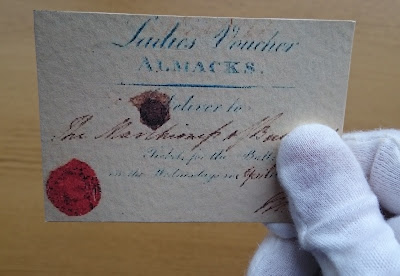
Almack’s, the Place to See and Be Seen During the Regency

Almack’s history is divided into two parts: one is from the inception to around 1815 and the other from 1815 on.

Willis’s Rooms ~ also called “Almack’s”
from Old and New London by E Walford (1878)

First opening on 12 February 1765 on King Street, St. James’s, Almack’s Assembly Rooms were situated immediately to the east of Pall Mall Place and comprised

… three very elegant new-built rooms, a ten-guinea subscription, for which you have a ball and supper once a week for twelve weeks. [written in a letter from Gilly Williams to George Selwyn, 22 February 1765, in Jesse, John Heneage, George Selwyn and his contemporaries (1843)].

Named after their founder, a Scotsman named William Almack, the rooms were initially home to a ladies’ club, designed to permit gambling in the smaller rooms and dancing in the great room. Unlike the entertainments hosted by Madame Cornelys at the Carlisle House, Almack’s developed an “exclusiveness” which set aside the more scandalous assemblies at Carlisle. On a side note, Almack also owned The Thatched House Tavern and founded a club for gentlemen that later became Brooks’s.

Almack’s lost a large portion of its popularity when the Pantheon opened in 1772. However, when the Pantheon burned down, Almack’s was still standing and grew again in popularity.

Though leading ladies of the Haut Ton were known as patronesses of Almacks, at first, both men and women were named to be patron.

The assemblies were held four or five times a season. They were held on Tuesdays and Thursdays, but not  every week. The patronesses were listed in the paper, and the notice gave the date of the first assembly.

We assume around 1815, after the war with Napoleon ended, Lady Jersey took over Almack’s. The announcements seem to have ceased, the assemblies changed to Wednesday nights, and they were held just about every week during the season. The patronesses greatly restricted its membership. A person could not simply show up at the door and expect admittance. To attend, the person had to procure a “voucher,” signed by one of the patronesses, who are said to have kept a list of whether a person was “good ton” or “bad ton.” This exclusivity element lasted until around 1824.

According to (Samuel Leigh) Leigh’s New Picture of London (1818):

The balls at Willis’s rooms, commonly called Almack’s, are held every Wednesday during the season. They are very splendid, and are very numerously and fashionably attended. Some ladies are styled lady patronesses of these balls; and in order to render them more select, (the price being only seven shillings,) it is necessary that a visitor’s name should be inserted in one of these ladies’ books, which of course makes the admission difficult.

By the 1790s, Almack’s no longer hosted gaming rooms. Instead, dances and assemblies were the entertainment. Eventually, Almack’s became the place for a young lady to “demonstrate” her suitability to members of the ton and for a gentleman to seek out a wife of good social standing. Therefore, it became informally known as “The Marriage Mart.’

The committee at Almack’s changed periodically, but, during the middle of the Regency period, as recorded by Gronow, the Patronesses were Lady Castlereagh, Lady Jersey, Lady Cowper, Mrs. Drummond Burrel, the Countess Esterhazy, and the Countess Lieven. As stated in Ticknor’s [Ticknor, George, Life, Letters, and Journals of George Ticknor (1876).] diaries: only one lady acted as patroness at a time on a rotation basis, but the members of the committee were referred to collectively as the “patronesses of Almack’s.”

Every Monday the Patronesses convened for the sole purpose of deciding who to drop from their membership and to whom to extend a voucher. The criteria for consideration to their hallowed halls was pretty much dependent upon one’s position in society, one’s address, one’s wealth (but being wealthy was not an automatic key to entrance), manners, how one behaved and treated others, and one’s general countenance. All considered acceptable young ladies were introduced to suitable partners by the patronesses, or suffer the consequences of being shunned by them and society, as a whole.

As mentioned above, Gronow, an army officer in London wrote:

the Ladies Castlereagh, Jersey, Cowper, and Sefton, Mrs Drummond Burrell, now Lady Willoughby, the Princess Esterhazy, and the Countess Lieven. [Gronow, Captain. The Reminiscences and Recollections of Captain Gronow (1862).] [Note: Other patronesses were the Marchioness of Salisbury and Lady Downshire.]

Posted in architecture, British history, buildings and structures, Georgian England, Georgian Era, history, real life tales, Regency era, research | Tagged , , , , , , , , , | Comments Off on Almack’s, the Place to See and Be Seen During the Regency

Statute of Wills, Henry VIII’s Answer to Primogeniture

05aee257e11c9e215186cece06325ad7

Caister Castle is a 15th-century moated castle situated in the parish of West Caister, some 5 kilometres (3 mi) north of the town of Great Yarmouth.

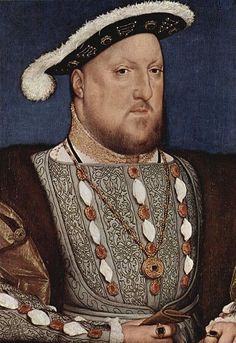
The Statute of Wills (32 Hen. 8, c. 1 – enacted in 1540) was an English Act of Parliament, which created a mechanism for landowners to name who would inherit their landed property. A written will was required. It permitted a land owner to leave two-thirds of his property to anyone as long as their was a written will and testament. Prior to the enactment of this statute, land could be passed by descent only if and when the landholder had competent living relatives who survived him, and it was subject to the rules of primogeniture. When a landholder died without any living relatives, his land would escheat (or revert) to the Crown. The statute was something of a political compromise between Henry VIII and English landowners, who were growing increasingly frustrated with primogeniture and royal control of land.

Ironically, the Statute of Wills was passed by Parliament only four years after the Statute of Uses banned the practice of splitting the title to land to avoid paying royal fee associated with the property. The state of law at the time pressed hardly on other classes than the owners of land. Unfortunately, the accepted conditions often defrauded creditors and intending purchasers of what was rightly theirs. The hereditary heir, unless bound by specialty, was free, according as his honour or his judgment dictated, to pay or to repudiate the debts which his ancestor had incurred; and it was not until the reign of Henry VIII that the heir to an entailed estate was rendered liable even to Crown debts, and then only to those secured by judgment. Until this Statute (and later the Wills Act), the personal estate of a deceased intestate was, if sufficient for the purpose, exclusively liable for the satisfaction for the purpose, exclusively liable for the satisfaction or his mortgage debts while the realty descended unincumbered to the heir-at-law.

572d0512517868eaffbcdf9f7a51aa24Purchasers of land in the period subsequent to de donis (De donis conditionalibus is the chapter of the English Statutes of Westminster (1285), which originated the law of entail.) were often cruelly wronged by the production of latent entails, which deprived them of land for which they had previously paid and for which they had “researched” the validity of the true owner. Francis Bacon’s Treatise on the Use of Land talks about how entailed estates were not liable to forfeiture, how personal offenses could not be addressed by the courts to the heir, how the Crown was prejudiced by the previous “laws,’ which greatly reduced its security for debts due from subjects whose property came under the Crown’s care, so “the King could not safely commit any office of account to such whose lands were entailed, nor other men trust them with loan of money.” 

The Statute of Wills created a number of requirements for the form of a will. Specifically, most jurisdictions still require that a will must be in writing, signed by the testator (the person making the will) and witnessed by at least two other persons. 

Some of the procedures created by the Statute of Wills remain effective in modern law. The statute required that wills be in writing, that they be signed by the person making the will, or testator, and that they be properly witnessed by other persons. If any of these requirements was not met, the will could not be enforced in court. These requirements exist today in state law and are intended to ensure that wills are not fabricated and that the testator’s intent is fulfilled.

A testamentary trust is one that becomes effective at the settlor’s death. To effectively create a testamentary trust, it must be created in a duly executed will. To comply with the Statute of Wills, all the elements of the testamentary trust must be ascertainable from the face of the will and any applicable documents incorporated by reference or facts of independent significance. These elements are:

  • Intention to create a trust;
  • Permissible purpose for the trust;
  • Identification of beneficiaries; and
  • Existence of trust res.
 
In England and Wales, the Statute of Wills was repealed and superseded by the Wills Act of 1837. 
Resources: 

The Law and Custom of Primogeniture by Sir Perceval Lawrence
Read more: Statute of Wills – Land, Law, Death, and Property – JRank Articles http://law.jrank.org/pages/10505/Statute-Wills.html#ixzz4IkgeFjcd


Posted in Act of Parliament, Anglo-Normans, castles, Living in the UK, primogenture | Tagged , , , , , | 3 Comments

The Treatment of Typhus Upon the Russian Front During the Napoleonic Campaign

In the year 1817, a Prussian army physician by the name of Krantz published a medical history of the treatment of typhus during the Napoleonic campaign in Russia. It was entitled: Bemerkungen ueber den Gang der Krankheiten welche in der koniglich preussischen Armee vom Ausbruch des Krieges im Jahre 1812 bis zu Ende des Waffenstillstandes (im Aug.) 1813 geherrscht haben, which is translated as “Remarks on the course of the Diseases which have reigned in the Royal Prussian Army from the Beginning of the War in the Year 1812 until the End of the Armistice [in August] 1813.”

Prianishnikov_1812

According to Krantz, the soldiers of the Grande Armée (Grand Army) had brought more than the destruction of war to the Russian front. Whole families, especially those with whom the French soldiers had dwelled, were stricken down by typhus. The Prussian soldiers of York’s corps supposedly did not know the disease until they followed the French’s retreat. Krantz reports that the Prussian army corps knew rapidly knew typhus. He also records another phenomenon: There was a certain uniformity among the different divisions. “On account of the overflowing of the rivers, the men had to march closely together on the road, at least until they passed the Vistula near Dirschau, Moeve, and Marienwerder. Of the rapid extent of the infection we can form an idea when we learn the following facts: In the first East Prussian regiment of infantry, when it came to the Vistula, there was not a single case of typhus, while after a march of 14 miles on the highway which the French had passed before them, there were 15 to 20 men sick in every company, every tenth or even every seventh man. In those divisions which had been exposed to infection while in former cantonments, the cases were much more numerous, 20 to 30 in every company.” (“The Treatment of Typhus,” Historion.net)

In addition to the typhus outbreak, epidemic ophthalmy spread through some of the divisions. A common “causal nexus” connected the two diseases. However, it was noted that the two ailments never attacked the same individual. It was as if typhus gave the patient an immunity against ophthalmy and vice versa. Ironically, Krantz and the other physicians discovered the diseases were often “cured” by the cold of the march. “We found confirmed, says Krantz, what had been asserted a long time before by experienced physicians, that cold air had the most beneficial effect during the inflammatory stage of contagious typhus.” (“The Treatment of Typhus,” Historion.net)

Those suffering from typhus were dressed in warm clothing to protect them from the cold and placed on a wagon to be covered completely by straw. The wagons followed the retreating troops, but they stopped frequently so the patients could be given a tea of “Infusum Chamomillae, species aromaticarum, etc., with or without wine or spiritus sulphuricus aetherius.” Those suffering from typhus were given several cupfuls of the mixture to warm them. The soldiers’ hands and feet were wrapped in rags to prevent frostbite.300px-Napoleons_retreat_from_moscow

At night, those infected were crowded into makeshift hospitals. Those with typhus were separated from those needing other medical treatments, often being placed in barns or larger homes – all filled to capacity and then some. “All the hospitals between the Vistula and Berlin, constantly overfilled, were thoroughly infected, and thus transformed into regular pest-houses exhaling perdition to everyone who entered, the physicians and attendants included. On the other hand, most of the patients who were treated on the march recovered. Of the 31 cases of typhus of the 2d. battalion of the infantry guards reported from Tilsit to Tuchel, only one died, while the remaining 30 regained their health completely, a statistical result as favorable as has hardly ever happened in the best regulated hospital and which is the more surprising on account of the severe form of the disease at that time.” (“The Treatment of Typhus,” Historion.net)

Krantz goes on to say that of 330 patients in the first East Prussian regiment of infantry, 300 recovered and 30 were sent to hospitals in Elbing, Maerkisch, Friedland, Conitz, and Berlin. None died. What was discovered was the cold prevented the spread of the disease. Keeping the patients in the wagons and moving about the countryside did not permit the disease to brew and develop into a death sentence. For most patients, three days after they had been free from fever for 24 hours they were fit to rejoin their units.

As opposed to the customary treatment of the time, which included the exclusion of fresh air and the hourly administration of medication, those treated on the march experienced a 2-3% mortality rate.1024px-Myrbach-Cossacks

Note: I used this research as part of my Regency era based novel, A Touch of Honor (Book 7 of the Realm Series).ATOHCrop2

Posted in British history, Georgian England, Georgian Era, history, medicine, military, Napoleonic Wars, real life tales, Realm series, Regency era, research, science | Tagged , , , , , , , , , , , , | 3 Comments

Did An Officer’s Wife Receive a Pension if Her Husband Died in the Napoleonic Wars?

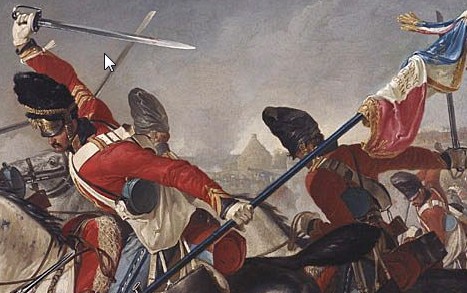
Scots Greys at Waterloo carrying Canteens without regimental markings. ~ http://www.militaryheritage.com/canteen.htm

 Did an officer’s wives receive  any kind of pension or a refund for her husband’s purchased rank if the man was killed in battle?

 First, permit me to explain, regiments were formed “whole cloth” in some regions, or whole battalions of a regiment. While regiments *generally* had districts and counties where they would recruit. A Sargent and a small group of enlisted men would ‘beat the drum’ and collect recruits, usually ‘enlisted’ men, but that could include officers. Customarily, men who wanted to become officers would apply to the colonel of the regiment, who often was not with their regiment on the Continent, but rather in England, or he might apply to the regimental agent. This process could be conducted in person; yet more often, it was executed by letter with recommendations from friends and relatives. A person could apply directly to the Horse Guards too, but then they would not have a choice as to which regiment they would be assigned.

Only about one-third of all commissions were purchased during the wars. More were purchased between 1792-1800 than later. Also more were purchased in Guard units and cavalry. One reason pensions were created and raised for officers and their wives [though badly handled at times] was because there was no commission to hand the wife. Commissions were the property of the officer. He purchased it. It was his to dispose of when he so chose.

In 1798, far more commissions were bought, meaning more money was raised. An ensign or lieutenant would receive 300 – 400 pounds, depending on whether the position was in a guards unit or the cavalry.  Extended leave was the man’s choice.  However, if it continued for several months, the army, meaning the man’s colonel,  would go after him to serve or sell out. Colonels made money from their regiment and despised having an idler on the payroll.  I read where one officer, after seven months on leave, without his commanding officer receiving any statement of when he would return was asked to return to the army, sell out, or the colonel would sell his commission for him. The man was receiving his pay during that time and taking advantage of the system. This action was the social equivalent of a dishonorable discharge.

The method of filling the necessary posts for an army was part of the Old World proprietary practices where the regiment was a business owned and run by a colonel. He sold commissions in his regiment. This was slowly phased out during the Napoleonic wars to where the Army was not just ‘Okaying’ a colonel’s choice, but granting commissions themselves as the Ordinance Department did for the Engineers and Artillery. 

So, when an officer died, his commission would be presented to the widow WHEN and IF  it was bought by another, which could be immediately, or not for a long, long time, particularly when a regiment was involved in a campaign and willing and monied candidates were not readily at hand. Depending on the colonel, he might have the regimental agent pay the purchase cost out to the widow immediately, or he may wait or ‘forget’ to pay it, just as we see such things happening in the business world today.  The officers of the mess would often auction off an officer’s belongings to raise money for the widow because she would have to pay for any transportation costs to send the body home. 

When the officer hadn’t bought a commission, had what was known as a ‘free commission’, he did not ‘sell out’, he ‘cried out’ and the widow would not receive any pension until she presented the colonel’s signed affidavit to a bank, which would then ‘charge’ the government, which was very bad at paying pensions during different points in the war. Unfortunately, the pensions were not regularly paid. Pensions for wives were about 40% of what an officer’s pay had been when he was alive. Later, in 1814, the pension was raised to equal half-pay.

One must recall the scandal caused by the Duke of York and his mistress selling commissions during the early years of the war. 

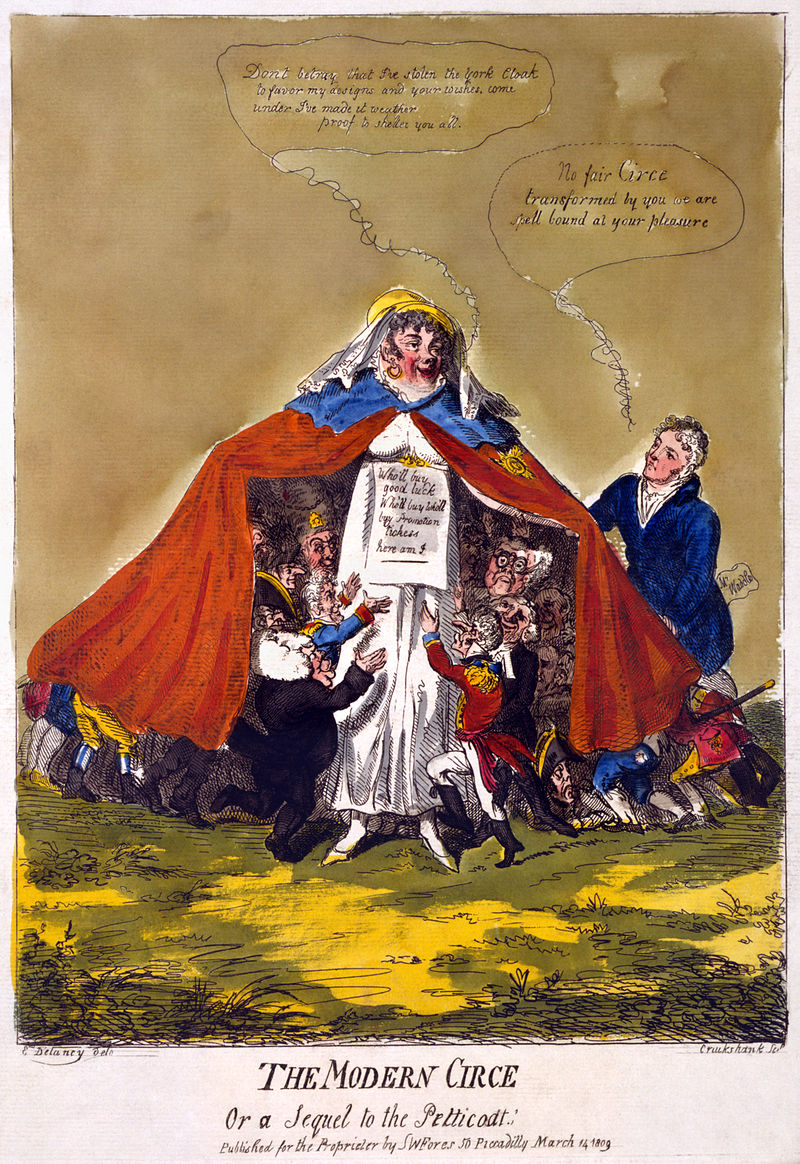
“Mary Anne Thompson was the daughter of a humble tradesman. Attractive and intelligent, she was married before the age of 18, to a man named Clarke, who worked as a stonemason However, shortly after the marriage, her husband went bankrupt, and Mary Anne Clarke left him. By 1803 Clarke had been established long enough in the world of  courtesans to receive the attention of Frederick, Duke of York, then the Commander in Chief of the army.

“Taking her as his mistress, he set her up in a fashionable residence. However, he failed to supply the funds necessary to support their lavish lifestyle. In 1809, a national scandal arose when Clarke testified before the House of Commons that she had sold army commissions with the Duke of York’s knowledge. The scandal was the subject of much humour and mockery, especially by caricaturists. Frederick was forced to resign from his position, though he was later reinstated.

“The modern Circe or a sequel to the petticoat”, caricature of Mary Anne Clarke by Isaac Cruikshank, 15 March 1809. Her lover Frederick, Duke of York resigned from his post at the head of the British Army ten days after the caricature’s publication. https://en.wikipedia.org/wiki/Mary_Anne_Clarke#/media/File:Mary_Anne_Clarke2.jpg

“After the Duke of York resigned his post as Commander in Chief of the Army, and before he was later reinstated, he cut all ties to Clarke, paying her a considerable sum to prevent her from publishing letters he had written to her during their relationship. When the scandal forced Clarke to leave London, she took a tenancy of Loughton Lodge, Loughton, Essex. Clarke was prosecuted for libel in 1813 and imprisoned for nine months.” [Mary Anne Clarke]

We must consider the time period in which this is happening, as well as society’s class norms. These transferred directly into the army. Gentlemen were officers, officers were Gentlemen,  non-commissioned officers were the middle class, educated to some extent, and the enlisted men, the lower classes.

These colonels could have as much responsibility for their regiment as they wished, but they often handed off all administrative duties to the regimental agent and the Lieutenant Colonel of the regiment, who was essentially the officer in the field, though certainly there were the commanding colonel who campaigned with their regiment. There were reports and paperwork that had to go to the Horse Guards or the Secretary of the Army, but the only time the colonel of the regiment HAD to appear was if he was summoned. Like most of those who were or aspired to be gentlemen, ‘serving a function’ was too much like being in TRADE for a number of the colonels. They had people, adjutants, aides, commissary officers, and other staff to deal with that sort of thing. 

What is often overlooked is the real changes in the military from 1792 to 1815. The old system was in flux. The army took control of commissioning officers around 1811 and a pension system was set up for retiring officers who had been given a commission and could ‘cry out’, but had nothing to sell as a commission. Widow’s pensions were also given serious attention during this time as they would not receive the commission costs if their husband died.

Other Resources: 

The Evolution of French Napoleonic Army Organization

History: Napoleonic Wars Army Structure

Napoleonic Era British Infantry

Napoleonic Wars

Napoleonic Wars by Rob Hartman

Posted in British history, Georgian England, Georgian Era, Great Britain, history, Living in the Regency, military, real life tales, Regency era, war | Tagged , , , , , , | 2 Comments

“Commissions” for an Officer Engineer or Artilleryman in the Regency Era

I recently had another writer send me a message to ask about the process for a man of the gentry or the aristocracy to purchase a commission as an officer engineer or artilleryman. First, permit me to say I am far from an expert on this subject, but the way I understand it, commissions for these positions were not sold. However, I will tell you, dear readers, if you ask me this same question later, I may have a different response. It seems there were no “absolutes” regarding these positions.

A person could only purchase a commission in a cavalry or infantry regiment. For any other regiment, such as the Royal Engineers or Royal Artillery, the young man had to attend the Royal Military Academy at Woolwich in order to receive a commission. Promotions there were based on length of service and experience.

I have read numerous accounts where cadets entered the Royal Military Academy at age fourteen, but other accounts have the person entering at age twenty. What I can say with some certainty is there was an entrance exam, which required more than a simple working knowledge of both regular math and geometry. When the person graduated is a whole other story. The fourteen year old graduated at age 18, while the twenty year old graduated at age twenty-five. This leads me to believe the courses required for this type of commission took four years to complete.

This information would naturally lead one to assume it would take four years to “graduate,” but I have read of instances where the officer passed back and forth between the artillery and engineers, so I am truly not certain that the Ordinance Department made any distinction between the two.

I think it is safe to say no officer was commissioned under the age of sixteen and, more likely, most were eighteen or older. We must remember those who attended the Academy had also to pass an exit exam. If one failed, he returned to the classroom for more instruction.

“Captain Wentworth, with five-and-twenty thousand pounds, and as high in his profession as merit and activity could place him, was no longer nobody. He was now esteemed quite worthy to address the daughter of a foolish, spendthrift baronet, who had not principle or sense enough to maintain himself in the situation in which Providence had placed him ...” [Chapter 24, Persuasion, by Jane Austen]

The Navy proved to be a popular trade/occupation for the sons of the gentry, but less so for sons of the aristocracy. A boy as young as ten could “volunteer” for a seafaring apprenticeship, one attached to the Captain of a particular ship. This position was unpaid, and the boy’s parents footed the bill for his food and clothes. He could become a midshipman when he reached 14.

The other means to become a midshipman was through the Royal Naval Academy at Portsmouth. Two of Jane Austen’s brothers attended the academy. It taught seamanship along with the standard educational subjects. Obviously, mathematics was emphasized because the use of the subject in navigation. It took two years (funded by the young man’s parents) onboard a ship for the fellow to become a Midshipman.

The Gunner and His Crew in Aubrey’s Royal Navy ~
https://thedearsurprise.com/the-gunner-and-his-crew-in-aubreys-royal-navy/

Naval History and Military Command provides us this excellent breakdown of duties:

OF GUNNERS, GUNNERS’ MATES, GUNNERS’ YEOMEN, AND QUARTER GUNNERS.

GUNNER of a ship of war, (cannonier de vaisseau, Fr.) an officer appointed to take charge of the artillery and ammunition aboard; to observe that the former are always kept in order, and properly fitted with tackles and other furniture, and to teach the sailors the exercise of the cannon.

The GUNNER’S Mate is to assist the gunner in every part of his business; he is an officer who should be as well acquainted with gunnery, and every thing respecting the ordnance and military stores, as the gunner himself: his particular business under the gunner is to have every thing ready for action in a moment’s warning; he should never be as a loss to know where to lay his hands upon any article belonging to the gunner’s department; he should be expert in preparing port and false fires, match stuff, grenadoes, and every sort of combustible used in war; and in a word, in doing every part of a gunner’s duty on board a ship of war.

The GUNNER’S Yeoman’s particular business is the stowage of the magazine, filling the store-rooms, &c. account, care, and distribution of all the stores of that department, under the gunner’s orders.

Quarter– GUNNER, an inferior officer under the direction of a ship of war, whom he is to assist in every branch of his duty; as keeping the guns and carriages in proper order, and duly furnished with whatever is necessary; filling the powder into cartridges, scaling the guns, and keeping them always in a condition for service. The number of quarter-gunners in any ship is always in proportion to the number of her artillery, one quarter-gunner being allowed to every four cannon.

OF MASTERS AT ARMS AND CORPORALS

MASTER at arms, an officer appointed by warrant from the board of admiralty, to teach the officers and crew of a ship of war the exercise of small arms; to confine and plant centinels over the prisoners, and superintend whatever relates to them during their confinement. He is also, as soon as the evening gun shall be fired, to see all the fires and lights extinguished, except such as shall be permitted by proper authority, or under the inspection of centinels. It is likewise his duty to attend the gangway, when any boats arrive aboard, and search them carefully, together with their rowers, that no spirituous liquors may be conveyed into the ship, unless by permission of the commanding officer. He is to see that the small arms be kept in proper order. He is to visit all vessels coming to or going from the ship, and prevent the crew from going from the ship without leave. He is also to acquaint the officer of the watch with all irregularities in the ship which shall come to his knowledge. In these several duties he is assisted with proper attendants, called his corporals, who also relieve the centinels, and one another, at proper periods.

CORPORAL of a ship of war, an officer under the master at arms, employed to teach the sailors the exercise of small arms, or musketry; to attend at the gang-way, or entering-ports, and observe that no spirituous liquors are brought into the ship, unless by particular leave from the officers. He is also to extinguish the fire and candles at eight o’clock in winter, and nine in summer, when the evening gun is fired; and to walk frequently down into the lower decks in his watch, to see that there are no lights but such as are under the charge of proper centinels, which he is to see placed, &c.

Forgive me for I have again digressed. For a very long time, there was no artillery or engineer manual. Each student created his own in the Academy from the courses he took, and he had to present that “manual” to the Academy teachers for approval as part of his graduation requirements.

Another source I particularly enjoyed was a “Service” magazine, for it held several accounts after the war from a variety of artillery officers. One I particularly enjoyed was “Shots from an Old Six Pounder.” You can find the information on Google Books on clicking the link. (The United Service Magazine, Volume 57, Page 2)

Other Sources:

Gentlemen’s Occupations

The Gunner and His Crew

Posted in British history, British Navy, Georgian England, Georgian Era, historical fiction, history, Jane Austen, military, Persuasion, real life tales, Regency era, research | Tagged , , , , , , , , | Comments Off on “Commissions” for an Officer Engineer or Artilleryman in the Regency Era

The East India Company, the World’s Most Powerful Cooperation, a Guest Post from Eliza Shearer

This post first appeared on the Austen Authors’ blog on November 12, 2019. Enjoy!

“Do you understand muslins, sir?”

“Particularly well; I always buy my own cravats, and am allowed to be an excellent judge; and my sister has often trusted me in the choice of a gown. I bought one for her the other day, and it was pronounced to be a prodigious bargain by every lady who saw it. I gave but five shillings a yard for it, and a true Indian muslin.”

Jane Austen’s Northanger Abbey, Chapter 3

I have been reading a great deal about the East India Company (EIC) of late because one of the characters in Miss Price’s Decision works for it. Four centuries before Walmart, Volkswagen or Amazon, the EIC was the original multinational corporation, employing thousands, yielding more power than many countries and enjoying unimaginable freedom to operate. 

A Profitable Multinational Operation 

The EIC, famously known as The Company, was founded in 1600 to foster trade with the so-called East Indies. By the Regency, the products in its portfolio included cotton muslins like the one bought by Tilney, as well as silk, spices, tea, salt, porcelain, opium and many more.  

At the same time, The Company did much more than overseeing commercial transactions between England and Asia. The EIC was involved in politics as much as in trade, and it effectively controlled a large territory and a population of millions, setting the foundation of what would become the British Empire. 

The EIC even had its own army, with 260,000 soldiers by 1803 (that’s twice the size of the British Army at the time). They enforced the execution of trade and taxation agreements and ensured that Indian labourers did as they were told. They were also known for ruthless looting of local riches.

(The EIC may have been Honourable on paper, but on the ground, it was anything but!)  

The Professionalisation of The Company

The men who worked as administrators for the EIC traditionally achieved their roles by patronage. By the Regency, patronage was still key in the recruitment process, but the EIC controlled such a vast territory that there was a pressing need for competently trained administrators, known as ‘writers’. 

EIC writers were clerical workers in charge of recording all the transactions overseen by the organisation, from minutes of meetings to accounting books to stock logs. Their importance to keep the EIC machinery running smoothly was such that the EIC (you guessed it!) founded its own college to train them up. 

The East India College, known as Haileybury, was established in 1806 in Hailey, Hertfordshire. The College, which was a short distance north of London, had the specific purpose of educating the young men destined to serve as EIC administrators in the colonies. 

A Very Peculiar College

Haileybury was a private institution quite unlike anything else. The curriculum was very ambitious. As well as political economy, philosophy, history, mathematics, law, and the classics, students were taught languages they would need once in their positions abroad, such as Arabic, Urdu, Bengali, Sanskrit or Persian. 

Admission to the programme was complex and required candidates to be backed by rich and powerful patrons. The College was not a cheap operation. The tutors were paid handsomely, some as much as 500 pounds a year, and with a reason, because they were amongst the most brilliant scholars of their time, many having previously taught at Oxford and Cambridge. 

By the mid-nineteenth century, many viewed the East India Company with suspicion, and in 1855, a Parliament act was passed “to relieve the East India Company from the obligation to maintain the College at Haileybury.” The Indian Civil Service would take its place, but the halo of Haileybury would remain for decades afterwards. 

Haileybury College in Miss Price’s Decision

I found the story of Haileybury too fascinating to ignore, so I weaved it into Miss Price’s Decision, which tells the story of Fanny Price’s sister Susan. Here is an excerpt discussing it:

“Miss Price! Another pleasant coincidence!”

Holding the dirty cloth in my hand, I looked up. Jamie Gartner was standing in front of me, beaming. His smile turned into a frown when he saw my tea-stained dress. 

“Can I be of any assistance?”

I blushed, shook my head and mumbled something. His gaze was burning my skin. To hide my embarrassment, I introduced Jamie to my companions, and to my relief, Mr Allen began to ask him a great many questions. Their conversation immediately touched upon Jamie’s occupation. Jamie, it turned out, had studied at the prestigious Haileybury College and had subsequently acquired a clerking post at the East India Company.

“Do you happen to know a Mr Payne? He has a post in the main registry.”

“It is my pleasure to work alongside him, sir.”

“Do you really? It is a small world, indeed. And do you plan to remain in the London office or are you destined to go abroad?”

“I have applied for a post in Calcutta. It is an important port and offers great opportunities for a writer like me as the company grows.”

Mr Allen appeared impressed, and invited Jamie, who confessed he was on his own, to join our little party. He readily accepted, to the delight of Mrs Allen and Miss Morland, who had been clinging to his every word. (…)

Mrs Allen’s fan tapped my arm.

“Have you known Mr Gartner long, then?”

“We grew up together,” I replied, trying to sound more animated than I felt. (…)

“He appears to have done very well for himself. A son of my cousin’s attended the East India College in Hertfordshire a few years ago, and his mother likes to go on about how only the most talented manage to secure a place, and how well he speaks all manners of strange languages, and how good he is with numbers.”  

“He was always a very bright boy,” I replied with a smile. 

“He must have very good patrons, too. My cousin tells me that, in order to be accepted into that fancy college, students need to be recommended by people in high places. They are also expected to pay hefty fees, although to be fair, their studies set them up for life. Do they not, Mr Allen?”

“My understanding is that posts abroad offer excellent prospects,” replied Mr Allen, stroking his chin. “Mr Gartner is not married, is he?”

“No, I do not think so,” I replied. 

“Well, if he is to travel to the East Indies, he will be in a hurry to find himself a wife,” said he. “There are very few Englishwomen in those lands.” 

Mrs Allen let out a cry of delight.

Eliza Shearer’s Miss Price’s Decision, Chapter 9

How familiar are you with the East India Company and what do you think of the curriculum at Haileybury College? 

Posted in Austen Authors, book excerpts, book release, British history, excerpt, Georgian England, Georgian Era, Great Britain, Guest Post, historical fiction, history, Living in the Regency, Mansfield Park, political stance, publishing, real life tales, Regency era | Tagged , , , , , , , , , , , , , | Comments Off on The East India Company, the World’s Most Powerful Cooperation, a Guest Post from Eliza Shearer

Jane Austen and the East India Company – a Guest Post from Elaine Owen

This post originally appeared on Austen Authors on June 21, 2019. Enjoy!  If you missed it, you can read part one HERE

In 1752 a young English woman traveled from the land of her birth to the continent of India for the express purpose of finding a husband. She had been an orphan from the age of six and had only a handful of younger siblings and more distant relatives to claim as her own. With no fortune and no family connections to attract possible suitors, this was probably her best shot at making a profitable marriage.

The young lady, just twenty two at the time, was named Philadelphia (“Phila”) Austen, and she had a younger brother named George. Many years in the future she would become an aunt to the newborn Jane Austen. But at the time all she knew was that she was supposed to become a bride for someone who worked for the East India Company.

Philadelphia Austen Hancock

In my last post I talked about the East India Company and mentioned that Jane Austen was connected to the company in some surprising ways. Today I would like to explore that connection in some detail.

On the six month passage to India Phila made friends with another husband-seeking woman named Margaret Maskelyne. When they arrived in India Phila became quickly engaged to Tysoe Saul Hancock, who worked for the East India Company as a surgeon but also earned money by trading Indian products such as salt and cloth. Phila’s friend Margaret married another East India man by the name of Robert Clive. Eventually these two couples also became close friends with another East India couple, Warren and Marian Hastings. The relationships between these three couples would have a profound influence on the life of Jane Austen.

Hastings and Clive were not mere tradesmen. They both rose through the ranks of the East India Company to the very highest positions of leadership. Robert Clive became one of the military leaders of the East India Company and brought India, modern day Pakistan and modern day Bangladesh into the British Empire. He did this by overthrowing the rightful heir to the Bengal throne and installing a puppet leader instead. His official title eventually became Commander in Chief of British India. Clive is known in history as a competent but corrupt leader for removing wealth from the Indian people, condoning atrocities, and implementing land policies that caused one of the worst famines in modern times.

Warren Hastings worked under Clive and helped him implement his programs. While Clive managed the military side of things, Hastings handled the administrative end, eventually becoming the first Governor General of India. To his credit Hastings saw the corruption and abuses of the British rule in India and he often tried to negotiate between the two sides. But he was an East India man and he was bound to enforce even rules he did not personally agree with.

We know that the Phila and her husband maintained close ties with both of these families, especially the Hastings. For a short time all three couples lived in the Clive’s home in India. Phila’s marriage to Hancock seems not to have been a happy one, and there was widespread speculation that Hastings, not Hancock, was the father of Phila’s only child (Eliza). Whether that is true or not we do know that when Hastings sent his young son George to live in England, the child lived with Phila’s relatives, the Austen family. George died of diphtheria while in the Austen’s care, but the warm association between the Hastings and Austen families continued unabated. Many years later, when Hastings was on trial in England for corruption, the Austen family followed every detail of the proceedings and staunchly supported their long time friend. And Hastings eventually gave Eliza Hancock, his godchild and possible natural daughter, an enormous fortune of ten thousand pounds.

Tysoe Saul Hancock, Clarinda, Eliza, and Philadelphia

So, was Jane Austen aware of the less than savory actions of the East India Company? Did she know that her own family was so closely connected to them? She must have. In her lifetime there was such widespread criticism of the East India Company that Parliament passed a series of laws curtailing its powers and bringing it more directly under the control of the British government. Hastings himself was investigated for corruption for an astonishing seven years. (He was ultimately acquitted.) It’s easy to imagine Jane and her family sitting at the dinner table or writing letters to each other, discussing the latest corruption charges against Hastings and wondering how their aunt Phila and cousin Eliza would be affected.,

Jane leaves no direct statements criticizing her family’s powerful friends. We can surmise that the author who crafted such fair minded, morally strong characters as Fanny Price and Anne Elliott was offended by the excesses and abuses of the British government in other parts of the world. But she was a woman, a daughter of the house, and hardly in a position to challenge the status quo. My best guess is that Jane probably felt conflicted at times, as we all do when people close to us are tied to movements or causes we find objectionable. Most likely she tried not to think about it too much.

There is, however, a bare hint of this conflict in Mansfield Park. I suspect that this passage is the closest Jane ever came to publicly expressing her thoughts about the darker side of British colonial policy.

[Edmund to Fanny] “Your uncle is disposed to be pleased with you in every respect; and I only wish you would talk to him more. – You are one of those who are too silent in the evening circle.”

[Fanny] “But I do talk to him more that I used. I am sure I do. Did not you hear me ask him about the slave trade last night?”

“I did – and was in hopes the question would be followed up by others. It would have pleased your uncle to be inquired of farther.”

“And I longed to do it – but there was such a dead silence! And while my cousins were sitting by without speaking a word, or seeming at all interested in the subject, I did not like – I thought it would appear as if I wanted to set myself off at their expense, by shewing a curiosity and pleasure in his information which he must wish his own daughters to feel.”

The “dead silence” comment is interesting, for it exactly describes how Jane treated the subject of British abuses in general in her novels. Fanny Price was speaking of slavery in Barbados, but she could just as easily have been speaking of atrocities in India.

The East India Company eventually collapsed under its own weight. The Indian Rebellion of 1857 was harshly put down, but the crown had finally had enough of the business enterprise that had ruled large parts of the British empire on behalf of the crown for so long. It nationalized the East India Company and took over all of its holdings, its finances, and especially its armed forces. In 1874 the company was disbanded entirely.

There is at least one writer out there who believes that we can thank the East India Company, at least in part, for having Jane Austen’s novels available to us today. As I mentioned before, Warren Hastings gave Eliza Hancock, Phila’s daughter, a massive inheritance of 10,000 pounds in the form of a trust fund. Eliza married a French duke who was killed in the revolution. Then, as a widow, she married Jane’s brother Henry, which meant that Henry had control of the inheritance from Hastings–an inheritance that came from Hastings’ work for the East India Company. Henry is the family member who negotiated with publishers on Jane’s behalf, signed contracts in her name, and promoted her works after her death. Without Henry Austen we might not have heard of Jane Austen. In my opinion this is a very tenuous connection, but it certainly gives one pause.

What do you think? Should Jane have addressed this difficult sort of topic in her novels? Should she have openly criticized the British government and East India Company, or was she right to stay silent on the subject? I know these are tricky questions but I would really like to hear your thoughts!

Posted in British history, Georgian England, Georgian Era, Guest Post, history, Jane Austen, Mansfield Park, marriage, marriage customs, political stance, reading, real life tales, Regency era, research, writing | Tagged , , , , , , , , | 1 Comment