Although Sir Alexander Chandler and Miss Alana Pottinger do not come to their Happily Ever After in Lady Chandler’s Sister through handfasting, it is a subject of discussion. They met in Scotland, and handfasting was a more common practice there. But what was handfasting?
Historically, marriage towards the latter part of the medieval period in Scotland could be executed by the exchange of consent between a man and a woman. This was what we say in the modern setting, i.e., “I Edward take you Margaret to be my wife.” During the medieval times, witnesses were not necessary to make the marriage valid. Basically, this marriage by consent held true from the early 1200s to the Reformation. This was a practice of canon law, essentially the Roman Catholic Church, not civil law. Oddly, this practice went against the earlier precepts of parental consent and the marriage only being binding after it was consummated. However, the Catholic church argued that these “clandestine” marriages, as they were termed, were as legal and as binding as were those performed by a priest.
Some of these practices changed with the Council of Trent (1563). Roman Catholic law then insisted upon a priest performing the marriage for it to be legal. However, Scottish Reformation did not get around to “reforming” the marriage laws as quickly as did other Protestant countries. Both the Protestant Kirk and Scottish civil law did not change. Consent between the couple remained as the basis for a legal joining. That being said, the Protestant Kirk did not approve of “clandestine” marriages, any more than did the Catholic contingent. Many Scottish Protestants attacked the practice, calling it a form of “fornication” and declaring it illegal.
So, how does this apply to “handfasting”? In late medieval Scotland (and northern England), “handfasting” was a term for “betrothal.” In A. E. Anton’s “‘Handfasting’ in Scotland” (The Scottish Historical Review, October 1958), we learn:
“Among the people who came to inhabit Northumbria and the Lothians, as well as among other Germanic peoples, the nuptials were completed in two distinct phases. There was first the betrothal ceremony and later the giving-away of the wife to the husband. The betrothal ceremony was called the beweddung in Anglo-Saxon because in it the future husband gave weds or sureties to the woman’s relatives, initially for payment to them of a suitable price for his bride but later for payment to her of suitable dower and morning-gift. The parties plighted their troth and the contract was sealed, like any other contract, by a hand-shake. This joining of hands was called a handfæstung in Anglo-Saxon, and the same word is found in different forms in the German, Swedish and Danish languages. In each it means a pledge by the giving of the hand.
“… The joining of the hands became a feature of betrothals in Scotland and in England during the medieval period. A Scottish protocol narrates that on 24 July 1556, the Vicar of Aberdour ‘ministrat and execut the office anent the handfasting betwix Robert Lawder younger of the Bass and Jane Hepburn docter to Patrick Errl Botwell in thir vordis following: “I Robert Lawder tak thow Jane Hepburne to my spousit wyf as the law of the Haly Kirk schawis and thereto I plycht thow my trewht and syklyk I the said Jane Hepburne takis you Robert Lawder to my spousit husband as the law of the Haly Kirk schaws and therto I plycht to thow my trewth,” and execut the residew of the said maner of handfasting conforme to the consuetud usit and wont in syk casis’ What this ‘consuetude’ was may be gathered from a protocol on the sponsalia of David Boswell of Auchinleck and Janet Hamilton, daughter of the Earl of Arran. After the consents had been exchanged ‘the curate with the consent of both parties with their hands joined betrothed the said David and Janet who took oath as is the custom of the Church’. In fact, the ceremony of joining hands became so closely associated with betrothals in medieval times that in Scotland, and apparently the north of England, the ordinary term for a betrothal was a handfasting. The use of the term in this sense persisted in Elgin as late as 1635.”
One catch in all this is the idea that if a couple had sex after becoming handfasted, they were no longer betrothed, but rather legally married. Handfasting could result in marriage if the couple made their consents to marry or if the pair enjoy conjugal relationships. If they did not exchange consents and did not have marital relationships, they were not married (simply betrothed, which means the betrothal could still be broken).
“History of Marriage in Great Britain and Ireland”viaWikipedia ~
Sir Alexander Chandler knows his place in the world. As the head of one of the divisions of the Home Office, he has his hand on the nation’s pulse. However, a carriage accidenton a deserted Scottish road six months earlier has Sir Alexander questioning his every choice. He has no memory of what happened before he woke up in an Edinburgh hospital, and the unknown frightens him more than any enemy he ever met on a field of battle. One thing is for certain: He knows he did not marry Miss Alana Pottinger’s sister in an “over the anvil” type of ceremony in Scotland.
Miss Alana Pottinger has come to London, with Sir Alexander’s son in tow, to claim the life the baronet promised the boy when he married Sorcha, some eighteen months prior. She understands his responsibilities to King and Crown, but this particular fiery, Scottish miss refuses to permit Sir Alexander to deny his duty to his son. Nothing will keep her from securing the child’s future as heir to the baronetcy and restoring Sir Alexander’s memory of the love he shared with Sorcha: Nothing, that is, except the beginning of the Rockite Rebellion in Ireland and the kidnapping of said child for nefarious reasons.
An impressive ending to the beautifully crafted Twins’ Trilogy – Starr’s ***** Romance Reviews
Love. Power. Intrigue. Betrayal. All play their parts in this fitting conclusion to a captivating, romantic suspense trio. – Bella Graves, Author & Reviewer
2019 International Book Award Finalist in Historical Romance
When the Hardwick Act for the Prevention of Clandestine Marriages went into effect in March of 1754, the rules for marrying in England changed dramatically. Prior to that time, all the couple had to do was to pronounce their vows before a clergyman of the Church of England. Heck, it did not even have to be one’s local clergyman or even one’s local church. In fact, the Fleet Street prison saw quite a few marriages in those days. “A Fleet Marriage was a common example of an irregular or a clandestine marriage. An “irregular” marriage was one that took place either away from the home parish of the spouses (but after banns or licence), or at an improper time. “Clandestine” marriages were those that had an element of secrecy to them: perhaps they took place away from a home parish, and without either banns or marriage licence.
“It is often asserted, mistakenly, that under English law of this period a marriage could be recognized as valid if each spouse had simply expressed (to each other) an unconditional consent to their marriage. While, with few local exceptions, earlier Christian marriages across Europe were by mutual consent, declaration of intention to marry and upon the subsequent physical union of the parties,[3][4] in 1563 the Council of Trent, twenty-fourth session, required that a valid marriage must be performed by a priest before two witnesses. By the 18th century, the earlier form of consent-based marriages (“common-law marriages” in modern terms) were the exception. Nearly all marriages in England, including the “irregular” and “clandestine” ones, were performed by ordained clergy. [Fleet Marriage]
Meanwhile, Nancy Researcher tells us, “The new act was meant to make marriages more public and regular. Though people had always been encouraged to have the banns called, it now became a requirement that they do so unless the couple obtained a license from the local bishop or the Archbishop of Canterbury. By 1811 the cost of a special license was £5. It was mostly used by the aristocracy and men in the public eye. The standard license from a bishop required a bond for £100 to be forfeit if the couple lied about any allegation as well as a slight fee. This license named the parish in which the wedding would be held. This license entailed a wait of seven days.”
According to many sources, no provisions existed for proxy marriages in the British Isles. HOWEVER, if a marriage by proxy took place in a country where they were permitted, then such a marriage would be valid in England. Supposedly, none of the cases which were brought before the court involved men or women who had been born and baptized in England. YET, WHAT IF NO ONE QUESTIONED THE MARRIAGE? WHAT IF ITS LEGALITY WAS NEVER UNDER DEBATE BY THE COURT SYSTEM?
After all, Royal brides who were married by proxy in their country of origin–more as a protective measure than a legal marriage–but were married in a Church of England ceremony on arrival in England.
And that being said, there is just enough of an opening in law to make the possibility believable. Under English Common Law, if a proxy marriage is valid by the law of the place where the marriage took place (lex loci celebrations), then it is recognized in England and Wales. “Recognition of Marriages by Proxy Abroad” from the Yale Law Review, tells us, “At common law the mutual consent of both parties perverba de praesenti sufficed without more to create the marital status. . . . Since the mutual consent need not be expressed by the parties in the presence of each other, . . . the English courts had early adopted the provisions of the canon law recognizing the validity of marriages by proxy.”
There upon is what I latched my plot twist in Amending the Shades of Pemberley.
“You have willfully misunderstood me, Miss Bennet. You have no worry of my releasing you, for I do not wish you to perform as a governess to my daughter, but rather as my wife and the mistress of my hereditary estate.”
Elizabeth Bennet had thought the stranger quite handsome; yet, she had ignored those first tendrils of interest, for she was in no position for the gentleman to pursue her. She and her sister Mary were all who remained of their family. Moreover, Longbourn and its furnishings were to be sold. They were destitute, and, if fortunate, headed for service in some stranger’s household.
Fitzwilliam Darcy’s proposal of marriage would save both Mary and her, for her sister had agreed to assist with the gentleman’s young daughter. But what of the man’s tale of having corresponded with her father and of Mr. Bennet having purported a marriage between this stranger and her? Elizabeth knew nothing of the arrangement nor of the man’s existence. Though their marriage would solve all her troubles, what if the man’s tale was not completely truthful? Would Mr. Darcy become her enemy or a man she could learn to love?
Enjoy this short excerpt from Chapter Three:
“Yes, sir,” the servant said, “may I be of assistance?”
“Mr. Darcy to speak to Mr. Phillips. His niece, Miss Elizabeth, asked me to speak to him on a matter of importance.”
“Step in, sir. I’ll fetch Mr. Phillips.”
Darcy waited in the foyer but a handful of moments before a middle-aged man, perhaps a few years older than Mr. Bennet, appeared. “Come in, sir. I recognized your name from my wife’s tale of how much of her late sister’s life you purchased at the auction. My office away from my actual office is just along this hall.”
Darcy was a bit impressed by the size of Mr. Phillips’s house. Many country solicitors lived well, but Mr. Phillips appeared to be doing quite well. When they entered the man’s office, Phillips closed the door behind him. “Claim a seat, sir. The servant said you came on behalf of my niece Elizabeth.”
“Miss Elizabeth asked me to call on you and secure your attendance at her wedding, rather, I should say ‘our’ wedding.”
“Most assuredly, Mrs. Phillips and I will be happy to attend, although I admit Elizabeth could have given us the happy news when she and Mary arrived today to stay with us while things are settled with the estate. I would much prefer our girl knew a home of her own rather than the prospects of service.”
Darcy recognized Elizabeth’s honor would not permit her to become a “poor relation” instead of a servant in another’s home. In that manner, he and she were much alike. He toiled alongside the men he had hired to work the mine, though they thought him a bit daft for doing so.
“When is the wedding?” Phillips asked.
“Today. In an hour when Mr. Williamson comes to Longbourn. I brought a special license with me today.”
“A special license?” Phillips asked. “Those are reserved for the aristocracy. Should I be addressing you as ‘my lord’ rather than ‘sir.’”
My late mother was the daughter of an earl.” Darcy grinned. “The Archbishop is my godfather.”
“Does Elizabeth know this?”
“I mentioned it when I explained about the special license; however, I do not think it completely registered with my betrothed, though I expect several questions on the subject when Miss Elizabeth has time to consider what I said. I believe, today, your niece was more concerned with whether I would accept Miss Mary into my household,” Darcy explained.
“And you agreed?” Phillips asked suspiciously.
Darcy unwrapped the strings from the satchel he carried. “Mr. Bennet and I corresponded for nearly six years. This is the copy of the marriage settlements we agreed upon a little over five years back.” He placed the papers on the desk. “Before you ask, Miss Elizabeth knows nothing of these negotiations between her father and me. She does know Mr. Bennet and I held a friendship and her father thought she would make me a good wife.”
“I knew something of Thomas Bennet’s correspondence with a young fellow in India, but I did not know you two began negotiations for a marriage between you and Elizabeth. Bennet must have thought highly of you if he took it upon himself to make such an arrangement. Elizabeth is of her grandmother’s nature and was something of a favorite of Mr. Bennet’s, but I assume you know all this. Yet, I must say, this arrangement is all quite odd,” Phillips declared. He read the first few lines of the paper. “Mr. Bennet openly states you hold no obligation to act upon the agreement if you do not find Elizabeth to your liking.” The man’s eyebrow rose in question. “I assume you believe my niece acceptable.”
Darcy cut through the series of questions. “Miss Elizabeth Bennet is handsome enough to tempt any number of men, and you may count me among them. However, more importantly, she possesses other qualities I admire and actually require in a wife. Your niece has demonstrated the care she takes with all she encounters. I watched her at the auction with Mr. Bingley and her neighbors, and even calculated her interactions with me, a complete stranger. Moreover, thanks to Mr. Bennet’s letters, I know much about Miss Elizabeth’s exemplary character and even some of her faults. My family legacy is in tatters, the estate, though grand, suffers, which means I must spend a great deal of time out of my house to set it aright. I have a five-year-old daughter who requires a strong woman with a caring heart to make a home for her, something my Alice has never known, for, in India, I was often away earning a living. Alice is frightened and requires a stable influence in her life, something other than her doll upon which clings for comfort. I also require a capable mistress for my estate, and, naturally, I will eventually require an heir for all my labors.”
“And you can afford to keep Elizabeth as she deserves to be kept?” Phillips demanded.
“Before I departed England, the family estate easily brought in ten thousand a year. We will not be looking at such amounts for some time, but, within a few years, your niece will be one of England’s most revered women. I made a fortune in India, which I will use to set it all aright. If you require more information, Mr. Bingley can speak to my family’s position in society.
“Mr. Bennet’s personal papers should have a copy of this agreement among them. I am certain you may read it more thoroughly among his will and so forth, at your leisure, and find it legally binding if Elizabeth and I wish it. Your niece is of age and can choose where she may. We both understand, I could demand Miss Elizabeth marry me, and she would have little recourse but to agree. Denying me could place her back in the ranks of poverty or even in debtor’s prison. However, I would prefer she enter our marriage on her own stated conditions. It would serve neither of us well to be on contentious ground, for there is much to be done and little time to do it.”
In the singular form the lexicon of a particular subject is all the terms associated with it. The lexicon of a person or group is all the words they commonly use. As a plural noun, a lexicon is an alphabetical list of the words in a language or the words associated with a particular subject. To distinguish lexicon from a dictionary, it is an alphabetical list of the words in a language or the words associated with a particular subject.
These examples are a mix of what one might hear upon the lips of the aristocracy, as well as examples of Cant used upon London’s streets and those terms used by farmers and like in the country.
R. A. – member of the Royal Academy, which was founded by George III
race courses – There were five famous racecourses for horses during this time: (1) Newmarket in Surrey; (2) Goodwood in West Sussex; (3) Epsom Downs, also in Surrey; (4) Royal Ascot in Berkshire; and (5) Doncaster in South Yorkshire
Radcliffe, Ann – was an English author, and a pioneer of the Gothic novel. Her style is romantic in its vivid descriptions of landscapes, and long travel scenes, yet the Gothic element is obvious through her use of the supernatural. It was her technique of explained Gothicism, the final revelation of inexplicable phenomena, that helped the Gothic novel achieve respectability in the 1790s.
Ann Radcliffe – Wikipedia
radical – extreme liberals who demanded governmental reforms leading to the Reform Act of 1832
rag-and-bone shop – a shop that bought and sold rags that could be made into paper, as well as bones the could be ground up into manure
ragbag – servants had the privilege to place discarded rags from their master’s household in a ragbag to be sold later for a profit
rake – A dissolute man who indulges in excessive drinking, gambling, and debauchery. In romance novels, most often rake is incorrectly used interchangeably with “libertine” or “roué” however, the latter two terms mean a womanizer, not necessarily one who is also excessive with gambling and drinking – so Mr. George Wickham would be a libertine or roué, not a rake.
Ramsgate – Ramsgate was/is a seaside town in the neighborhood of Thanet in England. It is on the southern coast of the island. In Jane Austen’s time it was a place of high standards.
rank – a person’s social standing
ranker – an officer who had advanced to his position from the ordinary soldiers instead of purchasing his commission; gentlemen rankers were the opposite situation as they were gentlemen who sought anonymity among the ranks of the ordinary soldiers, likely due to some disgrace or scandal from which they wished to escape
rasher – a thin slice of ham or bacon
ratafia – a macerated fruit punch liqueur, flavored with almond extract.; often a touch of brandy is added
rate – the rate of a ship-of-war was based on the number of guns; first-rates carried 100+ guns; second-rates carried between 75-100, etc., down to sixth-rates
rate – a local parish tax
read himself in – the incumbent reads the Thirty-nine Articles aloud to his congregation upon assuming his new office
recusant – a person who refused to attend Church of England services (originally used only for Catholics and Dissenters)
Red Book – a list of everyone who worked for the government
reddle – a red chalk used for marking the sheep’s owners before they are sheared
reddingote – a long, fitted coat generally worn for colder temperatures; could have a belt and be trimmed with fur
reel – a Scottish dance that involved a series of figure 8s
Reform Act of 1832 – brought about to eliminate the underrepresentation of the lower classes (especially the middle class) by redistributing the parliamentary seats among the boroughs
regent – a person who reigned on behalf of a monarch (George IV became the Prince Regent when his father was declared insane in 1810)
Regency – the years 1811-1820 when Prince George IV ruled as Regent during his father, King George III’s, mental illness
register – a record of the births, deaths, and residents of a parish
regular – the enlisted army of the British government as opposed to the irregulars (militia and volunteers)
repeater – an old-fashioned watch that struck the last hour or quarter hour when a person pushed the handle on it; very useful in the dark in providing the time; A repeater is a complication in a mechanical watch or clock that audibly chimes the hours and often minutes at the press of a button. There are many types of repeater, from the simple repeater which merely strikes the number of hours, to the minute repeater which chimes the time down to the minute, using separate tones for hours, quarter hours, and minutes. They originated before widespread artificial illumination, to allow the time to be determined in the dark, and were also used by the visually impaired. Now they are mostly valued as expensive novelties by watch and clock enthusiasts.
resurrectionist – a body snatcher (Before 1833, only the bodies of criminals could be used in medical schools for the teaching of anatomy.)
retainer – a servant who had been with a family for extended years
Reticule – (sometimes called a “ridicule”) a Regency purse in which ladies carried their essential calling cards, handkerchief, comb, etc.; held about the wrist with a long drawstring closure
Right Honourable – the formal way to address earls, viscounts, barons, and privy councillors; also used for a peer’s eldest son bearing as a “courtesy title”
ring a peal over someone’s head – to scold
Riot Act – (originally the Riot Act of 1714) a justice of the peace would, literally, read a troublesome crowd “the riot act,” meaning he would read his instructions to disperse to the group; after an hour, if more than 12 remained those arrested would be guilty of a felony
river tick – to have no money; to be deeply in dept. Credit was drawn on a ticket—hence the shortened word ‘tick.’
Robin Redbreast – the colloquial name for the Bow Street Runners because of their vests
roly-poly – a very old word based on two origins: 1. Biscuit dough spread with jam. 2. rowle powle, a worthless fellow. This term originates from a 16th century rolling ball game
rotten borough – a parliamentary borough with few inhabitants; part of the Reform Act of 1832 was to eliminate such boroughs
Rotten Row – a walkway for horses in the southern part of Hyde Park; the word comes from a corruption of the phrase route de roi meaning “King’s Row” in French
round gown – A dress with the bodice and skirt joined in a single garment (during the Regency and earlier, these pieces were generally separate), with the skirt closed all around, ie not opened to expose an underskirt.
roué – a man who is lascivious or unrestrained sexually, an immoral womanizer
rout – a crowded party with no music or dancing or places to sit; yet, people attended in order to be to see and to be seen
Royal Crescent (Bath) – The Royal Crescent, one of Bath’s most iconic landmarks, was built between 1767 and 1775 and designed by John Wood the Younger. This impressive landmark forms a sweeping crescent of 30 Grade I Listed terrace houses, and is without doubt one of the greatest examples of Georgian architecture anywhere in the UK.
Royal Exchange – where the various trades met in London; each trade met with others of a like trade and were allotted a particular area in the Royal Exchange; Lloyd’s of London was also house in the Exchange
Royal Naval College – The Royal Naval Academy (1733 – 1837) was established at Portsmouth Dockyard as a facility to train officers for the Royal Navy. The founders’ intentions were to provide an alternative means to recruit officers and to provide standardised training, education and admission. The officers learned not only military strategies, but were taught social skills such as dancing.
In 1733, a shore side facility was established in the dockyard for 40 recruits. A comprehensive syllabus provided theoretical and practical experience in the dockyard and at sea. Graduates of the Academy could earn two years of sea time as part of their studies, and would be able to take the lieutenant’s examination after four years at sea instead of six. The Academy did not, however, achieve the objective of becoming the preferred path to becoming a naval officers. The traditional means of a sea-going ‘apprenticeship’ remained the preferred alternative. The vast majority of the officer class was still recruited in this manner based on family ties, and patronage. Family connections, ‘interest’ and a sincere belief in the superiority of practical experience learned on the quarterdeck ensured that the officer class favoured the traditional model. William IV summed up this view when he remarked that “there was no place superior to the quarterdeck of a British man of war for the education of a gentleman.”
There was a clear prejudice against Academy graduates. The then rating of midshipman-by-order, or midshipman ordinary, was used specifically for graduates of the Royal Naval Academy, to distinguish them from midshipmen who had served aboard ship, who were paid more. After two years at sea, graduates of the academy were eligible to be promoted to midshipman.
The college closed as a young officer training establishment in 1837 meaning that from that date all youngsters setting out on a naval career proceeded directly to sea. Two of Jane Austen’s brothers, Francis and Charles, attended the Academy in 1786 and 1791 respectively. Both went on to become Admirals.
Royal Navy – The Royal Navy (RN) is the principal naval warfare service branch of the British Armed Forces. Tracing its origins to the 16th century, it is the oldest service branch and is known as the Senior Service. From the end of the 17th century until well into the 20th century it was the most powerful navy in the world.
rubber – required gamers to win two out of three or three out of five hands of whist, etc.
rushlight – ordinary rushes, which have been dipped in drippings of oil or grease, so they can be easily set alight; used in place of candles by the poor
Those of us who read and write Regency novels have all heard of elopements to Gretna Green. Harking back to 1754 and the introduction of a new controversial Marriage Act in England, Gretna Green flourished as a haven for runaway couples. It even receives mentions in not just 1 but amazingly 3 of Jane Austen novels, Pride & Prejudice, Sense & Sensibility and Mansfield Park.
“MY DEAR HARRIET, You will laugh when you know where I am gone, and I cannot help laughing myself at your surprise to-morrow morning, as soon as I am missed. I am going to Gretna Green, and if you cannot guess with who, I shall think you a simpleton, for there is but one man in the world I love, and he is an angel.” – Lydia Bennet in Pride and Prejudice, Chapter 47
From Austenonly, we learn, “References to Scotland in Jane Austen’s adult works are few, but she did make use of the different marriage laws in Scotland in three of her novels: Sense and Sensibility, Pride and Prejudice and Mansfield Park. In Sense and Sensibility, Colonel Brandon had planned to elope to Gretna with his poor Eliza but was thwarted at the last minute by the folly of her maid exposing their plans. In Pride and Prejudice Wickham planned to elope with Georgiana Darcy to Gretna Green, but his dastardly plan was foiled by Georgiana’s confession to Darcy before they could set out on the road. Quite typically he had no such plans to take Lydia Bennet there, though she was initially under the misapprehension that Gretna was to be their final destination. In Mansfield Park, Julia Bertram and Mr Yates run off to Gretna to be married amid the turmoil of the adulterous goings on between Maria Rushworth and Mr Crawford.
“Why Gretna Green? Gretna, or Scotland as Jane Austen mostly wrote when she used the term in her novels, was, in the late 18th Century a place where couples thwarted in their plans to marry legally in England and Wales could resort, in order to marry legally without parental consent. From the implementation of the Clandestine Marriages Act of 1753, it was impossible for anyone under the age of 21 years age to legally marry without their parents ( or guardians) consent.”
We must remember that Scotland is approximately 320 miles from London. The main thoroughfare from London to Edinburgh followed the Great North Road or a series of turnpike roads on the western side of the country. The journey was not an easy one. The average carriage travelled between 5-7 miles per hour––that is not accounting for poor weather, tolls, meals, changing out the horses, etc. Even traveling 12 hours per day, it would take a couple some 4 days to reach Scotland, more than likely 5 days. Do not forget that many times irate family members were in hot pursuit.
But Gretna Green was not the only place for elopements in Scotland. The Great North Road took couples to Scotland via Northumberland. Lamberton, Berwickshire, Scotland, for example, is 4 miles north of Berwick-upon-Tweed in Northumberland. The now demolished Old Toll House at Lamberton, situated just across the border in Scotland, was notorious for its irregular marriages. From 1798 to 1858 keepers of the Toll, as well as questionable men-of-the-cloth, married couples in a hurry to escape relations.
Paxton, Berwickshire, Scotland, lies 1 mile west of the border with Northumberland, Berwick-upon-Tweed. Mordington, another Scottish village, was 5 miles from Northumberland. It is said that many chose to be married by the toll keepers of these two border towns.
Sometimes the couple chose to cross the Coldstream Bridge, which links Cornhill-on-Tweed, Northumberland, to Coldstream, a civil parish in the Scottish Borders area of Scotland. Much like Gretna Green, it was a popular centre for runaway marriages. As with the other towns mentioned, couples were joined in marriage at the toll house.
Who performed these marriages? The simple answer is: anyone who wanted to do so. Declaring one’s vows to live together before witnesses could constitute a binding marriage. One did not require a clergyman to be deemed a wedded couple. These ceremonies would also provide a certificate as proof of the marriage, for when the couple returned home.
Irregular Scottish marriages simply required the couple’s agreement and witnesses to the act to be legal. A couple could publicly promise to abide in marriage, which could be followed by consummation as proof or simply by cohabitation with repute. Any citizen could witness a public promise. The idea of “marrying over the anvil” in the legend of Gretna Green came about by the blacksmith being one of the first building encountered by the couple seeking a Scottish marriage in the village, and the blacksmith was a “citizen.” A marriage of “cohabitation with repute” was an old style of common-law marriage.
MR. DARCY’S BRIDEs: A Pride and Prejudice Vagary
I much prefer the sharpest criticism of a single intelligent man to the thoughtless approval of the masses.
ELIZABETH BENNET is determined that she will put a stop to her mother’s plans to marry off the eldest Bennet daughter to Mr. Collins, the Bennet heir to Longbourn, but a man that Mr. Bennet considers an annoying dimwit. Hence, Elizabeth disguises herself as Jane and repeats her vows to the supercilious rector as if she is her sister, thereby voiding the nuptials and saving Jane from a life of drudgery. Yet, even the “best laid plans” can often go awry.
FITZWILLIAM DARCY is desperate to find a woman who will assist him in leading his sister back to Society after Georgiana’s failed elopement with Darcy’s old enemy George Wickham. He is so desperate that he agrees to Lady Catherine De Bourgh’s suggestion that Darcy marry her ladyship’s “sickly” daughter Anne. Unfortunately, as he waits for his bride to join him at the altar, he realizes he has made a terrible error in judgement, but there is no means to right the wrong without ruining his cousin’s reputation. Yet, even as he weighs his options, the touch of “Anne’s” hand upon his sends an unusual “zing” of awareness shooting up Darcy’s arm. It is only when he realizes the “zing” has arrived at the hand of a stranger, who has disrupted his nuptials, that he breathes both a sigh of relief and a groan of frustration, for the question remains: Is Darcy’s marriage to the woman legal?
What if Fitzwilliam Darcy and Elizabeth Bennet met under different circumstances than those we know from Jane Austen’s classic tale: Circumstances that do not include the voices of vanity and pride and prejudice and doubt that we find in the original story? Their road to happily ever after may not, even then, be an easy one, but with the expectations of others removed from their relationship, can they learn to trust each other long enough to carve out a path to true happiness?
Darcy handed her down from the let carriage before a small inn. They were a little less than three hours removed from Allard’s estate, but he had noticed how with each mile of the journey, Elizabeth’s shoulders had relaxed a bit more.
Their return to the manor house had been executed in relative silence. As he walked beside her, Darcy’s mind had reviewed all his interactions with Allard and how he had failed to notice the weaknesses in the man’s business aplomb before arriving on the man’s threshold. Thankfully, Elizabeth had not attempted to tease or cajole him from his self-chastisements. She was not that kind of woman, one who chattered on, filling the air with nonsense. No. Elizabeth Bennet was a woman who used language as she did every other facet of her life, with a combination of intelligence and economy.
It was only when the manor came into view that she offered, “I must beg your pardon, Mr. Darcy, for I have again interfered in your well-structured life.”
He halted their progress and turned her to him. “I consider your presence in my life a blessing, and you are not to think otherwise. You have prevented me from making two monumental mistakes. How can you think me from sorts?”
She searched for the sincerity in his expression for several elongated seconds before the worry set her features transformed into a smile that had Darcy’s heart skipping a beat. “Shall that be my role in your life, Mr. Darcy? Savior?” Good humor filled her tease, and he found himself smiling in return.
“My personal guardian angel,” he said softly as he brought her gloved hand to his lips, where he kissed the inside of her wrist.
A flush of color raced to her cheeks, but she did not rip her hand from his grasp. Instead, with a delightful laugh, one that had a rush of warmth filling his abdomen, she taunted, “Mrs. Bennet will testify that I am more devil than angel, and you, sir, would do well to remember as such.”
“May I be of assistance, sir?” The innkeeper rushed forward to greet them.
Darcy tucked Elizabeth closer to his side. “My cousin and I require rooms,” he announced. They had agreed that as they traveled in the direction of the Flynns’ estate that it was probable that they would encounter others from Flynn’s household, who might recognize Elizabeth, and so she was now Darcy’s relation instead of his wife. He would go to extremes to protect Elizabeth’s reputation, for he had grown truly fond of her.
The innkeeper eyed them suspiciously. “Not many of your ilk come this way.”
Darcy understood the man’s insinuation. “My cousin and I were guests at the Allard estate outside of Edinburgh, but measles have struck some of those employed upon the estate. We thought it best to depart early before the illness spreads to those in the main house.” He told the truth—just not the complete truth.
“Measles, heh?” the man asked as he turned the register so Darcy might sign it. “That be a bad business.” He handed Darcy the pen, but did not place the ink well upon the table. “Before ye be signing, sir, ye shud know there be a weddin’ occurrin’ here this evening. Not exactly the weddin’, more along the lines of the celebration. There be no assembly hall or meeting place large enough to hold the sizable family gathering. Most in the area call in here regularly. Might’n be a bit loud.”
Darcy did not wish to climb back into the crowded let carriage with Sheffield and Hannah observing his every interaction with Elizabeth, but he dutifully asked, “And the next decent inn?”
“For the likes of you, sir, some twelve miles along the main road south.”
Darcy leaned down to ask, “What say you, Elizabeth?”
“In truth,” she said softly, “I could sleep through the roughest storm God chose to deliver.A few partiers will not disturb me. A good meal and a bath are all I require for the evening.”
“Then we will stay.” He grinned at her. “You heard the lady. Two rooms as far removed from the jubilation as possible.”
Within a quarter hour, they dined in the common room of the inn. Only three others occupied the room, so they were relatively alone and could speak freely. “I wish to extend my apologies,” he said in serious tones. “I thought myself in charge of what has occurred between us since you ran from the church, but I fear I have done you irreparable harm. I have placed you in a abrasive surrounding and opened you to further accusations. You must permit me to do more than present your sisters with a larger dowry.”
She looked up in alarm. “Such as?”
“I would not be opposed to our joining,” he stated honestly. Since taking her acquaintance, Darcy had often considered the possibility of calling her wife.
Elizabeth shook off the idea. “I could not entertain your address, Mr. Darcy. Even if you had not brought me aboard your yacht, my actions at the church discredited my name. It was foolish of me to think such cheekiness could be ignored. Even if I had simply thwarted Mr. Collins’s plans, I named my fate. I doubt either the gentleman or your aunt would have remained silent regarding my purposeful slight. And I find it hard to believe that my father will be capable of controlling Mrs. Bennet’s aspersions. He has failed miserably in the past when Mrs. Bennet sets her mind to such misery. Most certainly, all in the neighborhood know something of my ill-advised bravado by now.”
He did not approve of her decision, but Darcy nodded his agreement. “I must abide by your choice.”
Silence settled between them, and it was not the kind of silence that caused distress. It was more of the manner in which two friends can sit together, even when they disagree upon something important. He searched for a means to change her mind, but he knew Elizabeth adamant in her opinions. Before he could form an argument to persuade her, the wedding party, literally, carried the newly-wed couple into the inn. The bride and the groom were perched on the shoulders of four bulky Scotsmen, who proudly hefted the pair higher, to the cheers of all those trailing behind them.
“Oh,” Elizabeth sighed heavily as she looked on. “Is she not beautiful? Such joy upon her countenance. Do you suppose they are in love?”
Darcy studied the pair as their escorts set them upon the floor. “The groom appears enthralled with his bride.” He noted the look of longing upon Elizabeth’s face, and he felt a bit sad that because of him, she would never know such happiness. “Is that your desire? To marry for love?” Such would go a long way in explaining why she had refused him, for Darcy knew her affections had not been stirred by their acquaintance.
She shrugged off his questions. “Do you find it odd, Mr. Darcy, that I am as susceptible to the idea of discovering a man who holds me in deep regard as are my sisters? Is it not foolish for a woman of my years to carry the wish of the Cinder Maid buried deep in her heart?”
“My parents married for love,” he admitted. “Together, they were a force with which to be reckoned.” Darcy chuckled in remembrance. “They were quite remarkable. I always believed if I could replicate their devotion to each other in my own marriage that Pemberley could survive and prosper.”
“Then when did you have a change of heart?” she challenged. “From your own lips, Miss De Bourgh did not claim your heart.”
“I do not know exactly how to define that particular moment.” He sat staring out the window over her shoulder. “I thought I had several years before I must choose a wife. Thought myself above entering the marriage mart. But…” He closed his eyes to drive away the taste of bile rising to his throat whenever he considered the betrayal practiced at George Wickham’s hands.
“But?” Elizabeth prompted, as she slipped her hand into his. “Know that I can serve as your confidante, Mr. Darcy.”
He opened his eyes to study her beautiful countenance. How was it possible that they had known each other less than a fortnight; yet, she was essential to all that he held most dear? “But a former friend used our relationship to attempt a seduction of my sister.” He had said the words aloud, and all his fears of the world swinging away from its axis had proved false. “I blundered—not giving her the attention she required,” he explained, “and Georgiana is so broken that I am desperate to restore her good humor. I thought that Anne might prove a comforting force for Miss Darcy. Mayhap even lead my sister to a better understanding of Georgiana’s lack of fault in the matter.”
Tears pooled in Elizabeth’s eyes. “And who is to lead you to a better understanding of your role in the matter, Mr. Darcy?” she asked in sympathetic tones.
He squeezed her hand. “My fault will never be obliterated. It is Georgiana’s heart that requires protection. She is not yet sixteen and was easily misled by a man she recognized as part of our family’s legacy. Miss Darcy trusted him, but all Mr. Wickham, who was my childhood chum and the son of my father’s steward, wished was my sister’s substantial dowry.”
“Oh, William,” she whispered. “You cannot take the blame for some blackguard’s disposition. You can only execute your life with honor.” She smiled weakly. “I know young girls. I was one very recently.” A bit of a tease entered her tone. “We give our hearts away many times before we discover a man worth knowing.”
“Pardon, friends,” the innkeeper said as he set two steaming plates before them. “Wanted to get yer meal out before the celebration became too rowdy.” He chuckled good-naturedly as he glanced over his shoulder at the wedding party. “The bride be the daughter of Sir James Metts, a knight who earned his title via our local bishop. She be a good girl. Don’t know much of the groom. He be Greek. And Catholic. Never knew a Greek before. Some sort of diplomat, I hears. They met in London at a musicale, whatever that may be.” He set two tea cups upon the table without saucers. “Don’t know ‘bout the spirits, but the young man claims this a traditional drink for those of his kind. Says it tastes of aniseed or fennel. Wishes you to join him in a toast to his bride.” The innkeeper poured two fingers full in the cups.
Elizabeth eyed the drink suspiciously. “And what does the gentleman call these spirits?”
“Ouzo.”
She glanced to Darcy. “Are you familiar with the drink?”
“It may surprise you, my dear,” he said with a genuine smile, “but I never experienced a grand tour nor do I associate with high rollers.”
Her mouth formed a teasing pout. “Then I suppose it falls to me to taste the brew first. I would not wish to stain your immaculate reputation by demanding that you imbibe first.”
Darcy’s smile widened. “We will partake of the brew together.” He lifted his cup to tap it gently against hers. “To life.”
“To love,” she added.
Then they turned as one toward the happy couple, and with the others gathered in the room, they declared, “To a happy marriage.”
Marriage ceremonies associated with the Fleet Prison is London were many in the mid to late 1700s. It is estimated that in the 1740s over half of London’s marriage ceremonies took place in “marriage shops” surrounding the Fleet Prison. By some accounts, 800,000 people named in the marriage records of the times were married in this manner. These were what some termed as “clandestine” or “irregular” marriages. According to GenGuide, “A marriage without banns or licence or conducted away from the parish of residence of both parties was considered ‘clandestine’ and a marriage that took place in one of the party’s parishes without banns or licence or away from the parish of either party by banns or licence was considered ‘irregular’. Whichever way was chosen, the union was in the eyes of the law a legally binding contract. Many nonconformists married in this manner often in their own meeting houses.
“Marriage registers from ceremonies conducted in and around the Fleet Prison in London, with many taking place in local taverns and coffee houses. As clergymen were often confined to the Fleet as debtors, they performed marriage ceremonies for other inmates for a fee without licence or other formalities. This practice was stopped in 1711, but clergy carried on conducting irregular but legal marriage ceremonies in nearby taverns. These so called ‘marriage shops’ could also be found in the grounds of the May Fair Chapel and the King’s Bench prison and other centres such as the Holy Trinity, Minories and St. James, Dukes Place. The ceremonies were conducted by individuals who had taken holy orders without licence who could legally marry two people at any time and at any place. Although they ignored the official rules on using banns and licences the marriages were still legally valid.”
Between 1613 and 1754, a legal loophole created a situation where on-the-spot marriages could be carried out in an area surrounding the Fleet Debtors’ Prison, known as the ‘Liberties of the Fleet’. There is suspicion that some illicit matches took place, against the will of one or other of the parties, but judging from the number of unions made (estimated to be almost 250,000 in just 60 years up to 1753), it seems more likely that the ability to marry without parental consent might well have been the more common motivation.
Clergymen who were imprisoned for debt, set up shop in the Liberty of Fleet Prison and conducted weddings. At the time, marriage needed only to be conducted by an ordained clergyman of the Church of England for the ceremony to be valid. Many of these weddings passed unnoticed into history. Sometimes these marriages were bigamous and quite often fraudulent. A man, for example, might marry a woman with a bit of money or property and then relieve her of it before decamping. He might then go elsewhere and marry another with the due reading of the banns.
While the courts accepted all sorts of evidence that a couple had been joined together in a valid marriage, they were very reluctant to accept the certificate or register of a Fleet parson. This reluctance was based on numerous examples of fraud, forgery, and false entries.
The Lord Chancellor, Lord Hardwicke thought to close those loopholes. The Marriage Act 1753, full title “An Act for the Better Preventing of ClandestineMarriage“, popularly known as Lord Hardwicke’s Marriage Act (citation 26 Geo. II. c. 33), was the first statutory legislation in England and Wales to require a formal ceremony of marriage. It came into force on 25 March 1754. “The legislation stipulated that marriage must take place in a licensed Anglican parish church in the bride or bridegroom’s own parish and be recorded in a special book with a numbered space for each entry, to prevent fraud. Banns were read publicly on three separate Sundays, which allowed for objections to be raised possibly by parents of children under the age of 21 or previous spouses to call a halt to the proposed wedding. The legislation also allowed marriage by licence in a different parish to that of the couple’s residence. The only exceptions allowed were for Quakers and Jews, so all other non conformists including Roman Catholics had to marry in an Anglican church.
“As the Hardwicke’s Act did not apply in Scotland, English ‘runway’ couples were able to obtain a valid marriage certificate in the Scottish border towns such as Ayton, Chain Bridge, Coldstream, Gretna Green, Halidon Hill, Ladykirk, Lamberton, Mordington, Norham and Paxton. Less well known areas for ‘irregular’ marriages were the coaching inns in the Canongate district of Edinburgh and South Leith marriages which are transcribed in Marshall’s Calendar of Irregular Marriages in the South Leith Kirk Sessions Records 1697-1818. The English Episcopal Chapels in Scotland during the 19th century also married English runaways.
“In Scotland a marriage was considered ‘regular’ after the reading of banns and if the marriage ceremony was conducted by a minister of the established Church of Scotland. The 1834 Marriage (Scotland) Act extended ‘regular’ marriages by permitting dissenting clergy to conduct marriage ceremonies. If these requirements were not adhered to the marriage was deemed ‘clandestine’and illegalbutcruciallycould be valid in the eyes of the state. Under Scots Law a marriage was considered valid (but not legal) under certain conditions as follows:
§ Both parties declared themselves married in the presence of witnesses.
§ Marriage ceremony followed by sexual intercourse.
§ Simply living together with the status of man and wife – by habit and repute.
“Irregular marriages in Scotland were abolished with the passing of the Marriage (Scotland) Act 1939 which introduced civil marriages with marriages only becoming legal and valid on production of a certificate proving publication of banns or a notice of intended marriage and if celebrated in an office of an authorised Registrar. Irregular marriages were unrecorded in the statutory marriage registers.” (Fleet and Other Irregular Marriages)
In the singular form the lexicon of a particular subject is all the terms associated with it. The lexicon of a person or group is all the words they commonly use. As a plural noun, a lexicon is an alphabetical list of the words in a language or the words associated with a particular subject. To distinguish lexicon from a dictionary, it is an alphabetical list of the words in a language or the words associated with a particular subject.
These examples are a mix of what one might hear upon the lips of the aristocracy, as well as examples of Cant used upon London’s streets and those terms used by farmers and like in the country.
packet – a ship carrying mail (and occasionally passengers) along a regularly defined route
packman – a peddler of ladies’ goods (linen and cotton)
paddock – a horse pasture
page – a boy hired to run errands, etc.
palace – the official residence of a king, queen, bishop, or other sovereign or exalted personage; name given to the home of a bishop in the Church of England
Pall Mall and St James’s Square shown in Richard Horwood’s map of 1799. – Public Domain – Wikipedia
Pall Mall – the site of many fashionable men’s clubs in the West End of London
palsy – any type of paralysis
pamphlets and tracts – very popular with readers of the 17th Century; held true accounts of murders, fires, and robberies, as well as exotic places; often these were “sensational” journalism at its worst; the 19th Century saw a resurgence of these types of story lines in early novels and the Gothic influence
pannier – a large round basket used for market days; slung over a horse
pantalettes – worn from about 1820 to 1850 (end of Regency into the Victorian period) by little girls; undergarments with frilled bottoms and descending below the level of skirt and petticoat to be visible
Men’s Silk Pantaloons, 1830s ~ Los Angeles County Museum of Art ~ http://yesterdaysthimble. com/drawers/
pantaloon – pants worn from the beginning of the 1800s; in history, men’s tight-fitting trousers, especially those fastening under the instep worn in the late 18th and early 19th centuries
paragon – exemplary; model of correct behavior
parasol – A parasol is a small umbrella used by women in Jane Austen’s time. As fair or pale skin was considered a thing of beauty, it fell upon women to protect their skin from the effects of the sun. (Remember Caroline Bingley criticizes Elizabeth Bennet for being so “dark” of skin.)
parsonage – A parsonage is the building that houses the leader of the local Christian church. This naming convention may differ by denomination. May also be known as a vicarage, manse or rectory.
Parliament – consists of the House of Lords and the House of Commons
parish – the local unit of ecclesiastical jurisdiction in the Church of England
park – an enclosed area with trees and lawns and sometimes sheep and deer for the purpose of artistic views, rather than for profit or cultivation
Park Lane – an upscale address in Mayfair; ran along the eastern border of Hyde Park
parlor – the formal room in a modest home
parlormaid – hired in families who could not afford a male servant to perform duties similar to a butler
parsonage – the house given to the local parson as part of the “living” presented to him by his patron; the land attached to the parsonage often remained the property of the local landowner
parterre – different-sized plots of flowers connected by various walkways and paths in a formal garden
pastille – a roll of paper that could be set afire to disinfect or fumigate a room
patent – given by the monarch to his subjects; a “letter patent” was an open letter that could be read by anyone, which permitted the holder certain privileges; a “patent of nobility” was a royal grant of noble status
patience – a card game of solitaire
patriarchal society – a society where women’s rights are ignored; men hold the rights and the decision making powers
patronage – giving notice to or financial assistance to a person or place
pattens – worn by women to keep their shoes from getting muddy or wet in the outdoors; circular rings that could be strapped onto the shoe’s bottom to raise the foot up a few inches; a heavy wooden clog worn for work in the garden or to walk through mud.
Peeler – nickname given to the members of the new Metropolitan Police Force (Scotland Yard, etc.), which replaced the Bow Street Runners; founded in 1829 by Sir Robert Peel
peer – a nobleman (duke, marquis, earl, viscount, baron); hereditary title; owner of a seat in the House of Lords
pelisse – a long, dress-like coat, which was often lined with fur; a long-sleeved ladies’ jacket with a 3/4 length worn in the 18th and 19th centuries; Sleeves may be short or long, garment is buttoned or tied in the front, generally, the skirt extends full length to three quarters length.
Pembroke – a four-legged table with two sides that could be swung up for additional space
pence – the plural of penny
Peninsular War – the campaign fought by the Duke of Wellington from 1808-1814 in Spain and Portugal against Napoleon’s forces
pensioner – an ex-soldier or sailor; in-pensioners resident at the Royal Hospital at Chelsea (army) or Greenwich (navy); out-pensioners lacked an official residence; at Cambridge University, the term meant a nonscholarship student
perpetual curate – a parish clergyman equivalent to a vicar; distinguished from an ordinary curate; Perpetual Curate was a class of resident parish priest or incumbent curate within the United Church of England and Ireland. The name is found in common use mainly during the first half of the nineteenth century. The legal status of perpetual curate originated as an administrative anomaly in the 16th Century. Unlike ancient rectories and vicarages, perpetual curacies were supported by a cash stipend, usually maintained by an endowment fund, and had no ancient right to income from tithe or glebe.
personal guide book – books that define proper conduct; highly popular in the early 18th century; people of the upwardly mobile middle class sought these self-help books to learn how to conduct themselves properly in Society
petticoat – part of a woman’s intimate clothing; had a decorative binding at the bottom and sometimes extended a bit below the woman’s gown’s hemline; the chemise went over the petticoat; made of linen; its purpose was to protect the hem of the lady’s dress
1794 – Ladies taking an airing in their phaeton Nikolaus Innocentius Wilhelm Clemens von Heideloff, 1761-1837 – Dresses of August 1794 from The Gallery of Fashion – Public Domain – Wikipedia
phaeton – a light, open carriage with 4 wheels and pulled by 1 or 2 horses and used for pleasure driving; usually had a convertible top; a low phaeton had seats lower to the ground than the high phaeton, which young gentlemen preferred; the high phaeton was more dangerous to drive as the height made it easy to tip over; women often drove low phaetons around restricted areas (i.e., an estate), rather than on public roads. The high-perch or highflyer phaeton was made fashionable by the Prince Regent.
physician – the most distinguished of the medical professions; dealt only with internal disorders (illnesses for which a physic could be given); surgeons handled broken bones, wounds, etc.; physicians were referred to as “Doctor,” while surgeons were “Mister”
pianoforte – a predecessor of the modern piano; developed in about 1730. According to Candice Hern‘s website, “Keyboard instruments prior to that time could be played with precision but without variation of volume. The pianoforte allowed more versatility by producing notes at different volumes depending on the amount of force used to press the keys. It could be played softly (piano) or loudly (forte) — the full Italian term for the original instrument was gravicèmbalo col piano e forte (literally harpsichord with soft and loud).” The pianoforte shown in the image below is a Broadwood, 1791, from Kenwood House in London.
Piccadilly – an upscale street in the West End of London; said to be called as such because an 1600s tailor in the area made high ruff collars called piccadillies
pier glass – a long mirror placed between two windows; used for ornamentation purposes
pin money – an allowance given to a woman as part of the marriage settlements
Pink of the Ton – height of fashion or top of the mode. Usually referred to males. Beau Brummell is often spoken of in this sense, for Brummell was a trend setter (image from Wikipedia)
pipe – wine was sold by the “pipe,” or a unit of 105 gallons
piquet – a card game for two people played with 32 cards (no 2s, 3s, 4s, 5s, and 6s); players must earn the highest number of cards in one suit
plant a facer – strike someone in the face
plate – silverward
Plough Monday – first Monday after Twelfth Day; a new agricultural season began on this day
pluck to the backbone – brave; courageous
plums – in the Christmas plum pudding, plums were raisins
pluralist – holding more than one benefice or living in the Church of England
poaching – an illegal act where someone hunt game animals on another’s property; land owners could trap the poachers in a similar animal trap or even shoot them, if caught; those caught poaching could also be sent to a penal colony
pocket borough – a parliamentary borough under the control of a powerful individual; outlawed in 1832 by the Reform Bill; in the man’s “pocket,” so to speak
pocket pistol – a flask for alcohol carried in a pocket; Queen Anne pistols are a type of flintlock pistol distinguished by the lockplate being forged in one piece with the breech and the trigger plate. They are usually a breech-loading design known as a turn-off pistol. Possibly first made in England and certainly achieving relatively little popularity elsewhere, they came in fashion in England during the reign of Anne, Queen of Great Britain, hence the name.
pony – slang for £25
poorhouse – publicly supported homes for the poor
poppet – a term of endearment usually spoken by a man of, perhaps, his sister or even of a woman affected
port – a favorite after-dinner drink for gentlemen; a sweet Portuguese red wine
portmanteau – a traveling bag; a large two-sided trunk or suitcase
post – the system by which the king’s horses were provided; later the system for delivering the mail
postboy – boys who delivered the mail on foot or horseback before the mail coaches replaced them in the late 1700s
post captain – title to distinguish captains in the Royal Navy who held permanent positions as captains of ships with at least 20 guns
post chaise – a chaise used with rented horses; on long journeys, it was necessary to change horses periodically; travelers would send their horses home after a long journey and travel on with rented ones – Again, Candice Hern’s site describes the post chaise, as such and provides additional information: “The post chaise or traveling chariot was a small carriage pulled by two or four horses, and was owned or hired by those wishing to travel privately, that is not on a large public conveyance like a stage coach or mail coach. Hired post chaises were most often traveling chariots that had been discarded by gentlemen — sort of like a fleet of used rental cars. The hired chaises were generally painted yellow, hence the nickname Yellow Bounder. They were quite small, usually with only one forward seat facing a large glass window. There was often an outside bench seat in the back, over the rear wheel, where servants rode. Luggage was carried on a little forward platform between the front springs, and could also be strapped on the roof. The post chaise was “steered” by postilions, or post boys, seated upon the horses. There was no seat for a driver, and none was needed. One post boy was engaged to drive each pair of horses, ie a team of four horses was driven by two post boys, a lead-boy and a wheel-boy. Each rode on the left side of a pair, and wore iron guards on his right leg and foot to protect against injury from the center pole. The wheel-boy was generally the more experienced of the two. New post boys were trained by riding the lead team with the wheel-boy calling out instructions from behind. When the horses were changed along the route, new post boys were hired with them. Boys in name only, these riders were generally small, hardy little men, like jockeys, and were often colorful characters nattily dressed in “uniforms” associated with specific posting inns. They almost always wore white leather breeches and short jackets with large brass buttons, and tall beaver hats in which they kept their possessions. Private postilions were kept by those who traveled frequently and used their own traveling chariots. But these drivers often posted only to the first stop on a long journey, driving the owner’s team back home after new horses and post boys were hired.”
The print shows a post chaise: “The Elected M.P. on His Way to the House of Commons” by James Pollard, 1817. From the book The Regency Road by N. C. Selway.
postilion – the person who rides and guides the horses that is pulling a carriage
potboy – a youth who delivered drinks at a tavern
pony – 25 pounds Sterling (Cant)
pound – a unit of money = 240 pence or 20 shillings; the basic unit of currency used in the United Kingdom. Also called the pound sterling as its was forged from silver metal. The pound is broken into smaller units of currency called pence.
preferment – a job or position that was a step upward financially or socially
Presbyterian – Presbyterian theology typically emphasizes the sovereignty of God, the authority of the Scriptures, and the necessity of grace through faith in Christ. Presbyterian church government was ensured in Scotland by the Acts of Union in 1707, which created the Kingdom of Great Britain. The Presbyterian denominations in Scotland hold to the Reformed theology of John Calvin and his immediate successors, although there is a range of theological views within contemporary Presbyterianism.
primogeniture – meant that a family’s property and wealth went directly to the eldest son; ensured that property stayed with the family and the paternal surname survived; the legal right of the eldest child (son) to inherit the entire estate of his parents. Subsequent sons had to make a living by choosing an occupation fitting for a gentleman (clergy, solicitor/lawyer, etc.).
Prime Minister – head of government
Prince Consort – a prince married to a reigning queen
Prince Regent – A Prince who rules in place of an incapacitated father. In the case of the period between 1811 and 1820, Prince George IV (sometimes referred to as “Prinny”) ruleed because his father, George III, had a debilitating mentally illness. The name “Regency” as in Regency Era is derived from this distinction. The Regency Period saw the rise of many well-known authors and styles of art, including Jane Austen and Regency Classicism.
via wikipedia
Princess Royal – the oldest daughter of a reigning monarch
priory – usually a small abbey or a monastery run by a prior prioress
private ball – given by the owner of a large country house or an upscale home in London’s more prestigious districts; attendance came by invitation only; the evening followed a particular schedule: began at 8 P.M. with mingling and dancing; dancing the supper set with a lady meant a gentleman escorted her in to supper at midnight; departure came between 3-4 A.M.
prize money – a manner of earning a fortune in the British Navy; money or loot obtained from capturing a vessel and dividing the proceeds among the capturing crew
promenade – a promenade is either a public or private area reserved for walking. The phrase can also be used to refer to walking, either as exercise or for pleasure.
public ball – also referred to as assemblies; open to anyone who could afford a ticket; the ball ticket also included supper; were generally held on a monthly basis to coincide with the full moon (to expedite travel at night)
public school – a particularly English phenomenon with a long history; public schools were actually private schools such as Eton, Harrow, and Rugby; founded by wealthy donors as “independent schools” for ordinary boys to learn Greek and Latin, but, eventually, the schools took in boys from aristocratic and even royal families and became “private” schools; government supported public education did not begin until the 19th century in England; Winchester College was the original English public school
publishing banns – a means to marry in the Church of England; the couple requested the local clergyman to announce their upcoming wedding from the pulpit for three successive Sundays during the service; a bride and groom who lived in different church parishes had the banns read in both; if no one objected to the wedding then the couple could marry within 90 days of the final announcement of the banns; because publishing the banns cost nothing, it was the preferred method of the poorer classes
puffed off – when a young lady is married off, much to her mama’s delight
Pump Room (Bath) – where Society in Bath gathered to ‘take the waters’ (drink the thermal spa water for medicinal purposes); also the place to meet and socialize, and, of course, to ‘promenade’ about the room
pumps – customarily worn by men as formal footwear; usually brown or black in color and, generally, unadorned, though a small tassel or bow could be seen occasionally; to be worn instead of boots at balls or assemblies; said to be required by the patronesses of Almack’s
purse – used by a gentleman to hold his coins
putrid fever – Typhus
quadrille – a dance performed by four couples in a square formation; had 5 sets of movements; originally the word “quadrille” was a card game played by 4 people with 40 cards, similar to whist
quality – how the lower classes referred to the upper classes
quarter days – four days which marked when rents were due: Lady Day (March 25), Midsummer (June 24), Michaelmas (September 29) and Christmas (December 25)
quarto – a sheet of paper that had been folded twice to yield 4 leaves (8 pages)
quid – money slang for a sovereign; one pound sterling
quinsy – tonsillitis
quiz – someone who mocks others or acts peculiarly
quizzing glass – a single lens spectacle with a short ornate handle generally worn on a ribbon or chain around the neck
Quorn – one of the oldest and most prestigious of the fox-hunting packs in England; named for Quorn Hall in the Midlands where the pack was first bred in the mid 1700s
I often receive questions from readers or new authors to historical romance regarding the legal age to marry during the Regency. Below are some of the questions I have received and my response. Perhaps it will help another writer or reader.
Dance with Death Wedding by Rowlandson Wellcome
Question: I’ve been reading more than writing while I’ve been sick, and I keep seeing the age of consent for marriage being twenty-five years. I thought it was only twenty-one.
Answer: If a young gentleman or young lady wanted to marry before reaching his or her age of majority (meaning age 21), he or she required the permission of his/her parent or guardian. The acceptable age of majority was 21 years of age. It was 1970 before England accepted the age of 18 for majority.
Parents/Guardians had to extend permission for individuals who were underage to marry in England. The only exception was where the underage party had been married before, say, in another country. The age of consent was 12 for girls and 14 for boys, but parental consent to marry by licence was needed for minors under the age of 21.
So, this means the girl could marry at age 12 and the boys at age 14 but ONLY with parental permission. A common marriage licence, and even a special licence, to marry an underage person had to be signed off on by a parent or guardian. This was a sworn statement that provided permission for the underaged. person or persons to marry. After age 21, the person could choose to marry whoever best pleased him/her. If they lied about having parental consent, the marriage could be set aside.
I do not know where people get the idea a female had to have a guardian until she married or until age 25. I believe the age of marrying without missioner was 25 in France, at the time, and perhaps such was the idea. However, I think the confusion comes from fathers or someone setting up a trust for a female. The trust would give her money at age 25 or when she married, if she married with the approval of the man named guardian of the money. If she didn’t have his approval, she could marry if over age 21, she just wouldn’t receive the money.
Question: If an underage lady (say 19) elopes to Gretna without her guardian’s consent, can the guardian have the marriage declared illegal and annulled?
Answer: No. One could marry in Scotland at 14 without permission.
The reason many made the trek to the Scottish border was because Scottish law said the couple only required a witness, not even a priest, and, as long as they were over fifteen, then English Law accepted a marriage that was witnessed in Scotland. The Smithy is just the first building one comes across over the Scottish border and that is how the Smithy became the place the deed was done and a couple married “over the anvil.” There were a dozen or more people living in Gretna Green who set themselves up to offer to be a witness to couples crossing the border.
“Joseph Paisley was an ex-tobacconist and smuggler, renowned for his strength. He became a blacksmith, but quickly recognised it was more lucrative to marry eloping couples and became one of the first blacksmith priests in 1754. Despite becoming immensely fat and addicted to drink, he continued to conduct marriage ceremonies until his death in 1814.
“Robert Elliot was a farmer’s son who worked for a stagecoach company. In 1811, he married Paisley’s granddaughter, Ann Graham, in the parish church at Gretna Green. He became Paisley’s assistant in the marriage business and took over from him on his death in 1814.
“In his memoirs, Elliot claimed to have performed between 4,000 and 8,000 marriage ceremonies before he retired from the business in 1840. However, some of the other facts in his memoirs were clearly wrong, so it is hard to know how accurate this figure is and impossible to confirm one way or the other as his registers, and those of Paisley, were destroyed in a fire.” (Regency History)
Scotland, also, had a civil register years before they appeared in England. One could be married merely by going to this register and having the man record the marriage. Quite often the man was willing to predate the entry back several months if the woman was pregnant even though it legally didn’t matter when the child was conceived. All that mattered was whether or not the parents were married when it was born.
Question: What about marrying by common license? Did those have to be done at the local parish as well, or could they be done at any church?
Also, how common were common licenses? I can’t remember where I read that most aristocratic marriages were done by common license and only the lower classes had the banns read. Is this true?
Answer: The Common license required the name of the parish church in which the wedding would take place. According to the parish registers I have seen, many people of the gentry and middling sort, as well as aristocrats married by common license. Some felt the ribald remarks and tomfoolery committed by some of the villagers/friends kept them from having the banns called. Most of the special licenses were used by the aristocracy.
Question: Did couples need to get special approval to marry at a local church, like St James’s or St Peter’s?
Answer: A couple had to marry at their parish church unless they had a special license when they could marry at any place a clergyman would conduct the ceremony.
Question: I read somewhere that a couple could marry at age 6. How was that possible?
Answer: Okay, I could be wrong on this, but I believe someone twisted the meaning of “permission” to mean to marry at age six. It is my understanding, the couple could become engaged at age six, and the girl could break the engagement at age 12, if such was not her desire.
The number of marriages of “infants” decreased during the Age of Enlightenment and up until the 18th century when people started to think 16 was too young. Also, the trend was towards nuclear families instead of more communal living with many generations in the same house. Marriage statistics take in all classes of people. A peer of the realm or his wealthy heir could marry at any age. A man of lower status had to be established in his profession or job to be able to afford a wife. Quite often the would-be bride was also working in some way to acquire money for the new home.
The fact it it was legal to marry at twelve and fourteen for girls and boys does not mean it was common. I have seen statistics saying that during the early 19th century the average age for women to marry in the British Isles was mid-twenties.
As for the short life expectancy, most of that is due to death in early childhood. If a person has six children, and three die before the age of one and the other three live to be seventy, their average life expectancy is thirty-five. As Sheldon Cooper would say on The Big Bang Theory: “Do the math.”
18th and 19th Century: Gretna Green – The Place for Elopements 18thcand19thc.blogspot. com
During the Regency, despite what some authors may include within the story line, the age of consent for females was twenty-one, not twenty-five as some would lead the reader to believe. Although I do not know from where the idea of the female having a guardian until age 25, what I assume is happening is the author (and many times the reader) is confusing the idea of a female’s guardianship with the age of majority. The confusion likely comes from fathers or another person setting up a trust for a female. The trust would provide the woman a “fortune” at age 25 or when she married (if she married with the approval of the man named as guardian of her money.)
If the woman did not have her guardian’s approval (and was less that age 21) and chose to marry, she just would not receive the money. So age of consent was not the issue as much as age of majority. In most places it was 21. In the Danish West Indies it was 25.
If an underage lady eloped to Gretna Green without her guardian’s consent, can the guardian have the marriage declared illegal and annulled? The answer is “No.” One could marry in Scotland at 14 without permission, so as long as the girl was 14, the marriage could not be annulled.
English males and females considered a journey to Gretna Green when permission was withheld because Scottish Law meant they required only a witness, not even a priest, and as long as they were fourteen or over then English Law accepted a marriage that was witnessed in Scotland. For the aristocratic class, there were fewer mad escapes to Scotland than the Regency romance genre would lead the reader to believe. The “Smithy” was just the first building one came across over the Scottish border, and that is how the Smithy became the place the deed was done (or generally not done), but when English Law first changed there were some ten different people all over Gretna who set themselves up to offer to be a witness to couples crossing the border.
A book about Robert Elliot: Gretna Green Anvil Priest 1814-1840 describes his stint
as a “marriage priest” in Gretna. “Elliot was born in Northumberland, the son of a farmer. While working for a stagecoach company, he met Ann Graham, the granddaughter of Joseph Paisley. They were married in January 1811 at the village church in Gretna Green, as was considered proper; very few of the local people were married in the irregular way.
“The couple lived with Paisley, and Elliot assisted the old man with his marriage ceremonies. When Paisley died in 1814, Elliot was a natural successor and he continued the marriage trade.
“In 1842 Elliot had his memoirs published. In them he states that he performed between 4,000 and 8,000 ceremonies. He also claims that he was the only priest working in Gretna Green at that time and had been for the last thirty years. However, it had been put beyond doubt that there were at least two other priests at the time.
Gretna Green and the Runaway Regency Bride | Shannon Donnelly’s … shannondonnelly.com
“The majority of Elliot’s history is taken from his memoirs in which he also gives accounts of ‘noteworthy elopements’ but it is likely that the events of some of his stories occurred before he became a Gretna Green Priest. Unfortunately the majority of his registers, and those of Paisley, were lost when Elliot’s handicapped daughter set fire to her bed one night, and burned herself to death together with the registers that were stored on the bed’s canopy.” (Visiting Gretna Green)
“He [Elliot] gives the form of service he used for celebrating marriages – which, though much abbreviated, appears to be taken almost direct from the Marriage Service of the Church of England. He also narrates several stories of runaway marriages – some of them tragic ones. The most dramatic, if I remember aright, told of the shooting of a bridegroom, immediately after the consummation of the marriage, by the father of the bride – infuriated to find that his pursuit had been in vain…. These tragic occurrences, however, would appear to be matters of the far past. Nothing of the kind was ever mentioned by Mr Linton – who succeeded Elliot as Priest – as I was informed by Mrs. Armstrong, his daughter, when I came to examine Gretna Hall Registers; which, together with copies of the marriage certificates, are in her keeping. In these Registers – which date from the year 1825, and some of which are in the handwriting of Robert Elliot appear, among many of less note, the names of a Bourbon Prince of Naples, Duke of Capua; of a Duke Sforza Cesarini, a Lord Drumlanrigh, and a Lady__Villers, a daughter of one of the Earls of Jersey. (The Scot’s Magazine. Volume 4, June-November 1888-1889, Edited by the Rev. W. W. Tulloch, B. D., Perth: S. Cowan & Co., Printers and Publishers, 1889)
The Scottish “priest” asked the couple their purpose in appearing before him and then asked the traditional question of whether the male took the female to be his wife and if the female took the male to be her husband. He also presented them with a marriage certificate and recorded the marriage in his books. Scotland had a civil register years before such a recording appeared in England. One could be married merely by going to this registrar and having him record the marriage. Quite often the man was willing to predate the entry back several months if the woman was pregnant even though it legally did not matter when the child was conceived. All that mattered was whether or not the parents were married when the child was born.
What about marrying by common license?Did those have to be done at the local parish as well, or could they be done at any church? Also, how common were common licenses?
Some sources lead us to believe that most aristocratic marriages were done by common license and only the lower classes had the banns read. Is this true?
Marriage Banns were read for three consecutive Sundays. Minors wishing to marry had to provide proof of parental/guardian consent. One of the pair who was marrying had to be a resident of the parish in which they were to to be married. The banns were read in both the parish of the groom and the parish of the bride if they came from separate parishes. The curate of the parish where the vows were to take place could not conduct the ceremony without a certificate from the curate of the other parish, warranting that the banns had been duly read three times. Banns were good for three months. After that time, the process would need to be repeated. Weddings were conducted between 8 and noon only. From the first reading to the third, the time required to wait for the publishing of the banns was 15 days. Generally, people think of the period being three weeks. Theoretically, if the couple resided in the same parish and no wait was required for verifying the proper reading in another parish, they could wed on the sixteenth day.
“I publish the Banns of marriage between [Groom’s Name] of [his local parish] and [Bride’s Name] of [her local parish]. If any of you know cause or just impediment why these two persons should not be joined together in Holy matrimony, ye are to declare it. This is the first [second, third] time of asking.”
A Common or Ordinary Marriage License could be obtained from any bishop or archbishop. The use of the common/ordinary license meant no public announcement of the wedding was necessary. The wedding could take place with only a seven-days’ waiting period. Another name for these licenses was Bishop’s Licenses. Proof of parental or a guardian’s consent must be provided for minors under 21 years of age, as well as a sworn statement was given that there was no impediment [i.e., the couple were not related to one another in the prohibited degrees or proof of a deceased spouse if one of the pair was a widow/widower] The name of the parish church where the ceremony would take place was required on the license. Witnesses were required, and either the groom or the bride had to have resided in the parish for at least four weeks prior to the marriage. [Do you recall this issue when Mr. Wickham married in Lydia Bennet in London in Pride and Prejudice?] The license, like the banns, was good for 3 months from date of issue. The cost of a common or ordinary license was 10 shillings to one pound. According to the parish registers, many people of the gentry and middling sort, as well as aristocrats married by common license. It seems that some felt that the ribald remarks and boisterous fun executed by some of the villagers/friends kept them from having the banns called.
“La! You are so strange! But I must tell you how it went off. We were married, you know, at St. Clement’s, because Wickham’s lodgings were in that parish. And it was settled that we should all be there by eleven o’clock.”
A special license could only be obtained at Doctors Commons in London from the Archbishop of Canterbury or his representative. With a special license, the couple could marry at any convenient time or place, as long as the ceremony was presided over by a clergyman from the Church of England. The names of both parties were inscribed on the license, so no “surprises” as we often see in romance novels. One could not fill in the certificate AFTER the ceremony. There was also NO such thing as marriage by proxy in England at the time. An average bloke off the street (assuming he could fork over the money for a special license) could not purchase one. They were available to peers and their children, members of Parliament, Privy Councillors, baronets, knights, Westminster court judges, etc. Originally, special licenses cost 20 guineas (approximately one pound + one shilling), but the Stamp Duty imposed on the actual paper, vellum or parchment upon which the license was printed, in 1808 brought the price to £4, which increased to £5 by 1815.
Did couples need to receive special approval to marry at a local church, like St James or St. Peter’s? A couple married at their parish church unless they had a special license so they could marry at any place a clergyman would conduct the ceremony, including a drawing room in a great house or even a village green.
Although it was legal to marry in Scotland at 14 without permission, English children needed permission until they were 21. However, a child could be married off at age seven in England with parental permission. Supposedly this child had the right to deny the marriage at age 12. Any marriage after age 12 for girls and age 14 for boys was considered valid if done with parental permission. The number of marriages of infants decreased during the age of enlightenment until the 18th century when people started to think age 16 was too young. Also, the trend of the day was towards “nuclear families,” instead of more communal living with many generations in the same house. Marriage statistics take in all classes of people. A peer of the realm or his wealthy heir could marry at any age, for he had the fortune to provide for his new family, as well as his widowed mother and siblings. A man of lower status had to be established in his profession or job to be able to afford a wife. In such cases, quite often the would-be bride was also working in some way to acquire money for the new home.
The fact that it was legal to marry at fourteen does not mean it was common. There are statistics that say during the early 19th Century the average age for women to marry in the British Isles was mid-twenties. As for the short life expectancy, one must look at how the statistics were developed. For example, many who passed early on did so in the first few years of infancy and childhood. If one had six children, and three passed before the age of one and the other three lived to be fifty, their average life expectancy was only twenty-five. We must remember that numbers can be manipulated to prove whatever we wish.
In the singular form the lexicon of a particular subject is all the terms associated with it. The lexicon of a person or group is all the words they commonly use. As a plural noun, a lexicon is an alphabetical list of the words in a language or the words associated with a particular subject. To distinguish lexicon from a dictionary, it is an alphabetical list of the words in a language or the words associated with a particular subject.
These examples are a mix of what one might hear upon the lips of the aristocracy, as well as examples of Cant used upon London’s streets and those terms used by farmers and like in the country.
to nab – to seize or catch unawares
Nabob – a person who returned from India to Europe with a fortune
nacky – ingenious
national school – schools set up by the Church of England’s National Society for Promoting the Education of the Poor in the Principles of the Established Church throughout England and Wales; originally founded in 1811; organized to teach children to read the Bible; eventually became the man source of primary education for the England’s lower classes
navy list – a list of the officers in the navy, as well as their positions/ships
navvy – those who worked on the building of the canals in the early 1800s; they were “inland navigators”; performs very hard physical labor
neck or nothing young blood – a very sporty young nobleman
Neck Verse – the person claiming the benefit of clergy were obliged to read a verse in a Latin manuscript to save themselves on the gallows; Accused laymen who lacked the requisite familiarity with Latin could attempt to cheat the test by learning the verse in question. Hence Psalm 51 became known as the ‘neck verse’ – because it could save your neck from the noose.
negus – a popular drink at balls and assemblies; made from sugar mixed with water and wine (sherry and port); credited to Colonel Francis Negus
nettled – provoked; out of temper
never a feather to fly with – has no money
newel post – the post at the bottom of the stairs; a bannister extended upward from it
Prisoner in his cell at Newgate Prison~from Crime Library http://www.crimelibrary. com/serial_killers/weird /todd/newgate_4.html
Newgate Prison – the main prison in London; site of public executions; connected to the Old Bailey by a passageway; sadistically, the accused was seated beside his coffin in the prison chapel; people were charged a shilling to view the proceedings
Newgate Calendar – a collection of the biographies of some of Newgate Prison’s most notorious inmates
New Light – a Methodist
nicknacks – toys, baubles or curiosities
nicknackatory – a toyshop
nicumpoop or nincumpoop – a foolish fellow
night magistrate – a constable
nightman – one whose business it was to empty necessary houses in London; always done in the night
nightrail – night gown, also called a bed dress, and it really was a dress, long sleeve high collar, ruffle along the bottom
to nim – to steal or pilfer
ninny or ninnyhammer – derogatory term calling someone stupid or slow; although often said with affection in a teasing manner
nob – a person with a great deal of social status
nobility – generally used to refer to the peerage; class of people of high rank or birth
noblesse oblige– a French phrase that means “nobility obliges”; the obligation of honorable, generous, and responsible behavior associated with high rank or birth
noddy – a simpleton or fool; also a kind of low cart with a seat before it for the driver, found in and around Dublin and used in the same manner as a hackney coach
nonconformists – the Protestant sects (Quakers, Unitarians, Baptists, and Methodists) who did not conform to the Church of England’s teachings; nonconformists could not hold office in a borough (until 1828), nor could they receive an Oxford or Cambridge degree
not a mean bit yet – still attractive
nonesuch (sometimes nonpareil) -the male equivalent of the “”Incomparable,” which is a female of the ton without rival, match or peer. A nonesuch would excel at sports, driving, and the cut of clothes, etc.
Nore Naval Mutiny (May 1797) – near the Thames Estuary, sailors mutinied over the terrible living conditions on board ship and for the low pay; the mutineers blocked the London port; unfortunately, the mutiny failed as a result of deserters and a lack of food
normal school – one that trained teachers
note of hand – a promissory note
notorious picksome – fussy
nunnery – slang for a bawdy house
nursery – a room set aside for your children (infants to age 4 or 5)
nursery maid – bathed and dressed the children of wealthy women; they entertained their charges during the day
nypper – a cut-purse or pickpocket; so called by one Wotton, who in the year 1585 kept an academy for the education and perfection of pickpockets and cut-purses, which was a “school” located near Smart’s Key, near Billingsgate
oaf – a silly fellow
oakum – the tarred strands that make up ropes; in many prisons, the inmates picked oakum apart; then ships were caulked with the oakum substance
oatcakes – the wealthy in Scotland, Ireland, and northern England ate oatcakes, while the poorest classes settled for ones made from corn, barley, and wheat
to occupy a woman – to have carnal knowledge of the woman
Octagon Room – in Bath; a central room with a domed roof and walls painted with scenic designs; served as a meeting room and as a music room
offices – the parts of the house where work was conducted (kitchen, stables, etc.)
“The Old Bailey, Known Also as the Central Criminal Court” Date 1808 Source Ackermann, Rudolph; Pyne, William Henry; Combe, William (1904) [1808] “Old Bailey” in The Microcosm of London: or, London in Miniature, Volume 2, London: Methuen and Company Retrieved on 9 January 2009. Public Domain
Old Bailey – the site of the main criminal court in London
old dog at it – expert; accustomed
Old Harry – a composition used by vintners to adulterate their wines; also the nickname of the Devil
Old Style – the means to reckon dates before 1752, when the English changed out the Julian calendar and replaced it with the Greorgian calendar; they permanently “lost” eleven days in the process (Thursday, September 14, 1752 followed Wednesday, September 2, 1752, under the new calendar.)
Oliver’s scull – a chamberpot
on the shelf – a term referring to a spinster no longer in her first blush of youth and not considered a likely candidate for marriage due to her age
Optime – the senior and junior optimes are the second and lass classes of Cambridge honors conferred on taking a degree. Wranglers is the first optime. The last junior optime is called the Wooden Spoon.
At the University of Cambridge in England, a “Wrangler” is a student who gains first-class honours in the Mathematical Tripos competition. The highest-scoring student is the Senior Wrangler, the second highest is the Second Wrangler, and so on. By contrast, the person who achieves the lowest exam marks while still earning a third-class honours degree (that is, while still earning an honours degree at all) is known as the wooden spoon.
A student is named as Senior Wrangler in 1842, an accolade “synonymous with academic supremacy”.~ Public Domain
(taking) orders – becoming a clergyman in the Church of England; the church consisted of three orders: deacons, priests, and bishops
ormolu – from the French word for “gold”; a piece of furniture/clock/ornamentation made to look gold through the use of gold leaf or a substance resembling gold
ottoman – (not a footstool) an upholstered bench, generally with no arms or back used as kind of sofa
overset – bring upset; crying, etc.
outrider – an armed rider who rides ahead of a carriage and sometimes behind to keep an eye out for highwaymen
“Happiness in marriage is entirely a matter of chance.”—Pride and Prejudice, Chapter VI
After another disappointing Season fending off matchmaking mamas and grasping debutantes, Fitzwilliam Darcy has given up hope of finding a wife. His business partner, Edward Gardiner, suggests a sojourn into Hertfordshire to escape the machinations of Town—and meddlesome aunts who take every opportunity to help him on the marriage mart.
Although asserting his nieces would never be a match for Darcy, Gardiner suggests Jane and Elizabeth Bennet might make pleasant acquaintances while in the neighborhood. Privately, Darcy’s aunt, declares this sly approach to matchmaking as “inventive,” but wagers with Gardiner that nothing will come of it.
When Darcy meets Gardiner’s nieces, it comes as a terrific shock to find them poised, intelligent, and beautiful. Elizabeth Bennet intrigues Darcy like no other. With only his heart as a guide and keenly aware that his future is at stake, Darcy must decide if Elizabeth is a woman worthy or simply another husband-seeking miss.
Will Gardiner win the wager by manipulating a love match for his beloved niece? Or will Darcy’s doubtful aunt take the prize?
How this tale came about:
Wagers won and lost are tales told for years amongst friends, private causes for shame or pride, and never without cost or gain. In my life, I have been fortunate to have those who would rather wager on my successes than push, prod, or badger for me to take a leap of faith. And, truly, it changes one’s mindset when it’s a wager over the relentless “Have you done…” xyz thing someone wants you to do.
In this novel, Darcy and Bingley are the subject of a wager rather than participants. I have watched dollar bills and beers exchange hands dependent on reactions, results, even receptivity in a given situation. But how could that translate to Darcy and Bingley going to Hertfordshire with lower defenses? More fun was the want for both parties in the wager to wish the same outcome, Darcy at last finding a wife, and for Bingley to take his sisters in hand and, hopefully, to also find his wife.
The reverberations of the setup in chapter one ripple through the novel. And I carry of wagers throughout the novel. Sometimes in an obvious way, but, hopefully, there are one or two that will surprise those who read it.
How the fortuitous wager was made: A peak into Chapter 1.
Two months before the ball at Netherfield Park in Meryton, Hertfordshire
An abridged version of the conversation at office of BG Emporium near Gracechurch Street, London
“I see we’re alone this morning, Mr. Gardiner,” Lady Matlock said as she swept into the warehouse office.
“You have impeccable timing, Your Ladyship. I’ve just ordered coffee.”
“That delicious brew from the West Indies, pray?”
“The very one.”
“Excellent. Young Bingley and my nephew?”
“Preparing for a journey to Hertfordshire, I’d imagine,” Gardiner said merrily as he looked up from what he was writing.
“The impetus?”
“Young Bingley declared it impossible to find an eligible lady who is both pleasant to look at and has enough sense not to agree the sky is green just because he suggested it,” Gardiner said as he folded his hands together on his desk.
The partnership, established between Gardiner and Charles Bingley’s now-deceased father, was longstanding. Fitzwilliam Darcy had become a silent partner some years previous. More recently, additional investors included Darcy’s aunt and sister.
“And what does their ‘Aunt Madeline’ think of this? I cannot think your wife has no opinion on the matter.”
“She’s heard them complain that the debutantes this Season will be equally insipid to those they rejected last Season. Same as the one before that and the Season before that.”
“I’m beginning to despair.” Her Ladyship took a seat as she began to remove her gloves. “The gossip rags occasionally mention my nephew’s lack of attention to those most eligible on the marriage mart. Even young Bingley’s lack of interest in ladies fresh from the nursery.”
“Yes, they’ve quite given up, or so they said.”
“Darcy, bless him, refuses to dishonor the memory of his parents by marrying a woman he cannot greatly esteem.”
“Young Bingley harbors a bitter taste after Miss Hammond’s attempted seduction at her father’s demand.” Gardiner sat behind his desk, clasping his hands together on his paunch. “To avoid this Season, he mentioned the need to look into becoming a landowner in consideration of his own father’s dying wish. Darcy suggested a lease.”
“And you just happened to know of a place they could lease in Hertfordshire?”
“Not per se, Your Ladyship. I own an estate there. I offered Bingley Netherfield Park to learn estate management. Darcy quickly offered his assistance.”
“Of course my nephew offered, hoping to avoid the Season without young Bingley to help the conversation along. But that doesn’t mean they’ll notice your nieces.”
“Did I say anything of my nieces?”
“Aren’t you concerned that young Bingley’s manners may mark him capricious and my nephew reticent in so small a society?” Lady Matlock tutted.
“Your nephew is reticent? Quite escaped my notice.” Gardiner snuffled.
“No doubt Darcy thought one grasping Miss Bingley was easier to avoid than two matchmaking aunts. Your wife and I are equally determined to see them married.”
“Not to mention the desire to avoid hearing of the betting book at White’s on who will be compromised first, Bingley or himself,” Gardiner said with irony.
“How many nieces do you have?”
“Five.”
“Miss Bennet and Miss Elizabeth are both lovely.” Lady Matlock flipped a page in the stack of papers. “The last time they were in London, they joined Madeline and me when we took pies and other viands to the orphanage.”
“Three of my nieces are of a marriageable age.”
“When you spoke of your nieces, no doubt my nephew asked why they were not previously introduced?”
“Indeed. As he studied his signet ring with affected ennui.”
“I daresay, your nieces are quite safe from the most eligible bachelors in all of England,” Lady Matlock declared with wry wit. “I’ve tried every possible means to encourage my nephew to take a bride.”
“Not every possible means, Your Ladyship.”
“Mark my words. Supercilious Darcy will arrive and offend everyone with his stoic silence. Affable Bingley will surely make friends, but can he stick to a decision if it is not in business? They will find your nieces amiable, intelligent, and even an attractive prospect. But will your nieces find them worthy of their attention?”
“I’m certain Bingley could follow his heart to happiness.”
“Do tell how you overcame the infamous skepticism of Fitzwilliam Darcy, Mr. Gardiner?”
“After first expressing doubt of any woman’s ability to meet his lofty expectations? I mentioned that while my nieces would be exceedingly pleasant company during their stay in Hertfordshire, the girls wouldn’t turn their heads toward matrimony. That they would only marry for love. That he would be unmolested.”
“In essence, you dared Darcy and Bingley not to fall in love with your nieces? Oh, that is delicious. Why did I not think of that?”
“Then, I listed all that disqualified my nieces as suitable marriage prospects for him. This way, neither would be shocked, especially Darcy, and are instead prepared to overlook their shortfalls.”
“Better and better.”
Gardiner waited as a servant delivered the coffee, then poured a cup for Her Ladyship. “I also explained how my nieces join Madeline and me when we travel because I never intended to put the girls in their path, unwilling for them to think I wanted special consideration on their behalf. They need no such intervention, of course.”
“The proverbial hidden treasures. No man can resist a hidden treasure,” Lady Matlock said, her eyes gleaming with pleasure.
Her Ladyship lifted the cup to her lips, breathing in the rich, aromatic blend.
“Still, the dour expression Darcy affects when in the company of strangers will quite offend your sisters and their neighbors.”
“I gave him forewarning. None in Meryton are of the first circles, not even the third, but they’re a welcoming, if meddlesome, people. I warned them they were to regard those of the area with forbearance. I also explained that my nieces have no dowries,” Gardiner said as he looked into his cup, swirling his coffee.
“A dowry is an advantage, but you know it is not required. What of the younger girls?”
“The middle niece, Mary, is plain, bookish, and pompous. Their two youngest sisters are flighty and immature. But all are good-hearted girls. Still, Darcy would not have countenanced the acquaintance without warning. I also disclosed that my sister is loud and often boorish. The estate is entailed away from the female line. Fanny birthed five daughters in her quest to have one son. She’s convinced herself that she and her unmarried daughters would be thrown out to live in the hedgerows when Bennet leaves this earth.”
“That’s every woman’s fear,” Lady Matlock interpolated. “Would your sister attempt a compromise?”
“Darcy asked the same question. Not only can I assure you she would not, but her daughters, certainly the older three, would thwart any schemes. Jane and Elizabeth determined long ago that they would marry only for love. I suspect either would consider marriage if a deep and abiding affection existed—with mutual respect.”
“Given their situation, that is an extraordinary hope,” Lady Matlock said skeptically.
“I also warned the young men of my brother Bennet’s penchant to expose his sardonic wit. I’ve pondered whether I should include him in my scheme, for he would think it a great diversion.”
“Would he?”
“To be sure.”
“Tell me how you described the two eldest?”
“That Jane chooses to see the best in everyone in every encounter and situation. If confronted by highwaymen, she’d assume he resorted to such measures to care for his family. I abhor how my sister pushes our sweet Jane toward every gentleman in Meryton or anyone visiting the neighborhood. Still, were Jane unimpressed, you wouldn’t readily know it through her countenance. I told them that Jane, like Darcy, affects a mask. She’ll appear pleasant, but, like Darcy, the truth is in her eyes.”
“Oh, this is delectable.” Lady Matlock sipped her coffee. “The coffee, too. And of Miss Elizabeth?”
“She can be found in her father’s study reading or helping him manage the estate. I told them that Lizzy is a staunch defender of her family despite our faults.”
“Darcy would think that an ideal trait for a sister of Georgiana’s.”
“They all are ideal sisters in their own way. While Jane might smooth over a remark made thoughtlessly, Lizzy steps in to minimize the embarrassment her family may bring upon themselves, even as she attempts to correct her younger sisters. Lizzy has told my wife she believes her advice is often ignored. Maddie assures me it is not. But Lizzy makes few allowances unless there are good intentions, even if a situation might go awry.”
“As gentlewomen, your nieces wouldelevate young Bingley more in society. And I know them to be capable. A society so full of eligible young ladies and so lacking in gentlemen would be a dull existence. I suspect these two men, in particular, will be quite cossetted.”
“To occupy themselves, the girls read intrigues and seek the same in their everyday lives. They set wrongs to rights, actual or perceived. The young ladies of Meryton are quite capable, intelligent, and whimsical by turns. Your reticent nephew will have an interesting time of it.”
“Darcy is not so much an ogre that he doesn’t know how to converse with a lady.”
“He’ll have the chance to prove it. Bingley decided to throw a ball,” Gardiner said. “When they return to Town in eight weeks, I’d be astonished if neither has fallen in love with my nieces.”
“And me not at all.” Lady Matlock set her cup on the desk. “As I said, I’ve tried everything, nearly everything. I confess I find your approach amusing, but I hold no hope.”
“And I hope they’re not so foolish as to overlook two ladies so formed for them,” said Gardiner.
“Please tell me you didn’t use those same words my sister Catherine proclaims when she declares my nephew must marry her daughter.”
“I wouldn’t be so foolish.”
“A wager then?” Lady Matlock challenged, clasping her hands together gleefully.
“A wager with our regular terms, or do you prefer to set others, Lady Matlock?”
“I think the usual quite satisfactory.”
As in previous friendly wagers, Lady Matlock and Mr. Gardiner stood to shake hands, officially sealing the bet.
“Knowing Bingley, I suspect you have him lost to the idea of your niece Jane already. Given your satisfaction, I presume that’s just as you intended. And though better than any scheme of my own, I still do not see Darcy falling for Miss Elizabeth, though she’s a lovely young woman.”
“Yet, I shall hope. No man, particularly those of his standing, appreciates being told what he must or must not do. And a hidden treasure is always the most valuable, for he must work to claim it.”
“True,” Lady Matlock said as she gathered together the contracts. “I’ll coordinate with Madeline about new gowns for all your nieces and even the Miss Lucases. The girls have been generous in their sewing for the orphanage. We have, these ten years, benefited from their handiwork. I think they more than deserve a small gift in return.”
“To the winner goeth the spoils,” Gardiner said as he lifted his coffee cup to her before she exited the office.
Will be available to Read on Kindle Unlimited May 31, 2024
Giveaway!! Leave a comment on this post or any associated with the book’s release to be a part of the giveaway. I have three eBook copies available for the winners. The giveaway ends May 30. Winners will be chosen by Random.org and will be notified on May 31, 2024, the day the book officially releases.

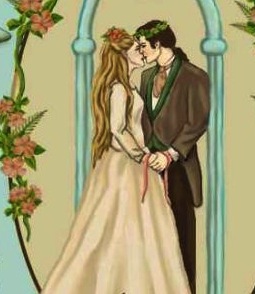 Historically, marriage towards the latter part of the medieval period in Scotland could be executed by the exchange of consent between a man and a woman. This was what we say in the modern setting, i.e., “I Edward take you Margaret to be my wife.” During the medieval times, witnesses were not necessary to make the marriage valid. Basically, this marriage by consent held true from the early 1200s to the Reformation. This was a practice of canon law, essentially the Roman Catholic Church, not civil law. Oddly, this practice went against the earlier precepts of parental consent and the marriage only being binding after it was consummated. However, the Catholic church argued that these “clandestine” marriages, as they were termed, were as legal and as binding as were those performed by a priest.
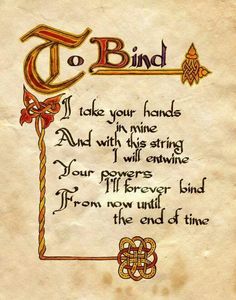 “… The joining of the hands became a feature of betrothals in Scotland and in England during the medieval period. A Scottish protocol narrates that on 24 July 1556, the Vicar of Aberdour ‘ministrat and execut the office anent the handfasting betwix Robert Lawder younger of the Bass and Jane Hepburn docter to Patrick Errl Botwell in thir vordis following: “I Robert Lawder tak thow Jane Hepburne to my spousit wyf as the law of the Haly Kirk schawis and thereto I plycht thow my trewht and syklyk I the said Jane Hepburne takis you Robert Lawder to my spousit husband as the law of the Haly Kirk schaws and therto I plycht to thow my trewth,” and execut the residew of the said maner of handfasting conforme to the consuetud usit and wont in syk casis’ What this ‘consuetude’ was may be gathered from a protocol on the sponsalia of David Boswell of Auchinleck and Janet Hamilton, daughter of the Earl of Arran. After the consents had been exchanged ‘the curate with the consent of both parties with their hands joined betrothed the said David and Janet who took oath as is the custom of the Church’. In fact, the ceremony of joining hands became so closely associated with betrothals in medieval times that in Scotland, and apparently the north of England, the ordinary term for a betrothal was a handfasting. The use of the term in this sense persisted in Elgin as late as 1635.”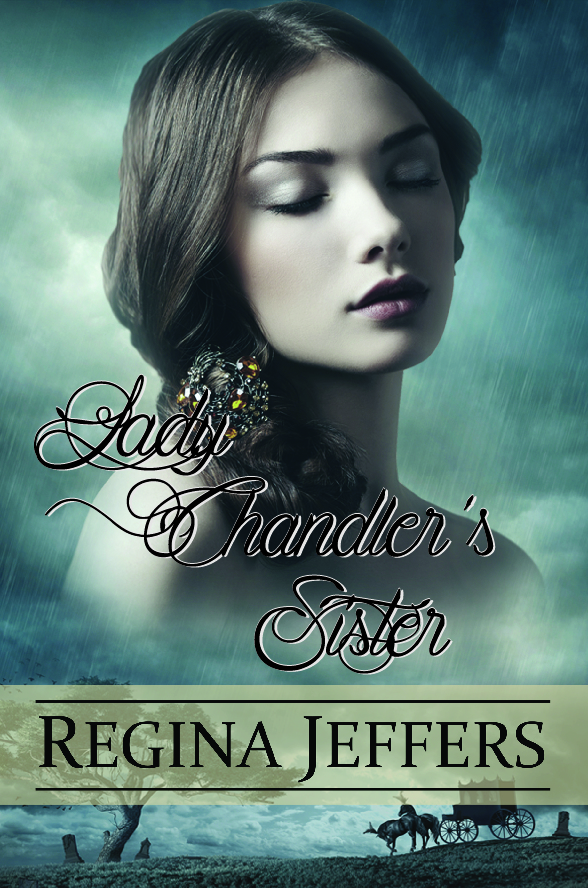
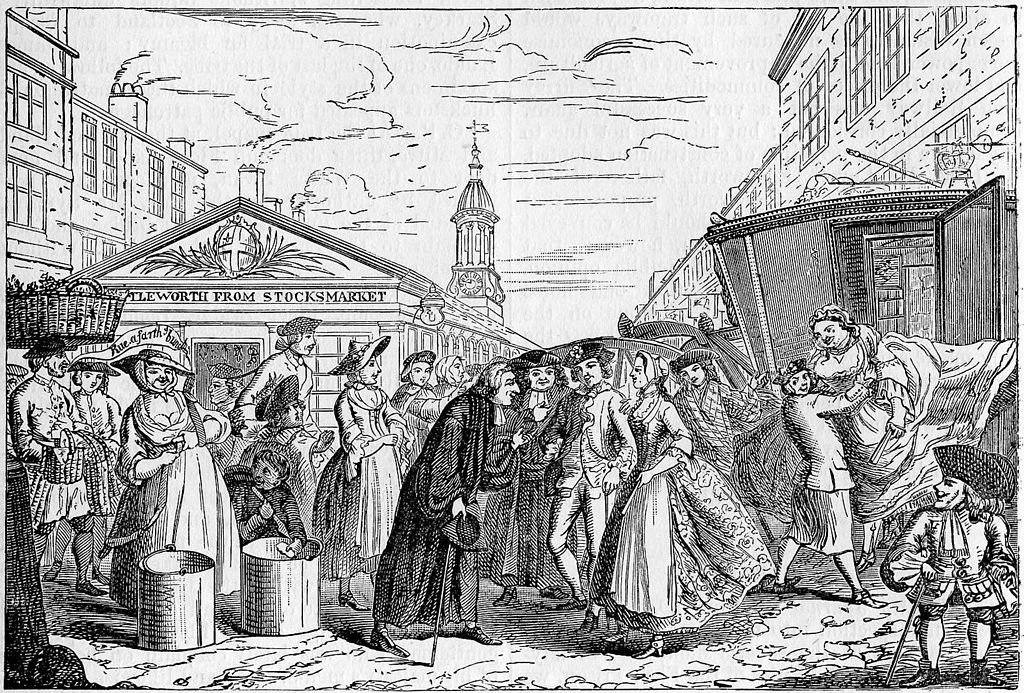


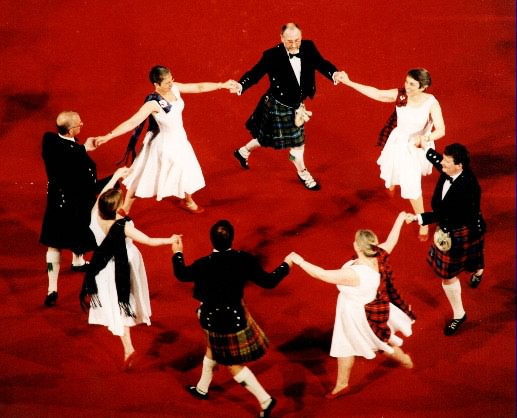
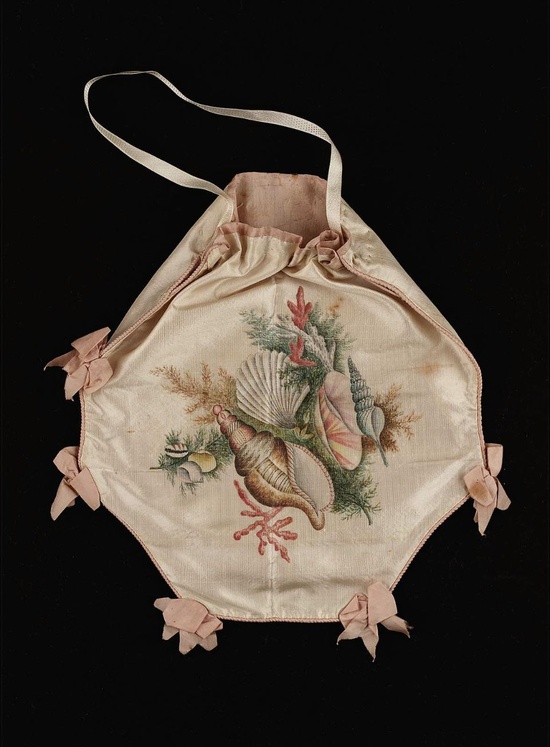

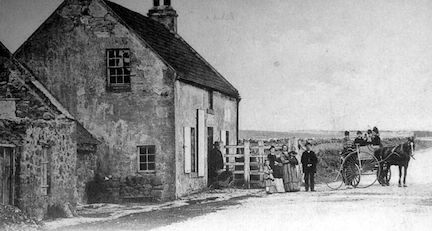
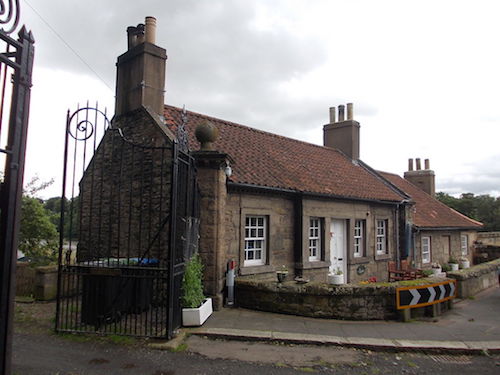

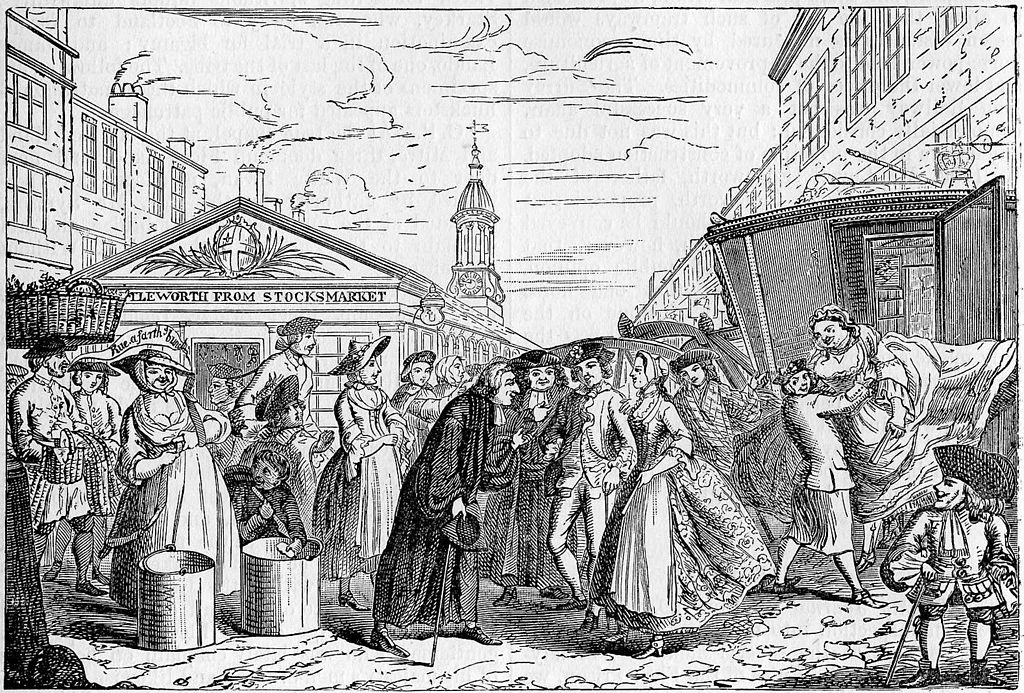
 The Lord Chancellor, Lord Hardwicke thought to close those loopholes. The Marriage Act 1753, full title “An Act for the Better Preventing of ClandestineMarriage“, popularly known as Lord Hardwicke’s Marriage Act (citation 26 Geo. II. c. 33), was the first statutory legislation in England and Wales to require a formal ceremony of marriage. It came into force on 25 March 1754. “The legislation stipulated that marriage must take place in a licensed Anglican parish church in the bride or bridegroom’s own parish and be recorded in a special book with a numbered space for each entry, to prevent fraud. Banns were read publicly on three separate Sundays, which allowed for objections to be raised possibly by parents of children under the age of 21 or previous spouses to call a halt to the proposed wedding. The legislation also allowed marriage by licence in a different parish to that of the couple’s residence. The only exceptions allowed were for Quakers and Jews, so all other non conformists including Roman Catholics had to marry in an Anglican church.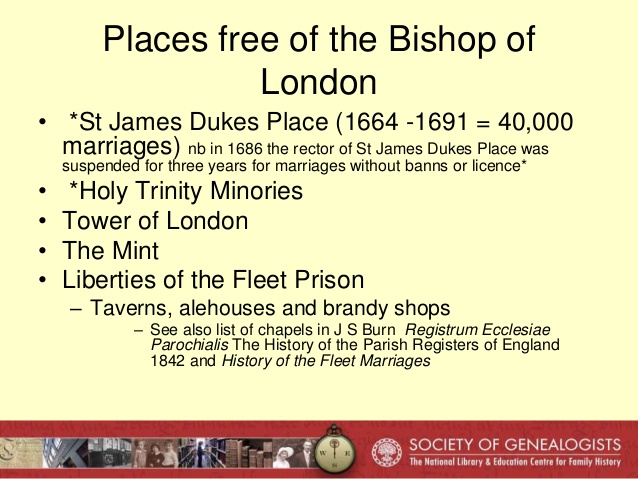




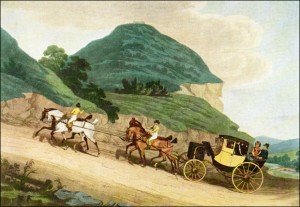
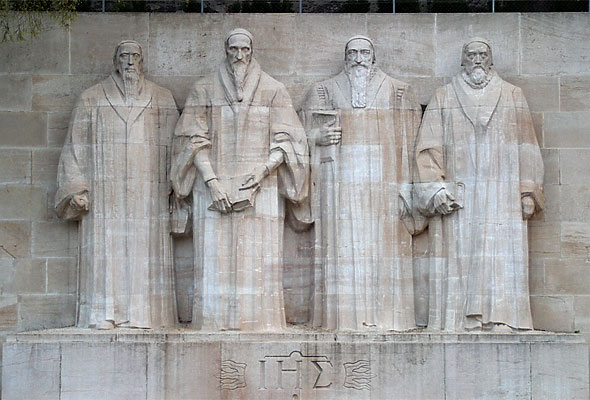


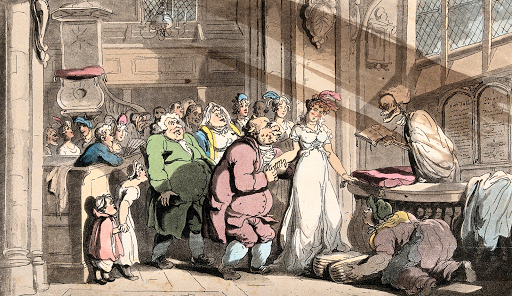


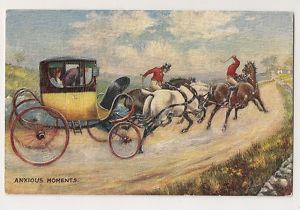

!["The Old Bailey, Known Also as the Central Criminal Court" Date 1808 SourceAckermann, Rudolph; Pyne, William Henry; Combe, William (1904) [1808] "Old Bailey" in The Microcosm of London: or, London in Miniature, Volume 2, London: Methuen and Company Retrieved on 9 January 2009. Public Domain](https://reginajeffers.blog/wp-content/uploads/2015/01/images2.jpeg)


 Every Woman Dreams...
