The Luddite movement plays a part of my Dragonblade Publishing series, with book 4, Lost in the Lyon’s Garden, coming out in mid March. Throughout the series, we have seen Lord Aaran Graham, infiltrating the group, and, with the climax of book 3, we find the British government sentencing many of the Luddites to death or transportation. But who were the Luddites? For what did they protest?
The Luddites were textile workers afraid that automated machinery would replace them, just as many of us in this modern day world worry that artificial intelligence is coming for our jobs. The Luddites also held concerns regarding pay and output quality. If you have ever read Elizabeth Gaskell’s North and South or have seen the miniseries for the book, you have an idea of the conditions in the factories. Of course, Gaskell’s novel takes place closer to the end of the Industrial Revolution, while my story takes place in the middle of the Napoleonic Wars, specifically in 1812.
The Luddites opposed the use of certain types of automated machinery due to concerns relating to worker pay and output quality. They often destroyed the machines in organised raids. [“Who were the Luddites?”. History.com.] Members of the group referred to themselves as Luddites, self-described followers of “Ned Ludd“, a legendary weaver whose name was used as a pseudonym in threatening letters to mill owners and government officials. [Binfield, Kevin (2004). “Foreword”. Writings of the Luddites. Johns Hopkins University Press. pp. xiv.]
Public Domain
Beginning in Nottinghamshire, the sentiments and the violence associated with the Luddite movement spread to the north and west, as well as to Yorkshire. The mill owners began to hire men to keep the protestors out, and even the Prime Minister, Spencer Perceval, had troops move against the protestors. Perceval was assassinated in 1812, but such did not slow down the government’s attack on the Luddites. Those who were caught were either executed (as was the situation in my series, being hanged at York Castle) or were transported to penal colonies. [“Luddites in Marsden: Trials at York”]
Eventually, the term “Luddite” came to mean any who were opposed to the use of new technologies. Should we begin to use the term as we privately “curse” the use of A/I in taking over the world?
The movement was believed to have been founded by Ned Ludd, but he was never identified, and may well be mythical. Some authorities claim his surname to be Ludlam. The movement was dedicated to destroying machinery, not people
Lord Liverpool, the Prime Minister after Spencer Perceval, instigated severe measures, culminating in a mass trial at York in 1813. [This trial is the background for the climax of book 3 of my series.]
The Luddites in Marsden
Marsden is located in West Yorkshire, England, in the Colne Valley, near Huddersfield and the Peak District National Park, and in Marsden, by the end of the Napoleonic Wars, food was scarce and unemployment high.
Living in Marsden were two brothers, James and Enoch Taylor, both blacksmiths by trade. These brothers built a cropping machine that could do the work of 10 croppers. Obviously, the mill owners realized the innovation could save them both money and time and began installing the machines in their mills.
There was also a man, another “Enoch,” who make sledgehammers, which were naturally called “Enochs.” The Luddites used a rallying cry of “Enoch made the, and Enoch shall break them!” when they attacked the different mills to destroy the cropping machines.
“Apparently, the law-abiding menfolk of Marsden were stirred to riot by “desperate men of Longroyd Bridge!” The first riot was at the scene of William Horsfall’s mill, which had been fortified.
“The leader of the Marsden Luddites was George Mellor. He could read and write, and while in prison signed a petition calling for Parliamentary reform. He worked at John Wood’s finishing shop at Longroyd Bridge, along with Benjamin Walker, who, according to some, was to betray them eventually. New documentary evidence, however, seems to suggest that this may not be altogether true. Regular troops and cavalry were brought in and quartered in the village.” [Marsden History]
Read in Kindle Unlimited!
Enjoy this new series within The Lyon’s Den Connected world by Regina Jeffers.
Book 1 – Lyon in the Way
Book 2 – Lyon’s Obsession
Book 3 – Lyon in Disguise
Book 4 – Lost in the Lyon’s Garden
Book 5 – Lyon on the Inside
Posted inUncategorized|Comments Off on Luddites as Marsden Mill ~ Who Were the Luddites?
Question: How were JPs/magistrates selected? Was it a local decision process, or were the London Courts involved too?
In Regency England, the position of Justice of the Peace (JP) was a crucial part of local governance, particularly in maintaining law and order. JPs, typically drawn from the ranks of the gentry, were unpaid officials responsible for a wide range of duties, including administering justice, supervising local officials, and managing various community services.
Most sources list their Key Responsibilities as being:
Law Enforcement: JPs were the primary law enforcement officers at the local level, responsible for investigating crimes, apprehending suspects, and conducting preliminary hearings.
Judicial Functions: They presided over petty sessions (minor offenses) and quarter sessions (more serious cases).
Supervision of Local Officials: They oversaw constables, watchmen, and other local officials, ensuring the proper functioning of the legal system.
Community Management: They were involved in various aspects of community life, including fixing wages, regulating alehouses, overseeing poor relief, and managing road and bridge repairs.
Enforcing Government Policies: They acted as agents of the central government, implementing policies and ensuring compliance within their counties.
Justice of the Peace were customarily chosen from the ranks of the landed gentry or the aristocracy. They could also be wealthy merchants and the like. We might think no one would want such a position, for it had LOTS of responsibility, but no monetary compensation, but, more than a few men enjoyed the social standing and influence it provide them within their community.
The office of Justice of the Peace has been around since the medieval period, but its role in the safety of and the functioning of a community grew substantially during the Tudor and Stuart eras. The role of Justice of the Peace became a key part of the English governmental system and were especially important in the rural areas, forming a “squirearchy” of sorts when the landed gentry held significant power. They still held significant power during the Regency era, but the Local Government Act of 1888 brought about great changes. The Local Government Act of 1888 established county councils and county borough councils in England and Wales, creating a two-tier system of local government. This act significantly reorganized local administration by transferring certain powers and responsibilities from other authorities to these newly formed councils.
Some JPs were knighted. They are Austen scholars who believe this was true of Sir William Lucas in Pride and Prejudice. Austen, herself, never suggests this. All she tells us is Sir William Lucas had been formerly in trade in Meryton, where he had made a tolerable fortune, and risen to the honour of knighthood by an address to the king during his mayoralty.
A letter to a local JP would be sent to his home. A letter to a magistrate of a police office would be addressed to him there.
According to Debretts, magistrates have a JP at the end of their name, but that is optional. In court, he would be addressed as “Your Worship” or simply “Sir.”
There were two or three classes or categories of local courts.
The Justice of the Peace made application to the one in charge of the rolls of JPs– usually the Lord Lieutenant. The Lord Lieutenant forwarded the name to the King who consulted the Lord Chancellor and/or his attorney general and solicitor general or not. The Lord Chancellor sent a commission for the man to be a Justice of the Peace in a specific county. Men who were actively working in law could not apply. The man required a private income of around £300 a year, though heirs of peers usually did not have to prove his income. The JP’s were not paid but had ways of having an income though, some slipped up and took too much. Those who had been too greedy were then tried at the criminal side of King’s Bench Court.
The Aldermen and Lord Mayor of London were elected in the city of London, and they automatically also became magistrates for London. They also made up the panel of judges at Old Bailey with one of the judges of the high courts. Various town corporations had their own way of appointing or naming magistrates. The magistrates of the public offices as the places were called Westminster were paid a salary. They were also appointed by the Crown. Most of the men did not have any legal training at all. Books such as the Justice of the Peace and Parish Officer were written for their use.
The JPs and magistrates held summary courts, that means no jury. They heard the accusation and what defence there might be and either sentenced the person to the stocks, the pillory, a stay in jail, or to be held for the assize where a jury trial would be held and the accused could be sentenced to death or transportation. JPs and magistrates could levy fines or brief periods of incarceration, but not death or transportation. The JPs worked on regulations for business licenses. Some matters were held over to the Quarter session when all the JPs of a county met to deal with some problems.
The Thames Police had jurisdiction of all crimes committed on the river and the docks. The Thames Police Office had 21 river surveyors, 8 land constables, 69 river constables, 2 watchmen, 2 door keepers, and 1 messenger. Patrick Colquhoun was the receiver in 1815.
The most famous of the magistrate offices was the one at Bow Street in Westminster. This had been started by the Fielding brothers in the 18th century.
In 1815, the chief magistrate at Bow Street was Sir Nathaniel Conant. He received £ 1200 a year. His two associate magistrates earned £600 each.
Other magistrates at public offices were at Great Marlborough Street;
Hatton-Garden;
Worship Street, Shoreditch;
Lambeth Street, Whitechapel;
High-street, Shadwell
Queen Square, Westminster (the chief magistrate there was Patrick Colquhoun)
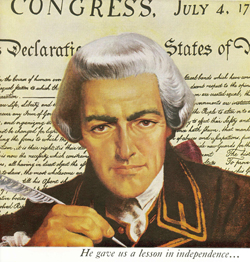
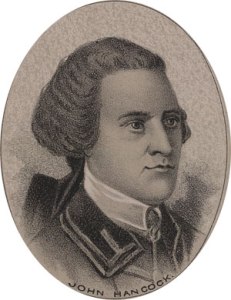
With the flamboyant signature on the Declaration of Independence, John Hancock is a name easily remembered. But what do we know of Hancock’s life? Hancock was 40 years of age when he signed the Declaration of Independence. Hancock was a merchant by trade. He was married and had 2 children. He died at the age of 56 in 1793.
John Hancock was born on 23 January 1737 in Baintree, Massachusetts (now known as Quincy, Massachusetts), to Mary Hawke and John Hancock (the elder), clergyman. Mr. Hancock died when John was a child of seven, and for a period, Mary moved in with in-laws in the Lexington, Massachusetts, area. Eventually, she sent John to live with his wealthy aunt and uncle, Lydia and Thomas Hancock, who adopted him.
First, Hancock attended the Boston Latin School, a long-established public school, and later, Harvard College, graduating at the age of 17. After his schooling, he apprenticed with his uncle, who owned a large shipping business. As Hancock proved quite efficient, the uncle sent him on a business mission to England in 1760. There, he witnessed the coronation of King George III. When his uncle died in 1763, Hancock inherited a great wealth: an import-export business and a home on Beacon Hill.
The newfound fortune placed him in the company of the loyalists and social position, and Hancock earned a reputation for his exorbitance. He also was known for his philanthropy: assisting those who encounter disasters, etc.
According to Signing Their Lives Away (Denise Kiernan and Joseph D’Agnest, page 39), “He funded his alma mater, paid for street lamps and concert halls, and helped impecunious friends such as Samuel Adams feed their families. But he also had flaws. He was impossibly vain and imagined scenarios and roles for himself that he could not reasonably attain or fulfill. For example, he became peeved when Congress chose George Washington to led the Continental Arm. His frustration appears misplaced when one realizes he had no real military experience, unless one counts the time he ran the honor guard for the Massachusetts royal governor. He and his ceremonial troops would march around in fancy uniforms that Hancock, of course, had bought for all his men. Dapper and small, Hancock loved elegant clothing. In this he did not conform to one’s image of a Yankee Puritan, and he would later class famously with dour, plain, and perhaps brighter congressmen such as John Adams.”
However, Hancock kept his revolutionary ideas. Soon he advocated America’s separation from England. He was elected to the Boston Assembly in 1766 and became a member of the Stamp Act Congress.
When the custom officials in Boston Harbor seized one of his ships on the charge of running contraband goods, a group of citizens stormed the customs office, burned the government boat, and beat the officers. Likely, Hancock had smuggled in good to avoid unreasonable taxation. Samuel Adams successfully defended Hancock against the charges and the ship was seized as a royal asset, which was the impetus for the riot. Unfortunately, the ship was burned. After this incident with the Liberty and the Boston Massacre, Hancock encouraged others to participate in the Boston Tea Party.
The Boston Massacre was a street fight that occurred on March 5, 1770, between a “patriot” mob, throwing snowballs, stones, and sticks, and a squad of British soldiers. Several colonists were killed and this led to a campaign by speech-writers to rouse the ire of the citizenry. Hancock was among those to speak out.
Elected to the Provincial Congress of Massachusetts and the Continental Congress in 1774, he became the President with the resignation of Peyton Randolph. “In 1774, Hancock was made leader of the Massachusetts delegate to the second Continental Congress, which would convene the following year in Philadelphia. Yet Hancock and [Samuel] Adams were hunted by British general Thomas Gage. The two were warned by Paul Revere during his famous April 18, 1775 night ride shouting out that British forces were on their way. Hancock and Adams fled Lexington, where they were staying, and eventually made their way to Philadelphia.
“The Congress met in May, 1775. George Washington was appointed leader of the Continental Army while Hancock was appointed congress president. Hancock would give the coming American war effort financial support while hispresidential role was more of a figurehead position, with congressional decisions generally achieved through committee. In August of the same year, he wed Dorothy Quincy, who came from a merchant family as well. Hancock’s business fortune by this time had significantly dwindled.” (Biography.com)
He retired in 1777 after suffering with gout, but remained in the role of public service in Massachusetts. Eventually, he became governor for five years. Stepping away again, Hancock was persuaded to accept the governorship once more in 1787. There he stayed until his death in 1793.
“The dignity and character of John Hancock, celebrated by friend and enemy alike, did not suffer for his love of public attention. He was a populist in every sense, who held great confidence in the ability of the common man. He also displayed a pronounced contempt for unreasoned authority. A decree had been delivered from England in early 1776 offering a large reward for the capture of several leading figures. Hancock was one of them. The story, entirely unfounded, is that on signing the Declaration, Hancock commented, ‘The British ministry can read that name without spectacles; let them double their reward.” An alternate story, also unfounded has him saying, “There, I guess King George will be able to read that!’ He was the first to sign and he did so in an entirely blank space.” (USHistory.org)
“It was his task to help unify a group of quarreling, self-important men. In the end, Hancock, as president of Congress, was the first to stick his neck out for the cause. He and the secretary of Congress, Charles Thomson, were the only men to sign the original document on July 4 before it went out to the printer, John Dunlap. Hancock reportedly announced that he signed his name in large letters so that King George could read his signature without spectacles. Then he dared England to double the £500 reward already on his head. Hancock’s flamboyant signature probably says more about his overall character than that specific intent. Though John Adams resented Hancock’s election to the presidency, it’s unlikely that Adams could have hobnobbed and charmed the southerners as well s did his charming and fashion-conscious friend. They probably bonded over things like tie wings, imported silks, and the latest button designs.” (Kiernan and D’Agnest, page 47).
According to Historic Food, “The first record of ice cream in this country is from 1671. It was on the menu of a feast for the Knights of the Garter held in St. George’s Hall at Windsor Castle. However, at this time it was such an exclusive dish that it appeared only on the king’s table. The earliest printed recipe appeared in Mrs Eale’s Receipts, a little work on confectionery published in London in 1718. Mrs Eales claimed to have been confectioner to Queen Anne, during whose reign ice cream continued to be a luxury enjoyed only at court and by the nobility. It was not until the second half of the 18th century that ices become more widely available from confectioners’ shops.”
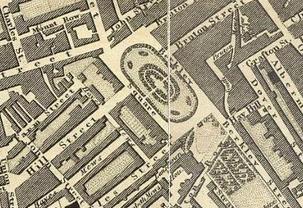
Gunter’s Tea Shop was originally called The Pot and Pineapple.It was located at Nos. 7 -8 Berkley Square. Italian pastry chef, Domenico Negri established it in 1757. The “pineapple” was chosen as part of the name for it symbolized luxury, and pineapples were a common ingredient used in confections. The shop sold English, French, and Italian wet and dry sweetmeats. Custards, cream ice, frozen mousses, jellied fruit, candies, syrups, biscuits, and caramels were served. Some of the cream ice flavors include chocolate, lavender, maple, Parmesan, Gruyere cheese, and bergamot. Mousses were often vanilla, saffron, and pineapple. For more information on sweetmeats, chocolate, and ice cream in Regency England, go HERE. Gunther’s seems to have served their individual ices in glass dishes. I particularly love this site that gives LOTS of details on flavor of the ices, making the ices, history, etc. Georgian Ices.
During the Regency, the ice was less important that going to Gunther’s and being seen. It was a social experience. So, no one would have gone there for a single ice and then taken it away. Gunther’s does appear to have had wait staff that would bring ices to a party parked in a carriage nearby, then collected the empty glasses later. They seem to have done the same for those who wished to enjoy their ices outdoors rather than in the shop. This entry from the Encyclopedia of London tells us:“A custom grew up that the ices were eaten, not in the shop, but in the Square itself; ladies would remain in their carriages under the trees, their escorts leaning against the railings near them, while the waiters dodged across the road with their orders. For many years, when it was considered not done for a lady to be seen alone with a gentleman at a place of refreshment in the afternoon, it was perfectly respectable for them to be seen at Gunter’s Tea Shop.”
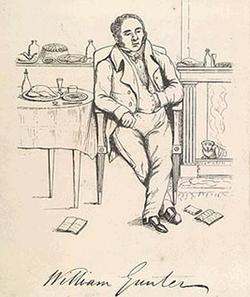
James Gunter became Negri’s business partner in 1777, and by 1799, Gunter was the sole proprietor. During the Regency and throughout the 19th and 20th centuries, Gunter’s was considered a fashionable light eatery in Mayfair, well known for its ices, sorbets, and confections. From the business, Gunter purchased a mansion in Earl’s Court.Gunter’s son Robert took over his father’s business after James’s death in 1819. At his father’s suggestion, Robert had studied confections in Paris. Eventually, Gunter’s cousin John became a partner in 1837, assuring the business would remain in the family. William, another of James’s sons published a cookbook, Gunter’s Confectioner’s Oracle, in 1830. His book was said to be filled with gossip, namedropping and a terrible dictionary of ingredients, as well as recipes. He began his cookbook with a dream he had of being led to a banquet by a witch. He supposedly “told all,” but in his alphabetical dictionary of raw materials, he “skipped B because it ‘is to us an empty letter.’ C was a fourteen-page treatise on coffee, in French … The dictionary skipped D and E. The letter F was for flour. Then Gunter wrote, ‘I now skip a number of useless letters until I arrive at P.” – Of Sugars and Snow: A history of ice-cream making, Jeri Quinzio, University of California Press, 2009, p. 65.
There were also famous apprentices who worked at the shop and went on to write their own cookbooks.
Gunther’s does appear to have offered a catering service, which was very popular with those planning parties. When ices were ordered for an affair at a private home, from what I can tell, the ice mixture was left frozen in the container in which it was made, usually a metal bowl or cylinder. These containers might have a matching metal cover or simply be covered with a layer or two of oil cloth tied on with twine. These containers were packed in large baskets, layered with enough straw and ice to keep them cold for the expected length of time until they would be served. Once the event was over, the containers, the baskets, and probably the straw, were all retrieved by someone from Gunther’s.
Via Jane Austen’s London, we learn, “(From a Correspondent) Mrs Morton Pitt’s Masquerade (from The Morning Chronicle, 16 June 1801) –
“Mrs Morton Pitt opened her house in Arlington-street, for the first time, upon the debut of her beautiful and accomplished daughter in the beau mond: this of course attracted a most brilliant and dazzling assemblage of all the fashionable world; and, whether from the condescending manner of the beautiful hostess, or the high glow of spirits which universally reigned throughout the whole company, the writer protests he has not, in the career of fashion of this year, seen so much conviviality. The supper was such as everyone must expect, when they hear that Mr Gunter, of Berkeley-square, superintended in that department.’
“He did not cater only within London. On 25 August 1804 The Morning Post reported, in its Fashionable World column:
“’Lady Smith Burgess’s Fete at Havering Bower in Essex…about 200 of the neighbouring nobility and gentry, and many others from town were present…. About five o’clock [in the afternoon] the company…returned into the Saloon, where a most sumptuous Breakfast was set out. The entertainment consisted of every delicacy which the munificence of her Ladyship could provide, and the taste of Mr Gunter, the confectioner, could display.’
When the east side of Berkeley Square was demolished in 1936–7, Gunter’s moved to Curzon Street. The tea shop closed in 1956, although the catering business continued for another twenty years. Gunter’s was also known for its catering business and beautifully decorated cakes. In 1811, the Duchess of Bedford’s and Mrs. Calvert’s ball suppers featured the shop’s confectionery, a tradition followed by many a society lady. Along with Bolland’s of Chester and W G Buszard, Gunter’s were considered to be the wedding cake makers du jour and made the bride cake for the marriage of Queen Victoria’s Granddaughter Princess Louise of Wales in 1889.
The period of most intense hunting in the Regency Era was the autumn and winter months, specifically from the “Glorious Twelfth” of August for game birds like grouse, which transitioned into fox hunting from November to March. Gentry would leave London after the social “Season” ended in August to shoot game in the autumn and then participate in fox hunts through the winter.
Autumn (August – October): Bird Shooting
The Glorious Twelfth: August 12th marked the start of the grouse shooting season.
Other Game: Partridge, duck, and geese were also hunted during the fall.
Purpose: Shooters would travel to country estates to enjoy these autumn pursuits.
Winter (November – March): Fox Hunting
The Start of the Season: The primary fox hunting season began in November.
“Riding to Hounds”: Fox hunting was a popular sport that involved riding horses after a pack of hounds.
End of the Season: The fox hunting season concluded before the first spring planting began.
Why this schedule?
Social Season: The entire social calendar revolved around the “London Season,” which ended in August.
Weather: The cooler months provided ideal conditions for outdoor pursuits.
Fox Population: Fox hunting was once a form of vermin control, but by this era, it was a respected sport for the wealthy, according to Risky Regencies. [This is a fabulous article. It even includes dates when specific hunting sports could be practiced.]
Pheasant Shooting, by George Morland
During the Regency Era, game laws restricted hunting and owning hunting equipment to the landed gentry, with severe penalties like deportation or even death for poachers. The laws were designed to protect game like deer and pheasants from being hunted by the poor. Eligible hunters needed a specific property value or were the eldest sons of people of high degree. These laws also controlled who could possess hunting dogs, guns, and other tools, and limited the sale and possession of game meat to qualified individuals.
Who was allowed to hunt? Basically, the answer is landowners. Individuals with property valued at over £100 annually, or those leasing land worth more than £150 annually, were typically qualified. The eldest son of a family of higher degree also had the right to hunt. Moreover, individuals who owned certain land rights or “franchises” could also hunt legally.
Who was not allowed to hunt? Poorer individuals, including small farmers and tenants, were generally excluded from hunting and could not own game or hunting equipment. Anyone not possessing the required qualifications, regardless of their land ownership, could be penalized for hunting.
Were there certain prohibited items and practices? Ordinary people could not legally possess hunting implements such as guns, snares, or certain breeds of hunting dogs. Laymen were forbidden from possessing hunted game. The sale and purchase of game meat were restricted to individuals who were legally qualified to kill it.
What were the punishments for breaking the law? Offenders caught poaching faced severe penalties, which could include significant fines, long jail sentences, or being sent to a penal colony for deportation. In some cases, particularly for repeated or serious offenses, the punishment could even be hanging.
What was the purpose of the laws? The laws primarily served to prevent the poorer classes from hunting and depleting game populations. They reinforced the social hierarchy by restricting a pastime and a form of food acquisition to the wealthy gentry.
First, permit me to say, as journalism was one of my majors for my undergraduate degree, the types of newspapers available during the Georgian era has always fascinated me. I have several digital copy files of The Morning Chronicle and of The Morning Post, as well as The Times and The Post. I do not see much in any of these papers which might make any of them what we now call a “gossip rag,” like we now think of fully displayed at the checkout counters of your local grocery store.
There were columns in each paper about the royals and the fashionable sect. Generally, these were about who had arrived in London, who had left, who was giving a ball or an extravagant supper, etc. I have seen such listings in The Morning Chronicle, so I must imagine such was true for the other major papers of the day.
Criminal Conversation (adultery) cases were chronicled in most of the major papers, and, if a Parliamentary divorce was granted, there were records of those actions.
I was told that The Morning Herald contained more gossip than many of the others, but, unfortunately, I have never come across any copies of that particular newspaper.
Cartoons in print shop windows were more commonplace. From a book I read about the way some publishers reported criminal conversation cases and divorce trials, I had the impression that these were published as self standing small pamphlets rather than as part of a newspaper. As I understood it, there were pamphlets, etc., available at local coffee shops and tea shops or chocolatier or even pubs. They could be found at gaming hells, private clubs for gentlemen, etc.
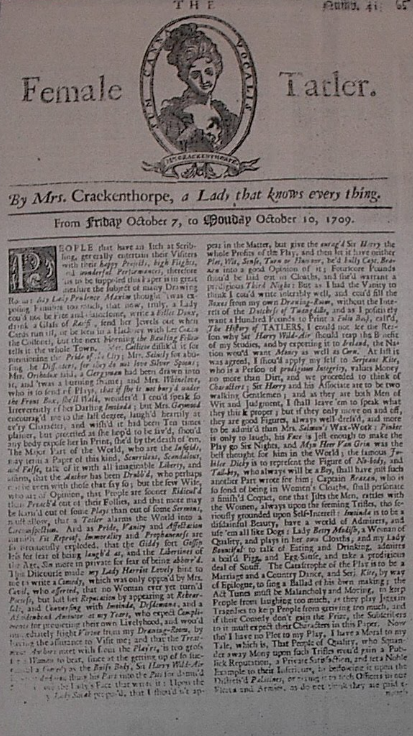
Zoe Archer at Unusual Historicals tells us: “Just like today, when we have a huge range of tabloids to choose from, the Londoner in search of scandal had a range of rags and broadsheets, including The Tatler [sic], The Flying Post, The British Apollo, The Observator, and The Female Tatler. Some were published for years. Others folded within weeks or months. The periodicals were themselves the subject of scandal, such as The Female Tatler, whose authorship by ‘Mrs. Crackenthorpe’ was debated, and, for a time, there were two Female Tatlers, each claiming to be real.”
“Almost all of these scandal sheets claimed their purpose was to be instructional and morally edifying. Mrs. Crackenthorpe claims:
“When we daily hear of unaccountable whims and extravagant frolics committed by the better sort, we must expect those of inferior classes will imitate them in their habits of mind, as well as body, and the only way to correct great men’s foibles, is handsomely to ridicule ’em; a seasonable banter has often had a reclaiming effect, when serious advice from a grave divine has been thought impudence.
“No doubt this is a case of protesting too much. As soon as people stop misbehaving, then there is nothing left to publish, and the tabloid folds up shop. And besides, reading about scandals is just plain fun.”
When the Bridgerton series came out Vogue magazine ran an article involving whether a gossip column could be feasible in the Georgian era. It says: “Yes: Regency, or late Georgian-era England, was booming with ‘scandal sheets,’ or newspapers strongly focused on personalities and juicy stories. Multiple factors led to this golden age of gossip: In 1695, London got rid of their ‘Licensing Act,’ which previously limited the number of printing presses that could exist. Then there was the shrinking importance of the monarchy. In 1688, parliament significantly limited the power of the king and his court. So by the 1700s, more people could print more things, and they could print them about powerful people to boot.
“Come the late 1790s and early 1800s, a few additional societal factors played a part: One, a massive population boom—London went from under a million people in 1801 to around one and a quarter million in 1820. With that came a rise in crime, but also general debauchery like drinking and gambling. Two, there was a greater focus on arts and culture—a lover of beautiful things, the Prince Regent spent lavishly on paintings, buildings, and public works. Suddenly you had an aesthetics-focused society with a seedy underbelly and a weakened monarchy. The final accelerator? Little to no libel laws and, in 1814, the arrival of the mass-producing, industrial printing press.
“So what did these gossip rags say? Let’s examine some of the juicier entries. According to an article by Stella Tillyard in History Today, in 1769, various newspapers reported that “an assignation at the White at St. Albans between L—G— and certain great D—e, was disconcerted by the forcible intrusion of my lord’s gentleman.” This makes no sense to us now, but at the time, readers were used to public figures only being identified by their initials. ‘Readers would easily have identified the great Duke as the King’s brother the Duke of Cumberland, and his lover as the society beauty Lady Grosvenor, and looked forward with salacious anticipation to the next chapter,’ wrote Tilyard.
“The Morning Post also exhaustively chronicled the balls of London’s social season, which ran from Easter to the early summer. An account from the Prince Regent’s June 4, 1811, fête in the drawing room at St. James’s Palace, detailed exactly who danced with who: ‘The first couple who tripped on the light fantastic toe were Earl Percy, and the accomplished, and deservedly celebrated beauty, Lady Jane Montague, daughter of the Duchess of Manchester,’ the paper wrote. (Two years later, the Duchess of Manchester left her highborn husband for a footman.) They even wrote a bulleted list: Earl of Digby with the Countess of Jersey, Lord Mark Kerr with Lady Elizabeth Clive, Lord Charles Somerset with Mis Metcalfe, and so on.”
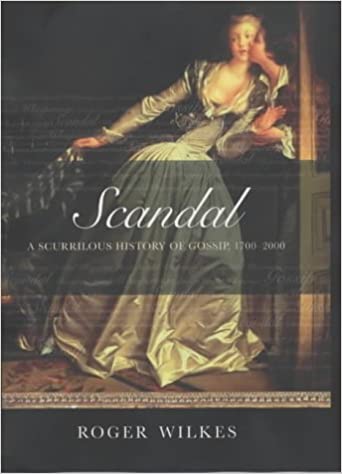
All that being said, from my reading of Roger Wilkes’s SCANDAL: A SCURRILOUS HISTORY OF GOSSIP 1700 – 2000, it seems newspapers focused only on reporting gossip and scandal did not begin to appear until the 1820s. The term “scandal sheet” did not come into the language until the 1890s. Pamphlets, yes, columns in newspapers, yes, broadsheets, yes, but entire newspapers, no.
Book Blurb from Amazon: Newspaper and magazine gossip is a potent and sulphurous brew – much derided and much devoured – that long ago became part of the daily diet of millions. The raw ingredients are scandal, rumour, glamour and scurrility, and the best is shot through with (preferably illicit) sex, disclosure and danger. How and why has this happened, and where will this obsession lead us? “Scandal!” takes us from Regency London, where muck-raking scandal sheets were hawked in the streets, to the modern free-for-all where tabloid and internet gossip rule. From the madness of King George to the madness of Bill Clinton’s affair with Monica, this book goes behind the scenes to look at the mechanisms that disseminate gossip and the power and influence that it continues to exert.
Today, I begin a new series entitled “Traitor Tuesday.” For those of you who follow this blog, you know I, generally, only post on Mondays, Wednesdays, and Fridays, and I post about England and specifically the Regency Era, for most of my novels are set in that time period, and I do tons of research which I share with my followers.
However, 2026 is a year of celebrating the United States of America. After all, it is 250 years since the the American Revolution – the war for independence [sort of] from King George III and the British empire. At the end of 2025, Ken Burns brought to the American viewing public a six-part [each 2 hours long] series to Public Broadcasting (PBS). If you have not seen it, I highly recommend you do, especially if you are a citizen of the U.S.
My efforts in this series is not to replicate Burns’s stories, but to speak of the 56 men who represented the colonies that would eventually become states. Learn of their wisdom. Their heroism. Their doubts. Their fears. Their mistakes. Their prejudices. Their hopes for a better future. We begin this story with Benjamin Franklin, the man who was, for the most part, in Europe, “diplomatically” explaining the colonies’ complaints to all who would listen and trying to convince others to finance their scheme and stand with them against the power of the Kingdom of Great Britain.
Every Tuesday of the twelve months of 2026, I will feature one of the signers of the Declaration of Independence. On the last Thursday of the month, there will be a “bonus” article. There were nearly 60 men who signed the Declaration of Independence. [12 months x 4 Tuesdays/month traitors = 48 posts, but I need a total of 56, one for each of the document’s signers.] “Nearly” in my estimations means some months will also contain a “Bonus” Traitor Thursday, during the last week of the month. I know this does not make sense to some of you, while others will think it quite creative. A few more will not care one way or the other. I have attempted, where possible, to match the months with the birthdays of the signers, BUT some records only list the year of the man’s birth. In other words, no plan is perfect.
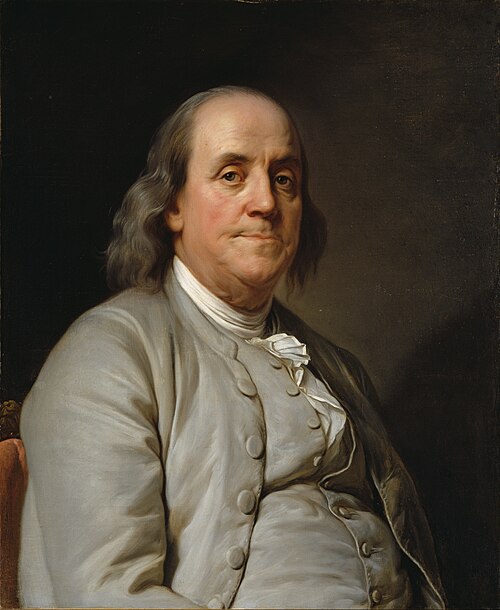
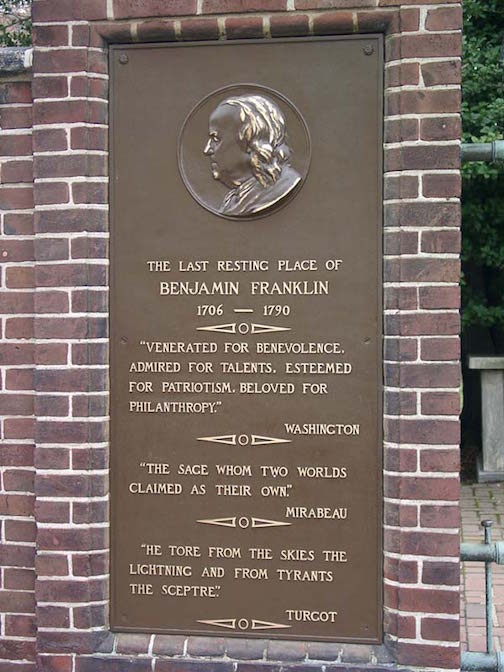
Benjamin Franklin was known as a printer and publisher, a writer, a scientist and inventor, a philosopher and a philanthropist. He was 70 years of age at the time of the signing of The Declaration of Independence. Known as a scientist and a printer, he died in 1790 at the age of 84. Those are the simple facts, but there was so much more to this man and his fellow “traitors.” I hope you will learn something new and become more aware for what we all should be thankful.
The son of a candlemaker, Benjamin Franklin was born in Boston, Massachusetts, on January 17, 1706. He was the youngest son of Josiah Franklin’s seventeen children. His father attempted to teach Benjamin his trade, but Benjamin was not interested. He attended grammar school at age eight, but was put to work at ten. He apprenticed as indentured as a printer to his brother half-brother James, who printed the New England Courant. Reportedly, James was a harsh master, often beating young Benjamin.
Benjamin beat James at his own game. Franklin lived frugally so he could purchase books and educate himself. At age twelve, Benjamin published his first article. He wrote secret letters under the pseudonym of “Mrs. Silence Dogwood,” a middle-aged widow with very set opinions. As Mrs. Dogwood he wrote about politics, business practices, politics, and society, including fashion. James published the letters, which were very popular. Unfortunately, James had no idea that Benjamin was the author. Young Benjamin was an avid reader, inquisitive and skeptical. Through his satirical articles, he poked fun at the people of Boston and soon wore out his welcome, both with his brother and with the city. He ran away to New York and then on to Philadelphia at the age of 16, looking for work as a printer.
In Philadelphia, he took a position with another printer. He managed a commission to Europe for the purpose of buying supplies to establish a new printing house in Philadelphia, but found himself abandoned when he stepped off ship.
Ironically, although he had no formal education beyond the age of 10 years, Franklin was celebrated throughout Europe, welcomed in any Royal Court, sought out by every prestigious society. Through hard work and frugality he bought his fare back to Philadelphia in 1732 and set up shop as a printer. He started The Pennsylvania Gazette and also published an annual (beginning in 1741) entitled Poor Richard’s Almanack. Some of our most common sayings come to us from Poor Richard’s Almanack. For example, we have “Early to bed, and early to rise, makes a Man healthy, wealthy, and wise.” and “A Penny saved is a penny earned.” and “Three may keep a secret if two of them are dead.” and my personal favorite “If you would not be forgotten, as soon as you are dead and rotten, either write things worth reading, or do things worth writing.” Along with the Bible, Poor Richard’s Almanack was indispensable. The pamphlet included a calendar and planting advice.
He was appointed clerk of the Pennsylvania Assembly in 1736, and as Postmaster the following year. He was elected to the Pennsylvania Assembly in 1751 and served as an agent for Pennsylvania (and ultimately for three other colonies) to England, France, and several other European powers. At age 42, Franklin turned over his business to his partner and became a philanthropist. He promoted the first American hospital, library, and volunteer fire department in his beloved Philadelphia. He set the groundwork for the school that would become the University of Pennsylvania. But it was not only Pennsylvania that he served. He was a proponent of a colonial mail system. As such, the British Parliament named him Postmaster General. As an inventor, Franklin claims the lightning rod, bifocals, and the Franklin stove.
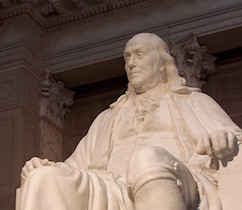
He lived some 30 years in England and Europe. He spent time in London as an ambitious young man. In addition, he lived predominantly in London from 1757 to 1770, where he represented the views of the Pennsylvania colony to the British Parliament. While there he was awarded the honorary degree of “Doctor Franklin.” Artists painted him as a modern-day Prometheus, complete with lightning bolts behind him. The day after his arrival in England, Franklin was summoned to explain the colonial objection to the Stamp Act to the House of Commons. He wrote articles for the British newspapers in hopes of explaining the American point of view, but to no avail. He leaked anti-rebel letters penned by the Massachusetts royal governor. He was arraigned for disloyalty to the Crown in 1774, which resulted in nothing more than his being stripped of his Postmaster position.
He returned to the colonies in 1775. The Revolutionary War had begun. He was nearly 70 years of age when he accepted the role of Congressman. He was accustomed to life in England and Europe, and at his advanced age, he would often have a sedan chair (powered by four inmates from the local jail) carry him to the statehouse from his home. Franklin’s power was centered upon his ability to twist the written word to whip up the colonists. Moreover, he had the ability of print whatever he chose to share with others. He also joined fellow signer, Robert Morris, in financing the revolution. Franklin donated his pay as the American Postmaster General, as well as £3000 of his own money.
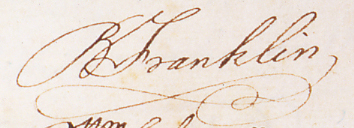
He did fail in convincing the Canadian government in joining the revolt against Great Britain. Returning to Pennsylvania, he was appointed to the Committee of Five, along with Thomas Jefferson, John Adams, Roger Sherman and Robert Linvingston, to draft the Declaration of Independence. Jefferson wrote the first draft of the document, but Franklin made one important change. He switched out Jefferson’s “We hold these truths to be sacred and undeniable” for “We hold these truths to be self-evident.” It was also Franklin who convinced John Morton to break the tie of the Pennsylvania delegation to vote in favor of withdrawing from British rule.
In the fall of 1776, he departed for France to seek assistance from the French in the war against Great Britain. Franklin took two grandsons with him: Temple (age 17) and Benny (age 7). By this time in his life, Franklin was more than a bit eccentric. He took “air baths” for he thought going naked was good for his health. He wore a fur frontiersman cap to keep his bald scalp warm, which started a “fur cap” fashion statement among the French aristocratic females. He managed to convince the French to aid the American effort. 44,000 French troops served along with the American patriots.
Franklin helped draft the Treaty of Paris, which ended the Revolutionary War. He signed the peace treaty in 1783. Benjamin remained in France until 1785. He returned to America to assist in drafting the U. S. Constitution, which he also signed.
Cover for First Edition 1793 via wikipedia
Franklin’s personal life was a bit from step from other signers. Deborah Read, was his common-law wife. They were together for some 44 years. She died in 1774. He sired three children. Two with Deborah and one with another woman. His illegitimate son, William Franklin, Temple’s father, was the royal governor of New Jersey. In that role, William Franklin was imprisoned by the U. S. government in January 1776. Franklin refused to assist his son because of William’s alignment with Great Britain. William was released in 1778. In his waning years, Franklin wrote his autobiography, which was published in 1793. Franklin died at the age of 84 on April 17, 1790.
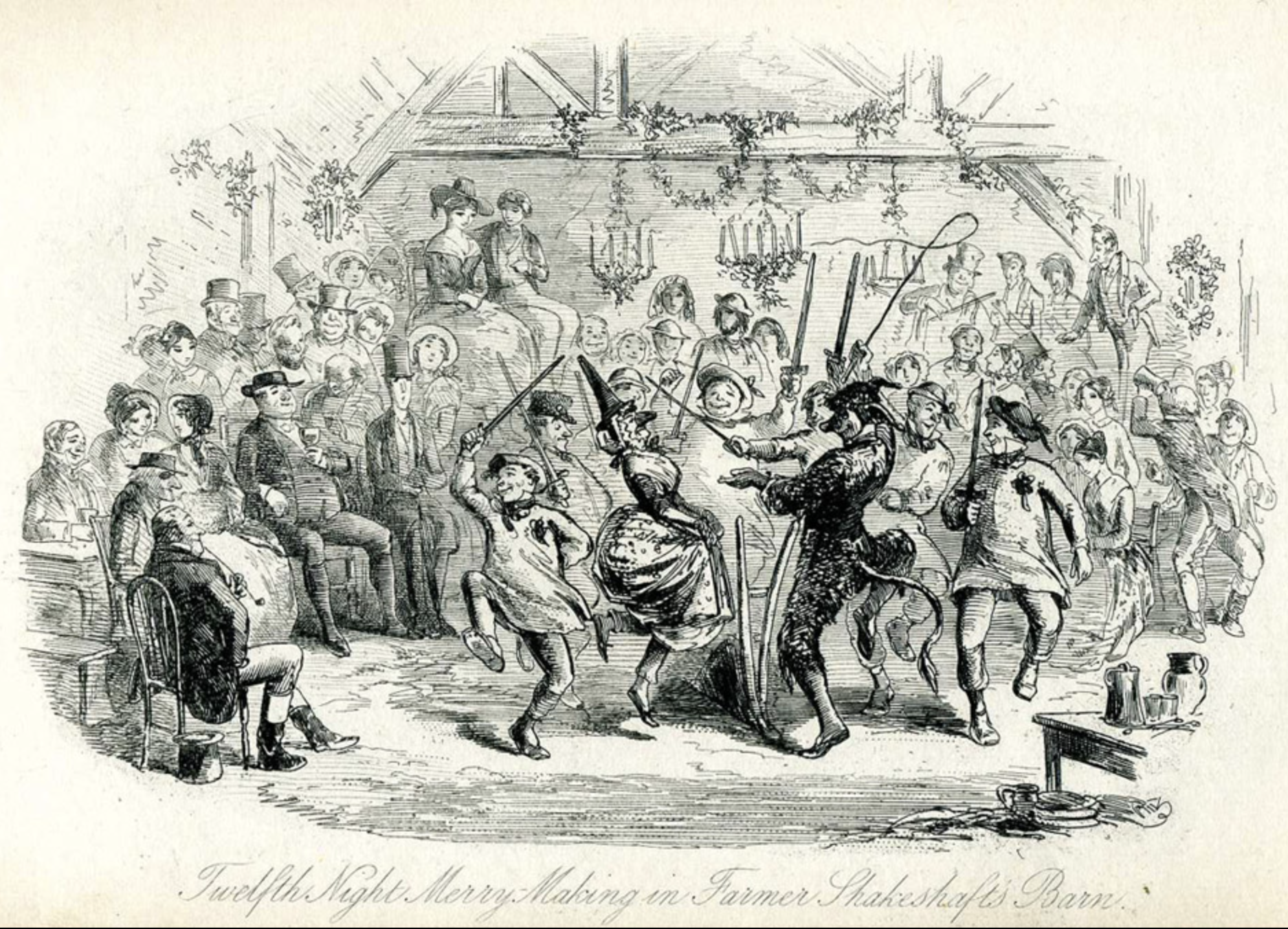
In Regency England, Twelfth Night (January 5th) marked the climax of the Christmas season with revelry, games, and masquerades. It was a time for breaking social norms, with balls, parties, and theatrical merriment, often including masquerades where guests adopted character roles. The centerpiece was the Twelfth Night cake, and the person finding a bean or pea baked inside would become the “King” or “Queen” of the evening.
Its history is rooted in ancient pre-Christian festivals, such as the Roman Saturnalia and Celtic Samhain, which featured inversions of social order and revelry. Over time, these traditions merged with Christian celebrations of the Epiphany, which commemorates the visit of the Three Wise Men to the baby Jesus.
Pre-Christian Roots: Twelfth Night celebrations have roots in festivals like Saturnalia, where social roles were reversed, and a Lord of Misrule held sway.
Christianization: The celebration evolved to coincide with the eve of Epiphany, which commemorates the visit of the Three Wise Men.
Feast of Fools: In medieval Europe, Twelfth Night was also known as the Feast of Fools, a time for feasting, drinking, and overturning social norms.
Shakespeare’s Play: Shakespeare’s play “Twelfth Night” is believed to have been inspired by and performed during these celebrations, reflecting the holiday’s themes of social inversion and revelry.
“Twelfth Night Merry-Making in Farmer Shakeshaft’s Barn”, from Ainsworth‘s Mervyn Clitheroe, by Phiz ~ Public Domain
Key Aspects of Twelfth Night Celebrations:
Balls and Parties: Elaborate balls were held in homes or assembly rooms, featuring dancing like cotillions and country dances.
Masquerades: Costumes and masks were common, adding a playful, theatrical element.
Twelfth Night Cake: A rich fruitcake with a bean and/or pea baked inside.
King and Queen of the Bean/Pea: The individuals finding the bean and pea respectively would lead the festivities and adopt humorous or whimsical roles for the evening.
Topsy-Turvy Customs: Servants might playfully mimic their masters, and general merriment and games were encouraged.
Popular Games: Games like charades, snapdragon (plucking raisins from flaming brandy), and card games were popular.
End of Christmastide: Twelfth Night marked the end of the Christmas season, and decorations were traditionally taken down and sometimes burned.
Out with the Old: Some sources mention a belief that keeping greenery after Twelfth Night would bring bad luck.
In Regency England, Twelfth Night was a night of revelry, games, music, and even theatrical performances. The aristocracy and the gentry often hosted grand balls in their homes or local assembly rooms. One might host a masquerade ball (something one sees in many Regency romances.
With the Twelfth Night cake, the man who found the bean became the King of the Bean, and the woman who found the pea was the Queen of the Pea. We Regency writers like to bring our hero and heroine together in this manner. It is especially delightful if they have “hated” each other until this moment in the book. These traditions reflect customs passed down through centuries.
A performance or soliloquies or recitations from Shakespeare’s comedy, Twelfth Night, might also be presented as part of the festivities. If one recalls, Shakespeare uses themes of mistaken identity throughout the play.
Food served are quite lavish, with an emphasis on desserts of all sorts. Naturally, a Wassail bowl was necessary, along with mulled wine or brandy.
One might find the “lower” class enjoying community gatherings on this particular evening.
Devout Christians might have spent the evening attending church services leading into the Epiphany morning.
Although publishers long ago labeled Jane Austen-inspired pieces as “niche” literature, they erred. Austen’s touch can be found in a variety of pieces: women’s literature, romance, variations, historical fiction, paranormal, fantasy, and mystery. Over the years, I have written several cozy mysteries using Austen’s characters. It is easy to concoct a mystery story around her plots. Miss Austen provides us with a variety of starting points.
For example, without good reason, General Tilney sends Catherine Morland from Northanger Abbey. He has no care for her safety upon the road alone. Meanwhile, his eldest son seduces Isabella Thorpe and then abandons her. In Pride and Prejudice, Mr. Wickham produces a multitude of lies that mislead Elizabeth Bennet and others in Meryton. He seduces innocents. He plots with Mrs. Younge. Frank Churchill in Emma pursues one woman while claiming a secret betrothal with another. Mr. Willoughby leads Marianne on in Sense and Sensibility. He abandons his pregnant mistress. Both actions occur because he must marry for money. Henry Crawford blatantly flirts with an engaged woman and then elopes with her. Tom Bertram is responsible for many of the major plot points that dominate the start of Mansfield Park. His gambling debts are part of the reason why his father, Sir Thomas, must go to Antigua to take care of his financial problems. Tom’s debts also mean that Edmund will not be able to move into the Parsonage at Mansfield Park when he is ordained. Mr. Elliot abused Mrs. Smith’s trust in Persuasion and later attempts to claim Anne to wife so he might prevent Sir Walter from remarrying and producing an heir to replace him. Austen offers her readers a “secret,” perhaps not a major crime, but one that can be employed be a skilled contemporary writer.
As the lady anticipated the modern romance, Austen also added to the mystery genre. The mystery/suspense plot requires the ending to be a restoring of order. Does not each of Austen’s heroines solve a “mystery” of sorts to bring her world to order? And is it not “love” that brings those involved together again and allows them to heal?
So how does one transform an Austen story to a mystery? P. D. James did as such in Death Comes to Pemberley. According to W. H. Auden in “The Guilty Vicarage” found in Harper’s Magazine (from a 1948 article), a mystery/detective story requires ” (1) A closed society so that the possibility of an outside murderer (and hence of the society being totally innocent) is excluded; and a closely related society so that all its members are potentially suspect (cf. the thriller, which requires an open society in which any stranger may be a friend or enemy in disguise). Such conditions are met by: (a) the group of blood relatives (the Christmas dinner in the country house); (b) the closely knit geographical group (the old world village); (c) the occupational group (the theatrical company); (d) the group isolated by the neutral place (the Pullman car).
“In this last type the concealment-manifestation formula applies not only to the murder but also to the relations between the members of the group who first appear to be strangers to each other, but are later found to be related. (2) It must appear to be an innocent society in a state of grace, i.e., a society where there is no need of the law, no contradiction between the aesthetic individual and the ethical universal, and where murder, therefore, is the unheard-of act which precipitates a crisis (for it reveals that some member has fallen and is no longer in a state of grace). The law becomes a reality and for a time all must live in its shadow, till the fallen one is identified. With his arrest, innocence is restored, and the law retires forever.The characters in a detective story should, therefore, be eccentric (aesthetically interesting individuals) and good (instinctively ethical) — good, that is, either in appearance, later shown to be false, or in reality, first concealed by an appearance of bad.”
Let us check off the requirements as they relate to Austen’s books: a closed society (✓); a closely related society, that of a village (✓); the appearance of an innocent society (✓); and a society where there is no need of the law (✓). Auden goes on to explain how “rituals” characterize the closed society and that the perpetrator of the “crimes” uses his knowledge of the rituals to take advantage of the community. Auden also suggests that the plot must include an individual of superior intelligence to solve the mystery and reset the harmony within the society. Look at Wickham in Pride and Prejudice. He uses his knowledge of the more lax care of innocents at seaside resorts so he might attempt to seduce Georgiana Darcy (at Ramsgate) and successfully compromise Lydia Bennet (at Brighton). It is only with Fitzwilliam Darcy’s knowledge of Mr. Wickham’s propensity for debauchery and the man’s cohorts that the Bennets’ world is restored.
Resources:
Auden, W. H. “The Guilty Vicarage.” 1948. Detective Fiction: A Collection of Critical Essays. Robin W. Winks, Editor. Woodstock Foul Play, 1980. 15-24.
Check out my mysteries based around Jane Austen’s Pride and Prejudice
The Phantom of Pemberley: A Pride and Prejudice Mystery
HAPPILY MARRIED for over a year and more in love than ever, Darcy and Elizabeth can’t imagine anything interrupting their bliss-filled days. Then an intense snowstorm strands a group of travelers at Pemberley, and terrifying accidents and mysterious deaths begin to plague the manor. Everyone seems convinced that it is the work of a phantom-a Shadow Man who is haunting the Darcy family’s grand estate.
Darcy and Elizabeth believe the truth is much more menacing and that someone is trying to murder them. But Pemberley is filled with family guests as well as the unexpected travelers-any one of whom could be the culprit-so unraveling the mystery of the murderer’s identity forces the newlyweds to trust each other’s strengths and work together.
Written in the style of the era and including Austen’s romantic playfulness and sardonic humor, this suspense-packed sequel to Pride and Prejudice recasts Darcy and Elizabeth as a husband-and-wife detective team who must solve the mystery at Pemberley and catch the murderer-before it’s too late.
The Disappearance of Georgiana Darcy: A Pride and Prejudice Mystery
A THRILLING NOVEL OF MALICIOUS VILLAINS, DRAMATIC REVELATIONS, AND HEROIC GESTURES THAT STAYS TRUE TO AUSTEN’S STYLE
SHACKLED IN THE DUNGEON of a macabre castle with no recollection of her past, a young woman finds herself falling in love with her captor-the estate’s master. Trusting him before she regains her memory and unravels the castle’s wicked truths would be a catastrophe.
Far away at Pemberley, the Darcys happily gather to celebrate the marriage of Kitty Bennet. But a dark cloud sweeps through the festivities: Georgiana has disappeared without a trace. Upon receiving word of his sister’s likely demise, Darcy and Elizabeth set off across the English countryside, seeking answers in the unfamiliar and menacing Scottish moors.
How can Darcy keep his sister safe from the most sinister threat she has ever faced when he doesn’t even know if she’s alive? True to Austen’s style and rife with malicious villains, dramatic revelations and heroic gestures, this suspense-packed mystery places Darcy and Elizabeth in the most harrowing situation they have ever faced- finding Georgiana before it’s too late.
The Mysterious Death of Mr. Darcy: A Pride and Prejudice Mystery
A THRILLING STORY OF MURDER AND BETRAYAL FILLED WITH THE SCANDAL, WIT AND INTRIGUE CHARACTERISTIC OF AUSTEN’S CLASSIC NOVELS
Fitzwilliam Darcy is devastated. The joy of his recent wedding has been cut short by the news of the sudden death of his father’s beloved cousin, Samuel Darcy. Elizabeth and Darcy travel to Dorset, a popular Regency resort area, to pay their respects to the well-traveled and eccentric Samuel. But this is no summer holiday. Danger bubbles beneath Dorset’s peaceful surface as strange and foreboding events begin to occur. Several of Samuel’s ancient treasures go missing, and then his body itself disappears. As Darcy and Elizabeth investigate this mystery and unravel its tangled ties to the haunting legends of Dark Dorset, the legendary couple’s love is put to the test when sinister forces strike close to home. Some secrets should remain secrets, but Darcy will do all he can to find answers-even if it means meeting his own end in the damp depths of a newly dug grave.
With malicious villains, dramatic revelations and heroic gestures, The Mysterious Death of Mr. Darcy will keep Austen fans turning the pages right up until its dramatic conclusion.
The Prosecution of Mr. Darcy’s Cousin: A Pride and Prejudice Mystery (Mystery/Suspense/Thriller; Fiction/Historical Fiction)
Fitzwilliam Darcy is enjoying his marital bliss. His wife, the former Elizabeth Bennet,presented him two sons and a world of contentment. All is well until Darcy receives a note of urgency from his sister Georgiana. In truth, Darcy never fully approved of Georgiana’s joining with their cousin. Major General Edward Fitzwilliam for Darcy assumed the major general held Georgiana at arm’s length, dooming Darcy’s sister to a life of unhappiness.
Forced to seek his cousin in the slews of London’s underbelly, at length, Darcy discovers the major general and returns Fitzwilliam to his family. Even so, the Darcy’s troubles are far from over. During the major general’s absence from home, witnesses note Fitzwilliam’s presence in the area of two horrific murders. When Edward Fitzwilliam is arrested for the crimes, Darcy must discover the real culprit before his cousin is hanged for the crimes and the Fitzwilliam name is marked by shame.
1752 was the first year in England and Wales, in which the civil or legal year began on 1st January. In Scotland, however, the New Year was celebrated on 1st January in 1600 for the first time, creating a discrepancy between the nations of Great Britain during the period 1600-1751.
The University of Nottingham tells us, “The 1st of January was not always recognised as marking the start of the year. In fact, until 1751, the civil (and ecclesiastical and legal) year was considered in England and Wales to begin on Lady Day, the 25th of March. This can create ambiguity, because for dates between the 1st of January and the 25th of March the historical year does not match the civil year.
“Thus, for example, a document dated the 25th of January 1748 (civil year) was actually written on what we would consider the 25th of January 1749 (historical year). The new historical year had begun but the civil year continued until the 25th of March. In order to address this ambiguity, researchers are advised to refer to the date as the 25th January 1748/9. Indeed, many contemporaries actually did the same thing, as in this example of a letter from Thomas Pelham-Holles, 4th Duke of Newcastle upon Tyne [later 1st Duke of Newcastle under Lyne]. The correct date according to the historical year is the latter of the two figures.”
In Regency England, New Year’s celebrations were modest compared to Christmas, with a focus on reflection, goodwill, and social connections. While elaborate balls and parties were reserved for Christmas and Twelfth Night, New Year’s Eve and Day still held significance with customs like small gatherings, toasts, and superstitions.
New Year’s Eve:
Small Gatherings: Families and close friends would gather for informal dinners or parties.
Toasts: People would raise a glass to wish for health and prosperity for loved ones.
Reflection: It was a time to reflect on the past year and set intentions for the new one.
Midnight Observances: Church bells might ring, and households might light candles or make noises to ward off evil spirits.
First Footing (in some regions): In the North of England and Scotland, the first person to enter a home in the new year was considered a harbinger of luck, often bringing symbolic gifts like coal, salt, or bread.
New Year’s Day:
Continuation of Celebrations: Some New Year’s Eve gatherings might continue into the day.
Formalities:The Lord Chamberlain’s office would set a deadline for applications to present daughters at court.
Less Emphasis on Feasting: While New Year’s Day was not a major feast day, there was still an emphasis on starting the year fresh.
House Cleaning: Some families would engage in thorough house cleaning, discarding old items and food to symbolize a fresh start.
Superstitions:
First Footing: The first person to enter a home in the new year was believed to bring good or bad luck.
Creaming the Well: In some regions, young women would race to draw the first water from a well, believing it would determine their marriage prospects.
Other Superstitions: There were various other superstitions related to luck and prosperity for the new year, such as opening doors and windows at midnight.
Significance of the tradition of Creaming the Well:
Marital Prospects: The possession of this first drawn water was thought to increase a young woman’s chances of marriage within the coming year. The belief was that if a woman could get the man she wished to marry to drink this water before the end of New Year’s Day, their union was destined.
Curative Properties: Some also attributed curative properties to the first water drawn from the well on New Year’s Day.
Ensuring Productivity: In certain areas, it was believed that washing the udders of cows with this water would ensure the animals’ productivity throughout the year.


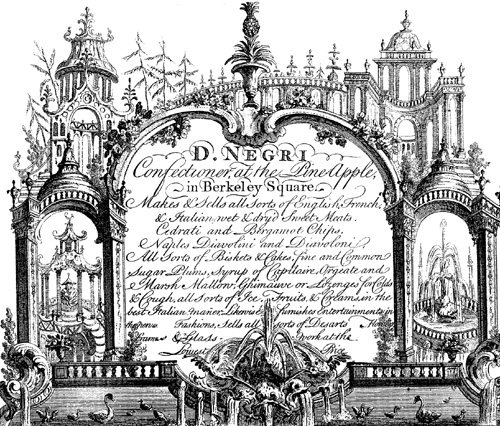 Gunter’s Tea Shop was originally called The Pot and Pineapple.It was located at Nos. 7 -8 Berkley Square. Italian pastry chef, Domenico Negri established it in 1757. The “pineapple” was chosen as part of the name for it symbolized luxury, and pineapples were a common ingredient used in confections. The shop sold English, French, and Italian wet and dry sweetmeats. Custards, cream ice, frozen mousses, jellied fruit, candies, syrups, biscuits, and caramels were served. Some of the cream ice flavors include chocolate, lavender, maple, Parmesan, Gruyere cheese, and bergamot. Mousses were often vanilla, saffron, and pineapple. For more information on sweetmeats, chocolate, and ice cream in Regency England, go
 James Gunter became Negri’s business partner in 1777, and by 1799, Gunter was the sole proprietor. During the Regency and throughout the 19th and 20th centuries, Gunter’s was considered a fashionable light eatery in Mayfair, well known for its ices, sorbets, and confections. From the business, Gunter purchased a mansion in Earl’s Court.
 When the east side of Berkeley Square was demolished in 1936–7, Gunter’s moved to Curzon Street. The tea shop closed in 1956, although the catering business continued for another twenty years. Gunter’s was also known for its catering business and beautifully decorated cakes. In 1811, the Duchess of Bedford’s and Mrs. Calvert’s ball suppers featured the shop’s confectionery, a tradition followed by many a society lady.
 He lived some 30 years in England and Europe. He spent time in London as an ambitious young man. In addition, he lived predominantly in London from 1757 to 1770, where he represented the views of the Pennsylvania colony to the British Parliament. While there he was awarded the honorary degree of “Doctor Franklin.” Artists painted him as a modern-day Prometheus, complete with lightning bolts behind him. The day after his arrival in England, Franklin was summoned to explain the colonial objection to the Stamp Act to the House of Commons. He wrote articles for the British newspapers in hopes of explaining the American point of view, but to no avail. He leaked anti-rebel letters penned by the Massachusetts royal governor. He was arraigned for disloyalty to the Crown in 1774, which resulted in nothing more than his being stripped of his Postmaster position.
 He did fail in convincing the Canadian government in joining the revolt against Great Britain. Returning to Pennsylvania, he was appointed to the Committee of Five, along with Thomas Jefferson, John Adams, Roger Sherman and Robert Linvingston, to draft the Declaration of Independence. Jefferson wrote the first draft of the document, but Franklin made one important change. He switched out Jefferson’s “We hold these truths to be sacred and undeniable” for “We hold these truths to be self-evident.” It was also Franklin who convinced John Morton to break the tie of the Pennsylvania delegation to vote in favor of withdrawing from British rule.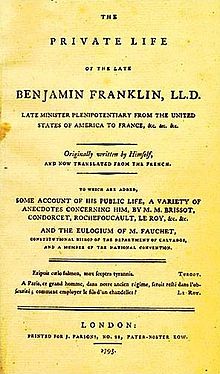


 The Disappearance of Georgiana Darcy: A Pride and Prejudice Mystery
 The Prosecution of Mr. Darcy’s Cousin: A Pride and Prejudice Mystery


 Every Woman Dreams...