!["This painting shows the great fire of London as seen from a boat in vicinity of Tower Wharf. The painting depicts Old London Bridge, various houses, a drawbridge and wooden parapet, the churches of St Dunstan-in-the-West and St Bride's, All Hallow's the Great, Old St Paul's, St Magnus the Martyr, St Lawrence Pountney, St Mary-le-Bow, St Dunstan-in-the East and Tower of London. The painting is in the [style] of the Dutch School and is not dated or signed." The painting itself is thought to be from the 17th century, and so in the public domain.](https://reginajeffers.blog/wp-content/uploads/2013/04/great_fire_london.jpg?w=300&h=215)
“This painting shows the great fire of London as seen from a boat in vicinity of Tower Wharf. The painting depicts Old London Bridge, various houses, a drawbridge and wooden parapet, the churches of St Dunstan-in-the-West and St Bride’s, All Hallow’s the Great, Old St Paul’s, St Magnus the Martyr, St Lawrence Pountney, St Mary-le-Bow, St Dunstan-in-the East and Tower of London. The painting is in the [style] of the Dutch School and is not dated or signed.”
The painting itself is thought to be from the 17th century, and so in the public domain.
The Great Fire of London was a major conflagration that swept through the central parts of the English city of London, from Sunday, 2 September to Wednesday, 5 September 1666. The fire gutted the medieval City of London inside the old Roman City Wall. It threatened, but did not reach, the aristocratic district of Westminster, Charles II’s Palace of Whitehall, and most of the suburban slums. It consumed 13,200 houses, 87 parish churches, St. Paul’s Cathedral and most of the buildings of the City authorities. It is estimated to have destroyed the homes of 70,000 of the City’s 80,000 inhabitants. The death toll is unknown but traditionally thought to have been small, as only six verified deaths were recorded. This reasoning has recently been challenged on the grounds that the deaths of poor and middle-class people were not recorded, while the heat of the fire may have cremated many victims leaving no recognisable remains.
The Great Fire started at the bakery of Thomas Farriner (or Farynor) on Pudding Lane, shortly after midnight on Sunday, 2 September, and spread rapidly west across the City of London. The use of the major firefighting technique of the time, the creation of firebreaks by means of demolition, was critically delayed owing to the indecisiveness of the Lord Mayor of London, Sir Thomas Bloodworth. By the time large-scale demolitions were ordered on Sunday night, the wind had already fanned the bakery fire into a firestorm which defeated such measures. The fire pushed north on Monday into the heart of the City. Order in the streets broke down as rumours arose of suspicious foreigners setting fires. The fears of the homeless focused on the French and Dutch, England’s enemies in the ongoing Second Anglo-Dutch War; these substantial immigrant groups became victims of lynchings and street violence. On Tuesday, the fire spread over most of the City, destroying St. Paul’s Cathedral and leaping the River Fleet to threaten Charles II’s court at Whitehall, while coordinated firefighting efforts were simultaneously mobilising. The battle to quench the fire is considered to have been won by two factors: the strong east winds died down, and the Tower of London garrison used gunpowder to create effective firebreaks to halt further spread eastward.
The social and economic problems created by the disaster were overwhelming. Evacuation from London and resettlement elsewhere were strongly encouraged by Charles II, who feared a London rebellion amongst the dispossessed refugees. Despite numerous radical proposals, London was reconstructed on essentially the same street plan used before the fire.
By the 1660s, London was by far the largest city in Britain, estimated at half a million inhabitants. Comparing London to the Baroque magnificence of Paris, John Evelyn called it a “wooden, northern, and inartificial congestion of Houses,” and expressed alarm about the fire hazard posed by the wood and about the congestion. By “inartificial,” Evelyn meant unplanned and makeshift, the result of organic growth and unregulated urban sprawl. A Roman settlement for four centuries, London had become progressively more overcrowded inside its defensive City wall. It had also pushed outwards beyond the wall into squalid extramural slums such as Shoreditch, Holborn, and Southwark and had reached far enough to include the independent City of Westminster.
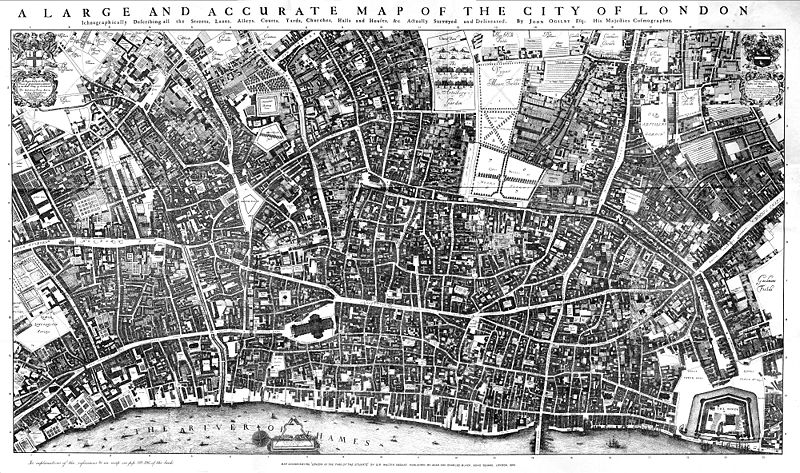
By the late 17th Century, the City proper—the area bounded by the City wall and the River Thames—was only a part of London, covering some 700.0 acres (2.833 km2; 1.0937 sq mi), and home to about 80,000 people, or one sixth of London’s inhabitants. The City was surrounded by a ring of inner suburbs, where most Londoners lived. The City was then as now the commercial heart of the capital, and was the largest market and busiest port in England, dominated by the trading and manufacturing classes. The aristocracy shunned the City and lived either in the countryside beyond the slum suburbs, or in the exclusive Westminster district (the modern West End), the site of Charles II’s court at Whitehall. Wealthy people preferred to live at a convenient distance from the traffic-clogged, polluted, unhealthy City, especially after it was hit by a devastating outbreak of bubonic plague in the Plague Year of 1665.

Central London in 1666, with the burnt area shown in pink.
The relationship between the City and the Crown was very tense. During the Civil War, 1642–1651, the City of London had been a stronghold of Republicanism, and the wealthy and economically dynamic capital still had the potential to be a threat to Charles II, as had been demonstrated by several Republican uprisings in London in the early 1660s. The City magistrates were of the generation that had fought in the Civil War, and could remember how Charles I’s grab for absolute power had led to that national trauma. They were determined to thwart any similar tendencies of his son, and when the Great Fire threatened the City, they refused the offers Charles made of soldiers and other resources. Even in such an emergency, the idea of having the unpopular Royal troops ordered into the City was political dynamite. By the time Charles took over command from the ineffectual Lord Mayor, the fire was already out of control.
Fire hazards in the City
The City was essentially medieval in its street plan, an overcrowded warren of narrow, winding, cobbled alleys. It had experienced several major fires before 1666, the most recent in 1632. Building with wood and roofing with thatch had been prohibited for centuries, but these cheap materials continued to be used. The only major stone-built area was the wealthy centre of the City, where the mansions of the merchants and brokers stood on spacious lots, surrounded by an inner ring of overcrowded poorer parishes whose every inch of building space was used to accommodate the rapidly growing population. These parishes contained workplaces, many of which were fire hazards—foundries, smithies, glaziers, which were theoretically illegal in the City, but tolerated in practice. The human habitations intermingled with these sources of heat, sparks, and pollution were crowded to bursting point and their construction increased the fire risk: the typical six- or seven-storey timbered London tenement houses had “jetties” (projecting upper floors): they had a narrow footprint at ground level, but would maximise their use of land by “encroaching,” as a contemporary observer put it, on the street with the gradually increasing size of their upper storeys. The fire hazard posed when the top jetties all but met across the narrow alleys was well perceived—”as it does facilitate a conflagration, so does it also hinder the remedy”, wrote one observer—but “the covetousness of the citizens and connivancy [that is, the corruption] of Magistrates” worked in favour of jetties.
In 1661, Charles II issued a proclamation forbidding overhanging windows and jetties, but this was largely ignored by the local government. Charles’ next, sharper, message in 1665 warned of the risk of fire from the narrowness of the streets and authorised both imprisonment of recalcitrant builders and demolition of dangerous buildings. It too had little impact.
The river front was important in the development of the Great Fire. The Thames offered water for firefighting and the chance of escape by boat, but the poorer districts along the riverfront had stores and cellars of combustibles, which increased the fire risk. All along the wharves, the rickety wooden tenements and tar paper shacks of the poor were shoehorned amongst “old paper buildings and the most combustible matter of Tarr, Pitch, Hemp, Rosen, and Flax which was all layd up thereabouts.” London was also full of black powder, especially along the river front. Much of it was left in the homes of private citizens from the days of the English Civil War, as the former members of Oliver Cromwell’s New Model Army still retained their muskets and the powder with which to load them. Five to six hundred tons of powder were stored in the Tower of London at the north end of Tower Bridge. The ship chandlers along the wharves also held large stocks, stored in wooden barrels.
17th Century Firefighting
Fires were common in the crowded wood-built city with its open fireplaces, candles, ovens, and stores of combustibles. There was no police or fire department to call, but London’s local militia, known as the Trained Bands, was at least in principle available for general emergencies, and watching for fire was one of the jobs of the watch, a thousand watchmen or “bellmen” who patrolled the streets at night. Self-reliant community procedures for dealing with fires were in place and were usually effective. Public-spirited citizens would be alerted to a dangerous house fire by muffled peals on the church bells and would congregate hastily to fight the fire. The methods available for this relied on demolition and water. By law, the tower of every parish church had to hold equipment for these efforts: long ladders, leather buckets, axes, and “firehooks” for pulling down buildings. Sometimes taller buildings were levelled to the ground quickly and effectively by means of controlled gunpowder explosions. This drastic method of creating firebreaks was increasingly used towards the end of the Great Fire, and modern historians believe it was what finally won the struggle.
Failures in Fighting the Fire
London Bridge, the only physical connection between the City and the south side of the river Thames, was itself covered with houses and had been noted as a deathtrap in the fire of 1632. By dawn on Sunday these houses were burning, and Samuel Pepys, observing the conflagration from the Tower of London, recorded great concern for friends living on the bridge. There were fears that the flames would cross London Bridge to threaten the borough of Southwark on the south bank, but this danger was averted by an open space between buildings on the bridge, which acted as a firebreak. The 18 foot (5.5 m) high Roman wall enclosing the City put the fleeing homeless at risk of being shut into the inferno. Once the river front was on fire and the escape route by boat cut off, the only exits were the eight gates in the wall. During the first couple of days, few people had any notion of fleeing the burning City altogether: they would remove what they could carry of their belongings to the nearest “safe house,” in many cases the parish church, or the precincts of St. Paul’s Cathedral, only to have to move again hours later. Some moved their belongings and themselves “four and five times” in a single day. The perception of a need to get beyond the walls only took root late on the Monday, and then there were near-panic scenes at the narrow gates as distraught refugees tried to get out with their bundles, carts, horses, and wagons.
The crucial factor which frustrated firefighting efforts was the narrowness of the streets. Even under normal circumstances, the mix of carts, wagons, and pedestrians in the undersized alleys was subject to frequent traffic jams and gridlock. During the fire, the passages were additionally blocked by refugees camping in them amongst their rescued belongings, or escaping outwards, away from the centre of destruction, as demolition teams and fire engine crews struggled in vain to move in towards it.
Demolishing the houses downwind of a dangerous fire by means of firehooks or explosives was often an effective way of containing the destruction. This time, however, demolition was fatally delayed for hours by the Lord Mayor’s lack of leadership and failure to give the necessary orders. By the time orders came directly from the King to “spare no houses,” the fire had devoured many more houses, and the demolition workers could no longer get through the crowded streets.
The use of water to extinguish the fire was also frustrated. In principle, water was available from a system of elm pipes which supplied 30,000 houses via a high water tower at Cornhill, filled from the river at high tide, and also via a reservoir of Hertfordshire spring water in Islington. It was often possible to open a pipe near a burning building and connect it to a hose to play on a fire, or fill buckets. Further, Pudding Lane was close to the river.
Theoretically, all the lanes from the river up to the bakery and adjoining buildings should have been manned with double rows of firefighters passing full buckets up to the fire and empty buckets back down to the river. This did not happen, or at least was no longer happening by the time Pepys viewed the fire from the river at mid-morning on the Sunday. Pepys comments in his diary that nobody was trying to put it out, but instead they fled from it in fear, hurrying “to remove their goods, and leave all to the fire.” The flames crept towards the river front with little interference from the overwhelmed community and soon torched the flammable warehouses along the wharves. The resulting conflagration not only cut off the firefighters from the immediate water supply from the river, but also set alight the water wheels under London Bridge which pumped water to the Cornhill water tower; the direct access to the river and the supply of piped water failed together.
London possessed advanced fire-fighting technology in the form of fire engines, which had been used in earlier large-scale fires. However, unlike the useful firehooks, these large pumps had rarely proved flexible or functional enough to make much difference. Only some of them had wheels, others were mounted on wheelless sleds. They had to be brought a long way, tended to arrive too late, and, with spouts but no delivery hoses, had limited reach. On this occasion an unknown number of fire engines were either wheeled or dragged through the streets, some from across the City. The piped water that they were designed to use had already failed, but parts of the river bank could still be reached. As gangs of men tried desperately to manoeuvre the engines right up to the river to fill their reservoirs, several of the engines toppled into the Thames. The heat from the flames was by then too great for the remaining engines to get within a useful distance; they could not even get into Pudding Lane.
Development of the Fire
The personal experiences of many Londoners during the fire are glimpsed in letters and memoirs. The two most famous diarists of the Restoration, Samuel Pepys (1633–1703) and John Evelyn (1620–1706), recorded the events and their own reactions day by day, and made great efforts to keep themselves informed of what was happening all over the City and beyond. For example, they both travelled out to the Moorfields park area north of the City on the Wednesday—the fourth day—to view the mighty encampment of distressed refugees there, which shocked them. Their diaries are the most important sources for all modern retellings of the disaster. The most recent books on the fire, by Tinniswood (2003) and Hanson (2001), also rely on the brief memoirs of William Taswell (1651–82), who was a fourteen-year-old schoolboy at Westminster School in 1666.
Sunday
After two rainy summers in 1664 and 1665, London had lain under an exceptional drought since November 1665, and the wooden buildings were tinder-dry after the long hot summer of 1666. A fire broke out at Thomas Farriner’s bakery in Pudding Lane a little after midnight on Sunday 2 September. The family was trapped upstairs, but managed to climb from an upstairs window to the house next door, except for a maidservant who was too frightened to try, and became the first victim. The neighbours tried to help douse the fire; after an hour the parish constables arrived and judged that the adjoining houses had better be demolished to prevent further spread. The householders protested, and the Lord Mayor Sir Thomas Bloodworth, who alone had the authority to override their wishes, was summoned.
When Bloodworth arrived, the flames were consuming the adjoining houses and creeping towards the paper warehouses and flammable stores on the river front. The more experienced firemen were clamouring for demolition, but Bloodworth refused, on the argument that most premises were rented and the owners could not be found. Bloodworth is generally thought to have been appointed to the office of Lord Mayor as a yes man, rather than for any of the needful capabilities for the job. He panicked when faced with a sudden emergency. Pressed, he made the often-quoted remark “Pish! A woman could piss it out,” and left. After the City had been destroyed, Samuel Pepys, looking back on the events, wrote in his diary on 7 September 1666: “People do all the world over cry out of the simplicity [the stupidity] of my Lord Mayor in general; and more particularly in this business of the fire, laying it all upon him.”
On Sunday morning, Pepys, who was a senior official in the Navy Office, ascended the Tower of London to view the fire from a turret, and recorded in his diary that the eastern gale had turned it into a conflagration. It had burned down several churches and, he estimated, 300 houses and reached the river front. The houses on London Bridge were burning. Taking a boat to inspect the destruction around Pudding Lane at close range, Pepys describes a “lamentable” fire, “everybody endeavouring to remove their goods, and flinging into the river or bringing them into lighters that lay off; poor people staying in their houses as long as till the very fire touched them, and then running into boats, or clambering from one pair of stairs by the water-side to another.” Pepys continued westward on the river to the court at Whitehall, “where people come about me, and did give them an account dismayed them all, and word was carried in to the King. So I was called for, and did tell the King and Duke of Yorke what I saw, and that unless His Majesty did command houses to be pulled down nothing could stop the fire. They seemed much troubled, and the King commanded me to go to my Lord Mayor from him, and command him to spare no houses, but to pull down before the fire every way.” Charles’ brother James, Duke of York, offered the use of the Royal Life Guards to help fight the fire.
A mile west of Pudding Lane, by Westminster Stairs, young William Taswell, a schoolboy who had bolted from the early morning service in Westminster Abbey, saw some refugees arrive in hired lighter boats, unclothed and covered only with blankets. The services of the lightermen had suddenly become extremely expensive, and only the luckiest refugees secured a place in a boat.
The fire spread quickly in the high wind. By mid-morning on Sunday, people abandoned attempts at extinguishing the fire and fled; the moving human mass and their bundles and carts made the lanes impassable for firemen and carriages. Pepys took a coach back into the city from Whitehall, but only reached St Paul’s Cathedral before he had to get out and walk. Handcarts with goods and pedestrians were still on the move, away from the fire, heavily weighed down. The parish churches not directly threatened were filling up with furniture and valuables, which would soon have to be moved further afield. Pepys found Bloodworth trying to coordinate the fire fighting efforts and near to collapse, “like a fainting woman,” crying out plaintively in response to the King’s message that he was pulling down houses. “But the fire overtakes us faster then [sic] we can do it.” Holding on to his civic dignity, he refused James’s offer of soldiers and then went home to bed. King Charles II sailed down from Whitehall in the Royal barge to inspect the scene. He found that houses were still not being pulled down, in spite of Bloodworth’s assurances to Pepys, and daringly overrode the authority of Bloodworth to order wholesale demolitions west of the fire zone. The delay rendered these measures largely futile, as the fire was already out of control.
By Sunday afternoon, 18 hours after the alarm was raised in Pudding Lane, the fire had become a raging firestorm that created its own weather. A tremendous uprush of hot air above the flames was driven by the chimney effect wherever constrictions such as jettied buildings narrowed the air current and left a vacuum at ground level. The resulting strong inward winds did not tend to put the fire out, as might be thought: instead, they supplied fresh oxygen to the flames, and the turbulence created by the uprush made the wind veer erratically both north and south of the main, easterly, direction of the gale which was still blowing.
In the early evening, with his wife and some friends, Pepys went again on the river “and to the fire up and down, it still encreasing.” They ordered the boatman to go “so near the fire as we could for smoke; and all over the Thames, with one’s face in the wind, you were almost burned with a shower of firedrops.” When the “firedrops” became unbearable, the party went on to an alehouse on the South Bank and stayed there till darkness came and they could see the fire on London Bridge and across the river, “as only one entire arch of fire from this to the other side of the bridge, and in a bow up the hill for an arch of above a mile long: it made me weep to see it.” Pepys described this arch of fire as “a bow with God’s arrow in it with a shining point.”
Monday
By dawn on Monday, 3 September, the fire was principally expanding north and west, the turbulence of the fire storm pushing the flames both further south and further north than the day before. The spread to the south was in the main halted by the river, but had torched the houses on London Bridge, and was threatening to cross the bridge and endanger the borough of Southwark on the south bank of the river. Southwark was preserved by a pre-existent firebreak on the bridge, a long gap between the buildings which had saved the south side of the Thames in the fire of 1632 and now did so again; flying embers started a fire in Southwark but it was quickly stopped. The fire’s spread to the north reached the financial heart of the City. The houses of the bankers in Lombard Street began to burn on Monday afternoon, prompting a rush to get their stacks of gold coins, so crucial to the wealth of the city and the nation, to safety before they melted away. Several observers emphasise the despair and helplessness which seemed to seize Londoners on this second day, and the lack of efforts to save the wealthy, fashionable districts which were now menaced by the flames, such as the Royal Exchange—combined bourse and shopping centre — and the opulent consumer goods shops in Cheapside. The Royal Exchange caught fire in the late afternoon, and was a smoking shell within a few hours. John Evelyn, courtier and diarist, wrote:
“The conflagration was so universal, and the people so astonished, that from the beginning, I know not by what despondency or fate, they hardly stirred to quench it, so that there was nothing heard or seen but crying out and lamentation, running about like distracted creatures without at all attempting to save even their goods, such a strange consternation there was upon them.”
Evelyn lived four miles (6 km) outside the City, in Deptford, and so did not see the early stages of the disaster. On Monday, joining many other upper-class people, he went by coach to Southwark to see the view that Pepys had seen the day before, of the burning City across the river. The conflagration was much larger now: “the whole City in dreadful flames near the water-side; all the houses from the Bridge, all Thames-street, and upwards towards Cheapside, down to the Three Cranes, were now consumed.” In the evening, Evelyn reported that the river was covered with barges and boats making their escape piled with goods. He observed a great exodus of carts and pedestrians through the bottleneck City gates, making for the open fields to the north and east, “which for many miles were strewed with moveables of all sorts, and tents erecting to shelter both people and what goods they could get away. Oh, the miserable and calamitous spectacle!”
Suspicion soon arose in the threatened city that the fire was no accident. The swirling winds carried sparks and burning flakes long distances to lodge on thatched roofs and in wooden gutters, causing seemingly unrelated house fires to break out far from their source and giving rise to rumours that fresh fires were being set on purpose. Foreigners were immediately suspects because of the current Second Anglo-Dutch War. As fear and suspicion hardened into certainty on the Monday, reports circulated of imminent invasion, and of foreign undercover agents seen casting “fireballs” into houses, or caught with hand grenades or matches.
There was a wave of street violence. William Taswell saw a mob loot the shop of a French painter and level it to the ground, and watched in horror as a blacksmith walked up to a Frenchman in the street and hit him over the head with an iron bar.
The fears of terrorism received an extra boost from the disruption of communications and news as facilities were devoured by the fire. The General Letter Office in Threadneedle Street, through which post for the entire country passed, burned down early on Monday morning. The London Gazette just managed to put out its Monday issue before the printer’s premises went up in flames (this issue contained mainly society gossip, with a small note about a fire that had broken out on Sunday morning and “which continues still with great violence”). The whole nation depended on these communications, and the void they left filled up with rumours. There were also religious alarms of renewed Gunpowder Plots. As suspicions rose to panic and collective paranoia on the Monday, both the Trained Bands and the Coldstream Guards focused less on fire fighting and more on rounding up foreigners, Catholics, and any odd-looking people, and arresting them or rescuing them from mobs, or both together.
The inhabitants, especially the upper class, were growing desperate to remove their belongings from the City. This provided a source of income for the able-bodied poor, who hired out as porters (sometimes simply making off with the goods), and especially for the owners of carts and boats. Hiring a cart had cost a couple of shillings on the Saturday before the fire; on the Monday it rose to as much as £40, a fortune (equivalent to over £4000 in 2005).
Seemingly every cart and boat owner within reach of London made their way towards the City to share in these opportunities, the carts jostling at the narrow gates with the panicked inhabitants trying to get out. The chaos at the gates was such that the magistrates ordered the gates shut on Monday afternoon, in the hope of turning the inhabitants’ attention from safeguarding their own possessions to the fighting of the fire: “that, no hopes of saving any things left, they might have more desperately endeavoured the quenching of the fire.” This headlong and unsuccessful measure was rescinded the next day.
Even as order in the streets broke down, especially at the gates, and the fire raged unchecked, Monday marked the beginning of organised action. Bloodworth, who as Lord Mayor was responsible for coordinating the fire-fighting, had apparently left the City; his name is not mentioned in any contemporary accounts of the Monday’s events. In this state of emergency, Charles again overrode the City authorities and put his brother James, Duke of York, in charge of operations. James set up command posts round the perimeter of the fire, press-ganging any men of the lower classes found in the streets into teams of well-paid and well-fed firemen. Three courtiers were put in charge of each post, with authority from Charles himself to order demolitions. This visible gesture of solidarity from the Crown was intended to cut through the citizens’ misgivings about being held financially responsible for pulling down houses. James and his life guards rode up and down the streets all Monday, rescuing foreigners from the mob and attempting to keep order. “The Duke of York hath won the hearts of the people with his continual and indefatigable pains day and night in helping to quench the Fire,” wrote a witness in a letter on 8 September.
On the Monday evening, hopes were dashed that the massive stone walls of Baynard’s Castle, Blackfriars, the western counterpart of the Tower of London, would stay the course of the flames. This historic royal palace was completely consumed, burning all night.
A contemporary account said that, that day or later, King Charles in person worked manually to help to throw water on flames and to help to demolish buildings to make a firebreak.
Tuesday
Tuesday, 4 September, was the day of greatest destruction. The Duke of York’s command post at Temple Bar, where Strand meets Fleet Street, was supposed to stop the fire’s westward advance towards the Palace of Whitehall. Making a stand with his firemen from the Fleet Bridge and down to the Thames, James hoped that the River Fleet would form a natural firebreak. However, early on Tuesday morning, the flames jumped over the Fleet, driven by the unabated easterly gale, and outflanked them, forcing them to run for it. There was consternation at the palace as the fire continued implacably westward: “Oh, the confusion there was then at that court!” wrote Evelyn.

Ludgate in flames, with St. Paul’s Cathedral in the distance (square tower without the spire) now catching flames. Oil painting by anonymous artist, ca. 1670.
Working to a plan at last, James’s firefighters had also created a large firebreak to the north of the conflagration. It contained the fire until late afternoon, when the flames leapt across and began to destroy the wide, affluent luxury shopping street of Cheapside.
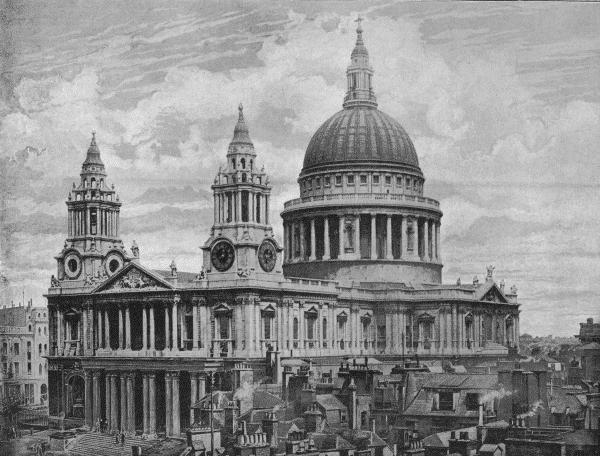
Everybody had thought St. Paul’s Cathedral a safe refuge, with its thick stone walls and natural firebreak in the form of a wide, empty surrounding plaza. It had been crammed full of rescued goods and its crypt filled with the tightly packed stocks of the printers and booksellers in adjoining Paternoster Row. However an enormous stroke of bad luck meant that the building was covered in wooden scaffolding, undergoing piecemeal restoration by a then relatively unknown Christopher Wren. The scaffolding caught fire on Tuesday night. Leaving school, young William Taswell stood on Westminster Stairs a mile away and watched as the flames crept round the cathedral and the burning scaffolding ignited the timbered roof beams. Within half an hour, the lead roof was melting, and the books and papers in the crypt caught with a roar. “The stones of Paul’s flew like grenados, the melting lead running down the streets in a stream, and the very pavements glowing with fiery redness, so as no horse, nor man, was able to tread on them”, reported Evelyn in his diary. The cathedral was quickly a ruin.
During the day, the flames began to move eastward from the neighbourhood of Pudding Lane, straight against the prevailing east wind towards Pepys’s home on Seething Lane and the Tower of London with its gunpowder stores. After waiting all day for requested help from James’s official firemen, who were busy in the west, the garrison at the Tower took matters into their own hands and created firebreaks by blowing up houses in the vicinity on a large scale, halting the advance of the fire.
Wednesday
The wind dropped on Tuesday evening, and the firebreaks created by the garrison finally began to take effect on Wednesday 5 September. Pepys walked all over the smouldering city, getting his feet hot, and climbed the steeple of Barking Church, from which he viewed the destroyed City, “the saddest sight of desolation that I ever saw.” There were many separate fires still burning themselves out, but the Great Fire was over. Pepys visited Moorfields, a large public park immediately north of the City, and saw a great encampment of homeless refugees, “poor wretches carrying their good there, and every body keeping his goods together by themselves,” and noted that the price of bread in the environs of the park had doubled. Evelyn also went out to Moorfields, which was turning into the main point of assembly for the homeless, and was horrified at the numbers of distressed people filling it, some under tents, others in makeshift shacks: “Many [were] without a rag or any necessary utensils, bed or board… reduced to extremest misery and poverty.” Evelyn was impressed by the pride of these distressed Londoners, “tho’ ready to perish for hunger and destitution, yet not asking one pennie for relief.”
Fears of foreign terrorists and of a French and Dutch invasion were as high as ever among the traumatised fire victims, and on Wednesday night there was an outbreak of general panic in the encampments at Parliament Hill, Moorfields and Islington. A light in the sky over Fleet Street started a story that 50,000 French and Dutch immigrants, widely rumoured to have started the fire, had risen and were marching towards Moorfields to finish what the fire had begun: to cut the men’s throats, rape the women, and steal their few possessions. Surging into the streets, the frightened mob fell on any foreigners they happened to encounter, and were, according to Evelyn, only “with infinite pains and great difficulty” appeased and pushed back into the fields by the Trained Bands, troops of Life Guards, and members of the court. The mood was now so volatile that Charles feared a full-scale London rebellion against the monarchy. Food production and distribution had been disrupted to the point of non-existence; Charles announced that supplies of bread would be brought into the City every day, and safe markets set up round the perimeter. These markets were for buying and selling; there was no question of distributing emergency aid.
Deaths and Destruction
Only a few deaths from the fire are officially recorded, and deaths are traditionally believed to have been few. Porter gives the figure as eight and Tinniswood as “in single figures,” although he adds that some deaths must have gone unrecorded and that, besides direct deaths from burning and smoke inhalation, refugees also perished in the impromptu camps. Hanson takes issue with the idea that there were only a few deaths, enumerating known deaths from hunger and exposure among survivors of the holocaust, “huddled in shacks or living among the ruins that had once been their homes” in the cold winter that followed, including, for instance, the dramatist James Shirley and his wife. Hanson also maintains that “it stretches credulity to believe that the only papists or foreigners being beaten to death or lynched were the ones rescued by the Duke of York,” that official figures say very little about the fate of the undocumented poor, and that the heat at the heart of the firestorms, far hotter than an ordinary house fire, was enough to consume bodies fully, or leave only a few skull fragments. The fire, fed not merely by wood, fabrics, and thatch, but also by the oil, pitch, coal, tallow, fats, sugar, alcohol, turpentine, and gunpowder stored in the riverside district, melted the imported steel lying along the wharves (melting point between 1,250 °C (2,300 F) and 1,480 °C (2,700 F)) and the great iron chains and locks on the City gates (melting point between 1,100 °C (2,000 F) and 1,650 °C (3000 F)). Nor would anonymous bone fragments have been of much interest to the hungry people sifting through the tens of thousands of tons of rubble and debris after the fire, looking for valuables, or to the workmen clearing away the rubble later during the rebuilding. Appealing to common sense and “the experience of every other major urban fire down the centuries,” Hanson emphasises that the fire attacked the rotting tenements of the poor with furious speed, surely trapping at the very least “the old, the very young, the halt and the lame” and burying the dust and ashes of their bones under the rubble of cellars; making for a death toll not of four or eight, but of “several hundred and quite possibly several thousand.”
The material destruction has been computed at 13,500 houses, 87 parish churches, 44 Company Halls, the Royal Exchange, the Custom House, St. Paul’s Cathedral, the Bridewell Palace and other City prisons, the General Letter Office, and the three western city gates, Ludgate, Newgate, and Aldersgate. The monetary value of the loss, first estimated at £100,000,000 in the currency of the time, was later reduced to an uncertain £10,000,000 (over £1 billion in 2005 pounds). Evelyn believed that he saw as many as “200,000 people of all ranks and stations dispersed, and lying along their heaps of what they could save” in the fields towards Islington and Highgate.
Aftermath

The Monument to the Great Fire of London to commemorate the Great Fire of London, designed by Sir Christopher Wren
An example of the urge to identify scapegoats for the fire is the acceptance of the confession of a simple-minded French watchmaker, Robert Hubert, who claimed he was an agent of the Pope and had started the Great Fire in Westminster. He later changed his story to say that he had started the fire at the bakery in Pudding Lane. Hubert was convicted, despite some misgivings about his fitness to plead, and hanged at Tyburn on 28 September 1666. After his death, it became apparent that he had not arrived in London until two days after the fire started. These allegations that Catholics had started the fire were exploited as powerful political propaganda by opponents of pro-Catholic Charles II’s court, mostly during the Popish Plot and the exclusion crisis later in his reign.
Abroad in the Netherlands the Great Fire of London was seen as a divine retribution for Holmes’s Bonfire, the burning by the English of a Dutch town during the Second Anglo-Dutch War.
In the chaos and unrest after the fire, Charles II feared another London rebellion. He encouraged the homeless to move away from London and settle elsewhere, immediately issuing a proclamation that “all Cities and Towns whatsoever shall without any contradiction receive the said distressed persons and permit them the free exercise of their manual trades.” A special Fire Court was set up to deal with disputes between tenants and landlords and decide who should rebuild, based on ability to pay. The Court was in session from February 1667 to September 1672. Cases were heard and a verdict usually given within a day, and without the Fire Court, lengthy legal wrangles would have seriously delayed the rebuilding which was so necessary if London was to recover.
Encouraged by Charles, radical rebuilding schemes for the gutted City poured in. If it had been rebuilt under some of these plans, London would have rivalled Paris in Baroque magnificence. The Crown and the City authorities attempted to establish “to whom all the houses and ground did in truth belong” to negotiate with their owners about compensation for the large-scale remodelling that these plans entailed, but that unrealistic idea had to be abandoned. Exhortations to bring workmen and measure the plots on which the houses had stood were mostly ignored by people worried about day-to-day survival, as well as by those who had left the capital; for one thing, with the shortage of labour following the fire, it was impossible to secure workmen for the purpose. Apart from Wren and Evelyn, it is known that Robert Hooke, Valentine Knight and Richard Newcourt proposed rebuilding plans.
With the complexities of ownership unresolved, none of the grand Baroque schemes for a City of piazzas and avenues could be realised; there was nobody to negotiate with, and no means of calculating how much compensation should be paid. Instead, much of the old street plan was recreated in the new City, with improvements in hygiene and fire safety: wider streets, open and accessible wharves along the length of the Thames, with no houses obstructing access to the river, and, most importantly, buildings constructed of brick and stone, not wood. New public buildings were created on their predecessors’ sites; perhaps the most famous is St. Paul’s Cathedral and its smaller cousins, Christopher Wren’s 50 new churches.
On Charles’ initiative, a Monument to the Great Fire of London, designed by Christopher Wren and Robert Hooke, was erected near Pudding Lane. Standing 61 metres (200 ft) tall and known simply as “The Monument”, it is a familiar London landmark which has given its name to a tube station. In 1668 accusations against the Catholics were added to the inscription on the Monument which read, in part:
“Here by permission of heaven, hell broke loose upon this Protestant city…..the most dreadful Burning of this City; begun and carried on by the treachery and malice of the Popish faction…Popish frenzy which wrought such horrors, is not yet quenched…”
Aside from the four years of James II’s rule from 1685 to 1689, the inscription remained in place until 1830 and the passage of the Catholic Emancipation Act.
Another monument, the Golden Boy of Pye Corner in Smithfield, marks the spot where the fire stopped. According to the inscription, the fact that the fire started at Pudding Lane and stopped at Pye Corner was an indication that the Fire was evidence of God’s wrath on the City of London for the sin of gluttony.
The Great Plague epidemic of 1665 is believed to have killed a sixth of London’s inhabitants, or 80,000 people, and it is sometimes suggested, as plague epidemics did not recur in London after the fire, that the fire saved lives in the long run by burning down so much unsanitary housing with their rats and their fleas which transmitted the plague. Historians disagree as to whether the fire played a part in preventing subsequent major outbreaks. The Museum of London website claims that there was a connection, while historian Roy Porter points out that the fire left the most insalubrious parts of London, the slum suburbs, untouched.
Alternative epidemiological explanations have been put forward, along with the observation that the disease disappeared from almost every other European city around the same time.
Following the Fire, the thoroughfares of Queen Street and King Street were newly laid out, cutting across more ancient thoroughfares in the City, creating a new route up from the Thames to the Guildhall; they were the only notable new streets following the fire’s destruction of much of the City.










!["This painting shows the great fire of London as seen from a boat in vicinity of Tower Wharf. The painting depicts Old London Bridge, various houses, a drawbridge and wooden parapet, the churches of St Dunstan-in-the-West and St Bride's, All Hallow's the Great, Old St Paul's, St Magnus the Martyr, St Lawrence Pountney, St Mary-le-Bow, St Dunstan-in-the East and Tower of London. The painting is in the [style] of the Dutch School and is not dated or signed." The painting itself is thought to be from the 17th century, and so in the public domain.](https://reginajeffers.blog/wp-content/uploads/2013/04/great_fire_london.jpg)