Eccentrics of the Regency Period Series: “The Golden Ball” or Edward Hughes Ball Hughes

280px-Alfred_Guillaume_GabrielEdward Hughes Ball Hughes, also known as “The Golden Ball,” was an English dandy infamous for his extravagant lifestyle. Born in May 1798, Hughes was educated at Eton and Trinity College, Cambridge. He spent some time in the 7th Hussars but left arm life to enjoy his fortune. He quickly attracted the attention of the Haut Ton. Hughes was a handsome man known for his chocolate-colored coach and his invention of the black cravat.

In 1823, Hughes made a mésalliance by unexpectedly marrying Maria Mercandotti, a 16-year-old Spanish dancer, who left a theatre full of patrons waiting in vain to see her. William Harrison Ainsworth reportedly said, “The damsel is gone, and no wonder at all/that, bred to the dance, she is gone to a Ball.” The couple later separated and was divorced in 1839.

In 1824, Hughes purchased Oatlands Palace (near Weybridge) from the Duke of York for the exorbitant price of £180,000. Later, the sale of the grounds for housing lots, which created the modern community of Oatlands, was a profitable venture for Hughes. He and young wife went to live in Greenwich, where he kept an “open” house and played whist for five-pound points. Hughes achieved the reputation as one of the great gamblers of the day. He was said to have spent a night in the garden betting on the outcome of games of battledore and shuttlecock.

Hughes mounting gambling debts and extravagant living forced him to move to France in 1829 to avoid his creditors. His affairs were left in the hands of his solicitors, Freere and Forster, who sent Hughes an allowance upon which to live. He was far from destitute, however; according to a governmental report, Hughes was one of the foreign investors in the Second Bank of the United States. In 1832, his holding amounted to $51,000 in stock.

In 1835, Hughes came into the possession of the manor of Sidmouth. In 1835, he helped finance a new sea wall for the town. In 1839, a law was passed by Parliament allowing Hughes to tear down the market and build a new one. An 1846 law confirmed that the new market had been built and that no one could sell anything in the manor except at the market, unless they paid a toll at the market building.

Many stories were told about Hughes’ origins and family, most of them untrue. For example, one tale said he was the son of a slop seller. His grandmother Ruth (c. 1731 – 1800), after her first husband, a Mr. Ball, had died, married Admiral Edward Hughes. Admiral Hughes advanced the career of his wife’s eldest son, Captain Henry Ball (c. 1754-1792), who served under Hughes as captain of his flagship in India, but Henry predeceased him. Admiral Hughes died in 1794 without issue, and Hughes, son of Ruth’s second son David Ball (c. 1760-1798), inherited the Hughes money (40,000 pounds a year, an enormous fortune, and especially so without the encumbrance of an expensive country house to maintain) upon turning 21; he adopted the Hughes last name at that time. Ball Hughes’ mother’s name was Sarah; she later remarried, to a man named Thomas Johnson.

Hughes’ older sister Catherine Ball was a socialite, journalist, and novelist who eventually styled herself the “Baroness de Calabrella” after acquiring property in Italy. She married an older man, Rev. Francis Lee, at the age of 16 in 1804, without her mother’s permission, and was separated from him in 1810 on charges of adultery; her lover, Captain George de Blaquiere, was successfully sued by Lee for criminal conversation. She was later a friend of the Countess of Blessington  and married the Countess’ first patron, Thomas Jenkins. Another sister, Ruth, married Houlton Hartwell, son of Admiral Francis Hartwell, in 1812; he was one of the Prince Regent’s chaplains. A third sister, Sydney, married Sir John Ignatius Burke, 10th Baronet of Glinsk. There was a fourth sister, Elizabeth Ball.
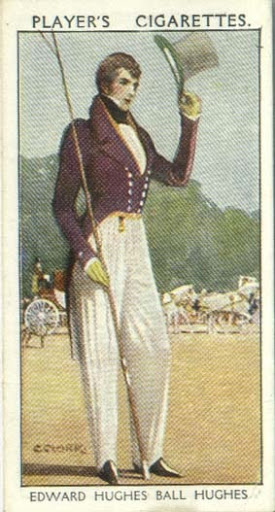
PastedGraphic2-2012-12-27-08-33Hughes had several several relationships while in France, although it is unclear whether he actually remarried. With actress Eliza Breugnot Momborne he had three children: Edward Seymour; Adeline Eleanor, and Sydney Matilda. Edward Seymour died in 1867 in Dieppe after his horse fell on him; d’Orsay had made a portrait of him as a young man. Hughes later had several children with Anne Henriette de Dauvet: Edward Edmund Hughes Ball Hughes and Kate Henrietta Edwardine Hughes Ball Hughes.

Hughes was exceedingly handsome, generous, and entertained lavishly. Lord William Pitt-Lennox, a rival dandy, declared that Hughes tried too hard to be the toast of the ton. Pitt-Lennox said of Hughes, “Brummell sets the fashion; Ball Hughes merely follows it.” Hughes, for example, was known to dislike hunting, but he nevertheless kept a string of hunters because he saw doing so as “trendy.” He also disliked music while maintaining a box at Covent Garden. He knew little of racing but always attended Ascot and Goodwood. Pitt-Lennox was also to have said of Hughes, “[His] manner in public was too coxcombical; he screwed his mouth up, and lisped or drawled forth his words, while his manner of walking was so affected that he looked as if he was on stilts, and had swallowed the kitchen poker.”
Posted in British history, Jane Austen, Living in the Regency, real life tales, Regency era | Tagged , , , , , | 6 Comments

Living in Regency England – Heating the House

From the Georgian Period forward, the majority of the London townhouses were heated by coal rather than wood. Thus, members of Society and visitors to the City “enjoyed” the ever-preent film of coal dust in the air. In the late 17th and early 18th Century, the fireplaces remained wood-burning elements within the households. These fireplaces were designed with wide chimneys and a brick hearth.

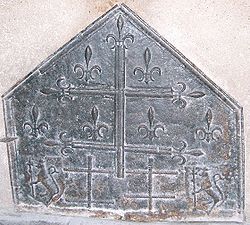
Fireback in the house of Jeanne d'Arc in Domrémy

Fireback in the house of Jeanne d’Arc in Domrémy

When coal came into use, a free-standing iron or steel basket was placed in the fireplace. These baskets usually had an iron fireback behind it. After 1750, these iron baskets occurred regularly in both country, as well as city, households. Quite often, down drafts drove smoke from these coal baskets into the rooms, and the heat escaped up the chimneys (i.e., the constant “smog” in London).  A fireplace fireback is a heavy cast iron, sized in proportion to the fireplace and the fire, which is placed against the back wall of the fireplace. The metal is heated by the fire, and then that heat is radiated into the room. The thick iron keeps the heat which would otherwise be lost and returns it to the room. A fireback may increase the fire’s efficiency by as much as 50%. The thicker the fireback, the longer (and softer) the radiative effect. The fireback also protected the back of the fireplace from heat and flames.


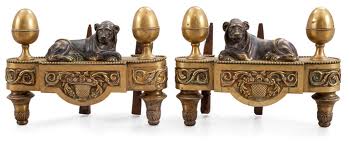
18th Century firedogs

Stove “grates” became popular in early to mid 18th centuries. These stove grates combined the coal basket, the fireback, and firedogs.  The first fireplaces in Tudor homes consisted of a pair of fire dogs, which raised the ends of the burning logs to improve the burning efficiency. By the end of the 18th Century, the first fire baskets came into use, which helped to contain and manage the fire, improving efficiency.

From Russell Taylor at Building Conservation, we learn, “Chimneys and flues are subjected to intense heating and cooling cycles, condensation and aggressive chemical reactions caused by hot flue gases. Above the roof line the chimney stack is exposed to the full force of the weather. To withstand such conditions, maintenance and repairs need to be of the highest standard, and it is important that design elements of such significance are conserved properly. Yet works are often badly executed by unqualified contractors using inappropriate materials and ill-conceived methods. The result can be damaging to the character and fabric of the building, and may even be dangerous.

“Although flues have been in use since ancient times, many early domestic fires were open hearths where the smoke billowed around inside the building. The widespread adoption of flues in the late medieval period coincided with an increase in the use of brick, which is better able to withstand the temperature of a domestic fire than stone because it is a fired material. Even in stone building areas brick was often used for the chimneys and flues, particularly from the 19th century onwards.

“The earliest chimneys were large, crude structures serving a single fire, but as more fireplaces were required, chimneys became smaller and more efficient, combining several flues, each serving a separate fire.

“At first the usual domestic fuel was wood, but coal was used surprisingly early – in London from the mid-17th century and everywhere except rural areas by the mid-18th century. The change to coal resulted in smaller fireplaces as more heat is given off by a smaller quantity of fuel, and grates were required because coal, being denser than wood, will not burn unless there is an oxygen supply under it.

“In the 17th and 18th Centuries, when coal was the principal fuel used, grates were really simple baskets combining fire-dogs and fire-back in a single unit. Then came cast iron hob-grates and finally the various types of register grates based on principles established by Count Rumford in 1797. These grates had a narrow throat for more efficient flue draught, the fire was pushed forward to the front of the hearth and the sides were splayed to radiate heat more efficiently. Register grates became the standard from then on.

“By the 18th century most chimneys were built with 12″ flues, and this size was reduced still further following Count Rumford’s innovations. As a result the usual dimension for a brick flue came to be just 9 x 9″ (one brick by one brick) and the wall between the flues, the ‘withe’, was usually 4½” (half a brick). Brick dimensions often also govern the dimensions of quite elaborately shaped stacks so for any replacement bricks the original Imperial sizes must be precisely matched.

“Flues are lined with ‘parging’, a render mix used to prevent gases escaping through mortar joints and cracks in the structure. Parging is always somewhat roughly executed and is usually of the same mix as the brick mortar, because it is done piecemeal as the chimney stack rises. However, special mixes were also used and are found in older and larger flues. The first edition of McKay’s Building Construction in 1944, for example, recommended a mix of one part lime to three parts sand with ox hair, mixed at the rate of one pound of hair to three cubic feet of mortar. An alternative mix comprised one part lime to two parts sand and one part cow dung.”

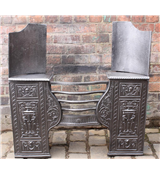
The cast iron hob grate was the first major improvement to the 3-part stove grate. Early hob grates were used in modest homes as early as 1720.

Late Georgian Cast Iron Hob Grate from the Caroon Foundry

Late Georgian Cast Iron Hob Grate from the Caroon Foundry

Original hob grates were made from cast iron with hobs either side used for heating and cooking and were fitted into the chimney breast. Hob grates are often known as register grates, the difference being register grates have a register plate on the back to protect the back brickwork of the chimney, control emissions and airflow from the fire. Today “register grates” are popularly known as “hob grates” despite having the register plate on the back. The name “register grate” came because the original hob grate design with a register plate on the back was registered/ patented/ copyrighted.

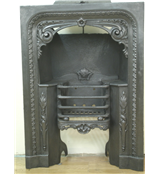
Regency Cast Iron Hob Grate

Regency Cast Iron Hob Grate

Original hob grates were first used during the reigns of King George I – IV (1740-1830) and in the Regency period (1811-1820) where the Prince Regent ruled due to his father King George III’s sickness. Hob grates were popular during these periods as they were an effective way of cooking and heating at the same time. The two hobs either side of the grate allowed for plenty of room for cooking utensils and at the same time the fire would radiate heat into the room. Hob grates were used right up until the Edwardian period although the functionality of being able to cook on the hobs died out as new technologies became available. During the Edwardian period and Art Nouveau hob grates tended to have changed in style somewhat, the main difference being that they often had tiles placed in them.

The hob grates allowed for smaller coal baskets and more efficiency. The cast iron versions radiated more heat into the rooms. They came into being around 1750. The top and front were made of one single iron casting, while the remainder of the apparatus was a thin sheer iron. Being economical to produce, hob grates soon became the standard in townhouses and smaller rooms in great mansions. In poorer Georgian houses, the hob grate served as a cooking stove.

Count Rumford

Count Rumford

In 1796, Benjamin Thompson, Count Rumford, the polymathematical founder of the Royal Institution, wrote a pamphlet called Chimney Fireplaces. In it, Rumford described the advantages of a narrower chimney throat. Rumford applied his knowledge of heat to the improvement of fireplaces. He made them smaller and shallower with widely angled covings so they would radiate better. And he streamlined the throat, or in his words “rounded off the breast” so as to “remove those local hindrances which forcibly prevent the smoke from following its natural tendency to go up the chimney…” Rumford “put his money where his mouth was” by installing new grates in his Brompton Row, Knightsbridge, residence. “Rumford Stoves,” which brought the heat source closer to the opening and which canted the sides to increase radiation, quickly became popular among wealthy aristocrats, including the Marquis of Salisbury.

The Rumford fireplace created a sensation in London when he introduced the idea of restricting the chimney opening to increase the updraught. He and his workers changed fireplaces by inserting bricks into the hearth to make the side walls angled and added a choke to the chimney to increase the speed of air going up the flue. It effectively produced a streamlined  air flow, reducing turbulence  so the smoke would go up into the chimney rather than lingering and often choking the residents. Many fashionable London houses were modified to his instructions, and became smoke-free as well as more efficient. Thompson became a celebrity when news of his success became widespread. In an age when fires were the principal source of heat, this simple alteration in the design of fireplaces was copied everywhere .

Plan of Rumford fireplace

Section of Rumford fireplace

Rumford fireplaces were common from 1796, when Count Rumford first wrote about them, until about 1850. Jefferson had them built at Monticello, and Thoreau listed them among the modern conveniences that everyone took for granted. There are still many original Rumford fireplaces, often buried behind newer renovations. He also invented a cast iron stove, which competed successfully with the famous Benjamin Franklin stove. Both devices gave much more control over the air flow into the fire, and were both much more efficient users of fuel. Such stoves were expensive, but saved so much fuel as to justify the cost of installation very quickly.

Further improvements were slow coming. In the 1820s and 1830s stove grates and hob grates, continued to follow the patterns of the late 1780s.


Posted in British history, Jane Austen, Living in the Regency, real life tales, Regency era | Tagged , , , , , , | 9 Comments

Eccentrics of the Regency Period Series: Charles Stanhope, Lord Petersham

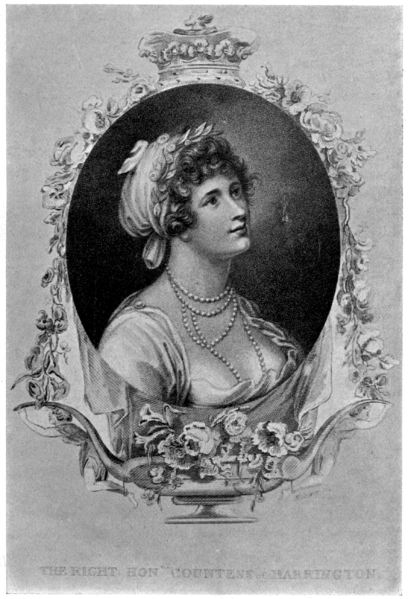
Charles Stanhope, Viscount Petersham

Charles Stanhope, Viscount Petersham

Eccentricity was not social suicide during the Regency, as long as Society’s pundits had given their approval. Occasionally, eccentricity was considered quite fashionable. During the Regency, Lord Petersham was as popular as Beau Brummell, but we know little of him because little has written of him other than the occasional paragraph in a period journal. He was described by Princess Lieven as the “maddest of all the mad Englishmen.”

Charles Stanhope, 4th Earl of Harrington (8 April 1780 – 3 March 1851) was an English peer and man of fashion. He was Viscount Petersham until he assumed the position as the Earl in 1829. At age 15, Petersham entered the Coldstream Guards in 1793, and later became Captain of the 10th Regiment of (Light) Dragoons in 1799. In 1803, he was made a major in the Queen’s Rangers, and a Lieutenant Colonel in the 3rd West India Regiment in 1807. He was made Lord of the Bedchamber to King George III until 1820, and continued in that role from 1820 to 1829 for King George IV.

from the Victoria and Albert Museum

from the Victoria and Albert Museum

Petersham never appeared in public before 6 P.M. The Prince Regent emulated Petersham’s affected manners, especially the viscount’s “fashion,” his tea drinking, and his addiction to snuff. Petersham owned 365 snuff boxes, one for each day of the year.

from the Victoria and Albert Museum

Said to resemble Henry VI, Petersham purposely grew a small pointed beard to emphasize the similarity. He designed many of his clothes. It was the Petersham who introduced “Cossack” trousers to Society. These trousers had nipped-in waists and ankles, with balloon legs in the middle, and made of garish striped material. He gave his name to the Harrington hat and the Petersham overcoat. Petersham was a man of many moods and whims. For example, he once decided he preferred a particular shade of brown above all other colors. This affection reportedly started as a tribute to a widow named Mary Browne, but the color brown became his trademark long after his love affair with the lady had ended. He was famous for the brown color of his coach, his harness, his coachman’s top hat and spurs, his clothing, and his servants’ livery. He even ordered a brown sild embroidered coat to wear at Court.

Petersham was equally known for his obsession with expensive trivia. From The Eclectic Magazinewe find this description of Petersham’s apartments: “The room into which we are ushered was more like a shop than a gentleman’s sitting-room. All around the walls were shelves, upon which were placed the canisters containing congou, pekoe, souchong, bohea, gunpowder, Russian, and many other teas, all the best of their kind; on the other side of the room were beautiful jars, with names in gilt letters, of innumerable kinds of snuff, and the necessary apparatus for moistening and mixing. Other shelves and many tables were covered with a great number of magnificent snuff boxes; for Lord Petersham had perhaps the finest collection in England, and was supposed to have a fresh box for every day of the year. I heard him, on the occasion of a delightful old light-blue Sévres box he was using being admired, say in his lisping way, ‘Yes, it is a nice summer box, but it would not do for winter wear.'”

Unlike his contemporary Beau Brummell, Petersham enjoyed the company of women. Lady Frances Webster’s husband attempted to horsewhip Petersham on the street in retribution for the viscount’s affair with his wife.

Maria Foote

Maria Foote

At age 50, he acceded to the Stanhope family title. He finally married in 1831 to Maria Foote, the Covent Garden actress and ex-courtesan, who was 17 years his junior. Their affair had met with the 3rd Earl’s disapproval and had been the gossip of London and Derbyshire. The 4th Earl of Harrington commissioned William Barron to landscape the park at Elvaston Castle, his father’s Gothic’s confection by James Wyatt. Lewis Cottingham redecorated Wyatt’s original entrance hall. Renamed the Hall of the Fair Star, it was dedicated to the chivalrous pursuit of love. The new Countess was in her element in this make-believe world of chivalry. They lived quite happily in their “love nest” and were said to host some of Society’s “jolliest” parties.

Posted in British history, Jane Austen, legends and myths, Living in the Regency, real life tales, Regency era | Tagged , , , , | 3 Comments

To Horse! Regency Side Saddles

I recently wrote a scene for Book 5 of my “Realm” series, A Touch of Mercy, in which the heroine must ride side saddle and be unseated from the ride. Therefore, I spent a good deal of time checking other sources for details. Below, you find some of the facts I discovered. 

15th Century saddle

15th Century saddle

A pillion is a mostly British English term for a secondary pad, cushion, or seat behind the main seat or saddle on a horse, motorcycle, bicycle or moped. A passenger in this seat is said to “ride pillion” or may themselves be referred to as a “pillion.” The word is derived from the Scottish Gaelic for a “little rug,” pillean, which is itself from the Latin pellis for “animal skin.” One or more pelts would often have been used as a secondary seat on horseback; the usage has carried over to motorcycles. A pillion was placed behind the man’s regular saddle for him to carry the woman behind him.

Facing to the side on the pillion placed the woman in a precarious position. The woman had no control over the horse, she was merely a passenger seated by the man. In the 9th Century a planchette, a small footrest, was added to the pillion. The planchette improved balance, but the woman still had no control over the animal upon which she rode.

Anne of Bohemia, wife of Richard II, introduced this Classical Greek pillion with the attached planchette style to England in 1382, and it remained the standard for several centuries. Eventually, a raised cantle and a horn in the center front were added. In the 16th Century, Catherine de Medici, Queen consort of France from 1547 until 1559, as the wife of King Henry II of France, insisted on changes to her side saddle. Catherine suggested a horn in the front over which to hook her knee and to face forward for the beginning changes. Later, she suggested a second horn to the left of the central one, which further improved balance.  She also had the planchette removed and replaced with the single slipper stirrup, which could be made of metal or wood and covered with fabric.

1799 side saddle

1799 side saddle

Two centuries passed before the side saddle saw additional changes. Unfortunately, the important changes occurred after the Regency Period. Regency ladies still suffered from frequent falls. Only the most expert horsewoman could maintain her balance over rough roads or with any speed. In addition, Regency side saddles sported a long leather skirt, which prevented the woman from controlling the horse with her leg and foot. The slipper stirrup often placed the woman in danger for it she fell from the saddle, she could be dragged behind the horse. It was also precarious to sit with one weight too far to the left. Balance remained an issue.

Toward the end of the eighteenth century some women, such as Catherine the Great and Marie Antoinette, chose to ride astride, but it was not popular among the nobility. Marie Antoinette relinquished the idea when she became queen. In 1805, a Milanese riding master, Federigo Mazzuchelli, made the ridiculous claim that women could not ride astride because they had more rounded thighs than men. Men and woman alike accepted Mazzuchelli’s assertion as the absolute truth. His book Scuola Equestre remained a popular and was widely circulated on the Continent.

Needless to say, women could not easily mount the side saddle without the assistance of a riding block or with a gentleman’s assistance. If she tried to pull herself into the saddle by catching the horn and hoisting herself up, the lady would likely find herself lying flat upon the floor. A woman would place her foot in the joined hands of her gentleman escort or the groom to be lifted to the saddle. Women always rode with an accompanying gentleman or a groom.

Behind the side saddle, it was common to place a heavy weight linen canvas to prevent slippage. The side saddle was also padded heavily to fit the specific horse. This protect the female rider and helped to prevent saddle galls, sores on the horse’s back caused by abrasions. Most Regency side saddles were customized for the women who rode upon them AND the horses who carried them.

Because the woman could not cue the horse equally on its right and left flanks, she normally carried a short whip or a thin leather-covered cane to cue the horse on the right. If the leather skirt was shortened, the lady could use a single spur on the left side. The riding habits Regency women wore often rose above the ankle and exposed skin if she rode too quickly. Such behavior would be considered scandalous. Therefore, women often sewed ribbons into the hems of their skirts to tie to their boots to keep the skirt tail in place. Again, this could place the woman in danger, especially if the ribbon wrapped itself about the spur or the slipper stirrup and the woman took an unexpected fall.

In 1830, Charles Pellier came up with the leaping head/horn. The leaping head was an additional pommel, which curved downward. Women placed their left knee under the leading head, which improved balance. Later improvements included a flatter seat, a safety stirrup (approximately 1850), and a balance or Sefton girth (1880).

The Oregon Regency Society has a wonderful post with FABULOUS diagrams of side saddles. Please visit http://oregonregency.blogspot.com/2011/09/riding-sidesaddle-very-horsey-post.html for more details, as does Christy English on English Historical Fiction Authors http://englishhistoryauthors.blogspot.com/2012/10/noblewomen-and-horseback-riding-in.html .

Posted in British history, Industry News/Publishing, Living in the Regency, Regency era | Tagged , , , | 7 Comments

Plough Monday and Molly Dancing: British Traditions

The Oxford Dictionary of English Folk Lore describes a plough jag as, “One of the three main types of mumming play, found only in the East Midlands, and first reported in the 1820s. Performances were concentrated on Plough Monday,  but could take place at any time over the Christmas/New Year period, and were typically by teams of male farm workers who, in addition to performing the play around the neighbourhood, dragged a plough with them, and were thus often called by local names such as Plough Jags, Plough Bullocks, and so on. Plough plays invariably include the combat/cure sequence of the more widespread Hero-Combat type of play, but their main feature, which distinguishes them, is a ‘wooing’ section. Either a ‘Lady’ (played by a man) is wooed by a series of suitors or, more commonly, a Recruiting Sergeant entices the Lady’s farm worker lover away and she then accepts the Fool’s advances. Much of the wooing is expressed in sung dialogue.”

Plough Monday was “the first Monday after Twelfth Day (6 January) and in rural communities this was traditionally the day on which farm workers prepared to go back to work after the Christmas break, and to start the all-important task of ploughing the fields ready for sowing later in the year. The day itself had its own customs, including one in which one of the farm lads had to get into the kitchen and place one of the tools of his trade at the screen, or fireplace, before the maid had put the early morning water on to boil (see Tusser, 1580/1878 edn.: 180).

More common, however, was some form of ceremony involving a plough. In many areas there was a ‘common plough,’ housed in the church, which could be used by any smallholder too poor to own one himself. At New Year or Plough Monday the plough would be blessed by the parish priest and then decorated and paraded around the neighbourhood by the ploughboys of the local farms. Money collected by these men went to maintain the ‘plough lights,’ which were candles kept burning in the church to ensure continued divine blessing on this essential operation in the farming cycle. The Reformation of the church in the 16th century abolished both the lights and the plough blessing, and also removed the ecclesiastical sanction for the plough procession, but the latter continued, or was revived, by the farm workers who then collected money on their own behalf—to be spent on drink and merrymaking. The procession and plough were the main focus, but the custom took on divergent forms, with some teams performing versions of plough plays, others simply dancing and singing or reciting rhymes. The first known reference to the plough procession dates from January 1413, in Durham, but it is not until the 18th century that informative descriptions of the custom become available.”

Molly Dancing was “a customary dance tradition performed by men at the Christmas/New Year/ Plough Monday season in East Anglia in the 19th century and up to about the Second World War. It therefore comes under the classification of ceremonial dance, but Molly dancing was not as well developed or complex as other dance forms such as Morris or Sword dancing and has therefore received much less attention. The performance was sometimes dismissed as ‘just jigging about,’ but was loosely based on 19th-century social dances. Molly dancers wore ordinary clothes, decorated with ribbons and rosettes, and usually had blackened faces, and had at least one man dressed in women’s clothes, while in some teams they all wore female clothes. They danced in the village street and collected money door to door and from passers-by, who sometimes joined in.

“The earliest references so far discovered are found in local newspaper accounts for the 1820s, although the word ‘Molly’ in this context does before 1866. There are definite affinities with Plough Monday plough customs, and it is probable that Molly dancing developed from these, and like the ploughboys, Molly dancers had a reputation for being rough and ready, and even somewhat threatening. There has been renewed interest in recent years, and there are now many revival Molly dance teams. There are several possible derivations for the word ‘Molly’. It could well be simply a form of ‘Morris’, as many customary dance or drama customs were locally termed ‘morris dances’. However, ‘Molly’ is also common as a dialect word for a man dressed as a woman.

From the Old Glory: Molly Dancers and Musicians (http://old-glory.org.uk/index.htm), we learn, “There would also be gangs of Molly dancers, sometimes accompanying the plough gangs.  Old Glory was formed in 1994 to revive the tradition of Molly dancing in East Suffolk.  Molly dancing traditionally only appeared during the depths of winter and is regarded by many people as the East Anglian form of Morris.  It is characterized by blackened faces, heavy boots (usually hobnailed) and the presence of a ‘Lord’ and a ‘Lady,’ two of the men specially attired respectively as a gentleman and his consort, who lead the dances.  There are other characters in Old Glory, such as the ‘umbrella-man,’ who acts as announcer, a ‘box-man’ carrying a collecting box, the ‘broom-man,’ who clears the way for the dancers, and the ‘whiffler,’ whose job it is to marshal the dancers.  Blackening faces was a form of disguise, since the dancers could not afford to be recognised.  Some of those people from whom they had demanded money with menaces would have been their employers.  Molly dancing is by nature robust and, some would say, aggressive.  These qualities are emphasised by the sound of the hobnailed boots worn by the dancers, which were the normal form of footwear for farm workers in the East of England right up until the second half of the twentieth century.

There is very little known about the dances that Molly dancers of the early part of the twentieth century would have performed, other than that they resembled country dances, but danced using a slow, heavy step, and with much swinging about in pairs.  We have constructed our own dances, based on such information as we have, and we have developed our own distinctive style – the ‘Waveney Valley’ tradition.  The Molly dancers of Old Glory are all men, whilst the musicians are all women.  The musicians play a variety of traditional instruments, invariably including at least one four-stop melodeon in the ‘Suffolk key’ of C.”

The word ‘mumming’ causes confusion, as it can refer to a number of relatively distinct customs, and many visiting custom  have borne the name, but by far the most widespread is the mumming play. In late medieval times, it was the fashion amongst the nobility to stage elaborate ‘mummings’ which involved dressing up or disguising, such as wearing dragon, peacock, and swan heads, or dressing as angels. Other reports show that it was not only at court that people liked to disguise themselves at Christmas, and there were several occasions when attempts were made to ban mummings and disguisings to prevent masked young men roaming the streets getting up to mischief. A New Year custom, apparently confined to the Yorkshire area, involved parties of disguised people entering people’s houses on New Year’s Eve, without knocking as the doors had generally been left unlocked. The residents had to guess their identity, and once they did so offered food and drink to the visitors before they moved on to another house. The custom was almost exactly the same as that which is still going strong (also called mumming or mummering) in Newfoundland. ‘At Wakefield and Stanby (Yorkshire) the mummers enter a house, and if it be in a foul state they proceed to sweep the hearth, and clean the kitchen range, humming all the time “Mum-m-m”’ (Henderson, 1866: 54). In Barton, Cambridgeshire, up to about 1914, boys with blackened faces, calling themselves ‘mummers’, paraded the village singing a verse which has echoes from the mumming play (Porter, 1974: 72); and, in addition, some Christmas Eve carol-singers in the West Riding of Yorkshire were also called mummers, as were those who carried the wassail cup around in the Cleveland area.”

Burton_upon_Stather

Enquiries with the North Lincolnshire Museum yielded the following information. (http://www.folkplay.info/Forum/TD_Forum_6_Burton_upon_Stather.htm)- Burton upon Stather Plough Jags: A Photographic Query

The photo of plough jags from Burton-upon-Stather has appeared in three publications. The first is North Lincolnshire. A pictorial history by Kevin Leahy and David Williams published by North Lincolnshire Council in 1996 on page 61 with the following caption, and is probably where the scanned image came from;

“Burton-upon-Stather Plough Jags, 1907. Plough plays, representing death and resurrection, have their roots in the village culture of the Middle Ages. This simple ceremony was an allegory of the burial and growth of seed. The plays were preceded by a procession which included the terrifying hobby-horse, and Besom Betty. They were performed on Plough Monday which was the first Monday in January. Newspaper reports of the 1870s and 1880s record the decline of the plays, although some, as at Burton-on-Stather, lingered on into the twentieth-century.”

The second was in 1996 in The Parish of Burton upon Stather with Normanby and Thealby by Geoffrey Robinson M.B.E., on page 60 with the following caption;

“The annual Festival of the Plough Jacks (corrupted to Jags) took place on or about Monday, January 9th. Its origin was embodied in the idea of invoking a blessing on the ploughman and his plough. In the 1850/60’s the Sheffield family took a prominent part in encouraging the entertainment when a plough was drawn through a large fire kindled in the courtyard of Normanby Park. Jarvis writes that ‘many a barrel of beer was given by the squire on these occasions, but like many a good thing, got out of hand’. A fatal accident occurred in connection with the event and the glamour of the Plough Festival ceased.”

He has since given his large collection of photographs to the Museum. The third was Twentieth Century Lincolnshire in the History of Lincolnshire Series edited by Dennis Mills on page 354 in 1989 with this caption;

“The Burton-upon-Stather (or Burton Stather) Plough Jags, 1907. They are said to have been ‘a double gang, who often split up to work a village quickly, gathering together at the best and likeliest houses’. According to Mrs.E.H.Rudkin, they were ‘Four Hat Men, two Besom Betties, two Niggers, two Hobby Horses, one Doctor, one Soldier, one Lady’. Source: D.N. Robinson Collection.”

Posted in British history, gothic and paranormal, legends and myths, Living in the Regency, real life tales, Regency era, Victorian era | Tagged , , , , , | 7 Comments

Would You Recognize a Hunky Punk?

High-Ham-8389“Hunky Punk” is a West Country (UK) word for grotesque carvings on the side of English buildings, especially churches. The word originated in Somerset and is ascribed to the Old English word “hunkers,” which means haunches and “punchy,” which means short-legged. Unlike a gargoyle, which drains water through its mouth, a hunky punk has no architectural purpose. Hunky punks are decorative elements used for balance. For example, on the corner of a church, along the coping ridge below any castellations, one might find three hunky punks and one gargoyle. All four elements appear to be gargoyles, but the roof likely only drains in one direction; therefore, there is only one true gargoyle.

Some term a hunky punk as a short squatting figure found only on Somerset churches. Hunky punks come in many sizes and shapes. Recognized in spiritual architecture throughout the world, they are mostly found on buildings built in the middle to late medieval period.

York Minster

York Minster

“Some theories consider that the balance of good and evil created in church design to remind worshippers of the narrow path they tread was present in everything. This meant that for every good and benign creature, such as a saint or an animal to signify purity, there had to be an opposite to bring out the fear of evil. In York Minster, for example, the carvings in the Chapter house, which are particularly disgusting and obscene and which were supposedly created as caricatures of the then Dean and Chapter, were put there above the seats to create an opposite to each occupant, who we might like to assume was not in fact the foul person their carvings made them out to be.” The church tower at Isle Abbots (in Somerset) has eight Hunky Punks: a person playing the bagpipes, an Oriental lion dog, a goat, a dragon, a Chinese dragon, a primitive dragon, a winged lion, and a lion.

Isle Abbots

Isle Abbots

A hunky punk is a type of Grotesque. “A grotesque is a carved figure, usually of a mytholigical creature, demon, or strange beast, used as an ornamental feature in church decoration. The term is sometimes confused with gargoyle, which is a special type of carved beast used to decorate a drainpipe. Grotesques can be found almost anywhere inside or outside a church, but are often used to decorate a frieze just under the eaves or as projecting carvings on a tower. Grotesques might depict human figures or faces, demons, animals, or other mythical creatures, often with exaggerated fierce of humourous expressions. Some are obviously meant to lampoon real local characters or represent church patrons.” (from Britain Express)

Posted in British history, gothic and paranormal, legends and myths, real life tales | Tagged , , , | 4 Comments

Do You Speak Jane Austen? (Part 3)

The last third of the alphabet was a bit of a challenge. The letters “x” and “z” were less than cooperative. I searched Pride and Prejudice, Sense and Sensibility, and Mansfield Parkfor the letters, but was, generally, unsuccessful. “X” was impossible to find, and “Z” did not willing make an appearance, but below, one may find part 3 of “Do You Speak Jane Austen?”

(The quotes are from Pride and Prejudice unless so noted.)

Q
quadrille
 – a historic dance performed by four couples in a square formation, a precursor to traditional square dancing

(but in Pride and Prejudice, Austen used the word not for the dance, but to mean)

quadrille – a card game popular during the 18th century, played by four people with a deck of 40 cards

She had been graciously pleased to approve of both of the discourses which he had already had the honour of preaching before her. She had also asked him twice to dine at Rosings, and had sent for him only the Saturday before, to make up her pool of quadrille in the evening. (Chapter 14)

querulous–given to complaint; grumbling; questioning

Mrs. Bennet was restored to her usual querulous serenity; and, by the middle of June, Kitty was so much recovered as to be able to enter Meryton without tears; an event of such happy promise as to make Elizabeth hope that by the following Christmas she might be so tolerably reasonable as not to mention an officer above once a day, unless, by some cruel and malicious arrangement at the War Office, another regiment should be quartered in Meryton. (Chapter 42)

R
reel
–a type of Scottish dance

“Do not you feel a great inclination, Miss Bennet, to seize such an opportunity of dancing a reel?” (Chapter 10)

rapacity–extreme gluttony; greed

When the tea-things were removed, and the card-tables placed, the ladies all rose, and Elizabeth was then hoping to be soon joined by him, when all her views were overthrown by seeing him fall a victim to her mother’s rapacity for whist players, and in a few moments after seated with the rest of the party. (Chapter 54)

S
sanguine–optimistic

The sanguine hope of good, however, which the benevolence of her heart suggested had not yet deserted her; she still expected that it would all end well, and that every morning would bring some letter, either from Lydia or her father, to explain their proceedings, and, perhaps, announce their marriage. (Chapter 47)

saucy–insolent; bold

Oh! how heartily did she grieve over every ungracious sensation she had ever encouraged, every saucy speech she had ever directed towards him. (Chapter 52)

sennight– one week (from “seven nights”)

“Indeed I am. I shall entreat his pardon for not having done it earlier. I believe him to be Lady Catherine’s nephew. It will be in my power to assure him that her ladyship was quite well yesterday se’nnight.” (Chapter 18)

subjoin–add to the end

“And will you give yourself the trouble of carrying similar assurances to his creditors in Meryton, of whom I shall subjoina list according to his information?”

(Chapter 50)

supercilious – overly proud

For, though elated by his rank, it did not render him supercilious; on the contrary, he was all attention to everybody. (Chapter 5)

T
tractable – obedient; changeable; flexible

“I never heard any harm of her; and I dare say she is one of the most tractable creatures in the world.” (Chapter 33)

threadbare – worn; frayed

They found Mary, as usual, deep in the study of thorough-bass and human nature; and had some extracts to admire, and some new observations of threadbare morality to listen to. (Chapter 12)

U
unabashed
 – unapologetic; shameless

Lydia was Lydia still; untamed, unabashed, wild, noisy, and fearless. (Chapter 51)

ungovernable – incapable of being controlled

She was not of so ungovernable a temper as Lydia; and, removed from the influence of Lydia’s example, she became, by proper attention and management, less irritable, less ignorant, and less insipid. (Chapter 61)

untinctured – lacking color; without a trace of vestige as in “untinctured condescension”; not to infuse (as with a quality)

On this point she was soon satisfied; and two or three little circumstances occurred ere they parted, which, in her anxious interpretation, denoted a recollection of Jane not untinctured by tenderness, and a wish of saying more that might lead to the mention of her, had he dared. (Chapter 44)

V
vexatious
 – annoying

Were the same fair prospect to arise at present as had flattered them a year ago, every thing, she was persuaded, would be hastening to the same vexatious conclusion. (Chapter 53)

Vingt-et-un – blackjack

“Yes; these four evenings have enabled them to ascertain that they both like Vingt-et-un better than Commerce; but with respect to any other leading characteristic, I do not imagine that much has been unfolded.” (Chapter 6)

W
white soup
 – a soup made of broth and eggs

“If you mean Darcy,” cried her brother, “he may go to bed, if he chooses, before it begins—but as for the ball, it is quite a settled thing; and as soon as Nicholls has made white soup enough, I shall send round my cards.” (Chapter 11)

whist – a four-person card game similar to bridge

When the card-tables were placed, he had the opportunity of obliging her in turn, by sitting down to whist. (Chaper 16)

X
(In the three novels I surveyed, there were no words beginning with the letter X.)

Y
York
 – a borough of Northern England

“Aye, there she comes,” continued Mrs. Bennet, “looking as unconcerned as may be, and caring no more for us than if we were at York, provided she can have her own way.” (Chapter 20)

Z
(In Pride and Prejudice, I found no words beginning with “Z,” and in Mansfield Park and Sense and Sensibility, I found only the usual “zeal” and “zealous.” I fear I did not check Northanger Abbey, Persuasion, or Emma for either “X” or “Z.” Perhaps, someone else knows more than I on those three Austen classics. Yet, here a few examples of “Z” from MP and from S&S.)

Mrs. Norris was most zealous in promoting the match, by every suggestion and contrivance likely to enhance its desirableness to either party; and, among other means, by seeking an intimacy with the gentleman’s mother, who at present lived with him, and to whom she even forced Lady Bertram to go through ten miles of indifferent road to pay a morning visit. (MP, Chapter 4)

Maria, with only Mr. Rushworth to attend to her, and doomed to the repeated details of his day’s sport, good or bad, his boast of his dogs, his jealousy of his neighbours, his doubts of their qualifications, and his zeal after poachers, subjects which will not find their way to female feelings without some talent on one side or some attachment on the other, had missed Mr. Crawford grievously; and Julia, unengaged and unemployed, felt all the right of missing him much more. (MP, Chapter 7)

He deprecated her mistaken but well-meaning zeal. (MP, Chapter 23)

In the promotion of this object she was zealously active, as far as her ability reached; and missed no opportunity of projecting weddings among all the young people of her acquaintance. (S&S, Chapter 8)

But this did not last long; Elinor had hardly got their last visitors out of her head, had hardly done wondering at Charlotte’s being so happy without a cause, at Mr. Palmer’s acting so simply, with good abilities, and at the strange unsuitableness which often existed between husband and wife, before Sir John’s and Mrs. Jennings’s active zeal in the cause of society, procured her some other new acquaintance to see and observe. (S&S, Chapter 21)

So, what are some of your favorite Regency era words?

Posted in British history, Jane Austen, Living in the Regency, real life tales, Regency era | Tagged , , , | 2 Comments

Stop the Presses! Austen Admirers Kickstarter Project Brings Everything Austen into One Place

2203520-kickstarter_badge_funded-1For those that do not know me, my name Is Angie Kroll, and I’m the person behind the Austen Admirers Smartphone App Kickstarter Campaign.  To find out more about how I became a Jane Austen fan, check out my blog posts on Darcyholic Diversions and Mary Simonsen’s Blog . Author P.O. Dixon and IndieJane graciously allowed me to explain the nuts and bolts of what Kickstarter is and how it works last week.  Today, I’m grateful to Regina Jeffers for asking me to share more about Austen Admirers on her wonderful blog. angdave
If you follow Austenesque Reviews or Leatherbound Reviews, you know that I’m a girl who likes to play around with graphics and web design.  It’s been 10 years since I built my first website, and I work part-time in web, graphic and smartphone design, mostly cover the cost of the JAFF books Iove to download.  It’s those skills that I bring to Austen Admirers.
Regina is one of the amazing people who were kind enough to give me advice on how to conduct the campaign.  Her advice on the giveaways were invaluable.  For the first level, I wanted a reward for supporters that I thought would be easy to do on my end, and fun for everyone that pledges.  I decided to try something visually appealing.  Hence, the creation of the web’s first Social Media Calling Card.  But, one of the first questions I’ve had most of people ask me – what exactly is a Social Media Calling Card?
callingcards2A Social Media Calling Card (SMCC) is Austen Admirer’s update of the Regency era’s calling card.  According to romance author Donna Hatch, “Calling cards were a considered more than an accessory during the Georgian, Regency, and Victorian eras. They were an integral part of polite society. A gentleman or lady always carried them, and would give their card to the footman who answered the door, who would then announce their visit to the gentleman or lady of the house.”  Regency calling cards eventually evolved into business cards, LinkedIn, Facebook and Twitter.
 
Erlynn-SMCCThose of us who love JAFF dream about what it would like to be a Lord, Lady, Duke or Duchess.  The SMCC combines the best of both of these worlds- by supporting Austen Admirers, you can live that experience!  Jane Austen readers are as creative as their namesake.  I’ve made cards for dames, an italian duchess, jedi knight, grammar guru, and even a queen!  Can you DO anything with a Social Media Calling Card?  Not really – they are just for fun, though you may want to print it, and hang it on your bathroom mirror to remind yourself of your relationship to the aristocracy!Hoemke-SMCC
 
Would you like to have your own Social Media Calling Card?  A minimum donation of $5 will get you a custom card made by yours truly.  Just go to Kickstarter.com, then to Austen Admirers Facebook Page to see more examples.  Don’t forget to follow @AustenAdmirers or @AngieKroll on Twitter where you can find some amazing giveaways associated from some incredible authors!  If you have any questions, feel free to email me at adkroll (at) gmail (dot) com!
 
Thank you for asking me to guest post today, Regina!
Posted in Industry News/Publishing, Jane Austen, Living in the Regency, Regency era | Tagged , , , | 2 Comments

Jane Austen and Feminism

In 1968, the Women’s Liberation Movement staged a demonstration at the annual Miss America Beauty pageant in Atlantic City, New Jersey. They protested the idea that the most important thing about a woman is how she looks. Women’s liberation attacked “male chauvinism, commercialization of beauty, racism and oppression symbolized by the Pageant.”(JoFreeman.com) I am a product of that particular generation. I was a teen in the 1960s and a young woman in 1970s. Generally, I was raised in the Southern states, and I thoroughly understand the “good ole boys” system. Recently, at my retirement recognition gathering at the high school where I taught for many years, instead of praising me for my dedication to my academic area or to my students, my principal stood up and said, “If you have ever served on a committee with Regina, you know that she has no problem in speaking her mind.” Well, that is something, but, obviously, not how one would like to be remembered after 40 years in the classroom. In other words, I had “ruffled his feathers” on more than one occasion by not always conforming to how he thought a woman should act. I have never been subservient to a male. That was my mother. I am a daughter of the women’s movement. So, like Jane Austen, while I write about romance and tradition and virtue, I still place my female characters in roles where they “defy” the never ending patriarchal society in which they live.

In 18th Century England, certain educated women began to question why men did not see women as rational creatures. Among those were Mary Astell and Catherine Macaulay, who discussed such issues as the lack of a female educational system and the absolute authority of males in the family unit. One must wonder if these ideas influenced a young Jane Austen. In each of Austen’s six main novels, the concept of marriage is told from a female perspective. Is Jane telling us that the male view is obsolete?

It would be difficult to call Austen a feminist because her point of view is very subtle. Yet, her message has been read by millions of women around the world, and I openly admit that it influenced me. But who influenced Jane? We shall never know for sure, but it is likely that one of those could have been Mary Wollstonecraft. In 1792 (when Jane was but an impressionable 16-year-old), Wollstonecraft released A Vindication of the Rights of Woman. As an English teacher, this was one of my favorite pieces to bring to my students for it has strong parallels to modern times. Wollstonecraft openly stated that both men and women have the potential to conduct themselves as reasonable and rational human beings. One sex did not have dominance over the other. Wollstonecraft also attacked earlier writers, especially John Milton and Rosseau, for advocating the subordinate position of women in a man’s life. The author’s idea that the 18th Century English educated their women only in how to attract (or “trap”) a man into marriage, but did nothing to equip them with the skills to be good wives and mothers was quite controversial. With Vindication’s release, new doors opened for women writers.

However, Wollstonecraft soon lost her life to childbirth. (BTW, her daughter was Mary Godwin, who eventually became the wife of Percy Shelley and the author of Frankenstein.) Afterwards, Wollstonecraft’s husband, William Godwin, wrote a sometimes embellished Memoir of his wife’s life. He told the world of the love affair that produced an illegitimate child and of her suicide attempts and of her rejection of Christianity. Wollstonecraft was labeled an atheist and a “whore.” Critics held a new weapon in discrediting her work, and indirectly, the writings of all women.

Unfortunately, Mary’s downfall brought close scrutiny on those who followed. A female writer could not be seen as advocating the overthrow of marriage rituals. In 1798, the Reverend Richard Polwhele published an anti-feminist satirical poem entitled “The Unsex’d Females.” In it, Polwhele argued that the “sparkle of confident intelligence” was proof that female writers were immodest and that it was a sign of the “corrupt” times that anyone would go so far to consider a woman’s work on the same level as a man’s. Please remember that it was that same year (1798) when the publisher Cadell refused Rev. Austen’s offer of his daughter Jane’s First Impressions manuscript.

Jane Austen does one thing better than any other female writer. She writes dominate female characters with spotless reputations. In each novel, one finds the seduced-and-abandoned plot embedded in the main story line, but Austen’s subject is not courtship. Kathryn B. Stockton of the University of Utah says, “Austen’s works are about ‘marriageship: the cautious investigation of a field of eligible males, the delicate maneuvering to meet them, the refined outpacing of rivals, the subtle circumventing of parental power and the careful management, which turns the idle flirtation into a firm offer of marriage with a good settlement for life. All this must be carried on in a way that the heroine maintains her self-respect, her moral dignity, and her character as daughter, sister, friend, and neighbor.’” For myself, I am more inclined to agree with G. K. Chesterton, who said, “Jane Austen could do one thing neither Charlotte Bronte or George Eliot could do: She could cooly and sensibly describe a man.”

In Persuasion, Austen wrote, “But let me observe that all histories are against you, all stories, prose and verse. If I had such a memory as Benwick, I could bring you fifty quotations in a moment on my side the argument, and I do not think I ever opened a book in my life, which had not something to say upon woman’s inconstancy. Songs and proverbs, all talk of woman’s fickleness. But perhaps you will say, these were all written by men.”
“…Men have had every advantage of us in telling their story. Education has been theirs in so much higher a degree; the pen has been in their hands. I will not allow books to prove any thing.”
After Wollstonecraft’s “downfall,” women writers, even those who did not express views of “female philosophers,” had difficulty finding a market for their writing and gaining respect for their talents in a male-dominated occupation. They had to stress the virtue of ladylike qualities and respectable lives. Rights for women could not be their focus.

Posted in British history, Jane Austen, Living in the Regency, real life tales, Regency era | Tagged , , | 7 Comments

Do You Speak Jane Austen? (Part 2)


Do You Speak Jane Austen? Part 2

A laugh, a fist pounding on a desk top, a raised eyebrow – these are all signals to punctuation of the spoken word, but what of the written word? We start with the assumption that we each wish to avoid language that is insensitive, stereotypical, or in any other way derogatory. But was that true for Jane Austen’s time? Look below. Are there words that you particularly like? Ones you find useless in our modern world?

J
jilt – to deceive a lover

“Let Wickham be your man. He is a pleasant fellow, and would jilt you creditably.” (Chapter 24)

St. James
St. James’s Palace is one of London’s oldest palaces. It is situated in Pall Mall, just north of St. James’s Park. Although no sovereign has resided there for almost two centuries, it has remained the official residence of the Sovereign and the most senior royal palace in the UK

Such formidable accounts of her ladyship, and her manner of living, quite frightened Maria Lucas who had been little used to company, and she looked forward to her introduction at Rosings with as much apprehension as her father had done to his presentation at St. James’s. (Chapter 29)

judged – to form an opinion or conclusion about

“Perhaps,” said Darcy, “I should have judged better, had I sought an introduction; but I am ill-qualified to recommend myself to strangers.” (Chapter 31)

K
kindred – family; similar people

“Can you possibly guess, Lizzy, who is meant by this?” ‘This young gentleman is blessed, in a peculiar way, with every thing the heart of mortal can most desire—splendid property, noble kindred, and extensive patronage. Yet in spite of all these temptations, let me warn my cousin Elizabeth, and yourself, of what evils you may incur by a precipitate closure with this gentleman’s proposals, which, of course, you will be inclined to take immediate advantage of.’ (Chapter 57)

kindness – an act intended to show kindness or good will; benevolence

“I can no longer help thanking you for your unexampled kindness to my poor sister.” (Chapter 58)

L
licentiousness – lack of moral discipline

“And it is the more to be lamented, because there is reason to suppose as my dear Charlotte informs me, that this licentiousness of behaviour in your daughter has proceeded from a faulty degree of indulgence; though, at the same time, for the consolation of yourself and Mrs. Bennet, I am inclined to think that her own disposition must be naturally bad, or she could not be guilty of such an enormity, at so early an age.” (Chapter 48)

livery – clothing marked for a particular member of the aristocracy

The horses were post; and neither the carriage, nor the livery of the servant who preceded it, were familiar to them. (Chapter 56)

loo – a betting card game

On entering the drawing room she found the whole party at loo, and was immediately invited to join them; but suspecting them to be playing high she declined it, and making her sister the excuse, said she would amuse herself for the short time she could stay below, with a book. (Chapter 8)

M
missish – prim and sentimental

“You are not going to be missish, I hope, and pretend to be affronted at an idle report. For what do we live, but to make sport for our neighbours, and laugh at them in our turn?” (Chapter 57)

Michaelmas – the feast day of the archangel Michael, celebrated on September 29

“Why, my dear, you must know, Mrs. Long says that Netherfield is taken by a young man of large fortune from the north of England; that he came down on Monday in a chaise and four to see the place, and was so much delighted with it, that he agreed with Mr. Morris immediately; that he is to take possession before Michaelmas, and some of his servants are to be in the house by the end of next week.” (Chapter 1)

mortifications – humiliation; shame

“Let me thank you again and again, in the name of all my family, for that generous compassion which induced you to take so much trouble, and bear so manymortifications, for the sake of discovering them.” (Chapter 58)

N
Netherfield – the fictionalized estate that Mr. Bingley rents in Hertfordshire

“Was there no good in your affectionate behaviour to Jane while she was ill atNetherfield?” (Chapter 60)

noble – dignified; gallant; aristocratic; gracious

“Had you not been really amiable, you would have hated me for it; but in spite of the pains you took to disguise yourself, your feelings were always noble and just; and in your heart, you thoroughly despised the persons who so assiduously courted you.” (Chapter 60)

novelty – freshness; uniqueness; something new, original, and different that is interesting or exciting, though often for only a short time

He was as much awake to the novelty of attention in that quarter as Elizabeth herself could be, and unconsciously closed his book. (Chapter 11)

O
odious – horrible; loathsome; abhorrent

“How many letters you must have occasion to write in the course of a year! Letters of business, too! How odious I should think them!” (Chapter 10)

obeisance – a gesture of respect, such as a bow or a curtsy; honor; loyalty

The two gentlemen left Rosings the next morning, and Mr. Collins having been in waiting near the lodges, to make them his parting obeisance, was able to bring home the pleasing intelligence, of their appearing in very good health, and in as tolerable spirits as could be expected, after the melancholy scene so lately gone through at Rosings. (Chapter 37)

P
penance – remorse; a hardship endured to compensate for wrongdoing

It seemed like wilful ill-nature, or a voluntary penance, for on these occasions it was not merely a few formal inquiries and an awkward pause and then away, but he actually thought it necessary to turn back and walk with her. (Chapter 33)

preferment – promotion; advancement; elevation; upgrading;

pecuniary – financial; relating to money

His own father did not long survive mine, and within half a year from these events, Mr. Wickham wrote to inform me that, having finally resolved against taking orders, he hoped I should not think it unreasonable for him to expect some more immediatepecuniary advantage, in lieu of the preferment, by which he could not be benefited. (Chapter 35)

Note! Yes, I know that I added a few extra words in this mix. I had originally thought to have two words for each letter of the alphabet. However, I am anticipating some problems when I reach x and z. The extras are to make up for my latter deficiencies.

Posted in British history, Jane Austen, Living in the Regency, Regency era, writing | Tagged , , , | Comments Off on Do You Speak Jane Austen? (Part 2)