Henry Holland, Georgian Architect of Carlton House and the Brighton Pavilion

Henry Holland (20 July 1745 – 17 June 1806) was an architect to the English nobility. Born in Fulham, London, his father also Henry ran a building firm, and he built several of Capability Brown’s buildings, although Henry would have learnt a lot from his father about the practicalities of construction, it was under Brown that he would learn about architectural design, they formed a partnership in 1771. He married Brown’s daughter Bridget on the 11th February 1773 at St George’s, Hanover Square. In 1772, Sir John Soane joined Holland’s practice in order to further his education, Soane left in 1778 to study in Rome. Holland paid a visit to Paris in 1787; this is thought to have been in connection with his design of the interiors at Carlton House, from this moment on his interior work owed less to the Adam style and more to contemporary French taste.

Holland was a founder member in 1791 of the Architects’ Club, which included Thomas Hardwick as a signtory. In the 1790s, he translated into English, A.M. Cointereaux’s Traite sur la construction des Manufactures, et des Maisons de Champagne. Holland was feeling unwell in the early summer of 1806, on the 13 June he had a seizure, and his son Lancelot made this entry in his diary on the 17th June, ‘My poor father breathed his last about 7 o’clock in the morning. He had got out of bed shortly before and inquired what the hour was. Being told he said is was too early to rise and got into bed again. He immediately fell into a fit. I was sent for, and a minute after I came to his bedside he breathed his last.’ He was buried at All Saints Church, Fulham, in a simple tomb, a few yards from the house in which he had been born. Bridget Holland, his wife, lived for another 17 years and was the main beneficiary of her husband’s will.

Children

Of his sons the elder Henry Jr (1775-1855). remained a bachelor. The younger son Colonel Lancelot (1781-1859), married Charlotte Mary Peters (1788-1876) and they had fifteen children. Of Holland’s five daughters, two married two brothers, Bridget (1774-1844) to Daniel Craufurd (lost at sea 1810) and Mary Frances Holland (1776-1842) to Major-General Robert Craufurd (1764–1812), commander of the Light Division during the Peninsular War. Bridget later remarried to Sir Robert Wilmot of Chaddesden. The remaining daughters, Harriet (1778-1814), Charlotte (1785-1824) and Caroline (1786-1871) never married.

Early Work
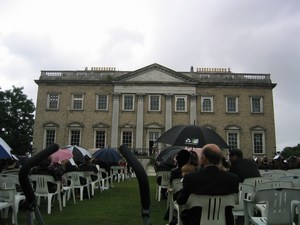
Claremont

Claremont

Holland began his practice by designing Claremont House for Robert Clive, 1st Baron Clive, with his future father-in-law in 1771, and their partnership lasted until Brown’s death twelve years later. Claremont is of nine by five bays, of white brick with stone dressings. The main feature on the entrance front is the tetrastyle Corinthian pedimented portico. This leads to the entrance hall with red scagliola columns, these are arranged in an oval with the rectangular room. The drawing room has a fine plaster ceiling and marble fireplace with two caryatids. There is a fine staircase.

In 1771 he took a lease from Charles Cadogan, 2nd Baron Cadogan, on his Chelsea estate and began the Hans Town (named after an earlier owner Hans Sloane) development on 89 acres (360,000 m²) of open field and marsh. There he laid out parts of Knightsbridge and Chelsea, including Sloane Street and Sloane Square, and Hans Place, Street and Crescent and Cadogan Place. The buildings were typical Georgian, terraced houses, they were three or four floors in height plus an attic and basement and two or three windows wide, of brick, decoration was minimal, occasionally the ground floor was decorated with stucco rustication. These developments quickly became some of the most fashionable areas in greater London. Construction was slow, the start of the American War of Independence, in 1776, being one of the factors; Lord Cadogan also died that year. Sloane Square was virtually complete by 1780. Apart from a few houses on the east side, Sloane Street was not developed before 1790. By 1789, Holland was living in a house designed by himself, called Sloane Place; it was to the north of Hans Place. The house was large 114 feet in length, to the north the octagonal entrance hall had a black and white marble floor the south front had a one storey ionic loggia across the central five bays with an iron balcony above in front of the main bedrooms, the rooms on the ground floor south front were the drawing room, dining room, lobby, library and music room. As the area was developed on ninety-nine year leases Holland’s houses were almost entirely rebuilt from the 1870s onwards. A few houses survive in Hans Place, Nos. 12 and 33-34. Cadogan Square was laid out from 1879 onwards in part over the gardens of Sloane Place.

Benham Park

Benham Park

Another joint work was Benham Park 1774-75 designed for William Craven, 6th Baron Craven, three stories high, nine bays wide, in a plain neoclassical style, of stone, with a tetrastyle Ionic portico, the building was altered in 1914, the pediment on the portico was replaced by a balustrade and the roof lowered and hidden behind a balustrade. The interiors have also been altered. Though the Circular Hall in the centre of the building, with its large niches and fine plasterwork, is probably as designed by Holland, is has an opening in the ceiling rising to the galleried floor above and a glazed dome. The principal staircase is also original.

Brown had been designing the landscape of Trentham hall since 1768, for the owner Granville Leveson-Gower, 1st Marquess of Stafford (he was an Earl at the time), when it was decided to remodel the house, this took from 1775–78, it was enlarged from nine to fifteen bays, the pilasters and other features were in stone, but the walls were of brick covered in stucco to imitate stonework. The building was remodelled and extended by Sir Charles Barry in 1834-40 and largely demolished in 1910.
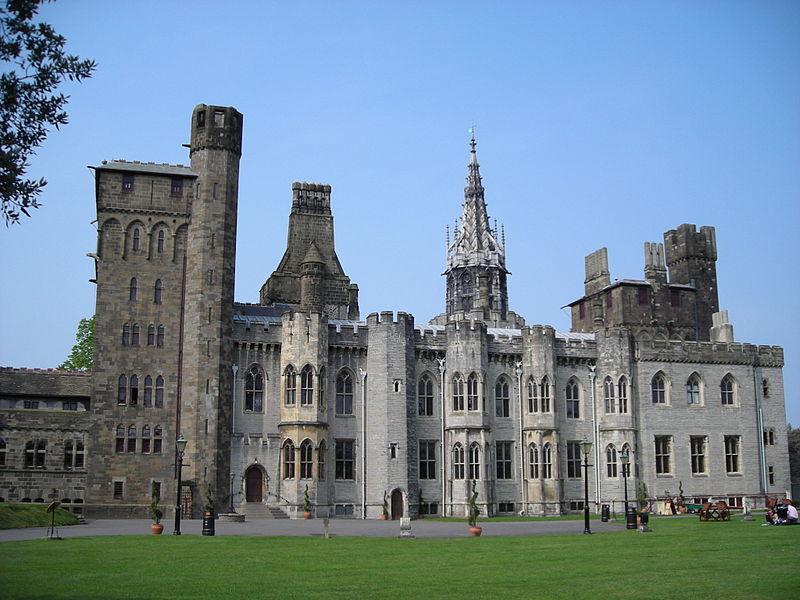
Cardiff Castle (Holland's work is the pale coloured stone)

Cardiff Castle (Holland’s work is the pale coloured stone)
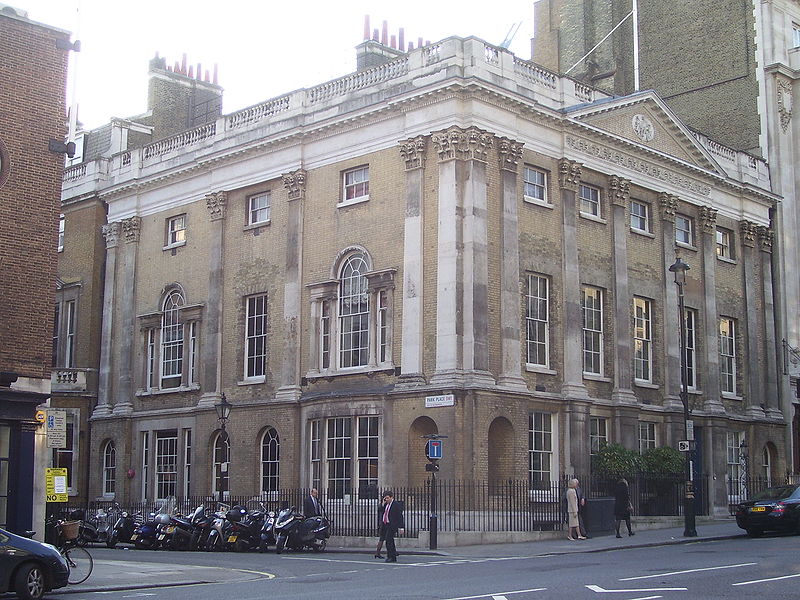
John Stuart, 1st Marquess of Bute commissioned Holland and Brown to restore Cardiff Castle (1778–80), Holland’s interiors were swept away when the castle was remodelled and extended by William Burges in the 1860s. The east front of the
Brooks's club, London

Brooks’s club, London

main apartments retain Holland’s work a rare example of him using Gothic Revival architecture and the neoclassical style Drawing Room being the only significant interior to survive more or less as Holland designed it.

In 1776 Holland designed Brooks’s club in St James’s Street, Westminster. Build of yellow brick and Portland stone in a Palladian style similar to his early country houses. The main suite of rooms on the first floor consisted of the Great Subscription Room, Small Drawing Room and the Card Room, Brook’s was known for its gambling on card games, the Prince of Wales being a member. The interiors are in neoclassical style, the Great Subscription Room having a segmental barrel vault ceiling.

From 1778-81, for Thomas Harley, Holland designed and built Berrington Hall, Herefordshire, one of his purest exercises in the Neoclassical style, the exterior is largely devoid of decoration, the main feature is the tetrastyle Ionic portico. The interior are equally fine, the most impressive being the staircase at the centre of the building, with its glazed dome and the upper floor is surrounded by Scagliola Corinthian columns. The main rooms have fine plaster ceilings and marble chimneypieces, these are the library, dining and drawings rooms. The small boudoir has a shallow apse screened by two Ionic columns of Scagliola imitating Lapis lazuli. Holland also designed the service yard behind the house with the laundry, dairy and stables as well as the entrance lodge to the estate in the form of a Triumphal arch.

In 1788 Holland continued the remodelling of Broadlands in Hampshire for Henry Temple, 2nd Viscount Palmerston started by Brown. The exterior was re-clad in yellow brick and a three bay recessed Ionic portico added on the north front, a tetrastyle Ionic portico was added on the south front, within he added the octagonal domed lobby, also by Holland are the ground floor rooms on the south front library (Wedgwood room), saloon and drawing room, and on the east front the dining room, all in the Adam style.

Carlton House
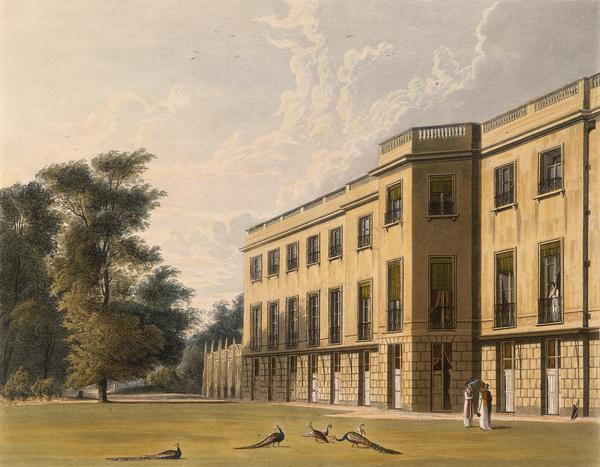
The garden front of Carlton House in London. Early 19th century illustration.

The garden front of Carlton House in London. Early 19th century illustration.

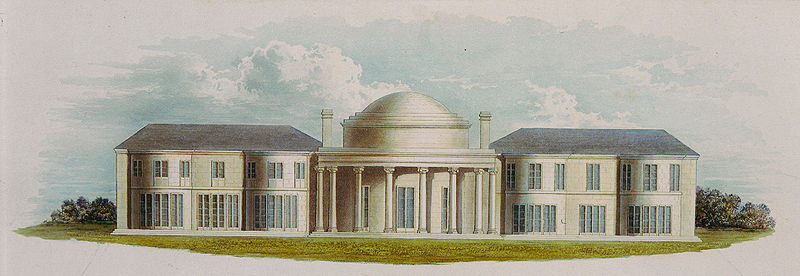
Holland first major commission for the Prince of Wales, later King George IV, was his celebrated remodelling of Carlton House, London (1783-c.1795), exemplified his dignified neoclassicism, which contrasted with the more lavish style of his great contemporary Robert Adam. Carlton House was his most significant work, built on a slope, the north entrance front on Pall Mall was of two floors, the south front overlooking the gardens and The Mall was of three floors. The large hexastyle Corinthian portico on the north front acted as a porte-cochère, after Carlton was demolished the columns were reused in the construction of the National Gallery by the architect William Wilkins. The principal rooms were on the ground floor as entered on the north front. The various floors were linked by the Grand Staircase, built c.1786, this was one of Holland’s finest designs. Carlton House was demolished in 1827, other significant interiors by Holland were the Great Hall, (1784–89), and the Circular Dining Room (1786–94). After Carlton House was demolished many fittings including chimney-pieces were reused by John Nash in the construction of Buckingham Palace.

Marine Pavilion, Brighton

the garden front of the Marine Pavilion at Brighton, later to be transformed into the Royal Pavilion. Between the late 1780s and the early 1810s.

the garden front of the Marine Pavilion at Brighton, later to be transformed into the Royal Pavilion. Between the late 1780s and the early 1810s.

Holland is perhaps best remembered for the original Marine Pavilion (known as such from 1788) (1786–87) at Brighton, Sussex, designed for the Prince of Wales. The Prince had taken a lease on a farmhouse in October 1786, in the centre of Brighton, then little more than a village. From 1788 Holland began transforming the building, the east front had two double height bows added, to the north the present saloon was created circular in plan with two apses to north and south, the exterior was of the form of a large bow surrounded by Ionic columns, and to the north of that the farmhouse copied, the west front was quite plain, a tetrastyle, Ionic portico in the centre flanked by two wings forming an open court. Holland proposed further alterations to the pavilion in 1795, but due to the Prince’s financial problems were delayed/ and it was not until 1801 that any work was carried out, this involved extending the main facade with wings at 45 degrees to north and south containing an eating room and conservatory (these were later replaced by Nash’s Banqueting and Music rooms) and the entrance hall was extended with the portico moved forward, and three new staircases created within. In 1803 Holland produced a design to remodel the Pavilion in Chinese style, but this was not executed.

Later work
The Prince of Wales brother Prince Frederick, Duke of York and Albany commissioned Holland to extend Dover House (then called York House), work started in 1788 he designed the facade to Whitehall with its portico and behind it the circular domed vestibule 40 feet in diameter with an inner ring of eight scagliola Doric columns.

In 1785 George Spencer, 2nd Earl Spencer entrusted Holland with the remodelling of his country house Althorp, the exterior was encased in white Mathematical tiles to hide the unfashionable red brick[36] and he added the four Corinthian pilasters to the entrance front. He also added the corridors to the wings. Several interiors are by Holland, the Library, Billiard Room and the South Drawing Room. He also remodelled the Picture Gallery.

One of the Prince of Wales’s friends was Francis Russell, 5th Duke of Bedford, he commissioned Holland to remodel and extend his country residence Woburn Abbey from 1786, this involved a remodelling the south front, within the south wing Holland remodelled several rooms (1787–90), the Venetian Room, to house twenty four paintings of Venice by Canaletto, the Ante-Library and the Library a tripartite room divided by openings containing two columns of the Corinthian order. Also he created the greenhouse (1789)(later altered by Jeffry Wyattville c.1818) attached to the stable block, a grand riding-school (1789) demolished, indoor tennis court, demolished and Chinese style dairy (1789). Within the park he also designed a new entrance archway (1790), farm buildings, cottages and kennels. In 1801 he converted the greenhouse into a sculpture gallery to house the Duke’s collection of Roman sculpture, adding the ‘Temple of Liberty’ at the east end to house busts of Charles James Fox and other prominent Whigs.

Holland went on to design the Theatre Royal, Drury Lane, when it was rebuilt (c.1791-94) as Europe’s largest functioning theatre with 3919 seats. The building was 300 feet in length, 155 feet in width and 108 feet tall. The Portland stone exterior was of four floors, rising a floor higher above the stage, the facades were fairly plain, the main embellishments were on the ground floor a single storey Ionic colonnade surrounding the building, there were shops and taverns behind it. The auditorium was approximately semi-circular in plan, with the Pit, there was a row of eight boxes flanking each side of the Pit, two levels of boxes above, then two galleries above them. The stage was 42 feet wide and 34 feet to the top of the scenery. The Theatre Royal burnt down on the night of 24 February 1809. At the Royal Opera House he rebuilt the auditorium in 1792. The new auditorium contained a pit and four horseshoe shaped, straight-sided tiers, the first three were boxes, and the four the two-shilling gallery. The ceiling was painted to resemble the sky. In addition Holland extended the theatre to provide room for the Scene Painters, Scene Room, Green room, Dressing Rooms etc. The theatre burnt down on the 20th September 1808. From 1802 Holland converted York House on Piccadilly into the Albany apartments.

In 1796 Holland started remodelling Southill House, Southill, Bedfordshire, for Samuel Whitbread the work would continue until 1802, the exterior was remodelled with loggias and a portico with Ionic columns and the interiors completed modernised in the latest French Directoire style. The finest interiors are the library, drawing room, dining room, Mrs Whitbread’s room and the boudoir. In the garden Holland created the north terrace and the temple with four Tuscan columns.

In 1796 Holland received the commission to design the new headquarters for the East India Company, East India House in Leadenhall Street, the city of London. In order to find a suitable design a competition had been held between Holland, John Soane and George Dance. The building was of two stories and fifteen bays in length, the centre five having a portico of six Ionic columns, that only projected by the depth of a column from the facade. The building was demolished in 1861-62.

List of architectural work

Projects marked # were joint works with Brown.
Hale House, Hampshire, alterations (1770)
Hill Park, near Westerham, Kent, (c.1770) subsequently altered and renamed Valence
Battersea Bridge, the original wooden bridge (1771-2) demolished 1881
#Claremont House (1771–74)
#Benham Park (1774–75)
#Trentham Hall remodelled (1775–80), later remodelled by Sir Charles Barry (1834–49) demolished 1910
#Cadland, near Southampton (1775–78) demolished 1953
Brooks’s club London (1776–78)
#Cardiff Castle reconstruction in a Gothic style (1777–78)
Hans Town, London, including Cadogan Place, Sloane Street & Sloane Square, (1777–1791), few of his buildings survive
The Crown Hotel, Stone, Staffordshire (1778)
Berrington Hall (1778–81)
St. Michael’s Church, Chart Sutton, rebuilt except for the tower (1779) altered in 19th century
#Nuneham House alterations (1781–82)
Grangemouth, he devised the plan for the town, (1781–83)
7 St. James Square, London, refronted (1782)
Carlton House, London (1783–95) demolished 1827.
Spencer House, London, internal alterations (1785–92)
Royal Pavilion Brighton, (1786–87) remodelled by John Nash (1815–22)
Bedford House, Bloomsbury, remodelled dining room (1787) demolished 1800
Knight’s Hill, Norwood, Surrey, (1787) demolished 1810
Stanmore Park, Stanmore, Middlesex, (1787) demolished
Woburn Abbey, the south front, library, stables, sculpture gallery, Chinese dairy, entrance lodge (1787–1802)
Althorp remodelled the exterior and interior (1787–89)
105 Pall Mall, London, remodelled interior (1787) demolished 1838
Dover House (was York House), Whitehall, extended the house adding the grand pillared & domed entrance hall and facade & portico on Whitehall (1789–92)
House, Allerton Mauleverer for the Duke of York (1788) rebuilt 1848-51
Broadlands Ionic Portico on east front, and the major interiors (1788–92)
Oakley House, Bedfordshire, (1789–92)
44 Berkeley Square, remodelling of rooms the original architect being William Kent (c.1790)
Theatre Royal, Drury Lane designed the 3rd theatre (1791–94) burnt down 1809
Covent Garden Theatre, new auditorium (1792) burnt down 1808
The Swan Hotel, Bedford c.(1792)
Birchmore Farm, Woburn, Bedfordshire (1792)
Oatlands House, Weybridge, (1794–1800)
The Theatre, Aberdeen, Marischal Street, (1795) demolished
Debden Hall, Debden, Epping Forest (1795) demolished 1936.
Southill Park Southill, Bedfordshire (1796–1802)
Park Place, Henley-on-Thames, (1796) demolished
East India House London (1796–1800) demolished 1861-2
Dunira, Perthshire, (1798) demolished
East India Warehouses, London, Middlesex Street, (1799–1800) demolished
Wimbledon Park House (1800) demolished 1949
Albany (London) conversion of the former Melbourne House by William Chambers into bachelor apartments (1803–04)
Assembly rooms, Glasgow added terminal pavilions (1807) to the building by Robert Adam, demolished 1889
Gateway Westport, County Mayo (1807) demolished 1958

Posted in British history, Georgian Era, Living in the Regency, real life tales, Regency era, Uncategorized, Victorian era | 1 Comment

Backlists and the Copyright Law

This article from Publisher’s Weekly is one of the best on explaining what can and cannot be expected with backlists and an author’s rights. To read the complete article, go to http://www.publishersweekly.com/pw/by-topic/industry-news/publisher-news/article/55377-will-the-copyright-act-open-a-floodgate-of-contract-rewrites-for-authors.html

Publishing attorney Lloyd Jassin has been writing and speaking about the termination clause for more than two years. He was a major source for an August 2011 PW story on the clause and what it could mean for the book industry. With the first authors able to opt out of old contracts starting in January 2013, PW asked Jassin for a reminder about the termination provision and how it is triggered.

When the Copyright Act was passed in 1976, little thought was given to the future impact of an esoteric provision that gave individual authors the “option” to terminate book contracts and “recapture control” of their copyrights. This provision was designed to protect against bad deals for authors—and is intended to aid authors who signed contracts with little bargaining power and who were not aware of the potential future value of their work. Accordingly, Congress embedded in the Copyright Act a “reset button” for every post-1977 contract, which, when activated 35 years after a contract was signed, returns ownership and control of the copyright to the author or author’s heirs.

This means that, starting in 2013, authors and their heirs or estates will be able to terminate virtually any publishing contract entered into on or after January 1, 1978. While some authors will use this powerful right to reclaim ownership and control of their books, others will leave their publishing contracts intact, but extract more favorable terms for doing so.

Given that 35-year “reset button,” the first author termination right to vest began taking effect on January 1, 2013. There is, however, a very specific process that must be followed in order for authors to successfully reclaim control of their copyrights. To successfully terminate the copyrights, holders must provide “legally sufficient” termination notices, which need to be sent and recorded. What is meant by legally sufficient? To give a precise summary, you have to know that grants signed after 1977 can be terminated during a five-year window starting 35 years from the date the author-publisher agreement was signed.Since termination notices can go out as early as 10 years before the effective date of termination, or as late as two years prior, notices for 1978 works can be served as late as 2016. To complete the termination, the notice must also be recorded with the Copyright Office. Boring stuff, until you get the big picture.

Posted in Industry News/Publishing | Comments Off on Backlists and the Copyright Law

History of Body Snatching

Body snatching is the secret disinterment of corpses from graveyards. A common purpose of body snatching, especially in the 19th century, was to sell the corpses for dissection or anatomy lectures in medical schools. Those who practised body snatching were often called “resurrectionists” or “resurrection-men.” A related act is grave robbery, uncovering a tomb or crypt to steal artifacts or personal effects rather than corpses.

Before the Anatomy Act of 1832, the only legal supply of corpses for anatomical purposes in the UK were those condemned to death and dissection by the courts. Those who were sentenced to dissection by the courts were often guilty of comparatively harsher crimes. Such sentences did not provide enough subjects for the medical schools and private anatomical schools, which did not require a licence before 1832. While during the 18th century hundreds had been executed for trivial crimes, by the 19th century only about 55 people were being sentenced to capital punishment each year. However, with the expansion of the medical schools, as many as 500 cadavers were needed.

Interfering with a grave was only a misdemeanour at common law, not a felony, and was therefore only punishable with fine and imprisonment, rather than transportation or execution. The trade was a sufficiently lucrative business to run the risk of detection, particularly as the authorities tended to ignore what they considered a necessary evil.

Body snatching became so prevalent that it was not unusual for relatives and friends of someone who had just died to watch over the body until burial, and then to keep watch over the grave after burial, to stop it being violated. Iron coffins, too, were used frequently, or the graves were protected by a framework of iron bars called mortsafes, well-preserved examples of which may still be seen in Greyfriars churchyard, Edinburgh.
Visitors to the older Edinburgh graveyards must have noted their strange resemblance to zoological gardens, the rows of iron cages suggesting rather the dens of wild animals than the quiet resting-places of the dead.

One method the body snatchers used was to dig at the head end of a recent burial, digging with a wooden spade (quieter than metal). When they reached the coffin (in London the graves were quite shallow), they broke open the coffin, put a rope around the corpse and dragged it out. They were often careful not to steal anything such as jewellery or clothes as this would cause them to be liable to a felony charge.

The Lancet reported another method. A manhole-sized square of turf was removed 15 to 20 feet (5 to 6 m) away from the head of the grave, and a tunnel dug to intercept the coffin, which would be about 4 feet (1.2 m) down. The end of the coffin would be pulled off, and the corpse pulled up through the tunnel. The turf was then replaced, and any relatives watching the graves would not notice the small, remote disturbance. The article suggests that the number of empty coffins that have been discovered “proves beyond a doubt that at this time body snatching was frequent.”

During 1827 and 1828, Burke and Hare brought a new dimension to the trade of selling corpses “to the doctors” by murdering rather than grave-robbing and supplying their victims’ fresh corpses for medical dissection. Their activities, and those of the London Burkers who imitated them, resulted in the passage of the Anatomy Act 1832. This allowed unclaimed bodies and those donated by relatives to be used for the study of anatomy, and required the licensing of anatomy teachers, which essentially ended the body snatching trade. The use of bodies for scientific research in the UK is now governed by the Human Tissue Authority.

Body snatching in the United States of America
In the United States, body snatchers generally worked in small groups, which scouted and pillaged fresh graves. In general, fresh graves were best, since the earth had not yet settled and digging was easy work. The removed earth was often shoveled onto canvas tarp laid by the grave, so the nearby grounds were undisturbed. Digging commenced at the head of the grave, clear to the coffin. The remaining earth on the coffin provided a counterweight which snapped the partially covered coffin lid, which was covered in sacking to muffle noise, as crowbars or hooks pulled the lid free at the head of the coffin. Usually, the body would be disrobed–the garments thrown back into the coffin before the earth was put back into place.

Resurrectionists have also been known to hire women to act the part of grieving relatives and to claim the bodies of dead at poorhouses. Women were also hired to attend funerals as grieving mourners; their purpose was to ascertain any hardships the body snatchers may later encounter during the disinterment. Bribed servants would sometimes offer body snatchers access to their dead master or mistress lying in state; the removed body would be replaced with weights.

Although medical research and education lagged in the United States compared to medical colleges’ European counterparts, the interest in anatomical dissection grew in the United States. Philadelphia, Baltimore, New York were renowned for body snatching activity: all locales provided plenty of cadavers. Finding subjects for dissection proved to be “morally troubling” for students of anatomy. As late as the mid-19th century, John Gorham Coffin, a prominent professor and medical physician wondered how any ethical physician could participate in the traffic of dead bodies.

Dr. Charles Knowlton (1800–1850) was imprisoned for two months in the Worcester (Massachusetts) County Jail for “illegal dissection” in 1824, a couple of months after graduating with distinction from Dartmouth Medical School. His thesis (http://www.danallosso.com/Graverobbing.html) defended dissection on the rationalist basis that “value of any art or science should be determined by the tendency it has to increase the happiness, or to diminish the misery, of mankind.” Knowlton called for doctors to relieve “public prejudice” by donating their own bodies for dissection.

The body of Ohio congressman John Scott Harrison, son of William Henry Harrison, was snatched in 1878 for Ohio Medical College, and discovered by his son Benjamin Harrison.

Emerging medical schools
The demand for cadavers for human dissection grew as medical schools were established in the United States. Between the years of 1758 and 1788, only 63 of the 3500 physicians in the Colonies had studied abroad, namely at Edinburgh. Study of anatomy legitimized the medical field, setting it apart from homeopathic and botanical studies. Later, in 1847, physicians formed the American Medical Association, in an effort to differentiate between the “true science” of medicine and “the assumptions of ignorance and empiricism” based on an education without the experience of human dissection.

In 1762, Dr. William Shippen, Jr., founded the medical department of University of Pennsylvania. Dr. Shippen put an advertisement in the Pennsylvania Gazette in November 1762 announcing his lectures about the “art of dissecting, injections, etc.” The cost was “five pistoles.” In 1765, his house was attacked by a mob, claiming the doctor had desecrated a church burying ground. The doctor denied this and made known that he only used bodies of “suicides, executed felons, and now and then one from the Potter’s Field”.

In Boston, medical students faced similar issues with procuring subjects for dissection. In his biographical notes, John Collins Warren, Jr. wrote, “No occurrences in the course of my life have given me more trouble and anxiety than the procuring of subjects for dissection.” He continues to tell of the difficulty his father John Warren had finding subjects during the Revolutionary War: many soldiers who had died were without relation. These experiences gave John Warren the experience he needed to begin his lectures on anatomy in 1781. His advertisement in the local paper stated the following: “A Course of lectures will be delivered this Winter upon the several Branches of Physick, for the Improvement of all such as are desirous of obtaining medical Knowledge: Those who propose attending, are requested to make Application as soon as possible, as the Course will commence in a few days. It was dated and signed: Boston 01/01/1781 John Warren, Sec’y, Medical Society.

Ebenezer Hersey, a physician, left Harvard College £1,000 for the creation of a Professorship in Anatomy in 1770. A year earlier, John Warren and his friends had created a secret anatomic society. This society’s purpose was to participate in anatomic dissection, using cadavers that they themselves procured. The group’s name was the “Spunkers”; however, speaking or writing the name was prohibited. Often the group used shovels to obtain fresh corpses for its anatomical study.

Harvard Medical School was established on November 22, 1782; John Warren was elected Professor of Anatomy and Surgery. When his son was in the college in 1796, the peaceful times provided few subjects. John Collins Warren, Jr. wrote: “Having understood that a man without relations was to be buried in the North Burying-Ground, I formed a party … When my father came up in the morning to lecture, and found that I had been engaged in this scrape, he was very much alarmed.”

Dr. John Warren’s quest for subjects led him to consult with his colleague, W.E. Horner, professor of anatomy at University of Pennsylvania, who wrote back: “Since the opening of our lectures, the town has been so uncommonly healthy, that I have not been able to obtain a fourth part of subjects required for our dissecting rooms.”

Warren later enlisted the help of an old family friend, Dr. John Revere (son of Paul Revere) to procure subjects for dissection. Revere called upon John Godman who suggested that Warren employ the services of James Henderson, “a trusty old friend and servant” who could “at any time, and almost to any number, obtain the articles you desire.”

Dr. John Warren attempted to set up a cadaver provision system in Boston, similar to the systems already set up in New York and Philadelphia. Public officials and burial-ground employees were routinely bribed for entrance to Potter’s Field to get bodies. In New York, the bodies were divided into two groupings–one group contained the bodies of those “most entitled to respect, or most likely to be called for by friends”; the other bodies were not exempt from exhumation. In Philadelphia’s two public burying grounds, anatomists claimed bodies regularly, without consideration. “If schools or physicians differed over who should get an allotment of bodies, the dispute was to be settled by the mayor–a high-reaching conspiracy that resulted in a harvest of about 450 bodies per school year.”

Race and body snatching
Public graveyards were not only sanctioned by social and economic standing, but also by race. New York was 15% black in the 1780s. “Bayley’s dissecting tables, as well as those of Columbia College” often took bodies from segregated section of potter’s field, the Negroes Burying Ground. Free blacks as well as slaves were buried there. In February 1787, a group of free blacks petitioned the city’s common council about the medical students, who “under cover of night…dig up the bodies of the deceased, friends and relatives of the petitioners, carry them away without respect to age or sex, mangle their flesh out of wanton curiosity and then expose it to beasts and birds.”

In December 1882, it was discovered that six bodies had been disinterred from Lebanon Cemetery and were en route to Jefferson Medical College for dissection. Philadelphia’s African-Americans were outraged, and a crowd assembled at the city morgue where the discovered bodies were sent. Reportedly, one of the crowd urged the group to swear that they would seek revenge for those who participated in desecration of the graves. Another man screamed when he discovered the body of his 29-year-old brother. The Philadelphia Press broke the story when a teary elderly woman identified her husband’s body, whose burial she had afforded only by begging for the $22 at the wharves where he had been employed. Physician William S. Forbes was indicted, and the case led to passage of various Anatomical acts.

After the public hanging of 39 Dakota warriors in the aftermath of the Dakota War of 1862, a group of doctors removed the bodies under cover of darkness from their riverside grave and divided the corpses among themselves. Doctor William Worrall Mayo received the body of a warrior called “Cut Nose” and dissected it in the presence of other doctors. He then cleaned and articulated the skeleton and kept the bones in an iron kettle in his office. His sons received their first lessons in osteology from this skeleton.

Public outcry
Graves of whites also were not safe: On February 21, 1788, a body of a white woman was taken from Trinity Church. A hundred-dollar reward was offered by the rector of the church for information leading to the arrest of grave robbers. In the Daily Advertiser, many editorial letters were written about the incident: one such writer named Humanio warned that “lives may be forfeit … should [the body snatchers] persist.” There was cause for concern: body snatching was perceived to be “a daily occurrence.” To assuage the outraged public, legislation was enacted to thwart the activities of the body snatchers; eventually, anatomy acts, such as Massachusetts Anatomy Act of 1831, allowed for the legalization of anatomy studies.

Prior to these measures allowing for more subjects, many tactics were employed to protect the bodies of relatives. Police were engaged to watch the burying grounds but were often bribed or made drunk. Spring guns were set in the coffins, and poorer families would leave items like a stone or a blade of grass or a shell to show whether the grave was tampered with or not. In his collection of Boston police force details, Edward Savage made notes of a reward offer on April 13, 1814: “The selectmen offer &100 reward for arrest of grave-robbers at South Burying-Ground.” Iron fences were constructed around many burying grounds, as well as deterrent to body snatchers. “Burglar proof grave vaults made of steel” were sold with the promise that loved ones’ remains would not be one of the 40,000 bodies “mutilated every year on dissecting tables in medical colleges in the United States.” The medical appropriation of bodies aroused much popular resentment. Between 1765 and 1884, there were at least 25 documented crowd actions against American medical schools.

Despite these efforts, body snatchers persisted. At City Hospital in New York, on April 13, 1788, a group of boys playing near the dissection room window peered in. Accounts vary, but one of the boys saw what he thought were his mother’s remains or that one of the students shook a dismembered arm at the boys. The boy, whose mother had recently died, told his father of the occurrence; the father, a mason, led a group of laborers in an attack on the hospital.

In order to control the destruction of private property, the authorities participated in searches of local physicians’ houses for medical students, professors, and stolen corpses. The mob was satisfied. Later, the mob reassembled to attack the jail where some of the medical students were being held for their safety. The militia was called, but few showed; this was perhaps due to the militia sharing the public’s outrage. One small troop was harassed and quickly withdrew. Several prominent citizens–including Governor George Clinton; General Baron von Steuben, and John Jay–participated in the ranks of the militia protecting the doctors at the jail. Three rioters were killed when the embattled militia opened fire on the mob, and when militia members from the countryside joined the defense, the mob threat quickly dissipated.

Body snatching in other countries
Canada

The practice was also common in other parts of the British Empire, such as Canada, where religious customs, as well as the lack of means of preservation made it hard for medical students to obtain a steady supply of fresh bodies. In many instances the students had to resort to fairly regular body snatching.

In Montreal during the winter of 1875, typhoid fever struck at a convent school. The corpses of the victims were filched by body snatchers before relatives arrived from America, causing an international scandal. Eventually the Anatomy Act of Quebec was amended to prevent a recurrence, effectively ending medical body snatching in Quebec.

China
In China there has been reports in 2006 of a resurgence in the ancient practice of ghost marriages in the northern coal-mining regions of Shanxi, Hebei and Shandong. Although the practice has long been abandoned in modern China, some superstitious families in isolated rural areas still pay very high prices for the procurement of female corpses for deceased unmarried male relatives. It is speculated that the very high death toll among young male miners in these areas has led more and more entrepreneurial body snatchers to steal female cadavers from graves and then resell them through the black market to families of the deceased. In 2007, a previously convicted grave robber, Song Tiantang, was arrested by Chinese authorities for murdering six women and selling their bodies as “ghost brides.”

Cyprus
In Cyprus, the former President Tassos Papadopoulos’s body was stolen from his grave on 11 December 2009.

France
In the 1530s while studying in Paris, Vesalius was accustomed to robbing the Paris graveyards with fellow anatomy pupils. Body snatchers in France were called “Les Corbeaux” (the crows). Violation of graves could result in a year’s imprisonment plus a stiff fine.

Ireland
In Dublin, Ireland, the medical schools of the 18th and 19th centuries were on a constant hunt for bodies. The Bullys’ Acre or Hospital Fields at Kilmainham was a rich source of anatomical material as it was a communal burial ground and easily accessed. Soldiers attached to the nearby Royal Hospital were always on the alert for grave robbers mainly because many of their comrades were buried there. In November 1825, a sentry captured Thomas Tuite, a known resurrectionist, in possession of five bodies. When searched his pockets were found to be full of teeth–in those days a set of teeth fetched £1 (about £50 in 2011). Many other graveyards were targets of the medical students or those who made robbing graves their profession. The largest cemetery in Ireland, Glasnevin Cemetery, laid out in the 18th century, had a high wall with strategically placed watch-towers as well as blood-hounds to deter body snatchers.

The Netherlands
In The Netherlands, poorhouses were accustomed to receiving a small fee by undertakers who paid a fine for ignoring burial laws and resold the bodies (especially those with no family) to doctors.

Contemporary body snatching
There are also modern-day reports of body snatching, although this is very rare. One notorious case in the United Kingdom involved the theft of the remains of Gladys Hammond from Yoxall Churchyard near Lichfield in south Staffordshire. Mrs Hammond’s remains were taken by animal rights extremists who were campaigning against Darley Oaks Farm, a licensed facility that bred guinea pigs for scientific research. Mrs Hammond was the mother in law of one of the farm’s owners. After a four-year investigation by Staffordshire Police four leaders of the Save the Newchurch Guinea Pigs campaign group (three men: Kerry Whitburn of Edgbaston, John Smith of Wolverhampton, John Ablewhite of Manchester; and one woman: Josephine Mayo of Staffordshire) were jailed for conspiracy to blackmail. The men received 12 years each and the woman received four years. The police said the conspiracy included the theft of Mrs Hammond’s remains, which were recovered by police following information given by one of the four.

In February 2006, Dr. Michael Mastromarino, then a 42-year-old former New Jersey-based oral surgeon and CEO and executive director of operations at Biomedical Tissue Services, was convicted along with three employees of illegally harvesting human bones, organs, tissue and other cadaver parts from individuals awaiting cremation, for forging numerous consent forms, and for selling the illegally obtained body parts to medical companies without consent of their families, and then sentenced to long prison terms. BTS sold its products to five companies, including Life Cell Corporation, of New Jersey, and Regeneration Technologies, of Florida.

There is still a demand for corpses for transplantation surgery in the form of allografts. Modern body snatchers feed this demand. Tissue such gained is medically unsafe and unusable. The broadcaster Alistair Cooke’s bones were removed in New York City and replaced with pvc pipe before his cremation. The director Toby Dye made the documentary Body Snatcher of New York about this case in 2010.

Posted in British history, Georgian Era, real life tales, Regency era, Scotland, Victorian era | Tagged | 5 Comments

A Regency Era Teaching Hospital

Jeffers-TMDOMD In THE MYSTERIOUS DEATH OF MR. DARCY, I spent a great deal of time researching medical practices of the period of which my fictionalized surgeon might be aware, as well as early medical schools students might have attended. I purposely chose the area of Manchester, although my fictionalized school is nothing like the one described below. It is much cruder in its use of illegal bodies. Early on, hospitals depended on resurrectionists to supply anatomy students with corpses upon which to complete their studies of the body. (Please see yesterday’s post on the UK Resurrectionists.)

There are thirty-two medical schools in the United Kingdom that are recognised by the General Medical Council and from which students can obtain a medical degree. There are twenty-four such schools in England, five in Scotland, two in Wales and one in Northern Ireland. All but Warwick Medical School and Swansea Medical School offer undergraduate courses in medicine. The Bute Medical School (University of St Andrews) and Durham Medical School offer undergraduate pre-clinical courses only, with students proceeding to another medical school for clinical studies. Although Oxford University and Cambridge University offer both pre-clinical and clinical courses in medicine, students who study pre-clinical medicine at one of these universities may move to another university for clinical studies. At other universities students stay at the same university for both pre-clinical and clinical work.

The earliest place of medical training in Britain was Barts Hospital, now part of Queen Mary, University of London, where it has taken place continuously since its foundation in 1123. Medical teaching has taken place at the University of Oxford since at least the 13th century and its first Regius Professor of medicine appointed in 1546. Medical teaching began at the foundation of University of Aberdeen School of Medicine in 1495, although even as late as 1787 there were calls “for the establishment of a medical school” in Aberdeen. The University of St Andrews began teaching medicine in the late 15th century. The University of Cambridge appointed its first Regius Professor of medicine in 1540 although it is likely teaching occurred well before this date. Teaching began in 1550 at St Thomas’ Hospital, London. St George’s, University of London has its origins in 1733. The London Hospital Medical College (LHMC) was founded in 1785 and is now part of Queen Mary, University of London’s School of Medicine. Formal medical education began in Birmingham in 1767, and in Manchester in 1814. In the early 19th century, medical schools in Belfast, Sheffield, Leeds, Newcastle, and Liverpool were formally established, between 1821 and 1842.

Picture of the old Medical School in 1908 Source: School of Medicine

Picture of the old Medical School in 1908 Source: School of Medicine

Currently, the School of Medicine at the University of Manchester is one of the largest in the UK with around 2,000 undergraduates, 1,400 postgraduates and 1,200 staff. The school is divided into five separate divisions, also called schools, one of which, Manchester Medical School is responsible for medical undergraduate tuition. The others, Community-Based Medicine, Translational Medicine, Biomedicine, and Cancer and Enabling Sciences Sciences, are primarily postgraduate and research divisions. As of 2008 the medical school admits some 380 home medical students and a further 29 from overseas per year.

The School of Anatomy at Manchester Royal Infirmary was opened by Joseph Jordan in 1814. In the intervening 60 years more than one private medical school existed in Manchester: the most successful was that in Pine Street not far south of the Infirmary. The Royal Manchester School of Medicine and Surgery did not open until 1874 (at Owens College), and medical degrees were awarded by the Victoria University from 1883. The school was made co-educational in 1899 after a long and contentious debate about whether women could be members of the College at all. The first female medical student to qualify Catherine Chisholm practised as a paediatrician after graduating. The success of the school meant that the building needed to be extended twice, in 1883 and 1894. From 1903/04 degrees were awarded by the Victoria University of Manchester.

A considerable space was allocated to the library of the Manchester Medical Society (founded 1834) which until 1930 remained in their possession while accommodated in the University. The library became part of the university library at that time and remained in the building until 1981 when it was transferred into the present Main Library building of the John Rylands University Library (part of the rare books went to the John Rylands Library).

Additional departments were added from time to time: chronologically these were pharmaceutics, dentistry, public health. A dental hospital was associated with the department of dentistry.
Until 1908 the Manchester Royal Infirmary was at Piccadilly a mile away from the school but in 1908 it moved to a new site on Oxford Road much nearer the medical school and the two institutions were interdependent.

The medical school expanded greatly in the 1950s, culminating in the opening of the Stopford Building in 1973, and additionally providing clinical studies for students who had completed their pre-clinical studies at St Andrews.

Posted in British history, Georgian Era, Living in the Regency, real life tales, Regency era, Victorian era | Tagged , , , , | Comments Off on A Regency Era Teaching Hospital

How to Give Your Self Published Book a Traditionally Published Look

This article comes from DBW (Digital Book World) Daily. To read the complete article, go to http://www.digitalbookworld.com/2013/how-to-avoid-the-self-published-look/

The following is an excerpt from Guy Kawasaki’s new book APE: How to Publish a Book.  

Don’t self-publish. That’s as good as admitting you’re too lazy to do the hard work.
Sue Grafton, LouisvilleKY.com, August 7, 2012

Appearance Is Everything
This chapter helps you avoid publishing a book that looks cheesy, vain, and amateurish. Steve Jobs taught me that little details separate the mediocre from the excellent. The way to avoid the “self-published” look is simple, and it increases the attractiveness, professionalism, and marketability of your book.

The first outward sign that your book is self-published is a crappy cover design. This topic merits a long discussion, so we’ll address it in the next chapter.

The first internal sign that your book is self-published is crappy writing, but our writing and editing tips will help you avoid this. Sue Grafton notwithstanding (she did retract her statement in the epigraph above, but S for Self-Publishing is out of the question), the stigma of self-publishing has diminished. But it still exists, and there’s no reason why you can’t make your book look like it’s professionally published; remember, the goal is artisanalbooks.

Posted in Industry News/Publishing | Comments Off on How to Give Your Self Published Book a Traditionally Published Look

Dorset’s Smugglers’ Tunnel

Jeffers-TMDOMD In my research for THE MYSTERIOUS DEATH OF MR. DARCY, I have spent a great deal of time researching all those special “places” in Dorset, which would become part of the setting of this novel. Today, I would like to introduce you to Newton’s Cove.

Newton's_Cove,_Weymouth_-_geograph.org.uk_-_459320 Newton’s Cove is a small cove with sand, shingle and rock pools, just 0.3 miles south of Weymouth, Dorset, England, overlooking Portland Harbour and next to the Nothe Fort. The beach is mainly used by locals and by tourists who visit the Nothe Fort and its gardens. Locals tell tales of a smugglers’ tunnel built to transport goods from the cove inland. Several houses above the tunnel are also said to have access to the area, which leads the cellar of The Boot Inn in Rodwell. Some say it is not a tunnel but a cave under Nothe Fort, which served as the smugglers’ headquarters.

Before a recent concrete promenade walk was constructed, ghost-like figures were seen often on the beach. Those in West Plains, which is now called North Quay, speak of the tunnel as a certainty. Supposedly, the present-day Municipal Offices and the car park are built over the tunnel. Ironically, these offices were built on land once occupied by West Plains, an area known for its prostitutes, petty thieves, and cutthroats during the 18th and 19th centuries.

Modern events

Geograph-2523778-by-sue-hogben In 2009, a new bridge was constructed over either side of Newtons Road, after the original 73-year-old concrete bridge was demolished. The Dorset County Council had planned to put in ramps on the banks either side of the road, however a successful campaign by residents and community groups caused the council to find money in the budget to fund a new structure. The new bridge was designed by artist Chris Tipping, who collaborated with the council’s engineering and construction teams.

In 2011, Dorset Wildlife Trust organised an event based in the cove as part of their three-year investigation, which is termed the ‘Welly Zone’. Staff from Weymouth Sea Life Park and Dorset Wildlife Trust spent two-and-a-half hours logging plant and animal life they found in the inter-tidal area and rockpools on and around the beach in a bid to win protection for the fragile shoreline and shallow water habitats along the Dorset coastline. The results were indications of climate change as various shells were found seemingly expanding their region along the South West coast, whilst presence of Asia native wireweed was also discovered.
Newton’s Cove Coast Protection Scheme

In 2003 a £1.95 million scheme was devised to protect residential property in the area and at the same time safe-guarding and enhancing important local geological environment. Originally damaged from the tide, a new sea wall now provides accessible public right of way.
Landscape architect Enplan, who were inspired by the view across Weymouth Bay of Dorset coast’s chalk cliffs, had proposed features that mimic the outline of the facing cliffs of the Bay and the Isle of Portland. The cove’s main walls were shaped and curved in two planes and faced in local Portland stone. Afterwards, the area was further enhanced by using architectural lighting and landscape planting to strengthen a contemporary and continental feel for warm summer evening promenading. The judges of the scheme had stated “This scheme represents a vitally important contribution to the defence of the sea wall in Weymouth. But more than that, it is an excellent example of a contemporary promenade with a ‘corniche’ atmosphere.”

As a result of the scheme’s success, Newton’s Cove Coast Protection Scheme was the 2004 finalist in the Prime Minister’s better public buildings awards.

Posted in British history, Georgian Era, gothic and paranormal, Living in the Regency, real life tales, Regency era, Victorian era | Tagged , , , , , | Comments Off on Dorset’s Smugglers’ Tunnel

The OP Riots of 1809


Killing No Murder

Killing No Murder

The Old Price Riots of 1809 were caused by rising prices at the new Theatre at Covent Garden, London, after the previous one had been destroyed by fire. Covent Garden was one of two “patent” theatres in London in the 19th century, along with Drury Lane. When Drury Lane was burned down, Covent Garden became the premiere theatre in that time. The riots lasted three months, and ended with John Philip Kemble, the manager of the theatre, being forced to make a public apology.

The OPs protested against the rise in seat prices, the reduction of the gallery (where the poor watch the play), and the increase in the size of richer patrons’ private boxes. Those who preferred the old price (OPs) opposed those who supported Kemble and the management (NPs). The protest continued for 62 days. The riots occurred in the pits, though people in the private boxes joined in. The OPs claimed the poor had as much right to view a play as did the wealthiest of the Realm.

Georgian theatres had three very distinct areas from which to take in a play. The floor of the theatre held simple benches and was called the “pit.” Those in the pits were usually the most discriminating of the theatre goers. They had the best views of the stage. Surrounding the pits were tiers of enclosed seats (boxes). The gallery was above the tiered seating. A theatre goer experienced the main play, songs, dances, some sort of “circus” act, and a short comedy. If one entered the theatre at the interval, he could be admitted for half price.

The major theatres of the time were Covent Garden and Drury Lane. Known as Theatres Royal, Covent Garden and Drury Lane sent scripts to the Lord Chamberlain for approval. As both theatres had seen major renovations in the 1790s, they could seat some 3000 people.

The minor theatres had a burlesque type of atmosphere. These lesser theatres put on “musicals” – songs, dances, acrobatics. If a scene was acted out, dialogue was written out on scrolls and the actors mimed the action. These “musicals” were known as burlettas. Local magistrates licensed these lesser theatres. Whereas, the Theatres Royal could not perform plays with politically biased scripts, the lesser theatres could and several plays depicts events in France were seen upon their stages. The minor theatres put on extravaganzas to draw in crowds.

Thirty lives were lost in 1808 when Covent Garden burned to the ground, but Covent Garden came back strong. Management borrowed money from their rich patrons, most importantly £10.000 from the Duke of Northumberland. Angelica Catlani, a renowned soprano, was hired to attract customers. The Acropolis was the model for the theatre’s design. Luxurious boxes were added for the wealthy patrons, but these boxes limited the view from the gallery. The prices increased from six shillings to seven shillings for the boxes and three and six to four shillings for the pit and the third tier. The gallery price remained the same, but the new gallery was so far up and the rake so steep that the audience (crammed into so called ‘pigeon holes’) could only see the legs of the performers.

All of this would have been well and good except for a second tragedy. In March 1809, Drury Lane also burnt down, leaving Covent Garden as the only theatre permitted to perform plays. Covent was to reopen on 18 September 1809. Macbeth was to the opening play. John Kemble stepped upon the stage to a round of applause, but when he began his opening speech, members of the crowd began to hiss and hoot and yell. Eventually, magistrates were called to read the Riot Act to the crowd, demanding that the group disperse to be arrested. The majority of the audience remained in place. They sang “God Save the King” and “Rule Britannia.”

The OP Dance

The OP Dance

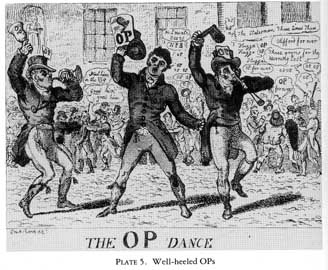
The fracas continued on subsequent nights. The OPs brought their own special form of ammunition: pots and pans to bang together, musical instruments, bells, etc. If you have heard of the Harlem shake or gangnam style, you will find it amusing to know the OPs also came up with a welly dance, usually performed on the benches and followed by boisterous shouts of “OP!”

A committee met over a six-day period to discuss the new prices, but when the committee supported the price change, the riots resumed with a vengeance. The OPs staged mock fight scenes, raced about the theatre, carried banners and placards and sang song while the legitimate actors attempted to say their lines. Kemble, the theatre manager, hired boxers to throw the ramble rousers out or have them arrested. When one of Kemble’s “bouncers” arrested Henry Clifford, a well-known radical barrister, Kemble was found guilty of false arrest.

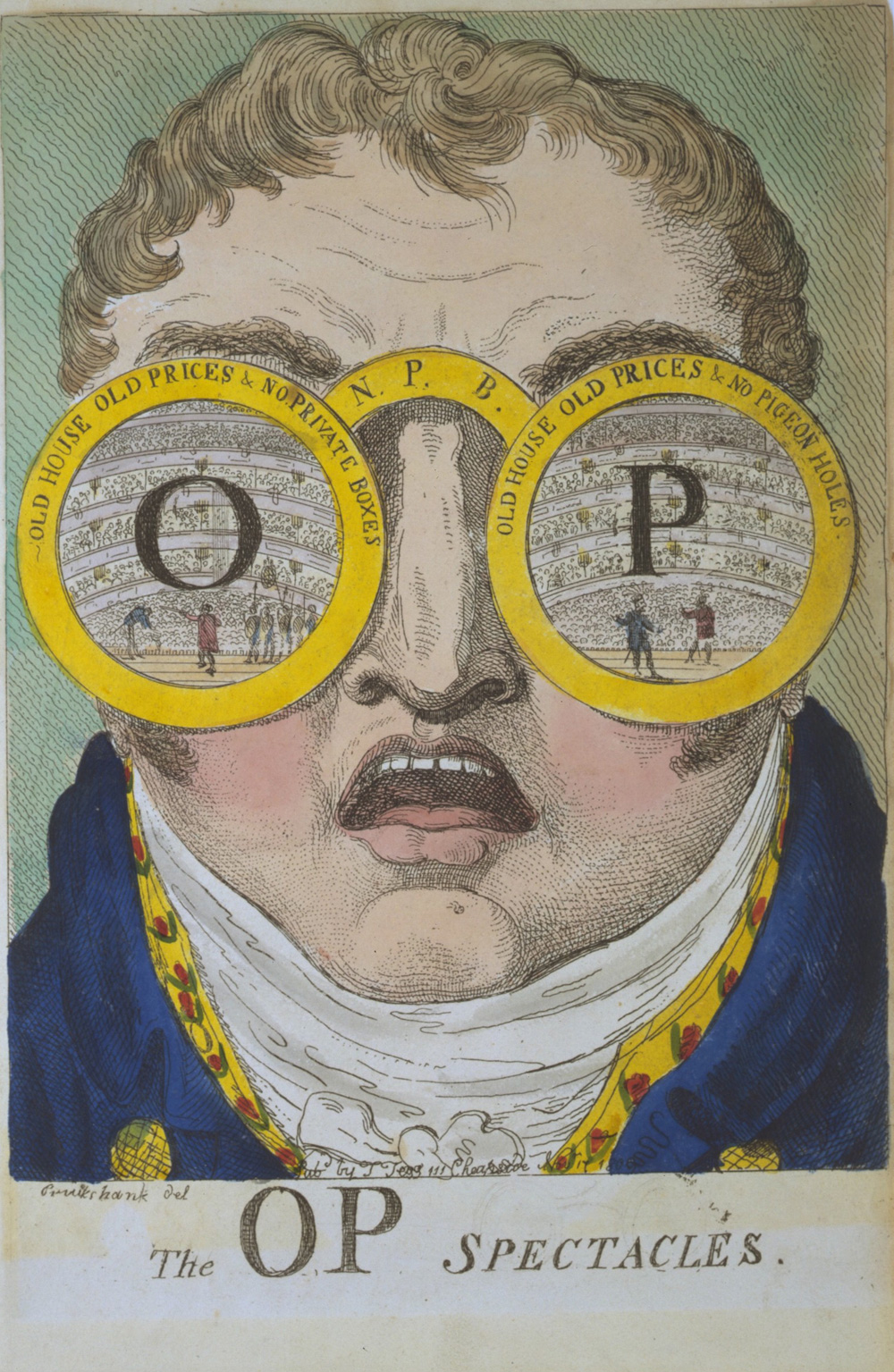
A caricature of John Philip Kemble (1757-1823) showing a portrait of a man wearing large spectacles with the letters 'OP' on each lens with theatrical scenes behind. The inscription on the left frame is 'Old House, Old Prices & No Private Boxes'; on the right frame is 'Old House, Old Prices & No Pigeon Holes'.

A caricature of John Philip Kemble (1757-1823) showing a portrait of a man wearing large spectacles with the letters ‘OP’ on each lens with theatrical scenes behind. The inscription on the left frame is ‘Old House, Old Prices & No Private Boxes’; on the right frame is ‘Old House, Old Prices & No Pigeon Holes’.

On 14 December 1809, Kemble had agreed to terms with Clifford. He announced a return to the previous prices. All charges against the rioters were dropped. The British government feared the rioters might take on more weighty causes such as the price of bread or an unpopular war with France, but no attempt to organize for other causes occurred.

The Great Reform Act of 1832 finally addressed whether the minor theatres had a right to perform plays. In 1843, the patents for the Theatres Royal were abolished. However, that did not solve all the problems. The “lesser” theatres went for the quick buck. The repertoire was not inspiring. These theatres encouraged middle class audiences.

Without their monopoly on “legitimate” drama, Drury Lane and Covent Garden could not remain solvent. There were just too many seats to fill to turn a major profit. Covent Garden burned down a second time in 1856. Instead of replacing Covent a second time, the Italian Opera House took its place.

The books Theater and Disorder in Late Georgian London (Oxford University Press, 1992, by March Baer) and A People’s History of London (Verso, 2012, by Lindsey German and John Rees) have excellent sections on the riots and the conditions which brought them about.

There is a great article on the OP Riots at Counterfire.


Posted in British history, Georgian Era, Living in the Regency, real life tales, Regency era, Victorian era | Tagged , , , , | Comments Off on The OP Riots of 1809

The Star of Israel, Mendoza the Jew

Daniel Mendoza

Daniel Mendoza

Daniel Mendoza was the first Jewish prize fighter to become Champion of England from 1792 to 1795. Mendoza stood but 5’7”, but he was a scrapper. Weighing in a 11.5 stone (160 pounds), he was billed as “Mendoza the Jew.” Mendoza was the only middleweight boxer to win the Heavyweight Championship of the World.

It was Mendoza who brought changes to boxing. Before he became popular, men simply stood still and slugged it out. Mendoza introduced the idea of “defense.” Many criticized Mendoza’s tactics, but soon all boxers were using the techniques. He opened his own boxing academy in 1789, which was known as the Mendoza School or the Jewish School. Mendoza also published The Art of Boxing, a book that described his techniques.

Mendoza’s first win came over an opponent known as Harry the Coalheaver, whom he beat in 40 rounds. In a 1787 professional fight, Mendoza won both the bout and the patronage of the Prince of Wales (later George IV). Mendoza was the first Jew to have an audience with England’s King George III, which both elevated the Jew in London’s population, but also a vicious tide of anti-Semitism.

From 29 March 1787 edition of The Times, we see a bit of the secrecy behind the English Sport of Boxing. Generally, only a few knew of the site for a match until the last moment. Prize fights were against the law. Most of the clergy and many of the middle class thought the bare knuckles bouts brutal. That being said, the brutality did not keep the throngs from enjoying the matches. “The boxing match between Martin the Bath Butcher, and Mendoza the Jew, which has been the subject of every blackguard’s conversation for some days, was put a stop to on Tuesday, by the prudent and praise-worthy interference of the civil poser. The parties met on Ealing Common, attended by a great concourse of people (among whom was the Prince – whether accidental or otherwise, we know not – we may, however, reasonably suppose the former – and some other personages of note) when a Justice of the Peace, and a posse comitatus, assisted by a party of the Light Dragoons, made their appearance, and prevented the decision of the combat. In justice to the high personage, whose name we are sorry to mention on this occasion, he was the first to shew respect to the civil authority, by retiring with his party, as soon as the Magistrate made his appearance. The riot act was read, and the mob, in number perhaps ten thousand, dispersed quietly.”

The fight was rescheduled for Barnet Racegroun on 17 April. The crowd numbered some 5000. Mendoza easily defeated Martin in 30 minutes. He won a prize of £500 from the Prince.

In 1788, 1789, and 1790, Mendoza fought storied matches against Richard Humphries, Mendoza’s mentor. He lost the first bout in 29 rounds, but managed to win the other two in 52 and 15 rounds, respectively. The 1789 match was the first time spectators were charged an entry payment to a sporting event. The fights were hyped by a series of combative letters in the press between Humphries and Mendoza.

Mendoza laid claim to the English Championship when Benjamin Brain retired in 1791, but Bill Warr challenged Mendoza’s claim. The two met in Croydon in May 1792. Mendoza’s claim to the title prevailed in 23 rounds. The two met again in 1794. Mendoza dispensed with Warr in a little over a quarter hour.

Gentleman John Jackson

Gentleman John Jackson

In 1795, Mendoza fought “Gentleman” John Jackson for the championship at Hornchurch in Essex. Jackson was five years younger, 4 inches taller, and 3 stone (42 pounds) heavier. Jackson won in nine rounds. Reportedly, Jackson caught Mendoza long hair, holding Mendoza in place where Jackson could pummel him into submission in ten minutes. Jackson used the win to propel him into Society. Jackson’s Rooms opened at 13 Bond Street, along with the Fives Court off Jermyn Street, where public sparring took place.

Born in Aldgate in July 1764, Mendoza, a descendant of Spanish Marranos (Jews coerced into conversion to Christianity) who had lived in London for nearly a century, became such a popular figure in England that songs were written about him, and his name appeared in scripts of numerous plays. His personal appearances would fill theaters, portraits of him and his fights were popular subjects for artists, and commemorative medals were struck in his honor.

At age 13, he was apprenticed to a glasscutter, but he fought with the employer’s son and was forced from the position. Later, he apprenticed to a Jewish greengrocer and still later to a tea dealer. His fortune rested in his fists.

In his 72 years, Mendoza made and spent a fortune. His memoirs were finally published in 1818. After his glory days, he spent time as a pub owner, teaching boxing, and even was hired by the theatre manager John Philip Kemble in an attempt to suppress the Old Price Riots; the resulting poor publicity probably cost Mendoza much of his popular support, as he was seen to be fighting on the side of the privileged. He even spent time in King’s Bench prison for his debts.

Mendoza made his last public appearance as a boxer in 1820 at Banstead Downs in a grudge match against Tom Owen; he was defeated after 12 rounds. He died on 3 September 1836. By then, the thrill of the boxing ring had waned. Mendoza left his family of 11 children in poverty. One of Mendoza’s descendants, Rufus Daniel Issacs, became Lord Chief Justice and 1st Marquess of Reading.

Peter Sellers

Peter Sellers

Another of Mendoza’s descendants, the actor Peter Sellers of Pink Panther fame, bears a resemblance to his great-great-grandfather. Perhaps, Sellers used some of the lessons he learned from his relative in those zany scenes of Cato attacking Inspector Clouseau. A print of Mendoza fighting Humphries can be seen on the wall of Clouseau’s office in the films.

Mendoza features as a character in Rodney Stone, a Gothic mystery novel by Sir Arthur Conan Doyle, and one of his fights is mentioned in the 1934 The Scarlet Pimpernel film. A play about Mendoza, “The Punishing Blow” by Randy Cohen debuted in 2009, and a film on the life of Daniel Mendoza, entitled “Mendoza,” is supposed due for release in 2013.

Daniel Mendoza was one of the inaugural group elected in 1954 to the Boxing Hall of Fame and of the inaugural class of the International Boxing Hall of Fame in 1990.

Excellent Resources on Daniel Mendoza:

International Jewish Sports Hall of Fame  

Jewish Quarterly (Includes specifics of each fight and wonderful primary sources)


Posted in British history, Georgian Era, Living in the Regency, real life tales, Regency era, Victorian era | Tagged , , , , , , , | 2 Comments

The Magnificent Cheshire Cathedral

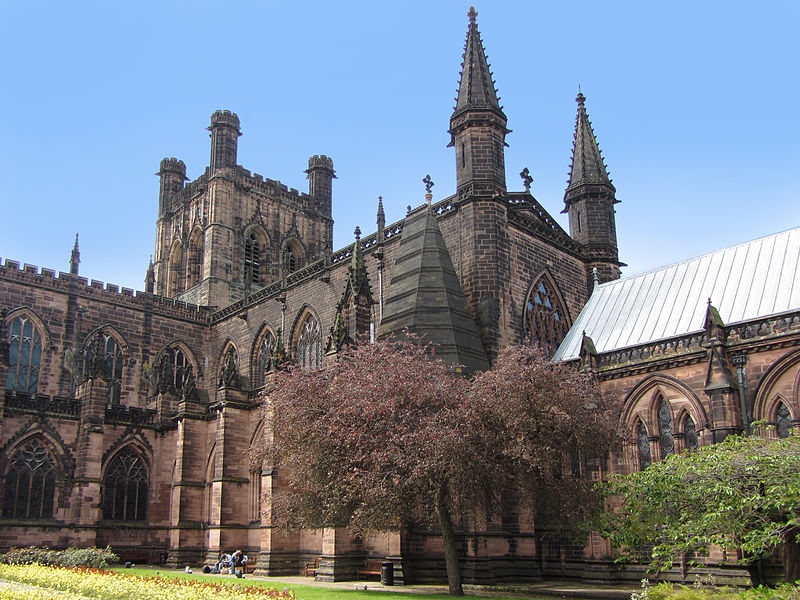
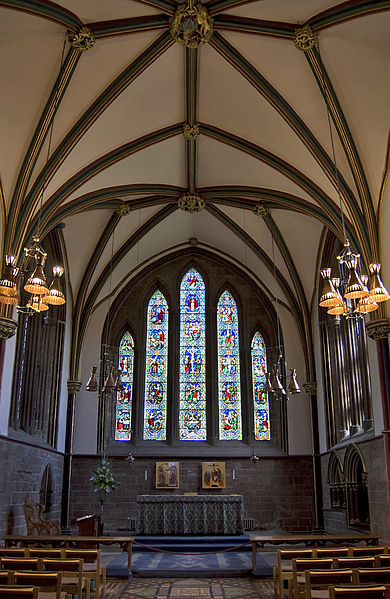
Chester Cathedral, England. The cathedral seen from the south-east looking towards the choir, right, with the Lady Chapel projecting, extreme right, and the south transept, left. The Lady Chapel is in the Early English (or Lancet) Gothic style, marked by the simple windows. The choir is in the late Geometric Decorated Gothic style. The South transept has Flowing Decorated windows in the aisle, and Perpendicular Gothic windows in the clerestory. The friable Red Sandstone building was heavily restored in the 19th century.

Chester Cathedral, England. The cathedral seen from the south-east looking towards the choir, right, with the Lady Chapel projecting, extreme right, and the south transept, left. The Lady Chapel is in the Early English (or Lancet) Gothic style, marked by the simple windows. The choir is in the late Geometric Decorated Gothic style. The South transept has Flowing Decorated windows in the aisle, and Perpendicular Gothic windows in the clerestory. The friable Red Sandstone building was heavily restored in the 19th century.

Cathedral is the mother church of the Church of England Diocese of Chester, and is located in the city of Chester, Cheshire, England. The cathedral, formerly St Werburgh’s abbey church of a Benedictine monastery, is dedicated to Christ and the Blessed Virgin Mary. Since 1541 it has been the seat of the Bishop of Chester and centre of worship, administration, ceremony and music for the city and diocese.

The cathedral is a Grade I listed building, and part of a heritage site that also includes the former monastic buildings to the north, also listed Grade I. The cathedral, typical of English cathedrals in having been modified many times, dates from between 1093 and the early 16th century, although the site itself may have been used for Christian worship since Roman times. All the major styles of English medieval architecture, from Norman to Perpendicular, are represented in the present building.

The cathedral and monastic buildings were extensively restored during the 19th century amidst some controversy, and a free-standing bell-tower was added in the 20th century. The buildings are a major tourist attraction in Chester, a city of historic, cultural and architectural importance. In addition to holding services for Christian worship, the cathedral is used as a venue for concerts and exhibitions. History

Chester Cathedral: Shrine of Saint Werburga ( 1340 )

Chester Cathedral: Shrine of Saint Werburga ( 1340 )

The city of Chester was an important Roman stronghold. There may have been a Christian basilica on the site of the present cathedral in the late Roman era, while Chester was controlled by Legio XX Valeria Victrix. Legend holds that the basilica was dedicated to St Paul and Saint Peter. This is supported by evidence that in Saxon times the dedication of an early chapel on this site was changed from Saint Peter to Saint Werburgh. In the 10th century, St Werburgh’s remains were brought to Chester, and 907 AD her shrine was placed in the church. It is thought that Æthelfleda turned the church into a college of secular canons, and that it was given a charter by King Edgar in 968. The abbey, as it was then, was restored in 1057 by Leofric, Earl of Mercia and Lady Godiva. This abbey was razed to the ground around 1090, with the secular canons evicted, and no known trace of it remains.

In 1093 a Benedictine monastery was established on the site by Hugh Lupus, Earl of Chester, and the earliest surviving parts of the structure date from that time. The abbey church was not at that time the cathedral of Chester; from 1075 to 1082 the cathedral of the diocese was the nearby church of St John the Baptist, after which the see was transferred to Coventry. In 1538, during the dissolution of the monasteries, the monastery was disbanded and the shrine of Saint Werburgh was desecrated. In 1541 St Werburgh’s abbey became a cathedral of the Church of England by order of Henry VIII. At the same time, the dedication was changed to Christ and the Blessed Virgin. The last abbot of St Werburgh’s Abbey, Thomas Clarke, became the first dean of the new cathedral at the head of a secular chapter.

Although little trace of the 10th-century church has been discovered, save possibly some Saxon masonry found during a 1997 excavation of the nave, there is much evidence of the monastery of 1093. This work in the Norman style may be seen in the northwest tower, the north transept and in remaining parts of the monastic buildings. The abbey church, beginning with the Lady Chapel at the eastern end, was extensively rebuilt in Gothic style during the 13th and 14th centuries. At the time of the dissolution of the monasteries, the cloister, the central tower, a new south transept, the large west window and a new entrance porch to the south had just been built in the Perpendicular style, and the southwest tower of the façade had been begun. The west front was given a Tudor entrance, but the tower was never completed.

In 1636 the space beneath the south west tower became a bishop’s consistory court. It was furnished as such at that time, and is now a unique survival in England, hearing its last case, that of an attempted suicide of a priest, in the 1930s. Until 1881, the south transept, which is unusually large, also took on a separate function as an independent ecclesiastical entity, the parish church of St Oswald. Although the 17th century saw additions to the furnishings and fittings, there was no further building work for several centuries. By the 19th century, the building was badly in need of restoration. The present homogeneous appearance that the cathedral presents from many exterior angles is largely the work of Victorian restorers, particularly George Gilbert Scott. The 20th century has seen continued maintenance and restoration. In 1973–75 a detached belfry designed by George Pace was erected in the grounds of the cathedral. In 2005 a new Song School was added to the cathedral. During the 2000s, the cathedral library was refurbished and relocated. It was officially reopened in September 2007. The cathedral and the former monastic buildings were designated by English Heritage as Grade I listed buildings on 28 July 1955. In February 2009 plans for the transformation of the area around the cathedral and nave platform were announced.

External Features
Like the cathedrals of Carlisle, Lichfield and Worcester, Chester Cathedral is built of New Red Sandstone, in this case Keuper Sandstone from the Cheshire Basin. The stone lends itself to detailed carving, but is also friable, easily eroded by rain and wind, and is badly affected by pollution. With the other red sandstone buildings, Chester is one of the most heavily restored of England’s cathedrals. The restoration, which included much refacing and many new details, took place mainly in the 19th century. The sandstone exterior (from the south west) has much decorative architectural detail but is heavily restored.

Because the south transept is similar in dimension to the nave and choir, views of the building from the south-east and south-west give the impression of a building balanced around a central axis, with its tower as the hub. The tower is of the late 15th century Perpendicular style, but its four large battlemented turrets are the work of the restoration architect George Gilbert Scott. With its rhythmic arrangement of large, traceried windows, pinnacles, battlements and buttresses, the exterior of Chester Cathedral from the south presents a fairly homogeneous character, which is an unusual feature as England’s cathedrals are in general noted for their stylistic diversity. Close examination reveals window tracery of several building stages from the 13th to the early 16th century. The richness of the 13th-century tracery is accentuated by the presence of ornate, crocketted drip-mouldings around the windows; those around the perpendicular windows are of simpler form.

The façade of the cathedral is dominated by a large deeply recessed eight-light window in the Perpendicular style, above a recessed doorway set in a screen-like porch designed, probably by Seth and George Derwall, in the early 1500s. This porch formed part of the same late 15th-century building programme as the south transept, central and southwest towers, and cloister. Neither of the west towers was completed. To the north is the lower stage of a Norman tower, while to the south is the lower stage of a tower designed and begun, probably by Seth and George Derwall, in 1508, but left incomplete following the dissolution of the monastery in 1538. The cathedral’s façade is abutted on the north by a Victorian building housing the education centre and largely obscured from view by the building previously used as the King’s School, which is now a branch of Barclays Bank. The door of the west front is not used as the normal entrance to the cathedral, which is through the southwest porch which is in an ornate Tudor style.

Interior Features
The interior of Chester Cathedral gives a warm and mellow appearance because of the pinkish colour of the sandstone. The proportions appear spacious because the view from the west end of the nave to the east end is unimpeded by a pulpitum and the nave, although not long, is both wide and high compared with many of England’s cathedrals. The piers of the nave and choir are widely spaced, those of the nave carrying only the clerestory of large windows with no triforium gallery. The proportions are made possible partly because the ornate stellar vault, like that at York Minster, is of wood, not stone.

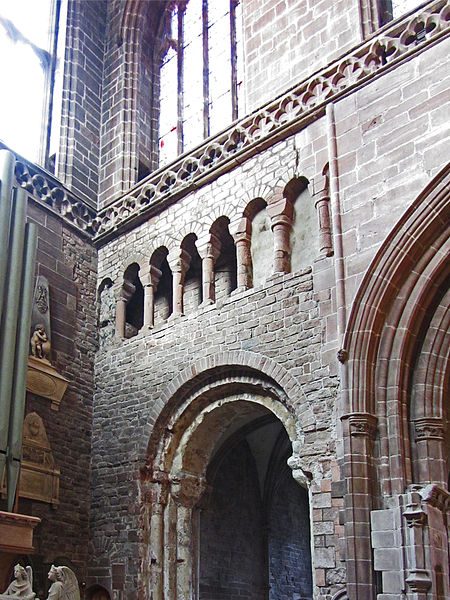
Chester Cathedral, England. The north transept of the cathedral showing a Norman arch and gallery

Chester Cathedral, England. The north transept of the cathedral showing a Norman arch and gallery

Norman remnants
The present building, dating from around 1283 to 1537, mostly replaced the earlier monastic church founded in 1093 which was built in the Norman style. It is believed that the newer church was built around the older one. That the few remaining parts of the Norman church are of small proportions, while the height and width of the Gothic church are generous would seem to confirm this belief. Aspects of the design of the Norman interior are still visible in the north transept, which retains wall arcading and a broadly moulded arch leading to the sacristy, which was formerly a chapel.The transept has retained an early 16th-century coffered ceiling with decorated bosses, two of which are carved with the arms of Henry VIII and Cardinal Wolsey.

The north west tower is also of Norman construction. It serves as the baptistry and houses a black marble font, consisting of a bowl on a large baluster dating from 1697. The lower part of the north wall of the nave is also from the Norman building, but can only be viewed from the cloister because the interior has been decorated with mosaic.

Early English
The Early English Gothic chapter house, built between 1230 and 1265, is rectangular and opens off a “charming” vestibule leading from the north transept. The chapter house has grouped windows of simple untraceried form. Alec Clifton-Taylor describes the exterior of this building as a “modest but rather elegant example of composition in lancets” while Nikolaus Pevsner says of the interior “It is a wonderfully noble room” which is the “aesthetic climax of the cathedral”. To the north of the chapter house is the slype, also Early English in style, and the warming room, which contains two large former fireplaces. The monastic refectory to the north of the cloister is of about the same date as the chapter house.

The Lady Chapel, Early English Gothic, (1265-90)

The Lady Chapel, Early English Gothic, (1265-90)

The Lady Chapel to the eastern end of the choir dates from between 1265 and 1290.It is of three bays, and contains the Shrine of St Werburgh, dating from the 14th century. The vault of the Lady Chapel is the only one in the cathedral that is of stone. It is decorated with carved roof bosses representing the Trinity, the Madonna and Child, and the murder of Thomas Becket. The chapel also has a sedilia and a piscina.

Decorated Gothic
The choir, of five bays, was built between 1283 and 1315 to the design of Richard Lenginour, and is an early example of Decorated Gothic architecture. The piers have strongly modelled attached shafts, supporting deeply moulded arches. There is a triforium gallery with four cusped arches to each bay. The sexpartite vault, which is a 19th-century restoration, is supported by clusters of three shafts which spring from energetic figurative corbels. The overall effect is robust, and contrasts with the delicacy of the pinnacled choir stalls, the tracery of the windows and the rich decoration of the vault which was carried out by the ecclesiastical designers, Clayton and Bell. The choir stalls, dating from about 1380, are one of the glories of the cathedral.

The aisles of the choir previously both extended on either side of the Lady Chapel. The south aisle was shortened in about 1870 by George Gilbert Scott, and given an apsidal east end, becoming the chapel of St Erasmus. The eastern end of the north aisle contains the chapel of St Werburgh. The building of the nave, begun in 1323, was halted by plague and completed 150 years later.

The nave of six bays, and the large, aisled south transept were begun in about 1323, probably to the design of Nicholas de Derneford. There are a number of windows containing fine Flowing Decorated tracery of this period. The work ceased in 1375, in which year there was a severe outbreak of plague in England. The building of the nave was recommenced in 1485, more than 150 years after it was begun. The architect was probably William Rediche. Remarkably, for an English medieval architect, he maintained the original form, changing only the details. The nave was roofed with a stellar vault rather like that of the Lady Chapel at Ely and the choir at York Minster, both of which date from the 1370s. Like that at York, the vault is of wood, imitating stone.

Perpendicular Gothic
From about 1493 until 1525 the architect appears to have been Seth Derwall, succeeded by George Derwall until 1537. Seth Derwall completed the south transept to a Perpendicular Gothic design, as seen in the transomed windows of the clerestory. He also built the central tower, southwest porch and cloisters. Work commenced on the south west tower in 1508, but it had not risen above the roofline at the time of the dissolution of the monasteries, and has never been completed. The central tower, rising to 127 feet (39 m), is a “lantern tower” with large windows letting light into the crossing. Its external appearance has been altered by the addition of four battlemented turrets by George Gilbert Scott in the 19th century.

Former monastic buildings
The Perpendicular Gothic cloister is entered from the cathedral through a Norman doorway in the north aisle. The cloister is part of the building programme that commenced in the 1490s and is probably the work of Seth Derwall. The south wall of the cloister, dating from the later part of the Norman period, forms the north wall of the nave of the cathedral, and includes blind arcading. Among the earliest remaining structures on the site is an undercroft off the west range of the cloisters, which dates from the early 12th century, and which was originally used by the monks for storing food. It consists of two naves with groin vaults and short round piers with round scalloped capitals.

Leading from the south of the undercroft is the abbot’s passage which dates from around 1150 and consists of two bays with rib-vaulting. Above the abbot’s passage, approached by a stairway from the west cloister, is St Anselm’s Chapel which also dates from the 12th century. It is in three bays and has a 19th century Gothic-style plaster vault. The chancel is in one bay and was remodelled in the early 17th century. The screen, altar rails, holy table and plaster ceiling of the chancel date from the 17th century. The north range of the cloister gives access to a refectory, built by Simon de Whitchurch in the 13th century. It contains an Early English pulpit, approached by a staircase with an ascending arcade. The only other similar pulpit in England is in Beaulieu Abbey.

Restoration
Much of the exterior stonework has been refaced in the 19th and 20th centuries. By the 19th century the fabric of the building had become badly weathered, with Charles Hiatt writing that “the surface rot of the very perishable red sandstone, of which the cathedral was built, was positively unsightly” and that the “whole place previous to restoration struck one as woebegone and neglected; it perpetually seemed to hover on the verge of collapse, and yet was without a trace of the romance of the average ruin.” Between 1818 and 1820 the architect Thomas Harrison restored the south transept, adding corner turrets. This part of the building served until 1881 as the parish church of St Oswald, and it was ecclesiastically separate. From 1844 R. C. Hussey carried out a limited restoration including work on the south side of the nave.

The most extensive restoration was carried out by the Gothic Revival architect, George Gilbert Scott, who between 1868 and 1876 “almost entirely re-cased” the cathedral. The current building is acknowledged to be mainly the product of this Victorian restoration commissioned by the Dean, John Saul Howson. In addition to extensive additions and alterations to the body of the church, Scott remodelled the tower, adding turrets and crenellations. Scott chose sandstone from the quarries at Runcorn for his restoration work. In addition to the restoration of the fabric of the building, Scott designed internal fittings such as the choir screen to replace those destroyed during the Civil War. He built the fan vault of the south porch, renewed the wooden vault of the choir and added a great many decorative features to the interior.

Scott’s restorations were not without their critics and caused much debate in architectural circles. Scott claimed to have archaeological evidence for his work, but the Liverpool architect, Samuel Huggins argued in an 1868 address to the Liverpool Architectural Society, that the alterations were less like restoration and more like rebuilding. One of the larger changes was to shorten the south aisle and restyle it as an apse. The changes also proposed the addition of a spire above the existing tower, but this proposal was later rejected. Samuel’s further paper of 1871 entitled On so-called restorations of our cathedral and abbey churches compelled the Dean to attempt to answer the criticism. The debate contributed to the establishment of the Society for the Protection of Ancient Buildings.

Later in the century, from 1882, Arthur Blomfield and his son Charles made further additions and modifications, including restoring and reinstating the Shrine of St Werburgh. More work was carried out in the 20th century by Giles Gilbert Scott between 1891 and 1913, and by F. H. Crossley in 1939.

Bell Tower
Towards the end of 1963 the cathedral bells, which were housed in the central tower, were in need of an overhaul and ringing was suspended. In 1965 the Dean asked George Pace, architect to York Minster, to prepare specifications for a new bell frame and for electrification of the clock and tolling mechanism. Due to structural difficulties and the cost of replacing the bells in the central tower it was advised that consideration should be given to building a detached bell and clock tower in the southeast corner of the churchyard. It was decided to proceed with that plan, and in 1969 an announcement was made that the first detached cathedral bell tower was to be erected since the building of the campanile at Chichester Cathedral in the 15th century. In February 1969, nine of the ten bells in the central tower were removed to be recast by John Taylor & Co as a ring of twelve bells with a flat sixth. The new bells were cast in 1973. Work on the new bell-tower began in February 1973. Two old bells dating from 1606 and 1626 were left in the tower. On 26 February 1975 the bells were rung for the first time to celebrate the wedding of a member of the Grosvenor family. The official opening on 25 June 1975 was performed by the Duke of Gloucester. The belfry is known as the Dean Addleshaw Tower, after the dean of the cathedral responsible for its construction. The tower is built in concrete, faced with sandstone at its base. It is the first detached bell tower to be built for a cathedral in this country since the Reformation. Between the bell tower and the south transept is a garden in remembrance of the Cheshire Regiment (originally the 22nd Regiment of Foot).

Fittings and Glass
The Consistory Court of 1632 The treasures of Chester Cathedral are its rare fittings, specifically its choir stalls and the 17th-century furnishing of the bishop’s consistory court in the south tower, which is a unique survival.

Choir Stalls
The choir stalls date from about 1380. They have high, spiky, closely set canopies, with crocketed arches and spirelets. The stall ends have poppyheads and are rich with figurative carving. The stalls include 48 misericords, all but five of which are original,depicting a variety of subjects, some humorous and some grotesque. Pevsner states that they are “one of the finest sets in the country,” while Alec Clifton-Taylor calls them “exquisite” and says of the misericords that “for delicacy and grace they surpass even those at Lincoln and Beverley.”

Organ

The organ

The organ

In 1844, an organ by Gray & Davison of London was installed in the cathedral, replacing an instrument with parts dating back to 1626. The organ was rebuilt and enlarged by Whiteley Bros of Chester in 1876, to include harmonic flutes and reeds by Cavaillé-Coll. It was later moved to its present position at the front of the north transept. In 1910 William Hill and Son of London extensively rebuilt and revoiced the organ, replacing the Cavaillé-Coll reeds with new pipes of their own. The choir division of the organ was enlarged and moved behind the choirstalls on the south side. The instrument was again overhauled by Rushworth and Dreaper of Liverpool in 1969, when a new mechanism and some new pipework made to a design by the organist, Roger Fisher, was installed. Since 1991 the organ has been in the care of David Wells of Liverpool.

Stained Glass
Chester suffered badly at the hands of the Parliamentary troops. As a consequence, its stained glass dates mainly from the 19th and 20th centuries and has representative examples the significant trends in stained glass design from the 1850s onwards. Of the earlier Victorian firms, William Wailes is the best represented, in the south aisle (1862), as well as Hardman & Co. and Michael Connor. Glass from the High Victorian period is well represented by two leading London firms, Clayton and Bell and Heaton, Butler and Bayne. The Aesthetic style is represented by Charles Eamer Kempe. Early 20th century windows include several commemorating those who died in World War I.

There are also several notable modern windows, the most recent being the refectory window of 2001 by Ros Grimshaw which depicts the Creation. The eight-light Perpendicular window of the west end contains mid-20th century glass representing the Holy Family and Saints, by W. T. Carter Shapland. Three modern windows in the south aisle, designed and made by Alan Younger to replace windows damaged in the Second World War. They were donated by the 6th Duke of Westminster to celebrate the 900th anniversary of the cathedral and contain the dates 1092 and 1992 to reflect the theme of “continuity and change.”

Posted in British history, castles, Georgian Era, gothic and paranormal, legends and myths, Living in the Regency, real life tales, Regency era, Ulysses Press, Victorian era | Tagged , , | Comments Off on The Magnificent Cheshire Cathedral

What is “Swarming” in Book Terms?

This article infuriates me. I have seen a few such comments on my own books. I have personally known of those who upped their ratings with positive reviews from friends and family and who have “attacked” other writers with the help of those same family and friends. Tell me what you think.

This article comes the January 20, 2013 edition of the The New York Times. To read the complete article, go to http://www.nytimes.com/2013/01/21/business/a-casualty-on-the-battlefield-of-amazons-partisan-book-reviews.html?_r=0

Reviews on Amazon are becoming attack weapons, intended to sink new books as soon as they are published.

Randall Sullivan is the author of “Untouchable: The Strange Life and Tragic Death of Michael Jackson.”

In the book Randall Sullivan writes that Michael Jackson’s overuse of plastic surgery reduced his nose to little more than a pair of nostrils and that he died a virgin despite being married twice.

In the biggest, most overt and most successful of these campaigns, a group of Michael Jackson fans used Facebook and Twitter to solicit negative reviews of a new biography of the singer. They bombarded Amazon with dozens of one-star takedowns, succeeded in getting several favorable notices erased and even took credit for Amazon’s briefly removing the book from sale.

“Books used to die by being ignored, but now they can be killed — and perhaps unjustly killed,” said Trevor Pinch, a Cornell sociologist who has studied Amazon reviews. “In theory, a very good book could be killed by a group of people for malicious reasons.”

Posted in Industry News/Publishing | 6 Comments