Thomas Cubitt, Master Builder

ThomascubittThomas Cubitt (1788–1855), born Buxton, Norfolk, was the leading master builder in London in the second quarter of the 19th century, and also carried out several projects in other parts of England.

Background
The son of a Norfolk carpenter, he journeyed to India as ship’s carpenter from which he earned sufficient funds to start his own building firm in 1810 on Gray’s Inn Road, London where he was one of the first builders to have a ‘modern’ system of employing all the trades under his own management.

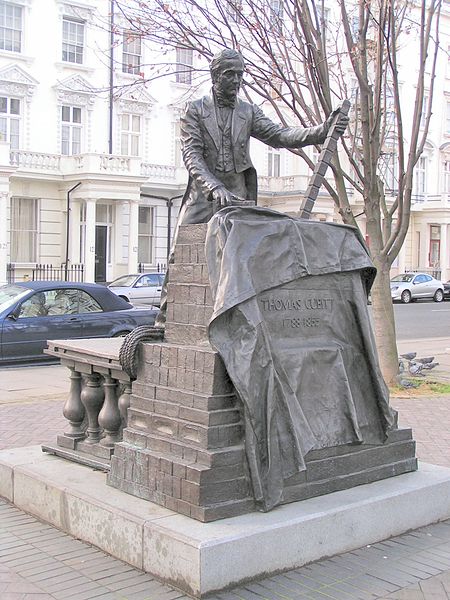
Statue of Thomas Cubitt by William Fawke, 1995. Denbigh Street, London. The twin to this statue can be found in Dorking, Surrey.

Statue of Thomas Cubitt by William Fawke, 1995. Denbigh Street, London. The twin to this statue can be found in Dorking, Surrey.

Cubitt’s first major building was the London Institution in Finsbury Circus, built in 1815. After this he worked primarily on speculative housing at Camden Town, Islington, and especially at Highbury Park, Stoke Newington (now part of Islington).

His development of areas of Bloomsbury, including Gordon Square and Tavistock Square, began in 1820, for a group of landowners including the Duke of Bedford. Having built much of Tavistock Square in the 1820s, Cubitt later extended Tavistock House for Dickens. He also oversaw the installing of a soundproof study at the top of Carlyle’s house in Chelsea. Both Dickens and Carlyle praised Cubitt’s efforts. In his journal (Carlyle Letters, 25 July 1850), Carlyle described Cubitt as “A hoary modest sensible-looking man.”

He was commissioned in 1824 by Richard Grosvenor, 2nd Marquess of Westminster, to create a great swathe of building in Belgravia centred around Belgrave Square and Pimlico, in what was to become his greatest achievement in London. Notable amongst this development are the north and west sides of Eaton Square, which exemplify Cubitt’s style of building and design. The scale of Cubitt’s work is astounding. In Nineteenth Century Architecture in Britain, Reginald Turnor says of Cubitt, “Pimlico and Clapham, terrace after terrace and square after square, were later ventures in which Cubitt improved upon all the speculative building which had ever done before, or, one supposes, will ever be done again.”

Cubitt was also responsible for the east front of Buckingham Palace. He also built and personally funded nearly a kilometre of the Thames Embankment. He was employed in the large development of Kemp Town in Brighton, and Osborne House on the Isle of Wight, completed in 1851. Cubitt’s public works included the provision of public parks, including being an organiser of the Battersea Park Scheme.

In 1827 he withdrew from the management of the business he had established at Gray’s Inn Road leaving such matters to his brother William Cubitt; the firm of Cubitts still carried out the work of Thomas Cubitt and the change robbed neither of the partners of the credit for their work.

He died in 1855 and was taken from Dorking for burial at West Norwood Cemetery on 27 December 1855. After his death, Queen Victoria said “In his sphere of life, with the immense business he had in hand, he is a real national loss. A better, kindhearted or more simple, unassuming man never breathed.

Another statue of Cubitt can be seen in Dorking, opposite the Dorking Halls, as he was favoured there for his architecture on his Denbies estate. Cubitt had built himself a country house in Surrey. Prince Albert visited him there. On the main road into town is a memorial showing Cubitt’s image standing on a raised platform, hidden by a stack of uncovered bricks and a brick measure in his hand. The plaque reads, “Thomas Cubitt – MasterBuilder. Born 1788 – Died 1855 at ‘Denbies,’ Dorking. ‘A GREAT BUILDER AND A GOOD MAN.'” statue1

In 1883 the business was acquired by Holland & Hannen, a leading competitor, and the combined business became known as Holland & Hannen and Cubitts and subsequently as Holland, Hannen & Cubitts.

Family
Cubitt had two brothers, the contractor and politician William and the architect Lewis who designed many of the houses built by Thomas.

His son by his wife Mary Anne Warner, George, who was created Baron Ashcombe in 1892, was the great-great-grandfather of Camilla, Duchess of Cornwall.

Posted in British history, Georgian Era, Living in the Regency, real life tales, Regency era, Victorian era | Tagged , | Comments Off on Thomas Cubitt, Master Builder

Four Reasons Paperbacks Survive

This article comes from The Millions. To read the complete article, go to http://www.themillions.com/2013/04/the-point-of-the-paperback.html, which includes an interesting outlook on the future of the paperback book, as well as some magnificent book covers.

BOOKS AS OBJECTS
The Point of the Paperback
By NICHOLE BERNIER posted at 6:00 am on April 2, 2013

1.
“Why are they still bothering with paperbacks?” This came from a coffee-shop acquaintance when he heard my book was soon to come out in paperback, nine months after its hardcover release. “Anyone who wants it half price already bought it on ebook, or Amazon.”

Interestingly, his point wasn’t the usual hardcovers-are-dead-long-live-the-hardcover knell. To his mind, what was the use of a second, cheaper paper version anymore, when anyone who wanted it cheaply had already been able to get it in so many different ways?

I would have taken issue with his foregone conclusion about the domination of ebooks over paper, but I didn’t want to spend my babysitting time down that rabbit hole. But he did get me thinking about the role of the paperback relaunch these days, and how publishers go about getting attention for this third version of a novel — fourth, if you count audiobooks.
I did what I usually do when I’m puzzling through something, which is to go back to my journalism-school days and report on it. Judging by the number of writers who asked me to share what I heard, there are a good number of novelists who don’t quite know what to do with their paperbacks, either.

Here’s what I learned, after a month of talking to editors, literary agents, publishers, and other authors: A paperback isn’t just a cheaper version of the book anymore. It’s a makeover. A facelift. And for some, a second shot.

Posted in Uncategorized | Comments Off on Four Reasons Paperbacks Survive

British Forms of Address

How does one address the members of the nobility or the aristocracy in England. That depends on whether a person is speaking directly to the person, writing to the person informally, and writing to the person in a formal situation.

Royalty
For each entry, one will find the following pattern:

Position
On envelopes
Salutation in letter
Oral address

King
His Majesty The King
Your Majesty
Your Majesty, and thereafter as “Sir/Sire”

Queen
Her Majesty The Queen
Your Majesty
Your Majesty, and thereafter as “Ma’am”

Prince of Wales
His Royal Highness The Prince of Wales
Your Royal Highness
Your Royal Highness, and thereafter as “Sir”

Wife of the Prince of Wales
Her Royal Highness The Princess of Wales (traditionally)
(or) Her Royal Highness The Duchess of Cornwall
(or) Her Royal Highness The Duchess of Rothesay (an exception to tradition since 2005)
Your Royal Highness
Your Royal Highness, and thereafter as “Ma’am”

Princess Royal
HRH The Princess Royal
Your Royal Highness
Your Royal Highness, and thereafter as “Ma’am”

Royal Peer
HRH The Duke of XXX, e.g., HRH The Duke of Cambridge
Your Royal Highness
Your Royal Highness, and thereafter as “Sir”

Royal Peeress
HRH The Duchess of XXX, e.g., HRH The Duchess of Cambridge
Your Royal Highness
Your Royal Highness, and thereafter as “Ma’am”

Sovereign’s Son
(unless a peer) HRH The Prince XXX, e.g. HRH The Prince John
Your Royal Highness
Your Royal Highness, and thereafter as “Sir”

Sovereign’s son’s wife
(unless a peeress) HRH The Princess XXX, e.g. HRH The Princess John
Your Royal Highness
Your Royal Highness, and thereafter as “Ma’am”

Sovereign’s Daughter
(unless a peeress)
HRH The Princess XXX
Your Royal Highness
Your Royal Highness, and thereafter as “Ma’am”

Sons of the Prince of Wales
(unless a peer) HRH Prince XXX of Wales, e.g., HRH Prince Frederick of Wales
Your Royal Highness
Your Royal Highness, and thereafter as “Sir”

Sovereign’s son’s son, Prince of Wales’s eldest son’s sons
(unless a peer) HRH Prince XXX of XXX, e.g. HRH Prince Michael of Kent
Your Royal Highness
Your Royal Highness, and thereafter as “Sir”

Sovereign’s son’s son’s wife
(unless a peeress) HRH Princess XXX of XXX, e.g., HRH Princess Michael of Kent
Your Royal Highness
Your Royal Highness, and thereafter as “Ma’am”

Sovereign’s son’s daughter, Prince of Wales’s eldest son’s daughters
(unless a peeress) HRH Princess XXX of XXX, e.g., HRH Princess Beatrice of York
Your Royal Highness
Your Royal Highness

Sovereign’s son’s son’s son
(unless a peer) (Except son of the eldest son of the Prince of Wales) The Lord XXX Windsor, e.g., The Lord Nicholas Windsor
Dear Lord XXX
Lord XXX

Sovereign’s son’s son’s son’s wife
(unless a peeress) The Lady XXX Windsor, e.g., The Lady Nicholas Windsor
Dear Lady XXX
Lady XXX

Sovereign’s son’s son’s daughter
(unless a peeress) The Lady XXX Windsor, e.g., The Lady Helen Taylor
Dear Lady XXX
Lady XXX

A formal announcement in The London Gazette reads: “The Queen has been pleased by Letters Patent under the Great Seal of the Realm dated 31 December 2012 to declare that all the children of the eldest son of the Prince of Wales should have and enjoy the style, title and attribute of Royal Highness with the titular dignity of Prince or Princess prefixed to their Christian names or with such other titles of honour.” This refers to any children of Duke and Duchess of Cambridge.

Nobility
Peers and Peeresses
Position
On Envelopes
Salutation in Letter
Oral Address

Duke
(His Grace) The Duke of XXX
My Lord Duke or Dear Duke (of XXX)
Your Grace or Duke

Duchess
(Her Grace) The Duchess of XXX
Madam or Dear Duchess (of XXX)
Your Grace or Duchess

Marquess or Marquis
(The Most Honourable) The Marquess of XXX
My Lord Marquess or Dear Lord XXX
My Lord or Your Lordship or Lord XXX

Marchioness
(The Most Honourable) The Marchioness of XXX
Madam or Dear Lady XXX
My Lady or Your Ladyship or Lady XXX

Earl
(The Right Honourable) The Earl of XXX
My Lord or Dear Lord XXX
My Lord or Your Lordship or Lord XXX

Countess
(The Rt Hon) The Countess of XXX
Madam or Dear Lady XXX
My Lady or Your Ladyship or Lady XXX

Viscount
(The Rt Hon) The Viscount XXX
My Lord or Dear Lord XXX
My Lord or Your Lordship or Lord XXX

Viscountess
(The Rt Hon) The Viscountess XXX
Madam or Dear Lady XXX
My Lady or Your Ladyship or Lady XXX

Baron (or) Lord of Parliament
(The Rt Hon) The Lord XXX
My Lord or Dear Lord XXX
My Lord or Your Lordship or Lord XXX

Baroness (in her own right)
(The Rt Hon) The Lady XXX or (The Rt Hon) The Baroness XXX
Madam or Dear Lady XXX or Dear Baroness XXX
My Lady or Your Ladyship or Lady XXX or Baroness XXX

Baroness (in her husband’s right) (or) Lady of Parliament (in her or her husband’s right) (The Rt Hon) The Lady XXX
Madam or Dear Lady XXX
My Lady or Your Ladyship or Lady XXX

Eldest sons, grandsons and great-grandsons of dukes, marquesses and earls
Position
On envelopes
alutation in letter
Oral address
Eldest sons of dukes, marquesses and earls use their father’s most senior subsidiary title as courtesy titles: note the absence of “The” before the title. If applicable, eldest sons of courtesy marquesses or courtesy earls also use a subsidiary title from their (great) grandfather, which is lower ranking than the one used by their father. Eldest daughters do not have courtesy titles; all courtesy peeresses are wives of courtesy peers.

Courtesy Marquess
(The) Marquess of XXX
My Lord or Dear Lord XXX
My Lord or Lord XXX

Courtesy Marquess’s Wife
(The) Marchioness of XXX
Madam or Dear Lady XXX
My Lady or Lady XXX

Courtesy Earl
(The) Earl of XXX
My Lord or Dear Lord XXX
My Lord or Lord XXX

Courtesy Earl’s Wife
(The) Countess of XXX
Madam or Dear Lady XXX
My Lady or Lady XXX

Courtesy Viscount
(The) Viscount XXX
My Lord or Dear Lord XXX
My Lord or Lord XXX

Courtesy Viscount’s Wife
(The) Viscountess XXX
Madam or Dear Lady XXX
My Lady or Lady XXX

Courtesy Baron (or) Courtesy Lord of Parliament
(The) Lord XXX
My Lord or Dear Lord XXX
My Lord or Lord XXX

Courtesy Baron’s wife (or) Wife of Courtesy Lord of Parliament
(The) Lady XXX
Madam or Dear Lady XXX
My Lady or Lady XXX

Heirs-apparent and heirs-presumptive of Scottish peers
Position
On envelopes
Salutation in letter
Oral address

Heirs-apparent and heirs-presumptive of Scottish peers use the titles “Master” and “Mistress”; these are substantive, not courtesy titles. If, however, the individual is the eldest son of a Duke, Marquess or Earl, then he uses the appropriate courtesy title, as noted above.

Scottish peer’s heir-apparent or heir-presumptive
The Master of XXX
Sir or
Dear Master of XXX
Sir or Master

Scottish peer’s heiress-apparent or heiress-presumptive
The Mistress of XXX
Madam or Dear Mistress of XXX
Madam or Mistress

Sons, grandsons and great-grandsons of peers
Position
On envelopes
Salutation in letter
Oral address

Duke’s younger son (or) (Courtesy) Marquess’s younger son
(The) Lord XXX XXX, e.g. (The) Lord James Marshall
My Lord or Dear Lord XXX (XXX), e.g. Dear Lord James (Marshall)
My Lord or Lord XXX, e.g. Lord James

Duke’s younger son’s wife (or) (Courtesy) Marquess’s younger son’s wife
(The) Lady XXX XXX, e.g., (The) Lady James Marshall
Madam or Dear Lady XXX, e.g., Dear Lady James
My Lady or Lady XXX, e.g., Lady James

(Courtesy) Earl’s younger son (or) (Courtesy) Viscount’s son (or) (Courtesy) Baron’s son (or) (Courtesy) Lord of Parliament’s son
The Hon XXX XXX, e.g. The Hon James Marshall
Sir or Dear Mr XXX, e.g. Dear Mr Marshall
Sir or Mr XXX, e.g. Mr Marshall

(Courtesy) Earl’s younger son’s wife (or) (Courtesy) Viscount’s son’s wife (or) (Courtesy) Baron’s son’s wife (or) (Courtesy) Lord of Parliament’s son’s wife
The Hon Mrs XXX XXX, e.g. The Hon Mrs James Marshall
Madam or Dear Mrs XXX, e.g. Dear Mrs Marshall
Madam or Mrs XXX, e.g. Mrs Marshall

Daughters, granddaughters and great-granddaughters of peers
Position
On envelopes
Salutation in letter
Oral address
If a daughter of a peer or courtesy peer marries another peer or courtesy peer, she takes her husband’s rank. If she marries anyone else, she keeps her rank and title, using her husband’s surname instead of her maiden name.

Duke’s daughter (or) (Courtesy) Marquess’s daughter (or) (Courtesy) Earl’s daughter (or) (unmarried or married to a commoner)
(The) Lady XXX XXX (if unmarried), e.g. (The) Lady Sarah Brady (or) (The) Lady XXX XXX (Husband Surname, if Married), e.g. (The) Lady Sarah Williams
Madam or Dear Lady XXX, e.g. Dear Lady Sarah
My Lady or Lady XXX, e.g. Lady Sarah

(Courtesy) Viscount’s daughter (or) (Courtesy) Baron’s daughter (or) (Courtesy) Lord of parliament’s daughter (unmarried)
The Hon XXX XXX, e.g. The Hon Melinda Alexander
Madam or Dear Miss XXX, e.g. Dear Miss Alexander
Madam or Miss XXX, e.g. Miss Alexander

(Courtesy) Viscount’s daughter (or) (Courtesy) Baron’s daughter (or) (Courtesy) Lord of Parliament’s daughter(married to a commoner)
The Hon Mrs Brown (Husband Surname)
Madam or Dear Mrs Brown
Madam or Mrs Brown

Gentry and Minor Nobility
Position
On Envelopes
Salutation in Letter
Oral Address

Baronets
Baronet
Sir XXX XXX, Bt (or Bart), e.g. Sir Samuel Smith
Sir or Dear Sir XXX (XXX), e.g. Dear Sir Samuel (Smith)
Sir or Sir XXX, e.g. Sir Samuel

Baronetess in her own right
Dame XXX XXX, Btss, e.g. Dame Samantha Brown, Btss
Madam or Dear Dame XXX (XXX), e.g. Dear Dame Samantha (Brown)
Madam or Dame XXX, e.g. Dame Samantha

Baronet’s wife
Lady XXX, e.g. Lady Lowery
Madam or Dear Lady XXX, e.g. Dear Lady Lowery
My Lady or Lady XXX, e.g. Lady Lowery

Baronet’s divorced wife
XXX, Lady XXX, e.g. Grace, Lady Lowery
Madam or Dear Lady XXX, e.g. Dear Lady Lowery
My Lady or Lady XXX, e.g. Lady Lowery

Baronet’s Widow
Dowager Lady XXX or Lady XXX if the heir incumbent is unmarried, e.g. Dowager Lady Lowery (or) Lady Lowery
Madam or Dear Lady XXX, e.g. Dear Lady Lowery
My Lady or Lady XXX, e.g. Lady Lowery

Knights
Position
On envelopes
Salutation in letter
Oral address

Knight (of any order)
Sir XXX XXX, e.g. Sir James Lucas
Sir or Dear Sir XXX (XXX), e.g. Dear Sir James (Lucas)
Sir or Sir XXX, e.g. Sir James

Lady (of the Order of the Garter or the Thistle)
Lady XXX XXX, e.g. Lady Mary Smith
Madam or Dear Lady XXX (XXX), e.g Dear Lady Mary (Smith)
My Lady or Lady XXX, e.g. Lady Mary

Dame (of an order other than the Garter or the Thistle)
Dame XXX XXX, e.g. Dame Margaret Lowery
Madam or Dear Dame XXX (XXX), Dear Dame Margaret (Lowery)
Madam or Dame XXX, e.g. Dame Margaret

Knight’s Wife
Lady XXX, e.g. Lady Lowery
Madam or Dear XXX XXX, e.g. Dear Lady Lowery
My Lady or Lady XXX, e.g. Lady Lowery

Posted in British history, Georgian Era, Living in the Regency, real life tales, Regency era, Scotland, Uncategorized, Victorian era | Tagged , , , , , , , , , , , , , | 2 Comments

The Luddites, Fighting for a Better Life

Luddite The Luddites were 19th-century English textile artisans who protested against the newly-developed, labour-saving machinery from 1811 to 1817. The stocking frames, spinning frames, and power looms introduced during the Industrial Revolution made it possible to replace the artisans with less-skilled, low-wage labourers, leaving them without work.

Although the origin of the name Luddite is uncertain, a popular theory is that the movement was named after Ned Ludd, allegedly a youth who had smashed two stocking frames 30 years earlier, and whose name had become emblematic of machine destroyers. The name evolved into the imaginary General Ludd or King Ludd, a figure who, like Robin Hood, was reputed to live in Sherwood Forest.

Any casual observer of working-class behaviour during the years 1740 to 1800 might easily have come to the conclusion that the majority of the lower orders were disaffected to the point of disloyalty toward the King and his Government. Such a verdict, however, would have been inaccurate, as a careful study of the facts would have proved. There was never any evidence and display of disloyalty, nor any real signs of disaffection toward the Government. Even when the opportunity came in 1745, and again in 1789, for the people to ally themselves with revolutionary movements, they remained aloof. It is no exaggeration to say that the suffering masses of the eighteenth century never tried to alter the Constitution and never openly desired a change in the form of administration. What concerned them most was the adequate meeting of their daily needs. When that became difficult because of high prices and continued exploitation, they quickly lost their patience and vented their anger in noisy demonstrations.

But when commodities remained plentiful and prices fairly stable, then the working classes maintained their tranquillity and disorders became rare. There can be no shadow of doubt about the conclusion that physical distress and anxiety were responsible for the explosions of violence so frequently occurring throughout the greater part of the century.

The movement emerged during the harsh economic climate of the Napoleonic Wars, which saw a rise in difficult working conditions in the new textile factories. The principal objection of the Luddites was the introduction of new wide-framed automated looms that could be operated by cheaper, relatively low-to-unskilled labour, resulting in unemployment among the skilled textile workers. The movement began in Nottingham in 1811 and spread rapidly throughout England over the following two years. Handloom weavers burned mills and pieces of factory machinery. Many wool and cotton mills were destroyed before the British government suppressed the movement.

History
The Luddites, often enjoying local support, met at night on the moors surrounding industrial towns, where they would practice drills and manoeuvres. Their main areas of operation were Nottinghamshire in November 1811, followed by the West Riding of Yorkshire in early 1812 and Lancashire by March 1813. Luddites battled the British Army at Burton’s Mill in Middleton and at Westhoughton Mill, both in Lancashire. Rumours abounded at the time that local magistrates employed agents provocateur to instigate the attacks. Using the pseudonym King Ludd, the Luddites and their supporters anonymously sent death threats to–and even attacked–magistrates and food merchants. Activists smashed Heathcote’s lacemaking machine in Loughborough in 1816. He and other industialists had secret chambers constructed in their buildings which be used as hiding places during an attack. In 1817, an unemployed Nottigham stockinger and probable ex-Luddite named Jeremiah Brandreth led the Pentrich Rising, which was a general uprising unrelated to machinery but could be seen as the last major Luddite act.

Government Response
Later intrepretation of Machine Trashing (1812), showing two men superimposed on an 1844 engraving from the Penny magazine which shows a post 1820s Jacquard loom.

The British Army clashed with the Luddites on several occasions. At one time, there were more British soldiers fighting the Luddites than Napoleon on the Iberian Peninsula. Three Luddites, led by George Mellor, ambushed and assassinated a mill owner named William Horsfall from Ottiwells Mill at Crosland Moor in Marsden, West Yorkshire. Horsfall had remarked that he would, “Ride up to his saddle in Luddite blood.” Mellor fired the fatal shot to Horsfall’s groin, and all three men were arrested.

The British government sought to suppress the Luddite movement with a mass trial at York in January 1813. The government charged over sixty men, including Mellor and his companions, with various crimes in connection with Luddite activities. While some were actual Luddites, many had no connection to the movement. Rather than legitimate judicial reckonings of each defendant’s guilt, these were show trials intended as a deterrent to other Luddites from continuing their activities. Through effective displays of harsh consequences, including many executions and penal transportations, the trials quickly ended the movement.

Parliament subsequently made “machine breaking” (i.e. industrial sabotage) a capital crime with the Frame Breaking Act and the Malicious Damage Act. Lord Byron, becoming one of the few prominent defenders of the Luddites after the treatment of the defendants at the York trials, opposed this legislation.

In Retrospect

Later intrepretation of Machine Trashing (1812), showing two men superimposed on an 1844 engraving from the Penny magazine which shows a post 1820s Jacquard loom.

Later intrepretation of Machine Trashing (1812), showing two men superimposed on an 1844 engraving from the Penny magazine which shows a post 1820s Jacquard loom.

The movement can also be seen as part of a rising tide of English working-class discontent in the early 19th century. An agricultural variant of Luddism, centring on the breaking of threshing machines, occurred during the widespread Swing Riots of 1830 in southern and eastern England. Research by Kevin Binfield places the Luddite movement in its proper historical context: as organised action by stockingers had occurred at various times since 1675, the movements of the early 19th century must be viewed in the context of the hardships suffered by the working class during the Napoleonic Wars rather than an absolute aversion to machinery.

Such figures are not without their value. They should not be taken to portray a comfortable, well-ordered society in which the conditions of labour may be contrasted with the later conditions of exploitation, unemployment and misery; the permanent condition of the times was still that of underemployment.

Employment which arose out of the growth of trade and shipping in ports — the dramatic ‘growth’ industries of these years — were notorious then, as later, for occupations with precarious employment prospects. But, also in ‘domestic’ manufacturers, there was a desire for more available labour than normally employed; this, as an insurance against labour shortages in boom times.

Moreover, the organization of manufacture by merchant-capitalists, still the predominant textile industry form, was inherently unstable. Whilst the financier’s capital was still largely in the form of raw material, it was easy to increase commitment where trade was good; but, it was almost as easy*to cut back when times were bad. Merchant-capitalists lacked the incentive of later factory owners, their capital invested in building and plant, to maintain a steady rate of production, and return on fixed capital. Combined with this seasonal variations in wage rates, effects of violent short-term fluctuations springing from harvests and war, periodic outbreaks of violence become more easily-understood.

Spasmodic rises in food prices provoked keelmen on the Tyne to riot in 1709, tin miners to plunder granaries at Falmouth in 1727. There was a rebellion in Northumberland and Durham in 1740, manhandling of Quaker corn dealers in 1756. More peaceably, skilled artisans in the cloth, building, shipbuilding, printing and cutlery trades organized friendly societies to insure them against unemployment and sickness and sometimes, gild fashion, against the intrusion of ‘foreign’ labour into their trades.

In modern usage, “Luddite” is a term describing those opposed to industrialisation, automation, computerisation or new technologies in general.

Posted in British history, Georgian Era, Living in the Regency, real life tales, Regency era, Victorian era | Tagged , , | Comments Off on The Luddites, Fighting for a Better Life

Ned Ludd, Leader of the Luddites, or Maybe Not…

LudditeNed Ludd or Ned Lud, possibly born Ned Ludlam or Edward Ludlam, is the person from whom the Luddites took their name.

In 1779, Ludd is supposed to have broken two stocking frames in a fit of rage. After this incident, attacks on the frames were jokingly blamed on Ludd. When the “Luddites” emerged in the 1810s, his identity was appropriated to become the folkloric character of Captain Ludd, also known as King Ludd or General Ludd, the Luddites’ alleged leader and founder.

Supposedly, Ludd was a weaver from Anstey, near Leicester. In 1779, either after being whipped for idleness, or after being taunted by local youths, he smashed two knitting frames in what was described as a “fit of passion.” This story is traceable to an article in The Nottingham Review on 20 December 1811, but there is no independent evidence of its truth.

John Blackner’s book History of Nottingham, also published in 1811, provides a variant tale of a lad called “Ludnam” who was told by his father, a framework-knitter, to “square his needles.” Ludnam took a hammer and “beat them into a heap.” News of the incident spread, and whenever frames were sabotaged, people would jokingly say “Ned Ludd did it.” Nothing more is known about the life of Ludd.

By 1812, the organized frame-breakers who became known as the Luddites had begun using the name King Ludd or Captain Ludd for their mythical leader. Letters and proclamations were signed by “Ned Ludd.”

In Popular Culture
Music

The character of Ned Ludd is commemorated in the folk ballad “General Ludd’s Triumph.” Chumbawamba recorded a version of this song on their 2003 release, English Rebel Songs 1381–1984.

Robert Calvert wrote and recorded another song “Ned Ludd,” which appeared on his 1985 album Freq; which includes the lyrics:
They said Ned Ludd was an idiot boy
That all he could do was wreck and destroy, and
He turned to his workmates and said: Death to Machines
They tread on our future and they stamp on our dreams.

Steeleye Span’s 2006 album Bloody Men has a five-part section on the subject of Ned Ludd.
The Heaven Shall Burn song “The Final March” has a direct reference to Captain Ludd.

Alt-country band The Gourds affectionately refer to Ned Ludd as “Uncle Ned” in the song “Luddite Juice” off their 2009 release, Haymaker.

The Scottish folk musician Alasdair Roberts sings of Ned Ludd in his song “Ned Ludd’s Rant (For World Rebarbarised)” on his 2009 album, Spoils.

Theo Simon has written a song entitled “Ned Ludd,” commemorating the machine-breakers of 1811-13 and praising current direct action protest as a continuation of his ethos.

San Diego punk band The Night Marchers included a song called “Ned Lud” on their 2013 release “Allez, Allez.”

Literature
Edmund Cooper’s alternative-history The Cloud Walker is set in a world where the Luddite ethos has given rise to a religious hierarchy, which dominates English society and sets carefully prescribed limits on technology. A hammer – the tool supposedly used by Ned Ludd – is a religious symbol, and Ned Ludd is seen as a divine, messianic figure.

The novel The Monkey Wrench Gang (1975), by Edward Abbey, is dedicated to Ned Ludd.
Anne Finger wrote a collection of short stories titled Call Me Ahab about famous disabled historical and literary figures, which included the story “Our Ned” about Ned Ludd.

Ecodefense: A Field Guide To Monkeywrenching was published by Ned Ludd Books. Much of the content came from the “Dear Ned Ludd” column in the newsletter of the group Earth First!.

Posted in British history, Georgian Era, legends and myths, Living in the Regency, real life tales, Regency era, Uncategorized, Victorian era | Tagged , , | 2 Comments

Nicholas Hawksmoor, a Builder of Georgian Churches

Nicholas Hawksmoor (probably 1661 – 25 March 1736) was a British architect born in Nottinghamshire, probably in East Drayton or Ragnall.

Life
Hawksmoor was born in Nottinghamshire in 1661, into a yeoman farming family, almost certainly in East Drayton or Ragnall, Nottinghamshire. On his death he was to leave property at nearby Ragnall, Dunham and a house and land at Great Drayton. It is not known where he received his schooling, but it was probably in more than basic literacy. George Vertue, whose family had property in Hawksmoor’s part of Nottingham shire, wrote in 1731 that he was taken as a youth to act as clerk by ‘Justice Mellust in Yorkshire, where Mr Gouge senior did some fretwork ceilings afterwards Mr. Haukesmore [sic] came to London, became clerk to Sr. Christopher Wren & thence became an Architect.’

Wren who hearing of his ‘early skill and genius’ for architecture, took him as his clerk at about the age of 18. His early drawings in a sketch-book, containing sketches and notes some dated 1680 and 1683, of buildings in Nottingham, Coventry, Warwick, Bath, Bristol, Oxford and Northampton. His somewhat amateur drawings, now in the Royal Institute of British Architects Drawings Collection, shows that he was still learning the techniques of his new profession at the age of 22. His first official post was as Deputy Surveyor to Wren at the Winchester Palace from 1683 until February 1685. Hawksmoor’s signature appears on a brickmaker’s contract for Winchester Palace in November 1684. Wren was paying him 2 shillings a day in 1685 as assistant in his office in Whitehall.

From about 1684 to about 1700, Hawksmoor worked with Christopher Wren on projects, including Chelsea Hospital, St. Paul’s Cathedral, Hampton Court Palace and Greenwich Hospital. Thanks to Wren’s influence as Surveyor-General, Hawksmoor was named Clerk of the Works at Kensington Palace (1689) and Deputy Surveyor of Works at Greenwich (1705). In 1718, when Wren was superseded by the new, amateur Surveyor, William Benson, Hawksmoor was deprived of his double post to provide places for Benson’s brother. “Poor Hawksmoor,” wrote Vanbrugh in 1721. “What a Barbarous Age have his fine, ingenious Parts fallen into. What wou’d Monsr: Colbert in France have given for such a man?” Only in 1726 after William Benson’s successor Hewett died, Hawksmoor was restored to secretaryship, though not the Clerkship of the works – this post was given to Filtcroft. In 1696, Hawksmoor was appointed surveyor to the Commissioners of Sewers for Westminster, but was dismissed in 1700, “‘having neglected’ to attend the Court several days last past.”

He then worked for a time with Sir John Vanbrugh, helping him build Blenheim Palace for John Churchill, 1st Duke of Marlborough, where he took charge from 1705, after Vanbrugh’s final break with the demanding Duchess of Marlborough, and Castle Howard for Charles Howard, later the 3rd Earl of Carlisle. In July 1721 John Vanbrugh made Hawksmoor his deputy as Comptroller of the Works. There is no doubt that Hawksmoor brought to the brilliant amateur the professional grounding he had received from Wren, but it is also arguable that Wren’s architectural development was from the persuasion of his formal pupil, Hawksmoor.

By 1700, Hawksmoor emerged with a major architectural personality, and in the next 20 years he proved himself to be one of the great masters of the English Baroque. His baroque, but somewhat classical and gothic architectural form was derived from his exploration of Antiquity, the Renaissance, the English Middle Ages and contemporary Italian baroque. Unlike many of his wealthier contemporaries, Hawksmoor never travelled to Italy on a Grand Tour, where he might have been influenced by the style of architecture there. Instead he studied engravings especially monuments of ancient Rome and reconstructions of the Temple of Solomon.

In 1702, Hawksmoor designed the baroque country house of Easton Neston in Northamptonshire for Sir William Fermor. This is the only country house for which he was the sole architect, though he extensively remodelled Ockham House, now mostly destroyed, for the Lord Chief Justice King). Easton Neston was not completed as he intended, the symmetrical flanking wings and entrance colonnade, very much in the style of John Vanbrugh, remaining unexecuted.

As he neared the age of 50, his creativeness was received by two universities, Oxford and Cambridge. In 1713, Hawksmoor was commissioned to complete King’s College, Cambridge: the scheme consisted of a Fellows’ Building along King’s Parade, and opposite the Chapel a monumental range of buildings containing the Great Hall, kitchens and to the south of that the library and Provost’s Lodge. Wooden models and plans of the scheme survive, but it proved too expensive and Hawksmoor produced a second scaled down design. But the college that had invested heavily in the South Sea Company lost their money when the ‘bubble’ burst in 1720. The result was that Hawksmoor’s scheme would never be executed, the college was finished later in the 18th century by James Gibbs and early in the 19th century by William Wilkins. In 1690s, Hawksmoor gave proposals for the library of the Queen’s College, Oxford. However like many of his proposals for both universities, such as All Souls College, The Radcliffe Library, Brasenose College, Magdalen College Oxford, was not executed.

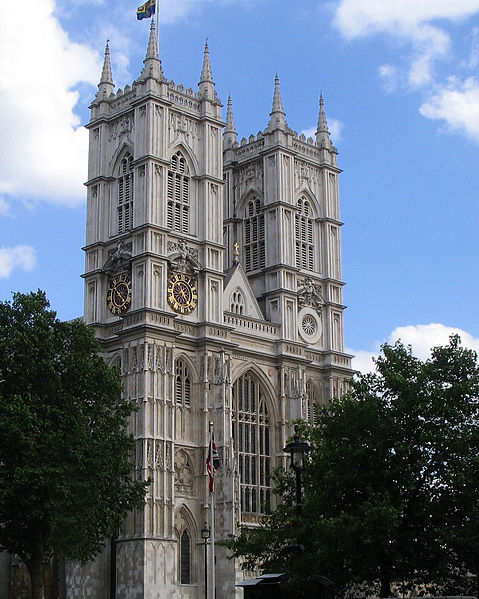
The West Towers, Westminster Abbey

The West Towers, Westminster Abbey

After the death of Wren in 1723, Hawksmoor was appointed Surveyor to Westminster Abbey. This post received 100 pounds voted by Parliament for the repair and completion of the Abbey in 1698. The west towers of the Abbey were designed by Hawksmoor but was not completed until after his death.

Hawksmoor conceived grand rebuilding schemes for central Oxford, most of which were not realised. The idea was for a round library for the Radcliffe Camera but that commission went to James Gibbs. He did design the Clarendon Building at Oxford; the Codrington Library and new buildings at All Souls College, Oxford; parts of Worcester College, Oxford with Sir George Clarke; the High Street screen at The Queen’s College, Oxford and six new churches in London.

Hawksmoor’s six London churches
In 1711, parliament passed an Act for the building of Fifty New Churches in the Cities of London and Westminster or the Suburbs thereof, which established a commission which included Christopher Wren, John Vanburgh, Thomas Archer, and a number of churchmen. It appointed Hawksmoor and William Dickinson as its surveyors. As supervising architects, they were not necessarily expected to design all the churches themselves. Dickinson left his post in 1713 and was replaced by James Gibbs. Gibbs was removed from his post in 1716 and replaced by John James. James and Hawksmoor remained in office until the commission was wound up in 1733. The declining enthusiasm of the Commission, and the expense of the buildings, meant that only twelve churches were completed, six designed by Hawksmoor, and two by James in collaboration with Hawksmoor. The two collaborations were St Luke Old Street (1727–33) and St John Horsleydown (1727–33), to which Hawksmoor’s contribution seems to have been largely confined to the towers with their extraordinary steeples. The six churches wholly designed by Hawksmoor are his best-known independent works of architecture. They compare in their complexity of interpenetrating internal spaces with contemporaneous work in Italy by Francesco Borromini. Their spires, are essentially Gothic outlines executed in innovative and imaginative Classical detail. Although Hawksmoor and John James terminated the commission by 1733, they were still being paid “for carrying on and finishing the works under their care” until James’s death.
St Alfege’s Church, Greenwich
St George’s Church, Bloomsbury
Christ Church, Spitalfields
St George in the East, Wapping
St Mary Woolnoth

Christ Church Spitalfields (1714–29), west front

Christ Church Spitalfields (1714–29), west front

Garden Buildings and Monuments

Hawksmoor also designed a number of structures for the gardens at Castle Howard these are:
The Pyramid (1728)
The Mausoleum (1729–40) built on the same scale as his London churches, it is almost certainly the first free-standing mausoleum built in Western Europe since the fall of the Roman empire.
The Carrmire Gate, (c.1730)
The Temple of Venus (1731-5) demolished
At Blenheim Palace he designed the Woodstock Gate (1723) in the form of a Triumphal arch. He also designed the obelisk in Ripon market place, erected in 1702, at 80 feet in height it was the first large scale obelisk to be erected in Britain.

Death and obituary
Hawksmoor died on 25 March 1736 in his house at Millbank from ‘Gout of the stomach.’ He had suffered poor health for the last twenty years of his life and was often confined to bed hardly able to sign his name. His will instructed that he be buried at the church at Shenley, Hertfordshire. This has been deconsecrated and his tomb stone there is now in a private garden. It has this inscription:
P M S
L
Hic J[acet]
NICHOLAUS HAWKSMOOR Armr
ARCHITECTUS
obijt vicesimo quin[t]o die [Martii]
Anno Domini 1736
Aetatis 75

Hawksmoor’s only child was a daughter, Elizabeth, whose second husband, Nathanial Blackerby, who wrote the obituary of his father-in-law.
His obituary appeared in Read’s Weekly Journal, no. 603. 27 March 1736.
: Thursday morning died, at this house on Mill-Bank, Westminster, in a very advanced age, the learned and ingenious Nicholas Hawksmoor, Esq, one of the greatest Architects this or the preceeding (sic) Century has produc’d. His early skill in, and Genius for this noble science recommended him, when about 18 years of age, to the favour and esteem of his great master and predecessor, Sir Christopher Wren, under whom, during his life, and for himself since his death, he was concerned in the erecting more Publick (sic) Edifices, than any one life, among the moderns at least, can boast of. In King Charles II’s reign, he was employ’d under Sir Christopher Wren, in the stately buildings at Winchester; as he was likewise in all the other publick structures, Palaces &c, erected by that great Man, under whom he was assisting, from the Beginning (factually wrong, Hawksmoor was 14 years old then) to the Finishing of that grand and noble Edifice the cathedral of St. Paul’s, and of all the churches rebuilt after the Fire of London. At the building of Chelsea-College he was Deputy-Surveyor, and Clerk of Works, under Sir Christopher Wren. At Greenwich-Hospital he was, from the Beginning ’till a short time before his death, Clerk of Works. In the Reigns of King William and Queen Anne, he was Clerk of their Majesties Works at Kensington, and at Whitehall, St. Jame’s and Westminster. In the reign of King George I, he was first Surveyor of all the new Churches, and Surveyor of Westminster-Abbey, from the death of Sir Christopher Wren. He was chiefly concern’d in designing and building a great number of magnificent Nobleman’s Houses, and particularly (with Sir John Vanbrugh) those of Blenheim and Castle-Howard, at the latter of which he was at his Death, carrying on a Mausoleum in the most elegant and grand Stile (sic), not to mention many others: But one of the most surprising of his undertakings, was the repairing of Beverley Minster, where the stone wall on the north-side was near three Foot out of the perpendicular, which he mov’d at once to its upright by means of a machine of his own invention. In short his numerous Publick Works at Oxford, perfected in his lifetime, and the design and model of Dr. Ratcliff’s Library there, his design of a new Parliament-House, after the thought of Sir Christopher Wren; and, to mention no more, his noble Design for repairing the West-End of Westminster-Abbey, will all stand monuments to his great capacity, inexhaustible fancy, and solid judgement. He was perfectly skill’d in the History of Architecture, and could give exact account of all the famous buildings, both Antient (sic) and Modern, in every part of the world; to which his excellent memory, that never fail’d him to the very last, greatly contributed. Nor was architecture the only science he was master of. He was bred a scholar. and knew as well the learned as the modern tongues. He was a very skilful mathematician, geographer, and geometrician; and in drawing, which he practised to the last, though greatly afflicted with Chiragra, few excelled him. In his private life he was a tender husband, a loving father, a sincere friend, and a most agreeable companion; nor could the most poignant pains of Gout, which he for many years laboured under, ever ruffle or discompose his evenness of temper. And as his memory must always be dear to his Country, so the loss of so great and valuable man in sensibly, and in a more particular manner felt by those who had the pleasure of his personal acquaintance, and enjoy’d the happiness of his conversation.

Upon his death he left a widow, to whom he bequested all his property in Westminster, Highgate, Shenley, and East Drayton, who later married William Theaker; grandchild of this second marriage ultimately inherited Hawksmoor’s properties near Drayton, after the death of the architect’s widow. Hawksmoor’s only child was a daughter, Elizabeth.

Recovering Hawksmoor’s Reputation
Modern scholarship has sought to distinguish Hawksmoor’s work from that of Christopher Wren and the other designers in the Office of Works such as Robert Hooke. Many buildings were previously attributed without distinguishing their designers by name and Hawksmoor’s reputation as an individual designer has been obscured by this fact. Modern re-apraisal began with a study in 1924 by Harry Stuart Goodhart-Rendel. The major breakthrough in Hawksmoor scholarship came with Kerry Downes’s 1979 monograph the examined the numerous documents of Hawksmooor’s work, a happy result of much of his work being for the Office of the King’s Works, who kept their records.

Hawksmoor’s influence by Old Testament descriptions of the Temple of Solomon and lost wonders of the ancient world is explored in Pierre De La Ruffiniere’s du Prey’s 2000 study of Hawksmoor. In 2002, Hawksmoor was the subject of an award-winning monograph by the architectural historian Vaughan Hart, which appraised Hawksmoor in the light of archival discoveries since the work of Kerry Downes.

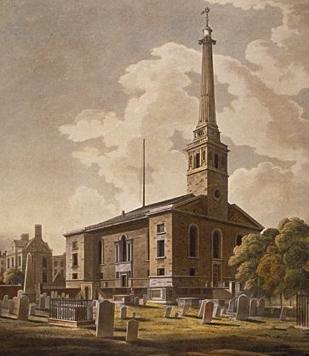
St. John's Horsleydown (1727–33), joint work with John James, tower by Hawksmoor, bombed in London Blitz then demolished

St. John’s Horsleydown (1727–33), joint work with John James, tower by Hawksmoor, bombed in London Blitz then demolished

Hawksmoor in Modern Literature
Hawksmoor’s architecture has influenced several poets and authors of the twentieth century. His church St Mary Woolnoth is mentioned in T. S. Eliot’s poem The Waste Land (1922).

Algernon Stitch lived in a “superb creation by Nicholas Hawksmoor” in London in the novel Scoop by Evelyn Waugh (1938).

Hawksmoor is the subject of a poem by Iain Sinclair called ‘Nicholas Hawksmoor: His Churches,’ which appeared in Sinclair’s collection of poems Lud Heat (1975). Sinclair promoted the poetic interpretation of the architect’s singular style of architectural composition that Hawksmoor’s churches formed a pattern consistent with the forms of Theistic Satanism though there is no documentary or historic evidence for this. This idea was, however, embellished by Peter Ackroyd in his novel Hawksmoor (1985) the historical Hawksmoor is refigured as the fictional Devil-worshiper Nicholas Dyer, while the eponymous Hawksmoor is a twentieth-century detective charged with investigating a series of murders perpertrated on Dyer’s (Hawksmoor’s) churches.

Both Sinclair and Ackroyd’s ideas in turn were further developed by Alan Moore and Eddie Campbell in their graphic novel, From Hell, which speculated that Jack the Ripper used Hawksmoor’s buildings as part of ritual magic, with his victims as human sacrifice. In the appendix, Moore revealed that he had met and spoke with Sinclair on numerous occasions while developing the core ideas of the book. The argument includes the idea that the locations of the churches form a pentagram with ritual significance.

A view of All Souls College, looking east from the University Church of St Mary the Virgin

A view of All Souls College, looking east from the University Church of St Mary the Virgin

Posted in British history, Georgian Era, Living in the Regency, real life tales, Regency era, Victorian era | Tagged , , | Comments Off on Nicholas Hawksmoor, a Builder of Georgian Churches

Book Buying Stats and Building an Author Following

This article comes from The Globe and Mail. As a mid-list author with a niche following, this struck home. To read the complete article, go to http://www.theglobeandmail.com/arts/why-book-buying-stats-might-stifle-the-next-great-author/article6755208/

This article is part of Next, The Globe’s five-day series examining the people, places, things and ideas that will shape 2013.

Given the pressure to reduce costs, something had to give in the formerly genteel world of book publishing, and it’s not the publishers. Rationalizing with mergers, capitalizing on global fads and making up in digital sales some of what they have lost in print, the big houses are stubbornly resisting their oft-foretold extinction.

The true dinosaurs of the new age are authors. Once happily enclosed in the “stables” of publishers willing to nurture and develop their talent, even if they never wrote a major bestseller, droves of so-called “mid-list” authors now find themselves roaming among the ever-present throng of wannabes flogging unpublished work in an indifferent market. And that throng is most likely to produce tomorrow’s bestsellers, even if they begin life as obscure, self-published digital texts that, onloy after they find a following, are taken up and heavily marketed to mainstream prominence by major publishing houses.

Many mid-list authors have fallen victim to increasingly sophisticated, widely available sales data, according to agents and publishers. Publishers can now assess every author’s lifelong sales thanks to such services as Nielsen Bookscan in the United States and BookNet Canada.

Posted in Industry News/Publishing | Comments Off on Book Buying Stats and Building an Author Following

John Wilson Croker, Public Steward and Controversial Regency Era Figure

490px-John_Wilson_Croker_by_William_Owen_detail John Wilson Croker (20 December 1780 to 10 August 1857) was an Irish statesman and author.

Life
He was born at Galway, the only son of John Croker, the surveyor-general of customs and excise in Ireland. He was educated at Trinity College, Dublin, where he graduated in 1800. Immediately afterwards, he entered Lincoln’s Inn, and in 1802 he was called to the Irish bar.

His interest in the French Revolution led him to collect a large number of valuable documents on the subject, which are now in the British Museum. In 1804, he published anonymously Familiar Epistles to J. F. Jones, Esquire, on the State of the Irish Stage, a series of caustic criticisms in verse on the management of the Dublin theatres. The book ran through five editions in one year. Equally successful was the Intercepted Letter from Canton (1805), also anonymous, a satire on Dublin society. During this period a rather scathing poem attributed to Croker led to the suicide of actor John Edwin, husband of Elizabeth Rebecca Edwin. In 1807, he published a pamphlet on The State of Ireland, Past and Present, in which he advocated Catholic emancipation.

The following year he entered parliament as member for Downpatrick, obtaining the seat on petition, though he had been unsuccessful at the poll. The acumen displayed in his Irish pamphlet led Spencer Perceval to recommend him in 1808 to Sir Arthur Wellesley, who had just been appointed to the command of the British forces in the Iberian Peninsula, as his deputy in the office of chief secretary for Ireland. This connection led to a friendship which remained unbroken until Wellington’s death.

The notorious case of the Duke of York in connexion with his abuse of military patronage furnished Croker with an opportunity for distinguishing himself. The speech which he delivered on 14 March 1809, in answer to the charges of Colonel Wardle, was regarded as the most able and ingenious defence of the duke that was made in the debate; and Croker was appointed to the office of secretary to the Admiralty, which he held without interruption under various administrations for more than twenty years. He proved an excellent public servant, and made many improvements which have been of permanent value in the organization of his office. Among the first acts of his official career was the exposure of George Villiers, a fellow-official who had misappropriated the public funds to the extent of £200,000.

In 1824 he helped found the Athenaeum Club, and became the subject of the lampoon beginning “I’m John Wilson Croker, I do as I please…”

In 1827, he became the representative of Dublin University, having previously sat successively for the boroughs of Athlone, Yarmouth, Bodmin and Aldeburgh. He was a determined opponent of the Reform Bill, and vowed that he would never sit in a reformed parliament; he left parliament in 1832. Two years earlier he had retired from his post at the admiralty on a pension of £1500 a year. Many of his political speeches were published in pamphlet form, and they show him to have been a vigorous and effective, though somewhat unscrupulous and often virulently personal, party debater. Croker had been an ardent supporter of Robert Peel, but finally broke with him when he began to advocate the repeal of the Corn Laws.

He was for many years one of the leading contributors on literary and historical subjects to the Quarterly Review, with which he had been associated from its foundation. The rancorous spirit in which many of his articles were written did much to embitter party feeling. It also reacted unfavourably on Croker’s reputation as a worker in the department of pure literature by bringing political animosities into literary criticism.

He had no sympathy with the younger school of poets who were in revolt against the artificial methods of the 18th century. In April 1833 he savagely criticised Poems, published the previous December by Alfred Tennyson – an attack which, coupled with the death of his friend Arthur Hallam, discouraged the aspiring poet from seeking to publish anything more for nine years. He was also responsible for the famous Quarterly article on John Keats’s Endymion. Shelley and Byron erroneously blamed this article for bringing about the death of the poet, ‘snuffed out,’ in Byron’s phrase, ‘by an article’ (they, however, attributed the article to William Gifford).

His magnum opus, an edition of Boswell’s Life of Johnson (1831) was the subject of an unfavourable review by Macaulay in the Edinburgh Review (a Whig rival/opponent of the Quarterly Review) The main grounds of criticism were echoed by Thomas Carlyle in a less famous review in Fraser’s Magazine

*** that Croker had added extensive notes, which were to little point, being superfluous or declaring Croker’s inability to grasp Johnson’s point on matters where the reviewers had no difficulty. Macaulay also complained (with numerous examples) of factual errors in the notes; Carlyle of their carping attitude to Johnson’s motives (Carlyle, whose father was a stonemason, and who (like Johnson) had scraped a living as a schoolmaster, before writing encyclopaedia articles for bread-and-butter wages, also took great exception to one note which took for granted that when Johnson spoke of having lived on 4 ½ d a day he was disclosing something of which he should have been ashamed to speak)

*** that Croker had not preserved the integrity of Boswell’s text, but had interpolated text from four other accounts of Johnson (Hawkins, Mrs Thrale, etc.), distinguished only from genuine Boswell by being inside brackets, so that “You begin a sentence under Boswell’s guidance, thinking to be carried happily through it by the same: but no; in the middle, perhaps after your semi-colon, and some consequent ‘for’ – starts up one of these Bracket-ligatures, and stitches you in half a page to twenty or thirty pages of a Hawkins, Tyers, Murphy, Piozzi; so that often one must make the old sad reflection, Where we are, we know; whether we are going no man knoweth.”

Croker made no immediate reply to Macaulay’s attack, but when the first two volumes of Macaulay’s History appeared he took the opportunity of pointing out the inaccuracies in the work. Croker was occupied for several years on an annotated edition of Alexander Pope’s works. It was left unfinished at the time of his death, but it was afterwards completed by the Rev. Whitwell Elwin and Mr WJ Courthope. He died at St Albans Bank, Hampton.

Croker was generally supposed to be the original from which Benjamin Disraeli drew the character of “Rigby” in Coningsby, because he had for many years had the sole management of the estates of the Marquess of Hertford, the “Lord Monmouth” of the story. Hostile portrayals of Croker can also be found in the novels Florence Macarthy by Lady Morgan (a political opponent whom Croker subjected to notoriously savage reviews in the Quarterly) and The Anglo-Irish of the Nineteenth Century (1828) by John Banim.

The chief works of Croker not already mentioned were:
Stories for Children from the History of England (1817), which provided the model for Scott’s Tales of a Grandfather
Letters on the Naval War with America
A Reply to the Letters of Malachi Malagrowther (1826)
Military Events of the French Revolution of 1830 (1831)
a translation of Bassompierre’s Embassy to England (1819)
He also wrote several lyrical pieces of some merit, such as the Songs of Trafalgar (1806) and The Battles of Talavera (1809). He edited the Suffolk Papers (1823), Hervey’s Memoirs of the Court of George II (1817), the Letters of Mary Lepel, Lady Hervey (1821–1822), and Walpole’s Letters to Lord Hertford (1824). His memoirs, diaries and correspondence were edited by Louis J Jennings in 1884 under the title of The Croker Papers (3 vols.).

Posted in British history, Georgian Era, Living in the Regency, real life tales, Regency era | Tagged , , | Comments Off on John Wilson Croker, Public Steward and Controversial Regency Era Figure

Spencer Perceval, the UK’s Only Assassinated Prime Minister

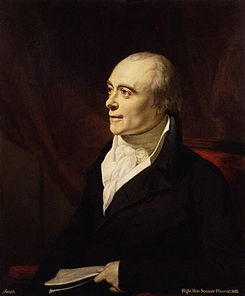
245px-Spencer_Perceval Spencer Perceval, KC (1 November 1762 – 11 May 1812) was the Prime Minister of the United Kingdom from 4 October 1809 until his death on 11 May 1812. He is the only British Prime Minister to have been assassinated. He is also the only Solicitor General or Attorney General to have been Prime Minister.

The younger son of an Irish earl, Perceval was educated at Harrow and Trinity College, Cambridge. He studied law at Lincoln’s Inn, practised as a barrister on the Midland Circuit and in 1796 became a King’s Counsel before entering politics at the age of 33 as a Member of Parliament for Northampton. A follower of William Pitt, Perceval always described himself as a “friend of Mr Pitt,” rather than a Tory. Perceval was opposed to Catholic emancipation and reform of Parliament; he supported the war against Napoleon and the abolition of the slave trade. He was opposed to hunting, gambling and adultery, did not drink as much as most Members of Parliament, gave generously to charity, and enjoyed spending time with his twelve children.

After a late entry into politics his rise to power was rapid; he was Solicitor and then Attorney General in the Addington Ministry, Chancellor of the Exchequer and Leader of the House of Commons in the Portland Ministry, and became Prime Minister in October 1809. At the head of a weak ministry, Perceval faced a number of crises during his term in office including an inquiry into the disastrous Walcheren expedition, the madness of King George III, economic depression and Luddite riots. He survived these crises, successfully pursued the Peninsular War in the face of opposition defeatism, and won the support of the Prince Regent. His position was looking stronger by the spring of 1812, when John Bellingham, a merchant with a grievance against the Government, shot him dead in the lobby of the House of Commons.

Although Perceval was a seventh son and had four older brothers who survived to adulthood, the Earldom of Egmont reverted to one of his great-grandsons in the early 20th century and remained in the hands of his descendants until its extinction in 2011.

Childhood and Education
Perceval was the seventh son of John Perceval, 2nd Earl of Egmont; he was the second son of the earl’s second marriage. His mother, Catherine Compton, Baroness Arden, was a grand-daughter of the 4th Earl of Northampton. Spencer was a Compton family name; Catherine Compton’s great uncle Spencer Compton, 1st Earl of Wilmington, had been Prime Minister.

His father, a political advisor to Frederick, Prince of Wales and King George III, served briefly in the Cabinet as First Lord of the Admiralty. Perceval’s early childhood was spent at Charlton House, which his father had taken to be near Woolwich docks.

Perceval’s father died when he was eight. Perceval went to Harrow School, where he was a disciplined and hard-working pupil. It was at Harrow that he developed an interest in evangelical Anglicanism and formed what was to be a lifelong friendship with Dudley Ryder. After five years at Harrow he followed his older brother Charles to Trinity College, Cambridge, where he won the declamation prize in English and graduated in 1782.

Legal Career and Marriage
As the second son of a second marriage, and with an allowance of only £200 a year, Perceval faced the prospect of having to make his own way in life. He chose the law as a profession, studied at Lincoln’s Inn, and was called to the bar in 1786. Perceval’s mother had died in 1783, and Perceval and his brother Charles, now Lord Arden, rented a house in Charlton, where they fell in love with two sisters who were living in the Percevals’ old childhood home. The sisters’ father, Sir Thomas Spencer Wilson, approved of the match between his eldest daughter Margaretta and Lord Arden, who was wealthy and already a Member of Parliament and a Lord of the Admiralty. Perceval, who was at that time an impecunious barrister on the Midland Circuit, was told to wait until younger daughter Jane came of age in three years’ time. When Jane reached 21 in 1790 Perceval’s career was still not prospering, and Sir Thomas still opposed the marriage. So the couple eloped and married by special licence in East Grinstead. They set up home together in lodgings over a carpet shop in Bedford Row, later moving to Lindsey House, Lincoln’s Inn Fields.

Perceval’s family connections obtained a number of positions for him: Deputy Recorder of Northampton, and Commissioner of Bankrupts in 1790; Surveyor of the Maltings and Clerk of the Irons in the Mint — a sinecure worth £119 a year – in 1791; counsel to the Board of Admiralty in 1794. He acted as junior counsel for the Crown in the prosecutions of Thomas Paine in absentia for seditious libel (1792), and John Horne Tooke for high treason (1794). Perceval joined the Light Horse Volunteers in 1794 when the country was under threat of invasion by France.

Perceval wrote anonymous pamphlets in favour of the impeachment of Warren Hastings, and in defence of public order against sedition. These pamphlets brought him to the attention of William Pitt the Younger and in 1795 he was offered the appointment of Chief Secretary for Ireland. He declined the offer. He could earn more as a barrister and needed the money to support his growing family. In 1796 he became a King’s Counsel and had an income of about £1000 a year.

Early Political Career 1796–1801
In 1796 Perceval’s uncle, the 8th Earl of Northampton, died. Perceval’s cousin, who was MP for Northampton, succeeded to the Earldom and took his place in the House of Lords. Perceval was invited to stand for election in his place. In the May by-election he was elected unopposed, but weeks later had to defend his seat in a fiercely contested general election. Northampton had an electorate of about one thousand — every male householder not in receipt of poor relief had a vote — and the town had a strong radical tradition. Perceval stood for the Castle Ashby interest, Edward Bouverie for the Whigs, and William Walcot for the corporation. After a disputed count Perceval and Bouverie were returned. Perceval represented Northampton until his death 16 years later, and is the only MP for Northampton to have held the office of Prime Minister. 1796 was his first and last contested election; in the general elections of 1802, 1806 and 1807 Perceval and Bouverie were returned unopposed.

When Perceval took his seat in the House of Commons in September 1796 his political views were already formed. “He was for the constitution and Pitt; he was against Fox and France,” wrote his biographer Denis Gray. During the 1796–1797 session he made several speeches, always reading from notes. His public speaking skills had been sharpened at the Crown and Rolls debating society when he was a law student. After taking his seat in the House of Commons, Perceval continued with his legal practice as MPs did not receive a salary, and the House only sat for a part of the year. During the Parliamentary recess of the summer of 1797 he was senior counsel for the Crown in the prosecution of John Binns for sedition. Binns, who was defended by Samuel Romilly, was found not guilty. The fees from his legal practice allowed Perceval to take out a lease on a country house, Belsize House in Hampstead.

It was during the next session of Parliament, in January 1798, that Perceval established his reputation as a debater — and his prospects as a future minister — with a speech in support of the Assessed Taxes Bill (a bill to increase the taxes on houses, windows, male servants, horses and carriages, in order to finance the war against France). He used the occasion to mount an attack on Charles Fox and his demands for reform. Pitt described the speech as one of the best he had ever heard, and later that year Perceval was given the post of Solicitor to the Ordnance.

Solicitor and Attorney General 1801–1806
Pitt resigned in 1801 when the King and Cabinet opposed his bill for Catholic emancipation. As Perceval shared the King’s views on Catholic emancipation he did not feel obliged to follow Pitt into opposition and his career continued to prosper during Henry Addington’s administration. He was appointed Solicitor General in 1801 and Attorney General the following year. Perceval did not agree with Addington’s general policies (especially on foreign policy), and confined himself to speeches on legal issues. He kept the position of Attorney General when Addington resigned and Pitt formed his second ministry in 1804. As Attorney General Perceval was involved with the prosecution of radicals Edward Despard and William Cobbett, but was also responsible for more liberal decisions on trade unions, and for improving the conditions of convicts transported to New South Wales.

Pitt died in January 1806. Perceval was an emblem bearer at his funeral and, although he had little money to spare (by now he had eleven children), he contributed £1000 towards a fund to pay off Pitt’s debts. He resigned as Attorney General, refusing to serve in Lord Grenville’s ministry of “All the Talents” as it included Fox. Instead he became the leader of the Pittite opposition in the House of Commons.

During his period in opposition, Perceval’s legal skills were put to use to defend Princess Caroline, the estranged wife of the Prince of Wales, during the “delicate investigation”. The Princess had been accused of giving birth to an illegitimate child and the Prince of Wales ordered an inquiry, hoping to obtain evidence for a divorce. The Government inquiry found that the main accusation was untrue (the child in question had been adopted by the princess) but was critical of the behaviour of the princess. The opposition sprang to her defence and Perceval became her advisor, drafting a 156-page letter in her support to King George III. Known as “The Book,” it was described by Perceval’s biographer as “the last and greatest production of his legal career.” When the King refused to let Caroline return to court, Perceval threatened publication of the book. But Grenville’s ministry fell – again over a difference of opinion with the King on the Catholic question – before the book could be distributed and, as a member of the new Government, Perceval drafted a cabinet minute acquitting Caroline on all charges and recommending her return to court. He had a bonfire of the book at Lindsey House and large sums of Government money were spent on buying back stray copies, but a few remained at large and “The Book” was published soon after his death.

Chancellor of the Exchequer 1807–1809
On the resignation of Grenville, the Duke of Portland put together a ministry of Pittites and asked Perceval to become Chancellor of the Exchequer and Leader of the House of Commons. Perceval would have preferred to remain Attorney General or become Home Secretary, and pleaded ignorance of financial affairs. He agreed to take the position when the salary (smaller than that of the Home Office) was augmented by the Duchy of Lancaster. Lord Hawkesbury (later Liverpool) recommended him to the king by explaining that he came from an old English family and shared the king’s views on the Catholic question.

Perceval’s youngest child, Ernest Augustus, was born soon after Perceval became Chancellor (Princess Caroline was godmother). Jane Perceval became ill after the birth and the family moved out of the damp and draughty Belsize House, spending a few months in Lord Teignmouth’s house in Clapham before finding a suitable country house in Ealing. Elm Grove was a 16th-century house that had been the home of the Bishop of Durham; Perceval paid £7,500 for it in 1808 (borrowing from his brother Lord Arden and the trustees of Jane’s dowry) and the Perceval family’s long association with Ealing began. Meanwhile, in town, Perceval had moved from Lindsey House into 10 Downing Street, when the Duke of Portland moved back to Burlington House shortly after becoming Prime Minister.

One of Perceval’s first tasks in Cabinet was to expand the Orders in Council that had been brought in by the previous administration and were designed to restrict the trade of neutral countries with France, in retaliation to Napoleon’s embargo on British trade. He was also responsible for ensuring that Wilberforce’s Bill on the Abolition of the Slave Trade, which had still not passed its final stages in the House of Lords when Grenville’s ministry fell, would not “fall between the two ministries” and be rejected in a snap division.[6] Perceval was one of the founding members of the African Institute, which was set up in April 1807 to safeguard the Abolition of the Slave Trade Act.

As Chancellor of the Exchequer Perceval had to raise money to finance the war against Napoleon. This he managed to do in his budgets of 1808 and 1809 without increasing taxes, by raising loans at reasonable rates and making economies. As leader of the House of Commons he had to deal with a strong opposition, which challenged the government over the conduct of the war, Catholic emancipation, corruption and Parliamentary reform. Perceval successfully defended the Commander-in-Chief of the army, the Duke of York, against charges of corruption when the Duke’s ex-mistress Mary Anne Clarke claimed to have sold army commissions with his knowledge. Although Parliament voted to acquit the Duke of the main charge, his conduct was criticised and he accepted Perceval’s advice to resign. (He was to be re-instated in 1811).

Portland’s ministry contained three future prime-ministers – Perceval, Lord Hawkesbury and George Canning – as well as another two of the 19th-century’s great statesmen: Lord Eldon and Lord Castlereagh. But Portland was not a strong leader and his health was failing. The country was plunged into political crisis in the summer of 1809 as Canning schemed against Castlereagh and the Duke of Portland resigned following a stroke. Negotiations began to find a new Prime Minister: Canning wanted to be Prime Minister or nothing, Perceval was prepared to serve under a third person, but not Canning. The remnants of the cabinet decided to invite Lord Grey and Lord Grenville to form “an extended and combined administration” in which Perceval was hoping for the Home Secretaryship. But Grenville and Grey refused to enter into negotiations, and the king accepted the Cabinet’s recommendation of Perceval for his new Prime Minister. Perceval kissed the king’s hands on 4 October and set about forming his Cabinet, a task made more difficult by the fact that Castlereagh and Canning had ruled themselves out of consideration by fighting a duel (which Perceval had tried to prevent). Having received five refusals for the office, he had to serve as his own Chancellor of the Exchequer – characteristically declining to accept the salary.

Prime Minister 1809-1812
The new ministry was not expected to last. It was especially weak in the Commons, where Perceval had only one cabinet member – Home Secretary Richard Ryder – and had to rely on the support of backbenchers in debate. In the first week of the new Parliamentary session in January 1810 the Government lost four divisions, one on a motion for an inquiry into the disastrous Walcheren expedition (in which, the previous summer, a military force intending to seize Antwerp had instead withdrawn after losing many men to an epidemic on the island of Walcheren) and three on the composition of the finance committee. The Government survived the inquiry into the Walcheren expedition at the cost of the resignation of the expedition’s leader Lord Chatham. The radical MP Sir Francis Burdett was committed to the Tower of London for having published a letter in William Cobbett’s Political Register denouncing the government’s exclusion of the press from the inquiry. It took three days, owing to various blunders, to execute the warrant for Burdett’s arrest. The mob took to the streets in support of Burdett, troops were called out, and there were fatal casualties. As Chancellor, Perceval continued to find the funds to finance Wellington’s campaign in the Iberian Peninsula, whilst contracting a lower debt than his predecessors or successors.

King George III had celebrated his Golden Jubilee in 1809; by the following autumn he was showing signs of a return of the illness that had led to a Regency in 1788. The prospect of another Regency was not attractive to Perceval, as the Prince of Wales was known to favour Whigs and disliked Perceval for the part he had played in the “delicate investigation”. Twice Parliament was adjourned in November 1810, as doctors gave optimistic reports about the King’s chances of a return to health. In December select committees of the Lords and Commons heard evidence from the doctors, and Perceval finally wrote to the Prince of Wales on 19 December saying that he planned the next day to introduce a Regency Bill. As with Pitt’s bill in 1788, there would be restrictions: the Regent’s powers to create peers and award offices and pensions would be restricted for 12 months, the Queen would be responsible for the care of the King, and the King’s private property would be looked after by trustees.

The Prince of Wales, supported by the Opposition, objected to the restrictions, but Perceval steered the bill through Parliament. Everyone had expected the Regent to change his ministers but, surprisingly, he chose to retain his old enemy Perceval. The official reason given by the Regent was that he did not wish to do anything to aggravate his father’s illness. The King signed the Regency Bill on 5 February, the Regent took the royal oath the following day and Parliament formally opened for the 1811 session. The session was largely taken up with problems in Ireland, economic depression and the bullion controversy in England (a Bill was passed to make bank notes legal tender), and military operations in the Peninsula.

The restrictions on the Regency expired in February 1812, the King was still showing no signs of recovery, and the Prince Regent decided, after an unsuccessful attempt to persuade Grey and Grenville to join the government, to retain Perceval and his ministers. Richard Wellesley, 1st Marquess Wellesley, after intrigues with the Prince Regent, resigned as Foreign Secretary and was replaced by Castlereagh. The Opposition meanwhile was mounting an attack on the Orders in Council, which had caused a crisis in relations with America and were widely blamed for depression and unemployment in England. Rioting had broken out in the Midlands and North, and been harshly repressed. Henry Brougham’s motion for a select committee was defeated in the Commons, but, under continuing pressure from manufacturers, the government agreed to set up a Committee of the Whole House to consider the Orders in Council and their impact on trade and manufacture. The committee began its examination of witnesses in early May 1812.

A painting depicting the assassination of Perceval. Perceval is lying on the ground while his assassin, John Bellingham, is surrendering to officials (far right) A painting depicting the assassination of Perceval. Perceval is lying on the ground while his assassin, John Bellingham, is surrendering to officials (far right)Assassination

At 5:15 on the evening of 11 May 1812, Perceval was on his way to attend the inquiry into the Orders in Council. As he entered the lobby of the House of Commons, a man stepped forward, drew a pistol and shot him in the chest. Perceval fell to the floor, after uttering something that was variously heard as “murder” or “oh my God.” They were his last words. By the time he had been carried into an adjoining room and propped up on a table with his feet on two chairs, he was senseless, although there was still a faint pulse. When a surgeon arrived a few minutes later, the pulse had stopped, and Perceval was declared dead.

At first it was feared that the shot might signal the start of an uprising, but it soon became apparent that the assassin – who had made no attempt to escape – was a man with an obsessive grievance against the Government and had acted alone. John Bellingham was a merchant who believed he had been unjustly imprisoned in Russia and was entitled to compensation from the Government, but all his petitions had been rejected.[9] Perceval’s body was laid on a sofa in the Speaker’s drawing room and removed to Number 10 in the early hours of 12 May. That same morning an inquest was held at the Cat and Bagpipes public house on the corner of Downing Street and a verdict of wilful murder was returned.

Perceval left a widow and twelve children aged between three and twenty, and there were soon rumours that he had not left them well provided for. He had just £106 5s 1d in the bank when he died. A few days after his death, Parliament voted to settle £50,000 on Perceval’s children, with additional annuities for his widow and eldest son. Jane Perceval married Lieutenant-Colonel Sir Henry Carr, brother of the Reverend Robert James Carr, then vicar of Brighton, in 1815 and was widowed again six years later. She died aged 74 in 1844.

Perceval was buried on 16 May in the Egmont vault at St Luke’s Church, Charlton. At his widow’s request, it was a private funeral. Lord Eldon, Lord Liverpool, Lord Harrowby and Richard Ryder were the pall-bearers. The previous day, Bellingham had been tried, and, refusing to enter a plea of insanity, was found guilty. He was hanged on 18 May.

In a curious echo Henry Bellingham, who is descended from a relative of Bellingham’s, was elected in 1983 as the Member of Parliament for North West Norfolk. In 1997 he lost the seat by 1,339 votes. This could be attributed in part to the 2,923 votes received by the Referendum Party candidate Roger Percival, who claimed to be descended from Perceval.

Posted in Uncategorized | Tagged , , , | 2 Comments

Infamous Court Cases: The 1828 Burke and Hare Murders

Hare_and_Burke_drawing The Burke and Hare murders, also known as the West Port murders, were a series of murders committed in Edinburgh, Scotland, over a period of about ten months in 1828. The killings were attributed to Irish immigrants William Burke and William Hare, who sold the corpses of their 16 victims to Doctor Robert Knox as dissection material for his well-attended anatomy lectures. Burke and Hare’s accomplices were Burke’s mistress, Helen McDougal, and Hare’s wife, Margaret Laird. From their method of killing their victims came the word “burking,” meaning to smother and compress the chest of a murder victim, and a derived meaning, to suppress something quietly.

Before 1832, there were insufficient cadavers legitimately available for the study and teaching of anatomy in Britain’s medical schools. As medical science began to flourish in the early nineteenth century, the demand for cadavers rose sharply, but at the same time the legal supply failed to keep pace. One of the main sources—the bodies of executed criminals—had begun to dry up owing to a reduction in the number of executions being carried out in the early nineteenth century. The situation of too few corpses available to doctors for demonstrating anatomical dissection to growing numbers of students attracted criminal elements willing to obtain specimens by any means. As at similar institutions, doctors teaching at the Edinburgh Medical School, which was universally renowned for medical sciences, relied increasingly on body-snatchers for a steady supply of “anatomical subjects.” The activities of these “resurrectionists” gave rise to particular public fear and revulsion, but, such were the financial inducements, the illegal trade continued to grow. It was a short step from grave-robbing to anatomy murder.

Burke and Hare
Burke (1792–1829) was born in Urney, near Strabane, in the very west of County Tyrone, part of the Province of Ulster in the north of Ireland. Urney, a small district where the village of Clady is located, lies on the eastern bank of the River Finn, just across from County Donegal. After trying his hand at a variety of trades and serving as an officer’s servant in the Donegal Militia, he left his wife and two children in Ireland and emigrated to Scotland about 1817, working as a navvy on the Union Canal. There he met Helen McDougal. Burke afterwards worked as a labourer, weaver, baker and a cobbler.

Hare’s birthplace is variously given as Poyntzpass near Newry, or Derry, both of which are also in the Province of Ulster in Ireland. He was born in 1792 or 1804. Like Burke, he emigrated to Scotland and worked as a labourer on the Union Canal. While working at the Edinburgh terminus of the canal, he met a man named Logue, who ran a lodging-house for beggars and vagrants in the nearby West Port area of the town. When Logue died in 1826, Hare married Logue’s widow, Margaret Laird. She continued to run the lodging house while Hare worked at the canal basin.

Something of Hare’s origins and character are revealed in the following account from the Newry Telegraph of 31 March 1829.

Hare was born and bred about one half mile distant from Scarva in the opposite county of Armagh and shortly before his departure from this country he lived in the service of Mr Hall, the keeper of the eleventh lock near Poyntzpass. He was chiefly engaged in driving the horses which his master employed in hauling lighters on the Newry Canal. He was always remarkable for being of a ferocious and malignant disposition, an instance of which he gave in the killing of one of his Master’s horses, which obliged him to fly to Scotland where he perpetrated those unparalleled crimes that must always secure him a conspicuous page in the annals of murder.

Murders
Shortly after their arrival in Edinburgh in November 1827, Burke and McDougal moved into Tanner’s Close where Margaret Hare’s lodging-house was situated. Burke had met Margaret on previous trips to Edinburgh, but it is not known whether he was previously acquainted with Hare. Once Burke arrived in the close, they became good friends.

According to Hare’s later testimony, the first body they sold was that of a tenant, an old army pensioner who had died of natural causes on 29 November 1827. He had died owing Hare £4 rent, so to recoup the loss they substituted the body by filling the coffin with bark and took the cadaver to Edinburgh University, looking for a purchaser. According to Burke’s later testimony, they asked for directions to Professor Monro, but a student directed them instead to Surgeon’s Square where they sold the body for £7.10s (2010 values: £731, US$1,130) to an assistant of Dr. Robert Knox, an anatomist of considerable reputation owing to the knowledge and skill he had gained as an army surgeon at the time of Waterloo. But for this chance encounter, the public opprobrium, which later fell on Knox, would have attached to Munro.

Knox was an extra-mural lecturer who, as was customary at the time, charged fees to medical students and visitors attending his lectures on anatomy. His advertising promised “a full Demonstration on Anatomical Subjects” as part of every course of lectures he delivered, and he boasted that his lectures drew a class of above 400 pupils.

Burke and Hare’s first murder victim was a sick tenant named Joseph, a miller by trade, whom they plied with whisky and then suffocated. When there were no other sickly tenants, they decided to lure a victim from the street. In February 1828, they invited pensioner Abigail Simpson to spend the night before her return home to the village of Gilmerton. The following morning they employed the same modus operandi, serving her with alcohol to intoxicate her, and then smothering her. This time they placed the body in a tea-chest and handed it over to a porter sent to meet them “at the back of the Castle.” They were paid £10.

Mary Paterson
Two further undated murders took place that spring. One victim was invited into the house by Mrs Hare and plied with drink until Hare’s arrival; the other was dispatched in similar circumstances by Burke acting on his own. Next, Burke encountered two women, Mary Paterson and Janet Brown, in the section of Edinburgh known as the Canongate. He invited them to breakfast at his brother’s house in Gibb’s Close, but Brown left when an argument broke out between McDougal and Burke. When she returned, she was told Paterson had left with Burke; in fact, she, too, had been taken to Dr. Knox’s rooms in a tea-chest. The two women were described as prostitutes in contemporary accounts. The story later arose that one of Knox’s students had recognized the dead Paterson, whose acquaintance he had made a few days earlier.

Daft Jamie
One victim was an acquaintance of Burke, a woman called Effie who scavenged for a living and was in the habit of selling him scraps of leather she found, which he could use for his cobbling. They were paid £10 for her body. Then Burke “saved” an inebriated woman from being held by a policeman and his assisting neighbour by claiming he knew her and could take her back to her lodging. He delivered her body to the medical school just hours later. The next two victims were an old woman and her mute son or grandson, aged about 12.

While the woman died from an overdose on painkillers, Hare took the young boy and stretched him over his knee, then proceeded to break his back. He later said that this was the murder which disturbed him the most, as he was haunted by his recollection of the boy’s expression. The customary tea-chest being found inadequate, both bodies were forced into a herring barrel and conveyed to Surgeons’ Square, where they fetched £8 each.
According to Burke, the barrel was loaded onto a cart which Hare’s horse refused to pull uphill from the Cowgate, so Hare had to call a porter to help him drag it the rest of the way on a sled. Once back in Tanner’s Close, Hare took his anger out on the horse by shooting it dead in the yard.

Mrs Docherty
Two more victims were Burke’s acquaintance, Mrs. Hostler, and one of McDougal’s relatives, Ann Dougal, a cousin from Falkirk. Burke later claimed that about this time Mrs Hare suggested converting Helen McDougal into merchandise on the grounds that “they could not trust her, as she was a Scotch woman”; but he had refused.

Another victim was Mary Haldane, a former lodger who, down on her luck, asked to sleep in Hare’s stable. Burke and Hare also murdered her daughter Peggy Haldane when she called a few days later to inquire after her mother’s whereabouts.

Burke and Hare’s next victim was a familiar figure in the streets of Edinburgh, a mentally retarded young man with a limp, named James Wilson. “Daft Jamie,” as he was known locally, was 18 at the time of his murder. The boy resisted, and the pair had to kill him together, though later each blamed the other for taking the main part in the crime. His mother began searching and asking for the boy.

When Dr. Knox uncovered the body the next morning, several students recognized Jamie. Knox denied that it was the missing boy, and was reported to have dissected the body ahead of others to render the remains unrecognizable.

While Hare was in the habit of disposing of victims’ clothing in the Union Canal, Burke passed Jamie’s clothes to his nephews, leaving behind material evidence which was recovered before the trial. Burke stated later that he and Hare were “generally in a state of intoxication” when the murders were carried out, and that he “could not sleep at night without a bottle of whisky by his bedside, and a twopenny candle to burn all night beside him; when he awoke he would take a draught of the bottle—sometimes half a bottle at a draught—and that would make him sleep.”

The last victim was Mrs Mary Docherty. Burke lured her into the lodging house by claiming his mother was also a Docherty, but he had to wait to complete his murderous task because of the presence of lodgers, James and Ann Gray. The Grays left for the night and neighbours later reported having heard the sounds of a struggle and even a woman’s voice crying “murder!”

Detection
The next day the Grays returned, and Ann Gray became suspicious when Burke would not let her approach a bed where she had left her stockings. When they were left alone in the house in the early evening, the Grays checked the bed and found Docherty’s body under it. On their way to alert the police, they ran into McDougal who tried to bribe them with an offer of £10 a week. They refused.

Burke and Hare had removed the body from the house before the police arrived. However, under questioning, Burke claimed Docherty had left at 7 A.M., while McDougal claimed she had left in the evening. The police arrested them. An anonymous tip-off led the authorities to Knox’s dissecting-rooms, where they found Docherty’s body, which James Gray identified. William and Margaret Hare were arrested soon thereafter. The murder spree had lasted almost ten months.

When an Edinburgh paper reported the disappearances on 6 November 1828, Janet Brown went to the police and identified her friend Mary Paterson’s clothing.

Trial and execution
The evidence against the pair was far from conclusive. In the one case for which the authorities had a body (Mrs Docherty’s) the medical experts could not state the cause of death with any certainty, and the prospect seemed real that Burke and Hare would blame each other for the murders, leaving a jury uncertain as to whom to convict for a capital offence. Lord Advocate Sir William Rae, therefore, offered Hare the opportunity “to turn King’s evidence”, i.e. be granted immunity from prosecution if he confessed and agreed to testify against Burke.

Contemporary accounts suggest Burke was perceived as the more intelligent of the two, and was, therefore, presumed to have taken the lead in their crimes. After visiting both men in their cells, Christopher North described them in Blackwood’s Magazine (March 1829):– although there was “nothing repulsive” about Burke who was “certainly not deficient in intellect”, he was “steeped in hypocrisy and deceit; his collected and guarded demeanour, full of danger and guile”, a “cool, calculating, callous and unrelenting villain”; Hare, on the other hand, was “the most brutal man ever subjected to my sight, and at first look seemingly an idiot.” Comparing the two women, he observed that Mrs Hare “had more of the she-devil.”

The Lord Advocate’s decision was extremely unpopular with the press and the public, which throughout the trial expressed hostility towards the Hares. A petition on behalf of James Wilson’s mother and sister, protesting against Hare’s immunity and intended release from prison, was given lengthy consideration by the High Court and rejected by a vote of 4 to 2 against.

Burke and McDougal faced three charges of murder in respect of Mary Paterson, James Wilson, and Mrs Docherty (the third charge to be heard first and, on a successful capital conviction, the other two to remain unheard). The trial took place on Christmas Eve 1828 and lasted twenty-four hours. A journalist who was present described the dismal scene in the packed court-room,

By orders from the Court a large window was thrown open as far as it could be done, and a current of cold damp air beat for twenty-four hours upon the heads of the whole audience… The greater part of the audience being Advocates and Writers to the Signet in their gowns, these were wrapped round their heads, and, intermingled with various coloured handkerchiefs in every shade and form of drapery, which gave to the visages that were enshrouded under them such a grim and grisly aspect as assimilated them to a college of monks or inquisitors, or characters imagined in tales of romance, grouped and contrasted most fantastically with the costume of the bench and the crowded bar engaged in the trial.

The jury retired to consider its verdict at 8.30 A.M. on Christmas Morning and returned fifty minutes later to find Burke guilty of the third charge and the charge against McDougal not proven.

Before passing the death sentence, the Lord Justice-Clerk, David Boyle, addressed Burke with the words,

You now stand convicted, by the verdict of a most respectable jury of your country, of the atrocious murder charged against you in this indictment, upon evidence which carried conviction to the mind of every man that heard it. (…) In regard to your case, the only doubt that has come across my mind, is, whether, in order to mark the sense that the Court entertains of your offence, and which the violated laws of the country entertain respecting it, your body should not be exhibited in chains, in order to deter others from the like crimes in time coming. But, taking into consideration that the public eye would be offended with so dismal an exhibition, I am disposed to agree that your sentence shall be put in execution in the usual way, but accompanied with the statutory attendant of the punishment of the crime of murder, viz.- that your body should be publicly dissected and anatomized. And I trust, that if it is ever customary to preserve skeletons, yours will be preserved, in order that posterity may keep in remembrance of your atrocious crimes.

The edition of the Edinburgh Evening Courant newspaper that covered the trial sold an extra 8,000 copies, increasing its revenue by £240.

Burke was hanged at 8:15 A.M. on 28 January 1829, a day of torrential rain, in front of a crowd estimated at between 20,000 and 25,000. Window-seats in tenements overlooking the scaffold were hired at prices ranging from 5 shillings to £1. On the following day, Burke was publicly dissected in the anatomy theatre of the University’s Old College. Police had to be called when large numbers of students gathered demanding access to the lecture, for which a limited number of tickets had been issued. A minor riot ensued and calm was restored only after one of the university professors decided to allow the would-be gatecrashers to pass through the theatre in batches of fifty at a time. During the dissection, which lasted for two hours, Professor Alexander Monro dipped his quill pen into Burke’s blood and wrote “This is written with the blood of Wm Burke, who was hanged at Edinburgh. This blood was taken from his head.”

Burke’s skeleton is displayed at the University of Edinburgh’s Anatomy Museum. His death mask and items made from his tanned skin are exhibited at Surgeons’ Hall. Following the execution and dissection wallets supposedly made from his skin were offered for sale on the streets of Edinburgh. A calling card case made from his skin is displayed at The Police Information Centre in Edinburgh’s Royal Mile.
Calling Card Case made from Burke's skin

Calling Card Case made from Burke’s skin

McDougal was released after the charge against her was found to be not proven. Knox was not prosecuted, despite public outrage at his role in providing an incentive for the 16 murders. Burke swore in his confession that Knox had known nothing of the origin of the cadavers.

Summary of victims

Burke made two confessions while awaiting execution: an official judicial confession (3 January 1829) and a statement to the Edinburgh Evening Courant (7 February 1829). While these differ to some extent in chronological sequence and detail, combining their content enables the following list of victims to be compiled (and, where known, the amounts paid for them). Burke asked in his condemned cell whether Knox could pay the £5 share of the money he was expecting to receive for Mrs Docherty so that he could buy a new set of clothes before appearing in public on the scaffold.

— Donald, the pensioner (£7.10s)
1. Abigail Simpson of Gilmerton (£10)
2. Joseph, the miller (£10)
3. Drunken female lodger (£10) – Burke acting alone
4. English male lodger from Cheshire (£10)
5. Mary Haldane, lodger (?)
6. Effie, the cinder-gatherer* (£10)
7. Glasgow woman (£8)
8. Glasgow woman’s son or grandson (£8)
9. Female lodger – Hare acting alone (?)
10. Drunken woman in the West Port (£10) `
11. Margaret Haldane* (£8)
12. Mary Paterson, the street-walker, also known as Mary Mitchell (£8)
13. Mrs Hostler, the washerwoman (£8)
14. Ann McDougal, cousin of Helen (£10)
15. James Wilson (£10)
16. Mary Docherty, the beggar-woman, also known as Margery Campbell (-)
(9 were killed in “Hare’s House” and 2* in the stables in the courtyard; 4 were killed in “Burke’s House” (two closes east from Tanner’s Close where he and McDougall had gone to lodge with a carter called Brogan); and 1 at the house of Burke’s brother, Constantine Burke, in the Canongate; 12 of the victims were women.)

The novelist Sir Walter Scott commented,
Our Irish importation have made a great discovery of Oeconomicks, namely, that a wretch who is not worth a farthing while alive, becomes a valuable article when knockd on the head & carried to an anatomist; and acting on this principle, have cleard the streets of some of those miserable offcasts of society, whom nobody missd because nobody wishd to see them again.

Aftermath
McDougal returned to her house, but on venturing out the following evening to buy liquor was attacked by an angry mob and had to be taken into police custody for her own safety. She was taken to the police station in the West Port, but after the mob laid siege to it, she was dressed in men’s clothes and escaped through a back window to the police lock-up off the town’s High Street. After meeting with a hostile reception on returning to her home area of Stirling, she revisited Edinburgh briefly before moving on to Newcastle, where she was again recognized, attacked and taken into police custody. The authorities took her to the county border with Durham, after which her trail went cold. She was rumoured to have died in Australia in 1868.

Margaret Hare was released from the Calton Gaol and almost immediately spotted making her way to the Old Town and surrounded by a hostile crowd, from which she was rescued by police intervention. After a few days in the High Street lock-up, she moved to Glasgow where, according to newspaper reports, she and her child had to be rescued on two occasions from hostile mobs. She was moved secretly from the Calton Police Office to Greenock where the police put her on board a ship bound for Belfast on the way to her family home near Derry.

Hare was released in February 1829 and immediately assisted in leaving Edinburgh by the mailcoach to Dumfries. At one of its stops, he was recognized by a fellow-passenger who, as chance would have it, was a junior counsel who had represented James Wilson’s family. On arrival in Dumfries the news of Hare’s presence spread like wildfire and a crowd estimated at 8,000 gathered at the hostelry where he was staying the night. Police arrived and arranged for a decoy coach to draw off the crowd while Hare escaped through a back window into a carriage, which took him to the town’s tolbooth. A crowd surrounded the building; stones were thrown at the door and windows and street lamps smashed before 100 special constables arrived to restore order. In the small hours of the morning, escorted by a sheriff officer and militia guard, Hare was taken out of town, set down on the Annan Road and instructed to make his way to the English border. Two days later the driver of the northbound mail reported having passed him within half a mile of Carlisle. Several days later he was spotted two miles south of the town; the last reported sighting of him on the mainland.

The Newry Telegraph reported on 31 March 1829:

On Friday evening last Hare the murderer called in a public house in Scarva accompanied by his wife and child and having ordered a naggin of whiskey he began to enquire for the welfare of every member of the family of the house, with well affected solicitude. However, as Hare is a native of this neighbourhood, he was very soon recognised and ordered to leave the place immediately, with which he complied after attempting to palliate his horrid crimes by describing them as having been the effects of intoxication. He took the road towards Loughbrickland followed by a number of boys yelling and threatening in such a manner as obliged him to take through the fields with such speed that he soon disappeared whilst his unfortunate wife remained on the road imploring forgiveness and denying, in the most solemn manner, any participation in the crimes of her wretched husband. They now reside at the house of an uncle of Hare’s near Loughbrickland.

Many popular tales about Hare circulated in the years after the trial. One such told of him being mobbed and thrown into a lime pit, causing him to be blinded and to end his days as a blind beggar on the streets of London. However, none of these tales were ever confirmed by hard evidence.

Knox kept silent about his dealings with Burke and Hare. Although a committee of inquiry cleared him of complicity, the Edinburgh mob held him accountable nonetheless (transactions had been carried out by assistants or servants; and his claim of having no reason to suspect foul play was accepted with some reservations expressed). A few days after Burke’s hanging, a crowd converged on his house and began throwing stones at its windows. An effigy of Knox, which had been carried in procession from the Calton Hill was hanged from a nearby tree and set alight by a bonfire underneath. While the police dispersed the crowd, Knox, disguised in his military cloak and armed with sword, pistols and a Highland dirk, escaped through a back door. He continued to lecture on anatomy into the 1840s and eventually moved to London where, from 1856, he worked as an anatomist at the Brompton Hospital and had a medical practice in Hackney until his death in 1862.

In 1836 five boys hunting for rabbits found a set of 17 miniature coffins containing small wooden figures in a cave on the crags of Arthur’s Seat. Contemporaries believed that they were made for the purpose of witchcraft. No-one at the time appears to have linked them to the number of bodies involved in the Burke and Hare case. Some of the coffins are now displayed in the National Museum of Scotland in Edinburgh.

Anatomy Act 1832
The murders highlighted the crisis in medical education and led to the subsequent passing of the Anatomy Act 1832, which expanded the legal supply of medical cadavers to eliminate the incentive for such behaviour. The Act authorised persons who had legal custody of a dead body to send it to a medical school before burial, so that it might be used for the study of anatomy and practice of surgery. If relatives could not be found, Public Health Authorities, Parish Councils and Boards of Guardians etc. counted as legal custodians. About the law, an editorial in The Lancet stated:

Burke and Hare … it is said, are the real authors of the measure, and that which would never have been sanctioned by the deliberate wisdom of parliament, is about to be extorted from its fears … It would have been well if this fear had been manifested and acted upon before sixteen human beings had fallen victims to the supineness of the Government and the Legislature. It required no extraordinary sagacity, to foresee that the worst consequences must inevitably result from the system of traffic between resurrectionists and anatomists, which the executive government has so long suffered to exist. Government is already in a great degree, responsible for the crime which it has fostered by its negligence, and even encouraged by a system of forbearance.

The Act also ended anatomising as part of the death sentence for murder.

In media portrayals and popular culture

Marcel Schwob told their story in the last chapter of Imaginary Lives (1896.) Jorge Luis Borges, who recognizes Schwob as an influence of his own A Universal History of Infamy, wrote that this story was the most successful one in the book.

The Burke and Hare murders are referenced in Robert Louis Stevenson’s short story, “The Body Snatcher,” which portrays two doctors in Robert Knox’s employ responsible for buying the corpses from the killers.

The 1945 film The Body Snatcher, directed by Robert Wise, stars Bela Lugosi and Boris Karloff. The murders were adapted into a 1948 film with the working title Crimes of Burke and Hare; however, the British Board of Film Censors deemed its topic too disturbing and insisted that references to Burke and Hare be excised. The film was redubbed with alternative dialogue and characters, and was released as The Greed of William Hart.

In the Warner Brothers Merrie Melodies cartoon, “My Little Duckaroo” (1954), the villain, Nasty Canasta, reads the “Gravedigger’s Joke Book,” authored by Burke and Hare.

The 1960 film The Flesh and the Fiends starred Peter Cushing as Knox, Donald Pleasence as Hare and George Rose as Burke. The following year, The Anatomist featured Alastair Sim as Knox.

The New Exhibit, a 1963 episode of The Twilight Zone, features Burke and Hare along with several other historical murderers as exhibits in a wax museum tended by curator Martin Balsam.

The 23 November 1964 episode of The Alfred Hitchcock Hour, “The McGregor Affair” featured Burke and Hare as characters. Andrew Duggan starred as McGregor, a man who hauls items for Burke and Hare. Burke was played by Arthur Malet, and Hare by Michael Pate.

In the 1965 TV show The Munsters, season 1, Herman Munster (Fred Gwynne) shows home movies featuring two grave robbers. Herman claims that he once knew them (Burke and Hare).

The 1971 film Dr. Jekyll and Sister Hyde transported Burke and Hare into the late Victorian era and portrayed them as being employed by Dr. Jekyll. Burke was played by Ivor Dean and Hare by Tony Calvin.

The 1971 film Burke & Hare starred Derren Nesbitt as Burke and Glynn Edwards as Hare.

The 1985 film The Doctor and the Devils, directed by Freddie Francis, is based on Dylan Thomas’ 1953 screenplay of the same name and is a retelling of the Burke and Hare murder story with the names of the characters altered. Timothy Dalton plays Dr. Rock (Thomas’ characterization of Dr. Knox), while Jonathan Pryce and Stephen Rea play the Burke and Hare surrogates.

In the 1989 children’s show Tugs, two scrap dealers are known as Burke and Blair, a parody of the two corpse dealers.

In 1999 a novel inspired by Burke and Hare, Grave Robbers, was written by Robin Mitchell and published by Luath Press, Edinburgh.

The 2004 Doctor Who audio drama Medicinal Purposes placed the Sixth Doctor (Colin Baker) amidst the events of the murders; the play featured Leslie Phillips as Dr. Knox and David Tennant (who would later become the Tenth Doctor) as “Daft Jamie.”

I Sell The Dead, a 2008 comedy horror film, has pub patrons claiming career grave-robbers Willie and Arthur are successful rivals to Burke and Hare’s notoriety.

Burke & Hare, a comedy film loosely based upon the historical case, starring Simon Pegg as Burke and Andy Serkis as Hare, and directed by John Landis, began filming in early 2010, and was released in the UK on 29 October 2010. It received a North American release in 2011.

In April 2012, Channel 4 TV featured on its Four Rooms show a card case made out of skin taken from William Burke’s hand.

The stage musical “Bloodless: The Trial of Burke and Hare” had its Toronto premiere in October 2012.

In 2012, the Burke and Hare murders and Dr. Knox’s use of their victims as subjects for dissection was covered in an episode of Dark Matters: Twisted But True, in a segment entitled “Cadavers for Sale.”

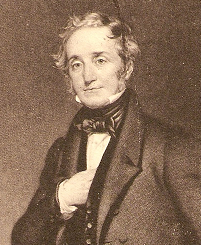
Posted in British history, film, Georgian Era, gothic and paranormal, legends and myths, Living in the Regency, real life tales, Regency era, Scotland, Victorian era | Tagged , , , , , | 3 Comments