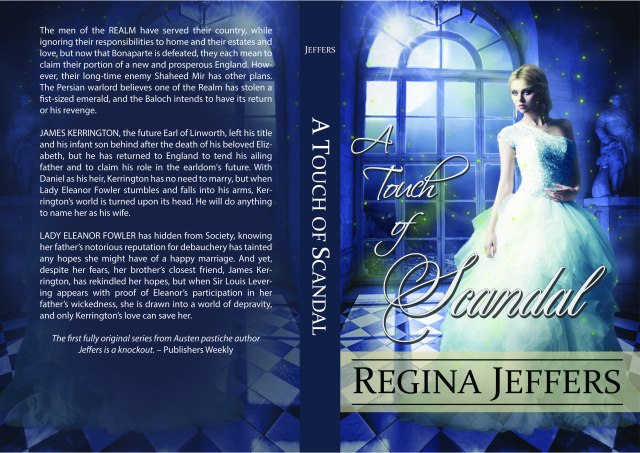
The Hero Who Does Not Believe Himself One: “A Touch of Love: Book 6 of the REALM Series”

Originally, I thought the Realm series would be three, mayhap four novels. I thought the books would cover the adventures of James Kerrington (book 1), Brantley Fowler (book 2), Marcus Wellston (book 3), and Gabriel Crowden (book 4). For the other three men of the REALM, I thought I would write novellas. All that changed as the series grew. Soon each of the gentlemen had his own story. 

In A Touch of Love, we meet Sir Carter Lowery, who is the second son of Baron Blakehell. Sir Carter is the youngest of the seven members of the Realm, but he is being groomed eventually to take over their particular unit of the Home Office. Sir Carter receives a baronetcy in book 1 when Sir Louis Levering emotionally attacks the Prince Regent and loses his position in Society. Carter’s back story shows a young man always attempting to prove himself worthy to his father, who favors the older brother, Lawrence Lowery. Lawrence and Carter are close, but their father Baron Blakehell offers Carter no encouragement. Fresh off the Waterloo battlefield, such was the reason Carter joined the Realm and why he is so driven. 

As a side note, Lawrence Lowery appears twice in this series. Early on in Book 3, he assisted his brother’s friends by escorting Lord Averette, from the picture, providing time for the Realm to rescue Velvet Aldridge from a crazy Balock assassin. In this book six, he plays a supporting character to Sir Carter’s efforts to thwart a group of smugglers. Lawrence Lowery has his own book, His American Heartsong, which serves as a companion to the series. 

We first meet Lucinda Warren, the heroine of book 6, in book 2 of the series. Lucinda’s late husband, Matthew Warren, served with Brantley Fowler for a time, and Bran and Matthew had been school chums. When Fowler, the Duke of Thornhill, encounters Lucinda at a museum showing, it thinks it would be wise to choose someone other than Miss Velvet Aldridge upon whom to spread his attentions. Lucinda is only a passing fancy for the duke, and nothing of importance happens between them, but something of note passes between her and Sir Carter at Lady Eleanor Fowler’s Come Out ball. It is something quite profound, but it takes the duke bringing the two back together to set Carter and Lucinda’s steps on the same path. 

Lucinda’s situation greatly deteriorates after her brief encounter with Fowler. She lives on her widow’s pension, but one day she returns home to find an abandoned child upon her doorstep. The boy is Jewish, and he has a note pinned to his clothes saying he is her late husband’s child, and Matthew Warren had been married to a Jewess on the Continent before he married Lucinda. The woman was not dead when Warren pronounced his vows to Lucinda. Moreover, Warren is a Jew himself — a Jew who had been raised up as a Protestant. If Lucinda was never married to Warren, she has no means of support, and so she calls upon Fowler for assistance. As Sir Carter is the one with the most knowledge and connections in the Realm, Fowler recruits his friend to assist Lucinda. Little do they know Matthew’s deception lies deeper than a bit of bigamy. Warren’s double life puts both Lucinda and Sir Carter in danger.

 A Touch of Love: Book 6 of the Realm Series

The REALM has returned to England to claim the titles they left behind. Each man holds to the fleeting dream of finally knowing love and home, but first he must face his old enemy Shaheed Mir, a Baloch warlord, who believes one of the group has stolen a fist-sized emerald. Mir will have the emerald’s return or will exact his bloody revenge.. Aristotle Pennington has groomed

SIR CARTER LOWERY as his successor as the Realm’s leader, and Sir Carter has thought of little else for years. He has handcrafted his life, filled it with duties and responsibilities, and eventually, he will choose a marriage of convenience to bolster his career; yet, Lucinda Warren is a temptation he cannot resist. Every time he touches her, he recognizes his mistake because his desire for her is not easily quenched. To complicate matters, it was Mrs. Warren’s father, Colonel Roderick Rightnour, whom Sir Carter replaced at the Battle of Waterloo, an action which had named Sir Carter a national hero and her father a failure as a military strategist.

LUCINDA WARREN’s late husband has left her to tend to a child belonging to another woman and has drowned her in multiple scandals. Her only hope to discover the boy’s true parentage and to remove her name from the lips of the ton’s censors is Sir Carter Lowery, a man who causes her body to course with awareness, as if he had etched his name upon her soul. Cruel twists of Fate have thrown them together three times, and Lucinda prays to hold off her cry for completion long enough to deny her heart and to release Sir Carter to his future: A future to which she will never belong.

“The first fully original series from Austen pastiche author Jeffers is a knockout.” – Publishers Weekly

Kindle   https://www.amazon.com/Touch-Love-Book-Realm-ebook/dp/B00GFDGYZQ/ref=asap_bc?ie=UTF8

Amazon    https://www.amazon.com/Touch-Love-Realm-6/dp/0615893597/ref=tmm_pap_swatch_0?_encoding=UTF8&qid=&sr=

Kindle Unlimited https://www.amazon.com/kindle-dbs/hz/subscribe/ku?passThroughAsin=B00GFDGYZQ&_encoding=UTF8&shoppingPortalEnabled=true

Book Bub https://www.bookbub.com/books/a-touch-of-honor-book-7-of-the-realm-series-by-regina-jeffers

Audible (Virtual Voice Narration) https://www.amazon.com/dp/B0CSSGGJ3F

Enjoy this Excerpt from Chapter 2:

Lucinda wiped at the moisture accumulating on the inside of the thin windowpane. For nearly two months, she explored every resource at her disposal in determining what she might do to survive her nightmare.

“My efforts would prove more profitable if I could explain why I wished to know more of Mr. Warren’s service in Spain,” she grumbled under her breath. She wore several layers to keep warm. Coal cost more than Lucinda could afford, and she and the boy wore much of their respective wardrobes to ward off the chill and the dampness. Turning to the child, she announced, “The rain stopped. We should see to our errands and a bit of air while we might.”

“Yes, Ma’am.” The boy obediently retrieved his jacket. The garment was already too small for the lad. She wondered how she was to provide for the child. Lucinda knew she could always turn Simon over to the authorities, but the thought of the sensitive, frail boy in one of the orphanages fortified her resolve to find a means to save him. She considered swallowing her pride and begging her uncle for assistance, but Lucinda doubted the Earl of Charleton would take kindly to her asking for funds to raise a Jewish child belonging to her late husband. No, Lucinda would delay the rumor of ruin awaiting her on the earl’s steps for as long as she could.

Thirty minutes saw her approaching the small park she and the boy frequented when the weather permitted. Mrs. Peterman presented Simon with a small ball, and the boy enjoyed working it up and down a low hill with intricate footwork that Simon must have learned in his former home. Lucinda brushed off a bench with a handkerchief.

“You must stay where I may see you,” Lucinda cautioned. She always worried on how other children might treat the child. “I shall rest here while you enjoy yourself.”

Simon smiled largely. The boy’s spontaneity surprised her. He was usually so serious-faced. The gesture made him more childlike.

“Thank you, Ma’am.”

Lucinda watched him go. The well-worn ball twirling through the brown grass. There were days she cursed the boy’s appearance in her life, but she never cursed the child. It was no fault on Simon’s part for what had occurred. “Likely someone would discover Captain Warren’s perfidy before long,” she murmured. Lucinda took to thinking and speaking of her late husband as either “Mr.” or “Captain” Warren. It was her means to distance herself from everything for which Matthew Warren stood.

“Mrs. Warren?” Lucinda looked up to observe a freckled-faced young man standing before her. Hat in hand, he bowed awkwardly to her.

A familiar face. Lucinda laughed easily.

“Lieutenant Worsley? My goodness. To think we meet again after all these years.” She patted the bench beside her. “If you have a few moments, please join me.” After Matthew’s death and that of her father, Lucinda quickly came to the conclusion she had no true friends, only a string of acquaintances, who waltzed in and out of her life. The man standing before her was one such acquaintance.

“I would be honored, Ma’am.” With a blush of color on his cheeks, the young lieutenant sat stiffly on the other end of the bench. “I could not believe my eyes when I crossed the street and spotted you upon this very bench,” he said on a nervous exhalation.

The man was several years older than she, but his actions said otherwise. The former lieutenant was quite discomfited.

“How long have you been in London?” she asked in politeness.

“We only arrived this week.” Worsley nervously ran his finger along the line of his cravat.

Lucinda felt sorry for him. She did not know Lieutenant Worsley well, but she always noted how he stumbled over his words when he was in the presence of a woman. She assumed him quite naïve, but that was years prior. Should not the war have given the man more confidence?

“We?” she inquired. “With your family or your wife or betrothed perhaps?”

She could not erase the teasing tone from her words. Since coming to London, Lucinda knew very little company, and it was good to speak to an acquaintance with the easy of joined memories.

Worsley fingered his hat.

“Oh, no, Ma’am. I am not the one betrothed, but my sister made a fine match with Sir Robert O’Dell. Mother insisted we come up from Surrey to commission a trousseau for the nuptials. Mama seems to think I should take in some of the entertainments. She believes I require a wife to ease my way into Society.” Lucinda doubted a wife would cure the man’s bashfulness.  He swallowed deeply. “Is Captain Warren in London also? I would enjoy an evening with someone who speaks of all I we shared upon the Continent. It is sometimes difficult for others to accept honesty in my responses.”

Lucinda knew immediate regret. Perhaps, more than shyness plagued the man. Those who served suffered, even if they survived the devastation.

“I fear Captain Warren met his Maker a year before Waterloo. I am alone in the City. I only recently left behind my mourning weeds for Mr. Warren and for the colonel.” In hindsight, because of her late husband’s betrayal, she wished she never mourned Matthew’s passing.

“Your father also?” Worsley said in incredulity.

“Yes, at Waterloo.” Lucinda would not tell him how foolishly she responded when the French approached. Sometimes, she wondered if her father would have survived if she did not act so uncharacteristically.

They sat in companionable silence for several minutes before the lieutenant said, “You must pardon my familiarity, Ma’am, but I do not understand how you could be permitted to live without the guidance of a man.”

Lucinda knew many males would not approve of her actions.

“As you have said, Lieutenant Worsley, those who were not on the Continent cannot understand the conditions under which we lived. Even the women who followed the drum hold a different perspective of what is important in life. I fear an afternoon tea with companions speaking of frills and lace holds no attraction for me.”

“Are you one of those bluestockings?” Worsley snarled with displeasure. The man must learn to curb his tongue if he meant to find a wife. Where had the lieutenant’s timidity gone? Had it all been an act? Or was it she who erred? Her experience with men came from the confines of war. She had no means of knowing when to speak her mind and when to temper her words.

She said calmly, “I always was a reader, but I am far from advocating universal suffrage. Moreover, I must insist my life is my own concern.” Lucinda reached for her gloves.

The lieutenant stood quickly.

“Please forgive me, Ma’am. I spoke from turn.”

Lucinda noted the remorse upon the man’s countenance. “I am not annoyed with you, Lieutenant,” she said dutifully, although she was embarrassed to admit how she came to this moment.

Worsley’s Adam’s apple worked hard.

“I truly meant no disrespect, Mrs. Warren. England changed much in the decade I was away. I am often at sixes and sevens it seems.”

“As are we all,” she said compliantly.

He shuffled his feet in place.

“Would it be?” Tentativeness returned. “Would it be acceptable for me to call upon you while I am in London?”

Lucinda stood also.

“Your offer is greatly appreciated, Lieutenant, but we should each find a means to return to English society. It would be wrong of us to seek comfort in each other.” Her words sounded foolish, but Mr. Worsley nodded his agreement.

“You speak with reason, Mrs. Warren. The captain would be proud to call you his wife,” he declared.

Lucinda kept the scorn from her expression, but not totally from her tone.

“I am certain Captain Warren rewarded his wife with his devotion,” she said enigmatically. She spoke the truth: Mr. Warren devoted himself to his wife; the only exception was she was not that woman. She extended her hand to the lieutenant. “I wish you well, Mr. Worsley. Find your happiness and seize it tightly to you.”

A look of confusion crossed the man’s countenance He accepted her hand and bent to kiss her glove.

“I pray I know the happiness you did with Captain Warren, Ma’am.”

Lucinda withdrew her fingers from the man’s grasp. As a squire’s son, Mr. Worsley would do well among the genteel sect.

“I pray you know happiness beyond what you observed in my stead.”

* * *

Carter frowned as he read the missive. Much had happened since he saw his parents board The Northern Star. First, he led an operation, which confiscated a large supply of opium entering England: then he set about dismantling the vessel to search for clues to the whereabouts of Murhad Jamot, a known enemy of the Realm. Gabriel Crowden reported seeing Jamot aboard The Sea Spray when the Realm staged its take over, and although Carter initially declared his disbelief in the marquis’s account, he knew the Marquis of Godown would never say as such if it were not true.

Thinking on the marquis’s report brought Carter a moment of regret, and he prayed he did not permanently damage his relationship with Lord Godown. His actions were a great mistake. It all started when Carter fished Lady Godown from the water. The woman and the marquis’s elderly aunts had been taken prisoners; however, the marquise escaped. Godown’s wife attempted an impossible swim for shore in the icy waters off England’s coast. Thinking the lady was a cabin boy, Carter captured her and brought Lady Godown into his small boat. Realizing who she was, Carter turned the ship toward shore and where her husband awaited. Even so, as Carter carried Lady Godown to Crowden’s waiting arms, an unusual loneliness invaded Carter’s heart.

He lifted the marquise into his arms before light-footing his way from the small boat to the lower planking.

“You do that very well, Sir Carter,” Lady Godown murmured from where her head rested below his chin. “I imagine you are an excellent dancer.”

The woman’s words brought a smile to Carter’s lips. It felt a lifetime since he experienced the teasing tone of a handsome woman. He admitted, if only to himself, to enjoying the warmth of Lady Godown’s breath against the base of his neck. At the time, Carter wondered how it would feel to carry his own wife into his bedroom and to know the happiness the other of his unit had discovered. Without thinking, he kissed the soft fuzz at the crown of Lady Godown’s head.

“I will not fail you,” he whispered hoarsely as he climbed the irregular steps leading to the main docks. “In truth, I will prove myself an excellent partner. Promise you will save me a dance at the first ball of the Season.” A gnawing longing caught in his chest. Carter looked up from where his lips grazed Lady Godown’s hair to view Crowden’s approach.

Carter gave his head a mighty shake to drive the memory away.

“Almost as great an error as that fiasco at Waterloo,” he chastised. The missive he held in his hand would only add to the chaos of late. It was from his assistant at the Home Office: Rumors of “Shepherd’s” leaving his post sooner than expected spread quickly among Lord Sidmouth’s staff. Carter frowned. Unlike many of those not of the “inner circle,” he was well aware of Shepherd’s, whose real name was Aristotle Pennington, interest in the Marquis of Godown’s Aunt Bel: Rosabel Murdoch, the Dowager Duchess of Granville. Carter even held hopes that those in power might consider him for Pennington’s replacement. He wondered how Pennington’s leaving would affect the Realm. If Carter did not earn the post, he was not certain he wished to follow another’s orders.

“How would someone else know as much as Shepherd?” he murmured. “Shepherd possesses knowledge beyond the field. He defined the Realm’s role in the world.”

Carter stared out the window at the harbor. He had remained in Liverpool since before Twelfth Night, and he was exhausted by the tedium. It was odd: he was the youngest of their band, but it was he who assumed the duties of King and country. The remainder of his group sought relief in home and family, while he looked to his occupation to fill the long hours.

“Somehow, Kerrington, Fowler, and Wellston proved more successful than I,” he told the empty room. “I thought I had the right of it…”

The sound of the explosion sent Carter diving for protection. The smell of gunpowder filled the air. Splinters of wood flew past as he covered the back of his head with his hands. He landed face down on the dirt floor of the warehouse, which the Realm had procured as his headquarters while in Liverpool. A whish of hot air brushed his scalp.

“Sir Carter!” Symington Henderson called as he rushed into the room. Carter did not move, mentally checking each of his limbs for injury. The young man knelt beside him. “Sir Carter?” Henderson said anxiously. “Are you injured, Sir?”

Carter slowly lowered his hands and pushed upward to sit on his knees. His ears still rang from the impact, and the smell of heated smoke brought back images he worked hard to quelch. He retrieved his handkerchief to wipe his face and hands. Over his shoulder, a gaping hole loomed in the side of the building, which looked out upon the busy dock.

“I appear to be in one piece.” Carter’s voice trembled, and his breath came in short bursts. A crowd had gathered on the other side of the opening to peer into the small office.

Henderson supported Carter to his feet. He swatted away the dust on Carter’s shoulders.

“I sent agents to investigate,” Henderson assured.

Carter nodded his gratitude.

“Have them ask if anyone saw a stranger in the area.” His voice held more authority than he expected.

“I will see to everything, Sir.” Henderson began to gather the papers strewn about the room. “Perhaps you should call in at the Golden Apple and refresh your things,” Henderson suggested cautiously.

Carter raised an eyebrow in dissatisfaction.

“I do not require a nurse,” he said adamantly, but a small voice in his head said, But my mother’s presence would be soothing. Why is it, he thought, we wish our mother’s comfort when the world sends us its worst? He heard more than one soldier, while lying wounded upon the battlefield, calling out for his mother.

Henderson halted his efforts.

“But, Sir. You must feel the ticking clock,” he declared. “On balance, this is your third encounter with death in a little more than six weeks. You cannot think to remain invincible forever.”

* * *

Lucinda permitted the boy to choose two new books at the makeshift lending library. It was an expense she tolerated. Although but five years of age, Simon devoured books, and they had come to a routine of sorts: she read several chapters of a compelling adventure to the child at night, and the next day, the boy would reread the pages, sounding out the words he did not recognize immediately. Young Simon often carried the book to her and asked Lucinda to pronounce a difficult word. As foolish as it sounded, she believed the child memorized the passages.

She glanced down at the boy. He was an odd one–so mature and yet so innocent. Simon never questioned why someone deposited him upon her doorstep. He never complained about the pallet she made for him before the fire nor of the less than palpable meals she managed to place before him. Lucinda supposed the child’s good nature was the reason she tolerated Simon’s obsession with books. Books and the carved wooden horse, which was among the child’s belongings when she discovered him alone in the world.

Early on, Lucinda attempted to question the boy on what he could recall of his previous life, but whoever sent Simon to her schooled the child well. Lucinda would not even consider the possibility Simon held no memories of what came before: the child was too intelligent.

Lucinda set her key to the lock of the double rooms she let in the Peterman’s household, but the door stood ajar. Instantly, she was on alert. Lucinda knew, without a doubt, she had locked the door. She handed the two books she meant to return to the lending library to Simon to hold while she pulled the door closed and gave the lock a solid shake before releasing it.

“Stay here,” she whispered sternly to the boy, who went all wide-eyed. “If you hear anything unusual, run for assistance. Do you understand me?”

Simon nodded several times.

Lucinda swallowed hard and stood slowly. She caught the latch in her trembling hand and edged the door open. Through the narrow crack, she could see her few belongings strewn about the room. Her heart clutched in her chest. She wished she possessed some sort of weapon.

Glancing back to where the boy clung to the wall opposite, she mouthed, “Be prepared. I mean to check what is inside.” Simon appeared less frightened.

Slowly, she turned to face the slender slit. With the palm of her hand, she shoved hard against the flat surface, and the door swung wide to bang against the inside wall. Both she and the child jumped with the sound. Catching at her heart with her hand, Lucinda stepped into the dimly lit space.

Whoever had entered her rooms pulled the drapes closed to block the view from the buildings across the way. Lucinda edged forward, circling the room, her back to the wall. Carefully, she sidestepped over the blocks scattered upon the floor. Without turning her head from the room, she caught the heavy drape and carried it backward to permit the late afternoon sun to invade the space before tying it off with the ribbon she found discarded upon the floor.

She looked up to observe Simon clinging to the doorframe. Motioning the boy to remain in his place, Lucinda executed a more serious search. Even though she thought it foolish to do so, Lucinda knelt to peer beneath the bed. Next, she searched the wardrobe and behind the standing screen; finally, she moved through the small dressing room, which ran the width of her one large room.

Finding nothing unusual, other than the disarray, Lucinda released the pent up breath she did not realize she held.

“Simon, would you ask Mrs. Peterman to come to our rooms. We should speak to the constable.”

The boy’s voice wavered, but he agreed. When Simon disappeared into the house’s passageway, Lucinda scrambled to her secret hiding place. She quickly worked the board free under the small side table to retrieve her bag of coins. Peeking inside, she knew relief to find the coins still in the cloth bag.

The sound of approaching footsteps set her in motion. She would count the coins later, when the boy went to sleep. Shoving the bag into the small opening, she slid the board into place just as Simon burst through the open door, followed closely by Mrs. Peterman.

“Oh, my Girl,” the matron wailed as she clutched a handkerchief to her lips. “I never…” The landlady braced her stance by clasping the back of a chair.

Although still shaken, Lucinda’s ever practical self said, “I think it best we contact the authorities.”

Mrs. Peterman frowned dramatically.

“I am certain this is an anomaly; there is no reason to involve the constable.”

“Someone invaded my room,” Lucinda said in amazement. “A person climbed two flights of stairs, worked my lock free, and then shuffled through my belongings.” Lucinda’s voice rose quickly as her pulse throbbed in the veins of her neck.

The landlady glanced about the room to the disarray.

“Are you certain you locked the door?”

Lucinda swallowed her retort. Despite the disaster of the moment, the rooms were reasonably price.

“Ask the boy.” She kept her countenance expressionless. “He held my package while I secured the door.” Lucinda caught her personal wear from a pile on the floor and shoved the items into a now empty drawer. “Someone targeted my room,” she insisted.

Mrs. Peterman waved away Lucinda’s protest.

“I imagine whoever it was simply tried all the doors until he found one he could manipulate. I cannot say I am surprised. I warned Mr. Peterman we should lock the main door to the house at all times. There are so many men without occupations roaming the streets these days.”

Lucinda’s shoulders slanted defiantly.

“Then you mean to do nothing?”

The landlady pulled herself up to her full height.

“I mean to send Mr. Peterman to repair the door. Unless you lost a fortune, Mrs. Warren,” the woman said threateningly, “calling on the authorities would waste their valuable time and show poorly on my household. I shall not have word upon the street that I do not keep a secure establishment.”

Lucinda bit the inside of her jaw to keep from speaking out against the injustice. Instead she said, “If you will ask Mr. Peterman to a look about the place, I shall be satisfied.”

Mrs. Peterman smiled falsely.

“Naturally, my girl.” The landlady gestured to the clutter. “After you set the rooms aright, you and young Simon should join me for tea. I always enjoy your conversation.”

“Thank you, Ma’am,” Lucinda said respectfully. She thought she discovered a place where she and the boy could live out their middling lives. For all she knew, the culprits could easily be the Petermans, rather than an outsider. Lucinda reminded her foolish self never to trust anyone. She trusted her parents to arrange a comfortable marriage for her, and she trusted Matthew Warren to act the role of husband. She would learn her lessons well: No one would know her loyalty ever again.

* * *

The nightmare had returned, only this time with a twist. As always, the blood was everywhere, and the acrid smell filled Carter’s lungs. Screams of pain echoed in his ears, but the smoke parted, and the boy was there. His cheeks covered with mud, the youth cringed behind the fallen horse. The French had charged their position, and Carter knew real fear. He was not supposed to be at Waterloo; he had sold his commission to join the Realm some fifteen months prior, but when Wellesley personally asked for Carter’s assistance, Carter readily agreed.

“You men, form a line along the ridge!” he shouted above the noise of the cannons.

Although Carter no longer wore a military uniform, the voice of authority remained. British soldiers scrambled to do his bidding. Men limped and crawled to a defensive position with the hill at their backs. Whoever was these men’s commanding officer had made a strategic error: They were too exposed.

“Come with me,” he commanded as he reached for the lad, who did not move with the others.

The youth’s cinnamon-colored eyes were the most compelling ones Carter ever saw. “My father?” the boy’s voice squeaked.

Carter looked about him: Nothing but bodies and destruction everywhere. Why would any father permit his son to view the slaughter that was war? The French advanced with a flourish, and time was of an essence.

“Your father would expect you to live,” he said defiantly. Catching the lad by the arm, he dragged the youth along behind him. When they reached the line, Carter shoved the boy behind a tree. “Stay hidden!” he ordered. “I will come for you when this is over.” Without looking back, Carter strode away to oversee the rag-tag group of soldiers.

They were outnumbered five to one, but as the French broke into a run, Carter rallied the men.

“No hoity-toity Frenchie is to cross the line. Do you hear me? No Frenchies beyond this point. They are soft. They possess half the heart of an Englishman. Now do your duty. For King George and Country and for your loved ones in England! Do it now, or you will see your children speaking French!”

As the squares formed, Carter glanced to where he left the boy. A bit of the youth’s shirt showed behind the tree, and Carter wondered if either of them would survive the day.

“It was the last you saw of the boy,” Carter whispered in bitter regret. He had taken a bullet in the leg and was removed from the field at the battle’s end. What with the blood loss and the fever, he was weeks in recovery. When learning of Carter’s injury, Shepherd whisked Carter away to a safe house, where he had spent countless days and nights reliving each harrowing moment of the battle. By the time he walked away from the secret facility, Carter held no idea where to search for the youth.

Somehow, the unit of which he assumed command lost only five good Englishmen during the melee, while the French suffered over a hundred before sounding a retreat. Theirs was but a single skirmish in a chaotic campaign, but Wellesley proclaimed Carter a hero.

“Never felt the hero,” Carter grumbled as he swung his legs over the bed’s edge. “I failed the boy.”

Posted in book excerpts, estates, excerpt, Georgian England, Georgian Era, heroines, historical fiction, history, publishing, reading, reading habits, Realm series, Regency era, Regency romance, research, war, writing | Tagged , , , , , , , , , , , | Comments Off on The Hero Who Does Not Believe Himself One: “A Touch of Love: Book 6 of the REALM Series”

The Importance of Packet Boats in the Regency Era + the Anticipated Release of “Lyon in the Way” from Dragonblade Publishers

In The Marchioness’s Madness, which is still waiting to be published, the often used travel by packet boats is more developed, than it is in my tale coming soon from Dragonblade Publishers. The hero and heroine in The Marchioness Madness are an older couple who has been denied marriage when they were younger. The hero has hidden the heroine on Jersey, and the packet boats are used for travel for many of the characters. In my newest series, coming soon from Dragonblade Publishers, the packet boats are used for the heroes in the series to reach the Continent easily and to transport one of the villains to England.

“Jersey sits in the Bay of St Malo, 14 miles (22 kilometres) from the French coast and 85 miles (137 kilometres) south of the English coast. Jersey is the biggest of the Channel Islands. Jersey is only 5 miles (8 kilometres) long and 9 miles (14.5 kilometres) wide.” [gov.je] Jersey was also one of the places those in England, if of age, could go to marry without parents’ permission, and it was significantly closer than racing to Scotland.

The Channel Islands were properties of the English Crown, but they had their own legislature and laws. They were not part of France, though, as you can tell from above, their proximity to the French coast made travel there both easier and more dangerous during the war. According to my notes, the Channel Islands allowed marriage to anyone 21 or older without any residency requirements.  My notes do not, however, mention what the rules were for people younger than 21, as I was not researching that situation when I made them. If someone knows the answer, please share it with us.

Originally, packet boats or packet ships carried mail packets to and from British embassies, colonies, and outposts. It was a regularly scheduled service that carried mail, freight, and passengers. The seamen were called packetmen, and the business is called packet trade.

“Packet” can mean a small parcel but, originally meant a parcel of important correspondence or valuable items, for urgent delivery. The French-language term “paquebot” derives from the English term “packet boat,” but means a large ocean liner. [ Oxford English Dictionary – Packet: “A small pack, package, or parcel. In later use freq.: the container or wrapping in which goods are sold; packaging; a bag or envelope for packing something in. Also: the contents of a packet. In early use chiefly used of a parcel of letters or dispatches, esp. the state parcel or mail in which letters to and from foreign countries were carried.”] This sense became extended to mean any regularly scheduled ship, carrying passengers, as in packet trade. The word “packet” is frequently modified by the destination, e.g. Sydney packet, or by motive force, e.g. “steam packet”.

Poster advertising a packet service, Greenock, Scotland, to New York, 1823

Beginning in 1689 between Falmouth and Corunna, Spain, by 1755, packet boats began traveling between Falmouth, England, and New York. More routes were added over the years to larger cities like Philadelphia and Baltimore. One must remember this was before the American Revolution.

The shipments from government officials includes important dispatches, transfer of money between merchants, and even gold bars. There was no cargo, and only a few cabins available for passengers who booked the crossing.

Falmounth was used because of its harbor in southwestern England, and the mouth of the harbor was protected by fortified castles on each side.

Later, additional routes were added, especially those of importance in Europe.

The ever-fabulous Cheryl Bolen tells us, “In 1793 the post office designed special packet ships that were light, with only two masts and a small crew of 22. These ships weighed less than 200 tons. (By comparison, Lord Nelson’s HMS Victory weighed 3,500 tons and could accommodate a crew of 850.)

“Paid by the post office, crews aboard the packet boats knew how to operate the ship’s seven guns. The most well known packet captain, John Bull, commanded his The Duke of Marlborough against the French at Falmouth’s Pendennis Castle in 1814. Another famous packet captain was William Rogers, who skippered the Windsor Castle in 1807. Other packet boats were FoxSwiftsureFrancis Freeling, and Speedy.”

‘Mail Packet off Eastbourne’ – Oil Painting. Mid 19th century. Artist Captain Victor Hughes RN. (2005-0102) ~ https://www.postalmuseum.org/collections/mail-by-sea/

The link above has much more information if you are interested in the subject.

One man wants her dead. Another may love her forever.

For over a year, Lord Richard Orson has been quietly captivated by the unconventional Lady Emma Donoghue. Headstrong, brilliant, and unapologetically involved in causes that rattle Society’s comfort, Emma is nothing like the debutantes he’s expected to court.

But when he finds her bruised, confused, and alone in Covent Garden after midnight, Richard is thrust into a far more dangerous game.

Someone wants Emma silenced. And now, Richard has only moments to uncover the truth, protect her from harm, and keep her out of scandal’s reach. But staying focused is harder than he imagined—especially when every glance, every accidental touch, reminds him how perfectly she fits in his arms.

Tropes you’ll love:
✔ Protective hero / damsel in distress (with a twist)


✔ Bluestocking heroine
✔ Rescue & recovery romance
✔ Unlikely match / opposites attract
✔ Slow burn with rising suspense
✔ One bed (forced proximity)
✔ Hero falls first

As danger closes in and secrets are revealed, Richard must decide whether he’s willing to risk his life—and his heart—for a woman who’s always been worth the fight.

A suspenseful, slow-burn Regency romance where danger ignites desire, and love must outpace the clock.

Purchase Link:

Read in Kindle Unlimited!

Enjoy book one in a new series within The Lyon’s Den Connected world by Regina Jeffers.

Book 1 – Lyon in the Way
Book 2 – Lyon’s Obsession
Book 3 – Lyon in Disguise
Book 4 – Lost in the Lyon’s Garden
Book 5 – Lyon on the Inside

Posted in book release, British history, commerce, Dragonblade Publishers, Georgian England, Georgian Era, Great Britain, historical fiction, history, Living in the Regency, real life tales, Regency era, research | Tagged , , , , , , | 2 Comments

The Book That Made My Friend Cry: A Touch of Mercy, Book 5 of the REALM Series


ATOMCrop copy

Original Cover of A Touch of Mercy

This was the book in which my friend Kim said, “You should have warned me about what was happening. I was in tears for hours afterwards.” 

The heroine of the book is Miss Mercy Nelson. She is the younger sister of Grace Nelson from book 4 (A Touch of Grace). Mercy has run away from her brother’s home because he brings in several low-lifes and permits them free reign of the household. Mercy and the maids hide together each evening to keep themselves safe from the drunken crew. She thinks to follow Grace, who has placed herself out in the world as governess, to London, but when she and her brother receive word Grace has died (read book 4 and you will know this is erroneous), Mercy has no choice, but to set out on her own. On the road, she meets Henry “Lucifer” Hill, the man of all work, to Aiden Kimbolt, Lord Lexford, and Hill takes her to live at Lexford’s estate, even passing her off as Lexford’s half sister from an affair the viscount’s father had some years back. 

I originally thought to have Aiden Kimbolt marry Satiné Aldridge, the sister of Velvet Aldridge in book 2 (A Touch of Velvet) and twin to Cashémere Aldridge in book 3 (A Touch of Cashémere), but there was a problem. You see, by book 5, I could no longer tolerate Satiné’s ways. I know! I wrote her that way, but, after much consideration,  I thought Aiden deserved a better woman than Satiné. In book 3, he attempts to rescue Satiné from a kidnapper, but he is knocked unconscious and is slow to wake after a concussion. He has some memory loss, making Hill’s deception easier to swallow for the reader. The problem is Aiden becomes attracted to Mercy, but if she is his half-sister, as Mr. Hill has explained, then no romantic relationship can exist between them. 

As part of his back story, Kimbolt has returned from his duty to the Realm on the Continent because he is the new heir presumptive after his elder brother’s death. His father has sent for him to return home and to marry his brother’s widow, which would be a questionable marriage, for although the British accepted a marriage between first cousins, a marriage between a man and his brother’s widow could be voided. Poor Aiden does as his father asked, but it is with a heavy heart, for his brother’s widow was the one woman Aiden had thought to marry. He and Susan had been long time sweethearts. Their marriage is short-lived because new wife commits suicide. He assumes the role of viscount and the guardianship of his nephew (who is the eldest son of the eldest son), who could replace him as the viscount, but for one little “glitch” I toss into the mix. That you must learn on your own.

In this book, we find the Realm’s old enemy still at large. Murhad Jamoot breaks into Lexford’s home and sets fire to the house. Moreover, Jamoot is in cahoots with the man to whom Mercy’s brother means to marry her off. The man is a widower with a large family, for he has been married multiple times. He requires a young wife to take care of his house and his children. 

51YKc0AyULL.jpg 

A Touch of Mercy: Book 5 of the Realm Series

Members of the Realm have retuned to England to claim the titles they left behind. Each holds to the fleeting dream of finally knowing love, but first he must face his old enemy Shaheed Mir, a Baloch warlord, who believes one of the group has stolen a fist-sized emerald. Mir will have the emeralds return or will exact his bloody revenge.

A devastating injury has robbed AIDAN KIMBOLT, VISCOUNT LEXFORD, of part of his memory, but surely not of the reality that lovely Mercy Nelson is his fathers by-blow. Aidan is intrigued by his sistersvivacity and how easily she ushers life into Lexington Arms, a house plagued by Deaths secretssecrets of his wifes ghost, of his brothers untimely passing, and of his parentsmarriage: Secrets Aidan must banish completely to know happiness.

Fate has delivered MERCY NELSON to Lord Lexfords door, where she quickly discovers appearances are deceiving. Not only does Mercy practice a bit of her own duplicity, so do all within Lexington Arms. Yet, dangerous intrigue cannot squash the burgeoning passion consuming her and Viscount Lexford, as the boundaries of their relationship are sorely tested. How can they find true love if they must begin a life peppered with lies?

Kindle   https://www.amazon.com/Touch-Mercy-Book-Realm-ebook/dp/B00CRS8780/ref=asap_bc?ie=UTF8

Amazon   https://www.amazon.com/Touch-Mercy-Book-Realm/dp/0615813828/ref=tmm_pap_swatch_0?_encoding=UTF8&qid=&sr=

Kindle Unlimited https://www.amazon.com/kindle-dbs/hz/subscribe/ku?passThroughAsin=B00CRS8780&_encoding=UTF8&shoppingPortalEnabled=true

Book Bub https://www.bookbub.com/books/a-touch-of-mercy-book-5-of-the-realm-series-by-regina-jeffers

Audible (Virtual Voice Narration) https://www.amazon.com/dp/B0CSS288KM

Enjoy this excerpt from Chapter 2 when Mr. Hill finds Mercy upon the road.

From an interested distance, Lucifer had observed the viscount’s pursuit of one female after another, but none could absolve Lord Lexford from his guilt. Hill had served the viscount since their time together on the Continent, and he suspected he knew more of Aidan Kimbolt than had the viscount’s late father.

Lord Lexford had saved Henry Hill from a torturous end. Hill and a dozen other British soldiers had found themselves prisoners behind enemy lines. He always thought he could have escaped upon his own, but Lucifer could not have left his fellow Englishmen behind. When the day of their deaths arrived, he had made his peace with God and with his decision to stay. But much to his relief, Lord Lexford had come charging into the camp, followed by James Kerrington and Marcus Wellston. Three Englishmen who could fight like twenty good men, and despite his complete exhaustion, Lucifer had taken up the cause. Within minutes, the four of them had stood triumphant. It was a proud moment: One to be savored by a man, who had not known the glow inside his gut from such exquisite glory before that time.

The incident had given Lucifer a ‘hunger’ to be a better person. To return to his letters and to learn from these heroes. At the time, he had pledged his allegiance to Viscount Lexford, just the Honorable Mr. Kimbolt, at the time. He had given his word he would serve Lord Lexford for a period of ten years. He had done so out of gratitude, but his were not all altruistic reasons. Lucifer had wanted to associate with men of the caliber of those who had proved to be his rescuers. To hitch his stars with such greatness. That choice had been made some seven years prior, and although he knew his lordship would release him from his vow, as easily as had the British government, Lucifer refused to break his promise. However, the thought of the happiness he could know if he could make Hannah his wife certainly tempted him to beg for his independence.

“Cannot leave his lordship’s service until I see the man well settled. Especially now that his missus’s memory haunts him,” Lucifer reasoned aloud. “The problem lies in the means by which his lordship seeks a replacement for the former viscountess. In his misplaced guilt, the viscount looks only upon women, who favor the late Lady Lexford. In Hill’s opinion, his lordship required a miss who is Lady Lexford’s opposite. Lord Lexford should not wallow in his memories. He should place Lady Lexford firmly in the past. The lady was never a true wife to the man.

Hill flicked the reins across the horses’ backs. The rain had greatly delayed his return to Lexington Arms, and irritation hunched his shoulders in the manner, which only Hannah’s soft touch could cure. “It will be a long time before I will see my sweet gel again,” he warned his wayward heart. As they had done for the last few hours, his musings might have continued along the same lines, but a bizarre sight caught Hill’s attention. “What in Heavens’ name?” he exclaimed as he pulled up on the reins.

Sitting on a stile was a gargoyle-like figure. Some four feet in height, whatever it was, it did not move. Having experienced more than one ambush during his years with Lord Lexford and the Realm, Hill proceeded slowly. He reached for his gun before crawling down carefully from the bench seat. Cautiously, he edged closer to the figure for a better look.

“Easy, Boy,” he cooed as his hand caressed the horse’s rump. Stepping heavily into the thick mud, he steadied his stance by tugging on the harness.

Finally, he stood before the gray-clad apparition. Despite the icy rain now dripping from his hat and down his back, Hill smiled. “Are you not an intriguing sight?” he said with fascination. “I thought you were a witch or a medieval bear come to life.”

“Neither,” the girl said through chattering teeth.

“I can see you are a wood sprite instead,” he said with a chuckle.

The girl pulled her wet cloak closer. “I require no pretty words from the likes of you,” she boldly declared. She stepped from the stile to stand in a mud-filled puddle. Lucifer noted the wear of her boots. They had many miles on them. “If you will excuse me…” She picked up a small bag and took several steps in the opposite direction of his.

“Where are you traveling, gel?” Hill called to her retreating form.

“It is none of your concerns, sir,” she said smartly.

Lucifer enjoyed her sass. “I thought perhaps you might require a ride.” He waited until the count of three to determine if she would accept. The viscount was always telling him not to rush a woman’s decision. The fairer sex prefers to weigh all their options before deciding what is best. We men are the impulsive ones, Lord Lexford had said on more than one occasion.

She paused, but did not turn around. “What is your destination?”

Hill remained where she had left him. “I mean to finish my journey to Lexington Arms in Cheshire. I am to prepare the manor for the master’s return.”

~~~

Mercy caught her breath. She knew of Lexington Arms. It was the seat of Viscount Lexford. Upon Grace’s return to Foresthill Hall, Mercy and her sister had spent a delightful afternoon discussing Grace’s brief encounter with the viscount, his associates, and even the Prince Regent. Afterwards, Mercy had searched Debrett’s for each of the men Grace had mentioned.

“The Prince Regent actually came to the table and spoke to everyone?” Mercy’s mouth had stood agape in amazement. At first, she could not believe her sister’s tale.

Grace chuckled in that self-deprecating manner her sister wielded to defend off the least bit of praise. “Obviously, our monarch held no interest in me,” Grace had asserted. 

“There were several very beautiful women at the table and more nobility than should be permitted in one place. Ignoring the Dowager Duchess of Norfield, who is a beauty even in her advanced years, and Viscountess Averette, Prince George’s eye fell heavy on Miss Aldridge. The lady resembles her younger sister, Miss Cashémere, who outshone many of higher titles. They are both very dark of color and strikingly elegant. And there was Lady Eleanor Kerrington, who had won the praise of the Queen during Lady Eleanor’s Presentation. She and Lord Worthing have only recently married. Lady Worthing is the Duke of Thornhill’s sister. She is tall and majestic. I can assure you I faded into the tapestry; yet, it was a moment only few can claim.”

Mercy had sat spellbound. Living at Foresthill, she had held no hopes of having the acquaintance of any of the nobility. “And what of the men?” she had asked in curious delight. “Were they exceedingly handsome?”

Her sister’s eyes had glazed over in quiet contemplation. Finally, Grace continued, “The men in our party, other than Viscount Averette, who has grown a good-sized paunch since last you saw him, included several from the aristocracy, who served together during the war and beyond.” Her sister had taken great satisfaction in ticking off the names upon her fingers. “Lord Worthing, who is the heir to the Linworth title, led the group when they served abroad. He is magnificently tall and lean. He possesses the most mesmerizing steel gray eyes I have ever encountered and a strong jaw, which speaks of his ancestral lines. The Duke of Thornhill is shorter than Lord Worthing, but he is equally muscular in build. He has light brown hair, which he wears a bit too long to be fashionable and dark brown eyes. It is my understanding from my time with the Averettes that the Duke has recently married his cousin Miss Aldridge. The bachelors included Sir Carter Lowery, a newly minted baronet and a very affable young man; Lord Yardley, an earl from Northumberland, who is stoical and serious minded, but who I suspect holds very deep emotions; the Marquis of Godown, who is sinfully handsome, and Viscount Lexford from Cheshire, who is sandy blond of head and boyishly handsome.”

Mercy smiled knowingly. If she traveled to Lexington Arms with this stranger, she would have the acquaintance of the viscount, and, perhaps, several of his associates. It could be a means to honor her sister’s memory. Grace had been a governess, but she had dined with the Prince. Could not Mercy assume a position under the viscount’s roof and come to know those of the peerage? She turned slowly to best judge the man who offered her an adventure.

~~~

Lucifer had remained perfectly still so as not to frighten the girl. To allow the truth of his words to take root. “His lordship and I served together during the war. Now, I am his man of all means.” The girl nodded her understanding. Hill’s instincts told him she was a runaway. She was miserably cold, but she refused to acknowledge her desolation. Lucifer could not resist admiring the woman’s defiance. It spoke well of her character. “If you require employment, I imagine there is a place on his lordship’s staff. That

is if you are willing to put in a fair day’s work. I am not offering you charity.”

He noted the pleased smile, which graced the girl’s lips. Her hood had slipped from her head, and with the icy crystals mixing with the red gold of her hair, the woman reminded him of a snow princess he had once seen in a painting in a Viennese art museum.

“Why would you offer a complete stranger a position in your master’s household?” Her cultured tongue told Lucifer the girl was no country miss. The woman before him was a genteel lady. That particular fact only solidified Hill’s resolve to escort her to Cheshire. He would not leave any woman to suffer as he suspected this one had. He would do the correct thing, the only thing.

“Years prior, the viscount saved me from Death’s claws. He is a good man, and he would expect me to extend his benevolence to you.” He smiled easily. “If you pardon my saying so, Miss, you appear to have come upon hard times.”

“Be there children at his lordship’s home?” she asked tentatively. “My sister was a governess. I had thought to find a similar position.”

Lucifer gave a slight shake of his head. He thought of the child Mr. and Mrs. Rhodes had whisked away from a distraught Lord Lexford. Lucifer had always thought if his lordship had poured his love onto the babe that the viscount would have found peace by now. He took a half step in the girl’s direction.

“I fear not, but we can find you some other form of employment. At least, come with me to Cheshire. Spend several days with us. Recover your strength. Fortify your will to travel on.” The girl swayed in place, but Lucifer did not reach for her. She might think he meant her harm.

“I worked at an inn recently,” she protested weakly.

“For how long?” he coaxed.

Her eyes closed as if she was silently counting. “Five days.” She paused awkwardly. “The Pawleys fed me and gave me a warm place to sleep.”

He wondered if he might have to resort to kidnapping the girl. She possessed no skills to survive a winter on the road, and Lucifer meant to see her well. “Five days of charity proves the Pawleys worth knowing, but five days after how many weeks?”

The girl snarled her nose in remembrance. “Perhaps six.”

Lucifer edged closer in anticipation of seizing the girl. “Would you not wish for more days of warmth and nourishment? I can promise you Mrs. Osborne makes the finest lemon tarts in all England.”

The girl looked over her shoulder to the road behind her. “But Cheshire is the way I came. I cannot retrace my steps.”

Lucifer dug into his pocket to retrieve his purse. Fishing several coins from the leather pouch, he extended them toward the girl. “Come to work at Lexington Arms. Stay, at least, through Twelfth Night, and if you do not care for the place, use these coins to purchase your passage to London or wherever else you wish to go.”

“Why?” she asked skeptically. “Why do you insist on offering your assistance?” She looked off across the empty fields. “The last people I trusted stole all my money, as well as my mother’s locket. I have nothing of value remaining.”

“I want nothing from you, gel. I have me a beautiful angel, who claims to love the likes of me. And I have a comfortable home and a generous employer. For a man who has not always walked on Heaven’s path, I hold many blessings. I think it is time I become the Good Samaritan.” He extended his hand to her. “Come, Girl,” he encouraged. “You require what I offer.”

Although the rain had lessened, moisture dripped across her cheeks from her eyes’ corners. “Are you certain the viscount will not object?”

Lucifer breathed easier: He would win this battle. With an ironic chuckle, he said, “His lordship will likely not realize you were not always part of his staff.” Thoughts of the injury, which had robbed Lord Lexford of his memory, were never far from Hill’s mind.

He meant to see the viscount well again.

He caught her elbow and directed the girl towards the flat bed wagon he drove. Lucifer knew better than to give her time to change her mind. The girl had required a bit of encouragement and a good dose of coercion.

“It might be best if you sit in the back,” he suggested. “You can place the blankets about you. It won’t be much drier, but perhaps a bit warmer. I will set your bag under the seat.” He pressed the coins into her gloved hand as he lifted the girl to the wagon. “Sit back,” he ordered as he gathered the damp blankets he had stashed in a wooden crate beneath the bench and tucked them about her. “We still have a piece to go so stay as dry as possible.”

The girl nodded her gratitude. “May I…may I know the name of my benefactor?” She openly shivered from the cold.

“Name is Mr. Hill. Henry Hill, but most people call me Lucifer.”

She smiled at him, a smile that uncurled from her heart, and Hill thought she might be one of the prettiest girls of his acquaintance. The smile changed her face completely.

“Lucifer? As in the Devil?”

“My mother once remarked that I be devilishly large for my age,” he said with a shrug. “The description stuck. I have been Lucifer ever since.”

Through lips trembling from the cold, she said, “I am Mer…I am Mary,” she stammered. Lucifer heard untruths in her tone. “Mary…Mary Purefoy.”

Obviously, she wanted no one to know her true identity, a fact which confirmed Lucifer’s assumption of her being a runaway.

“You should rest, Miss. We will be in Cheshire soon. When we reach Lexington Arms, we will test your skills in making a proper bed for yourself.” Leaving her to snuggle deeper into the blankets, Lucifer climbed onto the bench seat. With a cluck of his tongue and a flick of his wrist, he set the team in motion.

Purposely, he did turn his head again to look at her. He suspected the girl would watch him warily until she recognized he meant her no harm. Instead, Lucifer concentrated on maneuvering the wagon along the rough road, as well as the problem of what to do with the girl he had just rescued.

After some twenty minutes of pure silence, he secreted a glance in the girl’s direction. Finding her curled in a tight ball and fast asleep, he chuckled. The girl’s countenance spoke of her exhaustion. He knew what it meant to be hungry. Knew also of the hopelessness of those who traversed English roads in the wake of what some were calling the “year without summer.” As an innocent, less scrupulous travelers had robbed the girl of her few belongings, but she had not high tailed it back to where she had come. The girl had spirit. Her actions spoke of both her desperation and her determination. Those qualities had increased Hill’s respect for his passenger.

Yet, he worried for her safety. Despite her earlier encounter with disaster, Miss Purefoy had accepted his tale after only minor encouragement. Her bravado aside, the girl had not learned her lesson; and his leaving her to her own devices would have been a mistake. She had trusted him not to defile her. Although not born to the role, Lucifer considered himself a gentleman, but most traveling English roads these days would not come close to that description. Before she reached London, some man would have the girl’s virginity by seduction or by force. Even now, she slept soundly in a steady rain in a rocking wagon. If not for his honor, he could claim the girl before she could put up a fight.

“The aristocracy,” he murmured in amusement. “The so-called ruling class.”

Until he had met the members of the Realm, Hill had always disparaged the ignorance he had found among those of rank, but he quickly discovered Lord Lexford’s acquaintances were the exceptions to the rule. He turned his head to study the girl more closely. She was nothing like the women his lordship usually chose; yet, even on such a short acquaintance, Lucifer had hatched a plan of sorts. “

Lord Lexford has always preferred his women dark of hair and soft of nature. Exactly like Miss Satiné and Lady Susan,” he thought aloud. “However, I think Lord Lexford requires a snow princess. A fiery blonde wood sprite instead of a dark fairy. One full of innocence and a bit of sauciness.” Lucifer smiled with the possibilities. “If Lord Lexford could discover happiness, then I would have no worries for my honor, and mayhap the viscount would hold no objections to my claiming my own contentment.”

Lucifer reached under the seat to retrieve the girl’s small bag. “Let me view what you think to be important in your life, Miss Purefoy.”

He glanced again to where the girl’s head rested on a half-full seed sack. Removing his glove to lift the bag’s latch, Lucifer dug his right hand into the contents. His fingers traced their way through layers of silk and wool. Finally, he touched upon a stack of papers, and he closed his fist about the pages. Using his coat to shield the paper from the peppering rain, Lucifer lifted them high enough to where he might read them without removing his eyes from the road.

“Letters,” he said under his breath. “With the directions to Mercy Nelson of Foresthill Hall in Lancashire.”

Before the girl could discover his deviousness, Lucifer returned the pages to her bag and replaced the satchel under the seat.

“Mercy Nelson,” he whispered, rolling the name about his tongue. “Mercy. A much better name for a genteel lady than Mary Purefoy.” He chuckled with his next thoughts. “And exactly what his lordship requires,” Hill said with assurance. “A touch of mercy.”

Posted in book excerpts, books, eBooks, excerpt, Georgian England, heroines, historical fiction, Inheritance, Levirate marriage, Living in the Regency, marriage, primogenture, Realm series, Regency era, Regency romance, romance, suspense | Tagged , , , , , , , , , , | 5 Comments

A Feud Between Romantic Heroes and a Look Back at A Touch of Grace, Book 4 of the REALM Series + Upcoming Release of “Lyon in the Way”

Next month, I hope to release a new romantic mystery/suspense series. This one is from Dragonblade Publishers, so I thought I might revisit my very successful Realm series and some of what made that particular series so special. In this book there is an ongoing feud of sorts between the hero Gabriel Crowden and a character named Adam Lawrence, who makes an appearance in multiple books I have written. More on that below.

*********************************

Look for Book 1, Lyon in the Way coming June 18, 2025 from Dragonblade Publishers, to be followed in quick succession (every three months) by Lyon’s Obsession, Lyon in Disguise, Lost in the Lyon’s Garden, and Lyon on the Inside.

Lyon in the Way: The Lyon’s Den Connected World (Book 1)

For over a year, Lord Richard Orson has been quietly captivated by the unconventional Lady Emma Donoghue. Headstrong, brilliant, and unapologetically involved in causes that rattle Society’s comfort, Emma is nothing like the debutantes he’s expected to court.

But when he finds her bruised, confused, and alone in Covent Garden after midnight, Richard is thrust into a far more dangerous game.

Someone wants Emma silenced. And now, Richard has only moments to uncover the truth, protect her from harm, and keep her out of scandal’s reach. But staying focused is harder than he imagined—especially when every glance, every accidental touch, reminds him how perfectly she fits in his arms.

As danger closes in and secrets are revealed, Richard must decide whether he’s willing to risk his life—and his heart—for a woman who’s always been worth the fight.

A suspenseful, slow-burn Regency romance where danger ignites desire, and love must outpace the clock.

Buy Links (including Goodreads and BookBub)

Amazon https://www.amazon.com/dp/B0F5XC33ZJ

*************************************

A Touch of Grace remains my favorite book of the Realm series. Mayhap, it was because by this time in writing the series, I did not feel the need to offer but a bit of repetition in the story to draw the readers in. Or mayhap, it was because I was absolutely invested in the couple in this book. In my mind’s eye, I could see them as perfectly as if they stood before me. 

Gabriel Crowden, the Marquis of Godown, is an Englishman with French ancestors, living at a time when England was at war with France. One can quickly denote his French heritage for his title is “marquis,” rather than the English spelling of “marquess.” He is an Adonis—a man with perfect looks and perfect manners—but with a life far from perfection. Some five years prior, he had been banished from England, for he had refused to marry a woman who had set a trap of compromise for him. The woman’s deception and the resulting action of his refusal makes him a bitter man, one who takes his resentment for his “punishment” and his lost years with his father out on the women in his life. When he returns to England, his three eccentric aunts take it upon themselves to see him married and settled. However, Gabriel prefers his life as a rake about Town. 

One special twist I provided Gabriel was an unspoken “feud” of sort with Adam Lawrence, Viscount Stafford (and future Earl of Greenwall). Many of you will recall Adam is my “go-to guy.” He appears in some twelve of my novels, from a simple walk through to his own story in His Irish Eve, but, in this story, I make him Gabriel’s competition for the hand of several different women. 

With a need to protect him from his accuser’s father and one to teach him something of life, Gabriel’s aunt, his father’s eldest sister, a formidable duchess, has approached Aristotle Pennington, the man she has loved all her life, but a man below her family’s expectations, to find Gabriel a position with the Realm, a covert British intelligence unit operating during the Napoleonic War. Pennington’s doing so saves Gabriel from the rejection of society and removes him from England when all meant to press him into an imprudent marriage. After several years with the Realm, Godown is eventually summoned home to claim his father’s title, only to learn his father has placed special provisions in his will. Fearing Gabriel would perish in his service to the Crown, the former marquis has stated in his will Gabriel must be married and the new marquise with child before a particular date or forfeit the peerage to a relation Gabriel despises. As this was not an English-created peerage, it dates back to the times of the dual monarchy of France and England, normal primogeniture laws do not affect it. Unaware of the restrictions upon him, Godown drifts through the social Season with little care for more than his own pleasures only to learn his days are “numbered.” 

Miss Grace Nelson was first introduced to the readers of this series in Book 2, A Touch of Velvet. She was the governess to Miss Gwendolyn Aldridge, the only child of Lord Averette, a viscount and the paternal uncle to three of the heroines in this series: Velvet (book 2), Cashémere (book 3) and Satiné Aldridge (book 7). At the beginning of this book, Averette is gathering his belongings to escape to the Continent to avoid punishment for crimes he has committed. In Grace’s opening scene, the man is physically abusive to his wife, and Grace steps in to save the woman. Averette dismisses Grace from her position, and she must return to her brother, who has run through the family’s fortune; thus, the reason Grace is in a governess position. 

Although she is quite comely, to avoid men’s unwanted attentions, Grace has disguised her appearance with spectacles and a strict hairstyle. When Gabriel encounters her again, he “sees” her as a woman worth knowing, and, ironically, she sees him in a likewise manner. However, their path to happiness is NOT an easy one. There are moments of trust and of love, but these memories are smothered by fears of betrayal and the overwhelming evidence that Grace is somehow involved in a plot to kill Gabriel. 

512J3dWI1KL.jpg


Third Place:
Historical Romance
SOLA’s Seventh Annual
Dixie Kane Memorial Awards

Book Blurb: 

“The first fully original series from Austen pastiche author Jeffers is a knockout.” – Publishers Weekly

“Jeffers’s close look at the dark secrets of Regency society instills a sense of realism.” – Publishers Weekly

After years away from England, members of the Realm return home to claim the titles and the lives they had previously abandoned. Each man holds onto the fleeting dream of finally know love and home. For now, all any of them can hope is the resolution of his earlier difficulties before Shaheed Mir, their old enemy, finds them and exacts his revenge. Mir seeks a mysterious emerald, and he believes one of the Realm has it.

GABRIEL CROWDEN, the Marquis of Godown, can easily recall the night that he made a vow to know love before he met his Maker. However, that was before Lady Gardenia Templeton’s duplicity had driven Godown from his home and before his father’s will had changed everything. Godown requires a wife to meet the unusual demands of the former marquis’s stipulations. Preferably one either already carrying his child or one who would tolerate his constant attentions to secure the Crowden line before the deadline.

MISS GRACE NELSON dreams of family died with her brother’s ascension to the title. Yet, when she meets the injured Marquis of Godown at a Scottish inn, her dreams have a new name. However, hope never has an easy path. Grace is but a lowly governess with ordinary features. She believes she can never earn the regard of the “Adonis” known as Gabriel Crowden. Besides, the man has a well-earned skepticism when it comes to the women in his life. How can she prove that she is the one woman who will never betray him? 

EXCERPT (from Chapter 2) 

Gabriel had watched the tree line behind him for what felt of hours before a flicker of movement proved his suspicions correct. The attack that had left a gaping hole in his shoulder had not been from a highwayman or even a hunter accidentally shooting in the wrong direction. Someone had followed his trail. Someone had purposely targeted him. Likely, Murhad Jamot had doubled back. Kerrington had escaped, but the Realm’s old enemy had laid in wait. Now, Gabriel would likely die on this lonely Scottish road, halfway between his past and his future.

With difficulty, he raised his gun to lie along the flat line of the rock he had chosen as shelter. Resting his gun against the rock face, he used his left hand to lift the right to where he might grasp the gun’s handle. The movement brought fresh blood gushing from the wound, and Gabriel bit the inside of his jaw to prevent his losing consciousness. He might meet Death in the next few minutes, but if he had anything to say of it so would Jamot.

The woods around him had silenced—a sure sign that a man stalked the land. It was the way with nature. A signal of an invasion within its midst. Gabriel gave his head a shake to clear his vision, and then he inhaled deeply to steady his shaking grip. “I few more minutes, God,” he whispered as he wrapped his index finger about the gun’s trigger. “Then you may claim my sorry soul and that of a Baloch heathen.” He wondered how God might receive such a prayer: one where he prayed to be permitted to kill another before he died. Thou shall not kill.

Before he could finish the thought, a man on horseback burst through the tree line. Expecting to see a dark-skinned Baloch, the pale-faced Anglo caught Gabriel’s mind napping, and for a brief second, he paused. Just a fraction of a second, but long enough to give his opponent an advantage. Luckily, the man’s aim was off. A spray of rock fragments peppered Gabriel’s head and chest, but he did not flinch. His years with the Realm had taught him well. In the next instant, he returned fire. The Realm had seen to those lessons, as well. His attacker had foolishly risen up in the saddle—making the man a larger target.

Biting away the pain, he squeezed the trigger. The bullet flew straight, but the horse turned its head ever so slightly, and Gabriel’s hope of the shot finding his attacker’s heart disappeared. Instead, the man slumped forward as the horse raced away to the west.

Gabriel groaned as he forced himself to stand. “I require a few additional minutes, God,” he gasped. “Hold your hand steady, Lord.”

With those words, he stumbled towards where Balder waited impatiently for him. Reaching for the saddle, he strained to swing his leg over the rise and settle in the seat. “Come on, old friend.” He laced the reins through his gloved fingers and set the horse in a cantor. Each thud of Balder’s hoofs set his teeth on edge, but Gabriel managed to stay in the saddle. He would find the man who had shot him. He would finish what he had started, and then he would die.

* * *

Grace wanted to stomp her foot in annoyance. They had arrived at the overnight stop for the coach, but she had received no welcome. “I do not let rooms to unchaperoned or unmarried ladies,” the innkeeper asserted as she had protested his lack of understanding. “You are welcome to wait in the common room.”

She shot a quick glance at the open room. The inn sported several occupants—a variety of social classes mingling together. Unfortunately, other than the bar maids, only two women took their evening meals among the patrons. Even dressed as non-conspicuously as possible, her “aloneness” would draw attention. And in these quarters, attention was not a desirable commodity. Grace swallowed hard and straightened her shoulders. “I understand,” she said royally. It would be a very long night.

She reluctantly accepted the man’s objections. If the innkeeper wished to maintain his business’s reputation, he would enforce the unwritten rules, which governed society: Permitting a man the liberty of a kiss resulted in a woman’s ruination and provided a man with bragging rights. Dancing more than two sets at a ball would bring about an engagement. Responding to a man’s attentions before his intentions were known brought ridicule or disappointment. One could not use one’s suitor’s Christian name, nor could one exchange correspondence or gifts before the wedding vows were pronounced. Likewise, it was not quite the thing to drive alone with a gentleman. And, most decidedly, a woman did not travel unaccompanied. With a deep sigh, she turned to survey the room.

Grace did not look forward to remaining awake all night. She certainly would not permit herself to fall asleep. It would be too dangerous. Someone could steal her coins or something more precious. A woman was easy prey for a man who had consumed too much ale. A woman was defenseless in such matters. The female victim always bore the blame for a man’s lack of control.

Frustrated, she stepped outside to watch the busy inn yard. More strangers had arrived. She should claim a dark corner of the noisy common area before none remained for the choosing. “Stretch my legs while it remains light,” she said softly to herself. If the mail coach had stopped in a village, she might have sought the pity of a widow or a newlywed couple to spend a night on a chaise or even a pallet before the hearth. But their journey had brought her and her fellow passengers to this inn, one between villages–with no choice but to wait with the others for the morning coach. “The innkeeper said the coach will depart at four,” she reminded herself.

She inhaled deeply. “No rain,” she continued to keep her own company. “At least, my journey shall not be delayed.” She thought of her home. Of her brother Geoffrey, who had assumed her father’s title after the funeral. Of how quickly things had deteriorated. Of how Geoffrey had brought his debts to the barony. Of how many of the family’s treasures had been sold to keep the title solvent. Of how she had promised to make her own way in the world if Geoffrey would warrant the care of their younger sister Mercy. “Geoffrey will not be pleased to see me,” she thought aloud. “But it will not be for any duration. I have my letter of reference; I will find another position.”

* * *

Gabriel had trailed his attacker for nearly two hours. He had decided that the man was not a professional killer. His attacker had made no attempt to hide the blood from where Gabriel’s bullet had removed a mighty chunk of the man’s shoulder. He did not think the man he pursued would die from the wound Gabriel had inflicted upon him. It was more than a flesh wound, for it continued to bleed after all this time; but it would not be fatal unless the man did not find medical assistance soon. His attacker could die from infection, but Gabriel would see to the task before that time.

He would not fail his friends. He could have personal enemies—knew for certain he did have many who objected to the descendant of a French diplomat as a ranking member of the British aristocracy and the House of Lords—but not the type of enemy who would assault him on a deserted Scottish road. First, no one, but a select few, even knew of his presence in Scotland. Those who hated him would fight their battles in London’s ballrooms and on the Parliamentary floor. No, the man he sought was the Realm’s enemy. If his assailant succeeded in eliminating Gabriel, he would turn his attention to Gabriel’s only true friends, the men with whom he had served. Before he took his last breath, Gabriel would see his attacker dead. Viscount Worthing and the others would observe his death as a warning for their own safety.

The blood trail led to a small coaching inn. From his vantage point, Gabriel had watched the comings and goings of the inn yard. Nothing unusual. The place was not a trap. At least, not an obvious one. When his attacker had charged Gabriel’s position, in the midst of the chaos, he had glimpsed the man’s horse. Gabriel closed his eyes to relive those few brief seconds. The man bearing down on him, his firing, and then the slumped over figure in its retreat. “Cream colored. Perhaps fifteen hands high. Not as large as Balder,” he recited what he could remember. Patting his stallion’s neck, Gabriel pulled the reins to the left. “Let us see what the stables holds.”

* * *

“I want to know of this horse’s rider,” Gabriel told the young boy who had rushed forward to take Balder’s reins. He had found his attacker’s mount. The man could not be far.

The boy rubbed Balder’s nose. “The cream?” The youth looked over his shoulder at the animal he had just placed in the third stall. “His master fell and hurt ’is shoulder. Mistress Bradshaw be doctoring’ ’im in the kitchen.”

Gabriel leaned heavily against Balder’s side. Normally, he oversaw his horse’s care, but not this evening. Tonight, he would trust the boy to see to his favorite mount. He handed the boy a coin. “Give him some extra oats and brush him, and you’ll receive another coin for your efforts.” Gabriel swallowed the pain radiating through his chest. “And another if you inform me immediately if the cream’s owner chooses to leave the inn.”

“Aye, sir.” The boy’s eyes grew in anticipation. “I be finding’ you, sir.”

Gabriel shuffled towards the partially opened stable door. The place where the bullet rested in his chest burned with hell’s fire. He had managed to stay alive despite his enemy’s best efforts. Despite God’s plan for him to join his parents. Slowly. Methodically, he turned his feet in the direction of the inn. If he were to meet his Maker, he would do so in a clean bed.

* * *

Grace stepped from the wooden walkway, which ran along the inn’s front and turned her steps toward the stable. She had no desire to be out of view of the busy inn yard. Hostlers rushed to and fro to aid those seeking shelter before nightfall. She would discover what animals the inn housed for the mail line, as well as examining the mounts of her fellow travelers. She had always loved the horses her father had kept upon the estate, especially those the former baron used when he rode to the hunt. Anything to pass the time.

Yet, as she reached the stable’s main door, it swung wide, and a man in a finely fitted coat staggered forward. At first, she had thought to turn on her heels to make a speedy escape, but then a face of an Adonis stilled her. She had seen him previously—but twice. In London. At the party at Carlton House. And again at the celebratory gathering at the Duke of Thornhill’s Town home. “Lord Godown,” she gasped, and then observed the painful grimace as he pitched forward. Grace instinctively caught him, shoving him backwards to brace him against the building. “My lord, you are unwell!” she said in concern. He used his free hand to steady himself against the door. “Permit me to find assistance.” Her hand rested on his arm, and Grace heard the hiss as he looked out over the inn yard. She imagined he judged how many steps it would take to achieve the inn’s door.

“No,” he insisted. With a deep inhale, he said, “Would you be so kind as to lead me to the inn?”

Without considering her actions, Grace laced his arm about her shoulder to brace his weight against her frame. She had never felt such panic. When she had first laid eyes on this man—some six months prior—she had considered his Christian name and how perfectly it fit his handsome countenance. Gabriel. The angel. The avenging angel, but an angel, nonetheless. “Lord Godown, please,” she whispered hoarsely as his heavy tread nearly took both of them to their knees. “Permit me to find someone more fit to assist you.”

A barely perceptible shake of his head declared his refusal. Grace’s bonnet shifted forward as his arm pressed heavy on her shoulders. He continued his jerky steps towards his goal–another ten feet to the walkway.

Finally, she shoved up on his arm to bracket his weight against the building’s side. Sliding free of his grasp, she turned to examine him more closely. In the darkening shadows, she realized his hair was sweaty and windblown, and dirt streaked his clothes’ fine cut. Then she saw the trickle of blood darkening his shirt. “Oh, my God!” she rasped as she reached for her handkerchief to press to the opening. “Tell me what has happened.”

Head back and eyes closed, he appeared unable to answer, but he finally spit out the words. “Trailed my attacker to this inn.” Grace looked on in wonderment as he took a deep steadying breath. “You did not faint from the blood.”

“No, my lord.” Grace pulled a second cloth from her reticule. She pressed it firmly over the first.

“Do you have a room?” he asked through gritted teeth.

Grace doubly regretted her unmarried status. If she had proper quarters, she could tend his wounds in private. She shook her head in the negative. “The innkeeper will not let to a woman without companionship. I will spend the night in the common room.”

Lord Godown nodded weakly. “Would you share my room?” He caught her gaze, and the clarity surprised her. “If you have a husband whom you were to meet on the road. . .” He did not finish his thoughts as the pain snatched his breath away. Frantically, he caught at her hand. He said softly, “I do not wish to die alone.”

Grace recognized his proposition to be a scandalous one, but she had accepted the inevitable conclusion the moment she had draped Gabriel Crowden’s arm about her. She would willingly participate in her reputation’s ruination. The fear she recognized in his gaze stayed her. This man carried death about his strong, muscular shoulders. “Yes, I will stay with you, Lord Godown,” she said without hesitation.

“You have called me by name three times. Do we hold a prior acquaintance?” She noted how he stood taller.

Grace blushed as disappointment filled her. Why would an “Adonis” remember someone as nondescript as she? “Grace…Miss Grace Nelson. Lord Averette once served as my employer.”

Lord Godown cupped her face as if seeing it for the first time. “Miss Nelson. Of course.” He stroked her mouth with the thumb of his left hand. “Just what I require. A touch of grace.”

Grace could not breathe. She had never known such an exquisite moment. He had seen her. Truly seen her. Not the governess, but the woman of three and twenty with dreams buried, but not deceased. And she knew him also. Not the face of perfection. But a man who had known great loss. She licked her lips for moisture, and her tongue grazed his ungloved thumb. She noticed how something flared in his gaze. “How should we proceed, my lord?” she said uncertainly.

Her words had broken the spell, but his fingers still traced her skin. Grace’s breathing shallowed, and pure warmth spread through her. “You are my wife,” he said confidently. “Your maid abandoned you, taking your purse and leaving only a public ticket for your transportation.” He easily wound an elaborate tale. He was, obviously, a man accustomed to improvising in intense situations. “We were to meet in Carlisle, but when you did not appear, I came searching for you.” She nodded her agreement. “Reach into my inside pocket and remove my purse. I will not be able to do so when we enter. Have it at ready to place in my hand,” he ordered. She did as he instructed. “I will also require a card from my case.”

“You should probably open it in the innkeeper’s presence,” she said. “It will bring legitimacy to our claim. I have previously spoken to Mr. Bradshaw regarding a room.” She fished the items from his various pockets. “The innkeeper will recognize me.”

Lord Godown smiled at her with admiration. “You are quick to assess what must be done.”

“I have been my own mistress since leaving the schoolroom. I left home at eighteen,” she explained.

A frown crossed his brow, but he made no comment on her disclosure. Instead, he lifted her chin with his fingertips. “Miss Nelson. Grace. The man who attempted to kill me is in the kitchen being tended to by the inn’s mistress. I managed to wound him.” She nodded her understanding. He inhaled deeply and looked off as if seeing something she did not. “If he discovers I have taken refuge within these walls, he will come for me. What I am asking of you could be dangerous.”

Despite wishing to appear brave before this magnificent man, Grace’s lower lip trembled. “How shall you stop him?” she asked tentatively.

Lord Godown smiled wryly. “If I am awake, I will deal with him. If not. . .”

“I must see to his demise,” she whispered. The thought of taking another’s life frightened her.

He must have recognized her fear. “It will not come to that,” he assured. “But I must stop him. Others of your acquaintance are in danger: Lord Worthing, Thornhill, Lord Lexford and Sir Carter.”

“Those with whom you served?”

“Yes. They are my earnest companions. I cannot explain now, but know my words are true.” He swayed, and Grace instinctively reached for him. “You cannot send for the surgeon, Miss Nelson. You must tend my wound,” he insisted. “No one must know how close to death I am.”

“Please do not speak as such, my lord.” She clutched at his lapel.

“My life is in your hands, my dear,” he said in a matter-of-fact manner that sent a shiver down her spine. He caught her fingers and brought them to his lips. “If I should die before I wake…”

Grace bristled. “I shall not have it! Do you hear me, Lord Godown? You shall not die on my watch!” Despite her best efforts, a tear crept down her cheek.

Lord Godown flicked it away. “I will do my best to comply. Now, come, my dear. We have a farce to play.”

How he managed to walk so straight and so proud, Grace would never know. Every step must have brought Lord Godown excruciating pain, but other than a flex of his muscle under her fingertips, she would never have guessed the truth. As they entered the establishment with her hand resting firmly on his arm, his countenance displayed nothing but amiability.

“Ah, my good man,” he said aristocratically as the innkeeper hustled forward to greet him. “Thank you for attending to my wife’s needs.” He flipped open the case and placed his calling card on the counter’s corner. Unobtrusively as possible, Grace slid it in Mr. Bradshaw’s direction. Lord Godown palmed the case and placed it in her hand. “My marquise has spoken of your kindness, sir.” The innkeeper’s eyebrow rose as he eyed Grace suspiciously, for she had said nothing of a husband previously, nor had she mentioned she was a marquise. Yet, she knew the man would not question them further, for a good innkeeper, even one on the Scottish side of the border, knew to toad to the whims of the English aristocracy. He read the ornate card. Meanwhile, Lord Godown said, “I pray the room you were preparing for her ladyship will suffice for we two. I have been too long without my bride. She has attended a sick relative for several weeks.” The marquis glanced lovingly at her, and, for a moment, even Grace believed the illusion he created.

The innkeeper blustered, “Of…of course, Lord Godown. I will see to it immediately. If you will sign the registry, sir.” Bradshaw turned the book for Gabriel’s signature.

“May I?” Grace said on a rush. “I never tire of signing my new name.” She knew he could not lift his arm high enough to reach the book.

“And I never tire of reading it, my dear,” he said evenly.

Grace caught the quill and signed their names with a flourish. “Delightful as always,” she said with a girlish sigh.

“This way, your lordship.” The innkeeper gestured to the stairs.

His muscles flexed, pulling Grace closer to his side. The stairs would be a challenge. Despite the impropriety, Grace slid her arm under his jacket and about his waist. As they climbed, she gave a list of instructions. “Have someone bring his lordship’s and my bags to the room. We shall require hot water to freshen our things after the dusty travel. A simple meal. Perhaps a clear broth with bread and cheese.” She tried to anticipate what she might require to attend him.

“And plenty of brandy,” Lord Godown added. “My wife will have tea, but I will require your best brandy.”

Mr. Bradshaw opened the door to the room and busied himself with building a fire. Over his shoulder, he said, “I will send up extra candles for better lighting.” He set the coals ablaze. “And how long might you be staying with us, my lord.”

Lord Godown reached into the purse Grace had surreptitiously placed in his hand while the innkeeper tended the fire. “I was considering a stay of some three days. Perhaps, longer. When a man is without his wife so shortly after his marriage, he must pay the price of the lady’s good intentions.” He lightly tossed a coin to the man, who adeptly caught it. “We do not wish to be disturbed. Her ladyship will send word when meals are to be served.”

“Absolutely, my lord.” Bradshaw made a deep obeisance.

When she noted Lord Godown swayed in place, Grace quickly closed the door before the innkeeper fawned further. “My lord!” She rushed forward to brace him. “Sit.” She assisted him to the bed’s edge. “If you can tolerate it,” she said as she frantically worked his tight-fitting jacket from his shoulders. “Do not lie flat until I can remove your clothing. I doubt I can turn you to treat your wounds, otherwise.”

Godown chuckled, “I seriously doubt, my dear, there is anything you cannot do once you set your mind upon it.” She had freed him of the jacket and turned to his cravat. “But as being undressed by an exceedingly pretty woman is not one of the seven deadly sins, I believe, I will enjoy the intimacy of the moment. I doubt to have this pleasure ever again.”

Grace’s cheeks pinked. “You will know such wayward pleasures again, my lord.” Her thoughts brought a deeper red. “And I am far from pretty, Lord Godown.”

His Lordship brushed a stray curl from her face. “That is where you err, Miss Nelson. You are the most handsome woman I have ever beheld.”

***********************************

A Touch of Grace: Book 4 of the Realm Series – Purchase Links

Kindle    https://www.amazon.com/Touch-Grace-Book-Realm-ebook/dp/B008RA437Q/ref=asap_bc?ie=UTF8

Amazon    https://www.amazon.com/Touch-Grace-Regina-Jeffers/dp/1477621350/ref=tmm_pap_swatch_0?_encoding=UTF8&qid=&sr=

Kindle Unlimited https://www.amazon.com/kindle-dbs/hz/subscribe/ku?passThroughAsin=B008RA437Q&_encoding=UTF8&shoppingPortalEnabled=true

Book Bub https://www.bookbub.com/books/a-touch-of-grace-book-4-of-the-realm-series-by-regina-jeffers

Audible (Virtual Voice Narration) https://www.amazon.com/dp/B0CSS5GP25

Posted in books, eBooks, excerpt, Georgian Era, historical fiction, Living in the Regency, marriage, Napoleonic Wars, Realm series, Regency era, suspense, writing | Tagged , , , , , , , , , , , | 3 Comments

Burning Wool as a Plot Device in a Mystery + the Upcoming Release of “Lyon in the Way” from Dragonblade Publishers

in the last year, I have added the concept of burnt wool to a mystery. What should a reader know about this? The website By Hand, which is located in London, has a new piece on what happens when a variety of cloth/material is burned. They even included pictures. By Hand London is an independent sewing pattern brand, established in 2012

Their page on The Burn Test is superb. They show us this . . .

and this . . .

Meanwhile, Fabric Link tells us . . .

Wool does not melt, drip, or stick to the skin when it burns, and it is naturally flame resistant, for it has a high water content and high nitrogen. When it meets a heat source, it, generally, does not flame, but, rather, it smolders. But even that is not a prolonged process. It produces little smoke and few toxic gas fumes like synthetic fibers might do. “In addition, wool’s cross-linked cell membrane structure will swell when heated to the point of combustion, forming an insulating layer that prevents the spread of flame. This also means that wool produces less smoke and toxic gas than synthetic fibres.

“Wool’s flame-resistant properties make it an ideal fibre for interiors such as carpets, curtains, upholstery and bedding, helping to reduce the risk of fire spreading within a house or other building. Wool textiles are also used widely in personal protective equipment (PPE) to protect firemen, military personnel and anyone else exposed to fire or explosives. Wool’s characteristic of only smouldering and not melting or dripping onto skin, can itself be a lifesaver.” [IWTO – International Wool Textile Organization]

So, I added the idea of burnt wool to my short story “Order and Disorder,” which can be found in Crime and Culpability: A Jane Austen Mystery Anthology.

“No one can withstand the charm of such a mystery.” – Jane Austen, Persuasion

Jane Austen mysteries have become a popular subgenre of Austen variations, but this is more than just a trend. Austen was a masterful storyteller who embedded clues within her stories for her readers to follow, inviting readers to read between the lines and “gather the evidence” to follow her intricate plot lines.

In this anthology, various authors who are also fans and admirers of Austen’s work have taken the challenge to add some mystery to Austen’s stories and characters. From Regency sequels to film noir retellings to cozy art heists, Crime and Culpability: A Jane Austen Mystery Anthology explores the many faces of Austen and all of her enigmas.

Featuring stories by Regina Jeffers, Riana Everly, Jeanette Watts, Michael Rands, Linne Elizabeth, Emma Dalgety, and Elizabeth Gilliland, with a foreword by Regina Jeffers and an introduction by Elizabeth Gilliland Rands.

Kindle https://www.amazon.com/Crime-Culpability-Austen-Mystery-Anthology-ebook/dp/B0D6JQN6JL

Available to Read on Kindle Unlimited 

BookBub https://www.bookbub.com/books/crime-culpability-a-jane-austen-mystery-anthology-by-regina-jeffers-and-elizabeth-gilliland

Excerpt noting when George Wickham meant to hide the evidence.


Instead, he sat in a nearby chair and tugged on his boots. As he began to gather his meager belongings, he caught up his own coat. He could not leave it in the cottage, for then the world would know it was him who killed Schultz. Instead, he fished out a pair of scissors from a drawer in a table and began to cut the coat into pieces and tossed them into the fire. It was not easy to cut the heavy material, and he recited a string of curses as he pulled, tugged, and cut away the sleeves and collar and the lining. The wool in the coat had its smoke seeping into the house itself, and he rushed to open a window on opposite sides of the room so the smoke could escape. He had thought to cut off the buttons to sell, but they were too hard to dislodge, and time was ticking away. In the end, he gathered up the coat and crammed it into the bag belonging to Schultz. George would be rid of it in an alley or toss it overboard once he was out to sea.

And again, when Mr. Cowan and Darcy are beginning to solve the murder.


“Parts of a military coat remain in the house, though someone appears to have cut it up and tossed the pieces in the fire to destroy it. Unfortunately, wool does not burn, but rather ignites briefly and then chars. It shrinks from the flame, curling slightly as if in an effort to escape the fire. Wool produces a strong odor, resembling the smell of burning hair, which is likely why we found the windows open on opposite sides of the sitting room to create a cross draft. The residue of what does burn completely turns into a black, hollow irregular-shaped bead that can be easily crushed between a person’s fingers into a gritty black powder.”

Now, in my latest book, Lyon in the Way coming soon from Dragonblade Publishers.

With that declaration, Richard placed the rolled sheet upon the now empty card table. “Mrs. Dove-Lyon’s ‘Titan’ discovered this somewhere near the musicians’ entrance and the privacies at the back of the Lyon’s Den. The lady asked her club manager to deliver it to you.” 

“At the back of the club, towards where the shooter ran?” Duncan thought aloud. “How convenient. Has anyone gone through it?” Richard was glad to know he had asked the same questions as Duncan, who had led more investigations than those at Whitehall could count. 

“Neither Mrs. Dove-Lyon nor Titan, but we do not know how long the coat has been hidden away,” Richard cautioned. 

“Why did the others not find it previously?” Duncan asked. 

“All excellent questions,” Richard assured. “Perhaps Dora or Lady Emma could create a list of what else we must learn.” When Dora did not move, Lady Emma claimed the paper pad and pencil they had used to keep score for the card game. “Let us have a look and then we can determine what else must be revealed.” He unrolled the sheet and removed the silver paper. The coat had been folded neatly, first in half, then quarters, and finally in eights. Richard stepped to the side to permit Duncan a closer look. “Should we send around messages to the others?”

“In a moment,” Duncan said as he reverently touched the light wool coat. “Whoever wore this nearly snuffed out my life,” he said solemnly. 

There are multiple references to the wool coat in Lyon in the Way, and someone even attempts to burn it, but is the wool coat an actual clue or a red herring? You must read the tale to find out the truth. LOL!

Book Blurb:

One man wants her dead. Another may love her forever.

For over a year, Lord Richard Orson has been quietly captivated by the unconventional Lady Emma Donoghue. Headstrong, brilliant, and unapologetically involved in causes that rattle Society’s comfort, Emma is nothing like the debutantes he’s expected to court.

But when he finds her bruised, confused, and alone in Covent Garden after midnight, Richard is thrust into a far more dangerous game.

Someone wants Emma silenced. And now, Richard has only moments to uncover the truth, protect her from harm, and keep her out of scandal’s reach. But staying focused is harder than he imagined—especially when every glance, every accidental touch, reminds him how perfectly she fits in his arms.

Tropes you’ll love:
✔ Protective hero / damsel in distress (with a twist)
✔ Bluestocking heroine
✔ Rescue & recovery romance
✔ Unlikely match / opposites attract
✔ Slow burn with rising suspense
✔ One bed (forced proximity)
✔ Hero falls first

As danger closes in and secrets are revealed, Richard must decide whether he’s willing to risk his life—and his heart—for a woman who’s always been worth the fight.

A suspenseful, slow-burn Regency romance where danger ignites desire, and love must outpace the clock.

Purchase Link:

Read in Kindle Unlimited!

Enjoy book one in a new series within The Lyon’s Den Connected world by Regina Jeffers.

Book 1 – Lyon in the Way
Book 2 – Lyon’s Obsession
Book 3 – Lyon in Disguise
Book 4 – Lost in the Lyon’s Garden
Book 5 – Lyon on the Inside

Posted in Always Austen, anthology, book excerpts, book release, Dragonblade Publishers, Georgian England, Georgian Era, historical fiction, mystery, publishing, Regency era, Regency romance, research, science, suspense | Tagged , , , , , , , , , , | Comments Off on Burning Wool as a Plot Device in a Mystery + the Upcoming Release of “Lyon in the Way” from Dragonblade Publishers

What is a Glass Cone? And a Look Back at A Touch of Cashémere, Book 3 of the Realm Series

Next month, I hope to release a new romantic mystery/suspense series. This one is from Dragonblade Publishers, so I thought I might revisit my very successful Realm series and some of the history regarding each of the stories in the series. I love to base my stories in the history of the times. My new series is set in 1812 London and involves the assassination of the Prime Minister, Perceval Spencer, a forgery gang led by the real-life William Booth, the Luddite uprising, etc. Like the Realm series, the men all work for the Home Office and are tied together as “brothers” in service to their country. Look for Book 1, Lyon in the Way coming June 15, 2025, to be followed in 3-month increments by Lyon’s Obsession, Lyon in Disguise, Lost in the Lyon’s Garden, and Lyon on the Inside.

This cone shaped building was built in 1740 for William Fenney. He had previously managed a nearby Glasshouse owned by his mother-in-law. Eventually the Catcliffe Glasshouse passed into the hands of Henry Blunn before its closure in 1884-1887. It then re-opened briefly in 1900. The cone is now the oldest surviving structure of its type in Western Europe and one of only four to remain in the United Kingdom. – in Catcliffe, South Yorkshire
Public Domain – The Red House Cone is a Grade II listed glass cone located in Wordsley in the West Midlands, adjacent to the Stourbridge Canal bridge on the A491 High Street. It is a 90-foot (27 m) high conical brick structure with a diameter of 60 feet (18 m), used for the production of glass.
Lemington Glass Works were opened in 1787 by the Northumberland Glass Company in the village of Lemington 3.5 miles (5.6 km) west of Newcastle upon Tyne.[ The land was leased to them by the Duke of Northumberland. At first their four large cones only produced flat glass.The location of the works was ideal for local coal supplies, with the North Wylam to Lemington Point Waggonway running within very close proximity to the works. It was also situated beside the River Tyne (prior to its rerouting in 1876) which made it easy to bring sand, alkali, and suitable clay for the melting pots to the works.
Alloa Glass Works in the burgh of Alloa ~ CC BY-SA 2.0 ~ Alan Murray-Rust

Serving as my example in the book, A Touch of Cashémere, was the Alloa Glass Works cone. In a cone like this one, I set a magnificent rescue scene in this tale.

Wikipedia tells us, “The Northern Glass Cone is a 19th-century structure formerly used in the glass manufacturing process at Alloa Glass Works in the burgh of Alloa, the administrative centre of the central Scottish council area of Clackmannanshire. The brick-built cone is the only such structure to survive in Scotland, and is one of four in the United Kingdom, along with Catcliffe Glass Cone in South Yorkshire, Lemington Glass Cone in Tyne and Wear, and Red House Cone in Wordsley, West Midlands.’

“Lady Frances Erskine established the Alloa Glass Works in 1750.

“Craftsmen from Bohemia (in the present-day Czech Republic), who also oversaw the construction of the first glass cone on the site, trained the workers. The original structure was 90 feet (27 m) tall.

“By 1825, the Edinburgh Glasgow and Alloa Glass Company owned the site; they built another three cones, of which the Northern cone, 79 feet (24 m) high, was one. (Its immediate neighbour was correspondingly known as the Southern cone.) The base was octagonal, rather than circular, and had arched entrances. The main body of the cone was of brick laid in English Bond formation. The original cone and one other were demolished before the 1960s, but the Southern cone survived until 1968. At the same time, the Northern cone regained its original appearance when some later additions were removed.”

So, why am I going on and on about the glassmaking industry in the UK? Besides the interesting structure that the glass cone is architecturally, one of these structures plays a pivotal role in my third installment of the Realm series. A Touch of Cashémere has its climax in a partially built glass cone – one in which the heroine Cashémere Aldridge and her twin sister, Satiné, are being held captive.

Book Blurb:

“The first fully original series from Austen pastiche author Jeffers is a knockout.” – Publishers Weekly

MARCUS WELLSTON never expected to inherit his father’s title. After all, he is the youngest of three sons. However, his oldest brother Trevor is considered incapable of meeting the title’s responsibilities, and his second brother Myles has lost his life in a freak accident; therefore, Marcus has returned to Tweed Hall and the earldom. Having departed Northumberland years prior to escape his guilt in his sister’s death, Marcus has spent the previous six years with the Realm, a covert governmental group, in atonement. Now, all he requires is a biddable wife with a pleasing personality to claim a bit of happiness. Unfortunately, neither of those phrases describe Miss Cashémere Aldridge.

CASHEMERE ALDRIDGE thought her opinions were absolutes and her world perfectly ordered, but when her eldest sister Velvet is kidnapped, Cashé becomes part of the intrigue. She quickly discovers nothing she knew previously could be etched in stone. Leading her through these changes is a man who considers her a “spoiled child.” A man who prefers her twin Satiné to Cashémere. A man whose approval she desperately requires: Marcus Wellston, the Earl of Berwick.Toss in an irate Baloch warlord, a missing emerald, a double kidnapping, a blackmail attempt, and an explosion in a glass cone, and Cashé and the Realm have their hands full. The Regency era has never been hotter, or more dangerous.

Kindle    https://www.amazon.com/Touch-Cashemere-Book-Realm-ebook/dp/B008C2MPZ6/ref=tmm_kin_swatch_0?_encoding=UTF8&qid=&sr=

Amazon  https://www.amazon.com/Touch-Cash-mere-Regina-Jeffers/dp/0615654584/ref=tmm_pap_swatch_0?_encoding=UTF8&qid=&sr=

Kindle Unlimited https://www.amazon.com/kindle-dbs/hz/subscribe/ku?passThroughAsin=B008C2MPZ6&_encoding=UTF8&shoppingPortalEnabled=true

Book Bub https://www.bookbub.com/books/a-touch-of-cashemere-book-3-of-the-realm-series-by-regina-jeffers

Audible (Virtual Voice Narration) https://www.amazon.com/dp/B0CSSL7X8M

Posted in British history, buildings and structures, customs and tradiitons, Great Britain, Living in the UK, mystery, real life tales, Realm series, Regency era, Regency romance, research, romance, Scotland, suspense | Tagged , , , , , , , , , , , , , | 4 Comments

When the First Book of a Series Becomes the Second: A Touch a Velvet: Book 2 of the Realm Series

When I first began to write the Realm series, I envisioned only four books, with the possibility of one or two novellas. However, the “best laid plans” turned into an eight-book series: one for each of the seven members of the Realm, a covert operation during the Napoleonic Wars, plus, the eighth book, which brings all the elements together in a heart-wrenching conclusion. 

A Touch of Velvet was originally slated to be book one of the series. But all writers can attest to those “nasty” minor characters which demand to be featured immediately. Therefore, I set A Touch of Velvet aside to write A Touch of Scandal. It was fine, because Eleanor Fowler of book one is the sister and cousin of the main characters in book two: Brantley Fowler and Velvet Aldridge. There is some overlap of the story line of book two with book one. I did this on purpose, for we authors never know when a reader will join a series. As a reader, I do this all the time. Recently, I read book 2 of Kate Baldwin’s “My Notorious Aunt” trilogy before I read the other two books. For one of my favorite series, Mary Balogh’s “Slightly” series, I read Rannulf’s story Slightly Wicked and then had to go back to Aidan’s story of Slightly Married. Moreover, the main event in Eleanor’s life also affects the life of her brother Brantley. It cannot be entirely ignored in book two. 

Brantley’s name comes from a young man I met at an Enterprise Rental Car outlet in Monroe, North Carolina. He told me his name was Brantley Fowler (note: the Fowlers have many roads and buildings named for them in this area). I immediately thought the name perfect for a character in a Regency-based book, so I wrote it down in my notebook and told him some day I would make him “famous.”  The name “Velvet” came from a former student, one of the most beautiful girls I ever encountered. The “Velvet” in the book does not possess the same character personality as the real the “Velvet,” but it was the former student’s image I had in my head when I wrote the character’s description.

Brantley is my Don Quixote type character. He is the one who regularly “rescues the damsel in distress.” His father is the Duke of Thornhill, an infamous rake. He found his father with one of the household maids while his mother was dying. This action drives Brantley from his home and thwarts his willingness to claim his inheritance. Like the other members of the Realm, Brantley joins the unit to “fight to demons,” as much as to fight for the his country.

    ATOVCoverRough2Original cover of “A Touch of Velvet,” but I replaced it for two reasons: (1) the image is used on many other book covers; (2) I did a rewrite of the book.

 Velvet Aldridge is the oldest of the three Aldridge sisters, who are farmed out to different relatives when their parents are killed in suspicious carriage accident. Velvet has lived with the Fowlers since she was five years of age. She is Bran and Eleanor’s second cousin. Velvet has loved Brantley since she was twelve, but her hopes of marrying him are set aside when she learns he has married while away on the King’s business and has a young daughter. 

ATOV eBook Cover2 copy.jpg

A Touch of Velvet: Book 2 of the Realm Series

After years away from England, members of the Realm return home to claim the titles and the lives they once abandoned. Each man holds on to the fleeting dream of finally knowing love. For now, all any of them can hope is the resolution of their previous difficulties before Shaheed Mir, their old enemy, finds them and exacts his revenge. Mir seeks a mysterious emerald, and he believes one of the Realm has it.

No one finds his soul mate when she is twelve and he seventeen, but Brantley Fowler, the Duke of Thornhill, always thought he had found his. The memory of Velvet Aldridge’s face was the only thing that kept him alive all those years he remained estranged from his family. Now, he has returned to Kent to claim his title and the woman he loves, but first he must obliterate the memory of his infamous father, while staving off numerous attacks from Mir’s associates.

Miss Velvet Aldridge always believed in “happily ever after.” Yet, when Brantley Fowler returns home, he has a daughter and his wife’s memory to accompany him. He promised her eight years prior he would return to make her his wife, but Thornhill, as her guardian, only offers her a Season and a dowry. How can she make him love her? Make him her “knight in shining armor”? Regency England has never been hotter or more dangerous.

Kindle   https://www.amazon.com/Touch-Velvet-Book-Realm-ebook/dp/B008C2MQFK/ref=asap_bc?ie=UTF8

Amazon   https://www.amazon.com/Touch-Velvet-Regina-Jeffers/dp/0615651968/ref=tmm_pap_swatch_0?_encoding=UTF8&qid=&sr=

ALSO AVAILABLE FROM KINDLE UNLIMITED https://www.amazon.com/kindle-dbs/hz/subscribe/ku?passThroughAsin=B008C2MQFK&_encoding=UTF8&shoppingPortalEnabled=true

Book Bub https://www.bookbub.com/books/a-touch-of-velvet-book-2-of-the-realm-series-by-regina-jeffers

Audible (Virtual Voice Narration) https://www.amazon.com/dp/B0CSRY12WH

Excerpt from A Touch of Velvet

End of Chapter Two:

Bran’s coach rolled to halt before the grandeur that was Thorn Hall. The familiarity was nearly as discomforting as was the differences in the place. Although to the eye of a stranger, everything announced the manor as that of a man of the nobility, but a swift glance over the structure told Bran the place required some discreet repairs before the public would learn of the Hall’s decline.

He turned his head to observe his sister rushing down the entrance steps. Even from a distance Bran noted the hope crossing her features. She knew she had won, and for once Bran was glad to present her the victory. Shepherd was correct; this was his responsibility, and he had neglected it too long.

Reaching the main steps, Eleanor paused about halfway down and waited for a footman to let down the coach’s steps. Brantley unfolded his large frame from the carriage’s constraints and stepped upon Thornhill land for the first time in eight years. He turned to follow Eleanor’s gaze toward the second carriage, where his footman assisted Sonalí and Mrs. Carruthers to the ground.

The scene was everything that was family, and Bran realized how much he had missed the idea of being part of his sister’s life.

As quickly as the child’s feet touched the ground, Sonalí’s head turned to where Eleanor stood. Immediately, she was at a run, arms spread, and Eleanor scampered to greet her.

“Aunt Ella,” Sonalí laughed, “we came to find you.”

Lifting the child to her, Eleanor spun her in complete abandon. It was the perfect scene of domesticity in Bran’s opinion. His daughter required a woman’s touch, and he could think of none finer than his sister. All would work to his benefit, Bran told his worried heart.

“I never was so happy to see anyone,” Eleanor assured with a laugh Bran had long missed.

He joined the two of them at the bottom of the main steps. “You do not play fair, Ella,” he teased as he lifted her hand to his lips.

“That would be your fault, Bran. You taught me everything I know.” Their eyes met and held–a new understanding flashing between them. “Thank you,” she mouthed as she took his proffered arm.

“Welcome home, Your Grace,” Mr. Jordan executed a proper bow. “The staff will be elated.”

“Thank you, Mr. Jordan.” He handed his hat and cane to the man. “I apologize for no notice of my return. Hopefully, I will not strain your resources.”

Mr. Jordan blustered, “I assure you, Your Grace, any inconvenience is secondary to the joy of seeing you with Lady Eleanor.”

“Obviously, I require the nursery opened, as well as the school room. This is my daughter Miss Sonalí and her caretaker Mrs. Carruthers.”

Accustomed to commanding his own staff, Bran did not falter, and it pleased him to hear the authority in his voice, even if it thought it a bit strained.

“Instantly, sir.” Jordan snapped his fingers and two maids rushed away to do Bran’s bidding. “I will have your luggage placed in the Master’s room.”

“No!” Bran’s emphatic denial rang through the hall; yet, he forced a smile to his lips and calmed his tone. “If I might, I wish to establish myself in the other wing.”

“Most assuredly, sir. Please join Lady Eleanor in the drawing room. I will send in refreshments while we prepare your rooms.”

“Thank you, Mr. Jordan.” The man bowed, whispering urgent orders to various staff members before making his exit.

“Are there cakes, Aunt Ella?” Sonalí still rested against her shoulder.

Eleanor shot a quick glance to a man, who stood red-faced and confused, and Bran followed her gaze. Horace Leighton, he thought. Bran understood the man’s look of bewilderment: All Leighton’s plans of inheriting the dukedom had suddenly vanished.

“I believe we must send for fresh cakes, darling,” Ella cooed to Sonalí in the way all women speak to children. “But know, Cook will be happy to have a child in the house. Your papa often sneaked off to the kitchen for Cook’s chocolate tarts.” Eleanor placed his daughter before her and extended her hand. “Come along. Permit me to show you your papa’s new home, Sonalí.”

At the drawing room door, Bran purposely turned to his flustering cousin. “Cousin Horton,” he called. “Forgive me. With all the excitement of seeing Eleanor and being at Thorn Hall, I did not notice you there. Are you staying with us, Horton?”

Bran knew exactly why Horton Leighton was in residence. Even if it were not obvious from what Ella had told him previously and what Shepherd had shared, Bran would know. In Cornwall, a week ago, he sat staring at the likenesses of his mother and of the woman he once thought to be his destiny, and Bran’s carefully constructed world had changed. The miniatures were the perfect remedy for his complacency: He had made the impetuous decision to return to his past. At that moment, he sent out inquiries on the true status of what would now be his title and finished with his questioning of Shepherd.

“Well, come in, Leighton,” he ordered. “It has been a decade since I last saw you. Tell me how goes everything in Hampshire?” He ushered the man into the room ahead of him.

Away from the staff’s ears, Bran closed the door behind them. Mrs. Carruthers instinctively removed Sonalí to the far corner of the room to entertain the child while the cousins spoke in private.

“Please, everyone, have a seat.” Eleanor gestured to a cluster of chairs.

Finally seated in close proximity to one another, Leighton turned immediately on Eleanor. “You knew,” he hissed.

“Of course,” Bran broke in before Eleanor could respond. “Ella and I have corresponded over the years.” It was a lie, but one which would aid Bran’s transition. 

“Brantley and I thought it best others did not know,” Ella added.

Bran leaned back into the chair, attempting to appear nonchalant. “I argued with my father, not my sister.”

“But not ten minutes ago,” Leighton sent accusations in Eleanor’s direction, “you asked if I held word of your brother. You let me go on and on, knowing Thornhill would come to claim his title today!” Leighton’s words rose in volume.

“I thank you, Sir,” Bran snapped, “to keep your voice down. I will not subject my sister or my child to fits of anger.” Bran glanced quickly at his daughter. “Mrs. Carruthers,” he spoke gently to the woman, “the formal gardens are through those doors. Why do you not escort Sonalí on a brief walk? It would do you both well after the long journey.”

“Yes, Mr. Fowler…I mean, Your Grace.”

When the pair was safely from earshot, Bran spoke again to his cousin. “Eleanor did not know of my arrival. She has attempted on several occasions to convince me to return to Thorn Hall, but unlike others, I possess no need of the fortune or the title. I was not inclined to subject myself to this world again, but I cannot deny my child a birthright. It was her mother’s dying wish.”

Eleanor eyes met Bran’s suspiciously. No doubt she recalled him as a master of bending the truth to fit his own agenda and logic. Although he spoke half-truths, his sister agreed to what Bran said. Despite his aversion to Thorn Hall’s memories, Bran had returned home because Ella needed him, and she was obviously quite pleased.

Looking more than a bit irritated and still muttering, Leighton pushed to his feet. “If you will excuse me, I believe I will retire to my room. Obviously, I possess correspondence to which to attend.” He offered a thick-waisted bow as Bran rose to his own feet. “Welcome home, Your Grace,” Horton mumbled.

“Thank you, Cousin.” Bran walked the man to the door. Closing it behind Leighton, he turned to his sister. “Well, Ella, did I surprise you?”

Within two heartbeats, she was in his arms, sobbing in trembling bursts of tears. “Thank God,” she repeated. “I thought all lost.”

“Shush, Ella.” Bran stroked the back of her head and kissed her cheek. “I am sorry, infinitely sorry, I left you to deal with this alone,” he whispered. “We will do what is right for you.”

She clung to him for several heart-wrenching minutes. Bran knew real regret for not returning sooner. He never considered how the dukedom could have injured his sister. At length, she stepped from his embrace. Lifting her chin in elegant grace reminiscent of his mother, Eleanor swiped the tears away with her palms. With a couple of unladylike sniffs, she recovered her composure just as the tea service arrived. “I shall find Mrs. Carruthers and Sonalí.” She looked away so the maid would not observe her tear-streaked face. “I am famished, as I suspect Sonalí will be. Surely, they did not go far.”

Bran permitted his sister her emotions without his censure. “I may not possess the fortitude to wait.”

Ella gestured to the service. “Please, it is your house now, Bran; you must not wait on anyone.”

He corrected, “It is our house, Ella.”

Eleanor gave him a quick curtsy. “Thank you for returning home, Bran. You answered my prayers in a most spectacular manner.” Then she slipped through the open door.

Bran caught up one of the plates and placed several small sandwiches and cakes upon it. He strolled around the room, observing objects he had fought so hard to forget. The draperies were new and two of the chairs, but everything else were much as he remembered it. Stately and stylish and speaking very much of his mother, Bran always liked this particular room. When he entered Thorn Hall a few moments earlier, he chose it as the first room he would encounter as the new Duke of Thornhill. He desperately required to step into a memory before facing his future. Deep in thought of the past, he lifted one of the sandwiches to his mouth as he turned just as Velvet Aldridge swept into the room and back into his life.

Posted in book excerpts, books, British history, Georgian England, historical fiction, Living in the Regency, Napoleonic Wars, reading, reading habits, Realm series, Regency romance, romance, suspense, war | Tagged , , , , , , | 3 Comments

Demoiselle en detresse, a Popular Story Telling Trope + the Anticipated Release of “Lyon in the Way” from Dragonblade Publishers

What does it mean to be a “damsel in distress”? In today’s culture, such a phrase will likely set off triggers of some kind or another. Please remember that I am 77 years old, and we never thought of “triggers” as a possibility. I am not criticizing those who have known trauma (for I have, in my past, been savagely attacked), but I am just setting the table for the phrase “damsel in distress” as a common trope in storytelling.

It is a trope used by writers in which a helpless woman is in need of being saved by a hero. I admit to being guilty of using this trope in my upcoming novel, Lyon in the Way, which will be released by Dragonblade Publishers on 18 June 2025.

We have grown up with this trope, and while it assuredly does nothing for the feminine movement, it is an easily recognizable means used by writers to move a romance story forward.

Frank Bernard Dicksee‘s 1885 painting Chivalry ~ Public Domain

I will pause for a moment in my storytelling and quote from a site that speaks to how this trope has hurt women.

“A damsel in distress is typically a helpless woman who is in need to be saved by a hero, usually a man who is flawless. The woman, whether a princess or a peasant, doesn’t take any action towards saving herself, but waits patiently for the hero figure to take plenty of steps to save her. While this may be a simple description of the damsel in distress trope, we’re sure you have come across plenty of variations. From Cinderella and Rapunzel to the plots of innumerable movies and shows in languages from around the world, we’ve seen this trope surface again and again all around us. 

“But the thing to note is that for a trope that emerges frequently, most of us have failed to outgrow it or recognise the harm it does, especially to women. In fact, the trope does immense disservice to women and women empowerment. Here’s everything you need to know.” [How the Damsel in Distress Trope Hinders Women Empowerment]

A literary trope is an artistic effect realized with figurative language — word, phrase, image — such as a rhetorical figure. In editorial practice, a trope is “a substitution of a word or phrase by a less literal word or phrase”. Semantic change has expanded the definition of the literary term trope to also describe a writer’s usage of commonly recurring or overused literary techniques and rhetorical devices (characters and situations), motifs, and clichés in a work of creative literature.

The damsel in distress is a narrative device in which one or more men must rescue a woman who has been kidnapped or placed in other peril. The “damsel” is often portrayed as beautiful, popular and of high social status; they are usually depicted as princesses in works with fantasy or fairy tale settings. Kinship, love, lust or a combination of those motivate the male protagonist to initiate the narrative. [Sarkeesian, Anita (March 7, 2013). “Damsel in Distress (Part 1) Tropes vs Women”Feminist Frequency.]

Critics have linked the helplessness of these women to societal views that women as a group need to be taken care of by men and treated nicely. [Sarkeesian] Throughout the history of the trope, the role of the woman as the victim in need of a male savior has remained constant, but her attackers have changed to suit the tastes and collective fears of the period: “monsters, mad scientists, Nazis, hippies, bikers, aliens…” [Lowbrow, Yeoman (December 28, 2014). “When Natives Attack! White Damsels and Jungle Savages in Pulp Fiction“]

European fairy tales frequently feature damsels in distress. Evil witches trapped Rapunzel in a tower, cursed Snow White to die in Snow White, and put the princess into a magical sleep in Sleeping Beauty. In all of these, a valorous prince comes to the maiden’s aid, saves her, and marries her (though Rapunzel is not directly saved by the prince, but instead saves him from blindness after her exile). [“Unga Fakta – Grekisk mytologi”http://www.ungafakta.se (in Swedish).]

The damsel in distress was an archetypal character of medieval romances, where typically she was rescued from imprisonment in a tower of a castle by a knight-errant. Geoffrey Chaucer’s The Clerk’s Tale of the repeated trials and bizarre torments of patient Griselda was drawn from Petrarch. The Emprise de l’Escu vert à la Dame Blanche (founded 1399) was a chivalric order with the express purpose of protecting oppressed ladies. [“Chivalry or The Chivalric Code”webpages.uidaho.edu.]

Paolo Uccello’s depiction of Saint George and the dragon, c. 1470, a classic image of a damsel in distress

The theme also entered the official hagiography of the Catholic Church—most famously in the story of Saint George who saved a princess from being devoured by a dragon. A late addition to the official account of this Saint’s life, not attested in the several first centuries when he was venerated, it is nowadays the main act for which Saint George is remembered. [“BBC – History – Historic Figures: St George (?–303)”http://www.bbc.co.uk.]

These tales are not just in the Western cultures. When I taught World Literature in high school, one of the units I used was Fairy Tales from around the world. I brought in children’s book versions of probably 50 different tales. This I would ask the students to identify the different tropes. Needless to say, in many of the fairy tales, there was “saving the damsel in distress.”

For example, look at

Yeh-hsien. Cenerentola. Cendrillon. Ashenputtle. Chernuska. Cinderella. These are just a few of the names of one of the best known and most beloved fairy tale characters in the world. The tale is known in countless variations throughout Europe and Asia as well as Africa and the Americas. The tales share the familiar story of a persecuted heroine who finally triumphs over oppressed circumstances through her virtue and the assistance of a magical helper. Whatever name she is given, the character has inspired countless generations and remains a vibrant part of modern popular culture. A discussion of the Cinderella Cycle is provided in the introduction, explaining how seemingly unrelated tales are considered part of the Cinderella family. A brief history of Cinderella scholarship is also included, detailing why the tale was once considered the key to understanding how stories were disseminated around the world. Building upon Marian Roalfe Cox’s seminal work with Cinderella over 120 years ago, this collection offers more than 150 full length Cinderella tales and over 200 summaries of other variants from around the world. Some of the tales are new translations, a few appearing for the first time in English. Many of the stories are clearly related to each other, but with some the relationship is less obvious. Whether you are a student of folklore or an armchair enthusiast, this anthology offers a diverse array of tales with a unifying theme that both entertains and educates, all gathered for the first time in one impressive collection.

Book Excerpt: Enjoy this Excerpt from Chapter One of Lyon in the Way, where Lord Richard Orson stumbles across a badly beaten Lady Emma Donoghue, a woman he has desired for more than a year for her bravado, her comely face, and (well, you will learn when you read the book).

Satisfied the stranger had abandoned his plans, Richard was again in search of Hunt’s carriage, but he had somehow made a wrong turn in his pursuit of the unknown man in black. “Foolish,” he chastised himself. “I am no better than the other drunks peppering these streets.” 

He made two more ill turns in quick succession and had to backtrack. “It would be nice to have a street light here and there,” he grumbled as he found himself in what he thought was the old market area. “I understand now why the Duke of Bedford wishes Parliament to regulate this area.” He paused to look around him to claim his bearings. Thinking himself assured of where to find Hunt’s carriage, Richard took a side street and a short alley, ignoring a man throwing up his oats and a woman chastising him in her best “fishwife” imitation for ducking under her line of clean laundry and knocking part of the rope down. 

Richard had cleared the pair and stepped upon the wooden walkway when a woman staggered from the shadows and, quite literally, into his arms. At first, he thought another of the area’s many pickpockets thought to make him her mark, but somehow Richard recognized her. The woman was not inebriated, nor did she appear to be on some sort of black powder, she was injured. 

Though she attempted to pull away from his embrace, he held her in place. There was blood seeping from a cut at her temple, as well as several defensive style wounds along her arm. 

She swayed in place as he propped her against the side of a nearby building so he might determine how badly she was injured, while also searching the area for a sign of her attacker. 

“Don’t!” she groaned as he braced her with one hand and turned as best he could to scan the area. “Don’t touch me, I must find the three . . .” 

“I shan’t!” he declared, though he kept his hand on her shoulder. “Who was in your party?” he asked, though the idea of her being with any man who would do this to her was unsettling. “Find three what?”

Her dark chocolate hair hung loose on one side and what once must have been a string of pearls laced in her curls had fallen over her forehead, which sported what would likely be a large bruise. The skirt of her gown was ripped on one side and covered with “alley” filth, a mix of garbage and human waste and mud, as if she had been knocked to her knees, and she was missing her evening slippers. 

He asked again. “With whom were you traveling? Are there others for whom I should be seeking? Three more, perhaps?” Richard was already wondering if the man he had been following earlier had committed this crime. He could not imagine even the daring Lady Emma Donoghue, though she pushed all boundaries of conformity, would venture to Covent Garden alone. She swayed in place and he tightened his hold on her shoulder. “How did this happen?”

She looked at him oddly, as if she suddenly realized he was there before her. “I . . . I . . . I do not know.” 

“We will discover the truth,” he said. “Permit me to assist you to this building’s entrance steps. I would like to have a look around. To know assurances that someone else has not been harmed. Can you place your trust in me to do what I say? Afterwards, I will see you home.” 

“Home?” she asked and frowned. “Do not wish to return home.”

“Do not worry. I will not desert you.” He guided her to the steps leading to the main door of the building, but he had quickly become aware of how his touch frightened her. She half sat and half collapsed onto the stained bricks of the entranceway. He permitted her to slump against the cold stone, claimed his Queen Anne pistol, and walked back the way she had come, but there was no one along the street and no signs of a struggle, not even one of her missing shoes. He was guessing whatever had happened to her, it had not happened nearby. Perhaps someone had dumped her in Covent Garden after assaulting her elsewhere. 

Richard briefly wondered if she had been raped. He prayed not, for a woman of her “huzzah” should not be played foul.

Hurrying back to where he had left her, he roused her gently. If she had a head injury, he did not want her sleeping until a physician or a surgeon examined her. “Come now, my lady,” he said as he gently coaxed her to her feet. “Again, I ask, can you tell me who you were with earlier this evening?” 

She looked around her. “I do not . . . recall,” she said with a frown. 

“My lady . . .” he began, but she reached a bloody hand to him to prevent his question. 

“How do you . . . know me . . . to be a lady?” she asked, and it was the first time she appeared truly frightened, rather than simply confused. 

“You are Lady Emma Donoghue. Earlier today, you and some of your acquaintances prevented a number of gentlemen from entering White’s.” He would not tell her he had been asking the occasional question about her for coming up on two years. Like it or not, the woman fascinated him. 

“And this was . . . my punishment?” she asked. 

“I cannot say with any confidence,” he admitted. “As I was one of the men at White’s, I saw you there. You have been among those ‘protesting,’ shall we term your actions, at several venues for months. Yet, of course, you are well aware of those efforts.” 

“Who are you?” she asked as she staggered away from him, fear obviously returning. 

He reached a hand to her when she swayed in place. “I am Lord Richard Orson. I am a peer of the realm and often assist those in the government.”

Book Blurb:

One man wants her dead. Another may love her forever.

For over a year, Lord Richard Orson has been quietly captivated by the unconventional Lady Emma Donoghue. Headstrong, brilliant, and unapologetically involved in causes that rattle Society’s comfort, Emma is nothing like the debutantes he’s expected to court.

But when he finds her bruised, confused, and alone in Covent Garden after midnight, Richard is thrust into a far more dangerous game.

Someone wants Emma silenced. And now, Richard has only moments to uncover the truth, protect her from harm, and keep her out of scandal’s reach. But staying focused is harder than he imagined—especially when every glance, every accidental touch, reminds him how perfectly she fits in his arms.

Tropes you’ll love:
✔ Protective hero / damsel in distress (with a twist)

✔ Bluestocking heroine
✔ Rescue & recovery romance
✔ Unlikely match / opposites attract
✔ Slow burn with rising suspense
✔ One bed (forced proximity)
✔ Hero falls first

As danger closes in and secrets are revealed, Richard must decide whether he’s willing to risk his life—and his heart—for a woman who’s always been worth the fight.

A suspenseful, slow-burn Regency romance where danger ignites desire, and love must outpace the clock.

Purchase Link:

Read in Kindle Unlimited!

Enjoy book one in a new series within The Lyon’s Den Connected world by Regina Jeffers.

Book 1 – Lyon in the Way
Book 2 – Lyon’s Obsession
Book 3 – Lyon in Disguise
Book 4 – Lost in the Lyon’s Garden
Book 5 – Lyon on the Inside

Posted in book excerpts, book release, books, British history, Chaucer, Dragonblade Publishers, Georgian England, Georgian Era, hero, heroines, historical fiction, mystery, reading habits, Regency era, Regency romance, research, romance, suspense | Tagged , , , , , , , , , , , , , , , , | Comments Off on Demoiselle en detresse, a Popular Story Telling Trope + the Anticipated Release of “Lyon in the Way” from Dragonblade Publishers

The First Time I Wrote a Regency Romantic Suspense/Mystery: A Touch of Scandal, Book 1 of the REALM Series

In June, the first of my new five mystery/romance/suspense books for Dragonblade Publishers hits the shelf. A new book will follow every three months. The titles are Lyon in the Way, Lyon’s Obsession, Lyon in Disguise, Lost in the Lyon’s Garden, and Lyon on the Inside. Yes, they are each part of the Lyon’s Den series trademarked by Dragonblade, but they are an original series that uses the Lyon’s Den as one of the backdrops for the action.

Lyon in the Way from Dragonblade Publishers, releasing 18 June 2025 – now on PreOrder on Amazon

For the books, I chose to use a format I used in my highly successful Realm series. Each book begins with a prologue told by the hero of the book. With each new edition of the series, the reader learns more and more facts about what happens in that moment in time and how it changes the lives of these seven men. In the Realm series, that prologue begins in an isolated camp on what would now be the Pakistan and India border. A young woman is being abused because she spoke out against the leader of the men, and Brantley Fowler, the hero of book 2, saves her. However, his actions on that day changes not only his life but that of each of the men in the group. Likewise, the epilogue of each book provides a “picture” of the extremes the warlord uses to discover which of the seven Realm members stole a large jewel. With each book the reader is provided more and more clues until the wild and crazy conclusion.

This format—prologue and epilogue—is being repeated in my Lyon’s Den mystery series. Hopefully, you’ll not figure the whodunit out until the end.

Until I wrote The Scandal of Lady Eleanor, all I had written were Jane Austen adaptations and retellings, including Darcy’s PassionsDarcy’s Temptation,Vampire Darcy’s DesireThe Phantom of Pemberley and Captain Wentworth’s Persuasion. I was very appreciative of Ulysses Press taking a chance on my first true Regency romance. What did not work out was before they could continue the series, Ulysses made the business decision to finish the fiction books under contract (including several of mine) and then switch to non-fiction only products. In truth, Ulysses was very much a non-fiction publisher when I joined them, so the decision was not surprising. However, that particular decision left my Realm series in limbo. It was impossible to sell the series to another traditional publisher for who would want to finish a series started by another publisher? Therefore, I ended up self publishing the series. Nevertheless, it still was quite successful, winning multiple writing awards.

Ulysses Press cover for The Scandal of Lady Eleanor

I must admit that it was liberating to write a story from beginning to end, without a preconceived framework already in place. When an author tackles an Austen storyline, he/she must stay somewhat true to the original characters or “suffer the ire” of Janeites. In my Austen books, I work in her original wording and use what I know of the lady and the times. With the Realm series, the characters and the conflict were part of me. 

The Scandal of Lady Eleanor (aka A Touch of Scandal): Book 1 of the Realm Series

2011 Write Touch Readers’ Award, 2nd Place, Historical Romance 

Warning: This series is a bit “spicier” than my customary clean JAFF romances.

A Touch of Scandal (formerly called The Scandal of Lady Eleanor) is the first book in the “Realm” series. 

The Realm is a covert group working for the British government during the Regency Period. They rescue British citizens, bring about diplomatic portals, etc. Its members are titled aristocrats and minor sons—therefore, the name “the Realm.” The members in this series number seven: James Kerrington, Lord Worthing (and future Earl of Linworth), who is the hero of A Touch of Scandal; Brantley Fowler, the Duke of Thornhill, from Book 2, A Touch of Velvet; Gabriel Crowden, Marquis of Godown, from A Touch of Grace; Aidan Kimbolt, Viscount Lexford, from A Touch of Mercy; Marcus Wellston, serving as the regent for his elder disabled brother, the Earl of Berwick, from A Touch of Cashémere; Lord John Swenton, a baron, from A Touch of Honor, and Carter Lowery, the youngest son of Lord Blakehell, from A Touch of Love. The series conclusion, A Touch of Emerald, features Kerrington’s son, Daniel. These men of the Realm have served together for several years in India and Persia, and they possess a stout camaraderie. Each holds reason for fleeing his home and title, and each must reclaim his place in Society, while still occasionally executing a mission in the name of the government. Unfortunately, not only must these men fight their own demons, they must foil the plans of Shaheed Mir, a Baloch warlord, who believes one of them has stolen a fist-sized emerald; and Mir means to have it back and at any cost to lives.

In A Touch of Scandal, James Kerrington, the future Earl of Linworth and a key member of the Realm, never expected to find love again after the loss of his beloved wife, Elizabeth. But upon his return home, Kerrington’s world shifts on its axis when Lady Eleanor Fowler, literally, stumbles into his arms. Unfortunately, not all is as it seems with Lady Eleanor, as she hides a deep secret. She had hoped the death of her father, William Fowler, the Duke of Thornhill, would offer her family a chance at redemption from their dark past, but when Sir Louis Levering produces proof of Eleanor’s father’s debauchery, she is thrown into a web of immorality and blackmail. It is up to Kerrington and his associates in the Realm to free Eleanor from Levering’s hold.

original cover for A Touch of Scandal

In writing this series, I chose to use “modern issues” throughout. Just because life appears “simpler” does not mean Regency England did not reek of scandal. Women lacked options. Even women of a wealthier class were the property of first their fathers and then their husbands. As such, Lady Eleanor Fowler is no exception. When her mother dies, her father’s debauched lifestyle invades her privacy, and she is sucked into a situation because she “loves” a parent who does not really understand the meaning of the word. Eleanor’s brother Brantley escaped the Duke of Thornhill’s hold on his household, but Eleanor is left behind to cope in the only way she knows how: Survive.

__________________________________

Current cover for A Touch of Scandal

A Touch of Scandal: Book 1 of the Realm Series

The men of the REALM have served their country, while ignoring their responsibilities to home and love, but now Bonaparte is defeated, they each mean to claim their portion of a new and prosperous England. However, their long-time enemy Shaheed Mir has other plans. The Persian warlord believes one of the Realm has stolen a fist-sized emerald, and the Baloch intends to have its return or his revenge.

JAMES KERRINGTON, the future Earl of Linworth left his title and his infant son behind after the death of his beloved Elizabeth, but he has returned to England to tend his ailing father and to establish his roots. With Daniel as his heir, Kerrington has no need to marry, but when Eleanor Fowler stumbles and falls into his arms, Kerrington’s world is turned upon its head. He will do anything to claim her.

LADY ELEANOR FOWLER has hidden from Society, knowing her father’s notorious reputation for debauchery has tainted any hopes she might have of a happy marriage. And yet, despite her fears, her brother’s closest friend, James Kerrington, has rekindled her hopes, but when Sir Louis Levering appears with proof of Eleanor’s participation in her father’s wickedness, she is drawn into a world of depravity, and only Kerrington’s love can save her.

The first fully original series from Austen pastiche author Jeffers is a knockout. – Publishers Weekly

Jeffers’s characters stay in the reader’s heart and mind long after the last page has been turned. – Favored Elegance

Purchase Links:

Kindle   https://www.amazon.com/Touch-Scandal-Book-Realm-ebook/dp/B00JBOA9PW/ref=asap_bc?ie=UTF8

Amazon   https://www.amazon.com/Touch-Scandal-Book-Realm/dp/1496180941/ref=tmm_pap_swatch_0?_encoding=UTF8&qid=&sr=

Kindle Unlimited  https://www.amazon.com/kindle-dbs/hz/subscribe/ku?passThroughAsin=B00JBOA9PW&_encoding=UTF8&shoppingPortalEnabled=true

BookBub https://www.bookbub.com/books/a-touch-of-scandal-book-1-of-the-realm-series-by-regina-jeffers

Audible (Virtual Voice Narration) https://www.amazon.com/dp/B0CSQT18P2

Prologue (Excerpt):

“What do you plan to do?” James Kerrington asked as he leaned across Brantley Fowler, while pretending to reach for the bowl of fruit. Kerrington studied Fowler’s countenance as the man stared at where the Baloch warriors held the girl. Kerrington really did not need to ask. He and Fowler were the two of the original members of a group the British government “lovingly” referred to as the Realm. The unit ranged between the ages of nineteen and twenty-five. As he was the eldest, the others called Kerrington “Captain,” although no such military ranks existed between them.

The group often called Fowler “The Vicar” because the future Duke of Thornhill always wanted to “save” every soul they encountered, especially woman and children. Surprisingly, the baby-faced Fowler was also able to convince those their group captured to confess as readily as any clergyman. “Authoritative persuasion,” was the word they had coined for exacting information from those mean to defy the English government. Fowler had joined the group after a short stint with some shady seamen following the young man’s alienation from Thornhill and the dukedom, as well as a tumultuous time with Wellesley and the Spanish front. Fowler had never said exactly what had caused the rift between him and his infamous father.

Kerrington’s family knew something of Fowler’s. His mother, Lady Camelia Kerrington had made her Come Out with Fowler’s aunt, Agatha Braton, the Duchess of Norfield, and so Kerrington was familiar with some of the family history. Fowler’s father, the Duke of Thornhill, held a reputation for a lusty sexual appetite. Having viewed his friend’s multiple attempts to save more than one woman who suffered at the hands of a brute, Kerrington suspected there was truth buried in the gossip.

Fowler gritted his teeth, offering a grim smile to the Baloch warriors sitting about the low table, while Kerrington immediately assessed the situation. Fowler hissed, “Each man who enters that tent gives the girl a rupee because Mir says that is all she is worth — one rupee — one shilling and fourpence in England.” His friend’s breathing became shallow, obviously biting back anger. “She is not yet sixteen.”

“You cannot save the world, Fowler,” Gabriel Crowden, another of Realm numbers, cautioned.

Fowler insisted, “I can save her.”

Kerrington shot a glance about the tent to assure himself the others were aware of the change in their situation. He often regretted the fact he had shown more care with these men than he had ever shown to his son. Daniel resided with James’s parents at Linworth Hall. When he had walked away from his home after Elizabeth’s death, he had also deserted the child, who had cost his wife her life.

“Oh, Lord, here we go again,” Crowden grumbled as he slid the bench and slipped into the shadows. “Permit me time to assume a position.”

Kerrington stiffened in anticipation as he watched Fowler stand slowly and stretch. His friend pretended to exercise his legs. “I believe I will take a walk,” Fowler announced, but before James’s friend could execute more than five steps in the direction of the girl’s tent, a burly-looking soldier, under Mir’s command, blocked Fowler’s path. Without saying a word, the man had told Fowler to reconsider his choices, but James knew the Baloch would be sorry he had crossed the young duke.

Raising his hands in an act of submission, Fowler smiled largely and turned to Kerrington with a warning of what was to come. Fowler shrugged as if to agree with the warrior, but in a split second, he had struck the guard with an uppercut, sending the man reeling with a broken nose.

A heartbeat later, Kerrington and Fowler stood back-to-back, taking on all comers, delivering lethal thrusts after deadly jabs. “I have it,” Kerrington called as he parlayed a broken chair for a weapon. “Retrieve the girl. Take her to the Bombay safe house.” He shoved Fowler in the direction of the girl’s tent.

His friend did not look back; Fowler knew he count on Kerrington and the others in their group to break through Mir’s line of defense. Together, they would provide Fowler time to make a complete escape.

Preparing for the next assault, he wondered about his own sanity. How many times over the previous two years had Fowler staged “a fight to the death” in order to save some female? Somehow, Kerrington had accepted the future duke’s “need” to rescue the disadvantaged. It seemed only fair, if he was to die, he should do so in an effort to save some woman — an act of penitence, so to speak. He had had no skills to save the woman he love — Elizabeth Morris — the woman he had married and had promised to love and to honor and to protect “as long as ye both shall live.” Unfortunately, Elizabeth Morris Kerrington had live but two years, two months, and ten days before she had passed in childbirth — his child — their child. Mayhap by saving this woman, he might atone for for what he could not do for Elizabeth, and what he had done to Daniel — just walking away from the boy, unable to look upon his own child without seeing Elizabeth and experiencing the pain of her loss.

Turning his head, Kerrington noted how Fowler ran for the horses while pulling the scantily-clad girl behind him. Kerrington spun to the right, twirling a sword he had pulled from his walking stick, using the stick and rapier in tandem with swinging figure eights to ward off three Baloch soldiers. “Now!” he called above the battle’s clamor, and the Realm members synchronized their final strikes, leaving their opponents sprawled on the tent’s floor. They had dashed toward their tethered horses, swinging up into the saddles. They would distract pursuers, riding off in three separate directions — all in opposition to Fowler’s exit — to meet again in two days at their common house.

Racing toward the nearest hill, Kerrington pulled up the reins to take a quick look, making certain they had all made it out safely. He felt responsible, although each of his mean were quite capable and very menacing in his own right. “Let us depart, Captain,” Aidan Kimbolt called from somewhere behind him. Kerrington had seen all he had needed to see — they all were moving away from Shaheed Mir’s tents. Turning the horse in a complete circle, he nodded to Kimbolt, the group’s best horseman, to disguise Fowler’s hoof prints in the sand, before galloping away in the direction of the dying sunset.

Posted in book excerpts, books, British history, eBooks, excerpt, Georgian England, Georgian Era, historical fiction, mystery, peerage, publishing, reading habits, Realm series, Regency era, Regency romance, war, writing | Tagged , , , , , , , , , , , | Comments Off on The First Time I Wrote a Regency Romantic Suspense/Mystery: A Touch of Scandal, Book 1 of the REALM Series

Could an Earldom Pass Through the Female Line?

Question from a Reader: Could an earldom pass through the female line? Let us say an earl dies and he has no living sons remaining and there are no grandsons, could the earldom pass to his eldest daughter?

Answer: Could be “yes,” but more likely “no,” so if this is the plot point on which you wish to know author suicide, I would not recommend it as a plot bunny. That being said, let me make several explanations.

First and foremost, It depends on the original documents that set up the title in the first place. If the documents say, as most do, ‘to heirs male of the body’, then the title CANNOT descend through daughters. Some of the older titles say ‘heirs of the body’. In this case, one of the daughters will inherit in her own right and will become the countess of XXXXX, but will not be able to exercise all the privileges of the title (for example, she will not be able to sit in the House of Lords). Everything depends on the founding documents.

If it is heirs male of the body, the title would become dormant until they can search all collateral family lines, no matter how distant.

Here’s a brief summary with an example from the lovely Jude Knight’s website ~ https://judeknightauthor.com/…/who-inherits-the-title…/

Generally speaking, only the Scottish had founding documents that permit a female to inherit. Now that I have said such, people will provide me a hundred examples from the time period where a female inherited.

It is often easier to start with the question of how to make X the peer. There were a few cases of earldoms in the English peerage where the title went to a daughter. There is even an appendix on it in the Complete Peerage. Usually, such peerages went to the oldest daughter if there were no sons. while baronies could go into abeyance, some argue that earldoms did not.

The complete peerage of England, Scotland, Ireland, Great Britain, and the United Kingdom : extant, extinct, or dormant

A peerage by writ was a very old peerage. There were only earls and barons at that time. These peerages were based on a writ of summons to the Parliament of the day. As most peers acquired other titles and higher ranks along the way, these sometimes were forgotten. However, there have been several cases where a superior title was dormant, extinct, or went to a male where the barony (and rarely an earldom) could be inherited by a daughter or daughters. Because they were by writ, there was no patent for these and so the inheritance was not tied strictly to the oldest son.

Basically, legitimate sons inherited in birth order. If the founding documents do not specifically allow daughters to inherit, then the title goes into abeyance until the Monarch allows a child of one of the daughters to take the title. It might not be the eldest, in this case.

The title does not go into abeyance if the daughter can inherit (the wording appears to be heirs general). It goes to the eldest daughter. This happens mostly in Scotland. The eldest daughter’s eldest son inherits from her even if he is younger than any son the other daughters have.

Abeyance is where there is no known heir or where there is a dispute about which heir is the right one. For example, the 1st earl had an eldest son who inherited and twin sons as younger sons. Birth order for these two has been lost over time, and they both have one male descendant in the 6th generation. Which is the heir? No one can be confident. Therefore, the title goes into abeyance while the King, and those he assigns the task, figure it out.

Question #2 – What if the holder of the title successfully petitioned the Crown to recreate the title for the eldest son of one of the daughters?

Answer: Though I assume this could be accomplished, I am not assured of what sort of rules and caveats one must overcome to make this happen. I would also assume that this option would have had to have been set up prior to the death of the last title holder.

It seems to me, and I do not wish to be your “Debbie Downer” in this matter, that this option would have been known before the last title holder’s death. This is not something that research might discover, after the death, making an unknown as the new title holder.

Title holders knew who was next in line. Simple as that. Only if there were numerous deaths (which I have written in one of my books) would one see a significantly younger son inherit or even the son of one of the daughters. However, when I did this, I kept it in the male line, with two heirs dying before they could inherit and one of those having only daughters at the time of his death. One killed in a duel on the Continent before he married. And the fourth with a son who became the new earl after that father’s death. A bit overkill (pardon the pun), but still male heirs of the body.

Posted in Uncategorized | Comments Off on Could an Earldom Pass Through the Female Line?