Georgian Era Mystery~The Cock Lane Ghost: A Format for Religious Fervor

A 19th-century illustration of Cock Lane. The haunting took place in the three-storey building on the right.

A 19th-century illustration of Cock Lane. The haunting took place in the three-storey building on the right.

The Cock Lane ghost was a purported haunting that attracted mass public attention in 1762. The location was an apartment in Cock Lane, a short road adjacent to London’s Smithfield market and a few minutes’ walk from St Paul’s Cathedral. The event centred on three people: William Kent, a usurer from Norfolk, Richard Parsons, a parish clerk, and Parsons’ daughter Elizabeth.

Following the death during childbirth of Kent’s wife, Elizabeth Lynes, he became romantically involved with her sister, Fanny. Canon law prevented the couple from marrying, but they nevertheless moved to London and lodged at the property in Cock Lane, then owned by Parsons. Several accounts of strange knocking sounds and ghostly apparitions were reported, although for the most part they stopped after the couple moved out, but following Fanny’s death from smallpox and Kent’s successful legal action against Parsons over an outstanding debt, they resumed. Parsons claimed Fanny’s ghost haunted his property and later his daughter. Regular séances were held to determine “Scratching Fanny’s” motives; Cock Lane was often made impassable by the throngs of interested bystanders.

The ghost appeared to claim Fanny had been poisoned with arsenic, and Kent was publicly suspected of being her murderer. But a commission whose members included Samuel Johnson concluded the supposed haunting was a fraud. Further investigations proved the scam was perpetrated by Elizabeth Parsons, under duress from her father. Those responsible were prosecuted and found guilty; Richard Parsons was pilloried and sentenced to two years in prison.

The Cock Lane ghost became a focus of controversy between the Methodist and Anglican churches and is referenced frequently in contemporary literature. Charles Dickens is one of several Victorian authors whose work alluded to the story and the pictorial satirist William Hogarth referenced the ghost in two of his prints.

Background
In about 1756–57 William Kent, a usurer from Norfolk, married Elizabeth Lynes, the daughter of a grocer from Lyneham. They moved to Stoke Ferry where Kent kept an inn and later, the local post office. They were apparently very much in love, but their marriage was short-lived as within a month of the move Elizabeth died during childbirth. Her sister Frances—commonly known as Fanny—had during Elizabeth’s pregnancy moved in with the couple, and she stayed to care for the infant and its father. The boy did not survive long and rather than leave, Fanny stayed on to take care of William and the house. The two soon began a relationship, but canon law appeared to rule out marriage; when Kent travelled to London to seek advice, he was told as Elizabeth had borne him a living son, a union with Fanny was impossible. In January 1759 therefore, he gave up the post office, left Fanny, and moved to London, intending to “purchase a place in some public office” in the hope that “business would erase that passion he had unfortunately indulged.” Fanny meanwhile stayed with one of her brothers at Lyneham.

Despite her family’s disapproval of their relationship, Fanny began to write passionate letters to Kent, “filled with repeated entreaties to spend the rest of their lives together.” He eventually allowed her to join him at lodgings in East Greenwich near London. The two decided to live together as man and wife, making wills in each other’s favour and hoping to remain discreet. In this, however, they did not reckon on Fanny’s relations. The couple moved to lodgings near the Mansion House, but their landlord there may have learnt of their relationship from Fanny’s family, expressing his contempt by refusing to repay a sum of money Kent loaned him (about £20).In response, Kent had the landlord arrested.

While attending early morning prayers at the church of St Sepulchre-without-Newgate, William Kent and Fanny met Richard Parsons, the officiating clerk. Although he was generally considered respectable, Parsons was known locally as a drunk and was struggling to provide for his family. He listened to the couple’s plight and was sympathetic, offering them the use of lodgings in his home on Cock Lane, to the north of St Sepulchre’s. Located along a narrow, winding thoroughfare similar to most of central London’s streets, the three-storey house was in a respectable, but declining, area, and comprised a single room on each floor, connected by a winding staircase. Shortly after Mr and Mrs Kent (as they called themselves) moved in, Kent loaned Parsons 12 guineas, to be repaid at a rate of a guinea per month.

It was while Kent was away at a wedding in the country that the first reports of strange noises began. Parsons had a wife and two daughters; the elder, Elizabeth, was described as a “little artful girl about eleven years of age.” Kent asked Elizabeth to stay with Fanny, who was then several months into a pregnancy, and to share her bed while he was away. The two reported hearing scratching and rapping noises. These were attributed by Mrs Parsons to a neighbouring cobbler, although when the noises reoccurred on a Sunday, Fanny asked if the cobbler was working that day; Mrs Parsons told her he was not. James Franzen, landlord of the nearby Wheat Sheaf public house, was another witness. After visiting the house he reported seeing a ghostly white figure ascend the stairs. Terrified, he returned home, where Parsons later visited him and claimed also to have seen a ghost.

As Fanny was only weeks away from giving birth, Kent made arrangements to move to a property at Bartlet’s Court in Clerkenwell, but by January 1760, it was not ready and so they moved instead to an “inconvenient” apartment nearby, intending only a temporary stay. However, on 25 January, Fanny fell ill. The attending doctor diagnosed the early stages of an eruptive fever and agreed with Kent that their lodgings were inadequate for someone at so critical a stage of pregnancy. Fanny was therefore moved, by coach, to Bartlet’s Court. The next day her doctor returned and met with her apothecary. Both agreed Fanny’s symptoms were indicative of smallpox. On hearing this, Fanny sent for an attorney, to ensure the will she had had made was in good order and Kent would inherit her estate. An acquaintance of Kent’s, the Reverend Stephen Aldrich of St John Clerkenwell, reassured her she would be forgiven for her sins. She died on 2 February.

As sole executor of Fanny’s will, Kent ordered a coffin, but fearful of being prosecuted should the nature of their relationship become known, asked that it remain nameless. On registering the burial he was, however, forced to give a name, and he gave her his own. Fanny’s family was notified, and her sister Ann Lynes, who lived nearby at Pall Mall, attended the funeral at St John’s. When Ann learned of the terms of Fanny’s will, which left her brothers and sisters half a crown each and Kent the rest, she tried but failed to block it in Doctors’ Commons. The bulk of Kent’s inheritance was Fanny’s £150 share of her dead brother Thomas’s estate. This also included some land owned by Thomas, sold by the executor of his estate, John Lynes, and Kent received Fanny’s share of that too (almost £95). Her family resented this. Legal problems with Lynes’s sale meant each of Thomas’s beneficiaries had to pay £45 in compensation to the purchaser, but Kent refused, claiming he had already spent the money in settling Fanny’s debts. In response to this, in October 1761, John Lynes began proceedings against Kent in the Court of Chancery. Meanwhile Kent became a stockbroker and remarried in 1761.

Haunting

A 19th-century illustration of the room where the haunting took place

A 19th-century illustration of the room where the haunting took place

Echoing the actions of Kent’s previous landlord, Parsons had not repaid Kent’s loan—of which about three guineas was outstanding—and Kent therefore instructed his attorney to sue him. He managed to recover the debt by January 1762, just as the mysterious noises at Cock Lane began again.

Catherine Friend had lodged there shortly after the couple left but moved out when she found the noises, which had returned intermittently and which were becoming more frequent, could not be stopped. They apparently emanated from Elizabeth Parsons, who also suffered fits, and the house was regularly disturbed by unexplained noises, likened at the time to the sound of a cat scratching a chair. Reportedly determined to discover their source, Richard Parsons had a carpenter remove the wainscotting around Elizabeth’s bed. He approached John Moore, assistant preacher at St Sepulchre’s since 1754 and rector of St Bartholomew-the-Great in West Smithfield since June 1761. The presence of one ghost, presumed to belong to Fanny’s sister, Elizabeth, had already been noted while Fanny lay dying, and the two concluded that the spirit now haunting Parsons’ house must be that of Fanny Lynes herself. The notion that a person’s spirit might return from the dead to warn those still alive was a commonly held belief, and the presence of two apparently restless spirits was therefore an obvious sign to both men that each ghost had an important message to disclose.

Parsons and Moore devised a method of communication; one knock for yes, two knocks for no. Using this system, the ghost appeared to claim Fanny had been murdered. It was conjectured the mysterious figure in white, which so terrified James Franzen, presumed to be the ghost of Elizabeth, had appeared there to warn her sister of Fanny’s impending death. As the first ghost had seemingly vanished, this charge against Kent—that he murdered Elizabeth—was never acted on, but through repeated questioning of Fanny’s ghost it was divined she had died not from the effects of smallpox, but rather from arsenic poisoning. The deadly toxin had apparently been administered by Kent about two hours before Fanny died and now, it was supposed, her spirit wanted justice.

Moore had heard from Parsons how Kent had pursued the debt he was owed, and he had also heard from Ann Lynes, who had complained that as Fanny’s coffin lid was screwed down she had not been able to see her sister’s corpse. Moore thought Fanny’s body might not show any visible signs of smallpox and if she had been poisoned, the lack of scarring would have been something Kent would rather keep hidden. As a clergyman with inclinations toward Methodism, he was inclined to trust the ghost, but for added support he enlisted the aid of Reverend Thomas Broughton, an early Methodist. Broughton visited Cock Lane on 5 January and left convinced the ghost was real. The story spread through London, The Public Ledger began to publish detailed accounts of the phenomenon, and Kent fell under public suspicion as a murderer.

Séances
After reading the veiled accusations made against him in the Public Ledger, Kent determined to clear his name, and accompanied by a witness went to see John Moore. The Methodist showed Kent the list of questions he and Parsons had drawn up for the ghost to answer. One concerned William and Fanny’s marital status, prompting Kent to admit he and Fanny had never married. Moore told him he did not think he was a murderer, rather, he believed the spirit’s presence indicated “there was something behind darker than all the rest, and if he would go to Parson’s house, he might be a witness to the same and convinced of its reality.”

On 12 January therefore, Kent enlisted the aid of the two physicians who attended Fanny in her last days, and with Reverend Broughton, went to Cock Lane. On the house’s upper floor Elizabeth Parsons was publicly undressed, and with her younger sister was put to bed. The audience sat around the bed, positioned in the centre of the room. They were warned the ghost was sensitive to disbelief and told they should accord it due respect.

When the séance began, a relative of Parsons, Mary Frazer, ran around the room shouting “Fanny, Fanny, why don’t you come? Do come, pray Fanny, come; dear Fanny, come!” When nothing happened, Moore told the group the ghost would not come as they were making too much noise. He asked them to leave the room, telling them he would try to contact the ghost by stamping his foot. About ten minutes later they were told the ghost had returned, and they should re-enter the room. Moore then started to run through his and Parsons’ list of questions:

“Are you the wife of Mr. Kent?” —Two knocks
“Did you die naturally?” —Two knocks
“By poison?” —One knock
“Did any person other than Mr. Kent administer it?” —Two knocks

English Credulity or the Invisible Ghost (1762). The ghost appears above the two children in the bed. Also visible are John Fielding (left) and a companion. The portraits on the wall are of The Bottle Conjuror and Elizabeth Canning. The artist is unknown, but may have been Oliver Goldsmith.

English Credulity or the Invisible Ghost (1762). The ghost appears above the two children in the bed. Also visible are John Fielding (left) and a companion. The portraits on the wall are of The Bottle Conjuror and Elizabeth Canning. The artist is unknown, but may have been Oliver Goldsmith.

After more questions, a member of the audience exclaimed “Kent, ask this Ghost if you shall be hanged.” He did so, and the question was answered by a single knock. Kent exclaimed “Thou art a lying spirit, thou are not the ghost of my Fanny. She would never have said any such thing.”

Public interest in the story grew when it was discovered the ghost appeared to follow Elizabeth Parsons. She was removed to the house of a Mr Bray, where on 14 January, in the presence of two unidentified nobles, more knocking sounds were heard. A few days later she was returned to Cock Lane, where on 18 January another séance was held. In attendance were Kent, the apothecary, and local parish priest and incumbent of St John Clerkenwell, Reverend Stephen Aldrich. On that occasion, when a clergyman used a candle to look under the bed, the ghost “refused” to answer, Frazer claiming “she [the ghost] loving not light.” After a few minutes of silence the questioning continued, but when Moore asked if the ghost would appear in court against Kent, Frazer refused to ask the question.

When they lived at Cock Lane, William and Fanny had employed a maid, Esther “Carrots” Carlisle (Carrots on account of her red hair). She had since moved to a new job and knew nothing of the haunting, but seeking evidence of Fanny’s poisoning, Moore went to question her. Carrots told him Fanny had been unable to speak in the days before she died, so Moore invited her to a séance, held on 19 January. Once there, she was asked to confirm Fanny had been poisoned, but Carrots remained adamant Fanny had said nothing to her, telling the party William and Fanny had been “very loving, and lived very happy together.”

Kent arrived later that night, this time with James Franzen and the Reverends William Dodd and Thomas Broughton. Frazer began with her usual introduction before Moore sent her out, apparently irritated by her behaviour. He then asked the party of about 20 to leave the room, calling them back a few minutes later. This time, the séance centred on Carrots, who addressed the ghost directly:

“Are you my mistress?” —One knock, followed by scratches
“Are you angry with me, Madam?” —One knock
“Then I am sure, Madam, you may be ashamed of yourself for I never hurt you in my life.”

At this, the séance was ended. Frazer and Franzen remained alone in the room, the latter reportedly too terrified to move. Frazer asked if he would like to pray and was angered when he apparently could not. The séance resumed, and Franzen later returned to his home, where he and his wife were reportedly tormented by the ghost’s knocking in their bedchamber.

Investigation
On 20 January another séance was held, this time at the home of a Mr Bruin, on the corner of nearby Hosier Lane. Among those attending was a man “extremely desirous of detecting the fraud, and discovering the truth of this mysterious affair,” who later sent his account of the night to the London Chronicle. He arrived with a small party, which included Reverend James Penn of St Ann’s in Aldersgate.

Inside the house, a member of the group positioned himself against the bed, but was asked by one of the ghost’s sympathisers to move. He refused, and following a brief argument the ghost’s supporters left. The gentleman then asked if Parsons would allow his daughter to be moved to a room at his house, but was refused. For the remainder of the night the ghost made no sound, while Elizabeth Parsons, now extremely agitated, displayed signs of convulsions. When questioned she confirmed she had seen the ghost, but she was not frightened by it. At that point several of the party left, but at about 7 A.M. the next morning the knocking once more recommenced. Following the usual questions about the cause of Fanny’s death and who was responsible, the interrogation turned to her body, which lay in the vaults of St John’s.

Prince Edward, Duke of York and Albany, attended a séance on 30 January 1762.

Prince Edward, Duke of York and Albany, attended a séance on 30 January 1762.

Parsons agreed to move his daughter to Reverend Aldrich’s house for further testing on 22 January, but when that morning Penn and a man of “veracity and fortune” called on Parsons and asked for Elizabeth, the clerk told them she was not there and refused to reveal her whereabouts. Parsons had spoken with friends and was apparently worried Kent had been busy with his own investigations. Instead, he allowed Elizabeth to be moved that night to St Bartholomew’s Hospital, where another séance was held. Nothing was reported until about 6 A.M., when three scratches were heard, apparently while the girl was asleep. The approximately 20-strong audience complained the affair was a deception. Once Elizabeth woke she began to cry, and once reassured she was safe admitted she was afraid for her father, “who must needs be ruined and undone, if their matter should be supposed to be an imposture.” She also admitted that although she had appeared to be asleep, she was in fact fully aware of the conversation going on around her.

Whereas several advertisements have appeared in the papers reflecting upon my character, who am father of the child which now engrosses the talk of the town; I do hereby declare publicly, that I have always been willing and am now ready to deliver up my child for trial into the hands of any number of candid and reasonable men, requiring only such security for a fair and gentle treatment of my child, as no father of children or man of candour would refuse.
Richard Parsons, the Public Ledger, 26 January 1762

Initially only the Public Ledger reported on the case, but once it became known that noblemen had taken an interest and visited the ghost at Mr Bray’s house on 14 January, the story began to appear in other newspapers. The St. James’s Chronicle and the London Chronicle printed reports from 16–19 January (the latter the more sceptical of the two), and Lloyd’s Evening Post from 18–20 January. The story spread across London and by the middle of January the crowds gathered outside the property were such that Cock Lane was rendered impassable. Parsons charged visitors an entrance fee to “talk” with the ghost, which, it was reported, did not disappoint. After receiving several requests to intercede, Samuel Fludyer, Lord Mayor of London, was on 23 January approached by Alderman Gosling, John Moore and Parsons.

They told him of their experiences, but Fludyer was reminded of the then recent case of fraudster Elizabeth Canning and refused to have Kent or Parsons arrested (on charges of murder and conspiracy respectively). Instead, against a backdrop of hysteria caused in part by the newspapers’ relentless reporting of the case, he ordered Elizabeth be tested at Reverend Aldrich’s house.

Meanwhile, Elizabeth was again the subject of study, in two séances held 23–24 January.Parsons accepted the Lord Mayor’s decision, but asked that “some persons connected with the girl might be permitted to be there, to divert her in the day-time.” This was refused, as were two similar requests, Aldrich and Penn insisting they would accept only “any person or persons, of strict character and reputation, who are housekeepers.” Aldrich and Penn’s account of their negotiations with Parsons clearly perturbed the clerk, as he defended his actions in the Public Ledger. This prompted Aldrich and Penn to issue a pointed retort in Lloyd’s Evening Post: “We are greatly puzzled to find Mr. Parsons asserting that he hath been always willing to deliver up the child, when he refused a gentleman on Wednesday evening the 20th inst. […] What is to be understood, by requiring security?”

Elizabeth was taken on 26 January to the house of Jane Armstrong, sleeping there in a hammock. The continued noises strengthened the resolve of the ghost’s supporters, while the press’s ceaseless reporting of the case continued. Horace Walpole, 4th Earl of Orford, announced that with the Duke of York, Lady Northumberland, Lady Mary Coke and Lord Hertford, he was to visit Cock Lane on 30 January. After struggling through the throngs of interested visitors though, he was ultimately disappointed; the Public Advertiser observed that “the noise is now generally deferred till seven in the morning, it being necessary to vary the time, that the imposition may be the better carried on.”

Exposure
With Lord Dartmouth Aldrich began to draw together the people who would be involved in his investigation. They chose the matron of a local lying-in hospital as principal lady-in-waiting, the critic and controversialist Bishop John Douglas, and Dr George Macaulay. A Captain Wilkinson was also included on the committee; he had attended one séance armed with a pistol and stick; the former to shoot the source of the knocking, and the latter to make his escape (the ghost had remained silent on that occasion). James Penn and John Moore were also on the committee, but its most prominent member was Dr Samuel Johnson,who documented the séance, held on 1 February 1762:

On the night of the 1st of February many gentlemen eminent for their rank and character were, by the invitation of the Reverend Mr. Aldrich, of Clerkenwell, assembled at his house, for the examination of the noises supposed to be made by a departed spirit, for the detection of some enormous crime. About ten at night the gentlemen met in the chamber in which the girl, supposed to be disturbed by a spirit, had, with proper caution, been put to bed by several ladies. They sat rather more than an hour, and hearing nothing, went down stairs, when they interrogated the father of the girl, who denied, in the strongest terms, any knowledge or belief of fraud. The supposed spirit had before publickly promised, by an affirmative knock, that it would attend one of the gentlemen into the vault under the Church of St. John, Clerkenwell, where the body is deposited, and give a token of her presence there, by a knock upon her coffin; it was therefore determined to make this trial of the existence or veracity of the supposed spirit. While they were enquiring and deliberating, they were summoned into the girl’s chamber by some ladies who were near her bed, and who had heard knocks and scratches. When the gentlemen entered, the girl declared that she felt the spirit like a mouse upon her back, and was required to hold her hands out of bed. From that time, though the spirit was very solemnly required to manifest its existence by appearance, by impression on the hand or body of any present, by scratches, knocks, or any other agency, no evidence of any preter-natural power was exhibited. The spirit was then very seriously advertised that the person to whom the promise was made of striking the coffin, was then about to visit the vault, and that the performance of the promise was then claimed. The company at one o’clock went into the church, and the gentleman to whom the promise was made, went with another into the vault. The spirit was solemnly required to perform its promise, but nothing more than silence ensued: the person supposed to be accused by the spirit, then went down with several others, but no effect was perceived. Upon their return they examined the girl, but could draw no confession from her. Between two and three she desired and was permitted to go home with her father. It is, therefore, the opinion of the whole assembly, that the child has some art of making or counterfeiting a particular noise, and that there is no agency of any higher cause.

— Samuel Johnson (1762)

Disappointed the ghost had failed to reveal itself, Moore now told Kent he believed it was an imposter, and he would help reveal it. Kent asked him to admit the truth and write an affidavit of what he knew, so as to end the affair and restore Kent’s reputation, but Moore refused, telling him he still believed the spirit’s presence was a reminder of his sin. Moore’s view of the couple’s relationship was shared by many, including Mrs Parsons, who believed the supposed ghost of Elizabeth Kent had disapproved of her sister’s new relationship.

Another séance on 3 February saw the knocking continue unabated, but by then, Parsons was in an extremely difficult—and serious—situation. Keen to prove the ghost was not an imposture, he allowed his daughter to be examined at a house on The Strand from 7–10 February, and at another house in Covent Garden from 14 February. There she was tested in a variety of ways, which included being swung up in a hammock, her hands and feet extended. As expected, the noises commenced, but stopped once Elizabeth was made to place her hands outside the bed. For two nights the ghost was silent. Elizabeth was told if no more noises were heard by Sunday 21 February, she and her father would be committed to Newgate Prison. Her maids then saw her conceal on her person a small piece of wood about 6 by 4 inches (150 by 100 mm) and informed the investigators. More scratches were heard but the observers concluded Elizabeth was responsible for the noises, and she had been forced by her father to make them. Elizabeth was allowed home shortly after.

On or about 25 February, a pamphlet sympathetic to Kent’s case was published, called The Mystery Revealed, and most likely written by Oliver Goldsmith. Meanwhile, Kent was still trying to clear his name, and on 25 February, he went to the vault of St John’s, accompanied by Aldrich, the undertaker, the clerk and the parish sexton. The group was there to prove beyond any doubt that a recent newspaper report, which claimed the supposed removal of Fanny’s body from the vault accounted for the ghost’s failure to knock on her coffin, was false. The undertaker removed the lid to expose Fanny’s corpse, “and a very awful shocking sight it was.” For Moore, this was too much, and he published his retraction:

In justice to the person, whose reputation has been attacked in a most gross manner, by the pretended Ghost in Cock-lane; to check the credulity of the weak; to defeat the attempts of the malicious, and to prevent further imposition, on account of this absurd phenomenon, I do hereby certify, that though, from the several attendances on this occasion, I have not been able to point out, how, and in what manner, those knockings and scratchings, of the supposed Ghost, were contrived, performed, and continued; yet, that I am convinced, that those knockings and scratchings were the effects of some artful, wicked contrivance; and that I was, in a more especial manner, convinced of its being such, on the first of this month, when I attended with several persons of rank and character, who assembled at the Rev. Mr. Aldrich’s, Clerkenwell, in order to examine into this iniquitous imposition upon the Public. Since which time I have not seen the child, nor heard the noises; and think myself in duty bound to add, that the injured person (when present to hear himself accused by the pretended Ghost) has not, by his behaviour, given the least ground of suspicion, but has preserved that becoming steadfastness, which nothing, I am persuaded, but innocence could inspire.
—John Moore (1762)

It was not enough to keep him from being charged by the authorities with conspiracy, along with Richard Parsons and his wife, Mary Frazer, and Richard James, a tradesman.

Trial
The trial of all five was held at the Guild Hall in London on 10 July 1762. Presiding over the case was Lord Chief Justice William Murray. Proceedings began at 10 A.M., “brought by William Kent against the above defendants for a conspiracy to take away his life by charging him with the murder of Frances Lynes by giving her poison whereof she died.”

The courtroom was crowded with spectators, who watched as Kent gave evidence against those in the dock. He told the court about his relationship with Fanny and of her resurrection as “Scratching Fanny” (so-called because of the scratching noises made by the “ghost”). James Franzen was next on the stand, his story corroborated by Fanny’s servant, Esther “Carrots” Carlisle, who testified later that day. Dr Cooper, who had served Fanny as she lay dying, told the court he had always believed the strange noises in Cock Lane to be a trick, and his account of Fanny’s illness was supported by her apothecary, James Jones. Several other prosecution witnesses described how the hoax had been revealed, and Richard James was accused by the prosecution’s last witness of being responsible for some of the more offensive material published in the Public Ledger.

The defence’s witnesses included some of those who had cared for Elizabeth Parsons and who presumably still believed the ghost was real. Other witnesses included the carpenter responsible for removing the wainscotting from Parsons’ apartment and Catherine Friend, who to escape the knocking noises had left the property. One witness’s testimony caused the court to burst into laughter, at which she replied “I assure you gentlemen, it is no laughing matter, whatever you may think of it.”

Reverend Thomas Broughton was also called, as was Reverend Ross, one of those who had questioned the ghost. Judge Murray asked him “Whether he thought he had puzzled the Ghost, or the Ghost had puzzled him?” John Moore was offered support by several esteemed gentlemen and presented Murray with a letter from the Archbishop of Canterbury, Thomas Secker, who sought to intercede on his behalf. Murray placed the letter in his pocket, unopened, and told the court “it was impossible it could relate to the cause in question.” Richard James and Richard Parsons also received support from various witnesses, some of whom although acknowledging Parsons’ drink problem, told the court they could not believe he was guilty.

The trial ended at about 9:30 P.M.. The judge spent about 90 minutes summing up the case, but it took the jury only 15 minutes to reach a verdict of guilty for all five defendants. The following Monday, two others responsible for defaming Kent were found guilty and later fined £50 each. The conspirators were brought back on 22 November, but sentencing was delayed in the hope they could agree on the level of damages payable to Kent. Having failed to do so, they returned on 27 January 1763 and were committed to the King’s Bench Prison until 11 February, by which time John Moore and Richard James had agreed to pay Kent £588; they were subsequently admonished by Justice Wilmot and released. The following day, the rest were sentenced:

The Court chusing that Mr. Kent, who had been so much injured on the occasion, should receive some reparation by punishment of the offenders, deferred giving judgment for seven or eight months, in hopes that the parties might make it up in the meantime. Accordingly, the clergyman, and tradesman agreed to pay Mr. Kent a round sum—some say between £500 and £600 to purchase their pardon, and were, therefore, dismissed with a severe reprimand. The father was ordered to be set in the pillory three times in one month—once at the end of Cock–Lane; Elizabeth his wife to be imprisoned one year; and Mary Frazer six months in Bridewell, with hard labour. The father appearing to be out of his mind at the time he was first to standing in the pillory, the execution of that part of his sentence was deferred to another day, when, as well as the other day of his standing there, the populace took so much compassion on him, that instead of using him ill, they made a handsome subscription for him.
—Annual Register, vol cxlii. and Gentleman’s Magazine, 1762, p. 43 and p. 339

Parsons, all the while protesting his innocence, was also sentenced to two years imprisonment. He stood in the pillory on 16 March, 30 March, and finally on 8 April. In contrast to other criminals the crowd treated him kindly, making collections of money for him.

Legacy

In William Hogarth's Credulity, Superstition, and Fanaticism, the Cock Lane ghost is shown at the top of the thermometer, knocking to the girl in the bed. A Methodist preacher is seen to slip an icon of the ghost into the bodice of a young woman.

In William Hogarth’s Credulity, Superstition, and Fanaticism, the Cock Lane ghost is shown at the top of the thermometer, knocking to the girl in the bed. A Methodist preacher is seen to slip an icon of the ghost into the bodice of a young woman.

The Cock Lane ghost was a focus for a contemporary religious controversy between the Methodists and orthodox Anglicans. Belief in a spiritual afterlife is a requirement for most religions, and in every instance where a spirit had supposedly manifested itself in the real world, the event was cherished as an affirmation of such beliefs. In his youth, John Wesley had been strongly influenced by a supposed haunting at his family home, and these experiences were carried through to the religion he founded, which was regularly criticised for its position on witchcraft and magic. Methodism, although far from a united religion, became almost synonymous with a belief in the supernatural. Some of its followers therefore gave more credence to the reality of the Cock Lane ghost than did the Anglican establishment, which considered such things to be relics of the country’s Catholic past. This was a view that was epitomised in the conflict between the Methodist John Moore and the Anglican Stephen Aldrich. In his 1845 memoirs, Horace Walpole, who had attended one of the séances, accused the Methodists of actively working to establish the existence of ghosts. He described the constant presence of Methodist clergymen near Elizabeth Parsons and implied the church would recompense her father for his troubles.

Samuel Johnson was committed to his Christian faith and shared the views of author Joseph Glanvill, who, in his 1681 work Saducismus Triumphatus, wrote of his concern over the advances made against religion and a belief in witchcraft, by atheism and scepticism. For Johnson the idea that an afterlife might not exist was an appalling thought, but although he thought spirits could protect and counsel those still living, he kept himself distant from the more credulous Methodists, and recognised his religion required proof of an afterlife. Ever a sceptic, in his discussions with his biographer James Boswell, he said:

Sir, I make a distinction between what a man may experience by the mere strength of his imagination, and what imagination cannot possibly produce. Thus, suppose I should think I saw a form, and heard a voice cry, “Johnson, you are a very wicked fellow, and unless you repent you will certainly be punished;” my own unworthiness is so deeply impressed upon my mind, that I might imagine I thus saw and heard, and therefore I should not believe that an external communication had been made to me. But if a form should appear, and a voice tell me that a particular man had died at a particular place, and a particular hour, a fact which I had no apprehension of, nor any means of knowing, and this fact, with all its circumstances, should afterwards be unquestionably proved, I should, in that case, be persuaded that I had supernatural intelligence imparted to me.

Johnson’s role in revealing the nature of the hoax was not enough to keep the satirist Charles Churchill from mocking his apparent credulity in his 1762 work The Ghost. He resented Johnson’s lack of enthusiasm for his writing and with the character of ‘Pomposo,’ written as one of the more credulous of the ghost’s investigators, used the satire to highlight a “superstitious streak” in his subject. Johnson paid this scant attention, but was said to have been more upset when Churchill again mocked him for his delay in releasing The plays of William Shakespeare. Publishers were at first wary of attacking those involved in the supposed haunting, but Churchill’s satire was one of a number of publications which, following the exposure of Parsons’ deception, heaped scorn on the affair. The newspapers searched for evidence of past impostures and referenced older publications such as Reginald Scot’s Discoverie of Witchcraft (1584).

The ghost was referenced in an anonymous work entitled Anti-Canidia: or, Superstition Detected and Exposed (1762), which sought to ridicule the credulity of those involved in the Cock Lane case. The author described his work as a “sally of indignation at the contemptible wonder in Cock-lane.” Works such as The Orators (1762) by Samuel Foote, were soon available. Farcical poems such as Cock-lane Humbug were released, theatres staged plays such as The Drummer and The Haunted House.

Oliver Goldsmith, who had in February 1762 published The Mystery Revealed, may also have been responsible for the satirical illustration, English Credulity or the Invisible Ghost (1762). It shows a séance as envisioned by the artist, with the ghost hovering above the heads of the two children in the bed. To the right of the bed a woman deep in prayer exclaims “O! that they would lay it in the Red Sea!” Another cries “I shall never have any rest again”. The English magistrate and social reformer John Fielding, who was blind, is pictured entering from the left saying “I should be glad to see this spirit”, while his companion says “Your W——r’s had better get your Warrant back’d by his L—rds—p”, referring to a Middlesex magistrate’s warrant which required an endorsement from the Lord Mayor, Samuel Fludyer. A man in tall boots, whip in hand, says: “Ay Tom I’ll lay 6 to 1 it runs more nights than the Coronation” and his companion remarks “How they swallow the hum”. A clergymen says “I saw the light on the Clock” while another asks “Now thou Infidel does thou not believe?”, prompting his neighbour to reply “Yes if it had happen’d sooner ‘t would have serv’d me for a new Charater in the Lyar the Story would tell better than the Cat & Kittens.” Another clergyman exclaims “If a Gold Watch knock 3 times”, and a Parson asks him “Brother don’t disturb it.” On the wall, an image of The Bottle Conjuror is alongside an image of Elizabeth Canning, whose fraud had so worried Samuel Fludyer he had refused to arrest either Parsons or Kent.

Playwright David Garrick dedicated the enormously successful The Farmer’s Return to the satirical artist William Hogarth. The story concerns a farmer who regales his family with an account of his talk with Miss Fanny, the comedy being derived from the reversal of traditional roles: the sceptical farmer poking fun at the credulous city-folk. Hogarth made his own observations of the Cock Lane ghost, with obvious references in Credulity, Superstition and Fanaticism (1762). This illustration makes a point of attacking Methodist ministers, one of whom is seen to slip a phallic “ghost” into a young woman’s bodice. He again attacked the Methodists in The Times, Plate 2 (1762–1763), placing an image of Thomas Secker (who had tried to intervene on behalf of the Methodists) behind the Cock Lane ghost, and putting the ghost in the same pillory as the radical politician John Wilkes, which implied a connection between the demagoguery surrounding the Methodists and Pittites. The print enraged Bishop William Warburton, who although a vocal critic of Methodism, wrote:

I have seen Hogarth’s print of the Ghost. It is a horrid composition of lewd Obscenity & blasphemous prophaneness for which I detest the artist & have lost all esteem for the man. The best is, that the worst parts of it have a good chance of not being understood by the people.

The 19th-century author Charles Dickens—whose childhood nursemaid Mary Weller may have affected him with a fascination for ghosts—made reference to the Cock Lane ghost in several of his books. One of Nicholas Nickleby‘s main characters and a source of much of the novel’s comic relief, Mrs. Nickleby, claims her great-grandfather “went to school with the Cock-lane Ghost” and”I know the master of his school was a Dissenter, and that would in a great measure account for the Cock-lane Ghost’s behaving in such an improper manner to the clergyman when he grew up.” Dickens also very briefly mentions the Cock Lane ghost in A Tale of Two Cities and Dombey and Son.

According to a 1965 source, the site of Parson’s lodgings corresponded to the building with the modern address 20 Cock Lane. The house was believed to have been built in the late 17th century and was demolished in 1979.

Posted in British history, buildings and structures, Georgian Era, gothic and paranormal, Great Britain, legends and myths, Living in the UK, mystery, real life tales, religion | Tagged , , , , , , , , | Comments Off on Georgian Era Mystery~The Cock Lane Ghost: A Format for Religious Fervor

Pride and Prejudice 200 Excerpt: Darcy Realizes He’s Susceptible to Elizabeth Bennet’s Charms

P&P 200 Darcy Realizes He’s Susceptible to Elizabeth Bennet’s Charms

p&p200Pride and Prejudice: Scenes Jane Austen Never Wrote retells Austen’s classic from the view of the other characters in the story line (Mr. Collins, the servants, Charlotte Lucas, Bingley, Darcy, etc.)

“ . . . It is often only carelessness of opinion.”

As was customary, Darcy had risen before the rest of the Bingley household. Sitting alone in the breakfast room at Netherfield had  become a habit. The bitter taste of coffee reminded him of his “distaste” for the previous evening’s entertainment. He had never seen such gaucheness gathered in one place and at one time—from the supercilious Sir William to the many women of little intelligence, few true manners, and disagreeable temperaments. “Their rank, fortune, rights and expectations will always be different,” he reminded himself. A shudder of disgust briefly racked his body before an enigmatic smile and an arched eyebrow played fleetingly across his memory. Placing the cup down hard on the table, Darcy purposely shook his head trying to rid himself of the image. Disturbed by the vision but not knowing why, he rose quickly and strode through the hallways of Netherfield heading toward the stables. He should wait on Bingley, but it would be several hours before his friend came down. At the moment, Darcy needed to be free of the form and free of this feeling of uncertainty. Cerberus, thankfully, stood ready at the mounting block; and without realizing what he did, he turned the horse toward the same hill from which he had seen the flash of color along the road several days prior.2005_pride_and_prejudice_025-150x112
* * *
Having ridden hard, Darcy returned to Netherfield to find the Bingleys relaxing in the morning room. Their foray into Hertfordshire society had, evidently, exhausted them in so many ways. Bingley acknowledged Darcy’s entrance before remarking, “I see our friendship did not impact your decision to ride out without me. I had hoped we could continue our survey of the estate.”

“If you are honest with your reproofs, I beg your pardon most profusely, Bingley. Your hospitality is an honor I cherish.” Darcy gazed steadily at his friend. Fitzwilliam Darcy gauged Charles Bingley’s friendship as more than favorable. After having lost Mr. Wickham’s acquaintance as a result of the man’s perfidy, Darcy had been a long while before accepting the intimacy of a close male friend. Other than his cousin, Colonel Fitzwilliam, he trusted few people with the details of his life.

“Really, Darcy,” blustered Bingley, unaccustomed to such self-reproach from his friend, “I value your opinions and your company. Although my tone reflects my weariness, my words were meant in jest.” They gave each other a quick bow indicating mutual respect. Bingley emitted a soft laugh to relieve the unanticipated tension while both men moved to the serving tray to partake of the items there. “Did you enjoy your ride, Darcy?” he asked cautiously.

Darcy confessed in perfect truth, “It was an excellent way to clear away last evening’s vestiges.” Turning to Charles’s sister, he said, “Miss Bingley, your refinement and charity were never so appreciated as they were yesterday evening.” He quickly realized the lady wanted to gain Darcy’s approval by denigrating her brother’s successes last evening.

Bingley responded cheerfully, “Yes, my Dear, you and Louisa were much admired. I received so many compliments on your behalf last evening. I am indebted to you for establishing our family’s standing in the community. Your successes are our success.”

Darcy knew Miss Bingley had despised last evening; she had confided as much to him several times during the assembly; yet, she said, “Your attention honors me. We shall endeavor to do our duty, and I pray my contribution to the evening solidified your presence in the neighborhood, Charles.”

“I say, Darcy, would you mind if we took our meal in my study?” Bingley asked anxiously. “I foolishly agreed to meet with Mr. Ashe this afternoon. I would appreciate your further insights regarding Netherfield’s soundness prior to that time.”

“Of course, Bingley. I would be happy to be of service.”mr-darcy-played-by-colin-firth-in-pride-and-prejudice-1995-3-150x120
* * *
Leaving the ladies to their devices, the gentlemen retired to the study to continue their review of the Netherfield books and accounts. Ashe was Bingley’s man of business, and the solicitor would bring with him the final papers for Bingley’s assuming the property at Netherfield Park. Darcy thoroughly enjoyed these hours of withdrawal from the niceties society placed on gentlemen; what transpired behind the study door remained within his control. It held no double-edged expressions to dance around—no prejudices—and no enigmatic smile hauntingly resurfacing in his memory.

However, those hours passed too quickly, and they were forced by good manners to join the ladies for the evening meal. Unfortunately for Darcy and Bingley, Caroline Bingley could control her opinions no longer, and they were required to listen to Charles’s sister decrying his neighbors’ manners; the tirade started at dinner and increased in its vehemence. Darcy watched aghast with contempt. Miss Bingley possessed no empathy for her brother’s feelings. Miserable, Bingley suffered greatly, but Darcy felt far from being agreeable; he sat with a pronounced grimace.

Bingley insisted, “I never met with more pleasant people. Everyone offered their attentions and their kind regards; there was no one putting on airs or posing with false countenances; I was pleased to make the acquaintance of many of my new neighbors.”

“Charles, you lack judiciousness,” Miss Bingley intoned her contempt. “The women may be pretty by your judgment; yet, they lacked conversation and fashion. Were you not aware of their conceit?”

Bingley argued, “Your censure surely cannot be laid at Miss Bennet’s feet. Would you not agree, Darcy?”

Darcy’s honest nature allowed him only to concede that Miss Jane Bennet was attractive, but “she smiles too much.” He authorized the smallest degree of arrogance as acceptable.

“Smiles too much!” Bingley nearly came out of his chair in disbelief. “I can think of no one of my acquaintance more beautiful.”

darcy1001_228x3091-150x203Darcy spoke from principle, as well as pride. “I observed a collection of people who move in circles so distinct from my own. I find no manners and little beauty. I take no interest or pleasure at the prospect of renewing their acquaintances.” Yet, as soon as the words escaped his mouth, Darcy felt a twinge of betrayal. He wondered, for a moment, if a man could afford to cherish his pride so dearly.

Taking pity on their brother, Mrs. Hurst and her sister finally allowed Jane Bennet to be a sweet girl and declared their desire to know her better. They, therefore, established Miss Bennet as someone they admired and liked; Bingley accepted their praise of Miss Bennet, and Darcy watched as his friend, obviously, allowed himself the pleasure of thinking of the lady as someone he too would like to know better.
* * *
Over a fortnight Bingley continued to prefer the company of Jane Bennet to all others in Hertfordshire. Darcy had observed his young friend fall in and out of romantic relationships before, but he had never recalled Bingley to be more besotted. Bingley had danced with Miss Bennet four times at Meryton, had seen her one morning at his house, and had dined in company with her four times.

Unfortunately, as Bingley seemed about to give his heart to a woman clearly below him, Darcy discovered to his horror his own tendencies in that vein becoming more distinct. Every time Bingley sought Miss Bennet’s company, he placed Darcy, as Bingley’s companion, in Elizabeth Bennet’s presence. And each time as he swore to himself he would ignore Miss Elizabeth, Darcy found himself more enticed by her. Unconsciously, he placed himself where he could observe her, where he could listen to her conversations, and where he could interact with her. Although he rarely spoke to strangers, Darcy began to plan ways to afford verbal exchanges with Miss Elizabeth. darcy_large-150x205

When they did converse, however briefly, a verbal swordplay occurred between them; he understood that she desired an apology for his behavior at the assembly; Darcy also assumed Elizabeth Bennet recognized that he had a right to such behavior. His distinct station in life afforded him an air of superiority. Darcy had determined that she purposely flirted with him through these “verbal assaults,” and belatedly, he discovered that they worked remarkably well.

Only last evening, Miss Elizabeth had made inroads on Darcy’s tranquility. In the fullness of his belief, he had accused, “I hope to force you to do justice to your natural powers, Miss Elizabeth.”

With a raised eyebrow, a gesture, which he would never admit to anyone but himself had great power over him, the lady had retorted, “How delightful to feel myself of consequence to you, Mr. Darcy.”

As was her manner, she had stormed away in a huff, but Darcy had taken prodigious delight in the flush upon the lady’s cheeks and the natural sway of Miss Elizabeth’s hips. He would acknowledge to no one that it was an enticing sight–one that had inspired several of his dreams of late. As the days passed, he ascertained that he could offer no culpability to Bingley; he felt in nearly as bad of a position.

As Bingley and Darcy discovered themselves distracted by the Bennet ladies, Miss Bingley’s acute awareness of the changes in her brother and of his esteemed friend increased her fervent rebukes, especially those directed toward the second Bennet daughter. Miss Bingley congratulated herself when Darcy openly expurgated Elizabeth Bennet’s failings. He made observations about Miss Elizabeth’s not having an appealing countenance; he said with a critical eye that her figure lacked any point of symmetry; and he asserted that the lady’s manners showed no knowledge of fashionable acceptance. Yet, as he publicly castigated Miss Elizabeth’s virtues, in private thoughts, he found her face possessed a soul of its own, as her dark green eyes danced with life; he recognized her figure to be light and pleasing; and he had determined that her manners demonstrated a relaxed playfulness. “Not necessarily lovely, but certainly enchanting,” he told his empty chamber.

(This is an excerpt from Chapter 2 of Darcy’s Passions, which retells Pride and Prejudice from Mr. Darcy’s point of view. In addition to Darcy’s Passions, the excerpt is featured in Pride and Prejudice: Scenes Jane Austen Never Wrote.) JeffersDP


Posted in book excerpts, Jane Austen, language choices, Pride and Prejudice, Uncategorized | Tagged , , | Comments Off on Pride and Prejudice 200 Excerpt: Darcy Realizes He’s Susceptible to Elizabeth Bennet’s Charms

Guest Post: Even Royalty Loves Good Literature by Laura Purcell

Today I am happy to bring you a guest post from the fabulous Laura Purcell, who is in the midst of a blog tour for the release of The Queen of Bedlam, a book about Queen Charlotte of the United Kingdom. As I live in Charlotte, NC (in Mecklenbury County), the post and novel have struck a chord with me. I hope you enjoy it also.

Charlotte of Mecklenburg-Strelitz

Charlotte of Mecklenburg-Strelitz

In the early nineteenth-century, novels were often considered light, frivolous things. There was even a suggestion, as Jane Austen humorously portrays in Northanger Abbey, that young ladies might find themselves inflamed or over-stimulated by such works.

Amidst these prejudices, it’s surprising to find a love for novels at the heart of respectable English society: in the household of the Queen herself.

Queen Charlotte was an avid reader, sending her servants out to find books for her on local stalls. She composed her own poems for state occasions and even set up a small printing press at her house in Windsor, Frogmore, for improving tracts. Literature was a hobby that echoed down through to her daughters, especially the youngest two Sophia and Amelia. Even on her deathbed, we hear of Princess Amelia reading from and admiring Richardson’s Clarissa.

Princess Amelia

Princess Amelia

Princess Sophia

Princess Sophia

The French writer Madame de Genlis was a favourite with the family, and sent Charlotte all of her works. The Queen preferred moral or uplifting pieces to the prevalent Gothic romances, but as she told her servant Fanny Burney, “they write so finely now, even for the most silly books, that it makes one read on and one cannot help it.”

Frances Burney

Frances Burney

Burney herself was a novelist, who owed her employment to the Queen’s appreciation of her talents. Although some sources say she had a bishop vet the book first, Charlotte had Burney’s second novel Cecilia read aloud to her and distributed the work amongst her daughters. She clearly found the novelist entertaining and was horrified by Burney’s apparent reluctance to write again. “Shall we have no more?” she urged, “Nothing more?” Charlotte went on to admit she admired the improving nature of Burney’s work. “I think…there is a power to do so much good – and good to young people – which is so good a thing.”

Burney did go on to complete another novel, after leaving the Queen’s service. A contemporary, Mrs Papendeick, suggests removal from the royal household was Burney’s only option as an author. “The queen would not sanction novel writing under her own roof” she writes, as “the pen would be laid down with regret and duty found irksome.” But this is not borne out by Charlotte’s reception of the new book, Camilla. She was delighted to receive the five-volume novel on bended knee from Burney, and asked her to leave another set at the door to the King’s apartments. She invited Burney back the next day to speak with the King and their daughters. Eagerly, Charlotte told the King how Camilla was started there at Windsor Castle, where Burney had drawn up the story skeleton. On talking of the volumes, she said, “Mrs Boscawen is to have the third set, but the first – Your Majesty will excuse me! – is mine.”

Charlotte had a good claim to the first set of volumes: they were dedicated to her. Burney’s sycophantic address starts: ‘That goodness inspires a confidence, which, by divesting respect of terror, excites attachment to greatness, the presentation of this little work to Your Majesty must truly, however humbly evince.’ Going on to apologise for the common nature of her characters, Fanny ends with cringe-worthy flattery: ‘With the deepest gratitude and most heart-felt respect, I am, madam, Your Majesty’s most obedient, most obliged and most dutiful servant.”

This is a stark contrast to another dedication to royalty, some years later. Charlotte’s son George inherited his mother’s taste for literature. He was a particular fan of Jane Austen and invited her to tour his library at Carlton House. Sadly for George, Austen did not return his admiration.

225px-CassandraAusten-JaneAusten(c.1810)_hires Miss Austen was in a particular quandary when the Prince’s librarian, James Stainer Clarke, mentioned she might dedicate her next book to her illustrious admirer. Though Austen was not thrilled, she was unwilling to offend, and wrote to ask Stanier Clarke “whether it is incumbent on me to show my sense of the honour, by inscribing the work now in the press to HRH.” The use of the word incumbent is telling.

In the end, Austen was pressured into dedicating Emma to the Prince Regent. However, her plan was simply to send one set to him, two or three days before the work was generally public, and put on the title page: “Emma, dedicated by permission to HRH The Prince Regent.” This would not do. Her publishers insisted on transforming her dedication into a sycophantic, un-Austen gush. It ended as: “To His Royal Highness the Prince Regent this work is, by His Royal Highness’s permission, most respectfully dedicated, by His Royal Highness’s dutiful and obedient humble servant, the author.”

Austen would have been pleased, though, to find an appreciation of her work dribbled down to the next generation of the royal family. Princess Charlotte, the rising heir and hope of the nation, was much taken with Sense and Sensibility. “I have just finished reading; it certainly is interesting, and you feel quite one of the company. I think Maryanne and me are very like in disposition, that certainly I am not so good, the same imprudence, &c, however remain very like. I must say it interested me much.”

Perhaps Austen would have preferred to dedicate something to this straight-forward and fun-loving princess!

Laura Purcell

Laura Purcell

Connect with Laura on 

Twitter

Facebook

Website

Amazon Link to The Queen of Bedlam
Blurb:
London 1788. The calm order of Queen Charlotte’s court is shattered by screams. The King of England is going mad. Left alone with thirteen children and with the country at war, Charlotte has to fight to hold her husband’s throne. It is a time of unrest and revolutions but most of all Charlotte fears the King himself, someone she can no longer love or trust. She has lost her marriage to madness and there is nothing she can do except continue to do her royal duty. Her six daughters are desperate to escape their palace asylum. Their only chance lies in a good marriage, but no prince wants the daughter of a madman. They are forced to take love wherever they can find it, with devastating consequences. The moving true story of George III’s madness and the women whose lives it destroyed.


51LBy9iAu8L._BO2,204,203,200_PIsitb-sticker-v3-big,TopRight,0,-55_SX278_SY278_PIkin4,BottomRight,1,22_AA300_SH20_OU01_

Posted in British history, George IV, Great Britain, Industry News/Publishing, Jane Austen, Living in the Regency, Living in the UK, real life tales, Regency era, Regency personalities, writing | Tagged , , , , , , , | 3 Comments

Do You Remember? When Sophia Loren and Carlo Ponti Committed Bigamy

Sophia-Loren-Carlo-Ponti-Doctor-Zhivago-premiere In February 1965, an Italian court in Rome declared the 1957 nuptials of Sophia Loren and her producer husband, Carlo Ponti, invalid, saying his Mexican divorce from his first wife, Giuliana Fiastri was not legal. Oddly enough, it was not Fiastri who brought the matter to the Italian officials. Instead, it was a Milanese housewife by the name of Luisa Brambilla, who practiced her rights under Italian law, rights which say any Italian citizen may bring criminal charges against any other Italian citizen.

Unknown No divorce existed in Italy at the time. Generally, many ignored the need for divorce and simply co-habitated; however Brambilla thought these two celebrities should be made an example of what was becoming a society of promiscuity. Loren and Ponti were to stand trail on 6 July 1965, but they had “quietly” removed themselves to London to avoid the proceedings.1950-sophia-loren-400

At Fiastri’s suggestion, Ponti them moved to France and took up French citizenship. The first wife suggested with such a move that she and Ponti could have a second divorce, French style. Sophia Loren became the second Mrs. Ponti in a discreet ceremony, officiated over by the mayor of Sévres in April 1966.

220px-TwoWomenPoster Loren first met Carlo Ponti, Sr., in 1950 when she was 15 and he was 37. They married on 17 September 1957. However, Ponti was still officially married to his first wife Giuliana under Italian law because Italy did not recognize divorce at that time. The couple had their marriage annulled in 1962 to escape bigamy charges. In 1965, Ponti obtained a divorce from Giuliana in France, allowing him to marry Loren on 9 April 1966. They became French citizens after their application was approved by then French President Georges Pompidou.

They had two children:

Carlo Ponti, Jr.
born on 29 December 1968 (age 45)
Edoardo Ponti
born on 6 January 1973 (age 41)

Loren remained married to Carlo Ponti until his death on 10 January 2007 of pulmonary complications.

When asked in a November 2009 interview if she were ever likely to marry again, Loren replied “No, never again. It would be impossible to love anyone else.”

In 1962, her sister, Anna Maria Villani Scicolone, married the youngest son of Benito Mussolini, Romano, with whom she had a daughter, the neofascist Italian politician Alessandra Mussolini.

Her daughters-in-law are Sasha Alexander and Andrea Meszaros.Loren has four grandchildren: Lucia Sofia Ponti (born 12 May 2006),Vittorio Leone Ponti (born 3 April 2007). Leonardo Fortunato Ponti (born 20 December 2010) and Beatrice Lara Ponti (born 15 March 2012).

Posted in Do You Remember?, Pop Culture, real life tales | Tagged , , , , , | 2 Comments

From Where Does that Phrase Come?

words.1I am fascinated by the origin of common phrases. Her are some of my favorites, ones I have used repeatedly over the years. Add yours to the list, and we will see if we can find their sources.

the apple of one’s eye – In long ago days, the pupil of one’s eyes was referred to as an “apple” because the learned men of the day thought the pupil was solid, with much of the texture of an apple. By the 9th Century, however, the phrase meant “that which one held most dear.” After all, losing one’s sight was a dear loss, indeed.

to pull the wool over one’s eyes – This one is supposedly an Americanism. That assumption probably comes from the fact it was first used in print in an American newspaper around 1839. We must assume the actual phrase had been around for some time before it was used in print. “Wool” was used to make some wigs of the time. It is assumed some thieves would attack a wealthier man and literally pull the man’s wig over his eyes to blind him temporarily.

6a00d83451d9f869e200e550a2cf4e8834-800wijump on the bandwagon – The phrase has come to mean accepting a popular idea/cause. Often, a parade for a political candidate included a band of musicians. Those who endorsed the candidate who literally jump upon the band’s wagon to tell the crowds of their support. Although the practice was likely much older, the phrase dates to the second presidential campaign of William Jennings Bryan.

up the spout – This phrase has come to mean “plans gone wrong.” “Spout” is slang for a pawnshop. In pawnbrokers’ shops, the hoist which carried the items to the storage area was known as the “spout.” The pawned items went “up the spout.” The phrase was first recorded in A new and comprehensive vocabulary of the flash language by James H. Vaux in 1812. In Dickens’ tale, Mr. Pickwick (in Pickwick Papers) discovered the meaning of the “spout” when Pickwick visited Fleet Prison to see his friend, Mr. Alfred Jingle, who was imprisoned for debt. Jingle had pawned his boots and clothing for money to buy food. Jingle said, “Spout-dear relation-uncle Tom.”

to look a gift horse in the mouth – St. Jerome, one of the Latin Fathers of the Fourth Century, is credited with the origin of the phrase, but it is likely much older. Various proverbs similar to the phrase are found in many languages. People have for centuries used the condition of a horse’s teeth to determine its age. The idea is the receiver of a gift would practice bad manners by examining the gift for defects.

f973385000618eeb589085a13beefee1wet blanket – This phrase can be traced back to Scotland some 175 years prior. Scottish author, John Galt, used the phrase in his 1830 Lawrie Todd, or the Settlers in the Woods.  “I never felt such a wet blanket before or syne.” Galt used the word in its present day meaning of a “damper, especially on joyful situations.” What was so unique about Galt’s story line was it created sketches of the American frontier, which made the phrase take on American overtones.

by the skin of one’s teeth – In Job xix, the preposition “with” is used instead of “by.” “And I am escaped with the skin of my teeth.” Job meant he had escaped with nothing. The current Americanism did not come into fashion until the early 19th Century.The Skin of Our Teeth is a play by Thornton Wilder which won the Pulitzer Prize for Drama. It opened on Broadway on November 18, 1942. It was produced by Michael Myerberg and directed by Elia Kazan. The play is a three-part allegory about the life of mankind, centering around the Antrobus family of the fictional town of Excelsior, New Jersey. 160px-Skin_of_Our_Teeth_Handbill

to have an ax to grind – The phrase was once credited to Benjamin Franklin, but, in reality, it comes from an article written for the Wilkesbarre Gleaner in 1811 by Charles Miner. Miner told the tale of an old man using flattery to trick a young boy into using his father’s grindstone to sharpen and an ax. Later, the man called the boy a “sluggard” for missing school in order to do the good deed. Miner closed the tale with this comment, “When I see a merchant over-politie to his customers, begging them to taste a little brandy and throwing half his goods on the counter – thinks I, that man has an ax to grind.” The story was repeated in Essays from the Desk of Poor Robert the Scribe (which was confused with Poor Richard’s Almanac and therefore the Benjamin Franklin mistaken attribution).

to wear one’s heart on one’s sleeve – Shakespeare adapted a common phrase of his day: to pin something upon one’s sleeve. In Love’s Labor Lost, Biron says of Boyet, “This gallant pins the wenches on his sleeve.” Boyet has a great fondness for all the women. In Othello, Iago professes his devotion to Othello, but his actions are a facade.

to fly off the handle – In 1825, John Neal published the novel, Brother Jonathan; or the New Englanders. In it, Neal uses, “How they pulled foot when they seed us commin’. Most off the handle, some o’ the tribe, I guess,” in speaking of a surprise attack upon an Indian settlement. Judge Thomas C. Haliburton was the first to record the phrase in the more modern version of “to fly off the handle.” This was in The Attaché, or Sam Slick in England, which was published in 1844. The phrase means “to lose control.” When the ax head flew off the handle, the axman would definitely lose control. images-1

Posted in language choices, word play, writing | Tagged , , | 3 Comments

Appanage: The Custom for Royal Male Child Inheritance

An appanage or apanage is the grant of an estate, titles, offices, or other things of value to the younger male children of a sovereign, who would otherwise have no inheritance under the system of primogeniture. It was common in much of Europe.

The system of appanage has greatly influenced the territorial construction of France and the German states and explains the structure of the flags of many provinces of France.

Appanage also describes the funds given by the state to certain royal families — the annual income, for instance, given to the Swedish and Danish Royal Families. For the Mongols, khubi (share) refers to appanage in the Middle Ages.

Etymology
Late Latin *appanaticum, from appanare or adpanare ‘to give bread’ (panis), a pars pro toto for food and other necessities, hence for a “subsistence” income, notably in kind, as from assigned land.

History of the French Appanage
An appanage was a concession of a fief by the sovereign to his younger sons, while the eldest son became king on the death of his father. Appanages were considered as part of the inheritance transmitted to the puisne (French puis, “later”, + , “born [masc.]”) sons; the word Juveigneur (from the Latin comparative iuvenior, ‘younger [masc.]’; in Brittany’s customary law only the youngest brother) was specifically used for the royal princes holding an appanage. These lands could not be sold, neither hypothetically nor as a dowry, and returned to the royal domain on the extinction of the princely line. Daughters were excluded from the system: a now-archaic interpretation of Salic law generally prohibited daughters from inheriting land and also from acceding to the throne.

The appanage system was used to sweeten the pill of the primogeniture. It has traditionally been used to prevent the revolt of younger sons who would otherwise have no inheritance, while avoiding the weakening of the kingdom. Indeed, according to Frankish custom, the inheritance was to be divided among the surviving sons. The kingdom was considered family property, and so many divisions occurred under the Merovingians (the first following the death of Clovis I in 511), and later under the rule of the Carolingians in which the Treaty of Verdun of 843 gave birth to independent territories.

The consequences of equal division (dismemberment of the kingdom, civil wars, conflicts between heirs, etc.) led to the adoption of the appanage system, which has the advantage of diverting the claim of younger sons to the crown, which was the inheritance of the eldest. In addition, over time, the system guarantees the unity of the royal domain to the senior heir.

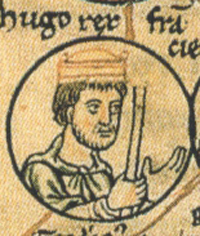
HugoKapet_kronika Hugh Capet was elected King of the Franks on the death of Louis V in 987. The Capetian dynasty broke away from the Frankish custom of dividing the kingdom among all the sons. The eldest son alone became King and received the royal domain except for the appanages. Unlike their predecessors, their hold on the crown was initially tenuous. They could not afford to divide the kingdom among all their sons, and the royal domain (the territory directly controlled by the king) was very small. Most of the Capetians endeavored to add to the royal domain by the incorporation of additional fiefs, large or small, and thus gradually obtained the direct lordship over almost all of France.

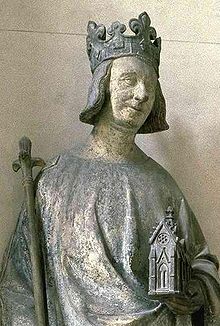
220px-Karel_V_van_Frankrijk King Charles V tried to remove the appanage system, but in vain. Provinces conceded in appanage tended to become de facto independent and the authority of the king was recognized there reluctantly. In particular the line of Valois Dukes of Burgundy caused considerable trouble to the French crown, with which they were often at war, often in open alliance with the English. Theoretically appanages could be reincorporated into the royal domain, but only if the last lord had no male heirs. Kings tried as much as possible to rid themselves of the most powerful appanages. Louis XI retook the Duchy of Burgundy at the death of its last male duke. Francis I confiscated the Bourbonnais, after the treason in 1523 of his commander in chief, Charles III, Duke of Bourbon, the ‘constable of Bourbon’ (died 1527 in the service of Emperor Charles V).

The first article of the Edict of Moulins (1566) declared that the royal domain (defined in the second article as all the land controlled by the crown for more than ten years) could not be alienated, except in two cases: by interlocking, in the case of financial emergency, with a perpetual option to repurchase the land; and to form an appanage, which must return to the crown in its original state on the extinction of the male line. The apanagist (incumbent) therefore could not separate himself from his appanage in any way.

After Charles V of France, a clear distinction had to be made between titles given as names to children in France, and true appanages. At their birth the French princes received a title independent of an appanage. Thus, the Duke of Anjou, grandson of Louis XIV, never possessed Anjou and never received any revenue from this province. The king waited until the prince had reached adulthood and was about to marry before endowing him with an appanage. The goal of the appanage was to provide him with a sufficient income to maintain his noble rank. The fief given in appanage could be the same as the title given to the prince, but this was not necessarily the case. Only seven appanages were given from 1515 to 1789.

Appanages were abolished in 1792 before the proclamation of the Republic. The youngest princes from then on were to receive a grant of money but no territory.

Appanages were reestablished under the first French empire by Napoleon Bonaparte and confirmed by the Bourbon restoration-king Louis XVIII. The last of the appanages, the Orléanais, was reincorporated to the French crown when the Duke of Orléans, Louis-Philippe, became king of the French in 1830.

The word apanage is still used in French figuratively, in a non-historic sense: “to have appanage over something” is used, often in an ironic and negative sense, to claim exclusive possession over something. For example, “cows have appanage over prions.”

List of Major French Appanages
Louis VI
**The County of Dreux for the king’s third son Robert.

Philip II
**The Counties of Domfront and Mortain for the king’s younger son Philippe Hurepel.

Louis VIII, by his 1225 will, granted
**The County of Artois to his second son Robert. Artois was lost by Robert’s male heirs, passing through a female line, and eventually was inherited by the Dukes of Burgundy. Louis XI seized it upon the death of Charles the Bold in 1477, but his son returned it to Charles’s heirs in preparation for his invasion of Italy in 1493.
**The Counties of Anjou and Maine to his third son John. This title returned to the crown when John died without heirs in 1232.
**The Counties of Poitou and Auvergne to his fourth son Alphonse. This title returned to the crown when Alphonse died without heirs in 1271.

Louis IX endowed
**1246 – The Counties of Anjou and Maine to his youngest brother, Charles. These titles passed to Charles’s granddaughter, who married Charles, Count of Valois, the younger son of Philip III, and thence to their son, Philip. When Philip inherited the throne as Philip VI, the titles merged into the crown.
**The County of Orléans to his eldest son, Philip. This title returned to the crown when he succeeded his father in 1270 as Philip III.
**ca. 1268 – The County of Valois to his second son, Jean Tristan. This title became extinct upon Jean Tristan’s death in 1270.
**1268 – The Counties of Alençon and Perche to his third son, Pierre. This title became extinct on Pierre’s death in 1284.
**1269 – The County of Clermont-en-Beauvaisis to his fourth son, Robert. Robert’s son, Louis, was later given the Duchy of Bourbon, which was treated as an apanage, although it was not technically one. Louis later traded Clermont for La Marche with his cousin Charles, Count of Angoulême, younger brother of King Philip V. These titles remained in the Bourbon family until they were confiscated due to the treason of Charles III, Duke of Bourbon in 1527.

Philip III
**The County of Valois to his second son Charles. Charles was later given the Counties of Alençon, Perche, and Chartres by his brother, Philip IV of France. Valois passed to Charles’s eldest son, Philip upon his death in 1325, and returned to the crown when Philip became King Philip VI in 1328. Alençon and Perche passed to Charles’s younger son, Charles. A descendant was raised to the dignity of Duke of Alençon. These titles returned to the crown upon the extinction of the Alençon line in 1525.
**The County of Beaumont-sur-Oise to his third son Louis. Louis was later given the County of Évreux by his brother Philip IV. These titles returned to the throne upon the death of Queen Blanche of Navarre in 1441.

Philip IV endowed
**the County of Poitou for his second son, Philip. This title returned to the throne when Philip became king in 1316.
**the Counties of La Marche and Angoulême for his third son, Charles IV. Charles later traded La Marche for the County of Clermont-en-Beauvaisis with the Duke of Bourbon. These titles returned to the throne when Charles became king in 1322.

Philip VI endowed the
**the Duchy of Normandy for his elder son John. This title returned to the throne when John succeeded his father in 1350.
**the Duchy of Orléans for his younger son Philip. This title returned to the throne when Philip died without issue in 1375.

John II the Good, on his departure to England in 1360, granted
**the Duchies of Anjou and of Maine to his second son Louis. This title returned to the throne upon the death of duke Charles IV, Louis I’s great-grandson, in 1481.
**the Duchies of Berry and of Auvergne to his third son John. These titles returned to the throne upon John’s death without male issue in 1416.
**In 1363, John II granted the Duchy of Burgundy to his fourth son Philip. Upon the death of Philip’s great-grandson Charles the Bold in 1477, King Louis XI claimed the reversion of Burgundy and seized the territory. It continued to be claimed, however, by Charles’s daughter Mary and her heirs. When Mary’s grandson Emperor Charles V defeated and captured Francis I at the Battle of Pavia in 1525, he forced Francis to sign a treaty recognizing him as Duke of Burgundy, but Francis disavowed the treaty when he was released, and the cession was revoked by the Treaty of Cambrai four years later. Charles and his heirs reserved their claims, however, and this reservation was repeated as late as the Treaty of the Pyrenees in 1659, when Philip IV of Spain continued to reserve his rights to the Duchy.

Charles VI granted
**the Duchy of Orléans and the County of Angoulême to his brother Louis in 1392. The Duchy of Orléans returned to the crown when Louis I’s grandson became Louis XII of France in 1498. The County of Angoulême returned to the crown when Louis I’s great-grandon became Francis I of France in 1515.

Louis XI granted
**the Duchies of Normandy, Berry, and Guyenne to his younger brother Charles. These titles returned to the crown when Charles died in 1472.

**Francis I granted
the Duchies of Orléans, Angoulême, and Châtellerault and the Counties of Clermont-en-Beauvaisis and La Marche to his second surviving son, Charles in 1540. To this was added the Duchy of Bourbon in 1544. These titles returned to the crown when Charles died without issue in 1545.

Charles IX granted
**the Duchies of Anjou and Bourbonnais and the County of Forez to the older of his two brothers, Henry, in 1566. He added the Duchy of Auvergne to these holdings in 1569. The titles returned to the crown when Henry succeeded his brother in 1574.
the Duchies of Alençon and Château-Thierry and the Counties of Perche, Mantes, and Meulan to his youngest brother, Francis in 1566. To this he later added the Duchy of Évreux and the County of Dreux in 1569. Francis’s other brother, Henry III, increased his holdings still further in 1576, granting him the Duchies of Anjou, Touraine, and Berry and the County of Maine. All these titles returned to the crown upon Francis’s death without issue in 1584.

Louis XIII granted
**The Duchies of Orléans and Chartres and the County of Blois to his younger brother Gaston in 1626. To this was added the Duchy of Valois in 1630. These titles returned to the crown on Gaston’s death without male issue in 1660.

Louis XIV granted
**The Duchies of Orléans, Chartres, and Valois to his brother, Philippe in 1661. To this was added the Duchy of Nemours in 1672. These titles passed to his descendants and were abolished during the Revolution in 1790. They were restored to the heir at the time of the Restoration in 1814. The heir, Louis Philippe III, duc d’Orléans, took the throne (usurping it in Legitimist theory, legitimately ascending by popular will under Orléanist theory) in 1830 following the July Revolution, and the titles may at this point be considered to have merged in the crown; given the extinction of the line of Louis XV with the death of Henri, comte de Chambord (Henri IV by Legitimist reckoning) and the forfeiture of the junior line of Louis XIV, most Legitimists would accept the merger of the duchy into the (defunct) crown in 1883.
**The Duchies of Alençon and Angoulême and the County of Ponthieu to his third grandson, Charles, duc de Berry in 1710. These titles returned to the crown upon his death without surviving issue in 1714

Louis XV granted
**The Duchy of Anjou and the Counties of Maine, Perche, and Senonches to his second surviving grandson, Louis Stanislas, comte de Provence in 1771. Louis was further given the Duchy of Alençon by his brother Louis XVI in 1774. These titles were abolished during the Revolution in 1790. When the monarchy and apanages were restored in 1814, Louis had inherited the throne as Louis XVIII, and his titles merged into the crown.
**The Duchies of Auvergne, Angoulême and Mercœur and the Viscounty of Limoges to his youngest grandson Charles, comte d’Artois in 1773. To this was added in 1774 by his brother, Louis XVI the Marquisate of Pompadour and the Viscounty of Turenne. In 1776, Louis XVI deprived Charles of Limoges, Pompadour, and Turenne, and gave him in exchange the Duchies of Berry and Châteauroux, the Counties of Argenton and Ponthieu, and the Lordship of Henrichemont. In 1778, the apanage was further reshaped, with Auvergne and Mercœur removed and replaced with the County of Poitou, leaving Charles with a final apanage consisting of the Duchies of Angoulême, Berry, and Châteauroux, the Counties of Argenton, Ponthieu, and Poitou, and the Lordship of Henrichemont. These titles were abolished during the Revolution in 1790, but were restored at the time of the Restoration in 1814. They merged into the crown when Charles became king in 1824.

Although Napoleon restored the idea of apanage in 1810 for his sons, none were ever granted, nor were any new apanages created by the restoration monarchs.

Western fFeudal Appanages Outside France
Appanages Within the British Isles

English and British monarchs frequently granted appanages to younger sons of the monarch. Most famously, the Houses of York and Lancaster, whose feuding over the succession to the English throne after the end of the main line of the House of Plantagenet caused the Wars of the Roses, were both established when the Duchies of York and Lancaster were given as appanages for Edmund of Langley and John of Gaunt, the younger sons of King Edward III.220px-Edward_III_of_England_(Order_of_the_Garter)

In modern times, the Duchy of Cornwall is the permanent statutory appanage of the monarch’s eldest son. Other titles have continued to be granted to junior members of the royal family, but without associated grants of land directly connected with those titles, or any territorial rights over the places named in the titles.

Scotland
DavidIofScotlandThe defunct Kingdom of Strathclyde was granted as an appanage to the future David I of Scotland by his brother William the Lion. Remnants of this can be found within the patrimony of the Prince of Scotland, currently Charles, Duke of Rothesay.

Kingdom of Jerusalem
In the only crusader state of equal rank in protocol to the states of Western Europe, the Kingdom of Jerusalem, the County of Jaffa and Ascalon was often granted as an appanage.

Brigantine Portugal
With the installation of the House of Braganza on the Portuguese throne, in 1640, an official appanage was created for the second eldest son of the monarch, the House of the Infantado. The Infantado included several land grants and palaces, along with a heightened royal pension.

Posted in British history, customs and tradiitons, Great Britain, Living in the UK, real life tales, royalty, Scotland | Tagged , , , , | 2 Comments

The Great Thunderstorm of Widecombe-in-the-Moor, an Early Incident of Ball Lightning

Wood carving representing the Great Storm

Wood carving representing the Great Storm

The Great Thunderstorm of Widecombe-in-the-Moor in Dartmoor, Kingdom of England, took place on Sunday, 21 October 1638, when the church of St Pancras was apparently struck by ball lightning during a severe thunderstorm. An afternoon service was taking place at the time, and the building was packed with approximately 300 worshippers. Four of them were killed, around 60 injured, and the building severely damaged.

Eyewitness Accounts

The tower of Widecombe church today

The tower of Widecombe church today

Written accounts by eyewitnesses, apparently published within months of the catastrophe, tell of a strange darkness, powerful thunder, and “a great ball of fire” ripping through a window and tearing part of the roof open. It is said to have rebounded through the church, killing some members of the congregation and burning many others. This is considered by some to be one of the earliest recorded instances of ball lightning.

The priest, George Lyde, was unhurt, but his wife “had her ruff and the linen next her body, and her body, burnt in a very pitiful manner.” The head of local warrener Robert Mead struck a pillar so hard the blow left an indentation; his skull was shattered, and his brain hurled to the ground. A “one Master Hill a Gentleman of good account in the Parish” was thrown violently against a wall and died “that night.” His son, sitting next to him, was unhurt.

Some are said to have suffered burns to their bodies, but not their clothes. A dog is reported to have run from the door, been hurled around as if by a small tornado, and fallen dead to the ground.

The village schoolmaster of the time, a gentleman called Roger Hill, and brother of the deceased “Master Hill,” recorded the incident in a rhyming testament which is still displayed on boards (originals replaced in 1786) in the church.

The Legend
According to local legend, the thunderstorm was the result of a visit by the devil who had made a pact with a local card player and gambler called Jan Reynolds (or Bobby Read, according to the tale recorded at the Tavistock Inn, Poundsgate). The deal was if the devil ever found him asleep in church, the Devil could have Reynolds’ soul. Jan was said to have nodded off during the service that particular day, with his pack of cards in his hand. Another version of the legend states the Devil arrived to collect the souls of four people playing cards during the church service.

The Devil headed for Widecombe via the Tavistock Inn, in nearby Poundsgate, where he stopped for directions and refreshment. The landlady reported a visit by a man in black with cloven feet riding a jet black horse. The stranger ordered a mug of ale, and it hissed as it went down his throat. He finished his drink, put the mug down on the bar where it left a scorch mark, and left some money. After the stranger had ridden away, the landlady found the coins had turned to dried leaves.

The Devil tethered his horse to one of the pinnacles at Widecombe Church, captured the sleeping Jan Reynolds, and rode away into the storm. As they flew over nearby Birch Tor, the four aces from Jan’s pack of cards fell to the ground, and today, if you stand at Warren House Inn, you can still see four ancient field enclosures, each shaped like the symbols from a pack of cards.

Posted in British history, gothic and paranormal, Great Britain, Living in the UK, mystery | Tagged , , | 1 Comment

Love Vanquishes Everything ~ ~ Meet and Greet: Author, Anna Belfrage + Excerpt from “Revenge and Retribution”

R&R webstampIt is with great pleasure I welcome author Anna Belfrage to “Every Woman Dreams.” Anna is releasing the sixth book in her highly acclaimed The Graham Saga. Today,  Anna brings us a short reflection on love and how it assists us in facing life’s many trials. She has also included an excerpt from “Revenge and Retribution.”

Love is king!
I am a sucker for love. As a consequence, I cannot imagine writing a book that does not contain a sizeable portion of love – albeit I generally avoid the mandatory complications of a romance as it drives me CRAZY when he and she are torn apart, both of them believing the other no longer cares for them. (This is when I will peek at the ending, needing reassurance. Idiotic, I know, as a romance also should have a happy ending, but just in case, I check) My characters are often torn away from each other, but at least they have the comfort of knowing somewhere their man/woman still loves them, will do anything to see them safe.

When I began writing The Graham Saga – years ago – I had in my head a laughing young woman named Alex Lind, a woman with short curly hair and deep blue eyes. She was wearing jeans and red Converse – which was a major problem, as my novel was set in the 17th century.  Hmm. Maybe I should save this apparition for another book.  The shadowy man who was to be the protagonist of the series, Matthew Graham, shook his head. His eyes were glued to the laughing woman, at present dancing on the spot to “It’s Raining Men.”

“I want her,” he said.

“But she’s not from your time,” I protested, looking at him. 
Matthew was leaning against the wall, arms crossed over his chest. His hitherto so vague form was suddenly fleshing out, bright hazel eyes meeting mine as he jerked his dark head in the direction of the woman.

“It’s her or no one.”

He went back to staring at her, a smile tugging at his long mouth.  No matter his linen shirt was worn and dirty, his breeches had seen far better days, and he was in serious need of a bath and a shave, he looked quite mouth-watering – but unfortunately (or not: after all, I am happily married, and Matthew Graham doesn’t exist except in my VERY active imagination) his attention was riveted on her, this as yet unknown Alex.

“But…”

“You heard me,” he said, beginning to fade away, all six feet and plus of him.

“Stop!” I yelled. “I’ll think of something.”

“You do that.” He gave me an encouraging smile.
Obviously, Matthew was smitten. A serious case of what the French call a coup de foudre, love at first sight. Some people scoff at the idea of something as ridiculous as immediate love, but personally I am not that certain. I believe some of us are lucky enough to meet the one and only, and the moment our eyes connect, we are done for.

As all of us know, there’s a major difference between saying “I’m in love with you” and saying “I love you.” The first statement describes a heady phase, no more, but if we’re lucky it morphs into the permanence exuded by the last statement, a commitment that extends – potentially – over a lifetime.  It requires guts to love with all your heart. It leaves you very vulnerable, which is why wounds to the heart take such a long time to heal.  But there is nothing as wonderful, as empowering and as liberating as to love someone unconditionally. It gives us strength when we need it the most, it gives us wings and allows us to soar. No wonder I’m a sucker for love…

One day, Alex-in-my-head caught sight of Matthew. At the time, he was fleeing for his life, scrambling up a dilapidated ladder to hide behind a crumbling chimney.  Dogs bayed, horses snorted, and the loud voice of the officer called his men to order, instructing them to find the fugitive and apprehend him.

“Fugitive?” Alex whispered, leaning forward.

“He’s just escaped from prison,” I explained, throwing a worried look at one of the soldiers who was studying the ladder.

“Is he a criminal?” She didn’t seem too bothered by the notion, incapable of tearing her eyes away from Matthew’s crouched body.

“No. But I’ll let him explain it to you in person.”

“You will?” She gave me a brilliant smile. “Now?”

“He’s sort of busy at present,” I pointed out. To my horror, the roof gave way, and a surprised Matthew was sucked into the house.

“Fix it,” Alex told me. “Make sure he makes it out okay.” Blue eyes hovered uncomfortably close to mine. “It’s him or no one.”

“He’s in the 17th century!” I protested.

“Well then put me there as well. He needs me!” Her face softened. “And I need him,” she added in an undertone, “I’ve needed him since well before I was born.”
Turns out Matthew and Alex were right. They were born three centuries apart, they should never have met, and yet they are each other’s missing half. Without her, he would be diminished. Without him, she wouldn’t quite know how to breathe. And no matter that by now they are well past their youth, the fire between them still burns, still scorches their hearts – as can be proved by the excerpt below from Revenge and Retribution, the recently released sixth book in The Graham Saga.

EXCERPT:

“And you are surprised?” Matthew blew into her nape, tickling her.

“She was pretty harsh,” Alex said, “and Betty generally isn’t.”

“Except when it comes to Ian. Surely you’ve noticed how protective she is of him?”

“Protective? She was flamingly jealous!”

“And you wouldn’t be?”

“You know I would,” she grumbled. She still was, a wave of puce green washing over her whenever she thought of Matthew and his first wife, Ian’s mother.  “Are you?” she asked, pummeling at her pillow. Occasionally, she wanted to claw Kate Jones’ eyes out as well, she reflected, in particular when Matthew was too attentive to her.

“Am I what?”

“Jealous.” She could feel him laughing behind her.

“Is it William Hancock that has caught your eye?”

“William?” Alex twisted round to see him. “What would I see in William?”

“I don’t know,” Matthew said, “but he, I think, is overly fond of you.”

“He is? Oh, don’t be silly. He looks at me with mild disapproval most of the time.”

“I know, aye? I see it in how his eyes follow you around, and how he lets his gaze linger a wee bit too long on your bosom and your arse.” It came out in a very dark voice, and Alex smiled.

“So you are jealous.”

“Not as such,” he replied with a yawn. “Not of him.” He sounded very dismissive.

“So who?” she said, now very wide awake.

Matthew groaned and pulled her down to lie against his chest. “Sleep, aye?”

“Who?” she repeated.

“Of John,” Matthew admitted sulkily. “I don’t like it that I wasn’t your first.”

Alex rubbed her face against his chest. “Idiot. I was twenty-six when we met.”

“Aye, and I still don’t like it. I would that no one but me had ever touched you, taken you, loved you.”

Alex struggled up to sit, making the whole bed sway.

“I’m glad that you weren’t.” She smiled at the way his eyes narrowed. “Otherwise, how would I have known just how lucky I was?” She kissed him: a long kiss. “Very lucky,” she said, licking her lips.

“Very,” he agreed huskily.

All of Anna’s books are available on Amazon US and Amazon UK.

For more information about Anna Belfrage and her books, visit her website!
For a somewhat more visual presentation of The Graham Saga, why not watch the book trailer?

You Tube Link and Anna’s website

From Anna Belfrage’s Website: The Graham Saga…

This is the story of Alex and Matthew, two people who should never have met – not when she was born three hundred years after him.

It all began the day Alex Lind got caught in a thunderstorm. Not your ordinary storm, no this was the mother of all storms, causing a most unusual rift in the fabric of time. Alex was dragged three centuries backwards in time, landing more or less at the feet of a very surprised Matthew Graham.

In a series of books we follow the life and adventures of the expanding Graham family, both in Scotland and in the New World – and let me tell you it is quite an exciting life, at times excessively so in Alex’ opinion.

Sometimes people ask me why Alex had to be born in the twentieth century, why not make her a woman born and bred in the seventeenth century where the story is set? The answer to that is I have no idea. Alex Lind is an insistent, vibrant character that sprung into my head one morning and simply wouldn’t let go.

Seductively she whispered about terrible thunderstorms, about a gorgeous man with magic, hazel eyes, about loss and sorrow, about love – always this love, for her man and her children, for the people she lives with. With a throaty chuckle she shared insights into a life very far removed from mine, now and then stopping to shake her head and tell me that it probably hadn’t been easy for Matthew, to have such an outspoken, strange and independent woman at his side.

At this point Matthew groaned into life. Nay, he sighed, this woman of his was at times far too obstinate, with no notion of how a wife should be, meek and dutiful. But, he added with a laugh, he wouldn’t want her any different, for all that she was half heathen and a right hand-full. No, he said, stretching to his full length, if truth be told not a day went by without him offering fervent thanks for his marvelous wife, a gift from God no less, how else to explain the propitious circumstances that had her landing at his feet that long gone August day?

Still, dear reader, it isn’t always easy. At times Alex thinks he’s an overbearing bastard, at others he’s sorely tempted to belt her. But the moment their fingertips graze against each other, the moment their eyes meet, the electrical current that always buzzes between them peaks and surges, it rushes through their veins, it makes their breathing hitch and … She is his woman, he is her man. That’s how it is, that’s how it always will be.

Other Books in the Graham Saga Series: scale_180_2147483647;donotenlarge-1scale_180_2147483647;donotenlargescale_180_2147483647;donotenlargescale_180_289;donotenlargescale_180_2147483647;donotenlarge


Posted in book excerpts, writing | Tagged , , | 6 Comments

The Westminster Paving Act: Setting London’s Roads Aright

In doing research for a recent release, THE MYSTERIIOUS DEATH OF MR. DARCY, which is set in Dorset, I came across the Purbek marble, a fossiliferous limestone found on the Isle of Purbeck, a peninsula in southeast Dorset, England. That discovery led to one thing and then another, and finally, I came across the Westminster Paving Act of 1762, a dramatic step forward on behalf of London’s dwellers.

maltonchThe Westminster Paving Act removed the responsibility of paving the streets from the individuals to a governmental type commission. Before the act, occupants were responsible for paving and cleaning a specified area before their residences.

From John Wood’s Description of Bath (1749), we discover:

But previous to the Duty of these Officers, every Housekeeper, inhabiting and residing within the City, Liberties, and Precincts thereof, is enjoined, Thrice in every Week at the least, that is to say, on Tuesday, Thursday, and Saturday, to sweep and cleanse, or cause to be swept and cleansed, all the Streets, Lanes, Alleys, and Public Places, before their respective Houses, Buildings, and Walls, and all other Public Places, to the End that the Filth, Ashes, Dirt, Dust, Rubble, and Rubbish may be ready to be carried away by the Scavengers, upon Pain to forfeit Three Shillings and Four-Pence for every Offence and Neglect. They are moreover Prohibited from throwing, casting, or laying; or from permitting any Person to throw, cast, or lay, any Ashes, Filth, Duff, Dirt, Rubbish, Dung, or other Annoyances, in any open Street, Lane, or Alley, within the said City, Liberties, Precincts, or Places aforesaid, before his or their own Dwelling-House, Buildings, or other Public Places within the said City; but, on the Contrary, are Required to keep, or cause the fame to be kept, in their respective Houses, Yards, or Backsides, until such Time as the Scavenger shall come by to receive and take the fame entirely away, under the Penalty of Five Shillings for every Offense.

Again, if any person or persons shall have any Straw or Hay, brought and thrown down for the Use or any Inn, or any other House, in any of the Streets, Lanes, Alleys, and other Public Places, within the said City, the Liberties, and Precincts thereof, and shall not carry the same into their Yards, Backsides, or Stables, sweep and clean the Place where such Straw or Hay was thrown down, and carry away the Rubbish occasioned thereby, within one Hour after such Straw or Hay shall be unloaded, he or they so neglecting is to forfeit Five Shillings for every Offense, to be levied by Distress and Sale of the Offender’s Goods, by Warrant, under the Hands of Two or more of the said Commissioners.

Now as to the Paving of the Streets, Lanes, Alleys, and Public Places of the City, every Occupier or Owner of any House, Houses, or Lands, next adjoining to such Street, Lane, Alley, or Public Place within the said City, Liberties or Precincts thereof, is Required, from Time to Time, within ten Days next after Notice given by the Surveyor, or Surveyors, to be appointed as above, well and sufficiently to pitch or pave, or cause to be pitched and paved, the Street, Alley, or Lane before his or their Houses, Habitations, Lands, and Public Places respectively, into the Middle of the Street, Lane, or Alley, except in the Market Place, and there only eight Feet in Width, under the Penalty of Ten Shillings for each Perch not so pitched; and so in Proportion for any greater or lesser Quantity or Space of Ground; and under the like Penalty for every Month, ‘till the same shall be pitched or paved; which Penalty is to be levied by Distress and Sale of the Offender’s Goods, and to be applied towards Maintaining one or more of the Scavengers to be appointed as aforesaid.

In London, the responsibility of paving and cleaning the streets was normally written into the building lease/sale. The problem with the London streets in the early 18th Century was the lack of consistency. The paving stones were round and fit to walk upon, but in a carriage the ride was quite rough. The wide flat stones, which were perfect underfoot, created a bumpy ride for they were raised above the flat of the road.

The 1762 Act specified that Purbeck stone should replace the previous stone. The act also called for the replacement of the drainage kennel, which was normally placed in the street’s middle, with kerbside gutters. This standard of the Purbeck stone remained in place throughout the late Georgian Period. Eventually, gravel was added between the stones to level out the road.

The act also required a system of street cleaning. As a side benefit of working as a Scavenger (those paid to clean the street by at a parish rate) grew, the streets became cleaner. For example, discarded ashes were collected to be sold to manufactures of inferior place bricks. Eventually, carts carrying water (barrels pierced with holes) kept the dust down on the road.

In the early 19th Century, the occupant was responsible for sweeping the pavement before his house. The parish scavenger removed the dirt from the street and that on the carriageway.

Unfortunately, all the laws of the land could not force those who occupied single rooms in lodge houses or those who frequented houses of ill repute or beer houses. There were some who simply did not care for the condition of the streets upon which they walked or rode.Jeffers-TMDOMD

Posted in British history, buildings and structures, Georgian Era, Great Britain, Living in the UK, real life tales | Tagged , , | 1 Comment

Life of the Gentry During the Regency Period…

Caroline of Brunswick

Caroline of Brunswick

During the Regency Period, wealth and social class separated the English citizenry. Beginning with the Royals, citizens found their place based on birthright and wealth. The nobility stood above the gentry, who stood above the clergy, who stood above the working class, etc. As part of the gentry, Jane Austen’s family held certain privileges, but also lacked political power. Although he was a rector, the Reverend George Austen was a “gentleman,” meaning man of the gentry class. Austen’s novels are populated with those of the gentry. Occasionally, her readers encounter the nobility, as in Lady Catherine De Bourgh and the Dowager Viscountess Dalrymple or the clergy as with Mr. Collins or Mr. Elton.

To be part of the landed gentry, the family had to own 300+ acres of property. The Reverend George Austen was part of the gentry, but he came from the lower end of the class distinction, while Jane’s mother came from a wealthier background. When one reads Austen, the person meets the gentry. A member of the gentry was known as a gentleman, but not all members of the gentry acted as a gentleman.

Good manners defined a person during the era. Loosely based on Renaissance Italy and 17th Century French customs, the “rules” of engagement during the Regency Period were strictly enforced by members of the “ton.” One who did not adhere to the rules would be shunned by Society. york_1804_hale

A gentleman, for example, was expected to speak properly and to avoid vulgarity; to be dressed appropriately; to dance well; to be well versed on a variety of subjects and to have a university education or above; and to practice condescion to those of a lower class.

When addressing women the eldest daughter in a family would be referred to as “Miss” + her last name (i.e, Miss Elliot or Miss Bennet). The younger sisters would be “Miss” + the woman’s given name (i.e, Miss Anne or Miss Elizabeth). Addressing males followed a similar form. The eldest son was “Mister” + last name (i.e, Mr. Ferras or Mr. Wentworth). The younger sons used both given name and surname (i.e., Mr. Robert Ferras or Mr. Frederick Wentworth).

People of lower rank were expected to wait to be introduced to someone of a higher rank. (Do you recall Catherine Morland and Mrs. Allen at Bath? They must wait for an introduction to Henry Tilney, who calls upon the evening’s master of ceremonies to do the deed.) Women of the period were to be obedient to their fathers and husbands, docile and without opinions, have refined qualities, and attendant to their families. Education was not a prerequisite for women. In Austen’s stories, her heroines often shun these predisposed qualities. One must remember that Darcy admires Elizabeth Bennet’s desire to improve her mind by extensive reading.

Derby from a Field Adjoining Abbey Barnes

Derby from a Field Adjoining Abbey Barnes

Posted in British history, customs and tradiitons, dancing, fashion, Jane Austen, Living in the Regency, Pride and Prejudice, Regency era, Regency personalities | Tagged , , | Comments Off on Life of the Gentry During the Regency Period…