 Angel Comes to the Devil’s Keep is now available for preorder. It is a romantic suspense from Black Opal Books, which is set in the Regency Period, and it is loaded with the twists and turns you expect from Regina Jeffers. Angel Comes to the Devil’s Keep is book one of the Twins’ Trilogy, to be followed by The Earl Claims His Comfort and Lady Chandler’s Sister.
Back Cover:
HUNTINGTON McLAUGHLIN, the Marquess of Malvern, wakes in a farmhouse, after a head injury, and being tended by an ethereal “angel,” who claims to be his wife. However, reality is often deceptive, and ANGELICA LOVELACE is far from innocent in Hunt’s difficulties. Yet, there is something about the woman that calls to him as no other ever has. When she attends his mother’s annual summer house party, their lives are intertwined ins a series of mistaken identities, assaults, kidnappings, overlapping relations, and murders, which will either bring them together forever or tear them irretrievably apart.
As Hunt attempts to right his world from problems caused by the head injury that has robbed him of parts of his memory, his best friend, the Earl of Remmington, makes it clear that he intends to claim Miss Lovelace as his wife. Hunt must decide whether to permit Angelica to align herself with the earldom or to claim the only woman who stirs his heart – and if he does the latter, can he still serve the dukedom with a hoydenish American heiress as his wife?
Excerpt: (Huntington McLaughlin and Angelica Lovelace’s first glance of each other)
Chapter 1
London 1819
The odor of the Thames as it wafted over the area beyond Greenland Docks caused Hunt’s nose to snarl, but Sir Alexander had declared that someone paid large sums of money for the privilege of a blind eye to unloaded contraband, and it was Hunt’s duty to learn more of the people involved. The wig Hunt wore itched, and he fought the urge to remove the offending item, and it did not slip his notice how his coachman, Etch, swallowed his amusement.
“Jist relax, sir. It shan’t be long,” Etch cautioned.
Hunt grunted his response, attempting to disguise his own mirth. He slouched lazily against the back of the chair, just as the baronet had taught him. It was not much, this bit of public duty he performed, but Hunt took a certain pride in doing more than being the Duke of Devilfoard’s heir apparent—more than being the Devil’s cub. His ears perked with interest at the conversation, taking place nearby.
“I tells you,” said the dark-haired man Hunt had followed into the tavern. “The viscounty means to learn more of the earl. Then we be makin’ a call upon his lordship.”
“And this Town lord knows of the earl?” the shorter of the two asked.
“That’s wat the viscounty says. Says he’s got an arr’ngement with the highest. He also say we be keepin’ the high lord company fer awhile ’til we’s know fer certain he be easy pickin’s. The viscounty be wantin’ information on who the high lord shows his attentions.”
The men rose to depart, and Hunt made to leave, but Etch placed a hand upon his sleeve.
“Wait.” The coachman nodded to the door. “Is that not Lord Newsome? Doing business in this part of London?”
Hunt’s expression screwed up in disbelief.
“The viscounty?” he wondered aloud. “This just became interesting.”
“You are pure evil,” she declared as he chased her through the intricate maze.
Dressed all in black, he stalked her, and Angel’s body heated from the brief brush of his fingertips upon her wrist. Catching her skirt tail, she skittered away from his slow pursuit.
“A copper for your thoughts,” she taunted with a nervous giggle.
“I was considering the pure pleasure of possessing my own personal angel.” His deep, resonant voice spoke of desire, but also of contentment.
“Am I that angel?” she rasped when he caught her shoulders and spun her to him.
“Forever.”
“Miss Angelica.” Her maid shook Angel’s shoulder. “Wake up, miss.”
Angelica Lovelace rolled to her back and stretched. She despised leaving the dream behind. It was one of her favorites, and she particularly enjoyed how it always ended with her in the dark stranger’s very masculine embrace.
“What is amiss?” she murmured.
Angelica kept her eyes closed, watching the scene’s details playing out behind her lids. She could not remember a time when she did not dream of her dark lover. Even as a very young girl, she enjoyed his company. When she was a child, he was her best friend, but when she turned to womanhood, he became her secret lover, and although she had never met him, he remained the man by which she judged all others. To her, he was her “dearest Devil,” always dressed in black, his shaggy coal-colored hair streaked with hints of mahogany. Over the years, Angelica blamed her oft-spoken-of irreverent attitude on the mystery man with a wicked wit and a splash of deviltry. If my critics knew of my sultry musings, they would agree I am quite beyond the pale. The thought brought a smile to her lips.
“Your father, miss,” the maid encouraged. “Mr. Lovelace requests you attend him in the small drawing room. Lord Arden has called.”
Angelica forced her eyes open. “Lord Arden?” She pushed herself to a seated position. “What might the baron require?”
“Mrs. Watson be thinking the baron will make himself known as a suitor.” The maid braced Angelica on the steps beside the bed.
“Do you suppose the baron consulted Mrs. Watson?” Angelica asked, with a bit of a tease.
The maid rarely understood Angel’s light sarcasm.
“Oh, no, miss. Mrs. Watson be creatin’ a guess.”
A chuckle slipped from Angelica’s lips. “And I thought an English upper servant worth her salt prided herself on knowing everything within the household.”
“Mrs. Watson knows enough.” The maid unlaced the ties on Angelica’s night rail. “I thought the silver muslin, miss.”
Angelica fought the urge to roll her eyes.
“Another virginal gown. Why is it English ladies announce their marital state with their gown’s color? What could be the harm in wearing a bright red or a royal blue?”
“You may choose whatever color most pleases you once you marry,” the maid observed in severe tones. “Lady Peterson wears only shades of purple. Can you imagine, miss? Purple dresses every day?”
Angelica frowned her disapproval.
“I am not certain I could tolerate the monotony. Needless to say, it would simplify the need for accessories. A few pairs of slippers and gloves would match one’s attire.”
“You’re so practical, miss,” the young girl observed.
Twenty minutes later and without breaking her fast, Angelica swept into the room. She and her father had imposed upon the earl and her mother’s sister Sarah by imploring upon her maternal relatives to open the earl’s Town house for the Season and for Lady Mannington to assume the position of Angelica’s sponsor in Society. Her mother’s older sister married Lord Mannington some five and twenty years prior. This was long before Angelica’s birth and before Lady Victoria Copley married Horace Lovelace and traveled to America.
“You sent for me, sir?” Angelica paused as her mother had taught her. ‘Allow the man to take your full measure.’ The words rang clear in Angel’s mind. It was comforting to have a bit of her mother with her.
Her father struggled to his feet. “There you are, my dear.”
Each day, Angelica became more aware of the man’s mortality. That particular fact was one of the reasons she had agreed to this venture. Her mother had passed two years prior, and her father insisted on carrying out his wife’s dying wishes. For years, Victoria Lovelace spoke of bringing her only daughter to England for a proper debut, but Lady Victoria succumbed to consumption before her wish knew fruition. Therefore, without the love of his life, Angel’s father made the journey.
“Please come in.” He gestured her forward. “You are acquainted with Lord Arden, I believe.”
“Yes, sir.” She curtsied to the man standing aristocratically beside the hearth. “The baron and I stood up together at the Breesons’ ball on Tuesday last.”
Arden executed a respectful bow.
“It is singular you have such perfect recall, Miss Lovelace.”
“Angelica has a quick mind,” her father remarked with pride, but then blustered. “Of course, my Victoria would say a learned lady was not a virtue by English standards.” He winced when shock crossed the baron’s features. “I apologize, Arden. I offer no censure. My late wife always accused me of acting a cake when speaking of our daughter. So many years away from my homeland must make me appear quite the heathen. I am accustomed to a freer-speaking society.”
“It is quite acceptable, Lovelace.” The baron grasped the hand Angelica extended in his direction and offered the obligatory air kiss. “Despite the consensus to the contrary, many Englishmen prefer their wives to possess a sensible nature.”
Angelica gestured to a nearby chair. “But the author of Pride and Prejudice proved in her first novel that sense and sensibility are different from intelligence, my lord,” she countered.
“I am surprised you have read the lady’s novels,” Arden remarked.
Angelica seated herself on the edge of the cushion and straightened her dress’s seam.
“Would your surprise be because the author is British rather than American or because the author is a lady, and women should not trespass upon the male dominated world of authorship?” She did not wait for his response before adding, “Perhaps your astonishment rests in the fact Sense and Sensibility is a novel rather than a serious tome?”
She smiled prettily at the man. Her mother may have determined Angelica required an English aristocrat for a husband. However, Angel had decided only a partner who could accept her flaws, as well as her substantial dowry, would do.
Arden frowned in what appeared to be confusion. He clearly did not expect a challenge to his opinions. “I suppose all three, Miss Lovelace.”
“But you hold no objection, my lord, to a woman who develops her mind through extensive reading?” Angel chuckled internally at the familiar line from the British author’s books. She was certain Arden possessed no idea of the remark’s source.
“I would imagine my wife would oversee our children’s educations. Therefore, I would expect a certain rationality—”
“Which brings us to the reason for Lord Arden’s visit, my dear,” her father interrupted. “Arden has requested my permission to call upon you with the intention of a courtship. That is, if you are agreeable.”
“A time to learn if we would suit?” Angel took a closer look at the baron. His thick dark brown hair had a tendency to curl about his collar. Barely six feet, the man struggled to appear more than a walking block of wood, but he possessed a pleasant countenance.
The baron bristled. “Customarily, such details are not discussed before the lady.”
Angel forced her mouth into a straight line. Since making her debut a month prior, she had delighted in ruffling the feathers of a number of gentlemen who saw her dowry as an inducement to marriage, even though it would be to a hoydenish American. When her father suggested this journey, Angel reminded him, as she had often reminded her dear mother, Angel’s ways would not sit well among the English elite for she spent too much time studying her father’s book on antiquities, tending to Horace Lovelace’s growing string of thoroughbreds, and overseeing the health and happiness of her father’s workers. Those were the things that brought her contentment in her Virginia home, but they were not qualities most men of the English peerage sought in a wife.
“We Americans often take a divergent course. I pray that fact does not present a difficulty to our future felicity, my lord,” she said with a practiced smile.
“Certainly not.” Despite his words of assurance, Arden frowned. “I welcome your frankness, Miss Lovelace.”
Angel heard the man’s insincerity, but she had promised her Aunt Sarah not to make predisposed judgments.
“Then how should we proceed, sir?”
“I thought I might escort you on daily outings,” he began. “If it is agreeable, we could drive today during the fashionable hour. I also hoped you would consider accompanying me to the theater tomorrow. My sister and her husband will join us.”
Angel stood to end the conversation. “I am amenable, Lord Arden.”
He followed her to his feet. “Then I will call for you this afternoon.”
“I shall anticipate it.” She directed him from the room, but before Angel opened the door to the main hallway, she paused. With her hand resting on the latch, she smiled innocently up at the man. “Might I ask one question before you leave us, my lord?”
He appeared surprised and then assumed a cynical expression. “By all means.”
Angel hesitated, undecided, but, in truth, she meant to set guidelines before their courtship began. “During this time where we determine whether we might suit, am I to limit my interactions with other gentlemen callers? I would prefer to understand our agreement.”
The baron’s eyes narrowed. “I would expect your undivided attention, Miss Lovelace.”
She smiled sweetly. “Then I would expect the same from you, my lord.”
“Of what do you accuse me, Miss Lovelace?” he huffed.
Angel withheld a glare of disgust. “I meant no offense, sir.” She schooled her features to portray politeness. With that, she opened the door and turned the baron over to the waiting footman.
“Was that necessary?” her father grumbled as he poured himself a glass of claret.
She resumed her seat. “I studied the list of potential candidates Uncle Lancelot provided us. Arden has a long-standing title, but he is deeply in debt. My dowry must appear quite tempting. The baron would accept a woman lacking in effeminate ways to salvage his estate. I mean to keep the baron off balance until I am certain of his motivations. Who knows? Perhaps we shall suit, but I shan’t be his subject. When I marry, I wish a relationship as loving as yours and mother’s.”
“Lady Victoria Copley was one of a kind,” her father said wistfully. “Your mother possessed a magnanimous heart. My Victoria deserved better than a minor son, but I am more than grateful she chose me from among her many suitors. You will find it difficult to discover a man of even half Lady Victoria’s merit.”
Angel thought of her devilish dreams. A man of passion and compassion would do well for her. “I require a man of vision, like my father,” she said in earnest.
The slow carriage procession drove Angel nearly to Bedlam, but she kept the smile upon her lips. She had agreed to the craziness of the “Marriage Mart,” as her Uncle Lancelot termed it, but she preferred to be anywhere else. The baron’s gig crawled along behind a Stanhope. Every few feet, the man would slow the carriage to acknowledge another member of the beau monde before introducing her to his acquaintances. The ton practiced their pompousness with prescribed efficiency, and Angel found it blatantly boring. With amusement, she wondered what her devil would say to such pretentiousness. Mayhap he would use it as a prime argument in defense of passion ruling the world. Not that Angel knew anything of passion. In fact, she had never known even the most faithful of kisses.
“Woolgathering, Miss Lovelace?” a brittle voice broke through her thoughts.
Angel flushed as she looked up into the countenance of a frowning earl. “I beg your pardon, Lord Townsend, I was simply enjoying the park’s splendor on a spring day.”
“You should always carry a parasol, Miss Lovelace,” Lady Townsend warned. “We would not wish to see you become too brown from the sun.”
Angel doubted the woman’s sincerity. She was certain the ton would celebrate any flaw Angel sported. She despised the British standard for unblemished skin. White pasty skin. Virginal white gowns. Proper manners, which hid prejudice and censure. A bland lifestyle wrapped in formality. She missed her American friends and her home in the picturesque Virginia mountains, and she missed riding at break neck speed across her father’s land.
“I am grateful for the suggestion, ma’am, and honored by your attention.” The carriage nudged forward, and Angel prepared to greet the baron’s next acquaintance. “What a crazy tradition!” she observed. “Would it not be wonderful to give the horses their heads?”
“A proper gentleman would never place his cattle in danger,” Arden said in chastisement.
Angel stiffened. His tone increased her often-quick ire. The baron’s first thought was of his team. Should he not think of the park goers or of her position in the high backed gig if safety was his true concern?
“I never suggested you turn your team free. I simply made the observation it would be a pleasant experience to feel the wind upon one’s cheeks.”
“Acting such would age a woman,” he said with another scowl.
Angel considered arguing, but she stifled her words. It was useless to think she might find a mate who spoke to her soul. Dutifully, she apologized. This was her first outing with Arden, and she would not leave the man with a poor impression of her manners. She ignored his declaration, and instead focused on the families enjoying the park. I wish for family, she thought. Children and a husband, who knows pleasure in me and in my devotion. A marriage where love rules our reason.
In resignation of what may never be, Angel turned her head and watched a tall figure toss a ball to a boy hefting a cricket bat. Even from a distance, she could tell he cut a fine figure. It was brazen of her to study one man when riding out with another, yet, she could not turn her gaze. Without realizing the reason, she extended her gloved hand in his direction, as if she wished to turn him toward her so she might look upon his features. It was the oddest sensations, and Angel swallowed hard against the rising constriction in her chest.
Huntington McLaughlin, Marquess of Malvern, ignored the continual line of carriages tooling its way along the lane leading to and from the Serpentine, as well as the Society mamas, who attempted to catch his attention. He never understood the ton’s desire to be on display. In fact, Hunt could not recall the last time he suffered a drive through the park during the fashionable hour. Today, he had brought Logan and Lucas, his sister’s twins, to the park. Earlier, he spent what felt like hours pacifying his father’s high dudgeon regarding Hunt’s refusal of Lord Sandahl’s virginal daughter, Lady Mathild.
“I want nothing of an innocent,” he declared.
If his father forced him to marry, Hunt would consider a widow, but no green girl straight from the schoolroom. He wished for a woman to place her love for him above all others—a woman who shared his passions for life and adventure and learning.
“What is amiss, Uncle Hunt?” Logan called as he took a few practice swings.
Hunt escorted his nephews to the park to remove them from Henrietta’s way. His twin sister was heavy with another child, and with Viscount Stoke away on governmental business, Hunt promised to see to the twins’ safeties, while permitting the boys to expend some of their unbridled energy.
“Nothing,” he mumbled, but he brought his forearm across his eyes to block the sun. Despite standing in an open field and surrounded by many of Society’s best, his loins tightened. From the long equipage line, he watched a slow-moving carriage turning toward Rotten Row. A golden-haired beauty clung to the gig’s side, the wisps of her hair alive with light, and she turned in the seat to stare at him. Too young, his mind argued, but his body reacted nonetheless. He hardened, and although he knew it a foolish act, as the distance between them was too far apart to distinguish each other’s features, he lowered his arm so she might look upon him. “Bloody hell,” he mumbled as the gig moved away.
“Come on, Uncle Hunt,” Logan encouraged.
Hunt withdrew his eyes from the departing carriage, but not before he spotted what he thought was the woman reaching out to him. It was like nothing he had ever experienced, and the movement set his body on alert.
“Right away,” he said with little conviction. With the girl no longer in sight, Hunt turned to the seven-year-olds. “Are you prepared?” He tossed the ball in the air to catch it again.
“It will be a fiver,” Logan bragged.
Hunt laughed at his nephew’s puffed-out chest. “No boasting until after you produce.” Yet, while he tossed the ball to Logan, Hunt thought only of the pleasure of greeting the unknown girl with an embrace she would never forget.
Pre-Order Links:
Nook
Kobo
Smashwords
Black Opal Books (Both eBook and Print copies are available for a discount.)

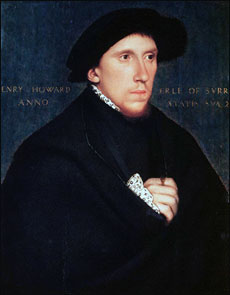 Born in Hunsdon, Hertfordshire, in 1517, Henry Howard, Earl of Surrey, was the eldest of Thomas Howard and Lady Elizabeth Stafford’s children. Surrey was of royal descent on both the paternal and the maternal sides of his family. He received an excellent education under John Clark. He learned Latin, Italian, Spanish, and French. Earl of Surrey was his courtesy title, bestowed when his father became the 3rd Duke of Norfolk. He was an early companion to Henry VIII’s illegitimate son, Henry Fitzroy, Duke of Richmond.
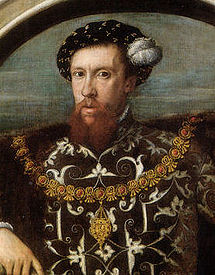 Surrey erred greatly by promoting his father’s position as Protector to young Prince Edward when Henry VIII’s health was failing in 1546. “The Seymours finally had their day, when Surrey ill-advisedly displayed royal quarterings on his shield. Arrested along with his father on charges of treason, he was imprisoned in the Tower. Several additional claims were made against him, including that he was secretly a papist. Surrey was indicted of high treason in January 1547, despite the lack of any real evidence, condemned, and executed (beheaded) on January 19, 1547, on Tower Hill. He was buried in the church of All Hallows Barking, but was later reinterred in the church of Framlingham, Suffolk. His second son Henry, Earl of Northampton, erected a magnificent tomb for him there in 1614. Surrey’s father, the Duke of Norfolk, remained in prison throughout the reign of King Edward VI, but was released when Queen Mary took the throne. Henry Howard’s first son, Thomas Howard, succeeded his grandfather to the title of Duke of Norfolk in 1553.



 Rather than circling warily around what you want to say for a half page or more, you need to illustrate the details. You must also learn not to hedge on a subject. If the person is a fool, call him one. Do not spend time with “in my opinion” or “as I see it” or “from my point of view.” Say what you wish to say. Avoid euphemisms. Admittedly, in certain time periods, euphemisms are plentiful to soften subjects that are sensitive or taboo. Just think of the number of ways to say that someone died: passed away, pushed up the daisies, met his Maker, kicked the bucket, cashed in his chips, etc. As I write books based in the Regency, I am conscious to say with child or enceinte for pregnant. I also include phrases such as “lying in” to describe the weeks leading up to the baby’s delivery.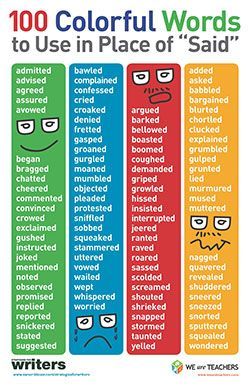




 This is a poster for You Nazty Spy!. The poster art copyright is believed to belong to the distributor of the film, Columbia Pictures, the publisher of the film or the graphic artist. Further details: Original lobby poster for You Nazty Spy (1940). {
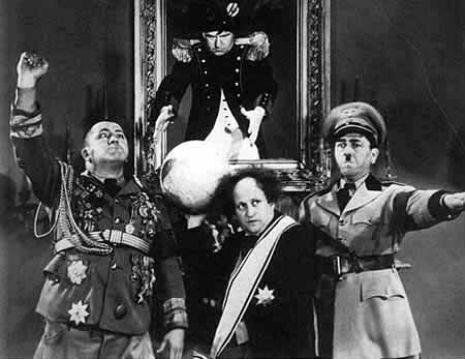 The Stooges, especially Moe Howard and Larry Fine, were quite active in the war efforts in America. They sold war bonds, and Moe even acted as an air-raid warden for his community in Beverly Hills. Moe and his brother Jerome (Curly) were raised by European immigrants in a small Jewish community near Brooklyn, New York. Larry was also of Jewish extraction and was known to follow European events quite closely.
 Plot of “You Nazty Spy”
 A Drop in the Bucket (or) Sea (or) Water
  Also in America, Tom and Jerry is an American animated series of short films created in 1940, by William Hanna and Joseph Barbera. It centers on a rivalry between its two title characters, Tom Cat and Jerry Mouse, and many recurring characters, based around slapstick comedy. In its original run, Hanna and Barbera produced 114 Tom and Jerry shorts for Metro-Goldwyn-Mayer from 1940 to 1958. During this time, they won seven Acacdemy Awards for Animated Short Film, tying for first place with Walt Disney’s Silly Symphonies with the most awards in the category. “Tom and Jerry” was a commonplace phrase for youngsters indulging in riotous behaviour in 19th-century London. However Brewer’s notes no more than an “unconscious” echo of the Regency era’s original meaning in the naming of the cartoon. (




 The site Wood chose for the Royal Crescent also demonstrates his interest in creating a “dialogue” between his buildings and their settings. Previous buildings and set pieces in Bath were all intensely urban and inward looking whereas the Royal Crescent was fully open and looked out on the open fields. This is not always apparent today, but when it was built in 1775, the crescent was situated right on the edge of the city with no nearby buildings to block residents’ views of the countryside. The Royal Crescent is among the greatest examples of Georgian architecture to be found. Outside of Bath, Wood’s most notable works include Buckland House in Buckland, Oxfordshire, and General Infirmary in Salisbury.


