Holiday Gift Giving and the Release of Mr. Darcy’s Present + Giveaway

Most people today think of the three gifts of gold, frankincense, and myrrh as being the original “Christmas presents.” However, we must recall that during the Roman ritual, known as Saturnalia, gifts were exchanged. The pagan rituals demanded that “generosity would be rewarded with good fortune in the coming year.” During the early stages of Christianity, most Christian converts still celebrated their old Roman holidays. When Christmas became an official date on the calendar (approximately the 4th Century A.D.), it was natural to carry over the tradition of giving presents, especially as “Christmas” and “Saturnalia” were celebrated at about the same time of the year. However, that being said, gift giving and the Christmas spirit were not always compatible.

Gift giving on New Year’s Day was a common practice during the Roman rule. This tradition began in the Dark Ages and continued in Britain through Queen Victoria’s reign. saint-nicholas6To this gifting tradition, we might add the legend of St. Nicholas, the bishop of Myra (beginning in the 4th Century). The St. Nicholas legend says the the priest bestowed gifts upon the poor throughout Asia Minor. The images of “Santa Claus” and of “Christmas stockings” can be traced to St. Nicholas’s life’s work. The anniversary of St. Nicholas’s death (December 6) was often marked during the Middle Ages with the bestowing of gifts on children.

Unfortunately, not all who knew of St. Nicholas kept his teaching sacred. Some European rulers demanded gifts of their subjects rather than to spread their wealth around. In the 10th Century, King Wenceslas (a Bohemian duke) began the practice of gift giving in the nature of St. Nicholas. He distributed firewood, food, and clothing to his subjects.

williamtheconquerorOn December 25, 1067, William the Conqueror donated a large sum of money to the Pope. This act planted the seed for change in Eastern Europe and later England and America. In Germany, many chose to give gifts to friends and neighbors anonymously. The Dutch did something similar, but they made it into a “treasure hunt” with written clues to where the gifts were located. The Danes were the first to wrap presents. They would put a small box into a larger one and then another one, etc., etc.

England at this time was under Puritan rule, and gift giving and all things Christmas were banned. The Puritans thought God did not want Jesus’s birthday to be a time of giving to others. Christmas was a day of solemn reflection. That being said, the upper class still gave gifts at New Year’s (a leftover tradition from Roman times). Some families also presented gifts to children on January 6 (old calendar January 17), which is “Twelfth Night” – a symbol of the day when the wise men gave gifts to the baby Jesus, twelve days after the Christ child’s birth.

Clement Moore’s poem “The Night Before Christmas” was an 1820s sensation, and the idea of Christmas gifts became more accepted. Charles Dickens’s A Christmas Carol emphasized the idea of gift giving, especially giving to the needy. Merchants took the idea to the next level. After the American Civil War, America was the center of “gift giving.” In the 1880s, Christmas gifts became commonplace in England, and by the early 1900s, Christmas had replaced the New Year’s tradition for gifts.

Catlogs, large department stores, dependable mail service, etc., all contributed to the gift giving frenzy known as Christmas. In the U.S., the average person spends $750-1500 on Christmas gifts.

Book Blurb for Mr. Darcy’s Present: A Pride and Prejudice Holiday Vagary

The Greatest Present He Would Ever Receive is the Gift of Her Love…

What if Mr. Darcy purchased a gift for Elizabeth Bennet to acknowledge the festive days even though he knows he will never present it to her? What if the gift is posted to the lady by his servants and without his knowledge? What if the enclosed card was meant for another and is more suggestive than a gentleman should share with an unmarried lady? Join Darcy and Elizabeth, for a holiday romp, loaded with delightful twists and turns no one expects, but one in which our favorite couple take a very different path in thwarting George Wickham and Lydia Bennet’s elopement. Can a simple book of poetry be Darcy’s means to win Elizabeth’s love? When we care more for another than ourselves, the seeds of love have an opportunity to blossom. 

Words of Praise for Mr. Darcy’s Present

Jeffers takes a familiar story and reinvigorates it with humor, warmth, and wisdom. – Roses and Lilacs ReviewsTRTU eBook Cover

Purchase Links:

CreateSpace        Amazon       Kindle        Kobo        Nook   

In Mr. Darcy’s Present, our favorite hero, is not so pleased with the demand of presenting presents to those he loves. It is not as if he is of the nature of Ebenezer Scrooge, rather he prefers to share his admiration with small gifts throughout the year.

Excerpt from Chapter Two of Mr. Darcy’s Present

“What have we here,” Bingley said as he eyed the array of items.

A bold grin claimed Darcy’s lips. “Despite my accident and his service to my person, Sheffield was kind in retrieving the items I previously selected to delight both the Fitzwilliam and Darcy sides of the family tree upon Christmas Day. Come tell me what you think.” He joined his friend before the table. “I would prefer to view many up close, but as this contraption that Harvon has upon my wrist makes me truly all thumbs, I have chosen to admire the more delicate pieces from afar.”

Bingley chuckled and with a dramatic bow said, “I am your squire, sir. Kindly bid me whatever you will.”

Darcy laughed easily in return. “As reason has gone the way of farthingales as to the relevance of Christmas, mayhap you might set the music box to playing. The tune is to be ‘The Holy and the Ivy,’ and I would hear the tone before presenting it to my cousin, Miss De Bourgh.”

Bingley’s eyebrow rose in curiosity as he reached for the item. “Customarily, you present Miss De Bourgh something less personal. Have you changed your mind regarding the lady’s suitability?”

Darcy reluctantly admitted, “Many men do not marry until thirty or beyond for they must first earn their fortunes, but that is not a consideration for me. I have been thinking of marriage often since my sister left the schoolroom. Miss Darcy will require a proper sponsor for her Come Out, and I will require an heir for Pemberley.”

Uncharacteristically, Bingley gazed upon him as if Darcy had escaped Bedlam. “I do not wish to offer an offense, but how might Miss De Bourgh prove an asset for either of those aspirations. By your own accounting, because of her poor health, your cousin has never known Society. Moreover the lady’s poor constitution could affect the possibility of a healthy heir. You cannot be serious in this notion, Darcy. I can think of a dozen women more suitable as the Mistress of Pemberley than Miss De Bourgh.”

“Such as Miss Bingley?” Darcy accused with more irritation than he intended. Even though he recognized Caroline Bingley could be considered a proper candidate to be his wife, her recent manipulations to separate her brother from Miss Bennet had soured Darcy’s opinion of her.

Bingley blanched white. “I am aware of Caroline’s aspirations, and I would celebrate having permission to call you ‘brother,’ but I have never encouraged my sister’s hopes of marrying you any more than you have encouraged her hopes of my choosing Miss Darcy.”

As it rushed forward to claim his conscious thoughts, Darcy pushed away the image of his and Bingley’s claiming family by marrying the Bennet sisters. “I apologize, Bingley. I am still from sorts with my injuries and the after consequences of the laudanum. You are correct regarding Miss De Bourgh’s health, but I am of the persuasion that if Anne were removed from Lady Catherine’s oversight, my cousin would blossom. Moreover, an endogamous marriage would strengthen the Fitzwilliam bloodlines.”

“And what of George Darcy’s bloodlines?” Bingley asked in serious tones. “You owe an allegiance to the Darcys also. It is the name your children will carry.”

“In the end, I must act in a manner that serves my estate best,” Darcy said simply, and Bingley, thankfully, permitted the subject to slip away.

Instead, his friend suggested, “Mayhap I could address the cards for each presentation if you would share your sentiments and later the directions. We could use a calling card so there would be no need for your signature.”

“I appreciate the offer,” Darcy said in grateful tones. He was also obliged to leave behind the prospect that he must choose someone other than Elizabeth Bennet as his life match. Such was not a welcomed thought.

Bingley laughed lightly as he retrieved a quill and ink from where they rested on Darcy’s desk. “You do recall my careless style of writing is quite different from your excellent penmanship?”

“I promise to keep my words to three syllables or less,” Darcy teased. As it was with him every minute since he left her in Hertfordshire, the conversation was another reminder of Elizabeth Bennet’s time at Netherfield and how she had supported Bingley’s defense of his friend’s nonsensical correspondence. Sometimes Darcy wondered if he would ever spend another day without her memory demanding his attention. Another day without her essence invading his heart. Keeping those thoughts private, he instinctively repeated part of what transpired that night at Netherfield, but he added a light-hearted tone. “Know I will not tolerate pride in your defects in writing,” he said with a wry twist of his lips. “No professions of such defects proceeding from a rapidity of thought and a carelessness of execution. Such will not impress me.”

Bingley placed a fist over his heart and playfully said, “I promise.” He placed a straight-back chair closer to the table. “Where do we begin?”

As part of today’s post, I have two eBook copies of Mr. Darcy’s Present for those who comment below. The giveaway will end at midnight on Saturday, October 1.

Posted in book excerpts, book release, Georgian England, Great Britain, holidays, Jane Austen, Living in the Regency, marriage customs, Pride and Prejudice, Regency era, Regency romance, Vagary | Tagged , , , , , , , , | 14 Comments

Robert Southwell, Jesuit Priest and Literary Contemporary of William Shakespeare

url“Robert Southwell was born around 1561 at Horsham St. Faith, Norfolk, the youngest son and fifth child in a family of eight. The Southwells, a county family that had prospered from the dissolution of the monasteries, formed part of a network of wealthy, interrelated families that included the Wriothsleys, Howards, Bacons, and Cecils as well as recusants such as Vaux, Arden, and Copley. Southwell was a studious boy whose father liked to call him ‘Father Robert.’ In 1576 Southwell, like many other boys of his class, was sent overseas to be educated in the Jesuit school at Douai. He would not see England again for ten years. Between the ages of fifteen and seventeen he became convinced of his vocation to a religious life, and in 1578 he was admitted to the noviceship at Rome, where he embarked upon his formation as a Jesuit. In 1581 he transferred from the Roman to the English College, where he became tutor and perfect of studies. He was ordained in 1584 and was sent on the English mission in 1586, landing secretly with his fellow Jesuit Henry Garnet somewhere between Dover and Folkestone in early July. He was about twenty-five years old.

“Christopher Devlin estimated a Catholic priest’s chance of survival in England in 1586 as one in three. Southwell led the active but disguised and secret life of a pastor for six years, working mostly in and around London except for some journeys into the Midlands. For much of this period he lived under the protection of Anne, countess of Arundel, whose husband, the earl, was a prisoner in the Tower of London. In June 1592 the notorious priest hunter Richard Topcliffe succeeded in capturing Southwell. Topcliffe, Elizabeth I’s servant and favorite, “an atrocious psychopath,” in Geoffrey Hill’s  words, was allowed to torture prisoners in his own house. Southwell was in this man’s hands and then in the hands of Privy Council interrogators and torturers for a month; news of his transfer to solitary confinement in the Tower was a relief to his friends.

“After more than two years’ imprisonment he was moved to the notorious cell in Newgate called Limbo, and his trial took place on 20 February 1595 under the statute of 1585, which had made it treason to be a Catholic priest and administer the sacraments in England. He was found guilty and was executed the next day by hanging, drawing, and quartering. At his trial Southwell said that he had been tortured ten times and would rather have endured ten executions. Pierre Janelle, who quotes the records in detail, writes that Southwell made of his trial and execution “a work of art of supreme beauty.” He was thirty-three at his death. Pope Paul VI canonized him on 25 October 1970 as one of the Forty Martyrs of England and Wales.

“Southwell wrote most of his English works between the time of his return to England in 1586 and his capture in 1592. As a prisoner he had no access to writing materials. Janelle described his literary career as an ‘apostolate of letters’ and thought that his superiors had instructed him to make writing a part of his missionary activity. This theory was perhaps based on the fact that Southwell and Garnet carried in their instructions permission to print “some small books for the defense of the faith and the edification of Catholics.” Other critics have treated Southwell’s work as versified doctrine, as religious propaganda, as a substitute for preaching, or as the outcome of his Jesuit training in religious faith and discipline by means of the Spiritual Exercises of Saint Ignatius of Loyola. Southwell states in the prefatory material to Mary Magdalen’s Funeral Tears(1591) and to Saint Peter’s Complaint (1595) that he wished to set an example of writing on religious themes in English, but nowhere does he say how or why he began to write.

imgres“His earliest works, dating from his Roman years, are Latin poems preserved at Stonyhurst. Brian Oxley has shown that these youthful poems share the mature Southwell’s habits of thought as well as the verbal artistry found in his English work: “Southwell’s sense of the artifice of holy things, and indeed, of the holiness of artifice, is central to his life and work.” The Latin poems are evidence of a strong, probably irresistible vocation as a writer and poet.

“Southwell’s first full-length English work was the prose An Epistle of Comfort (1587), which originated as a series of pastoral letters written to his hostess’s husband, the earl of Arundel, imprisoned in the Tower for his religion. Southwell published the book on a secret press supplied by the help of the countess—although it is unlikely that the press was actually in Arundel House, as some authorities suggest. Helen C. White has shown that the Epistle of Comfort—a letter written to encourage the persecuted, even to the point of martyrdom—is an example of an ancient Christian genre. It has sixteen chapters, the first eleven devoted to the various sources of comfort for the afflicted Catholics.

“Southwell begins modestly and generally, pointing out that suffering is a sign that his readers are out of the devil’s power, loved by God, and imitators of Christ. Suffering, he argues, is inseparable from human life and in most cases is no more than the sufferer deserves. Then, at midpoint, he turns to the peculiar situation of the recusants, beginning with the argument that there is comfort in suffering for the Catholic faith. He then presents a series of all-too-real possibilities, starting with general persecution and ascending through imprisonment and violent death to martyrdom itself. The concluding chapters deal with the unhappiness of the lapsed, the impossibility of martyrdom for the heretic, the glory that awaits the martyr, and, lastly, a warning to the persecutors. The content and the style are much influenced by the patristic authors whom Southwell quotes so deftly; the tone is measured, unyielding, even triumphant. In Southwell’s mind, the Catholics’ suffering is a direct consequence of the Protestant heresy, and that in turn is a manifestation of the perennial evil of earthly life. To bear its effects is an honor: “Let our adversaries therefore load us with the infamous titles of traitors and rebels.” (Poetry Foundation)

In “The Burning Babe,” the poet (through the narrator) tells of a cold winter night in which he felt a sudden heat. Looking up he discovers a burning babe, who is weeping. The child says, “I am newly born. My faultless breast is my furnace, and justice gives it fuel. But no men come to warm themselves at this fire. The metals in the fire are the defiled souls of men.” 

“For which, as now on fire I am to work them to their good/So will I melt into a bath to wash them in my blood.”

When the babe had finished talking, the poet realized that was Christmas Day. 

This particular poem is an allegory full of religious imagery and is typical of Southwell’s work. Although many of the figures are not particularly poetic (such as…”in fiery heats I fry”) nevertheless, the tone as a whole is quietly passionate and impressive. 

From 1584 until 1592, Robert, an ordained priest, conducted missionary labors in London. Arrested, he remained in jail for three years before being martyred at Tybum. He passed on 21 February 1595. He is one of the Forty Martyrs of England and Wales, canonized in 1970.

Additional Resources:

Catholic Online

Luminarium

Wikipedia  

Posted in legacy, poetry | Tagged , , , | 2 Comments

Best Intentions ~ Celebrating the Release of “Mr. Darcy’s Present” + Excerpt + Giveaway

I admit it. I love autumn. Here in North Carolina for the past two summers we have had a string of 90+ degrees days. This year, since May 27, we have had 82 such days. The lowest temperature we have experienced in three months is 83. So, I am thankful for the latter days of September and the early days of October when the heat and the humidity take a backseat. We will still receive a few days of 85+ degrees until November, but the heat eases, and people start thinking of the upcoming holidays.

Moreover, in my family, we have a series of birthdays between now and year’s end. I turned a sweet 69 years on September 17. [There was a time I thought being 69 meant one was ANCIENT! Not so much now.] My granddaughter Annalise turns 3 in early October. My stepson Tim will be 40 on Halloween. My grandson James will be 5 in early November, and his father (my son) Josh will be 32 in mid November. We have Thanksgiving in the States at the end of November [which included my late mother’s birthday] and Christmas in December. And the much anticipated event at the beginning of January will be a new grandchild. So you can see how my heart grows lighter once the heat of summer disappears.

On one of those recent hot summer evenings, I was speaking to my long time friend Charlotte on the phone, and is customary between us, we were reminiscing about some crazy antics from our childhood. Soon, I was telling her about the year I received four Easter baskets. This was a monumental event for my parents were separated in a time when divorce was still not “accepted.” My mother did not know whether she could scrap up enough money to purchase an Easter basket, and so she had prepared me for disappointment. Then God smiled on my 10-year-old self for my grandfather bought me a basket, our neighbors, who had no children of their own, did likewise, the woman for whom my mother worked presented me with a third one, and my mother was the bearer of the fourth. It was too much chocolate for one child, but I rationed it out to last a LONG time. What was odd about each was that somehow the little note from the presenters were mixed up, and I kept thanking the wrong people for the chocolate bunnies or the jelly beans. Soon the situation became a family source of laughter.

After our conversation between Charlotte and me ended, I held that special moment with me for several hours and into my slumber. As is customary for my writing, soon the idea for a new novel took root, and I decided to write a light-hearted sweet Christmas story with Darcy and Elizabeth. In this tale of Mr. Darcy’s Present, Darcy purchases a small gift for Elizabeth, one he never expects to present her – more one to ease his troubled soul after her rejection of his hand. Unfortunately, the note he sets with the gift becomes mixed up with the ones intended for Georgiana, Anne de Bourgh, and Darcy’s long-time friend Mrs. Osborne. Each of the women receives the wrong note, which causes our favorite hero more than one embarrassing moment.

So, here is a sample of Darcy’s dilemma. I hope you enjoy it.

TRTU eBook Cover

Book Blurb: The Greatest Present He Would Ever Receive is the Gift of Her Love…

What if Mr. Darcy purchased a gift for Elizabeth Bennet to acknowledge the festive days even though he knows he will never present it to her? What if the gift is posted to the lady by his servants and without his knowledge? What if the enclosed card was meant for another and is more suggestive than a gentleman should share with an unmarried lady? Join Darcy and Elizabeth, for a holiday romp, loaded with delightful twists and turns no one expects, but one in which our favorite couple take a very different path in thwarting George Wickham and Lydia Bennet’s elopement. Can a simple book of poetry be Darcy’s means to win Elizabeth’s love? When we care more for another than ourselves, the seeds of love have an opportunity to blossom.

Words of Praise for Mr. Darcy’s Present

Jeffers takes a familiar story and reinvigorates it with humor, warmth, and wisdom.

————————-

He set Bingley’s letter aside and quickly read through the other three. Deciding he could do no more until he summoned Sheffield to be his scribe in Bingley’s absence, he carried all four pieces to his study to search through his ledger for the necessary information for his correspondence. However, the empty table where the gifts once rested brought him up short. Swallowing hard against the realization the gift for Elizabeth was also among the missing, he turned to a passing footman to say, “Please ask Mr. Thacker and Mr. Sheffield to attend me here immediately.”

Darcy braced his weight against the doorframe for he did not think his legs would support him. “Surely there is a logical explanation,” he murmured to still the racing of his heart.

An out of breath Thacker came to a halt behind Darcy. “Is there something amiss, Mr. Darcy?”

Darcy did not look upon his servant. Thacker’s tone spoke of the butler’s concern. “May I inquire of the items that were on the table only yesterday?”

Thacker responded in uncertainty. “As Christmas Eve day is but four days hence, you instructed Mr. Sheffield to dispatch the assortment to the proper parties, sir. With the assistance of Mrs. Guthrie and one of the maids, the items were wrapped with paper and string. Mr. Sheffield made certain each parcel had the proper directions while I arranged for the various riders. Even Miss Darcy’s items were sent ahead to Rosings, sir.”

Cautiously, Darcy asked, “There were several items without a recipient’s name. What of those?”

“I cannot say, sir. But here comes Mr. Sheffield. He can speak to your concerns.”

Thinking it best that he interview his valet in private, Darcy motioned Sheffield into the room and closed the door. “Has something amiss occurred, sir?” Sheffield asked with the confidence of a long employed upper servant. Darcy walked toward the far side of the room to prevent anyone from eavesdropping at the door, and Sheffield followed with Darcy’s prompting. “Mr. Thacker informed me that you organized the distribution of the gifts you purchased in my name. Is that correct?”

“Yes, sir.” The confidence had disappeared from the valet’s features. “You presented me specific instructions last evening when you summoned me to assist with your undressing.”

“The same evening hours that, by your own words, I consumed both laudanum and brandy?”

Sheffield swallowed harder. “Yes, sir, but in my defense, at the time you did not appear unclear with your wishes. It was only after you did not wake promptly this morning and after Mrs. Guthrie mentioned your consumption of the brandy that I knew alarm. Your breathing was very shallow for several hours. I asked Thacker to place Nott on alert, but although you refused to arouse completely, Nott assured us it was only a matter of time for the dosage of laudanum to wear away.”

Darcy grumbled, “No more laudanum!”

“But Doctor Nott says…” Sheffield began.

“No more!” Darcy demanded. “Although I admire Nott’s noted knowledge, the physician is too free in dispensing the opiate, and I specifically requested that I not consume the mixture again. I do not appreciate your undermining my orders, even when you think you are serving my interests.” Darcy shot a glance again to the table, almost wishing to view the book and the pin still upon it. “So when exactly did you send out the parcels?”

“All were on their way by nine of the clock, sir.” His servant’s eyes were upon the floor.

“I thought you watched over me?” Darcy asked suspiciously.

“Last evening, after leaving your quarters, I came to your study and wrote out a list of the necessary directions for each parcel. I thought it odd that you chose to post the items for the Matlocks and the De Boughs, as you would customarily place them in your carriage, but I assumed you worried that your injuries could cause you a delay.”

Darcy asked the question to which he had no desire to know the answer for it would turn his life upside down. “And what of the book and the stick pin? The card held no recipient’s name.”

“As neither you or Mr. Bingley chose to sign the card, I assumed the items a gift for someone special. You did not use the initialed cards for that one particular gift. After Mr. Bingley’s man told Thacker that his master was to Hertfordshire, your instructions of last evening for the gift to be sent in Miss Elizabeth’s care made more sense.”

Dread settled in Darcy’s chest. “To Miss Elizabeth? I told you to have the presentation sent into Miss Elizabeth Bennet’s care?”

Confusion returned to Sheffield’s features. “Yes, sir.”

“Again,” Darcy demanded, “this occurred last evening, before I took to my bed?” Darcy did not yet know whether to sack everyone involved or to laugh at the absurdity of the situation.

Sheffield cleared his throat a second time. “Did you not assist in Mr. Bingley’s pursuit of Miss Bennet? It was all quite obvious to the gentleman’s staff in Hertfordshire that Mr. Bingley held the lady in regard. I assumed the message was on the plain card and not signed because Mr. Bingley had yet to know the lady’s heart. You instructed Mr. Bingley, did you not, sir, that a book of poetry, which women appreciate more than men, and an engagement jeweled pin, a gift ‘not too ornate,’ as you declared would be perfect to earn Miss Bennet’s regard. I supposed Mr. Bingley left instructions to send the gift to the lady’s sister, for Miss Elizabeth would have most certainly agreed to assist in Mr. Bingley’s efforts. Mr. Bingley could not offer Miss Bennet the gift until there was an understanding between him and the lady, and with Christmastide, the gentleman would not wish to risk having no gift when the lady accepted his hand. What other explanation could there be?”

Purchase Links:

CreateSpace             Amazon  

Kindle             Kobo             Nook   

I HAVE TWO eBOOKS of Mr. Darcy’s Present AVAILABLE AS A GIVEAWAY TO THOSE WHO COMMENT BELOW. THE GIVEAWAY ENDS AT MIDNIGHT, SEPTEMBER 29, 2016. 

Posted in Austen Authors, book excerpts, book release, Georgian England, historical fiction, holidays, Jane Austen, Living in the Regency, marriage, marriage customs, marriage licenses, medicine, Pride and Prejudice, Regency era, Regency romance, romance, tradtions, Vagary | Tagged , , , , , , | 24 Comments

Are You Familiar with These Words and Phrases?

043973228x_rgb4_xlgI love unusual words and phrases and often make note of them as I read. Today, we have a nice mix. 

As Nice as Ninepence means neat, tidy, well-ordered. Phrase Finder tells us that the origin of the phrase may include the variants, ‘as right as ninepence’ and ‘as neat as ninepence.’ 

as nice as ninepenceThere are suggestions that this expression derives from from ‘as nice as ninepins.’ In the game of Ninepins (Skittles) the pins are set out in a square. For the game to be fair this must be done neatly and accurately or, in the old parlance, nicely. There are no early records of ‘as nice as ninepins’ in print, which we might expect if the ‘ninepence’ version derived from it. The ‘ninepins’ form, in the guise of ‘as smart as ninepins’ isn’t found until the 20th century, so it is reasonable to assume that it is a simple mishearing of the earlier ‘as neat/clean/grand as ninepence’ versions.

We find the earliest known recorded form of the phrase is ‘as neat as ninepence’; the first citation is in James Howell’s English Proverbs, 1659:

“As fine as fippence, as neat as nine pence.”

as nice as ninepenceThe ‘fippence’ (five pence) here makes it clear that the reference is to money rather than to skittles. For it to appear in a list of sayings viewed as proverbial it must have been in existence for some time before 1659. There was a ninepence coin in circulation in the 16th and 17th centuries, although there was nothing especially neat or nice about it. The rhyming and alliterative style of the citation suggests that the ‘neat’ and ‘nice’ were chosen just for that reason. [When I originally went looking for this phrase, I sought out ninepence to nothing.”]

_____________________________________

Next, I have clever about his fambles.” I could not find this one as written, but we could break down the meaning. As a noun, “famble” was a form of obsolete slang meaning “hand.” The word came from the Old English famelen, and as a verb it means “to stammer.” In James Joyce’s “Ulysses,” we find, “White thy fambles, red the gan/And thy quarrons dainly is./Couch a hogshead with me then./In the darkmans clip and kiss.”

________________________________________

Bamboozle” is a word meaning  1.to deceive or get the better of (someone) by trickery, flattery, or the like; humbug; hoodwink(often followed by into); 2.to perplex; mystify; confound. The origin comes from 1695-1705. Bamboozle is one of those words that has been confounding etymologists for centuries. No one knows for sure what its origins are. One thing we do know is that it was originally considered “low language,” at least among such defenders of the language as British.

__________________________________________

It won’t fadge can be found in The 1811 Dictionary of the Vulgar Tongue, originally by Francis Grose. It means “it won’t do.” Its origin lie in the Anglo-Saxon,fægen, to fit together; Welsh, ffag, what tends to unite. In literature, we find, “How will this fadge?” from Shakespeare: Twelfth Night, ii. 2. It could also mean a “farthing ~ A corrupt contraction of fardingal, i.e. farthingale. (See Chivy.) Source: Dictionary of Phrase and Fable, E. Cobham Brewer, 1894.

___________________________________________

Earwig is a verb meaning “to eavesdrop on a conversation.” The archaic meaning is “influence (someone) by secret means or to fill the mind of with prejudice by insinuations.” Old English ēarwicga, from ēare ‘ear’ + wicga ‘earwig’ (probably related to wiggle ). “Earwigging” is any of numerous elongate, nocturnal insects of the order Dermaptera, having a pair of large,movable pincers at the rear of the abdomen.The insect is so named because it was once thought to crawl into the human ear. The word comes from the Middle English. 

______________________________________________

Humbug comes to us from 1751, student slang, “trick, jest, hoax, imposition, deception,” of unknown origin. Also appearing as a verb at the same time, “deceive by false pretext” (trans.). A vogue word of the early 1750s; its origin was a subject of much whimsical speculation even then. “[A]s with other and more recent words of similar introduction, the facts as to its origin appear to have been lost, even before the word became common enough to excite attention” [OED]. Meaning “spirit of deception or imposition; hollowness, sham” is from 1825.

______________________________________________

types-linen-fabric-800x800

Holland linens

From Jane Austen in Vermont, we learn the meaning of Holland Covers.” “One of my most favorite scenes in a movie is the opening of the 1995 Persuasion and the slow-motion laying on of the “holland covers” to protect all the Kellynch furniture as the Elliots retrench to Bath.  One can read just about any book of historical fiction and see this term used to refer to furniture coverings:  “shrouded in holland covers” or some such reference.  It is such a common reference in today’s historical fiction writings, and one reads along, knowing what it means, but where does the term come from? and most important of all, did Jane Austen ever use the term? 

“I have a book titled Regency Furniture, by Clifford Musgrave, and there is much on Henry Holland, and I recall when I first bought this book that I thought perhaps this is where the term originated – Holland designed furniture, so coverings for said furniture could be called ‘holland covers’ – no?  Holland was the architect appointed by the Prince Regent [then the Prince of Wales] to rebuild and refurbish Carlton House, the Prince’s London establishment since 1783.”

At British History Online, we find history of the import of holland linen:   

Holland and its neighbours were major producers of LINEN of all grades, the finest of which was usually designated simply as HOLLAND or HOLLAND CLOTH. It was much used for making the highest quality of NAPERY and BED LINEN above those made of DIAPER, HUCKABACK, FLAXEN CLOTH, HEMPEN CLOTH and TOW.

OED earliest date of use: 1617

Found described as PLAIN

A Dictionary of Costume and Fashion by Mary Brooks Picken [Dover, 1999] says the following under “Holland”: 

Closely woven linen fabric originally made in Holland.  The first Hollands were made of this fabric [i.e. a form-fitting foundation made by big establishments for special customers and used as a size guide in cutting and draping to save fittings] – a linen or fine cotton in plain weave, sized and often glazed [p. 175];

and under “Linens”:  firm, course, plain-woven, linen, unbleached or partly bleached, glazed and unglazed; originally from Holland.  Used for aprons, furniture covers, window shades, dress-form covers, etc. [p. 213]

And in Inside the Victorian Home: A Portrait of Domestic life in Victorian England, by Judith Flanders [Norton, 2004]:  

As the second half of the century progressed, hygiene became the overriding concern.  Mrs. Panton, still distressed about bedroom carpets, remembered a carpet that had spent twenty years on the dining room floor, “covered in Holland in the summer,” and preserved from winter wear by the most appallingly frightful printed red and green ‘felt square’ I ever saw.” [with a note:  Holland was a hard-wearing linen fabric, usually left undyed.  It was much used in middle- and upper-class households to cover and protect delicate fabrics and furniture.”  [p.  43] 


___________________________________________

Someone steals your thunder when they use your ideas or inventions to their own advantage. Phrase Finder tells us the Origin: Devices that produce the sound of thunder have been called on in theatrical productions for centuries. The methods used include – rolling metal balls down troughs, grinding lead shot in bowls, shaking sheets of thin metal. The latter device, called a thunder sheet, is still in use today. The bowl method was referred to in Alexander Pope’s literary satire The Dunciad, published in 1728:

With Shakespeare’s nature, or with Johnson’s art,
Let others aim: ‘Tis yours to shake the soul
With Thunder rumbling from the mustard bowl.

John DennisThe story that lies behind ‘stealing someone’s thunder‘ is that of the literary critic and largely unsuccessful playwright, John Dennis. In 1704, Dennis’s play Appius and Virginia was produced at the Drury Lane Theatre, London and he invented a new method of creating the sound of thunder for the production. We don’t know now what this method was (some texts say it was a refinement of the mustard bowl referred to by Pope, in which metal balls were rolled around in a wooden bowl), but it is reported that after Appius and Virginia failed and was closed, the method was soon afterwards used in a production of Macbeth. Dennis was less than pleased at having his idea purloined and this account of his response was recorded by the literary scholar Joseph Spence (1699–1768) and later quoted in W. S. Walsh’s Literary Curiosities, 1893:

“Damn them! They will not let my play run, but they steal my thunder.”

The actual words are in doubt and are also reported as “That is my thunder, by God; the villains will play my thunder but not my play!”. What is clear is that Dennis’s experience was the source of this attractive little phrase.

__________________________________________________

From World Wide Words, we find “dab hand.” This is mainly a British Commonwealth phrase, commonly used in sentences such as “My son has become a dab hand at renovating cast-off computers”. We’re able to trace its origin back to the end of the seventeenth century, but then the trail runs into the sand.

The phrase dab hand turns up first in the early nineteenth century and is widely recorded in English regional and dialect usage through the century. The first recorded use of dab by itself in a related sense is in the Athenian Mercuryof 1691. It’s also in the Dictionary of the Canting Crew of 1698-99: a dab there is “an exquisite expert” in some form of roguery. The US word dabster for an expert comes from the same source, and is recorded from about the same time. Dab is often reported as being school slang, but that may be a later development, as the early sightings all seem to have had criminal associations.

Nobody is even sure where the original dab came from: it may be linked to the Old Dutch dabben and German tappen. The verb first appears about 1300, when it meant to give somebody a sharp blow; it weakened in sense over time, until in the sixteenth century it arrived at its modern meaning of pressing lightly and repeatedly with something soft (the criminal slang dabs for fingerprints seems to derive from this sense, perhaps with a nod towards dab hand). It’s difficult to see how the idea of expertise grew out of the various senses of dab and it’s possible that in this sense it is a separate word, perhaps from adept.

Posted in etymology, word origins | Tagged , , | 3 Comments

Life Below Stairs: Benevolent Groups Come to the Aid of Domestic Servants

servants

Life as a servant in Victorian England | Revelations http://www.theinitialjourney.com

There were groups operating in London and throughout England to aid domestic servants. The most important of those were…

Established in May 1846, The General Domestic Servants’ Benevolent Institution was located at 32 Sackville Street, Piccadilly. It was under the patronage of Queen Victoria and Prince Albert. It was registered under the Friendly Societies Act, 13 & 14, Vict. c. 115. This group purpose was “to relieve honest and industrious domestic servants, of both sexes, who have been incapacitated by active duty from unavoidable misfortunes and the advance of age, with its consequent infirmities, by granting to members annual pensions, to be fixed by the committee of management for the time being, after taking into consideration the character, necessities, and especially the duration and the amount of subscription of the applicant, and to grant relief to a limited extent in cases of urgent temporary distress, provided that the members applying have subscribed upwards of three years, to be computed from the day of paying their first subscription money, and within two years of their application.” (Baylis, Thomas Henry. The Master and Mistress and Domestic Servants, London, Sampson Low, Son, and Co., 1857)

To become a member, servants had to be employed within one year of their application. They paid somewhere between 3 s. and 10 s. to become candidates for benefits offered by the institution. Those granted assistance receive 15 -20 Libra per year. The institution had some 7000 members and a permanent fund of 10000l.

The National Guardian Institute was located at 4 Bedford Row, London. It was established in 1825. It supplied families with competent domestic servants of good character. They also maintained almshouses. Almshouses for aged female servants were found in Raven Row, Mile End Road. Those residing there had to have an annual pension of 10l.  Under the patronage of Queen Victoria and Prince Albert, the Servants’ Royal Provident and Benevolent Society was amalgamated with the National Guardian Institute in May 1854. The Servants’ Royal Provident and Benevolent Society  was located at 49 and 9A, Great Marlborough Street, St. James’s. 

11000175893_cd8ca008f1_oThe Female Servants Home Society was located at 21 Nutford Place and 110 Hatton Garden. Lodging was available on Nutford Place for 1s. 9d. per week. At Hatton Garden, the cost was 1s. Medical attendants cared for those too ill to work. The society granted to servants who continued in the same employment rewards proportionate to their length of service. Those who were employed for two years received a copy of the Bible. Five years earned the servant a certificated testimonial and a suitable book. A silver medal was handed out for nine years service, and a good medal rewarded for fifteen years. The group founded homes to receive female servants who were displaced. Those in residence were given religious instruction, as well as advice on providing excellent service. 

The office of the Female Aid Society was located at 27 Red Lion Square. It was established in 1836 to provide shelter and protection to servants and other unprotected young ladies of good character, and to provide asylum to fallen, but penitent females. Three distinct “Homes” were established. A Servants’ Home was established at 51 Southampton Row, Russell Square, for respectable servants who were displaced. A Penitent’s Home was located at 57 White Lion Street, Barnsbury Road, Islington. A Friendless Home for young and friendless girls of good character was found at 17 New Ormond Street, Bedford Row. Foundling Girls


Posted in British history, Living in the UK, servant life, Victorian era | Tagged , , , , | 1 Comment

Celebrating the Release of “Mr. Darcy’s Present: A Pride and Prejudice Holiday Vagary” + Excerpt + Giveaway

target-christmasOkay, I know the calendar says September 19, but you cannot tell me you have not already seen Christmas decorations up in some of the big box stores. Years prior, I cursed the stores when they brought out Christmas items before Thanksgiving. Needless to say, no one in marketing paid any attention to my pithy complaints. Then Christmas appeared before Halloween. Now, it is here shortly after the “Back to School” sales. In truth, I gave up!!! If I cannot beat them, I will join them. I have not written a “Christmas” themed Pride and Prejudice story since Ulysses Press released Christmas at Pemberley, but today I introduce you to Mr. Darcy’s Present: A Pride and Prejudice Holiday Vagary. It officially released on September 13. a3bbb9b89eb1ad047a532416001a5784

So, what is the premise behind this tale? First, it takes place a month after Darcy leaves Elizabeth behind after the Netherfield Ball. He has impulsively proposed as the ball wound down. Again, he is soundly sent packing by Elizabeth. Yet, he cannot forget her, and although he knows she will never change her mind, he purchases a small gift for her for Christmas: a book of poetry and a jeweled stick pin. He has no intention of sending the items to her, but he keeps them to feed his misery. However, he has an accident, which has others assisting him with the delivery of the presents he chose for his family and Elizabeth. Sending an unmarried woman a gift is unacceptable in Regency society, and in the hurry to assist him, the gift for Elizabeth is sent out by mistake. He must save Elizabeth’s reputation by marrying her. But will Elizabeth accept her fate as his wife? Darcy uses her youngest sister’s elopement to prove himself a better man, but not in the manner Jane Austen gave us. This story has some delightful twists and turns that will surprise you. 

MDP eBook Cover (2) copy.jpg

Excerpt: 

Chapter One

“It is not her,” he murmured in self-chastisement.

Nearly a month had passed since he last looked upon her countenance, and although Elizabeth Bennet had adamantly refused the offer of his hand, every time he turned his head to scan the crowds scampering along the walkways lining Bond Street, Darcy expected to encounter her. It was as if he thought his constant desire for her would manifest itself into her actual appearance.

With a sigh of resignation he did what was required. Christmastide would arrive within the week, and he held obligations to his dear family. There were the traditional “gifts” to be arranged for his staff at Pemberley and at Darcy House, as well as for his tenants, and there were the more elaborate presentations expected by his dear family. He despised the necessity of shopping for the expected. Darcy preferred to surprise those for whom he cared with tokens of his affection throughout the year, rather than to break with the religious tone of Christmas day, but society had become quite greedy in that manner.

“You have the list, Sheffield?” he asked his valet. Because Darcy’s secretary had taken ill, Sheffield volunteered to choose items for Darcy’s family and the senior servants.

“Yes, Mr. Darcy.”

“Although I consider this business all of a piece, have your selections delivered to Darcy House. Make certain the merchants know some items will be returned as inappropriate for the recipient.”

“I understand, sir.”

Darcy gripped his cane tighter. Since his encounter with Miss Elizabeth, he often felt off kilter. “I will call upon Mr. Hess regarding the adjustments in Miss Darcy’s dowry. I will see you at Darcy House later.”

“I shan’t be long, sir,” the valet assured him.

“I would prefer careful thought to a speedy completion of your task,” he instructed. Glancing toward the bookstore across the busy street, he said in distraction, “Add a book of poetry to the list. Cowper, Scott, Coleridge, Prior, or something in that range and mayhap a simple pin a lady could wear upon a bonnet or to secure a shawl in place. Nothing ostentatious. Just a jewel to mark a gentleman’s regard.”

He knew Sheffield studied him carefully, but Darcy could not abandon his maudlin. He would never present Elizabeth Bennet with the present, but he would place the items away in the drawer with the multiple letters he had written to her, but never posted. “Anything else, sir?” his servant asked in a tone that sounded of concern.

Darcy shook his head in the negative. “That will be all, Sheffield.” Still deep in his regrets, he turned to bump into a young buck up to London on holiday. Darcy opened his mouth to extend his apologies, but the young man took instant offense at having his cravat knocked askew. The dandy shoved hard against Darcy’s chest, sending him windmilling backwards into the busy street. He saw Sheffield shove past the silly prat to reach for Darcy, but it was too late. A coal cart pulled by a donkey plowed into his side, knocking him to the ground. A loud groan of wood against wood announced the driver’s load shifted, and the coal covered him completely.

Giveaway: I have two eBook versions of this book available to those who comment below. The giveaway ends at midnight EDST, September 22, 2016.

Posted in Austen Authors, book excerpts, book release, books, eBooks, Georgian England, holidays, Jane Austen, Living in the Regency, marriage, marriage customs, marriage licenses, Pride and Prejudice, Regency era, Regency romance, romance, Vagary | Tagged , , , , , , | 16 Comments

Welcome Guest Author, Elf Ahearn, and the Amazon Sale of “A Rogue in Sheep’s Clothing”

Today, I welcome a fellow Beau Monder, Elf Ahearn to “Every Woman Dreams.” This is her first visit with us, and I hope you will show her the kindness you customarily show me. What can I tell you about Elf’s writing? Her tag line says it all: “Regency Romance with a Gothic Twist.” 

Elf brings us a fabulous story of the real-life horse upon which she based her inspiration for Manifesto, the horse in her release of A Rogue in Sheep’s Clothing: The Albright Sisters, Book 1. You will discover real inspiration in this tale!

Elf says: Reading annotated novels is cool. I adore knowing that Lewis Carroll created the Mad Hatter in Alice in Wonderland because hat makers used mercury to cure felt and went insane from it, and that the Mock Turtle’s song parodied a famous poem whose first stanza read, “Will you walk into my parlour? Said the spider to the fly.” So I thought I’d do a little annotating myself.

A Rogue in Sheep’s Clothing, which is currently on sale for a mere .99 cents at Amazon.com, features a dabble-gray stallion named Manifesto, and he was inspired by Snowman, a horse I worshipped as an equine-crazed tween.

In 1956 Snowman was a plow horse in Pennsylvania’s Amish country, and his eventual owner, Harry E. de Leyer was the owner of a riding school on Long Island. For whatever reason, Snowman’s Amish master put the white and speckled horse up for auction. As is still the case at these events, any animal not sold by the time the gavel makes its final knock, is loaded into a truck and hauled off to the slaughterhouse.

Harry, hoping to buy a few cheap school horses, was late to the auction, but in time to watch eight-year-old Snowman take his final steps up the truck’s ramp.

Now when I was a kid, I could swear I read this, but I have no proof it’s true; when Harry spied Snowman in the livestock trailer, he saw “a look of eagles” in the horse’s eyes. “A look of eagles;” I love that. So Harry motioned to the driver to lead Snowman back out, and he handed the guy $80 for his troubles.

A few months passed, and Harry used Snowman as a school horse, but being a shrewd business man, sold the animal to a neighbor for twice what he paid. Snowman would have none of it, though. Upon being turned out in the neighbor’s paddock, Snowman popped the five-foot fence between the two properties and galloped back to Harry. The humans tried again, but the $80 plow horse thwarted their efforts by leaping every obstacle they put in front of him. The eagle would not land.

snowman

Snowman

Recognizing Snowman’s extraordinary ability, Harry bought him back. Two years later his $80 investment won so many shows, he was named the U.S. Equestrian Federation’s Horse of the Year, the Professional Horseman’s champion, and the champion of Madison Square Garden’s Diamond Jubilee. In 1959, Snowman became the first horse to win the Open Jumper Championship at Madison Square Garden two years in a row.

Snowman was dubbed the “Cinderella horse,” and LIFE magazine called his reversal of fortune a “nags to riches” story. In addition, a book was written about him titled “The Eighty-Dollar Champion,” and there’s even a documentary called “Harry & Snowman.”

Snowman2.jpgManifesto, the stallion in A Rogue in Sheep’s Clothing, shares Snowman’s color and jumping ability, but my fictional horse is so spirited only Ellie can ride him. Snowman, however, was so gentle there’s a famous picture of Harry’s six kids riding him bareback. Even Johnny Carson once mounted him on national TV. But like Snowman, Manifesto is a champion, and Ellie, like Henry, considers her horse her best friend. And last, but most important, both horses share that look of eagles.

roguecropped-2A Rogue in Sheep’s Clothing

In Lord Hugh Davenport’s opinion, women of the ton perpetually hide behind a mask of deception. That’s hard for Ellie Albright, the daughter of an earl, to swallow—especially since she’s disguised herself as a stable hand to get back the prized stallion her father sold to Hugh to pay a debt. If Hugh learns her true identity she’ll lose the horse and her family will go bankrupt. Somehow, though, losing Hugh’s affection is beginning to seem even worse.

Already only a step away from being snagged in her own web of lies, Ellie’s deceit threatens to spin out of control when Hugh’s mother invites Ellie and her sisters to a house party. Now Ellie has to scramble to keep Hugh from knowing she’s the stable girl he wants to marry, while simultaneously trying to win his trust as herself. Can she keep her costumes straight long enough to save her family? And even if she does, will it be worth losing his love?

This is a new release of a previously published edition. 

Available on Amazon for 99 cents.

Excerpt from A Rogue in Sheep’s Clothing

Ellie eyed the splattered front of her gown. “Now look what you’ve done. I’m a mess.”

The beast yanked a crumpled handkerchief from his pocket. “Use this,” he said, accidentally brushing her breast.

Ellie shied from his touch. “My Heavens, sir, cease and desist! Now, give me your handkerchief, slowly.” As she took the linen square, her hand halted in midair. The sour look she intended for her assailant melted. La, what a handsome man. And then she realized she’d seen him before, but where? Dark eyes, nearly black, met her own, a hooked curl bisected his forehead, meeting the edge of a scar that crossed the ruddy crest of his right cheek.

I’m staring. Quickly she pretended to swab a spot of wine at her waist. Her breath went shallow and her thoughts scattered, but a smile tipped the corners of her lips. She’d had the great good fortune to be trod upon by one of Devon’s most elusive bachelors, Hugh Davenport, Earl of Bruxburton – one of the few gentlemen who’d failed to call at Fairland. A pulse of pain reminded her of her foot. “I … I think I need to sit down,” she told him.

“Ah yes…” said Hugh, looking for an empty chair.

Putting the tiniest bit of weight down, Ellie received a powerful jolt. “I’m afraid I’ll not be dancing again this evening.”

Hugh’s back straightened and a hard look seeped into his eyes. Is he annoyed? she wondered.

“Well, there must be a chair here somewhere.” He moved off on the hunt.

Ellie took a few limping steps after him. “I’ll need your assistance.” He came back and eyed her suspiciously. “Your arm, in fact,” she told him.

His lips hardened, but he looped her arm through his. As they passed a row of seated grande dams, every eye watched with envy.

At an alcove, Hugh stopped to let her pass. “In here,” he said.

“I can’t go in there alone with you.”

“Did you see a free chair on the floor?” he said. “Because what I saw was a row of plump sugar plums, and none of them likely to abandon her seat.”

“People will say I’ve been compromised.”

“Nonsense. I couldn’t possibly compromise anyone in an alcove shielded by a simple palm tree. A young lady compromised in such a manner either wants to be or wants to pretend she was. Which one are you?”

dscn0606Meet Elf Ahearn:  Elf Ahearn, yes that is her real name – lives in New York with her wonderful husband and a pesky cat who believes she’s the inspiration for all of Elf’s books, yet is really a charming distraction from writing. Learn more about Elf at elfahearn.com or on Facebook. Learn more about the cat by subscribing to The Writer’s Cat—a very infrequent newsletter about the feline in apricot fur.

Author contact information:

Website

Blog: Sign up for The Writer’s Cat – my very infrequent newsletter – by emailing me  

Social Media Links: Facebook friend me at Elf Ahearn

Posted in Act of Parliament, book excerpts, book release, customs and tradiitons, excerpt, Georgian Era, Great Britain, Guest Blog, Guest Post, heroines, historical fiction, Living in the Regency, real life tales, Regency era, Regency romance, religion, romance, royalty, Victorian era | Tagged , , , , , , , , , , | 3 Comments

Pre-Elizabethan Drama: Liturgical Drama

cas1692h

library.calvin.edu

English drama began as  an extension of the liturgy of the same church, which had abolished such displays because of their indecency some four centuries prior. The church made no move to revive an art form they considered to be associated with Satan. Instead, they had utilized “acting” to make the scriptures more accessible to the uneducated. 

In the Sixth Century, Pope Gregory compiled antiphons (or chants). These served as the basis for the rituals. In an antiphon, part of a church choir, or perhaps a single voice, chants a section of the service to which another part of the choir or a single voice answers. At first these passages were wordless. It was the Tenth Century before words were added to the antiphons. These were called tropes. 

The significance of the change was far-reaching. Dialogue could be exchanged between the separate parts, and thus liturgical dramas were born. The earliest of these dealt with the three Marys attending the tomb of Christ. Needless to say, this trope was staged or Easter Sunday. The popularity of the format brought stories for other services and other Biblical related “holidays” and more elaborate displays. By the Twelfth Century much of the Bible had been transformed into a “play” of sorts. 

Unfortunately, the form, which was meant to instruct the masses, held its limitations. The first of those was the lack of space. The churches simply could not hold the crowds coming together for the presentations. Crowds were very rowdy, jostling each other, sometimes actually breaking into fights. Moreover, the crowds demanded more and more secular material in the plays. Therefore, in 1201, Pope Innocent III ordered the plays performed outside the church. In 1255, Urban IV established a street festival, called Corpus Christi, in honor of the Sacrament. These plays were staged in the summer when the weather was better. Soon both the Easter and Christmas plays were abandoned. 

The guilds took over the plays when the Church gave up the presentations. They were assisted by the corporations that aided the towns. The plays drew visitors to the towns and so economic support appeared only reasonable for business increased with the influx of people. The different guilds “specialized” in the plays presented. For example, the water carriers guild enacted the Great Flood, grocers performed Adam and Eve in the Garden, etc. If the guilds required more funds to stage an elaborate display, the corporations chipped in the funds. 

The guild productions were not limited to pious displays, and more secular elements were added. Soon the plays were not a reflection of Biblical settings and morals, but those of contemporary England. One might see Mrs. Noah acting as the town gossip, shepherds overlooking the nativity suffered from unreasonable landlords, etc. Anachronisms were everywhere. For example, Herod would swear by the Trinity. Another Biblical character might mention Thomas à Becket. 

By the Fourteenth Century, these presentations were termed Miracle Plays. A “miracle” in those days meant anything dealing with religion. A Miracle play was one which speaks of an incident in the life of a saint, whereas, a Mystery play is used to characterize incidents from the Bible. However, in Medieval England, no such distinction occurred. 

Most miracles plays are in the form of four cycles, or collections. These collections are named after the four towns in which they were most often presented. The cycles are the York cycle (with 48 separate scenes), the Wakefield or Towneley cycle (with 32 scenes), the Chester cycle (25 scenes), and the Coventry or Ludus Coventriae cycle (43 scenes). There was also a Cornish cycle, and single plays or fragments of cycles that were acted at Dublin, Newcastle, Shrewsbury, etc. 

Heralds announced the Miracle plays 2-3 days in advance  of an actual performance with the crying of Banns. In a small town, the performers used the town square or other public place for the play. At least a dozen stands were constructed. A separate scene would be enacted upon each. With the scenes set up in a circle, the crowds could easily manage the viewing of each. While the crowd moved on to the next scene, another scene would set up so the performance was a continuous “cycle.”

c0f7ec437563cd3ebf7ec2f9fdf84ec5In larger towns, the scenes were set up upon wagons, called “pageants.” The wagons would be stationed at street corners or before a shop where the shopkeeper paid the performers a fee for the privilege. The pageants were arranged so horses (or apprentices) could drag the wagon to the next station. 

The anthology The English Drama 900-1642 (Norton) tells us, “The one on which the Second Shepherds’ Play was enacted, for example was said by a well-informed critic to have been at least thirty feet long. In one corner of it, Mak’s house probably stood. Near the center were the fields, where we find the shepherds at the beginning of the drama. In an opposite corner was the stable in Bethlehem, to which the shepherds go in the last scene. Usually there were two decks to the stage; if God was a character there might be three – the top one representing Heaven, the middle, Earth, the lower, Hell. The lower deck also served as a dressing room, and from its side there was an opening representing hell’s mouth, from which smoke belched, and from which the devil frequently leaped with a pitchfork. JacksonMiracleLL

“The major cycles were all written in English, although the early liturgical plays were in Latin. They follow rhyme schemes of a sort, but these schemes are obviously not the work of scholars, nor is the diction generally. Often, too, the plots of the plays are loosely strung together, for plotting was a thing which English dramatists learned from the ancients. The serious and the facetious are frequently jumbled together. Yet these complaints are definitely minor. The miracles are still interesting – quite apart from the historical reasons – because of their rich realism and humor, because they are fundamentally healthy, and because they reflect the growth of a people toward expression, which is freedom.” (pp. 3-4)


Posted in acting, Anglo-Saxons, drama, medieval | Tagged , , , | 1 Comment

R. J. Reynolds’s Tobacco Connection to King Edward VII

I live in North Carolina where for many years tobacco was “King.” Tobacco Road was an historic tobacco-producing area of central North Carolina. Among the many who rode the “tobacco wagon” to riches (until the 1980s when the U. S. enacted anti-smoking legislation) was the R. J. Reynolds Tobacco Company, which was based in Winston-Salem, North Carolina and founded by Richard Joshua Reynolds in 1875.  

200px-Richard_Joshua_Reynolds

en.wikipedia.org R. J. Reynolds, circa 1890

Richard Reynolds grew up on his father’s Virginia tobacco farm. In 1875, the South was in the aftermath of Reconstruction following the Civil War (the War Between the States). Reynolds was but 21 when he decided to go into business for himself. Prior to that time, Richard was in a tobacco manufacturing partnership with his father. Reynolds traveled by horseback to Winston, North Carolina, and bought land on Chestnut Street. The factory was a red frame building about the size of tennis court. At the time Winston was a village of about 800 citizens, while Salem was a nearby hamlet. The factory cost young Reynolds some $2400. 

Reynolds used the rest of the money he had saved to purchase the tobacco leaves required for the production of chewing tobacco. Tobacco auction houses (I once worked in one of these.) are traditionally pay for the tobacco on the spot type of operations. Reynolds employed only two assistants with the sprinkling of “seasonal” workers. The products were shipped out to other states. 

imgresReynolds knew his first “great success” with the introduction of Prince Albert smoking tobacco in 1907. Prince Albert is one of the more popular independent brands of pipe tobacco in the United States; in the 1930s, it was the “second largest money-maker” for Reynolds. More recently, it has also become available in the form of pipe-tobacco cigars. The blend is burley-based and remains one of America’s top-selling pipe tobaccos. Richard named the tobacco after Edward VII, who was known as Prince Albert before being crowned King (after the passing of Queen Victoria). Reynolds acquired the portrait of Prince Albert which was used on the package from the author Mark Twain. (“Pipe Dream Girl.” Time Magazine. November 23, 1931.) 

Reynolds’s next great success was the company’s entrance into the cigarette arena. R. J. Reynolds launched the world’s first blended cigarette. He chose the name “Camel” because most of tobacco manufacturers at the time used “Oriental” names for their products, and Reynolds thought the Camel would suit the Turkish tobacco used in the new cigarette. 

702_001The image of the camel used on the package came about with the serendipitous arrival of the Barnum and Bailey Circus in Winston-Salem. An Arabian dromedary called “Old Joe” was one of the featured animals of the circus. It helped in gaining permission to take a picture of the camel that Reynolds had closed the factory and permitted his employees a day at the circus. A drawing was made from the photograph. In order to enhance the “Oriental” look, the artist added the palm trees and the pyramid to the rendering. Camel cigarettes were launched with a creative marketing campaign on 21 October 1913. On day one of the campaign placards bearing the image of “Old Joe” and the word “Camels” appeared. On the second day, new placards with the image and the words “The Camels are coming!” appeared. On the next day, the placards read “Tomorrow there’ll be more Camels in this town than in all Asia and Africa combined.” On the release date, the placards read “Camel cigarettes are here.” Eventually, the slogan of “I’d Walk a Mile for a Camel” was used. (For me, I was the one often walking a mile for Camels for they were my mother’s cigarette of choice. They also contributed to her death.) 

H&HThumbnailIronically, in North Carolina we have replaced one vice with another. Many of the former tobacco farms have been converted into vineyards. I used that idea as a key point in my contemporary Pride and Prejudice novel, Honor and Hope, in which the hero saves the heroine by purchasing the tobacco farm owned by her family. He adds the land to his vineyard. 

Resources: 

History of R. J. Reynolds

NCpedia 

The Tobacco Industry and North Carolina 

Posted in America, American History, buildings and structures, business, commerce | Tagged , , , , | 5 Comments

The Marriage of Victoria, Princess Royal, to Prussian Prince Frederick William

The_Marriage_of_Victoria,_Princess_Royal,_25_January_1858

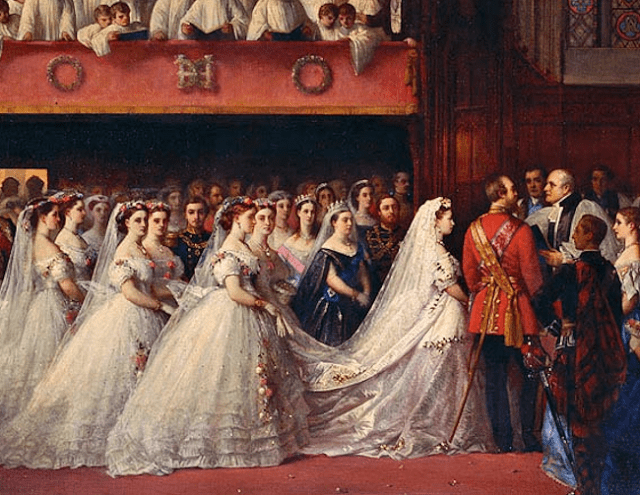
The Marriage of Victoria, Princess Royal and Prince Frederick William of Prussia, 25 January 1858, by John Phillip. via Wikipedia John Phillip – http://www.royalcollection.org.uk/collection/406819/the-marriage-of-victoria-princess-royal-25-january-1858

Who actually first initiated the idea of a marriage between Princess Victoria Adelaide Mary Louisa of Great Britain and Prince Frederick William of Prussia is not as important as the impact of the marriage. Some think Queen Victoria’s uncle, Leopold  I, “nudged” the couple together. Such a union would assist in Belgium’s security from France, which was a customary “enemy.” Others place the alliance firmly in the hands of Victoria’s husband, Prince Albert. We must recall that Albert’s ideals were different from those found in many European courts. Prince Albert did not advocate a “new order,” but rather a liberalization of the current ones.

Frederick William IV, however, was a reactionary who held tight to the idea that God wished his reign. However, by the mid 1850s, the Prussians had taken hold of parts of Austria’s valuable ore-rich lands, most notably that of Silesia.

800px-Oskar_Begas_Kronprinz_Friedrich_Wilhelm_von_Preußen_1867

Crown Prince Frederick William of Prussia, 1867, by Oskar Begas via Wikipedia

The Prussian royal family had taken refuge in London during the revolutions which swept Europe in 1848. Prince Albert and William had developed a friendship of sort during the Prussian courts retreat to England. During that time, Albert lobbied for a English-style parliament to be adopted by the Hohenzollerns. Although William listened attentively, he argued his own points. William did not relish the idea that non-Prussian Germans would become part of the government of a unified Germany.

“During the Revolutions of 1848, William successfully crushed a revolt in Berlin that was aimed at his elder brother, King Frederick William IV. The use of cannon made him unpopular at the time and earned him the nickname Kartätschenprinz (Prince of Grapeshot). Indeed, he had to flee to England for a while, disguised as a merchant. He returned and helped to put down an uprising in Baden, where he commanded the Prussian army. In October 1849, he became governor-general of Rhineland and Westfalia, with a seat at the Kurfürstliches Schloss in Koblenz. 

“During their time at Koblenz, William and his wife entertained liberal scholars like the historian Maximilian Wolfgang Duncker or Auguest von Bethmann-Hollweg and Clemens Theodor Perthes (de).  William’s opposition to liberal ideas gradually softened.

“In 1854, the prince was raised to the rank of a field-marshal and made governor of the federal fortress of Mainz. In 1857 Frederick William IV suffered a stroke and became mentally disabled for the rest of his life. In January 1858, William became Prince Regent  for his brother, initially only temporarily but after October on a permanent basis. Against the advice of his brother, William swore an oath of office on the Prussian constitution and promised to preserve it ‘solid and inviolable.’ William appointed a liberal, Karl Anton von Hohenzollern-Sigmaringen as Minister President and thus initiated what became known as the ‘New Era’ in Prussia, although there were conflicts between William and the liberal majority in the Landtag  on matters of reforming the armed forces.

Queen Victoria also developed an alliance during the Prussian royal retreat. William’s wife, Augusta of Saxe-Weimar. Weimar was one of the more liberal states in Europe, and Augusta’s political views were in contrast to her husband’s. The Prussian couple’s son, the Hohenzollern prince Frederick William, became a “possible” mate for the Princess Royal. 

Victoria,_Princess_Royal_1855“Fritz,” as Prince Frederick William was known, and Princess Victoria met first when Prince Albert and his secretary Baron Stockmar concocted a plan to invite the Prussian royals to London for Albert’s Grand Exhibition of 1851. Fritz was 20 at the time, and Victoria was but 10. The queen permitted Victoria to join the royal families, on the guise as a companion for Fritz’s younger sister. Princess Victoria’s German was fluent and she proved herself the perfect guide for her father’s exhibition. She was vivacious and made a good first impression. The two were permitted great access to one another (a fact which would not have occurred if she were older) over the two weeks the Prussians remained in London. If she had been older perhaps she might have noted the reticence and the alarm with which Frederick William noted the familiarity practiced openly by the British royal family. Life in Prussia would not be the same as life in London.

In September 1855, Fritz vacationed with the British royal family at Balmoral. He was now 24, and Princess Victoria was on the cusp of womanhood. Fritz admired the princess’s intelligence and took note of her comely features. Neither could image that the idea of a marriage between the two would not be welcomed by a large portion of the population. The British populace distrusted foreigners, in general. The Prussian populace worried for an alliance with England when Great Britain was at war with the powerful Russian tsar. Nevertheless, Fritz did propose and was accepted. However, Queen Victoria declared that the marriage could not take place for two years. The Queen wished the business kept private but when the information was shared with the prime minister, Lord Palmerston, the news became fodder for The Times. The Prussian court was called “paltry” and “wretched” by the British newsprint.

220px-VickyIn the years of waiting, Prince Albert “trained” his daughter in how to be an excellent queen consort. Albert spent two hours daily in this manner. Unfortunately, the Princess Royal was not as adaptable as her father. Victoria’s life in Prussia would never be what she wished. Where in England, the princess’s life held a certain informality, in Berlin she encountered strict court etiquette. Moreover, the Prussia that Fritz would govern would be a military-controlled state. The ruling House of Hohenzollern practiced a state-instilled monarchy. Fritz and Vicky were married in January 1858.

In February 1858, she rode through the streets of Berlin with her husband to the cheers of the gathered crowd. What she found was not a city to equal London, but rather a city more of the nature of Edinburgh until it moved to clear the air of raw sewage. Moreover, the Royal Palace, a 17th Century Baroque structure, was a cold desolate building. It held NO modern conveniences. There was no central corridor to speed one’s trek through chamber after chamber.

Reality also arrived in the form of her father-in-law, Prince William, who stood as Regent to his mad brother. William never totally approved of his son’s wife. As many hours as the princess had set with her father in tutelage, she was ill-equipped to handle her father-in-law’s snub, nor was she capable of understanding how Fritz could treat her with less respect than did her illustrious father. She did not understand how to win the heart’s of such a “cold” family, and Vicky would suffer for her ignorance. A liberally educated woman was not a welcomed asset to the Prussian court.

A month after her marriage, Albert sent his daughter a “master plan” for Vicky’s marriage. “Your place is that of your husband’s wife, and of your mother’s daughter.” Prince Albert also warned of public disdain for Vicky, which quickly proved true. Meanwhile, the Queen demanded that Vicky remain the British princess royal rather than accepting the role of Victoria, Princess of Prussia. The Prussians expected her to become the wife of the future king, not a British prima donna. The princess developed the annoying habit of declaring all things British as superior to all things Prussians.

Vicky obliged her mother’s demand for frequent letters by describing the appalling ignorance of the Prussian royal family. Her quick first impressions soon became open critical remarks that lost the princess the support of many who would have assisted her. Queen Victoria came to criticize all the efforts Vicky made to adhere to the strictures of the Prussian court. The queen was known to demand that her daughter keep her “Englishness.”


Posted in British history, family, Great Britain, history, Living in the UK, marriage, marriage customs, Victorian era | Tagged , , , , , , , | 5 Comments