
As readers and writers of Austenesque fiction, we spend a great deal of time thinking about the world Jane Austen inhabited. We know her drawing rooms, assembly halls, and country estates. We understand the social rules governing courtship, inheritance, reputation, and family obligation. Most importantly, we understand that Austen’s true subject was never politics or war, but character.
While writing my latest novel, Kindle the Light of Liberty, I found myself immersed in a world Austen never wrote about—a world that nevertheless asked many of the same questions.
As America approached the 250th anniversary of its founding, I became fascinated by the people whose stories often remain at the margins of its history. As both a Jewish author and a devoted admirer of Jane Austen, I wanted to understand how ordinary Jewish families experienced the Revolution: what they feared, what they hoped for, and how they navigated a society that was itself being transformed. The deeper I researched, the more I encountered individuals whose lives embodied courage, uncertainty, sacrifice, and resilience. Their stories revealed a transformation that extended far beyond famous generals and founding fathers. Immigrants who had spent their lives navigating uncertainty and limitation suddenly found themselves confronted with the promises—and demands—of liberty.
Some served on battlefields.
Philip Moses Russell enlisted in 1775 as a Surgeon’s Mate in the Continental Army. He endured the brutal winter at Valley Forge, caring for soldiers suffering from disease, exposure, and starvation. His service was so distinguished that George Washington personally commended him for his dedication to the sick and wounded.
Others contributed through leadership and sacrifice.
Colonel Mordecai Sheftall became the highest-ranking Jewish officer in the Continental Army. As Commissary General for Georgia and South Carolina troops, he spent much of his personal fortune securing desperately needed supplies for Patriot forces. Like so many supporters of independence, he risked not only his safety—he and his son were captured by the British and imprisoned aboard a prison ship for nearly two years—but also his livelihood for a cause whose success was far from certain.
Still others served through intelligence and civic duty.
Solomon Bush earned recognition for helping expose a British spy ring operating in Pennsylvania. While recovering from war injuries, Bush uncovered a British spy operating in Pennsylvania and alerted Washington to the danger. His story reminded me that the Revolution was not won solely on battlefields. Information, secrecy, and vigilance were often just as important as muskets and cannon.
Another historical figure who particularly captured my imagination was Isaac Franks.
Franks served under George Washington’s command as a foragemaster and later rose to the rank of colonel in the Pennsylvania militia. His story did not end with independence. During Philadelphia’s devastating yellow fever epidemic of 1793, when the federal government temporarily fled the capital, President Washington rented Franks’ home in Germantown and conducted the nation’s business from there. Today the house is remembered as the Germantown White House. I find something profoundly symbolic in that image. A Jewish patriot who had served the cause of independence now provided shelter to the nation’s first president during another moment of national crisis.
Historical details like these remind us how deeply Jewish Americans were woven into the fabric of the early Republic. Yet military service and public leadership tell only part of the story.
Modern readers are often familiar with the Culper Spy Ring, George Washington’s famous intelligence network operating in British-held New York. The image of coded messages, invisible ink, secret couriers, and carefully guarded identities has become one of the most enduring legends of the American Revolution. Yet the deeper I researched, the more I realized that intelligence gathering extended far beyond any single spy ring.
Information moved through merchant houses, family networks, religious communities, and ordinary correspondence. Women carried news between households. Tradesmen listened while conducting business. Travelers transported letters, rumors, and observations from one city to another. Entire communities participated in preserving and transmitting information, often without receiving recognition in the histories that followed.
For a novelist, this realization was irresistible.
It allowed me to imagine how a young Jewish woman in Philadelphia might contribute to the Patriot cause—not as a soldier, but as an observer. The daughter of a chandler would naturally move between homes, marketplaces, and social gatherings. She would hear conversations others dismissed. She would notice details that more powerful people overlooked. And because society often underestimated women, she could gather information while remaining nearly invisible.
That insight became the foundation for my heroine, Rose Wachsman.
Rose is not a member of the famous Culper Spy Ring, but as I continued my research, I became increasingly fascinated by the women whose lives history marginalized in fragments and footnotes. Women such as Abigail Lopez Gomez, Reyna Levy Moses, Abigail Minis, Grace Seixas Nathan, and countless wives, daughters, and sisters who sustained families and communities through years of uncertainty. Their stories survive in letters, business records, communal histories, and occasional references in the papers of more famous men. They reminded me, in many ways, of Austen’s heroines, who lived in a world where intelligence, judgment, and character mattered profoundly. These Jewish colonists navigated family expectations, social pressures, questions of loyalty, and uncertain futures. They simply did so against the backdrop of a revolution.
As I wrote Kindle the Light of Liberty, I found myself returning to a truth Austen acknowledged exceptionally well: history may provide the setting, but character determines the story. The American Revolution changed governments, borders, and laws. Yet beneath those dramatic events were ordinary people making deeply personal decisions. Whom should they trust? What did they owe their families? What risks were worth taking? How much should one sacrifice for principle? These are not merely political questions. They are profoundly human ones.
They are also the kinds of questions that animate Austen’s novels—written two centuries ago!
Although Jane Austen never wrote about Revolutionary America, I sometimes wonder what she might have thought of these forgotten patriots and their families. I suspect she would have been less interested in the battlefield than in the parlors, shops, and households where loyalties were tested and character revealed. She understood that history is shaped not only by public events, but by private choices. Perhaps that is why I never felt I was importing Austen into colonial America. I discovered, instead, how naturally her moral imagination already belonged there.
The more I learned about these forgotten Jewish Americans, the more convinced I became that their stories deserved to be told—not because they stood apart from the larger American story, but because they were always part of it.
And for a novelist, there is no greater invitation than discovering a story hidden in plain sight.

EXCERPT:
Rose learned the true weight of a word that night as her cousin laughed. It was not loud, nothing so coarse. It passed across the parlor like the clink of porcelain against a saucer: deliberate, polished, and unmistakably final. It moved through silk and candlelight, through men who had not fired a musket, but who would decide precisely where they were aimed
The cold lesson settled over her as she stood by the far wall, hands folded neatly before her, precisely as her aunt had instructed and her father warned. Observe. Speak only when addressed. And above all, never betray her ignorance—or her wit. She had obeyed. She had watched.
And she wished she had never come.
“Then we are agreed,” Rebecca said, her eyes gleaming with something dangerously close to delight. “The British shall find Philadelphia most… accommodating.”
The men around her smiled. Someone bowed. Another lifted his teacup as if in salute. Every sentence spoken within these walls carried the charge of treason. Rose resolved to conduct herself with care, lest any sign of partiality betray her—especially now when her aunt’s claims upon her attendance were equal to her father’s dependence upon her good sense.
The Franks hosted the most desirable salon in the city. Every week, loyalist merchants, British sympathizers, and townsmen not yet openly declared would gather here under the pretense of civility. They would come for the music, for gossip, for brandy imported before the ports closed. The exquisite mockery of it all was almost too much to bear. Here—here, treason was toasted with the very tea that had set the colonies aflame.
Rose’s fingers tightened against the fine rustle of her skirts just as her hostess appeared beside her, a plate of sweetmeats in hand.
“You look flushed,” said Rebecca, pressing a sugared almond upon her with an air of concerned authority.
“I am only a little warm.”
She studied Rose with curious intensity. “You disapprove of the company, I suppose. You must not judge too harshly.”
“I do not pretend to understand the finer points of politics, Cousin.”
“If our history has taught us anything, it is that understanding is rarely required,” Rebecca smiled faintly.
She felt her reserve begin to yield; there was something in the look of Rebecca’s eyes, a weariness in her tone, that gave Rose pause. For a fleeting moment, she searched for an extenuating excuse for her cousin’s duplicity.
“Survival is what matters in such a contest, and Rose, dear—the Crown remembers its friends.”
“And forgets its enemies?” Rose asked before she could stop herself.
“It forgets nothing.”
The illusion of vulnerability vanished, and Rose saw not a victim of circumstance, but a woman who had coolly weighed her options and chosen a side. She could not bestow sympathy on one who had made such a deliberate calculation. Would her own integrity have remained so resolute, had she been granted the same precarious choices? It was an inquiry she could not answer with confidence, and the doubt humbled her with a sense of her own untried virtue.
Grateful for a moment’s respite when her cousin was called away, Rose turned her scrutiny toward the other guests. A man shifted his stance with a singular lack of ease. Tall and broad-shouldered in a coat of superfine wool, he stood as if he had forgotten the art of occupying his own frame.
Nathan Hirsch.
She could only wonder which side of the room he believed himself to occupy. He was a familiar figure; she encountered him often enough while seeing to her tasks about town, and saw him every Sabbath in the beit tefillah—or as their neighbors styled it, their Jewish House of Prayer. Rose had heard him speak there amongst the men—softly, reverently, as if the very words required protection. Now he stood among Loyalists, his jaw tight, his eyes scanning the room with careful restraint.
He made his bow before her. Rose met his unreadable gaze as he straightened and held it a moment longer than courtesy required. She would dare him to justify his presence if she could —though her own, in truth, was no less precarious.
“Mr. Hirsch, sir!” A melodic voice sliced through the air. “Your condescension to attend our little soiree is most appreciated.”
Rebecca stepped into the gap between them, her silk skirts a shimmering barrier. She laid a hand on his sleeve—a gesture that was as much a claim as a caress.
“Ah—I see no introduction is required,” she continued. “No doubt you have met Miss Wachsman. My cousin has a certain grace, does she not? It is inherited from my father’s side of the family. One almost forgives the scent of the chandlery that follows her into the parlor.”
Mr. Hirsch did not immediately answer. His gaze rested somewhere beyond Rebecca’s shoulder, as though the matter required consideration rather than politeness. “In times of such…unfortunate upheaval,” he said at last, “one finds the usual boundaries of society become regrettably permeable. Needs must.”
“Oh, Mr. Hirsch! How droll you are this evening!”
“How so, madam? A chandler provides light where there is none. Whether that light is refined enough for this parlor,” he said, turning his gaze upon Rose’s countenance, “is perhaps less important than the fact that it allows one to see what is standing directly before one’s eyes.”
Rose lowered her eyes, not wishing to show her indignation. After all, she was a guest—not an escapee from the scullery. She managed to suppress a biting rejoinder, yet she could not help but notice that although Mr. Hirsch flexed his hand, he did not pull his arm away from her cousin.
This, then, was the lay of the land!
The contest, as her cousin put it, was not going to be decided only by muskets and marching men. It would be shaped in parlors like these—through rumors and assignations, and the subtle power of women who knew how to move loyalties without ever touching a sword. Yet power did not always announce itself with steel. Sometimes it arrived quietly, illuminating one path while leaving another in shadow. As the daughter of a chandler, Rose had long understood the utility of light. Hers was not the ostentatious glow of beeswax reflected in crystal, nor the blinding brilliance of these chandeliers. It was a common light, carried in guarded words and the subtle shift of a gaze—the kind of light that could expose or obscure as necessity required. And as the night progressed, Rose began to comprehend that very necessity.
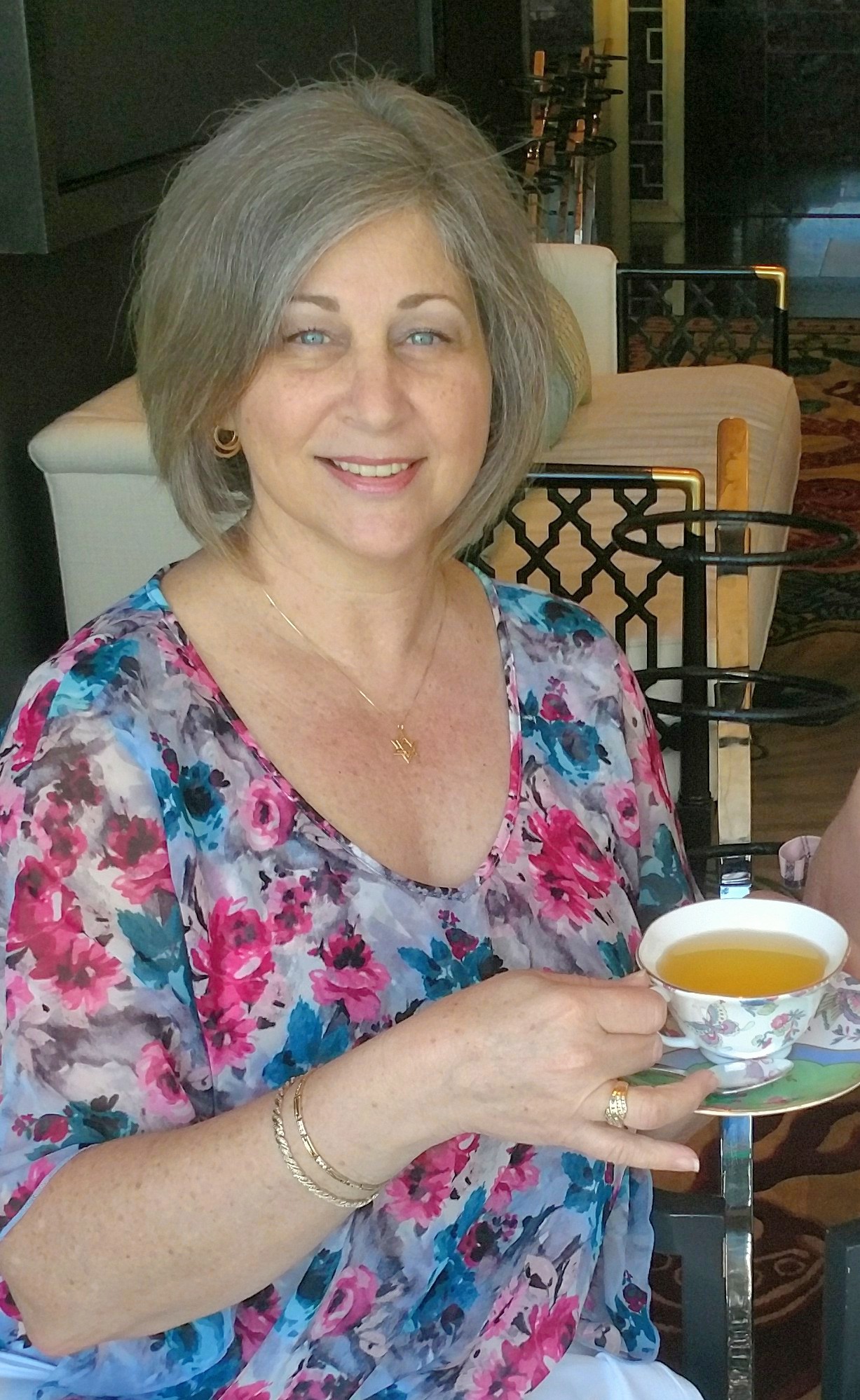
Author’s Bio:
Mirta is a second-generation Argentine; she was born in Buenos Aires in 1962 and immigrated to the United States that same year. Because of the unique fringe benefits provided by her father’s employer- Pan American Airlines- she returned to her native country frequently- growing up with “un pie acá y un pie allá” (with one foot here and one foot there).
Mirta’s fascination with Jewish history and genealogy, coupled with an obsession for historical period drama, has inspired her to create unique and enlightening novels. She has been a guest speaker for book clubs, sisterhood events, genealogy societies and philanthropic organizations. Sharing Jewish historical fiction has become her passion.
Besides being an avid novel reader, she has had a lifelong love for choral music and is a devoted Beatles fan. Follow Mirta on Amazon, Goodreads, Instagram, and BookBub or stop by her WordPress blog.


Thanks for sharing this history. I’ve done some reading of spies in this war but knew nothing of the Jewish contributions. Lovely excerpt, too.
Thank you for your kind comment.
Let me know, Collins, when you have something you would like to share with others. Your research is always amazing.