I am again attempting to answer a variety of questions from a reader on peerages. So, here goes…
Question: I have a question about politics circa 1812. I am constructing my character development fir a story line, and my hero is the son of an earl who hearty and healthy. Therefore, the son is not likely to inherit any time soon. While he holds an honorary title, there is no political privilege associated with that, I assume.
My hero is an ambitious sort, I planned to write him as having political aspirations.
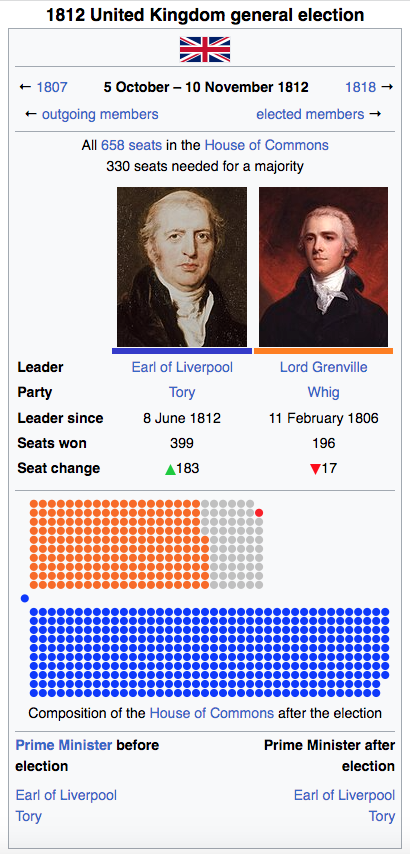
First Part of my response: You must remember that unlike here in the U.S. there were not elections every four years. “The 1812 United Kingdom general election was the fourth general election after the Union of Great Britain and Ireland, held on 5 October 1812 to 10 November 1812, taking place at the height of the Napoleonic Wars.
“The fourth United Kingdom Parliament was dissolved on 29 September 1812, four months after the Earl of Liverpool succeeded to the premiership following the assassination of Spencer Perceval. The new Parliament was summoned to meet on 24 November 1812, for a maximum seven-year term from that date. The maximum term could be and normally was curtailed, by the monarch dissolving the Parliament, before its term expired.”
Question #2: Would a man in his mid twenties have run/been elected to Parliament? Would there have been another way he could have participated in politics without being in the House of Commons? I know there must be reference material out there, just finding abbreviated information thus far.
Response: As the son of an earl, he would not normally enter a mp (member of Parliament) race in 1812 as the House of Lords held more power than it does today. If he is the eldest son, he will inherit his father’s seat in the House of Lords. He could lend his support very visibly to a cause or a party or a candidate, serve in the diplomatic corps and eventually become an ambassador. There was a lot of behind the scenes business at Whitehall, and it was not unusual for a peer to work there in the diplomatic offices, etc. Most of the oversight committees (for want of a better description) for the war effort were housed there. Nepotism was alive and well during the Regency.
Question #3: Would a man in his mid twenties have run/been elected to Parliament? Would there have been another way he could have participated in politics without being in the House of Commons?
Response: Absolutely. The lords often controlled many house seats – these were called “pocket buroughs” because they were in the peer’s pocket. So the landlord wanted “his guys” in there, whether they were sons — to allow them time to earn experience to become powerhouses in the Lords later on — or just yes-men. However, that being said, a son did not need to gain his experience by actually holding a seat. He could be appointed to a deputy position in any one of the Cabinet departments. The Exchequer was particularly desirable – nice and close to the money. People became very rich in that department. Sometimes, mysteriously so! The one I am not confident about (I would need to check with my military expert) is the Admiralty. I am not assured if civilians were acceptable on staff there or if they had to have military rank. Of course, for a son of an earl, that might easily be a small matter of purchasing a plum commission.
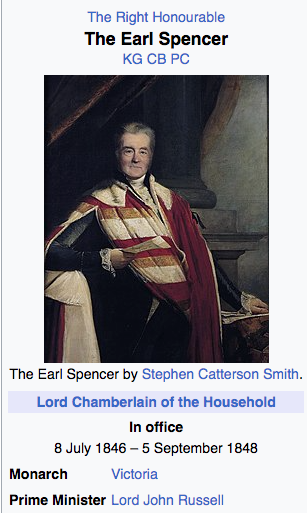
The secretary of the admiralty was often a peer. Earl Spencer held a position as Secretary of the Navy under Queen Victoria.
“Vice-Admiral Frederick Spencer, 4th Earl Spencer, (14 April 1798 – 27 December 1857), styled The Honourable Frederick Spencer until 1845, was a British naval commander, courtier, and Whig politician. He initially served in the Royal Navy and fought in the Napoleonic Wars and the Greek War of Independence, eventually rising to the rank of Vice-Admiral. He succeeded his elder brother as Earl Spencer in 1845 and held political office as Lord Chamberlain of the Household between 1846 and 1848 and as Lord Steward of the Household between 1854 and 1857. In 1849 he was made a Knight of the Garter.”
Question #4: I’m seeing examples of a member of the House of Commons moving to the House of Lords as he inherits a seat, but now I’m wondering if anyone fills his vacancy.
Response: Yes, they must hold a by election.
There were some by-elections when a man died or succeeded to a peerage.
The young man’s father or his uncle or his mother’s brother or his mother’s uncle probably had a borough under his control. There were quite a few of these in Cornwall alone. These rotten boroughs were safe seats for sprigs of the aristocracy.
Earl Spencer sent his oldest son into politics in the House of Commons. The father could be on some committees and hire the son to be a clerk.
Some young men preferred learning to manage the estates to playing politics.
Question #5: Was not William Pitt very young?
Response: “William Pitt was born on 28 May 1759 in Kent, the son of the earl of Chatham (William Pitt the Elder), himself a famous statesman. Pitt studied at Cambridge University, graduating when he was 17. In early 1781, he was elected to parliament aged 21. In 1782, he became chancellor of the exchequer. The following years were marked by the battle between George III and the radical Charles Fox, whom the king detested. Matters deteriorated when Fox forged an alliance with the previously loyal Lord North. The two men defeated the government and George was forced to ask them to take control. Fox became Pitt’s lifelong political rival.
“In December 1783, George III dismissed their coalition and asked Pitt to form a government. He was, at 24, the youngest man to become prime minister. He was immediately defeated in parliament but refused to resign. George III was prepared to abdicate rather than let Fox in again. In 1784, parliament was dissolved for a general election, which Pitt won. His government worked to restore public finances, severely strained by the cost of the American War of Independece and later by war with France. Pitt imposed new taxes – including Britain’s first income tax – and reduced both smuggling and frauds. He also simplified customs and excise duties.” [BBC History]
Question #6: Would he be geographically restricted in running for a seat? Like Congress?
Response: No. They were not restricted to the county in which they lived.
Unless one is dead or is made a peer, one can not resign from the House of Commons. One had to say one was taking the “Chiltern Hundreds” to resign from the House of Commons between elections.
First off, a seat in the House of Commons was a lifetime position, and there were MPs who found themselves therein against their will and until the early 1700s, they could not resign.
Things changed in 1701with the Act of Settlement (and some subsequent legislation) which made it illegal for any MP who accepted an office of the Crown for profit to remain in the House of Commons. I think it was John Pitt who first used this mechanism to resign – ie taking the Chiltern Hundreds.
The Chiltern Hundreds refers to the three ‘hundreds’ (administrative areas in Buckinghamshire) of Burnham, Desborough and Stoke. These ‘hundreds’ (the whole country was divided into ‘hundreds’ for administrative purposes), are located around the geographical area known as the Chiltern Hills. Note that only Desborough was actually in the Chiltern Hills. Anyway, the Crown office for profit involved in the Chiltern Hills instance was the (by then) nominal post of Crown Steward and Bailiff of the three Chiltern Hundreds of Stoke, Desborough and Burnham. But at this time, an MP could also resign from the House of Commons if he was given the Stewardship of the Manor of Old Shoreham (about a dozen MPs used this one in the latter half of the 18th century), and in the mid 19th century, the Stewardship of the Manor of Hempholme was used, as have a number of offer Crown offices from time to time.
And it was John Peel, not John Pitt who first used the new legislation (and the other significant piece of legislation was the Place Act of 1742.
A ‘Parliament’ refers to the full term served by an elected government (after a national election to fill all seats in the House of Commons).
A new Parliament does not commence if a sitting member dies (or a member succeeds to a title and leaves the House of Commons to take his seat in the House of Lords). In those cases, a by-election is held to fill the casual vacancy, but it does not ‘re-start’ the life or term of the Parliament.
The key thing in all this is that the Parliament (UK and Australia) lives and dies by the election of a majority government (lower house) led by a Prime Minister (also seated in the lower house). If the Parliament does not serve out the full term (eg: the 1974 dismissal of Whitlam and his government, or the PM choosing to go to the polls early, which a PM can and frequently does choose to do), that reduced term is still referred to as the ‘life’ of that particular Parliament.
There is nothing to stop your hero from deciding not to contest the seat at the general elections. He just cannot resign the seat while the Parliament is serving its term – ie: between the start of the term and the end of the term when the next general elections are held.
Courtesy peers and Irish peers had seats in the House of Commons, so the roster is sprinkled with Lords. The number of those who could vote was small. Elections were not secret. There was more secrecy about voting for new members for White’s than there was in voting for an MP. The other term for “pocket boroughs” was “rotten boroughs.
Brittanica defines pocket borough, as an “election district that is controlled by, or “in the pocket” of, one person or family. The term was used by 19th-century English parliamentary reformers to describe the many boroughs in which a relatively small population was either bribed or coerced by the leading family or landowners to elect their representatives to Parliament. As a result, Parliament was controlled by the landed gentry and seats were filled by representatives who wanted to please their patrons rather than their constituents. Reforms passed in 1832 and 1867 ended this practice by widening the franchise and redistributing parliamentary seats to reflect the population shift from rural areas to the industrial towns.”
All that being said, heirs to titles did enter the Commons, and they did so for a variety of reasons. Some were coerced by their fathers to further their fathers’ interests (eg: in the case of the rotten boroughs), and some were forced to take a seat in the Commons in the hope they might develop more responsible ways or behaviours their fathers deemed more fitting in an heir to the title. Others went into the Commons of their own free will, usually because they were keen to enter the political world and become an influencer. A peer who had political goals could gain much ground and attention from those in the Lords through his performance in the Commons and thereby enhance his standing in the Lords when he did enter that House.


