Introducing the Tragic Characters in Classic Literature Series + the Release of “I Shot the Sheriff” + a Giveaway

Public Domain ~ Rhead, Louis. “Bold Robin Hood and His Outlaw Band: Their Famous Exploits in Sherwood Forest”. New York: Blue Ribbon Books, 1912, page 129

More than a year ago, a group of us joined together to create a new series of Regency-based stories. The premise behind the project was to take a “tragic figure” from classic literature and present him or her a happy ending. We would be moving the story, no matter the original setting, into the late Georgian to early Victorian era, roughly 1790 to 1840. The chosen characters are found in public domain stories, and the series is entitled “Love After All.” Releases will be staggered and published by each individual author. The idea is to present the “tragic character” a happy ending.

Earlier in November (November 7), Lindsay Downs released The Monster Within,The Monster Without, which is based on Mary Shelley’s Frankenstein.

November 30, 2020, will see my release of I Shot the Sheriff, with a tale of the Sheriff of Nottingham.

December 8, 2020, will bring Audrey Harrison’s The Colonel’s Spinster, featuring Colonel Fitzwilliam from Jane Austen’s Pride and Prejudice.

December 29, 2020, brings Alina K. Field and her tale of Lancelot and Guinevere, entitled, Fated Hearts.

January 1, 2021, will bring us Alanna Lucas’s tale of Catherine and Heathcliffe from Wuthering Heights from Emily Brontë.

January 11, 2021, has the retelling of Madame Bovary, Gustave Flaubert tale from the pen of Nancy Lawrence. It will be entitled The Company She Keeps.

I will be back again on February 19, 2021, with the tale of Miles Standish from Longfellow’s “The Courtship of Miles Standish.” It will be entitled Captain Stanwick’s Bride.

Louisa Cornell will brings us the tale of Orpheus and Eurydice in Glorious Obsession, which will arrive on February 26, 2021.

NOTE: Additional stories will be added as they are arranged.

As most of you realize the Sheriff of Nottingham is the main antagonist in the Robin Hood stories—stories upon which I grew up reading on a regular basis. In fact, I still own a copy of 25 collected tales of Robin Hood, which my grandfather had received from his father when he was but 11 years of age. It has a 1912 copyright date, making it over 100 years old. The Sheriff is generally depicted as an unjust tyrant who mistreats the local people of Nottinghamshire, subjecting them to unaffordable taxes. Robin Hood fights against him, stealing from the rich, and the Sheriff, in order to give to the poor; a characteristic for which Robin Hood is best known. I grew up despising the Sheriff and adoring Robin Hood, so taking on this challenge was initially a bit daunting. Then I remembered how as a tongue-in-cheek moment, I added the Sheriff in book 6 of my Realm series, A Touch of Love, to see if anyone caught it. Ironically, if anyone did, he/she did not comment on my moment of brilliance some five years before this project fell into my lap. Little did I realize when I wrote A Touch of Love that it would serve as the basis for this new novel.
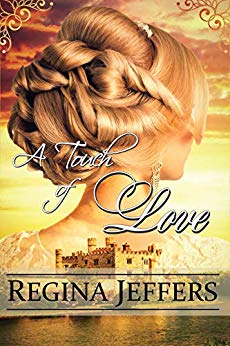
In I Shot the Sheriff, the reader will encounter several characters from the Realm series, most particularly, Mr. Aristotle Pennington, Aidan Kimbolt, Lord Lexford, and Mr. Henry Hill. This new story actually starts with a scene from A Touch of Love. As I said previously, I was simply wondering if any of the loyal readers of this Regency series would note I had used William de Wendenal, the suspected name of the Sheriff of Nottingham of the Robin Hood tales, in this new story? Now, I can do the reverse. Will readers of I Shot the Sheriff recognize the characters from my Realm series? 

In the Realm series, Sir Carter Lowery, an agent for the Home Office, is hunting for a group of men involved in an art theft ring. In chapter eleven, we find the following mention of de Wendenal: 

Carter met with the local sheriff regarding the attack. With McLauren’s assistance, he convinced Lord de Wendenal to leave the stranger in Carter’s custody overnight, but the effort proved fruitless. His assailant refused to provide his name or the reasons for the attack. What troubled Carter the most was he still held no idea whether he or Mrs. Warren was the shooter’s target.

Later, in Chapter Twenty-Four, when several of those involved in the theft ring have been caught, we find: 

Pennington agreed and placed the finishing touches to their plans.

“If none of you object, I believe it might be best to have Lord de Wendenal involved in transporting our prisoners.” 

“Why do we require the Sheriff of Nottingham?” Worthing asked. “Is there not someone closer?”

“First, de Wendenal’s auspices also covers Derbyshire. Moreover, my reports say some eight years prior, his lordship had several dealings with Ransing. At the time, I had no reason to think Ransing involved in stolen art, but I did think him connected to a smuggling ring in Kent. De Wendenal’s involvement in the case will provide the man the opportunity to turn over any stolen goods he might have acquired, setting an example for other members of the aristocracy,” Pennington explained. 

“Do you think de Wendenal honest enough to respond as you wish?” Lexford inquired with a lift of his eyebrows in suspicion. 

“I think Lord de Wendenal serves his office to the Crown well, and I do not place merit in the rumors of his dealings with the Earl of Sherwood. As to whether de Wendenal deals in stolen goods, I would say no more so than the average peer considers the brandy he drinks as contraband. Much of the so-called luxuries, we as a social class enjoy, are smuggled into the country. I am well aware of de Wendenal’s reputation, but I am not convinced he is corrupt. Unwise, very much so. Made many poor decisions in his youth, absolutely. But none worse than those owned by the Duke of Thornhill, and we all know Brantley Fowler’s true worth.” 

They all nodded their agreement. “You know best in such matters,” Godown assured. 

“I will have Henderson and Van Dyke accompany the sheriff and the prisoners to London. Give the event a more official look with local magistrates and the Home Office working together. I will send another of our men to take possession of Woodstone’s associates later in the week. From what Lexford and Worthing shared, I suspect the two who assisted with Mrs. Warren’s abduction were nothing more than a pair of unemployed lackeys.”

Finally, in Chapter Twenty-Six, two of the leaders of the theft ring stage an attack on Prince George, heir to the British throne. It is this attack which sets the beginning of I Shot the Sheriff. We read: 

“Remain with me, my boy,” Prinny said through tight lips and a fake smile. 

Through the champagne glass’s shine, Carter noted how Lord Worthing had crossed the musicians’ raised dais to stand some ten feet behind the prince’s attacker, and Swenton approached slowly from the man’s right. Surprisingly, Lord de Wendenal, the Sheriff of Nottingham, edged forward on the left.

In the original Robin Hood tales, we do not upon the sheriff’s character is based. More likely is a composite character, a mix of the stock characters at the time and the real people who served as the High Sheriff of Nottinghamshire, Derbyshire, and the Royal Forests. As most of the Robin Hood tales are set during the absence of King Richard I of England during the Third Crusade, the character of the Sheriff is likely based on the little-known William de Wendenal, which is what I have done in my tale.

The real William de Wendenal was the High Sheriff of Nottingham and Derbyshire from 1190 to 1194. We know little of his life. He assumed his duties in 1190 from baron Roger de Lizoures. However, when King Richard the Lionheart returned to England in March 1194, William de Ferrers, 4th Earl of Derby succeeded William de Wendenal as the High Sheriff. After that, de Wendenal disappears from the historical record. That is, until I brought him back to life (so to speak) in I Shot the Sheriff.

I Shot the Sheriff: Tragic Characters in Classic Literature Series Novel 

William de Wendenal, the infamous Sheriff of Nottingham, has come to London, finally having wormed his way back into the good graces of the Royal family. Yet, not all of Society is prepared to forgive his former “supposed” transgressions, especially the Earl of Sherwood. 

However, when de Wendenal is wounded in an attempt to protect Prince George from an assassin, he becomes caught up in a plot involving stolen artwork, kidnapping, murder, and seduction that brings him to Cheshire where he must willingly face a gun pointed directly at his chest and held by the one woman who stirs his soul, Miss Patience Busnick, the daughter of a man de Wendenal once escorted to prison. 

I Shot the Sheriff is based on the classic tales of Robin Hood, but it is given a twist and brought into the early 19th Century’s Regency era. Can even de Wendenal achieve a Happily Ever After? If anyone can have the reader cheering for the Sheriff of Nottingham’s happiness, it is award-winning author Regina Jeffers. 

NOW FOR THE GIVEAWAY: I HAVE 2 eBOOK COPIES OF “I SHOT THE SHERIFF” AVAILABLE TO THOSE WHO COMMENT BELOW. WINNERS WILL BE ANNOUNCED AND PRIZES DELIVERED WHEN THE BOOK RELEASES ON NOVEMBER 30, 2020.

Posted in book excerpts, book release, British history, eBooks, Georgian England, Georgian Era, historical fiction, Living in the Regency, publishing, real life tales, Realm series, Regency romance, romance, Vagary, writing | Tagged , , , , , , , , , , , , | 3 Comments

The Art of Dressmaking During the Regency Era

I had another author recently ask me if I knew the time frame for a dressmaker to complete a gown. In the scenario explained to me, the gown was already embroidered and an initial fitting had occurred. So it is really be just a matter of making small adjustments after a final fitting. I said 3-5 days. However, the other author’s editor thought that was too short of a time, saying it would take two weeks, at a minimum.

In truth, the number of days would depend on a variety of issues: Is the modiste located in London? Or in a provincial town or village? Is the client one of the leaders of Society or a simple younger sister of a gentleman? A duchess, for example, would command more service than somebody unknown among the haut ton.  How many other clients is the modiste servicing at the time? Is it the beginning of a new Season in London? Or is it off season? When the London Season starts, everyone requires new gowns, so modistes are overrun with business.

Small adjustments after a final fitting can take less than an hour, depending on the amount of work that must be done—all measurements would have been made before starting the gown, so there would be only tiny adjustments.  A reputable, and, likely, a not so reputable, London modiste would have many seamstresses working for her.  In an emergency, they could put together a simple gown for an important client in less than a day from scratch. More than likely, they would work late into the night or through the night, if need be, to please a good client or a client of which they were very fond or they were being paid handsomely to product the gown in a short period of time.

The amount of work a dressmaker has and the number of seamstresses employed would determine how long it takes to make a garment. Of course, the trimming and such also matters.  A court dress could well take five days if the seamstresses worked on nothing else. If one required a garment made expeditiously, one could pay extra, and it could usually be done.

A London dress maker could usually make one faster than a village  seamstress, though even a village seamstress could finish a simple dress in three days, if she had no other work.

One must recall, there were no printed patterns, so the lady and the dressmaker would have to confer on which style dress she wanted and then choose the fabric. If the lady had never been to the store before, she would be measured  and a unfinished muslin or linen mock up dress made and fitted to her. The most skilled part of the procedure was drawing off the pieces and then cutting them properly. The dressmaker had to be able to see the pattern behind the fashion illustrations.

The muslin pieces would be used as pattern pieces when the material was cut. Then the fabric pieces would be pinned together. Next, someone would baste the seams. All this is the time consuming part. The customer was supposed to come for the final fitting wearing the stays she would wear with the dress. Dress makers did not usually make the stays. Usually, the mock up dress served as the lining for the actual finished product.

The dress would be tried on and any final adjustments made. Then seamstresses would sew all the seams and add any trimmings and tidy up the gown.

A slightly out-of-period side note. Around the middle of the 19th century, the average Parisian modiste employed 20 seamstresses. By 1870, when his business was really taking off, Charles Worth employed 1200, turning out thousands of extremely elaborate dresses a year. Even the most elaborate gowns I’ve seen in prints from the Regency era are nothing like as complicated as Worth gowns from the 1870s.

So, as to the answer to my friend’s question, the time for the finished dress could be adjusted to fit the plot and the circumstances. If it means that the adjustments are minor and the dressmaker employs half a dozen seamstresses, the dress could be finished the next day. 

Posted in British history, customs and tradiitons, fashion, Georgian England, Georgian Era, Regency era | Tagged , , , , , | 5 Comments

Pirates of the Barbary Coast, a Guest Post from Jann Rowland

This post originally appeared on the Austen Authors’ blog on July 22, 2020. Enjoy! 

Among the most fearsome historic raiders of the seas were the Barbary Pirates, corsairs who operated from ancient times until the early nineteenth century.While their predations included such acts as seizing shipments of goods and wealth, their main purpose was to secure slaves to fund the slave trade, slaves which were sold as far away as China. Though the pirates operated mainly in the western Mediterranean Sea, their activities extended down the west coast of Africa and as far north as Iceland, as they raided villages and carried away slaves for the markets in northern Africa.

The Berbers themselves, from whom the term “Barbary Coast” derives, are an ethnicity indigenous mostly to North Africa, though some live in parts of West Africa. While they had at times been subject to the Ottoman Empire, the Barbary Coast states, including people based in modern day Algeria, Tunisia, Libya, and Morocco, were largely autonomous in that they chose their own leaders and lived off the booty they took from other powers. The pirates did not seem to care much who they took prisoner as long as it brought them profit—members of every race, creed, or religion were targets for plunder.

It is interesting to note that while most European powers as well as the Ottomans had abandoned the oar-driven vessels of antiquity, the Barbary Pirates continued to employ such vessels, which were often crewed by as many as one hundred fighting men armed with swords and pistols. In many ways, the Barbary ships were the direct descendants of triremes of the ancient world. This led to a distinct advantage for the heavily-armed European navies that sported potent cannons and heavy arms. The Barbary Pirates knew this and their fleets were not built for battle; they were raiders that attacked vulnerable targets and fled at the sight of armed ships of war.

At times, the piracy problem became so great that some states began campaigns to purchase slaves back from the traders. Money was collected at various churches, and at times ships were taxed to add to the fund, which was then used to purchase back slaves. Of course, though this effort was laudable, the numbers of slaves they returned to their homelands through this process was nothing more than a trickle compared with those taken away.

Various expeditions were mounted to attempt to curb the threat, counter-raiding the Barbary Coast states, at times carrying captives away, while at other times destroying facilities in retaliation. A notable such action was the sacking of Bona in 1607 by the Knights of Saint Stephen. Others, such as the Dutch bombardment of Tripoli in 1670 slowed the pirates’ activities for a time. However, it did little to halt the predations of the corsairs and in some ways spurred them on.

The attacks of the pirates reached their peak in the early seventeenth century, though they began to wane late that same century due to the increased naval capacity of those states ravaged by the Barbary Pirates. Some, such as the United States, negotiated treaties with the Barbary States to avoid their ships being targeted, but as a result were forced to pay heavy tributes in exchange. By some estimates, 20% of the United States federal governments’ expenditures in 1800  were in the form of such tributes.

By the nineteenth century, the flow of slaves through raids slowed to a trickle. The United States fought two Barbary wars, the first from 1801 – 1805, the second in 1815, to protect their merchant fleets from the raiders. But it was not until the French conquered Algiers in 1830 that the pirates were defeated and their raiding halted. There are some estimates that during a one hundred year period from the late sixteenth century to the late seventeenth, almost one million slaves were carried into captivity. The total number during their centuries-long existence must have numbered in the millions.

This is just a taste of the history of the Barbary Pirates, for there is much more that could be discussed if we had the time and space to do so. By the nineteenth century and the time of Jane Austen, much of the power of these raiders had been reduced, their effectiveness diluted. That did not stop them entirely, for there are other means of obtaining slaves by the use of men of few morals and an unscrupulous lust for wealth.

Thus, I will leave you with this post. Remember, this is part of a series of posts discussing some of the themes of my upcoming duology, which now has a title! The series name will be called The Bonds of Life, and the first volume The Bonds of Friendship. Thanks to J. W. Garrett for both the suggestion of the title and the original idea! I hope I haven’t painted too dark a picture—there will be a happily ever after. Have no fear of that!

Posted in Austen Authors, Guest Post, history, real life tales, research, writing | Tagged , , , , , , | Comments Off on Pirates of the Barbary Coast, a Guest Post from Jann Rowland

How Did Debrett’s Come By The Information Listed in “The New Peerage”?

I had an author friend send me an email question recently. She wanted to know if a man (her hero) had been married for some time, how well known would the marriage be to others in Society? Could he go about without anyone knowing? (Definitely a interesting plot point)

Today, Debrett’s is a professional coaching (meaning instructional) company, publisher, and authority on etiquette and behaviour. It was founded in 1769 with the publication of the first edition of The New Peerage. The company takes its name from its founder, John Debrett. 

John Debrett (8 January 1753 – 15 November 1822) was the London-born son of Jean Louys de Bret, a French cook of Huguenot extraction and his wife Rachel Panchaud. As a boy of thirteen, John Debrett was apprenticed to a Piccadilly bookseller and publisher, Robert Davis. He remained there until 1780, when he moved across Piccadilly to work for John Almon, bookseller and stationer. John Almon edited and published his first edition of The New Peerage in 1769 and went on to produce at least three further editions. By 1790, he had passed the editorship on to John Debrett who, in 1802, put his name to the two small volumes that made up The Correct Peerage of England, Scotland and Ireland. Despite twice being declared bankrupt, Debrett continued as a bookseller and editor of the Peerage; the last edition edited by him was the 15th edition, which was published in 1823. He was found dead at his lodgings on 15 November 1822, and was buried at St James’s Church, Piccadilly. [Debrett’s]

Now, back to the question at hand: During the early 1800’s, did Debrett’s list marriages?  Would others know of a person’s marriage, even if he does not mention it?

Debrett gathered the published information for his volumes from the deaths, births, and marriage columns in the newspaper and from  announcements sent to it; therefore, if no one reported the marriage, the information would not automatically be included. The 1802 Debrett’s did not, for example, know that Lord Byron had died in 1798. Upon his death, the barony passed to Byron’s cousin George Anson Byron, a career naval officer. The poet we know as Lord Byron, George Gordon Noel, sixth Baron Byron, was born on 22 January 1788 in London. His father died when he was three, with the result that he inherited his title from his great uncle in 1798. (BBC History)

The second part of my friend’s question dealt with how to address the hero, as he also had a military commission. 

The answer is rather simple: The hero could be addressed by whichever designation he prefers:  Captain Lord So-and-so or just Lord So-and-so.

From Debrett’s 1816 we find …  

If an officer has a title, or a courtesy title or style, he is addressed in the opening of a letter and in speech in exactly the same way as any other title-holder. It should be noted, however, that some titled officers prefer to be addressed by their Service rank.

If Admiral Sir Guy Jones expresses his preference to be addressed ‘Dear Admiral Jones’ instead of ‘Dear Sir Guy’, this should, of course, be observed.

On an envelope the service rank appears before the title, except in the case of ‘His Excellency’.

The one aspect of Debrett’s that has to be taken into account (in the historical sense as far as authoring historical novels goes), is that Debrett’s has updated its etiquette in relation to modern day rules of engagement. Take mediaeval and early post mediaeval forms of address – verbal and written – and one can see a differing theme in respect of titles. After all, a prince was referred to as “his grace,” so, too, monarchs who were also referred to as Sire/Majesty, et al.  Slowly changes came about as mediaeval squires (servants) seemingly vanished somewhere along the way and county squires (landowners) who had their own servants are the only reference to squires. What a turn-around in social standing that is?

Prior, during, and post the English Civil Wars and stretching to the Georgian era, names came before title, and in many aristocratic circles remained, thus, until the reign of William IV & the Victorian era, i.e. Charles Standish, Duke of Wherever. Letters were  addressed to the duke by fellow aristocrats as “Charles Balderdash, The Duke of Wherever.” Whilst lesser persons in society (knowing their place) would address a letter to “The Duke of Wherever,” and head the letter with “Dear Duke.” On the other hand, in private letters between aristocrats, one may address the duke as “Dear Balderdash,” and if close or related another may use, “Dear Charles,” or plain “Charles.”

By the Georgian era Squires (county gentlemen) had become magistrates wielding lesser judicial power than county court circuit judges, but nonetheless, these squire magistrates were greatly feared by poachers and livestock rustlers. I do not think I need to enlighten my readers as to why that was so, except local knowledge added greatly to a squire’s intelligence networking. What other interesting aspects of Historical Britain post English Civil Wars strikes a note with you?

Posted in British history, estates, Georgian England, Georgian Era, history, peerage | Tagged , , , , | Comments Off on How Did Debrett’s Come By The Information Listed in “The New Peerage”?

Fitzwilliam Darcy, Esq. (Esquire). . . Correct or Not?

According to etymonline.com, the work “Esquire” is a noun. It came to use “in the late 14C., from Middle French esquier “squire,” literally “shield-bearer” (for a knight), from Old French escuier “shield-bearer (attendant young man in training to be a knight), groom” (Modern French écuyer), from Medieval Latin scutarius “shield-bearer, guardsman” (in classical Latin, “shield-maker”), from scutum “shield” (see escutcheon). For initial e-, see e-. Compare squire (n.). Originally the feudal rank below knight, sense broadened 16c. to a general title of courtesy or respect for the educated and professional class, especially, later, in U.S., regarded as belonging especially to lawyers.

In our own dear title-bearing, democratic land, the title of esquire, officially and by courtesy, has come to include pretty much everybody. Of course everybody in office is an esquire, and all who have been in office enjoy and glory in the title. And what with a standing army of legislators, an elective and ever-changing magistracy, and almost a whole population of militia officers, present and past, all named as esquires in their commissions, the title is nearly universal. [N.Y. Commercial Advertiser newspaper, quoted in Bartlett, 1859]

Meanwhile, Wikiquote tells us: “Esquire (abbreviated Esq.) is a term of British origin (ultimately from Latin scutarius in the sense of shield bearer via Old French “esquier”). In Britain, it is an unofficial title of respect, having no precise significance, which is used to denote a high but indeterminate social status. Esquire is cognate with the word squire, which originally meant an apprentice or assistant to a knight. Relics of this origin can still be found today associated with the word esquire. For example in the Most Venerable Order of the Hospital of Saint John of Jerusalem, “Esquire” is today the most junior grade of membership. In the United States, the suffix Esq. most commonly designates individuals licensed to practice law, and applies to both men and women (in more modern times).”

Historically, in the UK, “esquire” was a title of respect, sometimes referred to as a courtesy title, accorded men of higher social rank, especially those members of the landed gentry who were above the rank of “gentleman,” but below the rank of “knight.” William Blackstone, a renown judge and jurist and author of Commentaries on the Laws of England said of the subject, “The title should be limited to those only who bear an office or trust under the Crown and who are styled ‘esquires’ by the king in their commissions and appointments; and all, I conceive, who are once honoured by the king with the title of ‘esquire’ have a right to that distinction for life.”

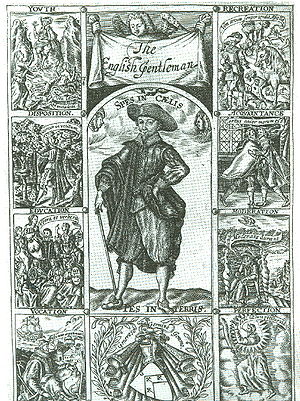
The Complete English Gentleman (1630), by Richard Brathwait, shows the exemplary qualities of a gentleman.

A gentleman was considered to be any man of good and courteous conduct. Originally, it was the lowest rant of the landed gentry of England, ranking below both “esquire” and “yeoman.” The rank of gentleman was comprised of the younger sons of the younger sons of peers and the sons of a baronet, a knight, and an esquire, in what is known as perpetual succession. A gentleman was not only courteous and law abiding, but he could display a coat of arms, which was a right he shared with members of the peerage, as well as some of the gentry. These groups equaled the British nobility.

In the 17th century, in Titles of Honour (1614), the jurist John Selden said that the title gentleman likewise speaks of ‘our English use of it’ as convertible with nobilis (nobility by rank or personal quality) [Selden, John (1614). Titles of Honour (1st ed.). London: William Stansby for Iohn Helme] and describes the forms of a man’s elevation to the nobility in European monarchies. In 1827, James Henry Lawrence explained and discussed the concepts, particulars, and functions of social rank in a monarchy, in the book On the Nobility of the British Gentry, or the Political Ranks and Dignities of the British Empire, Compared with those on the Continent. [Lawrence, Sir James Henry (1827) [1824]. The Nobility of the British Gentry or the Political Ranks and Dignities of the British Empire Compared with those on the Continent (2nd ed.). London: T.Hookham — Simpkin and Marshall.]

Esquire was not in general use for solicitors. More likely to be used by barristers. It was the form used by all those grandsons of peers without any other titles.

The rules of precedence of the Regency period put “esquire” and “gentlemen” in different categories. Landed men, especially those related to peers, like Fitzwilliam Darcy in Jane Austen’s “Pride and Prejudice” would be an “esquire.” He was the grandson of an earl. All the sons of younger sons of the peerage would be an “esquire” as would be sons of knights and baronets. Their sons would be gentlemen as would those with the king’s commission as an officer and a gentleman. The lines between esquire and gentleman were often hard to distinguish for all except the College of Heralds, and they charged a fee to make the decision.

“Esquire” was a status on the table of precedence.

An “esquire” was also a barrister or a judge who had not been given a peerage or even a knighthood. Younger sons of younger sons of dukes and marquesses or sons of earls, viscounts, and barons might be presented “esquire” after their names. Professors usually used their academic degrees, but would probably be seated with the esquires. The sons of a baronet ranked there.

A knight is a title senior to “esquire” for a barrister, for example. William Garrow was both. He was Sir William Garrow, PC, KC, FRS. (No “esquire.) Once knighted, he would be called Sir William. [On a side note and of interest to me with 40% of my ancestral DNA being from Scotland, Garrow was descended from the Garriochs of Kinstair, a Scottish royal line.]

“Esquire” was not used in speech, but, more so, perhaps, in addressing a formal letter.

If this topic interests you, please consider reading In Britain, who is entitled to the suffix of “Esquire” (“Esq.”)? It is MUCH more detailed than what I have attempted to cover here.

Posted in British history, Georgian England, Georgian Era, Jane Austen, Living in the Regency, Living in the UK, Pride and Prejudice, real life tales, Regency era, titles of aristocracy, word play | Tagged , , , , , , , , , | 4 Comments

Celebrating the Release of “A Regency Christmas Together” Anthology + a Giveaway

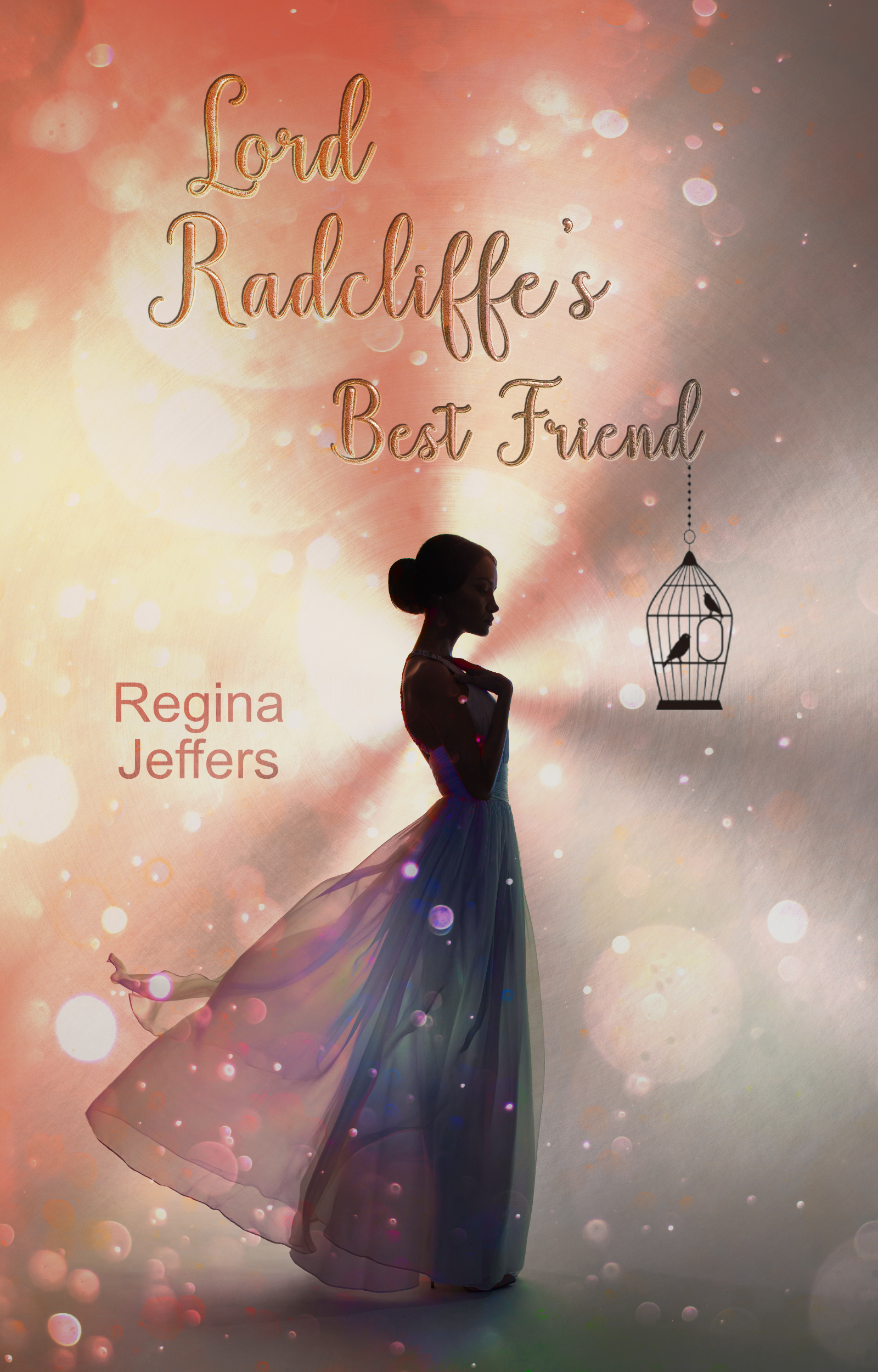
I have again joined forces with several authors for another Christmas-themed anthology. This one is entitled A Regency Christmas Together. The idea behind it is the hero and heroine are “trapped” together at Christmas. The “trapping” could be anything from being snowed in to being in a dangerous situation. My story Lord Radcliffe’s Best Friend is something of the latter nature, for those who regularly follow me know I adore a bit of drama in my tales. 

Hendrake Barrymore, Lord Radcliffe, is a typical male, a bit daff when it comes to the ways of women, especially the ways of one particular woman, Miss Adelaide Shaw, his childhood companion, a girl who plays a part in every pleasant memory Drake holds.

Yet, since he failed to deliver Addy’s first kiss on her fifteenth birthday, his former “friend” has struck him from her life just at a time when Radcliffe has come to the conclusion Adelaide is the one woman who best suits him.

This tale is more than a familiar story of friends to lovers for it presents the old maxim an unusual twist.

Below, you will find a short excerpt from Chapter One. If you are interested in reading more, swing over to Austen Authors for the first part of the chapter and for a second chance to win an eBook copy of A Regency Christmas Together

When news had arrived at the manor that Sultan could not be located, Adelaide knew exactly where the horse had gone. She had quickly changed into her riding habit and set out for the border between her father’s property and that of Lord Radcliffe. Addy suspected Sultan’s natural instinct to mate might be the needle’s prick in the continuing estrangement between the earl and her family. 

She reached a gloved hand down to pat her gelding’s neck. “Might as well face the Devil while the sun is up,” she murmured. She motioned to the grooms, who had accompanied her, to fetch Sultan. “Take him home. I will speak to Radcliffe and discover what restitution will be required. Do not mention any of this to my father. I shall discuss the matter with the baron upon my return. Also, send men out to repair our side of the fence. It appears someone has removed the rails we set atop of the brick wall. For what purpose, I have no idea. Yet, the removal permitted Sultan an easy jump.” 

“Yes, miss,” the men chorused. 

Looking to the opposing ridge, she spotted Radcliffe studying her. Without even a nod of her head in greeting, she nudged her horse forward. Quietly, she questioned, “Why must the man be the handsomest man of my acquaintance?”

Alcon shook his head as if in response. 

“I know,” she said softly. “I should ask the opinion of another female. Perhaps the mare below has taken note of his lordship’s appearance. Mayhap she holds an opinion of her owner that could prove mine in error.” 

She made her approach as Radcliffe had descended his side of the ridge to meet her in the middle. If only they could again find a similar “middle territory” in their relationship, then, she could, perhaps, go on with her life. Yet, Adelaide knew it would take more than this brief meeting to make her whole again. Bringing Alcon to a halt, she schooled her expression before greeting the earl. “Your lordship.” 

“Miss Shaw.” Why was it that the sound of his voice did odd things to her composure? It had been six years since she had displaced him from her world, and so much had changed within both their lives that should have made a difference, but hadn’t. However, anytime her eyes fell upon the man or someone mentioned his name or her father complained about the expense of having a well dug to use for the stock and the crops, she was right back where she always had been: in love with Hendrake Barrymore. 

If she could discover another man she could tolerate for more than an hour, maybe, then, she could marry and move away to her husband’s home. Distance, she had reasoned often, would aid in forgetting the ease which once had existed between her and the young man who had been her best friend when they were children. 

“I apologize for Sultan, my lord,” she said through tight. lips. “I shall speak to my father regarding restitution to Lord—”

“Shelton,” he supplied. 

“To Lord Shelton,” she continued. “I realize Sultan’s actions cost you the sale of the foal, and in these trying times, such business can assist in maintaining the land.” 

“Your father requires the fee, as well,” he said, keeping his steady gaze upon her and making Addy want to fidget. 

“I assure you, my lord, Sultan’s presence here today was not purposeful,” she argued, completely ignoring his gesture of goodwill. 

“I did not think the stallion’s actions purposeful,” he corrected. A frown marked his brow. “But certainly inconvenient.” 

She made to concentrate on the task at hand, rather than the bluest eyes she had ever beheld. “It appears someone has removed the wooden rails my father had placed on the brick wall marking the border between our properties. Sultan can easily clear the brick one without the railing.” 

His lordship eyed the wall suspiciously. “Like you, I would not name what remains of the wooden barrier a detriment to a horse of Sultan’s stature.” 

Addy kept her gaze upon the sad state of the wall. Such was safer where interactions with Radcliffe were concerned. From where she sat, the wall was in worse shape than she had originally thought. “It appears someone required . . . required the wood . . . to warm their cottages.” 

He dismounted, crossed to where she sat and lifted his hands to her to assist her to dismount. Obviously, he meant to make more of this encounter than was necessary. The fact she could not dismount or remount, for that matter, without his assistance, was something she was reluctant to admit, even to herself, for she did not want to consider the exquisite warmth of his hands upon her, for if he was to touch her, she would not be responsible for her actions. Despite his having betrayed her, even after six years, the man still held a power over her. 

“May I assist you down?” he questioned, but he did not step away from her.

Reluctantly, she nodded her agreement. “Step back so I might release my foot from the stirrup.”

“With your permission, I will do it,” he suggested with a slight lift of his brows, as if he meant to challenge her, something he had always done—something she desperately missed of having him in her life. 

Biting her bottom lip in frustration, she nodded her agreement. 

The subtle warmth of his hand on her leg above her half boots did crazy things to her most private place; yet, she swallowed her desire by reminding herself of his betrayal. Instead, she carefully shifted her weight to lift her right leg from around the pommel without exposing more of her person to him or tumbling off the saddle into his arms. A woman without the experience upon a horse she held would have not been able to release her leg and swivel in the seat without a spill. 

Both legs free, she leaned forward to place her hands on his broad shoulders and permitted him to assist her to the ground. The process was quite awkward, not the way one reads of it in the novels she adored, but possible, nonetheless.

At length, he set her before him, catching her hand in his. “We will inspect the wall together.” 

Using his hand for support, she bent to catch the loop on the skirt of her riding habit to avoid tripping upon it and to provide herself a few extra seconds to control the sudden racing tempo of her heart. “Such is not necessary, my lord,” she said tartly as she rose. It was important for her to keep her resentment in place, for she was too susceptible to the man. 

“I insist,” he said, setting her hand upon his arm.

Addy reluctantly fell into step beside him. “I assure you, my lord, my father is capable of seeing to the repair without your input.” 

He stopped suddenly, causing Addy to stumble. His hand again caught her about the waist to prevent her from falling, and Adelaide felt her heart jump with the same pleasant surprise she had known when he had been her best friend in the world and thought to share something with her. 

“Why is it you continue to despise me, Adelaide? I made a foolish mistake. Have you never erred in your judgement?”

The fact her body still touched his in two places—her hand rested upon his arm and his hand rested upon her waist—made it difficult for her to concentrate fully. She purposely stepped back to break their connection in order to clear her thinking. She retorted, “Most assuredly I have erred in my estimation of more than one ‘so-called’ gentleman.” 

“I refuse to apologize for my actions of six years past,” he growled. “I am not the same callow youth I was then.” 

“If I recall correctly, you refused to apologize then, as well. You offered your excuses, but no honest apology,” she countered. 

“This is ridiculous, Addy. We are wasting our lives arguing over something that cannot be changed,” he insisted. 

“As you say, my lord.” She walked away toward the wall. Purposely, studying it, she said, “Evidently, my father must ask Mr. Bowden to design a better barrier.” She fingered the two boards left behind. “This is unacceptable. Someone will take up the task in the morning. You have my word on the matter, my lord.” Without waiting for his opinions, she returned to where Alcon stood munching on the grass. Knowing she could not mount without Radcliffe’s assistance, she caught the animal’s reins to lead it home. “Come, Alcon.” She gave a little tug. “We must return to the manor.” 

Radcliffe stood where she had left him by the wall. From the corner of her eye she noted how he shook his head in what appeared to be disbelief. “You are the most stubborn woman of my acquaintance!”

She kept walking, slowly climbing the hill. It was a good mile to the house, but it would not be her first time walking that distance, nor would it likely be her last, although, she would admit, if only to herself, she wished she had worn more comfortable boots. Yet, she would never voice that particular complaint aloud. 

“You do not mean to allow me to assist you to the saddle?” he called. “Be reasonable, Addy!”

“Miss Shaw!” she declared without looking back to judge his reaction. “I am Miss Shaw.” She hid the pain such a declaration caused her. “My father will be in touch, my lord.” 

“Hendrake!” He stormed toward her, but thankfully did not attempt to prevent her retreat. “I am Hendrake! Drake! Not ‘my lord’ or ‘your lordship,’ not even ‘Radcliffe’! Say my name, Adelaide,” he demanded. 

Tears filled her eyes; yet, she did not slow her pace, nor did she look back to him. Instead, she stiffened her resolve, pulling her posture straighter and lifting her chin. She had a mile to allow herself another good cry. She had had plenty of them in the last six years, and, each time, she prayed it would be the last tears she shed over a man who had allowed his friends to attempt to deliver the kiss he had promised her—who had not thought to protect her from such manhandling—who had not even noticed the redness marking her cheek from where Lord French had slapped her when she had used a fireplace poker to fend off the man’s advances—who had only thought of the kiss she had denied him from a mere maid when Addy had been prepared to present him her whole heart. 

Now, for the GIVEAWAY. I have FIVE eBook copies of A Regency Christmas Together available to those who comment below. The Giveaway ends at midnight EST on Thursday, November 5. The winners will be announced on Sunday, November 8. Prizes will be delivered on November 11, when the anthology releases.

A Regency Christmas Together Anthology is on preorder until November 11, 2020, for only $0.99. It can also be read for FREE on Kindle Unlimited. https://www.amazon.com/Regency-Christmas-Together-Anthology-ANTHOLOGIES-ebook/dp/B08M3BR1Q9/ref=sr_1_3?dchild=1&keywords=a+regency+christmas+together&qid=1603978288&sr=8-3

A delightful anthology of Regency Romance Christmas stories from best selling authors! Fall in love at Christmas, with these wonderful romantic reads! Seven novellas, some sweet, some steamy, to keep you reading all through Winter, each centered around Christmas, and situations where people find themselves unexpectedly trapped together.

Lord Radcliffe’s Best Friend by Regina Jeffers
She’s been his friend since childhood – but he’s only just realised that he wants her to be more. It’s a pity that she’s decided he’s not her friend anymore…

Christmas with THAT Duke by Arietta Richmond
Ten years after betrayal tore them apart, they see each other again, for the first time. Trapped together by a blizzard, will they unravel the truth of the past and reclaim their love?

Mistletoe Magic by Janis Susan May
The daughter of a disgraced peer, now companion to a wealthy merchant’s widow, lady Serena did not expect, when there was a pounding on the door in a snowstorm, that what would fall through that door was her past, come to reclaim her.

Sleigh Bells and Slander by Summer Hanford
The least noticed sister, a gentleman pretending to be someone else, an interfering mother, love found despite it all.

The Merry Widow’s Snowbound Christmas by Sandra Masters
Unexpectedly back together, as the snow piles up outside, the heat rises inside, until long denied love overcomes all resistance.

Julie’s Christmas Joy by Victoria Hinshaw
Time has a habit of passing, and children grow up. When childhood companions meet again, neither is as the other remembered them – they have become far more interesting. When you add the well-meaning plotting of a grandmother and a great-aunt, their Christmas in Bath produces very unexpected results.

Me and Mr Jones by Ebony Oaten
A lady in need of a business partner, a man with a secret, an association that becomes far more than either of them intended.

If you love Regency Historical Romance, you’ll love these!

Posted in anthology, book excerpts, book release, Christmas, Dreamstone Publishing, eBooks, Georgian England, Georgian Era, giveaway, heroines, historical fiction, holidays, Living in the Regency, marriage, marriage customs, peerage, publishing, reading, reading habits, Regency era, Regency romance, writing | Tagged , , , , , , , , , , , , , | 13 Comments

Female Inheritance Laws + an Excerpt from MR. DARCY’S BRIDEs

Under English law, women were subordinate to their husbands. It was expected that she was under the “protection and influence of her husband, her baron, or lord.” The law stated the old adage of “two shall become one.” She was her husband’s “feme covert.” Any property she owned—real or personal—came under his control. A married woman could not draft a will or dispose of any property without her husband’s consent.

Women rarely inherited property. She could inherit “personal” belongings such as, furniture, jewelry, clothing, moveable goods, etc. But that does not mean that a woman could NOT inherit real property (meaning land, or what we now call “real estate”). The practice of primogeniture under English law presented the oldest son with the real property upon the death of the father. [Note: Matrilineal primogeniture, or female-preference uterine primogeniture, is a form of succession practiced in some societies in which the eldest female child inherits the throne, to the total exclusion of males. The order of succession to the position of the Rain Queen is an example in an African culture of matrilineal primogeniture: not only is dynastic descent reckoned through the female line, but only females are eligible to inherit.] Daughters could only inherit in the absence of a male heir. The law of intestate primogeniture remained on the statue books in Britain until the 1925 property legislation simplified and updated England’s archaic law of real property.

Aware of their daughters’ unfortunate situation, fathers often provided them with dowries or worked into a prenuptial agreement pin money, the estate which the wife was to possess for her sole and separate use not subject to the control of her husband, to provide her with an income separate from his.

In contrast to wives, women who never married or who were widowed maintained control over their property and inheritance, owned land and controlled property disposal, since by law any unmarried adult female was considered to be a feme sole. Some of the peeresses, in their own right had property, as well as the title which the husband couldn’t touch. Still, inheritance through the female of a peerage by patent was  extremely rare and usually only  put into the patent while the 1st peer was alive. Usually, the patents didn’t allow for female inheritance. It was rare for a woman to be able to inherit a peerage created by patent. The Duke of Marlborough had his patent changed when it was obvious he would not have a son, but that was a rare occurrence. Most females succeeded to a lesser peerage created by writ. Once married, the only way that women could reclaim property was through widowhood.

The dissolution of a marriage, whether initiated by the husband or wife, usually left the divorced females impoverished, as the law offered them no rights to marital property. The 1836 Caroline Norton court case highlighted the injustice of English property laws, and generated enough support that eventually resulted in the Married Women’s Property Act.

Lately, England has considered what is cleverly known as the “Downton Abbey” law. The Bill is so called after the anomaly of female succession at the heart of ITV’s Downton Abbey, in which the character of Lady Mary, the eldest daughter of the drama’s fictional earl, was unable to inherit the family seat because it had to pass to a male heir. The bill adds the rank of “baronets” to those titles in which females can inherit.

Like many in the JAFF community, I often write how Anne De Bourgh can inherit Rosings Park. I do so again in my latest novel, MR. DARCY’S BRIDEs. But how is that possible? As mentioned above, Anne can inherit if she does not marry. By English law, she could inherit when she reaches her majority at age 21. I customarily add something in Sir Lewis’s will that has her wait until she is 25. [Mayhap, Sir Lewis anticipated Lady Catherine’s “unwillingness” to be removed from the reins of Rosings Park, and provided Anne a bit of time to find a strong husband who would depose her ladyship, or some such story line.] Yet, in reality, it is also possible for Anne to inherit because her father’s title is one of baronet. The rank of “baronet” was created by James I, who founded the hereditary Order of Baronets in England in 1611 to be conferred on 200 gentlemen with large, profitable estates on the condition they funded the salaries of 30 soldiers for the war with Ireland. In these early baronetcies, it was written into the letters patent from the monarch when the titles were created that women could inherit if there was no male heir. The last baronetess, Dame Anne Maxwell Macdonald, whose ancestors became baronets in 1628, died in 2011 aged 104. Therefore, Anne De Bourgh could be the next baronetess of Rosings Park.

MDF eBook Cover Introducing MR. DARCY’S BRIDE…

I much prefer the sharpest criticism of a single intelligent man to the thoughtless approval of the masses.

ELIZABETH BENNET is determined that she will put a stop to her mother’s plans to marry off the eldest Bennet daughter to Mr. Collins, the Longbourn heir, but a man that Mr. Bennet considers an annoying dimwit. Hence, Elizabeth disguises herself as Jane and repeats her vows to the supercilious rector as if she is her sister, thereby voiding the nuptials and saving Jane from a life of drudgery. Yet, even the “best laid plans” can often go awry.

FITZWILLIAM DARCY is desperate to find a woman who will assist him in leading his sister back to Society after Georgiana’s failed elopement with Darcy’s old enemy George Wickham. He is so desperate that he agrees to Lady Catherine De Bourgh’s suggestion that Darcy marry her ladyship’s “sickly” daughter Anne. Unfortunately, as he waits for his bride to join him at the altar, he realizes he has made a terrible error in judgement, but there is no means to right the wrong without ruining his cousin’s reputation. Yet, even as he weighs his options, the touch of “Anne’s” hand upon his sends an unusual “zing” of awareness shooting up Darcy’s arm. It is only when he realizes the “zing” has arrived at the hand of a stranger, who has disrupted his nuptials, that he breathes both a sigh of relief and a groan of frustration, for the question remains: Is Darcy’s marriage to the woman legal?

What if Fitzwilliam Darcy and Elizabeth Bennet met under different circumstances than those we know from Jane Austen’s classic tale: Circumstances that did not include the voices of vanity and pride and prejudice and doubt that we find in the original story? Their road to happily ever after may not, even then, be an easy one, but with the expectations of others removed from their relationship, can they learn to trust each other long enough to carve out a path to true happiness?

EXCERPT from MR. DARCY’S BRIDEs (Chapter 18): This scene is Darcy’s threat to Lady Catherine when his aunt insists that he cannot back out of his marriage to Anne. [Trust me. Even with Darcy’s commanding tone in this excerpt, Lady Catherine is not easily put off.]

“Lady Catherine, sir.” His servant barely had time to open the door before his aunt strode into the room.

“Mr. Nathan, have my bags placed in my usual room,” his aunt instructed without so much as a by-your-leave.

Darcy’s ire grew quickly. He despised such presumptuousness. “Mr. Nathan, you will leave her ladyship’s bags upon her coach. And instruct my aunt’s coachman to remain nearby with her carriage. Lady Catherine will not be staying at Pemberley.”

Mr. Nathan nodded his understanding and rushed from the room, closing the door behind him.

“So this is the welcome I am to receive,” her ladyship harumphed. “Your mother would be ashamed of you, Darcy.” She sat heavily in an armed chair.

Darcy remained standing beside his desk. He spoke in clipped tones. “I was considering something similar as to Lady Anne’s reaction to your poor manners, Aunt. I can guarantee that George Darcy would never have tolerated your ordering his servants about, and neither will I. This is Pemberley, madam, not Rosings Park. I am the master here.”

His aunt snarled, “I see your insolence continues.”

“And I see you still think that the world will bend to your whims,” he countered.

Rather than to fuel their standoff with more inflammatory accusations, Lady Catherine switched tactics, a devise he had observed her employ previously. Darcy had always thought her doing so was an intelligent means for a woman to earn agreement over business matters in a man’s world, but her diversion would not work on him. “Is that girl in this house?” she demanded.

Darcy propped a hip on the corner of his desk and attempted to appear casual when he responded, “I fear Georgiana is not at home at this time. My sister will be sorry to have missed your call.”

Lady Catherine’s chin rose in stubbornness. “So that is the way you wish to discuss this matter. Very well. Then I shall be more direct. Did you bring Miss Elizabeth Bennet to Pemberley when you left Matthew Allard’s estate in Scotland?”

Darcy schooled his features. Someone would pay dearly for sharing his business with Lady Catherine. “I am not in the habit of discussing my personal life with anyone, and you of all people should realize I am more Darcy than Fitzwilliam. Your line of questions will not win you my favor.”

“I see you mean to protect this upstart! Are you so enthralled with the woman’s arts and allurements that you cannot see reason? If you fancy her, Darcy, then make her your mistress. Anne will ignore your indiscretions. I will instruct my daughter in the ways of men. Anne can be your wife while this strumpet can suffer your lust.”

His aunt’s description of aristocratic life sickened Darcy. “I have no intention of marrying Anne. You may beg. You may threaten. You may cajole. You may bargain. But I will never change my mind. I permitted you to use the memory of my dear mother to coerce me into agreeing to marry Anne, but Fate had other ideas. Anne was late, and I spoke my vows to another.”

“We both know those vows are not legal,” she drawled in warning tones.

Darcy had heard from his solicitor regarding those first vows exchanged with Elizabeth, and as expected, his first marriage to the woman had proved void. Mr. Jaffray had filed the papers to have the ceremony declared null. “Such knowledge does not change my resolve. I will not marry Anne.”

“Would you prefer that I instruct Anne in suing Miss Bennet for criminal conversation?” she challenged.

“Although neither Anne nor I could officially testify in such a suit, the truth would win out. A skilled barrister can make certain all the facts are relayed to the judge. The lady in question could not have claimed my affections away from your daughter, for beyond a fondness between cousins, I never loved Anne.” He would not say that Elizabeth Bennet held his heart in her delicate hands. “Moreover, as I did not hold the lady’s acquaintance until several hours after that morning at St. George, it would be impossible for her to draw me away with her arts and allurements. All such a suit would do would be to bring ruin upon Anne’s head and mar my family name, as well as yours. I doubt your brother Matlock will be most pleased with your choice. You would have your vengeance and little else to keep you warm in the winter. No man would ever claim Anne after such a public display, but I suppose that is what you wish. You wish Anne forever to remain under your control.”

“Anne’s dowry of thirty thousand pounds can cover any flaw you name,” Lady Catherine argued.

“Yes, I suppose her dowry and the promise of Rosings Park can conceal all but one of my cousin’s failings: that of possessing an overbearing and controlling mother. Only the most desperate of men would consider aligning his name with Sir Lewis’s daughter. You would be willing to turn over Anne’s future to a man of no principles. That fact should surprise me, but it does not,” he said in sad tones. “Such a man would run through every penny of Anne’s inheritance, leaving you and your daughter as Matlock’s poor relations. I suppose that must be my justice.”

“You think me so cold-hearted?” his aunt demanded. “Everything I do, I do for Anne.”

“You may tell yourself these lies,” Darcy cautioned, “but your family and soon society will recognize you as a bitter, vindictive woman.” He sighed heavily. “If you persist in this madness, I will sue Anne for breach of promise. Her fortune will be greatly reduced, for I will win my suit. There were at least two dozen witnesses that can swear to the fact that she left me at the altar. If not for the false exchange of vows, I would have been long gone from the church by the time Anne arrived. You, too, would have been gone, likely looking for your wayward daughter to strangle her, as you attempted to do when she did arrive. Are you willing to tarnish your daughter’s name twice in the court of public notice? Poor Anne who has never had a Season. Who has never been permitted the freedom to form a friendship. Who is poorly educated beyond what her governess provided her. That Anne will be irretrievably ruined.” His tone held the warning of winter’s embrace. “I do not wish to see Anne suffer, but I will not permit you to injure an innocent just to puff up your consequence.”

“An innocent?” his aunt accused in her most implacable voice. “The woman traveled with you to Scotland where she passed herself off as Mrs. Darcy. You see, Mr. and Mrs. Allard were quite pleased to tell my man of your indiscretions. Allard was most displeased that you withdrew your financial support of his latest venture.”

Allard’s financial future would be nonexistent when Darcy finished with the man. He would permit no one to bandy about Elizabeth’s name in a vile manner. “We could debate this matter all afternoon,” he announced as he stood. “I believe somewhere within your hard resolve you want what is best for Anne, and I am flattered you think me a suitable match for my cousin, but I wish to marry in affection, and my feelings for Anne are more brotherly than those of a potential husband.” A profound sadness crept into his tone when Darcy spoke of his cousin’s situation. He should have executed more to assist Anne before things had reached this turning point. Like most in the family, he had thought all would change when Anne inherited Sir Lewis’s properties and fortune. He had never considered the fact that Lady Catherine would do all she could to shove Anne out Rosings Park’s door in order to maintain control of all of Sir Lewis’s holdings. “Do you not wish something more for your daughter and your dearest sister’s only son than a marriage of convenience?”

“I wish to see Anne well settled,” she declared in undisguised contempt.

Darcy hesitated briefly before accepting the gauntlet. His aunt would force him to be ruthless. “Then you leave me no choice, madam. If you force me to marry Anne, I will leave you with little more than a humble cottage and a pair of servants to tend you for the remainder of your days. Anne will be five and twenty in two months. I will postpone the wedding until your daughter inherits Rosings Park per Sir Lewis’s will. All of it will belong to her, and as the estate and the fortune are entailed upon the female line, when we marry, as Anne’s husband, I will have control of it all. I have no intention of bringing Anne to child, so your many manipulations will be for naught. As you say, I will take my lust elsewhere. At Anne’s death, I will sell Rosings Park and all it holds piece-by piece, until nothing remains of Sir Lewis De Bourgh’s legacy. All you hold most dear will be scattered among the households of those with the funds to purchase it. I will destroy everything you have ever loved: Rosings Park and Anne. And each day of your miserable life you will know that I did these things in retribution for your foolish sense of consequence.” Needing to be away from his aunt, Darcy started for the door. “Good day, your ladyship. I will have Mr. Nathan see you out.” With that, he was gone, never looking back to view the look of astonishment upon his aunt’s features.

Posted in book excerpts, book release, estates, excerpt, giveaway, Inheritance, Jane Austen, Living in the Regency, marriage, marriage customs, marriage licenses, Pride and Prejudice, primogenture, publishing, Vagary, writing | Tagged , , , , , , , , , , | 16 Comments

Windows in Jane Austen’s Stories, a Guest Post from Eliza Shearer

We, Janeites, know that windows are a thing in Jane Austen’s novels. One of Mr Collins’ most memorable scenes in Pride and Prejudice takes place when he and his wife are on the way to visit the formidable Lady Catherine de Bourgh alongside their visitor, Miss Elizabeth Bennet. This is what happens as they approach Rosings:

 Every park has its beauty and its prospects; and Elizabeth saw much to be pleased with, though she could not be in such raptures as Mr. Collins expected the scene to inspire, and was but slightly affected by his enumeration of the windows in front of the house, and his relation of what the glazing altogether had originally cost Sir Lewis de Bourgh.

Chapter 29, Pride and Prejudice

In Georgian times glass was expensive, and therefore, the more windows a building had, the more handsome the income of its owners. In other words, Mr Collins’ awe of the number of windows is in fact, admiration for the wealth of his patroness. 

Windows as an Expression of Wealth

Windows were so inextricably linked to riches that the end of the 17th century saw the introduction of a new tax based on their number in any given property. It was effectively a levy on light and air, but a privileged few did not care.

In Mansfield Park, Austen alludes to the tax when describing the visit to Sutherton, the family estate of rich Mr Rushworth: 

Having visited many more rooms than could be supposed to be of any other use than to contribute to the window-tax, and find employment for housemaids, “Now,” said Mrs. Rushworth, “we are coming to the chapel, which properly we ought to enter from above, and look down upon; but as we are quite among friends, I will take you in this way, if you will excuse me”. 

Chapter 9, Mansfield Park

Of course, many Georgians did mind about their window tax contributions, and bricking up the openings of a property became a way to minimise its tax burden.

In Edinburgh, where I live, the impact of the tax is still visible in many streets of the New Town, built between the late 18th and the mid 19th centuries. Here is an example of a building I often walk past on my way to the city centre:

Bricked-up windows in Dundas Street, Edinburgh
A Georgian building with bricked-up windows in Dundas Street, Edinburgh

Expectations and Reality

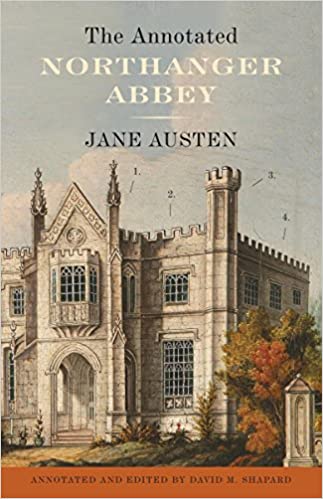
But windows in Austen’s novels communicate a great deal more than the wealth of their owners. For example, in Northanger Abbey windows illustrate Catherine Morland’s disappointment upon arriving in the Tilney family home. Her vivid imagination had pictured the Abbey to be gruesome and deliciously scary, but its windows announce it’s anything but:

The windows, to which she looked with peculiar dependence, from having heard the general talk of his preserving them in their Gothic form with reverential care, were yet less what her fancy had portrayed. To be sure, the pointed arch was preserved—the form of them was Gothic—they might be even casements—but every pane was so large, so clear, so light! To an imagination which had hoped for the smallest divisions, and the heaviest stone-work, for painted glass, dirt, and cobwebs, the difference was very distressing.

Chapter 20, Northanger Abbey

Poor Catherine, who finds shiny window panes instead of dusty, neglected and broken wall openings in the house she is visiting!

The Sash vs Casement Windows Issue

A conversation with a fellow member of the Scottish branch of the Jane Austen Scottish Society late last year also drew my attention to another windows-related fact in Austen.  You may remember that, in Emma, Mrs and Miss Bates occupy very modest dwellings in a brick house in Highbury. This is what Austen tells us about the place they call home: 

The house belonged to people in business. Mrs. and Miss Bates occupied the drawing-room floor; and there, in the very moderately-sized apartment, which was everything to them, the visitors were most cordially and even gratefully welcomed. 

Chapter 1, Emma

Later, in the letter from Frank Churchill to Mrs Weston, we read that the house has “sashed windows below, and casements above.” That is, sash windows on the ground floor and casements on the first floor, where the Bates ladies live. It’s an unremarkable mention, until you understand the context of windows during the Regency period.

A Tiny Detail, a Lot of Information

Sash windows consist of one or more panels assisted by weights, springs and pulleys hidden in the window frame that slide vertically to create openings. An innovation linked to improved glass manufacturing methods, the elegant proportions of sash windows were the perfect architectural feature for the new tastes of the Georgian era.

Such windows also provided better light levels and improved ventilation and were much easier to use. As a result, sash windows became very fashionable and replaced the older casement windows in most buildings. And therein lies the tiny detail that speaks of the Bates’ precarious financial situation.

Tamsin Greig, 2009

With just a few words, Austen informs us that the “people in business” that own the building have upgraded the ground-floor windows, but have not bothered to replace the windows on the floor above.

Perhaps they thought the investment wasn’t worth it, as they would never be able to recoup the money given the limited means of their tenants. In other words, the impoverished Bates ladies have to make do with the old, drafty and much more cumbersome iron casements, with lead latticework across the glass.  

It is quite wonderful: the more I read Austen, the more I marvel at her attention to detail and ability to make even the tiniest fragment of information a story upon itself. 

What are your thoughts on the topic of windows and Jane Austen? Are there any other situations in Austen’s works where windows, or any other apparently irrelevant detail, are in fact a lot more important than they seem at first sight? 

Sharing is Caring!

Posted in architecture, Austen Authors, British history, buildings and structures, Emma, Georgian Era, Guest Post, Jane Austen, Living in the Regency, Mansfield Park, Northanger Abbey, Pride and Prejudice, reading habits, Regency era | Tagged , , , , , , , , , , , , | Comments Off on Windows in Jane Austen’s Stories, a Guest Post from Eliza Shearer

A Crisis of Conflict Reflected in Austen’s Novels

From Amazon: The Origins of the English Novel, 1600-1740, combines historical analysis and readings of extraordinarily diverse texts to re-conceive the foundations of the dominant genre of the modern era. Now, on the fifteenth anniversary of its initial publication, The Origins of the English Novel stands as essential reading. The anniversary edition features a new introduction in which the author reflects on the considerable response and commentary the book has attracted since its publication by describing dialectical method and by applying it to early modern notions of gender.
Challenging prevailing theories that tie the origins of the novel to the ascendancy of “realism” and the “middle class,” McKeon argues that this new genre arose in response to the profound instability of literary and social categories. Between 1600 and 1740, momentous changes took place in European attitudes toward truth in narrative and toward virtue in the individual and the social order. The novel emerged, McKeon contends, as a cultural instrument designed to engage the epistemological and social crises of the age.

In the book, The Origins of the English Novel, 1600-1740, Michael McKeon purports the idea that the “new” novel form emerging in the mid 1700s displays a Progressive Ideology and the Transvaluation of Honor (150-151). He states, “Evidence on many fronts suggests that the early modern period marked a critical turning point in the efficacy not only of romance but also of the social institutions with which we are likely to associate it, a point at which they began systematically to attest not to the concord but to the discord of internals and externals, of virtue, status, wealth, and power. Indeed, the very life span of some of these social institutions suggests that they are to be seen not aa the traditional tools of stability but as signs of a crisis of confidence.”

Unprecedented new wealth brought on the rapid change of land ownership. A slew of new titles were bestowed during the reigns of James I and Charles I. Each brought more riches for the Crown and each served as a “balance” in an unbalanced society. Some even believe that James’s excessive sale of honors was the basis for the rebellion against the monarchy, but I am not an expert on that time and do not pretend to support the idea. However, history will show the “dispensing of Honours” and the large number of new titles created brought many, without merit or family connections or fortunes, into the aristocracy. The controversy had Sir Edward Walker, who served Charles I and Charles II, most loyally, saying, the inflation of honours “took off from the Respect due to Nobility and introduced a parity in Conversation . . . the Curtain being drawn they were discovered to be Men that heretofore were reverenced as Angels.”

We view this concept to a lesser extent in many of Jane Austen’s novels. She speaks of it in Sense and Sensibility in the whole Colonel Brandon/Willoughby fiasco, but it becomes painfully clear in her satire of the Gothic novel, Northanger Abbey. Those of us who love Jane Austen’s works and have studied her writings, combing through every small detail, know Austen spoke to such important topics as social class, a woman’s role in society, the role of the clergy, inheritance, primogeniture, imperialism, and gender relationships and responsibilities.

Austen was able to take the “romance” novel and have it speak not only of romance but of the underlying issues of a society in transition.

In Austen’s Northanger Abbey, General Tilney is the perfect Gothic villain. He is an evil, patriarchal man. Whereas the novels that proceeded Austen’s works connected goodness and virtue to those of the aristocracy, Austen and those that closely followed her in developing a new novel form did not. Austen placed “honor” and “respect” in the person, not the title/rank. For example, Captain Frederick Wentworth is Persuasion displays much more honor than does Sir Walter Elliot.

Because Catherine Morland has been brought to think this long-established virtues are associated with wealth and patrilineage, she assumes General Tilney must possess honor and sense and caring. Essentially, General Tilney must be a good man. Austen describes the general as:

Soon after their reaching the bottom of the set, Catherine perceived herself to be earnestly regarded by a gentleman who stood among the lookers-on, immediately behind her partner. He was a very handsome man, of a commanding aspect, past the bloom, but not past the vigour of life; and with his eye still directed towards her, she saw him presently address Mr. Tilney in a familiar whisper. Confused by his notice, and blushing from the fear of its being excited by something wrong in her appearance, she turned away her head. But while she did so, the gentleman retreated, and her partner, coming nearer, said, “I see that you guess what I have just been asked. That gentleman knows your name, and you have a right to know his. It is General Tilney, my father.”

Catherine’s answer was only “Oh!”–but it was an “Oh!” expressing everything needful: attention to his words, and perfect reliance on their truth. With real interest and strong admiration did her eye now follow the general, as he moved through the crowd, and “How handsome a family they are!” was her secret remark.

Catherine does not understand when she is treated poorly by the Tilneys:

Catherine’s expectations of pleasure from her visit in Milsom Street were so very high that disappointment was inevitable; and accordingly, though she was most politely received by General Tilney, and kindly welcomed by his daughter, though Henry was at home, and no one else of the party, she found, on her return, without spending many hours in the examination of her feelings, that she had gone to her appointment preparing for happiness which it had not afforded. Instead of finding herself improved in acquaintance with Miss Tilney, from the intercourse of the day, she seemed hardly so intimate with her as before; instead of seeing Henry Tilney to greater advantage than ever, in the ease of a family party, he had never said so little, nor been so little agreeable; and, in spite of their father’s great civilities to her–in spite of his thanks, invitations, and compliments–it had been a release to get away from him. It puzzled her to account for all this. It could not be General Tilney’s fault. That he was perfectly agreeable and good-natured, and altogether a very charming man, did not admit of a doubt, for he was tall and handsome, and Henry’s father. He could not be accountable for his children’s want of spirits, or for her want of enjoyment in his company. The former she hoped at last might have been accidental, and the latter she could only attribute to her own stupidity. Isabella, on hearing the particulars of the visit, gave a different explanation: “It was all pride, pride, insufferable haughtiness and pride! She had long suspected the family to be very high, and this made it certain. Such insolence of behaviour as Miss Tilney’s she had never heard of in her life! Not to do the honours of her house with common good breeding! To behave to her guest with such superciliousness! Hardly even to speak to her!”

Catherine Morland first opinion of General Tilney is based on his position in Society. He must be a man of honor, for he is a man holding a respected position of authority. Instead, he proves to be less than virtuous and his reason for accepting Catherine is his misunderstanding of your family’s wealth. She is the perfect match for Henry Tilney until she proves not to possess a rich dowry, which will enhance the Tilney family’s coffers. Even when the General shows his true colors and sends her away, she finds his actions incomprehensible of a man of honour—of a well-bred gentleman.

I leave it to my reader’s sagacity to determine how much of all this it was possible for Henry to communicate at this time to Catherine, how much of it he could have learnt from his father, in what points his own conjectures might assist him, and what portion must yet remain to be told in a letter from James. I have united for their ease what they must divide for mine. Catherine, at any rate, heard enough to feel that in suspecting General Tilney of either murdering or shutting up his wife, she had scarcely sinned against his character, or magnified his cruelty.

Henry, in having such things to relate of his father, was almost as pitiable as in their first avowal to himself. He blushed for the narrow-minded counsel which he was obliged to expose. The conversation between them at Northanger had been of the most unfriendly kind. Henry’s indignation on hearing how Catherine had been treated, on comprehending his father’s views, and being ordered to acquiesce in them, had been open and bold. The general, accustomed on every ordinary occasion to give the law in his family, prepared for no reluctance but of feeling, no opposing desire that should dare to clothe itself in words, could ill brook the opposition of his son, steady as the sanction of reason and the dictate of conscience could make it. But, in such a cause, his anger, though it must shock, could not intimidate Henry, who was sustained in his purpose by a conviction of its justice. He felt himself bound as much in honour as in affection to Miss Morland, and believing that heart to be his own which he had been directed to gain, no unworthy retraction of a tacit consent, no reversing decree of unjustifiable anger, could shake his fidelity, or influence the resolutions it prompted.

Posted in Austen actors, book excerpts, British history, excerpt, film, film adaptations, Georgian England, Georgian Era, historical fiction, Jane Austen, Living in the Regency, marriage customs, Northanger Abbey, reading habits, Regency era | Tagged , , , , , , , | Comments Off on A Crisis of Conflict Reflected in Austen’s Novels

The Royal Academy of Arts + an Excerpt from “A Lively Companion,” a Guest Post from Corrie Garrett

This post first appeared on the Austen Authors’ blog on 3 September 2020.

From your Regency readings, you may be familiar with Somerset House and the Summer Exhibition, a lavish and popular yearly art show. A catalog (and therefore entry) could be had for a shilling, and everyone who’s anyone in London would have gone to see the exhibition at some point!

While I haven’t used it as a location yet, I have used the Royal Academy of Arts, which was the group who put on the art show. (The original Somerset House was where Queen Charlotte was supposed to live if George III died before her. Instead, she was vested with Buckingham House, and they gave the new North Wing to the Royal Academy of Arts.)

Courtauld Gallery Staircase

Anyway, it was an art exhibition to which anyone could submit a painting. In fact, the founding group of the Royal Academy of Arts included two women, Angelica Kauffman and Mary Moser! Which is pretty cool.

Self-portrait, J.M.W. Turner

However, more to the point for my story purposes, not everyone who joined the Academy and received the honor of displaying work in the Summer Exhibition was aristocratic. Joseph Mallord William Turner (abbreviated J.M.W. Turner) is a great example. (In fact, it was a post here on Austen Authors that introduced me to him when I was researching my last series!) Turner was from a middle class family in Covent Gardens, burdened with a Cockney accent but remarkable talent. He was admitted to the Academy when he was fourteen, and displayed his first work at Somerset at fifteen!

I practically rubbed my hands together and cackled like a villain. What’s this I see before me? A middle/lower-class man who gained success and (could have) interacted with the highest families through his skill with painting and portraiture? Yes, please! (William Turner even received a snuff box from the King Louis Phillipe I!) I wanted to put Darcy through the wringer with Georgiana’s romance, and this fit the bill perfectly. Acclaimed painters were received everywhere, particularly portraitists… but at the same time, they definitely weren’t members of the “Upper Ten Thousand.” How would Darcy handle it if Georgiana fell in love with a such an “accepted outsider?”

Eruption of Vesuvius, J.M.W. Turner

I only used the barest idea of J.M.W. Turner for my story (and his last name, since it is fairly common), but his actual life story is also quite interesting. After his mother went to a mental institution, he was sent to live with a maternal uncle (rather like Fanny Price), and it was there that he was able to make his first forays into painting. His father would proudly display his son’s sketches in his barber shop window.

Eventually he traveled and gained more acclaim, particularly for his seascapes and other dramatic paintings. A huge volcano erupted in Indonesia in 1815 (making 1816 the “Year with No Summer”) and Turner painted the incredible sunsets caused by the ash in the upper atmosphere. He witnessed the burning of Parliament in 1834 and made watercolors of it. Turner’s experiments with color and light would become precursors of impressionist and abstract painting.

Although he grew reclusive in

Venice, J.M.W. Turner

later life, he did (re?)gain a close relationship with his father, and lived with him for 30 years until his father’s death.

So with that as background, here is a short excerpt from A Lively Companion, when Georgiana and Lizzy meet a young, up-and-coming painter…


Lizzy watched the little boy, in his ruffled shirt and small jacket, squirm upon the picturesque lounge. The painter seemed inured to that sort of thing, and also to being discussed as if he were not present.

“My mother’s portrait was done by Sir Thomas Lawrence,” Anne told them proudly.

Lady Catherine was just returning to them with her friend Mrs. Winkleigh. “Indeed, it was. Unfortunately Sir Thomas is off painting generals and such on the continent now. It would have been as well for him if he had stayed; I should have strongly counseled him to stay. I must have Anne’s portrait taken soon.”

Mrs. Winkleigh performed the introduction to the painter while his subject took a break for refreshment.

Mr. John Wesley Turner was a youngish man, not very tall or handsome, Lizzy thought, but with an intelligent, good-humored look to his eyes and forehead. He showed his smudged hands and apologized for being unable to properly greet them. He joked with Mrs. Winkleigh about painting her son on a stallion someday and was “deeply honored” to be considered by Lady Catherine and so on.

As they were leaving, he asked Miss Darcy whether she was satisfied with the expression and shadows of the child’s face.

“Oh, yes,” Miss Darcy said, “I’ve attempted my cousin’s children and never captured so much character. Not that I mean to compare… You are a professional…”

He smiled quizzically. “You look rather familiar to me, Miss Darcy. I’ve never painted you before; I think I would remember that, but perhaps we’ve met?”

Georgiana paled. “You are, perhaps, thinking of Miss Climping’s School for Girls in Bath. I believe we met in passing there.”

“Of course!” he said. “The arts mistress is my aunt. She had me judge some of the schoolgirls’ pieces or some such thing before the summer term. I believe you won.”

“You must have an uncommonly good memory,” Miss Darcy said. “Only a week’s visit for you, I believe.”

He laughed. “I’m afraid I don’t remember your artwork, except that it was clearly superior to the rest and made my decision quite easy.”


That’s it for now!

So, do you enjoy these kinds of dramatic, impressionistic paintings? Or do you prefer more realistic?

41v2pPoPN1L.jpg  A Lively Companion: A Pride and Prejudice Variation

from Corrie Garrett

Lizzy Bennet is more insulted than flattered when Lady Catherine asks her to be a temporary companion to Miss de Bourgh. Yes, a visit to Tunbridge Wells would be an interesting diversion, but at what cost?

When her father unexpectedly supports the plan, wanting Lizzy to gain a wider acquaintance and knowing it won’t get easier than this, Lizzy reluctantly submits. Thus begins a springtime trip of misunderstandings, revelations, and unexpected proposals.

When Mr. Darcy realizes Lizzy is not going home as planned, he feels foolish for nearly proposing due to an arbitrary deadline. Determined to make up his mind one way or another, he accompanies the party to the Wells.

While Miss de Bourgh takes the famed waters, Lizzy stumbles feet first into a friendship with Darcy’s sister and cousins. Indeed, she enjoys nearly all Darcy’s friends and family. She almost likes him, when he’s around them.

But that only makes it more painful when she must resolutely reject the proud head of the family…

A Lively Companion is a traditional variation on Pride and Prejudice, celebrating the humor, poignancy, and surprising inconsistency of life.

Posted in art, Austen Authors, book excerpts, British history, buildings and structures, Georgian England, Georgian Era, Guest Post, heroines, historical fiction, Jane Austen, Living in the Regency, Pride and Prejudice, Vagary, writing | Tagged , , , , , , , , , , , | Comments Off on The Royal Academy of Arts + an Excerpt from “A Lively Companion,” a Guest Post from Corrie Garrett