Jane Austen’s “Northanger Abbey” – Literary References Found Within

Title page from the original 1818 edition - Public Domain - Lilly Library, Indiana University

Title page from the original 1818 edition – Public Domain – Lilly Library, Indiana University

Previously, I looked at the history of the writing of Austen’s “first” and “last” novel. Today, we will spend a bit of time with the themes addressed, literary references, etc. Later, we will have a closer look at the main characters in a spoof of the 18th Century Gothic novel. 

Major Themes
The intricacies and tedium of high society, particularly partner selection.
The conflicts of marriage for love and marriage for property.
Life lived as if in a Gothic novel, filled with danger and intrigue, and the obsession with all things Gothic.
The dangers of believing life is the same as fiction.
The maturation of the young into sceptical adulthood, the loss of imagination, innocence and good faith.
Things are not what they seem at first.
Social criticism (comedy of manners).
Parody of the Gothic novels’ “Gothic and anti-Gothic” attitudes.
In addition, Catherine Morland realises she is not to rely upon others, such as Isabella, who are negatively influential on her, but to be single-minded and independent. It is only through bad experiences that Catherine really begins to mature and grow up.

Northanger Abbey was the first novel Jane Austen wrote. It is also the novel most closely related to the novels that influenced Austen’s reading, and parodies some of those novels, particularly Anne Radcliffe’s Gothic novel The Mysteries of Udolpho. In creating Catherine, the heroine of Northanger Abbey, Austen creates the heroine of a Gothic novel. Both Austen and Catherine portray Catherine’s life in heroic terms—Austen humorously, and Catherine seriously, especially when she suspects  General Tilney of murdering his wife. Because Austen couches her portrayal of Catherine in irony, Catherine is realistically portrayed as deficient in experience and perception, unlike the heroines of Gothic and romance novels. Catherine fails to recognize the obvious developing relationship between her brother James and her friend Isabella; she fails to recognize Isabella’s true nature until long after it has hurt her brother; she accidentally leads John Thorpe into thinking she loves him; and most significantly, she embarrasses herself in front of Henry Tilney  when he finds out she suspects his father of murder. While Catherine is an avid reader of novels, she is inexperienced at reading people, and this is what causes many of the problems she encounters. By the end of the novel, she has become a much better judge of character, having learned from her mistakes with Isabella and General Tilney. She is also, perhaps, a bit more cynical about people, as Henry is. Ultimately, it is her integrity and caring nature that win Henry’s heart and bring her happiness.(Spark Notes)

Allusions/References to Other Works
Several Gothic novels are mentioned in the book, including most importantly The Mysteries of Udolpho and The Italian by Ann Radcliffe. Austen also satirises Clermont, a Gothic novel by Regina Maria Roche. This last is included in a list of seven somewhat obscure Gothic works, known as the ‘Northanger horrid novels’ as recommended by Isabella Thorpe to Catherine Morland:

“Dear creature! how much I am obliged to you; and when you have finished Udolpho, we will read The Italian together; and I have made out a list of ten or twelve more of the same kind for you.”
“Have you, indeed! How glad I am!—What are they all?”
“I will read you their names directly; here they are, in my pocket-book. Castle of Wolfenbach, Clermont, Mysterious Warnings, Necromancer of the Black Forest, Midnight Bell, Orphan of the Rhine, and Horrid Mysteries. Those will last us some time.”
“Yes, pretty well; but are they all horrid, are you sure they are all horrid?”
“Yes, quite sure; for a particular friend of mine, a Miss Andrews, a sweet girl, one of the sweetest creatures in the world, has read every one of them…”
Though these lurid titles were assumed by some to be Austen’s own invention, Montague Summers and Michael Sadleir discovered that they really did exist and have since been republished. [See my post on the Northanger Horrid Novels.]

{BC217015-517C-40C2-A0F1-F08AE347F481}Img400.jpg Jane Austen, who referred to Fanny Burney as “the first of English novelists,” in Northanger Abbey refers to her inspiring novels:

“‘And what are you reading, Miss—?’ ‘Oh! It is only a novel!’ replies the young lady, while she lays down her book with affected indifference, or momentary shame. ‘It is only Cecilia, or Camilla, or Belinda‘; or, in short, only some work in which the greatest powers of the mind are displayed, in which the most thorough knowledge of human nature, the happiest delineation of its varieties, the liveliest effusions of wit and humour, are conveyed to the world in the best–chosen language.”

John Thorpe, who knows little about literature, tells Catherine that he likes The Monk (an over-the-top tale of lurid Gothic horror):

“Novels are all so full of nonsense and stuff; there has not been a tolerably decent one come out since Tom Jones, except The Monk; I read that t’other day; but as for all the others, they are the stupidest things in creation.”
“I think you must like Udolpho, if you were to read it; it is so very interesting.”
“Not I, faith! No, if I read any, it shall be Mrs. Radcliffe’s; her novels are amusing enough; they are worth reading; some fun and nature in them.”
“Udolpho was written by Mrs. Radcliffe,” said Catherine, with some hesitation, from the fear of mortifying him.
“No sure; was it? Aye, I remember, so it was; I was thinking of that other stupid book, written by that woman they make such a fuss about, she who married the French emigrant.”
“I suppose you mean Camilla?”
“Yes, that’s the book; such unnatural stuff! An old man playing at see-saw, I took up the first volume once and looked it over, but I soon found it would not do; indeed I guessed what sort of stuff it must be before I saw it: as soon as I heard she had married an emigrant, I was sure I should never be able to get through it.”

Motifs
Reading 

There are two kinds of reading in Northanger Abbey: reading books and letters, and reading people. Catherine Morland  is young and naïve, and she has a hard time distinguishing between the two types of reading. Before Catherine can really enter the world of adulthood, she needs to improve her ability to read people as well as novels. Throughout Northanger Abbey, Catherine finds herself unable to “read between the lines.” She does not notice the obvious romance developing between James and Isabella, she does not understand why Frederick Tilney gets involved, she has no idea why the General is so kind to her. All of these behaviors and motivations are clear to the reader and to the characters surrounding Catherine. When Catherine finally tries to do some of her own analysis, she gets her perceptions mixed up with those encouraged by her novel-reading: she recognizes General Tilney’s grumpiness and the tyrannical control he tries to exert over his children, but she attributes his attitude to the grisly murder of his wife, since such a plot twist occurs frequently in Gothic novels. One defining moment for Catherine comes as a result of reading text. She receives a letter from Isabella, and its contents open Catherine’s eyes to Isabella’s manipulative, ambitious ways. It would be going a bit too far to say that Catherine is an expert at reading people by the end of the novel, but she does become better at it, and she has learned when imagination can aid perception, and when it can hurt it.

Wealth  
In Austen’s novels, characters are often partly defined by their wealth and status. In Northanger Abbey, several characters are preoccupied with material longings. Isabella wants to marry someone rich, and forsakes James in favor of the richer Frederick. Mrs. Allen is obsessed with clothing and shopping, and when talking to Mrs. Thorpe, she feels less bad about her own childlessness when she notices the shabbiness of Mrs. Thorpe’s clothes. The General wants his children to marry into rich and wealthy families, and his personal obsession is with remodeling and landscaping. While giving a guided tour of Northanger Abbey, the General constantly asks Catherine to compare his home and gardens to those of Mr. Allen, and is always pleased to find that his belongings are larger or more impressive. In her later novels, Austen linked character’s personalities with the particular items they loved. In this early novel, she makes wealth itself the goal and passion of characters like Isabella and General Tilney. (Spark Notes)


Adaptations
p10722_d_v8_aa The A&E Network and the BBC released the television adaptation Northanger Abbey in 1986.

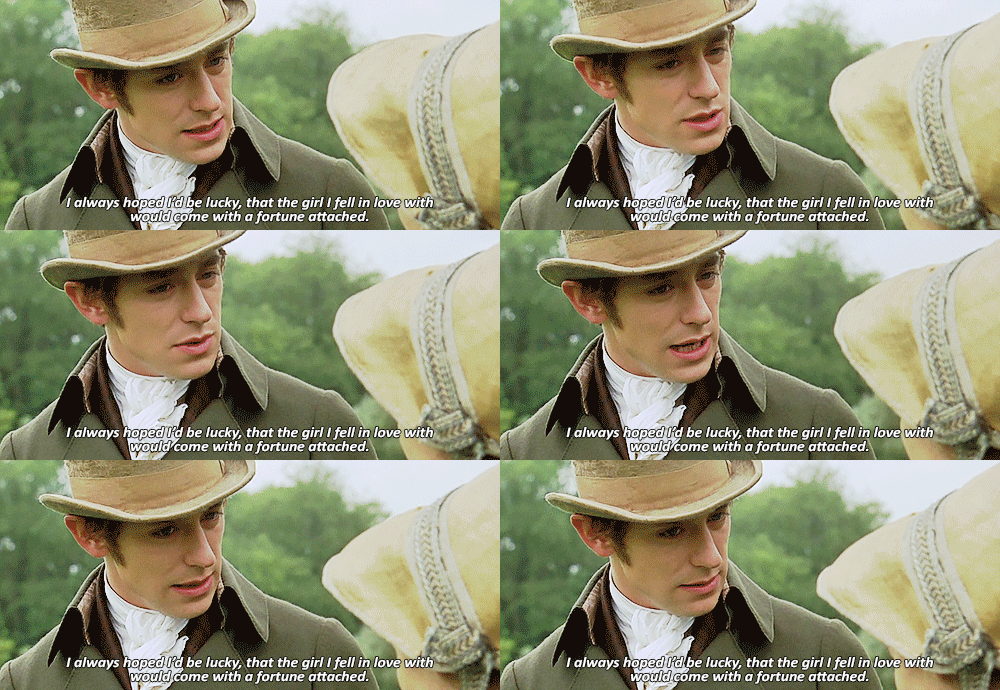
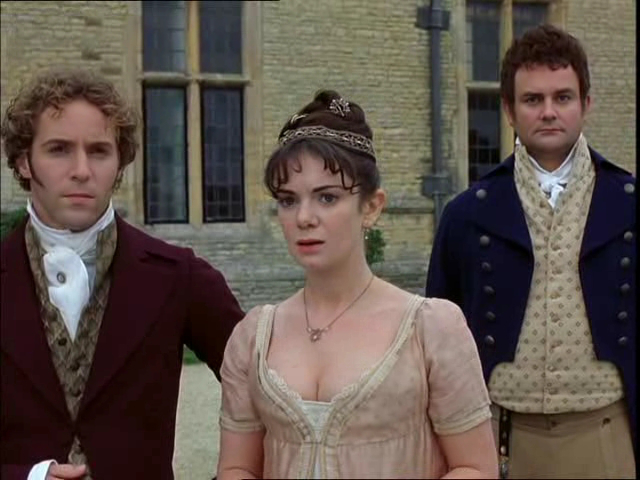
An adaptation of Northanger Abbey with screenplay by Andrew Davies, was shown on ITV on 25 March 2007 as part of their “Jane Austen Season”. This adaptation aired on PBS in the United States as part of the “Complete Jane Austen” on Masterpiece Classic in January 2008.

An adaptation of Northanger Abbey stage adaptation by Tim Luscombe, was produced by Salisbury Playhouse in 2009. It is published by Nick Hern Books (ISBN 9781854598370), and was revived in Chicago in 2013 at the Remy Bumppo Theatre.

A theatrical adaptation by Michael Napier Brown was performed at the Royal Theatre in Northampton in 1998

“Pup Fiction” – an episode of Wishbone featuring the plot and characters of Austen’s Northanger Abbey.

Historical Reference
The book contains an early reference to baseball. (“…Catherine, who had by nature nothing heroic about her, should prefer cricket, baseball, riding on horseback, and running about the country…”). [Fornelli, Tom (6 November 2008). “Apparently Jane Austen Invented Baseball”. AOL News.]

References to Northanger Abbey
MV5BMTM0ODc2Mzg1Nl5BMl5BanBnXkFtZTcwMTg4MDU1MQ@@._V1_SY317_CR0,0,214,317_AL_A passage from the novel appears as the preface of Ian McEwan’s Atonement, thus likening the naive mistakes of Austen’s Catherine Morland to those of his own character Briony Tallis, who is in a similar position: both characters have very over-active imaginations, which lead to misconceptions that cause distress in the lives of people around them. Both treat their own lives like those of heroines in fantastical works of fiction, with Miss Morland likening herself to a character in a Gothic novel and young Briony Tallis writing her own melodramatic stories and plays with central characters such as “spontaneous Arabella” based on herself.

Richard Adams quotes a portion of the novel’s last sentence for the epigraph to Chapter 50 in his Watership Down; the reference to the General is felicitous, as the villain in Watership Down is also a General.[Adams, Richard (1975). Watership Down. Avon. p. 470. ISBN 0-380-00293-0. …[P]rofessing myself moreover convinced that the general’s unjust interference, so far from being really injurious to their felicity, was perhaps rather conducive to it, by improving their knowledge of each other, and adding strength to their attachment, I leave it to be settled, by whomsoever it may concern…]

Unless so noted, information in this post comes from the script of Austen’s Northanger Abbey or from  Wikipedia.

Posted in British history, Great Britain, Jane Austen, Living in the Regency, real life tales, Regency era | Tagged , | 4 Comments

A Character Study of Charlotte Lucas, a Guest Post from Lelia Eye

This post originally appeared on the Austen Authors’ blog on 8 April 2021. I thought those here might enjoy the close examination many writers of Jane Austen Fan Fiction take before placing pen to paper. Ms. Eye is one of the most thorough I have encountered.

Unfortunately, my morning sickness seems to be clinging to me for longer than I had hoped, but life must carry on.

I thought this time I would take a textual look at Charlotte Lucas in Pride and Prejudice. I think she is an often-underutilized character whose practicality and keen eye are quite remarkable. In some ways, I feel she is a mouthpiece for Austen, yet there is always a danger in taking such an approach with a character in any work. After all, despite Charlotte’s general awareness, there is certainly much of the comedic about her (as can be seen with many of the characters in Pride and Prejudice).

On a side note, to my utmost surprise, while preparing this post, I noticed something that I had not before! In chapter 57, we learn that Charlotte is pregnant! But more on that later.

As I went through the text, I realized that Charlotte plays a much bigger role than I had initially realized. The name “Charlotte” occurs 85 times, and “Mrs. Collins” occurs 29 times. There are 25 instances where “Miss Lucas” refers to Charlotte (as opposed to Maria). Finally, “Collinses” occurs 5 times.

For a sense of perspective, “Mary” only occurs 39 times, and “Kitty” occurs 71 times.

Charlotte is immediately painted by Austen in a positive light:

  • The eldest of [the Lucases’ children], a sensible, intelligent young woman, about twenty-seven, was Elizabeth’s intimate friend.

Furthermore, Charlotte, coming from a large family, helps her family where she needs to, and she must be quite aware of her plainness of appearance since even her mother has observed it:

  • Elizabeth, for the sake of saying something that might turn her mother’s thoughts, now asked her if Charlotte Lucas had been at Longbourn since her coming away.
    “Yes, she called yesterday with her father. …”
    “Did Charlotte dine with you?”
    “No, she would go home. I fancy she was wanted about the mince-pies. For my part, Mr. Bingley, I always keep servants that can do their own work; my daughters are brought up very differently. But everybody is to judge for themselves, and the Lucases are a very good sort of girls, I assure you. It is a pity they are not handsome! Not that I think Charlotte so very plain—but then she is our particular friend.”
    “She seems a very pleasant young woman.”
    “Oh! dear, yes; but you must own she is very plain. Lady Lucas herself has often said so, and envied me Jane’s beauty. …”

Of course, Charlotte also seems (somewhat surprisingly) to be a bit of a gossip:

  • “Something very much to the purpose of course. He begins with congratulations on the approaching nuptials of my eldest daughter, of which, it seems, he has been told by some of the good-natured, gossiping Lucases. I shall not sport with your impatience, by reading what he says on that point. What relates to yourself, is as follows: ‘Having thus offered you the sincere congratulations of Mrs. Collins and myself on this happy event, let me now add a short hint on the subject of another; of which we have been advertised by the same authority. Your daughter Elizabeth, it is presumed, will not long bear the name of Bennet, after her elder sister has resigned it, and the chosen partner of her fate may be reasonably looked up to as one of the most illustrious personages in this land.’
  • And her neighbours at Lucas Lodge, therefore (for through their communication with the Collinses, the report, she concluded, had reached Lady Catherine), had only set that down as almost certain and immediate, which she had looked forward to as possible at some future time.
  • “My dear Sir,
    “I feel myself called upon, by our relationship, and my situation in life, to condole with you on the grievous affliction you are now suffering under, of which we were yesterday informed by a letter from Hertfordshire. Be assured, my dear sir, that Mrs. Collins and myself sincerely sympathise with you and all your respectable family, in your present distress, which must be of the bitterest kind, because proceeding from a cause which no time can remove. No arguments shall be wanting on my part that can alleviate so severe a misfortune—or that may comfort you, under a circumstance that must be of all others the most afflicting to a parent’s mind. The death of your daughter would have been a blessing in comparison of this. And it is the more to be lamented, because there is reason to suppose as my dear Charlotte informs me, that this licentiousness of behaviour in your daughter has proceeded from a faulty degree of indulgence; though, at the same time, for the consolation of yourself and Mrs. Bennet, I am inclined to think that her own disposition must be naturally bad, or she could not be guilty of such an enormity, at so early an age. Howsoever that may be, you are grievously to be pitied; in which opinion I am not only joined by Mrs. Collins, but likewise by Lady Catherine and her daughter, to whom I have related the affair. They agree with me in apprehending that this false step in one daughter will be injurious to the fortunes of all the others; for who, as Lady Catherine herself condescendingly says, will connect themselves with such a family? . . .”

Charlotte’s intimacy with the Bennets is readily evident through their easy conversation and through various pieces showing her closeness with Elizabeth, and furthermore, her handling of Mrs. Bennet seems well done:

  • That the Miss Lucases and the Miss Bennets should meet to talk over a ball was absolutely necessary; and the morning after the assembly brought the former to Longbourn to hear and to communicate.
    You began the evening well, Charlotte,” said Mrs. Bennet with civil self-command to Miss Lucas. “You were Mr. Bingley’s first choice.”
    “Yes; but he seemed to like his second better.”
    “Oh! you mean Jane, I suppose, because he danced with her twice. To be sure that did seem as if he admired her—indeed I rather believe he did—I heard something about it—but I hardly know what—something about Mr. Robinson.”
    Perhaps you mean what I overheard between him and Mr. Robinson; did not I mention it to you? Mr. Robinson’s asking him how he liked our Meryton assemblies, and whether he did not think there were a great many pretty women in the room, and which he thought the prettiest? and his answering immediately to the last question: ‘Oh! the eldest Miss Bennet, beyond a doubt; there cannot be two opinions on that point.’”

    My overhearings were more to the purpose than yours, Eliza,” said Charlotte. “Mr. Darcy is not so well worth listening to as his friend, is he?—poor Eliza!—to be only just tolerable.”
    “I beg you would not put it into Lizzy’s head to be vexed by his ill-treatment, for he is such a disagreeable man, that it would be quite a misfortune to be liked by him. Mrs. Long told me last night that he sat close to her for half-an-hour without once opening his lips.”

    “I do not mind his not talking to Mrs. Long,” said Miss Lucas, “but I wish he had danced with Eliza.”
  • But Elizabeth was not formed for ill-humour; and though every prospect of her own was destroyed for the evening, it could not dwell long on her spirits; and having told all her griefs to Charlotte Lucas, whom she had not seen for a week, she was soon able to make a voluntary transition to the oddities of her cousin, and to point him out to her particular notice.
  • When those dances were over, [Elizabeth] returned to Charlotte Lucas, and was in conversation with her, when she found herself suddenly addressed by Mr. Darcy who took her so much by surprise in his application for her hand, that, without knowing what she did, she accepted him. He walked away again immediately, and she was left to fret over her own want of presence of mind; Charlotte tried to console her:
    “I dare say you will find him very agreeable.”
    “Heaven forbid! That would be the greatest misfortune of all! To find a man agreeable whom one is determined to hate! Do not wish me such an evil.”
  • While the family were in this confusion, Charlotte Lucas came to spend the day with them. She was met in the vestibule by Lydia, who, flying to her, cried in a half whisper, “I am glad you are come, for there is such fun here! What do you think has happened this morning? Mr. Collins has made an offer to Lizzy, and she will not have him.”
    Charlotte hardly had time to answer, before they were joined by Kitty, who came to tell the same news; and no sooner had they entered the breakfast-room, where Mrs. Bennet was alone, than she likewise began on the subject, calling on Miss Lucas for her compassion, and entreating her to persuade her friend Lizzy to comply with the wishes of all her family. “Pray do, my dear Miss Lucas,” she added in a melancholy tone, “for nobody is on my side, nobody takes part with me. I am cruelly used, nobody feels for my poor nerves.”
    Charlotte’s reply was spared by the entrance of Jane and Elizabeth.

Of course, the flighty Mrs. Bennet seems to alternate between praising Charlotte, disparaging her (of course, when Charlotte chooses to marry Mr. Collins, Mrs. Bennet is not the only one with negative comments to make!), and viewing her in a neutral light:

  • “I hope, my dear,” said Mr. Bennet to his wife, as they were at breakfast the next morning, “that you have ordered a good dinner to-day, because I have reason to expect an addition to our family party.”
    “Who do you mean, my dear? I know of nobody that is coming, I am sure, unless Charlotte Lucas should happen to call in—and I hope my dinners are good enough for her. I do not believe she often sees such at home.”
  • “ . . . A great many changes have happened in the neighbourhood, since you went away. Miss Lucas is married and settled. . . .”
  • Bennet was really in a most pitiable state. The very mention of anything concerning the match threw her into an agony of ill-humour, and wherever she went she was sure of hearing it talked of. The sight of Miss Lucas was odious to her. As her successor in that house, she regarded her with jealous abhorrence. Whenever Charlotte came to see them, she concluded her to be anticipating the hour of possession; and whenever she spoke in a low voice to Mr. Collins, was convinced that they were talking of the Longbourn estate, and resolving to turn herself and her daughters out of the house, as soon as Mr. Bennet were dead. She complained bitterly of all this to her husband.
    “Indeed, Mr. Bennet,” said she, “it is very hard to think that Charlotte Lucas should ever be mistress of this house, that I should be forced to make way for her, and live to see her take her place in it!”
    “My dear, do not give way to such gloomy thoughts. Let us hope for better things. Let us flatter ourselves that I may be the survivor.”
    This was not very consoling to Mrs. Bennet, and therefore, instead of making any answer, she went on as before.
    “I cannot bear to think that they should have all this estate. If it was not for the entail, I should not mind it.”
  • “Well, Lizzy,” continued her mother, soon afterwards, “and so the Collinses live very comfortable, do they? Well, well, I only hope it will last. And what sort of table do they keep? Charlotte is an excellent manager, I dare say. If she is half as sharp as her mother, she is saving enough. There is nothing extravagant in their housekeeping, I dare say.”
    “No, nothing at all.”
    “A great deal of good management, depend upon it. Yes, yes. They will take care not to outrun their income. They will never be distressed for money. Well, much good may it do them! And so, I suppose, they often talk of having Longbourn when your father is dead. They look upon it as quite their own, I dare say, whenever that happens.”
    “It was a subject which they could not mention before me.”
    “No; it would have been strange if they had; but I make no doubt they often talk of it between themselves. Well, if they can be easy with an estate that is not lawfully their own, so much the better. I should be ashamed of having one that was only entailed on me.”
  • Elizabeth was sitting with her mother and sisters, reflecting on what she had heard, and doubting whether she was authorised to mention it, when Sir William Lucas himself appeared, sent by his daughter, to announce her engagement to the family.

    Elizabeth, feeling it incumbent on her to relieve him from so unpleasant a situation, now put herself forward to confirm his account, by mentioning her prior knowledge of it from Charlotte herself; and endeavoured to put a stop to the exclamations of her mother and sisters by the earnestness of her congratulations to Sir William, in which she was readily joined by Jane, and by making a variety of remarks on the happiness that might be expected from the match, the excellent character of Mr. Collins, and the convenient distance of Hunsford from London.
    Mrs. Bennet was in fact too much overpowered to say a great deal while Sir William remained; but no sooner had he left them than her feelings found a rapid vent. In the first place, she persisted in disbelieving the whole of the matter; secondly, she was very sure that Mr. Collins had been taken in; thirdly, she trusted that they would never be happy together; and fourthly, that the match might be broken off.
  • A week elapsed before [Mrs. Bennet] could see Elizabeth without scolding her, a month passed away before she could speak to Sir William or Lady Lucas without being rude, and many months were gone before she could at all forgive their daughter.
    Mr. Bennet’s emotions were much more tranquil on the occasion, and such as he did experience he pronounced to be of a most agreeable sort; for it gratified him, he said, to discover that Charlotte Lucas, whom he had been used to think tolerably sensible, was as foolish as his wife, and more foolish than his daughter!
    Jane confessed herself a little surprised at the match; but she said less of her astonishment than of her earnest desire for their happiness; nor could Elizabeth persuade her to consider it as improbable. Kitty and Lydia were far from envying Miss Lucas, for Mr. Collins was only a clergyman; and it affected them in no other way than as a piece of news to spread at Meryton.
    Lady Lucas could not be insensible of triumph on being able to retort on Mrs. Bennet the comfort of having a daughter well married; and she called at Longbourn rather oftener than usual to say how happy she was, though Mrs. Bennet’s sour looks and ill-natured remarks might have been enough to drive happiness away.
    Between Elizabeth and Charlotte there was a restraint which kept them mutually silent on the subject; and Elizabeth felt persuaded that no real confidence could ever subsist between them again. Her disappointment in Charlotte made her turn with fonder regard to her sister, of whose rectitude and delicacy she was sure her opinion could never be shaken, and for whose happiness she grew daily more anxious, as Bingley had now been gone a week and nothing more was heard of his return.
  • “ . . . First of all, he asked Miss Lucas. I was so vexed to see him stand up with her! But, however, he did not admire her at all; indeed, nobody can, you know; and he seemed quite struck with Jane as she was going down the dance. . . .”
  • “ . . . The Collinses will turn us out before he is cold in his grave, and if you are not kind to us, brother, I do not know what we shall do.”

Regardless of Mrs. Bennet’s opinions, Charlotte’s observations are often on-point:

  • “His pride,” said Miss Lucas, “does not offend me so much as pride often does, because there is an excuse for it. One cannot wonder that so very fine a young man, with family, fortune, everything in his favour, should think highly of himself. If I may so express it, he has a right to be proud.”

One of Charlotte’s most important observations is one that would rectify the misunderstandings of Jane’s affection for Bingley – if only Elizabeth had passed on the information to Jane and encouraged her to modify her behavior!

  • It was generally evident whenever they met, that he did admire her and to her it was equally evident that Jane was yielding to the preference which she had begun to entertain for him from the first, and was in a way to be very much in love; but she considered with pleasure that it was not likely to be discovered by the world in general, since Jane united, with great strength of feeling, a composure of temper and a uniform cheerfulness of manner which would guard her from the suspicions of the impertinent. She mentioned this to her friend Miss Lucas.
    “It may perhaps be pleasant,” replied Charlotte, “to be able to impose on the public in such a case; but it is sometimes a disadvantage to be so very guarded. If a woman conceals her affection with the same skill from the object of it, she may lose the opportunity of fixing him; and it will then be but poor consolation to believe the world equally in the dark. There is so much of gratitude or vanity in almost every attachment, that it is not safe to leave any to itself. We can all begin freely—a slight preference is natural enough; but there are very few of us who have heart enough to be really in love without encouragement. In nine cases out of ten a woman had better show more affection than she feels. Bingley likes your sister undoubtedly; but he may never do more than like her, if she does not help him on.”
    “But she does help him on, as much as her nature will allow. If I can perceive her regard for him, he must be a simpleton, indeed, not to discover it too.”
    “Remember, Eliza, that he does not know Jane’s disposition as you do.”
    “But if a woman is partial to a man, and does not endeavour to conceal it, he must find it out.”
    “Perhaps he must, if he sees enough of her. But, though Bingley and Jane meet tolerably often, it is never for many hours together; and, as they always see each other in large mixed parties, it is impossible that every moment should be employed in conversing together. Jane should therefore make the most of every half-hour in which she can command his attention. When she is secure of him, there will be more leisure for falling in love as much as she chooses.”
    “Your plan is a good one,” replied Elizabeth, “where nothing is in question but the desire of being well married, and if I were determined to get a rich husband, or any husband, I dare say I should adopt it. But these are not Jane’s feelings; she is not acting by design. As yet, she cannot even be certain of the degree of her own regard nor of its reasonableness. She has known him only a fortnight. She danced four dances with him at Meryton; she saw him one morning at his own house, and has since dined with him in company four times. This is not quite enough to make her understand his character.”
    “Not as you represent it. Had she merely dined with him, she might only have discovered whether he had a good appetite; but you must remember that four evenings have also been spent together—and four evenings may do a great deal.”
  • He declared himself to be totally unsuspicious of her sister’s attachment; and she could not help remembering what Charlotte’s opinion had always been.

Charlotte also expresses a very practical view on marriage which helps explain her willingness to accept Mr. Collins:

  • “Well,” said Charlotte, “I wish Jane success with all my heart; and if she were married to him to-morrow, I should think she had as good a chance of happiness as if she were to be studying his character for a twelvemonth. Happiness in marriage is entirely a matter of chance. If the dispositions of the parties are ever so well known to each other or ever so similar beforehand, it does not advance their felicity in the least. They always continue to grow sufficiently unlike afterwards to have their share of vexation; and it is better to know as little as possible of the defects of the person with whom you are to pass your life.”
    “You make me laugh, Charlotte; but it is not sound. You know it is not sound, and that you would never act in this way yourself.”
  • In as short a time as Mr. Collins’s long speeches would allow, everything was settled between them to the satisfaction of both; and as they entered the house he earnestly entreated her to name the day that was to make him the happiest of men; and though such a solicitation must be waived for the present, the lady felt no inclination to trifle with his happiness. The stupidity with which he was favoured by nature must guard his courtship from any charm that could make a woman wish for its continuance; and Miss Lucas, who accepted him solely from the pure and disinterested desire of an establishment, cared not how soon that establishment were gained.
    Sir William and Lady Lucas were speedily applied to for their consent; and it was bestowed with a most joyful alacrity. Mr. Collins’s present circumstances made it a most eligible match for their daughter, to whom they could give little fortune; and his prospects of future wealth were exceedingly fair. Lady Lucas began directly to calculate, with more interest than the matter had ever excited before, how many years longer Mr. Bennet was likely to live; and Sir William gave it as his decided opinion, that whenever Mr. Collins should be in possession of the Longbourn estate, it would be highly expedient that both he and his wife should make their appearance at St. James’s. The whole family, in short, were properly overjoyed on the occasion. The younger girls formed hopes of coming out a year or two sooner than they might otherwise have done; and the boys were relieved from their apprehension of Charlotte’s dying an old maid. Charlotte herself was tolerably composed. She had gained her point, and had time to consider of it. Her reflections were in general satisfactory. Mr. Collins, to be sure, was neither sensible nor agreeable; his society was irksome, and his attachment to her must be imaginary. But still he would be her husband. Without thinking highly either of men or matrimony, marriage had always been her object; it was the only provision for well-educated young women of small fortune, and however uncertain of giving happiness, must be their pleasantest preservative from want. This preservative she had now obtained; and at the age of twenty-seven, without having ever been handsome, she felt all the good luck of it. The least agreeable circumstance in the business was the surprise it must occasion to Elizabeth Bennet, whose friendship she valued beyond that of any other person. Elizabeth would wonder, and probably would blame her; and though her resolution was not to be shaken, her feelings must be hurt by such a disapprobation. She resolved to give her the information herself, and therefore charged Mr. Collins, when he returned to Longbourn to dinner, to drop no hint of what had passed before any of the family.
  • Miss Lucas called soon after breakfast, and in a private conference with Elizabeth related the event of the day before.
    The possibility of Mr. Collins’s fancying himself in love with her friend had once occurred to Elizabeth within the last day or two; but that Charlotte could encourage him seemed almost as far from possibility as she could encourage him herself, and her astonishment was consequently so great as to overcome at first the bounds of decorum, and she could not help crying out:
    “Engaged to Mr. Collins! My dear Charlotte—impossible!”
    The steady countenance which Miss Lucas had commanded in telling her story, gave way to a momentary confusion here on receiving so direct a reproach; though, as it was no more than she expected, she soon regained her composure, and calmly replied:
    “Why should you be surprised, my dear Eliza? Do you think it incredible that Mr. Collins should be able to procure any woman’s good opinion, because he was not so happy as to succeed with you?”
    But Elizabeth had now recollected herself, and making a strong effort for it, was able to assure with tolerable firmness that the prospect of their relationship was highly grateful to her, and that she wished her all imaginable happiness.
    “I see what you are feeling,” replied Charlotte. “You must be surprised, very much surprised—so lately as Mr. Collins was wishing to marry you. But when you have had time to think it over, I hope you will be satisfied with what I have done. I am not romantic, you know; I never was. I ask only a comfortable home; and considering Mr. Collins’s character, connection, and situation in life, I am convinced that my chance of happiness with him is as fair as most people can boast on entering the marriage state.”
    Elizabeth quietly answered “Undoubtedly;” and after an awkward pause, they returned to the rest of the family. Charlotte did not stay much longer, and Elizabeth was then left to reflect on what she had heard. It was a long time before she became at all reconciled to the idea of so unsuitable a match. The strangeness of Mr. Collins’s making two offers of marriage within three days was nothing in comparison of his being now accepted. She had always felt that Charlotte’s opinion of matrimony was not exactly like her own, but she had not supposed it to be possible that, when called into action, she would have sacrificed every better feeling to worldly advantage. Charlotte the wife of Mr. Collins was a most humiliating picture! And to the pang of a friend disgracing herself and sunk in her esteem, was added the distressing conviction that it was impossible for that friend to be tolerably happy in the lot she had chosen.
  • From his garden, Mr. Collins would have led them round his two meadows; but the ladies, not having shoes to encounter the remains of a white frost, turned back; and while Sir William accompanied him, Charlotte took her sister and friend over the house, extremely well pleased, probably, to have the opportunity of showing it without her husband’s help. It was rather small, but well built and convenient; and everything was fitted up and arranged with a neatness and consistency of which Elizabeth gave Charlotte all the credit. When Mr. Collins could be forgotten, there was really an air of great comfort throughout, and by Charlotte’s evident enjoyment of it, Elizabeth supposed he must be often forgotten.
    She had already learnt that Lady Catherine was still in the country. It was spoken of again while they were at dinner, when Mr. Collins joining in, observed:
    “Yes, Miss Elizabeth, you will have the honour of seeing Lady Catherine de Bourgh on the ensuing Sunday at church, and I need not say you will be delighted with her. She is all affability and condescension, and I doubt not but you will be honoured with some portion of her notice when service is over. I have scarcely any hesitation in saying she will include you and my sister Maria in every invitation with which she honours us during your stay here. Her behaviour to my dear Charlotte is charming. We dine at Rosings twice every week, and are never allowed to walk home. Her ladyship’s carriage is regularly ordered for us. I should say, one of her ladyship’s carriages, for she has several.”
    “Lady Catherine is a very respectable, sensible woman indeed,” added Charlotte, “and a most attentive neighbour.”
    “Very true, my dear, that is exactly what I say. She is the sort of woman whom one cannot regard with too much deference.”
    The evening was spent chiefly in talking over Hertfordshire news, and telling again what had already been written; and when it closed, Elizabeth, in the solitude of her chamber, had to meditate upon Charlotte’s degree of contentment, to understand her address in guiding, and composure in bearing with, her husband, and to acknowledge that it was all done very well. She had also to anticipate how her visit would pass, the quiet tenor of their usual employments, the vexatious interruptions of Mr. Collins, and the gaieties of their intercourse with Rosings.

Charlotte’s acceptance of Mr. Collins comes to us in a few pieces:

  • [After Mrs. Bennet asked everyone but Mr. Collins to leave the room,] Elizabeth passed quietly out of the room, Jane and Kitty followed, but Lydia stood her ground, determined to hear all she could; and Charlotte, detained first by the civility of Mr. Collins, whose enquiries after herself and all her family were very minute, and then by a little curiosity, satisfied herself with walking to the window and pretending not to hear.
  • The Bennets were engaged to dine with the Lucases and again during the chief of the day was Miss Lucas so kind as to listen to Mr. Collins. Elizabeth took an opportunity of thanking her. “It keeps him in good humour,” said she, “and I am more obliged to you than I can express.” Charlotte assured her friend of her satisfaction in being useful, and that it amply repaid her for the little sacrifice of her time. This was very amiable, but Charlotte’s kindness extended farther than Elizabeth had any conception of; its object was nothing else than to secure her from any return of Mr. Collins’s addresses, by engaging them towards herself. Such was Miss Lucas’s scheme; and appearances were so favourable, that when they parted at night, she would have felt almost secure of success if he had not been to leave Hertfordshire so very soon. But here she did injustice to the fire and independence of his character, for it led him to escape out of Longbourn House the next morning with admirable slyness, and hasten to Lucas Lodge to throw himself at her feet. He was anxious to avoid the notice of his cousins, from a conviction that if they saw him depart, they could not fail to conjecture his design, and he was not willing to have the attempt known till its success might be known likewise; for though feeling almost secure, and with reason, for Charlotte had been tolerably encouraging, he was comparatively diffident since the adventure of Wednesday. His reception, however, was of the most flattering kind. Miss Lucas perceived him from an upper window as he walked towards the house, and instantly set out to meet him accidentally in the lane. But little had she dared to hope that so much love and eloquence awaited her there.
  • He scarcely ever spoke to her, and the assiduous attentions which he had been so sensible of himself were transferred for the rest of the day to Miss Lucas, whose civility in listening to him was a seasonable relief to them all, and especially to her friend.
  • She owed her greatest relief to her friend Miss Lucas, who often joined them, and good-naturedly engaged Mr. Collins’s conversation to herself.

Charlotte serves as good method for Austen to display the ridiculousness of Lady Catherine and Mr. Collins:

  • “ . . . Mrs. Collins, did I tell you of Lady Metcalf’s calling yesterday to thank me? She finds Miss Pope a treasure. ‘Lady Catherine,’ said she, ‘you have given me a treasure.’ Are any of your younger sisters out, Miss Bennet?”
  • “ . . . I have told Miss Bennet several times, that she will never play really well unless she practises more; and though Mrs. Collins has no instrument, she is very welcome, as I have often told her, to come to Rosings every day, and play on the pianoforte in Mrs. Jenkinson’s room. She would be in nobody’s way, you know, in that part of the house.”
  • Collins, seeing that she was really unwell, did not press her to go and as much as possible prevented her husband from pressing her; but Mr. Collins could not conceal his apprehension of Lady Catherine’s being rather displeased by her staying at home.
  • “But if that is the case, you must write to your mother and beg that you may stay a little longer. Mrs. Collins will be very glad of your company, I am sure.”
    “I am much obliged to your ladyship for your kind invitation,” replied Elizabeth, “but it is not in my power to accept it. I must be in town next Saturday.”
    “Why, at that rate, you will have been here only six weeks. I expected you to stay two months. I told Mrs. Collins so before you came. There can be no occasion for your going so soon. Mrs. Bennet could certainly spare you for another fortnight.”
  • “Mrs. Collins, you must send a servant with them. You know I always speak my mind, and I cannot bear the idea of two young women travelling post by themselves. It is highly improper. You must contrive to send somebody. I have the greatest dislike in the world to that sort of thing. Young women should always be properly guarded and attended, according to their situation in life. When my niece Georgiana went to Ramsgate last summer, I made a point of her having two men-servants go with her. Miss Darcy, the daughter of Mr. Darcy, of Pemberley, and Lady Anne, could not have appeared with propriety in a different manner. I am excessively attentive to all those things. You must send John with the young ladies, Mrs. Collins. I am glad it occurred to me to mention it; for it would really be discreditable to you to let them go alone.”
  • “May I take the liberty of asking your ladyship whether you left Mr. and Mrs. Collins well.”
    “Yes, very well. I saw them the night before last.”
    Elizabeth now expected that she would produce a letter for her from Charlotte, as it seemed the only probable motive for her calling. But no letter appeared, and she was completely puzzled.
  • The promised letter of thanks from Mr. Collins arrived on Tuesday, addressed to their father, and written with all the solemnity of gratitude which a twelvemonth’s abode in the family might have prompted. After discharging his conscience on that head, he proceeded to inform them, with many rapturous expressions, of his happiness in having obtained the affection of their amiable neighbour, Miss Lucas, and then explained that it was merely with the view of enjoying her society that he had been so ready to close with their kind wish of seeing him again at Longbourn, whither he hoped to be able to return on Monday fortnight; for Lady Catherine, he added, so heartily approved his marriage, that she wished it to take place as soon as possible, which he trusted would be an unanswerable argument with his amiable Charlotte to name an early day for making him the happiest of men.
  • After a week spent in professions of love and schemes of felicity, Mr. Collins was called from his amiable Charlotte by the arrival of Saturday. The pain of separation, however, might be alleviated on his side, by preparations for the reception of his bride; as he had reason to hope, that shortly after his return into Hertfordshire, the day would be fixed that was to make him the happiest of men. He took leave of his relations at Longbourn with as much solemnity as before; wished his fair cousins health and happiness again, and promised their father another letter of thanks.
  • Collins and Charlotte were both standing at the gate in conversation with the ladies; and Sir William, to Elizabeth’s high diversion, was stationed in the doorway, in earnest contemplation of the greatness before him, and constantly bowing whenever Miss de Bourgh looked that way.
    At length there was nothing more to be said; the ladies drove on, and the others returned into the house. Mr. Collins no sooner saw the two girls than he began to congratulate them on their good fortune, which Charlotte explained by letting them know that the whole party was asked to dine at Rosings the next day.
  • Her ladyship, with great condescension, arose to receive them; and as Mrs. Collins had settled it with her husband that the office of introduction should be hers, it was performed in a proper manner, without any of those apologies and thanks which he would have thought necessary.
  • Elizabeth was ready to speak whenever there was an opening, but she was seated between Charlotte and Miss de Bourgh—the former of whom was engaged in listening to Lady Catherine, and the latter said not a word to her all dinner-time.
  • She enquired into Charlotte’s domestic concerns familiarly and minutely, gave her a great deal of advice as to the management of them all; told her how everything ought to be regulated in so small a family as hers, and instructed her as to the care of her cows and her poultry. . . . In the intervals of her discourse with Mrs. Collins, she addressed a variety of questions to Maria and Elizabeth, but especially to the latter, of whose connections she knew the least, and who she observed to Mrs. Collins was a very genteel, pretty kind of girl.
  • Lady Catherine then observed,
    “Your father’s estate is entailed on Mr. Collins, I think. For your sake,” turning to Charlotte, “I am glad of it; but otherwise I see no occasion for entailing estates from the female line. It was not thought necessary in Sir Lewis de Bourgh’s family. . . .”
  • She had spent six weeks with great enjoyment; and the pleasure of being with Charlotte, and the kind attentions she had received, must make her feel the obliged. Mr. Collins was gratified, and with a more smiling solemnity replied:
    “It gives me great pleasure to hear that you have passed your time not disagreeably. We have certainly done our best; and most fortunately having it in our power to introduce you to very superior society, and, from our connection with Rosings, the frequent means of varying the humble home scene, I think we may flatter ourselves that your Hunsford visit cannot have been entirely irksome. Our situation with regard to Lady Catherine’s family is indeed the sort of extraordinary advantage and blessing which few can boast. You see on what a footing we are. You see how continually we are engaged there. In truth I must acknowledge that, with all the disadvantages of this humble parsonage, I should not think anyone abiding in it an object of compassion, while they are sharers of our intimacy at Rosings.”
  • “I know not, Miss Elizabeth,” said he, “whether Mrs. Collins has yet expressed her sense of your kindness in coming to us; but I am very certain you will not leave the house without receiving her thanks for it. The favour of your company has been much felt, I assure you. We know how little there is to tempt anyone to our humble abode. Our plain manner of living, our small rooms and few domestics, and the little we see of the world, must make Hunsford extremely dull to a young lady like yourself; but I hope you will believe us grateful for the condescension, and that we have done everything in our power to prevent your spending your time unpleasantly.”
    Elizabeth was eager with her thanks and assurances of happiness. She had spent six weeks with great enjoyment; and the pleasure of being with Charlotte, and the kind attentions she had received, must make her feel the obliged. Mr. Collins was gratified, and with a more smiling solemnity replied:
    “It gives me great pleasure to hear that you have passed your time not disagreeably. We have certainly done our best; and most fortunately having it in our power to introduce you to very superior society, and, from our connection with Rosings, the frequent means of varying the humble home scene, I think we may flatter ourselves that your Hunsford visit cannot have been entirely irksome. Our situation with regard to Lady Catherine’s family is indeed the sort of extraordinary advantage and blessing which few can boast. You see on what a footing we are. You see how continually we are engaged there. In truth I must acknowledge that, with all the disadvantages of this humble parsonage, I should not think anyone abiding in it an object of compassion, while they are sharers of our intimacy at Rosings.”
  • “You may, in fact, carry a very favourable report of us into Hertfordshire, my dear cousin. I flatter myself at least that you will be able to do so. Lady Catherine’s great attentions to Mrs. Collins you have been a daily witness of; and altogether I trust it does not appear that your friend has drawn an unfortunate—but on this point it will be as well to be silent. Only let me assure you, my dear Miss Elizabeth, that I can from my heart most cordially wish you equal felicity in marriage. My dear Charlotte and I have but one mind and one way of thinking. There is in everything a most remarkable resemblance of character and ideas between us. We seem to have been designed for each other.”
    Elizabeth could safely say that it was a great happiness where that was the case, and with equal sincerity could add, that she firmly believed and rejoiced in his domestic comforts. She was not sorry, however, to have the recital of them interrupted by the lady from whom they sprang. Poor Charlotte! it was melancholy to leave her to such society! But she had chosen it with her eyes open; and though evidently regretting that her visitors were to go, she did not seem to ask for compassion. Her home and her housekeeping, her parish and her poultry, and all their dependent concerns, had not yet lost their charms.

Elizabeth’s feelings toward her friend are usually positive, though they become much more complex when Charlotte becomes engaged to Mr. Collins:

  • “ . . . The more I see of the world, the more am I dissatisfied with it; and every day confirms my belief of the inconsistency of all human characters, and of the little dependence that can be placed on the appearance of merit or sense. I have met with two instances lately, one I will not mention; the other is Charlotte’s marriage. It is unaccountable! In every view it is unaccountable!”
    “My dear Lizzy, do not give way to such feelings as these. They will ruin your happiness. You do not make allowance enough for difference of situation and temper. Consider Mr. Collins’s respectability, and Charlotte’s steady, prudent character. Remember that she is one of a large family; that as to fortune, it is a most eligible match; and be ready to believe, for everybody’s sake, that she may feel something like regard and esteem for our cousin.”
    “To oblige you, I would try to believe almost anything, but no one else could be benefited by such a belief as this; for were I persuaded that Charlotte had any regard for him, I should only think worse of her understanding than I now do of her heart. My dear Jane, Mr. Collins is a conceited, pompous, narrow-minded, silly man; you know he is, as well as I do; and you must feel, as well as I do, that the woman who married him cannot have a proper way of thinking. You shall not defend her, though it is Charlotte Lucas. You shall not, for the sake of one individual, change the meaning of principle and integrity, nor endeavour to persuade yourself or me, that selfishness is prudence, and insensibility of danger security for happiness.”
    “I must think your language too strong in speaking of both,” replied Jane; “and I hope you will be convinced of it by seeing them happy together. . . .”
  • “She is abominably rude to keep Charlotte out of doors in all this wind. Why does she not come in?”
    “Oh, Charlotte says she hardly ever does. It is the greatest of favours when Miss de Bourgh comes in.”
  • [Mr. Collins’s] marriage was now fast approaching, and [Mrs. Bennet] was at length so far resigned as to think it inevitable, and even repeatedly to say, in an ill-natured tone, that she “wished they might be happy.” Thursday was to be the wedding day, and on Wednesday Miss Lucas paid her farewell visit; and when she rose to take leave, Elizabeth, ashamed of her mother’s ungracious and reluctant good wishes, and sincerely affected herself, accompanied her out of the room. As they went downstairs together, Charlotte said:
    “I shall depend on hearing from you very often, Eliza.”
    That you certainly shall.”
    “And I have another favour to ask you. Will you come and see me?”
    “We shall often meet, I hope, in Hertfordshire.”
    “I am not likely to leave Kent for some time. Promise me, therefore, to come to Hunsford.”
    Elizabeth could not refuse, though she foresaw little pleasure in the visit.
    “My father and Maria are coming to me in March,” added Charlotte, “and I hope you will consent to be of the party. Indeed, Eliza, you will be as welcome as either of them.”
    The wedding took place; the bride and bridegroom set off for Kent from the church door, and everybody had as much to say, or to hear, on the subject as usual. Elizabeth soon heard from her friend; and their correspondence was as regular and frequent as it had ever been; that it should be equally unreserved was impossible. Elizabeth could never address her without feeling that all the comfort of intimacy was over, and though determined not to slacken as a correspondent, it was for the sake of what had been, rather than what was. Charlotte’s first letters were received with a good deal of eagerness; there could not but be curiosity to know how she would speak of her new home, how she would like Lady Catherine, and how happy she would dare pronounce herself to be; though, when the letters were read, Elizabeth felt that Charlotte expressed herself on every point exactly as she might have foreseen. She wrote cheerfully, seemed surrounded with comforts, and mentioned nothing which she could not praise. The house, furniture, neighbourhood, and roads, were all to her taste, and Lady Catherine’s behaviour was most friendly and obliging. It was Mr. Collins’s picture of Hunsford and Rosings rationally softened; and Elizabeth perceived that she must wait for her own visit there to know the rest.
  • March was to take Elizabeth to Hunsford. She had not at first thought very seriously of going thither; but Charlotte, she soon found, was depending on the plan and she gradually learned to consider it herself with greater pleasure as well as greater certainty. Absence had increased her desire of seeing Charlotte again, and weakened her disgust of Mr. Collins. There was novelty in the scheme, and as, with such a mother and such uncompanionable sisters, home could not be faultless, a little change was not unwelcome for its own sake. The journey would moreover give her a peep at Jane; and, in short, as the time drew near, she would have been very sorry for any delay. Everything, however, went on smoothly, and was finally settled according to Charlotte’s first sketch. She was to accompany Sir William and his second daughter.
  • Collins and Charlotte appeared at the door, and the carriage stopped at the small gate which led by a short gravel walk to the house, amidst the nods and smiles of the whole party. In a moment they were all out of the chaise, rejoicing at the sight of each other. Mrs. Collins welcomed her friend with the liveliest pleasure, and Elizabeth was more and more satisfied with coming when she found herself so affectionately received. . . . They were then, with no other delay than his pointing out the neatness of the entrance, taken into the house; and as soon as they were in the parlour, he welcomed them a second time, with ostentatious formality to his humble abode, and punctually repeated all his wife’s offers of refreshment.

    But though everything seemed neat and comfortable, she was not able to gratify him by any sigh of repentance, and rather looked with wonder at her friend that she could have so cheerful an air with such a companion. When Mr. Collins said anything of which his wife might reasonably be ashamed, which certainly was not unseldom, she involuntarily turned her eye on Charlotte. Once or twice she could discern a faint blush; but in general Charlotte wisely did not hear. After sitting long enough to admire every article of furniture in the room, from the sideboard to the fender, to give an account of their journey, and of all that had happened in London, Mr. Collins invited them to take a stroll in the garden, which was large and well laid out, and to the cultivation of which he attended himself. To work in this garden was one of his most respectable pleasures; and Elizabeth admired the command of countenance with which Charlotte talked of the healthfulness of the exercise, and owned she encouraged it as much as possible.
  • She continued in very agitated reflections till the sound of Lady Catherine’s carriage made her feel how unequal she was to encounter Charlotte’s observation, and hurried her away to her room.
  • Sir William stayed only a week at Hunsford, but his visit was long enough to convince him of his daughter’s being most comfortably settled, and of her possessing such a husband and such a neighbour as were not often met with. While Sir William was with them, Mr. Collins devoted his morning to driving him out in his gig, and showing him the country; but when he went away, the whole family returned to their usual employments, and Elizabeth was thankful to find that they did not see more of her cousin by the alteration, for the chief of the time between breakfast and dinner was now passed by him either at work in the garden or in reading and writing, and looking out of the window in his own book-room, which fronted the road. The room in which the ladies sat was backwards. Elizabeth had at first rather wondered that Charlotte should not prefer the dining-parlour for common use; it was a better sized room, and had a more pleasant aspect; but she soon saw that her friend had an excellent reason for what she did, for Mr. Collins would undoubtedly have been much less in his own apartment, had they sat in one equally lively; and she gave Charlotte credit for the arrangement.
    From the drawing-room they could distinguish nothing in the lane, and were indebted to Mr. Collins for the knowledge of what carriages went along, and how often especially Miss de Bourgh drove by in her phaeton, which he never failed coming to inform them of, though it happened almost every day. She not unfrequently stopped at the Parsonage, and had a few minutes’ conversation with Charlotte, but was scarcely ever prevailed upon to get out.
    Very few days passed in which Mr. Collins did not walk to Rosings, and not many in which his wife did not think it necessary to go likewise; and till Elizabeth recollected that there might be other family livings to be disposed of, she could not understand the sacrifice of so many hours. Now and then they were honoured with a call from her ladyship, and nothing escaped her observation that was passing in the room during these visits. She examined into their employments, looked at their work, and advised them to do it differently; found fault with the arrangement of the furniture; or detected the housemaid in negligence; and if she accepted any refreshment, seemed to do it only for the sake of finding out that Mrs. Collins’s joints of meat were too large for her family.
  • “Mr. Collins appears to be very fortunate in his choice of a wife.”
    “Yes, indeed, his friends may well rejoice in his having met with one of the very few sensible women who would have accepted him, or have made him happy if they had. My friend has an excellent understanding—though I am not certain that I consider her marrying Mr. Collins as the wisest thing she ever did. She seems perfectly happy, however, and in a prudential light it is certainly a very good match for her.”
    “It must be very agreeable for her to be settled within so easy a distance of her own family and friends.”
    “An easy distance, do you call it? It is nearly fifty miles.”
    “And what is fifty miles of good road? Little more than half a day’s journey. Yes, I call it a very easy distance.”
    “I should never have considered the distance as one of the advantages of the match,” cried Elizabeth. “I should never have said Mrs. Collins was settled near her family.”

    “ . . . Where there is fortune to make the expenses of travelling unimportant, distance becomes no evil. But that is not the case here. Mr. and Mrs. Collins have a comfortable income, but not such a one as will allow of frequent journeys—and I am persuaded my friend would not call herself near her family under less than half the present distance.”

Of course, Austen is sure to point out a bit of the hypocrisy in Elizabeth’s negative feelings toward what Charlotte has chosen in terms of her marital prospects:

  • The sudden acquisition of ten thousand pounds was the most remarkable charm of the young lady to whom he was now rendering himself agreeable; but Elizabeth, less clear-sighted perhaps in this case than in Charlotte’s, did not quarrel with him for his wish of independence. Nothing, on the contrary, could be more natural; and while able to suppose that it cost him a few struggles to relinquish her, she was ready to allow it a wise and desirable measure for both, and could very sincerely wish him happy.

Charlotte, perhaps knowing even early on of Darcy’s feelings, attempts to temper Elizabeth’s attitude toward him and help display both of them in a positive light (and otherwise kindly schemes for Elizabeth to have good marital prospects):

  • “What does Mr. Darcy mean,” said she to Charlotte, “by listening to my conversation with Colonel Forster?”
    “That is a question which Mr. Darcy only can answer.”
    “But if he does it any more I shall certainly let him know that I see what he is about. He has a very satirical eye, and if I do not begin by being impertinent myself, I shall soon grow afraid of him.”
    On his approaching them soon afterwards, though without seeming to have any intention of speaking, Miss Lucas defied her friend to mention such a subject to him; which immediately provoking Elizabeth to do it, she turned to him and said:
    “Did you not think, Mr. Darcy, that I expressed myself uncommonly well just now, when I was teasing Colonel Forster to give us a ball at Meryton?”
    “With great energy; but it is always a subject which makes a lady energetic.”
    “You are severe on us.”
    “It will be her turn soon to be teased,” said Miss Lucas. “I am going to open the instrument, Eliza, and you know what follows.”
    “You are a very strange creature by way of a friend!—always wanting me to play and sing before anybody and everybody! If my vanity had taken a musical turn, you would have been invaluable; but as it is, I would really rather not sit down before those who must be in the habit of hearing the very best performers.” On Miss Lucas’s persevering, however, she added, “Very well, if it must be so, it must.”
  • When the dancing recommenced, however, and Darcy approached to claim her hand, Charlotte could not help cautioning her in a whisper, not to be a simpleton, and allow her fancy for Wickham to make her appear unpleasant in the eyes of a man ten times his consequence.
  • Collins knew not what to make of him. Colonel Fitzwilliam’s occasionally laughing at his stupidity, proved that he was generally different, which her own knowledge of him could not have told her; and as she would liked to have believed this change the effect of love, and the object of that love her friend Eliza, she set herself seriously to work to find it out. She watched him whenever they were at Rosings, and whenever he came to Hunsford; but without much success. He certainly looked at her friend a great deal, but the expression of that look was disputable. It was an earnest, steadfast gaze, but she often doubted whether there were much admiration in it, and sometimes it seemed nothing but absence of mind.
    She had once or twice suggested to Elizabeth the possibility of his being partial to her, but Elizabeth always laughed at the idea; and Mrs. Collins did not think it right to press the subject, from the danger of raising expectations which might only end in disappointment; for in her opinion it admitted not of a doubt, that all her friend’s dislike would vanish, if she could suppose him to be in her power.
    In her kind schemes for Elizabeth, she sometimes planned her marrying Colonel Fitzwilliam. He was beyond comparison the most pleasant man; he certainly admired her, and his situation in life was most eligible; but, to counterbalance these advantages, Mr. Darcy had considerable patronage in the church, and his cousin could have none at all.
  • Charlotte had seen them from her husband’s room, crossing the road, and immediately running into the other, told the girls what an honour they might expect, adding:
    “I may thank you, Eliza, for this piece of civility. Mr. Darcy would never have come so soon to wait upon me.”
  • A short dialogue on the subject of the country ensued, on either side calm and concise—and soon put an end to by the entrance of Charlotte and her sister, just returned from her walk. The tête-à-tête surprised them. Mr. Darcy related the mistake which had occasioned his intruding on Miss Bennet, and after sitting a few minutes longer without saying much to anybody, went away.
    “What can be the meaning of this?” said Charlotte, as soon as he was gone. “My dear, Eliza, he must be in love with you, or he would never have called on us in this familiar way.”
    But when Elizabeth told of his silence, it did not seem very likely, even to Charlotte’s wishes, to be the case; and after various conjectures, they could at last only suppose his visit to proceed from the difficulty of finding anything to do, which was the more probable from the time of year.
  • Before any answer could arrive from Mr. Collins, or any congratulations to Elizabeth from his wife, the Longbourn family heard that the Collinses were come themselves to Lucas Lodge. The reason of this sudden removal was soon evident. Lady Catherine had been rendered so exceedingly angry by the contents of her nephew’s letter, that Charlotte, really rejoicing in the match, was anxious to get away till the storm was blown over. At such a moment, the arrival of her friend was a sincere pleasure to Elizabeth, though in the course of their meetings she must sometimes think the pleasure dearly bought, when she saw Mr. Darcy exposed to all the parading and obsequious civility of her husband.

And of course, there are some more minor pieces of text with regard to Charlotte:

  • Lady Catherine, Sir William, and Mr. and Mrs. Collins sat down to quadrille; and as Miss de Bourgh chose to play at cassino, the two girls had the honour of assisting Mrs. Jenkinson to make up her party.
  • When Lady Catherine and her daughter had played as long as they chose, the tables were broken up, the carriage was offered to Mrs. Collins, gratefully accepted and immediately ordered.
  • This, however, was no evil to Elizabeth, and upon the whole she spent her time comfortably enough; there were half-hours of pleasant conversation with Charlotte, and the weather was so fine for the time of year that she had often great enjoyment out of doors.
  • Colonel Fitzwilliam seemed really glad to see them; anything was a welcome relief to him at Rosings; and Mrs. Collins’s pretty friend had moreover caught his fancy very much.
  • Elizabeth was sitting by herself the next morning, and writing to Jane while Mrs. Collins and Maria were gone on business into the village, when she was startled by a ring at the door, the certain signal of a visitor.
  • He never said a great deal, nor did she give herself the trouble of talking or of listening much; but it struck her in the course of their third rencontre that he was asking some odd unconnected questions—about her pleasure in being at Hunsford, her love of solitary walks, and her opinion of Mr. and Mrs. Collins’s happiness; and that in speaking of Rosings and her not perfectly understanding the house, he seemed to expect that whenever she came into Kent again she would be staying there
  • On their being joined by Mr. Bingley himself, Elizabeth withdrew to Miss Lucas; to whose enquiry after the pleasantness of her last partner she had scarcely replied, before Mr. Collins came up to them, and told her with great exultation that he had just been so fortunate as to make a most important discovery.
  • “She is a very fine-looking woman! and her calling here was prodigiously civil! for she only came, I suppose, to tell us the Collinses were well. She is on her road somewhere, I dare say, and so, passing through Meryton, thought she might as well call on you. I suppose she had nothing particular to say to you, Lizzy?”
  • As soon as they had driven from the door, Elizabeth was called on by her cousin to give her opinion of all that she had seen at Rosings, which, for Charlotte’s sake, she made more favourable than it really was.
  • Darcy looked just as he had been used to look in Hertfordshire—paid his compliments, with his usual reserve, to Mrs. Collins, and whatever might be his feelings toward her friend, met her with every appearance of composure. Elizabeth merely curtseyed to him without saying a word.
    Colonel Fitzwilliam entered into conversation directly with the readiness and ease of a well-bred man, and talked very pleasantly; but his cousin, after having addressed a slight observation on the house and garden to Mrs. Collins, sat for some time without speaking to anybody.
  • After an affectionate parting between the friends, Elizabeth was attended to the carriage by Mr. Collins, and as they walked down the garden he was commissioning her with his best respects to all her family, not forgetting his thanks for the kindness he had received at Longbourn in the winter, and his compliments to Mr. and Mrs. Gardiner, though unknown.

And finally, here is the piece about Charlotte that most surprised me for having missed it before—the announcement of her pregnancy:

  • “ . . . The rest of his letter is only about his dear Charlotte’s situation, and his expectation of a young olive-branch. . . .”

I have to say that the above is a great piece of text. I love Mr. Bennet calling Collins’s child a “young olive-branch,” already expecting that the apple (or shall I say olive?) won’t be falling far from the tree!

Charlotte seems to be primarily painted as clever and willing to work with what she has to make her situation for herself better. Certainly, there are few who would wish to be married to a man like Collins, but at least he is not an unkind man, and she is able to figure out ways to minimize her exposure to his foolishness. What seems most surprising about her character is her gossipy nature. Of course, it is a little difficult to tell what gossip comes from her and what gossip comes from her family, but based on Mr. Collins’s wording, Charlotte certainly seems to be no innocent.

Of course, living with such a boring man means that she must take some solace in interesting gossip. And the Bennets are certainly not the type to avoid gossip themselves!

I rather like Charlotte, but I think the reason she may be often underused is that she does not seem terribly flawed. If one were to utilize this gossipy side of her, however, might that potentially lead to something interesting? It is certainly worth considering!

Posted in Austen Authors, Guest Post, historical fiction, Jane Austen, Pride and Prejudice | Tagged , , , , , , , | Comments Off on A Character Study of Charlotte Lucas, a Guest Post from Lelia Eye

Jane Austen’s “Northanger Abbey” – The Writing of the Novel

Today, a bit of background of the novel…

Title page from the original 1818 edition - Public Domain - Lilly Library, Indiana University

Title page from the original 1818 edition – Public Domain – Lilly Library, Indiana University

Many Austen fans are not aware that NORTHANGER ABBEY was the first novel Jane Austen wrote. It was true that Austen started what were later to be titled SENSE AND SENSIBILITY and PRIDE AND PREJUDICE, but according to Cassandra Austen’s Memorandum, Northanger Abbey was written circa 1798-99. Of course, at that time, the book was not called Northanger Abbey. It was entitled Susan.

Austen revised the book and sold it to Crosby & Co. (a London bookseller) for £10 in 1803. Unfortunately, Crosby & Co. did not choose to publish the book. In 1816, Jane’s brother Henry Austen negotiated with Cosby & Co. to resale the book to him for the same £10 that Crosby originally paid for it. Crosby & Co. had no idea at the time that the author of Susan was the same author as “the lady” who wrote the popular novels of Pride and Prejudice, Mansfield Park, Sense and Sensibility, and Emma.

Jane Austen revised the novel during 1816 and 1817. She wished to have the book published, going so far as to changing the main character’s name and the book’s title to Catherine.

The final result was a Gothic fiction parody, in which Austen mocks the conventions of the 18th Century novel genre. Catherine Morland, unlike Gothic heroines, is a plain girl from a middle class family. Catherine falls in love with the hero, Henry Tilney, before he has a serious thought of her, and exposing the heroine’s romantic fears and curiosities as groundless.

1172786

Northanger Abbey is often referred to as Jane Austen’s Gothic parody. Decrepit castles, locked rooms, mysterious chests, cryptic notes, and tyrannical fathers give the story an uncanny air, but one with a decidedly satirical twist.

 Claire Tomalin, Austen biographer, states that “Austen may have begun this book, which is more explicitly comic than her other works and contains many literary allusions that her parents and siblings would have enjoyed, as a family entertainment—a piece of lighthearted parody to be read aloud by the fireside.” (Tomalin, Claire. Jane Austen: A Life. New York: Vintage, 1997, p. 165.)

Moreover, as Joan Aiken writes, “We can guess that Susan [the original title of Northanger Abbey], in its first outline, was written very much for family entertainment, addressed to a family audience, like all Jane Austen’s juvenile works, with their asides to the reader, and absurd dedications; some of the juvenilia, we know, were specifically addressed to her brothers Charles and Frank; all were designed to be circulated and read by a large network of relations.” (Aiken, Joan (1985). “How Might Jane Austen Have Revised Northanger Abbey?”. Persuasions, a publication of the Jane Austen Society of North America.)

Austen addresses the reader directly in parts, particularly at the end of Chapter 5, where she gives a lengthy opinion of the value of novels, and the contemporary social prejudice against them in favour of drier historical works and newspapers. In discussions featuring Isabella, the Thorpe sisters, Eleanor, and Henry, and by Catherine perusing the library of the General, and her mother’s books on instructions on behaviours, the reader gains further insights into Austen’s various perspectives on novels in contrast with other popular literature of the time (especially the Gothic novel). Eleanor even praises history books, and while Catherine points out the obvious fiction of the speeches given to important historical characters through, Eleanor enjoys them for what they are.

463992357

Getty Images A print from an edition of Jane Austen’s Northanger Abbey ww.gettyimages.com/detail/news-photo/scene-from-jane-austens-northanger-abbey-a-print-from-an-news-photo/463992357#scene-from-jane-austens-northanger-abbey-a-print-from-an-edition-of-picture-id463992357

The directness with which Austen addresses the reader, especially at the end of the story, gives a unique insight into Austen’s thoughts at the time, which is particularly important due to her letters having been burned at her request by her sister upon her death.

Austen died in July 1817. Northanger Abbey (as the novel was now called) was brought out posthumously in late December 1817 (1818 given on the title page), as the first two volumes of a four-volume set that also featured another previously unpublished Austen novel, Persuasion. Neither novel was published under the title Jane Austen gave it; the title Northanger Abbey is presumed to have been the invention of Henry Austen, who arranged for the book’s publication.

Posted in British history, Great Britain, Jane Austen, Living in the Regency, real life tales, Regency era | Tagged , , | 7 Comments

The “Filles du roi” or Women of the King

Jean Talon, Bishop François de Laval and several settlers welcome the King’s Daughters upon their arrival. Painting by Eleanor Fortescue-Brickdale ~ Public Domain ~ https://en.wikipedia.org/wiki/King%27s_Daughters#/media/File:Arrival_of_the_Brides_-_Eleanor_Fortescue-Brickdale.png

Most of Canada during the 1600s was known as “New France.” French men had flocked to the new land with promises of wealth. However, few French women had done the same. This was a great concern to the French government because English settlers, both men and women, were greatly outnumbering the French in the area.

Therefore, the French government, during King Louis XIV’s reign, paid nearly 800 women to make the journey and settle in the colony. These women were between the ages of 12 and 25. They were chosen for their health and “good” character. Most were of lower class, but some destitute French nobility were chosen to “hook up” with French officers and gentlemen. These were young girls, grown women, and widows. Many were orphans. The Intendant in Canada assisted in establishing the women in the area. They received at marriage the King’s gift of 50 livres for commoners and 100 livres for those in society. These gifts are reflected in some of the marriage contracts entered into by the Filles du roi at the time of their first marriages. Out of the 768 women who accepted the King’s charge, 737 claimed marriages. The result was a population explosion, leading to the success of the colony.

The women disembarked in Quebec City, Trois-Rivières, and Montreal. After their arrival, their time to find husbands varied greatly. Some women found a husband in a matter of a few months, while others took a couple of years before finding an appropriate husband. Some married in church, while others chose to employ a notary, to sign a marriage contract.

The Arrival of the French Girls at Quebec, 1667. Watercolour by Charles William Jefferys ~ Public Domain ~ https://en.wikipedia.org/wiki/King%27s_Daughters#/media/File:The_Arrival_of_the_French_Girls_at_Quebec,1667-_C.W._Jefferys.jpg

The marriage contracts represented a protection for the women, both in terms of financial security if anything were to happen to them or their husband, and in terms of having the liberty to annul the promise of marriage if the man they had chosen proved incompatible. A substantial number of the filles du roi who arrived in New France between 1669 and 1671 cancelled marriage contracts; perhaps the dowry they had received made them disinclined to retain a fiancé with whom they found themselves dissatisfied.

An early problem in recruitment was the women’s adjustment to the new agricultural life. The filles du roi were mostly town girls, and only a few knew how to do manual farm work. Eventually, adjustments were made to recruit girls from rural areas.

The program, generally, was a resounding success. It was reported that in 1670, most of the girls who had arrived the previous year, 1669, were already pregnant and by 1671, a total of nearly 700 children were born to the Filles du Roi. The colony was expected to gain population self-sufficiency soon afterward.

Most of the millions of people of French Canadian descent today, both in Quebec and the rest of Canada and the USA (and beyond!), are descendants of one or more of these courageous women of the 17th century.

Other Sources:

Gagné, Peter J. (2002). Before the King’s Daughters The Filles à Marier, 1634-1662. Quintin Publications.

Hallowell, Gerald (2004). The Oxford companion to Canadian history. Don Mills, Ontario: Oxford University Press. 

Juliana L’Heureux, “Les Filles du Roi”, Portland (Maine) Press Herald, March 19, 1998.

La Société des Filles du roi et soldats du Carignan, has links to a listing of the Filles du roi and other information

Posted in history, marriage, marriage customs, real life tales | Tagged , , , , , , | 2 Comments

The Opera in Jane Austen’s London

Covent Garden Theatre
Theatre Royal, Covent Garden, 1806

I think you judge very wisely in putting off your London visit, and I am mistaken if it be not put off for some time. You speak with such noble resignation of Mrs. Jordan and the Opera House, that it would be an insult to suppose consolation required… Jane Austen to her sister Cassandra, 8 January1801

The opera, as we know it, was and was not performed separately during Jane Austen’s time. Many evening performances had more than one type of entertainment  on a night’s billing, meaning a lighter piece in the form of a comedy or even an opera would follow a more “classic” production. 

From what we know of her life, Jane Austen attended the opera often, especially when she spent time with her brother Henry in London. We can only assume she was privy to many of the great performances and performers of her time.  In 1814, she wrote to Cassandra that, “We are to see “The Devil to Pay” to-night. I expect to be very much amused. Excepting Miss Stephens, I daresay “Artexerxes” will be very tiresome.” 

Also known by the longer title The Devil to Pay: Or, The Wives Metamorphos’d, it was part of a group of ballad operas produced in the wake of the success of John Gay’s The Beggar’s Opera. It was first performed at the Royal Theatre on 6 August 1731. 

According to Jane Austen World, “This [meaning Jane Austen’s opinion] was an unusual position on a play that was, “one of the most successful and influential English operas of the eighteenth century”. The story, adapted from the 1729 Italian opera, was written by Thomas Arne, in English, thus appealing to both English Music lovers and Opera fans alike. It was performed over and over again after its premiere in 1762. Mozart attended a performance in 1765 as did Hayden, who exclaimed, “I had no idea we had such an opera in the English language.” Despite her profession that she was, “very tired of “Artexerxes,” highly amused with the farce, and, in an inferior way, with the pantomime that followed”, Jane nevertheless copied out the score of the overature of the opera into one her music books. These handwritten books give an insightful glimpse into the musical taste of the Austen family. They are held by the Jane Austen Memorial Trust, at Chawton Cottage, and contain selections from Handel, Mozart, Gay, Gluck, Clementti, and Haydn, as well as popular songs of the day. The aria, ‘The Soldier Tir’d of War’, from Artexerxes remains a popular showpiece to this day.

There is a book about the opera in London entitled Fashionable Acts: Opera and Elite Culture in London 1780-1880 by Jennifer Hall-Witt that I would recommend.

Book Blurb: In a brilliant reassessment of British aristocratic culture Hall-Witt demonstrates how the transformation of audience behavior at London’s Italian opera–from the sociable, interactive spectatorship of the 1780s to the quiet, polite listening of the 1870s–served as a sensitive barometer of the aristocracy’s changing authority. She explores how the opera participated in the patronage culture and urban sociability of the British elite prior to the Reform Act of 1832 when the opera served as the central meeting place for the ruling class during the parliamentary session. The vertical tiers of boxes at the opera highlighted not only the gendered nature of elite political culture, but also those features of aristocratic society most vulnerable to critique by political and moral reformers.

Hall-Witt shows how the elite adjusted its behavior in public venues, like the opera, partly in response to such criticisms. Offering a revised chronology for the decline of the British aristocracy based on such cultural compromises, Hall-Witt reveals how the very adaptations that helped the landed elite to survive as the ruling class into the Victorian period also undermined its ability to maintain its power in the long run.

One function of the opera was for the audience to see and be seen.  It took time for  the audience to come and listen to the music and see the drama. Most of the book is concerned with the time to 1840 and less afterwards.

“The Covent Garden Theatre, the original theatre on the site, was opened (1732) by John Rich and served for plays, pantomimes, and opera. During the 1730s, when George Frideric Handel was associated with the theatre, opera was emphasized, but later the focus shifted to plays. Managers in the late 18th and early 19th centuries included the noted actors George Colman the Elder, John Philip Kemble, and Charles Kemble. The structure burned in 1808 and was rebuilt in 1809. In 1847 it became the Royal Italian Opera House under the noted conductor Michael Costa and, later, Frederick Gye. The building burned in 1856, and a new building was opened in 1858. The Royal Italian Opera failed in 1884 and was replaced in 1888 by what came to be called the Royal Opera Company under Augustus Harris and, later, Maurice Grau; the repertoire was largely Italian opera.” [Britannica]

For more information on the type of people who attended the theatre, I would recommend Rachel Knowles’s piece found HERE

“According to Feltham’s The Picture of London for 1807 the numbers of people that could be accommodated in the theatre and the prices for each type of seat were:

“The doors opened at 5.30pm and the performance started at 6.30pm. People could be admitted for half price at the end of the third act of the play which, according to the The Picture of London (1809), was ‘generally a little after eight o’clock.’3 The Picture of London (1813) went into a little more detail, specifying that half-price began at the end of the third act of a five-act play but at the end of the second of a three-act play.”

In the early 19th century, box subscribers received a reduced price for the season in exchange for payment up front. They were supposed to let the management know when the box was not being used so the tickets could be sold again by the theater. Since the members of the ton were notoriously lax about this, at times theaters actually hired people to question servants and find out what people were doing. I am guessing that if the box holder provided use of the box to a party that did not include anyone on the subscriber list (the box holder provided the theater with a list and families quite often shared a box) they had to inform management.

I am fairly certain that by 1864 things had changed dramatically. There were a greater numbers of rich people in London by then and I assume the opera house had no problem selling out on a regular basis without the subscription method of financing the season. You could check the Annals of Covent Garden (available on Google Books) and see if it says anything about when things changed in that manner.  Most of my information comes from a compilation of newspaper clippings about the King’s Theatre in the British Library, plus various other theatrical histories.

If one is planning to include an opera scene in a book, etc., I would suggest he/she conducted research on individual theaters. There were a limited number of theaters and not all of them preformed operas (or even dramas). They also had set seasons when they were open and performing, which might affect a particular story line.

Some possible sources include: 

Plays About the Theatre in England, 1737-1800 or, The Self-conscious Stage from Foote to Sheridan by Dane Farnsworth Smith and M. L. Lawhon 

The Cambridge Companion to British Theatre 1730-1830, Edited by Jane Moody and Daniel O’Quinn

A good basic bit of info is here:

http://main.thebeaumonde.com/archives/5171 Most who liked the theater or opera would keep a box subscription. This would be kept up in several of the theaters (for the rich, cost wasn’t a problem). It would be unlikely that anyone would let their box to another–but they might offer its use to friends and/or relatives if it was not in use. Otherwise, it would be left vacant for that performance.

For a reference book on opera – http://www.pickeringchatto.com/titles/1092-9781848931657-london-opera-observed-1711-1844

Posted in British history, Georgian England, Georgian Era, Jane Austen, Living in the Regency, Living in the UK, Regency era, theatre | Tagged , , , , , , , | 4 Comments

Origin of a Sea Shantie: “What Shall We Do with the Drunken Sailor?”

“What Shall We Do with the Drunken Sailor?” was a work song, mainly sung on ships with a large number of crewmen. According to Song Facts, it is one of the oldest Anglo-Saxon sea shanties, one sung by the Indiamen of the Honourable John Company. It the one of the few songs the British Royal Navy permitted its crew to sing aboard ship. Supposedly, all hands would sing the song in unison while raising the anchor or hoisting the sails. “Wey, hey up she rises.” Reportedly, the first published reference to the tune was in the books an American whaling ship sailing from New London, Connecticut, to the Pacific in 1839. John Masefield, Poet Laureate of the United Kingdom, described the tune “as a ‘walk away’ shanty used for tacking, which would have been sung at a walking pace.” (Karen Dolby, Auld Lang Syne: Words to Songs You Used to Know, Michael O’Mara Books, ©2015)

220px-TenLittleInjuns1868.png The actual music was “a traditional Irish dance and march tune, ‘Oró Sé do Bheatha ‘Bhaile’ (Translated as ‘Óró, you are welcome home’).The same tune has also been used for other songs, possibly Ten Little Injuns.  (“Ten Little Injuns” is a popular song written by Septimus Winner in 1868 for the minstrel trade. It was based on an 1850s minstrel skit about one John Brown whose American Indian boy grows from “one little Injun” into “ten little Injuns,” and then back to one.) [You might know the “Ten Little Injuns” poem/song if you have ever read Agatha Christie’s And Then There Were None, which was originally entitled Ten Little Indians.)

The music was first reproduced in printed form in 1824 in Cole’s Selection of Favourite Cotillions published in Baltimore. ClassicCat tells us, “However, the lyrics were first published in 1891 under the title “What to do with a Drunken Sailor?”. Another version appears in The Shanty Book, Part I, Sailor Shanties, by Richard Runciman Terry, categorised as a ‘Windlass and Capstan’ shanty. He says of it: ‘Although mostly used for windlass or capstan, Sir Walter Runciman tells me that he frequently sang to it for ‘hand-over-hand’ hauling. Whall gives it on page 107 under the title ‘Early in the morning.’ It is one of the few shanties that were sung in quick time.'” Its lyrics are much older, and comprise several verses full of various unpleasant things that could be done to sober up an inebriated sailor, including “stick him in the scrubber with a hosepipe on him” and “shave his belly with a rusty razor.

220px-Edison_51548_-_DrunkenSailorMedley

Melody and first verse of “Drunken Sailor”, culled from R. R. Terry’s The Shanty Book, Part One (1921). via Wikipedia

 ClassicCat also provides us this list of parodies and variations: 

The main theme from the first movement o Shostakovich’s Piano Concerto No. 2 in F Major, Op. 102, mimics the song.

The Kingston Trio recorded “Early in the Morning” the chorus of which has the same tune but these lyrics: “When you lift your eyes and/see the sun a risin’/on the far horizon/early in the morning.”

American band Firewater recorded a song entitled “Snake-Eyes and Boxcars” that borrows the melody but changes the central lyric to “What shall we do with a drunken failure?”

Montreal band The Prowlers adapted the lyrics to suit the title “Drunken Skinhead” on their album “Hair Today, Gone Tomorrow”, released in 2001.

Folk singer Country Joe McDonald adapted the chorus for his song Save the Whales.

The melody is often used in Spongebob Square Pants.  

The song has also been used by Bleeding Hearts as the basis for ‘Siren Songs’ which was released in 2002 on their live acoustic album ‘Anarcoustica’.

Don Janse produced a particularly artistic arrangement in the early 1960s which has been included in several choral music anthologies. 

This song has been recorded by Sam Spence under the name “Up She Rises,” and is frequently used as background music for NFL Films.

In 2005, Toyota used the tune in a U. S. television commercial.

Drunken_sailor

Melody and first verse of “Drunken Sailor”, culled from R. R. Terry’s The Shanty Book, Part One (1921). Public Domain. via Wikipedia

Further reading:

Stan HugillShanties from the Seven Seas, Mystic Seaport Museum, 1994 ISBN 0-913372-70-6


If the song is now in your head, check out the Irish Rovers version HERE.

What will we do with a drunken sailor?
Early in the morning!

Way hay and up she rises,
Early in the morning!

Shave his belly with a rusty razor,
Early in the morning!

Way hay and up she rises,
Early in the morning!

Put him in a long boat till his sober,
Early in the morning!

Way hay and up she rises,
Early in the morning!

Stick him in a scupper with a hosepipe on him,
Early in the morning!
1

Way hay and up she rises,
Early in the morning!

Put him in the bed with the captains daughter,
Early in the morning!

Way hay and up she rises,
Early in the morning!

That’s what we do with a drunken sailor,
Early in the morning!

Way hay and up she rises,
Early in the morning!

Way hay and up she rises,
Early in the morning!


Posted in American History, British history, British Navy, music, tradtions | Tagged , , , , , , , | 7 Comments

Do You Know the Word “Blaginism”?

The word “blaginism” was coined by Soviet officials to mean “selfish exhibitionism.” You see, a pilot named Ivan Blagin caused the Soviets much embarrassment. Let me see if I can summarize what happened.

USSR pass. Airplane Tupolew / Tupolev ANT-20. Dead in 1935 ~ Public Domain https://en.wikipedia.org/wiki/Tupolev_ANT-20#/media/File:Tupolew_ANT-20_1935.jpg

Joseph Stalin wished the Soviets to rule the world of aviation. Therefore, he set Nikolaevich Tupolev, a top designer, with the task of creating a great passenger plane in honor of the writer, Maxim Gorky.

Tupolev was given an entire factory space and 800 workers to complete the task. The result was the largest plane at the time. In fact, its wingspan was wider that a Boeing 747, and it had 8 engines. It could cruise at 137 MPH and could travel 1200 miles before refueling.

This was 1934, but, just consider, the Maxim Gorky had a newspaper office, a laundry, a pharmacy, a café, and a movie theatre onboard. Two months after its test flight, the Maxim Gorky was ready for its “maiden” voyage. Onboard were 40 very special passengers: a mix farmers who had made their quota, high performing factory workers, and other “heroes” of the Revolution, along with a staff of 23.

Vasily KuptsovMaksim Gorky ANT-20 (1934), Russian Museum, St. Petersburg ~ Public Domain

On 18 May 1935, the Maxim Gorky took flight with two biplanes setting just off its wings. The purpose of the biplanes was for to prove to onlookers how large the Maxim Gorky actually was. Ivan Blagin was one of the pilots of the smaller plane. The other plane was there to take pictures of the Soviet’s achievement.

Blagin began doing some aerial stunts to show off for a boy onboard the Gorky and on the ground below. Blagin performed a loop around the large plane, but, evidently, he miscalculated and slammed into one of the Maxim Gorky‘s wings. Both planes broke apart. Blagin was killed in the impact, but so were 43 people aboard the Maxim Gorky. Obviously, Blagin did not live up to the maxim of Soviet discipline. His surname was coined to remind others of their duty to their country.

The Russians built another “Gorky,” but with the world at war, faster and smaller airplanes were needed instead.

Other Resources:

Dead Beat Media: The Maxim Gorky

The Maxim Gorky

Tupolev ANT-20

Posted in business, weaponry | Tagged , , | Comments Off on Do You Know the Word “Blaginism”?

A Great Hoax: Sawing Off Manhattan Island

Image via Interim Archives/Getty Images

Whether this story of true or not, it does make a fabulous read. “Supposedly,” in 1824, a retired ship carpenter convinced the people of New York that the southern tip of Manhattan Island was getting too heavy because of the weight of construction in the area. He claimed the end of the southern end of the island, near the Battery, was doomed to break off and sink, taking everyone on it to a watery grave.

The rumor of the added weight on the southern part of Manhattan Island had begun several years earlier, but it was Lozier’s bravado that brought the fears to life. Claiming that Mayor Stephen Allen put him in charge of the project, one day, Lozier got up on the proverbial soap box and began issuing his warnings to any and all who would listen to him. Lozier claimed the only way to save that particular portion of the island was to “saw it off.” Then, they would tow that portion of the island out to sea, turn it around and reattach it.

Lozier promised jobs to hundreds of laborers, even offering to provide triple the wages to those willing to work under water. Blacksmiths and carpenters were put to work designing 100-foot saws and 250-foot oars. A mess hall for the laborers was planned and farm animals were scheduled to be delivered to feed the hundreds of workers who had signed up for the job. New Yorkers, who had stood witness to the development of the Erie Canal, could not imagine this idea a bit looney. With New York ravaged by an economic depression and a yellow fever epidemic, work was hard to find. The prospect of steady employment at good wages, even of a temporary nature, was a godsend to many who wanted to believe.

Hundreds of eager workmen, craftsmen, and workers were signed up. Twenty men per saw, who could hold their breath under water, were needed to complete the task of sawing the island in half. One hundred men per oar was required to row it out to sea, past Governor’s and Ellis Island, turn it around and bring it back into shore. The saw were to be 100 feet long, with 3-foot teeth for sawing. Two dozen oars, each 250 feet long would be required and 24 towering cast-iron oarlocks.

Sawing-off of Manhattan Island,” tells us, “Surprisingly, the main concern was not the futility of the idea but of Long Island being in the way…. The story did not appear in any known newspapers (although the press supposedly did not report on such pranks in that era) and no records have been found to confirm the existence of the individuals involved. This has led to speculation that the incident never occurred and the original report of the hoax was itself a hoax, which is the conclusion Joel Rose suggests in his book, New York Sawed in Half: An Urban Historical (2001). The hoax was first documented in Thomas F. De Voe’s (1811-1892) volume The Market Book (1862), as conveyed by his uncle who was Lozier’s supposed associate, and was told again in Herbert Asbury’s work All Around The Town: Murder, Scandal, Riot and Mayhem in Old New York (1934, reissued as a Sequel to Gangs of New York). Another condensed retelling occurs in the 1960s Reader’s Digest book, Scoundrels and Scallywags: 51 Stories of the Most Fascinating Characters of Hoax and Fraud (1968).”

On the day the work on the project was to begin thousands of workers and onlookers arrived at Spring Street and Bowery. Even a marching band was included. Everyone was there, except Lozier, who was hiding out in Brooklyn, claiming to be “poor of health.” Speculation is that Lozier was never arrested because no one wanted to admit they had been so seriously duped by the man.

Other Sources:

Asbury, Herbert (April 3, 1956). “Sawing Off Of Manhattan”The Gazette. Montreal.

“The Day They Almost Sawed Off Manhattan”History Buff.

De Voe, Thomas F. De Voe (1862). The Market Book (full text online ed.). pp. 462–64.

The Great Sawed-Off Manhattan Hoax

Mobsters, Gangs, and Crooks

Rose, Joel (2001). New York Sawed in Half: An Urban Historical. Bloomsbury Publishing.

Sawing New York in Half” Hoax

Posted in American History, real life tales | Tagged , , , , | Comments Off on A Great Hoax: Sawing Off Manhattan Island

What Do You Know of Gail Borden, American Inventor of “Condensed Milk”?

borden

http://www.lsjunction.com/ people/borden.htm Gail Borden

Born November 9, 1801 in New York state, Borden spent parts of his childhood in New York, Kentucky, and Indiana. When his father expressed a desire for more fertile lands than he owned in New York, the elder Borden made the long wagon trek to Indiana. In twenty, Gail had finished school and taught school for two years. He excelled at arithmetic and became as surveyor. He and his brother Tom took a flatboat loaded with supplies for settlers down the Mississippi to New Orleans in the summer of 1822, where he learned of the opening of Texas to Americans. He and Tom met Stephen F. Austin and learned more of the new frontier.
Tom joined Austin’s famed “300 families” and moved to Texas, but Gail’s health did not permit Gail’s following his brother. He remained in Mississippi, where he met 16-year-old Penelope Mercer, whom he married. In 1829, Gail packed up his family to follow Tom to Texas. Gail was granted a Spanish league (4428 acres) of land along the Colorado River. After spending some time farming and raising stock, Borden replaced his brother as official surveyor in Austin’s colony, headquartered at San Felipe. He then represented San Felipe at the Convention of 1833. It was at the convention for statehood that he met Sam Houston.
Tom joined Austin’s volunteers when war broke out, while Gail remained behind to assume Austin’s place and more importantly, to publish a newspaper that would rally support for the cause. With Joseph Baker and his brother Thomas as partners, Borden launched theTelegraph and Texas Register, a newspaper that would serve as the voice of the government of the Republic of Texas after the revolution. He wrote the history of Texas as it was being made. He printed the battle cry of the new republic: Remember the Alamo!  When Santa Anna claimed Harrisburg, he burned Gail’s print shop and threw the press into the river.
President Sam Houston appointed Gail tax collector for the Port of Galveston and a year later he became Secretary and General Agent for the Galveston City Company. After serving as collector of customs at the port of Galveston in the early days of the Republic, Borden turned his energies to Galveston real estate. As agent for the Galveston City Company throughout the 1840s, he helped sell 2500 lots that developed the island into the largest city in Texas during the later part of the nineteenth century. He now had time to work on some ideas of his own.

99058288036553914427

The Return of the Land Schooner http://www.pressure-drop.us

One such idea was a condensed food product that would last for a long period of time. One evening at dinner, Gail and Penelope served condensed soup, condensed foods, fruits, and extracts. His guests firmly refused a second helping. After dinner, he treated his guests to a ride in a “land schooner.” The vehicle harnessed the wind and skittered across the beach. The women screamed for him to stop the vehicle. He applied the rudder the wrong way. The schooner splashed into the water, turned on its side, and skidded to a stop, dumping all the passengers in the water.
Gail and Penelope had six children, but in 1844, yellow fever swept Galveston. Gail’s four-year old son died in March and Penelope in September. He lost another son two years later, and Gail never quite recovered from the losses.
When gold was discovered in California, the party heading west asked Gail to make them a nutritious meat extract they could use along the trail. Gail based his product upon “pemmican,” an Indian product that was made from buffalo meat or venison. [The meat was dried in the sun, pounded into a fine powder and mixed into melted fat. The Indian concoction held a strong, unpleasant taste.] Gail’s “meat biscuit” held a more palatable taste. The gold seekers purchased 600 pounds of the product.
Dr. Elisha Kent Kane, the Arctic explorer, used the biscuits on an expedition. In 1851, the expedition was awarded the Great Council Medal at the International Exhibition in London. Tom and Gail built a meat biscuit plant in Galveston. Gail traveled to Washington in hopes of selling the product to the American war office, but the officials scoffed at the idea. Efforts to market the biscuits commercially also failed. The venture sent Gail Borden deeply into debt.
a6aae4596650f28b5fb0f213d3fa6b30On board a ship returning from the 1851 London Exhibition, Gail witnessed several children dying when the two cows on board ship took sick. Recognizing the need for a better means to deliver fresh milk to the populace, Borden applied a process he had viewed among a Shakers community in New Lebanon, New York. The Shakers used a vacuum pan when they condensed sugar, fruit juice, and extracts. He experimented with the process until created a milk that lasted for three days before it began to turn sour. He applied for a patent, but it was denied when the Patent Commissioner said there was “nothing new” in the process.
Unfortunately, Gail was deep in debt and a long experimental stage for the milk product was be too expensive. Two friends stepped in to help: Robert McFarlane, discoverer of dyeing processes and editor of the Scientific American and Dr. John H. Curried, head of an important laboratory offered to test Gail’s claims. The patent was issued on 19 August 1856. Two months later the world’s first condensed milk factory opened in Wolcottville, Connecticut.
Again, the venture was a failure. New York City customers accustomed to the watered output of “swill milk dairies” – doctored with chalk for whiteness and molasses for “creaminess” – found Gail Borden’s pure condensed milk strange and rejected it. Gail dejectedly returned to Texas.
New.Magic_.Back_He reestablished a working relationship with his former partners. They set up business in an abandoned mill at Burrville, Connecticutt under the name “Gail Borden Jr. and Company.” Again, Gail’s timing was bad for 1857 was the year of the Panic. The Panic of 1857 was a financial panic in the United States caused by the declining international economy and over-expansion of the domestic economy.
Fortunately, Gail met Jeremiah Milbank, a wholesale grocer and banker. Milbank took an interest in Gail’s invention and in Gail’s honest character. They became partners. Milbank bought out Gail’s previous partners. Milbank and Borden opened the New York Condensed Milk Company in February 1858. The first samples were carried from house to house. Next, Borden’s Condensed Milk was ladled out from 40-quart cans pushed through New York streets on a hand-cart. When Gail began canning the milk it lasted indefinitely and could be shipped worldwide. Gail Borden “pasteurized” milk long before Louis Pasteur.
When Frank Leslie, editor of Leslie’s Illustrated Newspaper led a campaign against the “swill milk,” Borden benefited. The Civil War brought more success for the company with an order for 500 pounds of condensed milk, but it brought personal sorrow. His son John Gail joined a New York regiment and his son Henry Lee a Texas Cavalry unit. Gail built several plants during the war. Demand ran ahead of production.
Borden_Condensed_Milk_1898Many competitors set up their own business. One actually adopted the “Borden” trademark. Gail Borden was forced to create the “Eagle Brand” trademark. At the end of the Civil War, Gail relinquished his duties to John Gail, home from the war. Gail returned to Texas. There he and Henry Lee, who also survived the war, revived the meat biscuit factory in what is now Borden, Texas. He died on 11 January 1874. Gail Borden is buried in Woodlawn Cemetery, north of Manhattan. The epitaph reads: “I tried and failed, I tried again and again, and and succeeded.”

images


Posted in America, American History, business, commerce, Uncategorized | Tagged , , , , , , , , | Comments Off on What Do You Know of Gail Borden, American Inventor of “Condensed Milk”?

Courts of Chancery, Barristers, and Solicitors

Microcosm_of_London_Plate_022_-_Court_of_Chancery,_Lincoln's_Inn_Hall_(tone)

Court of Chancery, Lincoln’s Inn Hall, 1808 ~ public domain

In the 15th Century, the Court of Chancery or of “equity” developed. It was under the lord high chancellor and provided an outlet for cases where results were not obtainable in the courts of common law. The courts of common law were the principal paths of royal justice by the 14th Century, making the common law rigid and inflexible. Relief customarily took the form of payment of damages and to the recovery of the possession of land and chattels. More complex situations were not addressed beyond the above-mentioned relief, often not treating complainants fairly and equitably. Moreover, during the 15th Century, powerful lords often bribed juries or defied court orders. 

“Disappointed litigants consequently turned to the king and council with petitions for justice. These petitions were referred to the lord chancellor, who by the 15th century had begun to build up a series of equitable remedies, together with policies governing their operation. In the exercise of his equitable jurisdiction, the chancellor initially was not bound by precedent, as were the common-law judges. He had wide powers to do justice as he saw fit, and he exercised them with a minimum of procedural formality. The chancery was relatively cheap, efficient, and just; during the 15th and 16th centuries, it developed spectacularly at the expense of the common-law courts. During the 17th century, opposition developed from the common-law judges and Parliament; they resented chancery’s encroachment upon the province of the common-law courts, and the chancellor was forced to agree not to hear any case in which there was adequate remedy, such as damages, at common law. 

“By the early 16th century, the development of a system of precedent exercised another restrictive influence on the continued growth of equitable remedies. Although most of the early chancellors had been clerics, the later ones were usually lawyers who used the newly initiated reports of cases to begin shaping equity into an established set of rules. By the middle of the 17th century, the equity administered by the Court of Chancery had become a recognized part of the law of the land. By the Judicature Act of 1873, the competitive, separate common-law law and equity courts in England, with their attendant delays, expense, and injustice, were abolished.” (Encyclopedia Britannica)

Therefore, the Court of Chancery was meant to settle cases involving trusts, wills, inheritance, and mortgages. Unfortunately, the the Regency Period, it was a mess of rules and regulations that could drag out for decades. Charles Dickens in Bleak House painted a picture of a good idea gone astray. A person who brought forth a suit had to be prepared for fees from solicitors and fees to the Commissioners, office fees, and the purchase of copies of the documents. Supplemental bills became necessary to reconstitute the circle of litigants after a death. Moreover, there were often fees to corrupt officials and clerks. “The documents in Jarndyce and Jarndyce were the stuff of legend.  Dickens wrote that upon the announcement of the Jarndyce case in court there was a ‘bringing in of great heaps, and piles, and bags full of papers’ and that once the ‘twenty-three gentlemen in wigs’ had argued for a bit and had the case ‘referred back, t’he copious documents were ‘bundled up again before the clerks had finished bringing them in.’ To top it all off, the process by which the court functioned was so technical and its procedures were so slow that ‘the length of time taken to decide even uncontested cases amounted to a denial of justice.’  This was a system ripe for abuse and certainly in need of reform.” (Law Meets Literature)

Chancery and the equity side of the Exchequer were the major courts of equity of the 18th Century. The work of barristers in these courts were not fundamentally different from common law practices. Teams of senior and junior barristers argued at major hearings, while single counsel would defend minor disputes. In suits of Chancery, where “Justice leaves Time the arbitor of all disputes and litigants leave their heirs more land than land to manage,” cases might last for years and create hundreds of rulings. 

As both Chancery and Exchequer met at Westminster Hall (and at Rolls and Lincoln’s Inn during holidays), they addressed issues not acceptable for the King’s Bench of Common Pleas courts. Therefore, by the 19th Century, barristers who practiced at Chancery were not required to “go on the circuit.” Chancery was not formally a court of record. It depended upon the opinions of the lord chancellor and his judges. It supposedly meant to deal with common sense and reason, rather than arbitrary laws.

Okay, what was the difference between a solicitor and a barrister in the Regency?

chancery-court

Lincoln’s Inn (Old Hall, Chapel, and Chancery Court), 1830 by Thomas Shepherd. ~ public domain

Nowadays, the basic difference between barristers and solicitors is that a barrister mainly defends people in court and a solicitor mainly performs legal work outside court. This was true also of the Regency, with some minor differences. 

Generally, to be a solicitor, a proctor, or an attorney, the man had to be an apprentice to a man practicing in the field in which he wished to practice: Common law, Chancery, or Civil law courts. Solicitors were regulated by parliamentary law while all the barrister/pleaders were regulated by their inns and the judges of the  courts to which they were admitted for practice.

There were different sorts of lawyers who practiced in different courts and required different training. Solicitors were regulated by parliamentary law, while barristers were governed by the benchers of their Inn of Court.

Both solicitors and barristers had to have several years of training. Solicitors were to have five years as an apprentice, all with the same man,  so if his “tutor” died,  it was problematic for the apprenticed solicitor. At the end of five years, he could apply for recognition and admittance to practice as a solicitor. After his studies, he had to be recommended by the one who was training him and provide proofs of dates, etc. Sometimes they were given an exam on various aspects of the work required of them. If a man attained a university degree in civil law, he could be entered without the five years apprenticing. Most who attended university thought of becoming  barristers. They had to study at inns of court for four years after  university, where they called it “eating their dinners” and worked in the office of a barrister while they learned the law. When the barristers of their inn thought them ready, they were called to the bar. Solicitors dealt directly with clients, while barristers had contact only with the solicitor and depended on the solicitors for an adequate presentation of the case. Both had to be admitted to practice in the  different courts. King’s Bench and Common Pleas were common law courts as were Criminal court. Chancery was a court of equity and the church courts were for marriages and wills  were under civil ( Roman) law. Many solicitors became very wealthy, though it was usually the barristers who went on to the peerage.

It took about seven years to become a good solicitor. Solicitors had a lower social standing than did barristers, for the most part, because they did the work and  money into their hands. However, they often became very rich. The man needed someone to recommend him for the study of law. He must read law for seven years if he did not go to university. It was better for him if he attended university and studied law there, but universities only taught civil law and the courts were mainly common law courts. However, going to university would cut his time at an inn of court down to about three years of working with someone (apprenticing) and eating his dinners there. The solicitors, proctors, and attorneys spoke with clients and drew up proper forms and created deeds, wills, and contracts. Some solicitors acted as men of business for large landowners.

The barristers, advocates, and sergeants (higher level barristers)  were the ones who could speak in the higher courts and present the case. Quite often they only spoke to judges  and not to juries. These men were not supposed to converse with the client at all.

Criminal practice was just coming in as a area of practice as it wasn’t yet common for all accused  or even the prosecution to have a lawyer. Barristers, sergeants, and advocates could also just be asked a point of law, even if it would not be necessary for them to defend or prosecute a case.

Could a foreigner be a barrister? Almost every profession required an oath of allegiance to the Church of England  and at least a show of having taken Communion. 

533503790c9e0ca28ddc420c8ca30a47

Lincoln’s Inn, Holborn Interior view of Lincoln’s Inn old hall

Bright Knowledge explains the current differences between solicitors and barristers: “When people talk about going to see their lawyer, it is usually a solicitor that they will contact. Solicitors can work for a big range of organizations, including” commercial or non-commercial law firms, the government, private businesses, banks, and corporations. They have specialized knowledge of different areas of the law such as family, crime, finance, property and employment. Most of the time solicitors advise clients, undertake negotiations and draft legal documents. It is primarily a desk job, but does involve traveling to see clients and representing them in court. In the past, a solicitor’s advocacy work was restricted to magistrates’ courts (where less serious cases are dealt with) and minor cases in county courts, but now there are a few solicitor advocates who work in the higher  level courts.

“Barristers can be distinguished from a solicitor because they wear a wig and gown in court. They work at higher levels of court than solicitors and their main role is to act as advocates in legal hearings, which means they stand in court and plead the case on behalf of their clients in front of a judge. They also have specialist knowledge of the law and so are often called on to give legal advice. Barristers do not come into contact with the public as much as solicitors. They are given details of a case by a solicitor and then have a certain amount of time to review the evidence and to prepare what they are going to say in court (a pleading). Most barristers are self-employed and work in Chambers with other barristers so they can share costs of accommodation and administrators. They can also be employed in-house as advisors by banks, corporations, and solicitors firms.”

Posted in Act of Parliament, British history, buildings and structures, Georgian England, history | Tagged , , , , , | 2 Comments