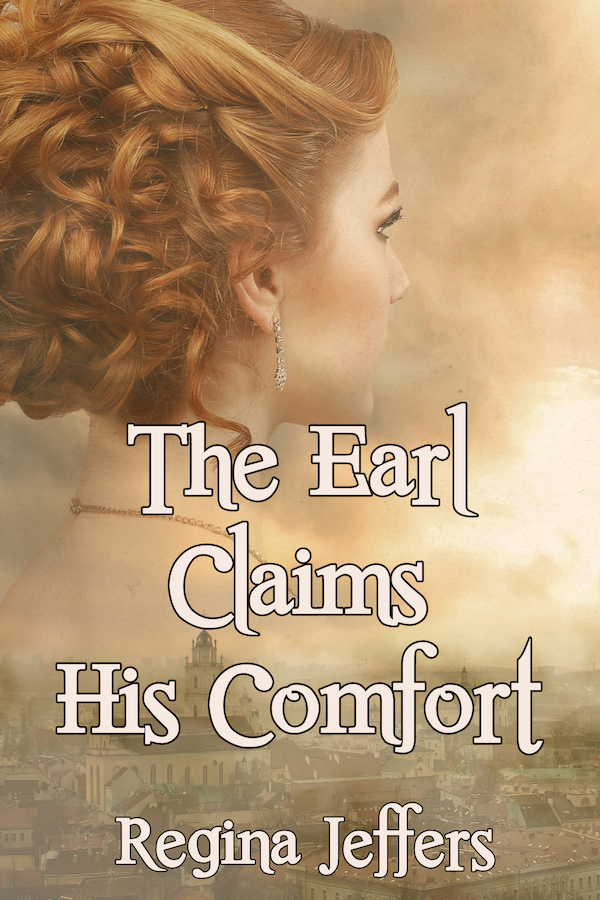
Christmas Romance Month with “His Irish Eve”

I began this story in response to readers’ requests to know more of Adam Lawrence, Viscount Stafford, the heir to the Earl of Greenwall and the hero of this novel. Stafford is a like-able rake about Town: Women flock to his masculine charms, and men know envy in his presence.

Adam Lawrence has made an appearance in many of my story lines. He is the character who ties several of my stories together for he is the constant. For example, Viscount Stafford meets Brantley Fowler and Velvet Aldridge at the infamous Vauxhall Gardens in A Touch of Velvet. In A Touch of Grace, Gabriel Crowden, the Marquis of Godown, despises Stafford’s rakish ways, and although Godown knows Lady Anthony as one of his conquests, the marquis objects to the woman also keeping company with Stafford. They often vie for the attentions of the same women in London, and it smarts for Godown to lose to Stafford. In A Touch of Mercy, Adam Lawrence assists Aidan Kimbolt, Viscount Lexford, rescue Miss Mercy Nelson, and he provides Baron John Swenton some much needed advice in A Touch of Honor, regarding Swenton’s war with priority and his desire to claim the woman he loves. Stafford also makes an appearance in His American Heartsong, the companion novel to the Realm series. He visits a house party hosted by Lawrence Lowery, Sir Carter’s older brother. In the book, he assists in disguising Lowery’s indiscretion that would destroy the reputation of Arabella Tilney, a respectable, but a bit hoydenish American, who serves as the heroine of the tale. 

In each of these “walk through” roles, my readers’ interest in Adam Lawrence piqued. Therefore, the viscount became a major character in my Austenesque novel, The Phantom of Pemberley. A cozy mystery set as a sequel to Jane Austen’s Pride and Prejudice, Phantom brings Adam Lawrence and his mistress Cathleen Donnel to the steps of Pemberley.

When a blizzard blankets Derbyshire, Fitzwilliam Darcy reluctantly provides the couple shelter. Lawrence’s presence proves an asset in the Darcys in solving a most unusual mystery. At the end of the novel, Viscount Stafford generously releases Cathleen from his protection. Cathleen travels alone to Cheshire to support her family following the passing of her uncle. Yet, the connection between Adam Lawrence and Cathleen Donnel is not complete. Phantom takes place in 1813, while His Irish Eve is set against the radicalism of 1819. For six years, the life-changing events at Pemberley have haunted Adam Lawrence’s steps. Loneliness dogs Stafford while the viscount searches for the one thing in his life, which will fill him with contentment. Little does Adam Lawrence know what Fate has in store for him.

Blurb: 

When the Earl of Greenwall demands his only son, Viscount Stafford, retrieve the viscount’s by-blow, everything in ADAM LAWRENCE’s life changes. Six years prior, Lawrence had released his former mistress Cathleen Donnell from his protection, only to learn in hindsight that Cathleen was with child. Stafford arrives in Cheshire to discover not only a son, but also two daughters, along with a strong-minded woman, who fascinates him from the moment of their first encounter.

AOIFE KENNICE, the children’s cousin and caregiver, appears impervious to Stafford’s masculine charms, as one of England’s most infamous rakes. In truth, Aoife is not as immune as she pretends, but she cannot imagine herself as the object of more than a flirtation on the part of the viscount, and Aoife cannot lose her pride, as well as her heart. On balance, they are world’s apart: Aoife is daughter of a minor Irish baron and the opposite of her beautiful cousin Cathleen, who possessed all the skills to lure in a handsome viscount. To make matters worst, Aoife maintains the family’s sheep farm to support Stafford’s family. A “lady,” Aoife is not.

Set against the backdrop of the radicalism of the Industrial Revolution and the devastation of the Peterloo Massacre, a battle begins: A fight Adam must win–a fight for the heart of a woman worth knowing, his Irish “Eve.”

Excerpt: 

Chapter 1
“Respect was invented to cover the empty place where love should be.”
– Leo Tolstoy

Late May 1819–Cheshire

“Bloody hell!”

Adam Lawrence cursed as his horse bucked again, each ripple of thunder sending the skittish stallion turning in circles. The skies opened unexpectedly in mid-morning, and Lawrence traveled in the rain for nearly an hour. He rode into the storm, the weather following along the God-forsaken emptiness of Cheshire. He knew little of the area except of the Cheshire cheese he often consumed at some of London’s best parties and of the Trent and Mersey Canal, which connected rural Cheshire to the industrial Midlands. Now, as he passed what appeared to be abandoned farmlands, Lawrence took pleasure in noting the aristocracy’s end, at least, the aristocracy his father preached.

In fact, it was his father who sent him out in this torrential downpour. When the Earl of Greenwall summoned his son to Leicestershire, Adam thought he would receive the usual lecture on financial responsibility. Instead, Robert Lawrence delivered a different edict.

“You will bring the boy to me.” The earl narrowed his gaze to rest censoriously on Adam.

Adam stiffened with the unspoken threat. His father’s tone was hardly encouraging.

“Plan to replace me, Father?”

In matters of his father, Adam always expected the worst. Cynicism cloaked Adam’s shoulders so long that no trust remained in his repertoire.
Greenwall’s expression signaled his father’s frustration with their renewed confrontational state.

“You leave me no choice.”

Adam heard what sounded of a hint of regret in his father’s tone. It bothered Adam that his lifestyle brought disdain to Greenwall, but Adam would never admit as such.

“You disregarded your obligation to the title, Adam,” His father spoke with cold indifference. “What am I to do? Turn everything over to your cousin? Atticus Duncan will ruin Greenwall with his taste for extravagance.”

“Worst than mine, Your Lordship?” Adam challenged.

Ignoring his finely tailored clothes, he flopped in a chair.

The earl ignored Adam’s provocations. He shuffled through a stack of papers.
“I will not give credence to a debate on your and Atticus’s reputations.” His father extended a letter for Adam’s perusal. “This is from your own man of business. Mr. Jennings corresponded with the young lady who demands the money from you.”

Adam studied the page. His first thought was the letter wreaked of blackmail.
“How are we to prove this woman even knows Cathleen Donnel? My God! I have not seen or heard from Cathleen for over six years–not since I put her on a public coach to Cheshire. I released my mistress to her family. Even gave her a generous settlement.” Adam’s eyes searched Jennings’s letter for details. “Where in bloody hell is Mobberley?”

“It is south of Manchester, some fifteen miles,” his father supplied.

Adam asked the question he avoided from the beginning.

“What will you do with the boy? How do we explain the sudden appearance of my son? Of your grandson? A child of whom we held no knowledge? A by-blow cannot inherit an entailment, Father.”

“It will be my concern.” The earl closed the conversation. “All you must do is confirm that the boy is yours and then bring the child to Greene Hall. I will see to the arrangements.” With that, his father stood, picked up his gloves, and prepared to take his leave. “A bank draft is available for the woman–repay her for her kindness toward the child.”

“Pay the lady for her silence, you mean,” Adam snarled.

Greenwall’s brow rose in contention.

“Believe what you wish, Adam. All I ask of you in the matter is to provide the child safe passage. Then you may return to whatever entertainment is your latest avocation.”

It was typical of his father’s orders: They spoke of disappointment. No matter what Adam did, he never pleased the earl. Somewhere along the way, Adam quit trying. It spoke profusely of their relationship that his father would welcome an illegitimate child into his home in hopes of salvaging the title.
“As you wish, Sir.” Adam leisurely stood. “Incidentally, I may require an advance on my next quarter’s allowance.”

The earl’s eyes narrowed in disapproval.

“Bring the boy, Adam, and we will discuss it.”

Deep in thoughts of Greenwall’s purpose in this madness, Adam did not react fast enough to prevent the disaster about to beset him. From the mud, an apparition rose to appear before his rain-blinded eyes It eerily spread its wings, opening first one appendage and then another before sending Adam’s mount pawing the air to fight off the attack. Before Adam could react to the manifestation’s appearance, he found himself sliding rear first from the saddle to land unceremoniously in a river of brown ooze. Somewhere in the recesses of his mind, he heard a shriek of surprise, but Adam could not tell whether it came from him or from the dark specter.

* * *

A sudden summer thunderstorm caught everyone in the village unawares, but now only Aoife Kennice fought Mother Nature. She hurried along the muddy road from Mobberley to the small cottage she shared with her late cousin’s three children. The cousin passed from pneumonia two years prior, and since that time, Aoife cared for the children, who were all born on the wrong side of the blanket. That fact might mean something to London aristocrats, but to Aoife the babes were simply the mac and iníons of her col ceathrar–the son and daughters of her cousin.

Although Aoife’s family departed Ireland when she was seven, Aoife often thought and spoke her parents’ native language: Another characteristic, which Aoife shared with her cousin Cathleen. Dear Cathleen, who left home at twenty to join a light opera company. Years later, when Cathleen Donnel passed, Aoife discovered her beloved cousin had, in reality, lost her way and became the mistress of one rich aristocrat after another. When Cathleen returned home briefly following the passing of Aoife’s father, Cathleen brought a tale of a marriage and a husband in the British military. It was only after Cathleen’s untimely demise that Aoife learned the truth. Cathleen’s illness and her trust in the wrong people left nothing for the care of the children, nothing but a few personal belongings; and when no one else stepped forward to care for them, Aoife did not hesitate when the call for assistance went out. She sent for Daniel, Aileen, and Elaine right away.

Today, Aoife made the trek to Mobberley in hopes that the solicitor she contacted in London finally sent word. She desperately needed to locate the children’s father. Realizing the small nest egg her parents left her nearly gone, Aoife abandoned her pride and made a plea for financial assistance. Three growing children could go through clothes and food at an astounding rate. When Aoife contacted the solicitor, Louis Jennings, a man whose name she found in her cousin’s papers, Aoife prayed for a monthly stipend from Cathleen’s former protector, anything to make their lives easier.

In addition to seeking word from Mr. Jennings, among her other errands on this particular day, Aoife dutifully mailed a teaching application to a girls’ school near Newcastle, where her brother was a village vicar.

Now, as the mud practically sucked her worn half boots from her feet, she rued her decision to walk to the village. Not a stitch of her clothing remained dry, and her serviceable bonnet drooped on all sides, permitting a steady stream of water to run down Aoife’s back and between her breasts. A deep rumble of thunder did not threaten her any more than the rain, but knowing Elaine’s fear of storms, Aoife quickened her efforts to reach the cottage.

The water stood on the road, the ditches lining the hardened pathway overflowing. Light-brown ooze filled every nook and crevice as Aoife trudged toward the cottage. As miserable as she every remembered being, she made herself say her daily prayers of thanksgiving, hoping praise would replace the curses fighting to escape. When her foot sank several inches into yet another mud hole, Aoife did not anticipate being slammed face first into the mud and the gook.

Spitting muck and wiping sludge from her eyes, Aoife did not see the stranger before she staggered to her feet, but by then it was too late. All Aoife could do was shield her face with her arms as the animal clawed the air about her head. Impending doom circled about her head. Without thinking, she screamed at the top of her lungs.

Frozen in place, waiting for the worse to happen, Aoife’s mind, initially, did not register the sound of the man hitting the ground. A guttural grunt announced the impact, which knocked the air from his lungs. The curse followed, as his ankle popped, when his weight came down on it at an odd angle.

* * *

Adam struggled momentarily for a coherent thought and a complete breath before realizing the muddy ghost was actually a woman wrapped in a dark cloak.

“Bloody Bedlam,” he yelled over the pounding rain. “Do you plan to stand there like a damn statue or will you offer me your assistance?”

As Adam sprawled on the ground, the woman lowered her arms and stared at him. He grappled with bringing himself upright. Two heartbeats later, she was by his side.

“I beg your pardon, Sir.” She reached for him, realizing too late that mud covered her hands. “What may I do to assist you?”

With the storm swirling around them, the woman spoke close to Adam’s ear, and he recognized the satiny tone of her words. It made him think of silken scarves and luscious fruit spread out before him. Unfortunately, the steady drip of the water from his hat sliding down the back of his shirt carried a taste of reality Adam had no wish to claim.

Adam emitted several expletives regarding the stupidity of the locals before he shouted, “Can you bring my horse around?”

Without hesitation, the stranger nodded her agreement, but Adam watched in doubt as the girl looked up, her bonnet flopping in unladylike pursuits. Muddy trails streamed down her face and seeped slowly into her day dress’s high neckline. When she finally spotted the animal at a short distance, to his amusement, she hiked the swirls of her wet skirt around the upper part of her legs and sloshed off after it.

When the woman stepped over Adam’s outstretched leg, he took a closer look at her. Adam assumed her a farmer’s wife, but after the delectable view of her mud-spattered legs, he certainly hoped the woman belonged to no one. The legs were thin, but muscular, and although he lay on his backside in filthy mud, Adam envisioned those legs wrapped around his body. His gaze rose higher to her small waist and the soft curve of her hips as the rain plastered the woman’s clothes to her lithe form. Even though he was soaked and cold, blood rushed to Adam’s groin, and a smile turned up his mouth’s corners.
The natural lilt of the girl’s voice brought his attention to her efforts.

“Easy now,” she coaxed as she slowed her progress, moving closer to the animal. “Come on, my pretty. Is minic a rinne bromach gioblach capall cumasach,” she murmured, as she reached for the reins before patting his horse’s neck. “You are magnificent,” the girl whispered close to the stallion’s ear, and Adam prayed she might say the same thing of him.

The calming effect the woman had on the skittish animal did not escape Adam’s notice. Taking a hold on the harness, she turned the stallion and led it back to where he sat in the murky mess. Although it still came steadily, the intensity of the rain slackened, but both the woman and Adam moved as if it did not exist. Completely soaked and mud-spattered, they had no reason to protect themselves from the elements.

Without instructions, the girl brought the horse along side where Adam sat. He breathed a harsh sigh as he lifted his weight to his knees.

“Hold him still,” Adam demanded before employing the horse and saddle to pull himself to one leg, avoiding putting his weight on the swelled ankle. Using his upper body to right his stance, Adam managed to first stand and then to place his injured foot into the stirrup. Using the saddle’s horn, he lifted upward. Gritting his teeth, Adam placed his weight on the injured foot as he swung the other leg over the horse’s back and settled into the seat. Releasing a steadying breath, he ordered, “Come.” Adam extended his hand to the woman. “I will take you up with me.”

* * *

The rain having washed away much of the dirt that once covered her eyes, Aoife now fully saw the man. His wide shoulders tapered to a flat stomach–a muscular back supporting his frame and strong arms and thighs, which bunched as the stranger lifted his weight into the saddle, and for a moment she wondered how it would be to know such a man, a man of strength. Deep in thought of masculine arms, it took several heartbeats before the stranger’s words penetrated Aoife’s conscious mind. When she looked up to see his outstretched hand, she backed from him.

“I cannot, Sir,” she pleaded for his understanding. “We know not each other. Moreove, I am covered in mud. It would ruin your fine clothes.”

The absurdity of her contention amused him, and the gentleman offered his best seductive smile.

“I am Adam Lawrence. If you provide me your name, we will know each other, and as far as my clothes, my valet will wish to burn these when he sees them.”

Aoife found herself staring into steel gray eyes, mesmerizing orbs beneath dark brows. As handsome as the devil, she thought. Just looking at him sent her heart pounding uncontrollably in her chest.

“You are…you are Viscount Stafford?” she stammered.

A crooked smile indicated the man’s appreciation, but he retracted his outstretched hand. He chuckled as he stared down at her.

“I realize I hold somewhat of a reputation, but I did not think my fame spread to Cheshire.” He leaned down, crossing his arms over the saddle horn. “However, I will learn more of this vicious gossip later; for now, I wish to be from the rain, and I wish to tend my ankle. However, as a peer and a gentleman, I cannot leave you to tramp through this prank of nature.”

The man gestured to the stream of mud flowing down the road’s center.

“You will come with me, my unknown lady of the sludge; my gentleman’s consequence requires I see you safely to your residence.” Again, Lord Stafford pointedly offered Aoife his hand.

“I thought you said your reputation already poor, Sir?” she challenged. “I would not wish to contribute to your societal renown.”

Aoife watched as his eyes narrowed in disapproval.

“Miss Sludge, you will ride with me of your own free will, or I will take you up without your permission,” the viscount snapped.

Aoife’s chin rose in defiance.

“A threat lacks a choice, Sir.”

Noticeably frustrated with the dampness seeping into his bones and with the logic Aoife threw back at him, the viscount edged the horse forward and caught her upper arm. With a gargantuan effort, he lifted her first beside the horse where he took a better hold, and then Lord Stafford jerked Aoife to his lap, sitting Aoife decidedly before him before touching the horse’s flanks with his heels.

“That is better.” The man caught her around the waist and sat her upon his right thigh. “Now tell me your name, Miss Sludge, or would you prefer my endearments.” Lord Stafford whispered close to Aoife’s ear, permitting his lips to brush across her lobe.

Aoife sputtered from the viscount’s forwardness, but she managed to sit tall, very prim and proper before answering, “Aoife Kennice,” she said waspishly.

Apparently amused by his own consequence, the future earl only half listened. “Pardon me,” he said huskily. With his forefinger, he turned her chin in his direction.

“Did the mud affect your hearing, my lord?” Aoife answered with a smirk. “My name is spelled A-O-I-F-E. It is Irish for ‘Eve’ or for ‘Life.’ It is pronounced ‘Ee-Fa.’ My surname is Kennice, which means ‘Beautiful.’”

The viscount’s smile broke his mouth’s line, and Aoife thought if he smiled at every woman as such he must possess a sheik’s harem.

“Beautiful life. I like that much better than Miss Sludge.” Lord Stafford pulled her closer, where her left shoulder lined his chest’s muscular wall and her hips rested above his manhood. “I am Adam, and you may be my Irish Eve.”

Purchase Links 

Read for Free on Kindle Unlimited   https://www.amazon.com/kindle-dbs/hz/subscribe/ku?passThroughAsin=B00XJM6GAE&_encoding=UTF8&shoppingPortalEnabled=true

Amazon    http://www.amazon.com/His-Irish-Eve-Regina-Jeffers/dp/1512169773/ref=sr_1_1?ie=UTF8&qid=1441298229&sr=8-1&keywords=his+irish+eve

Kindle   http://www.amazon.com/His-Irish-Eve-Regina-Jeffers-ebook/dp/B00XJM6GAE/ref=tmm_kin_swatch_0?_encoding=UTF8&qid=1441298229&sr=8-1

Posted in book excerpts, British history, eBooks, Georgian England, Georgian Era, Great Britain, historical fiction, Living in the Regency, publishing, Regency era, Regency romance, romance, writing | Tagged , , , , , , | 28 Comments

Christmas Romance Month with “Last Woman Standing”

Last Woman Standing first made its appearance in October 2019 as part of the Christmas anthology, A Regency Christmas Proposal. It is now a stand alone short romance available on Kindle and Kindle Unlimited. 

Kindle eBook: https://www.amazon.com/Last-Woman-Standing-Regency-Christmas-ebook/dp/B089DNBJS6/ref=sr_1_6?dchild=1&keywords=last+woman+standing&qid=1591300412&sr=8-6

Read for FREE on Kindle Unlimited: https://www.amazon.com/kindle-dbs/hz/subscribe/ku?passThroughAsin=B089DNBJS6&_encoding=UTF8&shoppingPortalEnabled=true

JACKSON SHAW, the Marquess of Rivens, never considered the “gypsy blessing” presented to his family during the time of Henry VIII truly a blessing. He viewed it more as a curse. According to the “blessing,” in his thirtieth year, at the Christmas ball hosted by his family, he was to choose a wife among the women attending. The catch was he possessed no choice in the matter. His wife was to be the one who proved herself to be his perfect match, according to the gypsy’s provisions: a woman who would bring prosperity to his land by her love of nature and her generous heart. In his opinion, none of the women vying for his hand appeared to care for anything but themselves.

EVELYN HAWTHORNE comes to River’s End to serve as the companion to the Marchioness of Rivens, his lordship’s grandmother. However, Lady Rivens has more than companionship in mind when she employs the girl, whose late father was a renown horticulturalist. The marchioness means to gather Gerald Hawthorne’s rare specimens to prevent those with less scrupulous ideas from purchasing Hawthorne’s conservatory, and, thereby, stealing away what little choice her grandson has in naming a wife, for all the potential brides must present the Rivenses with a rare flower to demonstrate the lady’s love of nature. Little does the marchioness know Hawthorne’s daughter might not only know something of nature, but be the person to fulfill the gypsy’s blessing.

Excerpt from “Last Woman Standing” 

Prologue

Battle of Guinegate

16 August 1513

“What shall it be, my Lord Rivens?” His Majesty King Henry VIII asked. “My gift of an earldom or the blessing offered by this gypsy hag?”

Hollister Rivens knew he should claim the earldom and forget the promises of the gypsy witch, but he had witnessed firsthand the apparent power the gypsy held, for it had been the Roma who had instructed the English to build five bridges overnight over the river Lys, thus allowing the English army free passage to the other side. With the bridges in place, Henry had moved his camp to Guinegate on 14 August, displacing a company of French horsemen who guarded the Tower of Guinegate, which led to the English victory at Guinegate. “May I not claim both, my King?” Rivens bravely asked.

Thankfully, Henry found the humor in Hollister’s bravado. “You are an odd one, Rivens, but I am thankful you have served me well today.” Hollister had been part of the Earl of Essex’s forces when Essex ordered the English men-at-arms and the heavy cavalry to charge. They had caught the French just as French army thought to execute a retreat, sending them into disorder. Hollister’s men had held the town of Thérouanne by driving off the French with cannon fire. “You will be from this day forward known as the Earl of Rivens, and you may choose to listen to the gypsy’s tale of woe.”

“Of blessing, my king,” Rivens said. “The gypsy promised me a blessing.”

“A blessing, then, it is, Rivens. Go hear what the hag has to offer you.”

Hollister quickly made his bows and crossed to the small hut where the gypsy had been given refuge. She bade him enter at his knock.

“I see a new man before me,” she said cryptically.

“I have been presented a new title by the King,” he explained.

“More land?” she asked in a mix of heavily-accented English and French.

“I did not ask. I am satisfied with the lands I hold,” he explained, “but a barony does not hold the same power as an earldom.”

“A man of reason,” she said. “Most men want both.”

“I chose both,” Hollister explained. “I chose the earldom and your blessing.”

She smiled then, and Hollister knew she understood his reason for coming. “You wish to know your fate.”

“I wish to know my fate and that of my descendants,” he corrected.

“An ambitious man, but one looking forward, not to the rear.”

“You can tell me this?”

“I can tell you what I see,” she cautioned. “I cannot tell you what to do with the message.”

“How do we go about this? Cards? Gold coins?” he asked in excitement.

“Just stand and close your eyes. I shall circle about you and tell you what I see.”

Feeling a bit foolish, Hollister closed his eyes tightly and stood in place. He could hear her steps drawing closer. She hummed an enchanting tune, one he had not heard previously. Finally, she began to speak. “Another step will be taken when the time comes, but it shall not be yours to take, but, rather, the steps of the relations of your great-greatson.”

“Then I will have an heir?” He asked opening his eyes.

She did not answer. Instead, she kept circling him and humming that delightful tune until he closed his eyes again. At length, she spoke again. “To know the blessings of love and prosperity, choose among those who nourish the earth to scent the air—find one who manipulates the light to comfort the planted seed and who blesses the sweet, soft rain that washes clean a troubled spirit, turning it into the blue of heaven.

“Blessings also come from those minding the cattle and the sheep and all the creatures of the earth. Blessings fall upon the roof and the chimney tall and the hearth blazing within. Blessings come from the one who is kind to both friend and foe, who opens wide the door to strangers and kin.

“Lying beside such a person brings a man dreams, possibilities, and promises at dawn and shelter to calm his soul at night. Love guides a person when his steps stray from the path.”

He heard her walk away from where he stood. Slowly opening his eyes, Hollister asked, “What does all that mean? Is Lady Rosalind my future or not?”

The gypsy smiled in amusement. “The only way to know for certain is to ask Lady Rosalind to bring you a flower.”

WILL THE GYPSY’S WORDS PROVE TO BE A BLESSING OR A CURSE FOR THOSE CALLED “LORD RIVENS”?

Posted in book excerpts, British history, Dreamstone Publishing, Georgian England, Georgian Era, giveaway, historical fiction, history, holidays, Living in the Regency, medieval, reading habits, Regency era, Regency romance, research, royalty, titles of aristocracy, war, writing | Tagged , , , , , , , , , , , , , , | 11 Comments

Christmas Romance Month with “Lady Joy and the Earl”

Today, I celebrate one of my favorite Christmas tales,”Lady Joy and the Earl.” It does not have the typical hero and heroine found in historical romances, for James Highcliffe, Earl of Hough, and Lady Jocelyn (Powell) Lathrop are middle aged. James and Jocelyn have known each other all their lives, for his family estate and hers march along together on one side. She was the pesky younger sister when James and her brother Emerson roamed the countryside as youths. However, by the time James was nineteen and Jocelyn, or “Joy” as her family calls her, was sixteen, they were in love. Unfortunately, when his father learned of the situation, Robert Highcliffe informed James he was betrothed to Lady Louisa Connick from the time of her birth. Joycelyn’s father then bargains her away to Lord Harrison Lathrop to pay his gaming debts. Lathrop, a viscount, wanted her substantial dowry and the connection to Lord Powell’s marquessate, but he never cared for her as a person. 

When the story opens, James’s wife, Louisa, has been dead for some eighteen months, and Lathrop for a decade. Both James and Jocelyn have grown children and a boat load of misery to bring to the table. The question is whether their being forced to join their families together at his estate and the spirit of Christmas can finally place them where they always belonged: AS HUSBAND AND WIFE.

The story is set near Aberford, Yorkshire, in December 1815, some six months after the Battle of Waterloo. I chose Aberford because it was about halfway between London and Edinburgh on the Great North Road, and it was situated close to the town of Leeds. In the story, the hero, James Highcliffe, is attempting to demonstrate to Lady Jocelyn how they share many memories. He asks her to assist him in giving his family a real Christmas celebration, for his household has been in mourning for several years. They consider the “wassail bob,” “vessel maids,” and “Cristes Maesse.” 

The service, known as “Christ’s Mass,” eventually became a description for celebrations of Jesus’ birth throughout the world. The word Christmas has its origin from the old English term Cristes Maesse, meaning “Christ’s Mass.” (Celebrating Holidays)

Traditional Customs and Ceremonies tells us, “The demise of this custom shows how easily common traditions can be lost. So popular was the custom that it had a place in the 11th edition of Encyclopedia Britannica:

“What is popularly known as wassailing was the custom of trimming with ribbons and sprigs of rosemary a bowl which was carried round the streets by young girls singing carols at Christmas and the New Year. This ancient custom still survives here and there, especially in Yorkshire, where the bowl is known as `the vessel cup,’ and is made of holly and evergreens, inside which are placed one or two dolls trimmed with ribbons. The cup is borne on a stick by children who go from house to house singing Christmas carols.”

“In the 1800s up to around 1920s, local children around the midlands and northern England, County Durham, Lancashire, and particularly Yorkshire, would enact a curious custom like a mix between carol singing and May Dolls. The custom had many names, often localised Wesley Bob, a Wassail Bob, a Vessel Cup, a Pretty Box or a Milly Box. When the custom was done varied. Visitation days recorded in accounts in Yorkshire emphasize this variation, for example, in Thorpe Hesley it began at Christmas Eve and went on for two to three days. Whereas, Hoyland Common practiced it only on Christmas day morning. In West Melton and Hemingfield, it was Boxing Day, and in Rawmarsh, it was New Year’s Day. Generally though the tradition would begin at Advent or more often St. Thomas’s Day, although in some areas it was November, suggesting there is nothing new in the early celebration of Christmas!

51KCcr2ODoL._SX331_BO1,204,203,200_.jpg 

“How the custom was organized differed from place to place. Sometimes it was a private form of begging and at others organized by the church. The basic approach was as follows: two girls would be the ‘vessel maids’ and they carried a box, decorated with evergreens and often fruit and spices, covered in a white cloth. At the people’s homes, the girls would sing a carol and solicit the homeowner for some money, usually a penny, to reveal what was under the sheet. This was a scene of the Holy Family.

Clement Miles in his Christmas in Ritual and Tradition notes that:

“At Gilmorton, Leicestershire, a friend of the present writer remembers that the children used to carry round what they called a “Christmas Vase,” an open box without lid in which lay three dolls side by side, with oranges and sprigs of evergreen. Some people regarded these as images of the Virgin the Christ Child and Joseph.”

MDP eBook Cover

“Lady Joy and the Earl: A Regency Christmas Novella”

They have loved each other since childhood, but life has not been kind to either of them. James Highcliffe’s arranged marriage had been everything but loving, and Lady Joy’s late husband believed a woman’s spirit was meant to be broken. Therefore, convincing Lady Jocelyn Lathrop to abandon her freedom and consider marriage to him after twenty plus years apart may be more than the Earl of Hough can manage. Only the spirit of Christmas can bring these two together when secrets mean to keep them apart.

The story is available on Kindle and Kindle Unlimited. 

Kindle   https://www.amazon.com/dp/B07HNMR9LY

Read for Free on Kindle Unlimited https://www.amazon.com/kindle-dbs/hz/subscribe/ku?passThroughAsin=B07HNMR9LY&_encoding=UTF8&shoppingPortalEnabled=true

This is how the use of these traditions play out in the story: 

He had spotted her in the upper gardens on his return to Hough House, and at that moment, James was thankful young Lathrop had insisted on examining the new mill James and Lord Powell had built together across the river separating their lands. Mr. Locke, James’s steward, had agreed to provide the Lathrop brothers a tour after the young lord began asking questions on the operation.

Dismounting, James left Sultan to munch the grass along the hedgerow and entered the garden off the nature trail to cross to where she studied one of the fountains.

“Good day, Joy,” he called as he came near.

“Oh, Lord Hough.” She jumped as if he had frightened her.

“Woolgathering, my dear?” he said with a smile.

“Simply considering something Lady Hough and your aunt mentioned earlier.”

“And what might that be?” An odd shot of desire crawled up James’s spine. Every time he looked upon Jocelyn, a primal demand overcame his good sense, and it was all he could do not to catch her up in his embrace and kiss her senseless.

“They spoke of your wife’s illness and of her slow death,” she confessed.

James frowned. “They should not have bothered you with the particulars of Louisa’s decline.”

As was typical for Jocelyn, she ignored his warning tones. Instead, she said, “I was astonished to learn of Lady Louisa’s propensity to—”

“To what?” he demanded.

Jocelyn hesitated, her gaze landing hard upon his countenance. “I have spoken from form. Your relationship with the late Lady Hough is none of my concern.”

James swallowed the retort rushing to his lips. If he expected to learn what occurred in her marriage, he must be more forthright in discussing his. He made himself respond in even tones. “I have nothing to hide. Louisa and I never fit. Despite what some may tell you, at least, in the beginning, I came to like her; she is the mother of my children, and for that fact, I owe her my kind regard. That being said, my wife and I held little in common. We were of the nature of distant cousins, each holding on to a relationship forced upon us and attempting to make the best of what we had been handed. I said earlier ‘in the beginning’ when I spoke of my caring for my countess. As time passed, we drifted further apart. Our attempts to make the best of our situation vanished. We differed on every point. If Meredith fell in the mud and soiled her dress, I would find my daughter’s actions amusing, praising her for her strong imagination and willingness to fight the dragon as fiercely as did her brother, whereas Louisa would look on the incident and my reaction with abhorrence.”

“Lathrop would have also found Lady Meredith’s actions repugnant,” she disclosed. “Poor Michael knew his father’s strap more than one time for returning home with muddy boots.”

James attempted to disguise his interest in Lathrop’s high-handedness. “Then Michael favors you in more than just his features,” he said cautiously, watching for Jocelyn’s reaction. “I recall your crossing muddy fields, chasing after Emerson or simply enjoying the day, your skirt tail three inches deep in mud.”

She laughed lightly. “My poor maid. Always scrubbing my petticoats. And, yes, Michael favors my temperament.” She looked past his shoulder as if expecting to see someone behind him. “Where are my sons?”

“I pointed out the new mill your brother and I had built at the mouth of the river. Mr. Locke rode out with us this morning, and he agreed to provide Andrew and Michael a tour of the facility. I believe young Lathrop hopes to borrow some of his uncle’s ideas for the Kent estate.”

She sighed heavily. “I am pleased Andrew seeks both your and Emerson’s advice, but I wish he would occasionally place his responsibilities for his title aside and simply enjoy a few days of family. Both of my sons, but Andrew, in particular, have difficulty separating Harrison’s exacting ways from those of the rest of the world.”

James wished to know more, but he had learned not to push Jocelyn for answers. She related more details each time they spoke, and he must practice patience. Instead, he used the opportunity to put forward his plan to bring her family and his together. “Then perhaps we can join forces to indulge our families, for I have promised Sebastian and Meredith a proper Christmastide celebration. Louisa’s long illness and eventual demise kept my household dark for four years. My children requested we celebrate in the manner of their youth, and I mean to see it done. Sebastian has recently met his majority, and Meredith is already asking for a Season. Soon they will claim their own families. I would have them carry happy memories of Hough House with them when they are elsewhere, not the ones of their mother wishing her life away. Please say you will seriously consider being a part of my plan. Surely you wish the same for Andrew and Michael.”

She eyed him suspiciously. “What did you have in mind?”

“The typical things: holly and mistletoe and a yule log, plus Yorkshire pudding and a turkey, as well as the annual hunt. All the things we had growing up here.” He spread his arms wide. “Anything we care to imagine. Tell me, Joy, what are some of your favorite memories of Christmastide at Powell Manor?”

She sighed dreamily. “Spiced cider and charades and visiting neighbors and children singing carols and a proper Yorkshire Christmas pie and the Wassail bob and ‘Cristes Maesse.’ Oh, I am certain some of these are no longer practiced; after all, I have been gone away for two decades, but you understand, do you not?”

James laughed conspiratorially. “I doubt if the new vicar would approve of vessel maids calling upon households and asking each party to pay a penny to view her unwrapping one of the cloth-covered figures of the nativity. Although I do understand the tradition is still accepted over near Haworth, the good people of Leeds and the surrounding area long ago abandoned the practice, despite the good fortune it is said to bring to the households which participate.”

“But you hold no objections to the others?” she insisted.

James’s expression softened when he looked upon her. “My dearest Jocelyn, if you wished for Lathrop and Michael to view the Wassail bob, I would hire a whole troop of vessel maids to entertain them.” He wagged his eyebrows at her. “Nothing is too lavish for such honored guests.”

Her frown lines deepened. “Do not be foolish, James. What kind of mother parades vessel maids before her sons?”

“None that I know personally,” he teased. “Although, I did hear of a most outrageous mother when I was still at university. The chaps spoke of her often. Some opera dancer who married a baron. DeLong, I believe the name was.”

“You are outrageous, my lord.” She laughed prettily. It was a sound James had longed to hear since they had become reacquainted. Her laughter was a sound that reminded him of all the things he missed about her.

“Then you promise to aid me in my quest?” he implored.

“You truly wish my assistance?” she inquired.

“Naturally, my mother will volunteer, but, I fear, even with Aunt Mary’s assistance, Lady Hough cannot handle all the preparations. She contracted consumption some four years removed. Although she thankfully recovered, my mother still tires easily.”

“Why do we not each create a list of favorites and then compare them? Certainly, the young people will also have favorites. We should not ignore their suggestions.”

James caught her hand and placed it on his arm. “It is chilly, and I believe my mother will have ordered tea by now. Let us go in and consult with Lady Hough. She will be thrilled with your involvement. And, of course, your mother will arrive later today. We will make a jolly group, will we not?”

Posted in book excerpts, book release, British history, customs and tradiitons, excerpt, family, Georgian England, Georgian Era, giveaway, historical fiction, holidays, Living in the Regency, marriage customs, publishing, reading, reading habits, Regency era, Regency romance, writing | Tagged , , , , , , , , , , , , , | 4 Comments

Christmas Romance Month with “Pemberley’s Christmas Governess: A Pride and Prejudice Vagary”

My newest JAFF book, Pemberley’s Christmas Governess, released onNovember 29, it is currently on sale for $0.99. Grab yours before the price goes up! The past couple of months have been hectic for me, and I have been planning ahead — doing my blogs in advance, etc., (actually writing this one on September), but mostly I have been cleaning out closets, shelves, etc., for I am closing on a new house sometime during the last two weeks of December. I am moving into a single story ranch style home after spending the last 18 years in this two-story home and the previous 22 in a bi-level. NO MORE STAIRS to climb!!! The idea delights me greatly, as I recently turned 74 years young, but my knees think I am 74 years old. So, if you follow me on social media, and I disappear for days at a time, I am either packing or writing. I have a Regency book entitled “An Escape to Love” arriving in January 2022 and a Regency historical fiction entitled “Obsession” coming out in March 2022 (which is not exactly a romance, but I will explain more on that later), and I am some 18 chapters into a new JAFF title, tentatively called “Mr. Darcy’s Inadvertent Bride.” It, too, will release in 2022, in all probability in June.

But, for now, you likely, are just wondering something about Pemberley’s Christmas Governess, which is my 28th JAFF title. Can you believe it? [You can find all my Austen-inspired titles HERE.) In this tale, Mr. Bennet has died while Elizabeth has been away visiting with Charlotte and Mr. Collins. Mrs. Bennet’s prediction of their all “being driven into the hedgerows” has come true faster than any of them could have considered. Mrs. Bennet blames Elizabeth for refusing Collins’s offer of marriage. Bingley has not taken Netherfield, so there is not Jane and Bingley. Elizabeth, therefore, has never met Fitzwilliam Darcy. To ease her family’s obligations, Elizabeth has taken a position as a governess, one she has held for 5 years, meaning she is nearly 25 and Darcy is approximately 33 years of age when they first meet.

Darcy has succumbed to the family’s wishes and married Anne de Bourgh, but Anne has died during child birth. He has mourned properly for his wife, a wife he had never truly loved, and he has decided as a means to moving back into society, he will host a house party for Christmastide. Lady Matlock is serving as his hostess. I should warn you Georgiana is not so sickening sweet in this tale as she was in Pride and Prejudice. After all, she is five years older, anxious to reach her majority and claim a husband. She has had to observe the mourning period for Mrs Anne Darcy and is glad to claim the society circumstances have previously kept from her. Miss Bingley is also getting a “little long in the tooth” and is more desperate than ever finally to claim Darcy to husband.

In the tale, Colonel Fitzwilliam has escorted Elizabeth to Pemberley in hopes either his mother or Darcy will provide her a good reference after she was accused of something terrible by one of his officers, which the colonel knew to be false. Obviously, when the colonel sends word he is bringing a young lady with him of whom he hopes both Darcy and Lady Matlock will approve, well . . . you can guess all the assumptions being made to twist the tale. Meanwhile, Elizabeth thinks she must prove herself “worthy,” and she assists in the nursery with Louisa Hurst’s two sons and Darcy’s daughter, Cassandra.

Pemberley’s Christmas Governess: A Holiday Pride and Prejudice Vagary

Two hearts. One kiss.

Following his wife’s death in childbirth, Fitzwilliam Darcy hopes to ease his way back into society by hosting a house party during Christmastide. He is thrilled when his cousin Colonel Fitzwilliam sends a message saying not only will he attend, but the colonel is bringing a young woman with him of whom he hopes both Darcy and the colonel’s mother, Lady Matlock, will approve. Unfortunately, upon first sight, Darcy falls for the woman: He suspects beneath Miss Elizabeth Bennet’s conservative veneer lies a soul which will match his in every way; yet, she is soon to be the colonel’s wife.

Elizabeth Bennet lost her position as a governess when Lady Newland accuses Elizabeth of leading her son on. It is Christmastide, and she has no place to go and little money to hold her over until after Twelfth Night; therefore, when Lieutenant Newland’s commanding officer offers her a place at his cousin’s household for the holy days, she accepts in hopes someone at the house party can provide her a lead on a new position. Having endured personal challenges which could easily have embittered a lesser woman, Elizabeth proves herself brave, intelligent, educated in the fine arts of society, and deeply honorable. Unfortunately, she is also vulnerable to the Master of Pemberley, who kindness renews her spirits and whose young daughter steals her heart. The problem is she must leave Pemberley after the holidays, and she does not know if a “memory” of Fitzwilliam Darcy will be enough to sustain her.

So, here is a “taste” of Pemberley’s Christmas Governess to whet your appetite for more of the tale. In this scene from Chapter Six, Darcy cannot seem to keep away from Elizabeth, even though he thinks she is promised to Fitzwilliam.

Finding no one about, Darcy had asked after his cousin only to learn Fitzwilliam was in the school room with Miss Bennet.

Darcy knew he frowned, but he could not quite quash the idea his cousin and the lady might be enjoying some privacy, while settling things between them. His heart sighed in continued disappointment, but he managed to say, “I will not interrupt them, for now. Where might I find the countess?”

Mr. Nathan also frowned, but, obviously, for a different reason. “I beg your pardon, sir. From what I understand, most of your houseguests are in the nursery. That is, all except Mr. and Mrs. Hurst and Miss Bingley.”

Darcy heard his butler’s unspoken criticism: All except those who should be there. “And what is so fascinating about Pemberley’s nursery?” Darcy asked with a lift of his eyebrows.

“I believe Miss Bennet, sir, convinced Colonel Fitzwilliam and Captain Stewart to reenact several of the battles to which they personally stood witness. Initially, Miss Darcy and the other young ladies accompanied the colonel, but I have learned from Mrs. Reynolds that Mr. Bingley and the other two gentlemen soon followed, as did Lady Matlock.”

Darcy’s lips twitched in amusement. Apparently, Mr. Nathan did not know whether to approve of this turn of events or not. “As I possess a legitimate excuse to call upon the nursery, I believe I will follow the others.”

“As is reasonable,” Mr. Nathan said as he bowed.

Darcy smiled. “If the party is interrupting Cassandra’s nap, I will be sending them down for tea. You might warn Cook.”

“Immediately, sir.”

With anticipation, Darcy quickly climbed the steps to the nursery. He paused briefly at the door to survey the room. The colonel and Captain Stewart were describing the evening of the Duchess of Richmond’s ball in Brussels. As if they had rehearsed it, the young gentlemen in the room claimed the hand of one of the ladies, including Mrs. Anderson, and began to waltz their partners about in small circles, for the room was too cramped to move about freely. Even Hursts’ sons danced around with Megs.

It was only then he realized the gentlemen ignored Miss Bennet’s presence in the room. The lady was framed by the window, and she was dancing, only Miss Bennet was dancing with his young daughter. Without considering his actions, Darcy slipped into the room and was standing before her when she turned around. A large smile, likely intended for his daughter or the exercise graced her lips, but he did not hesitate: Darcy placed both the woman and his child in a loose embrace and turned them in a slow circle. “Good afternoon, pumpkin,” he said as he bent his head to kiss the top of his daughter’s head, but his eyes never left Miss Bennet’s shocked gaze.

“Mr. Darcy,” she began in apology, attempting to step from his arms, but he tightened his hold just enough to dissuade her. As the rest of the room hummed the music, Darcy said softly, “I am dancing with my daughter and the most—”

However, at that moment, Colonel Fitzwilliam called out. “That is the moment when Wellington received the message of Bonaparte’s advance. We departed the ball, many of us still wearing our evening shoes and trousers. Partners were left upon the dance floor, some women receiving a brief kiss in parting.” Although Darcy had yet to move, he knew from the sound of giggles behind him, many women in the room received a chaste kiss on their foreheads or their hands.

Such was not what Darcy wished to kiss: Miss Bennet’s lips were so tempting, for the briefest of seconds, the rest of those within the room disappeared.

Then a laughing Mrs. Anderson appeared at his side to reach for Darcy’s daughter. “It’ll be impossible to convince Miss Cassandra to sleep now she has waltzed with her father. Even so, permit me to take her, Miss Bennet.”

Darcy reluctantly released his hold on Miss Bennet and his daughter. He scooped the child from Miss Bennet’s hold and lifted Cassandra into the air, teasing another giggle from his daughter’s lips before he deposited her into Mrs. Anderson’s waiting arms.

He knew Miss Bennet took several steps backward, retreating to the window, just as he turned to the rest of the room.

“Darcy!” his cousin called. “When did you join us?”

“Only a few moments ago,” he said with a well-placed smile. “I came to inform each of you I ordered tea to be delivered to the blue sitting room. However, I did not wish to disturb your tale or the effects of the duchess’s ball on everyone.” He glanced to Cassandra. “I stole a moment to dance with my daughter and enjoy her smile.”

Bingley said, “I thought Miss Bennet entertained Miss Cassandra.”

With difficulty, Darcy kept the scowl from his features, along with the desire to slap his friend across the back of Bingley’s head. He could not understand why none of the gentlemen in the room would think to partner Miss Bennet. If Mrs. Anderson and Megs deserved partners, why did not a gentleman’s daughter—a woman with impeccable manners and a delightful personality. Moreover, if Miss Bennet was Fitzwilliam’s betrothed, why was his cousin dancing with Georgiana? Obviously, the reason the colonel had agreed to this venture was to please Miss Bennet. “She did,” Darcy said with more calm than he felt. “I imposed on the lady to hold Cassandra while Miss Bennet and I took a few turns together. Cassandra did not appear to want to leave the good lady’s care, even to dance with her father.”

Georgiana lifted her chin in a gesture Darcy had never viewed her using previously and one of which he did not approve. It was very reminiscent of a gesture Miss Bingley often employed when criticizing others. “The tea will become cold; therefore, we should go below. I, for one, have had enough of the war for one day. Countess, might you lead?”

Darcy noted the countess’s dismay. “Will you join us, Darcy?”

“I will follow in a few minutes. I wish to spend a bit of time with Cassandra before she falls asleep,” he said in encouragement.

The group nodded their acceptance and departed two-by-two, leaving only the boys, Megs, Mrs. Anderson, Cassandra, and Miss Bennet behind.

Darcy waited until the sound of their voices died away before he turned to Miss Bennet. “Will you not join us, ma’am?”

“I think not,” she said softly. “I believe I will rest for a bit, that is, if Mrs. Anderson and Megs can oversee the nursery.”

“You are not employed by Pemberley,” he reminded her. “You are a guest.”

“I prefer to be of use to the household,” she argued.

“It is not necessary,” he corrected, “but I shan’t chastise you.”

With a quick nod of farewell, the lady made her exit. Darcy again reached for his daughter. “Were you having a good time with Miss Bennet?” he asked as he settled his child in his arms. Cassandra patted his cheeks in that adorable way of all small children.

“Miss Bennet has a way with both Miss Cassandra and Mr. Hurst’s sons,” Mrs. Anderson declared. “It be a shame she be in her situation, for she’d make some man a good wife and a mother for his children.”

Darcy agreed, but he would not be that man, and that particular idea displeased him more than he would ever admit to another. He stifled a groan of despair when he realized that when Colonel Fitzwilliam married Miss Bennet, they would often be in company together. He did not know whether he could tolerate the situation or not. Of course, if Fitzwilliam married, his cousin would likely move into the estate that would be his inheritance, which was located in Oxfordshire. Perhaps distance would provide Darcy time to control his jealousy.

After playing with Cassandra for a quarter hour, Darcy turned his steps toward where his guests were congregated, but as he crossed the passageway leading past Miss Bennet’s quarters, he stopped to consider what must be a strong case of insanity. Had the gentlemen ignored the lady because of her dowdy attire? Had they not noticed her splendid personality because it was hidden behind the “dull curtain” she presented for all to look upon? What would be the result if she made an appearance in something more appropriate? Without taking a full account of the consequences, he paused outside her door and knocked.

Within seconds, the lady opened the door. “Mr. Darcy? Is something amiss, sir?”

For the briefest of moments, he thought to push past her and spend time alone with her in her room, but, instead, he assured, “Nothing unusual. It simply occurred to me that perhaps you might feel from place when we gather.” He paused in awkwardness. Without a doubt, he should have thought over his actions before knocking. “I assure you, ma’am, I do not wish to sound condescending, but I thought you might have use of a few of my late wife’s gowns. You are shorter than was Anne,” he rushed to say, “and . . .” He glanced to her figure and willed the blush away. “If you are handy with a needle, I am certain you could find a use for several of the dresses.”

“I could not think to impose—” she began her protest.

“The gowns will be presented to a rag man when he calls upon the estate after the new year begins,” he declared. “Surely you could find a better use for any number of them. The late Mrs. Darcy was quite modest; therefore, the newer ones should serve you well. You would have new things for your new life.” The idea of her wearing something he had provided her pleased him. Even if she was to marry Fitzwilliam, she would think of him when she wore the gowns. It was the best he could do for now.

“I do not know what to say, Mr. Darcy. You have already been more than kind to me,” she declared.

“Nonsense,” he insisted. “I will ask Mrs. Reynolds to choose several among Anne’s gowns and assist you with your fittings.”

The woman reached out to catch his hand. Wrapping her two smaller ones around his, she said with tears misting her eyes, “When the colonel suggested I join him at Pemberley, I did not believe anyone would be as open in his welcome as you have proven to be. Your generosity has renewed my soul.” She brought the back of his hand to her lips to plant a gentle kiss on it. Heat raced up Darcy’s arm, and his breath caught in his chest. Yet, before he could react, she stepped back. “No one would ever believe my good fortune in taking Colonel Fitzwilliam’s acquaintance. Bless you, sir.” With that, the lady closed the door to her quarters, leaving Darcy in the empty passageway and wanting more.

Purchase Links:

Kindle https://www.amazon.com/Pemberleys-Christmas-Governess-Prejudice-Holiday-ebook/dp/B09KHK7FTG/ref=sr_1_3?dchild=1&keywords=pemberley%27s+christmas+governess&qid=1635602893&s=digital-text&sr=1-3

Amazon https://www.amazon.com/dp/B09KNCX1RF?ref_=pe_3052080_397514860

Book Bub https://www.bookbub.com/books/pemberley-s-christmas-governess-a-pride-and-prejudice-holiday-vagary-by-regina-jeffers

The book can also be read on Kindle Unlimited.

Posted in book excerpts, book release, Christmas, excerpt, Georgian England, Georgian Era, heroines, historical fiction, Jane Austen, Living in the Regency, marriage, Pride and Prejudice, publishing, reading habits, Regency era, Regency romance, romance, Vagary | Tagged , , , , , , , , , , , , , , | 2 Comments

Christmas Romance Month with “Mr. Darcy’s Present: A Pride and Prejudice Vagary”

逗人喜爱的葡萄酒圣诞节新-礼物嘲笑-62236984.jpg Mr. Darcy’s Present grew out of a trip down memory lane. I was attempting to go through photographs found in a box among my late mother’s belongings. I was adding the ones of people I recognized to a photo album, and among the pictures were several which chronicled two different occasions in my childhood. The first group were of the Christmas I remember most clearly of all those from my childhood. Among the few gifts my mother presented me was a book that contained these wonderful illustrations of some of my favorite stories to read. The cover was gold embossed, and I thought it the most perfect gift in the world. The other box held a locket made of what we called “pink gold.” According to my mother, the locket belonged to my grandmother, a woman I never knew because she passed from cancer when my mother was but seventeen. Inside the locket, there was a picture of me and one of my grandmother. 

Now some of you might think this sounds a bit too sentimental to have really happened. Yet, if you knew my family — one side of staunch German blood and the other of high-strung Scottish and Irish roots — you would know how much family and traditions mean to me. We spent many evenings sitting around with the “old folks” and enjoyed tales of days gone by. I am 74 now. I lived in a time when families still sat about the supper table and talked and young ones at the table listened to their elders. 

The other set of pictures came from the Easter that I received three Easter baskets. My parents separated when I was young, and in a day when women did not go off to work, it was difficult for my mother to scrap enough money together for an Easter basket, but that particular year, I received three: the modest one my mother purchased for me, a bit larger one from my grandfather, and a super-sized one from our neighbors, who had no children of their own. The thing was my mother put all three in hiding until the big day, but my mother’s cousin who was not so well educated dropped the cards on each, and when she put them back, the cards got mixed up, having me thanking the wrong people for each basket, until my mother became wise to what had occurred. 

From these memories, an idea hatched for Mr. Darcy’s Present. What if, in his misery and wishing he had the right to call upon Elizabeth Bennet again, Darcy purchased a gift for her he never meant to share with her? What if a run-in with a coal cart has him laid up for several weeks, and he employs Bingley to add a message to a calling card for each present? What if Anne de Bourgh receives Georgiana’s present; his sister Georgiana, the one meant for Elizabeth; Darcy’s long time “friend” and confidant, the one meant for his cousin, Anne; and Elizabeth, the one meant for his “friend”? How much chaos can ensue? What if Darcy’s gift of a simple book of poetry and a ruby stick pin are the perfect gifts to win Elizabeth’s heart?

MDP eBook Cover (1).jpgMr. Darcy’s Present: A Pride and Prejudice Vagary 

[Fiction; Romance; Regency; Austenesque; vagary; Christmas; holiday]

The Greatest Present He Would Ever Receive is the Gift of Her Love

What if Mr. Darcy purchased a gift for Elizabeth Bennet to acknowledge the festive days even though he knows he will never present it to her? What if the gift is posted to the lady by his servants and without his knowledge? What if the enclosed card was meant for another and is more suggestive than a gentleman should share with an unmarried lady? Join Darcy and Elizabeth for a holiday romp, loaded with delightful twists and turns no one expects, but one in which our favorite couple take a very different path in thwarting George Wickham and Lydia Bennets elopement. Can a simple book of poetry be Darcys means to win Elizabeths love? When we care more for another than ourselves, the seeds of love have an opportunity to blossom. 

Words of Praise for Mr. Darcys Present

Jeffers takes a familiar story and reinvigorates it with humor, warmth, and wisdom. – Roses and Lilacs Reviews

Amazon  https://www.amazon.com/Mr-Darcys-Present-Prejudice-Holiday/dp/1537422022/ref=sr_1_5?ie=UTF8&qid=1473685089&sr=8-5&keywords=mr.+darcy%27s+present

Kindle  https://www.amazon.com/Mr-Darcys-Present-Prejudice-Holiday-ebook/dp/B01LYSCC2U/ref=sr_1_1?s=digital-text&ie=UTF8&qid=1473780113&sr=1-1&keywords=mr.+Darcy%27s+present#nav-subnav

Kindle Unlimited     https://www.amazon.com/kindle-dbs/hz/subscribe/ku?passThroughAsin=B07HHFYJ1X&_encoding=UTF8&shoppingPortalEnabled=true

BookBub https://www.bookbub.com/books/mr-darcy-s-present-a-pride-and-prejudice-holiday-vagary-by-regina-jeffers

TRTU eBook Cover Excerpt from Chapter 1 of Mr. Darcy’s Present... ENJOY! 

Chapter One

It is not her,he murmured in self-chastisement.

Nearly a month had passed since he last looked upon her countenance, and although Elizabeth Bennet had adamantly refused the offer of his hand, every time he turned his head to scan the crowds scampering along the walkways lining Bond Street, Darcy expected to encounter her. It was as if he thought his constant desire for her would manifest itself in her actual appearance. You remain as foolish as ever.

With a sigh of resignation he did what was required. Christmastide would arrive within the week, and he held obligations. There were the traditional giftsto be arranged for his staff at Pemberley and at Darcy House, as well as for his tenants, and there were the more elaborate presentations expected by his dear family. He despised the necessity of purchasing the expected. Darcy preferred to surprise those for whom he cared with tokens of his affection throughout the year, rather than to break with the religious tone of Christmas Day, but society seized every opportunity to claim another reward to assuage its pride.

You have the list, Sheffield?he asked his valet. Because Darcys secretary had taken ill, Sheffield volunteered to retrieve the items for Darcys family and the senior servants.

Yes, Mr. Darcy.

Although I consider this business all of a piece, have the selections delivered to Darcy House. Make certain the merchants know some items will be returned as inappropriate for the recipient. He had previously viewed all the items on his list, but Darcy had yet to make a decision.

I understand, sir.

Darcy gripped his cane tighter. Since his last encounter with Miss Elizabeth, he often felt off kilter, as if he expected his familiar world to tilt. I will call upon Mr. Hess regarding the adjustments to Miss Darcys dowry and see you again at Darcy House later.

I shant be long, sir,the valet assured him.

Speed is not compulsory,he instructed. I wish you to conduct business in my name.Glancing toward the bookstore across the busy street, he said in distraction, Add a book of poetry to the list. Cowper, Scott, Coleridge, Prior, or something in that range and mayhap a simple pin a lady could wear upon a bonnet or to secure a shawl in place. Nothing ostentatious. Just a jewel to mark a gentlemans regard.

He knew Sheffield studied him carefully, but Darcy could not abandon his maudlin. He would never present Elizabeth Bennet with the fairing, but he would place the items away in the drawer with the multiple letters he had written to her, but never posted. Anything else, sir?his servant asked in a tone that sounded of concern.

Darcy shook his head in the negative. That will be all, Sheffield.Still deep in his regrets, he turned to bump into a young buck up to London on holiday. Darcy opened his mouth to extend his apologies, but the young man took instant offense at having his cravat knocked askew. The dandy shoved hard against Darcys chest, sending him windmilling backwards into the busy street. He noted how Sheffield shoved past the youth to reach for Darcy, but it was too late. A coal cart pulled by a donkey plowed into his side, knocking him to the ground. A loud groan of wood against wood announced the drivers load shifted, and the coal covered him completely.

* * *

Darcy could hear the rumble of voices nearby, but he refused to release the dream, for it was one of his favorites. He had claimed Elizabeth Bennets hand at the Netherfield Ball. Obviously, he would have preferred a waltz where he might hold her close, but it was strangely satisfying to grasp her gloved hand in his, even for a few brief seconds when they came together. Surely the lady must understand their connection was singular. Surely she experienced the same zing of a knot inside her chest that wished to be set free. Which wished to know him as much as he wished to know her. Which wished to bind them together. Never had Darcy known a woman who made his heart feel lighter.

It is your turn to say something now, Mr. Darcy. I talked about the dance, and you ought to make some kind of remark on the size of the room or the number of couples.

He smiled as he circled her. Whatever you wish me to say will be said.

A familiar playful taunt claimed her tone. No female had ever flirted with him by matching wits. Darcy enjoyed the twist of her lips as she said, Very well. That reply will do for the present. Perhaps, by and by, I may observe that private balls are much pleasanter than public ones, but now we may be silent.

They bantered in a like manner until they claimed the opposing corners in the form. It was then he made a serious misstep, one worse than claiming her toes. Do you and your sisters very often walk to Meryton?he asked to keep the conversation easy between them. He was so consumed by the joy of studying Miss Elizabeths beauty he did not realize Mr. Wickhams lies would foul the air surrounding them.

When you met us there the other day, we had just been forming a new acquaintance.

Despite his best efforts, a deeper shade of hauteur overspread his features, and during a long pause he searched for words to warn her from his former friend. At length, he responded in a constrained tone, Mr. Wickham is blessed with such happy manners as may insure his making friends. Whether he may be equally capable of retaining them is less certain.

The lady replied with emphasis, He has been so unlucky as to lose your friendship and in a manner which he is likely to suffer from all his life.

Matters between them were worsened by the appearance of Sir William Lucas, who made it clear that the neighborhood expected Bingley to propose to Miss Bennet. Sir Williams statement had Darcy rethinking his fascination with Miss Elizabeth. How could he permit Mrs. Bennets connection to trade to tarnish his familys name? And a gentleman does not play with a ladys reputation with misplaced flirtations, he reminded himself.

Her words penetrated his half-hearted responses. I remember hearing you once say, Mr. Darcy, you hardly ever forgavethat your resentment, once created, was unappeasable. You are very cautious, I suppose, as to its being created?

I am,he replied in a firm voice.

And never allow yourself to be blinded by prejudice.

I hope not.

It is particularly incumbent on those who never change their opinion to be secure of judging properly at first.

Her words had him second-guessing his opinion of only a few moments earlier.

May I ask to what these questions tend?His tone knew suspicion.

Merely to the illustration of your character.

His character? His roots were impeccable! His was a noble lineage!

I am attempting to make it out.

Disguising his piqued interest, he asked, And what is your success.

She shook her head as if she held her doubts. I do not get on at all. I hear such different accounts of you as to puzzle me exceedingly.

For a brief second Darcy wondered if he proposed, would she realize his finer qualities? I can readily believe,he replied gravely, that reports may vary greatly with respect to me, and I could wish, Miss Elizabeth, that you were not to sketch my character at this moment.He was once again from countenance with her. As there is reason to fear the performance would reflect no credit on either.

But if I do not take your likeness now, I may never have another opportunity.

Did she wish to know him better? A marriage would bring them together on every level. A tolerably powerful need for her remained even when his head declared the emotion insensible. I would by no means suspend any pleasure of yours,he said through husky tones.

Darcy? Darcy? Can you hear me?It was Georgiana and she sounded frightened. Please, William. Open your eyes.

He did not wish to leave Elizabeths image behind. There was still much he wished to say to her. It was imperative he convince her to accept his hand, but he held a duty to Georgiana. And so he lifted his heavy lids to welcome the worried features of his sister.

Oh, William.Her sob of relief had her bottom lip trembling. I feared we had lost you. I could not bear it.

He wished to take her in his arms to comfort her, but try as he might, Darcy could not lift his arms.

Bingley nudged Georgiana from her place. You gave us quite a scare, Old Chap,his friend said with a reassuring smile. Do not worry if you cannot yet move about. Doctor Nott and Mr. Harvon could not agree upon your treatment, but it was decided they would tie your arms to the bed frame. Broke you right wrist and suffered a blow to your head, as well as multiple cuts and bruises. Neither Harvon nor Nott wished you to bolt up unexpectedly and do more injury to yourself.

Darcy made himself form the word Water.His mouth was excessively dry.

Miss Darcy, fetch your brother some water,Bingley ordered. His friend remained sitting with one hip on the edge of the bed. At length, Georgiana handed Bingley the glass. Darcy could feel her worried eyes upon him, and so he made the effort to appear alert.I shant attempt to brace you. Let us use this spoon.Bingley held up the utensil before spooning the water into Darcys mouth. A coal cart toppled over on you,Bingley explained as he tended to Darcy. You will be quite stiff for a few days, but Harvon says your wrist is the worst of it. Once the laudanum wears away, Harvon will untie your arms. Miss Darcy says the opiate provides you nightmares, and no one wished you thrashing about in the bed.

Darcy thought of his dream of Elizabeth. It was far from perfect, but certainly not a nightmare. Thank you,he said as he refused another spoonful of the water. Sheffield?

Your man is fine. He took Lord Joyners son to task for the youths lack of forethought. His lordship was less than pleased with Sheffields tongue lashing of his son until he realized young Mr. Joyner had struck Mr. Fitzwilliam Darcy.Bingley winked at him. Lord Joyner prays you will not withdraw your investment in the canal in which he holds the primary interest.

Darcy pronounced through stiff lips, Would be foolish.

My sentiments exactly,Bingley said as he sat the glass of water and the spoon aside. When you are well enough to consider the situation, the magistrate awaits your decision as to addressing a complaint against the his lordships heir. But there is no need for you to place your mind to it at this time. Just rest. It will do young Joyner good to wait a few more days until he learns whether he faces charges of assault. I heard he has known great anguish at considering a charge of murder if you died. The wait will make him appreciate the privileges his fathers barony provides him. As to Sheffield, he tended you for the last two days. I sent him to his bed for some much required rest.

Two days?Darcy asked weakly.

The reason for your sisters distress,Bingley replied. Miss Darcy and I have fended off all those more curious than sincere. You have nothing of which to worry. The Matlocks and I will tend to Miss Darcy. For now, just rest.

Darcy attempted to nod his gratitude, but the movement sent a wincing pain shooting through his head. He squeezed his eyes shut to quell the piercing ache between his eyes. I am in your debt,he murmured through gritted teeth.

None of that,Bingley insisted. No soul can claim a truer friend.

Bingleys words had Darcy wondering if he had betrayed his friends trust by permitting Miss Bingley to separate Bingley from Miss Bennet. Was I protecting myself rather than my friend? he wondered. If Bingley claimed Miss Bennet, I will lose a friend, for I cannot bear to be in Miss Elizabeths presence and view her choose another. With that doubt planted firmly in his mind, he drifted to sleep only to return to the Netherfield ball and the disaster which marked his rejection.

Even though throughout the evening, he had held reservations regarding his own sanity in considering marriage to Elizabeth, as the ball at Netherfield wound down, his unconscious mind again sought her. Surprisingly, he discovered her hiding behind a pillar upon the terrace. Although she was not in the first tier of fashion, Elizabeths exuberance for life had him considering her more than just a handsome face. He looked upon her and could see his future in her eyes. And so, despite the world whispering in his ear for him to be rational, he asked, Would you walk with me, Miss Elizabeth?

Her spirits appeared inclined to refuse, but she nodded her agreement and placed her hand upon his proffered arm. He directed their steps first on a circular tour of the terrace and then down the steps to the garden. As foolish as it would be to speak the words aloud, his fate was marked. He held no plans to propose on this evening, but he knew he would do so. As they walked, Darcy attempted to organize the words he wished her to know. It is a beautiful evening, especially for November,he said in distraction. If we were in Derbyshire, we would be thinking of snow.

I understand the southern shires are more temperate,she responded.

At length, he brought her to a halt under a rose arbor that no longer held its blooms. They stood in silence for several minutes before he mustered the nerve to speak his heart. In vain have I struggled. It will not do. My feelings will not be repressed. You must allow me to tell you how ardently I admire and love you.

Elizabeth, obviously, had not expected him to speak so soon of his regard for her. After all, they had known each other only some six weeks. But he thought she must understand how often he showed her his preferences above all others in their company. She stared and colored, but remained silent. Such was sufficient encouragement for him. Foolishly, he spoke his avowals of all he felt for her. Even as the scene replayed through his laudanum-induced mind, Darcy knew a certain pride in how well he spoke. It was only when he detailed the qualms he held regarding her connections that things turned sour. In hindsight, he should have omitted his sense of her inferiority, of its being a degradation, and of the family obstacles which judgment had always opposed to inclination from his recital. If he had known his words would incite her waspish tongue, he would have held his.

He might have taken her unawares, but her response destroyed him.  In such cases as this, it is, I believe, the established mode is to express a sense of obligation for the sentiments avowed, however unequally they may be returned. It is natural that obligation should be felt, and if I could feel gratitude, I would now thank you. But I cannot. I have never desired your good opinion, and you have certainly bestowed it most unwillingly. I am sorry to have occasioned pain to anyone. It has been most unconsciously done, however, and, I hope, will be of short duration. The feelings which you tell me have prevented the acknowledgement of your regard can have little difficulty in overcoming it after this explanation.

He knew he paled with anger for he felt the blood rush from his heart, and the disturbance of his mind had to be obvious to her, and unfortunately, he could not disguise the tight line of his features as he sought control. He struggled for the appearance of composure. He refused to open his mouth until he believed he could speak without the alarm ringing in his head. And this is all the reply which I am to have the honor of expecting? I might, perhaps, wish to be informed why, with so little endeavor at civility, I am thus rejected. But it is of small importance.

I might as well inquire,replied she, why with so evident a desire of offending and insulting me, you chose to tell me that you liked me against your will, against your reason, and even against your character? Was not this some excuse for incivility, if I was uncivil? But I have other provocations. You know I have. Had not my own feelings been decided against you, had they been indifferent, or had they even been favorable, do you think that any consideration would tempt me to accept a man who would act against the happiness of a most beloved sister?

His color changed, but the emotion was short lived. He reined in his anger, but before he could respond, she continued, I have every reason in the world to think ill of you. You speak of the faults and follies of my family as if they are the unwashed. You deny a childhood friend a means to better himself, but the worst of your sins is how you plot with Miss Bingley to divide her brother from Miss Bennet. After our dance, I overheard you speaking to the lady. Miss Bingley spoke of Sir Williams assumption of a marriage between Jane and Mr. Bingley.

I did not encourage Miss Bingleys aspirations,he said in defense.

Yet you made no move to curtail her derogatory comments,she accused. In fact, you agreed with Miss Bingley, even going so far as to suggest she discover a means to keep her brother in London when he departs upon business this week. You have joined forces with Miss Bingley to expose your friend and Jane to the censure of the world for caprice and instability and to the derision for disappointed hopes, involving them both in misery of the acutest kind.

He wished to deny all of her accusations, but how could he? He had listened to Miss Bingleys litany of offenses against the Bennets, and although he never considered either Elizabeth or Miss Bennet inferior, Darcy held his doubts regarding the others in her family, the same doubts he had expressed earlier in his proposal. Moreover, as a guest in Bingleys household and as a gentleman, he could not dissuade Miss Bingley, for the lady served as Netherfields hostess.

Can you deny you have done this?she demanded.

With assumed tranquility, he replied, I have no wish of denying I offered my opinion to Miss Bingley, may she rejoice in her success. Toward Bingley I have been kinder than toward myself.He presented her a curt bow. I would offer you escort to the house, but I do not wish to hear another refusal from you lips.He looked upon her with dashed hopes. I perfectly comprehend your feelings and have now only to be ashamed of what my own have been. Forgive me for having taken up so much of your time. Please accept my best wishes for your health and happiness.

That was the last time he had seen her. Bingley departed for London on the Monday morning following the ball. He and Miss Bingley had followed two days later, and there was not a second that had passed in the three weeks since that Darcy had not regretted his actions on that night, but not because of his profession of love, but because the outcome had not been what he wished.

* * *

It was another two days before his physician permitted him from his bed. His wrist hummed with pain, but Darcy willed it away rather than permit Nott to continue dispensing more laudanum. He would accept the opiate only when he could no longer tolerate the pain and, even then, only in small doses. There had been a variety of nightmares with the dose Nott prescribed—some were full of the fires of Hell, but none of them touched his soul as did reliving Elizabeth Bennets refusal of his hand.

Do you require anything more, Mr. Darcy?Sheffield said as he placed a lap rug over Darcys knees. Mayhap some tea. Cook has baked a fresh batch of cakes.

Darcy attempted to disguise the frown claiming his forehead, but Sheffield took note, and so he offered, Nothing against Cooks preparations, but I am not in the mood for celebrating the festive days.

Sheffield claimed the poker and stirred the fire. It has been difficult for you and Miss Darcy since your fathers passing,his long-time servant remarked. Some would object to advice from one in service, but Darcy did not. His valet had been with him since Darcy was ten years of age. It was Sheffield who had talked Darcy through the birth of Georgiana and the eventual loss of Lady Anne Darcy. Sheffield was the one who spoke of rejoicing in Miss Darcys birth rather than the misery involved in the leave-taking of their mother. And it was his valet who delivered the devastating news of Mr. George Darcys passing in his sleep. I know Mrs. Reynolds would prefer your return to Pemberley for the Twelfth Night celebrations.

Darcy held up his casted wrist. Traveling does not appear in my future—certainly not for the number of days and hours required to reach Pemberley.

Sheffield glanced over his shoulder as he added more coal to the fire. Considering a one-armed groom taught you how to use the ribbons, I doubt your wrist could keep you from a curricle or from Pemberley, if such was your desire, sir.

Darcy paused to formulate his response. I just do not understand why some people put so much stock into a Christmas wish. It is dashed foolishness.

Sheffield stood to wipe his fingers on a handkerchief. I recall a fresh-faced lad who set up late into the night, waiting for the appearance of the Christmas star to make his wish.

Darcy recalled those days, as well. He had wished for a large family, one to fill Pemberley with laughter. He had been an only child at the time, and he felt robbed of the joy of family his school chums experienced. Little did he know, he would lose his mother, and his father would lose the woman he cherished. Often he wondered if his wish had been something less personal if God would have granted it and his family would have known happiness. And what good did it do that boy?Darcy argued. When Lady Anne Darcy passed, life—pure life—disappeared from Pemberley.He would never admit to anyone he held dreams of Miss Elizabeth restoring those childhood dreams of his estate. He often imagined her sitting upon the floor of the nursery with their children surrounding her. Just larks in the brain.

Sheffields expression said the valet did not believe Darcys protestations. Then I suppose you do not care to view the items the shops sent over for your inspection.

You managed the list, after all?he asked in surprise.

I did not wish to disappoint,Sheffield admitted. Moreover, I assumed you would wish me to execute your charge no matter the unusual situation. It was my duty to see your wishes completed. The items are in the library, but I could have them moved in here, sir.

Darcy sighed in acknowledgment. The days before the celebration grow short, so it is best I meet my obligations. Even though I care not for the festivities, others will think me a poor nephew or brother or cousin if I do not recognize those who claim me as part of their lives.

Posted in Austen Authors, book excerpts, book release, Christmas, eBooks, excerpt, Georgian England, historical fiction, Jane Austen, Living in the Regency, Pride and Prejudice, publishing, reading habits, real life tales, Regency era, Regency romance, tradtions, writing | Tagged , , , , , , , , , | 4 Comments

It is HERE!!! Pemberley’s Christmas Governess: A Pride and Prejudice Vagary Goes Live Today!!!

Today, my 28th Jane Austen-inspired tale goes live. I hope you have your copy waiting for you in your inbox. I pray you will enjoy this tale. It is a bit different from my usual fare, where I stay close to canon. Even so, I did not stray too far from Austen’s beloved tale.

Here are a few of the differences:

The tale begins five years after Austen’s tale. Elizabeth is nearly 25 years of age and Darcy is 33.

Elizabeth has become a governess after her father’s sudden death. Her mother blames Elizabeth for their penury for Elizabeth has refused Mr. Collins’s offer of his hand. Elizabeth, Jane, and Mary were sent to live with the Gardiners. Elizabeth immediately took a position as a governess to relieve the Gardiners of the financial burden. Mrs. Bennet, Lydia, and Kitty are in Meryton with Mr. and Mrs. Phillips. Bingley never came to Netherfield, so Elizabeth did not meet Darcy, but she has met Mr. Wickham.

Exhausted by the need to find a suitable wife, Darcy has fallen to family pressure and married Anne de Bourgh. He thought if he could remove his cousin from Lady Catherine’s care Anne might blossom. She does not. She dies in childbirth, leaving behind their infant daughter Cassandra Anne. After a proper period of mourning, Darcy is resigned to returning to the marriage mart. At the beginning of the book, he has agreed to host a Christmas party as a means to a return to Society. Lady Matlock will serve as his hostess.

Pemberley’s Christmas Governess: A Holiday Pride and Prejudice Vagary

Two hearts. One kiss. 

Following his wife’s death in childbirth, Fitzwilliam Darcy hopes to ease his way back into society by hosting a house party during Christmastide. He is thrilled when his cousin Colonel Fitzwilliam sends a message saying not only will he attend, but the colonel is bringing a young woman with him of whom he hopes both Darcy and the colonel’s mother, Lady Matlock, will approve. Unfortunately, upon first sight, Darcy falls for the woman: He suspects beneath Miss Elizabeth Bennet’s conservative veneer lies a soul which will match his in every way; yet, she is soon to be the colonel’s wife. 

Elizabeth Bennet lost her position as a governess when Lady Newland accuses Elizabeth of leading her son on. It is Christmastide, and she has no place to go and little money to hold her over until after Twelfth Night; therefore, when Lieutenant Newland’s commanding officer offers her a place at his cousin’s household for the holy days, she accepts in hopes someone at the house party can provide her a lead on a new position. Having endured personal challenges which could easily have embittered a lesser woman, Elizabeth proves herself brave, intelligent, educated in the fine arts of society, and deeply honorable. Unfortunately, she is also vulnerable to the Master of Pemberley, who kindness renews her spirits and whose young daughter steals her heart. The problem is she must leave Pemberley after the holidays, and she does not know if a “memory” of Fitzwilliam Darcy will be enough to sustain her.

Purchase the eBook HERE

Enjoy this short excerpt: Also check out the one on today’s Austen Authors Post. Follow me on my blog tour for more excerpts – some insights into the story – and the giveaways.

Mid-December 1818 – Gloucestershire

“I said to unhand me, sir,” Elizabeth Bennet ordered, as she shoved young Mr. Newland’s hands from her person. Ever since the man had returned home, he had dogged her every step. She had been serving as the governess for his two younger sisters for six months now, but this was the first time the lieutenant had been home since her arrival at his parents’ home. 

“I just be luckin’ for a bit of fun,” Mr. Newland slurred as he attempted to kiss her ear, but all she received was a wet lash of his tongue across her cheek. He reeked of alcohol. 

Elizabeth wished she had been more careful when she left her room a few minutes earlier, but she had briefly forgotten how the lieutenant seemed always to be around where she least expected it. She had thought him below stairs with his friends, both of whom had been excessively respectful to her. She shoved hard against his chest sending him tumbling backward to land soundly upon his backside. “If it is fun you require,” she hissed, “join your friends in the billiard room!” Elizabeth side-stepped the man as he reached for her. 

Lieutenant Newland attempted to turn over so he might stand, but he was too inebriated to put his hands flat for balance and to rotate his hips. “I don’t be requirin’ that kind of fun,” he grumbled. 

Elizabeth edged closer to the steps. She hoped to escape before Lady Newland discovered her with a torn sleeve and the woman’s rascal son doing a poor version of standing on his own. “You must find your ‘fun’ elsewhere, sir. I am not that type of woman.” 

She had been a governess for nearly five years—five years since her dearest “Papa” had died suddenly from a heart attack—five years since her mother, Kitty, and Lydia had moved in with Aunt Phillips in Meryton, and Jane and Mary had moved in with Uncle Gardiner. Elizabeth, too, had been sent to London with Jane and Mary, but it had been so crowded at her uncle’s town house, she immediately took a position as the governess to Mr. and Mrs. Gregory Sample’s daughters, Livia and Sylvia. She had remained with the Samples, who were a wealthy middle-class gentry family and friends of her Uncle Gardiner, for a little over two years before the Samples brought the girls out into society and married them off. 

In Elizabeth’s estimation, Livia, at age fifteen, was too young for marriage, but the girl appeared happy with her choice of a husband. Sylvia, at seventeen, had been more reluctant to wed, but the girl had followed her parents’ wishes. Few women had the freedom to choose their husbands, even in the lower classes, and certainly not in the gentry. 

Elizabeth had spent another two years with another wealthy, but untitled, family, preparing their daughter for an elite school for young women on the Continent. In mid-May, she had answered an advert with an agency to join the Newland household. Although she had often thought Lady Newland was too pretentious, Elizabeth had enjoyed the enthusiasm of her young charges: She had considered them to be very much of the nature of her sisters Mary and Lydia. Pamela wished desperately to please her parents, but to no avail, while Julia was as boisterous and as adventurous as had been Lydia. 

Elizabeth desperately missed her family, but, essentially, she knew their current situation was her fault. Such was the reason she had sacrificed herself by going out on her own—removing the responsibility for her care from her family’s hands—one less mouth to feed and to clothe. 

Jarred from her musings by Lieutenant Newland’s lunge for her legs, Elizabeth squealed and scampered down the steps before the man could catch her. However, the lieutenant’s momentum sent him tumbling down the stairs with a yelp of surprise—heels over head—to land spread-eagle on the floor, except one of his legs had been turned at an odd angle. A loud moan of pain escaped to echo through the hall. 

The sound of running feet filled the open hallway. Immediately, Elizabeth dropped to her knees to examine the lieutenant’s leg. “Permit me a look at your leg, sir,” she told the man as she swatted away his hands, still attempting to grope her. “Lay back!” she instructed. 

Immediately one of the lieutenant’s fellow officers was beside her. “Lay back, Lieutenant,” he ordered in a strong voice of authority. “Permit the lady to examine your leg.” The colonel looked to her, and Elizabeth mouthed, “Bad break.” 

After that, the colonel took charge. “Mr. Scott, send someone for a surgeon.” The butler rushed away. “You two, find some sturdy blankets and a board—a door, perhaps, so we might move Lieutenant Newland to his room.” 

“Yes, sir,” the footmen scrambled to do the colonel’s bidding. 

Before Elizabeth could extricate herself from the scene, she looked up to view Lady Newland’s worried countenance. It was all Elizabeth could do not to groan aloud. There was no hope that her ladyship would take Elizabeth’s side in the matter. “Nigel! Nigel, darling!” Lady Newland screeched as she knelt beside her son. “What has happened?” She shoved Elizabeth from the way. 

Colonel Fitzwilliam explained, “I have sent for a surgeon and a means to move Newland to his room.” 

Lady Newland nodded her understanding as she caught her son’s hand to offer comfort. Unfortunately, for Elizabeth, the lieutenant rolled his eyes up to meet hers. “I’m thorry, Miss Bennet.” 

Lady Newland cast a gimlet eye on Elizabeth. “Sorry for what, Miss Bennet?” she aked in accusing tones. 

Even though she knew such would cost her the position she held in the household, Elizabeth refused to tell a lie. “For the lieutenant’s attempt to take liberties where they were not welcomed, your ladyship.” 

Lady Newland stood to confront Elizabeth. “Evidently, you thought one day to take my place as viscountess.” 

The colonel stood also. “I believe you are mistaken, ma’am. Both Captain Stewart and I have warned the lieutenant that it is inappropriate for a gentleman to take favors with the hired help. Your son’s ‘infatuation’ has been quite evident to all who chose not to turn a blind eye to his thoughts of privilege.” 

Lady Newland pulled herself up royally. “I shall not listen to anyone defame Nigel’s character. I realize you are my son’s commanding officer, but I am the mistress of this house, and I say who is and is not welcome under my roof. I would appreciate it if you removed yourself from my home by tomorrow.” 

Captain Stewart joined them then. “Your ladyship, surely you realize the colonel is the son of the Earl of Matlock,” he cautioned. 

For the briefest of seconds, Lady Newland’s resolve faltered, but she looked again upon Elizabeth’s torn sleeve and stiffened in outrage. “You may stay, Colonel, if you wish to condemn the real culprit in this matter.” 

The colonel’s features hardened. “Although it provides me no pleasure to say so, for the British Army holds a standard for its officers, even those of a junior rank, but I have named the culprit, ma’am.” He bowed stiffly. “I thank you for your prior hospitality. I, for one, will depart in the morning after I learn something of your son’s prospects for recovery so I might properly report the surgeon’s prognosis to my superiors. Captain Stewart may choose to stay or depart on his own.” With that, he extended an arm to Elizabeth. “Permit me to escort you to your quarters, Miss Bennet.” 

Though in the eyes of Lady Newland, Elizabeth’s doing so was likely another mark against her character, she gladly accepted the gentleman’s arm, for she did not think her legs would support her without his assistance. She was without a position and had no place to go.

“Are you well, ma’am,” the colonel whispered. 

“There is no way Lady Newland will provide me a letter of character. The chances of my securing another position without a recommendation are next to impossible. I shall be fortunate if her ladyship agrees to pay me the wages due to me.” 

The colonel responded in tones of obvious disapproval. “I will speak to Lord Newland regarding your wages.” 

Elizabeth attempted to keep the tears from her eyes. Until now, no one had cared that she was alone in the world. “You are very kind, sir.” 

“Not kind enough,” he corrected. “Otherwise, I would have kept a tighter rein on Lieutenant Newland’s actions.” 

“You are the lieutenant’s commanding officer in military situations. You cannot also expect to be his conscience within the halls of his home,” she argued. “Even if you had squashed his desires on this journey, you could not guarantee the lieutenant would not return alone some time in the near future. The encounter was inevitable.” 

“Your calmness amazes me, Miss Bennet,” he declared. 

“I am far from calm, sir,” she said when they paused before the door to her quarters. “My insides are of the nature of a duck’s legs under water. On the surface the duck appears serene, but his legs are beating out a tattoo.” 

The colonel chuckled. “Tell me you have a place that will take you in, at least until you can claim another position.” 

Elizabeth wished she could provide the gentleman the reassurances he required, but, at present, she had no idea where to turn. “Perhaps my aunt and uncle in Cheapside—”

“Once you have considered your choices,” he said softly, “I would consider it an honor to assist you to your destination, if you will permit it.” 

Oddly, Elizabeth did not consider the man or his offer a threat to her person, as she had felt from the beginning with all Lieutenant Newland offered. “I thank you kindly, but I am not your responsibility, Colonel.” 

“My mother would argue otherwise. If she discovered I had abandoned you, there would be the Devil to pay for my lack of compassion. Do not tell her ladyship this, Miss Bennet, but I would rather return to the Continent and face the French a second time than to incur my mother’s wrath,” he said with an easy smile. 

Elizabeth, too, smiled largely. “Your secret is safe with me, sir. Now, go to the lieutenant. I am certain he is in great pain, and a voice of reason must prevail in his care.” 

Now, for the giveaway. I have two eBook copies of Pemberley’s Christmas Governess to present to two lucky winners who comment below. The giveaway will end Friday, December 3 at midnight, EST. I will contact winners by email.

Posted in Austen Authors, blog hop, book excerpts, Christmas, eBooks, excerpt, Georgian England, Georgian Era, giveaway, heroines, historical fiction, holidays, Pride and Prejudice, publishing, reading habits, Regency era, Regency romance, writing | Tagged , , , , , , , , , , , , , , , , | 22 Comments

Regency Romance Series Month: His American Heartsong: A Companion Book to the Realm Series

ATOVsmall.jpeg At the request of my readers, I created Lawrence Lowery’s story. In my Realm series, you first met Sir Carter’s older brother Lawrence in A Touch of Velvet when the future baron came to Linton Park at the request of Viscount Averette to question James Kerrington regarding the disappearance of Velvet Aldridge. Law played a key role in diverting Averette’s attentions long enough for the Realm members to save Velvet and the child Sonalí Fowler.

ATOGraceCrop2.jpg In A Touch of Grace, Lowery makes another brief appearance. He comes to London in search of the woman he loves. At Arabella Tilney’s Come Out ball, Law makes a spectacle of himself by proposing marriage in the middle of the dance floor. That possibility set many of you wondering how the proposal came about.

ATOL.jpg  Lawrence and Arabella make another appearance in A Touch of Love, Sir Carter and Lucinda’s story. In that one, they are married, but again, how did they reach that point? There is a magnificent scene where Arabella is held captive and  Lawrence and Sir Carter race to save her. You will love its execution. So, His American Heartsong is Arabella and Lawrence’s story. The hoydenish American is Lord Hellsman’s “Heartsong.” I hope you enjoy the tale.

When I wrote this story, I had this fabulous scene created where Arabella was sprayed by a skunk. Then it hit me! There are no skunks in England, at least not during the Regency period. You see, Arabella is a bit of a klutz; however, she is also brave and resourceful and exactly what Lawrence requires in his life, for Lawrence Lowery has been the model son, held in place by his father’s iron will. 

As a special point of interest, one will see a reference to Jane Austen’s characters from Pride and Prejudice in this story line. The mentioning of Fitzwilliam Darcy and Elizabeth Bennet is not purely to reel in members of the JAFF community to this story. For those of you new to my works, I also have written Austenesque sequels and adaptations for several traditional publishers. Occasionally, my stories crisscross. Adam Lawrence, for example, who is the subject of the tale, His Irish Eve, shows up in both my Regency romances and my Austen-inspired pieces. I love mixing the characters because it provides my readers points of reference to the time period and the social norms. 

All the 9 books of The REALM series are on sale in November for only $0.99 each. Grab the eBooks while you can. Find all my Regency titles HERE.

HAHS.jpg His American Heartsong: A Companion Novel of the Realm Series

The Deepest Love is Always Unexpected.

LAWRENCE LOWERY, Lord Hellsman, has served as the dutiful son since childhood, but when his father Baron Blakehell arranges a marriage with the insipid Annalee Dryburgh, Lowery must choose between his responsibilities to his future title and the one woman who makes sense in his life.

Although her mother was once a lady in waiting to the Queen, by Societys standards, MISS ARABELLA TILNEY is completely wrong to be the future baroness: Bella is an American hoyden, a woman more comfortable in a stable than in a drawing room, and who demands that Lowery do the impossible: Be the man he always dreamed of being.

Kindle   http://www.amazon.com/His-American-Heartsong-Companion-Novel-ebook/dp/B00Y7DDB9I/ref=sr_1_1?ie=UTF8&qid=1441298305&sr=8-1&keywords=his+american+heartsong

Amazon    http://www.amazon.com/American-Heartsong-Realm-Regina-Jeffers/dp/1512239046/ref=tmm_pap_swatch_0?_encoding=UTF8&qid=1441298305&sr=8-1

Kindle Unlimited  https://www.amazon.com/kindle-dbs/hz/subscribe/ku?passThroughAsin=B00Y7DDB9I&_encoding=UTF8&shoppingPortalEnabled=true

Chapter One

“I think…if it is true that there are as many minds as there are heads, then there are as many kinds of love as there are hearts.” – Leo Tolstoy

“What do you mean, you left them above Derwerth?” Lawrence Lowery demanded. “Please tell me you possess more sense than to leave three women alone on the mountain!”

“But two of them be Americans, your lordship.” The coachman nervously worked his hat’s rim through his fingers.

Lowery, who stiffened at the groundless denunciation, turned to his father. “Did you hear his imbecilic excuse? It is acceptable to treat these women with no respect because two are Americans! What the bloody hell does that mean?” Law loomed over the hired driver.

Discovering a lack of sense among those gathered at the family estate, Law angrily turned toward the stable hand awaiting his orders. “I require my horse and another for a coach immediately, Sack. I want ten men saddled and ready to ride within a quarter hour,” he barked out orders.

“Yes, your lordship.” The head groomsman hustled to do his bidding.

Lowery spoke privately to the baron. “I must go.”

“You might send Beauchamp and the men,” his father counseled. “There is no requirement for you to face the danger yourself, Lawrence.”

Lowery touched the baron’s arm gently. Although his father was still quite spry for a man of his age, Law realized the time for his succession drew nearer. “You understand I must, Father. I would not count myself a gentleman if I left three women in danger.”

Law knew what it meant to be lost in the hills surrounding the estate. At age ten, he had thought himself quite grown when he set off on a dare toward the summit of the nearness mountain. He did not make it more than a mile into the wilderness before becoming disoriented. It took his father some six hours to find him, and Law could still recall the fear bubbling in his throat. He could not imagine being both a woman and an outsider and being lost in England’s famous Peak District.

“I understand.” Blakehell turned toward the manor house. “You will take care, Lawrence. Remember you are my heir.”

Law had heard those words his whole life.

“You always have Carter.” Law could not control his constant need to deflect his father’s demands on him.

“I love my youngest child,” the baron began, “but Carter is not the right person for this title.” Which only meant Carter defied their father on more than one front, something Law rarely did. “Moreover, Carter has his property now; he does not require this one.”

“Yes, Father.” Law understood that the baron meant well, but Lawrence could not spend his life locked in the house, afraid to risk the title. Such was the reason the Baroness Blakehell delivered forth Lawrence’s younger brother Carter, along with the three sisters, who separated the two brothers. An heir and a spare, as the old adage went.

* * *

“How long must we wait for that foolish man to return?” Abigail Tilney complained for the fifth time in an hour.

Arabella’s sister despised any form of discomfort. It was for her wellbeing they had taken the small coach when traveling on horseback would have been more appropriate. Abigail did not ride well, and she refused anything, which did not come naturally to her; therefore, holding her perfection in tact.

“I imagine at least a couple of hours,” Annalee Dryburgh, their cousin assured Abigail. “Walking the horse after it threw a shoe must slow Mr. Moss’s progress.”

Abigail pulled her cloak tighter about her. “I hope it is soon. The air is much cooler in the uplands.”

“Lord, Abby, one would think a woman from Virginia’s mountainous region would appreciate the land’s beauty. I certainly prefer it to the coast lines.” Arabella Tilney stood, feet shoulder width apart and hands on hips, admiring the craggy landscape.

“It is a bog!” Abby asserted.

Bella sighed deeply. No sense in arguing with her sister. Bella had learned that lesson long ago. “But the purpose of this journey is to explore the sights. The plateau above from this angle is spectacular. Come look!”

Abby turned her body to rest her head on the coach’s soft cushions. “The only view of which I wish to partake is the one from my room at the inn,” she grumbled. “Wake me when Mr. Moss returns.”

Bella sat good-naturedly on an uprooted tree trunk. Her party had left Hayfield to visit the Kinder Plateau, but did not reach their destination. The horse had thrown a shoe, and now there was nothing to do but to wait and look out on the land’s beauty. If they had traveled by horseback, as Arabella preferred, then they could double up and still make it back safely to the inn. Unfortunately, they foolishly took an open carriage to pacify Abigail, and now she, her sister, and her cousin were without options. Bella wished she had persisted when Mr. Moss suggested they all walk the horse out, but again, their party had deferred to Abby’s insensibility. Now, Bella prayed for Mr. Moss’s early return. She would not wish to hear her younger sister’s tirade if the man did not come before nightfall. Abigail would not be happy, and Bella knew when Abby was not happy, her sister made everyone within earshot miserable.

* * *

“Storm comin’ in, your lordship!” Mr. Beauchamp pointed to the encroaching cloud bank. “We should call off the search until it passes. Too dangerous out in the open.”

“Lead the men to the Cliff Hole cottage and wait it out. I will take the extra horse into Brook Pass. If I discover nothing, I will follow you.”

The wind increased, and debris swirled about them. “Are you certain, my lord? I could go.”

Law knew the baron would claim Beauchamp’s head if Law placed himself in real danger, but Law felt the need to see the situation to a satisfying end. He shook his head in the negative. “I must go, Beauchamp. I know it sounds unreasonable; yet, I cannot abandon the search so soon.”

“Seek shelter, sir, if it the conditions become worse.”

“I have it.” Lawrence took the horse’s leading rope. “See to the men.”

Law rode in the direction of  where the path split, taking the trail rising to the plateau. He thought the women quite foolish to attempt such a trek in a carriage, but he understood the female mind as well as any man. He possessed three sisters, and Law could easily imagine one of the Lowery sisters doing the same.

The wind whipped his coat tails, and Law removed his hat so as not to lose it. He scanned the pathway, knowing it unlikely the women strayed from the worn road. Memories of his own fears had kept him at the task: Law felt the urgency of finding the ladies. He knew the rain line spread across the valley below. He and the women would require immediate shelter; therefore, he nudged the horse forward, picking up the pace, as much as the terrain would allow.

* * *

“Abby, we must find shelter,” Bella tugged on her sister’s hand. “A storm is coming!”

“I am going nowhere,” the girl asserted. “I am not afraid of lightning.”

Bella looked to where the storm clouds rolled over a nearby ridge. Thunder and lightning preceded nature’s drenching. “Well, I am! Please, Abby!”

Bella managed to coax her sister to a standing position just as the man approached on a coal black stallion. Despite the insensibility of the idea, Bella thought he resembled a dark angel riding toward them. The stranger whipped the horse’s reins, barreling down on them, but Bella experienced no fear, at least, not from the rider. As dark and as foreboding as the stranger appeared, she felt her heart lurch in recognition.

Sliding from the horse’s back, he offered them no British civilities. There was no time: Large droplets accompanied him, and they quickly soaked the open carriage seat. “This way!” he yelled over the tumult, catching Bella’s hand and taking off on a run. By design, her sister and cousin followed.

* * *

Without forethought, Law tugged the girl’s hand again, but she stumbled, unable to match his long strides. Feeling her go down, Law instinctively, grabbed the woman about the waist, lifting her petite form like a sack of flour. In the other hand, he kept a death grip on the horses’ reins. When he found the familiar cave, Law half shoved the woman he carried into the narrow opening, turning awkwardly to pull the other two along the trail.

The rain pelted them with a staccato of droplets, and Law felt the dampness soak his greatcoat, but before he entered the rock face’s slit, he tied the horses to a Spanish oak’s lowest branches. At length, Law squeezed his large form through the opening before shaking the water from his hair and coat.

In the shadowed light, he could barely make out the forms of the three women. They hugged one another tightly, cloaks wrapped around one another–unopened wings of a gigantic eagle.

“Is anyone injured?” he asked between thunderclaps.

From somewhere within the monstrous depths of cooing females, a melodic voice rang clearly, “No, Sir. We are grateful for your finding us.”

The eagle’s wings opened and closed and became three. He sighed deeply and brushed at his coat sleeves again. Being hunched over in the low-ceilinged crevice reminded Law of his manners at last.

“I am Lord Hellsman.” He timed his introduction between God’s fireworks. “I apologize for my rude entrance on the trail.”

“That is quite acceptable under the circumstances, your lordship.” The woman straightened her clothing. “Without you, we could be miserable, suffering the storm’s worst. I am Miss Dryburgh. My father isLord Dryburgh.”

“Part of Lord Graham’s family? From Staffordshire?” Law prided himself on knowing the British aristocracy’s countryseats.

“Yes, Sir.” The woman remained the group’s spokesperson. “And these are my cousins from America, Miss Tilney. And her sister Miss Abigail.”

Again, Law could not make out the ladies’ faces in the darkness. He could discern only their sizes–both small in stature–one downright petite. He could still feel the pressure of the smallest one along his side where he had carried her with him to the cave. Surprisingly, Law found he missed that brief feeling of warmth.

“We are pleased for the acquaintance, your lordship,” the sweet voice came from the shadows.

Another lightning flash made the smaller one jump and clutch at her cousin’s arm.

“My sister does not like storms,” the taller one explained.

“Forgive me, ladies. I must practice discourtesy again. I can barely make you out in the cave’s recess, and I remain a bit disoriented. I discerned that Miss Dryburgh is the tallest in height among the three of you, but between the Misses Tilney, I claim confusion.”

The melodious voice continued. “I am Abigail Tilney.”

Law turned his attention to the petite one, the one who trembled from the storm, and the one he had carried. “Then that must make you, Miss Tilney,” he half teased.

A squeaky “Yes, Sir” brought a smile to his lips.

“How did you know the cave was here, your lordship?” Miss Dryburgh asked.

Law mocked himself. “When I was ten, I ridiculously proved my manliness by hiding in this cave until my father rescued me from my wild imagination. If I am riding in the area, I revisit this spot. It keeps me humble.”

The squeak became a screech with a powerful flash of nature’s worst. “How…how long will the storm last?” a breathy Miss Tilney pleaded.

Lawrence glanced toward the downpour. “The rain usually lasts several hours.”

“Hours?” The woman’s voice betrayed her fear.

“Do not worry, Miss Tilney. The fireworks will end soon, even if the rain remains.”

“It will be dark before long,” Miss Dryburgh noted. “I mean darker than it is now.”

Law stared at the sheets of rain streaming along the opening. A waterfall rushing down the cliff face and splashing outside their refuge.

“When it eases a bit, I will gather some wood so we may have a fire.”

“You mean for us to spend the night in this cave, Lord Hellsman!” The sweetness had disappeared from Miss Abigail’s voice. “That is not possible!”

“Miss Abigail, if there were no storm, we might maneuver the limited path down the mountain with some degree of safety. However, between the rain and the fog, which will blanket the woodlands with darkness, there is no prospect of us driving your carriage off this peak tonight. Nor would I consider walking out at this point or even riding the two horses I brought with me. The road is narrow, and one false step could send us plummeting into emptiness. Moreover, who knows what creatures the woods hold?”

“Are you attempting to frighten us, your lordship?” Miss Tilney had found her voice. His exaggerations caused her to momentarily forget the storm.

“Absolutely, not, Miss Tilney. Simply speaking the truth. I will not assume the responsibility of bringing danger to our door after rescuing you. No one is injured or requiring medical care; it would be foolhardy to risk our lives.” Thinking on the conversation, Law could not help but to chuckle.

“What is so amusing, Lord Hellsman?” The petite one took a confrontational stance.

Law wiped the grin from his lips, but something shifted in his chest. “I suppose, Miss Tilney, I find it a bit bizarre to have this discussion hunched over from my surroundings and attempting to impress the three ladies of my most recent acquaintance with my ability to protect them through the night. It is somewhat surreal.”

“It is from the ordinary,” Miss Dryburgh took the sting from her cousin’s tone. “We Brits are practical that way, are we not, your lordship?”

Although the faces were still in shadows, he could recognize the timbre of their voices. “Absolutely, Miss Dryburgh.”

“Well, I shall not sleep a wink. What if the walls collapse in on us? What if there are bugs or even snakes!” Miss Abigail declared.

“Then by all means, Abby, be unreasonable,” Miss Dryburgh asserted. “If you were reasonable, we would have ridden out of here hours ago. So, if you do not wish to accept his lordship’s protection, then walk down the mountain at your own risk.”

“It is not necessary to snipe,” the girl retorted in an obvious pout.

Surprisingly, Miss Tilney took her cousin’s side. “Yes, Annalee does. You pay no attention unless we snipe, Abby!”

Law felt as if he had stepped into an alternate world, one where men finally heard how women really spoke to each other. Mayhap the cave held some sort of magical power: He had believed so as a child, for it had protected him from the dragons and monsters outside the opening. 

Miss Dryburgh motioned Law to sit, and he was thankful for the lady’s kindness. “When you wander out for the firewood, your lordship, there is a basket under the coach’s seat. The bread is likely ruined, but the other items should still be edible.”

“More British practicality, Miss Dryburgh?” he responded in bemusement.

“Someone must make decisions for our American counterparts. We Brits possess the impeccable manners,” the woman taunted.

“So, we do, Miss Dryburgh.” Law began to silently count to ten, wondering how long it would be before one of the Tilney sisters reacted to their cousin’s assertion. He reached two.

“Annalee, we are not barbarians! We have culture also. America does not exist only as in the eleventh century with stampeding hordes!”

Miss Dryburgh laughed aloud. “I am well aware Lady Althea raised you, Cousin. There is no need to convince me of your affability.” The lady straightened her cloak. “And…by the way, Bella…you have forgotten the storm.”

Arabella Tilney held her fists on her hips but the length of a breath before she joined her cousin in laughter. Hers was a laugh Law thought the most perfect one he ever heard. It held the timbre of soft tinkling bells.

Turning in Law’s direction, Miss Tilney asked, “How might we be of assistance, your lordship?”

“I would not have you exposed to the elements, Miss Tilney. My coat is heavier and my gloves thicker.” Lawrence peered through the opening. “The rain is not relenting, but it shall soon be dark. I must go while I may still make out shapes. I will bring the supplies to the opening and hand them to you? If my idea is acceptable?”

Miss Dryburgh shared conspiratorially. “You discovered Arabella’s weakness, Lord Hellsman. My cousin lives to be of use to others.”

“There are worse vices, Miss Dryburgh.”

Law pulled up his coat’s collar. Then he squeezed through the opening and ran toward the carriage. He retrieved the basket from under the bench. There were two lap blankets stuffed behind the box; he quickly placed them under his coat and ran once again toward the cave.

“Here!” he called as he shoved the items into Miss Tilney’s waiting hands.

Immediately, he turned to where he tethered the horses. At least, under the trees’ thick canopy, the rain did not fall relentlessly. The thick foliage blocked the light, as well as the moisture. Law efficiently removed the saddle and blanket from Triton’s back and carried them to the cave. He dropped it in the opening, saying he would move it when he returned, but Law noticed as he reversed directions that Miss Tilney tugged the leather in from the rain.

After that, Law located as much dry wood from the nearby copse as he could muster. He found several broken limbs and some branches he could use for kindling. It took four trips to stock enough wood for them to maintain a fire during the night. Law knew his men would not come until the morning, and it would be his responsibility to protect the women until then. He found it exhilarating in many ways to fend for his needs. Occasionally, Law enjoyed being from the drawing room and in nature. He often made overnight hunting or fishing trips with some of the local gentry. As the future baron, Law felt the responsibility of maintaining a sense of society. Yet, having been raised essentially alone, always in training to replace his father, he appreciated the communion of a group of men enjoying sport.

“That should serve us,” he announced as he bent over to reenter the cave.

He placed the wood to one side of the opening. Forgetting about the low ceiling, Law banged his head when he instinctively straightened. In embarrassment, he laughed at his error. “Surprisingly, this cave’s roof descended since I was age ten.”

“It is perfectly tall enough for me, your lordship,” Miss Tilney taunted as she spread one of the two blankets he retrieved from the carriage onto the earthen floor.

Law studied the lady closely as the diminutive form moved freely about the dead end crevice in which they hadsought shelter. Miss Arabella Tilney was as busy as the mouse of which she reminded him. First the squeak and now darting everywhere. He shook his head in amusement.

Meanwhile, he turned his attention to removing his drenched greatcoat before claiming a seat close to the cave’s opening. “I will start a fire. We should place it near the opening. That will serve for circulation, keeping the heat in and the smoke out. Moreover, I think it important to deter any animal, which might also seek shelter from the elements.”

Abigail half whined as she sat bundled up against the back wall of the enclosure. “Is there no way we might leave here tonight?”

“In truth, Miss Abigail, I pray my men do not attempt to rescue us this evening. I want none of them to perish. The danger is eminent, and although we may be a bit uncomfortable, we shall not perish. However, the fire at the cave’s opening will serve as a signal if they do search against my orders.”

Law noticed how Miss Tilney and Miss Dryburgh busied themselves with preparing what food they had available, as well as a space the ladies might share overnight, while Miss Abigail offered no assistance. His scowl announced Law’s disapproval of those who would not assist themselves.

He used a small spade he kept attached to the saddle to dig a shallow pit; then, Law stacked the wood he had found, lacing the kindling between the logs. He removed the flint and a small tin tinderbox he stored in a bag he had brought just in case they met trouble. He struck the steel striker and the flint module against each other to create the sparks to light the tinder, which was the remnants of a linen rag scorched for this very purpose. The sparks ignited the tinder, and Law used the spunks to spread the fire to kindling wood he had discovered in the copse. Soon he had a small fire burning steadily. The heat radiated throughout the tiny enclosure, removing the damp chill and driving away the encroaching darkness. “That is better,” Law declared as he turned toward the women.

“Come join us, your lordship,” Miss Dryburgh gestured to the spread.

Law moved forward on hands and knees. “Thank you, Miss Dryburgh.”

“One end of the bread remained untouched. It appears you reached it in time, Lord Hellsman,” Miss Tilney revealed.

Lawrence reached for an apple, permitting the women to eat before he chose any of the scarce offerings the ladies had placed before him. He took a small bite to make the fruit last longer.

The fire’s muted light provided him a better awareness of the three women.

Abigail Tilney appeared the youngest, likely seventeen or eighteen years of age. She had a head of golden locks that reflected the dancing flames’ brilliance, as well as a long, slender neck. Miss Abigail was likely very lithe in stature based on his peek of her thin arms when the girl reached for the bread. She had yet to remove her cloak so he had no true idea of her figure.

Annalee Dryburgh’s full figure showed well in the gown she had chosen for the day trip. Her corseted-cinched waist made the woman appear small compared to her ample bust line and hips. Not plump, but judged against the excessively thin Miss Abigail, Miss Dryburgh would be termed well fed by the people filling the village outside his father’s estate. Her chestnut hair framed a heart shaped face.

Then his eyes rested on the elder of the Tilney sisters: Arabella. She possessed nondescript–dull, brown hair, which was very wavy, and small breasts. Extremely petite. And always moving. Foot tapping. Fingers drumming. Amorphous. Yet, for some reason, Law’s eyes remained on her.

“Might we know more of your family, your lordship?” Miss Dryburgh asked as she wrapped some bread about hard cheese.

Law’s gaze scanned all three women, but for a reason to which he could give no voice, his eyes lingered on the elder of the two Americans. “My home seat is Blake’s Run in Derbyshire, and I am the eldest son of Baron Blakehell, Niall Lowery. There are three sisters–Louisa, who is married to Ernest Hutton, Lord MacLauren; Marie, who recently married Viscount Sheffield; and, lastly, Delia, the Viscountess Duff. From them, I possess one nephew and two nieces. The youngest of the family is my brother Carter, upon whom the Prince Regent quite recently bestowed a baronetcy for Carter’s service during the war.”

“Two seats within one family? Quite unusual, my lord.”

“It is Miss Dryburgh, but my father is more than pleased to have both his sons holding a title. Sir Carter is renovating Huntingborne Abbey in Kent, under my father’s guidance. Actually, I believe my brother’s situation provides the baron new life; the baron thrives when he has the opportunity to instruct others in the way of the land.” Lawrence grinned knowingly. “The baron is a great one on duty and responsibility.”

“Pardon my curiosity,” Miss Tilney said with a frown marking her brow. “If your father is a baron, should you not be The Honourable Mr. Lowery rather than a lord?”

Law had answered the question many times in his life. “My father holds two baronies. One English law recognizes as his principal seat. He also holds a Scottish barony that is not recognized in the same manner, meaning it holds no seat in the House of Lords. Blakehell prefers that his son and heir possesses a distinction that other sons of barons do not hold. I have been presented as Hellsman since my birth. It is purely a courtesy title, but we Brits are notorious for changing our names to whatever we wish. As long as I leave my Christian name of Lawrence untouched, there are no laws to prevent my father from calling me by an ancient title.” He attempted to disguise the feeling of humiliation he had experienced when someone at school had first questioned his use of a courtesy title, which was customarily granted to the sons of dukes and marquesses and earls, but not to barons. It was the first time that he truly understood his father’s obsession to be be more than he was. Self-consciously, he took a small sip of the wine, which Miss Tilney had poured for him. “And what of you, ladies?” he asked to change the subject.

“We are touring some of the English countryside before we travel to London for the Season,” Miss Dryburgh shared. “This will be my second Season. Regrettably, we did not stay the entire Season last year because Grandmamma took ill. My cousins are being presented by our Aunt Sarah, the Marchioness of Fayarrd.”

“And you, Miss Tilney? What of you? Are you anxious for a London Season?” His tone took on a teasing tone.

* * *

Arabella studied the man who had literally carried her into their shelter. She thought it amusing in some ways. If his lordship had manhandled either Abby or Annalee as he had her, her relatives would have claimed a case of the vapors. But Bella knew hard work’s value and was accustomed to being around men. Even so, Lord Hellsman held a mystique, which made her a bit uncomfortable. Gentle and aristocratic, the gentleman exemplified the English aristocracy; yet, raw masculinity exuded from him. He made decisions based on reason and followed them through, and Bella found those qualities very appealing.

“Our mother, sir, was at one time a member of the court, but she left to the Americas with our father some two and twenty years prior. However, she always dreamed of sending her daughters to London to enjoy what she determined was real society.”

* * *

Finding himself wanting to speak only to her, he did something that he rarely did: Law offered her a tease. “You spoke of culture earlier, Miss Tilney. Is there no society in America?” She smiled at him, and Law felt something like desire shoot through him.

“The Appalachian Mountains possess their particular culture, but it is not society as you know it, Lord Hellsman.”

“The Appalachians?” he questioned, rolling the word around in his mouth. “I am not familiar with the area.”

“You are in error, your lordship,” Miss Tilney corrected. “They are the same mountain range the English celebrate in Scotland and Wales.”

Lawrence enjoyed being challenged. Miss Tilney’s audacity was quite beguiling.

“That is just your theory, Bella,” Miss Abigail asserted. “To think the mountains at home might be under the ocean and part of this land demonstrates your blue stocking education.” To draw Law’s attention to her, the girl lightly touched his arm. “I am certain his lordship does not wish to discuss geography with a mere female.”

Law casually shifted his weight to permit the lady’s hand to fall away. He was accustomed to young girls vying for his attention. Although his future was a simple barony, it was a very wealthy one, and society mamas and their daughters had made him their target long ago. “Far be it from me to correct you, Miss Abigail,” he said in dismissal, “but I find any mental challenge invigorating. Lamentably, any woman who chooses to be successful during the Season must temper her words. Many men prefer their potential wives to simply be an excellent household manager.”

“See, Bella, even his lordship agrees with me,” Miss Abigail preened. “You cannot be Papa’s hoyden if you expect to attract a husband.”

Miss Tilney shrugged her shoulders. “Who says I wish a husband? I would be content to return home and to take care of Papa’s house.”

“Of course, you wish a husband,” her sister corrected. “Mama would be horrified to have you return to America unmarried.”

“Papa insists I meet my obligations this Season,”

Miss Dryburgh also did not guard her words. “I possess two younger sisters who have yet to know a Come Out.”

The parallel world remained: Even his sisters never spoke so liberally before him. Mayhap the openness of the Americans led them all into an instant intimacy. The Tilneys exemplified the American spirit and the American primitiveness, especially Miss Tilney, but Lawrence thought he would not trade this moment in this cave for all the drawing rooms in England. It was freedom.

“Did you travel from Staffordshire?” He asked to temper the conversation while keeping it going.

“We came to Matlock with my parents,” Miss Dryburgh shared. “They traveled to Lincolnshire to share time with my paternal grandparents. My family thought the Misses Tilney might enjoy the Peak District after leaving western Virginia. We departed Hayfield this morning.”

And so, the conversation continued over the next ninety minutes. Law told them of the area, history of his estate, and a bit upon some of the other families in the area. Miss Dryburgh related like information regarding Staffordshire, and the Tilneys spoke of their lives, describing the land and the people. Ironically, Miss Abigail spoke of rolling hills and Southern manners and a genteel lifestyle at her mother’s feet, while Miss Tilney spoke of rugged mountains, poor tenants, and the use of slaves on the adjoining properties. A more diverse description of their home could not be had. It was as if the sisters had described two different lands. Yet, as he thought on it, little difference existed with what he knew of England. Poor tenants and rich landowners subsisted side by side on English estates.

Outside, the rain continued, and Law added more wood to the fire. He could not imagine women of the ton adapting so quickly to their surroundings. Although he suspected Miss Abigail would easily matriculate into the ways of the beau monde, her cousin’s and her sister’s censure managed to quail the girl’s constant complaining.

“I will sleep near the fire to assure it does not go out overnight,” Law announced as the time on his pocket watch indicated sleep might be possible. His clothes remained damp, and a chill ran up and down his spine. If alone, he would remove his boots and his waistcoat, but a gentleman would never think of doing so before a lady. Moreover, if he removed his boots, Law was not certain he could wrestle them on in the morning. The leather would likely shrink.

He permitted the women the blankets to use along with their cloaks, and they made a “group” bed near the enclosure’s back wall. Law used his saddle as a pillow and his damp greatcoat for a blanket. Miserable as he had ever remembered being, he forced himself to settle on the floor of the rock face.

“Your lordship,” a half sleepy voice he recognized as Arabella Tilney’s called out, “do you have a gun for protection?”

Law smiled at her practicality. “Aye, Miss Tilney. Several.”

“That is exceedingly fine, Lord Hellsman,” she said huskily. “So do I.”

Law did not answer. He just widened his smile as he closed his eyes to welcome sleep.

* * *

He did not know how long he had slept. Ten minutes or ten hours? But definitely not long enough. A sharp sound had come from behind him and to the left, and Law forced his eyes open to permit the fire’s light in. A squeak told him immediately who and a sharp crack of thunder told him what, as he scrambled to his knees to reach her. This new storm, was, obviously, more violent than the previous one.

Arabella Tilney huddled, like a broken animal, against the cave’s sidewall, shivering and proving incoherent. A quick glance behind told him neither Miss Dryburgh nor Miss Abigail had heard their traveling companion, and for a moment, Lawrence wondered if he should wake them. But Miss Tilney cringed and covered her head with her arms in a protective stance, and Law could do nothing less than to take her into his embrace. He draped an arm about her small form. On his knees before her, he gently surrounded her with his heat, hiding the woman’s face in his chest and pulling Miss Tilney to him. “Easy, Sweetling,” he whispered close to her ear. “I have you.” Another thunderclap and an accompanying lightning bolt sent her clawing at his shirt and whimpering. Again, he attempted to comfort her. “Come, Mouse.” Law rocked the lady in place, stroking her back and caressing her arms. “I will permit nothing to harm you.”

The woman clutched at him, attempting to, literally, crawl under his skin, seeking his body as her shield, Miss Tilney plastered herself to him. “Do not leave me,” she begged.

“Never,” he murmured, and he had meant it. Madness had claimed his reason. He held the woman in an intimate embrace, and if either of her relatives awoke and observed them, Law would be honor bound to offer for the lady; however, he could not release Miss Tilney. More than Arabella Tilney’s obvious distress, Law enjoyed the feel of her along his body: her heat mingling with his. It had been a long time since he had desired a woman the way he desired this one. The blood rushed to his groin. She fit. Fit as if she were made for him alone.

“Come, Mouse.” Law nuzzled behind her ear as he stood them up. “Come with me.” Bent over, he led the woman to his makeshift bed. “I will hold you until the storm passes.”

Miss Tilney came willingly, never doubting Law’s honorable treatment of her. She permitted him to ease her down beside him on the rock face and then to spoon her body with his. Beyond the opening, the storm raged on. Consequently, Arabella Tilney scooted her backside into him. Her back pasted to his chest. Her hips to his groin. If she noticed the hardened bulge, Miss Tilney lodged no objections. Instead, she wriggled closer, massaging his body with hers.

Law inched nearer to her, accepting the exquisite line of Miss Tilney’s form. He dropped an arm across her, holding the lady to him and stroking her hair from her cheek. When she wormed nearer, he permitted himself the pleasure of grinding his erection into her buttocks’ crevice. Alas, it did nothing to relieve his “itch” to possess the woman; the movement only stoked the flame, but he could not deny himself the pleasure of her body stoking his passion. Beyond normal reason, he wanted her more than any woman he had ever known.

Catching his shoulder and draping his body over hers, Miss Tilney rested her head on his outstretched arm. “Thank you,” she whispered as she closed her eyes.

“Any time, Mouse,” Law breathed as he lowered his head to hers. He found his breathing turning shallow. He had not lain with a woman for some time, but his instant attraction to this prosaic female made no sense. Arabella Tilney was definitely not his type. In fact, her cousin better fulfilled his usual attraction. Law preferred a woman whose breasts more than filled his palms and whose long legs wrapped easily about his body. Although he favored a local widow, Mrs. Winslow, when he required an evening of distraction, unlike other men of his rank, Law kept no mistress. Mayhap that was the source of his reaction to this woman: He needed to call on the widow. Need and release.

Yet, as the innocent Arabella Tilney finally went still and returned to sleep in his embrace, Law felt a complete peace sweep over him. Yes, his erection still screamed for completion, and, yes, his eyes examined her body in minute detail, but his heartbeat became steady, as if it knew the lady as its own. The thought of such lunacy caused Law to shiver from the unknown.

As if Miss Tilney understood, the woman caught the hand with which he pressed her to him and brought it to her lips. She kissed his fingertips before sighing deeply; yet, never once, did she open her eyes.

Law’s erection jerked again, and he leaned forward to kiss her temple lightly. “You are a corundum, Sweetling.”

Law knew himself deranged simply to lie beside the woman, as if taunting the others to catch them together, but he did not move away. His heart sang a song of familiarity. He closed his eyes and breathed in the scent of Miss Tilney. Sweet lavender covered him as he closed his eyes to welcome sleep.

Posted in book excerpts, book release, books, British history, eBooks, estates, Georgian England, historical fiction, Jane Austen, Living in the Regency, marriage, primogenture, Realm series, titles of aristocracy, writing | Tagged , , , , , , , , , | Comments Off on Regency Romance Series Month: His American Heartsong: A Companion Book to the Realm Series

Regency Romance Series Month: A Touch of Love: Book 6 of the REALM Series

All the 9 books of The REALM series are on sale in November for only $0.99 each. Grab the eBooks while you can. Find all my Regency titles HERE.

Originally, I thought the Realm series would be three, mayhap four novels. I thought the books would cover the adventures of James Kerrington (book 1), Brantley Fowler (book 2), Marcus Wellston (book 3), and Gabriel Crowden (book 4). For the other three men of the REALM, I thought I would write novellas. All that changed as the series grew. Soon each of the gentlemen had his own story. 

In A Touch of Love, we meet Sir Carter Lowery, who is the second son of Baron Blakehell. Sir Carter is the youngest of the seven members of the Realm, but he is being groomed eventually to take over their particular unit of the Home Office. Sir Carter receives a baronetcy in book 1 when Sir Louis Levering emotionally attacks the Prince Regent and loses his position in Society. Carter’s back story shows a young man always attempting to prove himself worthy to his father, who favors the older brother, Lawrence Lowery. Lawrence and Carter are close, but his father Baron Blakehell offers Carter no encouragement. Fresh off the Waterloo battlefield, such was the reason Carter joined the Realm and why he is so driven. 

As a side note, Lawrence Lowery appears twice in this series. Early on in Book 3, he assisted his brother’s friends by escorting Viscount Averette, from the picture, providing time for the Realm to rescue Velvet Aldridge from a crazy Balock assassin. In this book six, he plays a supporting character to Sir Carter’s efforts to thwart a group of smugglers. Lawrence Lowery has his own book, His American Heartsong, which serves as a companion to the series. 

We first meet Lucinda Warren, the heroine of book 6, in book 2 of the series. Lucinda’s late husband, Matthew Warren, served with Brantley Fowler for a time, and Bran and Matthew had been school chums. When Fowler, the Duke of Thornhill, encounters Lucinda at a museum showing, it thinks it would be wise to choose someone other than Miss Velvet Aldridge upon whom to spread his attentions. Lucinda is only a passing fancy for the duke, and nothing of importance happens between them, but something of note passes between her and Sir Carter at Lady Eleanor Fowler’s Come Out ball. It is something quite profound, but it takes the duke bringing the two back together to set Carter and Lucinda’s steps on the same path. 

Lucinda’s situation greatly deteriorates after her brief encounter with Fowler. She lives on her widow’s pension, but one day she returns home to find an abandoned child upon her doorstep. The boy is Jewish, and he has a note pinned to his clothes saying he is her late husband’s child, and Matthew Warren had been married to a Jewess on the Continent before he married Lucinda. The woman was not dead when Warren pronounced his vows to Lucinda. Moreover, Warren is a Jew himself — a Jew who had been raised up as a Protestant. If Lucinda was never married to Warren, she has no means of support, and so she calls upon Fowler for assistance. As Sir Carter is the one with the most knowledge and connections in the Realm, Fowler recruits his friend to assist Lucinda. Little do they know Matthew’s deception lies deeper than a bit of bigamy. Warren’s double life puts both Lucinda and Sir Carter in danger.

ATOL3.jpg A Touch of Love: Book 6 of the Realm Series

The REALM has returned to England to claim the titles they left behind. Each man holds to the fleeting dream of finally knowing love and home, but first he must face his old enemy Shaheed Mir, a Baloch warlord, who believes one of the group has stolen a fist-sized emerald. Mir will have the emeralds return or will exact his bloody revenge.. Aristotle Pennington has groomed

SIR CARTER LOWERY as his successor as the Realms leader, and Sir Carter has thought of little else for years. He has handcrafted his life, filled it with duties and responsibilities, and eventually, he will choose a marriage of convenience to bolster his career; yet, Lucinda Warren is a temptation he cannot resist. Every time he touches her, he recognizes his mistake because his desire for her is not easily quenched. To complicate matters, it was Mrs. Warrens father, Colonel Roderick Rightnour, whom Sir Carter replaced at the Battle of Waterloo, an action which had named Sir Carter a national hero and her father a failure as a military strategist.

LUCINDA WARRENs late husband has left her to tend to a child belonging to another woman and has drowned her in multiple scandals. Her only hope to discover the boys true parentage and to remove her name from the lips of the tons censors is Sir Carter Lowery, a man who causes her body to course with awareness, as if he had etched his name upon her soul. Cruel twists of Fate have thrown them together three times, and Lucinda prays to hold off her cry for completion long enough to deny her heart and to release Sir Carter to his future: A future to which she will never belong.

The first fully original series from Austen pastiche author Jeffers is a knockout.Publishers Weekly

Kindle   https://www.amazon.com/Touch-Love-Book-Realm-ebook/dp/B00GFDGYZQ/ref=asap_bc?ie=UTF8

Amazon    https://www.amazon.com/Touch-Love-Realm-6/dp/0615893597/ref=tmm_pap_swatch_0?_encoding=UTF8&qid=&sr=

Kindle Unlimited https://www.amazon.com/kindle-dbs/hz/subscribe/ku?passThroughAsin=B00GFDGYZQ&_encoding=UTF8&shoppingPortalEnabled=true

Enjoy this Excerpt from Chapter 2:

Lucinda wiped at the moisture accumulating on the inside of the thin windowpane. For nearly two months, she explored every resource at her disposal in determining what she might do to survive her nightmare.

“My efforts would prove more profitable if I could explain why I wished to know more of Mr. Warren’s service in Spain,” she grumbled under her breath. She wore several layers to keep warm. Coal cost more than Lucinda could afford, and she and the boy wore much of their respective wardrobes to ward off the chill and the dampness. Turning to the child, she announced, “The rain stopped. We should see to our errands and a bit of air while we might.”

“Yes, Ma’am.” The boy obediently retrieved his jacket. The garment was already too small for the lad. She wondered how she was to provide for the child. Lucinda knew she could always turn Simon over to the authorities, but the thought of the sensitive, frail boy in one of the orphanages fortified her resolve to find a means to save him. She considered swallowing her pride and begging her uncle for assistance, but Lucinda doubted the Earl of Charleton would take kindly to her asking for funds to raise a Jewish child belonging to her late husband. No, Lucinda would delay the rumor of ruin awaiting her on the earl’s steps for as long as she could.

Thirty minutes saw her approaching the small park she and the boy frequented when the weather permitted. Mrs. Peterman presented Simon with a small ball, and the boy enjoyed working it up and down a low hill with intricate footwork that Simon must have learned in his former home. Lucinda brushed off a bench with a handkerchief.

“You must stay where I may see you,” Lucinda cautioned. She always worried on how other children might treat the child. “I shall rest here while you enjoy yourself.”

Simon smiled largely. The boy’s spontaneity surprised her. He was usually so serious-faced. The gesture made him more childlike.

“Thank you, Ma’am.”

Lucinda watched him go. The well-worn ball twirling through the brown grass. There were days she cursed the boy’s appearance in her life, but she never cursed the child. It was no fault on Simon’s part for what had occurred. “Likely someone would discover Captain Warren’s perfidy before long,” she murmured. Lucinda took to thinking and speaking of her late husband as either “Mr.” or “Captain” Warren. It was her means to distance herself from everything for which Matthew Warren stood.

“Mrs. Warren?” Lucinda looked up to observe a freckled-faced young man standing before her. Hat in hand, he bowed awkwardly to her.

A familiar face. Lucinda laughed easily.

“Lieutenant Worsley? My goodness. To think we meet again after all these years.” She patted the bench beside her. “If you have a few moments, please join me.” After Matthew’s death and that of her father, Lucinda quickly came to the conclusion she had no true friends, only a string of acquaintances, who waltzed in and out of her life. The man standing before her was one such acquaintance.

“I would be honored, Ma’am.” With a blush of color on his cheeks, the young lieutenant sat stiffly on the other end of the bench. “I could not believe my eyes when I crossed the street and spotted you upon this very bench,” he said on a nervous exhalation.

The man was several years older than she, but his actions said otherwise. The former lieutenant was quite discomfited.

“How long have you been in London?” she asked in politeness.

“We only arrived this week.” Worsley nervously ran his finger along the line of his cravat.

Lucinda felt sorry for him. She did not know Lieutenant Worsley well, but she always noted how he stumbled over his words when he was in the presence of a woman. She assumed him quite naïve, but that was years prior. Should not the war have given the man more confidence?

“We?” she inquired. “With your family or your wife or betrothed perhaps?”

She could not erase the teasing tone from her words. Since coming to London, Lucinda knew very little company, and it was good to speak to an acquaintance with the easy of joined memories.

Worsley fingered his hat.

“Oh, no, Ma’am. I am not the one betrothed, but my sister made a fine match with Sir Robert O’Dell. Mother insisted we come up from Surrey to commission a trousseau for the nuptials. Mama seems to think I should take in some of the entertainments. She believes I require a wife to ease my way into Society.” Lucinda doubted a wife would cure the man’s bashfulness.  He swallowed deeply. “Is Captain Warren in London also? I would enjoy an evening with someone who speaks of all I we shared upon the Continent. It is sometimes difficult for others to accept honesty in my responses.”

Lucinda knew immediate regret. Perhaps, more than shyness plagued the man. Those who served suffered, even if they survived the devastation.

“I fear Captain Warren met his Maker a year before Waterloo. I am alone in the City. I only recently left behind my mourning weeds for Mr. Warren and for the colonel.” In hindsight, because of her late husband’s betrayal, she wished she never mourned Matthew’s passing.

“Your father also?” Worsley said in incredulity.

“Yes, at Waterloo.” Lucinda would not tell him how foolishly she responded when the French approached. Sometimes, she wondered if her father would have survived if she did not act so uncharacteristically.

They sat in companionable silence for several minutes before the lieutenant said, “You must pardon my familiarity, Ma’am, but I do not understand how you could be permitted to live without the guidance of a man.”

Lucinda knew many males would not approve of her actions.

“As you have said, Lieutenant Worsley, those who were not on the Continent cannot understand the conditions under which we lived. Even the women who followed the drum hold a different perspective of what is important in life. I fear an afternoon tea with companions speaking of frills and lace holds no attraction for me.”

“Are you one of those bluestockings?” Worsley snarled with displeasure. The man must learn to curb his tongue if he meant to find a wife. Where had the lieutenant’s timidity gone? Had it all been an act? Or was it she who erred? Her experience with men came from the confines of war. She had no means of knowing when to speak her mind and when to temper her words.

She said calmly, “I always was a reader, but I am far from advocating universal suffrage. Moreover, I must insist my life is my own concern.” Lucinda reached for her gloves.

The lieutenant stood quickly.

“Please forgive me, Ma’am. I spoke from turn.”

Lucinda noted the remorse upon the man’s countenance. “I am not annoyed with you, Lieutenant,” she said dutifully, although she was embarrassed to admit how she came to this moment.

Worsley’s Adam’s apple worked hard.

“I truly meant no disrespect, Mrs. Warren. England changed much in the decade I was away. I am often at sixes and sevens it seems.”

“As are we all,” she said compliantly.

He shuffled his feet in place.

“Would it be?” Tentativeness returned. “Would it be acceptable for me to call upon you while I am in London?”

Lucinda stood also.

“Your offer is greatly appreciated, Lieutenant, but we should each find a means to return to English society. It would be wrong of us to seek comfort in each other.” Her words sounded foolish, but Mr. Worsley nodded his agreement.

“You speak with reason, Mrs. Warren. The captain would be proud to call you his wife,” he declared.

Lucinda kept the scorn from her expression, but not totally from her tone.

“I am certain Captain Warren rewarded his wife with his devotion,” she said enigmatically. She spoke the truth: Mr. Warren devoted himself to his wife; the only exception was she was not that woman. She extended her hand to the lieutenant. “I wish you well, Mr. Worsley. Find your happiness and seize it tightly to you.”

A look of confusion crossed the man’s countenance He accepted her hand and bent to kiss her glove.

“I pray I know the happiness you did with Captain Warren, Ma’am.”

Lucinda withdrew her fingers from the man’s grasp. As a squire’s son, Mr. Worsley would do well among the genteel sect.

“I pray you know happiness beyond what you observed in my stead.”

* * *

Carter frowned as he read the missive. Much had happened since he saw his parents board The Northern Star. First, he led an operation, which confiscated a large supply of opium entering England: then he set about dismantling the vessel to search for clues to the whereabouts of Murhad Jamot, a known enemy of the Realm. Gabriel Crowden reported seeing Jamot aboard The Sea Spray when the Realm staged its take over, and although Carter initially declared his disbelief in the marquis’s account, he knew the Marquis of Godown would never say as such if it were not true.

Thinking on the marquis’s report brought Carter a moment of regret, and he prayed he did not permanently damage his relationship with Lord Godown. His actions were a great mistake. It all started when Carter fished Lady Godown from the water. The woman and the marquis’s elderly aunts had been taken prisoners; however, the marquise escaped. Godown’s wife attempted an impossible swim for shore in the icy waters off England’s coast. Thinking the lady was a cabin boy, Carter captured her and brought Lady Godown into his small boat. Realizing who she was, Carter turned the ship toward shore and where her husband awaited. Even so, as Carter carried Lady Godown to Crowden’s waiting arms, an unusual loneliness invaded Carter’s heart.

He lifted the marquise into his arms before light-footing his way from the small boat to the lower planking.

“You do that very well, Sir Carter,” Lady Godown murmured from where her head rested below his chin. “I imagine you are an excellent dancer.”

The woman’s words brought a smile to Carter’s lips. It felt a lifetime since he experienced the teasing tone of a handsome woman. He admitted, if only to himself, to enjoying the warmth of Lady Godown’s breath against the base of his neck. At the time, Carter wondered how it would feel to carry his own wife into his bedroom and to know the happiness the other of his unit had discovered. Without thinking, he kissed the soft fuzz at the crown of Lady Godown’s head.

“I will not fail you,” he whispered hoarsely as he climbed the irregular steps leading to the main docks. “In truth, I will prove myself an excellent partner. Promise you will save me a dance at the first ball of the Season.” A gnawing longing caught in his chest. Carter looked up from where his lips grazed Lady Godown’s hair to view Crowden’s approach.

Carter gave his head a mighty shake to drive the memory away.

“Almost as great an error as that fiasco at Waterloo,” he chastised. The missive he held in his hand would only add to the chaos of late. It was from his assistant at the Home Office: Rumors of “Shepherd’s” leaving his post sooner than expected spread quickly among Lord Sidmouth’s staff. Carter frowned. Unlike many of those not of the “inner circle,” he was well aware of Shepherd’s, whose real name was Aristotle Pennington, interest in the Marquis of Godown’s Aunt Bel: Rosabel Murdoch, the Dowager Duchess of Granville. Carter even held hopes that those in power might consider him for Pennington’s replacement. He wondered how Pennington’s leaving would affect the Realm. If Carter did not earn the post, he was not certain he wished to follow another’s orders.

“How would someone else know as much as Shepherd?” he murmured. “Shepherd possesses knowledge beyond the field. He defined the Realm’s role in the world.”

Carter stared out the window at the harbor. He had remained in Liverpool since before Twelfth Night, and he was exhausted by the tedium. It was odd: he was the youngest of their band, but it was he who assumed the duties of King and country. The remainder of his group sought relief in home and family, while he looked to his occupation to fill the long hours.

“Somehow, Kerrington, Fowler, and Wellston proved more successful than I,” he told the empty room. “I thought I had the right of it…”

The sound of the explosion sent Carter diving for protection. The smell of gunpowder filled the air. Splinters of wood flew past as he covered the back of his head with his hands. He landed face down on the dirt floor of the warehouse, which the Realm had procured as his headquarters while in Liverpool. A whish of hot air brushed his scalp.

“Sir Carter!” Symington Henderson called as he rushed into the room. Carter did not move, mentally checking each of his limbs for injury. The young man knelt beside him. “Sir Carter?” Henderson said anxiously. “Are you injured, Sir?”

Carter slowly lowered his hands and pushed upward to sit on his knees. His ears still rang from the impact, and the smell of heated smoke brought back images he worked hard to quelch. He retrieved his handkerchief to wipe his face and hands. Over his shoulder, a gaping hole loomed in the side of the building, which looked out upon the busy dock.

“I appear to be in one piece.” Carter’s voice trembled, and his breath came in short bursts. A crowd had gathered on the other side of the opening to peer into the small office.

Henderson supported Carter to his feet. He swatted away the dust on Carter’s shoulders.

“I sent agents to investigate,” Henderson assured.

Carter nodded his gratitude.

“Have them ask if anyone saw a stranger in the area.” His voice held more authority than he expected.

“I will see to everything, Sir.” Henderson began to gather the papers strewn about the room. “Perhaps you should call in at the Golden Apple and refresh your things,” Henderson suggested cautiously.

Carter raised an eyebrow in dissatisfaction.

“I do not require a nurse,” he said adamantly, but a small voice in his head said, But my mother’s presence would be soothing. Why is it, he thought, we wish our mother’s comfort when the world sends us its worst? He heard more than one soldier, while lying wounded upon the battlefield, calling out for his mother.

Henderson halted his efforts.

“But, Sir. You must feel the ticking clock,” he declared. “On balance, this is your third encounter with death in a little more than six weeks. You cannot think to remain invincible forever.”

* * *

Lucinda permitted the boy to choose two new books at the makeshift lending library. It was an expense she tolerated. Although but five years of age, Simon devoured books, and they had come to a routine of sorts: she read several chapters of a compelling adventure to the child at night, and the next day, the boy would reread the pages, sounding out the words he did not recognize immediately. Young Simon often carried the book to her and asked Lucinda to pronounce a difficult word. As foolish as it sounded, she believed the child memorized the passages.

She glanced down at the boy. He was an odd one–so mature and yet so innocent. Simon never questioned why someone deposited him upon her doorstep. He never complained about the pallet she made for him before the fire nor of the less than palpable meals she managed to place before him. Lucinda supposed the child’s good nature was the reason she tolerated Simon’s obsession with books. Books and the carved wooden horse, which was among the child’s belongings when she discovered him alone in the world.

Early on, Lucinda attempted to question the boy on what he could recall of his previous life, but whoever sent Simon to her schooled the child well. Lucinda would not even consider the possibility Simon held no memories of what came before: the child was too intelligent.

Lucinda set her key to the lock of the double rooms she let in the Peterman’s household, but the door stood ajar. Instantly, she was on alert. Lucinda knew, without a doubt, she had locked the door. She handed the two books she meant to return to the lending library to Simon to hold while she pulled the door closed and gave the lock a solid shake before releasing it.

“Stay here,” she whispered sternly to the boy, who went all wide-eyed. “If you hear anything unusual, run for assistance. Do you understand me?”

Simon nodded several times.

Lucinda swallowed hard and stood slowly. She caught the latch in her trembling hand and edged the door open. Through the narrow crack, she could see her few belongings strewn about the room. Her heart clutched in her chest. She wished she possessed some sort of weapon.

Glancing back to where the boy clung to the wall opposite, she mouthed, “Be prepared. I mean to check what is inside.” Simon appeared less frightened.

Slowly, she turned to face the slender slit. With the palm of her hand, she shoved hard against the flat surface, and the door swung wide to bang against the inside wall. Both she and the child jumped with the sound. Catching at her heart with her hand, Lucinda stepped into the dimly lit space.

Whoever had entered her rooms pulled the drapes closed to block the view from the buildings across the way. Lucinda edged forward, circling the room, her back to the wall. Carefully, she sidestepped over the blocks scattered upon the floor. Without turning her head from the room, she caught the heavy drape and carried it backward to permit the late afternoon sun to invade the space before tying it off with the ribbon she found discarded upon the floor.

She looked up to observe Simon clinging to the doorframe. Motioning the boy to remain in his place, Lucinda executed a more serious search. Even though she thought it foolish to do so, Lucinda knelt to peer beneath the bed. Next, she searched the wardrobe and behind the standing screen; finally, she moved through the small dressing room, which ran the width of her one large room.

Finding nothing unusual, other than the disarray, Lucinda released the pent up breath she did not realize she held.

“Simon, would you ask Mrs. Peterman to come to our rooms. We should speak to the constable.”

The boy’s voice wavered, but he agreed. When Simon disappeared into the house’s passageway, Lucinda scrambled to her secret hiding place. She quickly worked the board free under the small side table to retrieve her bag of coins. Peeking inside, she knew relief to find the coins still in the cloth bag.

The sound of approaching footsteps set her in motion. She would count the coins later, when the boy went to sleep. Shoving the bag into the small opening, she slid the board into place just as Simon burst through the open door, followed closely by Mrs. Peterman.

“Oh, my Girl,” the matron wailed as she clutched a handkerchief to her lips. “I never…” The landlady braced her stance by clasping the back of a chair.

Although still shaken, Lucinda’s ever practical self said, “I think it best we contact the authorities.”

Mrs. Peterman frowned dramatically.

“I am certain this is an anomaly; there is no reason to involve the constable.”

“Someone invaded my room,” Lucinda said in amazement. “A person climbed two flights of stairs, worked my lock free, and then shuffled through my belongings.” Lucinda’s voice rose quickly as her pulse throbbed in the veins of her neck.

The landlady glanced about the room to the disarray.

“Are you certain you locked the door?”

Lucinda swallowed her retort. Despite the disaster of the moment, the rooms were reasonably price.

“Ask the boy.” She kept her countenance expressionless. “He held my package while I secured the door.” Lucinda caught her personal wear from a pile on the floor and shoved the items into a now empty drawer. “Someone targeted my room,” she insisted.

Mrs. Peterman waved away Lucinda’s protest.

“I imagine whoever it was simply tried all the doors until he found one he could manipulate. I cannot say I am surprised. I warned Mr. Peterman we should lock the main door to the house at all times. There are so many men without occupations roaming the streets these days.”

Lucinda’s shoulders slanted defiantly.

“Then you mean to do nothing?”

The landlady pulled herself up to her full height.

“I mean to send Mr. Peterman to repair the door. Unless you lost a fortune, Mrs. Warren,” the woman said threateningly, “calling on the authorities would waste their valuable time and show poorly on my household. I shall not have word upon the street that I do not keep a secure establishment.”

Lucinda bit the inside of her jaw to keep from speaking out against the injustice. Instead she said, “If you will ask Mr. Peterman to a look about the place, I shall be satisfied.”

Mrs. Peterman smiled falsely.

“Naturally, my girl.” The landlady gestured to the clutter. “After you set the rooms aright, you and young Simon should join me for tea. I always enjoy your conversation.”

“Thank you, Ma’am,” Lucinda said respectfully. She thought she discovered a place where she and the boy could live out their middling lives. For all she knew, the culprits could easily be the Petermans, rather than an outsider. Lucinda reminded her foolish self never to trust anyone. She trusted her parents to arrange a comfortable marriage for her, and she trusted Matthew Warren to act the role of husband. She would learn her lessons well: No one would know her loyalty ever again.

* * *

The nightmare had returned, only this time with a twist. As always, the blood was everywhere, and the acrid smell filled Carter’s lungs. Screams of pain echoed in his ears, but the smoke parted, and the boy was there. His cheeks covered with mud, the youth cringed behind the fallen horse. The French had charged their position, and Carter knew real fear. He was not supposed to be at Waterloo; he had sold his commission to join the Realm some fifteen months prior, but when Wellesley personally asked for Carter’s assistance, Carter readily agreed.

“You men, form a line along the ridge!” he shouted above the noise of the cannons.

Although Carter no longer wore a military uniform, the voice of authority remained. British soldiers scrambled to do his bidding. Men limped and crawled to a defensive position with the hill at their backs. Whoever was these men’s commanding officer had made a strategic error: They were too exposed.

“Come with me,” he commanded as he reached for the lad, who did not move with the others.

The youth’s cinnamon-colored eyes were the most compelling ones Carter ever saw. “My father?” the boy’s voice squeaked.

Carter looked about him: Nothing but bodies and destruction everywhere. Why would any father permit his son to view the slaughter that was war? The French advanced with a flourish, and time was of an essence.

“Your father would expect you to live,” he said defiantly. Catching the lad by the arm, he dragged the youth along behind him. When they reached the line, Carter shoved the boy behind a tree. “Stay hidden!” he ordered. “I will come for you when this is over.” Without looking back, Carter strode away to oversee the rag-tag group of soldiers.

They were outnumbered five to one, but as the French broke into a run, Carter rallied the men.

“No hoity-toity Frenchie is to cross the line. Do you hear me? No Frenchies beyond this point. They are soft. They possess half the heart of an Englishman. Now do your duty. For King George and Country and for your loved ones in England! Do it now, or you will see your children speaking French!”

As the squares formed, Carter glanced to where he left the boy. A bit of the youth’s shirt showed behind the tree, and Carter wondered if either of them would survive the day.

“It was the last you saw of the boy,” Carter whispered in bitter regret. He had taken a bullet in the leg and was removed from the field at the battle’s end. What with the blood loss and the fever, he was weeks in recovery. When learning of Carter’s injury, Shepherd whisked Carter away to a safe house, where he had spent countless days and nights reliving each harrowing moment of the battle. By the time he walked away from the secret facility, Carter held no idea where to search for the youth.

Somehow, the unit of which he assumed command lost only five good Englishmen during the melee, while the French suffered over a hundred before sounding a retreat. Theirs was but a single skirmish in a chaotic campaign, but Wellesley proclaimed Carter a hero.

“Never felt the hero,” Carter grumbled as he swung his legs over the bed’s edge. “I failed the boy.”

Posted in book excerpts, books, British history, eBooks, excerpt, Georgian England, historical fiction, Living in the Regency, military, Realm series, Regency romance, romance, war | Tagged , , , , , , , , , , , | Comments Off on Regency Romance Series Month: A Touch of Love: Book 6 of the REALM Series

Introducing “Pemberley’s Christmas Governess”

In Emma, Jane Austen describes Jane Fairfax in these terms: “With the fortitude of a devoted novitiate, she had resolved at one-and-twenty to complete the sacrifice and retire from all the pleasures of life, of rational intercourse, equal society, peace, and hope, to penance and mortification forever”

In my upcoming release, “Pemberley’s Christmas Governess,” such is Elizabeth Bennet’s fate. There has been no Mr. Bingley arriving at Netherfield. No prior meeting between Fitzwilliam Darcy and Elizabeth. Mr. Bennet has passed, and the family has been separated. Mrs. Bennet blames Elizabeth for their fate, for Elizabeth has refused Mr. Collins. Lydia, Kitty, and Mrs. Bennet are with the Phililpses. Jane, Mary, and Elizabeth have been sent to live with the Gardiners, but Elizabeth has quickly taken a position as a governess so as not to place additional encumbrances on her family and to pay her “restitution” for thinking herself above Mr. Collins.

Meanwhile, Darcy has succumbed to the family pressure and has married Anne de Bourgh. He thought he could “save” his cousin, but Anne preferred being taken care of and she died in chid birth. Darcy tends his infant child, Cassandra. It is five years into the future—five years after the original setting of Pride and Prejudice.

Now, before I share an excerpt from the tale to tempt you to place your preorder, let’s take a look at the life of a governess in Regency England.

The governess of a house is not a servant, in the sense we think of servants, for they have experienced an upbringing for the lady of the house, not one of the servants, nor is she a member of the household. They do not fit in with the upper female servants such as the nanny or the housekeeper because those servants might hold an exalted place in the household, but they are from humble beginnings. Generally, she lives a solitary life. Her finances are reduced. Governesses had to “dance on a tightrope.” If they were pretty, they could become easy prey for the gentlemen of the house. S Dinah Birch writes in her review of Other People’s Daughter: The Life and Times of the Governess by Ruth Brandon sats:

Their “predicament was earnestly debated in journals, advice books and manuals, educational treatises, newspapers, charitable commissions, lectures, reviews and memoirs. She became the object of inadequate charity, useless compassion and offensive condescension. Worse still, she had to endure the sense of having fallen from her proper place in the world, for most governesses had been brought up amid domestic comforts and cheerful expectations.”  

I thought I would tempt you with Darcy and Elizabeth’s first meeting. Enjoy! Then run over to Amazon to preorder the book, which releases on November 29, the Monday after Thanksgiving.

Excerpt:

As Darcy and Georgiana descended the steps, the main door swung open, and the image of his favorite cousin and most trusted confidant stepped down from the carriage to stretch for the briefest of seconds before greeting Mr. Nathan with a good-natured slap on the back. Spotting Darcy and Georgiana, the colonel crossed the short distance to the door and entered the foyer with a wide grin marking his lips. Darcy, instinctively, thought his cousin’s actions odd, for, most assuredly, Edward should be tending to the lady serving as his traveling companion first. 

However, before Darcy could lodge an objection or ask of the unknown lady, the colonel was striding toward him to catch Darcy up in a very masculine hug, slapping Darcy’s back hard in a demonstration of affection. “Too long, Darcy!” his cousin declared. “Permit me to look at you.” Edward leaned back and grinned again. “You age well, Darcy.” 

“Must be the Darcy blood,” Darcy said with a shared smile to mark his tease. “The Fitzwilliam blood makes a man a rascal of the first tier.” 

The colonel laughed easily. “That it does, Cousin!” Edward turned immediately to scoop Georgiana into his arms. “You cannot be my sweet Georgiana,” he declared with a wide smile of pleasure. “You are a fetching young woman. My Georgie is a thin wisp of a girl.” 

Georgiana giggled while slapping jovially at his chest with the back of her hand. “You must put me down, Cousin.”

“I cannot,” Edward asserted. “My heart is taken by the elegance of your countenance.” 

Darcy noted the look of pure happiness on his sister’s face, but, before he could comment on it, from halfway up the stairs, the Countess of Matlock instructed, “Put Georgiana on her feet this second and present your mother a proper greeting.” 

Edward looked up with adoration marking his features. “Yes, ma’am.” He kissed Georgiana’s forehead and then climbed the stairs to present his mother a proper bow of respect. 

“None of that,” the countess chastised before wrapping her arms about him. Edward easily lifted her into the air, and, for the briefest of seconds, Darcy knew jealousy. He had been but twelve when he lost his mother, Lady Anne Darcy, and not a day had gone by he did not wish to claim just such a moment for his own. 

Driving regret from his features, Darcy turned to greet Captain Stewart. “We are pleased you have decided to join us, sir.” He extended his hand in greeting. Outside, he caught a glimpse of a petite woman providing directions to what must be her maid and assisting Darcy’s footmen to separate the gentlemen’s trunks. A frown formed on his forehead. The lady should not be left to sort these things out. 

“Welcome, Captain Stewart,” Lady Matlock called as she descended the stairs on her son’s arm. 

The captain bowed properly and said, “Thank you and Darcy for accepting my presence along with the colonel.” 

“Always glad for more company,” Darcy repeated, while searching the drive once again with his eyes for the woman, who, evidently, had disappeared. 

Bingley and his youngest sister appeared to greet the new guests, and, so, Darcy slipped outside to ask Mr. Nathan what had transpired. “Where is the young lady, Nathan?”

“The lady insisted on following her abigail around the house to a ‘less than obtrusive entrance.’ She said she would speak to Mrs. Reynolds at the kitchen entrance.”

“Ridiculous!” Darcy growled as he went after the woman. “Miss! Miss!” he called, using his long legs to overtake her. “Miss, there must be—”

The lady turned to look upon him, and Darcy forgot to breathe. An odd sizzle of recognition swept through him—an emotion he had never felt previously, but one which felt natural, nonetheless, despite it sending his normal complacency on high alert. 

The lady was a good head shorter than he, but not quite as petite as he had first thought. Delicate, very feminine features and a fragile bone structure could not disguise the firmness of character he discovered in her expression. Moreover, the lady possessed the type of eyes in which a man could easily become lost. Intelligent eyes. They glistened from the cold, but when they looked at him, Darcy thought he could see a future that had long evaded his multiple attempts at consideration. They were green eyes with a touch of woodsy brown. Whether he liked it or not, he suspected they would haunt his dreams tonight, but he took quick note and found they were equally “haunted,” providing the woman a hint of vulnerability—a look which made him want to reach out and tug her into his embrace and offer her his protection.

Holding his hands tightly in fists at his side to keep the tug of possession from claiming his good sense, he said stiffly, “There is some mistake, miss. You are to join us in the family part of the house. The colonel wrote specifically to ask we welcome you into our home. Please permit me to escort you inside.” 

She stared at him with curious interest marking her features. A small smile tugged at the corners of her lips, and Darcy had the distinct feeling a smile on her lips might be his undoing. “I did not wish to interrupt the colonel’s homecoming. He has spoken often of the wonderful times he has spent at Pemberley.” She glanced around. “It is truly a magnificent estate, sir.” 

“I am pleased you find it so,” Darcy said, as a smile also claimed his lips. “You should view it in the spring and summer when it is green and full of color.” 

She sighed deeply. “I would enjoy doing just that so very much. When I was—” The lady paused, giving her head a good shake. “My memories are not significant or of interest to you, sir.” 

Darcy was not best pleased with her response. He would have liked to hear more of her opinion of his estate and her memories, but, instead, he presented her a slight bow. “Permit your maid to take your bags—” He looked to the girl, who appeared familiar. “I have seen you before, have I not?”

The maid dipped an awkward curtsey. “Yes, sir. I be Mr. Crownley’s daughter, Hannah, sir.” 

“Of course,” he said. “I thought you away from home.” 

“I was, sir. In Gloucestershire.”

Darcy nodded his acceptance. “I hope your mistress means to allow you to spend time with your family. Crownley will wish to see you for Christmas.” 

“I have already told Hannah she may spend as much time as she likes with her family,” the lady explained. 

“Good,” Darcy stated. “Then permit Hannah and my men to secure your bags in your quarters, and come away with me.” He offered the woman his arm. “The colonel’s mother is eager to take your acquaintance.” 

She hesitated. “But I do not know your name, sir,” she said with a pert lift of her chin and with what sounded of a tease in her tone. 

He smiled easily, realizing it had been forever since he had felt this light-hearted. “There is no one about to introduce us. The colonel is in the house,” he reminded her. 

The lady glanced over her shoulder to the maid. “Hannah holds both of our acquaintances. Could not she perform the deed?”

Darcy could not look away from the lady’s countenance. He said with another grin of satisfaction for the privilege of speaking to such an enchanting woman, “Miss Crownley, might you provide me the acquaintance of your mistress?”

The maid giggled, but she managed a proper curtsey. “Lard, I never thought—” The girl sobered immediately. “Mr. Darcy, may I give you the acquaintance of Miss Bennet? Miss Bennet, the master of Pemberley, Mr. Darcy.”

“Charmed, Miss Bennet.” He repeated with a bow. “If you have no objections, miss, I would see you inside the house. You must be quite chilled through standing outside for so long. Derbyshire winters are deceptively cold.” 

The lady curtseyed. “Charmed indeed, Mr. Darcy,” she said softly, before placing her gloved hand upon his arm. 

As he turned her steps toward the main entrance, in Darcy’s mind, time slowed. Desire as he had never known found a place in his chest. Instead of the main door, he was half-tempted to lead her to a nearby folly and enjoy more of the lady’s smiles. An insidious whisper pronounced her as his. Yet, when he reached the still open door, reality slapped him in the face. 

“There you are, Miss Bennet,” his cousin said as the lady left Darcy’s arm to stand beside his cousin. Edward said, very precisely, “My lady, with your permission, I would give you the acquaintance of Miss Elizabeth Bennet. Miss Bennet, my mother, the Countess of Matlock.” 

Darcy looked on as the woman, who had just bewitched him with a simple smile, executed a perfect curtsey. “I am humbled, my lady, by your kind recognition.” She glanced to the colonel and smiled largely. “Colonel Fitzwilliam has told me numerous tales of his family.” 

The countess arched an eyebrow that said she thought Edward’s actions odd, as did Darcy, for his cousin had shared nothing of the lady with any of his dear family, but Miss Bennet had said something similar to him only moments earlier. Darcy’s aunt smiled her “social” smile. “I believe I speak for all of the colonel’s family in saying we will be most happy to learn more of you, Miss Bennet. For now, welcome to Pemberley.” 

From a place on the staircase, Hurst called out, “Now, now, boys. No way for children to act. Louisa, I say do, something!”

Mrs. Hurst caught one of the boys just as Mrs. Anderson came rushing upon the scene. The nurse presented the gathering in the foyer a quick curtsey. “I apologize, Mr. Darcy,” she said, wringing her hands in obvious distress. “I be puttin’ Miss Cassandra down for a nap, and the boys slipped out when Megs was called away to assist Cook. They followed their parents after Mr. and Mrs. Hurst left the nursery.” 

Mrs. Anderson wrung her hands as if she was fearful of Darcy’s disfavor. He did not like the look on the woman, who had been very loyal to his family over the years.

He said, “No harm, Mrs. Anderson. I will ask Mrs. Reynolds to have Megs and another maid take turns in assisting you. I am grieved to have added to your duties. I will see you are readily compensated.” 

“I beg your pardon, Mr. Darcy. Might I be of assistance, sir? I would be happy to return the boys to the nursery and entertain them until the maid can return to her duties in the nursery.” Miss Bennet’s earnest expression said she spoke honestly. “Surely there are some items in the house that can be used to entertain the boys. Toy soldiers, perhaps, from when you and the colonel were younger. Most large households store such items away as the children age.” 

His cousin suggested, “The grey trunk. Hey, Darcy. We kept all our best cavalry in it.”

Darcy nodded his understanding and looked to his butler. 

“I believe it was placed in the attic some years back, sir. I can have someone bring it down immediately, Mr. Darcy.” 

“We should have done so before now,” Mr. Darcy admitted, although, in reality, it should be the Hursts’ responsibility to see their children were entertained. 

Miss Bennet immediately handed her cloak, bonnet, and gloves to Mr. Nathan and then climbed a few steps to claim the hand of first one of the Hurst boys and then the other. “Why do you not come with me? Mr. Darcy has promised us a treasure chest full of toys to explore together. Will that not be grand?”

The youngest of the two said, “Yes, ma’am.” 

The lady turned to Darcy. “With your permission, sir,” she murmured. 

Darcy attempted to keep the frown from his features, but he knew he failed. “I must object, Miss Bennet. It would be the worst of society to accept a young lady into my home as a guest and then expect her to perform the work of a governess. Neither I nor my household can impose upon your good nature in such a manner.” 

“I assure you, sir, I would not feel put upon in any such way. I prefer to make myself useful, and, as my position in society is one of governess, please permit me to assist you.” 

Without waiting for his permission, she turned the boys’ steps toward the above storey and gracefully climbed the stairs to where Mrs. Anderson waited to show her the way. As her little party turned toward the nursery, he heard her say, “You must tell me your names. I am Miss Bennet.” 

“Governess?” the countess asked her son. “Did Miss Bennet say she was a governess?”


Posted in Austen Authors, blog hop, book excerpts, book release, eBooks, excerpt, George Wickham, Georgian England, Georgian Era, heroines, historical fiction, holidays, Jane Austen, marriage, Pride and Prejudice, publishing, reading habits, Regency era, Regency romance, Vagary, writing | Tagged , , , , , , , , , , , , , , , | 3 Comments

Being a Widow in Regency England + Release of “A Regency Missives and Mischief” and a Giveaway

Regency Missives and Mischief released Friday! My tale in the anthology is entitled “His Christmas Violet,” a tale of an older couple — in their fifties. Both have lost their spouses in the last five years. Both have been true to their spouses, despite having once thought to marry each other. The hero, Sir Frederick Nolan, has waited patiently to marry Lady Violet Graham, but her ladyship is much harder to convince than he first suspects. Lady Graham has channeled her natural spontaneity to bend to her late husband’s wishes. She does not relish the idea of once again being a man’s property. Her widowhood has provided her a certain sense of independence.

What did it mean to be a widow in Regency England? As the widow of a peer, Violet is now the Dowager Lady Graham, for her eldest son has married. Lord Jeremiah Graham’s wife, Ruth, is Lady Graham. When they are together, such is how they are designated; otherwise, Violet is also addressed as “Lady Graham.” The distinction was not added to a woman’s title until the new holder of the title married. The definition of “dowager” states, “Until the new heir married, an aristocratic widow retained the title she acquired on the day of her wedding.”

I modeled my Lady Violet character’s desire for “freedom” on the character of Lady Russell in Jane Austen’s Persuasion. Lady Russell was a woman of independence. My characterization of Violet in this tale has her marrying Lord Graham when she is but sixteen. Her husband became somewhat her “teacher,” instructing her on what he expected of her conduct as the wife of a baron and what opinions she might express. He is never openly cruel to her, but he proves to be a hard man, one with very strict standards for his wife and his family. Therefore, like Lady Russell, my Violet would prove a fool to remarry. She would lose the funds set aside for her by her dower rights by her first husband and would be back at “square zero” again—back under the control of a man. All a woman in such a position would retain if she remarried was her dowry and any property she received through her mother. Everything belonging to her father went to his son, his heir, and, likewise, from her husband to his heir, in this case her eldest son, Jeremiah.

As I have explained in previous posts, a widow would receive a “dower share” of her husband’s estate. This money could provide her a certain sense of independence or, if she is not careful or if the funds provided are not sufficient, she might find herself quite poor.Upon the heir marriage, the dowager would move from the estate into a house of her own or into the dower house upon the estate itself. This would allow the wife of the heir what was due her as his wife. In my tale, Lady Ruth Graham has asked her mother in marriage to stay longer at Graham Hall to allow Ruth time to learn something of managing a household. However, Jane Austen’s World provides us with an example of how this “unspoken” arrangement might go awry. “As Amanda Vickery made clear in her fascinating book, Behind Closed Doors: At Home in Georgian England, some brides needed to summon a great deal of patience and cunning when their mamas-in-law dragged their heels in moving to the dower house. In real life, the Dowager Duchess of Leinster chose to live at Number 14 Harley Street in London. She would leave town occasionally to stay in her cottage in Wimbledon. Eleanor Percy, the Dowager Duchess of Northumberland, was the childless widow of the 4th Duke. The dowager moved into Stanwick Park following her husband’s death in 1865, and after the 5th Duke had moved into Alnwick Castle, the ducal estate. Eleanor lived a productive life at Stanwick Park, creating elaborate gardens and cultivating fruits and flowers. Sadly, Stanwick Hall no longer stands today due to lack of fortune. – Stanwick Hall: England’s Lost Country Houses

Jane Austen’s World also explains one key point about elopements. “The dowry was one of the reasons that it was more than foolhardy for a young woman of fortune to elope to Gretna Green. Upon marriage all her worldly goods were legally handed over to her husband. An unscrupulous man could spend every single one of her pennies – except the amount her father had settled upon her. A young woman who eloped had no such protection, for her family, caught unawares, would not have had the time to provide for her personal welfare. Her husband could go through her fortune (and his) with impunity, leaving her penniless and without recourse after his death.”

GIVEAWAY: I have two eBook copies of Regency Missives and Mischief available to those who comment below. The giveaway will end at midnight on Wednesday, November 10, 2021. (I will contact the winners through email.)

Seven delightful Regency Christmas stories from best selling and award winning authors.

Each one of these stories involves, in some way, a letter – letters which set in train a series of events that lead to unexpected adventures and, of course, eventually to love and Happy Ever Afters!

Seven delightful Regency Christmas stories from best selling and award winning authors.

Each one of these stories involves, in some way, a letter – letters which set in train a series of events that lead to unexpected adventures and, of course, eventually to love and Happy Ever Afters!

This anthology contains

Lady Augusta’s Letters by Arietta Richmond

A letter misplaced, a ship wrecked on foreign shores, a love thought lost, a journey through terrible hardship, faith rewarded by love regained.

When letters written are not always delivered as they should be, fate can intervene in the best and worst of ways.

His Christmas Violet by Regina Jeffers

They have loved each other since they were children, but how does Sir Frederick Nolan convince Lady Violet Graham to marry him, when she is most determined never again to permit any man dominion over her person?

Heartache and Holly by Summer Hanford

For seven years, Roslyn has carried on a secret engagement with the love of her life, William, with only the letters they exchange to sustain her. Now, William is back on English soil but the letters have stopped. With their time to be together at hand, has he suddenly changed his mind?

The Letter by Janis Susan May

Two correspondences intercepted and diverted, ten years apart, create a tangle which destroys lives. Can Antonia’s well intentioned intervention save them all, or will it make the situation worse?

A Letter for Miss Brixton by Emma Kaye

Miss Brixton has fallen in love. There is just one small difficulty standing between her and happiness. The entire courtship has been carried out through letters – and both she and her love have, from the start used pseudonyms. And to make matters worse, his letters have stopped coming…. How can she find him? Is there no hope for their love? Or has there been a secret plan behind it all, from the start?

Miss Remington’s Steely Resolve by Ebony Oaten

Ladies of the quality do not engage in anything approaching trade. Well, unless they have the camouflage of a widowed aunt to be the face of an enterprise, and grant it respectability. Amelia believes that she will continue as she has been, helping others find the perfect match, and never marrying herself. It is a belief which is sorely challenged by a most unusual customer, and a series of events which begin to unravel everything she has built for herself. Can she trust the solution she is offered? Or is love too much to risk?

The Marquess’ Christmas Match by Olivia Marwood

Becoming a governess seems the best way to save her family from penury, and allow her sisters a Season, as well as allowing Georgiana to avoid the unwanted advances of the cousin who inherited her father’s title. Except… the unpleasant new title holder continues his pursuit. Can the Marquess whose sisters she cares for help her unravel the puzzle, and win her heart? Or will ruin come to everything she cares for?

If you love Regency Romance, and Christmas, then this is the holiday read for you!

Only $0.99 on Kindle. The book can also be read on Kindle Unlimited.

Kindle  https://www.amazon.com/Regency-Missives-Mischief-Christmas-Anthology-ebook/dp/B09JWV49JK/ref=sr_1_3?keywords=regency+missives+and+mischief&qid=1636027900&sr=8-3

Amazon https://www.amazon.com/dp/1925165027?fbclid=IwAR2h1TjUQVEl9fmF1h69w1RTdkOcLkGPPUqhifyhBoykx1aUwtsY1hnMnSY

Posted in anthology, book release, Dreamstone Publishing, estates, Georgian England, Georgian Era, historical fiction, Jane Austen, Living in the Regency, publishing, real life tales, Regency era, Regency romance, research, suspense, writing | Tagged , , , , , , | 7 Comments