Charitable Organizations During the Georgian Era + the Upcoming Release of “Lost in the Lyon’s Garden” from Dragonblade Publishing (Arriving 18 March 2026)

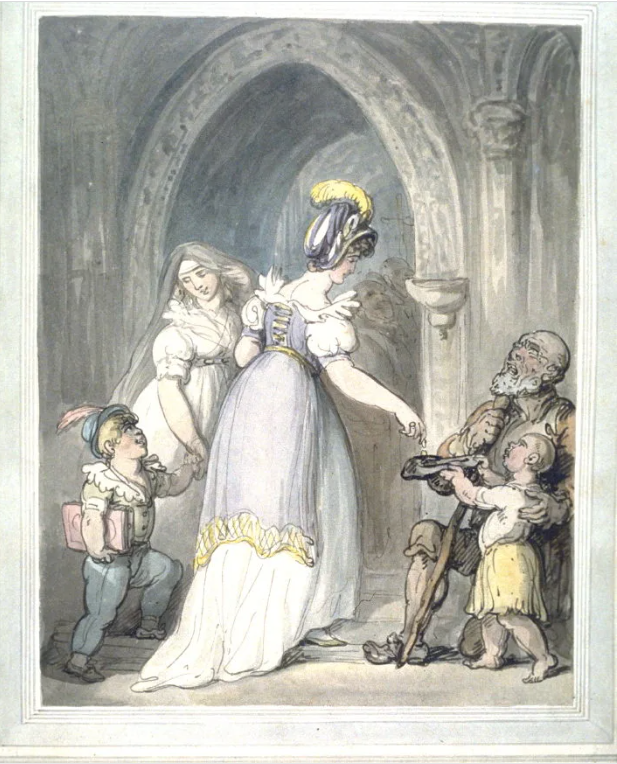
To those of means during the Regency Era, charitable causes were considered a social obligation deriving from the parishes. Churches throughout the land supported the poor and those in need.

The Voluntary Action History Society site tells us, “Looking at the mass of visual and printed material produced on the subject of charity during the 1700s, there were clearly resemblances between what people were concerned about then and what we are still debating today. To be sure, there were important differences. For instance, the Georgians had inherited the medieval tradition of almsgiving which the Henrician Reformation and subsequent Elizabethan legislation had effectively secularised.

“The ‘New Poor Law’ (officially the Poor Law Amendment Act) of 1834 was designed to make provision for the poor fairer for society as a whole, although it was regularly accused of inflicting inhuman cruelty, as the novels of Charles Dickens and others were at pains to show. This system, which was intended to clear away the detritus of ages and which arguably paved the way for the modern welfare state, has caused us to forget the Georgian idea of charity which was much more ad hoc and more dependent on the generosity of private individuals.”

A poor tax was levied on owners of land and buildings. This tax funded the workhouses and other efforts to assist the poor. The churches involvement was engrained in society from medieval times forward. Giving to the church meant giving to the orphanages and to the elderly and to the poor, in general.

“Philanthropy in the 19th century was based on religious tradition that was centuries in the making.  Historically, wealthy people in society gave to the poor as a Christian duty. Charity was seen as a way of saving one’s own soul while also helping those in need.  Protestants, especially those with strong evangelical leanings, believed that social conscience demanded social action.  They held that by coming into contact with human nature, particularly with those in need, that they were able to come in contact with Christ.[5]  Religious philanthropists believed that by helping the needy, they were helping their own kin because everyone was a child of God. Good works were, and are part of the foundation of Christianity, and pave the way to salvation.  Through the 19th century, the church increasingly became the vehicle of private and public social work.  However, it should be noted that though philanthropy was rooted in religious and church tradition, it also spread outside the church.  Philanthropy and religion are intertwined throughout history, but are not necessarily dependent on each other.” [Philanthropy]

The middle class took on the task with “gusto.” Women, in particular, stepped up to the task, but, not always for the reasons one might expect. Certainly, charity was an admirable trait. However, “working outside the home,” even in a charitable manner, provided these women a sense of worth beyond tending to their husband’s homes. Charitable work seemed to be an extension of their “natural” maternal instincts, but it also allowed women to meet and socialize with other women of like minds and education, opening them up to new experiences and ideas. “Charity begins at home” took on a whole different meaning.

Evangelism placed service to one’s fellow man above doctrine, and its rise to “popularity” as the 19th century progressed changed the look of charities from purely the work of the church to the work of society, as a whole. Non-church organizations, such as guilds, also could be supported without one considering himself or herself “not a Christian.” Women also created other means to support their favorite charities with organizing bazaars and dinner parties and collection boxes. Men still supported the organizations with the purse strings, but it was the women who made them work.

Some years back, another Regency-based author shared a list of actual charities during the Georgian and Victorian eras. I thought including the names might provide those interested in the scope of charitable work better insights.

The Society for Organising Charitable Relief and Repressing Mendicity (aka Charity Organisation Society or COS (this one took the position that most charities were being “hoodwinked by the cunning poor,”)

Manchester and Salford District Provident Society (DPS)

Liverpool Central Relief Society

Brightelmston Provident Institution

Brighton Provident and District Society

Liverpool Provident District Society

Central Relief SocietySociety for the Relief of Distressed Travellers and Others (1814)

Oxford Charity Organisation Committee

Anti-Mendicity Society

Oxford Anti-Mendicity and Charity Organisation Association

Society for the Relief of Distress (1860)

Invalid Children’s Aid Association (1888)

Barnardo Evangelical Trustees

Manchester and Salford Provident Dispensary Association

Edgbaston Mendicity Society

Brighton, Hove and Preston Charity Organisation Society

Leamington Charity Organisation and Relief Society

Vigilance Association (noted to be unpopular)

Birkhead Provident and Benevolent Society (later became the Birkhead Association for Organising Charitable Relief and Repressing Mendicity)

Ladies’ Sanitary Society- goal to promote habits of cleanliness among the working classes

[City Name] Relief Fund

Toxteth Relief Society

Brighton Jubilee and Accident Fund

Provident Dispensary Association

Oxford Working Women’s Benefit Society- basically a pool, women paid a small amount weekly and could claim benefits if they became sick.

Croydon Charitable Society

Reading Destitute Children Aid Committee- provided footwear with insistence on weekly repayments

Sick Relief Fund

Penny Savings Bank

London Ethical Society

Lock Hospital

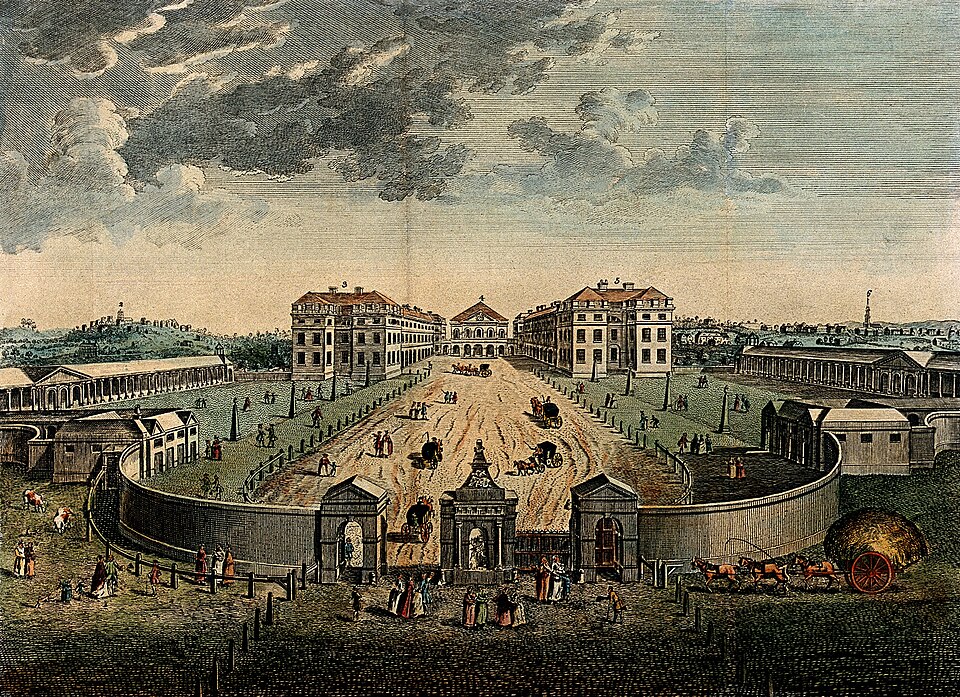
Foundling Hospital

General Lying-In Hospital (also British Lying-In Hospital, Lying-In Charity, etc.)

Marine Society

Philanthropic Society

Magdalen House

St. Thomas’s Hospita

Asylum for Orphaned Girls (also Asylum for the Reception of Orphaned Girls at Lambeth)

London Hospital

Society for the Discharge and Relief of Persons Imprisoned for Small Debts

Salters Guild

Smallpox Hospital

Society for Improving the Comfort and Bettering the Conditions of the Poor

Middlesex Hospital

Ladies Society for Employing the Female Poor

London Female Penitentiary

Lambeth Refuge for the Destitute

Dorking Provident Institution

The Church of England Waifs and Strays Society

Crutch & Kindness League (for ‘cripples’)

Metropolitan Association for Befriending Young Servants

Church Missionary Society

Society for Promoting the Religious Instruction of Youth

Female Friendly Society for the Relief of Poor, Infirm, Aged Widows and Single Women of Good Character, Who Have Seen Better Days

Other Sources:

Charity events in Georgian England, or, the poor shall be with us always

The Philanthropic Society of Mile End for the Relief and Discharge of Persons Imprisoned for Small Debts; and other objects

In book 4 of my mystery/romantic suspense series, the heroine’s sister has an illegitimate child, and many wish Miss Victoria Whitchurch to send her nephew to one of the foundling hospitals or an orphanage, but Miss Whitchurch refuses. Read all about the adorable bit of delight that is the child and the two adults who come to love him dearly.

Posted in aristocracy, book release, British history, Church of England, customs and tradiitons, Dragonblade Publishers, eBooks, Georgian England, Georgian Era, Great Britain, hero, heroines, historical fiction, history, laws of the land, Living in the Regency, mystery, publishing, Regency era, Regency romance, research, suspense, Victorian era, writing | Tagged , , , , , , , , , , , , , , , , , , , | 5 Comments

Do All Babies Have Blue Eyes at Birth? + the Upcoming Release of “Lost in the Lyon’s Garden” from Dragonblade Publishing (Arriving 18 March 2026)

Lost in the Lyon’s Garden not only has an analytical and caring hero and an over the top brave heroine, it has a newborn babe who will steal your heart away. Not the child of the hero and heroine, for they are both the children of vicars, but that of a close relative, and the child requires their protection and their love. In the story they mention the child’s blue eyes and marvel whether they will always be blue. So are all children born with blue eyes?

No, not all babies are born with blue eyes. While many babies, especially those of European descent, may appear to have blue eyes at birth, this is often due to a lack of melanin (a pigment that provides color) in the iris at that time. As babies are exposed to light, their eyes may darken to green, hazel, or brown as melanin production increases. Studies show that a significant percentage of newborns, particularly those of Asian, Black, and Hispanic descent, are born with brown eyes. VSP Direct

Here’s why:

Melanin, produced by melanocytes, is the pigment responsible for eye color. 

Melanocytes respond to light, and at birth, babies are in a relatively dark environment (the womb). As they are exposed to light, melanin production increases, potentially changing eye color. 

While melanin plays a role, genetics also determine the potential for eye color. Babies inherit genes from their parents that influence how much melanin their melanocytes produce. 

The idea that all babies are born with blue eyes is a myth. Many babies of color are born with brown or hazel eyes. 

Eye color can change in the first few years of life, but brown eyes are less likely to change than blue or green eyes. 

Healthline tells us, “Before the phrase “baby blues” came to refer to postpartum sadness (which is not the same as postpartum depression), it was actually a common synonym for “eyes.” Why? Well, because all babies are born with blue eyes, right? Wrong. Feast your baby blues upon this fun fact: Worldwide, more newborns have brown eyes than blue. And while it’s true that many babies have blue or gray eyes at first, it’s important to know that eye color can change for months after birth. And there are plenty of infants gazing out at their new surroundings with hazel and brown eyes, too. In fact, a 2016 Stanford University study involving 192 newborns found that nearly two-thirds of themTrusted Source were born with brown eyes, while only about 1 in 5 babies arrived with blue eyes. The Stanford researchers also noted, however, that the majority of babies in the study born with blue eyes were Caucasian. Those of other ethnic groups, including Asian and Hispanic, were more often born with brown eyes.”

Posted in book release, British history, Dragonblade Publishers, eBooks, Georgian England, Georgian Era, hero, heroines, historical fiction, history, mystery, publishing, Regency era, Regency romance, research, romance, series, suspense, writing | Tagged , , , , , , , , , , , , , , , | Comments Off on Do All Babies Have Blue Eyes at Birth? + the Upcoming Release of “Lost in the Lyon’s Garden” from Dragonblade Publishing (Arriving 18 March 2026)

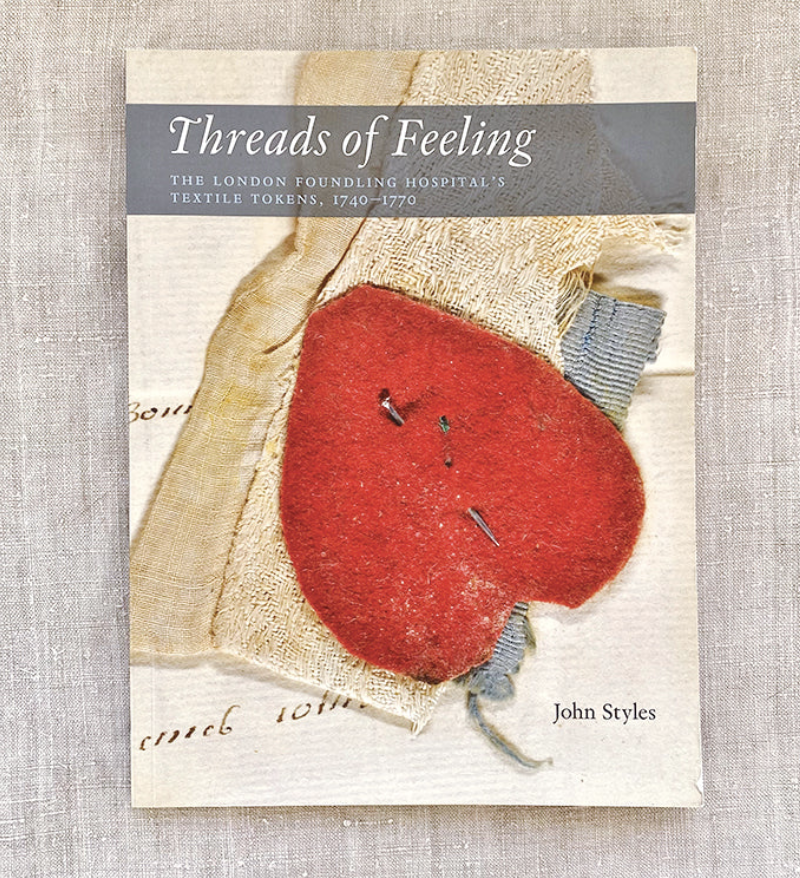
Threads of Feeling and the London Foundling Hospital

Back in 2011, London’s Foundling Hospital Museum had a somewhat tender and somewhat heartbreaking display of what was called “Threads of Feeling.” You see, beginning in the mid-18th Century, thousands of poor women who could no longer care for their children made the difficult decision to leave their babies with the London Foundling Home. Most likely thought it would be only a temporary decision. In fact, when writing Lost in the Lyon’s Garden, I thought, for a time, to have Miss Whitchurch search for her nephew there, but then I recalled “the threads of feeling” concept in place at the Foundling Hospital. Victoria would not know what her sister had chosen for the child.

Here is how the Threads of Feeling worked. Those distraught mothers were made to leave some kind of identifying piece pinned to the child in the event that sometime in the future the woman was in a position to return for the child. No name of the child was recorded. No name of the mother was recorded. It was essential that the token be distinctive. Be memorable. The hospital essentially erased the mother from the child’s life in order to give the child a chance to succeed in its world. A new name was presented to the child. It was provided with basic schooling, perhaps an apprenticeship, so it could make its way through the world.

If the mother’s circumstances changed, she would need to be able to identify in detail the object left as the child’s existence. The hospital made a vow to preserve the object.

The hospital, which was located Bloombury, soon took on many of the fashionable sect.

In describing the 2011 exhibition, The Guardian tells us, “Admission policy varied over time – at one point the hospital took only 200 babies a year, at another 4,000 – but from 1741 to 1760 16,282 babies entered the institution anonymously. The vast majority of mothers failed to heed the instruction to leave an identifying token, perhaps because they were too beaten down by rotten lives to imagine a time when they would be able to provide a warm, clean home for their baby. All the same, 5,000 of the infants deposited came with some kind of token attached. And by some lucky chance these tokens, mostly comprising bits of fabric carefully pinned to the baby’s admission billet, have survived. Over the past few decades they have been stored not at the museum itself but at London Metropolitan Archives where they have tended to languish, overlooked. Now, these slivers of everyday Georgian life are making a triumphant return to their original home where they will form the basis of the museum’s new exhibition, Threads of Feeling.

“The exhibition’s curator, Professor John Styles of Hertfordshire University, is emphatic about the significance of these 5,000 scraps of fabric, mundane and beautiful, lumpy and sheer. They comprise, he explains, nothing less than the biggest archive of 18th-century materials surviving in Britain, probably in the world. Historians who have tried to investigate the dress of the common people in the Georgian period – including Styles himself – have always fallen into a black hole where the evidence ought to be. The clothing of elite groups – fashionable merchants’ wives, duchesses with an eye for style – have survived in countless stately homes and museums. You can feast your eyes on silk and velvet, on silver buckles and pearl buttons, but you will search in vain for evidence of what ordinary working people wore to keep themselves dry and more-or-less warm.

“There are hints, of course, in paintings and cartoons, including those drawn by Hogarth (who was a governor of the hospital), but it is impossible to know whether these are strictly accurate. The prostitutes and fishwives who tumble through the satirist’s street scenes may well be based on close observation, but they are also exaggerations and fantasies, caricatures held up for the viewer’s pity, mirth and scorn. It is the Foundling tokens, snipped from either the mother’s or baby’s garments, that provide our only solid evidence of what ordinary clothing looked and felt like.

“To examine these samples is to enter a world of dizzying names and textures. Some are familiar – calico, flannel, gingham and satin – although the relationship between the 18th-century fabric and its modern equivalent often turns out to be stretched pretty thin. Other textiles boast names utterly mysterious to us, opening up a lost world of camblet and fustian, susy and cherryderry, calimanco and linsey-woolsey. What stands out is the high proportion – almost a third – of printed cottons and linens among the Foundling collection.”

Other Sources:

French General

Piecework

Threads of Feeling – Foundling Museum

Two Nerdy History Girls

Just as a point of reference for those knowing me as a Regency writer, The Foundling Hospital (formally the Hospital for the Maintenance and Education of Exposed and Deserted Young Children) was a children’s home in London, England, founded in 1739 by the philanthropic sea captain, Thomas Coram.

Posted in British history, buildings and structures, Georgian England, Georgian Era, history, Living in the Regency, reading, Regency era, research | Tagged , , , , , , , | 2 Comments

Traitor Tuesday ~ Celebrating 250 Years of the United States as a Separate Nation: Richard Henry Lee, Signer of the Declaration of Independence and the “Cicero” Who Advocated for a Bill of Rights

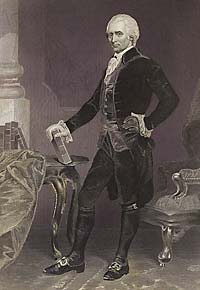
Richard Henry Lee - Colonial Williamsburg - www.history.org/ almanack/people/ bios/biolee.cfm

Richard Henry Lee – Colonial Williamsburg – http://www.history.org/
almanack/people/
bios/biolee.cfm

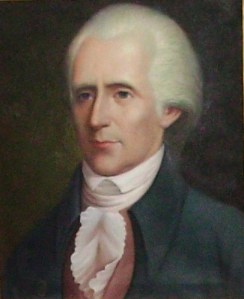
Richard Henry Lee was both a merchant and a plantation owner from Virginia. He was married twice and the father of six children. He was 44 when he signed the document. He died at the age of 62.

Richard Henry Lee, signer of the Declaration of Independence, was born on 20 January 1732 in Westmoreland County, Virginia. He was the seventh of eleven children of Thomas and Hannah Lee and a descendant of Colonel Richard Lee, the first of the Lees to arrive in America. Colonel Lee was a lawyer and planter and the largest landholder in Virginia with some 13,000 acres. 

“Today the different branches of the Lee family are known as: “Cobb’s Hall”, “Mount Pleasant”, “Ditchley”, “Lee Hall”, “Blenheim”, “Leesylvania”, “Dividing Creek”, and “Stratford”. These were the estate names of the descendants of Richard Lee I that are still referred to today when talking of Lee descendancy. An interesting note is that Lee had patented somewhere in the neighbourhood of 15,000 acres (61 km²) on both sides of the Potomac, in Maryland and in Virginia. Part of this land later became George Washington’s Mount Vernon. When he divided his estate among his children, he also left them the products of the several plantations including white indentured servants, Negro slaves, livestock, household furnishings, silver, and many other luxuries.

“Notable descendants of Richard Lee I include signers of the Declaration of Independence Francis Lightfoot Lee and Richard Henry Lee, Revolutionary War general Henry “Light Horse Harry” Lee, Confederate Civil War generals Robert E. Lee, Richard Taylor, William Henry Fitzhugh Lee, Stephen D. Lee, and George Washington Custis Lee, Richard L. T. Beale, Richard Lucian Page; President of the United States Zachary Taylor, Chief Justice of the United States Edward Douglass White, Governor of Maryland Thomas Sim Lee.” (Colonel Richard Lee) To those interested in the NFL, we can even make a connection to Eli and Peyton Manning, the quarterbacks for the New York Giants and the Denver Broncos, respectively. Captain Charles Lee Sr., who was one of Colonel Lee’s ten children of the “Cobbs Hall” sector, married Elizabeth Medstand, the daughter of Thomas Medstand and one of the Manning family’s ancestors. (Colonel Richard Lee)

Richard Henry Lee attended Wakefield Academy in England before returning to America. In 1757, he married Anne Aylett and set up residence at Chantilly. He also became a justice of the peace in 1757 and joined the Virginia House of Burgess in 1758. He quickly became a great defender of colonial rights, a not-so-popular stance in the early days of the “revolution.”

He led a group of “gentlemen” in confronting the British-appointed collector of stamps, and in 1766, he and many of his neighbors formed a boycott against British goods until the Stamp Act was repealed. His wife died in 1768, but he was not widowed long. In 1769, he married another Anne: Anne Pinckard. For the years between this second marriage and the beginning of the Revolutionary War, he built up his shipping business, specifically shipping tobacco to his brother William in London. 

 File:Richard Henry Lee Signature2.svg - Wikimedia Commons commons.wikimedia.org


File:Richard Henry Lee Signature2.svg – Wikimedia Commons
commons.wikimedia.org

From the Stratford Hall website, we learn, “Tall, thin and aristocratic in appearance, Richard Henry Lee was a born orator. He used his hand, always wrapped in black silk due to a hunting accident, to emphasize the cadences in his remarkably musical voice. His oratory was legend – ‘That fine polish of language which that gentleman united with that harmonious voice so as to make me sometimes fancy that I was listening to some being inspired with more than mortal powers of embellishment’ was how one observer described him.

Confrontational by nature, Richard Henry possessed a fiery, rebellious spirit. These same qualities brought him fame as a leading patriot of the day and incited the wrath of his enemies. At one point, he was ‘outlawed’ by a proclamation of English Governor Dunmore.

“As a member of Virginia’s House of Burgesses, Richard Henry’s first bill boldly proposed ‘to lay so heavy a duty on the importation of slaves as to put an end to that iniquitous and disgraceful traffic within the colony of Virginia.’ Africans, he wrote, were ‘equally entitled to liberty and freedom by the great law of nature.’ Such words, coming as they did in 1759, have been called ‘the most extreme anti-slavery statements made before the nineteenth century.'”

According to Colonial Williamsburg Foundation, “Lee remained involved in politics. He was appointed delegate to the Continental Congress in 1775, and was one of the signers of the Declaration of Independence in 1776. He served next in the Virginia House of Delegates in 1777, 1780, and 1785.

“When the Constitution was laid before Congress, Lee led the opposition to it. His chief concern was that the Convention, called only to amend the Articles of Confederation, had exceeded its powers.


“He worried also that the Constitution lacked a bill of rights; that it was a consolidated, rather than a federal, government and therefore opened the way to despotism; and that the lower house was not sufficiently democratic. He insisted upon amendments before adoption. His arguments were set forth in a series of ‘Letters of the Federal Farmer’ which became a textbook for the opposition.” (Colonial Williamsburg Foundation)

“By 1774, the flames of the Revolution, so faithfully fanned by the Lees, ignited the reluctant southern colonies. The call for an inter-colonial congress was made, and Richard Henry was chosen as one of the seven-man Virginia delegation to the first Continental Congress in Philadelphia. Once there, he was able to bridge the gap between the vastly different worlds of New England and the South. At the house of his sister, Alice Lee Shippen, he strengthened the bond with John and Samuel Adams and created a long-lasting friendship that transcended divisive regionalism and helped to unite the colonies as one nation.

“In the spring of 1776, Richard Henry, now joined by his brother Francis Lightfoot, took his seat in the second Continental Congress. Sensing what lay ahead, he wrote confidently to his brother William, ‘There never appeared more perfect unanimity among any sett of men, than among the delegates.’

“In three months as delegate, Richard Henry served on 18 different committees – none as important as his appointment to frame the Declaration of Rights of the Colonies, which led directly to the writing of the Declaration of Independence. On June 7, 1776, Richard Henry was accorded the well-deserved honor of introducing the bill before Congress:
…that these united Colonies are, and ought to be, free and independent States, that they are absolved from all allegiance from the British crown, and than all political connection between America and State of Great Britain is, and ought to be, totally dissolved…” (Stratford Hall)

Also See:

The Society of Descendants of the Signers of the Declaration of Independence

Posted in America, American History, British history, Declaration of Independence, Great Britain, real life tales | Tagged , , , , , | 4 Comments

Pauper’s Graves

In my latest Dragonblade book, Lost in the Lyon’s Garden, I deal with the removal of a loved one of the heroine from a pauper’s grave. What were they? What were the regulations for such burials in the Regency era?

William Thomas Smedley – Century Illustrated Monthly Magazine, May 1885, October 1885, Vol. XXX
“I COME TO CLAIM MY DEAD.” sketch by artist

First, let us look at the terms often used for such a burial place: Potter’s field. Potter’s field is a term of Biblical origin, a place dedicated for the burial of the bodies of unknown, unclaimed or indigent people. In addition to such dedicated cemeteries, most places have provision for pauper’s funerals to pay for basic respectful treatment of dead people without family or others able to pay, without a special place for interment.

The term “potter’s field” comes from Matthew 27:3–27:8 in the New Testament of the Bible, in which Jewish priests take 30 pieces of silver returned by a remorseful Judas:

Then Judas, who betrayed him, seeing that he was condemned, repenting himself, brought back the thirty pieces of silver to the chief priests and ancients, saying: “I have sinned in betraying innocent blood.” But they said: “What is that to us? Look thou to it.” And casting down the pieces of silver in the temple, he departed, and went and hanged himself with a halter. But the chief priests, having taken the pieces of silver, said: “It is not lawful to put them into the corbona [A poor boxalms boxoffertory box, or mite box is a box that is used to collect coins for charitable purposes.], because it is the price of blood.” And after they had consulted together, they bought with them the potter’s field, to be a burying place for strangers. For this the field was called Haceldama, that is, the field of blood, even to this day. — Douay–Rheims Bible

The site referred to in these verses is traditionally known as Akeldama, in the valley of Hinnom, which was a source of potters’ clay. After the clay was removed, such a site would be left unusable for agriculture, being full of trenches and holes, thus becoming a graveyard for those who could not be buried in an orthodox cemetery.

“Buried in a pauper’s grave” refers to the burial of a deceased person, unable to afford a funeral, in an unmarked or common grave, often called a potter’s field. These graves are for the indigent, unknown, or unclaimed, where bodies are placed when families cannot cover burial costs or identify the deceased. The term can also be used metaphorically to describe someone who is financially reckless and likely to die destitute.  

What it means literally

A pauper’s grave is reserved for people who die without the financial means to pay for a traditional burial or who are unclaimed by family. 

These burial grounds are also known as potter’s fields, a term with a Biblical origin describing a place where strangers, criminals, and the poor were buried. 

Graves in potter’s fields are often unmarked or have simple, low-quality markers, making it difficult to identify the specific individuals buried there. 

Why it happens

The primary reason is the deceased’s or their family’s inability to afford a private burial, leading to a public or indigence burial service. 

Sometimes, the deceased has no known relatives to claim the body and make burial arrangements. 

Historical context 

In early history of both England and the eastern U.S., a pauper’s burial was considered a great disgrace and a lasting blow to a family’s reputation.

The coffins used in pauper burials were of poor quality and could crack, sometimes even causing bodies to fall out.

Enjoy this scene from Lost in the Lyon’s Garden where Lord Benjamin Thompson and Lord Aaran Graham attempt to learn whether Miss Victoria Whitchurch’s sister now lies in a pauper’s grave.

Benjamin had known relief when he rode into the circle in the middle of the street upon which he lived. He could see the open door on Miss Whitchurch’s side of the house, and, for the briefest of seconds he thought perhaps she had anticipated his return. 

Then he noted the unfamiliar carriage before the house and was immediately alarmed. Benjamin edged the horse closer and dismounted, only to hear a squeal that sounded very much as if it was Miss Whitchurch, as well as cries of alarm. 

Without considering the consequences, he charged up the steps. A man stood over Miss Whitchurch, and Benjamin no longer saw reason. She was sprawled at the man’s feet, and he appeared to be prepared to kick her. 

Benjamin caught the man from behind, pulling him upward and off the floor to slam the fellow down hard on the brick tiles. Heaving in anger, he lorded over the fellow who was attempting to rise to his knees. 

“I advise you to stay down,” he growled, as two women assisted Miss Whitchurch from the floor. “Better yet,” he hissed. “Crawl your way out of my house and never darken my door again.” 

“My lord,” Miss Whitchurch rushed to his side, her hand resting on Benjamin’s back, and that flicker of hope had arrived again in his chest. “It is Mr. Betts. He wishes to see the boy.” 

“Conceiving a child does not make a man a father,” Benjamin declared in hard tones. “Nor does it make a woman a mother. If you wish to visit the child, find Miss Cassandra and bring her here. Miss Whitchurch would gladly provide her sister access to the child. Otherwise, you should be gone from my home before I count to ten. Never cross over my portal again. One . . . two . . .” 

Mr. Betts struggled to his feet as Benjamin continued to count, “Five . . . six . . .” Betts lifted his chin in defiance. “I cannot bring Cassandra here.” 

“Eight . . .” Benjamin said over the man’s protests, while Miss Whitchurch demanded, “Why?”

“Because your sister has been dead since early June!” 

Benjamin caught Miss Whitchurch when she swooned, scooping her into his arms to carry her to the nearest arm chair, where he sat and cradled her on his lap. Behind him, he knew Patterson and the others escorted Mr. Betts and the women outside. He heard Patterson instruct one of the footmen to accompany the women home safely, while the butler and Brunswick led Mr. Betts to the fellow’s carriage.

Meanwhile, Benjamin held the woman who owned his heart upon his lap. He rocked her as he might have rocked the child. “I have you, love,” he whispered close to her ear. 

She moaned and snuggled closer to him. “Cold,” she sighed. 

“A blanket, Mr. Patterson,” Benjamin ordered as his butler locked the outside door. 

Within less than a minute, Patterson returned with a covering. “Here, my lord.” His man spread a small blanket over Miss Whitchurch’s shoulders and back. “Poor dear,” Patterson murmured. 

“See the others, including Mrs. Sullivan and the boy, into the main part of the house and send someone to tend my horse. Miss Whitchurch has had a shock. We will join everyone later.” 

“Assuredly, my lord.” Mr. Patterson gently tucked the blanket about the lady before he ushered everyone who was looking on in concern from the room. 

“Just rest as long as you need,” he told her. “I will not leave you,” he whispered as he kissed the top of her head. “You are safe with me.” 

How long they remained as such, Benjamin did not know nor did he care. The lady required someone she could trust, and, like it or not, he wanted to be that person in her life. Darkness had filled the room before she did more than trace the outline of his stick pin. “Could Mr. Betts have told the truth?” she asked at last. 

“I cannot say with confidence,” he replied. “We know your sister did not apply for the cook’s position at The Red Rooster, but we do not know if she found work elsewhere, Now, with Mrs. Taylor’s demise, even if Miss Cassandra searched you out at your former quarters, she would not learn of your directions unless she called at Sustar’s.” 

“I thought I heard her that morning in the close when you pulled me into your arms,” she reasoned aloud. 

Benjamin did not deny her hopes, though he knew she likely heard what she wanted to hear, as the mind sometimes plays such tricks upon a person. Instead, he said, “With all that has happened of late, I am confident Duncan has not completed his inquiries on your behalf. Lord Liverpool has demanded Duncan’s constant attention, but only a day ago, Lord Graham volunteered to take up the cause. Graham performs often in a covert manner. He has many connections that others do not.” 

“Do you think he could discover Cassandra?” she asked softly. 

“I will send a message around to him and accept his assistance,” Benjamin assured. “You must understand, if Betts’s words prove true . . .” 

“He was likely with her when Cassandra died. Perhaps he had something to do with her death.” 

<<<>>>

“Thank you for coming so quickly, Graham,” Benjamin said as he shook his brother’s hand. 

“Your message said there was some urgency.” 

Benjamin poured them both a drink before he explained his purpose. “I wish to accept your offer to assist Miss Whitchurch in locating her sister.” He motioned Graham to a nearby chair. 

“Of course, but what has brought on your heightened concerns?” Graham asked as he lowered his weight into the chair. 

Benjamin sat heavily. “God was guiding my steps today. I arrived home to find Mr. Jonas Betts harassing Miss Whitchurch. He had forced himself into the house.” 

Graham grinned, his scar puckering his lips on one side. “I pray you kicked his arse into the street. Betts is a prat of the first realm.” 

Benjamin sighed heavily. “I was too busy slamming him into the tiled floor to kick his arse. He put his filthy hand on Miss Whitchurch.” 

“Next time, remember, we all know permanent ways to be rid of a body.” Graham’s smile widened. 

Benjamin permitted Graham’s easy manner to calm his frustration. “Next time,” he said, “I will follow your advice. Yet, what was worse was the dastard said something that I must investigate, but I have no idea where to begin.” 

“As I have said previously, I am your servant,” Graham assured. “Do you possess a starting point for our search? What has been done previously?’

“Unfortunately, I have failed the lady in that manner. I have become accustomed to her presence in my house, and I fear I have unconsciously not pursued any leads because I did not wish for Miss Whitchurch to leave. Moreover, it has taken the lady longer than it should have to trust me,” Benjamin admitted. He sighed again. “While I was ordering Mr. Betts from my home, Miss Whitchurch was begging him to bring Miss Cassandra to see the child, to which Betts responded that Cassandra Whitchurch was dead. Has been dead since early June.” 

“How would Betts know that?” Graham asked with a frown. 

“Betts could have been performing in a purposeful manner to harm Miss Whitchurch, for she repeatedly rejected his advances, even going so far as to take up a position as a teacher in a girls’ school in Bath to avoid him, while the younger sister encouraged Betts’s advances,” Benjamin confided. 

“And you came by this information how?” Graham asked with a lift of his brows in apparent amusement.  

Benjamin found himself grinning. “I asked what those from Hampshire in Duncan’s office knew of Lord Betts and his son.” 

Graham nodded his approval. “Always best to speak to those close to the source.” 

Benjamin continued. “Miss Whitchurch has heard nothing from her sister since she left the child in Miss Whitchurch’s room at the boarding house, which is exactly what has Betts’s assertions making more sense—that Miss Cassandra has been dead since early June. As best as we can derive, that was when Titan sent Cassandra Whitchurch to The Red Rooster, though, as I mentioned previously, Duncan and I confirmed the woman never applied for the position as cook at the inn. Since she left the child with her sister, Miss Cassandra has made no attempt to contact Miss Whitchurch. Never even presented her sister one pence for the care of the boy. Though I would not say so to the lady, Betts’s assertion holds more merit than I would like to present it.” 

“If Miss Cassandra is dead, without money or identity, she would be likely to be found in a pauper’s grave,” Graham warned. “I can begin there, but I believe it would do me well to speak to Titan and, perhaps, Mrs. Dove-Lyon. To learn more about the young woman. Do you object?” 

“Whatever it takes,” Benjamin assured. “We can no longer dance around this craziness. Miss Whitchurch refuses to have the boy christened, though Miss Cassandra told her in the note she left for her sister, to name the child, which sounds to me as if the woman had no desire to face her mistakes every day for the rest of her life. Yet, I cannot say that to Miss Whitchurch. She requires closure before she can claim her own life.” 

“Does Miss Cassandra resemble Miss Whitchurch? I will be required to describe her to those I ask.” Graham asked. 

Benjamin handed Graham a sketch of Miss Cassandra. It was between two sheets of card stock and tied off with a ribbon. “Miss Whitchurch drew this to show the boy something of his mother as he grew older. She had it put away with the things she brought from the boarding house. I did not ask if she performed so to keep her sister’s memory equally alive for herself, but it may be useful to whoever might have prepared the body for interment, especially if all roads lead to a pauper’s grave as you suggested. For identity purposes.” 

“Is it a true likeness?” Graham asked. 

“I did not view it, but I have seen several others of Miss Whitchurch’s drawings. She has sketched the child twice, and those were quite good.” 

Graham nodded his head in understanding before asking, “I suppose if I find the girl’s grave, you mean to have her exhumed and . . .” 

“And buried again on my Kent estate. Her parents cannot accept the girl in their home shire, and I plan to marry Miss Whitchurch, and she and the boy will want to honor Miss Cassandra and remember her. No one in Kent will know more than what I tell them. The child will be an orphan raised by his aunt. I will see to the boy’s schooling and assist him as best I can. Miss Whitchurch and I will present the child the legitimacy his own parents refused.”

Posted in Uncategorized | Comments Off on Pauper’s Graves

Luddites as Marsden Mill ~ Who Were the Luddites?

Frame breaking from the Penny Magazine 1844

Frame breaking from the Penny Magazine, 1844

The Luddite movement plays a part of my Dragonblade Publishing series, with book 4, Lost in the Lyon’s Garden, coming out in mid March. Throughout the series, we have seen Lord Aaran Graham, infiltrating the group, and, with the climax of book 3, we find the British government sentencing many of the Luddites to death or transportation. But who were the Luddites? For what did they protest?

The Luddites were textile workers afraid that automated machinery would replace them, just as many of us in this modern day world worry that artificial intelligence is coming for our jobs. The Luddites also held concerns regarding pay and output quality. If you have ever read Elizabeth Gaskell’s North and South or have seen the miniseries for the book, you have an idea of the conditions in the factories. Of course, Gaskell’s novel takes place closer to the end of the Industrial Revolution, while my story takes place in the middle of the Napoleonic Wars, specifically in 1812.

The Luddites opposed the use of certain types of automated machinery due to concerns relating to worker pay and output quality. They often destroyed the machines in organised raids. [“Who were the Luddites?”. History.com.] Members of the group referred to themselves as Luddites, self-described followers of “Ned Ludd“, a legendary weaver whose name was used as a pseudonym in threatening letters to mill owners and government officials. [Binfield, Kevin (2004). “Foreword”. Writings of the Luddites. Johns Hopkins University Press. pp. xiv.]

Public Domain

Beginning in Nottinghamshire, the sentiments and the violence associated with the Luddite movement spread to the north and west, as well as to Yorkshire. The mill owners began to hire men to keep the protestors out, and even the Prime Minister, Spencer Perceval, had troops move against the protestors. Perceval was assassinated in 1812, but such did not slow down the government’s attack on the Luddites. Those who were caught were either executed (as was the situation in my series, being hanged at York Castle) or were transported to penal colonies. [“Luddites in Marsden: Trials at York”]

Eventually, the term “Luddite” came to mean any who were opposed to the use of new technologies. Should we begin to use the term as we privately “curse” the use of A/I in taking over the world?

The movement was believed to have been founded by Ned Ludd, but he was never identified, and may well be mythical. Some authorities claim his surname to be Ludlam. The movement was dedicated to destroying machinery, not people

Lord Liverpool, the Prime Minister after Spencer Perceval, instigated severe measures, culminating in a mass trial at York in 1813. [This trial is the background for the climax of book 3 of my series.]

The Luddites in Marsden

Marsden is located in West Yorkshire, England, in the Colne Valley, near Huddersfield and the Peak District National Park, and in Marsden, by the end of the Napoleonic Wars, food was scarce and unemployment high.

Living in Marsden were two brothers, James and Enoch Taylor, both blacksmiths by trade. These brothers built a cropping machine that could do the work of 10 croppers. Obviously, the mill owners realized the innovation could save them both money and time and began installing the machines in their mills.

There was also a man, another “Enoch,” who make sledgehammers, which were naturally called “Enochs.” The Luddites used a rallying cry of “Enoch made the, and Enoch shall break them!” when they attacked the different mills to destroy the cropping machines.

“Apparently, the law-abiding menfolk of Marsden were stirred to riot by “desperate men of Longroyd Bridge!” The first riot was at the scene of William Horsfall’s mill, which had been fortified.

“The leader of the Marsden Luddites was George Mellor. He could read and write, and while in prison signed a petition calling for Parliamentary reform. He worked at John Wood’s finishing shop at Longroyd Bridge, along with Benjamin Walker, who, according to some, was to betray them eventually. New documentary evidence, however, seems to suggest that this may not be altogether true. Regular troops and cavalry were brought in and quartered in the village.” [Marsden History]

Read in Kindle Unlimited!

Enjoy this new series within The Lyon’s Den Connected world by Regina Jeffers.

Book 1 – Lyon in the Way

Book 2 – Lyon’s Obsession

Book 3 – Lyon in Disguise

Book 4 – Lost in the Lyon’s Garden

Book 5 – Lyon on the Inside

Posted in Uncategorized | Comments Off on Luddites as Marsden Mill ~ Who Were the Luddites?

Insights on the Position of Justice of the Peace in Regency England

Question: How were JPs/magistrates selected? Was it a local decision process, or were the London Courts involved too?

In Regency England, the position of Justice of the Peace (JP) was a crucial part of local governance, particularly in maintaining law and order. JPs, typically drawn from the ranks of the gentry, were unpaid officials responsible for a wide range of duties, including administering justice, supervising local officials, and managing various community services. 

Most sources list their Key Responsibilities as being:

  • Law Enforcement: JPs were the primary law enforcement officers at the local level, responsible for investigating crimes, apprehending suspects, and conducting preliminary hearings. 
  • Judicial Functions: They presided over petty sessions (minor offenses) and quarter sessions (more serious cases). 
  • Supervision of Local Officials: They oversaw constables, watchmen, and other local officials, ensuring the proper functioning of the legal system. 
  • Community Management: They were involved in various aspects of community life, including fixing wages, regulating alehouses, overseeing poor relief, and managing road and bridge repairs. 
  • Enforcing Government Policies: They acted as agents of the central government, implementing policies and ensuring compliance within their counties. 

Justice of the Peace were customarily chosen from the ranks of the landed gentry or the aristocracy. They could also be wealthy merchants and the like. We might think no one would want such a position, for it had LOTS of responsibility, but no monetary compensation, but, more than a few men enjoyed the social standing and influence it provide them within their community.

The office of Justice of the Peace has been around since the medieval period, but its role in the safety of and the functioning of a community grew substantially during the Tudor and Stuart eras. The role of Justice of the Peace became a key part of the English governmental system and were especially important in the rural areas, forming a “squirearchy” of sorts when the landed gentry held significant power. They still held significant power during the Regency era, but the Local Government Act of 1888 brought about great changes. The Local Government Act of 1888 established county councils and county borough councils in England and Wales, creating a two-tier system of local government. This act significantly reorganized local administration by transferring certain powers and responsibilities from other authorities to these newly formed councils. 

Some JPs were knighted. They are Austen scholars who believe this was true of Sir William Lucas in Pride and Prejudice. Austen, herself, never suggests this. All she tells us is Sir William Lucas had been formerly in trade in Meryton, where he had made a tolerable fortune, and risen to the honour of knighthood by an address to the king during his mayoralty.

A letter to a local JP would be sent to his home. A letter to a magistrate of a police office would be addressed to him there.

According to Debretts, magistrates have a JP at the end of their name, but that is optional. In court, he would be addressed as “Your Worship” or simply “Sir.” 

There were two or three classes or categories of local  courts.

The Justice of the Peace made application to the one in charge of the rolls of JPs– usually the Lord Lieutenant. The Lord Lieutenant forwarded the name to the King who consulted the Lord Chancellor and/or his attorney general and solicitor general or not. The Lord Chancellor sent a commission for the man to be a Justice of the Peace in a specific county. Men who were actively working in law could not apply. The man required a private income of around £300 a year, though heirs of peers usually did not have to prove his income. The JP’s were not paid but had ways of having an income though, some slipped up and took too much. Those who had been too greedy were then tried at the criminal side of King’s Bench Court.

The Aldermen and Lord Mayor of London were elected  in the city of London, and they automatically also became magistrates for London. They also made up the panel of judges at Old Bailey with one of the judges of the high courts. Various town corporations had their own way of appointing or naming magistrates. The magistrates of the public offices as the  places were called Westminster were paid a salary. They were also appointed by the Crown. Most of the men did not have any legal training at all.  Books such as the Justice of the  Peace and Parish Officer were written for their use.

The Justice of the Peace and Parish Officer
Richard Burn; Thomas D’Oyly; Edward Vaughan Williams
Published by T. Cadell, London, 1836

The JPs and magistrates held summary courts, that means no jury. They heard the accusation and what defence there might be and either sentenced the person to the stocks, the pillory, a stay in jail, or to be held for the assize where a jury trial would be held and the accused could be sentenced to death or transportation. JPs and magistrates could levy fines or brief periods of incarceration, but not death or transportation. The JPs worked on regulations for business licenses. Some matters were held over to the Quarter session when all the JPs of a county met to deal with some problems.

The Thames Police had jurisdiction of all crimes committed on the river and the docks. The Thames Police Office had 21 river surveyors, 8 land constables, 69 river constables, 2 watchmen, 2 door keepers, and 1 messenger. Patrick Colquhoun was the receiver in 1815.

The most famous of the magistrate offices was the one at Bow Street in Westminster. This had been started by the Fielding brothers in the 18th century.

In 1815, the chief  magistrate at Bow Street was Sir Nathaniel Conant.  He received £ 1200 a year. His two associate magistrates earned £600 each.

Other magistrates at public offices were at Great Marlborough Street; 

Hatton-Garden; 

Worship Street, Shoreditch;

Lambeth Street, Whitechapel; 

High-street, Shadwell 

Queen Square, Westminster (the chief magistrate there was Patrick Colquhoun)

Union Hall, Southwark. 

Other Sources:

Criminal Justice 1788-1851 East Riding Museums

Pen and Pension

Vanessa Riley’s Research Blog

Posted in aristocracy, British history, Georgian England, Georgian Era, Great Britain, history, laws of the land, Living in the Regency, Living in the UK, real life tales, Regency era, research | Tagged , , , , , , | 4 Comments

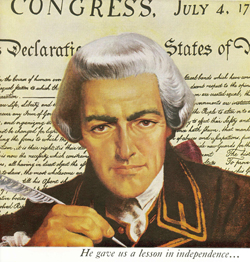
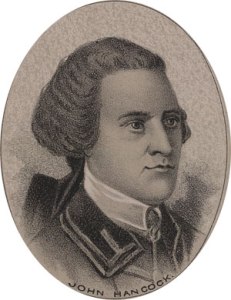
Traitor Tuesday ~ Celebrating 250 Years of the United States as a Separate Nation: “Put Your John Hancock on the Line!” Signer of the Declaration of Independence

With the flamboyant signature on the Declaration of Independence, John Hancock is a name easily remembered. But what do we know of Hancock’s life? Hancock was 40 years of age when he signed the Declaration of Independence. Hancock was a merchant by trade. He was married and had 2 children. He died at the age of 56 in 1793.

John Hancock was born on 23 January 1737 in Baintree, Massachusetts (now known as Quincy, Massachusetts), to Mary Hawke and John Hancock (the elder), clergyman. Mr. Hancock died when John was a child of seven, and for a period, Mary moved in with in-laws in the Lexington, Massachusetts, area. Eventually, she sent John to live with his wealthy aunt and uncle, Lydia and Thomas Hancock, who adopted him.

First, Hancock attended the Boston Latin School, a long-established public school, and later, Harvard College, graduating at the age of 17. After his schooling, he apprenticed with his uncle, who owned a large shipping business. As Hancock proved quite efficient, the uncle sent him on a business mission to England in 1760. There, he witnessed the coronation of King George III. When his uncle died in 1763, Hancock inherited a great wealth: an import-export business and a home on Beacon Hill. 

The newfound fortune placed him in the company of the loyalists and social position, and Hancock earned a reputation for his exorbitance. He also was known for his philanthropy: assisting those who encounter disasters, etc.

According to Signing Their Lives Away (Denise Kiernan and Joseph D’Agnest, page 39), “He funded his alma mater, paid for street lamps and concert halls, and helped impecunious friends such as Samuel Adams feed their families. But he also had flaws. He was impossibly vain and imagined scenarios and roles for himself that he could not reasonably attain or fulfill. For example, he became peeved when Congress chose George Washington to led the Continental Arm. His frustration appears misplaced when one realizes he had no real military experience, unless one counts the time he ran the honor guard for the Massachusetts royal governor. He and his ceremonial troops would march around in fancy uniforms that Hancock, of course, had bought for all his men. Dapper and small, Hancock loved elegant clothing. In this he did not conform to one’s image of a Yankee Puritan, and he would later class famously with dour, plain, and perhaps brighter congressmen such as John Adams.”

However, Hancock kept his revolutionary ideas. Soon he advocated America’s separation from England. He was elected to the Boston Assembly in 1766 and became a member of the Stamp Act Congress. 

When the custom officials in Boston Harbor seized one of his ships on the charge of running contraband goods, a group of citizens stormed the customs office, burned the government boat, and beat the officers. Likely, Hancock had smuggled in good to avoid unreasonable taxation. Samuel Adams successfully defended Hancock against the charges and the ship was seized as a royal asset, which was the impetus for the riot. Unfortunately, the ship was burned. After this incident with the Liberty and the Boston Massacre, Hancock encouraged others to participate in the Boston Tea Party. 

The Boston Massacre was a street fight that occurred on March 5, 1770, between a “patriot” mob, throwing snowballs, stones, and sticks, and a squad of British soldiers. Several colonists were killed and this led to a campaign by speech-writers to rouse the ire of the citizenry. Hancock was among those to speak out. 

Who was John Hancock? www.johnhancock.com
Who was John Hancock?
http://www.johnhancock.com

Elected to the Provincial Congress of Massachusetts and the Continental Congress in 1774, he became the President with the resignation of Peyton Randolph. “In 1774, Hancock was made leader of the Massachusetts delegate to the second Continental Congress, which would convene the following year in Philadelphia. Yet Hancock and [Samuel] Adams were hunted by British general Thomas Gage. The two were warned by Paul Revere during his famous April 18, 1775 night ride shouting out that British forces were on their way. Hancock and Adams fled Lexington, where they were staying, and eventually made their way to Philadelphia.

“The Congress met in May, 1775. George Washington was appointed leader of the Continental Army while Hancock was appointed congress president. Hancock would give the coming American war effort financial support while his presidential role was more of a figurehead position, with congressional decisions generally achieved through committee. In August of the same year, he wed Dorothy Quincy, who came from a merchant family as well. Hancock’s business fortune by this time had significantly dwindled.” (Biography.com)

He retired in 1777 after suffering with gout, but remained in the role of public service in Massachusetts. Eventually, he became governor for five years. Stepping away again, Hancock was persuaded to accept the governorship once more in 1787. There he stayed until his death in 1793. 

www.ushistory.org/ declaration/signers/ hancock.htm
http://www.ushistory.org/
declaration/signers/
hancock.htm

“The dignity and character of John Hancock, celebrated by friend and enemy alike, did not suffer for his love of public attention. He was a populist in every sense, who held great confidence in the ability of the common man. He also displayed a pronounced contempt for unreasoned authority. A decree had been delivered from England in early 1776 offering a large reward for the capture of several leading figures. Hancock was one of them. The story, entirely unfounded, is that on signing the Declaration, Hancock commented, ‘The British ministry can read that name without spectacles; let them double their reward.” An alternate story, also unfounded has him saying, “There, I guess King George will be able to read that!’ He was the first to sign and he did so in an entirely blank space.” (USHistory.org)

“It was his task to help unify a group of quarreling, self-important men. In the end, Hancock, as president of Congress, was the first to stick his neck out for the cause. He and the secretary of Congress, Charles Thomson, were the only men to sign the original document on July 4 before it went out to the printer, John Dunlap. Hancock reportedly announced that he signed his name in large letters so that King George could read his signature without spectacles. Then he dared England to double the £500 reward already on his head. Hancock’s flamboyant signature probably says more about his overall character than that specific intent. Though John Adams resented Hancock’s election to the presidency, it’s unlikely that Adams could have hobnobbed and charmed the southerners as well s did his charming and fashion-conscious friend. They probably bonded over things like tie wings, imported silks, and the latest button designs.” (Kiernan and D’Agnest, page 47). 

Also See:

The Society of the Descendants of the Signers of the Declaration of Independence

Posted in America, American History, British history, Great Britain, real life tales | Tagged , , , , , , , | Comments Off on Traitor Tuesday ~ Celebrating 250 Years of the United States as a Separate Nation: “Put Your John Hancock on the Line!” Signer of the Declaration of Independence

Welcome to Gunter’s Tea Shop, Where the Fashionable People Congregate

According to Historic Food, “The first record of ice cream in this country is from 1671. It was on the menu of a feast for the Knights of the Garter held in St. George’s Hall at Windsor Castle. However, at this time it was such an exclusive dish that it appeared only on the king’s table. The earliest printed recipe appeared in Mrs Eale’s Receipts, a little work on confectionery published in London in 1718. Mrs Eales claimed to have been confectioner to Queen Anne, during whose reign ice cream continued to be a luxury enjoyed only at court and by the nobility. It was not until the second half of the 18th century that ices become more widely available from confectioners’ shops.”

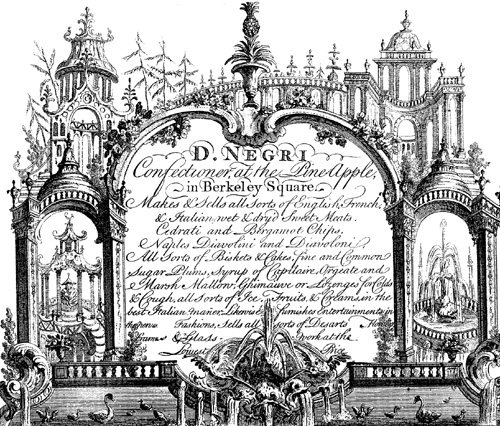
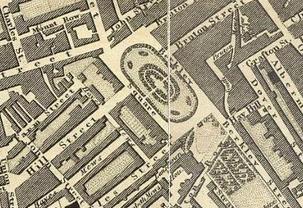
negricardGunter’s Tea Shop was originally called The Pot and Pineapple.It was located at Nos. 7 -8 Berkley Square. Italian pastry chef, Domenico Negri established it in 1757. The “pineapple” was chosen as part of the name for it symbolized luxury, and pineapples were a common ingredient used in confections. The shop sold English, French, and Italian wet and dry sweetmeats. Custards, cream ice, frozen mousses, jellied fruit, candies, syrups, biscuits, and caramels were served. Some of the cream ice flavors include chocolate, lavender, maple, Parmesan, Gruyere cheese, and bergamot. Mousses were often vanilla, saffron, and pineapple.  For more information on sweetmeats, chocolate, and ice cream in Regency England, go HEREGunther’s seems to have served their individual ices in glass dishes. I particularly love this site that gives LOTS of details on flavor of the ices, making the ices, history, etc. Georgian Ices4232720.jpg

During the Regency, the ice was less important that going to Gunther’s and being seen. It was a social experience. So, no one would have gone there for a single ice and then taken it away. Gunther’s does appear to have had wait staff that would bring ices to a party parked in a carriage nearby, then collected the empty glasses later. They seem to have done the same for those who wished to enjoy their ices outdoors rather than in the shop. This entry from the Encyclopedia of London tells us: “A custom grew up that the ices were eaten, not in the shop, but in the Square itself; ladies would remain in their carriages under the trees, their escorts leaning against the railings near them, while the waiters dodged across the road with their orders. For many years, when it was considered not done for a lady to be seen alone with a gentleman at a place of refreshment in the afternoon, it was perfectly respectable for them to be seen at Gunter’s Tea Shop.”

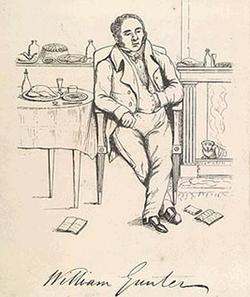
2366811.jpg     James Gunter became Negri’s business partner in 1777, and by 1799, Gunter was the sole proprietor.  During the Regency and throughout the 19th and 20th centuries, Gunter’s was considered a fashionable light eatery in Mayfair, well known for its ices, sorbets, and confections.  From the business, Gunter purchased a mansion in Earl’s Court.  Gunter’s son Robert took over his father’s business after James’s death in 1819. At his father’s suggestion, Robert had studied confections in Paris. Eventually, Gunter’s cousin John became a partner in 1837, assuring the business would remain in the family.  William, another of James’s sons published a cookbook, Gunter’s Confectioner’s Oracle, in 1830.  His book was said to be filled with gossip, namedropping and a terrible dictionary of ingredients, as well as recipes.  He began his cookbook with a dream he had of being led to a banquet by a witch. He supposedly “told all,” but in his alphabetical dictionary of raw materials, he “skipped B because it ‘is to us an empty letter.’ C was a fourteen-page treatise on coffee, in French … The dictionary skipped D and E. The letter F was for flour. Then Gunter wrote, ‘I now skip a number of useless letters until I arrive at P.” – Of Sugars and Snow: A history of ice-cream making, Jeri Quinzio, University of California Press, 2009, p. 65.  
There were also famous apprentices who worked at the shop and went on to write their own cookbooks. 

Gunther’s does appear to have offered a catering service, which was very popular with those planning parties. When ices were ordered for an affair at a private home, from what I can tell, the ice mixture was left frozen in the container in which it was made, usually a metal bowl or cylinder. These containers might have a matching metal cover or simply be covered with a layer or two of oil cloth tied on with twine. These containers were packed in large baskets, layered with enough straw and ice to keep them cold for the expected length of time until they would be served. Once the event was over, the containers, the baskets, and probably the straw, were all retrieved by someone from Gunther’s.

Via Jane Austen’s London, we learn, “(From a Correspondent)  Mrs Morton Pitt’s Masquerade (from The Morning Chronicle, 16 June 1801) –

“Mrs Morton Pitt opened her house in Arlington-street, for the first time, upon the debut of her beautiful and accomplished daughter in the beau mond: this of course attracted a most brilliant and dazzling assemblage of all the fashionable world; and, whether from the condescending manner of the beautiful hostess, or the high glow of spirits which universally reigned throughout the whole company, the writer protests he has not, in the career of fashion of this year, seen so much conviviality. The supper was such as everyone must expect, when they hear that Mr Gunter, of Berkeley-square, superintended in that department.’

“He did not cater only within London. On 25 August 1804 The Morning Post reported, in its Fashionable World column:

“’Lady Smith Burgess’s Fete at Havering Bower in Essex…about 200 of the neighbouring nobility and gentry, and many others from town were present…. About five o’clock [in the afternoon] the company…returned into the Saloon, where a most sumptuous Breakfast was set out. The entertainment consisted of every delicacy which the munificence of her Ladyship could provide, and the taste of Mr Gunter, the confectioner, could display.’

5597423.jpg     When the east side of Berkeley Square was demolished in 1936–7, Gunter’s moved to Curzon Street. The tea shop closed in 1956, although the catering business continued for another twenty years. Gunter’s was also known for its catering business and beautifully decorated cakes. In 1811, the Duchess of Bedford’s and Mrs. Calvert’s ball suppers featured the shop’s confectionery, a tradition followed by many a society lady. Along with Bolland’s of Chester and W G Buszard, Gunter’s were considered to be the wedding cake makers du jour and made the bride cake for the marriage of Queen Victoria’s Granddaughter Princess Louise of Wales in 1889.

Other Resources: 

Georgian Index 

Jane Austen’s World 

Jolie Beaumont 

LAHilden 

Vanessa Riley 

Posted in British currency, British history, commerce, Georgian England, Living in the Regency | Tagged , , , , , | 11 Comments

Hunting and the Game Laws During the Regency Era

The period of most intense hunting in the Regency Era was the autumn and winter months, specifically from the “Glorious Twelfth” of August for game birds like grouse, which transitioned into fox hunting from November to March. Gentry would leave London after the social “Season” ended in August to shoot game in the autumn and then participate in fox hunts through the winter.  

Autumn (August – October): Bird Shooting

  • The Glorious Twelfth: August 12th marked the start of the grouse shooting season. 
  • Other Game: Partridge, duck, and geese were also hunted during the fall. 
  • Purpose: Shooters would travel to country estates to enjoy these autumn pursuits. 

Winter (November – March): Fox Hunting

  • The Start of the Season: The primary fox hunting season began in November. 
  • “Riding to Hounds”: Fox hunting was a popular sport that involved riding horses after a pack of hounds. 
  • End of the Season: The fox hunting season concluded before the first spring planting began. 

Why this schedule?

  • Social Season: The entire social calendar revolved around the “London Season,” which ended in August. 
  • Weather: The cooler months provided ideal conditions for outdoor pursuits. 
  • Fox Population: Fox hunting was once a form of vermin control, but by this era, it was a respected sport for the wealthy, according to Risky Regencies. [This is a fabulous article. It even includes dates when specific hunting sports could be practiced.]
Pheasant Shooting, by George Morland

During the Regency Era, game laws restricted hunting and owning hunting equipment to the landed gentry, with severe penalties like deportation or even death for poachers. The laws were designed to protect game like deer and pheasants from being hunted by the poor. Eligible hunters needed a specific property value or were the eldest sons of people of high degree. These laws also controlled who could possess hunting dogs, guns, and other tools, and limited the sale and possession of game meat to qualified individuals. 

Who was allowed to hunt? Basically, the answer is landowners. Individuals with property valued at over £100 annually, or those leasing land worth more than £150 annually, were typically qualified. The eldest son of a family of higher degree also had the right to hunt. Moreover, individuals who owned certain land rights or “franchises” could also hunt legally. 

Who was not allowed to hunt? Poorer individuals, including small farmers and tenants, were generally excluded from hunting and could not own game or hunting equipment. Anyone not possessing the required qualifications, regardless of their land ownership, could be penalized for hunting.

Were there certain prohibited items and practices? Ordinary people could not legally possess hunting implements such as guns, snares, or certain breeds of hunting dogs. Laymen were forbidden from possessing hunted game. The sale and purchase of game meat were restricted to individuals who were legally qualified to kill it. 

What were the punishments for breaking the law? Offenders caught poaching faced severe penalties, which could include significant fines, long jail sentences, or being sent to a penal colony for deportation. In some cases, particularly for repeated or serious offenses, the punishment could even be hanging. 

What was the purpose of the laws? The laws primarily served to prevent the poorer classes from hunting and depleting game populations. They reinforced the social hierarchy by restricting a pastime and a form of food acquisition to the wealthy gentry. 

Other Sources:

Five Things to Know About Hunting in the Regency Era

Gamekeepers on Regency Estates

The Glorious Twelfth, Both a Poem and a Hunting Season

The Hunt

Hunting Season

Posted in aristocracy, British history, customs and tradiitons, estates, Georgian England, Georgian Era, holidays, laws of the land, Living in the Regency, Regency era, research | Tagged , , , , , , , , , , | 2 Comments