Weymouth’s History – Learn Something of the Site of Olympic Sailing Events

With the Olympic’s Sailing venue being based in Weymouth Bay and Portland Harbour this year, I thought I would add to the “legend” of Weymouth with some background information. Weymouth plays a significant role in my next Austen-inspired novel, The Mysterious Death of Mr. Darcy, which is due out after the first of the year.

Weymouth, itself, was once two independent communities, divided by the harbour. Weymouth developed on the harbour’s south side, while Melcombe developed on the northern side. Weymouth’s affluence was a dark contrast to Melcombe, famous as the sport where the Black Death plague had entered Britain.

The two “towns” often fought over the harbour’s ownership. The often violent rivalry between the two communities came to an end when, in 1591, Queen Elizabeth I enacted a bill which united the towns into the borough of Weymouth and Melcombe Regis. A wooden bridge connecting the towns spanned the harbour by 1594, but the “peace” was never a true one.

With the onset of the Civil War, new hostilities rose up between the towns. Melcombe came to be under Parliamentarian control and Weymouth under the control of the Royalists. In fact, in the side of a house on the Melcombe side of Maiden Street, there is a cannonball firmly lodged into the wall of one of the houses.

The whole in the wall is on the far left.

During the hostilities, a small group of residents led a plot to oust Cromwell’s forces from Weymouth and bring it back under Royalist rule. The Crabchurch Conspiracy brought more blood to the doors of Weymouth’s citizens. During the Crabchurch Conspiracy (1645), 250 Weymouth citizens were killed during the battle, which aimed to bring the town back under the control of the King’s army. Eventually, the monarchy was restored. The period that followed brought high taxes. The government wished to thwart the spread of smuggling and the “wide use” of alcohol among the Dorset citizens.

Gloucester Lodge

Things changed dramatically for the area in 1789, when King George III made his first visit to Weymouth. The King so loved the area’s golden sandy beaches, that he made Weymouth his “holiday” of choice. Eventually, he purchased Gloucester Lodge on the Melcombe seafront from his brother. Thus, Weymouth and Melcombe Regis became one of the first holiday resorts. A monument, a statue of George III, was erected in 1810 at the junction of the two main streets of the town, St. Mary Street and St. Thomas Street. It remains to this day on an island in the middle of the road along the seafront, a permanent reminder of what Royalty did for Weymouth.

George III’s Statue

Sadly, during WWII, Weymouth’s resort atmosphere gave over to the need to protect British soil from invasion. Between June 6, 1944, and May 7, 1945, nearly 500,000 troops and 150,000 vehicles departed for France via Weymouth’s harbour.

Posted in British history, Regency era | Tagged , , , , , | 4 Comments

Austen’s Transition to Modern Adaptations

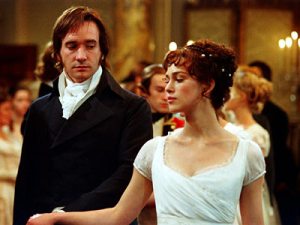
Jane Austen’s works are often classified as “romances.” The assumption comes from the premise that if the heroine meets a handsome man in Chapter One, he must be the hero. Fitzwilliam Darcy is the romantic hero of Pride and Prejudice, and although he does not appear in Chapter One, he does make an appearance by Chapter Three, and Austen’s chapters are short in comparison to contemporary writers. However, if you know nothing of the story line nor do you have sweet dreams of Colin Firth emerging dripping wet from a placid lake (Sigh!) or of Matthew Macfadyen walking through the morning mist with an open shirt and lots of chest hair (Sigh!), you may not think much of the infamous Mr. Darcy.

Quite frankly, upon our first meeting of this wonderful character, he is a jerk. He makes a horrendous “first impression.” But that is the thing with Austen. Her original title of the novel and her theme are one and the same: first impressions are misleading.

From the first line of Pride and Prejudice, “It is a truth universally acknowledged that a single man in possession of a good fortune must be in want of a wife,” Austen plays a merry game with her readers. “First impressions” are misleading: Darcy does not come to Hertfordshire seeking a wife; Wickham is not the perfect mate for Elizabeth; Jane might be more beautiful than Elizabeth, but she lacks her sister’s depth of character; Darcy’s best quality is not his wealth, nor is his worst quality his pride. Austen’s theme permeates every line, and, generally, the reader does not recognize that our favorite author hits us over the head with it. Readers simply sense the resonance found within Austen’s works.

Theme explains why Austen’s works are considered “classics.” Theme, well done, brings us universal truths, and discerning readers revere truth well told. Austen writes about the truths of an imperfect humanity.
What we find in Austen, as well as in the Brontes, Dickens, Conan Doyle, Shakespeare, etc., is how easily her stories are transferred to the present. Critics of “remaking” the classics refer to the phenomenon as “nostalgia.” Yet, it is much more than a longing for an easier time. If it is “nostalgia,” then what is missing from our current time that brings us to seek out another?

It is more than an “escape” into the past. Why do readers and viewers return again and again to these tales? What parts of these remakes of the classics speak to our present-day needs and fantasies? In reality, we often use a magnifying lens to view the world. This lens has a filter known as the “past.” We view contemporary society by reinventing the past. Parts of the past survive, while others fade away. From the perspective of current cultural and social ambitions, politics, and historiography, the past is remade. Do not our grandparents tell us of a simpler time? Do we not look back and see with out “selected” memory a past in which life moved as an easier pace? Yet, in truth, those easier times had issues similar to those of which we deal every day. Death, famine, disease, betrayal, corruption, etc., exist in each era.

As a writer of Austen-inspired novels, I strongly feel that I “hold” the past in waiting for my readers to cherish, but I also believe that my novels, as well as those of other writers of remakes, reshape the past in the current styles and fashions. Remakes appeal to both our need for the classics and our need for popular culture. As a teacher for 40 years, I repeatedly asked my students to read and view and analyze – to imagine themselves in relation to a past and an ever-changing present. 

As a writer, I reimagine Jane Austen’s works as a portal through which the reader can consider what we were, what we are, and what we want to be. In doing so, I underscore the importance of permitting the canon and its past to be complemented by, and in some sense supplanted by, the tools and technologies of our contemporary culture and popular media.

In such adaptations, those of use who delve into these remakes, retain the specifics of the context and the historical setting, while highlighting and exploring current issues. In my many Austen sequels/adaptations, I have used political intrigue, issues of race, women’s rights, the plight of the poor, post traumatic stress syndrome, childbirth, governmental spies, etc. These issues fit the historical setting, but they also speak to modern times.
So, how popular are these remakes? How easily have Jane Austen and others made the journey into contemporary times? In 1995, A&E Network aired an Andrew Davies’ retelling of Pride and Prejudice. It earned the network its highest rating ever in the U.S. In England, 21% of British viewers watched the last episode of this series, which starred Colin Firth and Jennifer Ehle. Sales of Pride and Prejudice hit 35,00 copies per week during the broadcast.

In the past twenty years, there have been more than 32 films and TV adaptations of Austen’s works, as well as over 300 continuations and sequels based on Austen’s six simple novels. Multiple markets have grown up around the love of Jane Austen: music to read Austen by; boutiques; guidebooks; cookbooks; dolls; advice books; organized tours, etc.

Based on what I have already shared, it shall not surprise you when I say, “Hello, my name is Regina, and I am a Jane Austen addict.” I own a Jane Austen action figure, Scrabble squares, paper dolls, and a jigsaw puzzle. I attend Austen conferences and dress in period costumes and try not to stumble through a country line dance. I sleep with “Mr. Darcy,” a teddy bear with a monogrammed shirt, as well as an image of Matthew Macfadyen on my pillowcase. Colin Firth is my screensaver. I have multiple autographed images of Firth and Macfadyen framed and mounted on my home office wall.

Because of Jane Austen, I have been a guest panelist at the Smithsonian. Because of Jane Austen, I have endured caustic criticism and glorious praise, sometimes in the same review. Because of Jane Austen, I have developed wonderful friendships with others who love her works as much as I. Because of Jane Austen, I see things as they are and as they ought to be. From Austen, I have learned that ordinary people can have interesting lives. So, I am a card-carrying Janeite, a member of the Jane Austen Society of North America. I am in love with a simpler time, and I wonder why everyone else does not love my best friend “Jane” equally as well.


Book Blurb:

Liz Bennet’s flirtatious nature acerbates Will Darcy’s controlling tendencies, sending him into despair when she fiercely demands her independence from him. How could she repeatedly turn him down? Darcy has it all: good looks, a pro football career, intelligence, and wealth. Pulled together by a passionate desire, which neither time nor distance can quench, they are destined to love, as well as misunderstand, each other until Fate deals them a blow from which they can no longer escape. Set against the backdrop of professional sports and the North Carolina wine country, Honor and Hope offers a modern romance loosely based on Jane Austen’s Pride and Prejudice.


Posted in Jane Austen, Regency era, writing | Tagged , , , | Comments Off on Austen’s Transition to Modern Adaptations

Ed Gein: The Real-Life Norman Bates

Of late, I’ve spent a lot of research hours on grave robbing, especially as it was practiced during the early 1800s. The need for medical schools to rob graves of “fresh” corpses to use as cadavers is common knowledge, but I had not thought to stumble across a modern-day grave robber, a man with a fetish for bowls made of human skulls; a wastebasket made of human skin; a full breastplate made of a skinned woman’s torso; ten female heads with the tops sawed off; skulls on his bedposts; human skin covering several chairs; a pair of lips on a drawstring for a window shades; and a belt made of different women’s nipples.

Ed Gein was the model for the Norman Bates character in Robert Bloch’s novel, Psycho. Bloch’s tale of murder and mayhem became the basis of the famous Alfred Hitchcock film. Some experts claim that Gein’s story also inspired the Texas Chainsaw Massacre and the Buffalo Bill character in Thomas Harris’s The Silence of the Lambs.

The son of Augusta and George Gein, Ed Gein early on moved to a remote farm outside of Plainfield, Wisconsin. His father was a drunkard, but his mother was highly religious. Augusta reportedly instilled strict rules of sexuality in the household. Both Ed and his brother Henry were told repeatedly about the “sinfulness of women” and of the utter evil of premarital sex.

Ed’s sexual confusion escalated after George Gein died in 1940. His father’s death forced Ed and Henry to seek odd jobs in the nearby town. Ed, generally, worked as a handyman. In 1944, Henry died under suspicious circumstances. He and Ed were fighting a nearby fire in the marshes; later, Henry’s body was found. He had several bruises about his head, and he was lying in an unburned area. However, authorities ruled the death as accidental: smoke asphyxiation.

Barely a year later, Augusta died of a stroke, leaving Ed all alone. Ed  nailed her bedroom door closed, preserving the room in immaculate condition. After his mother’s death, Ed became fascinated by human anatomy: absolutely devouring any information about Christine Jorgensen and the first sex-change operation. Ed considered such an operation for himself.  Later, he took up with a drifter, and the two of them began robbing graves for “souvenirs.” Reportedly, Ed Gein would scour the obituaries for information on female grave sites.

The grave robbing, eventually, no longer satisfied Gein’s fascination with the macabre. In December 1954, a woman named Mary Hogan disappeared from the bar she managed in Pine Grove, Wisconsin. Gein was a suspect, but no hard evidence could be linked to him at the time.

Three years later, another 50-something year old woman disappeared. Like Mary Hogan, Bernice Worden resembled Augusta Gein. The woman was abducted from the hardware store she owned. This time there was a more concrete connection to Gein. Worden’s son told authorities that Gein had approached Bernice about a date. A Plainfield resident told the police of how Gein bought antifreeze from Worden’s store on the day of the incident.

Arriving at Gein’s home, the police found decapitated body hanging from the rafters. Bernice’s torso was slit and gutted. Her genitalia removed. Her head had been turned into an ornament, and her heart sat in a saucepan on the stove. A search of the house produced a gun that matched the cartridge found at the scene of Mary Hogan’s murder. Gein confessed to the murder of both women and was committed to a secure mental institution, where he died of respiratory failure on July 26, 1984.

Posted in gothic and paranormal, legends and myths, real life tales, writing | Tagged | Comments Off on Ed Gein: The Real-Life Norman Bates

Henry VII, the First of the Tudors

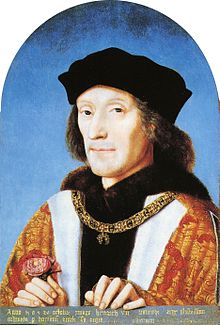
Henry VII came to the throne of England after defeating Richard III at Bosworth in 1485. With his accedence, England came into a long period of “National Pride.” The War of the Roses had weakened the nobility to the point where the Tudors could wield more power than had their predecessors, the Plantagenets. When Henry VII took the throne he broke the power of the barons by bringing back into favor the Court of the Star Chamber, to put on trial those who opposed Henry’s rule.

Henry married Elizabeth of York (uniting the houses of York and Lancaster) at Westminster Abbey on 18 January 1486. Together, they had seven children. He died at Richmond Palace in Surrey on 21 April 1509 at age 52. During his reign, Henry crushed a revolt at Stoke by the Earl of Lincoln on behalf of Lambert Simnel, a claimant to the throne. His invasion of France ended quickly when he withdrew his forces in return for a substantial payment from the French crown. In 1492, Henry managed to squash a second attempt to overthrow his rule. Perkin Warbeck made a claim to the throne; Warbeck was put to death in 1499.

Let us outline the Tudor dynasty.

Henry VII (1485-1509) marries Elizabeth of York (d 1503)

Their children were

(1) Arthur, Prince of Wales (19 September 1486 to 2 April 1502) marries Catherine of Aragon in 1501. (When Arthur dies, Prince Henry becomes heir to the throne. Henry later marries Arthur’s widow.)

(2) Margaret Tudor (28 November 1489 to 18 October 1541) marries James IV, King of Scotland (1473 – 1513) in 1503. Their child was James V of Scotland (1513 – 1542). James V married Mary of Guise. Their marriage gave the land Mary, Queen of Scots (1542-1567). Mary first married Francis II of France (who died in 1560); then Henry Lord Darnley (who died in 1567); and, finally, James, Earl of Bothwell (who died in 1578).

Margaret Tudor

(3) Henry VIII, who was born on 28 June 1491, (1509 -1547) marries Catherine of Aragon (divorced 1533). Their child Mary I ruled England from 1553-1558. Mary I married Philip II of Spain.

Henry VIII marries Anne Boleyn (beheaded in 1536). Their child, Elizabeth I, ruled England from 1558 to 1603.

Henry VIII marries Jane Seymour, who died from complications of child birth in 1537. Their son, Edward VI, ruled from 1547-1553.

Henry VIII marries Anne of Cleves (married and divorced within 7 months in 1540).

Henry VIII marries Catherine Howard (beheaded on grounds of adultery in 1542).

Henry VIII marries Catherine Parr (who died in 1548). Catherine outlived Henry. She married again shortly after his death.

(4) Elizabeth Tudor was born on 2 July 1492 and died 14 September 1495.

Mary Tudor

(5) Mary Tudor was born on 18 March 1496. Mary married Louis XII of France in 1514. Unfortunately, Louis passed in 1515. Mary then married Charles Brandon, 1st Duke of Suffolk. Their child, Francis, married Henry Grey, Duke of Suffolk. Francis and Henry’s child was Lady Jane Grey.

(6) Edmund Tudor, Duke of Somerset, was born on 21 February 1499 and died on 19 June 1500.

(7) Katherine Tudor was born on 2 February 1503 and died the same day. Elizabeth of York died as a result of Katherine’s birth.

(8) An illegitimate son was born to a “Breton Lady.” Sir Roland de Velville was born in 1474. He was knighted in 1497 and was Constable of Beaumaris Castle.


Posted in Uncategorized | Comments Off on Henry VII, the First of the Tudors

What Does Your eBook Reader Tell Publishers About Your Reading Habits?

IT TAKES THE AVERAGE READER JUST SEVEN HOURS TO READ THE FINAL BOOK IN SUZANNE COLLINS’S “HUNGER GAMES” TRILOGY ON THE KOBO E-READER—ABOUT 57 PAGES AN HOUR. NEARLY 18,000 KINDLE READERS HAVE HIGHLIGHTED THE SAME LINE FROM THE SECOND BOOK IN THE SERIES: “BECAUSE SOMETIMES THINGS HAPPEN TO PEOPLE AND THEY’RE NOT EQUIPPED TO DEAL WITH THEM.” AND ON BARNES & NOBLE’S NOOK, THE FIRST THING THAT MOST READERS DO UPON FINISHING THE FIRST “HUNGER GAMES” BOOK IS TO DOWNLOAD THE NEXT ONE.


For centuries, reading has largely been seen as a solitary and private act, an intimate exchange between the reader and the words on the page. But the rise of digital books has prompted a profound shift in the way we read, transforming the activity into something measurable and quasi-public.

In the past, publishers and authors had no way of knowing what happens when a reader sits down with a book. Does the reader quit after three pages, or finish it in a sitting? Do most readers skip over the introduction, or read it closely, underlining passages and scrawling notes in the margins? Now, e-books are providing a glimpse into the story behind the sales figures, revealing not only how many people buy particular books, but how intensely they read them.


The perfect man, according to data collected by digital publisher Coliloquy from romance-novel readers, has a European accent and is in his 30s with black hair and green eyes.


For centuries, reading has largely been a solitary and private act, an intimate exchange between the reader and the words on the page. But the rise of digital books has prompted a profound shift in the way we read, transforming the activity into something measurable and quasi-public.

To learn more about how “Big Brother” is watching another facet of our lives, please visit Alexandra Alter’s article on The Wall Street Journal at http://online.wsj.com/article_email/SB10001424052702304870304577490950051438304-lMyQjAxMTAyMDIwODEyNDgyWj.html


Posted in Uncategorized | Comments Off on What Does Your eBook Reader Tell Publishers About Your Reading Habits?

10 Lessons on Publishing for Women Readers from “Fifty Shades of Grey”

It may be the season for blue skies and sunshine, but the color scheme for books this summer has one shade: grey. British writer E.L. James’ erotic trilogy Fifty Shades of Grey, Fifty Shades Darker and Fifty Shades Freed has surged up like a publishing derecho. In bedrooms and book clubs, on mommy blogs and best-seller lists, it’s all about the blindfold, the billionaire and the “red room of pain.” In the USA, 20 million copies have been sold, and the 1,594-page trilogy has held the top three spots on USA TODAY’s Best-Selling Books list for nine weeks.

Why are millions of readers, most of them women, devouring the trilogy and praying the rumor that James is writing a fourth book is true? Here are 10 reasons Grey is the new green in book publishing.

To learn more about the 10 Reasons “Shades” has succeeded where others have failed, please visit Deirdre Donahue’s article on USA Today/Books at http://www.usatoday.com/life/books/news/story/2012-07-09/fifty-shades-of-grey-el-james-summers-hottest-book/56119174/1

Posted in Uncategorized | Comments Off on 10 Lessons on Publishing for Women Readers from “Fifty Shades of Grey”

Think Twice Before You Self Publish

If there’s a common flaw in self-publishing, it’s that too many books are published too soon. Experienced voices across the publishing world continually advise self-publishers to get help with editing, and not just copyediting but story editing too. It’s difficult, if not impossible, to properly edit your own work. But the siren call of the Kindle store is often too seductive. The urge to finish your first draft, chuck it through a spellchecker and release it in to the wild is often far too strong for eager writers to resist.

But resist you must. Not resisting results in your name being married, permanently, to sub-standard work which doesn’t show off your talents to their best. Do you really want, in five or ten years time, to look back on your early work and cringe? More to the point, do you really want your first act of publishing to result in the irreversible blotting of your copybook with your potential fans?

To read the complete article, please go to Suw Charman-Anderson’s article on Forbes. It is an excellent one for all those who are considering jumping into the self publishing quagmire.

http://www.forbes.com/sites/suwcharmananderson/2012/07/02/dont-publish-that-book/

Posted in Uncategorized | Comments Off on Think Twice Before You Self Publish

Of Water Nymphs and Mermaids – Have You Heard of These UK Legends?

Fairy maidens inhabiting the oceans, rivers, springs, meadows, woods, and wells are collectively known as nymphs. Nymphs resemble humans in height and overall appearance, but they are known for their enchanting beauty and seductive charms. According to most legends, water nymphs are the most dangerous of the “sisterhood.” Many in the UK are surrounded by legends of water nymphs. Of late, I have been researching legends and myths surrounding the south central UK, but I have enjoyed reading many of those found elsewhere in England.

In all countries, “water” is the source of life, and, therefore, it holds a veneration in the world’s various cultures. Sources of water in each small village and thriving metropolis holds the potential for legends and traditions to find root. These are often extremely local, and therefore little known.

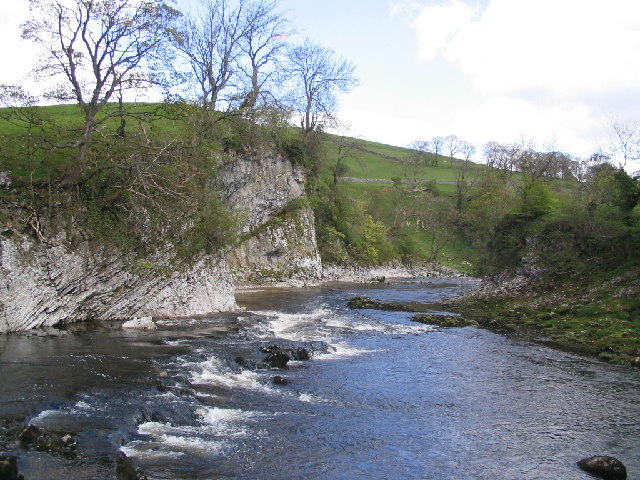
Loup Scar Burnsall:
Loup scar on the river Wharfe at Burnsall is a popular venue with climbers, and the river below is popular with canoeists.

With wells, the names alone suggest much. The memory of the mythical gods, satyrs, and nymphs of the ancient times lingers in a few, as in Thors-kil or Thors-well, in the parish of Burnsall; and in the almost universal declaration — by which not over-wise parents seek to deter children from playing in dangerous proximity to a well — that at the bottom, under the water, dwells a mysterious being, usually named Jenny Green-teeth or Peg-o’-the-Well, who will certainly drag into the water any child who approaches too near to it.

The tokens of medieval reverence for wells are abundant. The names of the saints to whom the wells were dedicated yet cling to them. “There is scarcely a well of consequence in the United Kingdom,” says the editor of Lancashire Folk-lore, “which has not been solemnly dedicated to some saint in the Roman calendar.”

Thus in Yorkshire one finds Our Lady’s Well or Lady Well; St. Helen’s Well; St. Margaret’s Well at Burnsall; St. Bridget’s Well near Ripon; St. Mungo’s Well at Copgrove; St. John’s Well at Beverley; St. Alkelda’s Well at Middleham, etc.

Thomas Hardy’s cottage

In Dorset, one may find a circular pool called Rushy Pond. It is a quarter mile southeast of Thomas Hardy’s cottage at Thorncombe Wood. Reportedly, unwary travelers are lured into the pond, never to seen again.

“I Said And Sang Her Excellence”
by Thomas Hardy

(Fickle Lover’s Song)

I said and sang her excellence:
They called it laud undue.
(Have your way, my heart, O!)
Yet what was homage far above
The plain deserts of my olden Love
Proved verity of my new.

“She moves a sylph in picture-land,
Where nothing frosts the air:”
(Have your way, my heart, O!)
“To all winged pipers overhead
She is known by shape and song,” I said,
Conscious of licence there.

I sang of her in a dim old hall
Dream-built too fancifully,
(Have your way, my heart, O!)
But lo, the ripe months chanced to lead
My feet to such a hall indeed,
Where stood the very She.

Strange, startling, was it then to learn
I had glanced down unborn time,
(Have your way, my heart, O!)
And prophesied, whereby I knew
That which the years had planned to do
In warranty of my rhyme.

BY RUSHY-POND.

Rushy Pond

Old Harry Rocks

At Old Harry Rocks at Studland in Dorset, there is a mystery of sorts. The water level never changes, whether by storms or droughts. Again, water nymphs are said to inhabit the pool and practice their magic within the pool’s depths.

Surprisingly, Staffordshire, which has no coastline, has the Legend of the Mermaid of Black Mere Pool. The small, remote, hilltop lake, around 50 metres wide, creates the perfect haunting site. Set on the craggy and barren southern edge of the Peak District, it is said that the dark, peat-stained waters of the pool are bottomless. Cattle refuse to drink from the water and birds never fly above it. A number of mysterious drownings are attributed to the waters, as well as one murder. In 1679, a woman pedlar was dumped into the pool by a local serial killer.

Tradition holds that the mermaid rises from the pool at midnight to lure unwary travellers to their deaths in the dark watery depths – but only single men, apparently. There are various legends concerning the origin of the mermaid. In one, a sailor from nearby Thorncliff fell in love with her and brought her back from sea, and in another she was originally a witch who transformed herself into a water nymph after been thrown into the pool during the Middle Ages.

Black Mere Pool

Posted in British history | Tagged , , , , , , | 2 Comments

A Resurgence of Jane Austen

Several people believe that Colin Firth’s stellar two-year “flirt” with Oscar’s fame – first with a spectacular performance in “A Single Man” and then in “The King’s Speech” – has led to a resurgence of Jane Austen’s popularity. In the 1995 BBC mini-series, Firth played the enigmatic Mr. Darcy from Austen’s Pride and Prejudice, and a legion of Austen fans are cheering on his successes. Obviously, I am one of those. I write Jane Austen adaptations, as well as Regency era romances. For a more detailed analysis of this “new” phenomena, read the article below from The Star.

Kristin Rushowy
Education Reporter
Almost 200 years after her death, it is a truth universally acknowledged that Jane Austen and her works have found new life in the online world.

But these days, there’s another, real-world reason for all the interest in the 19th-century novelist: English actor Colin Firth.

Beloved among fans for his portrayal of Mr. Darcy in the famed 1995 BBC production of Pride and Prejudice.

Firth was the reason “a lot of people got hooked on the novels,” said Deidre Lynch, an English professor at the University of Toronto whose Austen classes typically have as big a wait list as the classes themselves.

But, she added, that’s too simple an explanation for Austen’s ever-growing legion of fans. Social media, too, have given Austen a second life.

Austen is on Twitter — well, fans tweeting in her name — and is the subject of countless Facebook fan pages that grow daily, one with almost 850,000 “likes.” Devotees have created aFacebook newsfeed version of P&P, and others post videos to Youtube in Austen’s honour, from serious scene recreations to hilarious send-ups.

“It’s like votive offerings to Jane Austen, as if she were a saint,” said Lynch, editor of Janeites: Austen’s Disciples and Devotees.

In her current undergraduate class on romantic poetry and prose “Austen makes a few appearances,” she said. “The students would probably prefer more.”

Publishers often have trouble keeping up with demand for Pride and Prejudice.

There has been “a pretty steadily increasing Austen presence in popular culture — but not much of that really connected to the books Austen wrote,” noted Elaine Bander, president of the Canadian chapter of the Jane Austen Society of North America.

To read the complete article, please visit, http://www.thestar.com/entertainment/books/article/934803–jane-austen-is-back-thanks-to-colin-firth

Posted in Uncategorized | Tagged | Comments Off on A Resurgence of Jane Austen

The Movie “Becoming Jane” and Hidden References to Austen’s Novels

By Regina Jeffers

Becoming Jane is an imaginative, romantic tale that captures Jane Austen’s spirit, while playing with the truth. Many of us who delve in Austen-inspired literature have written our own “what if” stories, but one must be able to suspend reality and accept the witty, enchanting romance as all good storytelling to truly enjoy this film. (I did. So, I’m not offering that point as a criticism – only as a warning for those unfamiliar with the film.) This film takes some well known facts from Austen’s life and spins them into an ingenious tale of lost love.

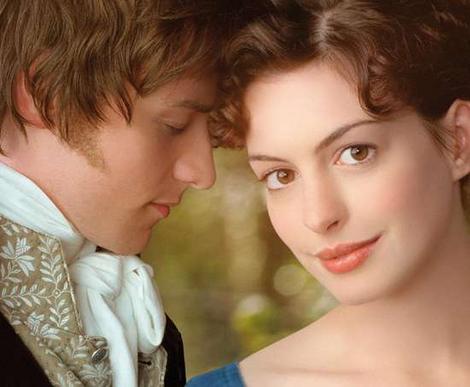
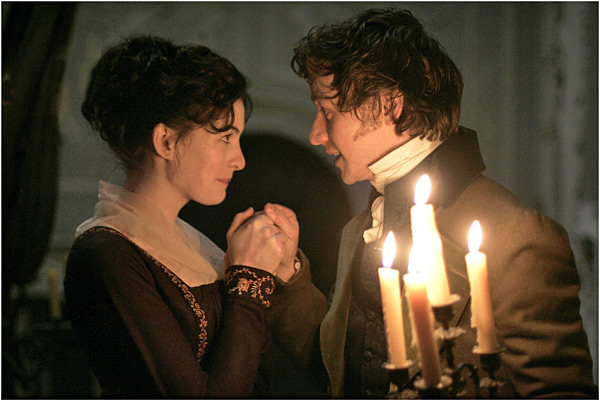
The film opens in the year 1795 and explores the feisty beginnings of an emerging 20-year-old writer, who wishes to live beyond what is expected of her – to actually marry for love. Anne Hathaway portrays Jane Austen, and James McAvoy plays the non-aristocratic Tom Lefroy, whose intellect and arrogance first raises young Jane’s ire and then captivates her heart. Juliann Jarrold, the film’s director says that “A couple of recent biographies have sort of honed in on this romance with Tom Lefroy, because it’s the older bios that tend to say she [Austen] didn’t have this romance; that somehow, out of her imagination, she was able to portray these amazing characters. Straight after [the alleged romance], she started writing First Impressions – and then Sense and Sensibility, and Northanger Abbey.” (BTW, do you not love the facial similarities between the real Tom Lefroy and James McAvoy in these two pictures?)

The film is known for taking the truth and making it a reality. For example, there is some evidence that Ann Radcliffe influenced Jane Austen; however, the film creates a meeting between the two. During this encounter, Radcliffe asks Austen of what she will write.
Radcliffe: Of what do you wish to write?
Jane:  The heart.
Radcliffe: Do you know it?
Jane: Not all of it.
Radcliffe: In time you will. If not…well, that situation is what imagination is for.
The film also provides us with plenty of “Jane” talk. For example, we hear part of the story/poem that Jane has created as a tribute to her sister Cassandra’s engagement.
“The boundaries of propriety were vigorously assaulted, as was only right, but not quite breached, as was also right. Nevertheless, she was not pleased.”
When others question Jane’s ambitions to become a novelist, she responds,
“Novels are poor insipid things, read by mere women, even, God forbid, written by women.”
But beyond the plot’s twists and turns, Becoming Jane playfully references Austen’s themes, characters, and story lines. So my question is how many such references can you name? Here are some (but not all) that I noted.
  • From Pride and Prejudice, we find…
  1. Jane’s character resembles a cross between the flirtatious Lydia Bennet, who loves to dance, and Elizabeth Bennet, whose verbal swordplay with Mr. Darcy is enticing. Mr. Warren is the klutzy clergyman whose proposal reminds us all of Mr. Collins. (He also is a bit like Mr. Elton in Emma.)
  2. Lady Gresham (Maggie Smith) is so Lady Catherine De Bourgh. She does not want Wisley to consider Jane as a mate, and I love the scene where she mentions “a little wilderness.”
  3. Lefroy’s character reminds of us the “worthless” activities of George Wickham early on in the film. Like Wickham, Lefroy studies law, but with not much success. Later he is very much Darcy in his judgment of “country” life.
  • From Sense and Sensibility, we find …
  1. Like Marianne Dashwood, Jane’s decisions are not based on “sense,” but on her “sensibility” (emotional response).
  2. Jane’s situation, if she does not marry Wisley, will be very much like the Dashwood sisters after losing their home.
  • From Northanger Abbey, we find …
  1. Jane plays cricket, very much as did Catherine Morland.
  2. Jane defends her desire to write novels.
  3. The scene in Uncle Benjamin’s house between Jane and Lefroy reminds one of the staircase scene between Henry Tilney and Catherine Morland.
  4. References to Ann Radcliffe’s (as well as other Gothic novels) are made in the novel. In the film, Jane visits Radcliffe.
  • From Mansfield Park, we find …
  1. Lady Gresham’s line to Jane about her duty to marry well reminds us of those spoken by Lady Bertram to Fanny Price.
  2. Lady Bertram spends her days with her pug dog, as does Countess Eliza, Jane’s cousin.
  • From Persuasion, we find …
  • Although she loves him, Jane breaks an engagement with Lefroy so that he has a chance for a better future. This is similar to what happens between Anne Elliot and Captain Wentworth.
  • In the novel, Anne meets Wentworth at a concert, where she must translate the opera for her cousin. She recognizes their love still exists, but she can say nothing. “How was the truth to reach him?” In the film, Jane meets Lefory many years after their separation at a concert. He has married and has a daughter named “Jane.”
Posted in Jane Austen | 12 Comments