Beware of Using Images from Google Searches

Recently, author Roni Loren shared her unfortunate experience of being sued for using copyrighted photos in a blog, pictures she had found on a Google search and pictures she had thought would be acceptable if she added to a personal, not-for-profit blog, on which she included a “I don’t claim to own this picture” disclaimer. Unfortunately,  because the law was n his side, the photographer won. This is a lesson from which we all can learn. Be careful what pictures you add to your blogs! (With her permission, I have linked this blurb to Roni Loren’s blog and the complete story.)

Posted in Uncategorized | 2 Comments

The Nomenclature of Nineteenth Century Address

How did one keep all those numerous titles straight when he addressed the members of the aristocracy and the titled?

Here are some of the MANY differences of which one needed to be aware:

“Lady” – used for the wife of a baronet or a knight (i.e., Sir Thomas Bertram’s wife in Mansfield Park is Lady Bertram)

“Lady” – used for a marchioness, countess, viscountess, or baroness (i.e., the wife of Viscount Lexford became Lady Lexford)

“Sir” – used for a baronet or a knight with his first name (i.e., Sir Thomas Bertram or Sir Walter Elliot from Persuasion)

“Baron” – used for a judge of the Exchequer Court or for a baron of the peerage upon formal occasions

“Lord” – used for an earl, marquis, or viscount – usually this was the title the man possessed (for example, the Earl of Linworth became Lord Linworth); barons were rarely spoken of as Baron Ashworth; instead, the man would be Lord Ashworth

“My Lord” – used for a peer below the rank of duke and to a bishop of the Church of England

“My Lord” – used for a lord mayor and judges of the King’s Bench and Common Pleas court

“Your Grace” – to a duke or duchess if the person making the address were below the gentry; the title is also used for an archbishop of the Church of England

“Duke” or “Duchess” – used for a duke or duchess and used by a member of the nobility or gentry

“Your Highness” – used for the nephews, nieces, and cousins of the ruling monarch/sovereign

“Your Royal Highness” – used for the monarch/sovereign’s spouse, children, and siblings

“Your Majesty” – used for the king or queen

Posted in British history, real life tales, Regency era | Comments Off on The Nomenclature of Nineteenth Century Address

“Dancing” in Austen’s Novels

I won’t dance; don’t ask me…

“To be fond of dancing was a certain step towards falling in love.” (Pride and Prejudice, Chapter 3) During Austen’s time, young people looked for a potential mate at dances. Austen, herself, enjoyed a good dance, and, therefore, she often used dance as part of her plot line. In a 1798 letter to her sister Cassandra, Austen wrote, “There were twenty Dances & I danced them all, & without any fatigue.” Dancing well was a “necessary evil.” Those who trod on their partners toes (i.e., Mr. Collins) were seen as gauche. Children of the gentry learned the latest dance steps early on.

Public balls or assemblies and private balls formed the two types of formal dances. Assemblies took place in large ballrooms in market towns and cities. They were constructed for the purpose of public gatherings. One might also hold a dance in the ballrooms at country inns (as in the Crown Inn inEmma) or in formal ballrooms in large houses (as in the Netherfield Ball in Pride and Prejudice or Sir Thomas’s ball in Mansfield Park).

Occasionally, the gentry would roll up the rugs for an impromptu dance. These were more characteristic of country life.

Characters discussing “dancing” and participating in “dance” occurs often in Austen’s story lines. FromPride and Prejudice, we find, “Elizabeth Bennet had been obliged, by the scarcity of gentlemen, to sit down for two dances…” (and) “Come, Darcy,” said he, “I must have you dance. I hate to see you standing about by yourself in this stupid manner. You had much better dance.” (as well as) “She had known him only a fortnight. She danced four dances with him at Meryton…”

“Every stranger can dance.” Sir William only smiled. (and)

“You would not wish to be dancing when she is ill.” (and)

“…and Elizabeth thought with pleasure of dancing a great deal with Mr. Wickham…” In fact, Austen uses “dance” eight and sixty times during the story line.

From Persuasion, the reader finds these references to “dancing.” 

“The girls were wild for dancing; and the evenings ended, occasionally, in an unpremeditated little ball.” (and) “This evening ended with dancing.” (as well as) “Oh, no; she has quite given up dancing.” (and)

“Yes, I believe I do; very much recovered; but she is altered; there is no running or jumping about, no laughing or dancing…” There are ten references to dance in Persuasion.

The reader comes across nine and forty mentions of the word “dance” in Mansfield Park. We have such gems as, “…for it was while all the other young people were dancing, and she sitting, most unwillingly, among the chaperones at the fire…” (and) “…been a very happy one to Fanny through four dances, and she was quite grieved to be losing even a quarter of an hour.” (as well as) “…but instead of asking her to dance, drew a chair near her, and gave her an account of the present state of a sick horse…” (and) “I should like to go to a ball with you and see you dance. Have you never any balls at Northampton? I should like to see you dance, and I’d dance with you if you would, for nobody would know who I was, and I should like to be your partner once more.”

“Dancing” is mentioned nine and sixty times in Emma. “She was in dancing, singing, exclaiming spirits…” (and) “She had suffered very much from a cramp from dancing, and her first attempt to mount the bank brought on such a return of it as made her absolutely powerless…” (and) “Indeed I will. You have shewn that you can dance, and you know we are not really so much brother and sister as to make it at all improper.” (as well as) “Pleasure in seeing dancing! – not I, indeed – I never look at it – I do not know who does. Fine dancing, I believe, like virtue, must be its own reward.” 

From Love and Friendship, one finds, “The Dancing, however, was not begun as they waited for Mis Greville.” (and) “I soon forgot all my vexations in the pleasure of dancing and of having the most agreeable partner in the room.” (as well as) “I can neither sing so well nor Dance so gracefully as I once did.” There are ten references to “dance” in Love and Friendship. 

One and twenty references to “dance” appear in Sense and Sensibility. They include: “In the country, an unpremeditated dance was very allowable…” (and) “Never had Marianne been so unwilling to dance in her life…” (and) “They speedily discovered that their enjoyment of dancing and music was mutual…”

Seven and sixty uses of “dance” can be found inNorthanger Abbey. One can find, “He wants me to dance with him again, though I tell him that it s a most improper thing, and entirely against the rules.” (and) “Oh, no; I am much obliged to you, our two dances are over; and, besides, I am tired, and do not mean to dance any more.”

My favorite quote regarding dancing comes fromNorthanger Abbey. In it, Henry Tilney makes a comparison between “dancing” and “matrimony.” He says, “…that in both, it is an engagement between man and woman, formed for the advantage of each; and that when once entered into, they belong exclusively to each other till the moment of its dissolution; that it is their duty, each to endeavor to give the other no cause for wishing that he or she had bestowed themselves elsewhere, and their best interest to keep their own imaginations from wandering towards the perfections of their neighbours, or fancying that they should have been better off with any one else.”


So, what are your favorite scenes in Austen’s novels that are associated with dancing? In November at Austen Authors (http://austenauthors.net), we will celebrate the 200thAnniversary of the Netherfield Ball. Are there other poignant Austen moments centering around dance? Please share your favorite scenes with all of us.

Posted in Jane Austen, Regency era | Tagged , , , , , , , , | 4 Comments

Dorset’s Cerne Abbas Giant and Fertility Legends

The Cerne Abbas Giant is a quirky figure carved out on Trendle Hill in Dorset, UK. Some 180 feet tall, the naked “Giant” holds a club aloft in his right hand. How he came to be resting on this hillside is a local mystery.

Cerne Abbas is a tourist village with many attractions, including the river, streets lined with stone houses and the Cerne Abbey. The church of St Mary is of 13th century origin but was largely rebuilt in the 15th and early 16th centuries and partly reconstructed in the 17th century. Features of interest include the 17th century pulpit and the great east window, which probably came from the abbey. In 2008, Cerne Abbas was voted Britain’s “Most Desirable Village.”

The most famous attraction is the Cerne Abbas Giant,  a 55 metre (180 ft) naked figure carved into the chalk hillside. The giant, owned by the National Trust, is thought by many to be an Iron Age fertility symbol but, as it is unlikely that the monks of Cerne Abbey would have tolerated such a figure, and with no records before the 17th century, this cannot be confirmed. Many scholars now think that it was created in the mid-17th century, although there is evidence of Iron Age settlement on the downs nearby.

One legend associated with the Giant is he represents a real-life giant who terrorized Cerne by killing livestock and even children. Reportedly, one day as the giant lay sleeping on the hillside, the villagers killed him. Afterwards, they cut out his outline in the chalk downlands.

Historians have claimed that the Giant is Cernunnos or Hercules or Gogmagog. However, as the Giant predates Roman occupation of England, the figure is likely a Celtic Fertility God.

Legend says that if a woman sat on the figure’s penis that it would cure her infertility. Other versions of the tale say the woman must spend a night laying on the figure during a new moon to cure her barrenness. Some say that the couple must have sexual intercourse while lying upon the outlined figure.

As crazy as these tales sound, in 1958, the Marquis of Bath and his wife Virginia visited the site. Having unsuccessfully tried to have a child for five years, the couple chose to lie on the Giant. Ten months later, their daughter was born. In tribute, the Marquis named the child Silvy Cerne. She is now Lady Silvy Cerne McQuiston. The Marquis even listed the “G. Cerne” as the child’s godfather on her baptismal papers. The family made an annual pilgrimage to the Giant.

Mr and Mrs Thorne of Puddletown were blessed by a white witch and performed an “active” romp upon the Giant’s form in 1998. Nine months later, Mrs Thorne delivered up a healthy boy.

Unfortunately, the National Trust, which owns the form and area surrounding it, have erected a protective fence around the site. They fear that too many such “expeditions” by desperate couples could erode away the Giant’s chalk form.

The Wessex Morris Men perform Morris dancing above the Giant every May Day at sunrise 5:28 A.M.

_____________________

For an article on the fertility boom in the area, visit The Telegraph.

Posted in British history, gothic and paranormal, legends and myths | 2 Comments

A Lesson on Victorian Prison Reform

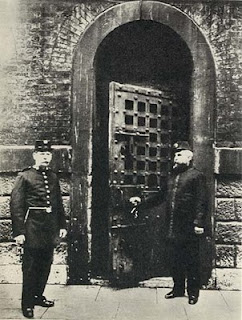
Bexhill Crouch Prison

Victorians were worried about the rising crime rate: offences went up from about 5,000 per year in 1800 to about 20,000 per year in 1840. They were firm believers in punishment for criminals, but faced a problem: what should the punishment be?

There were prisons, but they were mostly small, old and badly-run. Common punishments included transportation – sending the offender to America, Australia or Van Diemens Land (Tasmania), or execution – hundreds of offences carried the death penalty.

By the 1830s people were having doubts about both these punishments. The answer was prison: lots of new prisons were built and old ones extended.

One of the areas often looked at when states and local governments attempt to balance their budgets is the cost of maintaining prisons and jails. Recently, a national news source told of how one jail had prisoners clipping coupons for Swanson dinners. The jail would place an order with the local supermarket and use the coupons to reduce the cost of feeding the prisoners.

Such reforms can find their roots in great Victorian obsession to economize public expenditures. The idea of one prisoner per cell was actually an American innovation – the belief being that the prisoner, if kept in isolation, would know remorse for his crimes. In 1842, such a prison was built in Pentonville, Pennsylvania. Within six years, 54 prisons followed suit.

In Bath, England, a new Bath City Gaol was built at Twerton. The estimated cost of the gaol was £18,650, with the funds to build the gaol supported by local investors. The gaol was designed to hold 20 male debtors, 12 female debtors, 10 prisoners in the Infirmary, and 80 prisoners in separate cells.

Photograph, court yard of Wormwood Scrubs Prison, groups of prisoners pulling carts. (COPY 1/420 f.180)

The cells were 13 feet x 7 feet x 9 feet, and each contained a W.C. Besides separate cells, there were separate yards and separate sheds for working, as well as separate stalls in the chapel so the prisoner could only look upon the chaplain and not other prisoners.

Mr. Pike, the Turnkey of the Old Gaol on Grove Street, was given the position of Governor of the New Gaol at a salary of £100 per annum, plus £20 for his wife acting as Matron.

Fifteen years later, Mr. Perry, the Inspector of Prisons, set upon an inquiry into the running of the Bath City Gaol. The Pikes were charged with using prisoners as laborers about their home: tending the farm animals, working in the garden, doing housework, etc. Mrs. Pike allowed a prisoner named Amelia Hall to meet with her family and friends in the Governor’s house.

A breach of contract between Her Majesty’s Government and the Bath Town Council occurred over the supply of leather required for the manufacture of shoes by the convicts. Accounts were altered in the Governor’s favor. Some 12-18 pairs of shoes were made for Pike’s family members rather than for the prisoners over a two year period.

Needless to say, Pike was relieved of his duties. The management of the gaol was placed under the control of the Visiting Justices. The experiment of prison reform in Bath (financed by private capital; contracts for materials by competitive tender; subject to minimal accountability) does not lend itself well to the idea of the privatization of prisons.

Posted in British history, real life tales | Comments Off on A Lesson on Victorian Prison Reform

We Get Stacks and Stacks of Letters…

On the Perry Como Show, the chorus used to sing: “Letters, we get letters. We get stacks and stacks of letters.” However, during the Regency Period, the mail was expensive. MPs were the only ones who had a “free” ride for the mail delivery. Until 1840, MPs could “frank” their own letters.

In Jane Austen’s Mansfield Park, Edmund tells Fanny to have a friend or relative who was an MP to frank the letter for her and, therefore, save the Price family from the cost of the letter. “As your uncle will frank it, it will cost William nothing.”

Postage was based on the number of miles the letter traveled from point A to point B. Recipients paid, rather than the sender of the letter. These were the going rates for a single page: fourpence for the first fifteen miles, eightpence for eighty miles, etc., etc., up to seventeen pence for a letter covering seven hundred miles. Additional pages increased the price accordingly.

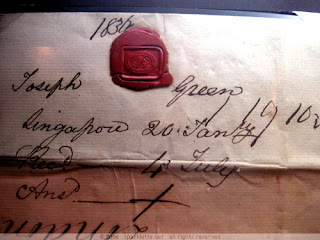
To save on the expense of sending a letter, people developed their own form of “Tweeting.” Abbreviations saved space. Often the writer would “cross” the letter, which meant turning the letter at right angles and writing between the previously written words.

A “two penny post,” which was developed for mail delivery within London proper, was separate from the General Post Office, which dealt with the national mail. There were designated shops for dropping off the mail.  As with the writing of the letter, abbreviations were used as part of the address/directions to speed the delivery: “W” for the West End; “N” for north of the Old City, etc.

After 1840, a person could send a letter anywhere in England for the cost of one penny. Railroads sped the delivery system and made the mail service more economical. Also, before 1840 envelopes were generally not used. In Jane Austen’s stories, her characters use a wafer to seal the letters. A wafer was small disk made of flour and gum. A person would lick the wafer and stick it to the folded sheet of writing to form the envelope. Those of the upper class used seals. It was melted and applied to the letter. Commonly, red seals were used for business and other colors for social correspondence. Black was a sign of death and mourning. 

Posted in British history, Jane Austen, Regency era | 3 Comments

The Peerage

If one reads Regency romance, he encounters his fair share of England’s titled gentlemen, often referred to as the “peerage.” In order of rank, one finds dukes, marquesses, earls, viscounts, and barons. Baronets and knights were NOT peers. The House of Lords were made up of those of the first rank, along with the bishops and the archbishops of the Church of England.

The title and the landed estates associated with the peerage were always inherited. “Life peerages” were created in the late 1800s, but, generally, without exception, the title passed to the eldest son. If the heir left a male child, the child would inherit if his father had passed before inheriting. If the child had died or there were no issue from the marriage, a brother could inherit. The male line of direct descent from the first holder of the title was always maintained. Even if the only male available was from a junior or “cadet” branch of the original family, he would inherit the title and the manor. Originally, titles were presented with “letters of patent” as a symbol of the presentation. The person with the oldest “patent” held rank over others of the same title.

As the estates became more and more problematic to maintain, many of the peers were forced to look beyond those with strong ancestral lines for mates. A woman from trade or of inferior lines could often marry into the peerage if she possessed a large enough fortune. Besides the expensive way of life that a titled gentleman was forced to uphold, the cost of maintaining the entailed property was often exorbitant. Marrying for love was not an option. A marriage of convenience often meant the titled gentleman must marry for the lady’s money. The man’s wife received the female equivalent of his title: duke/duchess; viscount/viscountess; earl/countess; etc. However, if an untitled gentleman married a titled lady, she relinquished her formal address to become a “Mrs.” In addressing a titled gentleman, he might have an accumulation of titles, such as Baron Joe, Viscount Smoe, and the Earl of Doe.


A British or Irish Duke is entitled to a coronet (a silver-gilt circlet, chased as jewelled but not actually gemmed) bearing eight conventional strawberry leaves on the rim of the circlet. The physical coronet is worn only at coronations. Any peer can bear his coronet of rank on his coat of arms above the shield.

So, how did one become a member of the peerage? Generally speaking, the title and land was bestowed upon a man for his loyalty and service to the monarchy. The prime minister in power, at the time, granted the power. Occasionally, military heroes (i.e., the Duke of Wellington) and lord chancellors were given titles. Rarely were commoners presented a title. If a commoner had no children (therefore, the title would die out with him), a title might be possible for extraordinary service. With each generation, only one child (the male heir) was given the title. The other children were “commoners.” Recently minted peers were not well received by the other members of the aristocracy.

Below the peerage were the baronets and knights, who were addressed as “Sir.” A baronetage was hereditary, but baronets were not peers, and they did not sit in the House of “Lords.” Baronets were the upper levels of the gentry. They might sit in the House of Commons, but this was not part of the title. Knighthoods were not hereditary. Distinguished lawyers and doctors and brewers became baronets, while those in trade were bestowed with the “Sir” of a knighthood.

A Royal Duke is a duke who is a member of the British Royal Family, entitled to the style of “His Royal Highness.” The current Royal Dukedoms are, in order of precedence:

▪                Edinburgh, held by The Prince Philip

▪                Cornwall (England) and Rothesay (Scotland), held by The Prince Charles, Prince of Wales

▪                Cambridge, held by Prince William

▪                York, held by The Prince Andrew

▪                Gloucester, held by Prince Richard

▪                Kent, held by Prince Edward

With the exceptions of the dukedoms of Cornwall and Rothesay, which can only be held by the eldest son of the Sovereign, royal dukedoms are hereditary, according to the terms of the Letters Patent that created them, which usually contain the standard remainder to the “heirs male of his body.” The British monarch also holds and is entitled to the revenues of the Duchy of Lancaster, and within the borders of the County Palatine of Lancashire is by tradition saluted as “The Duke of Lancaster.” Even when the monarch is a Queen regnant, she does not use the title of Duchess.

Posted in British history, Regency era, Uncategorized | Comments Off on The Peerage

The Life of the Gentry During the Regency Period

Caroline of Brunswick

During the Regency Period, wealth and social class separated the English citizenry. Beginning with the Royals, citizens found their place based on birthright and wealth. The nobility stood above the gentry, who stood above the clergy, who stood above the working class, etc. As part of the gentry, Jane’s family held certain privileges, but also lacked political power. Although he was a rector, the Reverend George Austen was a gentleman. Austen’s novels are populated with those of the gentry. Occasionally, her readers encounter the nobility, as in Lady Catherine De Bourgh and the Dowager Viscountess Dalrymple or the clergy as with Mr. Collins or Mr. Elton.

To be part of the landed gentry, the family had to own 300+ acres of property. The Reverend George Austen was part of the gentry, but he came from the lower end of the class distinction, while Jane’s mother came from a wealthier background. When one reads Austen, he meets the gentry. A member of the gentry was known as a gentleman, but not all members of the gentry acted as a gentleman. 

Good manners defined a person during the era. Loosely based on Renaissance Italy and 17th Century French customs, the “rules” of engagement during the Regency Period were strictly enforced by members of the “ton.” One who did not adhere to the rules would be shunned by Society.

A gentleman, for example, was expected to speak properly and to avoid vulgarity; to be dressed appropriately; to be able to dance well; to be well versed on a variety of subjects and to have a university education or above; and to practice condescion to those of a lower class.

When addressing women the eldest daughter in a family would be referred to as “Miss” + her last name (i.e, Miss Elliot or Miss Bennet). Youngest sisters would be “Miss” + the woman’s given name (i.e, Miss Anne or Miss Elizabeth). Addressing males followed a similar form. The eldest son was “Mister” + last name (i.e, Mr. Ferras or Mr. Wentworth). The younger sons used both given name and surname (i.e., Mr. Robert Ferras or Mr. Frederick Wentworth).

People of lower rank had to wait to be introduced to someone of a higher rank. (Do you recall Catherine Morland and Mrs. Allen at Bath? They must wait for an introduction to Henry Tilney, who calls upon the evening’s master of ceremonies to do the deed.) Women of the period were to be obedient to their fathers and husbands, docile and without opinions, have refined qualities, and attendant to their families. Education was not a prerequisite for women. In Austen’s stories, her heroines often shun these qualities. 

Posted in British history, Jane Austen, Regency era | 2 Comments

Oh the Places You Will Go…Real-Life Places in Jane Austen’s Life

The grand country estates and locations used in the film adaptations of Jane Austen’s novels often lead her fans into believing that “our Jane” lived in some of Britain’s finest homes. But where, oh where, did Jane Austen call home?

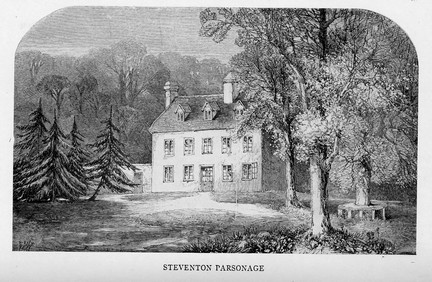
Steventon Rectory in Hampshire

The Steventon Rectory was Jane Austen’s birthplace. She lived at Steventon until she was five and twenty, from 1775-1801. It was a 17th Century property surrounding by large fields and sporting an attached farm. The Rectory is no longer standing, but St Nicholas Church, where Reverend Austen was the rector, can be seen. However, please remember that if you go to Hampshire that St Nicholas burned down and was rebuilt in 1872.

Bath

In 1800, Reverend Austen considered retirement. Because the Austens had met and married in Bath, the resort city became their destination. In May 1801, the Austens moved into a temporary “home.” In September, they found more permanent accommodations. They finally moved into 4 Sydney Place. There’s a plaque outside the house to commemorate Jane Austen’s years at the house. Because it was much smaller than their Steventon home, the Austens sold off Reverend Austen’s library and the pianoforte.

Southampton and Godmersham

With the passing of Reverend Austen in 1805, Jane, her mother, and her sister Cassandra found themselves in poor financial straits. The Austen took on the support of their mother and sisters. In 1806, the women moved in with Frank Austen and his new wife in Southampton. In 1808, they went to stay with Edward Austen at his Godmersham estate in Kent.

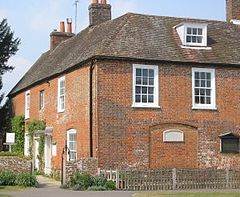
Chawton cottage

Chawton

In 1808, Edward lost his wife to childbirth. After this tragedy, he offered a six-bedroom cottage on another of his estates to his family. The women moved into the Chawton cottage in Hampshire, which was close to the Steventon property upon which they had once lived. By this time, James Austen was the Steventon rector. Jane published four novels while living at Chawton. She finished a fifth and started a sixth one during those years.

Winchester

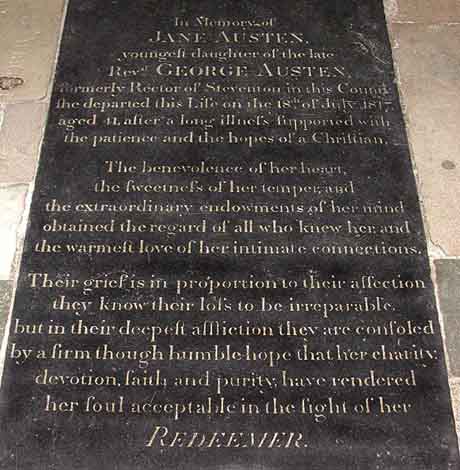
By 1816, Jane was no longer able to write. Her illness had progressed. In May 1817, her family took Jane to Winchester so that she might be near her physician, Giles King Lyford. They moved in with their old friends, the Biggs, at 10 College Street. In July 1817, Jane Austen lost her fight with her illness. She passed peacefully. She is buried at Winchester Cathedral. 

Posted in British history, Jane Austen, Regency era | Tagged | Comments Off on Oh the Places You Will Go…Real-Life Places in Jane Austen’s Life

Dorset’s Demon Judge

James Scott, first Duke of Monmouth

In June 1685, James Scott, the first Duke of Monmouth, the illegitimate son of King Charles II, landed at Lyme Regis in Dorset, bringing with him a bloody swatch of rebellion. In the days that followed, horror filled the hearts and minds of those living in the area. Monmouth brought some eighty trained soldiers with him. When King Charles II died, his Catholic brother, James, the Duke of York, who became King James II, succeeded him. However, Monmouth, a Protestant, made a bloody bid for the throne.

Landing in Lyme Regis, Monmouth marched across the West Country towards Taunton, into Somerset, Devon, and back to Dorset, gathering support for his bid. The revolt soon became known as The Pitchfork Rebellion. When word reached James II of his “nephew’s” efforts to claim the throne, James II sent an army, commanded by Lord Faversham, to crush the revolt.

On July 6, the two armies clashed at the Battle of Sedgemoor, where Monmouth’s army, along with the Duke, fled. The following morning, disguised as a farm laborer and hiding in a ditch at a spot now known as Monmouth’s Ash, the Duke was captured near Horton Heath, about 8 miles south of the hamlet of Woodyates. Escorted immediately to London, Monmouth was tried for treason and, eventually, beheaded on Tower Hill on July 15, 1685.

Monmouth’s Execution

George Jeffreys

As part of his revenge on those who stood with Monmouth, King James II sent his most ruthless judge, George Jeffreys, the First Baron Jeffreys of Wem, to deal with the rebels. Jeffreys held a reputation for swift justice and merciless sentences; he, eventually, rose to the position of Lord Chancellor, and occasionally served as Lord High Steward.  Some 1400 prisoners were brought before Jeffreys at the courts of Winchester, Taunton, and Dorchester. The court hearings were given the title of The Bloody Assizes, for some 300 men were put to death during the proceedings. Those found guilty by Jeffreys were hanged or drawn and quartered. Rotting bodies hung from makeshift gallows peppered the main highways and towns in the area. These gruesome sights were a clear warning to those who might force the king’s hand. Another 800 men were sentenced for transportation.

George Jeffrey

From his Prescript to the Sheriff of Dorset, Jeffreys leaves these orders: “These are, therefore, to will and require of you, immediately on sight hereof, to erect a gallows in the most public place to hand the said traytors on, and that you provide halters to hang them with, a sufficient number of faggots to burn the bowels, and a furnace or cauldron to boil their heads and quarters, and salt to boil them with, half a bushel to each traytor, and tar to tar them with, and a sufficient number of spears and poles to fix and place their heads and quarters; and that you warn the owners of four oxen to be ready with dray and wain, and the said four oxen, at the time hereafter mentioned for execution, and you yourselves together with a guard of forty able men at the least, to be present by eight o’clock of the morning to be aiding and assisting me or my deputy to see the said rebels executed. You are also to provide an axe and a cleaver for the quartering of the said rebels.”

Judge Jeffreys opened the Bloody Assizes at Dorchester on 5 September 1685 at the Antelope Hotel in the “Oak Room.” During his stay in Dorchester, Jeffreys stayed at a house in High West Street, a building, which is still known as his lodgings, and made his way to the courtroom by a secret passage in order to avoid the angry crowds. In one of his more infamous manipulations, Jeffreys convinced a young girl to spend the night in his bed in exchange for her brother’s freedom. When the girl woke the next morning, she peered out the window to see her brother hanging from the neck by a Bridport Dagger. (The town of Bridport was known for the production of netting and rope for the fishing industry and for use by the British navy. Bridport was also known for the production of the hangman’s rope. It was customary to say that those who were hanged were “stabbed by a Bridport Dagger.”) By the time, Jeffreys moved on to Lyme Regis, he had sentenced 74 men to death, sent another 175 to transportation, had 9 whipped, and pardoned 55.

On 11 September 1685, the Bloody Assizes opened at Lyme Regis. On the 12th of September, twelve men were executed on the beach west of the Cobb, and their body parts were displayed on spikes along the railings around the church. Two of the men’s heads were impaled on the iron gates of Chatham House. Jeffreys had dined at the great house on Broad Street the evening before the executions. Since that time, Jeffreys’ ghost is said to carry a bloody bone through the house.

This ghost tale is circumspect at best. After all, in reality, Jeffreys died some four years after the Bloody Assizes ended. During the Glorious Revolution, Jeffreys stayed in London when James II fled However, when William III’s troops marched into the city, Jeffreys disguised himself as a sailor and made his escape. He was captured at a public house in Wapping (now named The Town of Ramsgate). Fearing the public outcry for his “crimes,” Jeffreys begged for protection. On 18 April 1689, he died of kidney failure while in custody in the Tower of London.

Book Blurb:

The Disappearance of Georgiana Darcy

A Pride and Prejudice Mystery

By Regina Jeffers

A thrilling novel of malicious villains, dramatic revelations, and heroic gestures that stays true to Austen’s style…

Darcy and Elizabeth have faced many challenges, but none as dire as the disappearance of Darcy’s beloved sister, Georgiana. After leaving for the family home in Scotland to be reunited with her new husband, Edward, she has disappeared without a trace. Upon receiving official word that Georgiana is presumed dead, Darcy and Elizabeth travel to the infamous Merrick Moor to launch a search for his sister in the unfamiliar and menacing Scottish countryside. Suspects abound, from the dastardly Wickham to the mysterious MacBethan family. Darcy has always protected his little sister, but how can he keep her safe from the most sinister threat she has ever faced when he doesn’t even know if she’s alive? Written in the language of the Regency era and including Austen’s romantic entanglements and sardonic humor, this suspense-packed sequel to Pride and Prejudice recasts Darcy and Elizabeth as a husband-and-wife detective team hunting for truth amid the dark moors of Scotland.

Posted in British history | Tagged , , , , , , , , , , , , , | Comments Off on Dorset’s Demon Judge