The Real Murder Behind William Boyd’s “Any Human Heart”

In 1943 the richest man in the Bahamas was bludgeoned to death. Who was the murderer and what was the involvement of the Duke of Windsor? Intrigued by the case, William Boyd included it in his novel Any Human Heart, starring Matthew Macfadyen, Jim Broadbent, Hayley Atwell, Tom Hollander, Gillian Anderson, Kim Cattrall, and Samuel West has been adapted for TV. (I own this DVD, and I can tell you that both Macfadyen and Broadbent are magnificent in their roles.)

March 1985. Nassau, Bahamas. I am at a crowded drinks party in a sumptuous house in a huge, exclusive gated development called Lyford Cay, a few miles from Nassau, “where the billionaires go to escape from the millionaires”. I’m staying on the island with a friend of mine, and he has brought me to this “do” as his guest. Making conversation, I start to ask the people I’m talking to about the murder of Sir Harry Oakes – in Nassau in 1943, in the middle of the second world war. It’s a case that fascinates me – and one that fascinated the world, at the time.

Sir Harry Oakes was a multimillionaire, the richest man in the Bahamas. He had made his fortune with gold mines he’d discovered in Canada and was seeking to protect it by living in a tax haven. He was something of a local philanthropist but his main concern was always his money and how he could keep it intact and untaxed. On the morning of 8 July 1943 his body was discovered in his bed. Sir Harry had died from blows to the head made with some sort of spiked club. Then his body was covered in petrol, the down from a pillow tipped over it and the bed was set on fire. But, even though the body was badly scorched, the fire didn’t take. All the evidence was there. The local CID made an urgent call reporting the murder to the governor of the Bahamas – who just happened to be the former king of England, Edward VIII, now His Royal Highness the Duke of Windsor.

At this Lyford Cay drinks party, over 40 years later, everyone is more than happy to talk about the murder of Harry Oakes and who might have killed him. I am asking leading questions and am receiving a number of very animated and interesting answers. Then I see a burly man approaching me in a loud silk shirt, followed by two Bahamian servants in black suits and bow ties.

The man smiles at me. Dead eyes. “Are you the person asking questions about Harry Oakes?”

“Yes, I am,” I say, adding politely: “and who might you be?”

“This is my party,” the man informs me. “And if you ask one more question, I’ll have these guys throw you out.”

I promise not to ask any more questions about the murder of Sir Harry Oakes and my host wanders off, followed by his staff. No problem at all, I say silently to his broad, retreating back, I’ll just put it in a novel.

And so I did, years later, in my novel Any Human Heart (2002). Among the many things the novel contains is a full account of the murder of Harry Oakes, the identification of his murderer and the crucial role played in the case by the Duke of Windsor and how he did his utmost to pervert the course of justice and condemn an innocent man to death. It’s a measure of the enduring infamy and controversy of the case that it was still capable of ruffling feathers four decades later.

To read the complete article, visit The Guardian at http://www.guardian.co.uk/culture/2010/nov/13/william-boyd-any-human-heart-murder

Posted in Uncategorized, writing | Tagged , | 2 Comments

2005’s “Pride and Prejudice” – “Desiring” Elizabeth Bennet

by Regina Jeffers

In previous posts, we discussed how Andrew Davies “created” the image of a very masculine and virile Darcy by adding scenes to the 1995 Pride and Prejudice adaptation. Some of us probably participated in “Darcy Loving Parties” at the time of this mini-series’ release.

Today, I would like to examine the visual shift of “desire” to Elizabeth Bennet in the 2005 film. Casting the beautiful Keira Knightley in the lead role changed the focus. Choosing Ms. Knightley, who had established herself in Bend It Like Beckham, King Arthur, Love Actually, and The Pirates of the Caribbean, was designed to appeal to a younger and wider audience. Add Joe Wright’s emphasis on social realism to Knightley’s casting, and we have a film that grossed over $125 million worldwide.
Knightley’s casting could have backfired. Remember that Austen describes the character as, “She (Elizabeth) is tolerable, but not handsome enough to tempt me.” and “But no sooner had he made it clear to himself and his friends that she had hardly a good feature in her face ….” and “Though he had detected with a critical eye more than one failure of perfect symmetry in her form ….” Obviously, the casting of the equally lovely Rosamund Pike as Jane helped to “sell” the idea that Elizabeth’s fair face was less than her elder sister’s.
In the 2005 film, Elizabeth (Knightley) is found in EVERY scene, from the opening shot of her walking home while reading her book to the final kiss in the American version. The camera follows Elizabeth through the house. We see her world through Elizabeth’s eyes. When she walks away from Darcy at the Meryton assembly, everyone else pales, but our focus remains constant on Elizabeth. She is framed by the retreating camera lens.
When Elizabeth and Jane share secrets under the blankets, the audience is invited to join them. When she sensually traces Darcy’s belongings with her fingertips, we feel Elizabeth’s longing for a man she has allowed to slip through her fingers.
Through the camera, the viewer is always at Elizabeth’s side. 
We read over her shoulder in the opening scene. We enjoy the interplay between Elizabeth and Mr. Bennet regarding Mr. Collins’s pomposity. We hide behind a Netherfield column with her when her family’s actions bring humiliation. We observe Darcy’s approach through the morning mist as Elizabeth would, and we peek through the open door as she watches Darcy spin his sister around in circles.
Even when we have the occasional film seconds when Knightley is not in the framing, the scene pans to Elizabeth’s presence. It’s as if the camera leads us back to her. The maid carries items through the Bennet household and ends up in Elizabeth and Jane’s shared room. The intimate scene of Mr. and Mrs. Bennet’s bedroom guides us to another meeting between Jane and Elizabeth. Darcy’s appreciation of Georgiana’s pianoforte skills lead the viewer to Elizabeth’s accepting his invitation to Pemberley.
Knightley’s star power is “lessened” by her appearance in dingy, drab dresses and having her surrounded by a “working” home: animals, a barnyard swing, the kitchen, clothes lines, disarray. These techniques “muffle” Knightley’s beauty and allow the viewer to accept her as Austen’s most famous character. In contrast to the 1995 film, Matthew Macfadyen’s Darcy is often shot from a distance and always fully clothed (minus the American ending again). Even his open-shirt appearance in the pre-dawn hours is viewed from Elizabeth’s point of view. He’s coming to her. She waits for him. Therefore, she remains the center of attention.
Wright’s “extra” scenes direct the desire to Elizabeth. Davies’s film showed Darcy in his bath and diving into a pond to increase Colin Firth’s role. Wright uses the near kiss from Darcy’s first proposal, the caress as Darcy helps Elizabeth to the carriage, and the seductive circling of Darcy and Elizabeth at the Netherfield Ball as part of the film’s sexual subtext. These and several other scenes amplify the desire for Elizabeth.
One part of the film that has received much criticism is the way this adaptation minimizes the relationship between Elizabeth and Wickham and between Elizabeth and Colonel Fitzwilliam. Wright chose to omit Austen’s diversions because Elizabeth is the one to be desired, and Elizabeth desires Darcy. In this version, we do not consider her flirtation with either man as serious possibilities. In the 2005 film, Wickham spends more time with Lydia than he does with Elizabeth.
Okay, it is your turn. Where else in the film is Elizabeth the point of desire? How has her character been created? I have other ideas, but I am waiting for our  loyal fans to add their own opinions.
You may also want to take a look at this article. It’s quite revealing. Holden, Stephen. “Marrying off Those Bennet Sisters Again, but This Time Elizabeth is a Looker.” Review of Pride and Prejudice. The New York Times. 11 Nov. 2005. {http://movies2.nytimes.com/2005/11/11/movies/11prid.html?ex=1176782400&en=97912be821dd7738&ei=5070}
Posted in Jane Austen | Comments Off on 2005’s “Pride and Prejudice” – “Desiring” Elizabeth Bennet

Mars vs. Venus (or) Writing from a Woman’s Perspective

When I write a Pride and Prejudice sequel/adaptation, I do so from Darcy’s point of view, rather than from Elizabeth’s. When I speak of Austen’s Persuasion, I speak of Wentworth’s thoughts. When I am writing of the Realm, I do so as a member of this British covert unit. So, what does this mean in terms of how I approach a tale? It means that I must know something about the differences in how a male and a female views the world. For example, a woman would say, “I bought an indiglo-colored gown with a cornsilk netting.” However, a man might respond, “She bought a blue dress with some sort of beige-colored scratchy material attached.” With this in mind, let us take a look at some of the basis differences, which affect the plot line.

  • Women are better at judging a person’s character. A man excels in judging cause and effect.
  • Women seek acceptance; men seek respect.
  • Women see “romance” as the building of tension (eye contact, whispered words, gentle caresses, etc.). For men, desire equals instant gratification.
  • Women lie to make someone feel better. Men tell lies as a cover up, as a way to build their own egos, or as a means to expedite an issue.
  • Women prefer an emotional bonding (talk about it). Men hate to jump through a woman’s “hoops” just to get what he wants.
  • Women are more likely to conform to the group/situation’s rules regarding sex. Men will seek sex even if the group has outlawed it.
  • When women dine out, they carefully divide the check for what each owes. Men will often compete to pay the whole bill, or they will throw money on the table to cover the tab.
  • Women are competitive about the degree of attractiveness among their acquaintances. They are also competitive about morals and about domestic abilities. Men are highly competitive about job, social/professional status, and income.
  • Women can speak and listen at the same time. Men have no idea how to accomplish this.
  • Women will use words such as “Always” and “Never” when they argue. This allows a man to prove the woman’s points have no basis.
  • Women choose blank greeting cards. Men choose ones already loaded with words so they do not have to write anything beyond their names.
  • Women have a better recall of the spoken word than do men.
  • Women are more than likely to show their teeth when they smile.
  • Women leave a relationship because they are emotionally unfulfilled. A man feels he has failed if “his woman” is unhappy.
  • Women ask questions. Men make statements.
  • Women use words such as “could,” “would,” and “shall.” Men prefer the word “will.”
  • Women nod their heads to show they are listening. Men take that as agreement to their ideas. Little do they know, an argument will ensue later.
  • When a man seeks a mistress, he wants only the “status” of doing so. Often, he has no desire to leave his wife. A woman gives a man her heart and her body.
  • Men will challenge and interrupt more often than women.
  • Men will speak more bluntly than women. They are also more likely to use risqué language.
  • When speaking with female friends, women are likely to call each other by their given names and discuss intimate details of their lives. In an all-male gathering, men discuss life in general (no specifics), make crude jokes, and are likely to call each other by some derogatory nickname.
  • Women not on hormone replacement or the Pill find more masculine features attractive (the cave man effect). Women on the Pill, etc., find “softer” male faces more attractive.
  • Women need a “connection” to allow themselves to be vulnerable. For men, sex is the connection of choice. They use sex to display their vulnerable side.
Posted in Uncategorized, writing | Comments Off on Mars vs. Venus (or) Writing from a Woman’s Perspective

Pride 47 – Prejudice 5 (or) The Changing of Book Titles

Pride and Prejudice was originally entitled First Impressions, which is a much better title when one considers how Jane Austen bombards her readers with the theme of “impressions”: first, flawed, and founded. However, that is material for a future post.

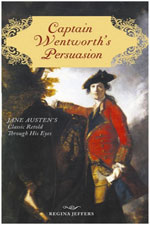
What I would like to consider today is why did the publishers deem it necessary to change the title to Pride and PrejudiceThere are several who write Austen-inpired novels who have had title changes at our publishers’ suggestions. For example, I have seen Wayward Love changed to Captain Wentworth’s PersuasionDarcy’s Dreams to Darcy’s TemptationDarcy’s Hunger to Vampire Darcy’s Desire, and most recently, A Touch of Gold to The Scandal of Lady Eleanor. Changing titles is a common practice among publishing companies.
Can one imagine the conversation between Thomas Egerton Publishers and Jane Austen?
Egerton: Miss Austen, we believe the reading public would respond to a title change.
Austen: Are you implying that I must add the word Darcy or Pemberley to the title to sell books?
Egerton: No, that will not be necessary for another 200 years.
Austen: (in awe) Do you expect my works to survive and become part of the British literary canon?
Egerton: Of course, not. You are a female. We will be fortunate to sell a few hundred copies, Miss Austen.
Austen: (a bit disconcerted by his condescending tone) But my book is about misconstruing others – of the weakness of making judgments based on first impressions.
Egerton: (ignoring her objection) We will follow the pattern of your first publication. Sense and Sensibility will be followed by Pride and Prejudice. It will give you a “hook” to capture your readers. A way to “brand” your novels. Now, if you will sign the contract, we can begin publication.

But why did Austen’s publishers choose those two words: pride and prejudice? Was it to stimulate a debate among those who wonder whether it was Darcy or Elizabeth who was prideful? Who acted with prejudice? College professors base entire semesters on just that concept. Or, perhaps, it was how often those two words are found in Austen’s text: The publishers’ belief that such repetition would create resonance and “connectiveness.”
The word “pride” appears seven and forty times in the text. One of my favorite uses of the word occurs in, “Vanity and pride are different things, though the words are often used synonymously.” I am also found of, “With what delightfulpride she afterward visited Mrs. Bingley, and talked of Mrs. Darcy, may be guessed.”
“Prided” is used but once, as is “proudly” and “proudest.” Meanwhile, “proud” is used one and twenty times. “Some may call him proud, but I am sure I never saw anything of it,” is spoken by Mrs. Reynolds. Later in the story, Elizabeth considers Darcy’s actions in dealing with Wickham. “For herself, she was humbled; but she was proud of him – proud that in a cause of compassion and honor he had been able to get the better of himself.”

“Prejudiced” is found once in the text; “prejudices” is used twice, and “prejudice” appears five times. “The general prejudice against Mr. Darcy is so violent, that it would be the death of half the good people in Meryton to attempt to place him in an amiable light.”

When I originally entitled my second book Darcy’s Dreams, I did so because I mimicked Austen’s repetition. I used the word “dream” seven and fifty times in the book. When Ulysses Press added the word “temptation” to attract readers, I made a mad scramble to add temptation to the manuscript. The process made me wonder if Austen did the same thing with pride and prejudice. Although I know it’s an illogical assumption, I like to imagine our dear Jane adding those two words as motifs within her text and also imagine her grumbling, just as I did with temptation.

In reality, Austen actually took the phrase “Pride and Prejudice” from the final chapter of Fanny Burney’s Cecilia, in which the phrase is used three times in capital letters on one page. 

Posted in Uncategorized | 2 Comments

Legend of Merlin and King Arthur’s Round Table


In the old days of King Arthur,

Of which Britons speak great honour,

All was this land filled with fairy,

The elf-queen with her jolly company.

From Chaucer’s “Canterbury Tales”

Of late, I have spent more hours than I care to consider in researching witches’ covens, druid markings, and fairy phenomena, specifically in Dorset, UK, where my next novel takes place. Dorset is surrounded by references to the wizard Merlin, which lends additional mystery and elements of the paranormal. One can find Winchester Castle in Hampshire, Merlin’s Tump at Marlborough and Stonehenge in Wiltshire, and Cadbury Castle, as well as Glastonbury Tor in Somersetshire. However, the most famous of the places associated with Merlin is the legendary court of Camelot. 

In the 15th Century, Sir Thomas Malory’s book Le Morte d’Arhur (The Death of Arthur) credits Merlin with the establishment of the Round Table in King Arthur’s court. The table, itself, has served as the symbol of equality in government and the chivalric order associated with Arthur’s knights.

The Round Table first appeared in a Norman language adaptation of Geoffrey of Monmouth’s Historia Regum Britanniae (1155). Wace’s Roman de Brut was based on Monmouth’s text. It is a verse history of Britain. Brut supplied a wider accessibility to the tales of the Arthur legend in a vernacular language. In his text, Wace is the first to mention the legend of Arthur’s Round Table and the first to ascribe the name “Excalibur” to Arthur’s sword. The Roman de Brut became the basis of Layamon’s Brut, an alliterative Middle English poem. In this poem, we learn of a mysterious “craftsman,” who came before Arthur to build him a circular table, which would seat 1600. Layamon does not give the character a name; it is Sir Thomas Malory, who assigned the event to Merlin.

According to Malory’s tale, Merlin brought about the raising of the Giant’s Dance and the Hanging Stones of Stonehenge. The stones were magically transferred from Killarus (Kildare) in Ireland to the Salisbury Plain as a memorial to British nobles treacherously slain by the Saxons. Stonehenge had, in actuality, been standing for thousands of years prior to Merlin and Arthur’s time, but the story brings forth the concept of a place of meeting where equality ruled.

In the 1190s, Robert de Boron’s Merlin creates an imitation of The Last Supper’s table, only this table was designed for Arthur’s father, Uther Pendragon. It had twelve seats and one left empty to represent Judas’s betrayal. The seat was to remain empty until a knight so pure he could claim the Holy Grail assumed the seat. The Didot Perceval, a prose continuation of de Boron’s work, continues the tale. The knight Percival sits in the seat and initiates the Grail’s quest.

The Lancelot-Grail cycle and the Post-Vulgate Cycle, prose cycles of the 13th Century, emphasized the chivalric attributes, often assigned to Arthur’s knights. In these tales, Galahad, rather than Percival, assumes the empty seat, now called the Siege Perilous. Galahad’s arrival marks the start of the Grail quest, as well as the end of the Arthurian era. Galahad’s tales say the Round Table is taken by King Leodegrance of Cameliard after Uther’s dead; Arthur inherits the table when he marries Leodegrance’s daughter Gwinevere. 

Arthur’s knights are said to have held their annual meetings at various locations, notably Caerleon and Carlisle and Camelot (possibly Cadbury Castle or the Great Hall at Winchester). Gathering at Whitsun (Pentecost), Arthur and his knights would share injustices righted and those still waiting to be addressed. Arthur’s knights would go forth across the land to protect the weak and to subdue tyrants.

Merlin had little to do with the Grail’s quest for his influence remained in Arthur’s early life, but the wizard is said to have foretold the coming of the Grail.

Book Blurb: 

The Disappearance of Georgiana Darcy

A Pride and Prejudice Mystery

By Regina Jeffers

A thrilling novel of malicious villains, dramatic revelations, and heroic gestures that stays true to Austen’s style


Darcy and Elizabeth have faced many challenges, but none as dire as the disappearance of Darcy’s beloved sister, Georgiana. After leaving for the family home in Scotland to be reunited with her new husband, Edward, she has disappeared without a trace. Upon receiving official word that Georgiana is presumed dead, Darcy and Elizabeth travel to the infamous Merrick Moor to launch a search for his sister in the unfamiliar and menacing Scottish countryside. Suspects abound, from the dastardly Wickham to the mysterious MacBethan family. Darcy has always protected his little sister, but how can he keep her safe from the most sinister threat she has ever faced when he doesn’t even know if she’s alive? Written in the language of the Regency era and including Austen’s romantic entanglements and sardonic humor, this suspense-packed sequel to Pride and Prejudice recasts Darcy and Elizabeth as a husband-and-wife detective team hunting for truth amid the dark moors of Scotland.

Posted in British history | Tagged , , , , , , , | 2 Comments

The Naming of Characters – A Rose by Any Other Name

Recently, one of my friends noted that I had used a familiar name or two from where I once lived in Ohio. She thought it quite clever of me, but I explained this was a common practice with authors. In fact, most of my “author” friends have told me of their naming characters and places after people they know.

I, for example, named Chadwick Harrison from Darcy’s Temptation after Chad Pennington, the former NFL quarterback. Pennington showed great kindness to my son while my mother lay dying. Clayton Ashford from the same book comes from Clay Aiken and my former principal at Parkwood High School. Kim Withey, a regular follower on this site, found her name used for the villain in The Phantom of Pemberley. My son’s godmother is married to a man named Epperly. In The First Wives’ Club, Nathaniel Epperly is Lord Eggleston. Recently, while I was writing a new chapter of my next Austen-inspired novel (tentatively entitled, The Mysterious Death of Mr. Darcy) I was watching Tamara Drewe on a cable channel. A character I introduced in that chapter became Nicholas Drewe.

In The Scandal of Lady Eleanor, James Kerrington is Lord Worthing. My son attended school in Worthington, Ohio. Gabriel Crowden, the hero of my next Regency romance, A Touch of Grace, is the Marquis of Godown. In the Worthing area, Godown Road is a regular cut through between major thoroughfares. (We often called it “God own”-ed.) I have been known to open the newspaper or to switch to a news channel in search of an interesting name for my characters.

Occasionally, I choose a name that is indicative of the name’s meaning. “Aoife,” the heroine of His Irish Eve, is so named because “Aoife” means “Eve.” She is the “Eve” to “Adam” Lawrence, one of the main characters in The Phantom of Pemberley. This novella is a continuation of Adam’s life after Phantom. Likewise, in my Christmas tale, Christmas at Pemberley, “Mary Joseph” is a major influence on Elizabeth Darcy’s life. From The Disappearance of Georgiana Darcy, one finds such names as “Dolina,” which comes from the Scottish Gaelic Dolag, which means “world ruler,” an apt name for the villain of the tale. Even the last name “MacBethan” was chosen to meet several requirements of the story line. First, “MacBethan” is a derivative of “MacBean.” As I wished the MacBethans to be related to the infamous Sawney Bean, that was important. Secondly, “MacBean” is a patronymic name that comes from the Gaelic and means “life.” As “life” is in short supply in the MacBethan household, it seemed more than appropriate.

So, based on my assumption from above, what is the possibility that our beloved Jane Austen used famous names or those she parlayed from the local newspapers in her stories? Could Mrs. Reynolds in Pride and Prejudice have come about because Jane read a piece about the famous artist Joshua Reynolds?

There was, for example, a real life George Morland, a man known for his paintings of rustic scenes. Could William Hodges have lent his name to Emma Woodhouse’s housekeeper? Hodges is best known for his paintings of exotic locales, especially those he visited while accompanying James Cook on the captain’s second voyage to the Pacific Ocean.

Charles Hayter was a painter who specialized in portraits of navy men. Is there any wonder that Hayter gives his name to a character in Austen’s book of seafaring men, that of Persuasion? (By the way, the real-life Hayter taught Princess Charlotte about perspective and was later given the title of Professor in Perspective and Drawing.)

Also in Persuasion, one finds Sir Walter openly declaring that Frederick Wentworth was “[q]uite unconnected; nothing to do with the Strafford family.” One must recall that in her early History of England, Austen defended Thomas Wentworth, the first Earl of Strafford and the architect of Charles I’s design for absolute government. In fact, scholars have traced the Strafford connection to Austen’s novels. It shows that in the 13th Century Robert Wentworth married an heiress named Emma Wodehous. Coincidence?

One of the things that I often found ironic in Austen’s novels is the number of “Whig” names she used: D’Arcy, Fitzwilliam, Dashwood, Wentworth, Woodhouse, Watson, Brandon, Churchill, Russell, Steele, and Bertram. Could our dear Jane have spent time with her nose buried in the Peerage of England? For a Tory daughter, she certain gave the Whigs prominence!

For a more in-depth study of these names, please visit, Janine Barchas’ “Artistic Names in Austen’s Fiction: Cameo Appearances by Prominent Painters,” Persuasion. 2009. Volume 31.

http://www.jasna.org/persuasions/printed/pers31.html

(or)

Reinbold, Amanda Katherine, “Jane Austen and the Significance of Names.” (2009). University of Tennessee Honors Thesis Projects. http://trace.tennessee.edu/utk_chanhonoproj/1313

Posted in Jane Austen, writing | Tagged , , , , , , , , , , , | Comments Off on The Naming of Characters – A Rose by Any Other Name

Time.com’s List of the Best 100 Novels

Welcome to the massive, anguished, exalted undertaking that is the ALL TIME 100 books list. The parameters: English language novels published anywhere in the world since 1923, the year that TIME Magazine began, which, before you ask, means that Ulysses (1922) doesn’t make the cut. (Yes, I know this is an older list, but I would still like to think that “popularity” does not always = “quality.”)

There is a slide show with detailed descriptions of each chosen title. Read more: http://entertainment.time.com/2005/10/16/all-time-100-novels/?iid=ent-main-feature#all

A – B

C – D

F – G

H – I

L – N

O – R

S – T

U – W

Read more:http://entertainment.time.com/2005/10/16/all-time-100-novels/?iid=ent-main-feature#all#ixzz1yjVi1d6G

Are there any from the list that you would put as one of your favorites? I, for example, would choose Brideshead Revisited, The Bridge of San Luis Rey, and Lord of the Flies. 

Posted in Uncategorized | Comments Off on Time.com’s List of the Best 100 Novels

The Influx of eBooks

This excerpt comes from Publishers Weekly. To read the complete article, visit http://www.publishersweekly.com/pw/by-topic/digital/retailing/article/52204-the-march-of-the-e-books.html

E-books accounted for 7% of consumer spending on books in 2011 and 14% of units purchased, according to the most recent data from Bowker Market Research. In 2010, e-books had a 2% share of dollars and a 4% share of units. The wide discrepancy between unit and spending gains reflects the lower price e-books have compared to print formats, especially hardcover. The increase in spending on e-books came largely at the expense of hardcover, with the market share for hardcovers falling from 42% in 2010 to 39% last year. In 2009, hardcovers held a 46% share of spending. Unit sales of hardcovers took a slightly steeper drop last year, falling from 34% of titles sold to 29%. Trade paperback fared better, with the Bowker data showing that after holding steady at 36% of spending in 2009 and 2010, trade paperback accounted for 37% of spending last year despite a dip in its share of units. The mass market paperback segment has had a steady decline in units and dollars between 2009 and 2011, with units falling from 18% in 2010 to 14% in 2011; its share of spending fell last year to 7% from 8% in 2010.

The Bowker numbers also illustrate the inroads e-books have made among some of the largest genres, but also show the impact the lower prices of e-books can have as increases in unit gains markedly outpaced share gains in spending. In the mystery/detective category, for example (which had the highest percentage of e-book sales among the major genres), e-books’ market share of units purchased rose to 24% last year from 6% in 2010.

Just behind mystery/detective among the top genres where e-books are the most popular were espionage/thriller, with e-books generating 15% of sales, up from 4% in 2010, and romance, where e-books also accounted for 15% of sales, up from 5%. In science fiction, e-book sales rose to 14% of all sales, up from 5%. In all three categories, units were more than a 20% share of purchases in 2010.

Posted in Uncategorized | Comments Off on The Influx of eBooks

Interview with Austen author, Regina Jeffers, and The Real World According to Sam (Part 2)

Part Two (originally published on The World According to Sam)

Q: Writing an entire novel continuing the adventures of Austen characters is rather indicative of your fondness for Miss Austen’s work. Can you tell us about your first experience with her work?

A: I have been in love with Jane Austen’s stories for as long as I can remember. When I was twelve, I read Pride and Prejudice and was hooked. Perhaps, it was being a product of the 1950s and 1960s. Those decades were a male dominated period (Have you ever watched “Mad Men”?). Jane Austen’s works looked at society through a comedic screen while examining issues found in a male dominated world. Charlotte Lucas symbolizes the prevailing attitude toward women, while Elizabeth Bennet does not condemn feminine “virtues,” but rather balances them with a sensible mind. In each of Austen’s novels, the main characters have experiences that create a profound and permanent transformation (Fitzwilliam Darcy and Elizabeth Bennet in Pride and Prejudice; Marianne Dashwood in Sense and Sensibility; Emma Woodhouse in Emma; Anne Elliot in Persuasion; Catherine Morland in Northanger Abbey; and Edmund in Mansfield Park). Austen’s witty, satirical approach to her subjects resonates across the centuries. Therefore, as a twelve-year-old, I read Jane Austen for the first time, and I was hooked.

Q: Can you tell us about any of your other published or planned works?

A: Currently, during the day, I am spending time with my new grandson. His parents are both teachers, and “LoLa” is tending the child until the end of the school year. I love to watch him reach each of his benchmarks. James is 6 months old and is my new best friend.

In the evenings, I am writing. My next Austen-inspired title with Ulysses Press will be another Darcy mystery to be released in the spring of 2013. I am preparing to release my contemporary version of Pride and Prejudice, entitled Honor and Hope, as soon as we decide on the cover art for the project. Recently, I have finished book 4 of my Regency historical series: A Touch of Grace. (Book 1 was The Scandal of Lady Eleanor [formerly A Touch of Gold]; Book 2 is A Touch of Velvet; Book 3 is A Touch of Cashémere.) Thankfully, The Scandal of Lady Eleanor was recognized by the the Write Touch Awards with a second place in historical fiction.  Publishers’ Weekly called this series a “knockout.” Those who have read the early versions of A Touch of Grace consider it a superior tale to Eleanor’s. 

Beside the above titles, I have written seven Austen-inspired titles. They include Darcy’s Passions: Pride and Prejudice Retold Through His Eyes; Darcy’s Temptation, The Phantom of Pemberley, Vampire Darcy’s Desires, The Disappearance of Georgiana Darcy, Captain Wentworth’s Persuasion, and Christmas at Pemberley. In addition to the books in the Realm series, The First Wives’ Club is the first book in a Regency era trilogy, and there’s always my contemporary romance, Second Chances: The Courtship Wars, which is based around a reality TV show.

Q: If you could spend an hour talking to anyone from any time in history, who would it be? And Why?

A: When I was younger, I had a fascination with George Custer. Besides the Regency Period, I read extensively about the American Civil War, when Custer’s military career began. I tried to discover every little detail about the man who died at the Battle of Little Bighorn. For example, did you know that a year after that fateful battle that Custer’s remains were dug up and reburied at West Point? Were you aware that Custer used a cinnamon scented tonic on his long golden locks? Did you realize that Custer wrote a book, published in 1874, entitled My Life on the Plains or Personal Experiences with the Indians? How about the fact that Walt Whitman, on hearing the news of Custer’s death, wrote the poem “From Far Dakota’s Canyons”? Among his men, Custer developed a reputation for flamboyant behavior. He led his troops into battle wearing a black velvet jacket trimmed with gold lace, a crimson necktie, and a white hat. He claimed that he adopted this outfit so that his men “would recognize him on any part of the field.”

Custer’s defeat at the Little Bighorn made the life of an obscure 19th century military figure into the subject of legends with countless songs, books, and paintings. Custer’s critics say his blunders caused his death and the death of his men. His supporters say he was only following standard military tactics of his time.

Paintings and writings about “the Custer massacre” depict Custer as a gallant victim, surrounded by bloodthirsty savages. The fact that Custer started the battle by attacking the Indian village is often omitted.

It is said that the “Indians” did not scalp or mutilate Custer’s body out of respect for his fighting ability, but few participating Indians knew who he was. To this day no one knows the real reason the Amerinds left Custer’s body intact.

Q: What’s the craziest, bravest, or stupidest thing you’ve ever done? 

A: I have discussed this previously. At one time, I worked as a volunteer EMT for a local fire department. In November 1970, I was a senior at Marshall University in Huntington, West Virginia. On November 14, after a loss to East Carolina University, Southern Airways Flight 932 went into the side of the hill on its approach to Tri-State Airport. No one survived. I was among those who retrieved bodies of football players, town leaders, university boosters, coaches, etc. It is a moment forever etched on my memory. The event was the focus of the 2006 Matthew McConaughey, Matthew Fox, and Anthony Mackie film “We Are Marshall.”

Q: What was your favorite chapter (or part) of “The Disappearance of Georgiana Darcy” to write and why? 

A: I love to write confrontations. I am not certain what that says about me. Perhaps, it is all the years that I spent in martial arts. I have always seen the forms (simulated fights) used to train the students in Tae Kwon Do as “dance.” Therefore, if one looks closely at any of my books, it’s the “fight scene” that takes more than one chapter. In “The Disappearance of Georgiana Darcy,” Major General Fitzwilliam (the former Colonel Fitzwilliam) and Darcy race across the Scottish moors to rescue a woman they believe to be the missing Georgiana; yet, before they have the opportunity to find their missing loved one, they must fight their way through the prison cells below Normanna Hall. Those pages are wrought with tension.

Q: List three of your favorite movies.

A: I would sit up late into the night to watch “Seven Brides for Seven Brothers,” “Von Ryan’s Express,” and “The Quiet Man.” I love period pieces also. I know you only asked for three, but I would be remiss if I did not mention: “North and South,” “Pride and Prejudice,” “The Young Victoria,” “Little Dorrit,” “The Way We Live Now,” “Jane Eyre,” “Persuasion,” “Bright Star,” “Lord Byron,” “The Tudors,” “Cranford,” etc., etc., etc.

Q: Name an actor or book character you have a crush on.

A: Actually, that is one and the same. I am a Matthew Macfadyen fan, and he is my Mr. Darcy. Several years ago, I was fortunate to meet Colin Firth, and I absolutely adore him. I am one of those fans who trot off to see every film in which Firth performs. However, in 1998, I came across a made-for-TV version of “Wuthering Heights” that was appropriate for my English classroom to view. In the part of Hareton, there was Macfadyen. He smiled in one scene, and my interest was engaged. After that, I followed his career in film and television. When he portrayed Fitzwilliam Darcy, it was simply icing on the cake.

Please note that prior to Macfadyen, I have held an interest in Errol Flynn, Clark Gable, James Garner, Howard Keel, Peter Lawford, and Jeffrey Hunter.

Q: Is there a book you know that you will never read? Or one you tried to read but just could not finish?

A: There are only a few books that I have not finished, and, truthfully, at the moment, I cannot think of any of them. (Out of sight…out of mind.) Sometimes, it takes several attempts to read certain pieces. One title that I never enjoyed teaching was Charles Dickens’ Great Expectations. It is awful to say, but when I was pregnant with my son, I purposely left Great Expectations for my substitute to teach while I was on pregnancy leave.

Q: Do you work from an outline or just write?

A: I have an “umbrella” list of events that should happen within the story, which serves as my outline. However, I am very much a pantser. I write my books out in long hand in several spiral notebooks. Then I word process the story. Finally, I edit and revise. Generally, the story picks up some spontaneous twists and turns that I did not originally anticipate. In my current title, however, the story has taken a divergent twist. Yet, I think the story is better for the unexpected turn.

Q: Do you ever experience writer’s block? 

A: Occasionally, writer’s block sets in. It is usually when I planned one path for the story, and the tale takes “one less traveled.” When that happens, I simply set the writing aside and let the book play out in my head until it works itself right. The longest I have ever spent away from a book was two weeks. That was with Darcy’s Temptation. I agonized over whether to use amnesia as part of the plot.

Posted in Uncategorized | Tagged , , , , , , , , , , , , , , | Comments Off on Interview with Austen author, Regina Jeffers, and The Real World According to Sam (Part 2)

Interview with Austen author, Regina Jeffers, and The Real World According to Sam

Part One (originally posted on The Real World According to Sam)

Q: Tell us about your latest book.

A: The Disappearance of Georgiana Darcy is a cozy mystery, much in the vein of an Agatha Christie novel or the “Murder She Wrote” TV series. A cozy is set in a deserted area and has no sex or graphic violence. Along with the main characters, a “cozy” requires the reader to use his intelligence to solve the mystery’s clues. The book is classified as romantic suspense, but there is more suspense than romance in the story line. I prefer the idea of “romantic elements” instead. The Disappearance of Georgiana Darcy is set two years after Pride and Prejudice ends. Although Georgiana Darcy had made a brilliant match in Major General Fitzwilliam, Darcy has never fully accepted the loss of his sister to a proper marriage, but he would gladly “lose” Georgiana to Edward Fitzwilliam’s care if it meant that he could finally locate her on the infamous Merrick Moor.

Book Blurb: Shackled in the dungeon of a macabre castle with no recollection of her past, a young woman finds herself falling in love with her captor–the estate’s master. Yet, placing her trust in him before she regains her memory and unravels the castle’s wicked truths would be a catastrophe.

Far away at Pemberley, the Darcys happily gather to celebrate the marriage of Kitty Bennet. But a dark cloud sweeps through the festivities: Georgiana Darcy has disappeared without a trace. Upon receiving word of his sister’s likely demise, Darcy and wife, Elizabeth, set off across the English countryside, seeking answers in the unfamiliar and menacing Scottish moors.

How can Darcy keep his sister safe from the most sinister threat she has ever faced when he doesn’t even know if she’s alive? True to Austen’s style and rife with malicious villains, dramatic revelations and heroic gestures, this suspense-packed mystery places Darcy and Elizabeth in the most harrowing situation they have ever faced–finding Georgiana before it is too late.

Q: What inspired you to write a mystery book set in the general Pride and Prejudice milieu?

A: The Disappearance of Georgiana Darcy is actually my second romantic suspense. Ulysses Press released The Phantom of Pemberley in 2010. It did well, placing third in the Dixie Kane Memorial Awards. Fans also received “Phantom” with open arms. Naturally, in the publishing world, one stays with success. But more than that, I believe the Regency Period, with its strict guidelines for behavior and the stringent delineation for social class makes it easy to craft a mystery. Information is withheld; yet, everyone in Regency era Society knows the secrets. It is the perfect scenario.

Yet, writing a mystery is always difficult–to mix overt clues about the crime with essential details that appear unimportant, but are necessary to solve the mystery. Balancing the reveal with inference gaps takes time and planning. And, of course, tossing in those lovely “red herrings,” which take the reader down the wrong paths, are wonderful to see come to fruition.

Q: Was it difficult to balance the tension required with mystery with the sort of generally non-mystery atmosphere associated with Austen characters (well, outside of Northanger Abbey, at least).

A: Actually, Austen was a master at creating a diversion, an ingredient necessary for a well-developed mystery. For example, in Pride and Prejudice, she manages to make her readers not see the truth about Mr. Darcy. About Mr. Wickham. About Elizabeth Bennet. Austen says things such as, “It is a truth universally acknowledged that a single man in possession of a good fortune must be in want of a wife.” This is a tongue-in-cheek statement of theme, but it is flawed first impression of what the story entails. She says of George Wickham that he is “beyond them all in person, countenance, air, and walk.” That is another flawed impression. Of Elizabeth, Austen says, “She is not so handsome as Jane, nor half so good-humored as Lydia.” Yet, those of us who have read the novel know this is a false impression. Elizabeth has depths of character not seen in either Jane or Lydia Bennet. Mr. Darcy says of Elizabeth, “She is tolerable, but not handsome enough to tempt me.” Flawed, again and again.

As in any well-told mystery, it is necessary to introduce an unexpected scenario. For the crime, it becomes prudent to develop a closed circle of suspects, each of whom has credible motives and reasonable opportunities to commit the crime. “Phantom” dealt with a series of unexpected deaths; “Disappearance” builds suspense with the setting. Legends of the Merrick Moor, the Awful Hand, and the Murder Hole add suspense to the story line.

Q: Will we get to see the good Mr. Darcy thrash a villain or two?

A: I have written several “Darcy” sequels and adaptations. In each, Mr. Darcy is a virile specimen of Regency era manhood. He has had more than one “tussle” with Mr. Wickham in my novels.

Andrew Davies’ created the image of “Darcy” in the 1995 Pride and Prejudice mini-series. Colin Firth as Fitzwilliam Darcy is given scenes (NOT found in the original story) that make his character more appealing to the predominantly female viewing audience. We see him on horseback, swimming in a placid lake, fencing, and hunting. We see him stepping from his bath and staring broodingly out a window. Women loved the image. These same women are my audience. I would be foolish to go against the model.

Q: Your novel has a mix of original creations and more well-known Austen characters. Did you find it difficult to write scenes with the Austen characters?

A: I seriously believe that Austen’s intertextual reinscriptions of Restoration comedy have echoes in contemporary rewrites of classical literature. Reading a historical novel in its period requires the reader to understand the period, as well as the social distance from the present. Despite Austen being a part of the Society of which she wrote, her works display a “distance” from the time period, and that “distance” marks Austen’s voice as one more distinct than others of her time. Jane Austen was sophisticated, subtle, and very intelligent in her handling of complex issues. Austen’s women were women of sense; they embodied the notion of rational love. Today’s audience has paradoxically maintained Austen’s “formula.”

Austen characters have lived in my head for half a century. They are often dancing about a ballroom or strolling along a country lane. When I write, the scenes play in my head as if they were part of a movie. When something is not correct, I simply hit “rewind” until the scene plays with authority. I often find myself saying, “Mr. Darcy would not say that.” Then I replay the scene until it is correct.

Q: Did you ever have any concern that readers might take issue with your interpretation of these well-known characters?

A: The most difficult part of writing Austen-inspired literature is that each of Austen’s fans feels as if “Jane” is her personal friend, and that reader knows “Jane’s mind” better than anyone else. Therefore, they bring to the reading experience a preconceived idea of how Austen’s characters would act outside of her novels. I have been fortunate, overall. Most of my readers feel that I understand how Austen’s characters would respond to various situations. However, I occasionally meet a reader who disagrees with what I have written. One thing that I do religiously in my works is that I use as much of Austen’s actual text as possible within the story line. Many love to hear familiar phrases in new situations.

Writing scenes with the forbidden word “SEX” in them is more of an issue. Many Janeites think any scene that involves sexual references is inappropriate for Austen-inspired works. My scenes are more realistic. I look at Darcy and Elizabeth’s joining as a loving one. I do not write torrid sexual encounters, but I also do not avoid the old adage of “an heir and a spare.” My scenes are more indicative of vintage films. One sees the build up, but then the door closes, and he knows what happens.

Q: Period novels necessitate research. Even with you having a starting point in a famous work, your story goes off in directions Austen never dreamt of. So, in the course of doing research for your novel, is there anything you learned that surprised you? 

A: The research is based on what would and would not be acceptable for the Regency Period, the time period in which the majority of my novels are set. The true Regency Period lasted only ten years, from 1811 to 1820. Most writers of the period place their stories somewhere between 1800 and 1820; however, a few feature everything from the French Revolution to the Reform. When I am creating a Jane Austen adaptation, my setting is defined by Austen’s original story line. For example, the events in Pride and Prejudice occur in 1812. If I am writing an Austen sequel, I must be aware of the events that happened in the years following 1812. In my latest novel, The Disappearance of Georgiana Darcy, Colonel Fitzwilliam is returning from service with Wellington at Waterloo. Therefore, the book must be true to June 1815. In my unique Regencies, I tend to place my characters in situations that occur between 1810 and 1815. It is the time period of which I am most familiar.

I have a stash of Regency related books to which I often turn for assistance. The Internet is helpful, but there is so much misinformation on the Web that a person must look for sites that verify the content found upon the page. One of the biggest issues is anachronistic phrases. I am more aware of those issues in my Austen-inspired works. Miss Austen has a distinct style, which is difficult to replicate, and I make a point of adding her actual wording to the story lines. In most Regencies on the mass market, in the publishing business, a certain number of anachronistic phrases are acceptable. Those serve as a segue between what is often seen as the stilted language of the period and modern phrasing. However, I do attempt to be true to language style.

I love to look for the “unusual” of the Regency era and then incorporate the legend into my novels. For example, there is the mysterious Holy Island of Lindisfarne and the legend of St. Cuthbert’s miraculous burial site or the real-life case of Mary Reynolds, a woman who suffered from Dissociative Identity Disorder. I also found it quite fascinating that Lord Thomas Cochrane proposed saturation bombing and chemical warfare during the Napoleonic Wars. The era has such “nuggets” that amaze my readers and keep them coming back for more.

Posted in Uncategorized | Tagged , , , , , , , , , | Comments Off on Interview with Austen author, Regina Jeffers, and The Real World According to Sam