10 Lessons on Publishing for Women Readers from “Fifty Shades of Grey”

It may be the season for blue skies and sunshine, but the color scheme for books this summer has one shade: grey. British writer E.L. James’ erotic trilogy Fifty Shades of Grey, Fifty Shades Darker and Fifty Shades Freed has surged up like a publishing derecho. In bedrooms and book clubs, on mommy blogs and best-seller lists, it’s all about the blindfold, the billionaire and the “red room of pain.” In the USA, 20 million copies have been sold, and the 1,594-page trilogy has held the top three spots on USA TODAY’s Best-Selling Books list for nine weeks.

Why are millions of readers, most of them women, devouring the trilogy and praying the rumor that James is writing a fourth book is true? Here are 10 reasons Grey is the new green in book publishing.

To learn more about the 10 Reasons “Shades” has succeeded where others have failed, please visit Deirdre Donahue’s article on USA Today/Books at http://www.usatoday.com/life/books/news/story/2012-07-09/fifty-shades-of-grey-el-james-summers-hottest-book/56119174/1

Posted in Uncategorized | Comments Off on 10 Lessons on Publishing for Women Readers from “Fifty Shades of Grey”

Think Twice Before You Self Publish

If there’s a common flaw in self-publishing, it’s that too many books are published too soon. Experienced voices across the publishing world continually advise self-publishers to get help with editing, and not just copyediting but story editing too. It’s difficult, if not impossible, to properly edit your own work. But the siren call of the Kindle store is often too seductive. The urge to finish your first draft, chuck it through a spellchecker and release it in to the wild is often far too strong for eager writers to resist.

But resist you must. Not resisting results in your name being married, permanently, to sub-standard work which doesn’t show off your talents to their best. Do you really want, in five or ten years time, to look back on your early work and cringe? More to the point, do you really want your first act of publishing to result in the irreversible blotting of your copybook with your potential fans?

To read the complete article, please go to Suw Charman-Anderson’s article on Forbes. It is an excellent one for all those who are considering jumping into the self publishing quagmire.

http://www.forbes.com/sites/suwcharmananderson/2012/07/02/dont-publish-that-book/

Posted in Uncategorized | Comments Off on Think Twice Before You Self Publish

Of Water Nymphs and Mermaids – Have You Heard of These UK Legends?

Fairy maidens inhabiting the oceans, rivers, springs, meadows, woods, and wells are collectively known as nymphs. Nymphs resemble humans in height and overall appearance, but they are known for their enchanting beauty and seductive charms. According to most legends, water nymphs are the most dangerous of the “sisterhood.” Many in the UK are surrounded by legends of water nymphs. Of late, I have been researching legends and myths surrounding the south central UK, but I have enjoyed reading many of those found elsewhere in England.

In all countries, “water” is the source of life, and, therefore, it holds a veneration in the world’s various cultures. Sources of water in each small village and thriving metropolis holds the potential for legends and traditions to find root. These are often extremely local, and therefore little known.

Loup Scar Burnsall:
Loup scar on the river Wharfe at Burnsall is a popular venue with climbers, and the river below is popular with canoeists.

With wells, the names alone suggest much. The memory of the mythical gods, satyrs, and nymphs of the ancient times lingers in a few, as in Thors-kil or Thors-well, in the parish of Burnsall; and in the almost universal declaration — by which not over-wise parents seek to deter children from playing in dangerous proximity to a well — that at the bottom, under the water, dwells a mysterious being, usually named Jenny Green-teeth or Peg-o’-the-Well, who will certainly drag into the water any child who approaches too near to it.

The tokens of medieval reverence for wells are abundant. The names of the saints to whom the wells were dedicated yet cling to them. “There is scarcely a well of consequence in the United Kingdom,” says the editor of Lancashire Folk-lore, “which has not been solemnly dedicated to some saint in the Roman calendar.”

Thus in Yorkshire one finds Our Lady’s Well or Lady Well; St. Helen’s Well; St. Margaret’s Well at Burnsall; St. Bridget’s Well near Ripon; St. Mungo’s Well at Copgrove; St. John’s Well at Beverley; St. Alkelda’s Well at Middleham, etc.

Thomas Hardy’s cottage

In Dorset, one may find a circular pool called Rushy Pond. It is a quarter mile southeast of Thomas Hardy’s cottage at Thorncombe Wood. Reportedly, unwary travelers are lured into the pond, never to seen again.

“I Said And Sang Her Excellence”
by Thomas Hardy

(Fickle Lover’s Song)

I said and sang her excellence:
They called it laud undue.
(Have your way, my heart, O!)
Yet what was homage far above
The plain deserts of my olden Love
Proved verity of my new.

“She moves a sylph in picture-land,
Where nothing frosts the air:”
(Have your way, my heart, O!)
“To all winged pipers overhead
She is known by shape and song,” I said,
Conscious of licence there.

I sang of her in a dim old hall
Dream-built too fancifully,
(Have your way, my heart, O!)
But lo, the ripe months chanced to lead
My feet to such a hall indeed,
Where stood the very She.

Strange, startling, was it then to learn
I had glanced down unborn time,
(Have your way, my heart, O!)
And prophesied, whereby I knew
That which the years had planned to do
In warranty of my rhyme.

BY RUSHY-POND.

Rushy Pond

Old Harry Rocks

At Old Harry Rocks at Studland in Dorset, there is a mystery of sorts. The water level never changes, whether by storms or droughts. Again, water nymphs are said to inhabit the pool and practice their magic within the pool’s depths.

Surprisingly, Staffordshire, which has no coastline, has the Legend of the Mermaid of Black Mere Pool. The small, remote, hilltop lake, around 50 metres wide, creates the perfect haunting site. Set on the craggy and barren southern edge of the Peak District, it is said that the dark, peat-stained waters of the pool are bottomless. Cattle refuse to drink from the water and birds never fly above it. A number of mysterious drownings are attributed to the waters, as well as one murder. In 1679, a woman pedlar was dumped into the pool by a local serial killer.

Tradition holds that the mermaid rises from the pool at midnight to lure unwary travellers to their deaths in the dark watery depths – but only single men, apparently. There are various legends concerning the origin of the mermaid. In one, a sailor from nearby Thorncliff fell in love with her and brought her back from sea, and in another she was originally a witch who transformed herself into a water nymph after been thrown into the pool during the Middle Ages.

Black Mere Pool

Posted in British history | Tagged , , , , , , | 2 Comments

A Resurgence of Jane Austen

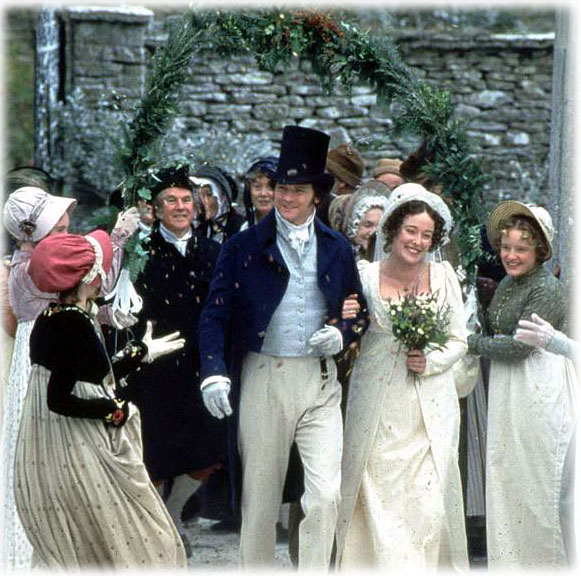
Several people believe that Colin Firth’s stellar two-year “flirt” with Oscar’s fame – first with a spectacular performance in “A Single Man” and then in “The King’s Speech” – has led to a resurgence of Jane Austen’s popularity. In the 1995 BBC mini-series, Firth played the enigmatic Mr. Darcy from Austen’s Pride and Prejudice, and a legion of Austen fans are cheering on his successes. Obviously, I am one of those. I write Jane Austen adaptations, as well as Regency era romances. For a more detailed analysis of this “new” phenomena, read the article below from The Star.

Kristin Rushowy
Education Reporter
Almost 200 years after her death, it is a truth universally acknowledged that Jane Austen and her works have found new life in the online world.

But these days, there’s another, real-world reason for all the interest in the 19th-century novelist: English actor Colin Firth.

Beloved among fans for his portrayal of Mr. Darcy in the famed 1995 BBC production of Pride and Prejudice.

Firth was the reason “a lot of people got hooked on the novels,” said Deidre Lynch, an English professor at the University of Toronto whose Austen classes typically have as big a wait list as the classes themselves.

But, she added, that’s too simple an explanation for Austen’s ever-growing legion of fans. Social media, too, have given Austen a second life.

Austen is on Twitter — well, fans tweeting in her name — and is the subject of countless Facebook fan pages that grow daily, one with almost 850,000 “likes.” Devotees have created aFacebook newsfeed version of P&P, and others post videos to Youtube in Austen’s honour, from serious scene recreations to hilarious send-ups.

“It’s like votive offerings to Jane Austen, as if she were a saint,” said Lynch, editor of Janeites: Austen’s Disciples and Devotees.

In her current undergraduate class on romantic poetry and prose “Austen makes a few appearances,” she said. “The students would probably prefer more.”

Publishers often have trouble keeping up with demand for Pride and Prejudice.

There has been “a pretty steadily increasing Austen presence in popular culture — but not much of that really connected to the books Austen wrote,” noted Elaine Bander, president of the Canadian chapter of the Jane Austen Society of North America.

To read the complete article, please visit, http://www.thestar.com/entertainment/books/article/934803–jane-austen-is-back-thanks-to-colin-firth

Posted in Uncategorized | Tagged | Comments Off on A Resurgence of Jane Austen

The Movie “Becoming Jane” and Hidden References to Austen’s Novels

By Regina Jeffers

Becoming Jane is an imaginative, romantic tale that captures Jane Austen’s spirit, while playing with the truth. Many of us who delve in Austen-inspired literature have written our own “what if” stories, but one must be able to suspend reality and accept the witty, enchanting romance as all good storytelling to truly enjoy this film. (I did. So, I’m not offering that point as a criticism – only as a warning for those unfamiliar with the film.) This film takes some well known facts from Austen’s life and spins them into an ingenious tale of lost love.

The film opens in the year 1795 and explores the feisty beginnings of an emerging 20-year-old writer, who wishes to live beyond what is expected of her – to actually marry for love. Anne Hathaway portrays Jane Austen, and James McAvoy plays the non-aristocratic Tom Lefroy, whose intellect and arrogance first raises young Jane’s ire and then captivates her heart. Juliann Jarrold, the film’s director says that “A couple of recent biographies have sort of honed in on this romance with Tom Lefroy, because it’s the older bios that tend to say she [Austen] didn’t have this romance; that somehow, out of her imagination, she was able to portray these amazing characters. Straight after [the alleged romance], she started writing First Impressions – and then Sense and Sensibility, and Northanger Abbey.” (BTW, do you not love the facial similarities between the real Tom Lefroy and James McAvoy in these two pictures?)

The film is known for taking the truth and making it a reality. For example, there is some evidence that Ann Radcliffe influenced Jane Austen; however, the film creates a meeting between the two. During this encounter, Radcliffe asks Austen of what she will write.
Radcliffe: Of what do you wish to write?
Jane:  The heart.
Radcliffe: Do you know it?
Jane: Not all of it.
Radcliffe: In time you will. If not…well, that situation is what imagination is for.
The film also provides us with plenty of “Jane” talk. For example, we hear part of the story/poem that Jane has created as a tribute to her sister Cassandra’s engagement.
“The boundaries of propriety were vigorously assaulted, as was only right, but not quite breached, as was also right. Nevertheless, she was not pleased.”
When others question Jane’s ambitions to become a novelist, she responds,
“Novels are poor insipid things, read by mere women, even, God forbid, written by women.”
But beyond the plot’s twists and turns, Becoming Jane playfully references Austen’s themes, characters, and story lines. So my question is how many such references can you name? Here are some (but not all) that I noted.
  • From Pride and Prejudice, we find…
  1. Jane’s character resembles a cross between the flirtatious Lydia Bennet, who loves to dance, and Elizabeth Bennet, whose verbal swordplay with Mr. Darcy is enticing. Mr. Warren is the klutzy clergyman whose proposal reminds us all of Mr. Collins. (He also is a bit like Mr. Elton in Emma.)
  2. Lady Gresham (Maggie Smith) is so Lady Catherine De Bourgh. She does not want Wisley to consider Jane as a mate, and I love the scene where she mentions “a little wilderness.”
  3. Lefroy’s character reminds of us the “worthless” activities of George Wickham early on in the film. Like Wickham, Lefroy studies law, but with not much success. Later he is very much Darcy in his judgment of “country” life.
  • From Sense and Sensibility, we find …
  1. Like Marianne Dashwood, Jane’s decisions are not based on “sense,” but on her “sensibility” (emotional response).
  2. Jane’s situation, if she does not marry Wisley, will be very much like the Dashwood sisters after losing their home.
  • From Northanger Abbey, we find …
  1. Jane plays cricket, very much as did Catherine Morland.
  2. Jane defends her desire to write novels.
  3. The scene in Uncle Benjamin’s house between Jane and Lefroy reminds one of the staircase scene between Henry Tilney and Catherine Morland.
  4. References to Ann Radcliffe’s (as well as other Gothic novels) are made in the novel. In the film, Jane visits Radcliffe.
  • From Mansfield Park, we find …
  1. Lady Gresham’s line to Jane about her duty to marry well reminds us of those spoken by Lady Bertram to Fanny Price.
  2. Lady Bertram spends her days with her pug dog, as does Countess Eliza, Jane’s cousin.
  • From Persuasion, we find …
  • Although she loves him, Jane breaks an engagement with Lefroy so that he has a chance for a better future. This is similar to what happens between Anne Elliot and Captain Wentworth.
  • In the novel, Anne meets Wentworth at a concert, where she must translate the opera for her cousin. She recognizes their love still exists, but she can say nothing. “How was the truth to reach him?” In the film, Jane meets Lefory many years after their separation at a concert. He has married and has a daughter named “Jane.”
Posted in Jane Austen | 12 Comments

The Real Murder Behind William Boyd’s “Any Human Heart”

In 1943 the richest man in the Bahamas was bludgeoned to death. Who was the murderer and what was the involvement of the Duke of Windsor? Intrigued by the case, William Boyd included it in his novel Any Human Heart, starring Matthew Macfadyen, Jim Broadbent, Hayley Atwell, Tom Hollander, Gillian Anderson, Kim Cattrall, and Samuel West has been adapted for TV. (I own this DVD, and I can tell you that both Macfadyen and Broadbent are magnificent in their roles.)

March 1985. Nassau, Bahamas. I am at a crowded drinks party in a sumptuous house in a huge, exclusive gated development called Lyford Cay, a few miles from Nassau, “where the billionaires go to escape from the millionaires”. I’m staying on the island with a friend of mine, and he has brought me to this “do” as his guest. Making conversation, I start to ask the people I’m talking to about the murder of Sir Harry Oakes – in Nassau in 1943, in the middle of the second world war. It’s a case that fascinates me – and one that fascinated the world, at the time.

Sir Harry Oakes was a multimillionaire, the richest man in the Bahamas. He had made his fortune with gold mines he’d discovered in Canada and was seeking to protect it by living in a tax haven. He was something of a local philanthropist but his main concern was always his money and how he could keep it intact and untaxed. On the morning of 8 July 1943 his body was discovered in his bed. Sir Harry had died from blows to the head made with some sort of spiked club. Then his body was covered in petrol, the down from a pillow tipped over it and the bed was set on fire. But, even though the body was badly scorched, the fire didn’t take. All the evidence was there. The local CID made an urgent call reporting the murder to the governor of the Bahamas – who just happened to be the former king of England, Edward VIII, now His Royal Highness the Duke of Windsor.

At this Lyford Cay drinks party, over 40 years later, everyone is more than happy to talk about the murder of Harry Oakes and who might have killed him. I am asking leading questions and am receiving a number of very animated and interesting answers. Then I see a burly man approaching me in a loud silk shirt, followed by two Bahamian servants in black suits and bow ties.

The man smiles at me. Dead eyes. “Are you the person asking questions about Harry Oakes?”

“Yes, I am,” I say, adding politely: “and who might you be?”

“This is my party,” the man informs me. “And if you ask one more question, I’ll have these guys throw you out.”

I promise not to ask any more questions about the murder of Sir Harry Oakes and my host wanders off, followed by his staff. No problem at all, I say silently to his broad, retreating back, I’ll just put it in a novel.

And so I did, years later, in my novel Any Human Heart (2002). Among the many things the novel contains is a full account of the murder of Harry Oakes, the identification of his murderer and the crucial role played in the case by the Duke of Windsor and how he did his utmost to pervert the course of justice and condemn an innocent man to death. It’s a measure of the enduring infamy and controversy of the case that it was still capable of ruffling feathers four decades later.

To read the complete article, visit The Guardian at http://www.guardian.co.uk/culture/2010/nov/13/william-boyd-any-human-heart-murder

Posted in Uncategorized, writing | Tagged , | 2 Comments

2005’s “Pride and Prejudice” – “Desiring” Elizabeth Bennet

by Regina Jeffers

In previous posts, we discussed how Andrew Davies “created” the image of a very masculine and virile Darcy by adding scenes to the 1995 Pride and Prejudice adaptation. Some of us probably participated in “Darcy Loving Parties” at the time of this mini-series’ release.

Today, I would like to examine the visual shift of “desire” to Elizabeth Bennet in the 2005 film. Casting the beautiful Keira Knightley in the lead role changed the focus. Choosing Ms. Knightley, who had established herself in Bend It Like Beckham, King Arthur, Love Actually, and The Pirates of the Caribbean, was designed to appeal to a younger and wider audience. Add Joe Wright’s emphasis on social realism to Knightley’s casting, and we have a film that grossed over $125 million worldwide.
Knightley’s casting could have backfired. Remember that Austen describes the character as, “She (Elizabeth) is tolerable, but not handsome enough to tempt me.” and “But no sooner had he made it clear to himself and his friends that she had hardly a good feature in her face ….” and “Though he had detected with a critical eye more than one failure of perfect symmetry in her form ….” Obviously, the casting of the equally lovely Rosamund Pike as Jane helped to “sell” the idea that Elizabeth’s fair face was less than her elder sister’s.
In the 2005 film, Elizabeth (Knightley) is found in EVERY scene, from the opening shot of her walking home while reading her book to the final kiss in the American version. The camera follows Elizabeth through the house. We see her world through Elizabeth’s eyes. When she walks away from Darcy at the Meryton assembly, everyone else pales, but our focus remains constant on Elizabeth. She is framed by the retreating camera lens.
When Elizabeth and Jane share secrets under the blankets, the audience is invited to join them. When she sensually traces Darcy’s belongings with her fingertips, we feel Elizabeth’s longing for a man she has allowed to slip through her fingers.
Through the camera, the viewer is always at Elizabeth’s side. 
We read over her shoulder in the opening scene. We enjoy the interplay between Elizabeth and Mr. Bennet regarding Mr. Collins’s pomposity. We hide behind a Netherfield column with her when her family’s actions bring humiliation. We observe Darcy’s approach through the morning mist as Elizabeth would, and we peek through the open door as she watches Darcy spin his sister around in circles.
Even when we have the occasional film seconds when Knightley is not in the framing, the scene pans to Elizabeth’s presence. It’s as if the camera leads us back to her. The maid carries items through the Bennet household and ends up in Elizabeth and Jane’s shared room. The intimate scene of Mr. and Mrs. Bennet’s bedroom guides us to another meeting between Jane and Elizabeth. Darcy’s appreciation of Georgiana’s pianoforte skills lead the viewer to Elizabeth’s accepting his invitation to Pemberley.
Knightley’s star power is “lessened” by her appearance in dingy, drab dresses and having her surrounded by a “working” home: animals, a barnyard swing, the kitchen, clothes lines, disarray. These techniques “muffle” Knightley’s beauty and allow the viewer to accept her as Austen’s most famous character. In contrast to the 1995 film, Matthew Macfadyen’s Darcy is often shot from a distance and always fully clothed (minus the American ending again). Even his open-shirt appearance in the pre-dawn hours is viewed from Elizabeth’s point of view. He’s coming to her. She waits for him. Therefore, she remains the center of attention.
Wright’s “extra” scenes direct the desire to Elizabeth. Davies’s film showed Darcy in his bath and diving into a pond to increase Colin Firth’s role. Wright uses the near kiss from Darcy’s first proposal, the caress as Darcy helps Elizabeth to the carriage, and the seductive circling of Darcy and Elizabeth at the Netherfield Ball as part of the film’s sexual subtext. These and several other scenes amplify the desire for Elizabeth.
One part of the film that has received much criticism is the way this adaptation minimizes the relationship between Elizabeth and Wickham and between Elizabeth and Colonel Fitzwilliam. Wright chose to omit Austen’s diversions because Elizabeth is the one to be desired, and Elizabeth desires Darcy. In this version, we do not consider her flirtation with either man as serious possibilities. In the 2005 film, Wickham spends more time with Lydia than he does with Elizabeth.
Okay, it is your turn. Where else in the film is Elizabeth the point of desire? How has her character been created? I have other ideas, but I am waiting for our  loyal fans to add their own opinions.
You may also want to take a look at this article. It’s quite revealing. Holden, Stephen. “Marrying off Those Bennet Sisters Again, but This Time Elizabeth is a Looker.” Review of Pride and Prejudice. The New York Times. 11 Nov. 2005. {http://movies2.nytimes.com/2005/11/11/movies/11prid.html?ex=1176782400&en=97912be821dd7738&ei=5070}
Posted in Jane Austen | Comments Off on 2005’s “Pride and Prejudice” – “Desiring” Elizabeth Bennet

Mars vs. Venus (or) Writing from a Woman’s Perspective

When I write a Pride and Prejudice sequel/adaptation, I do so from Darcy’s point of view, rather than from Elizabeth’s. When I speak of Austen’s Persuasion, I speak of Wentworth’s thoughts. When I am writing of the Realm, I do so as a member of this British covert unit. So, what does this mean in terms of how I approach a tale? It means that I must know something about the differences in how a male and a female views the world. For example, a woman would say, “I bought an indiglo-colored gown with a cornsilk netting.” However, a man might respond, “She bought a blue dress with some sort of beige-colored scratchy material attached.” With this in mind, let us take a look at some of the basis differences, which affect the plot line.

  • Women are better at judging a person’s character. A man excels in judging cause and effect.
  • Women seek acceptance; men seek respect.
  • Women see “romance” as the building of tension (eye contact, whispered words, gentle caresses, etc.). For men, desire equals instant gratification.
  • Women lie to make someone feel better. Men tell lies as a cover up, as a way to build their own egos, or as a means to expedite an issue.
  • Women prefer an emotional bonding (talk about it). Men hate to jump through a woman’s “hoops” just to get what he wants.
  • Women are more likely to conform to the group/situation’s rules regarding sex. Men will seek sex even if the group has outlawed it.
  • When women dine out, they carefully divide the check for what each owes. Men will often compete to pay the whole bill, or they will throw money on the table to cover the tab.
  • Women are competitive about the degree of attractiveness among their acquaintances. They are also competitive about morals and about domestic abilities. Men are highly competitive about job, social/professional status, and income.
  • Women can speak and listen at the same time. Men have no idea how to accomplish this.
  • Women will use words such as “Always” and “Never” when they argue. This allows a man to prove the woman’s points have no basis.
  • Women choose blank greeting cards. Men choose ones already loaded with words so they do not have to write anything beyond their names.
  • Women have a better recall of the spoken word than do men.
  • Women are more than likely to show their teeth when they smile.
  • Women leave a relationship because they are emotionally unfulfilled. A man feels he has failed if “his woman” is unhappy.
  • Women ask questions. Men make statements.
  • Women use words such as “could,” “would,” and “shall.” Men prefer the word “will.”
  • Women nod their heads to show they are listening. Men take that as agreement to their ideas. Little do they know, an argument will ensue later.
  • When a man seeks a mistress, he wants only the “status” of doing so. Often, he has no desire to leave his wife. A woman gives a man her heart and her body.
  • Men will challenge and interrupt more often than women.
  • Men will speak more bluntly than women. They are also more likely to use risqué language.
  • When speaking with female friends, women are likely to call each other by their given names and discuss intimate details of their lives. In an all-male gathering, men discuss life in general (no specifics), make crude jokes, and are likely to call each other by some derogatory nickname.
  • Women not on hormone replacement or the Pill find more masculine features attractive (the cave man effect). Women on the Pill, etc., find “softer” male faces more attractive.
  • Women need a “connection” to allow themselves to be vulnerable. For men, sex is the connection of choice. They use sex to display their vulnerable side.
Posted in Uncategorized, writing | Comments Off on Mars vs. Venus (or) Writing from a Woman’s Perspective

Pride 47 – Prejudice 5 (or) The Changing of Book Titles

Pride and Prejudice was originally entitled First Impressions, which is a much better title when one considers how Jane Austen bombards her readers with the theme of “impressions”: first, flawed, and founded. However, that is material for a future post.

What I would like to consider today is why did the publishers deem it necessary to change the title to Pride and PrejudiceThere are several who write Austen-inpired novels who have had title changes at our publishers’ suggestions. For example, I have seen Wayward Love changed to Captain Wentworth’s PersuasionDarcy’s Dreams to Darcy’s TemptationDarcy’s Hunger to Vampire Darcy’s Desire, and most recently, A Touch of Gold to The Scandal of Lady Eleanor. Changing titles is a common practice among publishing companies.
Can one imagine the conversation between Thomas Egerton Publishers and Jane Austen?
Egerton: Miss Austen, we believe the reading public would respond to a title change.
Austen: Are you implying that I must add the word Darcy or Pemberley to the title to sell books?
Egerton: No, that will not be necessary for another 200 years.
Austen: (in awe) Do you expect my works to survive and become part of the British literary canon?
Egerton: Of course, not. You are a female. We will be fortunate to sell a few hundred copies, Miss Austen.
Austen: (a bit disconcerted by his condescending tone) But my book is about misconstruing others – of the weakness of making judgments based on first impressions.
Egerton: (ignoring her objection) We will follow the pattern of your first publication. Sense and Sensibility will be followed by Pride and Prejudice. It will give you a “hook” to capture your readers. A way to “brand” your novels. Now, if you will sign the contract, we can begin publication.

But why did Austen’s publishers choose those two words: pride and prejudice? Was it to stimulate a debate among those who wonder whether it was Darcy or Elizabeth who was prideful? Who acted with prejudice? College professors base entire semesters on just that concept. Or, perhaps, it was how often those two words are found in Austen’s text: The publishers’ belief that such repetition would create resonance and “connectiveness.”
The word “pride” appears seven and forty times in the text. One of my favorite uses of the word occurs in, “Vanity and pride are different things, though the words are often used synonymously.” I am also found of, “With what delightfulpride she afterward visited Mrs. Bingley, and talked of Mrs. Darcy, may be guessed.”
“Prided” is used but once, as is “proudly” and “proudest.” Meanwhile, “proud” is used one and twenty times. “Some may call him proud, but I am sure I never saw anything of it,” is spoken by Mrs. Reynolds. Later in the story, Elizabeth considers Darcy’s actions in dealing with Wickham. “For herself, she was humbled; but she was proud of him – proud that in a cause of compassion and honor he had been able to get the better of himself.”

“Prejudiced” is found once in the text; “prejudices” is used twice, and “prejudice” appears five times. “The general prejudice against Mr. Darcy is so violent, that it would be the death of half the good people in Meryton to attempt to place him in an amiable light.”

When I originally entitled my second book Darcy’s Dreams, I did so because I mimicked Austen’s repetition. I used the word “dream” seven and fifty times in the book. When Ulysses Press added the word “temptation” to attract readers, I made a mad scramble to add temptation to the manuscript. The process made me wonder if Austen did the same thing with pride and prejudice. Although I know it’s an illogical assumption, I like to imagine our dear Jane adding those two words as motifs within her text and also imagine her grumbling, just as I did with temptation.

In reality, Austen actually took the phrase “Pride and Prejudice” from the final chapter of Fanny Burney’s Cecilia, in which the phrase is used three times in capital letters on one page. 

Posted in Uncategorized | 2 Comments

Legend of Merlin and King Arthur’s Round Table


In the old days of King Arthur,

Of which Britons speak great honour,

All was this land filled with fairy,

The elf-queen with her jolly company.

From Chaucer’s “Canterbury Tales”

Of late, I have spent more hours than I care to consider in researching witches’ covens, druid markings, and fairy phenomena, specifically in Dorset, UK, where my next novel takes place. Dorset is surrounded by references to the wizard Merlin, which lends additional mystery and elements of the paranormal. One can find Winchester Castle in Hampshire, Merlin’s Tump at Marlborough and Stonehenge in Wiltshire, and Cadbury Castle, as well as Glastonbury Tor in Somersetshire. However, the most famous of the places associated with Merlin is the legendary court of Camelot. 

In the 15th Century, Sir Thomas Malory’s book Le Morte d’Arhur (The Death of Arthur) credits Merlin with the establishment of the Round Table in King Arthur’s court. The table, itself, has served as the symbol of equality in government and the chivalric order associated with Arthur’s knights.

The Round Table first appeared in a Norman language adaptation of Geoffrey of Monmouth’s Historia Regum Britanniae (1155). Wace’s Roman de Brut was based on Monmouth’s text. It is a verse history of Britain. Brut supplied a wider accessibility to the tales of the Arthur legend in a vernacular language. In his text, Wace is the first to mention the legend of Arthur’s Round Table and the first to ascribe the name “Excalibur” to Arthur’s sword. The Roman de Brut became the basis of Layamon’s Brut, an alliterative Middle English poem. In this poem, we learn of a mysterious “craftsman,” who came before Arthur to build him a circular table, which would seat 1600. Layamon does not give the character a name; it is Sir Thomas Malory, who assigned the event to Merlin.

According to Malory’s tale, Merlin brought about the raising of the Giant’s Dance and the Hanging Stones of Stonehenge. The stones were magically transferred from Killarus (Kildare) in Ireland to the Salisbury Plain as a memorial to British nobles treacherously slain by the Saxons. Stonehenge had, in actuality, been standing for thousands of years prior to Merlin and Arthur’s time, but the story brings forth the concept of a place of meeting where equality ruled.

In the 1190s, Robert de Boron’s Merlin creates an imitation of The Last Supper’s table, only this table was designed for Arthur’s father, Uther Pendragon. It had twelve seats and one left empty to represent Judas’s betrayal. The seat was to remain empty until a knight so pure he could claim the Holy Grail assumed the seat. The Didot Perceval, a prose continuation of de Boron’s work, continues the tale. The knight Percival sits in the seat and initiates the Grail’s quest.

The Lancelot-Grail cycle and the Post-Vulgate Cycle, prose cycles of the 13th Century, emphasized the chivalric attributes, often assigned to Arthur’s knights. In these tales, Galahad, rather than Percival, assumes the empty seat, now called the Siege Perilous. Galahad’s arrival marks the start of the Grail quest, as well as the end of the Arthurian era. Galahad’s tales say the Round Table is taken by King Leodegrance of Cameliard after Uther’s dead; Arthur inherits the table when he marries Leodegrance’s daughter Gwinevere. 

Arthur’s knights are said to have held their annual meetings at various locations, notably Caerleon and Carlisle and Camelot (possibly Cadbury Castle or the Great Hall at Winchester). Gathering at Whitsun (Pentecost), Arthur and his knights would share injustices righted and those still waiting to be addressed. Arthur’s knights would go forth across the land to protect the weak and to subdue tyrants.

Merlin had little to do with the Grail’s quest for his influence remained in Arthur’s early life, but the wizard is said to have foretold the coming of the Grail.

Book Blurb: 

The Disappearance of Georgiana Darcy

A Pride and Prejudice Mystery

By Regina Jeffers

A thrilling novel of malicious villains, dramatic revelations, and heroic gestures that stays true to Austen’s style


Darcy and Elizabeth have faced many challenges, but none as dire as the disappearance of Darcy’s beloved sister, Georgiana. After leaving for the family home in Scotland to be reunited with her new husband, Edward, she has disappeared without a trace. Upon receiving official word that Georgiana is presumed dead, Darcy and Elizabeth travel to the infamous Merrick Moor to launch a search for his sister in the unfamiliar and menacing Scottish countryside. Suspects abound, from the dastardly Wickham to the mysterious MacBethan family. Darcy has always protected his little sister, but how can he keep her safe from the most sinister threat she has ever faced when he doesn’t even know if she’s alive? Written in the language of the Regency era and including Austen’s romantic entanglements and sardonic humor, this suspense-packed sequel to Pride and Prejudice recasts Darcy and Elizabeth as a husband-and-wife detective team hunting for truth amid the dark moors of Scotland.

Posted in British history | Tagged , , , , , , , | 2 Comments