The Twelve Days of Jane Austen – Day 8

(Sung to the tune of “The Twelve Days of Christmas”)

On the eighth day of Christmas, Jane Austen gave to me,
Eight Minor Pieces
Seven Austen Siblings
Six Classic Novels
F-i-v-e Bennet Singers
Four Abbey Tilneys
Three Sailing Captains
Two Dashing Colonels
And a love of Mr. Dar…cy.

Love and Freindship [satiric-humorous]
The Three Sisters
[more serious]
Frederic and Elfrida [satiric-humorous}
Jack and Alice
[unrestrained Juvenilia]
Henry and Eliza [early humorous]
Lesley Castle
(excerpts) [satiric-humorous]
Lady Susan [Jane Austen’s wickedest tale]
The Watsons
[uncompleted novel]

If you are interested in a summary of each of these works or if you are interested in reading them by eText, visit The Republic of Pemberley.

Posted in Jane Austen, Regency era | Tagged , | Comments Off on The Twelve Days of Jane Austen – Day 8

British Industrial Age Personality~Henry “Orator” Hunt, British Radical of the Industrial Age

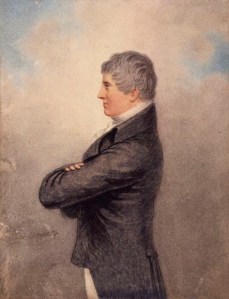
NPG 956,Henry Hunt,by Adam Buck

Henry “Orator” Hunt (6 November 1773–15 February 1835) was a British radical speaker and agitator, who advocated parliamentary reform and the repeal of the Corn Laws.

Because of his rousing speeches at mass meetings held in Spa Fields in London in 1816-17 he became known as the ‘Orator’, a term of disparagement accorded by his enemies. He embraced a programme that included annual parliaments and universal suffrage, promoted openly and with none of the conspiratorial element of the old Jacobin clubs. The tactic he most favored was that of ‘mass pressure,’ which he felt, if given enough weight, could achieve reform without insurrection.

Although his efforts at mass politics had the effect of radicalizing large sections of the community unrepresented in Parliament, there were clear limits as to how far this could be taken. Invited by the Patriotic Union Society, formed by the Manchester Observer, to be one of the scheduled speakers at a rally in Manchester on 16 August 1819, it became the Peterloo Massacre. Arrested and convicted, the incident cost him more than two years in prison.

The debacle at Peterloo, caused by an overreaction of the local Manchester authorities, added greatly to his prestige, but it advanced the cause not one step. Moral force was not sufficient in itself, and physical force entailed too great a risk. Although urged to do so after Peterloo, Hunt refused to give his approval to schemes for a full-scale insurrection. Thereby all momentum was lost, as more desperate souls turned to worn out cloak-and-dagger schemes, which surfaced in the Cato Street Conspiracy.  

While in prison for his part in Peterloo, Hunt turned to writing, to putting his message across through a variety of forms, including an autobiography. After his release he attempted to recover some of his lost fortune by beginning new business ventures in London, which included the production and marketing of a roasted corn Breakfast Powder, the “most salubrious and nourishing Beverage that can be substituted for the use of Tea and Coffee, which are always exciting, and frequently the most irritating to the Stomach and Bowels.” He also made shoe-blacking bottles, which carried the slogan “Equal Laws, Equal Rights, Annual Parliaments, Universal Suffrage, and the Ballot.” Synthetic coal, intended specifically for the French market, was another of his schemes. After the July Revolution in 1830 he sent samples to Gilbert du Motier, Marquis de La Fayette and other political heroes, along with fraternal greetings.

In his opposition to the Reform Bill Orator Hunt revived the Great Northern Union, a pressure group he set up some years before, intended to unite the northern industrial workers behind a platform of full democratic reform; and it is in this specifically that the germs of Chartism can be detected. Worn out by his struggles he died in 1835.

A monument to Hunt was erected in 1842 by “the working people”, in Every Street, Manchester, in Scholefield’s Chapel Yard. A “spiral” march was held on the anniversary of Peterloo, from Piccadilly around the town past the Peterloo site, down to Deansgate and through Ancoats to the monument. The monument’s stonework deteriorated and it was demolished in 1888.

Posted in British history, real life tales, Regency era | Tagged , , , | Comments Off on British Industrial Age Personality~Henry “Orator” Hunt, British Radical of the Industrial Age

The Eighth Day of Christmas (Jane Austen Style)

(Sung to the tune of “The Twelve Days of Christmas”)

images-5On the eighth day of Christmas, Jane Austen gave to me,
Eight Minor Pieces
Seven Austen Siblings
Six Classic Novels
F-i-v-e Bennet Singers
Four Abbey Tilneys
Three Sailing Captains
Two Dashing Colonels
And a love of Mr. Dar…cy.


Love and Freindship [satiric-humorous]
The Three Sisters 
[more serious]
Frederic and Elfrida [satiric-humorous}
Jack and Alice
 [unrestrained Juvenilia]
Henry and Eliza [early humorous]
Lesley Castle
 (excerpts) [satiric-humorous]
Lady Susan [Jane Austen’s wickedest tale]
The Watsons
 [incomplete novel]

If you are interested in a summary of each of these works or if you are interested in reading them by eText, visit The Republic of Pemberley.

Posted in holidays, Jane Austen | Tagged , | Comments Off on The Eighth Day of Christmas (Jane Austen Style)

The Twelve Days of Jane Austen – Day 7

(Sung to the tune of “The Twelve Days of Christmas”)

On the seventh day of Christmas, Jane Austen gave to me,
Seven Austen Siblings

Six Classic Novels
F-i-v-e Bennet Sisters
Four Abbey Tilneys
Three Sailing Captains
Two Dashing Colonels
And a love for Mr. Dar…cy

Posted in Jane Austen, Regency era | Tagged | Comments Off on The Twelve Days of Jane Austen – Day 7

Dr. Amy Smith and the Appeal of Jane Austen’s Characters

This is the transcript of a podcast with Professor Amy Smith, who recognized a common thread among her students when she taught Jane Austen, as opposed to when she taught other classic writers, such as Dickens or the Brontes. To read the complete article, please visit  WAMC: Northwest Public Radio’s website at http://www.wamc.org/post/dr-amy-smith-university-pacific-appeal-jane-austen-s-characters

In today’s Academic Minute, Dr. Amy Smith of the University of the Pacific probes the international appeal of the characters that populate the work of Jane Austen.

Amy Smith is an associate professor of English at the University of the Pacific in Stockton, California. In addition to a course in technical communication, she also teaches a popular course on Jane Austen.

About Dr. Smith

Dr. Amy Smith – The Appeal of Jane Austen’s Characters

Something fascinating happens when I teach Jane Austen – something that doesn’t with novels by Bronte or Dickens or Hemingway. Students immediately recognize people they know in Austen’s characters.

With Sense and Sensibility, somebody inevitably says, “My friend is such a Marianne, she drives me nuts!” Or with Pride and Prejudice: “Mrs. Bennet is hilarious – she’s just like my aunt!” Nobody’s ever read Wuthering Heights in one of my classes and said, “That Heathcliff is just like my boyfriend!” I got to wondering . . . would this “Austen Connection” happen with readers in other countries? I decided to run an Austen road test in Latin America to find out. I did book groups on Austen’s novels, in Spanish, in Guatemala, Mexico, Ecuador, Chile, Paraguay, and Argentina.

So, did readers connect with Austen? Yes and no – but mostly, yes.

Posted in Jane Austen, writing | Tagged , | 1 Comment

The Twelve Days of Jane Austen – Day 6

(Sung to the tune of “The Twelve Days of Christmas”)

On the sixth day of Christams, Jane Austen gave to me

Six Classic Novels
F-i-v-e Bennet Sisters
Four Abbey Tilneys
Three Sailing Captains
Two Dashing Colonels
And a love for Mr. Dar…cy.

Posted in Jane Austen, Regency era | Tagged , , , , , , | Comments Off on The Twelve Days of Jane Austen – Day 6

The Twelve Days of Jane Austen – Day 5

(Sung to the tune of “The Twelve Days of Christmas”)

On the fifth day of Christmas, Jane Austen gave to me,
F-i-v-e … Bennet Sisters
Four Abbey Tilneys
Three Sailing Captains
Two Dashing Colonels
And a love for Mr. Dar…cy.

Posted in Jane Austen, Regency era | Tagged , | Comments Off on The Twelve Days of Jane Austen – Day 5

The Twelve Days of Jane Austen – Day 4

(Sung to the tune of “The Twelve Days of Christmas”)

On the fourth day of Christmas, Jane Austen gave to me,
Four Abbey Tilneys
Three Sailing Captains
Two Dashing Colonels
And a love for Mr. Dar…cy.

Posted in Jane Austen, Regency era, Uncategorized | Tagged , | Comments Off on The Twelve Days of Jane Austen – Day 4

John Ketch, the Infamous Executioner

An infamous English executioner employed by King Charles II, John Ketch was an Irish immigrant who became famous through the way he performed his duties during the tumultuous 1680s. He was mentioned in the broadsheets of the time Appointed in 1663, he executed the death sentences of William Russell in Lincoln’s Inn Fields on 21 July 1683 and that of James Scott, the First Duke of Monmouth on 15 July 1685, after the Monmouth Rebellion. Ketch’s notoriety grew from what was termed his barbarity. Because of Ketch’s botched executions, the name “Jack Ketch” is used for all executioners, especially those who saw to the hangings at Newgate Prison. “Jack Ketch” is also a proverbial name for Death or Satan.
Ketch is first mentioned in the Proceedings of the Old Bailey for 14 January 1676, although no printed notice of the new hangman occurred until 2 December 1678, when a broadside appeared called The Plotters Ballad, being Jack Ketch’s incomparable Receipt for the Cure of Traytorous Recusants and Wholesome Physick for a Popish Contagion. Ketch reportedly wrote a second pamphlet himself. It was entitled The Man of Destiny’s Hard Fortune. It claimed that the hangman was confined for a time in the Marshalsea Prison.
A short entry in the autobiography of Anthony á Wood for 31 August 1681 describes how Stephen College was hanged in the Castle Yard, Oxford, says “and when he had hanged about half an hour, was cut down by Catch or Ketch and quartered under the gallows, his entrails were burnt in a fire made by the gallows.”


Lord Russell’s Execution:

Ketch’s execution of Lord Russell at Lincoln’s Fields Inn on 21 July 1683 was performed clumsily; in a pamphlet entitled The Apologie of John Ketch, Esquire he alleged that the prisoner did not “dispose himself as was most suitable” and that he was interrupted while taking aim.

On that occasion, Ketch wielded the instrument of death either with such sadistically nuanced skill or with such lack of simple dexterity—nobody could tell which—that the victim suffered horrifically under blow after blow, each excruciating but not in itself lethal. Even among the bloodthirsty throngs that habitually attended English beheadings, the gory and agonizing display had created such outrage that Ketch felt moved to write and publish a pamphlet title Apologie, in which he excused his performance with the claim that Lord Russell had failed to “dispose himself as was most suitable” and that he was therefore distracted while taking aim on his neck.

James Scott, First Duke of Monmouth’s Execution:

Monmouth’s execution on  Tower Hill by Jack Ketch on 15 July 1685

On the scaffold on July 15, 1685, James Scott, the First Duke of Monmouth, addressing Ketch, referred to his treatment of Lord Russell, thus disconcerting him, stating “Here are six guineas for you. Do not hack me as you did my Lord Russell. I have heard that you struck him three or four times. My servant will give you some more gold if you do the work well.” The duke subsequently undressed and felt the edge of the axe expressing some fear that it was not sharp enough, and laid his head on the block.” The first blow dealt by Ketch inflicted only a slight wound after which the Duke struggled, rose from the block, and looked reproachfully at the executioner before sinking down once more. Ketch struck the duke twice more, but still the neck was not severed, and the body continued to move. Yells of rage and horror rose from the onlooking crowd to which Ketch flung down the axe with a curse and stated that “I cannot do it, my heart fails me.” The sheriff present asked Ketch to “Take up the axe, man” to which Ketch responded by once more taking up the axe and dealing two more blows to the duke, killing him.  Still, the head remained attached and Ketch used a butcher’s knife from the sheath on his hip to cut the last sinew and flesh that prevented the head from dropping. The crowd was so enraged that Ketch had to be escorted away under strong guard.

Monmouth’s reminder of Russell’s execution either unnerved or angered Ketch. Even as the first blow fell upon the duke, those who counted themselves connoisseurs of the headman’s art knew the axe had missed its mark. Ketch stood back, regarding his botched handiwork, and dealt another blow, then another, as Monmouth writhed, screamed, and moaned. According to the official record of the Tower of London, there were five blows in all, though some onlookers counted seven and others eight. Whether five, seven, or eight, none proved sufficient to sever the man’s head from his suffering body, and Ketch pulled a butcher’s knife from the sheath on his hip, which he drew across the last cords of sinew and flesh that prevented the head from dropping to the scaffold floor. With that, the life of James Scott, 1st Duke of Monmouth, ended on July 15, 1685.

In his Diary, John Evelyn wrote of the duke’s execution that:

He [the duke] would not make use of a cap or other circumstance, but lying down, bid the fellow to do his office better than to the late Lord Russell, and gave him gold; but the wretch made five chops before he had his head off; which so incensed the people, that had he not been guarded and got away, they would have torn him to pieces.

The execution of the duke was considered to be worse than that of Lord Russell. In 1686, Ketch was deposed and imprisoned at Bridewell.

Later Life:

In 1686 Ketch was sent to prison for “affronting” a sheriff. His job was taken by his assistant, Paskah Rose,  formerly a butcher. Rose was arrested after only four months in his office for robbery. Ketch was reappointed in his place and hanged his own assistant at Tyburn.

He died towards the close of 1686.

Posted in British history, legends and myths, real life tales | Tagged , , , , | 4 Comments

The Twelve Days of Jane Austen – Day 3

(Sung to the tune of “The Twelve Days of Christmas”)

On the third day of Christmas, Jane Austen gave to me,
Three sailing Captains
Two dashing Colonels
And a love for Mr. Dar…cy.

(Come back tomorrow for the Day 4 entry.)

Posted in Uncategorized | Tagged , , | 1 Comment