The “French” Influence on the Regency Era

With George III’s first bit of madness in 1788 to the death of George IV in 1830, the world experienced the French Revolution, the Napoleonic Wars, the Congress of Vienna, and the Age of Reform.

England found itself inundated with French refugees during the French Revolution. Thousands of French aristocrats arrived on English shores in the wake of the Terror. Estimates are set at 40,000 + French aristocrats coming through ports such as Brighton. Many arrived with nothing more than the clothes on their backs.

French émigrés left behind many of their valuables, but they brought tales of the Terror to English shores. There were, for example, stories of Victims’ Balls. These were parties given by the survivors of the Terror, those whose relatives had been executed. To be admitted one had to present a certificate to prove that one of the person’s relatives had been guillotined. When a male entered the party, he would bow his head as if presenting it to the guillotine. Women would wear a red ribbon about their necks as a symbol of the spilled blood.

The stories of horror turned many good Englishmen against the idea of Reform. Any steps toward thinking of changing the status of the working poor through governmental reform took on the language of treason. Add to the reality of the French Revolution the one taking place in America, and the idea of change in the electoral system took a GIGANTIC step backward.

In 1793, England declared war on France. It would be 1815 before peace would be declared. The war was very unpopular with the English public. The English educated class had held a long love affair with everything French. They spoke French with ease and adored French fashion and art. The great majority of the public, however, were very much anti-French. Part of this dislike of the French came from the lower classes’ dislike of the English upper classes’ fascination with the French.

history-of-fashion_Picture31Francophiles spoke French, indulged in French food and wine, and filled their houses with French furniture. Even George IV, the Prince Regent, decorated his houses in the French style. English Society had no intention of letting a little thing such as a war to interfere with their French obsession. Smugglers thrived, especially smugglers of French brandy and art, as well as luxury food stuffs.

A temporary peace arrived on English shores with the Treaty of Amiens in 1802. English high society kept the Channel busy as they streamed into Paris to scarf up all things French. Whig leader, Charles James Fox, was one of the first to arrive on French shore, along with the Duchess of Devonshire as part of his entourage. George IV’s future mistress, Lady Conyngham, was deemed the most beautiful woman in Paris at the time. It was quite fashionable to be presented to Napoleon. Fraternizing with the enemy was very much in vogue.

Madame Recamier was the most famous hostess of the English influx, but the peace held for barely fourteen months. The peace may not have lasted, but the English fascination with the French remained entrenched throughout the Regency. It was quite ironic to hear the English conducting business in the language of their enemy.

The Regency is noted for its elegance and achievements in the fine arts and architecture. This era encompassed a time of great social, political, and even economic change. War was waged with Napoleon and on other fronts, affecting commerce both at home and internationally as well as politics. Despite the bloodshed and warfare the Regency was also a period of great refinement and cultural achievement, shaping and altering the societal structure of Britain as a whole.

Posted in British history, Jane Austen, Living in the Regency, real life tales, Regency era, Victorian era | Tagged , , , , , | 3 Comments

Regency and Victorian England: Household Servants

“The dinner, too, in its turn, was highly admired; and he begged to know to which of his fair cousins the excellence of its cooking was owning. But here he was set right by Mrs. Bennet, who assured him, with some asperity, that they were vey well able to keep a good cook, and that her daughters had nothing to do in the kitchen.” From Chapter 13 of “Pride and Prejudice”

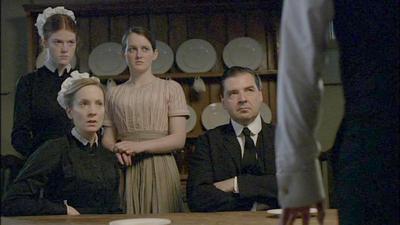
servants from Upstairs/Downstairs

servants from Upstairs/Downstairs

By the beginning of the 19th Century, keeping a servant or servants was a sign of prosperity, especially among the gentry and the quickly growing middle class. Physicians, lawyers, and other professionals found hiring servants improved their status within a community. 

In order to raise funds for the American War of Independence, the British government levied a tax of one guinea per male servant in 1777. This tax remained in place until 1937. Advertisements in newspapers listed available servants. Servants could be dismissed with either a month’s wages in hand or a month’s notice. Servants were expected to serve out his/her service prior to leaving. 

By religiously saving their wages, a servant, especially an upper servant, could retire in a degree of comfort. Male servants, who had left their positions, often turned to trade or the keeping of public houses. Upper female servants often remained in the household. Those with gentry ways could easily assimilate into a community. 

scene from Downtown Abbey

scene from Downtown Abbey

In September and May, mop fairs were held. This was a tradition, sometimes called a statute or hiring fair. Those being “sold” during the fair wore distinctive additions to their clothing, which indicated the position he/she sought.  A servant could also find a position through statute halls or through servant registries. This early “employment” agencies printed fliers that listed available servants. Unfortunately, these situations were prime areas for fraud. Some of the agencies charged exorbitant fees for nonexistent jobs. 

Generally, servants received a wage + an allowance for tea, sugar, and beer. Board wages were used to purchase food at public houses/inns when the servant was expected to travel between country homes and Town houses. In “The Writer’s Guide to Everyday Life in Regency and Victorian London,” Kristine Hughes says that a maid of all works would typically receive 6-8 pounds annually plus an allowance; a lady’s maid would receive 12-15 pounds + an allowance; a valet would receive 25-50 pounds + an allowance; a liveried footman 15-25 pounds + an allowance, and that “board wages amounted to about ten shillings per week for females, twelve shillings a week for males. Also a male was allowed a pot of ale per day and a woman a pint per day, in addition to the table beer served during meals. Tea money was paid to a servant in lieu of an employer providing daily tea and sugar.”

On days off from service, servants typically visited family and friends or a public house, which catered to the servant class. In grand house, special events were held purely for the servants. We have seen such activities in the Servant Ball during Season 2 of Downtown Abbey. Queen Victoria was known to host an annual Ghillie’s Ball for her servants at Balmoral Castle.  However, one must recall days off were not the rule of the day. Servants, generally, did not have “private” lives once they entered service. Female servants with suitors were quickly dismissed. 

Liveries were delivered on April 1 and October 1. 

The custom of distributing clothes -or what in the present day would be styled uniforms-  amongst the servants of the Crown- such as Judges, Ministers ,Stewards etc- date from a period nearly coeval with the Conquest.( circa 1066A.D.-jfw) This distribution was termed a “Livreé”: hence the more recent expression, “Livery.”

(Cussans,Page 311)

It ought to be remembered that during the late 18th century/early 19th century most household servants did not wear a distinctive  uniform, such as we are used to seeing in adaptations of fictional Edwardian households such as in Downtown Abbey andUpstairs, Downstairs. Female servants wore what was practical, and often wore cast-offs from their mistresses, though moralists detested this practise.  Sophie von La Roche wrote, during her travels in London in 1786 of the serving girls she saw in the streets of London:

…the maids, women of middle class and the children. The former almost all wear black taminy petticoats and heavily stitched, and over these long English Calico or linen frocks, though not so long and close-fitting to the body as our tailors and taste cut and point them. Further they mostly wear white aprons; though the servants and working women often appear in striped linen aprons

Jane Austen’s kinswoman by marriage, and friend of her aunt and uncle, Leigh Perrots, Mrs Lybbe Powys wrote in her diary of her visit to the Jackson family at Weasenham Hall in Norfolk in 1756:

“Never did a landlord seem so beloved, or indeed deserve to be so, for he is a most worthy man, and in however high a stile a man lives in in town, which he certainly does, real benevolence is more distinguishable in a family at their country -seat, and none do more good than where we now are. Then everything here is regularity itself , but the master’s method is, I take it, now become the method of the servants by use as well as choice.

“Nothing but death make a servant leave them. The old housekeeper has now been there one-and-fifty years; the butler two or three-and-thirty……I was surprised to see them all, except on Sundays, in green stuff gowns, and on my inquiring of Miss Jackson how they all happened to fix so on one particular colour, she told me a green camblet for a gown used for many years to be an annual present of her mothers to those servants who behaved well, and had been so many years in her family, and that now indeed, as they all behaved well, and had lived there much longer than the limited term, this was constantly their master’s New Year gift.

“I thought this in Mr Jackson a pretty compliment to his lady’s memory, as well as testimony of the domestics still deserving of his good opinion.”

According to Daniel Pool in What Jane Austen Ate and Charles Dickens Knew, footmen wore:

“…livery, or household uniform of fancy coat, knee breeches, stockings, and powdered hair, a costume that endured to the end of th 1800s. Because of their appearance at dinner and in public with the family, footmen were supposed to be the most “presentable” of the male servants. They were evaluated on the basis of the appearance of their calves in silk stocking, and they often gave their height when advertising for positions in the paper–it was considered absurd to have a pair of footmen who didn’t match in height. (Poole, pg. 221)


Posted in British history, Jane Austen, Living in the Regency, real life tales, Regency era, Victorian era | Tagged , , , , , | 8 Comments

The 19th Century Educational System (or Lack Thereof)

“Public” schools were founded through generous donations for the male children of the towns of Eton and Harrow, and they were originally open to all. The concept of the “grammar” school came from the fact that Latin and Greek grammar was the basis of the program. Eventually, these public schools began to operate as private schools for the children of rich patrons.

N7061898115TThese “public” schools were a social experiment in an era when education was patchwork at best.  No national school system existed at the beginning of the 19th Century. The rich hired a governess to teach their female children and a tutor to educate their sons until the boys could go off to Eton, Harrow, Oxford, and Cambridge.   Children of the poor were sent off to work the fields, or if fortunate, to an apprenticeship.

      “Eton College and Harrow School are both all-boy boarding schools. When the boys enter, they are 13 years old, and they spend five years before they graduate when they become 18 years old. Eton was established by King Henry VIII (1491-1541). Harrow started as an exclusive school for boys in 1243, but moved to the present location during the period of Queen Elizabeth I (1533-1603).

Until recently, most of the prime ministers came from Eton or Harrow. These schools used to teach their boys how to run the British empire. These days, they are interested in teaching them how to run international corporations. This does not appear to be an easy transition.”

Women were not taught Latin or Greek. From Making Home Life Attractive, we learn, “Gentlemen should not make use of classical quotations in the presence of ladies, without apologizing for or translating them. Even then, it should only be done when no other phrase can so aptly express their meaning. Much display of learning is pedantic and out of place in a drawing room. All topics especially interesting to gentlemen, such as the turf, the exchange, or the farm, should be excluded from general conversation.  Men should also remember that all ladies are not interested in politics, and dwell, of preference, upon such subjects as they are sure to be acquainted with. Never talk upon subjects of which you know nothing, unless it be for the purpose of acquiring information. Many young ladies and gentlemen imagine that, because they play a little, sing a little, draw a little, frequent exhibitions and operas, and so forth, they are qualified judges of art. No mistake is more egregious or universal. The young should never be critical. A young person of either sex can but appear ridiculous when satirizing books, people, or things: opinion, to be worth the consideration of others, should have the advantage of maturity.”

The idea of children not able to read their Bibles spearheaded the movement toward true public education. In 1811, the National Society for Promoting the Education of the Poor in the Principles of the Established Church was formed. By 1839, Parliament took up the cause of these “national” schools. In that year, Parliament granted 30,000 pounds to the running of these open schools.

The “national” schools ran on what was known as a monitorial system, meaning teachers taught monitors (selected students), who then taught the enrolled children. This system evolved into “training colleges,” another term for a teacher’s college.

In 1862, standards were implemented to set a “standardized” program for all children. These standards included the 3R’s.

Posted in British history, Jane Austen, Living in the Regency, real life tales, Regency era, Victorian era | Tagged , , , , , , | Comments Off on The 19th Century Educational System (or Lack Thereof)

Publishing Options for Women Writers in Jane Austen’s Time


Novels during the early Regency were geared toward the female reader; therefore, the door opened, if only a crack, for the female writer to step through. The female writers of the time assisted Jane Austen in several ways, among them the influence on her writing and building an audience for Austen’s early works.

The early female authors faced something that Austen did not. They faced public criticism, as women of the time, especially those of genteel birth, did not seek employment of any kind. Women were not to pursue fame and a career. They were discouraged by their husbands and families from publishing their works. Austen was fortunate to have a family who encouraged her writing, but even she published anonymously. Austen’s father, the Reverend Austen, even approached a publisher for Jane when she was but two and twenty. Later, Jane’s brother acted as her representative with the publisher under which she served.

Women of the period had limited means at their disposal under which they might see their works come to fruition:

(1) Publishing by subscription – Subscribers signed up to purchase a novel. When enough subscriptions were guaranteed, then the publisher released the book.

(2) Publishing by profit sharing – The publisher released the book at his expense. Copies were sold until a profit was made. Only then did the author received a fee for his work. If no profit was made, the author received nothing, but the pleasure of seeing her name in print.

(3) Publishing by selling the copyright – The author took a chance in selling her copyright to the publisher. She would receive a fee for the sale, but nothing beyond that. If the book  made a profit, only the publisher benefited.

(4) Publishing on commission – For this venture, the author paid all the costs for the book’s publication. The publisher acted as the author’s distributor. In the sales, the publisher would earn a 10% fee from the profits. If the book saw no profits, the loss rested on the author’s shoulders alone. This was the method Jane Austen used for her releases. Jane Austen published her first book at the age of four and thirty.

First Edition title page of Austen’s “Sense and Sensibility,” published in 1811

Posted in British history, Industry News/Publishing, Jane Austen, Living in the Regency, real life tales, Regency era | Tagged , , , | 6 Comments

Austen’s Publishing History

austen460Today is the 200th Anniversary of the publication of Jane Austen’s “Pride and Prejudice.” I thought in honor of the date we would take a quick look at the process of having her works published. Most of Austen’s story lines went through several revisions before the lady knew fruition. She reportedly made extensive changes in both “Sense and Sensibility” and “Pride and Prejudice.”

Sense and Sensibility was completed in 1795, but it did not know publication until 1811. (That is a sixteen year span. For authors who think they will write the next best seller and have it immediately caught up by an agent and publisher, this is a very sobering fact.)

Mansfield Park was finished in 1812 and was published two years later in 1814. (This appears to be Austen’s attempt at sentimentality. “Mansfield Park” does not enjoy the same level of popularity as Austen’s other novels.)


Pride and Prejudice knew a similar fate. Austen wrote the original manuscript in 1796. It was published in 1813. (Seventeen years of rejection. It makes me admire Austen more.)

Austen  began Northanger Abbey in 1798. The book was published posthumously in 1817.  (That time period is nearly two decades!)

Emma was finished in 1814 and published in 1815. Obviously, the success of Sense and Sensibility and Pride and Prejudice aided Austen in this process.

Finally, Persuasion was completed in 1815 and published posthumously in 1817.

Posted in British history, Industry News/Publishing, Jane Austen, Living in the Regency, real life tales, Regency era | Tagged , , , , , , , | 5 Comments

Living in Regency London – Lighting the House

Today, I have have dealt with three power outages in my area, and with each, I have privately cursed how dark is my home without the power of electricity. I have had to go without lights, TV, the internet, phone service, etc., and this modern-day “deprivation” has set me to thinking about the days of the Regency era when the almighty CANDLE ruled the home.

Until the Victorian Era, candles, lanterns, and rush-lights served as the principal means of lighting the Georgian styled home, and like every other aspect of Regency life, the use of the these sources of light adhered to their own “hierarchy” of use.

At the top of the Candle Hierarchy was the beeswax candle. These candles were more expensive than the others and could be left unattended for longer periods than could tallow or rush lights. However, they did melt faster than tallow candles. Wax candles were used by the very rich to prove their superiority to others. Wax candles were used in chandeliers because they burned themselves out rather than having to be snuffed out by the servants.Candles

IMG_3004-e1272244558721-200x300Tallow candles, usually made from mutton fat, were the main source of light in middle class homes and the lower gentry. They left behind a most annoying odor and did not burn evenly. Generally, the flame had to be snuffed out to prevent the charred wick falling into the tallow. If this happened, a “gutter” formed and melted wax would flow over everything. The tallow candle offered poor lighting and did not last for long.


Rush-lights were used by the poor. Rush-lights were made by dipping the stripped pith of common rushes into hot animal fat, often bacon fat. Rushes are commonly 2 feet long. They were held in place by a stand with a clip, and they usually burned out in an hour or so. The poor sometimes chose to burn tallow candles, but they were not economical. Eleven rushes would cost a family a farthing.rushlight2

It was commonplace to have only two candlesticks in each room. In some homes, wall sconces with mirrors behind them increased the lights. These sconces were typically mounted on the chimney-breast.

Unlike the homes on the Continent, most homes in Georgian London were slow to accept oil burning lamps. Ami Argand of Geneva demonstrated his improved lamp in 1783 to the French Academy of Sciences. Unfortunately for Argand, the French Academy did not take well to the experiment. So, Argand brought his invention to London. Argand lamps using Colza oil were used in some wealthier London homes, but they were very expensive and were “plagued” by the cumbersome need to mount the oil reservoir above the level of the burner. This mounted reservoir blocked off the light from one side of the lamp. After 1798, a pump was available to force the oil upwards.

Candles were more economical and remained the main source of light until the mid-19th Century.

Posted in British history, Jane Austen, real life tales, Uncategorized, writing | Tagged , , , , , , | 10 Comments

Are eBooks Destroying Traditional Publishing?

This article comes from NPR. It addresses the changing role of traditional publishing. This article matches up well with the one from yesterday on the increase in eBook reading among Americans.

E-Books Destroying Traditional Publishing? The Story’s Not That Simple

by ZOE CHACE

December 27, 2012 4:00 PM

What counts as a book these days, in a world of Kindles, Nooks and iPads — and eager talk about new platforms and distribution methods?

Traditional publishers are traveling a long and confusing road into the digital future. To begin with, here’s the conventional wisdom about publishing: E-books are destroying the business model.

People expect them to be cheaper than physical books, and that drives down prices. But the story’s not that simple. For one thing, digital publishers have the same problem that record labels do: piracy. And there’s just not the same stigma attached to pirating an e-book as there is to holding up a Barnes & Noble.

It turns out, though, that some publishers are doing pretty well despite the piracy problem. “We’ve had an incredible year,” says Sourcebooks President Dominique Raccah. “Last year was the best year in the company’s history. This year we beat that, which I didn’t think was even possible.” Raccah adds that her company is doing well because of digital publishing, not in spite of it. “It’s been an amazing ride,” she says.

It turns out there are some huge advantages — at least for publishers. A big one: The price of an e-book isn’t fixed the way it is with physical books. Ten years ago, a publisher would have sent out its books to the bookstore with the price stamped on the cover. After that, it was done — the publisher couldn’t put it on sale to sell more books.

To continue reading, please visit http://www.npr.org/2012/12/27/168068655/e-books-destroying-traditional-publishing-the-storys-not-that-simple One can even listen to the story rather than read it.

Posted in real life tales | Tagged , , | Comments Off on Are eBooks Destroying Traditional Publishing?

Reading Trends from 2012

This article comes from the Pew Internet & American Life Project. It contains wonderful graphics, which help to analyze the changes in the reading habits of Americans over the age of 16. It is worth the read.

E-book Reading Jumps; Print Book Reading Declines

by Lee Rainie and Maeve Duggan

Findings

The population of e-book readers is growing. In the past year, the number of those who read e-books increased from 16% of all Americans ages 16 and older to 23%. At the same time, the number of those who read printed books in the previous 12 months fell from 72% of the population ages 16 and older to 67%.

Overall, the number of book readers in late 2012 was 75% of the population ages 16 and older, a small and statistically insignificant decline from 78% in late 2011.

The move toward e-book reading coincides with an increase in ownership of electronic book reading devices. In all, the number of owners of either a tablet computer or e-book reading device such as a Kindle or Nook grew from 18% in late 2011 to 33% in late 2012. As of November 2012, some 25% of Americans ages 16 and older own tablet computers such as iPads or Kindle Fires, up from 10% who owned tablets in late 2011. And in late 2012 19% of Americans ages 16 and older own e-book reading devices such as Kindles and Nooks, compared with 10% who owned such devices at the same time last year.

To continue reading please follow this link: http://libraries.pewinternet.org/2012/12/27/e-book-reading-jumps-print-book-reading-declines/

Posted in Industry News/Publishing, real life tales, writing | Tagged , , , , , , , | Comments Off on Reading Trends from 2012

Oh, Give Me Land Lots of Land (or) the 19th Century Entail

As it had been for centuries, a man’s status in 19th Century British Society rested in the land he held. Land was a symbol of wealth and social rank. Therefore, the need to pass one’s “wealth” to future generations increased with the amount of land owned. Land was “influence,” as well as affluence. To ensure one’s descendants received what had been incurred, a system known as primogeniture was put in place. Primogeniture meant that all the land in each generation’s possession was left to the eldest son in the family rather than being divided equally among off the offspring. Secondly, an entail assured that said “eldest son” could not mortgage or divide or sell said inheritance. It was to be held for his eldest son, etc., etc., etc.

Primogenture developed during Norman times. The concept was by leaving the land to the eldest son, the estate would remain intact for future generations. It would also be economically capable of supporting a military force, which could assist the king. By the 19th Century, the King/Queen had other means to field a military presence, and social status became the basis of the practice. Customarily, primogenture was part of a gentleman’s will or deeds of settlement. This practice remained intact until 1925, when it was changed by law.

The entail prevented a wastrel from selling off the family estate to pay his debts. Do you recall Sir Walter Eliot in Jane Austen’s Persuasion. “There was only a small part of his estate that Sir Walter could dispose of; but had every acre been alienable, it would have made no difference. He had condescended to mortgage as far as he had the power, but he would never condescend to sell. No; he would never disgrace his name so far. The Kellynch estate should be transmitted whole and entire, as he had received it.” An entail was defined by a deed of settlement (or) a strict settlement. The heir normally received the land for his use ONLY in his lifetime. His rights ceased to exist upon his death.

Originally, many attempted to entail their properties until the end of the world, so to speak. However, the law would not permit “infinity” to stand. In practice, an entailed property only remained so until the grandson of the land owner making the settlement became of age at 21 years. Then, the heir could sell or give away the property. So, theoretically, the entail only held the land through the first and second generation of land owners. However, a little coercion often secured the land for future generations.

Most land owners (and their sons) held no other financial employment. If the property owner’s son wished to keep his “allowance,” he agreed to sign a new deed of settlement, which would assure the property remained in the family for another two generations, etc., etc. However, what if no males were born to inherit? A family line could end if a female remained single or even if she married. Single females had no children to inherit, and through married females, the property passed to someone outside the family.

Such a “disaster” was part of the plot of Jane Austen’s Pride and Prejudice. 

“‘Oh! my dear,’ cried his wife, ‘I cannot bear to hear that mentioned. Pray do not talk of that odious man. I do think it is the hardest thing in the world that your estate should be entailed away from your own children; and I am sure if I had been you, I should have tried long ago to do something or other about it.’ Jane and Elizabeth attempted to explain to her the nature of an entail. They had often attempted it before, but it was a subject on which Mrs. Bennet was beyond the reach of reason; and she continued to rail bitterly against the cruelty of settling an estate away from a family of five daughters, in favour of a man whom nobody cared anything about.”

The females, however, often found another means of “retaining” the property. Propriety permitted cousins to marry. A girl could remain in her childhood home when no males were available to inherit by marrying the “heir presumptive.” It was Elizabeth Eliot’s hope to marry William Walter Eliot, Esq., her father’s heir. “She had, while a very young girl, as soon as she had known him to be, in the event of her having no brother, the future baronet, meant to marry him.” And Mrs. Bennet wishes Elizabeth to marry the odious Mr. Collins in order to save Longbourn. In his proposal, Mr. Collins explains why he assumes one of the Bennet sisters would accept him. “Thus much for my general intention in favour of matrimony; it remains to be told why my views were directed to Longbourn instead of my own neighbourhood, where I assure you there are many amiable young women. But the fact is, that being, as I am, to inherit this estate after the death of your honoured father (who, however, may live many years longer), I could not satisfy myself without resolving to chuse a wife from among his daughters, that the loss to them might be as little as possible, when the melancholy event takes place—which, however, as I have already said, may not be for several years. This has been my motive, my fair cousin, and I flatter myself it will not sink me in your esteem. ”

Primogenture also created the concept of second and third sons searching for an heiress to marry so they might establish their own properties. It also sent marriage mad mothers into fits. There were only a limited number of eldest sons for daughters to land. Colonel Fitzwilliam in Pride and Prejudice says “Younger sons cannot marry where they like.” The real irony of this madness was the eldest son also inherited the debt from the previous generation. Even being the heir was not an path to “easy street.”

Posted in British history, Jane Austen, real life tales, Regency era | Tagged , , , | 20 Comments

The Face of Jack the Ripper

On Friday, I included a post on The Brutality of Jack the Ripper. This is one of favorite sources on the crime. In 2006, BBC News brought us a look at “Jack the Ripper” by using modern day profiling techniques. Below is a short excerpt from the article, which is well worth the read.

Jack the Ripper’s face ‘revealed’
Jack the Ripper e-fit

The case has fascinated people for decades

An e-fit showing what detectives believe serial killer Jack the Ripper looked like has been revealed.Using new profiling techniques, investigators have created a picture of what they believe the 19th Century murderer would have looked like.

The man, who evaded police in the 1880s, is thought to have killed and mutilated five London prostitutes.

The Scotland Yard team describe him as “frighteningly normal” but someone capable of “extraordinary cruelty”.

And investigators have admitted that police at the time were probably searching for the wrong kind of man.

Head of analysis for Scotland Yard’s Violent Crime Command Laura Richards, who has studied serial killer Fred West and Soham murderer Ian Huntley, revisited the case using modern police techniques.

To continue reading go to http://news.bbc.co.uk/2/hi/6164544.stm

Posted in British history, gothic and paranormal, Industry News/Publishing, legends and myths, real life tales, Victorian era | Tagged , | Comments Off on The Face of Jack the Ripper