UK Real Estate: Lacock Abbey, Wiltshire, Backdrop for Harry Potter, Pride and Prejudice, and Robin of Sherwood

Southern view of Lacock Abbey

Southern view of Lacock Abbey

Lacock Abbey in the village of Lacock, Wiltshire, England, was founded in the early 13th century by Ela, Countess of Salisbury, as a nunnery of the Augustinian order.

History
Lacock Abbey, dedicated to St Mary and St Bernard, was founded in 1229 by the widowed Lady Ela the Countess of Salisbury, who laid the abbey’s first stone 16 April 1232, in the reign of King Henry III, and to which she retired in 1238. Her late husband had been William Longespee, an illegitimate son of King Henry II. The abbey was founded in Snail’s Meadow, near the village of Lacock. The first of the nuns were veiled in 1232.

Generally, Lacock Abbey prospered throughout the Middle Ages. The rich farmlands which it had received from Ela ensured it a sizeable income from wool.

The chapter house survives unaltered.

The chapter house survives unaltered.


Following the Dissolution of the Monasteries in the mid-16th century, Henry VIII of England sold it to Sir William Sharington, who converted it into a house starting in 1539, demolishing the abbey church. Few other alterations were made to the monastic buildings themselves: the cloisters, for example, still stand below the living accommodation. About 1550, Sir William added an octagonal tower containing two small chambers, one above the other; the lower one was reached through the main rooms, and was for storing and viewing his treasures; the upper one, for banqueting, only accessible by a walk across the leads of the roof. In each is a central octagonal stone table carved with up-to-date Renaissance ornament. A mid-16th century stone conduit house stands over the spring from which water was conducted to the house. Further additions were made over the centuries, and the house now has various grand reception rooms.

In the 16th and early 17th centuries, Nicholas Cooper has pointed out, bedchambers were often named for individuals who customarily inhabited them when staying at a house. At Lacock, as elsewhere, they were named for individuals “whose recognition in this way advertised the family’s affinities”: the best chamber was “the duke’s chamber,” probably signifying John Dudley, 1st Duke of Northumberland, whom Sharington had served, while “Lady Thynne’s chamber,” identified it with the wife of Sir John Thynne of Longleat, and “Mr Mildmay’s chamber” was reserved for Sharington’s son-in-law Anthony Mildmay of Apethorpe in Northamptonshire.

During the English Civil War the house was garrisoned by Royalists. It was fortified by surrounding it with earthworks. The garrison surrendered (on agreed terms) to Parliamentarian forces under the command of Colonel Devereux, Governor of Malmsbury, within days of Oliver Cromwell’s capture of the nearby town of Devizes in late September 1645.

The Abbey also underwent alterations in the 1750s under the ownership of John Ivory Talbot in the Gothick Revival style. The architect was Sanderson Miller.

The house eventually passed to the Talbot family. It is most often associated with William Henry Fox Talbot (see my Friday, March 24, post on Talbot). In 1835 Talbot made the earliest known surviving example of a photographic negative, a photogenic print of the oriel window in the south gallery of the Abbey. Talbot continued with his experiments at the Abbey and by 1840 had discovered the negative/positive process to record photographic images by chemical means.

The Abbey houses the Fox Talbot Museum devoted to Talbot’s pioneering work in photography and the original photograph of the oriel window he developed.

Lacock Abbey and the surrounding village were given to the National Trust in 1944. The Trust market the abbey and village together as Lacock Abbey, Fox Talbot Museum & Village.

The Abbey in Film

The cloisters of Lacock Abbey

The cloisters of Lacock Abbey

Some interior sequences in Harry Potter and the Chamber of Secrets were filmed at Lacock, including the cloister walk (illustrated, left) where Harry comes out from Professor Lockhart’s room after serving detention and hears the basilisk. During four days in October 2007 Lacock was also used to film some scenes for the sixth Harry Potter film, Harry Potter and the Half-Blood Prince. Warner Bros. announced that the spooky nights of Hogwarts were also filmed here with most of the main characters including Daniel Radcliffe.

The Abbey was one of two major locations for the 2008 film version of the historical novel The Other Boleyn Girl.

Lacock appears in the “Robin Hood and the Sorcerer,” “Cromm Cruac” and “The Pretender” episodes of Robin of Sherwood. It was also used in the 1995 BBC/A&E production of “Pride and Prejudice.”

In the Spring of 2012, it was a filming location of the fantasy adventure movie Mariah Mundi and the Midas Box, which was released in 2013.

Posted in British history, buildings and structures, Living in the UK, religion | Tagged , , | 2 Comments

During the Reign of George IV: The Metropolitan Police Act of 1829

In my current WIP (Work in Progress), I have spent countless hours in studying the working of the law in 1816 London. The difficulty is there was no Metropolitan Police Force to handle the investigations. The fragmented dealings have created a quagmire of legalities for me to decipher, but I am loving the process.

Sir Robert Peel

Sir Robert Peel

The Metropolitan Police Act 1829 (10 Geo.4, C.44) was an Act of Parliament introduced by Sir Robert Peel and passed by the Parliament of the United Kingdom. The Act established the Metropolitan Police of London (with the exception of the City), replacing the previously disorganized system of parish constables and watchmen. The Act was the enabling legislation for what is often considered to be the first modern police force, the “bobbies” or “peelers” (after Peel), which served as the model for modern urban police departments throughout England. The UK’s first Police Act was the Glasgow Police Act of 30 June 1800 and another eleven Scottish cities and burghs established police forces under individual police Acts of Parliament before Peel’s Metropolitan Police was established. Until the Act, the Statute of Winchester of 1285 was cited as the primary legislation regulating the policing of the country since the Norman Conquest.

It is one of the Metropolitan Police Acts 1829 to 1895.

Organization
Section 1 of the Act established a Police Office for the Metropolis, to be under two commissioners who were to be Justices of the Peace.

Section 4, constituted the Metropolitan Police District from the Liberty of Westminster and parts of the counties of Middlesex, Surrey and Kent, and stated that “a sufficient number of fit and able men shall from time to time, by the direction of His Majesty’s Secretaries of State, be appointed as a Police Force for the whole of such district…” The constables were to have power not only within the MPD, but also throughout Middlesex, Surrey, Hertfordshire, Essex and Kent.

Section 6 made it an offence for the owner of a public house to harbour a police officer during his hours of duty.

Section 7 outlined the powers of the new police force. A constable was empowered to apprehend “all loose, idle and disorderly Persons whom he shall find disturbing the public Peace, or whom he shall have just Cause to suspect of any evil Designs, and all Persons whom he shall find between sunset and the Hour of Eight in the Forenoon lying in any Highway, Yard, or other Place, or loitering therein, and not giving a satisfactory Account of themselves…

Section 8 made it an offence to assault or resist a police officer, with the penalty of a fine not exceeding five pounds.

Other sections dealt with arrangements for the handing over of police powers in the various parishes, with existing “watchmen and night police” to continue until the commissioners indicated that the Metropolitan Police were ready to assume responsibility for the area. Overseers in the parishes were to levy a Police Rate on all persons liable to pay the Poor Rate, not to exceed eight pence in the pound.

Section 34 of the Act allowed other parishes to be added to the Metropolitan Police District by Order in Council. Any place in Middlesex, Surrey, Hertfordshire, Essex or Kent within twelve miles of Charing Cross could be added.

Posted in British history, George IV, Great Britain, Living in the UK, political stance | Tagged , | 1 Comment

Do You Remember When? A Pin-Up Became a Princess…

2186In the 1940s and 1950s, there was no one “hotter” that Rita Hayworth. With a reserved striptease in the film Gilda, Hayworth became every man’s fantasy. Who could believe in today’s age of near nudity upon every screen that a simple slow peel of arm-length black gloves could be so enticing? Later, Hayworth was reported as saying, “Every man I’ve ever known has fallen in love with Gilda and awakened with me.” (Do you recall Julia Roberts paraphrasing the quote when she is in bed with Hugh Grant in Notting Hill?) 

Hayworth’s pin up poster – the one of her kneeling on a bed in a black lace negligee – became the mainstay of American servicemen during World War II.

Born Margarita Carmen Cansino (the daughter of flamenco dancers) in Brooklyn, NY, Hayworth joined her father as his dancing partner at age 13. With her hair dyed black to emphasize her Latino roots, Rita and her father in performances in Mexican nightclubs in the Los Angeles area. Her parents neglected Rita’s education, and this lack of knowledge increased her insecurities as she matured.

At age 18, she married for the first time to a man named Edward Judson, a man some 20 years her senior. He was a small time wheeler-dealer and used car salesman. Judson was the one, however, to assist Hayworth with an introduction to Harry Cohn, the head of Columbia Pictures. Cohn signed Hayworth to a 7-year movie contract – a contract which required her to slim down her figure, to lighten her hair, and to change her name from “Margarita” to “Rita,” as well as to take the name “Hayworth” from her Irish mother’s surname. ritacolor2

Her first role of any significance came in a supporting role with Cary Grant in 1939’s Only Angels Have Wings. That role was followed by those of an ingenue in Cover Girl, as a terpsichore in You Were Never Lovelier, and the role which became her film signature, the one of Gilda. Her sensuous “Put the Blame on Mame,” which was dubbed by Anita Ellis, was an instant hit upon the music charts.

with Glenn Ford in "Gilda"

with Glenn Ford in “Gilda”

Her marriage to Judson was dissolved in 1943. That relationship was followed by one with Orson Welles. They wed in the fall of 1943. Welles elevated Hayworth’s image from seductress to leading lady by directing her in Lady from Shanghai. Welles co-starred with his wife; they were dubbed as Beauty and the Brain. However, Hayworth was to discover Welles true love was his work. In 1947, she told the press. “I’m tired of being a 25% wife.” Shortly afterwards, she left for the French Riviera with her daughter Rebecca.

Lady from Shanghai

Lady from Shanghai

There, she was introduced to Prince Aly Khan, a man a bit obsessed with the “Gilda” image. They began an affair, which became the fodder of the tabloids. In May 1948 (after both Hayworth and Khan had divorced), they were to have been married at Chateau de L’Horizon, Khan’s seaside villa in the south of France. In reality, they were married at city hall in Vallauris because French law could not be bent even for a prince. Aly placed a 32-carat diamond upon Hayworth’s hand. L’Horizon hosted the reception.

Hayworth soon gave birth to Princess Yasmin, but in April 1951, the couple separated. As it had been with Welles, Aly’s business and social duties kept the “princess” from knowing happiness. Hayworth said after the separation became final, “I have concluded that a happy and contented home life, which I earnestly desire for my children and myself, is otherwise unattainable.” The couple fought openly for the custody of Yasmin, but in 1953, Aly agreed to a $1.5 million settlement in a default divorce. Seven years later, Aly died in a car accident when his Alfa Romeo piled into a tree. He was dead at age 49.

Two more marriages followed. The first to singer Dick Haymes and then to producer/writer James H. Hill Jr. Her last major role for Columbia Pictures was as a stripper-turned-socialite opposite Frank Sinatra in Pay Joey (1957). That role was followed by critic favorites, Separate Tables (1958) and They Came to Cordura (1959).

Second-rate films peppered her filmography during the 1960s and by the 1970s there were rumors of drunkenness. She was replaced as the lead in the Broadway production of Applause because she could not remember her lines. She walked off sets of movies. Her behavior became quite irrational. Finally, the diagnosis of Alzheimer’s proved the alcoholism a mistaken assumption. Rita Hayworth died at age 68 in May 1987.

dancing with Fred Astaire

dancing with Fred Astaire

Posted in acting, Do You Remember?, film | Tagged , , | 2 Comments

The Princess Royal’s Not So Happy Life

The Princess Royal’s Not So Happy Life

As we watched Kate Middleton marry into the Royal Family, people kept saying things that made the life of a princess seem “ideal,” but we who have studied the Regency Period can name six princesses who knew nothing of the glam and glamour of being named “princess.” The Princess Royal, Charlotte Augusta Matilda, was the oldest of those.

The infant Charlotte in the arms of her mother, Queen Charlotte

George III and Queen Charlotte beget a total of 15 children: nine sons and six daughters. Life in the royal household was anything but ideal. Reportedly, the boys were often beaten for the least infraction, but they also had their “freedom.” So, despite George III’s “whip hand,” the king’s sons were given money and their own residences, some receiving these liberties as early as age eleven. The King’s daughters, however, were kept at home under the watchful eye of both parents. The diarist, Fanny Burney, wrote, “Never in tale or fable were there six sister Princesses more lovely.” However, late marriages and spinsterhood plagued all six.

One of the issues that kept the daughters out of the marriage ring was their parents’ insistence that the girls marry men whose politics aligned with the King and Queen’s. Therefore, the princesses were rarely out in Society. Obviously, the girls could not be seen dancing with someone of the Whigs party. Only the daughters of loyal Tories were ever invited to Windsor. Queen Charlotte remained quite adamant in that matter.

Princess Charlotte in 1769

Most experts agree that Queen Charlotte’s allegiance to her husband doomed the girls. Although King George III loved his daughters, he did not want them to marry. Repots say that before he went mad in 1788 that the King apologized to his daughters for not finding them appropriate husbands. The King’s madness and the French Revolution kept the girls at home until their mother’s watchful eye. Queen Charlotte feared her husband’s illness may have passed to her children, and she watched them carefully for early signs of the disease.

Several hopefuls applied for the girls, but each was turned away. Charlotte Augusta Matilda, the oldest of the daughters and known as the Princess Royal to distinguish her from her mother, was two and twenty when her father displayed signs of his madness in 1788. No talk of marriage was possible during these trying times. However, when the King took a turn for the better in 1789, the royal court received new offers of marriage. Denmark, Brunswick, Wurttemberg, and Orange sent inquiries, but the King continued to turn down all offers.

The Prince of Wales attempted to arrange a marriage for the Princess Royal to the heir to the Duke of Oldenburg, but those plans were thwarted. Finally, when Charlotte was nine and twenty, the Hereditary Prince of Wurttemberg approached her father about a possible match. Immensely fat, the Prince was no great prize. He was forty when they married. He had been married previously, and after bearing an illegitimate child in Russia, his wife had died under “suspicious” circumstances. The former Princess of Wurttemberg had been George III’s niece, daughter to his sister Augusta, Duchess of Brunswick. Therefore, King George insisted on clearing the Prince’s name before he would allow his daughter to marry the man.

Frederick I of Wurttemberg

On 18 May 1797 (after the Prince had been cleared), the Princess Royal, age 30, and her groom, Prince Frederick, who had turned forty, were finally permitted to marry. Princess Charlotte left England, never to see her dear father again. Charlotte was happy in her new home, and although her only child was stillborn, she gladly became stepmother to her husband’s four children. Prince Frederick succeeded his father as the reigning Duke of Wurttemberg on 22 December 1797. Charlotte courageously faced the ravages of the European continent during the Napoleonic era. Having previously fled the French several times, Charlotte received the conquering Napoleon with dignity when he marched into Wurttemberg in 1805. Duke Frederick ceded Montbeliard to France before assuming the titled of Elector of Wurttemberg, but Napoleon named Frederick King of Wurttemberg on 26 December 1805. Electress Charlotte became Queen on 1 January 1806. The action further alienated the former Princess Royal from her English family. Wurttemberg had joined Napoleon’s short-lived Confederation of the Rhine, which made the country an enemy of England and George III.

Queen Charlotte of Wurttemberg

To reciprocate, the new Queen arranged a match between her stepdaughter Catherine and Napoleon’s brother Jerome, which made Catherine queen of the new Kingdom of Westphalia. Toward the end of 1813, with Napoleon’s losses, Wurttemberg changed sides in the continuing conflict. In 1814, George IV invited his sister Charlotte to England for the victory celebrations, but Frederick refused to permit his wife to go. Frederick remained affronted by his wife’s family abandonment. Charlotte pretended an illness rather than to embarrass all involved with her refusal to attend.


When Frederick died in 1816, Charlotte maintained that she had been happy with the man. To honor her marriage vows, she wore black for the rest of her days. The Dowager Queen of Wurttemberg lived out her days in Stuttgart. Occasionally, she hosted visits from her brothers, the Duke of Kent, the Duke of Sussex, and the Duke of Cambridge, as well as Princess Augusta Sophia. By proxy, she was godmother to her niece, Princess Victoria of Kent, the future Queen Victoria. The year before she died in 1828, she returned to England for surgery for dropsy. Unfortunately, for her sisters, Charlotte’s successful marriage did nothing for their own prospects. The King and Queen used the dangers in which Charlotte found herself during the Napoleonic era as reason not to permit her sisters of making an appropriate match.

Posted in British history, George IV, Georgian Era, Great Britain, Living in the Regency, political stance, real life tales, Regency era | Tagged , , , , | 5 Comments

Victorian Astronomer, Francis Baily

150px-Francis_Baily_(The_Royal_Astronomical_Society) Francis Baily (28 April 1774 – 30 August 1844) was an English astronomer, most famous for his observations of ‘Baily’s beads’ during an eclipse of the Sun.

Life
Baily was born at Newbury in Berkshire in 1774 to Richard Baily. After a tour in the unsettled parts of North America in 1796–1797, his journal of which was edited by Augustus de Morgan in 1856, Baily entered the London Stock Exchange in 1799. The successive publication of Tables for the Purchasing and Renewing of Leases (1802), of The Doctrine of Interest and Annuities (1808), and The Doctrine of Life-Annuities and Assurances (1810), earned him a high reputation as a writer on life-contingencies; he amassed a fortune through diligence and integrity and retired from business in 1825, to devote himself wholly to astronomy.

Astronomical Work
By 1820, Baily had already taken a leading part in the foundation of the Royal Astronomical Society, and he received its Gold Medal in 1827 for his preparation of the Society’s Catalogue of 2881 Stars (Memoirs R. Astr. Soc. ii.). Later, in 1843, he would win the Gold Medal again. He was elected as president of the society for four consecutive two-year terms prior to his death.

The reform of the Nautical Almanac in 1829 was set on foot by his protests. He was elected a Foreign Honorary Member of the American Academy of Arts and Sciences in 1832. He recommended to the British Association in 1837, and in great part executed, the reduction of Joseph de Lalande’s and Nicolas de Lacaille’s catalogues containing about 57,000 stars; he superintended the compilation of the British Association’s Catalogue of 8377 stars (published 1845); and revised the catalogues of Tobias Mayer, Ptolemy, Ulugh Beg, Tycho Brahe, Edmund Halley and Hevelius (Memoirs R. Astr. Soc. iv, xiii.).

His observations of “Baily’s Beads,” during an annular eclipse of the sun on 15 May 1836, at Inch Bonney in Roxburghshire, started the modern series of eclipse expeditions. The phenomenon, which depends upon the irregular shape of the moon’s limb, was so vividly described by him as to attract an unprecedented amount of attention to the total eclipse of 8 July 1842, observed by Baily himself at Pavia.

220px-Solar_eclips_1999_6Baily’s Beads
In other work, he completed and discussed H. Foster’s pendulum experiments, deducing from them an ellipticity for the earth of 1/289.48 (Memoirs R. Astr. Soc. vii.). This value was corrected for the length of the seconds-pendulum by introducing a neglected element of reduction, and was used, in 1843, in the reconstruction of the standards of length. His laborious operations for determining the mean density of the earth, carried out by Henry Cavendish’s method (1838–1842), yielded the authoritative value of 5.66.

Baily died in London on 30 August 1844 and was buried in the family vault in St Mary’s Church in Thatcham. His Account of the Rev. John Flamsteed (1835) is of fundamental importance to the scientific history of that time. It included a republication of the British Catalogue.

The lunar crater Baily was named in his honour, as was the rigid and thermally insensitive alloy used to cast the 1855 standard yard (Baily’s metal, 16 parts copper, 2.5 parts tin, 1 part zinc).

Posted in British history, Great Britain, Living in the UK, real life tales, science, Victorian era | Tagged , , | 2 Comments

Pride 47 – Prejudice 5

Pride and Prejudice was originally entitled First Impressions, which is a much better title when one considers how Jane Austen bombards her readers with the theme of “impressions”: first, flawed, and founded. However, that is material for a future post.

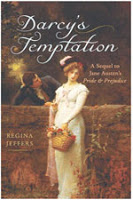
JeffersVDDWhat I would like to consider today is why did the publishers deem it necessary to change the title to Pride and Prejudice? There are several among my friends, who have had title changes at their publishers’ suggestions. For example, I have seen Wayward Love changed to Captain Wentworth’s Persuasion; Darcy’s Dream to Darcy’s Temptation; Darcy’s Hunger to Vampire Darcy’s Desire, and most recently, A Touch of Gold to The Scandal of Lady Eleanor. Changing titles is a common practice among publishing companies.ladyeleanorsmall

Can one imagine the conversation between Thomas Egerton Publishers and Jane Austen?
Egerton: Miss Austen, we believe the reading public would respond to a title change.
Austen: Are you implying that I must add the word Darcy or Pemberley to the title to sell books?
Egerton: No, that will not be necessary for another 200 years.
Austen: (in awe) Do you expect my works to survive and become part of the British literary canon?
Egerton: Of course, not. You are a female. We will be fortunate to sell a few hundred copies, Miss Austen.
Austen: (a bit disconcerted by his condescending tone) But my book is about misconstruing others – of the weakness of making judgments based on first impressions.
Egerton: (ignoring her objection) We will follow the pattern of your first publication. Sense and Sensibility will be followed by Pride and Prejudice. It will give you a “hook” to capture your readers. Now, if you will sign the contract, we can begin publication.

But why did Austen’s publishers choose those two words: pride and prejudice? Was it to stimulate a debate among those who wonder whether it was Darcy or Elizabeth who was prideful? Who acted with prejudice? College professors base entire semesters on just that concept. Or, perhaps, it was how often those two words are found in Austen’s text: The publishers’ belief that such repetition would create resonance and “connectiveness.”
The word “pride” appears seven and forty times in the text. One of my favorite uses of the word occurs in, “Vanity and pride are different things, though the words are often used synonymously.” I am also found of, “With what delightful pride she afterward visited Mrs. Bingley, and talked of Mrs. Darcy, may be guessed.”

“Prided” is used but once, as is “proudly” and “proudest.” Meanwhile, “proud” is used one and twenty times. “Some may call him proud, but I am sure I never saw anything of it,” is spoken by Mrs. Reynolds. Later in the story, Elizabeth considers Darcy’s actions in dealing with Wickham. “For herself, she was humbled; but she was proud of him – proud that in a cause of compassion and honor he had been able to get the better of himself.”

“Prejudiced” is found once in the text; “prejudices” is used twice, and “prejudice” appears five times. “The general prejudice against Mr. Darcy is so violent, that it would be the death of half the good people in Meryton to attempt to place him in an amiable light.”

darcystemptationsmallWhen I originally entitled my second book Darcy’s Dreams, I did so because I mimicked Austen’s repetition. I used the word “dream” seven and fifty times in the book. When Ulysses Press added the word “temptation” to attract readers, I made a mad scramble to add temptation to the manuscript. The process made me wonder if Austen did the same thing with pride and prejudice. Although I know it’s an illogical assumption, I like to imagine our dear Jane adding those two words as motifs within her text and also imagine her grumbling, just as I did with temptation.captainwentworthspersuasionsmall

Posted in British history, editing, Industry News/Publishing, Jane Austen, language choices, Regency era | Tagged , , , , | 3 Comments

During the Reign of George IV: The Catholic Relief Act of 1829

140px-Coat_of_Arms_of_the_United_Kingdom_(1816-1837).svg
The Roman Catholic Relief Act 1829, passed by Parliament in 1829, was the culmination of the process of Catholic Emancipation throughout Britain. In Ireland it repealed the Test Act 1673 and the remaining Penal Laws, which had been in force since the passing of the Disenfranchising Act of the Irish Parliament of 1728. Its passage followed a vigorous campaign on the issue by Irish lawyer Daniel O’Connell. O’Connell had firm support from the Prime Minister, the Duke of Wellington, as well as from the Whigs and liberal Tories.

The Act permitted members of the Catholic Church to sit in the Parliament at Westminster. O’Connell had won a seat in a by-election for Clare in 1828 against an Anglican. Under the then extant penal law, O’Connell as a Roman Catholic, was forbidden to take his seat in Parliament. Sir Robert Peel, the Home Secretary, who had until then always opposed emancipation (and had, in 1815, challenged O’Connell to a duel) concluded: “though emancipation was a great danger, civil strife was a greater danger.” Fearing a revolution in Ireland, Peel drew up the Catholic Relief Bill and guided it through the House of Commons. To overcome the vehement opposition of both the House of Lords and King George IV, the Duke of Wellington worked tirelessly to ensure passage in the House of Lords, and threatened to resign as Prime Minister if the King did not give Royal Assent.

Agitation
The campaign for Catholic emancipation in Ireland, 1828–1829, was led by Daniel O’Connell (1775–1847), organiser of the Catholic Association, but many others were active as well, both for and against.

245px-Richard_WellesleyAs Lord Lieutenant of Ireland from 1822 to 1828, the Marquess Wellesley (brother of the Duke of Wellington) played a critical role in setting the stage for the Catholic Emancipation Bill. His policy was one of reconciliation that sought to have the civil rights of Catholics restored while preserving those rights and considerations important to Protestants. He used force in securing law and order when riots threatened the peace, and he discouraged the public agitation of both the Protestant Orange Society and the Catholic Society of Ribbonman.

Bishop John Milner was an English Catholic cleric and writer highly active in promoting Catholic emancipation, prior to his death in 1826. He was a leader in anti-Enlightenment thought and had a significant influence in England as well as Ireland, and was involved in shaping the Catholic response to earlier efforts in Parliament to enact Catholic emancipation measures.

Meanwhile Ulster Protestants mobilised, after a delayed start, to stop emancipation. By late 1828 Protestants of all classes began to organise after the arrival of O’Connellite Jack Lawless who planned a series of pro-emancipation meetings and activities across Ulster. His move galvanised the Protestants to form clubs, distribute pamphlets and set up petition drives. However the Protestant protests were not well funded or coordinated and lacked critical support from the British government. After Catholic relief had been granted, the Protestant opposition divided along class lines. The aristocracy and gentry became quiescent while the middle and working classes showed dominance over Ulster’s Catholics through Orange parades.

Compromise
The Parliamentary Elections (Ireland) Act 1829 (10 Geo. IV, c. 8) which accompanied emancipation and received its Royal Assent on the same day, was the only major ‘security’ eventually required for it. This Act disenfranchised the minor landholders of Ireland, the so-called Forty Shilling Freeholders and raised fivefold the economic qualifications for voting. Starting in the initial relief granting the vote by the Irish Parliament in 1793, any man renting or owning land worth at least forty shillings (the equivalent of two Pounds Sterling), had been permitted to vote. Under the Act, this was raised to ten pounds.

Political Results
J. C. D. Clark (1985) depicts England before 1828 as a nation in which the vast majority of the people believed in the divine right of kings, and the legitimacy of a hereditary nobility, and in the rights and privileges of the Anglican Church. In Clark’s interpretation, the system remained virtually intact until it suddenly collapsed in 1828, because Catholic emancipation undermined its central symbolic prop, the Anglican supremacy. Clark argues that the consequences were enormous: “The shattering of a whole social order….What was lost at that point… was not merely a constitutional arrangement, but the intellectual ascendancy of a worldview, the cultural hegemony of the old elite.” Clark’s interpretation has been widely debated in the scholarly literature, and almost every historian who has examined the issue has highlighted the substantial amount of continuity between the periods before and after 1828–1832.

Eric J. Evans (1996) emphasises that the political importance of emancipation was that it split the anti-reformers beyond repair and diminished their ability to block future reform laws, especially the great Reform Act of 1832. Paradoxically, Wellington’s success in forcing through emancipation converted many Ultra-Tories to demand reform of Parliament. They saw that the votes of the rotten boroughs had given the government its majority. Therefore it was an ultra-Tory, the Marquis of Blandford, who in February 1830 introduced the first major reform bill, calling for the transfer of rotten borough seats to the counties and large towns, the disfranchisement of non-resident voters, preventing Crown office-holders from sitting in Parliament, the payment of a salary to MPs, and the general franchise for men who owned property. The ultras believed that a widely based electorate could be relied upon to rally around anti-Catholicism.

Posted in British history, George IV, Great Britain, Living in the UK, political stance, real life tales | Tagged , | 1 Comment

Georgian Happenings: The Wapping Coal Riots of 1798

John Harriott

John Harriott

Wapping Coal Riots of 1798
By Regina Jeffers

Coal was a major source of heat and an important commodity to London’s financial stability. As such, ships filled with coal called in at the various ports of London on the River Thames. Early on, officers of the West India Merchants and Planters Marine Police Institute (England’s first organized police force) patrolled the crowded Thames waters from their headquarters at Wapping New Stairs.

To understand the changes coming to the area at the turn of the 19th Century, one must realize that NO absolute authority existed to stifle the crimes, which followed the rapid growth of the area. John Harriott and Patrick Colquhoun organized their “Thames River Police” differently from what we know today of a marine police force. For one thing, the officers were watermen, lumpers, and surveyors. Initially, only five officers patrolled the area, and Harriott and Colquhoun learned to depend on “honest” workers among those who frequented the docks along the Thames. Harriott employed lumpers and watermen to help “police” the unloading of vessels. These men were under the protection of the Marine Police Office. They were paid extra for their diligence in stifling the crimes committed along the river. One such man was Gabriel Franks, the first “police officer” killed in the line of duty. When the coal ships were unloaded, thieves helped themselves to a substantial amount and sold it at “coal markets” along the streets of Wapping.

With Government's approval obtained the Marine Police began on the 2 July 1798 in Wapping High Street, on the site of the present Headquarters of the Marine Support Unit (MSU) of the Metropolitan Police.

With Government’s approval obtained the Marine Police began on the 2 July 1798 in Wapping High Street, on the site of the present Headquarters of the Marine Support Unit (MSU) of the Metropolitan Police.

On 16 October 1798, three men had been accused of coal theft and were standing trial at the Thames Magistrates Court attached to the Marine Police Office. Two of the men were coal heavers, while the third was a watchman’s boy. “They were all convicted and each fined forty shillings. As they left the building, friends arrived at the court, and paid the fines. Upon leaving, one of the three, Charles Eyers was met by his brother, James, who said, ‘Damn your long eyes, have you paid the money?’ Charles said, ‘Yes, I have.’ James then took his brother by the collar, dragged him toward the door and said, ‘Come along and we shall have the money back or else we shave have the house down!’ Within a very short period of time a hostile crowd had gathered outside the police office, and stones and rocks were being directed against the windows. The action that was to follow was to leave two men dead and another wounded.” (Thames Police Museum)

ps354348_lThose inside the Marine Police Office attempted to secure the building, but as the crowd and the violence continued, Officer Perry removed his pistol and fired upon the crowd. One of the rioters was killed, and the crowd outside withdrew slightly, but they did not disperse. Patrick Colquhoun took the opportunity to step into the street and to read the crowd the Riot Act. However, they refused to abandon their mission.

A man named Gabriel Franks was in a nearby public house. Upon hearing the noise of the crowd, he made his way to the Police Office and asked to be admitted, but the crowd drove him away. He retreated where he might observe the goings on. Franks instructed one of his companions (Mr Peacock) from the tavern to keep an eye on the rioters while he went to secure a cutlass for their protection. Unfortunately, before Franks could return, he was shot along the Dung Wharf.
Franks did not immediately succumb to his wounds, but lived on for several days. William Blizzard, a surgeon at the London Hospital, treated him. Assumptions are made as to the reason(s) for Franks’ attack, likely he was singled out for his association with the Police Office. Despite there being little evidence to the act, James Eyers was eventually arrested and charged with Franks’ murder. Eyers’ inciting the riot was, as a point of law, was responsible for Franks’ death, and the court agreed. He was tried and convicted of the crime and sentenced to hang. “In passing sentence the judge, Mr Justice Heath, donned the traditional black cap and spoke the usual and well-known phrase, ‘Prisoner. May the Lord have mercy upon your soul.’ Eyers replied, “Amen, I hope he will.” (The Thames Police Museum)

The actual trial transcript can be viewed at the Old Bailey trial site:
http://www.oldbaileyonline.org/browse.jsp?id=t17990109-5-person78&div=t17990109-5&terms

Meet Regina Jeffers:
Regina Jeffers is the author of several Austen-inspired novels, including Darcy’s Passions, Darcy’s Temptation, Vampire Darcy’s Desire, Captain Wentworth’s Persuasion, The Phantom of Pemberley, Christmas at Pemberley, The Disappearance of Georgiana Darcy, Honor and Hope and The Mysterious Death of Mr. Darcy. She also writes Regency romances: The Scandal of Lady Eleanor, A Touch of Velvet, A Touch of Cashémere, A Touch of Grace, A Touch of Mercy, A Touch of Love and The First Wives’ Club. A Time Warner Star Teacher and Martha Holden Jennings Scholar, Jeffers often serves as a consultant in language arts and media literacy. Currently living outside Charlotte, North Carolina, she spends her time with her writing, gardening, and her adorable grandson.

Posted in British history, buildings and structures, Georgian Era, Great Britain, real life tales | Tagged , , | Comments Off on Georgian Happenings: The Wapping Coal Riots of 1798

Do You Remember? Ingrid Bergman’s Fall from Movie Royalty

This is second installment of my new series: Do You Remember? Tell me, do you recall the extramarital affair with nearly destroyed Ingrid Bergman’s career? What do you think of how this affair shook out? Does it change how you feel about the actress? Leave your comments below.

Bergman had once played the role of “Joan of Arc,” and in the court of public opinion she was “burned at the stake” for the scandal of her infidelity: Ingrid Bergman, wife and mother and beloved movie star, had begun an affair with the Italian avant-garde film director Roberto Rossellini, who was also married at the time.

The Players: Lindstrom, Bergman, and Rossellini

The Players: Lindstrom, Bergman, and Rossellini

Swedish-born Bergman had a married Petter Lindstrom, a much older dentist-turned-neurosurgeon, and had had a child, a daughter named Pia. She had attracted notice in several Swedish films, and David O. Selznick, the producer of Gone with the Wind, had flown to Sweden to bring Bergman to Hollywood to co-star with Leslie Howard in Intermezzo. (The Hairpin) Selznick assumed control of Bergman’s career, casting her in a series of box-office hits: Casablanca (1942); For Whom the Bells Toll (1943); Gaslight (1944), for which she won an Oscar; and Spellbound and The Bells of St. Mary’s (1945). In America, through her films, Bergman earned the reputation of the “virginal, good girl.”

After seeing Open City and prompted by Irene Selznick, “in the late ’40s, Bergman wrote an adorable letter to Italian Neo-Realist director Roberto Rossellini – a man known for womanizing…and wearing sunglasses when most people in America were still squinting into the sun.

Dear Roberto, I saw your films Open City and Paisan, and enjoyed them very much. If you need a Swedish actress who speaks English very well, who has not forgotten her German, who is not very understandable in French, and who in Italian knows only “ti amo,” I am read to come and make a film with you.  – Ingrid Bergman” (The Hairpin)

Rossellini cabled her: “I just received with great emotion your letter which happens to arrive on the anniversary of my birthday as the most precious gift. It is absolutely true that I dreamed to make a film with you…” (Memories, February/March 1989) Bergman and Rossellini met in Paris in 1948 to speak on her starring in Stromboli, the first of seven ill-fated films the pair would make together.

All seemed fine whe Rossellini, Bergman, and Lindstrom came together for the 1948 screening of the film. When Rossellini called upon the Lindstroms, Bergman put down a 30 foot red carpet before her house to welcome the director.

All seemed fine whe Rossellini, Bergman, and Lindstrom came together for the 1948 screening of the film. When Rossellini called upon the Lindstroms, Bergman put down a 30 foot red carpet before her house to welcome the director.

Immediately, Rossellini replaced his previous lover, Anna Magnani, with Bergman for the lead role in his next film Stromboli. Rumors say Rossellini had made a bet with a friend he could bed Bergman within two weeks. There are also reports that the affair started when Rossellini stayed with the Lindstroms in Hollywood, but the affair became more obvious once the pair was on set in Italy.

Bergman denied the rumors of a pregnancy to gossip columnist of the day, Hedda Hopper. Less than a week later, Hopper’s rival Louella Parsons confirmed the pregnancy. Hopper was so angry about being scooped by her arch rival that she lambasted Bergman often and most thoroughly in her columns. Ed Sullivan, who produced and hosted the biggest show on television during this time, refused to permit Bergman on his show. Denunciations came from the Vatican. The actress was also denounced on the floor of the U. S. Senate  by Senator Edwin C. Johnson of Colorado as a “powerful influence for evil.” He continued by saying, “If out of the degradation associated with Stromboli, decency and common sense can be established in Hollywood, Ingrid Bergman will not have destroyed her career for naught. Out of her ashes may come a better Hollywood.” (The Hairpin) Once the affair became public knowledge, Bergman was shunned by Hollywood and was “forced” to leave the United States. She also lost the rights to her only child, 10-year-old Pia. The international press followed Bergman and Rossellini everywhere, reporting of their “vacation” on a remote island off the Italian coast only two weeks after her arrival in Italy for filming. The contrast between Bergman’s husband Lindstrom, who was described as plain spoken, strict and religious, to the flamboyant, poised and charming Rossellini was the text of any good romantic affair.

Bergman and Rossellini

Bergman and Rossellini

The 2 May 1949 issue of Life magazine ran a photo of the pair holding hands and the headline “Stombolian Idyl.” The Motion Picture Association of America reportedly cabled Bergman to warn her that her behavior would destroy her acting career. Instead of taking the caution to heart, Bergman and Rossellini flaunted their affair during the summer’s filming schedule. Lindstrom had no means of contacting his wife because of the lack of phones on the island. He learned of the affair in the newsprint. Lindstrom wrote his wife and begged her to show discretion, but she answered with words of finally discovering her love and her people. Years later, Bergman claimed her marriage was already in tatters before the affair began.

“As the attacks in the press and in Hollywood mounted, she concluded that she had to abandon her career, as well as her husband. At a press conference in Rome on 5 August, she released a statement: ‘Persistent malicious gossip that has even reached the point where I am made to appear as a prisoner has obliged me to break my silence and demonstrate my free will. I have instructed my lawyer to start divorce proceedings immediately. Also, with the conclusion of the picture it is my intention to retire from private life.” (Memories)

Unable to marry in Italy after her Mexican divorce, she and Rossellini married by proxy in Mexico on 24 May 1950, three months after Robertino had been born. Two years later, Bergman bore Rossellini their twin girls, Isabella and Ingrid. Between the two pregnancies, Stromboli was released to poor reviews and poor attendance. Rossellini would not permit her to take roles in the films of other directors, and so a string of forgettable flicks were produced. Bergman said of the period, “The world hated the Rossellini version of me, so nothing worked. It was something we did not talk about. But the silences between us grew longer.” (Brunette, Peter. Roberto Rossellini. Berkeley:  University of California Press,  c1996 1996. http://ark.cdlib.org/ark:/13030/ft709nb48d/)

Their marriage was annulled in 1956. Bergman then traveled to England to make Anastasia, a role which won her her second Oscar. In 1957, she won acclaim for her role in the Paris version of Tea and Sympathy. Bergman’s career was rekindled from the ashes. In 1958, she married Swedish producer Lars Schmidt. At this time, she permitted her children from Rossellini to return to their father in Rome. She won her third Oscar for best supporting actress in 1974’s Murder on the Orient Express. Bergman fought a courageous battle with breast cancer for eight years. She died on her 67th birthday on 29 August 1982.

ingrid-bergman1


Posted in acting, film, Pop Culture, real life tales | Tagged , , , | 6 Comments

Literary References in Jane Austen’s “Persuasion”

Literary References in Persuasion


Henry Austen in “A Biographical Notice of the Author,” said of his sister, “Short and easy will be the task of the mere biographer. A life of usefulness, literature, and religion, was not by any means a life of event.”

6a00cd96f8411f4cd501101631515c860bJane Austen’s last novel is less “light” than her earlier efforts. Anne Elliot is more unhappy and constrained than the likes of Elizabeth Bennet or the Dashwood sisters. Anne certainly is no Cinderella figure. She is too rich and too well placed in Society to be a sympathetic figure, but somehow Austen creates just such a character.

Anne is reminiscent of Charlotte Brontë’s Jane Eyre, except that Anne lacks Miss Eyre’s sharp tongue. Anne’s personality is visible only to Austen’s readers, those who share Anne’s literary mind and understand the references in the story. Persuasion reflects Jane Austen’s very “typical education.” She had improved her mind by extensive reading. Her audience would also have been aware of her references, but modern audiences are less likely to do so. Below are some of the those points of greatness found in Austen’s last novel.           

In reading Persuasion, an Austen fan must have a background in the literature of the time period. For example, the story begins with a reference to John Debrett’s Baronetage of England, which was published in 1808. That is quickly followed by a reference to Sir William Dugdale’s catalogue of Seventeenth Century nobility. Both mentions set the stage for Sir Walter’s vanity.

In Volume 1, Chapter 11, Austen says, “… the woody varieties of the cheerful village of Up Lyme, and above all, Pinny, wiht its green chasms between romantic rocks ….” Likely, Austen was “borrowing” from Samuel Taylor Coleridge’s “Kubla Khan,” in which the Romantic Period poet spoke of “deep romantic chasm” (1. 12) and “dancing rocks” (1. 23). At the end of the same chapter, Anne and Captain Benwick discuss his poetry choices. There are references to Sir Walter Scott’s “Marmion: A Tale of Flooden Field” (1808) and “The Lady of the Lake: A Poem” (1810). George Gordon’s (Lord Byron) receives a mention for “The Giaour: A Fragment of a Turkish Tale” (1813) and “The Bride of Abydos: A Turkish Tale” (1813). Bryon’s works were much talked about at the time of Austen’s writing her novel .

pbb In Volume 1, Chapter 12, there is another Byron reference. “Lord Byron’s ‘dark blue seas’ could not fail of being brought forward ….” This is a reference to Bryon’s “Childe Harold’s Pilgrimage,” Canto 2, Stanza 17 (1812). At the end of Chapter 12, one finds an allusion to Matthew Prior’s poem “Henry and Emma.” Austen says, “Without emulating the feelings of an Emma towards her Henry, she would have attended on Louisa ….” Prior’s poem is based on the traditional ballad “The Nut-Brown Maid.” The poem “Henry and Emma” tells the story of a girl who proves her selfless love by extending her devotion to the woman she considers to be her rival.
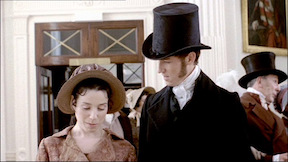
Persuasion-2007-persuasion-5250107-1024-576 From Volume 2, Chapter 3, one finds the quote, “The elegant little clock on the mantle-piece had struck ‘eleven with its silver sounds,’” to describe Mr. Elliot’s late visit to Camden-place. This is likely a reference to Alexander Pope’s “The Rape of the Lock,” canto 1, line 18 (1714).

In Volume 2, Chapter 8, Austen adds to the story line with a mention of a character from Fanny Burney’s Cecilia. “She could not do so, without comparing herself with Miss Larolles, the inimitable Miss Larolles ….” In the 1782 novel, the character seats herself at theatrical performances in a manner where she might “cultivate” those in her vicinity.

Finally, in the opening paragraph of Volume 2, Chapter 11, Austen makes a reference to The Arabian Nights or The Thousand and One Nights. “Her faith was plighted, and Mr. Elliot’s character, like the Sultaness Scheherazade’s head, must live another day.” Scheherazade kept her head by telling the legendary king of Samarkand a new tale every night.

Posted in book excerpts, British history, George IV, Great Britain, Jane Austen, language choices, Living in the Regency, real life tales, Regency era, Regency personalities, word play, writing | Tagged , , | 8 Comments