What of the Various Marriage Acts? (And) Marriage Annulments for the Very Young in Regency England?

“In the 12th century, Canon law jurist Gratian, stated that consent for marriage could not take place before the age of 12 years old for females and 14 years old for males; also, consent for betrothal could not take place before the age of 7 years old for females and males, as that is the age of reason. The Church of England, after breaking away from the Roman Catholic Church, carried with it the same minimum age requirements. Age of consent for marriage of 12 years old for girls and of 14 years old for boys were written into English civil law. [Dahl GB (August 2010). “Early teen marriage and future poverty”Demography47 (3): 689–718.]

“The first recorded age-of-consent law, in England, dates back 800 years. The age of consent law in question has to do with the law of rape and not the law of marriage as sometimes misunderstood. In 1275, in England, as part of the rape law, the Statute of Westminster 1275, made it a misdemeanor to have sex with a “maiden within age”, whether with or without her consent. The phrase “within age” was interpreted by jurist Sir Edward Coke as meaning the age of marriage, which at the time was 12 years old. [Robertson S. “Children and Youth in History | Age of Consent Laws”. Chnm.gmu.edu.]

“A 1576 law was created with more severe punishments for having sex with a girl for which the age of consent was set at 10 years old. [Robertson S. “Age of Consent Laws”. Children and Youth in History. Sydney, Australia: University of Sydney.]

“Under English common law the age of consent, as part of the law of rape, was 10 or 12 years old and rape was defined as forceful sexual intercourse with a woman against her will. To convict a man of rape, both force and lack of consent had to be proved, except in the case of a girl who is under the age of consent. Since the age of consent applied in all circumstances, not just in physical assaults, the law also made it impossible for an underage girl (under 12 years old) to consent to sexual activity. There was one exception: a man’s acts with his wife (females over 12 years old), to which rape law did not apply.”[Lindenmuth J. “The age of consent and rape reform in Delaware”. Widener Law Delaware Library.]

In 1875, the Offence Against the Persons Act raised the age to 13 years in England; an act of sexual intercourse with a girl younger than 13 was a felony.

Obviously, our modern sensibilities scream at this possibility, but in America, if you have ever traced your ancestors back to the late 1600s and early 1700s, you will find such was true. I have a couple of 13-year-old grandmothers (age at marriage) in my family tree, especially those branches that settled in the rural areas of Virginia and North Carolina, where women were few and the need to have sons to assist on the land was always looming over a man’s head. Like it or not, there were many young girls who were married off between 12 and 14. Some because there were few neighbors around and the “market” for women was sparse, and some because of the “belief” that young girls could withstand the rigors of child birth better than could a more mature woman.

It was not until 1875 when the Offences Against the Person Act raised the age to 13 in Great Britain and Ireland, and ten years later the Criminal Law Amendment Act of 1885 raised it to 16. That was for consent for sex. That was when having sex with a child under age 16 was statutory rape. 

It wasn’t until 1929 that the age was raised to 16 for marriage. The child still required permission until she or he reached the legal age of adulthood.

The Age of Marriage Act 1929 increased the  age of marriage to sixteen.

The law said that girls of age 12 and boys of 14 did not consent to the marriage, then they were not married. The regular church court dealt with these matters as it did all questions of marriage. I have never read a successful application in all the cases I have studied, but that does not mean there could not be an exception to the rule. 

The Marriage Act (1753) – Marriages in late Georgian England were governed by Hardwicke’s Marriage Act of 1753 which came into force on 25 March 1754 – an Act designed for ‘the better preventing of clandestine Marriages’. Although marriages usually took place in parish churches prior to this, it was possible to circumvent the system and get married in secret at places like the Fleet prison and St George’s Chapel, Mayfair.

“The 1753 Act stated that all marriages in England had to take place in a parish church or chapel, either after banns or by licence, unless under special licence. The law did not apply to members of the royal family. Nor did it apply to Jews and Quakers, but no concessions were made for other non-Conformists. There was a rush to get married before the Act came into force and the registers of St George’s Chapel state that 1,136 marriages took place between October 1753 and March 1754 including 61 on the 24 March 1754.” [Regency History]

The 1823 Marriage Act changed some of the standards for marriage.

Prior to the 1823 Marriage Act, someone had to take out a bond for a large sum of money which would be forfeit if it was later proved that the person applying for the licence had been lying.2 I have learned that very few bonds were forfeited, which suggests that in most cases, parents who had not given their consent were forced to accept the marriage in an effort to avoid scandal.

(4 Geo. 4) C A P. LXXVI.

[18th July 1823]

‘WHEREAS it is expedient to amend the Laws respecting the Solemnization of Marriages inEngland;’ Be it enacted by the King’s most Excellent Majesty, by and with the Advice and Consent of the Lords Spiritual and Temporal, and Commons, in this present Parliament assembled, and by the Authority of the same, That from and after the First Day of November next ensuing the passing of this Act, so much of an Act passed in the Twenty sixth Year of the Reign of KingGeorge the Second, intituled An Act for the better preventing of Clandestine Marriages , as was in force immediately before the passing of this Act; and also an Act passed in the present Session of Parliament, intituled An Act to repeal certain Provisions of an Act passed in the Third Year of His present Majesty, intituled ‘An Act to amend certain Provisions of the Twenty sixth of George the Second, for the better preventing of Clandestine Marriages ;’ shall be and the same are hereby repealed; save and except as to any Acts, Mattersor Things done under the Provisions of the said recited Acts, or either of them, before the said First Day ofNovember , as to which the said recited Acts shall respectively be of the same Force and Effect as if this Act had not been made; save also and except so far as the said recited Acts, or either of them, repeal any former Act, or any Clause, Matter or Thing therein contained.

[Read the whole Act HERE – Anno Regni GEORGII IV. Britanniarum Regis,Quarto. An Act for amending the Laws respecting the Solemnization of Marriages in England ]

If the spouse was particularly undesirable or there was a lot of money involved, the non-consenting parent might demand an annulment. But if the marriage had already been consummated, it was less likely, particularly if it was the bride who was underage, as she would be ruined.

There was a case where children who were married off at a young age but were put to bed together and then separated (for the children usually were separated and kept in the homes of their own family until older) hated each other when they next met. Even so, the court refused to grant the annulment. I am attempting to recall all the details for I read the materials (read lots of inheritance law and marriage law when I first became a writer back in the early 2000s) more than a decade back. I think it was that boy who did not apply for an annulment as soon as he was 14.

Though the boy and girl lived apart, they did meet from time to time. They were never reconciled to their marriage and continued to live apart in bitterness and anger. 

According to the law, they have to apply for the annulment at the age of twelve and fourteen, depending whichever reached the legal age first. Obviously, few children had the money or the knowledge to do so at that age. Most would not be allowed to discuss the matter with a proctor of the court or have the advice of an advocate. Though married they were still minors and under the care and guidance of parents or a guardian. They would have to have a way to earn money to pay the lawyers.

However, by the end of the 18th century, society had turned against child marriages. The Hardwicke Act had pulled the teeth out of the betrothal contract. It was generally believed that 15 and 16 year old girls were too young to marry. However, the law still allowed parents to marry of children as young as seven. These marriages could be annulled when the girls reached 12 and/or the boys reached 14. That was considered the age of puberty, but tat was only true as long as the couple had not slept in the same bed or been otherwise intimate. By the Regency era, the idea of force and “own free will” was beginning to change, but change came slowly to the law and especially the ecclesiastical law. I can see how they could be mistaken about their marriage being annulled. If one thinks on it, it would take a great deal to convince me that mere children that young knew enough of the law or how to go about applying for an annulment, as well as paying the lawyers and doing it all without the knowledge of parents and guardians.

I taught middle school language arts for 13 years of my 40 years in the classroom. We used to say our students were all on an hormonal elevator that never stopped on our floor. We would describe a middle school dance as . . . (1) 6th graders still chasing each other around the floor like they were still on the elementary play ground; (2) 7th graders dancing together in a group, perhaps 10 girls and 4 boys, all having fun together, but not necessarily touching each other; and (3) 8th grader couples where it might be difficult to place a stick pen between them. My fear (as I have two middle school aged grandchildren) is that even those standards no longer exist. What I described at 8th grade behavior could easily be happening to my sixth grade granddaughter this upcoming year. I hope not, for my son would go ballistic, and I am from West Virginia (enough said of my reaction).

Going back to the Regency for one more point of interest. If the boy was married at age 14, he could not attend school, for all students in school must be unmarried to attend.

Posted in Act of Parliament, British history, Church of England, family, Georgian England, Georgian Era, Great Britain, history, laws of the land, Living in the Regency, marriage, marriage customs, Regency era, research | Tagged , , , , , , , , , , , | Comments Off on What of the Various Marriage Acts? (And) Marriage Annulments for the Very Young in Regency England?

Question from a Reader About Yacht Clubs During the Regency

Reader Question: I noted in several of your books, you have the hero keeps his yacht moored or docked somewhere along the coastline. Why not in London?

Answer: It is true that I have not used London for docking a yacht, but that has more to do with the year in which I set the story than London’s accessibility. History in Focus tells us, “In order to get to London, boats had to sail up the Thames and that meant dependence upon the wind. Smaller boats could tack against the wind, but the larger boats usually required square sails, thus limiting their ability to tack. In the mid nineteenth century Henry Mayhew estimated that an easterly wind put 20,000 men on the riverside out of work. (H. Mayhew, London Labour and the London Poor
 (1861), ii. 298) The Thames was an immense traffic jam. Ships did their best to sail up or down it, but being unloaded was another matter and, until the end of the eighteenth century, few docks were built for unloading ships (as opposed to repairing them). There was then a rush of building, and docks and warehouses were built for the West India fleet, the East Indiamen and others. The space taken up by these warehouses was spoken of with awe. These docks were reasonably effective until the arrival of steam power led to the port moving further down the river.”

The Royal Yacht Club and the Royal Yacht Squadron, an actual place to keep yachts in London, was not founded in London until 1 June 1815 by a group of gentlemen drinking at the Thatched House Tavern in St James’s London. More than likely yachts which could have made a channel crossing would have been moored at the Royal Yacht Squadron, but that is an assumption not something I researched. The club included 42 gentlemen interested in yachting, assumably all owning one, but “interested” does not mean owning.

Even the Prince Regent was a member of the Royal Yacht Squadron. In 1819, the Prince expressed his honor at being admitted with a visit in his yacht, The Royal George, at Cowes on the Isle of Wight where he gave a dinner onboard. [As if any members of the RYS would deny their future king’s request to join their group …] The Prince Regent was so pleased with Cowes, he took a cottage there by the sea and returned to it as king in 1821. King George remained a member of the Yacht Club at Cowes until his death.

Okay, I am not a sailor, so I had to do some research for those of us who have a bit of a phobia about sailing. Why would people go all the way to the Isle of Wight to go sailing? The answer is the strip of water between the Isle of Wight and the southern coast of England, which is known as the Solent.

The Solent is reportedly the “heartland” of British sailing. It is known to be extremely challenging sailing with strong winds and fast tidal flows. And equally important it is right situated near Portsmouth, which was home base for the Napoleonic War era British Navy. In that aspect, it is easy to understand the global dominance of the British Navy when you realize just how hard it is simply to get in and out of Portsmouth. The English turned this into an advantage by developing modern compasses, maritime charts, tidal almanacs, and better sail and hull design than anyone else. 

Equally important they instilled an exceptionally high level of sailing skills and basic seamanship in all their young officers. The Solent is where this training took place. Whenever ships were in Portsmouth they would send “the young gentlemen” out on the Solent in small boats to practice sailing skills and race each other. Good captains paid very close attention to how well their junior officers handled small boats, motivated their crews, and dealt with capsizes, squalls, and other minor emergencies. Quite logical, since good seamanship, sound judgment, and command presence are all qualities that scale up to skippering larger vessels. 

This impromptu Navy training system gave birth to modern sport sailing as we know it. It also gave birth to the Royal Yachting Association (RYA) instruction program, which is still based on the Solent and still run largely by ex-Navy instructors. Being trained on the Solent by RYA instructors remains the worldwide gold standard today for both sport sailors and commercial captains. Solent-trained skippers are famous for their extremely high level of technical skill  … and for being cheerfully oblivious to conditions that give normal people panic attacks. 

What is now known as the Cowes Regatta is still carried out on the Solent. The festival originates from the Prince Regent’s interest in yachting which continued, as I said above, even after he became George IV in 1820. The first race started at 09:30 on Thursday 10 August 1826 with the prize of a “Gold Cup of the value of £100” and was held under the flag of the Royal Yacht Club, which later became the Royal Yacht Squadron. Another race was held the next day for prize money only (£30 for first place, £20 for second).

The Cowes Regatta as shown in East Cowes Castle by J. M. W. Turner 1827 ~ Public Domain

Until World War I, gentlemen amateurs employing skippers and crew raced the cutters and raters. Cruiser handicap classes and local one-designs dominated the 1920s and 1930s. A revival of big yacht racing arrived after World War II, and ocean racing classes started to predominate, especially after the first Admiral’s Cup event was held in 1957. Popularity grew with the introduction of the two ocean-going races that start and finish the regatta The Channel and the Fastnet. The Fastnet, which rounds the Fastnet rock far out in the Atlantic and can be dangerous, is held in odd-numbered years only. [Cowes Week]

Cowes Moorings in Race Week, c1900 ~ View across Cowes Harbour entrance – during Cowes Week c1900 – HMY Victoria and Albert (1899) on station at left – steam pinnace possibly from HMY at centre ~ CC BY 2.0 ~ https://en.wikipedia.org/wiki/Cowes_Week#/media/File:061114178-copy_(299998206).jpg

Sources:

How to Moor Your Yacht (and How Not To)

The Differences Between Anchoring, Mooring, and Docking

Posted in British history, British Navy, George IV, Georgian England, Georgian Era, history, Living in the Regency, Regency era, Regency personalities, research, royalty | Tagged , , , , , , , , , , , | Comments Off on Question from a Reader About Yacht Clubs During the Regency

Was the Term “Romance” Used to Describe Such Stories as We Think of Them Today in the Regency Era

First, we should define romance. The Encyclopedia Britannica tells us, “Romanticism can be seen as a rejection of the precepts of order, calm, harmony, balance, idealization, and rationality that typified Classicism in general and late 18th-century Neoclassicism in particular. It was also to some extent a reaction against the Enlightenment and against 18th-century rationalism and physical materialism in general. Romanticism emphasized the individual, the subjective, the irrational, the imaginative, the personal, the spontaneous, the emotional, the visionary, and the transcendental.” Please note in this definition there is no mention of the usual plot most of us nowadays think of as a “romance”: Boy gets girl. Boy loses girl. Boy gets girl again.

Romance and romantic stories do not completely align. A story of romantic love, especially. one which deals with love in a sentimental or idealized way is what we think of when people use the word “romance,” when say, referring to a Hallmark movie. Romantic love does “emphasize the individual, the subjective, the irrational, the imaginative, the personal, the spontaneous, the emotion, “etc., mentioned above.

The Romantic period describes an artistic, literary, musical and intellectual movement that emerged throughout Europe at the close of the eighteenth century and moving into the nineteenth century. Alternatively, Collins Dictionary describes romantic love as “an intensity and idealization of a love relationship, in which the other is imbued with extraordinary virtue, beauty, etc., so that the relationship overrides all other considerations, including material ones.”

Wikipedia provides us a simple comparison: “Romance comes from Roman, and first meant a story translated into French from Latin (the common language of old Rome), usually about the amorous adventures of chivalrous knights, which is how romances came to be associated with love stories. Now it’s used to mean a love relationship, in a story or not.”

Romeo and Juliet in 1870 oil painting by Ford Madox Brown considered to be the archetypal romantic couple, depicting the play’s iconic balcony scene. Public Domain from Wikipedia

The term “romance” had two competing definitions during the Regency period, which makes it even more difficult when the late 1700s and 1800s are seen as the move from the Enlightenment to the Romantic Period. In any case, Coleridge attempted to delineate the two, of course, one being bad and the other good. In 1798 he wrote about  Radcliffe’s Gothic novel, “The Italian”:

“It was not difficult to foresee that the modern romance…would soon experience the fate of ever attempt to please by what is unnatural, a departure from that observance of real life, which has placed the works of Fielding, Smollett, and some other writers, among the permanent sources of amusement.” [Coleridge’s italics].

Coleridge and Wordsworth  saw a ‘romantic’ as someone sensitive to real life and the emotions, as opposed to the ‘unnatural’ or works of art created purely for the purpose of exciting the senses, but having no ‘truth.’ They collaborated on a set of poetry to illustrate that dichotomy. It is called “Lyrical Ballads”, 1798/1800.

Jane Austen’s Northanger Abbey displays some of the same view between unnatural/artificial feelings and ‘true’ romantic sensibilities… as does her novel Sense and Sensibility in character, comparing Marianne to her older sister.  

So someone being ‘romantic’ could be romantic about anything, from the sunset to the opposite sex. It was an emotional, sensitive approach to the world in opposition to the rational, objective view of the Enlightenment. Johnann von Goethe’s “The Sorrows of Young Werther” of the mid-1700s seen as one of the first ‘romantic’ novels as opposed to such earlier novels such as Robinson Crusoe and Pamela, which were more ‘Lesson-focused’ morality tales. “Romance” even crept into dress and politics, with the Whigs being considered far more of a ‘romantic’ bent than the Tory’s.

It was only later that ‘Romantic Novels’ became strictly ‘romance’ novels, love stories.  So, romance was a period term, but had a much broader set of meanings for Regency folk.

Posted in British history, etymology, fashion, Georgian England, Georgian Era, historical fiction, history, Jane Austen, reading, Regency romance, research, romance, romantic verse, terminology, writing | Tagged , , , , , , , , , , , | Comments Off on Was the Term “Romance” Used to Describe Such Stories as We Think of Them Today in the Regency Era

When and When Not to Wear Boots in the Regency Era

Admittedly, several fashion illustrations for men of the Regency era show the man wearing a blue coat, beige pantaloons and boots. This has been described as the fashionable look for gentlemen. Because of this, many authors seem to think such an outfit was suitable for all occasions.

Boots were not meant to be worn everywhere. The aristocrats might have been boors, or oppressive landlords, or deaf to the cries of the poor, but they knew how to dress for the occasion.

Most would not wear boots to a ball or to church or to dinner. They generally would not wear boots to call on a lady unless to take her riding or driving. It may be we authors feel boots are more period or we do not like the idea of saying a man wore “pumps.”

H. Eldridge’s 1802 painting of Thomas, Earl of Haddington.
Painting of George, Duke of Argyll, by H. Eldridge, 1801.

Jessamyn Reeves Brown is an historian of Regency Fashion. Her research into Regency footwear shows that ‘prior to the Regency, both women and men wore what we now call “court shoes”: high-throated pumps with curved heels and side pieces that tied or buckled elaborately at the throat. As dresses became less structured and suits less elaborate, shoes did too. Heels dropped rapidly through the 1790s and by 1800 were very small indeed, while material was pared away to a minimum from the uppers. Men’s dress shoes lost their heels even before women’s did, but some retained the fine buckles of the 18th century for the most formal of occasions. Men’s shoes also became basic black quite early in the century – almost no other color is seen after 1800. Both men’s and women’s shoes of the 18th century had flaps attached at the instep and outstep that came up over the throat and were held in place with a buckle (most commonly) or were tied in place with bows. These flaps were called latchets, and they did not entirely disappear in the Regency.’ Discover more fascinating details of men’s footwear on her Regency Companion Page.

I previously read a book (cannot recall its name) where there was an interruption of the wedding ceremony, and the narrative remarked on the sound of boots of wedding guests. The polite gentleman wore shoes as a guest or a groom at a wedding. He wore shoes to a ball, to dinner, and to call on a lady.

He would not ride a horse to any of these occasions except, as noted above, if he was to go riding with a lady. Then boots would be appropriate.

I think it was the House of Lords that said no visitors were allowed in wearing boots. Boots were not allowed at Almacks’. Even military officers had dress shoes.

There are one or two paintings of public assemblies in which military men are shown wearing boots. I do not know if those were painted from life or imagination. At most local assemblies attendance was by payment of a fee, and all manner of people could join. One of the reasons Almacks was founded was to restrict attendance at the assembly to vetted people so the sons and daughters could meet eligible people to marry. Most officers wore shoes as part of their dress uniform. One reason was it was thought boots would be harder on dance floors. They also hurt more if they landed on a lady’s foot clad only in a slight evening slipper (something similar to a ballet shoe). Most evening shoes were soft soled, Boots were hard soled and hard on floors.

There are those stories which say the Duke of Wellington was refused admittance to Almacks because he was NOT DRESS properly. Some say His Grace showed up wearing boots and was turned away. There are also stories he arrived a few seconds after 11:00 P. M. and was turned away. In Gronow’s account the problem was Wellington was wearing trousers instead of breeches. In this account, when he is turned away, he says this is very proper, that he, above all persons, understands the importance of correct uniform.

I love Gronow, but we do have to consider he was writing his Reminiscences decades after the fact, and it was unlikely he was standing by the door and had heard the exchange at the time. So we’ll probably never know exactly what happened.

That being said, Gronow does get other details wrong. For example, according to one account of his life, Gronow was only stationed in Town for 1814. The women he lists as patronesses of Almacks for 1814 were incorrect. Also, one edition of his book was published with an illustration of  dancing from France and ever since it has been used to illustrate the fashions and the dance in England.

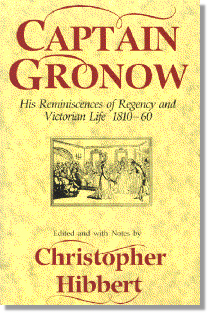
The Napoleon Series tells us something of Gronow. “Gronow, what can I say? Approach him with caution, even with Christopher Hibbert’s very helpful editing and annotations. R. H. Gronow (1794-1865) was one of those shadowy figures that drifted through the Regency and Victorian times. He rarely features in letters and diaries — but his memoirs, written in the 1860’s, seem to indicate he knew all the right people. Perhaps this was because he spent much of his time observing life around him, a commentator rather than a participant in events himself.

“There are three problems I have with Gronow. He wrote up to 40 years after events; he clearly wrote entirely for money; and there is no way of knowing if he was actually present at events that he writes about, or merely heard about them later. All in all, Gronow published four volumes of his reminiscences between 1862 and 1866, and they cover his life from 1810 to 1860. By the end of it he was rather scraping the barrel for suitably gossipy tittle-tattle to share with an avid public. Yes, the audience of the day lapped them up, and there lies some of the problems I have with Gronow. Clearly much of what he said is inaccurate, misdated, or just plain salacious gossip garnered from other sources such as Captain Jesse.”

Jane Austen’s World tells us: “The Patronesses of Almack’s guarded entry to the club like Valkeries prepared to do battle. No one, not even the Duke of Wellington, would dare to step a foot inside the establishment without a proper voucher, and, indeed, he was turned away once for wearing *gasp* trousers instead of knee breeches. But is this true? Please keep on reading.

“This passage from Social England Under the Regency by John Ashton (p 383) is quite telling:

The Duke of Wellington

Of course the Creme de la creme went to Almack’s, but numberless were the Peris who sighed to enter that Paradise, and could not. Capt. Gronow, writing of 1814, says: “At the present time one can hardly conceive the importance which was attached to getting admission to Almack’s, the seventh heaven of the fashionable world. Of the three hundred officers of the Foot Guards, not more than half a dozen were honoured with vouchers of admission to this exclusive temple of the beau monde, the gates of which were guarded by lady patronesses whose smiles or frowns consigned men and women to happiness or despair. These lady patronesses were the Ladies Castlereagh, Jersey, Cowper, and Sefton; … and the Countess Lieven.” (Note: At that time, two other patronesses included Lady Downshire and Lady Bathurst.) from Jane Austen’s World

Two major points on the issue of Boots: (1) So many of us are accustomed to informal clothes in practically any milieu, it is difficult for us to remember how boots were the sneakers of the day. (2) Also, when one is wealthy, one can afford to have different outfits for different activities. The ladies were said to have changed at least 3 times in a day, even if they never left the house.

Posted in British history, England, fashion, Georgian England, Georgian Era, history, Living in the Regency, real life tales, Regency era, research | Tagged , , , , , , , | 1 Comment

More Questions (and Hopefully Less Confusion) on Women and Inheritance During the Georgian Era

Question #1: Is it correct that the husband can serve as the peeress’s proxy in the House of Lords? I did discover some other interesting facts. There have been duchesses in their own right, and the husband can vote for her in the Lords, though the husband retains the same address he held before marriage.

Answer: Look at the dates of that practice as it stopped fairly early on. Husbands were not able to sit in the House of Lords in place of their wives by the late 18th century, at least.

Therefore, I am saying not in the time period of which we are usually interested. I think that was over by 1612, or thereabouts. In the time of Henry VIII, if a man and woman had a child, he had a right  of courtesy to her lands and “dignity” during his life time. As a consequence, one or perhaps, two husbands were allowed to sit in the House of Lords (cannot recall the number, but I am relatively certain someone will let me know my mistake).

From Edwardian Promenade, “The Peeress in Her Own Right” tells us, “But the one issue that looms the largest is that of women’s inheritance of titles. In America’s relatively egalitarian society, it seems unconscionable that, barring the lack of a male heir, a title either died off, fell into abeyance, or was passed to a distant relative. Granted, many titles in abeyance (usually baronies) passed to female relations, but according to Valentine Heywood, “when there is more than one daughter all are regarded as equal co-heirs. The result is that no one daughter can inherit until all the others are dead, or no issue of a daughter can inherit until the issue of other daughters is extinct. In other words, the title is in a state of suspended animation until all the co-equal claims are centered in one person.” This is the situation which befell Miss Marcia Lane-Fox, daughter of the 12th Baron Conyers.

“Lord Conyers’ heir and Marcia’s elder brother, Sackville FitzRoy, predeceased him, and when Lord Conyers died in 1888, his barony fell into abeyance. Marcia petitioned the Queen for the abeyance to be terminated in her favor in 1891, which was granted the following year. Marcia later laid claim to the barony of Fauconberg, which had fallen abeyance for some four and a half centuries after the death of the sixth baron, in 1463. Also in dispute was the barony of Darcy de Knayth, and Marcia and her younger sister Violet, laid a claim for this title, which dated back to 1332 and fell into abeyance when the fourth earl died in 1778, because it was thought that the patent limited the succession to heirs male. The sisters quickly rectified this mistake in a petition found in a 1900 volume of Journals of the House of Lords (the entire petition listed the family’s entire genealogy as proof!”

But then again, that was EDWARDIAN, not GEORGIAN.

Jure uxoris (a Latin phrase meaning “by right of (his) wife”) describes a title of nobility used by a man because his wife holds the office or title suo jure (“in her own right”). Similarly, the husband of an heiress could become the legal possessor of her lands. For example, married women in England and Wales were legally prohibited from owning real estate until the Married Women’s Property Act 1882.

However, one of the problems that must be addressed arose when the wife’s title was inherited by the oldest son, and he had the natural right of being a peer, even if his father was not. The King sometimes made the husband a peer in his own right. The problem was that there could not be two peers of the same peerage in the House of Lords. Henry VIII said he did not like it that a man could be ennobled and a peer one day, but not the next when his son turned 21. Palmer in his book on Peerage law said the law was never tested after that, and it was considered a “no go” from that point on and totally obsolete by the19th century.

Peerage Law in England: A Practical Treatise for Lawyers and Laymen. With an Appendix of Peerage Charters and Letters Patent. by Francis Beaufort Palmer

Women could always own property in their own right—as long as they were not married. Some of the peeresses in their own right had property, as well as the title which the husband could not touch. However, it was not until 1870’s that the married women’s property act was passed.

Still, inheritance through the female of a peerage by patent remained extremely rare and usually only  put into the patent while the 1st peer was alive. Usually, after that, the patents did not allow for female inheritance.

It was rare for a woman to be able to inherit a peerage created by patent. The Duke of Marlborough had his patent changed when it was obvious he would not have a son, yet again, a duke can change things that a baron might not be permitted. That was a rare occurrence. The son could not inherit through his mother if the mother was still alive.

Most females succeeded to a lesser peerage created by writ. Also, where was the young man born and what nationality is he? If his father is native American, and they live in the USA, and if he was born in the USA, he could not sit in the House of Lords, and he could inherit any property in England. Nothing prevents a British peerage from being held by a foreign citizen (although such peers cannot sit in the House of Lords, while the term foreign does not include Irish or Commonwealth citizens). Several descendants of George III were British peers and German subjects; the Lords Fairfax of Cameron were American citizens for several generations.

Questions #2. I have a character who is a marquess with lesser titles including a barony. He has no children, but one sibling, a sister. Is it possible for his main title to go to a distant male heir, and his lesser barony to go to his sister?

Answer: Yes. If the barony was one that came originally from attendance at HOUSE of LORDS way back when, then it could go to the sister instead of to the distant cousin. It was called a barony by writ. If any of the property was connected to that barony and not to the marquisate then she would get that too.

The marquisate could become extinct and the cousin be presented an earldom or a different barony, while the sister received most of the property. It depends on when and how each title was bestowed and the line of descent established in the patent.

If the man was the one who was created a marquess, his title would probably be extinct. For the title to go to a distant heir, the title has to have been granted to a distant relative from whom both men are descended.

Posted in Act of Parliament, Georgian Era, Inheritance | Tagged , , , | Comments Off on More Questions (and Hopefully Less Confusion) on Women and Inheritance During the Georgian Era

Question from a Reader/Writer Regarding the Pump Room in Bath

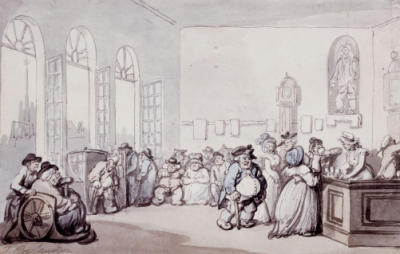
Question: Somehow, I expect I know the answer to this already. Sigh. In a scene I am writing set in the Pump Room, I have described a marble fountain dispensing the waters, only to go, “Wait a minute, is that more Victorian than Regency in its description?” So . . . in the Regency, would the waters have been dispensed by servers at some kind of bar, instead of from a fountain with spigots?

Answer: I found this quote from Google Books. Hope it helps a little.

The Early Days of the Nineteenth Century in England, 1800-1820, Volume 1 – By William Connor Sydney

An interesting glance at the Bath of 1811 is afforded by a letter of a Canadian traveller: “On one side is the pump, where a woman stands and distributes old King Bladud’s waters to old and young, sick and ill. An old duchess of eighty and a child of four were both drinking the waters while I was there. I had ‘a glass; it is very hot and tastes very mineral. At one end of the room is an orchestra, where bands of music are continually playing. The company at the same time walking up and down in crowds, minding the music, but buzzing like merchants on-‘change.”

Also, I have a “volume” of notes on a variety of subjects (some 800+ pages), but I do not know from whom or which source this quotes comes: “In the centre of the south side is a marble vase from which issue the water with a fire-place on each side.”

In addition, I have read multiple novels where the author describes that the water was distributed from a fountain. Now, that does not necessary mean they were correct. It could be a Georgette Heyer kind of thing where some of what the author made up is now considered part of the “legend of the Regency.”

For a novel with detailed descriptions of bathing in Bath (which I have not seen elsewhere), try Carolyn Korsmeyer’s Charlotte’s Story, originally published TouchPoint Press in 2021. It is an Austenesque story about Charlotte Lucas, I have not tracked down the author’s sources, but she is a meticulous researcher and an editor, so I am confident she has completed her search for facts. There are quite a few descriptions of Charlotte Lucas involved with the water in Bath, not just the Pump Room.

Charlotte Lucas, a character first appearing in Jane Austen’s Pride and Prejudice, has made an unfortunate marriage to the loquacious William Collins, reckoning that his tedious conversation is a small price to pay for a prosperous home and family. However, trouble brews within the first few months of marriage.

To ease the strain of their relationship, Charlotte leaves her husband to visit the fashionable city of Bath with several women companions. The weeks there prove to be a time for self-discovery and freedom, and the marital frost begins to thaw. However, events in Bath result in an unfortunate, even calamitous, consequence.

Charlotte devises an audacious solution that combines bold connivance and compassionate duplicity, pursuing her hope of happiness with the wit and courage to seek it.

The ever fabulous Shannon Donnelly once shared this link: There are a couple of images that show the lady distributing the waters from behind a counter, some sort of actual pump behind her:

1795 – https://www.alamy.com/pump-room-bath-built-in-1795-british-library-image268847264.html?imageid=AE5593D2-E873-46F3-B985-24EA3C82B3FE&p=868092&pn=1&searchId=5ff0de4acb93610a997a0157814a93f4&searchtype=0

1798 –

1825 – https://bathartandarchitecture.blogspot.com/2018/08/beau-nash-statue-in-pump-rooms-bath-by.html

Jane Austen’s World has a wonderful piece on The Pump Room’s Little Known Facts

Posted in aristocracy, British history, buildings and structures, England, fashion, Georgian Era, history, Jane Austen, legacy, legends | Tagged , , , , , , , , | 1 Comment

What Did the Term “Half-Pay Officers” Mean During the Regency? And What of “Honor”?

I thought addressing this recent question from a reader appropriate for the Memorial Day Weekend.

Question from a reader: I am confused about what it meant to be an officer on half-pay. Can you shed any light on this topic?

Specifically, I’ve often wondered about the term “half-pay officer.” Does an officer who sells out still receive half pay or only officers who retire without selling their commissions (if there is such a thing). My question concerns a major who sold out after Waterloo. Does he still receive half-pay?

Basically, if an officer bought his commission and sold it upon retiring, he was paying for his own retirement. Then, if he died, what happened to that money? A pretty good deal for the Army. It sounds like the military didn’t actually pay any pension, they just gave you back what you paid them for the honor of fighting and possibly dying.

Answer: Officers of the day, at least up to the late 1700s, were from the gentry; therefore, they were considered to be gentlemen. As gentlemen, they did not require the payment for their service that did those of the lower classes. They were doing what most of us would call their “civic duty” by purchasing a commission and supporting themselves while they served.

We must remember that early on Colonels ran their regiments as if they were a business. One purchased a commission in a regiment, NOT in the army. Those of the upper crust of society assuredly did not expect to be paid by the government for their service. [Well, I expect some did, but no one spoke of such on record.] They . . .

(1) were expected to buy their uniforms and all equipment

(2) were paid a quarterly salary that simply did not cover the expenses of being an officer in the army at any rank.

(3) There was no need for pensions or much in the way of compensation for serving. The officer was a part of a rich family.

This slowly changed during the multiple wars of the early 1800s, because of the 20 year length of the Napoleonic War and that so many officers were needed, the middle class, and in some cases [about 5%] enlisted men were commissioned without buying a commission.

Follow-Up Question: Did someone who paid for their commission receive an additional pension as well? From your response it does not sound like that was the situation. So the paid commission officer paid for his own retirement and the free commission officer did not?

I see that I did not explain this well. There was no pension for a purchased commission for the reason I repeated above. The wealthy aristocracy and gentry supposedly did not require the money to do their civic duty.

The families were expected to support their sons monetarily while in the army.  I just read “A Light Infantryman with Wellington,”the letters of Captain George Ulrich Barlow. Throughout his service, Barlow was getting money from his family, not just father, but uncles and cousins too.

A Light Infantryman with Wellington: The Letters of Captain George Ulrich Barlow 52nd and 69th Foot 1808-15 (From Reason to Revolution) ~ This series of letters was written by a light infantry officer on campaign, as a lieutenant with the 52nd Foot in Spain and a captain with the 69th Foot in Belgium and France. George Ulrich Barlow saw action at Ciudad Rodrigo, Badajoz, Vitoria, San Sebastian, Nivelle, Nive and Orthez. He transferred to the 69th Foot as a captain and served with them in Belgium at the battles of Quatre Bras and Waterloo and then remained with the Army of Occupation in France until 1818. His involvement in the fighting and his honest views of some of the famous characters he met during his service are enlightening, including his first audience with Wellington at Freineda in Portugal. There are also interesting asides in his correspondence including his father’s difficulties over his governorship of Madras and his brother’s involvement in a major mutiny at the Royal Military College. ~ https://www.amazon.com/Light-Infantryman-Wellington-Letters-Revolution/dp/1911628100

In truth, the incentive of the “free commission” was a good decision: One does not have to pay for one’s pension (outside of the bribe fee), and there was an improved social status which was otherwise impossible to attain in Regency England? i.e., It was very difficult to improve one’s social status in this era. Even making money was frowned upon (the merchant class) – think Mr. Bingley from Austen’s Pride and Prejudice. But the new status only went so far? Many were shunned later by one’s equal in military rank if not in birth. So how far did the “officer” status really go socially?

How far did the status go ‘socially’? 

During the war, pretty far, particularly if you could move up the ranks. Everyone was equal in the regimental Mess. After the war? Not as much, which created some resentment among the middle class officers who were now again seen as less that socially acceptable among the gentry. Obviously, retiring as a colonel was much better than as a captain. I would suggest if you want more on that concept that you read The Reminiscences and Recollections of Captain Gronow, being anecdotes of the camp, court, clubs and society 1810-1860”  He gives great descriptions of the social relationships and social movement of war and post-war officers.

Third Question: I understood that officers never fraternized with soldiers, that it was an unwritten code. Is this true?

True. It was an unwritten rule that gentlemen did not ‘fraternize’ with the lower classes. As a military brat and military wife, I can say with some accuracy that there has always been a certain class structure in the military. Same social structure: Officers=upper class  NCOs=Middle Class  Enlisted=Lower classes.  Officers communicated with NCOs [Who actually did all the professional work], but rarely with the enlisted men.  

Personal Soapbox Coming, so if you do not wish to read it, stop HERE.

Many send me message about the topic of honor. What did it mean and why is no longer applicable to our society?

If honor is so removed from our culture (people question why anyone would do anything if it does not serve himself. A person is assuredly thought to be “stupid” and we praise those who get away with something. His actions are considered as revered and as clever instead of dishonorable. It makes those of us who write about honor a bit out of step, for it is no longer a subject that readers can relate to and understand.

When we watch a film and someone fights a duel of honor, the modern viewer wonders why anyone would risk his life for his perceived “honor.” They often label the character as foolish and naive. I can understand that perspective, but having character, knowing the difference between right and wrong, and putting someone else before oneself does not seem to be revered and is even ridiculed. If honor is defined as one’s reputation and one’s character, how is honor defined if none of that matters? i.e., if the only thing that matters is what one can get for oneself?

I am not meaning to go on a diatribe, but I’m trying to come to terms with what honor used to mean, what it means today, and how to write a novel from the perspective of a different culture and make it sympathetic to the modern reader.

The self-serving and self-sacrificing parts of Regency Honor is not that hard to understand.

1. Only the Gentry and Upper Class were seen as having or concerned with ‘Honor’ as they understood it.

2. Honor was the reputation both an individual AND his family practiced. So often duels were fought to ‘preserve one’s honor’ which was one’s social reputation. Honor was part of an upper class family’s duty to the Crown, to serve and support the government and the running of society.

3. Winning ‘glory’ was in part garnering more honor for you and the family. All this goes way back to the Sun King and earlier where the main responsibility or goal of a prince was to win glory and honor for the family . . . either through war or extravagant spending . . . or both.

4. Saving face, personal pride, winning social acceptance or more acceptance today is not all that different from the Regency period honor. It was just seen as being achieved differently at times.

The wars and the infusion of middle class officers widened and generalized the ideals of honor and what it meant to be a gentleman, actions slowly superseded the notions of family honor and rank. One can see this conflict in Jane Austen’s “Pride and Prejudice.” Darcy feels that to be a “gentleman” he must make and enforce social distinctions, where Elizabeth Bennet sees the concept more as an issue of proper behavior. In the end, Elizabeth must still argue with Lady Catherine de Bourgh about whether as a gentleman’s daughter she is equal to Darcy in social status, while her ladyship is operating on the older distinctions. (You knew I would bring my discussion of honor back to Austen, did you not?)

from Chapter 56 of Pride and Prejudice

Yes, and I had heard it before. But what is that to me? If there is no other objection to my marrying your nephew, I shall certainly not be kept from it by knowing that his mother and aunt wished him to marry Miss De Bourgh. You both did as much as you could in planning the marriage. Its completion depended on others. If Mr. Darcy is neither by honour nor inclination confined to his cousin, why is not he to make another choice? And if I am that choice, why may not I accept him?”

“Because honour, decorum, prudence, nay, interest, forbid it. Yes, Miss Bennet, interest; for do not expect to be noticed by his family or friends, if you wilfully act against the inclinations of all. You will be censured, slighted, and despised, by every one connected with him. Your alliance will be a disgrace; your name will never even be mentioned by any of us.”

“These are heavy misfortunes,” replied Elizabeth. “But the wife of Mr. Darcy must have such extraordinary sources of happiness necessarily attached to her situation, that she could, upon the whole, have no cause to repine.”

(and)

“In marrying your nephew, I should not consider myself as quitting that sphere. He is a gentleman; I am a gentleman’s daughter; so far we are equal.”

“True. You are a gentleman’s daughter. But who was your mother? Who are your uncles and aunts? Do not imagine me ignorant of their condition.”

“Whatever my connections may be,” said Elizabeth, “if your nephew does not object to them, they can be nothing to you.”

During the Regency there were deep social changes going on and Jane Austen captures them in her tales. In each of her books she contrasts class and rank against behavior and ethics. During the Regency, being a Gentleman went from being a specific social rank to being primarily a code of behavior. 

Posted in aristocracy, British history, Georgian England, Georgian Era, historical fiction, history, Jane Austen, Living in the Regency, military, Napoleonic Wars, Pride and Prejudice, real life tales, Regency era, research, terminology | Tagged , , , , , , , , | 2 Comments

Anthony William Hall, the Man Who Would Be King

In 1931, a former Shropshire police inspector claimed to the rightful heir to the British throne. He was determined to be King Anthony and to displace King George V. His declaration provoked panic at the palace when two doctors refused to silence him by quietly certifying him insane. Hall claimed to have explosive evidence capable of overthrowing the Royal Family in the biggest shake-up in British history. If he had been successful, King George V would have been beheaded while the descendant of a common police inspector would be occupying the throne today. King Anthony I would have been known as a former export trader and author of a vehicle law manual.

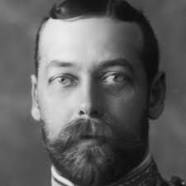
imgres-1.jpg King George V of Great Britain was born on June 3, 1865, the unpromising second son of Edward VII. Initially, he sought a career in the British Navy, but the untimely death of his brother, Albert, placed him on the throne. He became king in 1910 (serving until 1936) and played an active role supporting the troops during World War I. Though lackluster in personality, he won the loyalty of the middle class and many in Great Britain with his steadfast dedication to his country.

Anthony Hall caused widespread panic amongst the authorities, stretching to the King himself.  A Special Branch of the British government tracked Hall as the man toured cities with his claim to be the rightful heir to the throne as the descendant of an illegitimate love-child by Henry VIII and Anne Boleyn before they wed. Hall even wrote directly to King George V in February 2, 1931, accusing him of being a German with no claim to the Crown. He wrote: ‘The whole world has been hoodwinked for 328 years. You have no connection with the British Royal Family. You are an outsider.
Therefore leave the country. I claim the Crown.’

He threatened to arrest the King for treason, saying that even if he went to the Prime Minister and ‘pulled his beard,’ King George V would still be chucked out of Britain.
Astonishingly, his scurrilous claims were not only taken seriously by the public, but also the police, Home Office and the King himself.

HALL_344x450.jpg “Details have emerged from the National Archive of the royal family’s anxiety at the way Anthony Hall, who was said to be tall and always impeccably dressed, drew crowds of up to 800 people to hear his claims of direct lineage from Henry VIII. Across the West Midlands, he used his 1931 campaign meetings to denounce King George, the Queen’s grandfather, as a ‘pure blooded German’ with no right to rule Britain. According to a Home Office file, Hall traced his ancestry back to Thomas Hall, a ‘bastard son’ of Henry VIII who died in 1534. To add to his claim to the throne he argued that the real James I of England had been murdered as an infant and his remains lay in a coffin in Edinburgh Castle. His place was taken by an ‘impostor and changeling,’ James Erskine, whom he dubbed ‘goggle-eyed Jim.’ Hall argued that Erskine could not have been the rightful heir, not only because he was goggle-eyed but also his head was too large for his body and his rickety legs meant he couldn’t ride a horse. ‘Having proved he is an impostor it is obvious that all the kings who claim and have claimed to be descendants of his are not entitled to their jobs and are not part of the blood royal,’ he thundered to one large crowd.

“At the height of the great depression, his nightly rants at open air meetings in the Bull Ring, Birmingham, and other West Midlands towns, against the German occupants of Buckingham Palace drew large, approving crowds. But they left the police alarmed. However, King Anthony, a nephew of the high sheriff of Herefordshire, blew hot and cold in his strategy to win back the throne. In one speech he calmly argued that he did not want to start a rebellion or fight a new civil war and the whole matter could be settled in the courts. King George knew that he was an outsider without any connection with the British royal family, Hall claimed, and therefore should face facts and leave the country.

“But Hall, who had driven an ambulance on the Somme during the first world war, occasionally took a far stronger, more violent, line, telling one of his meetings in Birmingham that he would have no hesitation in shooting the king as he would shoot a dog. ‘The King is a German, a pure bred German … I want to become the first policeman to cut off the King’s head.’

“Buckingham Palace asked for him to be declared insane. ‘Would it not to be possible to keep him under observation with a view to his final detention in an institution without actually putting him in prison,’ King George’s private secretary, Sir Clive Wigram, asked the Home Office. So King Anthony was remanded in custody and two doctors called in to examine him. But both refused to certify him as insane. Dr Walter Jordan, a member of the Birmingham public assistance committee and an expert on lunacy, said, to the disappointment of the police and the Home Office: ‘His claim that he is entitled to the kingship of this country is not the mere autogenic delusion of the usual man who says ‘I am king’ but is a case of a sort.’

“At the palace, Sir Clive lamented that locking Hall away in an institution was no longer going to be a practical or effective way of dealing with him: ‘It is true that he is eccentric and wrong-headed, but he is not so obviously demented or insane that he could be dealt with without recourse to court proceedings.’ Sir Clive was convinced that unless something was done Hall would ‘continue with his scurrilous campaign.’ King George was consulted. He agreed that the full force of the law should be used to ‘put a stop to the effusions of the impostor,’ as long as the monarch’s involvement was kept secret and it did not end in Hall’s imprisonment. Buckingham Palace told the Home Office to go ahead ‘so long as it is quite understood that His Majesty is in no way responsible for the initiation of them.’ Hall was arrested and tried for using ‘quarrelsome and scandalous language.’ He was fined £10 and bound over to keep the peace with a surety of £25 or the alternative of two months’ imprisonment with hard labour. The chief constable of Birmingham reported to the palace that, after a swan song meeting in the Bull Ring, Hall finally left the city, ending the public campaign of the last Tudor claimant to the throne. Hall is believed to have died in 1947 leaving no male heirs.

Resources: 

BritRoyals

The Daily Mail 

The Guardian 

Wikipedia 

Posted in British history, kings and queens | Tagged , , , , , | 6 Comments

During the Georgian Era, Would a Vicar or Clergyman Take an Oath?

Question from a Reader: Is there a term for when a man becomes a vicar, such as getting sworn in or taking his vows, making an oath or something?

Answer: The man is appointed to the position by the one who owns the advowson—the right of presenting the living to someone. The Bishop of that Seat has to approve the appointment and then they “read ” the man in. Not so much a “they” as “who.” The archdeacon of that See, a cleric having a defined administrative authority delegated to him by the bishop in the whole or part of the diocese, is the one who does the job. The office has often been described metaphorically as oculus episcopi, the “bishop’s eye.” He comes and with congregation watching, puts the man’s hand on the key in the door or on the door, or the wall. Then he says, “By virtue of this mandate, I do induct you into the real, actual, and corporal possessions of this church of (name of church and location) with all the rights, profits, and appurtenances thereto belonging.”  Then the archdeacon leads the new clergyman inside. He fills out a certificate and the men of the church, the patron, and the vestry or other witnesses sign it. It is formally called an induction: The man is inducted into that church. But I have seen it called reading him in. Once a man has been read in he cannot be fired.

In the Regency period, a man entering the church usually went to university. There were few courses specifically for clergymen. A “seminary” during those day might very well be a girls’ school, not a place to study one’s religious beliefs or prepare one for tending a church. Prospective clergymen took the same courses as others for the most part with a study plan laid out by tutors. They attended some special lectures on theology and read the writings of St. Augustine, as well as Plato. There were complaints that the course of study was too secular. The tutor could also have them reading various works of theologians of the reformation as well .

They were supposed to use printed sermons and the prayers in the book of Common Prayer at first, anyway. 

After they graduated they might stay on as a tutor. They could not be ordained until age 24 and often required a position to hold them over until they found a church of their own. So, those of you who are Austen fans now know that Mr. Collins was likely around five and twenty or even older.

If they had the money and hoped to become a bishop one day, they might take courses in Civil law which was the law used in the church courts (English courts used Common law).  Most references to “Doctors,” such as Doctors’ Commons meant Doctor of Divinity (not medicine)  Doctors’ Commons was a place where Doctors of Divinity gathered. It was also where the Archbishop had an office and the site of the church court.

 As to how a man found a living, families and friends looked about for open livings. Those who stayed on as tutors had a chance at one of the livings where the university owned the right of presentation.

The man could be ordained at any time the bishop agreed to it but only after he was 24 years of age and had the offer of a position. After ordination, the man would be read into or inducted into the specific church.

In some churches the man would be rector and receive the major tithes. In others he would be vicar and receive the lesser tithes. Some times he might be a curate, which meant that he was paid a wage and could be sent home at any time. This was usually the case when the owner of the presentation had a young son he intended for the church and required a place holder until the boy turned 24. [See my Greater and Lesser Tithes and Who Received Them for more information.]

Jane Austen and the Clergy has some good information.

What I have described above is not the ordination which the bishop does in his cathedral. Taking orders or ordination is when the man—those in some denominations—places himself before the altar. The induction is the formal placing a man into a specific church to serve as the incumbent. The induction or “reading in” takes place in the church where the man will serve. According to the book of ecclesiastical law, the paragraph I provided earlier is what the arch deacon says.

He starts off with a warrant which is the formal, legal appointment which lays out the terms, the tithes, and the responsibilities.

Within 56 days the man is to read the 37 articles of religion to the congregation and affirm his whole hearted support of such.

There are 37 articles in the Book of Common prayer. The example is from the Province of the Archbishop of York, but the form is pretty much the same for both provinces. One resource as to the actual words would be a period copy of the Book of Common prayer.  

The Book of Common Prayer 1800 is online in Google Books 

The Clergyman’s Manual 1842, by Robert Simpson

Posted in British history, Church of England, customs and tradiitons, Georgian England, Georgian Era, history, Jane Austen, Living in the Regency, Regency era, religion, research, writing | Tagged , , , , , , , , | Comments Off on During the Georgian Era, Would a Vicar or Clergyman Take an Oath?

When You Discover One of Your Great Grandfather’s Has a Town Named After Him

Welcome to Marlinton, West Virginia.

Historic Depot and the Greenbrier River Trail in Marlinton. ~ Wikipedia ~ CC BY 2.5

What might you ask would have me writing about a small town in rural West Virginia? Well, the truth of it is I have once again been updating my Ancestry.com files. This town is named after my 7th Great Grandfather, Jacob Marlin.

Marlinton is a town in and the county seat of Pocahontas County, West Virginia, United States. The population was 998 at the 2020 census. Located along the Greenbrier River, it is known for its scenery.

Marlinton is named for Jacob Marlin, who, along with Stephen Sewell, became the first non-native settlers west of the Allegheny Mountains, in the Greenbrier Valley in 1749. They were discovered living there by surveyors John Lewis and his son, Andrew, in 1751. New Englanders Marlin and Sewell built a cabin in what would become Marlinton, but after various religious disputes, Sewell moved into a nearby hollowed-out sycamore tree. Sewell eventually settled on the eastern side of what is now called Sewell Mountain, near present-day Rainelle.

Jacob Marlin was born in April 1689 in Talbot County, Maryland. He married Sarah Armstrong in 1710. His daughter Susan, who is my 6th Great-Grandmother was the first of his children, followed by a son named Archibald and, later, another daughter named Eleanor. Those children were well spaced out, for he was gone for long stretches of time in exploration.

Greenbrier Pioneers and Their Homes by Ruth Woods Dayton tells us,

Marlin and Sewell were the first white settlers to reach the upper part of the valley. The year was 1749. Later, Sewell struck out on his own, moving farther west. He was killed by Indians, apparently at the cabin site and probably in 1756 during the French and Indian War. Marlin, who returned to the East, survived the Indian wars.

As a result of its rural location and proximity to the facilities of the United States National Radio Quiet Zone, the town has been a late adopter of broadband Internet. A 2018 article in Motherboard explains that the nearby Snowshoe Mountain ski resort has been able to provide fast internet, WiFi, and cell phone coverage by having a custom system built which is specially designed so as not to interfere with radio telescopes.

It is my understanding that the men had strong disagreements about religion, one being a Protestant and the other a Catholic.

Luke Bauserman in an article entitled “Giant Trees of Appalachia and the People Who Lived in Them,” tells us: “According to the Encyclopedia of West Virginia, the largest trees ever documented in the eastern states were three sycamores documented by George Washington in 1771 on the Three Brothers Islands in the Ohio River. [Google Books] Washington was amazed at the size of these trees and estimated in his diary that one of them was 61 feet in circumference at its base!
It turns out that my brother and I weren’t the first settlers to take up residence in a hollow tree either, not by a long shot:
• In 1750, explorers Jacob Marlin and Stephen Sewell headed westward across the Allegheny range and found there way to where the mouth of Knapps Creek empties into the Greenbrier River in what is now Pocahontas County, WV. The two men decided to settle in the area. They built a cabin for themselves, but ended up having a falling-out. Their quarrel eventually reached a point where they were not speaking to each other. So Sewell moved to a large hollow sycamore tree which stood a short distance from the cabin and lived there for a period of time.
• The following year, when surveyors for the Greenbrier Land Company entered the area, they found Marlin and Sewell living quite happily in their separate dwelling places. It was also reported that each morning the two men greeted each other with pleasant salutations. After Sewell moved on farther west where he was later killed by Indians, his former sycamore tree house served as a temporary dwelling place for many others who passed that way in subsequent years and remained as a landmark until 1930.”

Medium ~ The largest tree logged in the State of West Virginia, near Lead Mine, Tucker County, 1913. This white oak, as large as any California Sequoia, was probably well over 1,000 years old. It measured 13 feet in diameter 16 feet from the base, and 10 feet in diameter 31 feet from the base. © McClain Printing Company. ~ http://www.patc.us/history/archive/virg_fst.html
Smoky Mountains Hiking Club rests at a large chestnut tree. ~ Medium ~ http://therevivalist.info/win-a-blight-resistant-chestnut-tree/

“Marlin and Sewell.” e-WV: The West Virginia Encyclopedia. 08 February 2024. Web. Accessed: 07 April 2025.

Posted in America, American History, Appalachia, Uncategorized | Tagged , , , , | 2 Comments