Valentine Corbett in Suzanne Enoch’s “Sin and Sensibility: The Griffin Family, Book 1”

Okay, it’s Valentine’s Day this weekend. So, I’m taking a look at a couple of books who have characters named Valentine. The first is Valentine Corbett, Marquis of Deverill, from Sin and Sensibility by Suzanne Enoch. This book is part of the “Griffin Family” series.

51GF3qouokL._SX310_BO1,204,203,200_.jpgSin and Sensibility by Suzanne Enoch; An Avon Romantic Treasure Book; Copyright December 2004; ISBN 0-06-054325-6

Book Blurb: USA Today bestselling author Suzanne Enoch delights fans once again with this enchanting tale of a young lady determined to have an adventure and the white knight who charges to her rescue.

After yet another beau was chased away by her three over-protective brothers, Lady Eleanor Griffin decides she’s had enough. If she is to become a boring society wife, then she’s going to have some fun first. But when her adventure turns into more than what she bargained for, she is grateful for her knight in shining armour who rescued her from what was sure to become a scandalous situation.

Plot: Young Ladies Just Want to Have Fun… Unfortunately, Eleanor Griffin has three strapping brothers to frighten away any beau they deem unsuitable. She know she’s expected to marry eventually – probably some staid, crusty, old lord – but until that day day dawns, Nell intends to enjoy herself. However, the Duke of Melbourne isn’t about to let his sister run completely wild, and he asks his best friend, the Marquis of Deverill, to keep a close eye on the spirited lovely.

Could any chaperone be less qualified – yet, more appreciated – than Valentine Corbett? Here is a man as sinful as he is attractive; a notorious rake, gambler, and pursuer of women, whom Nell has fancied since childhood. Alas, the irresistible rogue seems uncharacteristically determined to be honorable, despite the passionate longing in his gaze. And Nell must tread carefully, for she has promised to immediately wed whomever her siblings choose should so much as a hint of scandal arise…

Poor Eleanor has three very overbearing brothers: Charlemagne (Shay), Zachary, and Sebastian (the Duke of Melbourne). Some people who have criticized this book have done so because they saw Eleanor as petulant and spoiled. I, on the other hand, saw her as an adventurous spirit that needed direction. When one considers how restrictive the Regency Period was for women, any woman who demanded her independence could be seen as self-serving. Enoch uses this perception to her advantage in telling this story of the typical rake who is reformed. The “rake” story line is a tried and true element of Regency romances, and Enoch uses it well.

There is no earth shattering moments in this novel. It is simply a well told romance. Its strength lies in the wonderful romantic scenes leading up to Valentine and Eleanor’s coming together, and the wit, humor, and sensuality that fills each of their encounters. Women love the “bad boys,” and I admit to falling in love with Valentine Corbett. He was a charming rascal. So, unlike some who on Amazon left less than a stellar review of this story, I enjoyed this one in the Griffin Family series. In fact, it is Sebastian’s story from the series that I disliked, but we will revisit that novel at a later date.

I give this story 4 out of 5 stars for great romantic scenes.

______________________________________

An Invitation to Sin (Book 2) 

Seven marriageable daughters . . . And Lord Zachary Griffin is just the man to help them.

51rPD6gwZxL._SX308_BO1,204,203,200_Book Blurb: After all, what could be more tantalizing than teaching the beautiful Witfeld sisters all the special ways of driving a man into submission—and marriage? And leading exquisite Caroline Witfeld, the most spirited and least frivolous sister, to temptation would be wildly delicious.

Zachary doesn’t realize that Caroline’s longing gazes have less to do with attraction and more to do with admission—to a prestigious arts conservatory. If only she could set those high cheekbones, that aristocratic brow, and those powerful shoulders to canvas, her dreams would all come true. But Caroline is soon having dreams of a very different sort—ones that involve the charming rogue and some improper behavior hardly befitting a lady dedicated to her art . . .unless she becomes dedicated to the art of love.

___________________________________

Something Sinful (Book 3)

UnknownIt was lust at first sight . . .

Book Blurb: She was a vision, an exotic goddess who floated across the ballroom, conjuring images of warm nights and silk sheets, and Lord Charlemagne Griffin felt lightning shoot straight to his . . . well, he was definitely interested. So the lady isn’t exactly the sharpest knife on the rack, as Shay soon discovers, but the generous bosom just above her low neckline more than makes up for it. Before he knows it, Shay is bragging about an impending business deal to impress her . . .

Lady Sarala Carlisle may appear naïve, but too late Shay realizes her unconventional beauty masks a razor-sharp intelligence and flawless instincts—and she’d just bested him! Well, two can play at this game, and one of Shay’s many skills is the fine art of seduction.

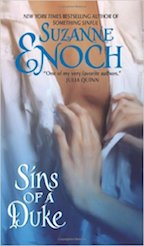
Sins of a Duke (Book 4)

41oMuVObEDL._SX290_BO1,204,203,200_Book Blurb: Lust is a Sin . . .
Sebastian Griffin, the Duke of Melbourne, has raised his younger siblings, seen to it that they made correct matches, and basically kept everyone in line. Seen as the most powerful man in England, Sebastian has a reputation for propriety and has maintained a scandal-free life.

Until now.

Josefina Katarina Embry is a beauty, to be sure, but she claims to be the princess of a faraway country. While she dazzles the ton with her wit and charm, Sebastian suspects she’s up to something. And he’s determined to expose her . . . if only he wasn’t so distracted by her brazen sensuality and the irresistible allure of her kiss. Sebastian knows an affair will lead them into scandal, but will the most powerful man in England risk all for a princess of dubious lineage . . . or will he allow a most sinful desire to rule his heart?

So do you have favorite characters named “Valentine”? Chime in with suggestions.


Posted in books, Georgian England, historical fiction, Living in the Regency, Living in the UK, Regency era, Regency romance, review, romance, Uncategorized | 3 Comments

Thomas Malory’s “Morte D’Arthur” Part II

Previously, I posted a detailed summary of Books 1 and 2 or Malory’s “Morte D’Arthur.” Today, I have chosen bits of the other books to discuss.

holy_grail_on_whiteBook XIII: This is the beginning of the Holy Grail legend. Arthur and his knights go down to the river, where they find a stone floating (note the magic, as stones generally sink to the bottom). In the stone is a magnificent sword, which is lettered in gold with the words “Never shall man take me hence but only he who is the best knight in the world.” This sword is not meant for the renowned Launcelot nor any of the other knights. Launcelot’s stone is the Siege Perilous. Therefore, Arthur and the knights return to the palace, but magic prevails. The palace becomes dark and all the windows and doors are closed and cannot be opened. Eventually, a old man dressed in white appears and with him is Galahad. The man claims Galahad is a descendant of the Biblical figure, Joseph of Arimathea, who caught the blood of the dying Christ in a goblet, i. e., the Holy Grail.

Galahad pulls out the sword from the floating stone. Amid thunder, the Holy Ghost enters the palace carrying the Holy Grail. The knights as a whole vow to pursue the quest of San greal (the Holy Grail). This book follows Galahad’s various adventures. The tales show his meeting Sir Launcelot and Sir Percevale, both of whom he defeats. Sir Launcelot enters a chapel to sleep, but he is plagued by dreams of a sick knight healed by San greal. Sir Launcelot’s sin of desiring Guinevere prevents him from being worthy of the Holy Grail. Launcelot encounters a hermit to whom he confesses his sinful love of Guinevere. The hermit makes him promise not to love her longer, and then he shrives him.

Book XVII: Having decided to rescue the inhabitants of a besieged castle, Galahad takes on first Gawain and then Ector. Afterwards, near the Castle Caroneck, he meets a gentlewoman, who tells him to follow her, which he does. She leads him to a ship carrying Perceval and Bors. This ship takes them to a second one, which carries a warning that only the most worthy of knights may board. This message come is the form of a strange sword. This sword brings death to the one who drew it, unless the man be a perfect knight.

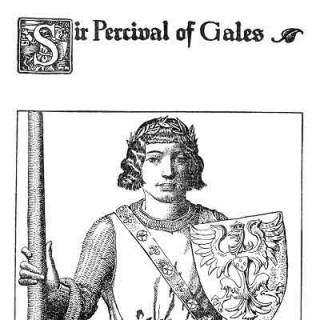
983248-percivale_3“Outside the ship, they meet Sir Percivale’s sister, who explains the history of the boat and the marvelous sword they will find inside it. The knights encourage Galahad to take the sword, which he does, naturally. The knights and maiden reboard the other ship (the one that bore Percyvale and Bors), which carries them to the Castle of Carteloyse in the Scottish Marches. There, they meet with hostile occupants and kill them all. Then they learn from the priest of the castle that they rescued the castle from three brothers who committed incest with their sister. Next, the knights and maiden come to a desolate forest, where they glimpse four lions led by a white hart. The four lions change into a man, lion, eagle, and ox. They learn that the hart represents Christ, and the lions stand for the four gospel-writers. The company arrives at a castle, where the knights must fight to prevent Percivale’s sister from having to give a basin full of blood. When the fight ends in a draw, the party agrees to lodge in the castle for the night and continue fighting the next day.When Percivale’s sister learns that the custom of the castle that involves bleeding a maiden is to save the life of its lady, she agrees to be bled, but loses her life in the process.” (Shmoop)

The next part deals with Launcelot. “A voice tells Launcelot to enter into the first ship that he finds. When he does, he finds Sir Percivale’s dead sister on board and reads a letter telling of the adventures that led to her death. Sir Galahad boards the ship also, and he and Launcelot sail together for six months, fighting a ton of wild beasts and having wild adventures. And it is, until a white knight on a white horse arrives and tells them it’s time to separate, and that this will be the last time they see one another. The boat takes Launcelot to a castle, which he enters, arriving before a locked door.Launcelot prays before  the chamber door and it opens. He then sees a silver table and a holy vessel covered in red silk, but when he tries to enter, a fiery breath knocks him right out. The people of the castle care for Launcelot, and he awakes from his sleep after twenty-four days, which represent the twenty-four years he lived in sin. The people of the Castle (which turns out to be Carbonek, King Pelles’ palace) tell Launcelot he’ll never see more of the Grail than he has already seen, so he decides to return to Logres. On his way to Logres, Launcelot sees Badgemagus’ tomb and learns that he was slain by Gawain. Launcelot returns to Arthur’s court, done with his grail quest.” (Shmoop)

The third part of the book returns to Galahad and achieving the Holy Grail. A vision appears to Sir Galahad in which delightful food is placed before him. Galahad anoints a cripple and makes the man whole. Galadhad is captured by a tyrannical king who places him and his companions in prison, but they are consoled by the San greal. The wicked king dies and Galahad is chosen as the new king. Soon after, Joseph of Arimathea appears and calls Galahad to Heaven. The pure knight is dead. Since then, no man has seen the Holy Grail.

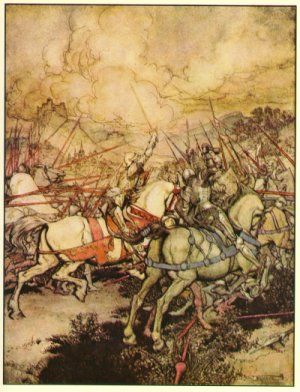
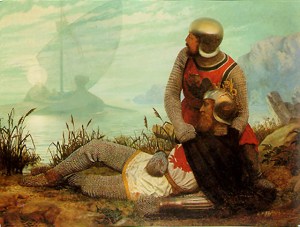
Book XXI: Sir Mordred, Arthur’s nephew, proclaims falsely that Arthur is dead and seizes the kingdom and Guinevere, who resists his advances. Mordred is excommunicated (for trying to marry his father’s wife) by the Archbishop of Canterbury, who quickly makes an exit to Glastonbury Abbey to hide from Mordred’s threats to kill him. Arthur receives word of Mordred’s plot and returns to England, forcing Mordred’s retreat to Dover. In the battle, Launcelot wounds Gawain, causing Gawain to take to his deathbed. On his deathbed, Gawain writes to Launcelot and begs Launcelot to come to Arthur’s aid. Arthur forces Mordred’s army to retreat to Salisbury Plain, where the two armies will meet on the Monday after Trinity Sunday. Arthur’s dreams hold a prophesy of his imminent death. Arthur’s knights suggest that Arthur cede some lands to Mordred rather than to meet in battle. Mordred agrees, but in signing the treaty one of Mordred’s men withdraws his sword when he sees a black snake (part of Arthur’s dream). The knights take up the fight. Arthur kills Mordred with a spear, but before he dies, Mordred plunges his sword into Arthur’s head. Arthur commands Sir Bedivere to cast the sword Excalibur into the lake. Bedivere hesitates, but on the third attempt, he throws the sword into the water, where the Lady of the Lake reclaims it. A barge containing ladies comes to receive the wounded king and to escort him to Avylyon, to either be healed or die. None know of Arthur’s actual death. Upon his tomb is written “Hic facet Arthurus, rex quondam rexque futures,” which means “Here lies Arthur, king who was and king who will be.”

lancelot_and_guinevere_by_deskridge-d4fi7dd

(Image via Lancelot and Guinevere by deskridge on DeviantArt
deskridge.deviantart.com) When Guinevere learns of her husband’s death she becomes a nun. Launcelot seeks her out at the Nunnery at Almesbury, but Guinevere is repentant of their sinful love and tells Launcelot to leave her. It is her belief that her sins caused the downfall of Arthur and his kingdom. He assures her that he, too, will do penance for their adultery. He travels to the monastery where Bedivere has become a monk, where he joins the holy order. After six years, Launcelot has a dream detailing Guinevere death. He decides it is only proper to fetch Guinevere’s body and see that it is buried beside Arthur. Unfortunately, the sight of the two graves sends Launcelot into a great depression. He refuses water and food and within six weeks, Launcelot is dead of a broken heart. All of Launcelot’s knights take holy orders to become monks. Sir Cador’s son, Sir Constantyn, becomes King of England.

Criticisms and Praise: Malory doesn’t give his characters any depth of reality. There’s no psychological depth to make the characters three dimensional. Malory accepted the Arthurian legend as he found it. Because of this the stories are full of incongruities, particularly the tale of Sir Gawain. It is a bit ironic that the characters of Launcelot and Guinevere are more developed than Arthur, for the tale is told. Malory lacked the humor to add realism and the writer’s prowess to add sympathy for a beloved hero.

The tale is full of action, which for the bloodthirsty is quite satisfying. Malory also employs a dignified, simple, direct prose with a distinct rhythm.


Posted in Age of Chaucer, Anglo-Normans, Anglo-Saxons, ballads, British history, Canterbury tales, Great Britain, legacy, legends and myths, medieval, reading, religion, romance, romantic verse, Uncategorized | 1 Comment

Welcome “Time Slip” Author, Heidi Sprouse + a Valentine Giveaway

Today, we welcome “Time Slip” Author, Heidi Sprouse to the blog. If you’re an Outlander fan, you must read Heidi’s new book, Whispers of Liberty. 

Regina: Tell my followers something of yourself, Heidi. They love to discover new writers. 
Heidi: I’ve had a love affair with the written word since I was a child. My first grade teacher told my mother I wouldn’t amount to anything, resulting in many sessions of Dick and Jane at bedtime. I still remember the victory of reading Green Eggs and Ham on my own. From then on, I was hooked, a veritable bookworm. It was only natural that writing would come next. I dabbled in stories for years, writing continuations of television programs with my best friend and filling notebooks with flights of fancy.

Fast forward to college and I majored in elementary education with a concentration in my true love, English. I continued with Master’s degrees in Reading and Early Childhood. I’ve dedicated over twenty years of my life to teaching, finding great pleasure and heartache as well. It is one of the most rewarding, hardest jobs anyone could do.
For the past twelve years, the passion of writing has grown. I finished my first novel shortly after my father’s death in 2003, a young adult novel that is therapeutic. Lakeside Magic is a free read on Smashwords. It’s rough around the edges as all firsts are, but has potential. Deep in the Heart of Dixie is also a free read on Smashwords. It is the story of an abused teen who flees and reinvents herself.

414f8WwjrdL._UY250_In March of 2010, Adirondack Sundown, a 100,000 word suspense thriller, hit and absolutely consumed my life. I was writing at every spare minute, pulling over to the side of the road, or sitting down in a grocery aisle to jot notes. T514B+qqRibL._UY250_he flood ofwriting continued and the tap hasn’t turned off since. I’ve completed many other novels since Belle Bridge Books published All the Little Things in the Cordial Creek Romances. I’ve since published Lightning Can Strike Twice, Aging Gracefully, and Sunny Side Up. Stay tuned for more to come!

perf5.250x8.000.inddMy latest adventure has been Whispers of Liberty, a jaunt through time that begins in my town, historic Johnstown NY, and carries my main character back to the Revolutionary war. Charlotte Ross is a history buff, having grown up with two history teachers for parents. She is surrounded by landmarks from colonial days and a home that is filled with artifacts. One night, on the anniversary of the Battle of Johnstown, she is led into the Colonial Cemetery by a man dressed in the uniform of a Revolutionary militia man. She touches a grave stone and is sucked back in time. Once there, she’ll meet her ancestor and a soldier, Benjamin Willson. Charlotte will fall hard for her militia man. Will she be able to change the tides of war?

I was led to this novel after watching “The Sons of Liberty” on the history channel, plus I love Outlander. The ideas for the story rolled out like a movie in my mind, carrying me on a great adventure as I learned a wealth of facts about my town. The novel merges past and present while giving readers a good dose of patriotic spirit. It also offers a strong heroine as the leading lady. Two more novels are in the works for a story that has been published by Bygone Era Books, a publisher that focuses solely on historical fiction and nonfiction.

You can find Heidi at these sites: 

Facebook at Heidi Sprouse Writer 
Twitter: Heidi Sprouse Author
Heidi Sprouse’s Website

Review of Whisper of Liberty at Manhattan Book Reviews

Purchase Links to Whispers of Liberty:
Kindle 
Amazon

Now, for the GIVEAWAY. Heidi is offering a signed print copy of Whispers of Liberty to a commenter below, but DO NOT SIMPLY COMMENT. You MUST answer the three scavenger hunt questions listed below. Include your response in the comment section below. You may find the answers on the links Heidi has provided (see above). The Giveaway ends at midnight EST on Saturday, February 13. The winner will be announced on Valentine’s Day. Good Luck! 

Scavenger Hunt Questions to win a signed, print copy:
1. On my Twitter page, I’m with the Beekman Boys for my profile picture. What television show/contest did they participate in and win?
2. Whispers of Liberty carries a woman back on time to the Revolution. What other popular series carries a woman back in time?
3, What do I do for a living? You’ll have to hunt on my author page!

Posted in real life tales | Tagged , , , , , , , , | 9 Comments

Life Below Stairs, Part I: Obligations and Compensation

12100820-standardWith the popularity of Upstairs, Downstairs and Downtown Abbey, the populace has become more aware of the British servant class. So what do we know of those who lived “below stairs”? First, rank and precedence ruled those of the servant class as much as it did their masters. What was known as the “pugs procession” was commonplace among servants. Instead of the chatty scenes between upper and lower servants on Downtown Abbey, most household were ruled by “silence.” All the servants would take their dinner together in the servants’ hall, but then the upper servants (the house steward, the butler, and the housekeeper) would move to a private sitting room for their dessert.

maids of downton abbey AP PBS Nick BriggsBeing neither seen nor heard would be the order of the day. It was not unusual for maids to turn and face the wall if she encountered her master or mistress in the passageways. The upper housemaids were responsible for the appearance of the rooms. They addressed the draperies, the floral arrangements, the chair covers, etc. The under housemaids did the physical duties of laying a fire, polishing, cleaning the grates, etc. In Letters from England, Elizabeth Davis Bancroft, the wife of the U.S. Minister to England (1846-49), wrote, “The division of labour, or rather ceremonies, between the butler and the footman I have now mastered, I believe in some degree, but that between the upper and under housemaid is still a profound mystery to me, though the upper has explained to me for the twentieth time that she did only ‘the top of the work.”

Richard Henry Dana, son of the author of Two Years Before the Mast, spoke of a similar demarcation of duties in his Hospitable England in the Seventies. Dana had been invited to spend some time with Earl Spencer at Althorp. He and Lord Charles Bruce wished to play some lawn tennis, but they could find no one to whitewash the court’s markings in the grass. It seems that the job belonged to the “man-of-all-work,” but the servant was no where to be found. Dana said, “Neither the gardener, nor the footmen, nor the valets, nor the bootblacks nor, of course, the maids would help. Our hostess knew this so well that she did not even ask them.”

Servants did receive certain “compensations” for their service. They had a roof over their heads and four full meals per day – breakfast, dinner, tea, and supper. If they were enterprising enough, they could also have the remains of the masters’ meals. They received either a pint of home brewed beer (half pint for women) with each meal or a beer money allowance, usually 8d per day. The upper servants often were provided with wine for their meals. Wages were paid quarterly. Except for clothing, servants had few expenses, and a wise servant could save enough for a nest egg, to start a small business, or assist his struggling family. Loyal servants received pensions of £20 to £25. Smart upper servants could “earn” extra funds from tradesmen seeking the master’s business. The cook, traditionally, claimed the roast’s drippings as her own. The butler and footmen laid claimed to the candle butts. A smart butler might siphon off some of the master’s wine stock, either a decanter at a time or a whole bottle.

1901093In Life Below Stairs by Frank Huggett [John Murray Publishers (July 14, 1977)], there is a list of wages (1888) from the records of the Duke of Richmond and Gordon paid out to the duke’s servants for a year’s service:

the house steward £100

the groom of the chamber £70

the valet, the housekeeper, and the cook £60 each

the butler £45

the footmen £26 to £34

the ladies’ maids £26 to £28

the stillroom maid £22

the kitchen maids £14 to £24

the housemaids and laundry maids £12 to £26

the scullery maid £12

Servants also EXPECTED to receive a tip from the master’s guests. A guest would be leave a half-sovereign for the housemaid in honor of the condition she maintained his quarters, a sovereign for the groom of the chambers for lighting the candles each evening, likewise a sovereign for the butler for his personal advice and favors and a footman who acted as valet to a gentleman traveling without his personal servant. A guest might also tip the gamekeeper, etc. etc., etc. The list could easily grow to a tidy sum. Even visitors making tours of great estates were expected to tip the housekeepers guiding their tours.

And Heaven help the guest who did not meet his obligations. Upon his next visit, he might be housed in a drafty chamber or find his cut of meat the least desirable ones.

Posted in British history, buildings and structures, customs and tradiitons, Georgian England, Georgian Era, Great Britain, history, legends, Living in the Regency, Living in the UK, real life tales, Regency era, Victorian era | 9 Comments

New Prison in the Regency Era, Setting for Part of My Cozy Mystery ~ The Prosecution of Mr. Darcy’s Cousin

New Prison plays a part in my 2015 release of The Prosecution of Mr. Darcy’s Cousin: A Pride and Prejudice Mystery.  I thought I might share a bit of information. Unlike the more widely known prison of the day, Newgate Prison, the New Prison had a less stellar past.

Located in the Clerkenwell area of central London, New Prison was used  between c.1617 and 1877 (it should not be confused with the New Gaol, another name sometimes applied to Horsemonger Lane Gaol in Southwark, south London). [New Prison

King's Bench Prison and Horsemonger Lane Gaol section of "Improved map of London for 1833, from Actual Survey. Engraved by W. Schmollinger, 27 Goswell Terrace" https://en.wikipedia.org/ wiki/Horsemonger_Lane_ Gaol

King’s Bench Prison and Horsemonger Lane Gaol section of “Improved map of London for 1833, from Actual Survey. Engraved by W. Schmollinger, 27 Goswell Terrace” https://en.wikipedia.org/
wiki/Horsemonger_Lane_
Gaol

The court system of the day used New Prison to house prisoners committed for examination before the police magistrates, for trial at the sessions, for want of bail, and occasionally on summary conviction. [New Prison] Such is the reason I chose to use New Prison as the facility to hold Darcy’s cousin, Major General Fitzwilliam. I made an assumption that New Prison would likely provide a bit more freedom than would Newgate, and I need for Darcy to be able to meet often with his cousin as a plot point leading to the trial scene.

The building was rebuilt three times: in 1773, 1818 (after being burnt down in the Gordon Riots of 1780), and in 1847. At this time it was renamed the Clerkenwell House of Detention, also known as Clerkenwell Prison. Next-door was another prison, the Clerkenwell Bridewell for convicted criminals, built in around 1615. This closed in 1794, being superseded by nearby Coldbath Fields Prison.

Modern Use of Building Remnants
During the Second World War part of the basement was altered to form a bomb shelter. Today, the site of the New Prison and the Clerkenwell Bridewell is occupied by the former Hugh Myddleton School (1893-c.1960), in Bowling Green Lane. A number of the original underground spaces and cells remain and are used for office space or storage. A 2007 adaptation of Oliver Twist used these spaces for filming in the July 2007. [New Prison]

PoMDC Cover-2-2
The Prosecution of Mr. Darcy’s Cousin: A Pride and Prejudice Mystery

(Mystery/Suspense/Thriller; Fiction/Historical Fiction)

Fitzwilliam Darcy is enjoying his marital bliss. His wife, the former Elizabeth Bennet, presented him two sons and a world of contentment. All is well until Darcy receives a note of urgency from his sister Georgiana. In truth, Darcy never fully approved of Georgiana’s joining with their cousin. Major General Edward Fitzwilliam for Darcy assumed the major general held Georgiana at arm’s length, dooming Darcy’s sister to a life of unhappiness.

Forced to seek his cousin in the slews of London’s underbelly, at length, Darcy discovers the major general and returns Fitzwilliam to his family. Even so, the Darcy’s troubles are far from over. During the major general’s absence from home, witnesses note Fitzwilliam’s presence in the area of two horrific murders. When Edward Fitzwilliam is arrested for the crimes, Darcy must discover the real culprit before his cousin is hanged for the crimes and the Fitzwilliam name is marked by shame.

Amazon 

Kindle 

Nook 

Kobo 

Excerpt: 

Matlock’s butler admitted him without question, and Darcy entered his aunt’s favorite sitting room just as the high constable informed the major general of the officer’s purpose in coming to Lockland Hall. The countess gasped and collapsed against the loose pillows lining the settee while the earl rose quickly to his feet in protest, but it was Edward’s look of acceptance, which brought Darcy up short.

“You wish this?” he asked into the noisy silence.

Edward’s eyes remained locked on Darcy’s.

“It is part of God’s plan.”

Darcy ignored the earl’s rising ire. He stared at his cousin in stunned disbelief.

“You mean to make a sacrifice? You mean to permit the authorities to take your life as you have taken others?”

Yet, Edward said nothing more. He stood straight and tall: a trained military leader.

“You will not remove my son to Shadwell!” Matlock insisted.

The high constable stood his ground. “I have my orders, Your Lordship.”

“I will go, Father,” The major general said with a strange sense of finality.

Edward adjusted the line of his jacket.

Matlock’s cheeks turned a beet red. “You will do no such thing! I will speak to Lord Sidmouth at the Home Office. This is a mockery of justice!”

Despite his nerves being oddly tense, Darcy spoke with authority.

“We should permit the High Constable his due, Uncle. If Lord Sidmouth agrees with you, the major general can be released in short time.”

“You speak nonsense, Darcy,” Matlock blustered.

As he was the only member of his family aware of the third murder, Darcy assured, “Trust me, Uncle. In this matter, the high constable has his reasons.”

Shock crossed the major general’s countenance.

“What reason?”

Darcy kept his eyes on his cousin.

“A third incident,” he explained, and before his uncle could lodge his protest, Darcy added, “I explained to the high constable you were at Darcy House when the attack occurred.”

“Then there is no reason I will be kept in custody.”

Darcy noted the tight fear in Edward’s voice.

“It is best, Father, that no scene is made. I will go with the gentlemen and trust the British judicial system to recognize the truth.”

The earl’s coloring blanched white, and he swayed in place, but he stepped from the way to permit the major general’s exit.

“Darcy, protect Mrs. Fitzwilliam. I want no more shame delivered to her door.”

“I will do my duty by my sister.”

With that, Edward gestured to the high constable to lead the way. Within seconds, the sound of the door’s closing behind his cousin could be heard echoing through the silent halls to where he and his aunt and uncle remained unchanged.

“You should not have permitted Edward to depart with those men,” the countess sobbed. “What will they do to my son?”

“It is a dire situation, Aunt,” Darcy spoke with gravity.

Matlock recovered some of his composure.

“What do you know that we do not?”

He gritted his teeth and strove to explain.

“I attended Mr. Cowan when he examined the latest scene. There are many similarities among the three incidents.”

The countess asked the obvious, “How could Edward be involved in this…this madness if he were at Darcy House?”

His aunt wrung her hands with worry.

“I spoke to the high constable of the major general’s being in his bed when I departed Darcy House; however, I did not confide the fact my cousin was absent from his bed for nearly three hours in the night’s middle.”

Darcy released a frustrated breath and attempted to rein in his unruly thoughts.

Matlock’s gaze narrowed.

“How can you be certain of Edward’s absence?”

Darcy scrubbed his face with his dry hands to drive away the exhaustion creeping into his veins.

“Georgiana woke to discover Edward missing. My sister feared he chose to desert her again. I searched the house for my cousin or a note of farewell. The major general returned through the servants’ entrance while I searched the lower level.”

“Where in the bloody…?” The earl caught himself before his wife.

“My cousin claimed to have gone for a walk.”

“A walk?” Matlock demanded in incredulity.

“Yes.”

Blast his cousin: Edward’s stubborn streak created a living nightmare.

“The major general claimed the need to be free of our forced imprisonment.”

The countess observed, “If the authorities learn of this walk, Edward’s freedom will no longer be so easily earned.”

Posted in British history, Great Britain, Jane Austen, Living in the Regency, mystery, real life tales, Regency era | Tagged , , , , , , , | 2 Comments

The Day the Music Died: 3 February 1959

This post is designed to have a look back at events that marked our world in popular culture and in literature. This one is on “ The Day the Music Died.” Do you recall the event that killed Buddy Holly, Ritchie Valens, and the Big Bopper? If so, sound off below.

the Big Bopper, Ritchie Valens, and Buddy Holly

the Big Bopper, Ritchie Valens, and Buddy Holly

On 3 February 1959, rock ‘n’ roll’s knew its first great loss: A plane carrying the current stars, Buddy Holly, Ritchie Valens, and J. P. Richardson (known as the Big Bopper) went down outside Clear Lake, Iowa.

A group of men view of the wreckage of a Beechcraft Bonanza airplane in a snowy field outside of Clear Lake, Iowa, early February 1959. The crash, on February 3, claimed the lives of American rock and roll musicians Buddy Holly, Ritchie Valens, and J. P. 'The Big Bopper' Richardson. (Photo by Hulton Archive/Getty Images)

A group of men view of the wreckage of a Beechcraft Bonanza airplane in a snowy field outside of Clear Lake, Iowa, early February 1959. The crash, on February 3, claimed the lives of American rock and roll musicians Buddy Holly, Ritchie Valens, and J. P. ‘The Big Bopper’ Richardson. (Photo by Hulton Archive/Getty Images)

The three stars had been part of the Winter Dance Party Tour, which was to play 24 cities in 24 days throughout the Midwest. Holly was the premiere attraction on the tour for he had previously garnered two appearances on the Ed Sullivan Show. Unfortunately, the bus transporting the musicians had heating problems, and many in the groups took ill with the flu. It was so bad that Holly’s drummer Carl Bunch was hospitalized with frostbite.

The night of the Clear Lake show found the Surf Ballroom packed with 1500 teens, most accompanied by their parents. Frankie Sardo opened the show with his hit “Take Out.” imagesThe Big Bopper was next on the program. Richardson wore a leopard jacket and carried a toy telephone. When he said, “Hellloooo baaaaaaby, this is the Big Bopper speakin’” the audience came to their feet. He continued with several mashups, including “The Big Bopper Wedding,” “Little Red Riding Hood,” and “The Purple People Eater Meets the Witch Doctor,” which was the novelty song on the flip side of his hit “Chantilly Lace.” (Memories, February/March 1989)

Unknown-1Valens was up next. He wowed the crowd with “La Bamba,” “Donna,” and “Come On, Let’s Go.” After the intermission, Dion and the Belmonts took the stage. With Bunch’s illness, Buddy had agreed to play drums for Dion, but he set up the drum set in the shadows of the stage’s lighting so as not to distract from the Belmonts’ performance.

When Holly took the stage, he gave the performance of his life, beginning with Billy Grammer’s “Gotta Travel On,” which was followed “That’ll Be the Day,” “Maybe Baby,” “Well…All Right.” He had obvious fun with “Bo Diddley” and with “Peggy Sue.” He finished with “Brown-Eyed Handsome Man,” which was performed twice–once alone and then with the whole touring troupe.Unknown

The conditions had driven Holly to charter a plane from nearby Mason City to Fargo, North Dakota, which was across the state line from Moorhead, Minnesota, the site of their next performance. The plane departed at 12:55 A.M., but it covered only a few miles before crashing, killing all four men instantly, in a snowstorm with high winds.

The plane had only enough room for Holly and his band and the pilot, Roger Peterson. Waylon Jennings, who became a legend in country music and who was Holly’s bass player at the time, relinquished his seat to J. P. Richardson, who was ill with a high fever. “According to Jennings’ autobiography, Holly teased his bass player by saying, ‘Well, I hope your ol’ bus freezes up.’ To which Jennings responded, ‘Well, I hope your ol’ plane crashes.’” (Ultimate Classic Rock)

“There are conflicting stories as to how Valens wound up in the third seat. Tommy Allsup, Holly’s guitarist, claimed that he lost a coin flip to Valens in the dressing room. In 2010, Dion Mimucci [the former lead singer of the popular 50s group Dion and the Belmonts], who had been silent about that night for 51 years, claimed that he, not Allsup, was slated for the third seat because he was one of the headliners. But after winning the coin toss, he balked at paying $36 for the flight–the amount his parents paid in monthly rent for the apartment where he grew up–and gave Valens the seat. Local DJ Bob Hale, who ws the MC for the concert, agrees that it was between Allsup and Valens, but that he, not Allsup, flipped the coin.” (Ultimate Classic Rock)

Most experts believe Peterson’s lack of experience in the storm conditions and the plane’s instrument panel contributed to the crash. Holly’s wife of only six months had a miscarriage when she heard the news.

“In March 1980, a long-missing piece of the plane crash was discovered. Holly’s signature black-rimmed glasses had landed in a snow bank and were discovered in the spring of 1959 [buried in the snow]. They were brought to the Cerro Gordo County Sheriff’s office, sealed in a manila envelope and forgotten about for 21 years. Upon discovery, the glasses were returned to his widow [Maria Elena Santiago] and are currently on permanent display at the Buddy Holly Center in his hometown of Lubbock, Texas.” (Ultimate Classic Rock)

(See “The Day the Music Died: Crash Site Photo Archive” for more images of the crash. )

Posted in American History, Do You Remember?, real life tales | Tagged , , , , , , , | Comments Off on The Day the Music Died: 3 February 1959

Excerpt from “Angel Comes to the Devil’s Keep”

scotney (Scotney Castle in Kent, England.- the old castle is in the foreground and the new in the background. http://www.castlesandmanorhouses.com/manorhouses.htm)

Soon, Black Opal Books will release the first book in a new Regency trilogy. Angel Comes to the Devil’s Keep brings together Angelica Lovelace, an American born hoyden of English parents, and Huntington McLaughlin, the Marquess of Malvern (and heir to the Duke of Devilfoard). Angelica is a bit of a hoyden in the opinions of British Society, but she is exactly what the marquess needs in his life to truly embrace his role as the future duke. However, nothing is easy about the course they choose, and Malvern questions whether or not Angelica might be better off with his best friend, Levison Davids, the Earl of Remmington.

Angel Comes to the Devil’s Keep

©Regina Jeffers 2016

Chapter One

imgres-1London 1819

The odor of the Thames as it wafted over the area beyond Greenland Docks caused Hunt’s nose to snarl, but Sir Alexander had declared that someone paid large sums of money for the privilege of a blind eye to unloaded contraband, and it was Hunt’s duty to learn more of the people involved. The wig Hunt wore itched, and he fought the urge to remove the offending item, and it did not slip his notice how his coachman, Etch, swallowed his amusement.

“Jist relax, Sir. It shan’t be long,” Etch cautioned.

Hunt grunted his response, attempting to disguise his own mirth. He slouched lazily against the back of the chair, just as the baronet taught him. It was not much, this bit of public duty he performed, but Hunt took a certain pride in doing more than being the Duke of Devilfoard’s heir apparent–more than being the Devil’s cub. His ears perked with interest at the conversation, taking place nearby.

“I tells you,” said the dark-haired man Hunt followed into the tavern. “The viscounty means to learn more of the earl. Then we be makin’ a call upon His Lordship.”

“And this Town lord knows of the earl?” the shorter of the two asked.

“That’s wat the viscounty says. Says he’s got an arr’ngement with the Highest. He also say we be keepin’ the high lord company fer awhile ’til we’s know fer certain he be easy pickin’s. The viscounty be wantin’ information on who the high lord shows his attentions.”

The men rose to depart, and Hunt made to leave, but Etch placed a hand upon his sleeve.

“Wait.” The coachman nodded to the door. “Is that not Lord Newsome? Doing business in this part of London?”

Hunt’s expression screwed up in disbelief.  “The viscounty?” he wondered aloud. “This just became interesting.”

* * *

“You are pure evil,” she declared as he chased her through the intricate maze.
Dressed all in black, he stalked her, and Angelica’s body heated from his brief touch, as he brushed her wrist with his fingertips. Catching her skirt tail, she skittered away from his slow pursuit.

“A copper for your thoughts,” she taunted with a nervous giggle.

“I was considering the pure pleasure of possessing my own personal angel.” His deep resonant voice spoke of desire, but also of contentment.

“Am I that angel?” she rasped when he caught her shoulders and spun her to him.

“Forever.”

“Miss Angelica.” Her maid shook Angel’s shoulder. “Wake up, Miss.”

Angelica Lovelace rolled to her back and stretched. She despised leaving the dream behind. It was one of her favorites, and she particularly enjoyed how it always ended with her in the dark stranger’s very masculine embrace.

“What is amiss?” she murmured. Angelica kept her eyes closed watching the scene’s details playing out behind her lids. She could not remember a time when she did not dream of her dark lover. Even as a very young girl, she enjoyed his company. When she was a child, he was her best friend, but when she turned to womanhood, he became her secret lover, and although she never met him, he remained the man by which she judged all others. To her, he was her “dearest Devil,” always dressed in black, his shaggy coal-colored hair streaked with hints of mahogany. Over the years, Angelica blamed her oft-spoken-of irreverent attitude on the mystery man with a wicked wit and a splash of deviltry. If my critics knew of my sultry musings, they would agree I am quite beyond the pale. The thought brought a smile to her lips.

“Your father, Miss,” the maid encouraged. “Mr. Lovelace requests you attend him in the small drawing room. Baron Arden has called.”

Angelica forced her eyes open. “Baron Arden? What might the baron require?” She pushed herself to a seated position.

“Mrs. Watson be thinking the baron will make himself known as a suitor.” The maid braced Angelica on the steps beside the bed.
“Do you suppose the baron consulted Mrs. Watson?” Angelica asked, with a bit of a tease.

The maid rarely understood Angel’s light sarcasm. “Oh, no, Miss. Mrs. Watson be creatin’ a guess.”

A chuckle slipped from Angelica’s lips. “And I thought an English upper servant worth her salt prided herself on knowing everything within the household.”

“Mrs. Watson knows enough.” The maid unlaced the ties on Angelica’s night rail. “I thought the silver muslin, Miss.”

Angelica fought the urge to roll her eyes. “Another virginal gown. Why is it English ladies announce their marital state with their gown’s color? What could be the harm in wearing a bright red or a royal blue?”

“You may choose whatever color most pleases you once you marry,” the maid observed in severe tones. “Lady Peterson wears only shades of purple. Can you imagine, Miss? Purple dresses every day?”

Angelica frowned. “I am not certain I could tolerate the monotony. Needless to say, it would simplify the need for accessories. A few pairs of slippers and gloves would match one’s attire.”

“You’re so practical, Miss,” the young girl observed.

Twenty minutes later and without breaking her fast, Angelica swept into the room. She and her father had imposed upon the earl and her mother’s sister Sarah by imploring upon her maternal relatives to open the earl’s Town house for the Season and for Lady Mannington to assume the position of Angelica’s sponsor in Society. Her mother’s older sister married Lord Mannington some five and twenty years prior. This was long before Angelica’s birth and before Lady Victoria Copley married Horace Lovelace and traveled to America.

“You sent for me, Sir?” She paused as her mother had taught her. “Allow the man to take your full measure.” The words rang clear in Angel’s mind. It was comforting to have a bit of her mother with her.

“There you are, my dear.” Her father struggled to his feet.

Each day, Angelica became more aware of the man’s mortality. That particular fact was one of the reasons she had agreed to this venture. Her mother had passed two years prior, and her father insisted on carrying out his wife’s dying wishes. For years, Victoria Lovelace spoke of bringing her only daughter to England for a proper debut, but Lady Victoria succumbed to consumption before her wish knew fruition. Therefore, without the love of his life, Angel’s father made the journey.

“Please come in.” He gestured her forward. “You are acquainted with Baron Arden, I believe.”

“Yes, Sir.” She curtsied to the man standing aristocratically beside the hearth. “The baron and I stood up together at the Breesons’ ball on Tuesday last.”

The baron executed a respectful bow. “It is singular you have such perfect recall, Miss Lovelace.”

“Angelica has a quick mind,” her father remarked with pride, but then blustered. “Of course, my Victoria would say a learned lady was not a virtue by English standards.” He winced when shock crossed the baron’s features. “I apologize, Arden. I offer no censure. My late wife always accused me of acting a cake when speaking of our daughter. So many years away from my homeland must make me appear quite the heathen. I am accustomed to a freer speaking society.”

“It is quite acceptable, Lovelace.” The baron grasped the hand Angelica extended in his direction and offered the obligatory air kiss. “Despite the consensus to the contrary, many Englishmen prefer their wives to possess a sensible nature.”

Angelica gestured to a nearby chair. “But the author of Pride and Prejudice proved in her first novel that sense and sensibility are different from intelligence, my lord,” she countered.

“I am surprised you have read the lady’s novels,” Arden remarked.

Angelica seated herself on the edge of the cushion and straightened her dress’s seam.
“Would your surprise be because the author is British rather than American or because the author is a lady, and women should not trespass upon the male dominated world of authorship?” She did not wait for his response before adding, “Perhaps your astonishment rests in the fact Sense and Sensibility is a novel rather than a serious tome?”

She smiled prettily at the man. Her mother may have determined Angelica required an English aristocrat for a husband. However, Angel had decided only a partner who could accept her flaws, as well as her substantial dowry, would do.

Arden frowned. He clearly did not expect a challenge to his opinions. “I suppose all three, Miss Lovelace.”

“But you hold no objection, Baron, to a woman who develops her mind through extensive reading?” Angelica chuckled internally at the familiar line from the British author’s books. She was certain Arden possessed no idea of the remark’s source.

“I would imagine my wife would oversee our children’s educations. Therefore, I would expect a certain rationality.”

“Which brings us to the reason for Baron Arden’s visit, my dear,” her father interrupted.

“Arden has requested my permission to call upon you with the intention of a courtship. That is, if you are agreeable.”

“A time to learn if we would suit?”

Angelica took a closer look at the baron. His thick dark brown hair had a tendency to curl about his collar. Barely six feet, the man struggled to appear more than a walking block of wood, but he possessed a pleasant countenance.

“Customarily, such details are not discussed before the lady,” the baron bristled.
Angelica forced her mouth into a straight line. Since making her debut a month prior, she had delighted in ruffling the feathers of a number of gentlemen who saw her dowry as an inducement to marriage, even though it would be to a hoydenish American. When her father suggested this journey, Angel reminded him, as she had often reminded her dear mother, Angel’s ways would not sit well among the English elite for she spent too much time studying her father’s book on antiquities, tending to Horace Lovelace’s growing string of thoroughbreds, and overseeing the health and happiness of her father’s workers. Those were the things that brought her contentment in her Virginia home, but they were not qualities most men of the English peerage sought in a wife.

“We Americans often take a divergent course. I pray that fact does not present a difficulty to our future felicity, Baron,” she said with a practiced smile.

“Certainly not.” Despite his words of assurance, Arden frowned. “I welcome your frankness, Miss Lovelace.”

Angelica heard the man’s insincerity, but she promised her Aunt Sarah not to make predisposed judgments.

“Then how should we proceed, Sir?”

“I thought I might escort you on daily outings,” he began. “If it is agreeable, we could drive today during the fashionable hour. I also hoped you would consider accompanying me to the theatre tomorrow. My sister and her husband will join us.”

Angelica stood to end the conversation. “I am amenable, Lord Arden.”

He followed her to his feet. “Then I will call for you this afternoon.”

“I shall anticipate it.” She directed him from the room, but before Angelica opened the door to the main hallway, she paused. With her hand resting on the handle, she smiled innocently up at the man. “Might I ask one question before you leave us, Baron?”

He appeared surprised and then assumed a cynical expression.“By all means.”

Angelica hesitated as if undecided, but, in truth, she meant to set guidelines before their courtship began.

“During this time where we determine whether we might suit, am I to limit my interactions with other gentlemen callers? I would prefer to understand our agreement.”

The baron’s eyes narrowed. “I would expect your undivided attention, Miss Lovelace.”

She smiled sweetly. “Then I would expect the same from you, Baron.”

“Of what do you accuse me, Miss Lovelace?” he huffed.

Angelica withheld a glare of disgust. “I meant no offense, Sir.” She schooled her features to portray politeness. With that, she opened the door and turned the baron over to the waiting footman.

“Was that necessary?” Her father grumbled as he poured himself a glass of claret.

She resumed her seat. “I studied the list of potential candidates Uncle Lancelot provided us. Arden has a long-standing title, but he is deeply in debt. My dowry must appear quite tempting. The baron would accept a woman lacking in effeminate ways to salvage his estate. I mean to keep the baron off balance until I am certain of his motivations. Who knows? Perhaps we shall suit, but I shan’t be his subject. When I marry, I wish a relationship as loving as yours and mother’s.”

“Lady Victoria Copley was one of a kind,” her father said wistfully. “Your mother possessed a magnanimous heart. My Victoria deserved better than a minor son, but I am more than grateful she chose me from among her many suitors. You will find it difficult to discover a man of even half Lady Victoria’s merit.”

Angelica thought of her devilish dreams. A man of passion and compassion would do well for her. “I require a man of vision, like my father,” she said in earnest.

* * *

The slow carriage procession drove Angelica nearly to Bedlam, but she kept the smile upon her lips. She agreed to the craziness of the “Marriage Mart,” as her Uncle Lancelot termed it, but she preferred to be anywhere else. The baron’s gig crawled along behind a Stanhope. Every few feet, the man would slow the carriage to acknowledge another member of the beau monde before introducing her to his acquaintances. The ton practiced their pompousness with prescribed efficiency, and Angelica found it blatantly boring. With amusement, she wondered what her devil would say to such pretentiousness. Mayhap he would use it as a prime argument in defense of passion ruling the world. Not that Angelica knew anything of passion. In fact, she had never known even the most faithful of kisses.

“Woolgathering, Miss Lovelace?” a brittle voice broke through her thoughts.

Angelica flushed as she looked up into the countenance of a frowning earl. “I beg your pardon, Lord Townsend, I was simply enjoying the park’s splendor on a spring day.”

“You should always carry a parasol, Miss Lovelace,” Lady Townsend warned. “We would not wish to see you become too brown from the sun.”

Angelica doubted the woman’s sincerity. She was certain the ton would celebrate any flaw Angel sported. She despised the British standard for unblemished skin. White pasty skin. Virginal white gowns. Proper manners, which hid prejudice and censure. A bland lifestyle wrapped in formality. She missed her American friends and her home in the picturesque Virginia mountains, and she missed riding break neck across her father’s land.

“I am grateful for the suggestion, Ma’am, and honored by your attention.”

The carriage nudged forward, and she prepared to greet the baron’s next acquaintance.

“What an absurd tradition!” she observed. “Would it not be wonderful to give the horses their heads?”

“A proper gentleman would never place his cattle in danger,” Arden said in chastisement.
Angelica stiffened. His tone increased her often-quick ire. The baron’s first thought was of his team. Should he not think of the park goers or her position in the high backed gig if safety knew his true concern?

“I never suggested you turn your team free; I simply made the observation it would be a pleasant experience to feel the wind upon one’s cheeks.”

“Acting such would age a woman,” he said with another scowl.

Angelica considered arguing, but she stifled her words. It was useless to think she might find a mate who spoke to her soul. She apologized. This was her first outing with Arden, and she would not leave the man with a poor impression of her manners. She ignored his declaration, and instead focused on the families enjoying the park. I wish for family, she thought. Children and a husband, who knows pleasure in me and in my devotion. A marriage where love rules our reason.

In resignation of what may never be, Angel turned her head and watched a tall figure toss a ball to a boy hefting a cricket bat. Even from a distance, she could tell he cut a fine figure. It was brazen of her to study one man when riding out with another; yet, she could not turn her gaze. Without realizing the reason, she extended her gloved hand in his direction, as if she wished to turn him toward her so she might look upon his features. It was the oddest sensation. Angel swallowed hard against the rising constriction in her chest.

* * *

Huntington McLaughlin, Marquess of Malvern, ignored the continual line of carriages tooling its way along the lane leading to and from the Serpentine, as well as the Society mamas, who attempted to catch his attention. He never understood the ton’s desire to be on display. In fact, Hunt could not recall the last time he suffered a drive through the park during the fashionable hour. Today, he brought Logan and Lucas, his sister’s twins, to the park. Earlier, he spent what felt of hours pacifying his father’s high dudgeon regarding Hunt’s refusal of Lord Sandahl’s virginal daughter, Lady Mathild.

“I want nothing of an innocent,” he declared.

If his father forced him to marry, Hunt would consider a widow, but no green girl straight from the schoolroom. He wished for a woman to place her love for him above all others–a woman who shared his passions for life and adventure and learning.

“What is amiss, Uncle Hunt?” Logan called as he took a few practice swings. Hunt escorted his nephews to the park to remove them from Henrietta’s way. His twin sister was heavy with another child, and with Viscount Stoke away on governmental business, Malvern promised to see to the twins’ safeties, while permitting the boys to expend some of their unbridled energy.

“Nothing,” he mumbled, but he brought his forearm across his eyes to block the sun. Despite standing in an open field and surrounded by many of Society’s best, his loins tightened. From the long equipage line, he watched a slow moving carriage turning toward Rotten Row. A golden-haired beauty clung to the gig’s side, the wisps of her hair alive with light, and she turned in the seat to stare at him. Too young, his mind argued, but his body reacted nonetheless. He hardened, and although he knew it a foolish act as the distance between them was too far apart to distinguish each other’s features, he lowered his arm so she might look upon him. “Bloody hell,” he mumbled as the gig moved away.

“Come on, Uncle Hunt,” Lucas encouraged.

He withdrew his eyes from the departing carriage, but not before he spotted what he thought was the woman reaching out to him. It was like nothing he had ever experienced, and the movement set his body on alert.

“Right away,” he said with little conviction. With the girl no longer in sight, Hunt turned to the seven-year-olds. “Are you prepared?” He tossed the ball in the air to catch it again.

“It will be a fiver,” Logan bragged.

Hunt laughed at his nephew’s puffed out chest. “No boasting until after you produce.” Yet, while he tossed the ball to Lucas, Hunt thought only of the pleasure of greeting the unknown girl with an embrace she would never forget.

* * *

“Are you frightened to toss the ball to me?” She pranced in a taunting manner.

He smiled in deviousness. “Your confidence exceeds your ability.”

His words taunted her, but she knew he would treat her gently. So, when he wound up as if to burn her with his bowler, Angel anticipated the easy loft. He did not disappoint her. The ball sailed within her reach, and Angelica smacked it with the bat, sending it buzzing past his ear.

With a burst of pure joy, she ran to touch the post with her bat as he scrambled for the ball to tag her out. As they both raced toward the home post, he caught her about the waist and swung her around in a circle.

“No fair!” she protested between gasps of delight.

He placed her before him. “I have no sense of fair play where you are concerned.” His thumb caressed her bottom lip. “You are mine,” he whispered. “You deserve to be more than a mere baroness.”

* * *

Angelica assumed her seat beside the baron in the Arden family box. After last night’s dream, she considered canceling her evening plans. Never before had her secret lover made such a bold statement, and it shook Angel’s composure. Realizing the unfairness to Arden, as well as to her father, Angelica met her obligations. Nevertheless, the dream remained clearly in her memory. She reminded her weary heart she promised her extended family to deal honorably with her suitors, and so she smiled at the man of whom she had already tired.

“Have you attended the theatre previously, Miss Lovelace?” Lady Wickersham asked as she waited for her husband to assist her with her wrap.

“Quite often, Your Ladyship.”

“I am certain it could not be of the same quality,” the baron’s sister declared. The Wickershams had commented on the lack of proper roads, religion, and refinement in the Americas. “How often must you have encountered a savage!” the woman exclaimed from nowhere. “Daily, I imagine.”

“Never once,” Angelica corrected, but the trio ignored her protests. Their snickers spoke volumes as to their honest opinion of the Lovelace fortune, and Angel bit the inside of her jaw to prevent the retort resting upon her lips.

“Have you traveled to the Americas, my lord?” she asked the newly minted Viscount Wickersham.

“Heavens, no!” he snapped. “Why would I care to place myself in such a hostile society?”

She wondered if Lord Wickersham held any notice of how patronizing he sounded. With hope, Angelica sought the baron’s attention to intercede, but her supposed suitor turned his notice to the lower levels. Angel followed his gaze. The baron’s eyes fell upon a dark-haired buxom beauty. Immediately, Angelica recalled observing the same woman near the park’s gate yesterday afternoon. The woman dropped a curtsy as the baron’s gig exited the park. Coincidence?

Suddenly, it became quite clear what bothered Angel about yesterday’s excursion. Other than when he introduced her to his brief acquaintances, Arden never spoke to her except to instruct or to criticize. In the ninety minutes’ outing, the baron generally ignored her. And the same occurred thus far this evening. He disregarded her in the carriage, spending his time discussing politics with his brother in marriage. Did Arden despise being around her? He required her dowry, but the baron seemed under the delusion he owed her nothing in return. She had shared her expectations with him, but Arden gave her request no care.
Irritated by his attitude, she whispered in the baron’s ear.

“Do you find the lady interesting, Sir?”

Arden turned his head to glare at her. “We are not yet betrothed, Miss Lovelace, but you show tendencies for jealousy,” he hissed. “Should I be flattered?”

“You should be courting my favor. It is my hand you seek,” she returned. Angelica refused to look away. If Arden thought to have a biddable wife, he should look elsewhere.

Arden’s cheeks flushed. “I will treat you with respect, Miss Lovelace, but I will not dance attendance on your every whim.”

“I see,” she said guardedly. With great care, she turned to the stage and began silently to count to one hundred. The pause would provide her time to make a decision. At length, turning to her party, Angelica set her mouth in a straight line. “If you will excuse me, Arden, I shall step to the ladies’ retiring room.”

“Shall I accompany you, Miss Lovelace?” Lady Wickersham asked as she adjusted her seat to address the stage.

Angelica kept her voice calm. “That shan’t be necessary, Viscountess. I noted a smudge on my gown, which I should address. Enjoy the opening aria.”

The baron did not think to honor her by rising when Angelica exited his box. Angel had never experienced such decided censure. When did Arden’s intent change? Does he mean to teach me a lesson prior to my accepting his plight? If so, the baron erred. Reaching the main entrance, she motioned to a footman.

“Might you assist me?”

“Certainly, Miss.”

“I am not feeling well. Would you hail a respectable hack to see me to St. James Street?”
The man bowed.

“Immediately, Miss.” He turned toward the nearest exit. Within moments, the footman reappeared. “Your ride awaits, Miss.” He escorted her to the carriage.

She slipped a coin into his hand. “One more task,” she whispered. “Please inform Lady Wickersham I developed a headache. Her Ladyship keeps her brother Baron Arden company.”

“As you wish, Miss.” With that, he steadied her step into the public coach.

As the hack rolled from the curb, Angelica looked back to determine if Arden followed. Instead of the baron’s angry countenance, on the corner stoop, she espied the same gentleman who played cricket in the park the previous day. She recognized him from his stance and by the way her breathing hitched tighter. He assisted a very enceinte woman, who clung to his arm. Two sons and another on the way. With a deep sigh of regret at her loss, she refocused her attentions on London’s busy streets. She was without a suitor once again. Baron Arden would be furious for she ended their courtship with a dramatic period.

* * *

Hunt turned his head to survey the traffic, but his gaze locked on the hackney and the woman climbing into it. His arm tensed. It is she, he thought.

“Someone you know?” His sister asked as her gaze followed his.

“No,” he murmured.

Henrietta tightened her hold on his arm. “The girl? The one with the golden blonde hair?”

Hunt could not remove his eyes from the hack. “Saw the lady yesterday when I escorted your boys to the park. At least, I think she is the same one.” His voice trailed off as the hack pulled away from the curb.

“Who is she?” Henrietta’s too sharp eyes followed the departing coach.

Hunt returned his attention to his sister. “Obviously no one of any consequence. Otherwise, what would the lady be doing in a public coach and alone at this time of the evening?”

“Is she pretty?” Etta’s expression lit with an interest Hunt recognized as his sister’s meddlesome ways.

He rolled his eyes heavenward. “First, I only saw the lady from a distance,” he cautioned. “She likely has bad teeth and crossed eyes.” His sister chuckled. “Moreover, I am in no humor to entertain a girl. If I share my time with a lady, I want one who can hold an intelligent conversation.”

“Is that what Alexandra Dandridge provides, Hunt? Intelligent conversation?”

He heard the disappointment, which laced his twin’s tone. “As a genteel lady, you should know nothing of the likes of Miss Dandridge,” Hunt warned.

“Every well-bred English woman knows of women such as Miss Dandridge. We just rarely speak of them,” his sister asserted.

Hunt swallowed his amusement. “Miss Dandridge was never known for intellectual repartee.”

“Was?” Etta jumped on the past tense verb.

“Was,” Hunt confirmed. “I released Zan several days prior.”

Henrietta intertwined their fingers as he escorted her across the busy street.

“I cannot say I am sorry to hear it, Hunt. I know Papa’s schemes are tiresome, but you do require someone with whom you may share your life. It is a sin against nature for you to have no children of your own. You are the perfect uncle.”

“Most certainly.” He grinned. “I spoil my nephews and then send them home for their parents to discipline.” They stepped from the way of the late arriving theatergoers. “I know my duty, Etta. I am well aware of my responsibility to the dukedom.”

* * *

He stepped upon the stage, and Angelica’s heart raced. The audience quieted, and everyone leaned forward in anticipation. Like the other spectators, she slid to the edge of her seat and waited for the opera’s opening notes. Without ever hearing him sing, Angel knew he would be a compelling baritone, one to mesmerize every female in the theatre.
As he opened his mouth for the first phrases, he made a slow advance to the stage’s edge and then down the side steps beyond the imaginary fourth wall of the stage. She knew he was coming for her: His gaze remained locked upon her countenance. It was as if she could feel the heat of his breath upon her cheek. As his voice rose to fill every corner of the house, he reached for her, and Angelica placed her hand in his.

Posted in Uncategorized | 3 Comments

When the Heart Dreams Romance Readers and Writers Weekend Mixer, Feb 5-6, with Madeline Hunter & Katherine Ashe

Come Join Me!

Featuring a Queen Authors Luncheon
Renaissance Charlotte Southpark Hotel, Charlotte, North Carolina
For people who love to read romance novels and an opportunity for authors to meet and build relationships with new readers in a relaxed casual setting.
February 5-6, 2016
romance@whentheheartdreams.com
http://www.whentheheartdreams.com

11986960_1065240896828536_5214047815952479922_n

Posted in Uncategorized | Comments Off on When the Heart Dreams Romance Readers and Writers Weekend Mixer, Feb 5-6, with Madeline Hunter & Katherine Ashe

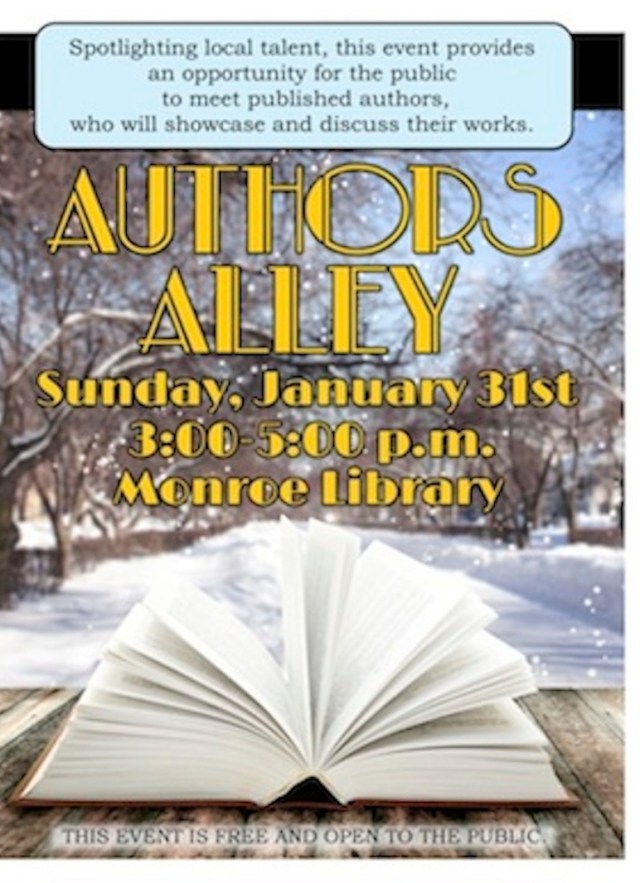
Authors Alley Event, 31 January 2016

 Come Join Me! Authors Alley Cards 2016 copy 2

Posted in books, contemporary romance, eBooks, historical fiction, Jane Austen, mystery, Pride and Prejudice, Realm series, Regency romance, Ulysses Press, vampires, writing | Comments Off on Authors Alley Event, 31 January 2016

A Primer for Books 1-2 of Thomas Malory’s “Le Morte d’Arthur”

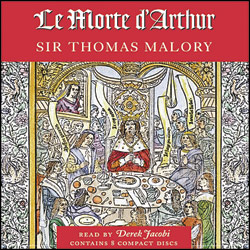
Le Morte d'Arthur Audio Book CDs Abridged www.audioeditions.com

Le Morte d’Arthur Audio Book CDs Abridged
http://www.audioeditions.com

For those of you who have never read Thomas Malory’s Le Morte d’Arthur or have not read it since you were in secondary school, I intend to keep this simple (or as simple as a 545 years old story can be). First, Malory complete the story about 1470, and William Caxton printed it for the first time in 1485. Malory’s tale is a compilation of stories of Arthur and his knights being drawn from both English and French sources. The cycle stories had developed gradually, but it was Malory that wove them together into a consecutive and unified order. Le Morte d’Arthur serves as the standard for later versions of tales of King Arthur.

The tale is divided into 21 books. Several predominate themes appear in the tales, including identity, loyalty, betrayal, vengeance, traditions and customs, rules of order, strength and skill, and love.

Book 1 – Uther Pendragon, King of England, falls in love with the Duke of Cornwall’s wife, Igrayne. Cornwall recognizes Uther’s intention of a seduction, and so he removes his wife to the fortress at Tintagel, while Cornwall holds up at Terrabyl. Uther attacks both castles. Uther grows sick during the siege, supposedly from anger with Cornwall and a desire for Igrayne. Sir Ulfius suggests that Uther seek the assistance of the wizard Merlin for a cure. Uther makes a bargain with Merlin to give Uther the duke’s wife. Merlin asks for the child Uther will sire as payment for the “gift.” Uther manages to kill Cornwall in a battle, and then he enters Tintagel in the form of the duke, where he seduces Igrayne. Arthur’s barons insist he marry Igrayne, and so he does. Igrayne’s sisters also make good marriages, with Morgause marrying King Lot of Orkney, and Elayne ending up with King Nentres of Garlot. Another sister, Morgan le Fay, is sent to school in a nunnery where she becomes a great sorceress. Afterward, she marries Uriens of Gore. 

On the night of the seduction, Uther begets Arthur. Arthur is born and given by Merlin to Sir Ector to foster. A brief battle takes place between Uther and his enemies, but shortly after the victory, Uther takes ill. Upon his death bed, Uther names Arthur as his heir. Even so, the kingdom is in disarray, with much in-fighting among the lords for power. Merlin suggests to the Archbishop of Canterbury that the Christ-child will complete a miracle at Christmas, and the powerful lords of the kingdom should stand witness. The lords come to London and, as they’re busy praying in the cathedral, a sword appears in the churchyard, stuck in a stone bearing the inscription “Whoso pulleth oute this swerd of this stone and anvyl is rightwys kynge borne of all Englond.” No one is capable of removing the sword, although many try.

Sir Ector and his son Sir Kay, along with Arthur, mean to participate in a joust on New Years’ Day, but Sir Kay forgets his sword and sends Arthur back to retrieve it. Unable to get into the locked house, Arthur does the next best thing: He extracts the sword from the stone. When Kay and Ector see it, they recognize it and understand that Arthur must be the king. Ector swears his loyalty to Arthur and asks him to make Kay his seneschal, to which Arthur agrees. As none of the other lords could withdraw the sword, they are faced with the possibility of being ruled by an unknown, and they object strongly. They go about delaying the decision by first suggesting a wait of one month and then until Pentecost. At length, the common people accept Arthur as king, and the lords must bend to their wishes.

Arthur is to celebrate his coronation at the next Pentecost with a feast in Carlyon. Six kings oppose him, and Arthur’s army manages to send them packing for a time, but fearing their return, Merlin suggests that Arthur seek the assistance of Ban and Bors of Gual, who make an alliance with Arthur. “Meanwhile, the force opposing Arthur has grown by five kings and includes fifty-thousand mounted knights and ten thousand footmen. They besiege the castle of Bedgrayne, then withdraw, leaving only a few men there to continue the siege. Arthur’s forces set upon their encampment and a long battle begins. Both sides fight bravely and it looks like the battle could last for a long time. Arthur’s forces set upon their encampment and a long battle begins. Both sides fight bravely and it looks like the battle could last for a long time. Arthur withdraws, rewarding his knights and Ban and Bors richly with the spoils of battle. Meanwhile, an earl named Saman shows up with his daughter, Lyonors, to pay homage to Arthur. Arthur promptly sleeps with Lyonors and conceives a son named Borce with her. Then, Arthur, Ban, and Bors help King Lodegreaunce of Camylard defend his Kingdom against King Ryons of Wales. While there, Arthur meets a girl named Gwenyvere for the first time. Ah, so this is the famous Gwenyvere.” (Shmoop)

Le Morte dArthur gorddcymru.org

Le Morte dArthur
gorddcymru.org

“Arthur returns to Carlyon, where King Lot’s wife, Morgause, soon arrives. Apparently, she’s there to deliver a message, but in reality, she just wants to spy on Arthur’s court. Arthur sleeps with her, too, and conceives a son, Mordred. After this, Arthur dreams that griffins and serpents come into his lands and fight with him, but he kills them in the end. Gee, we wonder what inspired that dream… To get his dream out of his mind, Arthur goes hunting. He chases a hart (a deer) but it gets away. Then Arthur sits down by a fountain to think. The questing beast, an animal whose belly makes a great noise like the sound of thirty baying hounds, passes by, followed by a man named King Pellynore in hot pursuit. Pellynore argues with Arthur about which one of them should pursue the beast further, then steals Arthur’s horse, the jerk.

“Later, Merlin, in the guise of a young child, tells Arthur that his father was Uther and his mother was Igrayne. Then, in the guise of an old man, he tells Arthur that he has conceived a child with his sister, and that child will destroy his kingdom. Arthur wants to know if this is true, so he asks Ector, who backs up Merlin. Then Arthur sends for Igrayne and has a joyful reunion with his mother. Meanwhile, a squire brings the body of his master to Arthur’s court and tells how a knight in the forest killed him. He asks for a good burial and revenge. A very young guy named Gryfflet asks to be made a knight so he can undertake the challenge. But when he fights with the knight in the woods, he’s defeated. He returns to Arthur’s court, badly wounded, and good doctors heal him.

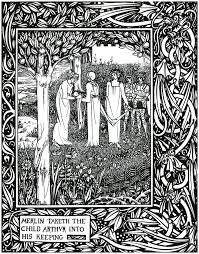
 Aubrey Beardsley's illustrations from Le Morte D'Arthur, page 1 www.abovetopsecret.com


Aubrey Beardsley’s illustrations from Le Morte D’Arthur, page 1
http://www.abovetopsecret.com

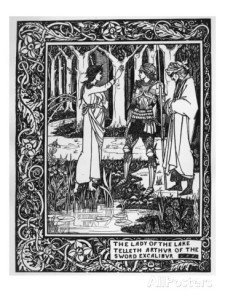
“Twelve knights arrive from the Emperor of Rome, demanding homage, or a show of respect. He offers instead to give them homage with a sharp sword or spear. Arthur rides out to avenge Sir Gryfflet and engages the mysterious knight, who turns out to be Sir Pellynore. Just as Sir Pellynore is about to kill Arthur, Merlin appears and enchants him into a deep sleep. Merlin takes Arthur to a lake. As creepy as it sounds, they see an arm clothed in white samite, rising out of the water, holding a sword. A woman boating on the lake tells Arthur that the sword is hers, but that he can have it if he promises to give her whatever she asks – a favor to be claimed later. Arthur and Merlin ride out on a barge to the middle of the lake and take the sword from the woman. After that, Arthur returns to court, passing an enchanted Sir Pellynore, who fails to recognize him, on the way.

“King Royns of North Wales sends a message to Arthur, saying he has defeated and taken the beards of the alliance of eleven knights, and wants Arthur’s beard, too. Arthur refuses to pay him homage. At Merlin’s advice, Arthur acts on the mother of all bad ideas and has all the babies in the land who were born on May Day put out to sea in the hope of destroying Mordred, who, you’ll remember, was predicted to destroy Arthur’s kingdom. All the babies die in a shipwreck except for Mordred, who is fostered by a good man until he is fourteen. King Royns receives Arthur’s message and gets crazy angry.” (Shmoop

 The Lady of the Lake Telleth Arthur of the Sword Excalibur, Illustration from 'Le Morte D'Arthur' Giclee Print by Aubrey Beardsley at AllPosters.com www.allposters.com


The Lady of the Lake Telleth Arthur of the Sword Excalibur, Illustration from ‘Le Morte D’Arthur’ Giclee Print by Aubrey Beardsley at AllPosters.com
http://www.allposters.com

Book 2“The Tale of Balyn and Balan: While Arthur’s in London, a knight arrives and tells him that King Ryons has amassed a large force and is burning and pillaging the lands of Arthur’s vassals. Arthur calls a council of all his men. During the council, a woman arrives saying she comes as a messenger from Lady Lyle of Avillion. When the lady raises her mantle, everyone sees that she’s wearing a sword. When Arthur inquires why she wears the sword, she tells everyone that she must wear it until a knight without treachery and treason draws it from the scabbard. All the knights at the council try to remove it, but none can.

“As the lady is leaving, a poorly-attired Northumbrian knight named Balyn asks to be allowed to attempt to pull the sword despite his poor appearance and succeeds. The lady asks for her sword back, but Balyn refuses. Then the lady tells him that it is for his own good that she asks for the sword back because if he keeps it, he will kill the person most dear to him with it. Then the Lady of the Lake arrives in court and demands the favor Arthur promised her in exchange for Excalibur (the sword he got from the lake): she wants the head (i.e. death) of Balyn or the sword-lady, claiming that Balyn killed her brother and the sword-lady killed her father.

“When Balyn finds out the Lady of the Lake demanded his head, he kills her, disgracing Arthur and getting himself exiled from court. So an Irish knight named Sir Launceor asks permission to be allowed to pursue and fight with Balyn to avenge Arthur’s disgrace, and Arthur grants it. Launceor and Balyn fight, and Balyn kills Launceor. A lady riding in pursuit of Launceor comes upon the scene and declares herself Launceor’s love, then falls upon his sword, killing herself.

“Balyn’s brother Balan rides onto the scene, and the two agree to head off together in pursuit of King Ryons so that Balyn can get back into Arthur’s good graces, Meanwhile, King Mark of Cornwall arrives and erects a rich tomb for the two lovers, Sir Launceor and Lady Columbe. While he is doing this, Merlin arrives and prophesies that Launcelot du Lake and Trystram will fight a battle in this place. Merlin tells Balyn that because of the death of Lady Columbe, he will strike a “stroke most dolorous,” through which three kingdoms will be destroyed.

“When Mark asks Balyn’s name, Balan tells him to call him “the Knight with the two Swords,” because he carries two: his own, and the one he refused to give back to the sword-lady. Balyn and Balan ride off in pursuit of King Ryons. Along the way they meet Merlin, who offers to help them catch the king. The three take shelter in a grove along the roadside. When Ryons passes by on his way to a rendezvous with a lover, Balyn and Balan leap out and strike down forty of his men, then capture him. They send Ryons to Arthur as a gift from the Knight with the Two Swords and his brother, whom Merlin explains to Arthur are Balyn and Balan.

“Soon, Ryons’ seriously angry brother, Nero, attacks Arthur at Castle Terrable. Luckily, Balyn and Balan are around to fight bravely in the battle. When Lot (Morgause’s husband) finds out that Arthur has just fought with and killed Nero, he takes advantage of the fact that Arthur’s forces are tired and mounts an attack. But King Pellynore kills King Lot during the fight, and the rest of his alliance flee and are later killed too. Unfortunately, this does not exactly sit well with Lot’s son, Gawain, who vows to take revenge on Pellynore for his father’s death.

“Merlin warns Arthur never to part with the scabbard of Excalibur, for as long as he wears it, he cannot lose a drop of blood. But Arthur makes the mistake of giving it to his sister Morgan le Fay, who substitutes a fake one in its place. Merlin prophesies that Arthur will fight a great battle near Salisbury with his own son, Mordred. This rather upsetting news causes Arthur to become ill, and he pitches some tents in a meadow where he tries to rest. A sorrowful knight passes by on a horse and Arthur asks him to stop, but he refuses. When Balyn passes by a few minutes later, Arthur asks him to bring the knight to him.

“Balyn finds the knight with a lady and promises him safety if the knight come with him. On the way back to Arthur, however, an invisible knight kills the sorrowful one with a spear. Balyn promises to continue this knight’s quest and avenge his death, whom the dying knight informs Balyn is named Garlonde. Balyn and the lady continue into a forest, where they meet with another knight, Peryne de Mounte Belyarde, who joins their party. Unfortunately, Garlonde kills him, too.

“Balyn constructs a tomb for Peryne. The next morning, he and the lady find the following written on it, in gold lettering: ‘Sir Gawain shall revenge his father’s death on King Pellynore.’ Balyn and the lady ride into a castle where the custom is to bleed young women in the hope that the blood of a maiden will heal the lady of the castle. The lady agrees to be bled, but her blood doesn’t work. Then the lady and Balyn lodge with a gentleman whose son has been badly wounded by Sir Garlonde and cannot be healed except with some of Sir Garlonde’s blood. The gentleman tells Balyn he can find Sir Garlonde at a feast held by King Pellam of Lystenoyse, so they immediately take off in that direction.

“Once there, Balyn sees Garlonde, who slaps him for staring. So Balyn kills Garlonde. The knights of the castle and King Pellam set upon Balyn for killing Garlonde, who turns out to be King Pellam’s brother. After a stroke from King Pellam causes Balyn’s own sword to break, he runs through the castle until he comes to a richly decorated chamber in which someone lies in a bed. From the bedside table, Balyn grabs a strange spear. He uses it to kill King Pellam, which prompts the whole castle to crumble, killing or trapping everyone inside.

“Luckily, Merlin is there to rescue Balyn from the castle. Merlin tells Balyn that he has struck the “Dolorous Stroke,” for which vengeance will fall upon him. Next, Balyn meets with a knight weeping by a tree and finds out that the man, Sir Garnyssh, is sad because his lady has failed to meet him as promised. The two of them ride to the castle where she lives. When Balyn goes inside, he finds the woman in the arms of another man. He brings Garnyssh there to see. Garnyssh promptly kills the two lovers, then kills himself.

“Balyn rides away quickly to avoid blame for the deaths. He decides to ride into another castle, despite being warned away from it by a sign that says, “It is not for no knight alone to ride toward this castle,” as well as an old man telling him to turn away. Once he reaches the castle, the chief lady tells him that the custom is that all entering knights must joust with a knight who refuses to let anyone on his island. Fearless, hot-headed Balyn agrees. Before leaving for the island, he trades shields with another knight who thinks Balyn’s is too small. The Knight of the Island is actually Balan, who fails to recognize his brother because he’s now carrying the wrong shield. The two knights fight a fierce battle, disarming one another completely and wounding one another fatally.

“After both knights have fallen, Balyn asks the other knight his name and learns that it is Balan. The lady of the nearby tower arrives on the scene and agrees to Balan’s entreaty to bury the two brothers together. Then she wrangles a priest who gives them their last rites, and they die within a day of one another.The lady erects a tomb for the brothers. Merlin arrives and inscribes it. He places Balyn’s sword in a marble stone that’s floating above the water. He leaves the scabbard on the shore near the island. Merlin prophesies that the man who is able to handle Balyn’s sword next will be the best knight in the world: Launcelot, or his son, Galahad.” (Shmoop

Posted in Age of Chaucer, Anglo-Normans, Anglo-Saxons, British history, Great Britain, King Arthur, legends | Tagged , , , , , , | Comments Off on A Primer for Books 1-2 of Thomas Malory’s “Le Morte d’Arthur”