Life Below Stairs: Benevolent Groups Come to the Aid of Domestic Servants

servants

Life as a servant in Victorian England | Revelations http://www.theinitialjourney.com

There were groups operating in London and throughout England to aid domestic servants. The most important of those were…

Established in May 1846, The General Domestic Servants’ Benevolent Institution was located at 32 Sackville Street, Piccadilly. It was under the patronage of Queen Victoria and Prince Albert. It was registered under the Friendly Societies Act, 13 & 14, Vict. c. 115. This group purpose was “to relieve honest and industrious domestic servants, of both sexes, who have been incapacitated by active duty from unavoidable misfortunes and the advance of age, with its consequent infirmities, by granting to members annual pensions, to be fixed by the committee of management for the time being, after taking into consideration the character, necessities, and especially the duration and the amount of subscription of the applicant, and to grant relief to a limited extent in cases of urgent temporary distress, provided that the members applying have subscribed upwards of three years, to be computed from the day of paying their first subscription money, and within two years of their application.” (Baylis, Thomas Henry. The Master and Mistress and Domestic Servants, London, Sampson Low, Son, and Co., 1857)

To become a member, servants had to be employed within one year of their application. They paid somewhere between 3 s. and 10 s. to become candidates for benefits offered by the institution. Those granted assistance receive 15 -20 Libra per year. The institution had some 7000 members and a permanent fund of 10000l.

The National Guardian Institute was located at 4 Bedford Row, London. It was established in 1825. It supplied families with competent domestic servants of good character. They also maintained almshouses. Almshouses for aged female servants were found in Raven Row, Mile End Road. Those residing there had to have an annual pension of 10l.  Under the patronage of Queen Victoria and Prince Albert, the Servants’ Royal Provident and Benevolent Society was amalgamated with the National Guardian Institute in May 1854. The Servants’ Royal Provident and Benevolent Society  was located at 49 and 9A, Great Marlborough Street, St. James’s. 

11000175893_cd8ca008f1_oThe Female Servants Home Society was located at 21 Nutford Place and 110 Hatton Garden. Lodging was available on Nutford Place for 1s. 9d. per week. At Hatton Garden, the cost was 1s. Medical attendants cared for those too ill to work. The society granted to servants who continued in the same employment rewards proportionate to their length of service. Those who were employed for two years received a copy of the Bible. Five years earned the servant a certificated testimonial and a suitable book. A silver medal was handed out for nine years service, and a good medal rewarded for fifteen years. The group founded homes to receive female servants who were displaced. Those in residence were given religious instruction, as well as advice on providing excellent service. 

The office of the Female Aid Society was located at 27 Red Lion Square. It was established in 1836 to provide shelter and protection to servants and other unprotected young ladies of good character, and to provide asylum to fallen, but penitent females. Three distinct “Homes” were established. A Servants’ Home was established at 51 Southampton Row, Russell Square, for respectable servants who were displaced. A Penitent’s Home was located at 57 White Lion Street, Barnsbury Road, Islington. A Friendless Home for young and friendless girls of good character was found at 17 New Ormond Street, Bedford Row. Foundling Girls


Posted in British history, Living in the UK, servant life, Victorian era | Tagged , , , , | 1 Comment

Celebrating the Release of “Mr. Darcy’s Present: A Pride and Prejudice Holiday Vagary” + Excerpt + Giveaway

target-christmasOkay, I know the calendar says September 19, but you cannot tell me you have not already seen Christmas decorations up in some of the big box stores. Years prior, I cursed the stores when they brought out Christmas items before Thanksgiving. Needless to say, no one in marketing paid any attention to my pithy complaints. Then Christmas appeared before Halloween. Now, it is here shortly after the “Back to School” sales. In truth, I gave up!!! If I cannot beat them, I will join them. I have not written a “Christmas” themed Pride and Prejudice story since Ulysses Press released Christmas at Pemberley, but today I introduce you to Mr. Darcy’s Present: A Pride and Prejudice Holiday Vagary. It officially released on September 13. a3bbb9b89eb1ad047a532416001a5784

So, what is the premise behind this tale? First, it takes place a month after Darcy leaves Elizabeth behind after the Netherfield Ball. He has impulsively proposed as the ball wound down. Again, he is soundly sent packing by Elizabeth. Yet, he cannot forget her, and although he knows she will never change her mind, he purchases a small gift for her for Christmas: a book of poetry and a jeweled stick pin. He has no intention of sending the items to her, but he keeps them to feed his misery. However, he has an accident, which has others assisting him with the delivery of the presents he chose for his family and Elizabeth. Sending an unmarried woman a gift is unacceptable in Regency society, and in the hurry to assist him, the gift for Elizabeth is sent out by mistake. He must save Elizabeth’s reputation by marrying her. But will Elizabeth accept her fate as his wife? Darcy uses her youngest sister’s elopement to prove himself a better man, but not in the manner Jane Austen gave us. This story has some delightful twists and turns that will surprise you. 

MDP eBook Cover (2) copy.jpg

Excerpt: 

Chapter One

“It is not her,” he murmured in self-chastisement.

Nearly a month had passed since he last looked upon her countenance, and although Elizabeth Bennet had adamantly refused the offer of his hand, every time he turned his head to scan the crowds scampering along the walkways lining Bond Street, Darcy expected to encounter her. It was as if he thought his constant desire for her would manifest itself into her actual appearance.

With a sigh of resignation he did what was required. Christmastide would arrive within the week, and he held obligations to his dear family. There were the traditional “gifts” to be arranged for his staff at Pemberley and at Darcy House, as well as for his tenants, and there were the more elaborate presentations expected by his dear family. He despised the necessity of shopping for the expected. Darcy preferred to surprise those for whom he cared with tokens of his affection throughout the year, rather than to break with the religious tone of Christmas day, but society had become quite greedy in that manner.

“You have the list, Sheffield?” he asked his valet. Because Darcy’s secretary had taken ill, Sheffield volunteered to choose items for Darcy’s family and the senior servants.

“Yes, Mr. Darcy.”

“Although I consider this business all of a piece, have your selections delivered to Darcy House. Make certain the merchants know some items will be returned as inappropriate for the recipient.”

“I understand, sir.”

Darcy gripped his cane tighter. Since his encounter with Miss Elizabeth, he often felt off kilter. “I will call upon Mr. Hess regarding the adjustments in Miss Darcy’s dowry. I will see you at Darcy House later.”

“I shan’t be long, sir,” the valet assured him.

“I would prefer careful thought to a speedy completion of your task,” he instructed. Glancing toward the bookstore across the busy street, he said in distraction, “Add a book of poetry to the list. Cowper, Scott, Coleridge, Prior, or something in that range and mayhap a simple pin a lady could wear upon a bonnet or to secure a shawl in place. Nothing ostentatious. Just a jewel to mark a gentleman’s regard.”

He knew Sheffield studied him carefully, but Darcy could not abandon his maudlin. He would never present Elizabeth Bennet with the present, but he would place the items away in the drawer with the multiple letters he had written to her, but never posted. “Anything else, sir?” his servant asked in a tone that sounded of concern.

Darcy shook his head in the negative. “That will be all, Sheffield.” Still deep in his regrets, he turned to bump into a young buck up to London on holiday. Darcy opened his mouth to extend his apologies, but the young man took instant offense at having his cravat knocked askew. The dandy shoved hard against Darcy’s chest, sending him windmilling backwards into the busy street. He saw Sheffield shove past the silly prat to reach for Darcy, but it was too late. A coal cart pulled by a donkey plowed into his side, knocking him to the ground. A loud groan of wood against wood announced the driver’s load shifted, and the coal covered him completely.

Giveaway: I have two eBook versions of this book available to those who comment below. The giveaway ends at midnight EDST, September 22, 2016.

Posted in Austen Authors, book excerpts, book release, books, eBooks, Georgian England, holidays, Jane Austen, Living in the Regency, marriage, marriage customs, marriage licenses, Pride and Prejudice, Regency era, Regency romance, romance, Vagary | Tagged , , , , , , | 16 Comments

Welcome Guest Author, Elf Ahearn, and the Amazon Sale of “A Rogue in Sheep’s Clothing”

Today, I welcome a fellow Beau Monder, Elf Ahearn to “Every Woman Dreams.” This is her first visit with us, and I hope you will show her the kindness you customarily show me. What can I tell you about Elf’s writing? Her tag line says it all: “Regency Romance with a Gothic Twist.” 

Elf brings us a fabulous story of the real-life horse upon which she based her inspiration for Manifesto, the horse in her release of A Rogue in Sheep’s Clothing: The Albright Sisters, Book 1. You will discover real inspiration in this tale!

Elf says: Reading annotated novels is cool. I adore knowing that Lewis Carroll created the Mad Hatter in Alice in Wonderland because hat makers used mercury to cure felt and went insane from it, and that the Mock Turtle’s song parodied a famous poem whose first stanza read, “Will you walk into my parlour? Said the spider to the fly.” So I thought I’d do a little annotating myself.

A Rogue in Sheep’s Clothing, which is currently on sale for a mere .99 cents at Amazon.com, features a dabble-gray stallion named Manifesto, and he was inspired by Snowman, a horse I worshipped as an equine-crazed tween.

In 1956 Snowman was a plow horse in Pennsylvania’s Amish country, and his eventual owner, Harry E. de Leyer was the owner of a riding school on Long Island. For whatever reason, Snowman’s Amish master put the white and speckled horse up for auction. As is still the case at these events, any animal not sold by the time the gavel makes its final knock, is loaded into a truck and hauled off to the slaughterhouse.

Harry, hoping to buy a few cheap school horses, was late to the auction, but in time to watch eight-year-old Snowman take his final steps up the truck’s ramp.

Now when I was a kid, I could swear I read this, but I have no proof it’s true; when Harry spied Snowman in the livestock trailer, he saw “a look of eagles” in the horse’s eyes. “A look of eagles;” I love that. So Harry motioned to the driver to lead Snowman back out, and he handed the guy $80 for his troubles.

A few months passed, and Harry used Snowman as a school horse, but being a shrewd business man, sold the animal to a neighbor for twice what he paid. Snowman would have none of it, though. Upon being turned out in the neighbor’s paddock, Snowman popped the five-foot fence between the two properties and galloped back to Harry. The humans tried again, but the $80 plow horse thwarted their efforts by leaping every obstacle they put in front of him. The eagle would not land.

snowman

Snowman

Recognizing Snowman’s extraordinary ability, Harry bought him back. Two years later his $80 investment won so many shows, he was named the U.S. Equestrian Federation’s Horse of the Year, the Professional Horseman’s champion, and the champion of Madison Square Garden’s Diamond Jubilee. In 1959, Snowman became the first horse to win the Open Jumper Championship at Madison Square Garden two years in a row.

Snowman was dubbed the “Cinderella horse,” and LIFE magazine called his reversal of fortune a “nags to riches” story. In addition, a book was written about him titled “The Eighty-Dollar Champion,” and there’s even a documentary called “Harry & Snowman.”

Snowman2.jpgManifesto, the stallion in A Rogue in Sheep’s Clothing, shares Snowman’s color and jumping ability, but my fictional horse is so spirited only Ellie can ride him. Snowman, however, was so gentle there’s a famous picture of Harry’s six kids riding him bareback. Even Johnny Carson once mounted him on national TV. But like Snowman, Manifesto is a champion, and Ellie, like Henry, considers her horse her best friend. And last, but most important, both horses share that look of eagles.

roguecropped-2A Rogue in Sheep’s Clothing

In Lord Hugh Davenport’s opinion, women of the ton perpetually hide behind a mask of deception. That’s hard for Ellie Albright, the daughter of an earl, to swallow—especially since she’s disguised herself as a stable hand to get back the prized stallion her father sold to Hugh to pay a debt. If Hugh learns her true identity she’ll lose the horse and her family will go bankrupt. Somehow, though, losing Hugh’s affection is beginning to seem even worse.

Already only a step away from being snagged in her own web of lies, Ellie’s deceit threatens to spin out of control when Hugh’s mother invites Ellie and her sisters to a house party. Now Ellie has to scramble to keep Hugh from knowing she’s the stable girl he wants to marry, while simultaneously trying to win his trust as herself. Can she keep her costumes straight long enough to save her family? And even if she does, will it be worth losing his love?

This is a new release of a previously published edition. 

Available on Amazon for 99 cents.

Excerpt from A Rogue in Sheep’s Clothing

Ellie eyed the splattered front of her gown. “Now look what you’ve done. I’m a mess.”

The beast yanked a crumpled handkerchief from his pocket. “Use this,” he said, accidentally brushing her breast.

Ellie shied from his touch. “My Heavens, sir, cease and desist! Now, give me your handkerchief, slowly.” As she took the linen square, her hand halted in midair. The sour look she intended for her assailant melted. La, what a handsome man. And then she realized she’d seen him before, but where? Dark eyes, nearly black, met her own, a hooked curl bisected his forehead, meeting the edge of a scar that crossed the ruddy crest of his right cheek.

I’m staring. Quickly she pretended to swab a spot of wine at her waist. Her breath went shallow and her thoughts scattered, but a smile tipped the corners of her lips. She’d had the great good fortune to be trod upon by one of Devon’s most elusive bachelors, Hugh Davenport, Earl of Bruxburton – one of the few gentlemen who’d failed to call at Fairland. A pulse of pain reminded her of her foot. “I … I think I need to sit down,” she told him.

“Ah yes…” said Hugh, looking for an empty chair.

Putting the tiniest bit of weight down, Ellie received a powerful jolt. “I’m afraid I’ll not be dancing again this evening.”

Hugh’s back straightened and a hard look seeped into his eyes. Is he annoyed? she wondered.

“Well, there must be a chair here somewhere.” He moved off on the hunt.

Ellie took a few limping steps after him. “I’ll need your assistance.” He came back and eyed her suspiciously. “Your arm, in fact,” she told him.

His lips hardened, but he looped her arm through his. As they passed a row of seated grande dams, every eye watched with envy.

At an alcove, Hugh stopped to let her pass. “In here,” he said.

“I can’t go in there alone with you.”

“Did you see a free chair on the floor?” he said. “Because what I saw was a row of plump sugar plums, and none of them likely to abandon her seat.”

“People will say I’ve been compromised.”

“Nonsense. I couldn’t possibly compromise anyone in an alcove shielded by a simple palm tree. A young lady compromised in such a manner either wants to be or wants to pretend she was. Which one are you?”

dscn0606Meet Elf Ahearn:  Elf Ahearn, yes that is her real name – lives in New York with her wonderful husband and a pesky cat who believes she’s the inspiration for all of Elf’s books, yet is really a charming distraction from writing. Learn more about Elf at elfahearn.com or on Facebook. Learn more about the cat by subscribing to The Writer’s Cat—a very infrequent newsletter about the feline in apricot fur.

Author contact information:

Website

Blog: Sign up for The Writer’s Cat – my very infrequent newsletter – by emailing me  

Social Media Links: Facebook friend me at Elf Ahearn

Posted in Act of Parliament, book excerpts, book release, customs and tradiitons, excerpt, Georgian Era, Great Britain, Guest Blog, Guest Post, heroines, historical fiction, Living in the Regency, real life tales, Regency era, Regency romance, religion, romance, royalty, Victorian era | Tagged , , , , , , , , , , | 3 Comments

Pre-Elizabethan Drama: Liturgical Drama

cas1692h

library.calvin.edu

English drama began as  an extension of the liturgy of the same church, which had abolished such displays because of their indecency some four centuries prior. The church made no move to revive an art form they considered to be associated with Satan. Instead, they had utilized “acting” to make the scriptures more accessible to the uneducated. 

In the Sixth Century, Pope Gregory compiled antiphons (or chants). These served as the basis for the rituals. In an antiphon, part of a church choir, or perhaps a single voice, chants a section of the service to which another part of the choir or a single voice answers. At first these passages were wordless. It was the Tenth Century before words were added to the antiphons. These were called tropes. 

The significance of the change was far-reaching. Dialogue could be exchanged between the separate parts, and thus liturgical dramas were born. The earliest of these dealt with the three Marys attending the tomb of Christ. Needless to say, this trope was staged or Easter Sunday. The popularity of the format brought stories for other services and other Biblical related “holidays” and more elaborate displays. By the Twelfth Century much of the Bible had been transformed into a “play” of sorts. 

Unfortunately, the form, which was meant to instruct the masses, held its limitations. The first of those was the lack of space. The churches simply could not hold the crowds coming together for the presentations. Crowds were very rowdy, jostling each other, sometimes actually breaking into fights. Moreover, the crowds demanded more and more secular material in the plays. Therefore, in 1201, Pope Innocent III ordered the plays performed outside the church. In 1255, Urban IV established a street festival, called Corpus Christi, in honor of the Sacrament. These plays were staged in the summer when the weather was better. Soon both the Easter and Christmas plays were abandoned. 

The guilds took over the plays when the Church gave up the presentations. They were assisted by the corporations that aided the towns. The plays drew visitors to the towns and so economic support appeared only reasonable for business increased with the influx of people. The different guilds “specialized” in the plays presented. For example, the water carriers guild enacted the Great Flood, grocers performed Adam and Eve in the Garden, etc. If the guilds required more funds to stage an elaborate display, the corporations chipped in the funds. 

The guild productions were not limited to pious displays, and more secular elements were added. Soon the plays were not a reflection of Biblical settings and morals, but those of contemporary England. One might see Mrs. Noah acting as the town gossip, shepherds overlooking the nativity suffered from unreasonable landlords, etc. Anachronisms were everywhere. For example, Herod would swear by the Trinity. Another Biblical character might mention Thomas à Becket. 

By the Fourteenth Century, these presentations were termed Miracle Plays. A “miracle” in those days meant anything dealing with religion. A Miracle play was one which speaks of an incident in the life of a saint, whereas, a Mystery play is used to characterize incidents from the Bible. However, in Medieval England, no such distinction occurred. 

Most miracles plays are in the form of four cycles, or collections. These collections are named after the four towns in which they were most often presented. The cycles are the York cycle (with 48 separate scenes), the Wakefield or Towneley cycle (with 32 scenes), the Chester cycle (25 scenes), and the Coventry or Ludus Coventriae cycle (43 scenes). There was also a Cornish cycle, and single plays or fragments of cycles that were acted at Dublin, Newcastle, Shrewsbury, etc. 

Heralds announced the Miracle plays 2-3 days in advance  of an actual performance with the crying of Banns. In a small town, the performers used the town square or other public place for the play. At least a dozen stands were constructed. A separate scene would be enacted upon each. With the scenes set up in a circle, the crowds could easily manage the viewing of each. While the crowd moved on to the next scene, another scene would set up so the performance was a continuous “cycle.”

c0f7ec437563cd3ebf7ec2f9fdf84ec5In larger towns, the scenes were set up upon wagons, called “pageants.” The wagons would be stationed at street corners or before a shop where the shopkeeper paid the performers a fee for the privilege. The pageants were arranged so horses (or apprentices) could drag the wagon to the next station. 

The anthology The English Drama 900-1642 (Norton) tells us, “The one on which the Second Shepherds’ Play was enacted, for example was said by a well-informed critic to have been at least thirty feet long. In one corner of it, Mak’s house probably stood. Near the center were the fields, where we find the shepherds at the beginning of the drama. In an opposite corner was the stable in Bethlehem, to which the shepherds go in the last scene. Usually there were two decks to the stage; if God was a character there might be three – the top one representing Heaven, the middle, Earth, the lower, Hell. The lower deck also served as a dressing room, and from its side there was an opening representing hell’s mouth, from which smoke belched, and from which the devil frequently leaped with a pitchfork. JacksonMiracleLL

“The major cycles were all written in English, although the early liturgical plays were in Latin. They follow rhyme schemes of a sort, but these schemes are obviously not the work of scholars, nor is the diction generally. Often, too, the plots of the plays are loosely strung together, for plotting was a thing which English dramatists learned from the ancients. The serious and the facetious are frequently jumbled together. Yet these complaints are definitely minor. The miracles are still interesting – quite apart from the historical reasons – because of their rich realism and humor, because they are fundamentally healthy, and because they reflect the growth of a people toward expression, which is freedom.” (pp. 3-4)


Posted in acting, Anglo-Saxons, drama, medieval | Tagged , , , | 1 Comment

R. J. Reynolds’s Tobacco Connection to King Edward VII

I live in North Carolina where for many years tobacco was “King.” Tobacco Road was an historic tobacco-producing area of central North Carolina. Among the many who rode the “tobacco wagon” to riches (until the 1980s when the U. S. enacted anti-smoking legislation) was the R. J. Reynolds Tobacco Company, which was based in Winston-Salem, North Carolina and founded by Richard Joshua Reynolds in 1875.  

200px-Richard_Joshua_Reynolds

en.wikipedia.org R. J. Reynolds, circa 1890

Richard Reynolds grew up on his father’s Virginia tobacco farm. In 1875, the South was in the aftermath of Reconstruction following the Civil War (the War Between the States). Reynolds was but 21 when he decided to go into business for himself. Prior to that time, Richard was in a tobacco manufacturing partnership with his father. Reynolds traveled by horseback to Winston, North Carolina, and bought land on Chestnut Street. The factory was a red frame building about the size of tennis court. At the time Winston was a village of about 800 citizens, while Salem was a nearby hamlet. The factory cost young Reynolds some $2400. 

Reynolds used the rest of the money he had saved to purchase the tobacco leaves required for the production of chewing tobacco. Tobacco auction houses (I once worked in one of these.) are traditionally pay for the tobacco on the spot type of operations. Reynolds employed only two assistants with the sprinkling of “seasonal” workers. The products were shipped out to other states. 

imgresReynolds knew his first “great success” with the introduction of Prince Albert smoking tobacco in 1907. Prince Albert is one of the more popular independent brands of pipe tobacco in the United States; in the 1930s, it was the “second largest money-maker” for Reynolds. More recently, it has also become available in the form of pipe-tobacco cigars. The blend is burley-based and remains one of America’s top-selling pipe tobaccos. Richard named the tobacco after Edward VII, who was known as Prince Albert before being crowned King (after the passing of Queen Victoria). Reynolds acquired the portrait of Prince Albert which was used on the package from the author Mark Twain. (“Pipe Dream Girl.” Time Magazine. November 23, 1931.) 

Reynolds’s next great success was the company’s entrance into the cigarette arena. R. J. Reynolds launched the world’s first blended cigarette. He chose the name “Camel” because most of tobacco manufacturers at the time used “Oriental” names for their products, and Reynolds thought the Camel would suit the Turkish tobacco used in the new cigarette. 

702_001The image of the camel used on the package came about with the serendipitous arrival of the Barnum and Bailey Circus in Winston-Salem. An Arabian dromedary called “Old Joe” was one of the featured animals of the circus. It helped in gaining permission to take a picture of the camel that Reynolds had closed the factory and permitted his employees a day at the circus. A drawing was made from the photograph. In order to enhance the “Oriental” look, the artist added the palm trees and the pyramid to the rendering. Camel cigarettes were launched with a creative marketing campaign on 21 October 1913. On day one of the campaign placards bearing the image of “Old Joe” and the word “Camels” appeared. On the second day, new placards with the image and the words “The Camels are coming!” appeared. On the next day, the placards read “Tomorrow there’ll be more Camels in this town than in all Asia and Africa combined.” On the release date, the placards read “Camel cigarettes are here.” Eventually, the slogan of “I’d Walk a Mile for a Camel” was used. (For me, I was the one often walking a mile for Camels for they were my mother’s cigarette of choice. They also contributed to her death.) 

H&HThumbnailIronically, in North Carolina we have replaced one vice with another. Many of the former tobacco farms have been converted into vineyards. I used that idea as a key point in my contemporary Pride and Prejudice novel, Honor and Hope, in which the hero saves the heroine by purchasing the tobacco farm owned by her family. He adds the land to his vineyard. 

Resources: 

History of R. J. Reynolds

NCpedia 

The Tobacco Industry and North Carolina 

Posted in America, American History, buildings and structures, business, commerce | Tagged , , , , | 5 Comments

The Marriage of Victoria, Princess Royal, to Prussian Prince Frederick William

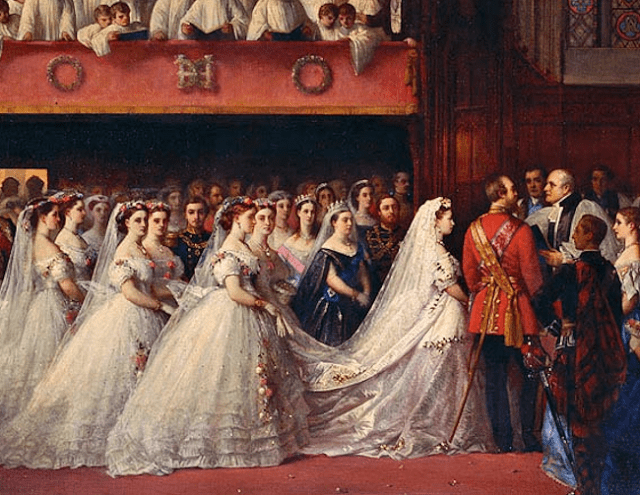
The_Marriage_of_Victoria,_Princess_Royal,_25_January_1858

The Marriage of Victoria, Princess Royal and Prince Frederick William of Prussia, 25 January 1858, by John Phillip. via Wikipedia John Phillip – http://www.royalcollection.org.uk/collection/406819/the-marriage-of-victoria-princess-royal-25-january-1858

Who actually first initiated the idea of a marriage between Princess Victoria Adelaide Mary Louisa of Great Britain and Prince Frederick William of Prussia is not as important as the impact of the marriage. Some think Queen Victoria’s uncle, Leopold  I, “nudged” the couple together. Such a union would assist in Belgium’s security from France, which was a customary “enemy.” Others place the alliance firmly in the hands of Victoria’s husband, Prince Albert. We must recall that Albert’s ideals were different from those found in many European courts. Prince Albert did not advocate a “new order,” but rather a liberalization of the current ones.

Frederick William IV, however, was a reactionary who held tight to the idea that God wished his reign. However, by the mid 1850s, the Prussians had taken hold of parts of Austria’s valuable ore-rich lands, most notably that of Silesia.

800px-Oskar_Begas_Kronprinz_Friedrich_Wilhelm_von_Preußen_1867

Crown Prince Frederick William of Prussia, 1867, by Oskar Begas via Wikipedia

The Prussian royal family had taken refuge in London during the revolutions which swept Europe in 1848. Prince Albert and William had developed a friendship of sort during the Prussian courts retreat to England. During that time, Albert lobbied for a English-style parliament to be adopted by the Hohenzollerns. Although William listened attentively, he argued his own points. William did not relish the idea that non-Prussian Germans would become part of the government of a unified Germany.

“During the Revolutions of 1848, William successfully crushed a revolt in Berlin that was aimed at his elder brother, King Frederick William IV. The use of cannon made him unpopular at the time and earned him the nickname Kartätschenprinz (Prince of Grapeshot). Indeed, he had to flee to England for a while, disguised as a merchant. He returned and helped to put down an uprising in Baden, where he commanded the Prussian army. In October 1849, he became governor-general of Rhineland and Westfalia, with a seat at the Kurfürstliches Schloss in Koblenz. 

“During their time at Koblenz, William and his wife entertained liberal scholars like the historian Maximilian Wolfgang Duncker or Auguest von Bethmann-Hollweg and Clemens Theodor Perthes (de).  William’s opposition to liberal ideas gradually softened.

“In 1854, the prince was raised to the rank of a field-marshal and made governor of the federal fortress of Mainz. In 1857 Frederick William IV suffered a stroke and became mentally disabled for the rest of his life. In January 1858, William became Prince Regent  for his brother, initially only temporarily but after October on a permanent basis. Against the advice of his brother, William swore an oath of office on the Prussian constitution and promised to preserve it ‘solid and inviolable.’ William appointed a liberal, Karl Anton von Hohenzollern-Sigmaringen as Minister President and thus initiated what became known as the ‘New Era’ in Prussia, although there were conflicts between William and the liberal majority in the Landtag  on matters of reforming the armed forces.

Queen Victoria also developed an alliance during the Prussian royal retreat. William’s wife, Augusta of Saxe-Weimar. Weimar was one of the more liberal states in Europe, and Augusta’s political views were in contrast to her husband’s. The Prussian couple’s son, the Hohenzollern prince Frederick William, became a “possible” mate for the Princess Royal. 

Victoria,_Princess_Royal_1855“Fritz,” as Prince Frederick William was known, and Princess Victoria met first when Prince Albert and his secretary Baron Stockmar concocted a plan to invite the Prussian royals to London for Albert’s Grand Exhibition of 1851. Fritz was 20 at the time, and Victoria was but 10. The queen permitted Victoria to join the royal families, on the guise as a companion for Fritz’s younger sister. Princess Victoria’s German was fluent and she proved herself the perfect guide for her father’s exhibition. She was vivacious and made a good first impression. The two were permitted great access to one another (a fact which would not have occurred if she were older) over the two weeks the Prussians remained in London. If she had been older perhaps she might have noted the reticence and the alarm with which Frederick William noted the familiarity practiced openly by the British royal family. Life in Prussia would not be the same as life in London.

In September 1855, Fritz vacationed with the British royal family at Balmoral. He was now 24, and Princess Victoria was on the cusp of womanhood. Fritz admired the princess’s intelligence and took note of her comely features. Neither could image that the idea of a marriage between the two would not be welcomed by a large portion of the population. The British populace distrusted foreigners, in general. The Prussian populace worried for an alliance with England when Great Britain was at war with the powerful Russian tsar. Nevertheless, Fritz did propose and was accepted. However, Queen Victoria declared that the marriage could not take place for two years. The Queen wished the business kept private but when the information was shared with the prime minister, Lord Palmerston, the news became fodder for The Times. The Prussian court was called “paltry” and “wretched” by the British newsprint.

220px-VickyIn the years of waiting, Prince Albert “trained” his daughter in how to be an excellent queen consort. Albert spent two hours daily in this manner. Unfortunately, the Princess Royal was not as adaptable as her father. Victoria’s life in Prussia would never be what she wished. Where in England, the princess’s life held a certain informality, in Berlin she encountered strict court etiquette. Moreover, the Prussia that Fritz would govern would be a military-controlled state. The ruling House of Hohenzollern practiced a state-instilled monarchy. Fritz and Vicky were married in January 1858.

In February 1858, she rode through the streets of Berlin with her husband to the cheers of the gathered crowd. What she found was not a city to equal London, but rather a city more of the nature of Edinburgh until it moved to clear the air of raw sewage. Moreover, the Royal Palace, a 17th Century Baroque structure, was a cold desolate building. It held NO modern conveniences. There was no central corridor to speed one’s trek through chamber after chamber.

Reality also arrived in the form of her father-in-law, Prince William, who stood as Regent to his mad brother. William never totally approved of his son’s wife. As many hours as the princess had set with her father in tutelage, she was ill-equipped to handle her father-in-law’s snub, nor was she capable of understanding how Fritz could treat her with less respect than did her illustrious father. She did not understand how to win the heart’s of such a “cold” family, and Vicky would suffer for her ignorance. A liberally educated woman was not a welcomed asset to the Prussian court.

A month after her marriage, Albert sent his daughter a “master plan” for Vicky’s marriage. “Your place is that of your husband’s wife, and of your mother’s daughter.” Prince Albert also warned of public disdain for Vicky, which quickly proved true. Meanwhile, the Queen demanded that Vicky remain the British princess royal rather than accepting the role of Victoria, Princess of Prussia. The Prussians expected her to become the wife of the future king, not a British prima donna. The princess developed the annoying habit of declaring all things British as superior to all things Prussians.

Vicky obliged her mother’s demand for frequent letters by describing the appalling ignorance of the Prussian royal family. Her quick first impressions soon became open critical remarks that lost the princess the support of many who would have assisted her. Queen Victoria came to criticize all the efforts Vicky made to adhere to the strictures of the Prussian court. The queen was known to demand that her daughter keep her “Englishness.”


Posted in British history, family, Great Britain, history, Living in the UK, marriage, marriage customs, Victorian era | Tagged , , , , , , , | 5 Comments

Changes in 19th Century English Schools

18th-century-school-roomEducation in England has roots deep in the Anglo-Saxon period. Latin was the main subject at these early schools and the instruction was directed toward the sons of “aristocracy” of the age. The church saw a need to train additional priests, as well as a need for someone to read the Bible and related documents to others. Both Oxford and Cambridge were founded as a means to train the clergy. It was during the reign of Edward VI that a reformed system of “free grammar schools.” 

During the early 19th Century, the Church of England founded programs of formal education. It was the end of the century before free, compulsory education was established by the government. The first secular college in England was University College London to be followed by King’s College London. Toward the end of the century, “redbrick” (a term originally used to refer to six civic universities founded in the major industrial cities of Great Britain in the 19th century) universities for the general public were founded. 

Likely, the biggest change on education in England came with the Protestant Reformation, for with it, reading of the Bible was still encouraged, but this time in English, rather than Latin used in the Catholic Church. Counties in the east of England, which had frequent interaction with the Low Countries, where the Reformation movement had flourished, developed a higher rate of literacy in the early years of the Reformation than did other areas of England.

In the 18th Century, there was a movement away from the apprenticeship system, especially among those trades that did not exist when the Statute of Apprentices became legal in the latter part of the 1500s. In the 1690s, the Society for Promoting Christian Knowledge was a major player in setting up Church schools across Britain. In its first two hundred years, the Society founded many charity schools for poor students in the 7 to 11 age group. It is from these schools that the modern concept of primary school education grew.  

The-School-Room-xx-Alfred-Rankley“Robert Raikes initiated the Sunday School Movement, having inherited a publishing business from his father and become proprietor of the Gloucester Journal in 1757. The movement started with a school for boys in the slums. Raikes had been involved with those incarcerated at the county Poor Law (part of the jail at that time); he believed that “vice” would be better prevented than cured, with schooling as the best intervention. The best available time was Sunday, as the boys were often working in the factories the other six days. The best available teachers were lay people.  The textbook was the Bible. The original curriculum started with teaching children to read and then having them learn the catechism, reasoning that a student who could read and understand the Bible could do the same with any other book.” (Power, John Carroll (1863). The Rise and Progress of Sunday Schools: A Biograhy of Robert Raikes and William Fox. New York: Sheldon & Company.)

“Raikes used his newspaper to publicize the schools and bore most of the cost in the early years. The movement began in July 1780 in the home of a Mrs. Meredith. Only boys attended, and she heard the lessons of the older boys who coached the younger. Later, girls also attended. Within two years, several schools opened in and around Gloucester.  Raikes published an account on November 3, 1783, of Sunday School in his paper, and later through the Gentleman’s Magazine

“The original schedule for the schools, as written by Raikes was ‘The children were to come after ten in the morning, and stay till twelve; they were then to go home and return at one; and after reading a lesson, they were to be conducted to Church. After Church, they were to be employed in repeating the catechism till after five, and then dismissed, with an injunction to go home without making a noise.'” (Moses, Montrose J. (1907). Children’s Books and Reading. New York: Mitchell Kennerley) 

The largest criticism of these schools was the use of the Sabbath for instruction because the idea of Sunday being the day of rest was deeply entrenched in the society of the day. Even so, by 1831, Sunday School in Great Britain was ministering weekly to 1,250,000 children, approximately 25% of the population.

The National Society for Promoting the Education of the Poor in the Principles of the Established Church in England and Wales was established in 1811. These were called “National Schools.” Non-denominational schools were begun in 1801 by the British and Foreign School Society. In 1814, compulsory apprenticeship by indenture was abolished.

Schools in the early 19th Century, therefore, taught their students to read, with the intention that they should read the Bible and religious tracts, but the students were not taught to write, as the lower classes did not see the value in learning to write. The half education seemed to have been perpetrated most often on girls. 

Hannah More wrote her Cheap Repository Tracts to provide her students something to read along with the Bible.The Cheap Repository Tracts consisted of more than two hundred moral, religious and occasionally political tracts issued in a number of series between March 1795 and about 1817, and subsequently reissued in various collected editions until the 1830s. They were intended for sale or distribution to literate poor people, as an alternative to what More regarded as the immoral traditional broadside ballad and chapbook publications.  Some even say, More opposed the writing of Thomas Paine. 

The tracts proved to be enormously successful with more than two million copies sold or distributed during the first year of the scheme. No one bothered to investigate the schools with any regularity. Some were Sunday schools. Some the village dame schools. Each person who set up a school had his own idea of what education was necessary. Some only taught enough reading for the children to learn something of their day’s work. Others had Sunday Schools which were more of the nature of regular schools and held on Sunday because that was the only time the children could attend.There was no standard to follow and no laws about what must be taught. The parents or the cost of education decided the curriculum.

A typical village school can be found in the form of  St Helen’s Church of England Primary School (www.abbotsham-sthelens.devon.sch.uk), which has been in existence for over nearly 200 years. There is a wealth of information on the School’s past available in the Abbotsham Archives including the School Register, dating back to 1894, and many pictures of pupils, staff and villagers. It was a “peculiar variety of building, which had a limited vogue in the 1820’s, was a two-storey schoolhouse, with teacher’s rooms on the ground floor and schoolroom above. As late as 1851 the Old Church House at Abbotsham was rebuilt on the same principle, and though the upper floor has long been removed the old steps up to it survived till recently. The plan probably derived from the previous use of the Church House. The upper storey was used as a school, with the paupers living below. This explains references to the building being a Poor House before it became a School.” (Historic References to Abbotsham School)

A great resource of the time is  The English Common Reader: A Social History Of The Mass Reading Public 1800-1900, by Richard Altick. This source primarily focuses on the history of education in England in the Nineteenth Century. He discusses the history of schools since they produced the “common reader.” 

Generally, the more “progressive” schools taught reading, writing, and arithmetic to what we would now consider to be the education of a 7-10 year old child. Few children could be spared for school after age seven or eight. Boys that showed promise  could be tutored by a local vicar, but for most the extent of a formal education ended early. 

Posted in Anglo-Saxons, British history, Church of England, Georgian England, giveaway, legacy, Living in the Regency, Living in the UK, reading habits, Regency personalities, religion, romance | Tagged , , , , , , | 13 Comments

Claiming a Title in the Regency Era

2x6_bookmark - side 1Many of the minor plot lines in my latest Regency romantic suspense concern who could inherit a title? There is the matter of the Marquess of Malvern’s losing his memory. Should the Duke of Devilfoard declare his eldest son incompetent and petition for his second son to assume control of the dukedom? Was such even legal? And what of the missing Earl of Sandahl? The original earl falls overboard on his “honeymoon” and cannot be found. Should he be declared dead? If so, who inherits? The logical answer is the second son, but that solution is not what it seems.

So, what do we know of peerages? When reading historical fiction/historical romance there are many misconceptions about titles. First thing a reader must know is not all titles are created equal. For example, a baronet may pass on his title to his heir, but he is not considered part of the Peerage in the United Kingdom. There are some 800+ peers in modern day England whose titles may be inherited. Peers include Dukes/Duchesses, Marquesses/Marchionesses, Earls/Countesses, Viscounts/Viscountesses, and Barons/Baronesses. The law that applies to a particular British title depends upon when it was bestowed upon the family and the method of its creation.

Peerages of England, Great Britain, and the United Kingdom follow English law; the difference between them is that Peerages of England were created before the Act of Union 1707, Peerages of Great Britain between 1707 and the Union with Ireland in 1800, and Peerages of the United Kingdom since 1800. Irish Peerages follow the law of the Kingdom of Ireland, which is very like English law, except no Irish peers have been created since 1898, and they have no part in the present governance of the United Kingdom. Scottish Peerage law is generally similar to English law, but differs in innumerable points of detail, often being more similar to medieval practice.” (Burke’s Guide to British Titles: Courtesy Titles. Burke’s Peerage and Gentry. 2005)

A title may be created by a writ of summons, which means that a person is summoned to Parliament. A writ of summons is a document calling Members of the House of Lords to Parliament. Members of the Lords may not take their seats until they have obtained their writ of summons. Writs of summons are issued by direction of the Lord Chancellor from the office of the Clerk of the Crown in Chancery. New writs are issued before the meeting of each Parliament to all Lords Spiritual and Temporal who have a right to seats in the House. (Francis Palgrave (1788-1861), Parliamentary Writs and Writs of Military Summons (2 volumes, 1827 and 1834)) Writs of summons set out the titles of the Sovereign and the recipient of the writ. They state the reason for Parliament’s calling upon the individual.

When the Earl of Berkley died, his oldest son applied for a writ of summons to the House of Lords. The Committee on Privilege turned him down and said he and the other brothers born before 1795 were illegitimate and that the earldom had fallen to the 16 year old born in 1796. The boy was too young to do anything about the matter and his oldest brother and mother ran things. When he came of age, he never put forth a claim to the earldom  However, he was, by right and law, the earl so anything requiring the signature of the earl had to be signed by him. He signed responsibility over to his oldest brother, but the title itself went dormant until he died.

200px-Marlborough-duke-first

Letters patent granting the Dukedom of Marlborough to Sir John Churchill were later amended by Parliament (via Wikipedia)

Titles may also be created by letters of patent. This method sets out a created peerage and names the person in question. It may limit the course of descent to the male line, with only legitimate children having a right to the title. (Scottish titles permit the “legitimacy” to be determined by a marriage, not simply a marriage at time of the birth.) Traditionally, only the peer sits in the House of Lords, but from the time of Edward IV, an heir to the title (who also held additional titles) could sit in the HOL as one of his father’s subsidiary dignities. This is possible through a writ of acceleration.

Letters Patent can be amended by Act of Parliament. Likely, the two most famous examples of amending Letters were the Dukedom of Marlborough in 1706 and the Duke of Windsor in 1936.

A person who is a possible heir to a peerage is said to be “in remainder.” A title becomes extinct (opposite to extant, which means alive) when all possible heirs (as provided by the letters patent) have died out, i.e., there is nobody in remainder at the death of the holder. A title becomes dormant if nobody has claimed the title or if no claim has been satisfactorily proven. A title goes into abeyance if there is more than one person equally entitled to be the holder.

In the past, peerages were sometimes forfeit or attainted under Acts of Parliament, most often as the result of treason on the part of the holder. The blood of an attainted peer was considered “corrupted,” consequently his or her descendants could not inherit the title. If all descendants of the attainted peer were to die out, however, then an heir from another branch of the family not affected by the attainder could take the title. The Forfeiture Act 1870 abolished corruption of blood; instead of losing the peerage, a peer convicted of treason would be disqualified from sitting in Parliament for the period of imprisonment.

Nothing prevents a British peerage from being held by a foreign citizen (although such peers cannot sit in the House of Lords). Several descendants of George III were British peers and German subjects; the Lords Fairfax of Cameron were American citizens for several generations.

“Hereditary peers do not have the automatic right to a writ of summons to the House. Irish peerages may not be disclaimed. A peer who disclaims the peerage loses all titles, rights and privileges associated with the peerage; his wife or her husband is similarly affected. No further hereditary peerages may be conferred upon the person, but life peerages may be. The peerage remains without a holder until the death of the peer making the disclaimer, when it descends normally.” (Hereditary Peers

london-herald-edward-viii-abdication

London Herald

So what can a person do if he does not wish to accept the title? He could simply refuse to take up the title or touch the money. Technically he’d still be the title’s holder, but to have the full title and honors he must be confirmed before Parliament, and all the legal stuff has to be done to ensure he is the correct heir. He can simply not claim the title and not style himself by the title, but it remains it place at his disposal. The person does not need to send in the writ of summons to the House of Lords, and he can refuse to use the title, but someone must care for the property, and no one else may claim the title while he is alive. He can also do something drastic, such as commit treason, in which case he and his family would be stripped of the title, but no one would recommend such a step. It would be easier simply not to claim the title.

Like it or not, the heir cannot be disinherited to prevent his assuming the title. If there is a living person and the lawful successor to a title, he cannot be displaced unless convicted of a crime. During the Regency there was no way to disclaim a peerage except by not using it and not sending in a request for a seat in the House of Lords.

AnAngelComes_LargeAngel Comes to the Devil’s Keep

Huntington McLaughlin, the Marquess of Malvern, wakes in a farmhouse, after a head injury, being tended by an ethereal “angel,” who claims to be his wife. However, reality is often deceptive, and Angelica Lovelace is far from innocent in Hunt’s difficulties. Yet, there is something about the woman that calls to him as no other ever has. When she attends his mother’s annual summer house party, their lives are intertwined in a series of mistaken identities, assaults, kidnappings, overlapping relations, and murders, which will either bring them together forever or tear them irretrievably apart. As Hunt attempts to right his world from problems caused by the head injury that has robbed him of parts of his memory, his best friend, the Earl of Remmington, makes it clear that he intends to claim Angelica as his wife. Hunt must decide whether to permit her to align herself with the earldom or claim the only woman who stirs his heart–and if he does the latter, can he still serve the dukedom with a hoydenish American heiress at his side?

Angel Comes to Devil’s Keep is a well-written tale of courage and sacrifice and what women went through in order to marry well in Regency England. The author did her homework and it shows in an authenticity that we don’t often see in Regency romances.

Purchase Links:

Nook                     

Amazon

Kindle

Kobo

Smashwords

Black Opal Books (Both eBook and Print Copies Available – Print Copies Have a Signed Bookplate)

Barnes & Noble

All Romance 

iTunes

GIVEAWAY:

Leave a comment below to be eligible for an eBook copy of Angel Comes to the Devil’s Keep (Book 1 of the Twins’ Trilogy). The giveaway ends at midnight EDST, August 7, 2016.

Posted in Uncategorized | 1 Comment

Sir Philip Sidney, Author of the Finest Love Poems in English Before Shakespeare

Sir Philip Sidney was born at Penhurst, Kent on 30 November 1554. He was the first child of Sir Henry Sidney and his wife, Mary, née Dudley. Present at the birth were his royal Spanish godfather and his maternal grandmother, whose husband, John Dudley, Duke of Northumberland, and son Guildford had been beheaded in 1553 following the failure of the Northumberland plan to place Guildford’s wife, Lady Jane Grey, on the throne. His father was often from home for Queen Elizabeth had appointed Sir Henry lord president of the Marches of Wales, a post that required him to spend months at a time away from home.

“The dominance of women in the poet’s early life was doubtless formative. Sidney’s skill in portraying female characters, from the bewitching, multifarious Stella of Astrophil and Stella (1591) to Philoclea and Pamela, the bold, beautiful, and articulate princesses of the Old Arcadia (written circa 1581) and the New Arcadia (1590; written circa 1583-1584) is, as C. S. Lewis notes in his English Literature in the Sixteenth Century, Excluding Drama (1954), without equal before William Shakespeare. The two versions of the Arcadia, Sidney’s most ambitious works, were written under the guiding spirit and often in the presence of Mary Sidney Herbert, his “dear Lady and sister, the Countess of Pembroke,” herself a great patron of writers, to whom the two versions of the Arcadia are dedicated. Mary went on to serve as Sidney’s literary executor after his death.” (Poetry Foundation)

Young Philip began his education at the Shrewsbury School, where he proved an apt and eager student and forged a lifelong friendship with Fulke Greville (later Baron Brooke), who would write a laudatory epitaph and biography of his bosom buddy. At the age of 13, Sidney transferred to the University of Oxford’s Christ Church College. Sir Philip attended Oxford and from 1572-1577 was successively in the suite of the Earl of Lincoln, Gentleman of the Bedchamber to Charles IX, at Heidelburg, Frankfort, in Vienna, in Italy, Prague, Dresdaen, in the Court of Queen Elizabeth, and on an embassy to Germany.  Sidney was the grandson of the Duke of Northumberland and heir presumptive to the Earl of Leicester and the Earl of Warwick. Sidney spent little time in the Elizabethan court until his appointment as governor of Flushing in 1585.

“From his youth, Sidney was respected for his high-minded intelligence, and frequently provided diplomatic service to Queen Elizabeth I as a Protestant political liaison. His opposition to her French marriage earned her displeasure, however, and he later left court and began writing his poetical works. In 1586, Sidney accompanied his uncle, Robert Dudley, Earl of Leicester, to the Lowlands to defend the Protestants and was wounded in battle, dying a few weeks later, on October 17. Considered a national hero, Sidney was given a lavish funeral. When his poetry was subsequently published, he became lauded as one of the great Elizabethan writers.” (Biography.com)

In 1579, a heated fracas known as the “tennis-court quarrel” between Sidney and Edward de Vere, Earl of Oxford, was ostensibly about rank and the rights of play, but beneath the facade were tensions between factions for and against the queen’s marriage. (The two had also been rivals for the hand of Anne Cecil—William Cecil, Baron Burghley’s daughter—and Oxford had married her.)

“Viewed in his own age as the best hope for the establishment of a Protestant League in Europe, he was nevertheless a godson of Philip II of Spain, spent nearly a year in Italy, and sought out the company of such eminent Catholics as the Jesuit martyr Edmund Campion. Widely regarded, in the words of his late editor William A. Ringler, Jr., as ‘the model of perfect courtesy,’ Sidney was in fact hot-tempered and could be surprisingly impetuous. Considered the epitome of the English gentleman-soldier, he saw little military action before a wound in the left thigh, received 23 September 1586 during an ill-conceived and insignificant skirmish in the Netherlands outside Zutphen, led to his death on 17 October, at Arnhem. Even his literary career bears the stamp of paradox: Sidney did not think of himself as primarily a writer, and surprisingly little of his life was devoted to writing.” (Poetry Foundation)

Songs of Arcadia The Countess of Pembroke’s Arcadia, also known simply as the Arcadia, is a long prose work by Sidney written towards the end of the 16th century. Having finished one version of his text, Sidney later significantly expanded and revised his work. Scholars today often refer to these two major versions as the Old Arcadia and theNew Arcadia. The Arcadia is Sidney’s most ambitious literary work by far, and as significant in its own way as his sonnets.The poet begs to be delivered from women who treat lovers scornfully. The poet cries, “Love is dead./ His death-bed, peacock’s folly/ His winding sheet is shame.” Finally, the poet decides that his song is not true after all. Love is merely sleeping. “Therefore from so vile fancy,/ To call such wit a frenzy/ Who love can temper thus,/ Good Lord, deliver us.” 

Sidney’s manuscripts of the Old Arcadia were not published until the 20th century. The New Arcadia, however, was published in two different editions during the 16th century, and enjoyed great popularity for more than a hundred years afterwards. William Shakespeare borrowed from it for the Gloucester subplot of King Lear; traces of the work’s influence may also be found in Hamlet and The Winter’s Tale. Other dramatizations also occurred: Samuel Daniel’s The Queen’s Arcadia,  John Day’s The Isle of Gulls, Beaumont and Fletcher’s Cupid’s Revenge, the anonymous Mucedorus, a play of the Shakespeare Apocrypha, and most overtly, in James Shirley’s The Arcadia. 

Astrophel and Stella -Probably composed in the 1580s, Sir Philip Sidney’s Astrophil and Stella is an English sonnet sequence containing 108 sonnets and 11 songs. The name derives from the two Greek words, ‘aster’ (star) and ‘phil’ (lover), and the Latin word ‘stella’ meaning star. Thus Astrophil is the star lover, and Stella is his star. Sidney partly nativized the key features of his Italian model Petarch, including an ongoing but partly obscure narrative, the philosophical trappings of the poet in relation to love and desire, and musings on the art of poetic creation. Sidney also adopts the Petrarchan rhyme scheme, though he uses it with such freedom that fifteen variants are employed.This series of sonnets treat the love of a man (likely Sidney) for a woman (likely Lady Rich) after her marriage. At first, she repels his suit. Eventually, he learns his attention are returned. The woman’s virtue keeps them from consummating their love. 

In sonnet 1, the Muse bades Astrophel to write of his love. “Fool,” said the Muse to me, “look in thy heart and write.”

Sonnet 2 describes the young man’s passion. His love was not sudden. He knew Stella for a long time and learned to love her. At first he did not tell her of his love, and now she is married, it is too late. 

In Sonnet 31, there is a change of mood. Hitherto, the poet has written poems of praise and has pictured his love as a pastime. Now his passion becomes deeper and more sorrowful. In this sonnet, he sees the moon looking upon the earth with great melancholy. He asks if ladies in heaven scorn their lovers as they do on earth. 

Sonnet 39 is an apostrophe to sleep: “Come, sleep! O’ Sleep, the certain knot of peace,/ The baiting-place of wit, the balm of woe,/ The poor man’s wealth, the prisoner’s release”/etc. He would have sleep console him. 

In Sonnet 41, he says that people looked on and approved of his prowess and gave many reasons, but the real reason was “Stella looked on, and from her heavenly face/ Sent forth the beams which made so fair my race.” 

Resources: 

Astrophel and Stella 

The Countess of Pembroke’s Arcadia

Luminarium 

Poetry Foundation

Sir Philip Sidney 

Posted in British history, Great Britain | Tagged , , , , , , | 1 Comment

Prince Leopold George Duncan Albert, Fourth Son of Queen Victoria and a Hemophiliac

prince leopold duke of albanyOn 7 April 1853, Queen Victoria delivered her fourth son and eighth child. Prince Leopold George Duncan Albert was the first of the queen’s children to be delivered with the aid of chloroform, a controversial procedure at the time. The belief by many in the medical field and the theological circles was that God meant women to “suffer” during childbirth so a symbol of Eve’s betrayal in the Garden of Eden. The queen’s use of the drug created quite a debate. It was also argued that a painful delivery assured that mother’s would wish to protect the children for whom they had suffered. The press thought the procedure too dangerous to the queen’s health. It was Victoria’s approval of the procedure that finally broke this archaic “male” perspective of women’s health. 

At the birth was Miss Lilly, the midwife who had assisted the Queen with Victoria’s other deliveries, and Dr. John Snow, the renown Edinburgh anesthetist, as well as the queen’s personal physician. The queen was not rendered unconscious by the chloroform. She was given only one once of the chemical. 

Unfortunately, the ease with which Leopold entered the world did not lessen the suffering he would know until his death. He was very thin compared to his siblings, and shortly after his second birthday, Leopold was diagnosed as being a hemophiliac, and even suffered from occasional epileptic seizures. The least scape or childhood accident translated into bed rest and a long time in healing. Victoria, in her usual candor, referred to Leopold as “the ugliest” of her children. 

Leopold_Duke of AlbanyThe diagnosis of hemophilia was not met well by either Victoria or Albert. “Blame” for the condition was denied by both the queen and her consort. So, who can be a hemophilia carrier?  “A daughter gets an X chromosome from her mother and an X chromosome from her father.  Suppose the X chromosome from her mother has the gene for normal blood clotting.  Suppose the X chromosome from her father has the gene for hemophilia. The daughter will not have hemophilia since the normal blood clotting gene from her mother is dominant.  It won’t allow the instructions from the hemophilia gene to be sent.

“The daughter is called a carrier for hemophilia.  She has the gene on one of her X chromosomes and could pass it on to her children. Does this mean that the mother alone is the one responsible for having a child with hemophilia? Not really. The mother is the one who passes the hemophilia gene.  However, it is the father’s sperm that determines if the child will be a boy or a girl.  It is not the “fault” of one parent since both parents contribute to the outcome.

“What are the chances of having a child with hemophilia?

  • No sons of a man with hemophilia will have hemophilia.
  • All daughters of a man with hemophilia will be carriers (called obligate carriers).
  • If a carrier has a son, the son has a 50% chance of having hemophilia.
  • If a carrier has a daughter, the daughter has a 50% chance of being a carrier.” (How Hemophilia is Inherited)

In other words, women are themselves not hemophiliacs. Only in the case of daughters of marriages between first cousins have been recorded. None of these females lived past puberty for the onset of menses would cause them to bleed to death. Females are the primary carriers of the hemophilia gene. Therefore, Queen Victoria was the likely carrier, Some experts argue that she became a carrier from a spontaneous mutation, while others speak of a sort of “conspiracy theory,” saying the mutation came from one of her parents.

Needless to say, the Duke of Kent would have had difficulty hiding such a condition, especially as the children of King George III were “watched” with the most astute of quizzing glasses. The Duchess of Kent’s medical history is also quite extensive and well researched. These leads many to believe that the Duke of Kent was not Victoria actual father.  

An article on History and Other Thoughts says, “An intelligent boy, Leopold wanted to attend Oxford. With the help of his brothers, he got his wish, although he was never allowed to complete a full course of study, but had to make due with a honorary degree. Still, the prince enjoyed the university life and made a lot friends. One of these was Alice Liddell, who inspired Alice in Wonderland. His cleverness, though, meant that he was prone to argue. As a result, he never got along too well with his mother.” Ironically, Leopold’s mind was the sharpest of Victoria’s sons. He became a confidential secretary to his mother. The position permitted him to meet with foreign and domestic ministers. His elder brother, the Prince of Wales, was not happy that Leopold was permitted information that he was not. However, Victoria ignored Bertie’s protestations. 

prince leopold with wife helenaEventually, Leopold won his mother’s permission to marry. However, his medical condition prevented many eligible princesses from accepting an offer. “Princess Helen of Waldeck-Pyrmont agreed to marry him. The couple tied the knot in 1882. Although when they married they barely knew each other, they soon grew to love, and became very devoted to, each other. The following year, Helen gave birth to a child, Alice. Unfortunately, Leopold didn’t get to spend a lot of time with his beloved family. In March 1884, he went, alone (his wife was pregnant and couldn’t travel) to the south of France, something he always did to escape the cold English winters. While there, he slipped, bruising his knee and hitting his head. That night, he died. The cause is unclear, but the most likely explanation is that he suffered a cerebral hemorrhage. Four months later, Helen gave birth to their second child, a boy named Charles Edward.”


Posted in British history, history, Living in the UK, medicine, Victorian era | Tagged , , , , , | 3 Comments