
I have been fascinated with the concept of “gaslighting” since I played a major role in a community theatre production of “Angel Street” (originally titled “Gas Light”), a play by British playwright Patrick Hamilton. In 1944, the play was made into a movie starring Charles Boyer, Ingrid Bergman, and Joseph Cotton. Naturally, as I was not born at that time, my introduction to Gaslight was much later. Even a young Angela Lansbury played the maid in this one.
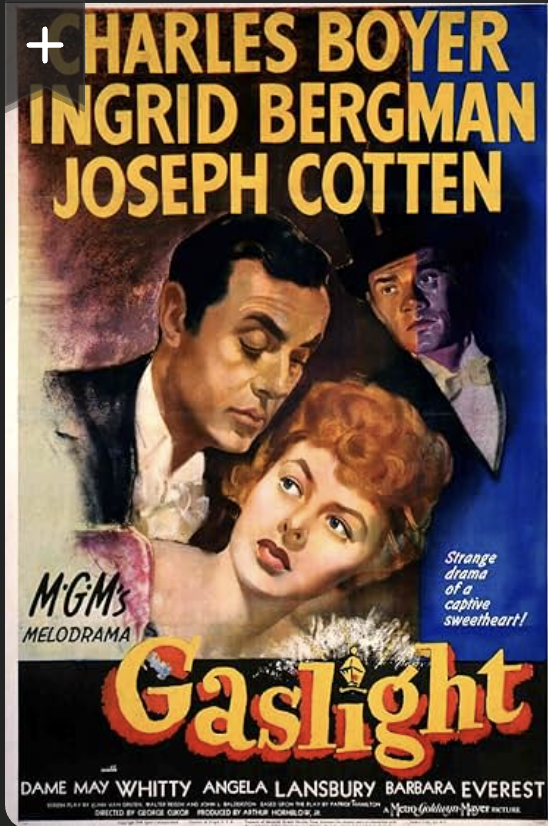
Gaslighting is a form of psychological manipulation where one person tries to make another question their own reality, memory, or sanity. It’s a tactic used to gain power and control over someone, often resulting in the victim feeling confused, anxious, and isolated.
Here’s a more detailed explanation:
- Distorting Reality: Gaslighters aim to distort the victim’s perception of events, making them doubt their own thoughts, feelings, and experiences.
- Shifting Blame: They often blame the victim for problems, making them feel guilty and responsible for the manipulator’s actions.
- Undermining Confidence: Gaslighters may criticize the victim’s abilities, decisions, and judgment, eroding their self-esteem.
- Isolation: They may isolate the victim from friends and family, further increasing their dependence on the gaslighter.
- Emotional Abuse: Gaslighting is considered a form of emotional abuse, as it can have a significant impact on the victim’s mental health and well-being.
- Origin of the term: The term “gaslighting” comes from the 1938 play “Gas Light” (also adapted into a film) where a husband manipulates his wife into believing she is losing her mind.
In essence, gaslighting is a harmful tactic used to control and manipulate another person by making them doubt their own perception of reality.
Nowadays, gaslighting falls into 5 types:
AI Overview
Gaslighting can manifest in various ways, but five common types include: outright lying, trivializing, denial, manipulation, and scapegoating. These tactics are used to undermine a person’s reality and sense of self.
Here’s a breakdown of the five types:
1. Outright Lies:.This involves fabricating stories or denying events that have actually occurred, often with the intent to confuse and disorient the victim.
2. Trivializing:.This tactic involves downplaying or dismissing the victim’s feelings, experiences, or opinions, making them feel as though their emotions are not valid or important.
3. Denial:.When a gaslighter denies something that is true, or something that they have said or done, despite evidence to the contrary.
4. Manipulation:.This involves using various controlling or harmful tactics to gain an advantage or to confuse and create doubt in the victim’s mind.
5. Scapegoating:.This involves unfairly blaming the victim for something they didn’t do, deflecting responsibility from the gaslighter.
Excerpt from Chapter Five where my heroine, Miss Audrey Moreau, finally realizes she is being manipulated by her Uncle Moreau.
Her uncle did not look up from the papers on his desk when he said, “I saw no reason in paying for services of which I will not benefit. You will remain alone in the house.”
“Alone?” Audrey asked. Once more, her heart plummeted to her stomach, hiding from the fear filling her chest. “What do you mean by saying I shall be alone in this house?”
Her uncle and Caroline planned to depart for France early the next morning, and Audrey was just hearing Uncle Jacobi’s full plans for her in his absence. She had spent the last two days coming to terms with being left behind, but she had not known the extent of her abandonment.
“You have heard me correctly,” her uncle declared in exacting tones. “We will take both Mr. Stark and Mathild with us. Mathild does not wish to remain in England, and I have promised to return her to France. Naturally, Mr. Stark will accompany me: He remains a loyal servant.”
Audrey heard her uncle’s emphasis on the word “loyal,” meaning this was, yet again, another maneuver to test her allegiance to her Uncle Jacobi. She had experienced more than one such proof of her willingness to follow her uncle’s orders since the initial announcement of his departure, but she had not expected this one because, customarily, Uncle Jacobi spoke of his expectations early and often. This change in tactics had Audrey feeling more off-kilter than usual.
When she was younger, she did not understand some of the manipulations he practiced. In those days, he also used them against Caroline, but to a lesser extent, likely because Caroline succumbed quicker to her father’s wishes than had Audrey. Certain phrases were used often—phrases she could hear ringing in her head, even now.
“I do not have time to listen to your nonsense. You make little sense, girl.”
Or . . .
“We spoke of this previously. You never recall our conversations. Sometimes I wonder about your intelligence.”
Or, he would accuse Audrey of confusing his promises.
“Of what do you speak? I never promised you a new book if you would reorganize the attic. Moreover, why must I bribe you to do the right thing for the family which rescued you when no one else cared whether you lived or died?”
Or . . .
“What an avid imagination you possess. It is a sorry fate you suffer, for, obviously, you cannot tolerate living in the reality of the home I have provided you. You are an ungrateful being, but what should I have expected from the likes of your father and mother, who never truly cared what torment they caused the rest of the family?”
Sometimes when Caroline displeased him, Uncle Jacobi would place the blame on Audrey’s shoulders.
“You must surely be aware, Caroline, how taking Audrey’s advice in such matters displays a weakness in your personality. You should not permit your cousin sway over you. Audrey always leads you astray. A daughter of mine should have a better head on her shoulders than the daughter of Darwood Lisey.”
Upon occasion, he would encourage Caroline to join him in trivializing Audrey’s arguments. More than once, her cousin had berated Audrey with phrases such as . . .
“Why must you always be so sensitive? You must know by now how my father only speaks to your faults so you might better yourself. Your father was a thief and perhaps a . . . Well, we assuredly do not know the extent of your father’s sins, but my father only wants the best for your future.”
Lyon in Disguise: Lyon’s Den Connected World
A handsome rake meets his match in a red-headed enchantress who is his enemy!
They may be on different sides of the law, but Lord Navan Beaufort is not going to permit that to stop him from protecting Miss Audrey Moreau. Navan has never thought truly to love anyone, but when he laid eyes on the red-headed beauty, his world shifted. Unfortunately, the lady appears to prefer Lord Alexander Dutton to him, though Navan has rarely had the opportunity to speak to her privately. That is, until he saves her from a fire one miraculous night. From there forward, she is his hope. His future.
Miss Audrey Moreau depends exclusively on her Uncle Jacobi for a home and protection. The man rescued her from a bayman’s plantation in the West Indies when she was five; yet, she well knows the “Marquis of Honfleur’s” schemes. She thought once Jacobi was caught, all would be well, but even from his jail, the man means to rain down harm upon her.
Can two lost souls find happiness together, when everyone in whom they had previously placed their trust have left them alone in the world?
Tropes You’ll Love:
- Enemies to lovers
- Self-declared bachelor
- Friends to lovers
- Adversaries
- Damsel in distress
- Best friend’s sister
- Different worlds/experiences
- Soul mates
- Emotional scars
- Fish out of water
Read in Kindle Unlimited!
Enjoy book one in a new series within The Lyon’s Den Connected world by Regina Jeffers.
Book 1 – Lyon in the Way
Book 2 – Lyon’s Obsession
Book 3 – Lyon in Disguise
Book 4 – Lost in the Lyon’s Garden
Book 5 – Lyon on the Inside
Amazon https://www.amazon.com/dp/B0G1V963YZ
Please Note: The price of this book will increase to $3.99 on 11/26/2025.


 Every Woman Dreams...