I had a recent question regarding what I knew about the conditions inside of orphanages during the Regency and Georgian eras. Below is a mash of all the tidbits I had accumulated on the subject. I have attempted to organize them in some order, but as I am currently recovering from cancer surgery and have a large patch over part of my face, maybe it is not as organized as I hoped. (Note: I wrote this in December 2024, not April 2025.)

All orphanages/foundling homes seem to be run privately as schools. I think the best descriptor I have is with Jane Eyre’s Lowood School, but I have not been able to find any first personal accounts of anyone who attended a school or orphanage such as this in either the Victorian or Regency era. Either I’m a terrible researcher or I’m looking in all the wrong places.
There are official reports by various boards and charitable organizations about the conditions. I have spoken previously about Charitable Organizations During the Regency. This post includes a long list of actual charitable organizations during the late Georgian and early Victorian eras.
Philanthropy in the 19th century was based on religious tradition that was centuries in the making. Historically, wealthy people in society gave to the poor as a Christian duty. Charity was seen as a way of saving one’s own soul while also helping those in need. Protestants, especially those with strong evangelical leanings, believed that social conscience demanded social action. They held that by coming into contact with human nature, particularly with those in need, that they were able to come in contact with Christ.
Women, in particular, especially those in the middle class, stepped up to the task, but, not always for the reasons one might expect. Certainly, charity was an admirable trait. However, “working outside the home,” even in a charitable manner, provided these women a sense of worth beyond tending to their husband’s homes. Charitable work seemed to be an extension of their “natural” maternal instincts, but it also allowed women to meet and socialize with other women of like minds and education, opening them up to new experiences and ideas
I do not know of any first person narrative regarding the conditions within the orphanages because most were not educated to the level where they could write such.
There is plenty on line about the work houses. The orphanages were often for children of clergymen, sailors, or army men. So many children in the institutions were actually illegitimate and suffered the sins of the fathers and mothers being put on the children.
Each one of these would have a board of governors and be run by their own laws and rules. There were hundreds of schools which were neither registered nor regulated. These ranged from day schools to boarding schools with many masters (mistresses) and expenses.
There was no requirement that children go to school nor any requirements of what they should be taught.
The better schools for boys prepared them for Eton, Harrow and such.
There were cathedral choir schools.
From what I understand, the infant mortality rate in orphanages was very high. From our perspective now, where we have noted and understood “failure to thrive,” we can see that the care given in a charity orphanage would likely be lacking in the individual attention, like cuddling babies, so even if their basic survival needs were met, many of them would have died.
Another thing is that children were pushed out of orphanages at an early age and either sent into domestic service or to apprenticeships. Dickens’s stories speak to this situation, but that was much later than the Regency era.
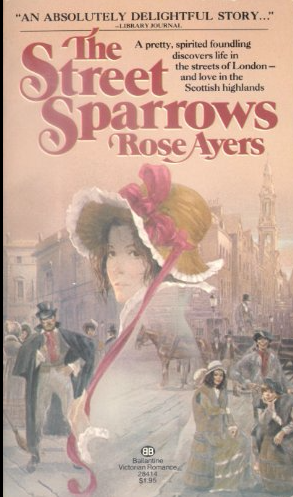
A book that was recommended to me was Rose Ayer’s The Street Sparrows. Again, it is set in 19th C London, but not necessarily the Georgian era. It is more the Victorian experience, but many appear to love this book, if you are interested. Two orphans in 19th-century London lead a precarious existence trying to earn their living any way they can.
It was fairly common early in the Industrial Era to sweep orphans off the streets in cities and put them to work in the mills. Their experience there varied from desperate to just very rough, though a few mill owners had some schooling for the children employed there. Again, though, their life expectancy was not very high.
Children were sent to work in mills and mines or on farms as young as seven. Some chimney sweeps had boys younger than that. Orphan girls were taught domestic tasks and were sent off to be maids. Some 12 year olds were maids of all work. Though not known to be widespread, some of the girls were also regularly raped. Most children of the laboring class had little schooling They certainly would not be writing memoirs. Now, sometimes a child was fortunate to fall in with a good family who was likely to treat the child as their own. Some one might educate a boy and have him trained up for their business, the church or the law–but that person would not be one to wrote about the conditions of the orphanage.
My late friend Lindsay Downs wrote a piece in 2014 for the English Historical Fiction Authors website, for he had written about a chimney sweep in his book Swept Away. I thought you might find what he had to say interesting:
“During the Regency period, there wasn’t adoption as we know it today. In England, this didn’t come about until the 1920’s.
“If the head of a household brought an orphan in but left no provisions for the child in his will, the new head had no obligation to continue the care. If the head did have unentitled property that could be left to the child in the will, it was probably with conditions until adulthood was reached.
“Another option would be to have a family in the village take the orphan in. This is what I did with my character. Depending on the needs of the family, the child might become a scullery maid or if taken in by a farmer, might become additional help. These are a few of the best possible options for these waifs.
“Another, and better, choice would be that a childless couple might take in a relative’s children. Here, through a provision in the will, the orphan would be able to inherit on the passing of their foster parents. This was not necessarily required of the new parents.
“When the child didn’t find a home with family or friends, they were turned over to the parish. Here an orphan could be contracted to a master under certain conditions. The pact gave control over the child to their, for lack of a better word, owner who was required to feed, clothe, and care for the boy or girl, and apprentice them in a trade. Sometimes the new master might not be as scrupulous as was thought, and he would force the child into dangerous work situations. One which comes to mind is a chimney sweep’s apprentice where they could easily die if care was not taken.”


 Every Woman Dreams...