In the singular form the lexicon of a particular subject is all the terms associated with it. The lexicon of a person or group is all the words they commonly use. As a plural noun, a lexicon is an alphabetical list of the words in a language or the words associated with a particular subject. To distinguish lexicon from a dictionary, it is an alphabetical list of the words in a language or the words associated with a particular subject.
These examples are a mix of what one might hear upon the lips of the aristocracy, as well as examples of Cant used upon London’s streets and those terms used by farmers and like in the country.
£ – symbol for the pound, a monetary unit
Ladies’ Mile – a road in Hyde Park set aside for women
Lady – used in the following manner: colloquially used for a man’s wife; the wife of a baronet or a knight; the wife of a peer below the rank of duke; the wife of a younger son of a duke or marquis; the daughter of a duke, marquis, or earl
ladybird – slang for a prostitute
Lady Day – March 25; a quarter day; until 1752, it was the start of the year for official business; the day the Angel Gabriel announced the birth of Jesus to the Virgin Mary
lady’s maid – the woman who tended to the mistress’s clothes and grooming; was an upper servant in the household
lag fever – a term of ridicule applied to men who being under sentence of transportation, pretend illness to avoid being sent from gaol to the hulks of the ships
Lambeth Palace – the official residence of the Archbishop of Canterbury
landau – an open carriage with four wheels; had a hood at each end and two seats opposite
land pirates – highwaymen
larder – where perishable goods were kept in a great house
lark – a bit of merriment
latitat – a nickname for an attorney, comes from the name if a writ

laudanum – opium in a solution of alcohol
law – “to give law to a hare” is a sporting term, signifying presenting the hare a chance of escaping by not setting the dogs after the hare until the hare is at some distance; it is also more figuratively used for giving another a chance of succeeding in a scheme or project
lawn – a fancy linen
league – a measure of distance that was not precise; somewhere between 2 and 4 miles
leaping over the sword – an ancient ceremony said to constitute a military marriage; a sword is laid on the ground and the parties to be married join hands, while the sergeant or corporal of the company repeated these words: “Leap rogue, and jump whore/And then you married for evermore.” Some believe this has been passed down from Norse weddings. “Traditionally, the groom would break into the tomb of an ancestor and retrieve a sword to be given to the bride. The bride would also exchange a sword to represent the transfer of protection between the two families, who were now responsible for supporting one another.” (The Knot)
to make a leg – to bow

levee – a formal reception for presenting men to the sovereign
liberty – an area outside the formal city limits but was still subject to the law’s representatives of the city
license to marry – there were three different licenses/means to marry: common/ordinary license, which was purchased from a clergyman and the couple married in the parish in which one of them lived; calling of the banns, in which the intention to marry was announced over a period of three consecutive Sundays – the couple could marry within 90 days of the last calling of the banns; a special license could only be afforded by the wealthy and those of the haut ton, but they permitted the couple to marry at any time and place
lifeholder – land/property leased for a period of time equivalent to the life of the leasee
life peerage – meant the title died with the holder; not a hereditary title [My friend Brian in Australia has this to say of a “life peerage”: Actually the ‘Life Peers’ is a relatively new thing, they were first created in 1958 by the Conservative party to boost their numbers in the House of Lords. The hereditary lords couldn’t be bothered attending Parliament so they decided to make (sell) life peerages, The Labour party saw the wisdom of doing this and followed suit stacking the upper house ( The Lords) to get their legislation through once they got into power, I look on them as pseudo lords/lady’s (Baron / Baronesses.) They are dished out to any party hack or big contributor to a political party’s coffers and in my mind are farcical.]
light-fingered – apt to pilfer
linen – a generic term for fine shirts and underwear
link – torches carried by “linkboys,” who ran ahead of a carriage to light its way through the city streets at night
linsey-woolsey – material made of wool and linen
list – a cloth’s edge from which slippers were sometimes made
manorhouse/thepeople/
charlie_duties.html
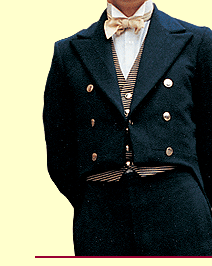
livery – the uniform worn by the servants of a house
living – a benefice
loggerhead – a stupid person; a blockhead
a mother’s loll – a favourite child
London Corresponding Society – founded in 1792 to oppose the war with France, fight hunger, and compel parliamentary reform; comprised mainly of small craftsmen
London Riots of 1795 – London Corresponding Society stoned the coach of George III as he traveled through London’s streets to open Parliament; later they rioted to pass acts forbidding Seditious Meetings, etc.
loo – a card game; must win the trick with the high card or the trump card
looby – an awkward, ignorant fellow
lord – member of the peerage; also a form of address; also a courtesy title given to the eldest sons of the peerage and to the younger sons, but only if the Christian and surnames were added (Lord James Landry)
low tide or low water – when there’s no money in a man’s pocket
CC BY-SA 3.0
lozenge – the shape of the coat of arms on a carriage for a spinster or a widow (rather than the shape of a shield used by the male heir of a line)
Low Church – people who did not practice the rituals of the Church of England (for example, the Evangelicals); stressed the Church’s Protestantism; tolerated Dissenters; supported Latitudinarianism or latitude within the church
a lumping penny-worth – a great quantity for the money; a bargain
lych-gate – a covered gateway at a church entrance where people attending a funeral would wait for the minister before moving the coffin to the graveyard
Other Sources:


 Every Woman Dreams...
Actually the ‘Life Peers’ is a relatively new thing, they were first created in 1958 by the Conservative party to boost their numbers in the House of Lords. The hereditary lords couldn’t be bothered attending Parliament so they decided to make (sell) life peerages, The Labour party saw the wisdom of doing this and followed suit stacking the upperhouse ( The Lords) to get their legislation through once they got into power, I look on them as pseudo lords/lady’s (Baron / Baronesses.) They are dished out to any party hack or big contributor to a political party’s coffers and in my mind are farcical. 🙄
The special licence to marry could only be issued by the Archbishop of Canterbury this from Wikipedia ;-
The other was the special license, which could only be granted by the Archbishop of Canterbury or his officials and allowed the marriage to take place in any church.
As a “special license” is often used as a plot device in Regency romances, I was aware of the Archbishop’s role in issuing the license. Even Mrs. Bennet suggested that Darcy and Lizzy get one in Pride and Prejudice.