In the singular form the lexicon of a particular subject is all the terms associated with it. The lexicon of a person or group is all the words they commonly use. As a plural noun, a lexicon is an alphabetical list of the words in a language or the words associated with a particular subject. To distinguish lexicon from a dictionary, it is an alphabetical list of the words in a language or the words associated with a particular subject.
These examples are a mix of what one might hear upon the lips of the aristocracy, as well as examples of Cant used upon London’s streets and those terms used by farmers and like in the country.

face making – begetting children
to face it out – to persist in a falsity
no face but his own – a saying of one who has no money in his pocket
It won’t fadge – it won’t do
to fag – to beat someone
fag – used in English public schools; denoted a younger boy who ran errands for an older student (to become “fatigued” by doing these errands)
faggot – a grouping of sticks tied together and used for fuel
fakement – a counterfeit signature; a forgery
fallow – farmland left temporarily unplanted

to famgrasp – to shake hands; figuratively, to agree or make up a difference
fancy man – a man kept by a lady
faro – a gambling game; players bet on the order of the cards being turned over by the dealer
farrier – a blacksmith
fartcatcher – a valet or footman: from his walking behind his master or mistress
A Father’s Legacy to His Daughters – a guide book by John Gregory (1774), which served as a young lady’s guide to conduct; Dr. Gregory suggested that women should hide their knowledge and wisdom to avoid appearing superior.

fat headed – stupid
faulkner – a tumbler, juggler, or shewer of tricks; perhaps because they lure the people, as a faulconer does his hawks (Cant)
feague – to increase the liveliness of a horse by inserting an irritant, such as a piece of peeled raw ginger or a live eel, in its anus

to feather one’s nest – to enrich oneself
feint – a sham attack on one part, when a real one is meant at another
fellow – a member of a college at Oxford or Cambridge; constituted the governing body of the college
female education – no standard curriculum existed for women; women were instructed in penmanship, reading, basic arithmetic, homemaking; sewing, manners, dancing, art, and music
fen – an area in and around Lincolnshire and Cambridgeshire; low, swampy area ~ A fen is similar to a marsh, a mire, a swamp, or a bog. In all of these wetland ecosystems, the water level tends to rise and fall, leaving them constantly soggy to some degree. Fens are distinguished by the kinds of plants that grow there, including tall grasses and moss, and by the acidity of the water. The word fen comes from the Old English fenn, which means “mud, mire, dirt, or marsh.”

fence – to pawn or sell to a receiver of stolen goods
fender – a protective grate to keep sparks from falling out onto the floor/carpet
Andrea Ferrara – the name of a famous sword-cutter: most of the Highland broad swords are marked with his name: whence an Andrea Ferrara has become the common name for the glaymore or Highland broardsword ~ Sir Walter Scott notes that the name of Andrea de Ferrara was inscribed “on all the Scottish broadswords that are accounted of peculiar excellence”.
Andrea Ferrara was born in Fonzaso in Italy (which is located in the province of Belluno-Dolomiti) and was an active and esteemed producer before and after his staying in Scotland (the ruins of his workshop are still in Belluno in the place called Busighel, near the river Ardo). This confirms the general belief reported by Scott that Ferrara was a Spanish or Italian artificer who was brought to Scotland in the early sixteenth century by James IV to instruct the Scots in the manufacture of the high-quality steel blades current in Renaissance Europe.
According to some sources the name of the manufacturer was Andrea dei Ferrari of Belluno, according to others, Andrew Ferrars or Ferrier of Arbroath.

to ferret – is to search out or expel one from his hiding place
fête – a large fancy party (fete champetre was a large outdoor party)
fichu – used as a head or shoulder covering by women; especially for low cut gowns

figure – an isolated dance step or a series of related steps, especially when referring to a country dance or a quadrille
fingerpost – road signs (usually at cross roads) in the shape of a finger; a post at a road junction from which signs project in the direction of the place or route indicated
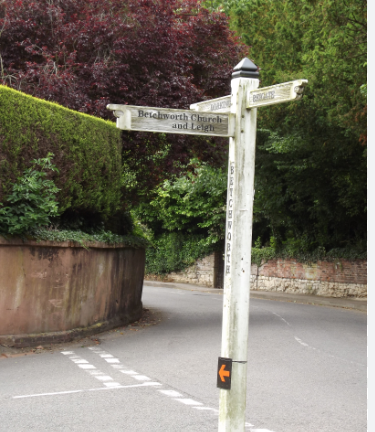
finger post – a parson, so called because he points out a way to others which he never goes himself
it won’t fit – it will not suit or do
flagon – a container for drinking alcohol; had a spout, handle, and lid
Fleet Prison – a prison housing debtors
fly – a rented horse and carriage
fly-flapped – whipped in the stocks
flying giggers – turnpike gates
fob – a cheat, trick, or contrivance: I will not be fobbed off so.
fogel – a silk handkerchief or neckerchief (slang)
foot pads – (also called “low pads”) – rogues who rob on foot
Fordyce’s Sermons (or) Sermons to Young Women – by Dr. James Fordyce (1765); explained within a Christian framework how a woman must please a man in order to earn his hand in marriage; women were taught to be docile, soft, and obedient; the sermons emphasizes beauty over education; women were told to avoid exercise
In the novel Pride and Prejudice (1813) by Jane Austen, Mr Collins, a clergyman, attempts to read the book aloud to the women during a visit to the Bennet household. The youngest of the five Bennet daughters, Lydia, interrupts him “before . . . three pages” leading him to stop reading, with the comment, “how little young ladies are interested by books of a serious stamp, though written solely for their benefit. It amazes me, I confess;—for certainly, there can be nothing so advantageous to them as instruction.”[3]
Additionally in the 1775 play The Rivals, by Richard Brinsley Sheridan, Fordyce’s sermon on Sobriety is mentioned.

Forlorn Hope – a gamester’s last stake
foolscap – 13″ x 17″ paper; bore a watermark of a fool’s cap and bells
Foot Guards – the infantry which guarded the sovereign; there were the Coldstream Guards, the Scots Guards, and the Grenadier Guards
footman – an indoor male servant; cleaned and trimmed the lamps, waited the meal service, and escorted the ladies of the house when the women made calls; normally wore a livery; were matched in height if more than one footman was employed in a household
foundling – a child dropped in the streets and found; is educated at the parish’s expense
fox – a sharp, cunning fellow
to foyst – is to pick someone’s pocket
franking – in reality, only members of Parliament (until 1840) could “frank” a letter, meaning to send the post for free (carrying on Parliamentary business without cost to the MP); the MP was to add his name and the date to the address; the letters were to weigh no more than one ounce; the privilege was often abused, however
freeholders – the landowners in a community
French Cream – brandy; so called by the old tabbies and dowagers when they drank it in their tea
French disease – venereal disease (also called the French pox)
Fribble – an effeminate fop; a name borrowed from a celebrated character of that kind, in the farce “Miss in Her Teens” by Mr. David Garrick
frigate – one of the smaller boats of the British Navy; used for reconnaissance, not part of the line

front – a small hairpiece worn above the forehead (usually by women)
fudge – nonsense
Fulhams – loaded dice are called high and lowmen or high and low fulhams, by Ben Jonson and other writers of his time; either because they were made at Fulham
furlong – equivalent to 660 feet; came from the phrase “furrow long”
fusiliers – infantry armed with fusils; later, fusiliers were outfitted as was all other member of the infantry, except they wore busbies
fustian – coarse cotton fabrics, such as corduroy or velveteen; usually in a dark color
Other Sources:


 Every Woman Dreams...
Thanks for sharing all these words!
I am enjoyed doing this series. It forces me to look up words that I have neglected previously.
I understand, when I come across a word I am unfamiliar with I don’t usually look it up & usually just go by the context it is found in.
As a former reading teacher, I found teaching context clues the easiest method for building comprehension and vocabulary.