Letters patent is defined as a “type of legal instrument in the form of a published written order issued by a monarch, president or other head of state, generally granting an office, right, monopoly, title or status to a person or corporation. Letters patent can be used for the creation of corporations or government offices, or for granting city status or a coat of arms. Letters patent are issued for the appointment of representatives of the Crown, such as governors and governors-general of Commonwealth realms, as well as appointing a Royal Commission. In the United Kingdom, they are also issued for the creation of peers of the realm.”
Letters patent are so named from the Latin verb pateo, to lie open, exposed, accessible. The originator’s seal was attached pendent from the document, so that it did not have to be broken in order for the document to be read. They are called “letters” (plural) from their Latin name litterae patentes, used by medieval and later scribes when the documents were written in Latin. This loanword preserves the collective plural “letters” (litterae) that the Latin language uses to denote a message as opposed to a single alphabet letter (littera). [Cassell’s Latin Dictionary, revised by Marchant & Charles, 260th. thousand: “Literae, Plur: that which is written; Cicero: Dare alicui literas (plur) ad aliquem: to give to a messenger a letter for a third person” via Wikipedia]
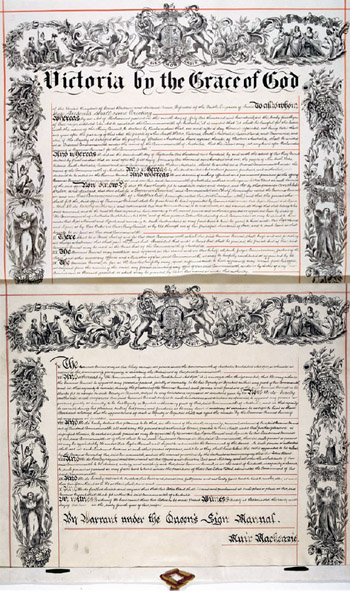
Basically, it is a legal statement which takes the form of a published written order. The person in charge of the government is generally the one who issues this type of document/order, though I will mention a few exceptions further down in this piece. The person receiving the letters patent is being presented with an exclusive right, privilege, title or office.
Letters patent are used to create peerages. Letters patent must explicitly name the recipient of the title and specify the course of descent; the exact meaning of the term is determined by common law. For remainders in the Peerage of the United Kingdom, the most common wording is “to have and to hold unto him and the heirs male of his body lawfully begotten and to be begotten”. Where the letters patent specifies the peer’s heirs male of the body as successors, the rules of agnatic succession apply, meaning that succession is through the male line only. Some very old titles, like the Earldom of Arlington, may pass to heirs of the body (not just heirs-male), these follow the same rules of descent as do baronies by writ and seem able to fall into abeyance as well.
In the UK, letters patent are issued for appointing representatives of the Crown (i.e., the governor of one of the Commonwealth realms), as well as appointing a Royal Commission. They can be used for the creation of a peerage, as in this example of Wellington being made a duke.
CREATION OF FIELD-MARSHAL the Marquis of Wellington
to be Marquis of Douro and Duke of Wellington
64 Geo. III
1814
George the Third, by the grace of Godof the United Kingdom of Great Britain and Ireland and of our other realms and territories, to all archbishops and all Lords Spiritual and Temporal, and all other of Our subjects whatsoever to whome these presents shall come, Greetings! Know ye that we of Our especial grace, certain knowledge and mere motion, have advanced, preferred and created our right trusty and entirely beloved cousin and councillor Field-Marshal Arthur, Marquis of Wellington, in our county of Somerset, Knight of the Most Noble Order of the Garter, to the state, degree, style, dignity, title and honour of Marquis Douro, And for Us Our heirs and successors do appoint, give, and grant unto him the said name, state, degree, style, dignity and honour of Marquis of Duoro. And moreover it being Our will and pleasure to dignify the said Arthur, Marquis of Wellington, with the title of Duke, and to admit him amongst the Dukes of our United Kingdom of Great Britain and Ireland of our more abundant especial grace and of our certain knowledge and mere motion, We have advanced, preferred, dignified, constituted and created the said Arthur, Marquis of Wellington, Duke of Wellington, in our county of Somerset, Also to the state, degree, style, title, dignity, name and honour of Duke of Wellington aforesaid. And him the said Arthur, Marquis of Wellington, Duke of Wellington, in our county of Somerset, Do by these presents advance, prefer, dignify, constitute and create, And we have appointed, given and granted by these presents for us, our heirs and successors, Do appoint, give and grant unto him, the said Arthur, Marquis of Wellington, the name, state, degree, style, dignity, title and honour of Duke of Wellington aforesaid. And him the said Arthur, Marquis of Wellington, by these presents we do dignify, invest and really enoble with such name, style, title, state, degree, dignity and honour of Duke of Wellington, in our county of Somerset, by girding him with a sword and putting a cap of honour and a coronet of gold on his head and by giving into his hand a rod of gold. To have and to hold the name, state, degree, style, dignity and honour of Duke of Wellington aforesaid, with all and singular pre-eminences and other honours belonging or appertaining to such name, style, title, state, degree, dignity and honour of Duke of Wellington aforesaid unto him the said Arthur, Marquis of Wellington, and the heirs male of his body lawfully begotten and to begotten for ever. And further we will and by these presents for us, our heirs and successors, Do give and grant unto the said Arthur, Marquis of Wellington, and his heirs male aforesaid, that he and his heirs male aforesaid, and every of them successively may bear and have the name, style, title, state, degree, dignity and honor of Duke of Wellington, and that they and every one of them successively may be called and styled by the name of Duke of Wellington. And that he, the said Arthur, Marquis of Wellington, and his heirs male aforesaid, and every one of them successively, may be held and deemed Dukes of Wellington, and be treated and reputed as dukes, and that they and every one of them successively may have, hold and possess a seat, place and voice in the Parliaments of us, our heirs and successors, within our United Kingdom of Great Britain and Ireland amongst other nobles and peers of this our United Kingdom of Great Britain and Ireland as Dukes of Wellington, and also that the said Arthur, Marquis of Wellington, and his heirs male aforesaid may enjoy and use, and every one of them successively may enjoy and use by the name of Duke of Wellington aforesaid, All and singular the rights, privileges, pre-eminences, immunities and advantages to the state of a duke in all things duly and of right belonging which other dukes of this our United Kingdom of Great Britain and Ireland have heretofore honourably and quietly used and enjoyed or as they do at present use and enjoy. And further we will and by these presents for us, our heirs and successors of our more ample grace Do grant unto the said Arthur, Marquis of Wellington, and his heirs male aforesaid, that these our letters patent or the enrolment thereof shall be sufficient and effectual in the law for the dignifying, investing and really enobling him, the said Arthur, Marquis of Wellington, and his heirs male aforesaid, with the several respective names, titles, dignities and honours of Marquis Douro and Duke of Wellington, in our county of Somerset, and this without any investiture, rites, ornaments or ceremonies whatsoever in this behalf due and accustomed which, for some certain reasons best known to us, we could not in due manner do and perform any ordinance, use, custom, rite, ceremony, prescription or provision due or used, or to be had, done or performed in conferring honours of this kind or any other matter or thing to the contrary thereof in any wise notwithstanding..
In witness whereof we have caused these our letters to be made patent. Witness Ourself at LOCATION) the nth day of MONTH in the xth year of Our Reign
The British monarchy might also use a letters patent to make an important announcement. Our dearest Queen Elizabeth II signed a letters patent only a few days before her passing. In it, the town of Colchester was presented the status of a “city.”

Here in the U.S., a letters patent (which we have a tendency to shorten to “patent,”) presents someone the patent for a new invention or discovery. The modern patent is protected by U.S. patent law, granting exclusive rights in an invention or a design.
Investopedia tells us, “Rights to a patent are effective only in the jurisdiction that granted the patent. The new invention is required to provide a different way of doing something or a unique solution. The opposite of letters patent is letters close, which are personal in nature and sealed so that only the recipient can read their contents.
“A letters patent is not sealed. Instead, it is open for public viewing at the patent and trademark office or another appropriate venue. A letters patent gives the rights of an invention to a person or entity for a limited period, usually for 20 years. The government may also refer to a patent as a ‘license’ giving its holder rights to the innovative process, design, or invention for a certain amount of time.
“The term appears to have originated from the Latin words “litterae patentes,” translated as “open letters” or “exposed letters” for public documents published by a monarch. The phrase evolved in English to refer to public documents signifying the rights to a new patent.”
The primary source of letters patent in the United States are intellectual property patents and land patents, though letters patent are issued for a variety of other purposes. They function dually as public records and personal certificates.

A U.S. General Land Office land patent for 40 acres of land in Dixon, Illinois, dated September 1, 1845. It is signed on behalf of President James K. Polk by Col. J. Knox Walker, the President’s private secretary and nephew. ~ https://en.wikipedia.org/wiki/Letters_patent#/media/File:US_General_Land_Office_Deed_1845.jpg


 Every Woman Dreams...

