Merry Christmas and Happy Holidays

Merry Christmas and Happy Holidays from my North Carolina Home to Yours. Today, I am watching my favorite Jane Austen movies and writing a new chapter for “A Touch of Grace.” It will be a quiet day, and for that I am thankful.

I encourage each of you to give God what he most wants for Christmas. Not your life. He has no use for it. God bestowed “life” upon you. Instead, consider giving him what he most desires: your sin.

Posted in Uncategorized | Comments Off on Merry Christmas and Happy Holidays

Winners for Jane Austen Birthday Soiree

From the many entries of the Jane Austen Birthday Soiree, I am pleased to announce the winners of a copy of Christmas at Pemberley. Because of the large number of entrants, I have added an extra copy of the book to the mix. Therefore, we will have TWO winners. They are

Identity Seeker

Miss Laurie

Congratulations and Happy Holidays!!!

Posted in Uncategorized | 2 Comments

Favorite Sayings and The Allure of Days Gone By…

(In cleaning out some of my school files, I came across these common phrases and their sources. Enjoy!!!)

Here are some facts about the 1500s:

People married in June. Most had taken their yearly bath in May, so the bride crarried a bouquet of flowers to cover their body odors. Hence, the bridal bouquet became a tradition at weddings.

A family used the same tub of water for baths. The man of the house received the benefit of clean water for his ablutions. His efforts were followed by all the other men/boys in the family. Women came next. Children were followed by babies. By then, the water was so dirty that one might hear “Don’t throw the baby out with the bath water. ”

“Peas porridge hot, peas porridge cold, peas porridge in the pot nine days old.” A vegetable stew served today would remain on the fire tonight. People ate their fill, and leftovers remained in the pot to get cold overnight. The next day, the fire was relit and new vegetables were added. Some pots held remnants from several days’ efforts.

Having meat to share was a sign of wealth. Families would, literally, hang bacon to dry where visitors might see it. “Bringing home the bacon” was a sign of importance. People would cut off some of the dried meat to share with their guests. They would “sit around and chew the fat. ”

Pewter plates were also a sign of wealth. Unfortunately, high acid foods (especially, tomatoes) caused some of the lead in the plates to seem into the food = lead poisoning. For many centuries, people thought it was the tomatoes that were poisonous.

Likewise, lead cups were used for ale and whisky. Imbibers often spent a couple of days passed out from the combination. If they couldn’t be brought around, they might find themselves laid out for burial. Hence, “holding a wake” to see if the person would awaken became commonplace.

Houses had thatched roofs, each with thick straw piled high. Unfortunately, no wood was underneath the straw. Often, small animals found warmth in the thatch. If it rained, the straw became slippery. Therefore, we have the saying “It’s raining cats and dogs.”

The animals and “bugs” could also drop unexpectingly on one’s head. Therefore, “canopy” beds became essential. A bed with big posts and a sheet hung over the top afforded some protection from the barrage of “visitors. ”

“Dirt poor” came about from the floors in poor households.  The rich had slate floors, which became slippery when wet. People, therefore, placed thresh on the floor to maintain their footing. As the winter wore on, more thresh was added. When people opened the door, the thresh would slip out. To prevent this from happening, they placed a piece of wood over the entranceway as a “thresh hold.”

(I first came across these facts in an article from Senior Sun in April 2006. I no longer have the original article to know the source of the facts from the news page.)

Posted in Uncategorized | Comments Off on Favorite Sayings and The Allure of Days Gone By…

You Know You Are a Kid of the 90s If…

(While cleaning out files today, I came across this list. I wondered how many of these my son would remember.)

You know you are a 90s kid if…

You’ve ever ended a sentence with the word “Psyche!”

You can sing the rap to “The Fresh Prince of Bel Air.”

You’ve worn skorts and felt stylish when doing so.

You learned to be part of the Baby-Sitters Club.

You use to love playing with  My Little Pet Shop.

You know that “Woah!” comes from Joey on “Blossom” and that “How Rude!” comes from Stephanie from “Full House.”

You remember when it was actually worth getting up early on Saturday to watch cartoons.

You wore a ponytail on the side of your head and had fluffed bangs.

You got super excited when it was Oregon Trail day in computer class at school.

You wanted to change your name to “JEM” in kindergarten.

You remember reading “Goosebumps.”

You know the profound meaning of “Wax on, wax off.”

You have pondered why Smurfette was the only female smurf.

You took plastic cartoon lunch boxes to school.

You remember the craze then the banning of slap bracelets and slam books.

You still get the urge to say “NOT” after (almost) every sentence.

You knew that Kimberly, the pink ranger, and Tommy, the green ranger, were meant to be together.

You remember “I’ve fallen and can’t get up.”

You owned jelly shoes and wore them everywhere.

You thought Brain would finally take over the world.

You remember going to the skating rink before there were inline skates.

You were injured on a Slip ‘n’ Slide.

You wore socks over leggings scrunched down.

You remember boom boxes vs. CD players.

You knew what it meant to say “Care Bear Stare.”

You remember Alf, the little brown alien from Melmac and Vicki the Robot from “My Little Wonder.”

You remember New Kids on the Block when they were “in.”

You knew all the characters’ names and their life stories on “Saved By the Bell.”

You played or collected “Pogs.”

You used to pretend to be a Mighty Morphin Power Ranger, and you owned a Skip It.

You had, at least, one GigaPet or Nano and brought it everywhere.

You watched the original Care Bears, My Little Pony, and Ninja Turtles.

You remember when the new Beanie Babies were always sold out.

You remember a time before the WB.

You got creeped out by “Are You Afraid of the Dark?”

You still remember how to do the Macarena.

“Talk to the hand…” enough said.

Are there others which should be on this list?

Posted in Uncategorized | 4 Comments

My Week with Jane Austen (as described in a letter to her cousin, Lady Williams)

16 December 2011

Dearest Cousin Jane, our own Lady Williams,

Today has been the most glorious of days. Against the wishes of my dear family, I have, reluctantly, answered the prayers of a most amenable lady, Miss Regina Jeffers, who resides in the Americas to spend my 236th birthday with her. Miss Jeffers is a woman with a temper remarkably easy and is everything that is generous and considerate. However, fearing for my Christian soul and because of principle, as well as pride, our beloved Cassandra and my cousin Eliza have accompanied me.

The source of the family’s fears lay in the naming of the neighborhood in which Miss Jeffers resides: Indian Trail. Images of undraped painted savages fired our fears, but Miss Jeffers assured me prior to our visit, that although Amerinds do exist in 21st Century America, the “tribes,” as the kind lady terms them, act far differently from the hostile massacres reported in the Times in 1810. With a bit of biting humor, the lady added, “Unless one counts losing one’s fortune at a Cherokee casino table as a violent attack.” Miss Jeffers later explained that to survive in modern America, the Cherokees and several other tribes native to the continent have resorted to opening gambling halls to support their numbers. I have never known anyone who has peopled such an establishment, but Eliza assures me that Henry has been known to associate with several London toffs who frequent gaming hells. As we always say of our most mercurial brother, “Oh that, Henry!” I could quite imagine John Willoughby, Tom Bertram, or George Wickham, with their blunted delicacy, their perversions, their corrupted vitiated minds, and their cold-blooded vanities, would intimately know the insides of these infamous dens. I admit to finding Miss Jeffers’ use of the term Amerinds for what we have disdainfully voiced as American Indians intriguing. Miss Jeffers claims her society is much more politically correct than previous generations. I am not familiar with the term, but having known George IV’s influence, I can readily determine her meaning. The phrase, “to his Royal Highness, THE PRINCE REGENT, this work is, by His Royal Highness’s permission, most respectfully dedicated, by His Royal Highness’s dutiful and obedient humble servant, THE AUTHOR” still haunts me.

Miss Jeffers lives on a quiet road in a radiantly beautiful community known as Lake Park. Eliza, Cassandra, and I arrived at Miss Jeffers’ stately home several days prior to the marking of my birthday celebration. According to the local weatherman, the temperature remained in the upper 60s. I am not certain what those words mean exactly; however, we have found the weather quite mild, and we have enjoyed several vigorous walks along the village streets, which sport a physician’s office, a school for small children, fashionable townhouses to rival many of London’s finest, and an excellent coffee shop – although I admit to having no taste for the bitter brew, the conversation and company were welcomed. I suppose that I should remark on the fact that in this day and age that a man might earn a living by predicting the weather. Although I have known several men who have held an interest in science, I had never thought that studying the weather might be a source of income. My hostess assures me that these predictors are only correct 50% of the time. I think that is more remarkable than the fact that a man might feed his family from such an occupation. This is definitely a very forward-thinking and ridiculous time. Thankfully, Miss Jeffers, my new BFF, prefers brewing her tea from loose leaves to imbibing in this American beverage. BFF, my most adored cousin, represents the words Best Friends Forever. It seems that not only the Americans, but the world, have turned its back on the King’s English.  Everything in this contemporary world is abbreviated for some odious form of communication called text messaging. Miss Jeffers is fond of LOL, which means laugh out loud. People in this time use this acronym to indicate what they have just offered an offense but did so with irony. Humor is the only socially accepted form of criticism, and the modern world has used this slight as common behavior. Our hostess has even described something called Twitter where people communicate with a total of 140 letters and spaces combined. How pitiful the depths of conversation has sunk! And to think I once had my dearest Anne Elliot say, “My idea of good company is the company of clever, well-informed people, who have a great deal of conversation.” Miss Jeffers has explained that she and her friends on Twitter “tweet” about me so I suppose that I must withdraw any objections I might have of this newfound form of elucidation.

I am in awe that Miss Jeffers lives in this modest home alone, with scarcely any private fortune. In my time, it would have never been possible. Yet, I have found great satisfaction in the main among my new acquaintance. It is a two-story dwelling surrounded by several stately trees and a small rose garden. What most amazed both Eliza and I were three rooms devoted to nothing but bathing and ones personal needs. With just the twist of a knob, hot and cold water are delivered upon a whim. No servants to tote the water nor the need for chamberpots. The early tales of water closets have miraculously developed into a system that whisks away one’s unmentionables with the touch of a lever.

Over the past few days, Miss Jeffers has graciously given me a personal “tour” of what she calls my influence on the literary canon. On her floor to ceiling shelves, the lady sports some 150 books based upon my six simple novels. We have traveled in a modern day carriage that Regina calls a Buick LaCrosse (a coach with all forward facing seats and no horses) to the bookstore closest to the lady’s home to marvel at the number of books available that are based on my writings. My own titles still thrive on the shelves after more than 200 years. The thought of such accolades has brought  me to happy tears. I am attempting to be sensible about my uncommon good fortune, but I admit that vanity was in such good order that a bit of burlesque crept into my bearing.

Our hostess has also introduced our party to a plethora of “films” that tout my novels as great works of literature. “Films” is the term Miss Jeffers uses. To describe these advancements, I would say that someone has captured the images of stage actors with scenery in a constantly moving format, which can be viewed multiple times. It seems there are various adaptations of my books. That sounds odd for me to say without sounding of conceit. It is not something I can easily accept, but accept them I will. I watched Sense and Sensibility with a wish that I had given the good Colonel Brandon as much depth as did the person who rewrote it for this play. Despite having the advantage in every feature, Northanger Abbey and Mansfield Park have received less attention than my other works.  I do not censure Miss Jeffers remarks, but there certainly is impropriety in making them public. I have been set to wondering what makes those two pieces less acceptable to the reading public, but my disapprobation is one of a great defect of temper, made worst by a very faulty habit of self-indulgence. LOL! I did adore one particular version of Persuasion. I have always held a fondness for Anne Elliot and Captain Wentworth. Despite not following my story line completely, the characters were captured beautifully by the actors. One British group has taken my beloved Pride and Prejudice and produced a performance that totals some six hours. It was fairly displayed, and I was quite pleased with it. A two-hour version of my favorite tale was less true to the actual story, but was equally as amiable.

Miss Jeffers also showed me other items bearing my name and likeness that she termed as collectibles: a trivia game, paper dolls, chess pieces, a necklace, a door marker, greeting cards, and even a doll created in my image. In viewing these items, I considered how much revenues from such items could have benefited my dear family, and I am grieved by the knowledge of how my mother, Cassandra, and I had to live after the passing of Reverend Austen. Cassandra, however, saw Miss Jeffers’s revelations as a bold statement of what she claims she had always known. My darling Cassandra speaks of my genius as if I might rival the world’s greatest thinkers. I am humbled by her praise. If I were a woman given to conceit, all this attention would lead me to shout for joy from the windows of the highest drying rooms of Chatsworth House.

Speaking of the great house leads me to share news of my actual birthday celebration. Although Miss Jeffers readily confirmed the numerous marvels that she could show me, my hostess had chosen a simpler celebration. We rose early, but I must say that the metropolitan concept of “early” is greatly in arrears of a new day’s start in the country. We breakfasted at the lady’s home. Our hostess kindly served a full breakfast with eggs, Cumberland sausages, bacon, potatoes, grilled tomatoes, grilled mushrooms, and toast with clotted cream. As a vegetarian, Miss Jeffers has gone to great lengths to share what she believes would remind our party of our happier times. With such warm feelings and lively spirits, it is difficult for me to do justice to her affection.

After breakfast, we departed the lady’s home for a leisurely driven journey to a place north of Charlotte. We marveled at the beauty of the countryside, a piedmont between the Appalachian Mountains and the Atlantic Ocean. I must say that if English roads had been so well maintained, Mr. Darcy’s journey from Pemberley to Longbourn would have have been but a matter of hours rather than days. Our destination was a place called Biltmore House, a 250-room French chateau in the mountain town of Asheville. It dates to 1895 and was built by George Vanderbuilt. I have enclosed a rendering of the house, which sports fabulous gardens, its own village, and a winery. One could spend days exploring this estate. The estate could easily contend as a model of my fictionalized Pemberley.

Leaving this magnificent house behind, we enjoyed an afternoon tea at a local tea shop called SweetTea’s Bakery and Tea Room. Miss Jeffers explained that in the South (of the American continent) that people prefer their tea cold and very very sweet, and that concept was the impetus for choosing the name for the tea room.  Today, the proprietress was serving cream teas, each of us choosing our own flavors. A pot of tea and a scone with clotted cream and raspberry preserves brought a renewal of our energies.

Returning to Charlotte, we took an early supper at Big Ben’s British Pub. According to Miss Jeffers, Big Ben is the nickname for the great bell of the clock at the north end of London’s Palace of Westminster. Over 150 years old, it is the largest four-face chiming clock in the world. I am sorry not to have known of this historic landmark until today. The pub is owned by two former Englishmen, and it strives to bring a taste of my home to these shores. Cassandra chose a shepherd’s pie with ground lamb; Eliza selected a steak and kidney pie; whereas, I chose the lord’s lamb roast with potatoes, several vegetables, and a Yorkshire pudding. We began our meal with a ploughman’s platter, a selection of fine cheese and crusty bread with a relish and a wally. We finished the meal with a sticky toffee pudding.

Exhausted by the day, we returned to Miss Jeffers’s home to watch two more of the moving pictures that she has shared with us this week. Surprisingly, although the wonderment remains, the stupefaction has lessened. Tonight we watched Miss Austen Regrets, and I found myself quite maudlin until Miss Jeffers chose a less effusively sentimental display in the fictionalize biography entitled Becoming Jane. Some day, my dear cousin, I shall describe a delicious scene in this story where our always demure Cassandra hid her eyes, while Eliza and I looked on in wry amusement at the actions of our Henry and Mr. LeFroy. Eliza always led me to think more boldly than I should, but I adore her for bringing the world to our little part of Hampshire.

This has been an accounting of my time in the Americas. I had held great trepidation at looking into the future, but Miss Jeffers has the advantage in every feature, and I have experienced a more cordial pleasure in the connection than I thought possible.

With love,

Your cousin Jane

____________________

Leaving a comment will place you in the drawing for a copy of my latest novel “Christmas at Pemberley.” The giveaway is open worldwide.

For further opportunities to celebrate Jane Austen’s birthday and to be involved in the one and thirty other giveaways as part of this blog tour, please see the links and information found in the “Giveaway” post below.

Posted in Uncategorized | Tagged , , | 82 Comments

Jane Austen Birthday Blog Giveaways

   Please visit each of the other participants in today’s Austen Birthday Tour. At each, fabulous Austen-related prizes and books are available. Leave a comment on each blog to be eligible for that particular giveaway. Drawings will be conducted on December 23, 2011.  It may be Jane Austen’s birthday, but you will receive the gifts.

Regina Jeffers at https://reginajeffers.wordpress.com  Giveaway of an autographed copy of Christmas at Pemberley  The giveaway is open internationally.

Sharon Lathan at  http://sharonlathanauthor.com/  Giveaway of autographed copy of Miss Darcy Falls in Love

Emily Snyder of O! Beauty Unattempted   http://emilycasnyder.blogspot.com/  Giveaway of Letters of Love and Deception 

Cindy Jones of First Draft   http://cindysjones.com/blog/  Giveaway of an autographed copy of My Jane Austen Summer and a package of Lily Berry’s Pink Rose Tea by Bingley’s Tea, Ltd.

Farida Mestek of Regency Sketches   http://faridamestek.blogspot.com/   Giveaway of I Was Jane Austen’s Best Friend by Cora Harrison

Marilyn Brant of Brant Flakes  http://marilynbrant.blogspot.com/   Giveaway of a canvas According to Jane tote bag and a pair of A Summer in Europe luggage tags

Velvet at   http://vvb32reads.blogspot.com/   Giveaway of Jane Austen’s Little Instruction Book (Charming Petites) by Jane Austen and edited by Sophia Bedford-Pierce; Illustrated by Mullen & Katz; Introduction by Barbara Paulding

Karen Doornebos at Fiction Versus Reality Smackdown   http://karendoornebos.com/blog/  Giveaway of 2 Jane Austen candles and 2 autographed copies of Definitely Not Mr. Darcy, plus drink coasters and tea

Erin Blakemore at The Heroine’s Bookshelf   http://theheroinesbookshelf.com/    Giveaway of a set of Potter-styled Pride and Prejudice notecards

Prue Batten of Mesmered’s Blog   http://mesmered.wordpress.com/  Giveaway of Anne Elliot’s Georgiana Darcy (Kindle edition)

Alyssa Goodnight at http://alyssagoodnight.com/blog/   Giveaway of a Jane Austen action figure

C. Allyn Pierson of Semi-True Stories at http://callynpierson.wordpress.com/  Giveaway of an autographed copy of Mr. Darcy’s Little Sister (open worldwide)

Laurel Ann Nattress of Austenprose    http://austenprose.com/   Giveaway of an autographed copy of Jane Austen Made Me Do It 

Deb at Jane Austen in Vermont   http://janeausteninvermont.wordpress.com/  Giveaway of a JASNA 2012 calendar from the Wisconsin JASNA Region

Juliet Archer of Choc Lit Author’s Corner   http://blog.choc-lit.co.uk./   Giveaway of an autographed copy of Persuade Me and of an autographed copy of The Importance of Being Emma

Laura Hile, Susan Kaye, Pamela Aidan, and Barbara Cornthwaite of Jane Started It!  http://crownhillwriters.wordpress.com/   A four part Giveaway consisting of: an autographed copy of Young Master Darcy:  A Lesson in Honour by Pamela Aidan; a set (Books 1 and 2) of the Frederick Wentworth, Captain books by Susan Kaye: two copies of Mercy’s Embrace: So Rough a Course (Book 1) by Laura Hile; and Books 1 and 2 of George Knightley Gentleman by Barbara Cornthwaite

Jane Greensmith of Reading, Writing, Working, Playing at  http://janegs.blogspot.com/   Giveaway of Imitations of Austen and of  Sense & Sensibility (Marvel Illustrated)

Jenny Allworthy of The Jane Austen Film Club at    http://janeaustenfilmclub.blogspot.com/   Giveaway of a copy of the Northanger Abbey DVD starring Felicity Jones and JJ Field (The winner will choose Region 1 or Region 2 DVD.)

Sitio Jane Austen of El Salón de Té de Jane of http://janeausten.mforos.com/377832/10647021-feliz-cumpleanos-jane-2011/  Giveaway of the Spanish edition of Sense and Sensibility for the 200th Anniversary + a DVD package with adaptations of Jane Austen (This is Region 2, but it is in Spanish and English.) + a BluRay of the BBC’s Emma with Romola Garai

Kaitlin Saunders of    http://www.kaitlin-saunders.com/   Giveaway of A Modern Day Persuasion

Becky Rhodehouse of One Literature Nut    http://mjmbecky.blogspot.com/  Giveaway of a selection of Austenesque Reads

Patrice Sarath at    http://www.patricesarath.com/  Giveaway of The Unexpected Miss Bennet 

Adriana Zardini of Jane Austen Brasil at http://www.janeaustenbrasil.com.br/  Giveaway of 1995 DVD of Sense & Sensibility (English/Portuguese subtitles)

Jane Odiwe of Jane Austen Sequels at http://www.janeaustensequels.blogspot.com/   Giveaway of a mug with one of Jane Odiwe’s illustrations and an autographed copy of Mr. Darcy’s Secret

Courtney Webb of Stiletto Storytime of http://stilettostorytime.wordpress.com/  Giveaway of Lucinda Brant’s Regency romance entitled Noble Satyr

Jennifer Becton at http://bectonliterary.com/  Giveaway of an eBook of the “Personages of Pride and Prejudice Collection,” which contains all of my Austenesque works: Charlotte Collins, Maria Lucas, and Caroline Bingley. The giveaway will be open internationally.

Vera Nazarian of Urban Girl Takes Vermont  http://urbangirlvermont.blogspot.com/  Giveaway of a copy of Nazarian’s gift harcover edition of her inspirational calendar and diary: The Perpetual Calendar of Inspiration

Abigail Reynolds of Pemberley Variations at http://www.pemberleyvariations.com/blog/  Giveaway of an autographed copy of Mr. Darcy’s Undoing

Austen Authors at http://austenauthors.net   Giveaway of Georgette Heyer’s Regency World by Jennifer Kloester

Katherine Cox of November’s Autumn at http://novembersautumn.blogspot.com/ Giveaway of a $10 Barnes & Noble gift card (U.S. only)

Maria Grazia of My Jane Austen Book Club at http://thesecretunderstandingofthehearts.blogspot.com/  Giveaway of a selection of Austenesque reads

Posted in Uncategorized | Tagged , , | 14 Comments

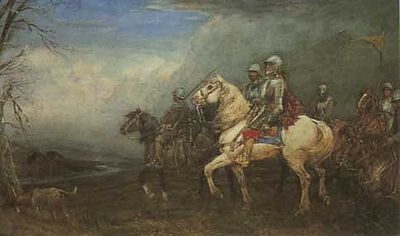
The Border Wars – England and Scotland

   The political struggle that has dominated much of England/Scotland’s history was often a result of the border wars. In Elizabethan times the Anglo-Scottish border counties, especially Northumberland, were the home of lawless clans who spent their lives raiding and marauding. The Border Reivers were not necessarily men of lower class. In fact, many were members of the Realm. They were excellent fighters and knew how to survive in a desolate land.

From BBC Home, we find that “Reiv – means to steal. The Reiver period is roughly categorised as 1450 – 1610. The movement came to its height in the late 1500’s and ended around 1610. The Reiver history is a mixture of fact and folklore. The English crown destroyed almost all of the documentation relating to Reiver life and so the Reiver’s story has passed down through oral history and folk traditions, rather than formal documentation. As a result, it is hard to untangle the mythological from the material when describing the Reiver movement.”

Following the Cheviot Hills, a bleak line of ridges and valleys that forms the border between England and Scotland, was the land upon which much blood was shed. Hadrian’s Wall, built by the Romans from Solway Firth to Berwick, never successfully kept either nation apart. The Chevoits sport peat bogs, broad rivers, hidden valley, salt marshes, and wooded areas. Raiding was an important way of life for those who lived on the borders. Neither treaties nor truces could prevent the continual struggle to survive in this desolate area. The purveyor of the strongest sword ruled the land. 

The Borders were not the romantic lands often portrayed in many current novels. It was a cruel, brutal land. The times were peppered with feuds between families. Clan loyalties were stronger than allegiance to either crown. Intermarriages brought about new alliances, but what really tied the area together was the geography, the belief in independence, and the society in which this people lived. English fought Scots, but they also fought Englishmen. The same held true for the Scotsmen. This created a dual nationality among men who lived along the Cheviot Hills. Not spoken of openly, it would not be unusual for the English to share “the spoils” with their Scottish brothers, or vice versa.

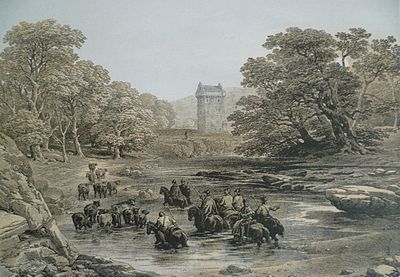
Autumn brought an increase in activity for the reivers. These families were often nomads, of sorts. The houses were of the type that they could be moved at a moment’s notice. We must remember that these people were violent, aggressive, and often ruthless, but they had a “sense of honor.” They consider reiving a way of life, but murder was looked down upon (even during a raid) unless there was no other option. A reiver’s object was to make a quick strike, plunder his enemy’s land, and return with his loot in tact – all this without loss of life, if possible.

   Using a series of beacons as warning signals, the retreat was the most risky part of a reiver’s foray. If he managed to avoid the local watches, the warden’s troopers, the paid militia, the broad rivers and mossy bogs, he might fall victim to the Hot Trod, the legal pursuit of the reivers, who were loaded down from their loot and by driving stolen cattle and sheep to their own keeps. During the Hot Trod, all male neighbors, between the ages of 16 and 60 of the victim, were required by law to join in the pursuit of the attackers. The posse also had the legal right to recruit others along the way. If a person refused to aid in the pursuit, he could be considered a traitor and put to death.

David Simpson of The Roots of the Region website (http://www.englandsnortheast.co.uk/BorderReivers.html ) says, “George M Trevelyan the great British historian, (a Northumbrian) superbly summed up the nature of the Border Reivers and their ballads when he wrote;  

‘They were cruel,coarse savages, slaying each other like the beasts of the forest; and yet they were also poets who could express in the grand style the inexorable fate of the individual man and woman, the infinite pity for all cruel things which they none the less inflicted upon one another. It was not one ballad- maker alone but the whole cut throat population who felt this magnanimous sorrow, and the consoling  charms of the highest poetry.’ Many of the Border Ballads still survive today, due to the avid collecting of the famous Border poet, Sir Walter Scott (1771-1832), himself the descendant of a famous border clan.”

Border Clans included the Armstrongs, Bells, Cecils, Croziers, Dodds, Douglases, Elliotts, Fenwicks, Forsters, Grahams, Homes, Howards, Irvines, Johnstones, Kerrs,  Maxwells, Nixons, Robsons, Scotts, Storeys, and Taits.

A superb source that summarizes and explains many of the key issues of the Border Wars is The Border Reivers http://www.nwlink.com/~scotlass/border.htm#THE%20LAND

The remnants of the reiver huts that were used as part of the “escape routes” became part of my upcoming novel, The Disappearance of Georgiana Darcy, which is due for release in March 2012. In researching these border wars for this novel, I have become quite enthralled with the story lines.


Posted in Uncategorized | Tagged , , , , | Comments Off on The Border Wars – England and Scotland

Galley Cat’s Idea for a Book Christmas Tree – Love It!!!!

I would so love to do this!!! How about you?

This comes from a December 12, 2011, post from Galley Cat. The short article invites others to do the same – to make their own book Christmas Trees and then to email a picture of their creation to Galley Cat (jason@mediabistro.com) for Jason Boog, who posted the image under “Readers, Trends.”

To see the entire article, visit http://www.mediabistro.com/galleycat/make-a-book-christmas-tree_b43712 .

Of course, if you follow me on this website, you know that on the top of my tree one would find Pride and Prejudice along with the Bible.

Posted in Uncategorized | Comments Off on Galley Cat’s Idea for a Book Christmas Tree – Love It!!!!

Writing an Inspirational Romance “Christmas at Pemberley”

(originally posted to Austenesque Reviews on December 1, 2011)

Meredith: Your latest book is different from the style you have previously employed in your Austen-inspired works. You term Christmas at Pemberley an inspirational romance. What can you tell us about why you decided to create an IR and what makes this book different from your other fare?

Regina: When Ulysses Press asked me to write a Christmas-themed sequel to Pride and Prejudice, I readily agreed. However, I soon realized I had again taken on yet another romance genre. Previously, for Ulysses, I have delved in Regency romance, paranormal, suspense, and cozy mysteries. With a Regency “Christmas” story, I would need to walk a fine line between the story’s dramatic development and the religious implications of the holiday.

The problem occurs because a Regency era Christmas was still steeped very much in religion. One must remember that in the 16th Century, to prevent subversion, the government banned Christmas celebrations. According to the Jane Austen Centre Magazine, “We have accounts from early 19th Century journals of Christmas days where the writer mentions the holiday but makes absolutely no fuss about it. Likewise, there are records of newspapers, published on December 25th that do not even contain the word Christmas.” A Regency era Christmas is NOT a Victorian one. There would be no tree, no stockings, no caroling, and very few presents. Boxing Day and Twelfth Night were days of celebration, NOT Christmas.

For me, this new novel created an “uncomfortable” situation. Perhaps, the problem rested in the idea of the separation of Church and State ingrained on my soul after 40 years of teaching in the public classrooms of three different states. I do not discuss religion or politics; even with my close friends, I remain quite closed mouthed.

My religious background is a mixed bag: I was early on raised as a Pentecostal, became a Baptist, am essentially an Existentialist, and married a Catholic. Mayhap, that is why I have never considered an inspirational novel. According to publishing statistics (although I have no proof of the assertion), the vast majority of readers of IRs are Fundamentalists, and although Catholicism has produced wonderful writers, such as Flannery O’Connor, Catholics do not commonly pen IRs. (Again, I do not speak from experience. Research into the genre before I began to write offered up such facts.)

IRs have deep roots in American literature. During the 19th Century, while Jane Austen and the Brontës created their novels to the delight of English readers, devout female writers in America shared stories of a young female heroine who first falls in love with and then converts the young hero. The stories contained multiple Biblical passages and moral lessons. These “domestic novels” were the first IRs.

Grace Livingstone Hill is considered by many to be the Georgette Heyer of modern inspirational romances. With over 100 books, Hill’s novels serve as an IR model. One finds in Hill’s books a beautiful Christian female (often in distress) who captures the regard of a rich, handsome, worthy gentleman. These books contain no sex, no violence, some drama, and a happy ending.

Ellen Michelleti of www.likeesbooks.com defines an inspirational romance as “one where the love story between the characters is closely intertwined with their development of a relationship with God. Usually at the beginning of an inspirational romance, one of the characters is a firm believer and the other is not. The progression of the relationship between the two characters explores not only matters of love, but also matters of doubt and faith. In an inspirational romance, part of the HEA [Happily Ever After] is where the one character who has been struggling with faith becomes a believer.”

So where does this definition leave my newest novel, Christmas at Pemberley? Trying to tell a compelling story based on Austen’s characters, I placed Elizabeth and Darcy in a difficult situation. They are two years into their marriage, and Elizabeth has yet to deliver an heir for Pemberley. The Darcys’ first child was lost early on, but the second loss had come some four months into Elizabeth’s pregnancy. With child for a third time, Elizabeth refuses to permit anyone to celebrate the possibility. In her mind, Darcy is the most deserving of husbands. Therefore, she must be the undeserving one in their relationship, and she is having a difficult time in coming to grips with her losses.

I based Elizabeth’s situation on my own. Before my son Joshua graced this world, I experienced a miscarriage and an ectopic pregnancy. While carrying Josh, I refused baby showers and gifts until I reached six months of the gestation. I had reasoned that if I could mark that month in my child’s development that, with the help of modern medicine, he would survive. I gave Elizabeth some of my qualms, my fears, my hopes, and my insensibility.

It is through Elizabeth attempting to right her world that religion is addressed in the novel. I prefer to think of the book as having an “edge.” Christmas at Pemberley contains a message of faith, but it is faith based in the real world. Life happens. Passion, jealousy, and deceit exist in every day life. How we handle each is a testament to our faith.

Below is an excerpt from the novel:

“A small gift from Nan,” Elizabeth said as she handed the hastily made child’s dressing gown to Mary. The woman had dutifully completed the delivery, and with Mrs. Washington’s assistance, Elizabeth had helped to freshen Mary’s clothing. Now, the new mother rested once again in the bed. She held the sleeping child in the bend of her arm.

“I’ll thank the girl properly,” Mrs. Joseph mumbled.

Elizabeth patted the lady’s hand. “Why do you not rest?”

“You require rest also,” Mrs. Joseph sleepily protested.

“First, I believe I’ll go downstairs and have a proper supper with Mr. Darcy. I need time to rest my back.” She stretched out her arms. “I’ll send Mr. Joseph to sit with you.”

“Let Matthew be. No one needs to watch me sleep.” Mary’s eyelids closed slowly, but then sprung open again. “That is unless you require private time with Mr. Darcy.”

Elizabeth smiled easily. “I never tire of the man’s company. Even after two years.”

“Then by all means send Mr. Joseph up. A woman of your infinite powers should have her every wish.” She caught Elizabeth’s hand in a tight grip.

Elizabeth’s finger gently touched the sleeping child’s hair. “My wish is to have what you have, Mary,” she whispered.

“You will, Elizabeth.” Mrs. Joseph assured. “You’ll have your own happiness…you and Mr. Darcy.” She paused and took a deep breath. “My child’s birth…I was never afraid, because God placed the incomparable Elizabeth Darcy in my life. My prayers…those I recited before Matthew and I left Stoke-on-Trent—they were for God to send an angel to protect my child, and on the third day of travel, I walked into this out-of-the-way inn; and there you were.

“My own angel.”

Elizabeth snorted. “I’ve been called many things, but ‘angel’ has rarely been one of them.”

“That’s where the world’s in error, Elizabeth. They see the defenses you display to anyone who barely knows you. They do not see your magnificent heart—your indomitable spirit—the purity of your soul.”

Elizabeth laughed self-consciously. “Do not bestow upon me too many exemplary qualities. If so, I’ll have to find something good to say of Miss Bingley.”

Mary’s eyebrow rose in curiosity. “Miss Bingley?”

Elizabeth chuckled lightly. “The younger sister of my sister Jane’s husband. She did poor Jane a disservice, and Miss Bingley also had once set her sights on Mr. Darcy.”

“Angels can feel jealousy, Elizabeth.” Mary squeezed Elizabeth’s hand.

“So, there are shades of angelic behavior?” Elizabeth’s voice rose in amusement.

Mary laughed also. “Absolutely. God’s love is the purest, but mankind can possess levels of the benevolent spirit.”

“Then, in your opinion, I have God’s attention.” Elizabeth puzzled over that concept.

“We all have God’s attention, but I believe that He’s chosen you among His favorites.”

Before she could stifle her words, Elizabeth defensively asked, “Then how could God allow my children to die before I knew them? Before I could tell them of my love?” Tears trickled from her eyes.

Mrs. Joseph swallowed hard. “That’s the question which most frightens you, is it not, Elizabeth? You wonder how, if you serve God, He could not honor you with a child of your own. How the rest of the world can know such happiness? How no one, except Mr. Darcy, understands the depth of your fear?”

“Yes,” Elizabeth murmured.

“I’ve no answer that would satisfy your heart: God gives us what we need when we need it. Matthew holds different ideas on such matters, but I believe that when the Bible says that God created man in His own image, that means God has His own foibles. He is a bit selfish. God wished to surround Himself with the laughter of children—the most magical sound in the world. Therefore, sometimes He does the selfish thing and calls the child home early. It is the only explanation that makes any sense.”

Elizabeth brushed away her tears. “I’ll endeavor to accept your explanation, Mary. It serves as well as any other.”

“You cannot argue with a woman named Mary so close to the celebration of our Lord’s birth,” Mrs. Joseph teasingly reasoned.

Elizabeth smiled easily. “No, I suppose, I cannot.”

Book Blurb:

Christmas at Pemberley: A Pride and Prejudice Christmas Sequel

To bring a renewed sense joy to his wife’s countenance, Fitzwilliam Darcy has secretly invited the Bennets and the Bingleys to spend the Christmastide festive days at Pemberley. But as he and Elizabeth journey to their estate to join the gathered families, a blizzard blankets the English countryside. The Darcys find themselves stranded at a small out-of-the-way inn with another couple preparing for the immediate delivery of their first child, while Pemberley is inundated with friends and relations seeking shelter from the storm.

Without her brother’s strong presence, Georgiana Darcy desperately attempts to manage the chaos surrounding the arrival of six invited guests and eleven unscheduled visitors. But bitter feuds, old jealousies, and intimate secrets quickly rise to the surface. Has Lady Catherine returned to Pemberley for forgiveness or revenge? Will the manipulative Caroline Bingley find a soul mate? Shall Kitty Bennet and Georgiana Darcy know happiness?

Written in Regency style and including Austen’s romantic entanglements and sardonic humor, Christmas at Pemberley places Jane Austen’s most beloved characters in an exciting yuletide story that speaks to the love, the family spirit, and the generosity that remain as the heart of Christmas.

Posted in Uncategorized | Comments Off on Writing an Inspirational Romance “Christmas at Pemberley”

Pride and Prejudice 2005 Interview

(originally posted on November 16, 2011 on both Christy Farmer’s website and P&P05)

1. Christmas at Pemberley covers two of my favorite subjects: Pemberley and Christmas! What are your hopes for Darcy and Elizabeth as you wrote this story?

Regina Jeffers: Like most Austen fans, I imagine Darcy and Elizabeth experiencing a long and happy marriage, but I am not foolish enough to believe the couple never held moments of regret or self-doubt. Working through those all-so-human emotions is the glue, which holds a marriage together.

Of late, I have been spending a great deal of time reminiscing over my son’s entrance into the world. One must understand that my son Josh has recently welcomed his son James to the family. Christmas at Pemberley is dedicated to my first grandchild. “An infant is a speck of Heaven that God has allowed us to experience.”
In a time when delivering a healthy heir defined a woman, I felt Elizabeth’s pain, and I wondered how Darcy might face the anguish of seeing his hopes for a family at Pemberley diminishing. Dealing with the loss of a child can make or break a marriage. I wrote the Darcys’ story from my own experiences. I was 38 when Joshua came into my life. Prior to his arrival, I had known a miscarriage and a near-death ectopic pregnancy. After those disappointments, I had resigned myself to the task of tending to my two stepsons. Then, miraculously, another pregnancy brought us renewed hope. However, during those early months, I was quite adamant that no one would even acknowledge my child’s existence. I had convinced myself that if the two of us made it to six months, then modern medicine would see him the rest of the way. That was my daily prayer.

Joshua came nearly seven weeks early. (My theatre class quickly became Marriage and Family Life!) That roller coaster ride of feeling unworthy and my questioning God’s will in my life became part of what Elizabeth Darcy experiences in her story. Elizabeth has heard from everyone that she is “unworthy” of being Darcy’s wife. How the Darcys resolve this lack of an heir and manage to keep the hope of Christmas is the nucleus of this tale.

2. According to the excerpt posted on your website (www.rjeffers.com), Georgiana experiences great conflict as she deals with intrusive family and friends during the holidays. Inquiring minds want to know, was this inspired by a series of actual events? (LOL!)

Regina Jeffers: Without mentioning names of my “ex’s” family, this is difficult to explain. I married into a large Italian family. My father-in-law was one of twelve children. Each of those twelve siblings had multiple children, who had multiple children. (Think My Big Fat Greek Weddingwith Italian elements.) Unfortunately, among those of such passionate natures, often a feud or a misunderstanding occurs. Heck! My father-in-law and I stubbornly refused to speak to each other for over a year after one such spat, but it was I who he requested to read his “love letter” to his wife of 50 years at their golden anniversary party.

That being said, one must realize how comical it is to be in a room occupied by two people, each of whom pretends the other does not exist. Have you ever carried on two entirely different conversations at the same time? I actually had such a scene in Christmas at Pemberley, but it was cut because it was a filler rather than one advancing the story line; yet, I found it quite delightful to have Lady Catherine ignoring Mrs. Bennet and Georgiana tending to her aunt and to Elizabeth’s mother over an afternoon tea break. Writing the comic relief does not come easily to me, and I was sore to part with the scene. However, the editor was correct. Other than to entertain my own vanity at having known success in writing a delicious scene, it served no purpose in telling the main story.

3. Regency Era Christmas celebrations were far different from how we celebrate today. Have you come to embrace any Regency traditions in your own holiday celebrations?

Regina Jeffers: When people imagine the old-fashioned perfection of a Regency Christmas, they often are actually reveling in images of a Victorian one. Christmas trees, stocking hung on the mantel, and tales of Father Christmas are not Regency traditions. Instead, a person would find a more low-key celebration with strong roots in Christian theology. A Yule log. A Christmas candle. A goose. Plum pudding. A tenant’s celebration. Greenery strung about the house. Those were the outward furnishings of a Regency Christmas. In reality, Boxing Day and Twelfth Night were the points of celebration of a Regency Christmastide.

Unfortunately, I must admit to being a bit of a “Bah-humbug” sort of person when it comes to Christmas. I am one of those “nut cases” who has his shopping completed by the first week of October. Although I love beautiful tree ornaments, I despise the hours of creating the perfect tree. One must realize that with a type A personality, a “perfect” tree is the only one permitted to rest in my living room. And so, although I relish finding the right gift for each person on my list, I avoid all the hoopla associated with the day. Instead, I am very active with several charitable organizations, which provide for those less fortunate. Seeing a child receive a toy or a family a food basket when all hope of either has dissipated is the true meaning of Christmas. I have no need of a pretty tree. In that manner, I practice Regency customs.

As I have spent the last few Christmases alone, I have practiced my own “English” customs. One of those is Stir-Up Sunday, the day upon which Christmas puddings are traditionally made in England. Stir-Up Sunday is the last Sunday before Advent, the last day one can make the Christmas fruitcakes and puddings that require time to be aged. In the U.S., we, as a nation, do not understand the difference between the “hated” store bought fruitcake and an excellent plum pudding. This year, with the new baby, my son and his wife will spend Christmas in North Carolina, rather than returning to Ohio to see their extensive family in the North. It is my hope to introduce the tradition of Stir-Up Sunday to their very Italian sensibilities.

4. To coincide with Jane Austen’s birthday (December 16), you have four events planned. What are the events and how can readers participate?
Regina Jeffers: For the largest of the events, in conjunction with the Union West Library, we have planned a Jane Austen birthday celebration. There will be tea, scones, lemon curd, and finger sandwiches for refreshments. I will make a short presentation of the Regency period and the life of Jane Austen and her continued impact on contemporary society. Barnes & Noble will serve as the bookseller for the event.

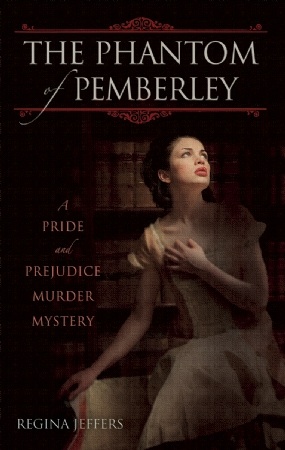
Part of the program is two book clubs having read my novels. We will meet to discuss, first, The Phantom of Pemberley and then Christmas at Pemberley. Finally, at one of the satellite libraries (Wadesboro, NC), I will be doing a public reading from Christmas at Pemberleyduring a “Brown Bag Lunch.” These four events cover an 18-day period, and it is a salute to Jane Austen’s enduring influence on literature and modern times. The dates, times, and locations are posted on my website (www.rjeffers.com). The public is welcome to join us for each of the programs.

5. From a teacher’s point of view, what were your most successful methods in teaching Jane Austen to your students?

Regina Jeffers: Teenagers possess very social natures. Therefore, I always prefaced the teaching of Pride and Prejudice or of Persuasion with mini lessons on what appeals to their hormone-induced brains: dating, courtship, clothing, marriage, dancing, transportation, parental demands, fashion, cosmetics, leisure activities, and FOOD (all in relationship to the Regency period and Jane Austen). To understand Austen’s novels, a reader must understand the concept of primogeniture, the distinction between social classes, and the customs of the genteel class. Add to those concepts, the realization that a woman, who wrote in the 19th Century about romance, was still a very marketable commodity, and I had appealed to all their motivations. They were always amazed at the commercial value of Jane Austen’s name in modern times. They were hooked before we turned the first page of the novel. Social customs, lifestyles of the “rich and famous,”and ways to capitalize on the mundane aspects of Regency England: I spoke their language.

6. Your road to publication is a most intriguing one because a student challenged you to write your own book! What were your first thoughts and what was the experience like? Did the results surprise the students? Did the student who offered the challenge receive an A?

Regina Jeffers: As you noted, I never considered writing novels as a career possibility. In 2007, during an Advanced Placement English Language and Composition class, I was in the middle of one of the above-mentioned mini lessons. That particular day, the lesson dealt with authors who rewrote the classics and the necessity to staying true to the original characters. I had described in contemptuous terms how one such Pride and Prejudice sequel had portrayed Darcy as a sniveling simpleton. (The group already understood my obsession with Jane Austen, and they sat in amusement as I briefly described this ‘wannabe’ author’s efforts to them. In all my conceit, I thought at the time that everyone would agree with me.) “I threw the book across the room,”I declared quite proudly.

To which, Will D. said, “If you know how to do this, why don’t you do it yourself?”

Of course, I laughed off his suggestion. “Even if I wanted to do something so foolish, when would I have time?” I countered.

“You always tell us that if we believe passionately in something that excuses are a lame attempt at avoiding failure.”

(Who would have suspected that he actually had listened to me? Where were those who say that teenagers always block out every moral lesson an adult offers? I had been caught in a trap of my own making.)
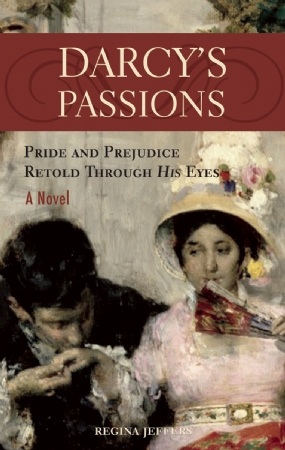
Over a four months’ period, I wrote Darcy’s Passions. I would remain at my desk each evening until 7. (English teachers spend an inordinate amount of time correcting essays.) Then I would go home, eat, shower, and write until 11 P.M. The next day, I would do it all over again. After beginning the project, I decided to self-publish the book, so the class could see the finished project. One of the students rendered a drawing of Darcy, which became the original cover art. The students served as editors. (Yes, there are some errors for that reason.) I never considered the book as anything more than a lesson in perseverance so those few mistakes did not bother me. The class was learning something more important: commitment. When it rose to #8 on the Amazon sales list, Ulysses Press contacted me about traditionally publishing the tale. The rest is history. Christmas at Pemberleyis my twelfth novel in less than four years. In addition, I have written two novellas and one short story “The Pemberley Ball,” which is featured in the anthology The Road to Pemberley.

As for Will D., he is a senior at UNC-Chapel Hill and is on my speed dial. As he remained my student for three years, he quickly learned his teacher’s eccentric nature and A’s were never a problem after that. (Yet, I still tease him about his early propensity to decorate his paper with semicolons when he held no idea what other punctuation might be required.)

7. You tend to write several novels a year. Many new writers speak of struggling to find balance between jobs, families, and finding time to write. How did you achieve balance and what would you say to young writers?

Regina Jeffers: Balance is actually not a realistic goal for a writer, and if one reads the above scenario, one will see that I did not always practice what I preach. Something has to suffer, and, early on, the writer must determine what it is he/she is willing to overlook. The only thing I would hold devotedly onto would be the quality time a person spends with his family and friends. Writing is a solitary process; therefore, do not squander away those opportunities to interact with others. It does matter if a person has a few dishes piled in the sink, if she forgets to fold the clothes the moment the dryer buzzes, if she can only commit to one committee at her child’s school, rather than the three or four she usually aspires to, or if she postpones cutting the grass until later in the week. What matters is that she still teaches her child how to tie his sneakers, that she finds time to help her elderly parents with their yard work, that she joins her best friends for a “birthday” lunch, and that she sit down with her family for the evening meal. Those social connections keep the brain energized and the heart strong. The rest can have its day when time from writing allows. (Besides, one might hear a juicy tidbit during those special moments that becomes the “center stone” of a perfectly good story line. LOL!)

8. Congratulations on your NaNoWriMo finish. Will your story from NaNoWriMo become published and if so, what is the story?

Regina Jeffers: In 2010, I finished A Touch of Cashémere (105,989 words) during NaNoWriMo. I had begun the book, but I had abandoned it in order to complete The First Wives’ Club. A Touch of Cashémere is the third book in the Realm series. The Realm is a covert group working for the British government. Book 1, The Scandal of Lady Eleanor (originally entitled A Touch of Gold) was my March 2011 release. It is the story of James Kerrington, the Realm’s leader, and Lady Eleanor Fowler. A Touch of Velvetfollows and tells the story of Eleanor’s brother, Brantley Fowler, and his life-long obsession with Velvet Aldridge. Cashémere Aldridge is Velvet’s sister. Her tale is mixed with that of Marcus Wellston’s. They come alive in A Touch of Cashémere.

(Back Cover of A Touch of Cashémere)
MARCUS WELLSTON never expected to inherit his father’s title. After all, he is the youngest of three sons. However, his oldest brother Trevor is mentally challenged and his second brother has lost his life in a carriage accident, so Marcus has returned to Tweed Hall and the earldom. He had left Northumberland years prior to escape the guilt of his sister’s death. He could not save Maggie, and Wellston has spent years in atonement with the Realm, a covert governmental group. Now, all he wants is a biddable wife with a pleasant personality. Neither of those terms describes Cashémere Aldridge.

CASHEMERE ALDRIDGE thought her opinions were absolutes and her world perfectly ordered, but when her eldest sister Velvet is kidnapped Cashé becomes a part of the intrigue. She quickly discovers nothing she knew before is sacred. Leading her through these changes is a man who considers her a “spoiled brat”–a man whose approval she desperately needs. Mix in an irate Baloch warlord, who seeks a missing emerald, and the Realm has its hands full. The Regency Period has never been hotter.

Ulysses Press released The Scandal of Lady Eleanor. To please the fans who wanted more of this series without waiting for Ulysses to decide whether to publish the rest of the series, I self published A Touch of Velvet and A Touch of Cashémere. A Touch of Grace and A Touch of Mercy will follow. Excerpts from all my books can be found at my website. Fans can purchase the books through the usual outlets or contact me personally at regina@rjeffers.com (There are PayPal links on my website). I keep copies on hand for those who want autographed books.

9. In regards to research, do you complete all the research prior to starting a new novel, or do you prefer to do the research as you go along?

Regina Jeffers: I have certain sites I revisit prior to writing any novel. They are sites dedicated to English geographical features, myths and legends, and customs of the Regency Period. Plus, I have an extensive personal library, which I consult regularly. These help me refresh my knowledge of the era, and sometimes they spark an idea. Once I have hatched a concept, I spend several weeks tweaking the details needed: names of villages, number of miles between each, accepted surnames for the new characters, historical facts to correspond with the story’s setting, weather conditions, etc. Little details are so important to a book’s accuracy. I often say that I spend days verifying facts that are less than a paragraph within a book.

While writing, I regularly stop to research the use of a particular phase or a historic fact. Often, such research changes the original story line. For example, I have spoken previously of writing an exquisite scene for “His American Heartsong,” in which the main character, Arabella, is sprayed by a skunk. I was laughing aloud as I created a scene reminiscent of a friend’s encounter with a black and white intruder. Unfortunately, my instincts screamed the realization that there are no skunks in England. A quick check proved my hunch true. I filed the scene in the trash and created a less enjoyable one.

10. Are you a plotter or a pantser?

Regina Jeffers: I am definitely a “pantser.” I write by the seat of my pants. That does not mean that I do not plan out the story, but it indicates that I do not outline every chapter prior to writing. I know how the book will end and the key events prior to my sitting down to begin a story. Yet, the events that progress that tale from Point A to Point B often unfold as my pen trails along the lined paper. Sometimes, those events surprise me, as well as my readers. I call my writing style the closed umbrella effect. Each spoke of story closes before the Velcro strip ties it all together.

11. Do you think young writers should publish their stories on their own (public) websites and blogs (why or why not)?

Regina Jeffers: For years, I have enjoyed pieces of fan fiction from some of my favorite authors. For many, they have converted their love of Austen, Conan Doyle, Dickens, Gaskell, etc., into writing careers. Some have found the transition fulfilling and have been successful; others have known disappointment. Those lucky few that find a publisher willing to bring the work to fruition have a ready-made fan base, a fact that publishers relish in today’s crazy marketplace. However, the release of these stories as “free” reads often backfires on a writer. Despite the traditional publisher making changes to the original manuscript, some readers refuse to pay for a book they have previously read without charge. Sales can be impacted. I suppose the answer lies in the writer’s purpose for displaying his work in a public forum. Is it purely for his creative expression and own pleasure? Is he seeking a career change? Has he attempted self-publishing or the traditional route and simply wants to increase his name recognition? Those personal motivations will impact a writer’s decision as to whether or not to open his work up to others on his blog/website.

A person can find excerpts of each of my novels, but I have never placed a complete manuscript on my website or on Austen Authors’ Writer’s Block. It is not because I believe myself better than those who choose the fan fiction route. It is just the opposite. I admire how organized they are. My writing process is a bit convoluted because I hand write my books in spiral notebooks with a black ink pen, and then I word-process them. There is always a delay between the story’s development and typing the end result. I would have readers waiting for months for the next installment–so much so that they would desert me for a more compelling story line.

12. If the opportunities existed, what would you like to say to Jane Austen?

Regina Jeffers: Until of late, I might have said, “What in the world were you thinking when you created Fanny Price?” But I have been carefully rereading Mansfield Parkafter many years of avoiding the novel, and I have developed a new appreciation for Austen’s often touted least favorite heroine.

That being said, I would have so many questions for “our Jane” that I am not certain where I might begin. I would hope I would not be limited to just one query. I would like to know, for example:

In some of Austen’s marriage plots, one finds an endogamous joining (Mansfield Park and Emma) and in others, one discovers an exogamous marriage of opposites (Pride and Prejudice and Persuasion). As Austen had several opportunities to form both types of marriages, I would ask if Jane held any regrets in never marrying, especially in calling off her engagement to Harris Bigg-Wither.

Did Austen intentionally include a strong awareness of the impending social changes encompassing England? In other words, were the limitations of her novels in the historical details self-imposed?

Most of Austen’s novels reflect the tension between the prospect of the woman’s role in the marriage mart and the growing demand for moral independence and self-respect on the part of the female populace. Based on her story lines, I would ask Austen to define the earthly reward of “virtue.”

Book Blurb

Christmas at Pemberley: A Pride and Prejudice Christmas Sequel

To bring a renewed sense joy to his wife’s countenance, Fitzwilliam Darcy has secretly invited the Bennets and the Bingleys to spend the Christmastide festive days at Pemberley. But as he and Elizabeth journey to their estate to join the gathered families, a blizzard blankets the English countryside. The Darcys find themselves stranded at a small out-of-the-way inn with another couple preparing for the immediate delivery of their first child, while Pemberley is inundated with friends and relations seeking shelter from the storm.

Without her brother’s strong presence, Georgiana Darcy desperately attempts to manage the chaos surrounding the arrival of six invited guests and eleven unscheduled visitors. But bitter feuds, old jealousies, and intimate secrets quickly rise to the surface. Has Lady Catherine returned to Pemberley for forgiveness or revenge? Will the manipulative Caroline Bingley find a soul mate? Shall Kitty Bennet and Georgiana Darcy know happiness?

Written in Regency style and including Austen’s romantic entanglements and sardonic humor, Christmas at Pemberley places Jane Austen’s most beloved characters in an exciting yuletide story that speaks to the love, the family spirit, and the generosity that remain as the heart of Christmas.

Author Bio

Regina Jeffers, a public classroom teacher for thirty-nine years, considers herself a Jane Austen enthusiast. She is the author of several Austen-inspired novels, including Darcy’s Passions, Darcy’s Temptation, Vampire Darcy’s Desire, Captain Wentworth’s Persuasion, The Phantom of Pemberley, and the upcoming The Disappearance of Georgiana Darcy. She also is a Regency romance author: The Scandal of Lady Eleanor, A Touch of Velvet, A Touch of Cashémere, and The First Wives’ Club. A Time Warner Star Teacher and Martha Holden Jennings Scholar, Jeffers often serves as a consultant in language arts and media literacy. Currently living outside Charlotte, North Carolina, she spends her time with her writing, gardening, and her new grandson. http://www.rjeffers.com

https://reginajeffers.wordpress.com
http://austenauthors.net
Twitter –@reginajeffers

(Books available from Barnes & Noble, Amazon, Books-a-Million, Joseph Beth, and Ulysses Press.)

Posted in Uncategorized | Comments Off on Pride and Prejudice 2005 Interview