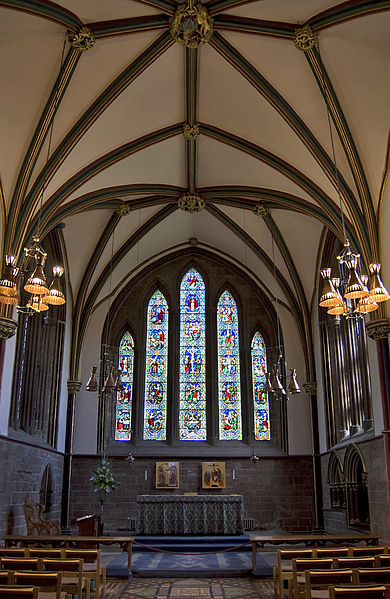
A Regency Era Teaching Hospital

Jeffers-TMDOMD In THE MYSTERIOUS DEATH OF MR. DARCY, I spent a great deal of time researching medical practices of the period of which my fictionalized surgeon might be aware, as well as early medical schools students might have attended. I purposely chose the area of Manchester, although my fictionalized school is nothing like the one described below. It is much cruder in its use of illegal bodies. Early on, hospitals depended on resurrectionists to supply anatomy students with corpses upon which to complete their studies of the body. (Please see yesterday’s post on the UK Resurrectionists.)

There are thirty-two medical schools in the United Kingdom that are recognised by the General Medical Council and from which students can obtain a medical degree. There are twenty-four such schools in England, five in Scotland, two in Wales and one in Northern Ireland. All but Warwick Medical School and Swansea Medical School offer undergraduate courses in medicine. The Bute Medical School (University of St Andrews) and Durham Medical School offer undergraduate pre-clinical courses only, with students proceeding to another medical school for clinical studies. Although Oxford University and Cambridge University offer both pre-clinical and clinical courses in medicine, students who study pre-clinical medicine at one of these universities may move to another university for clinical studies. At other universities students stay at the same university for both pre-clinical and clinical work.

The earliest place of medical training in Britain was Barts Hospital, now part of Queen Mary, University of London, where it has taken place continuously since its foundation in 1123. Medical teaching has taken place at the University of Oxford since at least the 13th century and its first Regius Professor of medicine appointed in 1546. Medical teaching began at the foundation of University of Aberdeen School of Medicine in 1495, although even as late as 1787 there were calls “for the establishment of a medical school” in Aberdeen. The University of St Andrews began teaching medicine in the late 15th century. The University of Cambridge appointed its first Regius Professor of medicine in 1540 although it is likely teaching occurred well before this date. Teaching began in 1550 at St Thomas’ Hospital, London. St George’s, University of London has its origins in 1733. The London Hospital Medical College (LHMC) was founded in 1785 and is now part of Queen Mary, University of London’s School of Medicine. Formal medical education began in Birmingham in 1767, and in Manchester in 1814. In the early 19th century, medical schools in Belfast, Sheffield, Leeds, Newcastle, and Liverpool were formally established, between 1821 and 1842.

Picture of the old Medical School in 1908 Source: School of Medicine

Picture of the old Medical School in 1908 Source: School of Medicine

Currently, the School of Medicine at the University of Manchester is one of the largest in the UK with around 2,000 undergraduates, 1,400 postgraduates and 1,200 staff. The school is divided into five separate divisions, also called schools, one of which, Manchester Medical School is responsible for medical undergraduate tuition. The others, Community-Based Medicine, Translational Medicine, Biomedicine, and Cancer and Enabling Sciences Sciences, are primarily postgraduate and research divisions. As of 2008 the medical school admits some 380 home medical students and a further 29 from overseas per year.

The School of Anatomy at Manchester Royal Infirmary was opened by Joseph Jordan in 1814. In the intervening 60 years more than one private medical school existed in Manchester: the most successful was that in Pine Street not far south of the Infirmary. The Royal Manchester School of Medicine and Surgery did not open until 1874 (at Owens College), and medical degrees were awarded by the Victoria University from 1883. The school was made co-educational in 1899 after a long and contentious debate about whether women could be members of the College at all. The first female medical student to qualify Catherine Chisholm practised as a paediatrician after graduating. The success of the school meant that the building needed to be extended twice, in 1883 and 1894. From 1903/04 degrees were awarded by the Victoria University of Manchester.

A considerable space was allocated to the library of the Manchester Medical Society (founded 1834) which until 1930 remained in their possession while accommodated in the University. The library became part of the university library at that time and remained in the building until 1981 when it was transferred into the present Main Library building of the John Rylands University Library (part of the rare books went to the John Rylands Library).

Additional departments were added from time to time: chronologically these were pharmaceutics, dentistry, public health. A dental hospital was associated with the department of dentistry.
Until 1908 the Manchester Royal Infirmary was at Piccadilly a mile away from the school but in 1908 it moved to a new site on Oxford Road much nearer the medical school and the two institutions were interdependent.

The medical school expanded greatly in the 1950s, culminating in the opening of the Stopford Building in 1973, and additionally providing clinical studies for students who had completed their pre-clinical studies at St Andrews.

Posted in British history, Georgian Era, Living in the Regency, real life tales, Regency era, Victorian era | Tagged , , , , | Comments Off on A Regency Era Teaching Hospital

How to Give Your Self Published Book a Traditionally Published Look

This article comes from DBW (Digital Book World) Daily. To read the complete article, go to http://www.digitalbookworld.com/2013/how-to-avoid-the-self-published-look/

The following is an excerpt from Guy Kawasaki’s new book APE: How to Publish a Book.  

Don’t self-publish. That’s as good as admitting you’re too lazy to do the hard work.
Sue Grafton, LouisvilleKY.com, August 7, 2012

Appearance Is Everything
This chapter helps you avoid publishing a book that looks cheesy, vain, and amateurish. Steve Jobs taught me that little details separate the mediocre from the excellent. The way to avoid the “self-published” look is simple, and it increases the attractiveness, professionalism, and marketability of your book.

The first outward sign that your book is self-published is a crappy cover design. This topic merits a long discussion, so we’ll address it in the next chapter.

The first internal sign that your book is self-published is crappy writing, but our writing and editing tips will help you avoid this. Sue Grafton notwithstanding (she did retract her statement in the epigraph above, but S for Self-Publishing is out of the question), the stigma of self-publishing has diminished. But it still exists, and there’s no reason why you can’t make your book look like it’s professionally published; remember, the goal is artisanalbooks.

Posted in Industry News/Publishing | Comments Off on How to Give Your Self Published Book a Traditionally Published Look

Dorset’s Smugglers’ Tunnel

Jeffers-TMDOMD In my research for THE MYSTERIOUS DEATH OF MR. DARCY, I have spent a great deal of time researching all those special “places” in Dorset, which would become part of the setting of this novel. Today, I would like to introduce you to Newton’s Cove.

Newton's_Cove,_Weymouth_-_geograph.org.uk_-_459320 Newton’s Cove is a small cove with sand, shingle and rock pools, just 0.3 miles south of Weymouth, Dorset, England, overlooking Portland Harbour and next to the Nothe Fort. The beach is mainly used by locals and by tourists who visit the Nothe Fort and its gardens. Locals tell tales of a smugglers’ tunnel built to transport goods from the cove inland. Several houses above the tunnel are also said to have access to the area, which leads the cellar of The Boot Inn in Rodwell. Some say it is not a tunnel but a cave under Nothe Fort, which served as the smugglers’ headquarters.

Before a recent concrete promenade walk was constructed, ghost-like figures were seen often on the beach. Those in West Plains, which is now called North Quay, speak of the tunnel as a certainty. Supposedly, the present-day Municipal Offices and the car park are built over the tunnel. Ironically, these offices were built on land once occupied by West Plains, an area known for its prostitutes, petty thieves, and cutthroats during the 18th and 19th centuries.

Modern events

Geograph-2523778-by-sue-hogben In 2009, a new bridge was constructed over either side of Newtons Road, after the original 73-year-old concrete bridge was demolished. The Dorset County Council had planned to put in ramps on the banks either side of the road, however a successful campaign by residents and community groups caused the council to find money in the budget to fund a new structure. The new bridge was designed by artist Chris Tipping, who collaborated with the council’s engineering and construction teams.

In 2011, Dorset Wildlife Trust organised an event based in the cove as part of their three-year investigation, which is termed the ‘Welly Zone’. Staff from Weymouth Sea Life Park and Dorset Wildlife Trust spent two-and-a-half hours logging plant and animal life they found in the inter-tidal area and rockpools on and around the beach in a bid to win protection for the fragile shoreline and shallow water habitats along the Dorset coastline. The results were indications of climate change as various shells were found seemingly expanding their region along the South West coast, whilst presence of Asia native wireweed was also discovered.
Newton’s Cove Coast Protection Scheme

In 2003 a £1.95 million scheme was devised to protect residential property in the area and at the same time safe-guarding and enhancing important local geological environment. Originally damaged from the tide, a new sea wall now provides accessible public right of way.
Landscape architect Enplan, who were inspired by the view across Weymouth Bay of Dorset coast’s chalk cliffs, had proposed features that mimic the outline of the facing cliffs of the Bay and the Isle of Portland. The cove’s main walls were shaped and curved in two planes and faced in local Portland stone. Afterwards, the area was further enhanced by using architectural lighting and landscape planting to strengthen a contemporary and continental feel for warm summer evening promenading. The judges of the scheme had stated “This scheme represents a vitally important contribution to the defence of the sea wall in Weymouth. But more than that, it is an excellent example of a contemporary promenade with a ‘corniche’ atmosphere.”

As a result of the scheme’s success, Newton’s Cove Coast Protection Scheme was the 2004 finalist in the Prime Minister’s better public buildings awards.

Posted in British history, Georgian Era, gothic and paranormal, Living in the Regency, real life tales, Regency era, Victorian era | Tagged , , , , , | Comments Off on Dorset’s Smugglers’ Tunnel

The OP Riots of 1809


Killing No Murder

Killing No Murder

The Old Price Riots of 1809 were caused by rising prices at the new Theatre at Covent Garden, London, after the previous one had been destroyed by fire. Covent Garden was one of two “patent” theatres in London in the 19th century, along with Drury Lane. When Drury Lane was burned down, Covent Garden became the premiere theatre in that time. The riots lasted three months, and ended with John Philip Kemble, the manager of the theatre, being forced to make a public apology.

The OPs protested against the rise in seat prices, the reduction of the gallery (where the poor watch the play), and the increase in the size of richer patrons’ private boxes. Those who preferred the old price (OPs) opposed those who supported Kemble and the management (NPs). The protest continued for 62 days. The riots occurred in the pits, though people in the private boxes joined in. The OPs claimed the poor had as much right to view a play as did the wealthiest of the Realm.

Georgian theatres had three very distinct areas from which to take in a play. The floor of the theatre held simple benches and was called the “pit.” Those in the pits were usually the most discriminating of the theatre goers. They had the best views of the stage. Surrounding the pits were tiers of enclosed seats (boxes). The gallery was above the tiered seating. A theatre goer experienced the main play, songs, dances, some sort of “circus” act, and a short comedy. If one entered the theatre at the interval, he could be admitted for half price.

The major theatres of the time were Covent Garden and Drury Lane. Known as Theatres Royal, Covent Garden and Drury Lane sent scripts to the Lord Chamberlain for approval. As both theatres had seen major renovations in the 1790s, they could seat some 3000 people.

The minor theatres had a burlesque type of atmosphere. These lesser theatres put on “musicals” – songs, dances, acrobatics. If a scene was acted out, dialogue was written out on scrolls and the actors mimed the action. These “musicals” were known as burlettas. Local magistrates licensed these lesser theatres. Whereas, the Theatres Royal could not perform plays with politically biased scripts, the lesser theatres could and several plays depicts events in France were seen upon their stages. The minor theatres put on extravaganzas to draw in crowds.

Thirty lives were lost in 1808 when Covent Garden burned to the ground, but Covent Garden came back strong. Management borrowed money from their rich patrons, most importantly £10.000 from the Duke of Northumberland. Angelica Catlani, a renowned soprano, was hired to attract customers. The Acropolis was the model for the theatre’s design. Luxurious boxes were added for the wealthy patrons, but these boxes limited the view from the gallery. The prices increased from six shillings to seven shillings for the boxes and three and six to four shillings for the pit and the third tier. The gallery price remained the same, but the new gallery was so far up and the rake so steep that the audience (crammed into so called ‘pigeon holes’) could only see the legs of the performers.

All of this would have been well and good except for a second tragedy. In March 1809, Drury Lane also burnt down, leaving Covent Garden as the only theatre permitted to perform plays. Covent was to reopen on 18 September 1809. Macbeth was to the opening play. John Kemble stepped upon the stage to a round of applause, but when he began his opening speech, members of the crowd began to hiss and hoot and yell. Eventually, magistrates were called to read the Riot Act to the crowd, demanding that the group disperse to be arrested. The majority of the audience remained in place. They sang “God Save the King” and “Rule Britannia.”

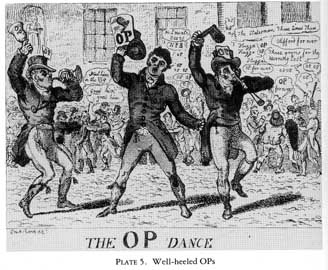
The OP Dance

The OP Dance

The fracas continued on subsequent nights. The OPs brought their own special form of ammunition: pots and pans to bang together, musical instruments, bells, etc. If you have heard of the Harlem shake or gangnam style, you will find it amusing to know the OPs also came up with a welly dance, usually performed on the benches and followed by boisterous shouts of “OP!”

A committee met over a six-day period to discuss the new prices, but when the committee supported the price change, the riots resumed with a vengeance. The OPs staged mock fight scenes, raced about the theatre, carried banners and placards and sang song while the legitimate actors attempted to say their lines. Kemble, the theatre manager, hired boxers to throw the ramble rousers out or have them arrested. When one of Kemble’s “bouncers” arrested Henry Clifford, a well-known radical barrister, Kemble was found guilty of false arrest.

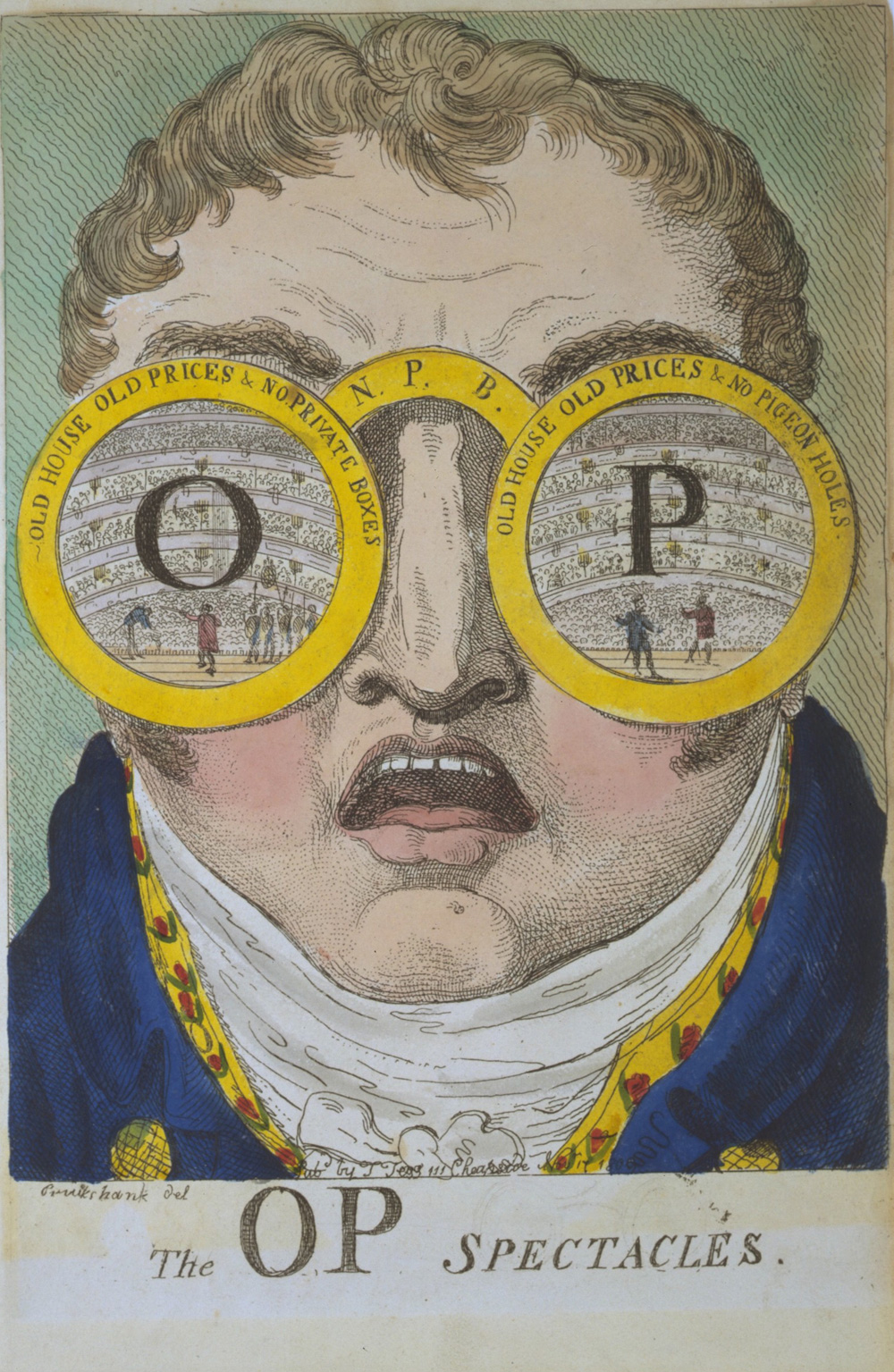
A caricature of John Philip Kemble (1757-1823) showing a portrait of a man wearing large spectacles with the letters 'OP' on each lens with theatrical scenes behind. The inscription on the left frame is 'Old House, Old Prices & No Private Boxes'; on the right frame is 'Old House, Old Prices & No Pigeon Holes'.

A caricature of John Philip Kemble (1757-1823) showing a portrait of a man wearing large spectacles with the letters ‘OP’ on each lens with theatrical scenes behind. The inscription on the left frame is ‘Old House, Old Prices & No Private Boxes’; on the right frame is ‘Old House, Old Prices & No Pigeon Holes’.

On 14 December 1809, Kemble had agreed to terms with Clifford. He announced a return to the previous prices. All charges against the rioters were dropped. The British government feared the rioters might take on more weighty causes such as the price of bread or an unpopular war with France, but no attempt to organize for other causes occurred.

The Great Reform Act of 1832 finally addressed whether the minor theatres had a right to perform plays. In 1843, the patents for the Theatres Royal were abolished. However, that did not solve all the problems. The “lesser” theatres went for the quick buck. The repertoire was not inspiring. These theatres encouraged middle class audiences.

Without their monopoly on “legitimate” drama, Drury Lane and Covent Garden could not remain solvent. There were just too many seats to fill to turn a major profit. Covent Garden burned down a second time in 1856. Instead of replacing Covent a second time, the Italian Opera House took its place.

The books Theater and Disorder in Late Georgian London (Oxford University Press, 1992, by March Baer) and A People’s History of London (Verso, 2012, by Lindsey German and John Rees) have excellent sections on the riots and the conditions which brought them about.

There is a great article on the OP Riots at Counterfire.


Posted in British history, Georgian Era, Living in the Regency, real life tales, Regency era, Victorian era | Tagged , , , , | Comments Off on The OP Riots of 1809

The Star of Israel, Mendoza the Jew

Daniel Mendoza

Daniel Mendoza

Daniel Mendoza was the first Jewish prize fighter to become Champion of England from 1792 to 1795. Mendoza stood but 5’7”, but he was a scrapper. Weighing in a 11.5 stone (160 pounds), he was billed as “Mendoza the Jew.” Mendoza was the only middleweight boxer to win the Heavyweight Championship of the World.

It was Mendoza who brought changes to boxing. Before he became popular, men simply stood still and slugged it out. Mendoza introduced the idea of “defense.” Many criticized Mendoza’s tactics, but soon all boxers were using the techniques. He opened his own boxing academy in 1789, which was known as the Mendoza School or the Jewish School. Mendoza also published The Art of Boxing, a book that described his techniques.

Mendoza’s first win came over an opponent known as Harry the Coalheaver, whom he beat in 40 rounds. In a 1787 professional fight, Mendoza won both the bout and the patronage of the Prince of Wales (later George IV). Mendoza was the first Jew to have an audience with England’s King George III, which both elevated the Jew in London’s population, but also a vicious tide of anti-Semitism.

From 29 March 1787 edition of The Times, we see a bit of the secrecy behind the English Sport of Boxing. Generally, only a few knew of the site for a match until the last moment. Prize fights were against the law. Most of the clergy and many of the middle class thought the bare knuckles bouts brutal. That being said, the brutality did not keep the throngs from enjoying the matches. “The boxing match between Martin the Bath Butcher, and Mendoza the Jew, which has been the subject of every blackguard’s conversation for some days, was put a stop to on Tuesday, by the prudent and praise-worthy interference of the civil poser. The parties met on Ealing Common, attended by a great concourse of people (among whom was the Prince – whether accidental or otherwise, we know not – we may, however, reasonably suppose the former – and some other personages of note) when a Justice of the Peace, and a posse comitatus, assisted by a party of the Light Dragoons, made their appearance, and prevented the decision of the combat. In justice to the high personage, whose name we are sorry to mention on this occasion, he was the first to shew respect to the civil authority, by retiring with his party, as soon as the Magistrate made his appearance. The riot act was read, and the mob, in number perhaps ten thousand, dispersed quietly.”

The fight was rescheduled for Barnet Racegroun on 17 April. The crowd numbered some 5000. Mendoza easily defeated Martin in 30 minutes. He won a prize of £500 from the Prince.

In 1788, 1789, and 1790, Mendoza fought storied matches against Richard Humphries, Mendoza’s mentor. He lost the first bout in 29 rounds, but managed to win the other two in 52 and 15 rounds, respectively. The 1789 match was the first time spectators were charged an entry payment to a sporting event. The fights were hyped by a series of combative letters in the press between Humphries and Mendoza.

Mendoza laid claim to the English Championship when Benjamin Brain retired in 1791, but Bill Warr challenged Mendoza’s claim. The two met in Croydon in May 1792. Mendoza’s claim to the title prevailed in 23 rounds. The two met again in 1794. Mendoza dispensed with Warr in a little over a quarter hour.

Gentleman John Jackson

Gentleman John Jackson

In 1795, Mendoza fought “Gentleman” John Jackson for the championship at Hornchurch in Essex. Jackson was five years younger, 4 inches taller, and 3 stone (42 pounds) heavier. Jackson won in nine rounds. Reportedly, Jackson caught Mendoza long hair, holding Mendoza in place where Jackson could pummel him into submission in ten minutes. Jackson used the win to propel him into Society. Jackson’s Rooms opened at 13 Bond Street, along with the Fives Court off Jermyn Street, where public sparring took place.

Born in Aldgate in July 1764, Mendoza, a descendant of Spanish Marranos (Jews coerced into conversion to Christianity) who had lived in London for nearly a century, became such a popular figure in England that songs were written about him, and his name appeared in scripts of numerous plays. His personal appearances would fill theaters, portraits of him and his fights were popular subjects for artists, and commemorative medals were struck in his honor.

At age 13, he was apprenticed to a glasscutter, but he fought with the employer’s son and was forced from the position. Later, he apprenticed to a Jewish greengrocer and still later to a tea dealer. His fortune rested in his fists.

In his 72 years, Mendoza made and spent a fortune. His memoirs were finally published in 1818. After his glory days, he spent time as a pub owner, teaching boxing, and even was hired by the theatre manager John Philip Kemble in an attempt to suppress the Old Price Riots; the resulting poor publicity probably cost Mendoza much of his popular support, as he was seen to be fighting on the side of the privileged. He even spent time in King’s Bench prison for his debts.

Mendoza made his last public appearance as a boxer in 1820 at Banstead Downs in a grudge match against Tom Owen; he was defeated after 12 rounds. He died on 3 September 1836. By then, the thrill of the boxing ring had waned. Mendoza left his family of 11 children in poverty. One of Mendoza’s descendants, Rufus Daniel Issacs, became Lord Chief Justice and 1st Marquess of Reading.

Peter Sellers

Peter Sellers

Another of Mendoza’s descendants, the actor Peter Sellers of Pink Panther fame, bears a resemblance to his great-great-grandfather. Perhaps, Sellers used some of the lessons he learned from his relative in those zany scenes of Cato attacking Inspector Clouseau. A print of Mendoza fighting Humphries can be seen on the wall of Clouseau’s office in the films.

Mendoza features as a character in Rodney Stone, a Gothic mystery novel by Sir Arthur Conan Doyle, and one of his fights is mentioned in the 1934 The Scarlet Pimpernel film. A play about Mendoza, “The Punishing Blow” by Randy Cohen debuted in 2009, and a film on the life of Daniel Mendoza, entitled “Mendoza,” is supposed due for release in 2013.

Daniel Mendoza was one of the inaugural group elected in 1954 to the Boxing Hall of Fame and of the inaugural class of the International Boxing Hall of Fame in 1990.

Excellent Resources on Daniel Mendoza:

International Jewish Sports Hall of Fame  

Jewish Quarterly (Includes specifics of each fight and wonderful primary sources)


Posted in British history, Georgian Era, Living in the Regency, real life tales, Regency era, Victorian era | Tagged , , , , , , , | 2 Comments

The Magnificent Cheshire Cathedral

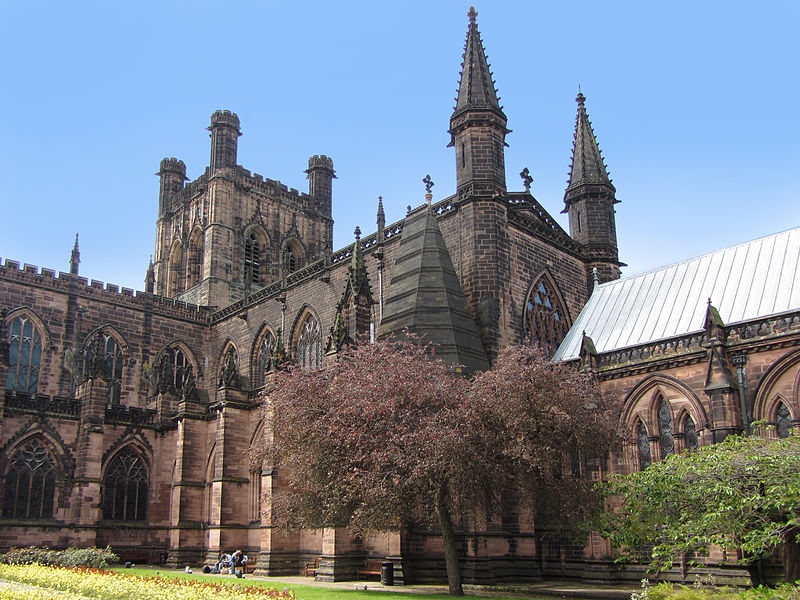
Chester Cathedral, England. The cathedral seen from the south-east looking towards the choir, right, with the Lady Chapel projecting, extreme right, and the south transept, left. The Lady Chapel is in the Early English (or Lancet) Gothic style, marked by the simple windows. The choir is in the late Geometric Decorated Gothic style. The South transept has Flowing Decorated windows in the aisle, and Perpendicular Gothic windows in the clerestory. The friable Red Sandstone building was heavily restored in the 19th century.

Chester Cathedral, England. The cathedral seen from the south-east looking towards the choir, right, with the Lady Chapel projecting, extreme right, and the south transept, left. The Lady Chapel is in the Early English (or Lancet) Gothic style, marked by the simple windows. The choir is in the late Geometric Decorated Gothic style. The South transept has Flowing Decorated windows in the aisle, and Perpendicular Gothic windows in the clerestory. The friable Red Sandstone building was heavily restored in the 19th century.

Cathedral is the mother church of the Church of England Diocese of Chester, and is located in the city of Chester, Cheshire, England. The cathedral, formerly St Werburgh’s abbey church of a Benedictine monastery, is dedicated to Christ and the Blessed Virgin Mary. Since 1541 it has been the seat of the Bishop of Chester and centre of worship, administration, ceremony and music for the city and diocese.

The cathedral is a Grade I listed building, and part of a heritage site that also includes the former monastic buildings to the north, also listed Grade I. The cathedral, typical of English cathedrals in having been modified many times, dates from between 1093 and the early 16th century, although the site itself may have been used for Christian worship since Roman times. All the major styles of English medieval architecture, from Norman to Perpendicular, are represented in the present building.

The cathedral and monastic buildings were extensively restored during the 19th century amidst some controversy, and a free-standing bell-tower was added in the 20th century. The buildings are a major tourist attraction in Chester, a city of historic, cultural and architectural importance. In addition to holding services for Christian worship, the cathedral is used as a venue for concerts and exhibitions. History

Chester Cathedral: Shrine of Saint Werburga ( 1340 )

Chester Cathedral: Shrine of Saint Werburga ( 1340 )

The city of Chester was an important Roman stronghold. There may have been a Christian basilica on the site of the present cathedral in the late Roman era, while Chester was controlled by Legio XX Valeria Victrix. Legend holds that the basilica was dedicated to St Paul and Saint Peter. This is supported by evidence that in Saxon times the dedication of an early chapel on this site was changed from Saint Peter to Saint Werburgh. In the 10th century, St Werburgh’s remains were brought to Chester, and 907 AD her shrine was placed in the church. It is thought that Æthelfleda turned the church into a college of secular canons, and that it was given a charter by King Edgar in 968. The abbey, as it was then, was restored in 1057 by Leofric, Earl of Mercia and Lady Godiva. This abbey was razed to the ground around 1090, with the secular canons evicted, and no known trace of it remains.

In 1093 a Benedictine monastery was established on the site by Hugh Lupus, Earl of Chester, and the earliest surviving parts of the structure date from that time. The abbey church was not at that time the cathedral of Chester; from 1075 to 1082 the cathedral of the diocese was the nearby church of St John the Baptist, after which the see was transferred to Coventry. In 1538, during the dissolution of the monasteries, the monastery was disbanded and the shrine of Saint Werburgh was desecrated. In 1541 St Werburgh’s abbey became a cathedral of the Church of England by order of Henry VIII. At the same time, the dedication was changed to Christ and the Blessed Virgin. The last abbot of St Werburgh’s Abbey, Thomas Clarke, became the first dean of the new cathedral at the head of a secular chapter.

Although little trace of the 10th-century church has been discovered, save possibly some Saxon masonry found during a 1997 excavation of the nave, there is much evidence of the monastery of 1093. This work in the Norman style may be seen in the northwest tower, the north transept and in remaining parts of the monastic buildings. The abbey church, beginning with the Lady Chapel at the eastern end, was extensively rebuilt in Gothic style during the 13th and 14th centuries. At the time of the dissolution of the monasteries, the cloister, the central tower, a new south transept, the large west window and a new entrance porch to the south had just been built in the Perpendicular style, and the southwest tower of the façade had been begun. The west front was given a Tudor entrance, but the tower was never completed.

In 1636 the space beneath the south west tower became a bishop’s consistory court. It was furnished as such at that time, and is now a unique survival in England, hearing its last case, that of an attempted suicide of a priest, in the 1930s. Until 1881, the south transept, which is unusually large, also took on a separate function as an independent ecclesiastical entity, the parish church of St Oswald. Although the 17th century saw additions to the furnishings and fittings, there was no further building work for several centuries. By the 19th century, the building was badly in need of restoration. The present homogeneous appearance that the cathedral presents from many exterior angles is largely the work of Victorian restorers, particularly George Gilbert Scott. The 20th century has seen continued maintenance and restoration. In 1973–75 a detached belfry designed by George Pace was erected in the grounds of the cathedral. In 2005 a new Song School was added to the cathedral. During the 2000s, the cathedral library was refurbished and relocated. It was officially reopened in September 2007. The cathedral and the former monastic buildings were designated by English Heritage as Grade I listed buildings on 28 July 1955. In February 2009 plans for the transformation of the area around the cathedral and nave platform were announced.

External Features
Like the cathedrals of Carlisle, Lichfield and Worcester, Chester Cathedral is built of New Red Sandstone, in this case Keuper Sandstone from the Cheshire Basin. The stone lends itself to detailed carving, but is also friable, easily eroded by rain and wind, and is badly affected by pollution. With the other red sandstone buildings, Chester is one of the most heavily restored of England’s cathedrals. The restoration, which included much refacing and many new details, took place mainly in the 19th century. The sandstone exterior (from the south west) has much decorative architectural detail but is heavily restored.

Because the south transept is similar in dimension to the nave and choir, views of the building from the south-east and south-west give the impression of a building balanced around a central axis, with its tower as the hub. The tower is of the late 15th century Perpendicular style, but its four large battlemented turrets are the work of the restoration architect George Gilbert Scott. With its rhythmic arrangement of large, traceried windows, pinnacles, battlements and buttresses, the exterior of Chester Cathedral from the south presents a fairly homogeneous character, which is an unusual feature as England’s cathedrals are in general noted for their stylistic diversity. Close examination reveals window tracery of several building stages from the 13th to the early 16th century. The richness of the 13th-century tracery is accentuated by the presence of ornate, crocketted drip-mouldings around the windows; those around the perpendicular windows are of simpler form.

The façade of the cathedral is dominated by a large deeply recessed eight-light window in the Perpendicular style, above a recessed doorway set in a screen-like porch designed, probably by Seth and George Derwall, in the early 1500s. This porch formed part of the same late 15th-century building programme as the south transept, central and southwest towers, and cloister. Neither of the west towers was completed. To the north is the lower stage of a Norman tower, while to the south is the lower stage of a tower designed and begun, probably by Seth and George Derwall, in 1508, but left incomplete following the dissolution of the monastery in 1538. The cathedral’s façade is abutted on the north by a Victorian building housing the education centre and largely obscured from view by the building previously used as the King’s School, which is now a branch of Barclays Bank. The door of the west front is not used as the normal entrance to the cathedral, which is through the southwest porch which is in an ornate Tudor style.

Interior Features
The interior of Chester Cathedral gives a warm and mellow appearance because of the pinkish colour of the sandstone. The proportions appear spacious because the view from the west end of the nave to the east end is unimpeded by a pulpitum and the nave, although not long, is both wide and high compared with many of England’s cathedrals. The piers of the nave and choir are widely spaced, those of the nave carrying only the clerestory of large windows with no triforium gallery. The proportions are made possible partly because the ornate stellar vault, like that at York Minster, is of wood, not stone.

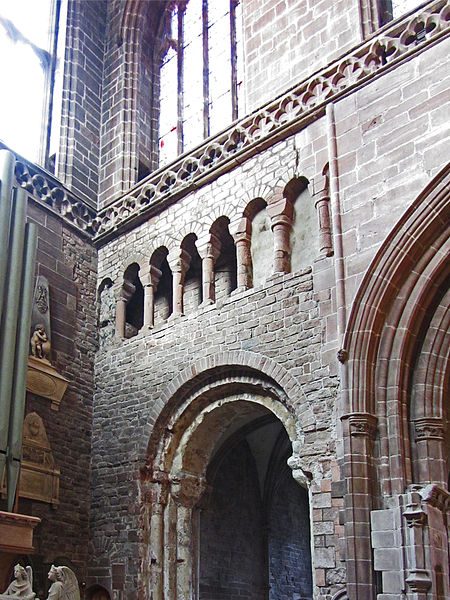
Chester Cathedral, England. The north transept of the cathedral showing a Norman arch and gallery

Chester Cathedral, England. The north transept of the cathedral showing a Norman arch and gallery

Norman remnants
The present building, dating from around 1283 to 1537, mostly replaced the earlier monastic church founded in 1093 which was built in the Norman style. It is believed that the newer church was built around the older one. That the few remaining parts of the Norman church are of small proportions, while the height and width of the Gothic church are generous would seem to confirm this belief. Aspects of the design of the Norman interior are still visible in the north transept, which retains wall arcading and a broadly moulded arch leading to the sacristy, which was formerly a chapel.The transept has retained an early 16th-century coffered ceiling with decorated bosses, two of which are carved with the arms of Henry VIII and Cardinal Wolsey.

The north west tower is also of Norman construction. It serves as the baptistry and houses a black marble font, consisting of a bowl on a large baluster dating from 1697. The lower part of the north wall of the nave is also from the Norman building, but can only be viewed from the cloister because the interior has been decorated with mosaic.

Early English
The Early English Gothic chapter house, built between 1230 and 1265, is rectangular and opens off a “charming” vestibule leading from the north transept. The chapter house has grouped windows of simple untraceried form. Alec Clifton-Taylor describes the exterior of this building as a “modest but rather elegant example of composition in lancets” while Nikolaus Pevsner says of the interior “It is a wonderfully noble room” which is the “aesthetic climax of the cathedral”. To the north of the chapter house is the slype, also Early English in style, and the warming room, which contains two large former fireplaces. The monastic refectory to the north of the cloister is of about the same date as the chapter house.

The Lady Chapel, Early English Gothic, (1265-90)

The Lady Chapel, Early English Gothic, (1265-90)

The Lady Chapel to the eastern end of the choir dates from between 1265 and 1290.It is of three bays, and contains the Shrine of St Werburgh, dating from the 14th century. The vault of the Lady Chapel is the only one in the cathedral that is of stone. It is decorated with carved roof bosses representing the Trinity, the Madonna and Child, and the murder of Thomas Becket. The chapel also has a sedilia and a piscina.

Decorated Gothic
The choir, of five bays, was built between 1283 and 1315 to the design of Richard Lenginour, and is an early example of Decorated Gothic architecture. The piers have strongly modelled attached shafts, supporting deeply moulded arches. There is a triforium gallery with four cusped arches to each bay. The sexpartite vault, which is a 19th-century restoration, is supported by clusters of three shafts which spring from energetic figurative corbels. The overall effect is robust, and contrasts with the delicacy of the pinnacled choir stalls, the tracery of the windows and the rich decoration of the vault which was carried out by the ecclesiastical designers, Clayton and Bell. The choir stalls, dating from about 1380, are one of the glories of the cathedral.

The aisles of the choir previously both extended on either side of the Lady Chapel. The south aisle was shortened in about 1870 by George Gilbert Scott, and given an apsidal east end, becoming the chapel of St Erasmus. The eastern end of the north aisle contains the chapel of St Werburgh. The building of the nave, begun in 1323, was halted by plague and completed 150 years later.

The nave of six bays, and the large, aisled south transept were begun in about 1323, probably to the design of Nicholas de Derneford. There are a number of windows containing fine Flowing Decorated tracery of this period. The work ceased in 1375, in which year there was a severe outbreak of plague in England. The building of the nave was recommenced in 1485, more than 150 years after it was begun. The architect was probably William Rediche. Remarkably, for an English medieval architect, he maintained the original form, changing only the details. The nave was roofed with a stellar vault rather like that of the Lady Chapel at Ely and the choir at York Minster, both of which date from the 1370s. Like that at York, the vault is of wood, imitating stone.

Perpendicular Gothic
From about 1493 until 1525 the architect appears to have been Seth Derwall, succeeded by George Derwall until 1537. Seth Derwall completed the south transept to a Perpendicular Gothic design, as seen in the transomed windows of the clerestory. He also built the central tower, southwest porch and cloisters. Work commenced on the south west tower in 1508, but it had not risen above the roofline at the time of the dissolution of the monasteries, and has never been completed. The central tower, rising to 127 feet (39 m), is a “lantern tower” with large windows letting light into the crossing. Its external appearance has been altered by the addition of four battlemented turrets by George Gilbert Scott in the 19th century.

Former monastic buildings
The Perpendicular Gothic cloister is entered from the cathedral through a Norman doorway in the north aisle. The cloister is part of the building programme that commenced in the 1490s and is probably the work of Seth Derwall. The south wall of the cloister, dating from the later part of the Norman period, forms the north wall of the nave of the cathedral, and includes blind arcading. Among the earliest remaining structures on the site is an undercroft off the west range of the cloisters, which dates from the early 12th century, and which was originally used by the monks for storing food. It consists of two naves with groin vaults and short round piers with round scalloped capitals.

Leading from the south of the undercroft is the abbot’s passage which dates from around 1150 and consists of two bays with rib-vaulting. Above the abbot’s passage, approached by a stairway from the west cloister, is St Anselm’s Chapel which also dates from the 12th century. It is in three bays and has a 19th century Gothic-style plaster vault. The chancel is in one bay and was remodelled in the early 17th century. The screen, altar rails, holy table and plaster ceiling of the chancel date from the 17th century. The north range of the cloister gives access to a refectory, built by Simon de Whitchurch in the 13th century. It contains an Early English pulpit, approached by a staircase with an ascending arcade. The only other similar pulpit in England is in Beaulieu Abbey.

Restoration
Much of the exterior stonework has been refaced in the 19th and 20th centuries. By the 19th century the fabric of the building had become badly weathered, with Charles Hiatt writing that “the surface rot of the very perishable red sandstone, of which the cathedral was built, was positively unsightly” and that the “whole place previous to restoration struck one as woebegone and neglected; it perpetually seemed to hover on the verge of collapse, and yet was without a trace of the romance of the average ruin.” Between 1818 and 1820 the architect Thomas Harrison restored the south transept, adding corner turrets. This part of the building served until 1881 as the parish church of St Oswald, and it was ecclesiastically separate. From 1844 R. C. Hussey carried out a limited restoration including work on the south side of the nave.

The most extensive restoration was carried out by the Gothic Revival architect, George Gilbert Scott, who between 1868 and 1876 “almost entirely re-cased” the cathedral. The current building is acknowledged to be mainly the product of this Victorian restoration commissioned by the Dean, John Saul Howson. In addition to extensive additions and alterations to the body of the church, Scott remodelled the tower, adding turrets and crenellations. Scott chose sandstone from the quarries at Runcorn for his restoration work. In addition to the restoration of the fabric of the building, Scott designed internal fittings such as the choir screen to replace those destroyed during the Civil War. He built the fan vault of the south porch, renewed the wooden vault of the choir and added a great many decorative features to the interior.

Scott’s restorations were not without their critics and caused much debate in architectural circles. Scott claimed to have archaeological evidence for his work, but the Liverpool architect, Samuel Huggins argued in an 1868 address to the Liverpool Architectural Society, that the alterations were less like restoration and more like rebuilding. One of the larger changes was to shorten the south aisle and restyle it as an apse. The changes also proposed the addition of a spire above the existing tower, but this proposal was later rejected. Samuel’s further paper of 1871 entitled On so-called restorations of our cathedral and abbey churches compelled the Dean to attempt to answer the criticism. The debate contributed to the establishment of the Society for the Protection of Ancient Buildings.

Later in the century, from 1882, Arthur Blomfield and his son Charles made further additions and modifications, including restoring and reinstating the Shrine of St Werburgh. More work was carried out in the 20th century by Giles Gilbert Scott between 1891 and 1913, and by F. H. Crossley in 1939.

Bell Tower
Towards the end of 1963 the cathedral bells, which were housed in the central tower, were in need of an overhaul and ringing was suspended. In 1965 the Dean asked George Pace, architect to York Minster, to prepare specifications for a new bell frame and for electrification of the clock and tolling mechanism. Due to structural difficulties and the cost of replacing the bells in the central tower it was advised that consideration should be given to building a detached bell and clock tower in the southeast corner of the churchyard. It was decided to proceed with that plan, and in 1969 an announcement was made that the first detached cathedral bell tower was to be erected since the building of the campanile at Chichester Cathedral in the 15th century. In February 1969, nine of the ten bells in the central tower were removed to be recast by John Taylor & Co as a ring of twelve bells with a flat sixth. The new bells were cast in 1973. Work on the new bell-tower began in February 1973. Two old bells dating from 1606 and 1626 were left in the tower. On 26 February 1975 the bells were rung for the first time to celebrate the wedding of a member of the Grosvenor family. The official opening on 25 June 1975 was performed by the Duke of Gloucester. The belfry is known as the Dean Addleshaw Tower, after the dean of the cathedral responsible for its construction. The tower is built in concrete, faced with sandstone at its base. It is the first detached bell tower to be built for a cathedral in this country since the Reformation. Between the bell tower and the south transept is a garden in remembrance of the Cheshire Regiment (originally the 22nd Regiment of Foot).

Fittings and Glass
The Consistory Court of 1632 The treasures of Chester Cathedral are its rare fittings, specifically its choir stalls and the 17th-century furnishing of the bishop’s consistory court in the south tower, which is a unique survival.

Choir Stalls
The choir stalls date from about 1380. They have high, spiky, closely set canopies, with crocketed arches and spirelets. The stall ends have poppyheads and are rich with figurative carving. The stalls include 48 misericords, all but five of which are original,depicting a variety of subjects, some humorous and some grotesque. Pevsner states that they are “one of the finest sets in the country,” while Alec Clifton-Taylor calls them “exquisite” and says of the misericords that “for delicacy and grace they surpass even those at Lincoln and Beverley.”

Organ
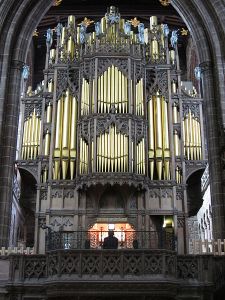
The organ

The organ

In 1844, an organ by Gray & Davison of London was installed in the cathedral, replacing an instrument with parts dating back to 1626. The organ was rebuilt and enlarged by Whiteley Bros of Chester in 1876, to include harmonic flutes and reeds by Cavaillé-Coll. It was later moved to its present position at the front of the north transept. In 1910 William Hill and Son of London extensively rebuilt and revoiced the organ, replacing the Cavaillé-Coll reeds with new pipes of their own. The choir division of the organ was enlarged and moved behind the choirstalls on the south side. The instrument was again overhauled by Rushworth and Dreaper of Liverpool in 1969, when a new mechanism and some new pipework made to a design by the organist, Roger Fisher, was installed. Since 1991 the organ has been in the care of David Wells of Liverpool.

Stained Glass
Chester suffered badly at the hands of the Parliamentary troops. As a consequence, its stained glass dates mainly from the 19th and 20th centuries and has representative examples the significant trends in stained glass design from the 1850s onwards. Of the earlier Victorian firms, William Wailes is the best represented, in the south aisle (1862), as well as Hardman & Co. and Michael Connor. Glass from the High Victorian period is well represented by two leading London firms, Clayton and Bell and Heaton, Butler and Bayne. The Aesthetic style is represented by Charles Eamer Kempe. Early 20th century windows include several commemorating those who died in World War I.

There are also several notable modern windows, the most recent being the refectory window of 2001 by Ros Grimshaw which depicts the Creation. The eight-light Perpendicular window of the west end contains mid-20th century glass representing the Holy Family and Saints, by W. T. Carter Shapland. Three modern windows in the south aisle, designed and made by Alan Younger to replace windows damaged in the Second World War. They were donated by the 6th Duke of Westminster to celebrate the 900th anniversary of the cathedral and contain the dates 1092 and 1992 to reflect the theme of “continuity and change.”

Posted in British history, castles, Georgian Era, gothic and paranormal, legends and myths, Living in the Regency, real life tales, Regency era, Ulysses Press, Victorian era | Tagged , , | Comments Off on The Magnificent Cheshire Cathedral

What is “Swarming” in Book Terms?

This article infuriates me. I have seen a few such comments on my own books. I have personally known of those who upped their ratings with positive reviews from friends and family and who have “attacked” other writers with the help of those same family and friends. Tell me what you think.

This article comes the January 20, 2013 edition of the The New York Times. To read the complete article, go to http://www.nytimes.com/2013/01/21/business/a-casualty-on-the-battlefield-of-amazons-partisan-book-reviews.html?_r=0

Reviews on Amazon are becoming attack weapons, intended to sink new books as soon as they are published.

Randall Sullivan is the author of “Untouchable: The Strange Life and Tragic Death of Michael Jackson.”

In the book Randall Sullivan writes that Michael Jackson’s overuse of plastic surgery reduced his nose to little more than a pair of nostrils and that he died a virgin despite being married twice.

In the biggest, most overt and most successful of these campaigns, a group of Michael Jackson fans used Facebook and Twitter to solicit negative reviews of a new biography of the singer. They bombarded Amazon with dozens of one-star takedowns, succeeded in getting several favorable notices erased and even took credit for Amazon’s briefly removing the book from sale.

“Books used to die by being ignored, but now they can be killed — and perhaps unjustly killed,” said Trevor Pinch, a Cornell sociologist who has studied Amazon reviews. “In theory, a very good book could be killed by a group of people for malicious reasons.”

Posted in Industry News/Publishing | 6 Comments

Groan!!! More Editing Tips

If the people with whom we communicate understand us when we use “may” instead of “can,” or “convince” instead of “persuade,” or “one another” when we should be using “each other,” does it really matter?

Semanticists often accept the changes, but grammarians, who establish and maintain language standards, are not so willing to swallow the mistakes.

My students always groaned when I responded to their requests for a restroom pass. Student: “Can I use the bathroom?” Me: “I don’t know. I have never followed you to the restroom to see if you have that ability.” Groan!!! Student: “May I use the restroom?” Me: “You have my permission.”

That is the basis of the difference between these words. Can means ability to, while may means permission.

Convince means to cause someone to believe.

Persuade means to cause someone to take action.

He convinced voters of the need for a new gas tax.

He persuaded the group to write letters to their lawmakers.

Use each other when two people, places, or things are involved.

Use one another for three or more.

Sam and Dave have known each other for since childhood.

Sam, Dave, and Horace have worked with one another on the new project.

Use farther for distance.

Use further to refer to degree or extent.

It was farther to grandma’s house than he expected.

He would speak further with reporters after the conference.

Use fewer for things one can count.

Use less for bulk or quantity.

Fewer than 100 protestors made an appearance.

We have less than a year’s supply of paper at the school.

In behalf of means for the benefit of.

On behalf of means in place of.

We raised money in behalf of the team.

The attorney spoke on behalf of his client.

Proved is considered a verb, while proven is an adjective. (This is an Associated Press rule. I know some dictionaries will disagree. Do not write me hate mail. LOL!)

His intuition proved profitable.

A proven method for discovering the truth was not available.

Doctor is a title, not a profession.

Use try to, not try and. Likewise, use be sure to, not be sure and.

Remove the eye from eyewitness.

Remember all mobs are angry, all beatings are brutal.

Avoid using past and future when they are obvious. For example, past history is redundant. So is past/previous/prior work experience. One’s future plans does not mean we doubling the meaning.

Nauseated means feeling sick or disgusted. Nauseous means causing sickness or disgust.

I felt nauseated after riding the roller coaster.

The man’s behavior was nauseating.

If you say your best friend is nauseous, you are saying your friend is disgusting.

Everyday is an adjective used to refer to days in general.

Every day emphasizes the individual day.

(Hint: If you can substitute each for every in the phrase, use every day.)

Finding true love is not an everyday occurrence.

Every day is a new experience in Internet marketing.

Famous means to be well known for favorable reasons.

Infamous and notorious mean to be well known for unfavorable reasons.

Stanch means to stop the flow of blood from a wound, to check or to extinguish.

Staunch means to be steadfast in principle or loyalty.

What are some of the words, which find confusing?

Posted in editing, Industry News/Publishing, writing | Tagged , , | 7 Comments

Criminal Conversation During the Regency

In a recent article I did for “Eccentrics of the Regency,” I did a piece on Edward Hughes Ball Hughes. In the piece, I wrote: “Hughes’ older sister Catherine Ball was a socialite, journalist, and novelist who eventually styled herself the “Baroness de Calabrella” after acquiring property in Italy. She married an older man, Rev. Francis Lee, at the age of 16 in 1804, without her mother’s permission, and was separated from him in 1810 on charges of adultery; her lover, Captain George de Blaquiere, was successfully sued by Lee for criminal conversation.” When I read this, I wondered whether “criminal conversation” was anything like “alienation of affection.” So, I was determined to find out.

Criminal conversation, commonly known as crim. con., is a tort arising from adultery. A tort, in common law jurisdictions, is a civil wrong. Tort law deals with situations where a person’s behavior has unfairly caused someone else to suffer loss or harm. A tort is not necessarily an illegal act, but it is an act or inaction that causes harm to another. The law allows anyone who is harmed to recover his loss. To prevail (win) in a tort law case the plaintiff (person suing) must show the actions or lack of action was the most likely cause of the harm.

It is similar to breach of promise, a former tort involving a broken engagement against the betrothed, and alienation of affections, a tort action brought by a deserted spouse against a third party.

Suits for criminal conversation reached their height in late 18th and early 19th-century England, where large sums, often between £10,000 and £20,000 could be demanded by the plaintiff, for “debauching” his wife. These suits were conducted at the Court of the King’s Bench in Westminster Hall, and were highly publicised by publishers such as Edmund Curll and in the newspapers of the day.  Although neither the plaintiff, defendant, or the wife accused of the adultery were permitted to take the stand, evidence of the adulterous behaviour was presented by servants or observers. It was based upon compensation for the husband’s loss of property rights in his wife, the wife being regarded as his chattel. Historically a wife could not sue her husband for adultery, as he could not be her chattel if she was already his. The tort was abolished in England in 1857, and the Republic of Ireland in 1976. It still exists in parts of the United States, although the application has changed. At least 29 states have abolished the tort by statute and another 4 have abolished it by common law. 

A number of very sensational cases were heard in the second half of the 18th century, including Grosvenor v. Cumberland in 1769, where Lord Grosvenor sued the King’s brother, the Duke of Cumberland for crim con with his wife, being awarded damages of £10,000; and Worsley v. Bisset in 1782, where Sir Richard Worsley lost his case against George Bisset, after it had been found that Sir Richard had colluded in his own dishonour, by showing his friend his wife Seymour Dorothy Fleming naked in a bath house. In 1796, the Earl of Westmeath was awarded £10000 against his wife’s lover, Augustus Bradshaw

Modern usage

The tort of criminal conversation seeks damages for the act of sexual intercourse outside marriage, between the spouse and a third party. Each act of adultery can give rise to a separate claim for criminal conversation.

The tort is still recognized in a minority of states in the United States, although it has been abolished either legislatively or judicially in most.

The tort has seen particular use in North Carolina (my current home state). In the case of Cannon v. Miller, 71 N.C. App. 460, 322 S.E.2d 780 (1984), the North Carolina Court of Appeals (the state’s intermediate appellate court), abolished the tort of criminal conversation, as well as the tort of alienation of affections,  in the state. However, the North Carolina Supreme Court summarily vacated the Court of Appeals’s decision shortly thereafter, saying in a brief opinion that the Court of Appeals had improperly sought to overrule earlier decisions of the Supreme Court. Cannon v. Miller, 313 N.C. 324, 327 S.E.2d 888 (1985). In 2009, the General Assembly approved legislation which placed some limits on such lawsuits. The bill was signed into law by Governor Bev Perdue on August 3, 2009, and is codified under Chapter 52 of the North Carolina General Statutes.

Posted in British history, Georgian Era, Living in the Regency, Regency era, Uncategorized | Tagged , , , , | 2 Comments

The Haunting of Portland Castle

The castle's entrance

The castle’s entrance

Portland Castle is one of the Device Forts, also known as Henrician Castles, built in 1539 by Henry VIII on the Isle of Portland to guard the natural Portland anchorage known as the Portland Roads. The castle lies in the far north of the island, in the village now called Castletown, near Fortuneswell. The castle is under the care of English Heritage Trust.The castle provided protection from French and Spanish invasion, and it remains one of the best surviving examples of costal defense from the period.

The castle artillery forts stretched all around the Kent coast, along the south coast of England, down to Lands End. Strategic sites were chosen protecting possible landing points of an invasion. The area today known as Portland Harbour was a weak point, and Portland castle was built. The entire harbour fell under artillery range from Portland Castle and nearby Sandsfoot Castle.

Portland Castle from Portland Harbor

Portland Castle from Portland Harbor

Portland Castle has a low profile offering less of a target, with a traditional rounded wall facing the sea, designed to deflect incoming ordnance. The land side was moated.

The castle was bolstered ready to repel the attempted invasion by the Spanish Armada in 1588. In the event the Royal Navy fended off the Spanish fleet in the Battle of Portland just east of the isle of Portland on 23 July 1588.

the cannon battery

the cannon battery

Portland Castle experienced its only real action during the English Civil War 1642-1649. Being an historic Royal Manor, Portland naturally supported King Charles and was a Royalist stronghold. Nearby Weymouth – a merchant town – firmly backed Cromwell’s Parliamentarians and a succession of battles and ruses saw Portland Castle captured and recaptured several times. Despite being hopelessly undermanned and inadequately armed, the Royalists managed to keep the island out of Cromwellian hands for all but two brief periods of the war. By 1645, after repeated attacks only Portland, Corfe, and Sherborne remained in Royalist hands. When defeat finally came in 1646 Portland’s surrender was bloodless, and on remarkably generous terms.

During the bloody exchanges during the Civil War, garrison physician, Richard Wiseman, was known to perform emergency surgery in the castle’s kitchen. There Wiseman would cauterize wounds with a hot poker, heated up in the nearby fireplace. Today, the smell of burning flesh often greets visitors to the castle.

The castle is often used by re-enactment groups. One such group left soot and ashes in the fireplace to cool over night. The next morning the hearth and fireplace had been swept clean. No one in the group took either credit or blame for the incident.

Upon another occasion photographic proof of a presence in the kitchen appeared when another re-enactor developed photographs of her fellow performers. A swirling mist was on one of the frames.

The kitchen is used as a wedding venue for civil ceremonies. During a 2008 ceremony a lady in a long flowing gown appeared to several guests before fading into thin air.

Like the kitchen, the Great Hall is also used as a wedding venue. The hall has its original Tudor floor and is a point of curiosity for re-enactors. The Portland Garrison Civil War Society often hold 17th Century dances in the hall. Spectral voices have been heard humming along to the tunes, even when the music stops unexpectedly. Other sounds, those of a family in conversation and moving about the room, have also been heard.

Along a stone staircase leading to an upper floor, the scent of lavender is often noted. The “Lavender Lady,” a woman associated with the last governor of Portland, one Charles Manning, is believed to be the source of the scent. This woman reportedly withered away behind the castle’s walls. She hated living among the “dead” and suffered both mentally and physically.

There have been sightings of “ghost” children at play, as well as false fire alarms, cold spots, and other paranormal activity. Even the Captain’s House, a elegant two-story building, upon the grounds has running water taps turned on and off at will.

On the restoration in 1660, Charles II rewarded Portland’s loyalty in the Civil War by a special Royal Grant Fund, giving back to the Islanders royalties on stone taken from the crown quarries. The Grant is still made today.

The castle again stood by during action in the Anglo-Dutch War with the Battle of Portland, a bloody but indecisive three-day sea battle close to the Island coast.

Portland castle was armed for the last time during the Napoleonic Wars. In 2007, it was announced that Portland Castle attracts 25,000 visitors a year, despite limited opening hours.

Posted in British history, castles, Georgian Era, legends and myths, Living in the Regency, real life tales, Regency era, Victorian era | Tagged , , , | 2 Comments