Regency Era Events: The Six Acts, Squashing Treasonable Conspiracy

In the United Kingdom, following the Peterloo Massacre of August 16, 1819, the British government acted to prevent any future disturbances by the introduction of new legislation, the so-called Six Acts, which labelled any meeting for radical reform as “an overt act of treasonable conspiracy.” The Parliament of the United Kingdom had reconvened on 23 November, and the new acts were introduced by the Home Secretary Lord Sidmouth. By 30 December, the legislation was passed, despite the opposition of the Whigs. The acts were aimed at gagging radical newspapers, preventing large meetings, and reducing what the government saw as the possibility of armed insurrection.

The acts included:
The Training Prevention Act, now known as the Unlawful Drilling Act 1819, (60 Geo. III & 1 Geo. IV c. 1) made any person attending a meeting for the purpose of receiving training or drill in weapons liable to arrest and transportation. More simply stated, military training of any sort was to be conducted only by municipal bodies and above.

The Seizure of Arms Act (60 Geo. III & 1 Geo. IV c. 2) gave local magistrates the powers to search any private property for weapons and seize them and arrest the owners.

The Misdemeanors Act (60 Geo. III & 1 Geo. IV c. 4) attempted to increase the speed of the administration of justice by reducing the opportunities for bail and allowing for speedier court processing.

The Seditious Meetings Prevention Act (60 Geo. III & 1 Geo. IV c. 6) required the permission of a sheriff or magistrate in order to convene any public meeting of more than 50 people if the subject of that meeting was concerned with “church or state” matters. Additional people could not attend such meetings unless they were inhabitants of the parish.

The Blasphemous and Seditious Libels Act (or Criminal Libel Act) (60 Geo. III & 1 Geo. IV c. 8),” toughened the existing laws to provide for more punitive sentences for the authors of such writings. The maximum sentence was increased to fourteen years transportation.

The Newspaper and Stamp Duties Act (60 Geo. III & 1 Geo. IV c. 9) extended and increased taxes to cover those publications which had escaped duty by publishing opinion and not news. Publishers also were required to post a bond for their behaviour.

Because of Whig opposition, as well as calmer conditions in Europe, the Six Acts were eventually dropped. Perhaps the one most dangerous to liberty, the Seditious Meetings Prevention Act, was repealed in 1824.

Posted in British history, Living in the Regency, real life tales, Regency era, Regency personalities, Victorian era | Tagged , , , , , , , , , , , | Comments Off on Regency Era Events: The Six Acts, Squashing Treasonable Conspiracy

Regency Era Events: The Blanket March, a Riot or a Cry for Assistance?

I have been frantically researching events from 1817 as part of my Work in Progress, book 6 of the Realm Series (A Touch of Love). Items of interest will be shared over the next couple of weeks.

The Blanketeers or Blanket March was a demonstration organised in Manchester in March 1817. The intention was for the participants, who were mainly Lancashire weavers, to march to London and petition the Prince Regent over the desperate state of the textile industry in Lancashire, and to protest over the recent suspension of the Habeas Corpus Act. The march was broken up violently and its leaders imprisoned. The Blanketeers formed part of a series of protests and calls for reform that culminated in the Peterloo Massacre and the Six Acts.

Background

William Benbow (pictured in Punch in 1848) announced the march at a public meeting.

William Benbow (pictured in Punch in 1848) announced the march at a public meeting.

England suffered economic hardship in the years immediately following the Napoleonic Wars, and Lord Liverpool’s government faced growing demands for social, political and economic reform. In the textile towns of the industrial North, wages fell sharply as the factory system developed, and traditional handloom weavers were among the worst affected. The Corn Laws of 1815 onward were intended to protect British agricultural workers from cheap foreign imports, but their effect was to increase grain prices and decrease supplies, causing hardship among the poor. In 1816 (the “Year Without a Summer”), severe weather resulted in poor harvests, leading to further food shortages during the winter of 1816—1817. Discontent led to riots, first in some country districts and then in towns and cities, notably the London Spa Fields riots of November–December 1816. A Reform Bill for universal suffrage was drafted, with considerable input from the Northern radicals, and presented to Parliament at the end of January by Thomas Cochrane, but it was rejected on procedural grounds by the House of Commons. After the Prince Regent’s coach was attacked on the way back from Parliament on 28 January 1817, the government embarked on the so-called “Gag Acts,” a number of measures to repress the radicals, including the suspension of the Habeas Corpus Act. The rejection of the draft bill, and the increasingly repressive measure, led to a series of events that included the Blanketeers’ march, as the radicals attempted, as Poole puts it: “to appeal in the last resort to the crown over the head of Parliament, and to exercise in person the right of petitioning, which had been denied them by proxy.”

In January and February 1817, various workers’ and deputies’ meetings in Manchester were addressed by the radical orators Samuel Drummond and John Bagguley. A recurring theme of these meetings was the supposed legal right of individuals to address petitions directly to the Crown. Drummond and Bagguley helped plan a march to London to present such a petition, holding meetings along the way and encouraging others to join the demonstration, and these plans were announced by William Benbow at a public meeting in Manchester on 3 March, at which the hope was expressed that the marchers would be 20,000 strong.

Samuel_Bamford Some Lancashire reformers opposed the march and advised their supporters not to take part. Samuel Bamford, a weaver, writer and radical leader from Middleton, had been part of the delegation to London to discuss and forward the abortive Reform Bill. He thought the march ill-planned and unwise, predicting that they would be “denounced as robbers and rebels and the military would be brought to cut them down or take them prisoners,” and expressed his relief that no Middleton people went as marchers. Bamford would later claim that one of the organisers disappeared with the money raised to feed the Blanketeers, leaving them without a means of support on the march.

Assembly and March
On 10 March 1817 around 5,000 marchers, mainly spinners and weavers, met in St. Peter’s Field, near Manchester, along with a large crowd of onlookers, perhaps as many as 25,000 people in total. Each marcher had a blanket or rolled overcoat on his back, to sleep under at night and to serve as a sign that the man was a textile worker, giving the march its eventual nickname. The plan was for the marchers to walk in separate groups of ten, in order to avoid any accusation of illegal mass assembly. Each group of ten carried a petition bearing twenty names, appealing directly to the Prince Regent to take urgent steps to improve the Lancashire cotton trade. The organisers stressed the importance of lawful behaviour during the march, and Drummond was quoted as declaring: “We will let them see it is not riot and disturbance we want, it is bread we want and we will apply to our noble Prince as a child would to its Father for bread.” Nevertheless, magistrates had the Riot Act read, the meeting was broken up by the King’s Dragoon Guards, and 27 people were arrested including Bagguley and Drummond. Plans for the march were thus in confusion, but several hundred men set off. The cavalry pursued and attacked them, in Ardwick on the outskirts of Manchester and elsewhere, including an incident at Stockport that left several marchers with sabre wounds and one local resident shot dead. Many dropped out or were taken into custody by police and the yeomanry between Manchester and Stockport, and the majority were turned back or arrested under vagrancy laws before they reached Derbyshire. There were unconfirmed stories that just one marcher, variously named as “Abel Couldwell” or “Jonathan Cowgill,” reached London and handed over his petition.

“Ardwick Bridge Conspiracy” and Aftermath
Some concern was expressed over the harsh suppression of the march, but the Manchester magistrates quickly provided justification for the authorities’ actions. On 28 March a private meeting of reformers was broken up in the Ardwick Bridge area of Manchester, and the following day it was announced that a major conspiracy had been discovered. According to the official story, deputies in Manchester and other Northern towns had been planning an uprising in which the army and local officials would be attacked, mills burned, and imprisoned Blanketeers liberated. It was said that up to fifty thousand people were expected to take part. Many suspected insurrectionists were arrested immediately, including Samuel Bamford, whose memoirs contain a detailed description of his arrest and detention.

The prisoners were taken to London in irons for personal interrogation by a secret tribunal including the Foreign Secretary, Lord Castlereagh and the Home Secretary, Lord Sidmouth. In some cases they were held without trial for months before their eventual release. No sign of the uprising was seen on the appointed day, but the event was used to support the government’s case for the continued emergency measures. Parliament renewed the suspension of Habeas Corpus again in June, and it was not reinstated until the following March, at which time legislation indemnifying officials for any unlawful actions during the period of suspension was also passed. Meanwhile, the Pentridge or Pentrich Rising in Derbyshire in June 1817 continued the trend of insurrection among the working classes in the name of social and political reform.

The government also clamped down on press comment and radical writing. It had already passed the Power of Imprisonment Bill in February 1817, prompting the journalist William Cobbett to leave for America for fear of arrest for his pro-reform writing and publishing, and the Seditious Meetings Act in March of that year, as a direct response to the Blanketeers’ march. On 12 May 1817 Sidmouth circulated instructions to the Lords Lieutenant that magistrates could use their own judgement on what constituted “seditious or blasphemous libel” and could arrest and bail anyone caught selling it. The Six Acts, which followed the Peterloo massacre, would include further restrictions designed to limit the freedom of the press.

The Blanketeers March and the subsequent conspiracy alarms led the Manchester magistrates to form the short-lived Manchester and Salford Yeomanry cavalry, intended to combat any future attempts at insurrection. It became infamous two years later for its role in the Peterloo Massacre.

Posted in British history, Living in the Regency, real life tales, Regency era, Regency personalities, Victorian era | Tagged , , , , , , , | 2 Comments

Regency Celebrity: James Savage, Designer of St. Luke’s Church

James Savage (1779-1852) was a British architect, perhaps best known for designing St Luke’s Church, Chelsea.

Savage was born in Hoxton, London, on 10 April 1779. He was educated at a private school in Stockwell and then articled to Daniel Asher Alexander, architect of the London Docks, for whom he worked for several years as clerk of the works. He became a student at the Royal Academy in 1796.

In 1800 he won second prize in a competition for improvements to the city of Aberdeen and five years later came first in a competition to rebuild the Ormond Bridge over the Liffey in Dublin, which had been swept away by a storm. The project was delayed, and in the meantime Savage developed a design for a bridge about fifty metres west of the original position of the Ormond Bridge, which he exhibited at the Royal Academy in 1809 under the title Richmond Bridge forming the approach to the Four Courts, Dublin. It was this bridge, named after the Duke of Richmond, that was constructed in 1813-16. Now known as the O’Donovan Rossa Bridge, it is a three arched bridge built of granite, with cast-iron balustrades.

In 1815 Savage won a competition to design a river-crossing at Tempsford in Bedfordshire with another three arched bridge.

The vaulted interior of St Luke's, Chelsea.

The vaulted interior of St Luke’s, Chelsea.

In 1819 his plans for the church of St Luke, Chelsea, were chosen from among more than forty submissions. He designed it in imitation of the Gothic churches of the fourteenth and fifteenth centuries, with solid stone vaulting supported by flying buttresses. St Lukes’s was an ambitious building, costing £40,000 and designed to accommodate 2,500 people; it was, according to Charles Locke Eastlake “probably the only church of its time in which the main roof was groined throughout in stone.” Savage originally intended the tower to have an open spire, like that of Wren’s St Dunstan-in-the-East, but this was forbidden by the Board of Trade. Eastlake, writing in the 1870s, criticised the building for its “machine made look” and “the cold formality of its arrangement.” Savage designed several other, less ambitious Gothic churches, and one, St James, Bermondsey, in the classical style.

He submitted designs for the new London Bridge to a committee of the House of Commons in 1823. He told the committee that he had used the same principles in designing the arches that he had in the vaults of St Luke, Chelsea, where, he said, there had not been “the slightest settlement in any part of the building, nor even a thread opening in any of the joints of the courses to indicate any strain or inequality of pressure.” The committee gave his design a positive reception, but chose one by John Rennie instead on the casting vote of the chairman.

In 1825, he drew up a plan which he called the “Surrey Quay” for embanking the south bank of the Thames, from London Bridge to Lambeth.

In 1830, Savage became architect to the Society of the Middle Temple for whom he built the Plowden Buildings, and a clock tower for their hall. In 1840, the society commissioned him to restore the Temple Church. The work was well underway when he was dismissed due to a disagreement with the building committee, leaving the work to be completed by Sydney Smirke and Decimus Burton. His other restoration work included repairs to the belfries of St-Mary-le-Bow, London, and the Broad Tower of Lincoln Cathedral, and considerable alterations to St Mary-at-Hill, London, where he worked in 1827-8, and again at the very end of his life.

In 1836, having unsuccessfully entered the competition to design the new Houses of Parliament, he published a pamphlet entitled Observations on Style in Architecture, with suggestions on the best mode of procuring Designs for Public Buildings and promoting the improvement of Architecture, in which he criticised the stipulation of a particular style for competition entries, and more generally attacked the slavish imitation of historical styles:

The architect and his patron are not aware that this piecemeal copying of details is quite compatible with an entire ignorance and neglect of all the more essential qualities for which the antique examples have been admired. They owe their effect to their singleness of intention, simplicity of means, beauty of proportion, and the all-pervading harmony of the totality, to which the details are most profoundly subordinate; for the perfection of the work is, when the parts are nothing and the totality everything. The end is felt, not the means.

Much of Savage’s practice involved arbitration cases and the investigation of architectural and engineering questions in court. Among these was the protracted Custom House case of the Crown v. Peto, in which the defendant Henry Peto attributed his success mainly to Savage’s evidence.

He was a member of the Surveyors’ Club, and, for a long time, member and chairman of the Committee of Fine Arts of the Society for the Promotion of Arts, Manufactures, and Commerce. He was a founder member of the Graphic Society, a member of the Institution of Civil Engineers, a member of the Architectural Society, and, briefly a fellow of the Institute of British Architects, from which he resigned after a disagreement. He exhibited at the Royal Academy from 1799 to 1832.

He died on 7 May 1852 and was buried in St, Luke’s, Chelsea.

Works
Richmond Bridge Dublin (1808).
Church of St John of Jerusalem, Well Street, Hackney (1810). Demolished.
Tempsford Bridge, Bedfordshire(1815).
St Luke’s Church, Chelsea (1820–24).
Clock tower and Plowden-buildings, Middle Temple
St. James’ Church, Bermondsey (1827-9).
Trinity Church, Sloane Street (1828-30).Demolished.
Holy Trinity Church, Tottenham Green (1828-9).
St. Mary’s Church, Ilford, Essex (1829–31).
St. Mary’s Church, Speenhamland, near Newbury, Berkshire (1829–31).Demolished.
Bull-and-Mouth-Inn, also known as the Queen’s Hotel, St. Martin’s-le-Grand, London (1831, demolished)
St. Michael’s Church, Burleigh Street, Strand (1832-3) Demolished.
St. Thomas the Martyr Church, Brentwood, Essex (1835). Demolished and replaced.
Rectory of St Mary-at-Hill, City of London (1834).
St. Paul’s Church, Addlestone, Chertsey, Surrey.
All Saints’ Church, Beulah Hill (1837).
Two bridges on the road at Reading, Berkshire.
Baptists College, Stepney.
Bromley and Tenterden Union Workhouses.

Writings
An Essay on Bridge Building in the Transactions of the London Architectural Society.
Prospectus of a Plan for the Surrey quay (1825)
Observations on the proposed new London bridge (1828)
Observations on Style in Architecture, with suggestions on the best mode of procuring Designs for Public Buildings and promoting the improvement of Architecture; especially in reference to a recommendation in the Report of the Commissioners on the Designs for the New Houses of Parliament, 1836

Posted in British history, buildings and structures, Georgian Era, Jane Austen, Living in the Regency, real life tales, Regency era, Regency personalities, Scotland, Victorian era | Tagged , , , , , , , , | Comments Off on Regency Celebrity: James Savage, Designer of St. Luke’s Church

Regency Celebrity: Thomas Telford, The Colossus of Roads

ThomasTelford Thomas Telford (1757–1834) was a Scottish civil engineer, architect and stonemason, and a noted road, bridge and canal builder. After establishing himself as an engineer of road and canal projects in Shropshire, he designed numerous infrastructure projects in his native Scotland, as well as harbours and tunnels. Such was his reputation as a prolific designer of highways and related bridges, he was dubbed The Colossus of Roads, and, reflecting his command of all types of civil engineering in the early 19th century, he was elected as the first President of the Institution of Civil Engineers, a post he retained for 14 years until his death.

Early Career
Telford was born on 9 August 1757 at Glendinning, a hill farm 3 miles west of Eskdalemuir Kirk, in the rural parish of Westerkirk, in Eskdale, Dumfriesshire. His father John Telford, a shepherd, died soon after Thomas was born. Thomas was raised in poverty by his mother Janet Jackson (d.1794).

At the age of 14, he was apprenticed to a stonemason, and some of his earliest work can still be seen on the bridge across the River Esk in Langholm in the Scottish borders. He worked for a time in Edinburgh, and in 1782 he moved to London where, after meeting architects Robert Adam and Sir William Chambers, he was involved in building additions to Somerset House there. Two years later, he found work at Portsmouth dockyard and — although still largely self-taught — was extending his talents to the specification, design and management of building projects.

In 1787, through his wealthy patron William Pulteney, he became Surveyor of Public Works in Shropshire. Civil engineering was a discipline still in its infancy, so Telford was set on establishing himself as an architect. His projects included renovation of Shrewsbury Castle, the town’s prison (during the planning of which he met leading prison reformer John Howard), the Church of St. Mary Magdalene, Bridgnorth and another church in Madeley. (Called in to advise on a leaking roof at St Chad’s Church Shrewsbury in 1788, he correctly warned the church was in imminent danger of collapse; his reputation was made locally when it collapsed 3 days later, but he was not the architect for its replacement).

Iron Bridge

Iron Bridge

As the Shropshire county surveyor, Telford was also responsible for bridges. In 1790, he designed a bridge carrying the London-Holyhead road over the River Severn at Montford, the first of some 40 bridges he built in Shropshire, including major crossings of the Severn at Buildwas, and Bridgnorth. The bridge at Buildwas was Telford’s first iron bridge. He was influenced by Abraham Darby’s bridge at Ironbridge, and observed that it was grossly over-designed for its function, and many of the component parts were poorly cast. By contrast, his bridge was 30 ft (10 m) wider in span and half the weight, although it now no longer exists. He was one of the first engineers to test his materials thoroughly before construction. As his engineering prowess grew, Telford was to return to this material repeatedly.

Bewdley bridge and Severn Side South, 2003

Bewdley bridge and Severn Side South, 2003

In 1795 the bridge at Bewdley, in Worcestershire was swept away in the winter floods and Telford was responsible for the design of its replacement. The same winter floods saw the bridge at Tenbury also swept away. This bridge across the River Teme was the joint responsibility of both Worcestershire and Shropshire, and the bridge has a bend where the two counties meet. Telford was responsible for the repair to the northern Shropshire end of the bridge.

Ellesmere Canal

The Pontcysyllte Aqueduct opened to traffic on the Ellesmere Canal in 1805.

The Pontcysyllte Aqueduct opened to traffic on the Ellesmere Canal in 1805.

Telford’s reputation in Shropshire led to his appointment in 1793 to manage the detailed design and construction of the Ellesmere Canal, linking the ironworks and collieries of Wrexham via the north-west Shropshire town of Ellesmere, with Chester, utilising the existing Chester Canal, and then the River Mersey.

Among other structures, this involved the spectacular Pontcysyllte Aqueduct over the River Dee in the Vale of Llangollen, where Telford used a new method of construction consisting of troughs made from cast iron plates and fixed in masonry. Extending for over 1,000 feet (300 m) with an altitude of 126 feet (38 m) above the valley floor, the Pontcysyllte Aqueduct consists of nineteen arches, each with a forty-five foot span. Being a pioneer in the use of cast-iron for large scaled structures, Telford had to invent new techniques, such as using boiling sugar and lead as a sealant on the iron connections. Eminent canal engineer William Jessop oversaw the project, but he left the detailed execution of the project in Telford’s hands.

The same period also saw Telford involved in the design and construction of the Shrewsbury Canal. When the original engineer, Josiah Clowes, died in 1795, Telford succeeded him. One of Telford’s achievements on this project was the design of the cast-iron aqueduct at Longdon-on-Tern, pre-dating that at Pontcysyllte, and substantially bigger than the UK’s first cast-iron aqueduct, built by Benjamin Outram on the Derby Canal just months earlier.

The Ellesmere Canal was completed in 1805, and alongside his canal responsibilities, Telford’s reputation as a civil engineer meant he was constantly consulted on numerous other projects. These included water supply works for Liverpool, improvements to London’s docklands and the rebuilding of London Bridge (c.1800).

Most notably (and again William Pulteney was influential), in 1801 Telford devised a master plan to improve communications in the Highlands of Scotland, a massive project that was to last some 20 years. It included the building of the Caledonian Canal along the Great Glen and redesign of sections of the Crinan Canal, some 920 miles (1,480 km) of new roads, over a thousand new bridges (including the Craigellachie Bridge), numerous harbour improvements (including works at Aberdeen, Dundee, Peterhead, Wick, Portmahomack and Banff), and 32 new churches.

Telford also undertook highway works in the Scottish Lowlands, including 184 miles (296 km) of new roads and numerous bridges, ranging from a 112 ft (34 m) span stone bridge across the Dee at Tongueland in Kirkcudbright (1805–1806) to the 129 ft (39 m) tall Cartland Crags bridge near Lanark (1822).

Telford was consulted in 1806 by the King of Sweden about the construction of a canal between Gothenburg and Stockholm. His plans were adopted and construction of the Göta Canal began in 1810. Telford travelled to Sweden at that time to oversee some of the more important initial excavations.

Many of Telford’s projects were undertaken due to his role as a member of the Exchequer Bill Loan Commission, an organ set up under the Poor Employment Act of 1817, to help finance public work projects that would generate employment.

The ‘Colossus of Roads’

Menai Suspension Bridge

Menai Suspension Bridge

During his later years, Telford was responsible for rebuilding sections of the London to Holyhead road, a task completed by his assistant of ten years, John MacNeill; today, much of the route is the A5 trunk road, although the Holyhead Road diverted off the A5 along what is now parts of A45, A41 and A464 through the cities of Coventry, Birmingham and Wolverhampton. Between London and Shrewsbury, most of the work amounted to improvements.

Beyond Shrewsbury, and especially beyond Llangollen, the work often involved building a highway from scratch. Notable features of this section of the route include the Waterloo Bridge across the River Conwy at Betws-y-Coed, the ascent from there to Capel Curig and then the descent from the pass of Nant Ffrancon towards Bangor. Between Capel Curig and Bethesda, in the Ogwen Valley, Telford deviated from the original road, built by Romans during their occupation of this area.
On the island of Anglesey a new embankment across the Stanley Sands to Holyhead was constructed, but the crossing of the Menai Strait was the most formidable challenge, overcome by the Menai Suspension Bridge (1819–1826). Spanning 580 feet (180 m), this was the longest suspension bridge of the time. Unlike modern suspension bridges, Telford used individually linked 9.5-foot (2.9 m) iron eye bars for the cables.

Telford also worked on the North Wales coast road between Chester and Bangor, including another major suspension bridge at Conwy, opened later the same year as its Menai counterpart.

Further afield Telford designed a road to cross the centre of the Isle of Arran. Named the ‘String road,’ this route traverses bleak and difficult terrain to allow traffic to cross between east and west Arran avoiding the circuitous coastal route.

Telford improved on methods for the building of macadam roads by improving the selection of stone based on thickness, taking into account traffic, alignment and slopes.

The punning nickname Colossus of Roads was given to Telford by his friend, the eventual Poet Laureate, Robert Southey. Telford’s reputation as a man of letters may have preceded his fame as an engineer: he had published poetry between 1779 and 1784, and an account of a tour of Scotland with Southey. His will left bequests to Southey, who would later write Telford’s biography, the poet Thomas Campbell (1777–1844) and to the publishers of the Edinburgh Encyclopaedia (to which he had been a contributor).

In 1821, he was elected a foreign member of the Royal Swedish Academy of Sciences.

The ‘Telford Church’
An Act of Parliament in 1823 provided a grant of £50,000 for the building of up to 40 churches and manses in communities without any church buildings (hence the alternative name: ‘Parliamentary Church’ or ‘Parliamentary Kirk’). The total cost was not to exceed £1500 on any site and Telford was commissioned to undertake the design. He developed a simple church of T-shaped plan and two manse designs – a single-storey and a two-storey, adaptable to site and ground conditions, and to brick or stone construction, at £750 each. Of the 43 churches originally planned, 32 were eventually built around the Scottish highlands and islands (the other 11 were achieved by redoing existing buildings). The last of these churches was built in 1830.

Late Career
Other works by Telford include the St Katharine Docks (1824–1828) close to Tower Bridge in central London, where he worked with the architect Philip Hardwick, the Gloucester and Berkeley Ship Canal (today known as the Gloucester and Sharpness Canal), Over Bridge near Gloucester, the second Harecastle Tunnel on the Trent and Mersey Canal (1827), and the Birmingham and Liverpool Junction Canal (today part of the Shropshire Union Canal) — started in May 1826 but finished, after Telford’s death, in January 1835. At the time of its construction in 1829, Galton Bridge was the longest single span in the world. He also built Whitstable harbour in Kent in 1832, in connection with the Canterbury and Whitstable Railway with an unusual system for flushing out mud using a tidal reservoir.

In 1820, Telford was appointed the first President of the recently-formed Institution of Civil Engineers, a post he held until his death.

Telford’s Death
Telford’s young draughtsman and clerk 1830-1834 George Turnbull in his diary states:
“On the 23rd [August 1834] Mr Telford was taken seriously ill of a bilious derangement to which he had been liable … he grew worse and worse … [surgeons] attended him twice a day, but it was to no avail for he died on the 2nd September, very peacefully at about 5pm. … His old servant James Handscombe and I were the only two in the house [24 Abingdon Street, London] when he died. He was never married. Mr Milne and Mr Rickman were, no doubt, Telford’s most intimate friends. … I went to Mr Milne and under his direction … made all the arrangements about the house and correspondence. … Telford had no blood relations that we knew of. The funeral took place on the 10th September [in Westminster Abbey]. … Mr Telford was of the most genial disposition and a delightful companion, his laugh was the heartiest I ever heard; it was a pleasure to be in his society.”

Honours
In 2011 he was one of seven inaugural inductees to the Scottish Engineering Hall of Fame.

Telford the Poet
George Turnbull states that Telford wrote and gave him a poem:
On reading an account of the death of ROBERT BURNS, the SCOT POET
CLAD in the sable weeds of woe,
The Scottish genius mourns,
As o’er your tomb her sorrows flow,
The “narrow house” of Burns.
Each laurel round his humble urn,
She strews with pious care,
And by soft airs to distance borne,
These accents strike the ear.
Farewell my lov’d, my favourite child,
A mother’s pride farewell!
The muses on thy cradled smiled,
Ah! now they ring thy knell.
—- ten verses and then —-
And round the tomb the plough shall pass,
And yellow autumn smile ;
And village maids shall seek the place,
To crown thy hallowed pile.
While yearly comes the opening spring,
While autumn wan returns ;
Each rural voice shall grateful sing,
And SCOTLAND boasts of BURNS.
22nd August, 1796. T.T.

(Turnbull includes notes that explain nine references to Burns’ life in the poem.)
Turnbull also states:
“His ability and perseverance may be understood from various literary compositions of after life, such as the articles he contributed to the Edinburgh Encyclopædia, such as Architecture, Bridge-building, and Canal-making. Singular to say the earliest distinction he acquired in life was as a poet. Even at 30 years of age he reprinted at Shrewsbury a poem called “Eskdale”, … Some others of his poems are in my possession.”

Bridges Designed by Telford
Telford’s Lothian Bridge (1831) on the present A68
Thomas Telford designed a number of bridges during his career. They include:
Bannockburn Bridge
Bewdley Bridge (1798)
Bonar Bridge (1812)
Bridgnorth bridge (1810)
Bridge of Keig (1827)[15]
Broomielaw Bridge, Glasgow (1816)
Buildwas bridge (1796)
Cantlop bridge (1820)
Chirk Aqueduct (1801)
Clachan Bridge (1792)
Conwy Suspension Bridge (1826)
Coundarbour Bridge (1797)
Craigellachie Bridge (1815)
Dean Bridge, Edinburgh (1831)
Dunans Bridge (1815)
Dunkeld Bridge (1809)
Eaton Hall Bridge (1824)
Galton Bridge (1829)
Glen Loy Aqueduct on the Caledonian Canal (1806)
Harecastle Tunnel (1827)
Holt Fleet Bridge (1827)
A proposal for London Bridge
Longdon-on-Tern Aqueduct (1796)
Lothian Bridge, Pathhead, Midlothian (1831)
Menai Suspension Bridge (1826)
Montford Bridge (1792)
Mythe Bridge (1826)
Over Bridge (1827)
Pontcysyllte Aqueduct (1805)
Potarch Bridge
Stanley Embankment (1823)
Telford Bridge (1813)
Tongland Bridge (1808)
Waterloo Bridge, Betws-y-Coed (1815)

Places Named For Telford

Statue of Thomas Telford outside the law courts in Telford, Shropshire.

Statue of Thomas Telford outside the law courts in Telford, Shropshire.

Telford New Town
When a new town was being built in the Wrekin area of Shropshire in 1968, it was named Telford in his honour. In 1990, when it came to naming one of Britain’s first City Technology Colleges, to be situated in Telford, Thomas Telford was the obvious choice. Thomas Telford School is consistently among the top performing comprehensive schools in the country.

Telford, Pennsylvania
The Borough of County Line in Montgomery County, Pennsylvania changed its name to Telford in 1857, after the North Pennsylvania Railroad Company named its new station there “Telford” in honour of Thomas Telford.

Edinburgh’s Telford College
Edinburgh’s Telford College, one of Scotland’s largest colleges, is named in the honour of the famous engineer.

Autobiography
Telford’s autobiography, titled The Life of Thomas Telford, Civil Engineer, written by himself, was published in 1838.

Posted in British history, buildings and structures, Georgian Era, Living in the Regency, real life tales, Regency era, Regency personalities, Scotland, Victorian era | Tagged , , , , , , | 2 Comments

Regency Celebrity: Robert Mylne, Architect for Blackfriars Bridge and First Briton to Win the Concorso Clementino Competition

Engraving of Mylne, aged 24, by Vincenzio Vangelisti, after a drawing by Richard Brompton.

Engraving of Mylne, aged 24, by Vincenzio Vangelisti, after a drawing by Richard Brompton.

Robert Mylne (4 January 1733 – 5 May 1811) was a Scottish architect and civil engineer, particularly remembered for his design for Blackfriars Bridge in London. Born and raised in Edinburgh, he travelled to Europe as a young man, studying architecture in Rome under Piranesi. In 1758 he became the first Briton to win the triennial architecture competition at the Accademia di San Luca, which made his name known in London, and won him the rivalry of fellow Scot Robert Adam.

On his return to Britain, Mylne won the competition to design the new Blackfriars Bridge over the Thames in London, his design being chosen over those of established engineers, such as John Smeaton. He was appointed surveyor to the New River Company, which supplied drinking water to London, and to St Paul’s Cathedral, where he was responsible for maintaining the building designed by Sir Christopher Wren. Both positions he held for life. Mylne designed a number of country houses and city buildings, as well as bridges. As his career progressed he concentrated more on engineering, writing reports on harbours and advising on canals, and appearing as an expert witness in lawsuits and trials.

Mylne was one of the founder members, with John Smeaton, of the Society of Civil Engineers, the first engineering society in the world, established in 1771. He was also a founder of the Architects’ Club, another early professional body, and regularly socialised with the eminent doctors, philosophers, and scientists of his day. Known for his quick temper and for his integrity, Mylne had a strong sense of duty, and could be stubborn when he knew he was right. This inflexibility made him unpopular with some, in an age when corruption was more widespread than today. He died aged 78 and was buried in St Paul’s Cathedral.

Early Life
Mylne was descended from a family of architects and builders, and was the great-grandson of mason and architect Robert Mylne (1633–1710), remembered particularly for his work as the King’s Master Builder at Holyrood Palace in Edinburgh. The younger Robert was born in Edinburgh, the son of Thomas Mylne, Edinburgh City Surveyor, and Deacon of the Incorporation of St Mary’s Chapel, the main guild of masons in Edinburgh. He was educated at the Royal High School from the ages of nine to fourteen, after which he was apprenticed to Daniel Wright, a wright, or carpenter, for six years. During this time he probably also learned stonemasonry from his father. He undertook work for the Duke of Atholl at Blair Castle in Perthshire, and was expected to take over the family business from his father.

Grand Tour
In autumn 1754, Mylne set off for mainland Europe on the “Grand Tour,” to join his brother William, who had been studying in Paris for a year. They travelled through France together, mostly on foot and by boat, visiting Avignon and Marseille, from where they sailed to Civitavecchia. Again travelling on foot, they arrived in Rome in January 1755, and took lodgings on the Via del Condotti. They made contact with Andrew Lumisden, secretary to James Stuart, the “Old Pretender,” and Abbé Peter Grant, the Scots agent in Rome. They also encountered Robert Adam, a fellow Scot also studying architecture. Adam was disdainful of the Mylnes’ poor situation, but viewed Robert Mylne as a potential rival, noting that he “begins to draw extremely well.” The Mylnes were continually short of funds, and had a joint allowance from their father of just £45 a year, compared to Adam’s annual expenditure of around £800.

Mylne learned architectural and figure drawing, and studied the art of architectural ornament, under the direction of Giovanni Battista Piranesi. Piranesi, who had also taught Robert Adam, was a great influence on the young Mylne, and the two continued to correspond after the latter left Rome. Mylne studied the Ancient Roman system of aqueducts and began to take on paid work as a tutor himself. A letter from the Duke of Atholl enquired when he would return to resume work at Blair, and offered Mylne the post of head carver, but he preferred to continue with his studies.

In the spring of 1757, shortly after William had returned home, Mylne accompanied the diplomat Richard Phelps and antiquarian Matthew Nulty on a tour of Sicily. He produced sketches and measured drawings of the antiquities for a projected book, although this was never published.

In 1758, Mylne decided to enter the triennial architecture competition, known as the Concorso Clementino, at the Accademia di San Luca (St Luke’s Academy), the subject being a design for a public gallery. He prepared two sets of drawings over seven months, apparently rejecting the first, and submitting the latter. This, the winning design, was heavily influenced by French neoclassical architecture, which helped it to stand out against the field of mostly baroque entries. On 6 September, all the entrants had to complete a prova, a drawing exercise under examination conditions, and on 18 September 1758, Mylne was awarded a silver medal, as the first Briton ever to win the competition. He was presented the award at a ceremony attended by twenty cardinals, as well as James Stuart, the Old Pretender, who was referred to in Rome as “King James III of England.” The event was publicised by his family in Edinburgh and London, and he acquired the patronage of the Prince Altieri, who arranged for his election to the Academy.

Mylne left Rome in April 1759, travelling to Florence, where he was elected to the Academy of Art, then Venice, Brescia, and villas designed by Andrea Palladio. He then travelled through Germany to Rotterdam, arriving in London on 17 July 1759.

Blackfriars Bridge under construction in 1764, engraved by Piranesi

Blackfriars Bridge under construction in 1764, engraved by Piranesi

Blackfriars Bridge
Mylne intended to establish himself as an architect in London, and to begin preparing his notes and sketches of Sicily for publication. However, on his arrival, he heard of the proposal to build a third bridge over the River Thames at Blackfriars. The closing date for the design competition was set for 4 October, giving Mylne less than three months to complete his scheme, although in his favour, he apparently found a friend in John Paterson, secretary of the Bridge Committee, and a fellow Scot. 69 schemes were entered into the competition, which was soon reduced to a shortlist of 14, including designs by the established engineers John Smeaton and John Gwynn, and the architects Sir William Chambers and George Dance the Elder. Mylne’s design stood out, however, as it was the only one to propose flatter, elliptical arches, rather than round ones. This departure, as yet untried in Britain, provoked a public debate, and brought Mylne under attack from Dr Samuel Johnson, a friend of John Gwynn, who suggested that elliptical arches would be too weak. In response Mylne published a pamphlet, under the name “Publicus,” in which the pseudonymous author praises Mylne’s design, while criticising those of his competitors.

On 22 February 1760, Mylne was finally declared the winner of the competition, and he was appointed surveyor to the new Blackfriars Bridge, with overall responsibility for design, construction and future maintenance of the structure, on a salary of £400 a year. The foundation stone was laid on 31 October, and on 1 October 1764 the first arch, the 100-foot (30 m) wide centre arch, was completed. Mylne corresponded with Piranesi regarding the project, and the latter made an engraving, based on Mylne’s reports, of the bridge under construction. Mylne introduced several technical innovations, including the use of removable wedges in the centring which supported the arches during construction, making it easier to dismantle. The foundations of the piers were on timber piles, levelled with an underwater saw, and the stonework was then built inside a huge caisson, a floating, submersible workspace, 86 feet (26 m) by 33 feet (10 m), and 27 feet (8.2 m) high.

Mylne's obelisk at St George's Circus, 1771

Mylne’s obelisk at St George’s Circus, 1771

The bridge was opened to all traffic in November 1769. As surveyor, Mylne was also responsible for laying out the approach roads; Bridge Street (now New Bridge Street) from the north, and Surrey Street (now Blackfriars Road) from the south. The squares of Chatham Square and Albion Place were laid out at the north and south ends of the bridge, respectively, and Mylne also designed the obelisk, which still stands, at St George’s Circus, in 1771. Although Mylne was briefly the target of satirical anti-Scots cartoons and pamphlets at the time of winning the competition, the completed bridge was universally well-received, and tolls repaid the £152,840 cost of building within a few years. Mylne received his final payment for the works, of £4,209, in 1776, and held the post of surveyor until his death, but the bridge had to be replaced in 1869, after the rebuilding of London Bridge in 1831 affected the flow of the river.

Architecture
Despite these early successes, Mylne never won the acclaim of his contemporaries, Robert Adam (1728–1792) and William Chambers (1723–1796). Although he became a successful architect, he played only a minor role in the development of neoclassical architecture, which was led by Adam and Chambers. Mylne followed the French style of neoclassicism, rather than the “Adam style,” and his work was also influenced by the post-Palladian buildings of English architect Isaac Ware (1704–1766). Mylne’s influence on British architecture was limited, although the Irish architect Thomas Cooley (1740–1784) was Mylne’s clerk at Blackfriars, and later produced designs, which show the influence of Mylne’s competition-winning Rome design.

Tusmore Park

Tusmore Park

Mylne designed a number of town houses and country houses, and a few public buildings. The first new country house was Cally, in Galloway, south-west Scotland, for James Murray of Broughton. Mylne had met Murray in Rome, and drew a set of plans while still there, although the house was built to a modified design. His largest country house was Tusmore, Oxfordshire, built in a Palladian style between 1766–1769 for William Fermor. Of his small town houses, the most successful is The Wick in Richmond. Designed in 1775 for Lady St Aubyn, the house has oval dining and drawing rooms. From 1794–1797 Mylne built a house for himself, The Grove, at Great Amwell.

St. Cecilias St Cecilia’s Hall in Edinburgh was one of Mylne’s first public buildings, built 1761–1763 for the Musical Society of Edinburgh. The oval, domed hall survives as part of Edinburgh University. Mylne’s design for the City of London Lying-in Hospital, built 1770–1773, comprised a high central cupola flanked by pedimented blocks. Another public building, Stationers’ Hall in London, was among his last architectural works, being refronted by him in 1800.

One or Mylne’s earliest works for a private client was for Edward Southwell (1705–1755) whom he is reputed to have met in Rome when Southwell was on the Grand Tour and Mylne was there studying under Piranesi. Mylne’s first work at Kings Weston House was in 1763 and involved designing and extensive new stables and kitchen garden complex, which still remain. In the years following Mylne worked on extensively modernising Kings Weston House and replacing Sir John Vanbrugh’s austere interiors. Here he created a suite of neo-classical rooms surrounding the remodelled Sallon which he filled with family portriats in refined carved architectural surrounds. His final work for Southwell was for a lodge house in 1768, the drawing for which he gifted to his client.

In 1766, Mylne was appointed Surveyor to St Paul’s Cathedral, completed by Sir Christopher Wren some 55 years earlier. Nominated by the Lord Mayor of London, his salary was £50 a year. In this capacity, Mylne was responsible for erecting a monument to Wren, whose only memorial at the time was in the basement. The existing Latin epitaph, Lector, si monumentum requiris, circumspice (reader, if you seek his monument, look around you), was reused on a tablet mounted on the organ screen in 1810, although this was destroyed in the Blitz. He purchased over 200 of Wren’s drawings, with his own money, and had them bound and presented to the Cathedral, thus recording the building’s history for posterity. On the death of Lord Nelson at Trafalgar in 1805, Mylne was partly responsible for the state funeral, building Nelson’s sarcophagus in the Cathedral basement, although the design of the monument fell to James Wyatt of the Office of Works. Mylne, together with the manufacturer Matthew Boulton, arranged for a secret deposit of commemorative medals, of Boulton’s making, to be placed inside the sarcophagus prior to Nelson’s interment.

In November 1775, he was also appointed clerk of works at Greenwich Hospital, another Wren building, under the surveyor James Stuart. At Greenwich he cleared unsightly workshops from the grounds and laid out a series of walkways. He was later accused by the Lieutenant Governor, Captain Baillie, of misusing funds and occupying space required by the Hospital’s pensioners. Mylne responded by accusing Baillie of corruption, and the ensuing enquiry vindicated Mylne and led to the dismissal of Baillie in 1778. A fire the following January destroyed the chapel, but Mylne and his superior, James Stuart, failed to work together to design and build a replacement. Mylne made frequent requests to Stuart for drawings, but Stuart, who was gaining a reputation for drunkenness and unreliability, accused Mylne again of corruption and insulting behaviour. A second investigation again found no evidence, but it was clear that Mylne and Stuart could not work together. Stuart was the established figure, so it was Mylne, as the junior partner, who was dismissed. Disgusted at the outcome, he had to be forced from his offices, and successfully sued for damages.

Engineering
From 1767 until his death, Mylne worked for the New River Company, whose head offices were adjacent to Blackfriars Bridge. He was initially hired as an assistant to the company surveyor Henry Mill, but took over on Mill’s death in 1769. The Company’s offices burned down at Christmas of that year, offering Mylne the opportunity to design a replacement. Later, Mylne designed and erected a monument to Sir Hugh Myddelton, designer of the New River, at Great Amwell.

He was also involved in the development of the Eau Brink Cut, a new channel for the River Great Ouse in East Anglia. The project resulted in much litigation with his associate Sir Thomas Hyde Page.

Projects
Blackfriars Bridge (1761–1769)
Remodelling of Kings Weston House (1763)
Cally House, Kirkcudbright (1763)
St Cecilia’s Hall, Cowgate, Edinburgh (1765), the oldest purpose-built concert hall in Scotland
Assembly Rooms, King Street, St James’s, London (1765)
Various works at Welbeck Abbey, Nottinghamshire (1760s)
Wormleybury Manor, Hertfordshire (1767–1769)
The Hunterian Medical School, Great Windmill Street, London (1767); the building now forms part of the Lyric Theatre.
Tusmore House, Oxfordshire (1770)
Alterations to Goodnestone House, Kent (1770)
Addington Palace, near Croydon, south London (1773–1779)
Bryngwyn House, Powys, Wales (1774)
The Wick, Richmond, London (1775)
Inveraray village, and interior remodelling of Inveraray Castle, Scotland (1780s and 1790s)
Middle Bridge, Romsey, Hampshire (1783)
Gloucester and Sharpness Canal (1790s)
Clachan Bridge linking the island of Seil to the Scottish mainland (completed 1792)
Dearne & Dove Canal, South Yorkshire (1793–1804)
New frontage to Stationers’ Hall, off Fleet Street, London (1800)
Works at Great Amwell, Hertfordshire, for the New River Company, London (until 1810)

Family
Robert had been intended as his father’s successor, but his established position in London meant that his younger brother William took on the family business on Thomas Mylne’s death in February 1763. William was commissioned to build Edinburgh’s new North Bridge later in the decade, but the structure partially collapsed in 1769, killing five people. Robert was one of his brother’s financial guarantors and was involved in the subsequent problems for several years, until William, his architectural career over, fled to America in 1773. He returned two years later, at which time Robert obtained him a job running the Dublin Waterworks. On William’s death in 1790, Robert had a plaque erected to his memory in St Catherine’s Church, Dublin.

In September 1770, Robert married Mary Home, the daughter of an army surgeon, leading to a rift between Mylne and his sister, who disliked the Home family. The couple resided at the Water House, New River Head, and had nine children:
Maria (1772–1794)
Emilia (b. 1773)
Harriet (b. 1774)
Caroline (b. 1775), married Colonel Duncan of the East India Company, 1797
Robert (1779–1798)
William Chadwell (1781–1863)
Thomas (1782, died aged six months)
Charlotte (b. 1785)
Leonora (b. 1788)

Mary Mylne died of a lung complaint in July 1797, shortly after the family had moved to Great Amwell. Robert designed a mausoleum for his wife and family, which still stands in Amwell Churchyard.

Robert junior was initially intended for an architectural career and was apprenticed to Henry Holland. However, this was unsuccessful, and Robert joined the army as an Ensign in 1797. Sailing for Gibraltar, his ship was captured, and he spent the following year in a French prison. Setting out again for Gibraltar after his return, he died on board ship in December 1798. It was therefore William’s role to take over from his father, which he did, being appointed surveyor to the New River on his father’s retirement in 1810.

Posted in British history, buildings and structures, Georgian Era, Living in the Regency, real life tales, Regency era, Regency personalities, Scotland, Victorian era | Tagged , , , , , , , , , , , , , , , , , | Comments Off on Regency Celebrity: Robert Mylne, Architect for Blackfriars Bridge and First Briton to Win the Concorso Clementino Competition

Charles Francis Greville, British Antiquarian, Collector and Politican

Greville_1749_1809 Charles Francis Greville PC, FRS (12 May 1749 – 23 April 1809), was a British antiquarian, collector and politician.

Background
Greville was the second son of Francis Greville, 1st Earl of Warwick, by Elizabeth Hamilton, daughter of Lord Archibald Hamilton. George Greville, 2nd Earl of Warwick, and Robert Fulke Greville, were his brothers.

Art Collections
Greville lived on a stringent income of ₤500 a year, but managed to acquire antiquities from Gavin Hamilton in Rome. He also purchased through his uncle a genre piece by Annibale Carracci. As a Fellow of the Royal Society, his special interest was in minerals and precious stones, which were catalogued by the émigré Jacques Louis, Comte de Bournon, and were later purchased via Act of Parliament for the British Museum. He was good friends with James Smithson, whom he sponsored for membership in the Royal Society and with whom he exchanged minerals.

Greville remained for years a very close friend of Sir Joseph Banks and, like him, a member of the Society of Dilettanti. He accompanied Banks at the organizing meeting in March 1804 of the precursor to the Royal Horticultural Society, the Society for the Improvement of Horticulture.

The nephew of Sir William Hamilton, the British envoy at Naples who formed two collections of Greek vases, one of which is at the British Museum, Greville briefly (1782–86) had for a mistress Emma Hart, whom he educated and took to George Romney’s studio where he was sitting for his own portrait; Romney became fascinated with the beautiful Emma, who later became Sir William’s Lady Hamilton and eventually Lord Nelson’s lover.

Political Career
When his father died in 1773 and his brother became Earl of Warwick, Greville inherited his seat of Warwick in the House of Commons. He held the seat until 1790. He served as a Lord of the Treasury from 1780 to 1782, as Treasurer of the Household from 1783 to 1784 and as Vice-Chamberlain of the Household from 1794 to 1804 and was sworn of the Privy Council in 1783.

Milford Haven
The construction of the seaport of Milford Haven, Pembrokeshire, South Wales, is due to Greville’s entrepreneurial spirit. When it was the property of Sir William Hamilton, Greville applied for an Act of Parliament to enable Hamilton and his heirs to make docks, construct quays, establish markets, with roads and avenues to the port, to regulate the police, and make the place a station for conveying the mails. The first structure was a coaching inn. Natives of Nantucket were induced to settle, and for some decades Milford was a whaling port. A royal dockyard was established during the Napoleonic Wars. At his death in 1803, Hamilton bequeathed it to his nephew.

Personal Life
Greville never married. He lived for years in a house facing Paddington Green, then a suburban district of London, where he indulged his passion for gardening in a large garden provided with glasshouses in which he grew many rare tropical plants, aided by his connection with Banks, and where he managed to coax Vanilla planifolia to flower for the first time under glass, in the winter of 1806-07. His contributions to the herbarium assembled by Sir James Edward Smith are preserved by the Linnaean Society of London. The Australasian genus Grevillea is named in his honour. In the latter part of his life he lived at Warwick Castle.

Greville died in April 1809, aged 60. Greville Island, in the South Island of New Zealand, was named to honour his memory by Ensign Barallier, in 1820. Greville plays a role in Susan Sontag’s 1992 novel The Volcano Lover, about Sir William Hamilton.

Posted in British history, Georgian Era, Living in the Regency, real life tales, Regency era, Victorian era | Tagged | Comments Off on Charles Francis Greville, British Antiquarian, Collector and Politican

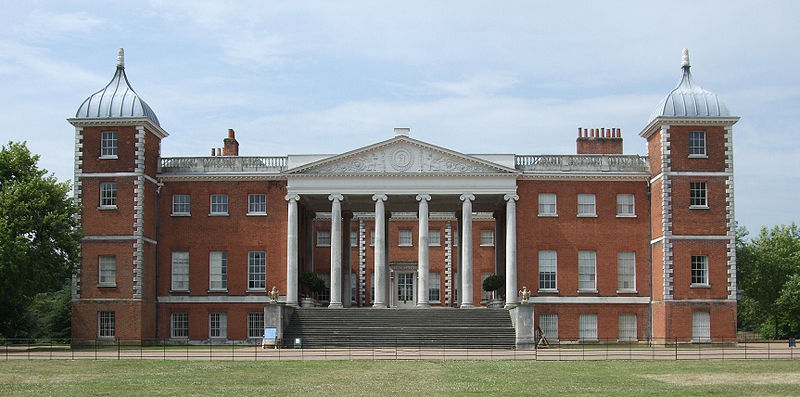
The Magnificent Osterley Park, Backdrop for TV, Film, and Literature

800px-Osterley_Park_House,_London-25June2009-rc Osterley Park is a mansion set in a large park of the same name. It is in the London Borough of Hounslow, part of the western suburbs of London. When the house was built it was surrounded by rural countryside. It was one of a group of large houses close to London, which served as country retreats for wealthy families, but were not true country houses on large agricultural estates. Other surviving country retreats of this type near London include Syon House and Chiswick House. The park is one of the largest open spaces in west London, though it is marred by the presence of the M4 motorway, which cuts across the middle of it.

Elizabethan
The original building on this site was a manor house built in the 1570s for banker Sir Thomas Gresham, who purchased the manor of Osterley in 1562. The “faire and stately brick house” was complete in 1576. It is known that Queen Elizabeth visited. The stable block from this period remains at Osterley Park. Gresham was so wealthy he also bought the neighbouring Manor of Boston in 1572. His widowed stepdaughter-in-law built the present Jacobean manor house there, which still stands to this day.

Child and Adam
Two hundred years later, the manor house was falling into disrepair, when, as the result of a mortgage default, it came into the ownership of Sir Francis Child, the head of Child’s Bank. In 1761 he employed Robert Adam, who was just emerging as one of the most fashionable architects in England, to remodel the house. When Sir Francis died in 1763, the project was taken up by his brother and heir Robert Child, for whom the interiors were created.

The house is of red brick with white stone details and is approximately square, with turrets in the four corners. Adam’s design, which incorporates some of the earlier structure, is highly unusual, and differs greatly in style from the original construction. One side is left almost open and is spanned by an Ionic pedimented screen which is approached by a broad flight of steps and leads to a central courtyard, which is at piano nobile level.

Adam’s neoclassical interiors are among his most notable sequences of rooms. Horace Walpole sarcastically described the drawing room as “worthy of Eve before the fall.” The rooms are characterised by elaborate, but restrained plasterwork, rich, highly varied colour schemes, and a degree of coordination between decor and furnishings unusual in English neoclassical interiors. Notable rooms include the entrance hall, which has large semi-circular alcoves at each end, and the Etruscan dressing room, which Adam said was inspired by the Etruscan vases in Sir William Hamilton’s collection, illustrations of which had recently been published. Adam also designed some of the furniture, including the opulent domed state bed, still in the house.

After Child
Robert Child’s only daughter, Sarah Anne Child, married John Fane, 10th Earl of Westmorland in 1782. When Child died two months later, his will placed his vast holdings, including Osterley, in trust for his eldest granddaughter, Lady Sarah Sophia Fane, who was born in 1785. She married George Child-Villiers, 5th Earl of Jersey, and thus Osterley passed into the Jersey family.

Home Guard Training Establishment
The grounds of Osterley Park were used for the training of the first members of the Local Defence Volunteers (forerunners of the Home Guard) when the 9th Earl, a friend of publisher Lord Hulton, allowed writer and military journalist Captain Tom Wintringham to establish the first Home Guard training school (which Hulton sponsored) at the park in May/June 1940, teaching the theory and practice of modern mechanical warfare, guerilla warfare techniques, and using the estate workers’ homes, then scheduled for demolition, to teach street fighting techniques.

The painter Roland Penrose taught camouflage techniques here, attempting to disguise the obvious charms of a naked Lee Miller. Maj. Wilfred Vernon taught the art of mixing home made explosives, and his explosives store can still be seen at the rear of the house, while Canadian Bert “Yank” Levy, who had served under Wintringham in the Spanish Civil War, taught knife fighting and hand-to-hand combat. Despite winning world fame in newsreels and newspaper articles around the world (particularly in the US), the school was disapproved of by the War Office and Winston Churchill, and was taken over in September 1940 and closed in 1941, the staff and courses reallocated to other newly opened WO approved Home Guard schools.

Postwar History
In 1947, a Ministry of Works team, including architect E.T. Spashett, converted the building for use as a convalescence home for injured airmen. George Child-Villiers, 9th Earl of Jersey gave the house and much of the estate to the National Trust in 1949. It is now open to the public, and contains most of the original furniture in excellent condition.

In Popular Culture
Television
***Osterley Park was originally proposed as the setting (and location) for the 1973 Doctor Who serial Day of the Daleks. The name was changed to “Auderley” in the finished programme, and was renamed “Austerley” in the novel of the serial. The location eventually used was Dropmore Park in Buckinghamshire.
***The entrance hall of the house also appeared as a room in an upmarket central London hotel in the denouement of the 2007 ITV adaptation of At Bertram’s Hotel.
***Osterley Park was used as the home of billionaire Sir Peter Maxwell, for the 2006 TV pilot, ‘Maxwell: Inside the Empire.’
***Chucklevision was also filmed in Osterley Park.
***The house featured in an episode of 1970s cult series The Persuaders, which starred Roger Moore and Tony Curtis.
***Many of the Horrible Histories (2009 TV series) episodes were filmed in Osterley House and Gardens.

Film
***The 1960 film The Grass Is Greener, starring Cary Grant, Deborah Kerr, and Robert Mitchum, was set and partly shot at Osterley Park House.
***The 2001 film Kabhi Khushi Kabhie Gham…, starring Shah Rukh Khan and Kajol, the garden reunion scene.
***Osterley Park has been used for Buckingham Palace scenes, including Victoria’s sitting room and anteroom, in the 2009 film The Young Victoria starring Emily Blunt and Rupert Friend.
***The 1984 film Top Secret!, starring Val Kilmer and Omar Sharif, features Osterley as East Berlin Town Hall, when the various cultural ambassadors are presented with medals by the East German Women’s Olympic Team.
***In the 2012 Batman film The Dark Knight Rises, the interior of Osterley Park mansion is used as a double for Wayne Manor.

Literature
***Osterley Park features in John Banville’s novel The Untouchable.

Posted in British history, Georgian Era, Jane Austen, legends and myths, Living in the Regency, real life tales, Regency era, Scotland, Uncategorized, Victorian era | Tagged , | Comments Off on The Magnificent Osterley Park, Backdrop for TV, Film, and Literature

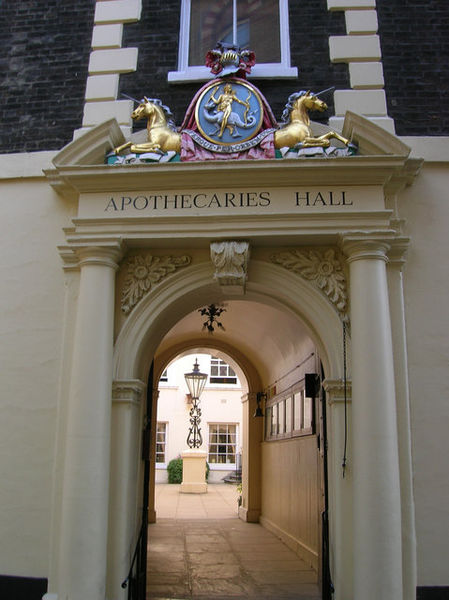
Worship Society of Apothecaries

Apothecaries' Hall Black Friars Lane, London

Apothecaries’ Hall
Black Friars Lane, London

The Worshipful Society of Apothecaries of London is one of the livery companies of the City of London. It is one of the largest livery companies (with over 1,600 members in 2012) and ranks 58th in their order of precedence.

The society is a member of the London Museums of Health & Medicine and its guild church is the Church of St Andrew-by-the-Wardrobe. The society’s modern roles include educational, social, ceremonial and charitable activities, in addition to supporting the City of London, its governance and the Lord Mayor of the City of London.

Prior to the foundation of the society in 1617, London apothecaries were in the Grocers’ Company (founded 1345), and before that they were members of the Guild of Pepperers (founded before 1180).

Having sought autonomy for many years, the apothecaries finally separated from the Grocers’ Company in 1617 when they were granted a Royal Charter by James I. During the remainder of the 17th Century its members (including Nicholas Culpeper) challenged the College of Physicians members’ monopoly of practising medicine. In 1704, the House of Lords overturned a ruling of the Queen’s Bench in the “Rose Case,” which effectively gave apothecaries the right to practice medicine, meaning that apothecaries may be viewed as forerunners of present-day general (medical) practitioners or family physicians.

The Apothecaries Act 1815 granted the society the power to licence and regulate medical practitioners throughout England and Wales. The society retained this role as a member of the United Examining Board until 1999; the society was capable of licensing doctors until 2008, but did not do so since the dissolution of the United Examining Board.

Notable people who qualified in medicine as a Licentiate of the Society (LSA) include John Keats (1816), Elizabeth Garrett Anderson (1865, thereby becoming the first openly female recipient of a UK medical qualification) and Ronald Ross (1881).

Motto and arms
Described in the society’s Grant of Arms of 1617 as “the inventor of physic” [i.e. medicine], Apollo is depicted in the coat of arms overcoming pestilence which is represented heraldically by a wyvern.

The society motto is Opiferque Per Orbem Dicor, a Latin part-quotation from Ovid referring to the Greek deity Apollo, meaning: “and throughout the world I am called the bringer of help.” The full quotation, from the first book of Metamorphoses (Daphne and Apollo), puts the motto in context and makes it particularly relevant to apothecaries:
Inventum medicina meum est, opiferque per orbem dicor, et herbarum subiecta potentia nobis. Hei mihi, quod nullis amor est medicabilis herbis; nec prosunt domino, quae prosunt omnibus, artes!
(Medicine is my invention, throughout the world I am called the bringer of help, and the power of herbs is under my control [but] alas for me, love cannot be cured by herbs, and the skills which help everyone else do not benefit their master.)

The society’s crest is a rhinoceros, and the supporters are golden unicorns.

Unusually, the illustration in the original grant of arms accords the Society the helmet of a Peer (noble), and the text specifies the red/white mantling usually associated with a Peer. The use of the term ‘Society’ rather than the usual ‘Company’ is traditional, though – the grant itself uses both terms, as do grants to other City companies.

Shield and Crest of the Apothecaries over the south gate of the Chelsea Physic Garden

Shield and Crest of the Apothecaries
over the south gate of the Chelsea Physic Garden

Chelsea Physic Garden
The Society of Apothecaries is perhaps best known generally for its foundation in 1673 of the Chelsea Physic Garden, London, one of Europe’s oldest botanical gardens and the second oldest in Britain. After Sir Hans Sloane granted the society rights to the manor of Chelsea, the four-acre (16,000 m²) garden became the richest collection of medicinal plants in Europe under the direction of Philip Miller. Its seed exchange programme, originally initiated with the Leiden Botanical Garden, led to cotton being planted for the first time in the Colony of Georgia.

Jealously guarded during the Society’s tenure, in 1983 the garden became a charity and opened to the public for the first time.

Education – History and Qualifications
In addition to providing qualifications in, and regulation of, the trade of the apothecary and dispensing, the Apothecaries’ Society offered primary medical qualifications until 1999. This began with the 1815 Medical Act, followed by further Acts of Parliament. The title of the original licence was Licentiate of the Society of Apothecaries (LSA). When the General Medical Council was established by statute in 1858, the LSA became a registrable qualification. From 1885, the examination included surgery, obstetrics and gynaecology, which were required by law following the Medical Act of 1886, and in 1907 the title was altered by parliamentary act to LMSSA to reflect this. The society ceased to be recognised by the General Medical Council as a provider of primary medical qualifications in 2008, although it had not issued any licences as a member of the United Examining Board since 1999.

Since 1928, when the Society instituted the first postgraduate qualification in Midwifery (the Mastery of Midwifery, MMSA), the Apothecaries have pioneered 15 further such diplomas in specialist subjects not offered by the Universities, Medical Royal Colleges or any other medical body.

The Apothecaries currently award postgraduate diplomas in the following fields (with their year of establishment):
Medical jurisprudence (1962)
History of medicine (1970)
GenitoUrinary medicine (1973)
Philosophy of medicine (1978)
Medical care of catastrophes (1994)
Forensic medical sciences (1998)
HIV medicine (2002)
Forensic and clinical aspects of sexual assault (2009)

In addition to this professional qualifications role, the present-day society also sponsors lecturers at UK Medical Schools, and organises courses and public lectures through two faculties: the ‘Faculty of the History and Philosophy of Medicine and Pharmacy’ and the ‘Faculty of Conflict and Catastrophe Medicine.’

Apothecaries’ Hall

Apothecaries' Hall courtyard in 1831

Apothecaries’ Hall courtyard in 1831

The society is based at Apothecaries’ Hall in Blackfriars. The building, originally part of the Dominican priory of Black Friars, was called Cobham House prior to its purchase by the society in 1632.

The original building was destroyed in the Great Fire of London in 1666. A new hall was built on the same site and completed in 1672 to the design of Edward Jerman; an “Elaboratory” was included at this time for the first ever large-scale manufacture of drugs. From then until 1922, the Society manufactured medicinal and pharmaceutical products at their Hall, and sold some of their products from a retail outlet opening onto Water Lane (now Blackfriars Lane). Much of the manufactured drugs were to supply clients of the Society which included the Navy, the Army, the East India Company and the Crown Colonies.

A major restoration and (external) building programme was carried out in the 1780s. Although the hall underwent further redevelopment in the 1980s, its appearance has altered little since the late-eighteenth century.

Apothecaries’ Hall is the oldest extant livery hall in the City of London, with the first-floor structure and arrangement of the Great Hall, Court Room and Parlour remaining as rebuilt between 1668 and 1670.

Members and Structure
At least 85% of the membership of the society are required to be medical practitioners. In fact, the membership is predominantly made up of prominent physicians (rather than surgeons who, for historical reasons, are more likely to be members of the Barbers’ Company).

The members of the society are (in descending rank):
The Master
Two Wardens (The “Senior Warden” and “Junior Warden”)
21 Assistants (and a small number of Assistants emeriti)
Liverymen (Full members of the society, all of whom are Freemen of the City of London. Liverymen of the society are in two classes, “guardant” and “couchant”)
Freemen of the society (most of whom are “Yeomen”)
Apprentices (not technically members of the society)

The Master, Wardens and Assistants together constitute the “Court,” which is the governing body of the society.

Members of the Court wear dark-blue gowns with gold facings. The Master and Wardens have chains of office and particular traditional robes – the Master’s trimmed with musquash, the wardens’ trimmed with fitch. Liverymen are “clothed” upon attaining that rank (modernly with a solicitor’s-type black robe and a blue/cream epitoge).

The society’s only truly academic dress were:
for the Master of Midwifery qualification (MMSA – ceased in 1963), a light-blue lambskin-faced robe with an blue/white epitoge
a dark-blue gown with blue/gold facings for the Licentiate (LMSSA)

The chief operating officer of the society is its Clerk and the hall is managed by the Beadle.
The Clerk wears a black solicitor’s gown trimmed with blue ribbons, and the Beadle’s robe is decorated with miniature hanging rosettes.

Other roles in the society include the Dean (a senior member who oversees the educational functions) and the Registrar (who directs the examinations’ department).

Posted in British history, Georgian Era, Living in the Regency, real life tales, Regency era, Victorian era | Tagged , , | Comments Off on Worship Society of Apothecaries

Guildhall, London’s Ceremonial and Administrative Center

Guildhall

Guildhall

Guildhall is a building in the City of London, off Gresham and Basinghall streets, in the wards of Bassishaw and Cheap. It has been used as a town hall for several hundred years, and is still the ceremonial and administrative centre of the City of London and its Corporation. The term Guildhall refers both to the whole building and to its main room, which is a medieval-style great hall. Guildhall complex houses the offices of the City of London Corporation and various public facilities. The building is traditionally referred to as Guildhall never “the” Guildhall.

Guildhall should not be confused with London City Hall, which is the administrative centre for Greater London, of which the City of London is only a geographically small part.
The nearest London Underground stations are Bank, St Paul’s and Moorgate.

Roman, Saxon and Medieval
The great hall is believed to be on a site of an earlier Guildhall (one possible derivation for the word ‘guildhall’ is the Anglo-Saxon ‘gild’, meaning payment, with a “gild-hall” being where citizens would pay their taxes). During the Roman period, it was the site of an amphitheatre, the largest in Britannia, partial remains of which are on public display in the basement of Guildhall Art Gallery and the outline of whose arena is marked with a black circle on the paving of the courtyard in front of the hall. Indeed, the siting of the Saxon Guildhall here was probably due to the amphitheatre’s remains. Excavations by MOLAS in 2000 at the entrance to Guildhall Yard exposed remains of the great 13th-century gatehouse built directly over the southern entrance to the Roman amphitheatre, which raises the possibility that enough of the Roman structure survived to influence the siting not only of the gatehouse and Guildhall itself but also of the church of St Lawrence Jewry whose strange alignment may shadow the elliptical form of the amphitheatre beneath. The first documentary reference to a London Guildhall is dated 1128 and the current hall’s west crypt may be part of a late-13th century building. Legendary British history made Guildhall’s site the site of the palace of Brutus of Troy.

1441–present
The current building was begun in c. 1411, and it is the only stone building not belonging to the Church to have survived the Great Fire of London in 1666. The complex contains several other historic interiors besides the hall, including the large medieval crypts, the old library, and the print room, all of which are now used as function rooms.

Trials in this hall have included those of Anne Askew (Protestant martyr), Henry Howard, Earl of Surrey, Sir Nicholas Throckmorton, Lady Jane Grey, Guildford Dudley, Thomas Cranmer, Henry Peckham, John Daniel, John Felton (Catholic), Roderigo Lopez, Henry Garnet (in connection with the Gunpowder Plot), Sir Gervase Helwys (in connection with the Overbury plot) and it contains memorials to Pitt the Elder, Pitt the Younger, Admiral Lord Nelson, the Duke of Wellington, William Beckford, and Winston Churchill. It also played a part in Jack Cade’s 1450 rebellion. On 16 November 1848 the pianist Frédéric Chopin made his last public appearance on a concert platform here.

The Great Hall did not completely escape damage in 1666; it was partially restored – with a flat roof – in 1670. The present grand entrance (the east wing of the south front), in “Hindoostani Gothic,” was added in 1788 by George Dance (and restored in 1910). A more extensive restoration than that in 1670 was completed in 1866 by City of London architect Sir Horace Jones, who added a new timber roof in close keeping with the original. This replacement was destroyed during The Second Great Fire of London on the night of 29/30 December 1940, the result of a Luftwaffe fire-raid. It was replaced in 1954 during works designed by Sir Giles Gilbert Scott.

Present
The day-to-day administration of the City of London Corporation is now conducted from modern buildings immediately to the north of Guildhall, but Guildhall itself and the adjacent historic interiors are still used for official functions, and it is open to the public during the annual London Open House weekend. Guildhall Art Gallery was added to the complex in the 1990s. The Clockmakers’ Museum and Guildhall Library, a public reference library with specialist collections on London, which include material from the 11th century onwards, are also housed in the complex.
The marathon route of the 2012 Summer Olympics passed through Guildhall Yard.

Gog and Magog
Two giants, Gog and Magog, are associated with Guildhall. Legend has it that the two giants were defeated by Brutus and chained to the gates of his palace on the site of Guildhall. Carvings of Gog and Magog are kept in Guildhall and 7 foot high wicker effigies of them donated by the Worshipful Company of Basketmakers in 2007 lead the procession in the annual Lord Mayor’s Show.

An early version of Gog and Magog were destroyed in Guildhall during the Great Fire of London. They were replaced in 1708 by a large pair of wooden statues carved by Captain Richard Saunders. These giants, on whom the current versions are based, lasted for over two hundred years before they were destroyed in the Blitz. They, in turn, were replaced by a new pair carved by David Evans in 1953 and given to the City of London by Alderman Sir George Wilkinson, who had been Lord Mayor in 1940 at the time of the destruction of the previous versions.

Functions
Guildhall hosts many events throughout the year, the most notable one being the Lord Mayor’s Banquet, which is held in honour of the immediate-past Lord Mayor and is the first to be hosted by the new Lord Mayor of the City of London. In keeping with tradition, it is at this Banquet that the Prime Minister makes a major World Affairs speech. One of the last acts of the outgoing Lord Mayor is to present prizes at the City of London School prize day at the Guildhall. Other events include those of various law firms, award evenings for the Wine and Spirit Education Trust (WSET), and the famous banquet for the International Wine and Spirit Competition (IWSC). The Worshipful Company of Carmen holds its Cart-Marking ceremony in the courtyard each July.

The Guildhall complex in c.1805. The buildings on the right and left have not survived.

The Guildhall complex in c.1805. The buildings on the right and left have not survived.

Posted in British history, Georgian Era, Living in the Regency, real life tales, Regency era, Victorian era | Tagged , | Comments Off on Guildhall, London’s Ceremonial and Administrative Center

London’s Livery Companies

Grocers' Hall, Prince's Street Grocers' Hall is the home of the Worshipful Company of Grocers, which ranks second of the City Livery Companies and was originally known as The Guild of Pepperers. Their earliest records date from the year 1180. Grocer's Hall is hidden in a court off Prince's St, and is easy to miss, as larger buildings surround it and entry to this court is through alleys under these buildings. The current building is the 5th Grocers' Hall and was completed in 1970 to replace the previous building which was destroyed by fire on 22nd Sept 1965. See the Grocers Company website http://www.grocershall.co.uk/

Grocers’ Hall, Prince’s Street Grocers’ Hall is the home of the Worshipful Company of Grocers, which ranks second of the City Livery Companies and was originally known as The Guild of Pepperers. Their earliest records date from the year 1180.
Grocer’s Hall is hidden in a court off Prince’s St, and is easy to miss, as larger buildings surround it and entry to this court is through alleys under these buildings. The current building is the 5th Grocers’ Hall and was completed in 1970 to replace the previous building which was destroyed by fire on 22nd Sept 1965.
See the Grocers Company website http://www.grocershall.co.uk/

The Livery Companies of the City of London are various historic trade associations almost all of which are known as the “Worshipful Company of…” their relevant trade, craft or profession. The medieval Companies originally developed as guilds and were responsible for the regulation of their trades, controlling, for instance, wages and labour conditions. Until the Protestant Reformation, they were closely associated with religious activities, notably in support of chantry chapels and churches and the observance of ceremonies, notably the mystery plays.

Some of the Livery Companies continue to have a professional role today: for example, the Scriveners’ Company admits senior members to that profession, the Apothecaries’ Company awards post-graduate qualifications in some medical specialties, and the Hackney Carriage Drivers’ Company comprises licensed London taxicab drivers who have learnt the “knowledge of London.” Other Companies have become purely charitable foundations, such as the Longbow Makers’ Company.

The active Companies, which currently number 108, play an important part in social life and networking in the City and have a long and proud history of cultural and education patronage. They retain voting rights for the City of London Corporation, the local authority with extensive local government powers.

After the Worshipful Company of Carmen was accepted in 1746, no new Companies were formed for over 100 years until the Master Mariners in 1926 (granted livery in 1932). Post-1926 Companies are often called modern Livery Companies.

Formed in 1999, the Security Professionals’ Company became the 108th Livery Company on 19 February 2008 when the Court of Aldermen approved their petition for livery. Two bodies, the Worshipful Company of Parish Clerks and the Company of Watermen and Lightermen, are recognised as City companies but without the grant of livery for historical reasons; three further guilds (the Company of Educators; Public Relations Practitioners; and, the Company of Arts Scholars) aim to obtain a grant of livery.

Governance
Livery Companies are governed by a Master (known in some Companies as the Prime Warden or Bailiff), a number of Wardens (who may be known as the Upper, Middle, Lower, or Renter Wardens), and a Court of Assistants, which elects the Master and Wardens. The chief operating officer of the Company is known as the Clerk.

Vinters' Hall is the home of the Worshipful Company of Vintners, 11th in the order of precedence.

Vinters’ Hall is the home of the Worshipful Company of Vintners, 11th in the order of precedence.

Members generally fall into two categories: freemen and liverymen. One may become a freeman, or acquire the “freedom of the company,” upon fulfilling the Company’s criteria: traditionally, one may be admitted by “patrimony,” if either parent was a liveryman of the Company; by “servitude,” if one has served the requisite number of years as an apprentice to the Company; or by “redemption,” by paying a fee. The Company may also vote to admit individuals as honorary freemen. Freemen are generally entitled to advance to becoming liverymen by a vote of the court of the Company. Only liverymen can take part in the election of the Lord Mayor, the Sheriffs, and the other traditional officers of the City.

Livery Halls
Many Companies still operate a livery hall where members and their guests can be entertained and Company business transacted. Among the earliest Companies known to have had halls are the Merchant Taylors and Goldsmiths in the 14th Century, but neither theirs nor any other Companies’ original halls remain: the few that survived the Great Fire of London were destroyed in the Blitz of the Second World War.

Today, 39 out of the 108 livery companies have halls in London, in addition to that of the Watermen and Lightermen, which is not strictly a livery hall but in regular use. Most are commonly available for business and social functions, such as weddings, commercial and society meetings, luncheons and dinners. The oldest hall now extant is that of the Worshipful Society of Apothecaries, dating from 1672. Several companies that do not have their own hall share office premises within a hall of another company on a semi-permanent basis, and examples are the Spectacle Makers’ Company, which uses part of Apothecaries’ Hall, and the Shipwrights, which co-habit with the Ironmongers. Three Livery Companies (the Glaziers and Painters of Glass, Launderers, and Scientific Instrument Makers) share a hall in Southwark, just south of but outside of the City of London, while the Worshipful Company of Gunmakers is based at Proof House, in the London Borough of Tower Hamlets and the Master Mariners’ ‘hall’ is an historical ship, HQS Wellington, moored in the Thames and shared with the Scriveners Company. Companies without their own hall will customarily book use of another hall for their formal livery functions, thus giving their members the opportunity to visit and appreciate a large number of livery halls by rotation. Many Blue Plaques in the City of London indicate where a number of companies used to have halls. However, whilst several livery companies may aspire to eventually owning, or again owning, their own hall it is appreciated that any increase in the overall number of livery halls would inevitably lead to some dilution of use of the existing halls. There is also some attraction in belonging to a company which is peripatetic.

The Worshipful Company of Fishmongers, whose hall is pictured, ranks fourth in the order of precedence of 1515.

The Worshipful Company of Fishmongers, whose hall is pictured, ranks fourth in the order of precedence of 1515.

Precedence
In 1515, the Court of Aldermen of the City of London settled an order of precedence for the 48 Livery Companies then in existence, which was based on the Companies’ economic or political power. The first 12 Companies are known as the Great Twelve City Livery Companies. There are now 108 Companies, with modern Companies ranked by seniority.

The Merchant Taylors and the Skinners have always disputed their precedence, so once a year (at Easter) they exchange sixth and seventh place in the order. This alternation is one of the theories for the origin of the phrase “at sixes and sevens,” as the master of the Merchant Taylors has asserted a number of times, although the first use of the phrase may have been before the Taylors and the Skinners decided to alternate their position. The dispute is due to their both receiving their charters in 1327, but there is no proof as to which was the first.

List of Companies in Order of Precedence
The Worshipful Company of Gunmakers, which is positioned 73rd in the order of precedence, has been based at Proof House for over 300 years.
The Worshipful Company of Mercers (general merchants)
The Worshipful Company of Grocers
The Worshipful Company of Drapers (wool and cloth merchants)
The Worshipful Company of Fishmongers
The Worshipful Company of Goldsmiths
The Worshipful Company of Skinners* (fur traders)
The Worshipful Company of Merchant Taylors* (tailors)
The Worshipful Company of Haberdashers (traders of sewing articles)
The Worshipful Company of Salters (traders of salts and chemicals)
The Worshipful Company of Ironmongers
The Worshipful Company of Vintners (wine merchants)
The Worshipful Company of Clothworkers
The Worshipful Company of Dyers
The Worshipful Company of Brewers
The Worshipful Company of Leathersellers
The Worshipful Company of Pewterers
The Worshipful Company of Barbers (and surgeons and dentists)
The Worshipful Company of Cutlers (knife, sword and cutlery makers)
The Worshipful Company of Bakers
The Worshipful Company of Wax Chandlers (wax candle makers)
The Worshipful Company of Tallow Chandlers (tallow candle makers)
The Worshipful Company of Armourers and Brasiers (armour makers and brass workers)
The Worshipful Company of Girdlers (swordbelt and dressbelt makers)
The Worshipful Company of Butchers
The Worshipful Company of Saddlers
The Worshipful Company of Carpenters
The Worshipful Company of Cordwainers (fine leather workers)
The Worshipful Company of Painter-Stainers
The Worshipful Company of Curriers (tanned leather dressers)
The Worshipful Company of Masons
The Worshipful Company of Plumbers
The Worshipful Company of Innholders
The Worshipful Company of Founders (brass and bronze workers)
The Worshipful Company of Poulters
The Worshipful Company of Cooks
The Worshipful Company of Coopers (barrel makers)
The Worshipful Company of Tylers and Bricklayers
The Worshipful Company of Bowyers (long bow makers)
The Worshipful Company of Fletchers (arrow makers)
The Worshipful Company of Blacksmiths
The Worshipful Company of Joiners and Ceilers (wood craftsmen)
The Worshipful Company of Weavers, the most ancient Company
The Worshipful Company of Woolmen
The Worshipful Company of Scriveners (court document writers and notaries public)
The Worshipful Company of Fruiterers
The Worshipful Company of Plaisterers (plasterers)
The Worshipful Company of Stationers and Newspaper Makers
The Worshipful Company of Broderers (embroiderers)
The Worshipful Company of Upholders (upholsterers)
The Worshipful Company of Musicians
The Worshipful Company of Turners (lathe operators)
The Worshipful Company of Basketmakers
The Worshipful Company of Glaziers and Painters of Glass
The Worshipful Company of Horners (horn workers and plastic)
The Worshipful Company of Farriers (horseshoe makers and horse veterinarians)
The Worshipful Company of Paviors (road and highway pavers)
The Worshipful Company of Loriners (harness makers)
The Worshipful Society of Apothecaries (medical practitioners and pharmacists)
The Worshipful Company of Shipwrights
The Worshipful Company of Spectacle Makers
The Worshipful Company of Clockmakers
The Worshipful Company of Glovers
The Worshipful Company of Feltmakers (hat makers)
The Worshipful Company of Framework Knitters
The Worshipful Company of Needlemakers
The Worshipful Company of Gardeners
The Worshipful Company of Tin Plate Workers
The Worshipful Company of Wheelwrights
The Worshipful Company of Distillers
The Worshipful Company of Pattenmakers (wooden shoe makers)
The Worshipful Company of Glass Sellers
The Worshipful Company of Coachmakers and Coach Harness Makers
The Worshipful Company of Gunmakers
The Worshipful Company of Gold and Silver Wyre Drawers (makers of thread for uniforms)
The Worshipful Company of Makers of Playing Cards
The Worshipful Company of Fanmakers
The Worshipful Company of Carmen
The Honourable Company of Master Mariners, the first of the 20th-century Companies
The City of London Solicitors’ Company
The Worshipful Company of Farmers
The Guild of Air Pilots and Air Navigators
The Worshipful Company of Tobacco Pipe Makers and Tobacco Blenders
The Worshipful Company of Furniture Makers
The Worshipful Company of Scientific Instrument Makers
The Worshipful Company of Chartered Surveyors
The Worshipful Company of Chartered Accountants in England and Wales
The Worshipful Company of Chartered Secretaries and Administrators
The Worshipful Company of Builders Merchants
The Worshipful Company of Launderers
The Worshipful Company of Marketors
The Worshipful Company of Actuaries
The Worshipful Company of Insurers
The Worshipful Company of Arbitrators
The Worshipful Company of Engineers
The Worshipful Company of Fuellers
The Worshipful Company of Lightmongers
The Worshipful Company of Environmental Cleaners
The Worshipful Company of Chartered Architects
The Worshipful Company of Constructors
The Worshipful Company of Information Technologists
The Worshipful Company of World Traders
The Worshipful Company of Water Conservators
The Worshipful Company of Firefighters
The Worshipful Company of Hackney Carriage Drivers (licensed London taxicab drivers)
The Worshipful Company of Management Consultants
The Worshipful Company of International Bankers
The Worshipful Company of Tax Advisers
The Worshipful Company of Security Professionals
Note: *The Skinners’ and Merchant Taylors’ Companies alternate position once per year.

City Companies without Grant of Livery
The Worshipful Company of Parish Clerks
The Company of Watermen and Lightermen
Neither of these companies intends ever to apply for livery; this is a long-standing tradition. The Company of Watermen and Lightermen was established by Act of Parliament in 1555 to control the watermen on the River Thames responsible for the movement of goods and passengers and remains the only ancient City Guild to be formed and controlled by Act of Parliament.

A guild which is recognised by the Court of Aldermen as a ‘London Guild’ applies to the Court to become ‘A Company without Livery.’ After a term of years the company applies to the Court for livery status, at which point it adopts the name “Worshipful Company of … ”

Other Guilds Aiming to Obtain a Grant of Livery
The Guild of Public Relations Practitioners
The Company of Arts Scholars
The Company of Educators
Neither the ‘City Livery Club’ nor ‘The Guild of Freemen of the City of London’ is recognised as a ‘guild’ by the City; they are merely social clubs. The three City of London Manors in Southwark (Guildable, King’s and Great Liberty) are manorial courts and their associations of Jurors and are not guilds, but are legally institutionalised under the Administration of Justice Act 1977.

Posted in British history, Georgian Era, Living in the Regency, real life tales, Regency era, Victorian era | Tagged , , | 4 Comments